FISA Bill Challenged in Court

President Bush, in the Rose Garden on Wednesday, called the wiretapping bill “long overdue” and crucial to national security. Photo by Brendan Smialowski / NYT.

Bush Signs Spy Bill, ACLU Sues
By Ryan Singel / July 10, 2008

The American Civil Liberties Union filed suit Thursday over a controversial wiretapping law, challenging the constitutionality of the expanded spy powers Congress granted to the president on Wednesday.

The federal lawsuit was filed with the court just hours after Bush signed the bill into law.

The ACLU is suing on behalf of journalist and human rights groups, asking the court put a halt to Congress’s legalization of Bush’s formerly secret warrantless wiretapping program. The ACLU contends (.pdf) the expanded spying power violates the Constitution’s prohibition on unreasonable searches and seizures.

On Wednesday, the Senate gave final congressional approval to a massive expansion of the Foreign Intelligence Surveillance Act, finishing a year of debate over how far the U.S. government should be able to conduct blanket surveillance using telecom facilities inside the United States.

In passing the FISA Amendments Act, Congress gave the executive branch the power to order Google, AT&T and Yahoo to forward to the government all e-mails, phone calls and text messages where one party to the conversation is thought to be overseas. President Bush signed the bill into law Thursday morning, describing it as a bill that “protect[s] the liberties of our citizens while maintaining the vital flow of intelligence.”

The ACLU contends those blanket powers to grab international communications of Americans without specific court orders violate the Fourth Amendment and would stymie journalists who often speak to confidential sources outside the country.

Plaintiff Naomi Klein, the liberal columnist and author, said the surveillance would compromise her writing about international issues.

“If the U.S. government is given unchecked surveillance power to monitor reporters’ confidential sources, my ability to do this work will be seriously compromised,” Klein said.

Longtime foreign correspondent Christopher Hedges admits that surveillance is not a new obstacle for journalists, but says this goes a step too far.

“There is a lot of monitoring that goes on especially when you are overseas,” Hedges said. “But this creates a further erosion in my ability to work as a journalist.”

The suit, filed in the U.S. District Court for the Southern District of New York Thursday, asks the judge to stay the implementation of the new powers, until its constitutionality is determined.

The Electronic Frontier Foundation, which has spearheaded the still ongoing lawsuits against the nation’s telecoms, will challenge the provision of the bill that gives retroactive amnesty to telecoms that are being sued for helping the government spy on Americans without warrants.

They argue that Congress’s attempt to have citizen lawsuits dismissed violates the separation of powers.

But the San Francisco-based online rights group also announced in a fund-raising letter on Thursday that it would also challenge the constitutionality of the bill’s expanded spying powers.

“We are also preparing a new case against the government for its warrantless wiretapping, past, present and future,” said EFF senior staff attorney Kevin Bankston, who said the details were being withheld to keep the element of surprise.

“But suffice to say it will be quite different from the other cases against the government that have been filed so far,” Bankston said. “Like with our case against AT&T, however, the ultimate goal will be the same: to halt the mass interception of Americans’ communications and to dismantle the dragnet spying network that was first exposed by our witness, AT&T whistleblower Mark Klein.”

Source. / Wired.com

The Rag Blog
Posted in RagBlog | Tagged , , , , , , | Leave a comment

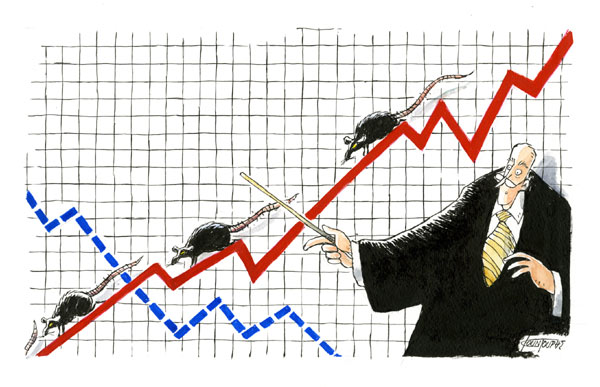
Drawn and Quartered

Michael Kountouris, Greece

The Rag Blog / Posted July 10, 2008

Posted in RagBlog | Tagged , , | Leave a comment

Friendly Skies Dept : Want Some Torture With Your Peanuts?


Airline bracelet id would double as stun device
By Jeffrey Denning

Just when you thought you’ve heard it all…

A senior government official with the U.S. Department of Homeland Security (DHS) has expressed great interest in a so-called safety bracelet that would serve as a stun device, similar to that of a police Taser®. According to the promotional video (view video below) found at the Lamperd Less Lethal, Inc. website, the bracelet would be worn by all airline passengers.

This bracelet would:

• Take the place of an airline boarding pass

• Contain personal information about the traveler

• Be able to monitor the whereabouts of each passenger and his/her luggage

• Shock the wearer on command, completely immobilizing him/her for several minutes

The Electronic ID Bracelet, as it’s referred to, would be worn by every traveler “until they disembark the flight at their destination.” Yes, you read that correctly. Every airline passenger would be tracked by a government-funded GPS, containing personal, private and confidential information, and would shock the customer worse than an electronic dog collar if the passenger got out of line.

Clearly the Electronic ID Bracelet is a euphemism for the EMD Safety Bracelet, or at least it has a nefarious hidden ability (thus the term ID Bracelet is ambiguous at best). EMD stands for Electro-Musclar Disruption. Again, according to the promotional video, the bracelet can completely immobilize the wearer for several minutes.

So is the government really that interested in this bracelet?

Apparently so.

According to this letter from DHS official, Paul S. Ruwaldt of the Science and Technology Directorate, office of Research and Development, which was written to the inventor whom he had previously met with, Ruwaldt wrote, “To make it clear, we [the federal government] are interested in . . . the immobilizing security bracelet, and look forward to receiving a written proposal.”

The letterhead, in case you were wondering, is from a U.S. Department of Homeland Security office at the William J. Hughes Technical Center at the Atlantic City International Airport, or the Federal Aviation Administration headquarters.

In another part of the letter, Mr. Ruwaldt confirmed, “It is conceivable to envision a use to improve air security, on passenger planes.”

Would every paying airline passenger flying on a commercial airplane be mandated to wear one of these devices? I cringe at the thought. Not only could it be used as a physical restraining device, but also as a method of interrogation, according to the same aforementioned letter from Mr. Ruwaldt.

Would you let them put one of those on your wrist? Would you allow the airline employees, which would be mandated by the government, to place such a bracelet on any member of your family?

Why are tax dollars being spent on something like this?

Is this a police state or is this America?

Source. / The Washington Times / Posted July 3, 2008

Promotional Video:
Govt-Issued Stun Bracelets for Airline Passengers

Thanks to Jim Baldauf / The Rag Blog

Posted in RagBlog | Tagged , , | Leave a comment

David Gray : Don’t Use My Music at Guantanamo


Singer-songwriter speaks out against music used in torture
By Andy Worthington

Singer-songwriter David Gray has taken a brave stand by complaining about the use of his music as torture by the US military in “War on Terror” prisons in Guantánamo, in Iraq, and in secret prisons run by the CIA.

On BBC Radio 4’s The World Tonight, singer-songwriter David Gray spoke out against the use of music as torture by the US military.

Gray’s chart-topping song Babylon, played repeatedly at ear-piercing volume, is one of dozens of songs, by artists including Eminem, Bruce Springsteen, Rage Against the Machine and Britney Spears, that has been used by the US military as part of a package of “enhanced interrogation techniques,” intended to “break” prisoners held without charge or trial in the “War on Terror” — in Guantánamo, in Iraq, and in secret prisons run by the CIA.

As the Guardian recently explained, the use of Babylon first came to light “after Haj Ali, the hooded man in the notorious Abu Ghraib photographs, told of being stripped, handcuffed and forced to listen to a looped sample of Babylon, at a volume so high he feared that his head would burst.”

Complaining that the only part of the torture music story that gets noticed is its “novelty aspect” — which he compared to “Guantánamo[‘s] Greatest Hits” — Gray delivered a powerful indictment of the misappropriation of his and other artists’ music.

“What we’re talking about here is people in a darkened room, physically inhibited by handcuffs, bags over their heads and music blaring at them for 24 hours a day, seven days a week,” he told the BBC. “That is torture. That is nothing but torture. It doesn’t matter what the music is — it could be Tchaikovsky’s finest or it could be Barney the Dinosaur. It really doesn’t matter, it’s going to drive you completely nuts.” He added, “No-one wants to even think about it or discuss the fact that we’ve gone above and beyond all legal process and we’re torturing people.”

This is the second time that Gray has spoken out about the use of music as torture. Two weeks ago, he explained, “The moral niceties of whether they’re using my song or not are totally irrelevant. We are thinking below the level of the people we’re supposed to oppose, and it goes against our entire history and everything we claim to represent. It’s disgusting, really. Anything that draws attention to the scale of the horror and how low we’ve sunk is a good thing.”

Reprieve, the legal action charity that represents over 30 prisoners at Guantánamo, recently launched an initiative, Pull the Plug on Torture Music, encouraging artists to sign up to prevent the use of their music as part of the US military’s torture techniques, to insert a clause in their contracts preventing the misuse of their music, and, in general, to raise awareness of the issue by spreading the word and playing anti-torture gigs.

Others who have signed up for Reprieve’s initiative include Massive Attack (who recently hosted a series of Reprieve events at their Meltdown festival at London’s Southbank Centre), Alabama 3, Elbow, the Magic Numbers, Seize the Day, and Tom Morello of Rage Against the Machine, who told Spin magazine in 2006, “The fact that our music has been co-opted in this barbaric way is really disgusting. If you’re at all familiar with ideological teachings of the band and its support for human rights, that’s really hard to stand.”

Whether you like David Gray’s music or not should be irrelevant. He understands what’s really going on with the use of music as torture, and he’s been brave enough to raise his head above the parapet, which is not something that musicians are always prepared to do.

Andy is the author of “The Guantánamo Files: The Stories of the 774 Detainees in America’s Illegal Prison” (published by Pluto Press/the University of Michigan Press).

Source. / DC Indymedia / Posted July 3, 2008

The Rag Blog

Posted in RagBlog | Tagged , , , , | 1 Comment

Julian E. Barnes :
No Surprise from the Most Murderous Nation

George Bush won't sign the ban on cluster bombs. Do the right thin sign the ban.

Activists decry new Pentagon policy on cluster bombs

By Julian E. Barnes | July 10, 2008

They say that taking 10 more years to eliminate the munitions with the highest failure rate for their bomblets ‘is completely inadequate from a humanitarian point of view.’

WASHINGTON — Human rights advocates Wednesday attacked a new Pentagon policy on cluster bombs, saying the military’s effort to build a safer version of the controversial weapon was misguided and likely to fail.

The three-page policy, formally released Wednesday, describes cluster bombs, which release tiny bomblets over a relatively wide area, as “legitimate weapons with clear military utility.”

But critics say the weapons have a high failure rate. Many bomblets may not explode on contact, and later can be accidentally triggered by civilians.

The new policy is designed to reduce the danger of unexploded bomblets by mandating that bombs with a “dud rate” higher than 1% will not be used after 2018. Until then, the use of a cluster bomb with a higher failure rate must be approved by regional commanders.

“For the U.S. to take another 10 years to eliminate the worst of the cluster munitions is completely inadequate from a humanitarian point of view,” said Bonnie Docherty, an arms researcher with Human Rights Watch.

In May, 111 nations, including Britain, endorsed an international ban on the use of cluster munitions. The move was a snub to the United States, Russia, China and Israel, which have opposed prohibitions on use of the munitions.

Each bomb contains several hundred smaller explosive devices, and the U.S. inventory includes a total of about 720 million of the bomblets. The Pentagon adopted a policy in 2005 banning acquisition of cluster bombs with a dud rate higher than 1%, but the inventory contains many munitions purchased before then.

The military has tried to find a weapon that can achieve a failure rate of 1% or lower, said Steve Goose, director of the arms division at Human Rights Watch. “There has been no production of cluster munitions because they cannot meet the standard in the cost range they want,” he said.

Human rights groups say that many have a failure rate of 16% or greater, and that even the improved weapons have had a higher failure rate on the battlefield.

“The military and manufacturers’ claims are one thing, and the reality of what happens in combat are another,” Goose said.

Air Force Lt. Col. Almarah K. Belk, a Pentagon spokeswoman, said certain situations may require the use of cluster bombs, citing as an example the presence of militants on the roof of a building occupied by civilians. A cluster bomb dropped on the roof could kill or injure the militants without destroying the building, she said.

“It is not pretty; nothing about war ever is,” Belk said. “It’s not always your first choice. . . . But the other alternatives aren’t good choices either. They would cause a lot more civilian injury, loss of life, a lot more infrastructure damage.”

Goose rejected that scenario, saying the use of a cluster bomb in a populated area should never be permitted.

“You can’t target one house. You will be littering the entire area with little land mines,” he said.

He said he was puzzled by the new policy because it is at odds with the push to use more precise low-yield weapons.

“It’s totally counter to the trend of being ever more concerned with collateral damage,” Goose said.

Source / Los Angeles Times

The Rag Blog

Posted in RagBlog | Tagged , | Leave a comment

Can’t Fall On Your Fannie Mae

Flowers grow in front of the headquarters of Fannie Mae in Washington. Photo by Ken Cedeno / Bloomberg News.

So lets see if I have things straight. The feds can’t just bail out Freddie and Fannie because that might cause the dollar to collapse. So they can’t do that.

But there is this $1.5 trillion in unprofitable real estate loans so the private investors are bailing out. So its time for the fed to swagger up to the stock market and use its 2.5 billion x 2 = $5 billion default cash accessible to reassure the market.

But the fed is financially out-gunned by a factor of three hundred to one in the cash it can currently use to reassure investors, who probably read the newspapers. So Paulson is begging Congress for bailout cash that could make Bear Stearns look small by comparison.

But whatever it takes, its still worth it because we’re trying to save the dollar, right?

Because if the dollar crashes, then oil might get so expensive we can’t afford to drive to work. Drive to work from the nice suburban homes that we financed with the Freddie and Fannie loans.

Roger Baker / The Rag Blog / July 10, 2008

Fannie, Freddie Are Too Big to Fail, Lawmakers Say
By Dawn Kopecki / July 10, 2008

Fannie Mae and Freddie Mac, the largest buyers of U.S. home loans, are too big for the government to let them fail, leading Republican and Democratic lawmakers said.

The government-chartered companies, which own or guarantee about half the $12 trillion of U.S. mortgages, can count on a federal lifeline, said Republican Senator John McCain, of Arizona, and Democratic Senator Charles Schumer, of New York.

The remarks by the presumptive Republican presidential candidate and the head of the congressional Joint Economic Committee followed a slide in the firms’ shares to the lowest level since 1991. They indicate Congress would push the administration to use government funds to prevent the companies from failing and threatening a deeper housing recession.

“They must not fail,” McCain said today during a campaign stop in Belleville, Michigan. Fannie Mae and Freddie Mac “are vital to Americans’ ability to own their own homes,” he said at an earlier stop in the state, one of the worst affected by the surge in foreclosures.

Central banks, pension funds and other investors hold $5.2 trillion in debt sold by the companies.

While bondholders can count on a backstop, equity investors can’t expect the government to halt a tumble in the companies’ shares, Representative Spencer Bachus, the senior Republican on the House Financial Services Committee, said today.

Fannie Mae slid 14 percent today to close at $13.20 in New York, down 67 percent this year. Freddie Mac declined 22 percent to close at $8, bringing its slump since the end of December to 77 percent.

`Continued Woes’

Stockholders should be prepared for more “difficulties,” said Kevin Flanagan, a fixed-income strategist in Purchase, New York, for Morgan Stanley’s individual investor clients. “Continued woes, continued difficulties are the expectation, and this is going to take a while to play itself out.”

Freddie Mac owed $5.2 billion more than its assets were worth in the first quarter, making it insolvent under fair-value accounting rules. The fair value of Fannie Mae assets fell 66 percent to $12.2 billion, data provided by the Washington-based company show, and may be negative next quarter, former St. Louis Federal Reserve President William Poole said.

“Markets should be assured that the federal government will stand by Fannie Mae and Freddie Mac,” Schumer said in a statement today. They “are too important to go under,” and Congress “will act quickly” if necessary, he said.

Central Role

Fed Chairman Ben S. Bernanke and Treasury Secretary Henry Paulson, while noting the central role of Fannie Mae and Freddie Mac in ending the mortgage-finance crisis, today refrained from endorsing any extra federal backing for the companies.

The companies “are playing a very important and vital role right now,” Paulson said in testimony to the House Financial Services Committee. They “need to continue to play an important role in the future,” he said.

Fannie Mae and Freddie Mac “are well capitalized now” in “a regulatory sense,” Bernanke told the panel. Still, the companies, like all financial institutions, need “to expand their capital bases so that they can be even more proactive in providing credit and support for the economy,” the Fed chief said.

The federal government can’t afford to take over all of Fannie Mae’s and Freddie Mac’s operations, because such a move would more than double federal government debt outstanding and “have disastrous consequences for the dollar,” said Joshua Rosner, an analyst with Graham Fisher & Co. Inc. in New York.

Limited Liability

Instead, the government could move the companies’ combined $1.5 trillion investment portfolios into a separate limited liability corporation that would gradually liquidate the assets, Rosner said. Fannie Mae and Freddie Mac would still be able to support the U.S. housing market by packaging home loans into securities they guarantee.

The U.S. Treasury, which analysts said would play a central role in any rescue of the firms, currently has the authority to buy $2.25 billion in each of the companies’ debt.

Congress created Fannie Mae during the Great Depression to revive the housing market and formed Freddie Mac in 1970. While a federal rescue is “premature,” Representative Paul Kanjorski said lawmakers should prepare for more trouble.

“I don’t think any of us could anticipate all the contingencies that can happen,” said Kanjorski, a Democrat from Pennsylvania. “We recognize that we’re in very dangerous waters, very stormy. We should have contingencies.”

Rescue Option

A rescue shouldn’t be an option, said Representative Jeb Hensarling, chairman of the fiscally conservative Republican Study Committee.

“The government should not be supporting the system as is,” said Hensarling, of Texas. Fannie Mae and Freddie Mac are a “government-sanctioned duopoly” that “no longer helps the market in the way that it once did” while posing “a huge systemic risk” to the economy.

In a sign that bondholder confidence is firm, the difference in yields between Fannie Mae’s 10-year notes and 10- year U.S. Treasury bonds narrowed by 2.2 basis points today from a four-month high of 89.9 basis points Monday. Freddie Mac’s yield narrowed 2 basis points relative to 10-year Treasuries from a four-month high Wednesday of 96 basis points.

The Office of Federal Housing Enterprise Oversight, the companies’ regulator, said today it deemed Fannie Mae and Freddie Mac “adequately capitalized.”

Investors should heed Ofheo’s comments, said House Financial Services Committee Chairman Barney Frank, a Massachusetts Democrat. “I would hope that people would not react to a sense of panic or whatever and would look at the reality and that we’ll be okay,” Frank told reporters.

Source. / Bloomberg

Posted in RagBlog | Tagged , , , , | Leave a comment

G8 : Determined to Kill Off the World’s Poor


The G8: Humanitarian Failure and Making the World Safe for Corporate Power
by Robert Weissman / July 10, 2008

It’s hard to dismiss the temptation to write off the G8 meetings as a meaningless talkfest.

On the other hand, when the political leaders of the most powerful countries get together and issue joint statements, it may be worth looking at what these planetary stewards have in mind. This is particularly true at a time when new global crises — skyrocketing oil prices, the spike in food prices, the impact of the U.S. recession and accelerating global warming — are added to ongoing public health disasters and persistent global poverty.

Is it too much to expect the G8 leaders (the political leaders of the United States, Japan, Canada, Britain, France, Germany, Italy and Russia) to offer something meaningful in response to these problems?

With the G8 meeting in Hokkaido, Japan just concluded, the answer apparently is, yes.

G8 failures seem to fall into two categories: first, promise to do too little, and then renege on commitments made; second, promote harmful policies and projects.

In the first category comes the G8’s statement on global public health. Following aggressive lobbying by public health groups, the G8 agreed to reiterate its commitment to provide universal treatment for HIV/AIDS. But the rich countries have not agreed to put the money on the table to achieve this objective. “The AIDS crisis in Africa is an emergency, and reaching universal access by 2010 will require a quadrupling of spending over current levels,” explains Masaki Inaba of the Africa Japan Forum. “A restating of existing commitments is not a sufficient response by the G8.”

The dominant public health need in the world’s poorest countries is to restore the public health systems decimated by decades of International Monetary Fund and World Bank “structural adjustment” programs. The G8 leaders said only that they aim to “work toward” poor countries achieving the World Health Organization (WHO) target of 2.3 professional health workers per 1,000 people. (By contrast, according to WHO data, the United States has about 31 health workers per 1,000 people, and 56 per 1,000 if you include the category of “health management and support workers.”)

Also in the first category is the pathetic G8 statement on climate change. Dragged down most of all by the anti-leadership of the United States, the G8 announced a commitment to a 50 percent reduction in carbon emissions by 2050. Well, a sort-of commitment.

The best science says the world needs at least an 80 percent reduction from 1990 emissions levels by 2050, and very likely more, so the G8 commitment is totally inadequate on its face.

But the G8 position is even more lame than it first appears. A statement from an environmental coalition including Friends of the Earth International explained the key flaws. “First, the G8 formula is a global cut,” not imposing particular responsibility on the rich, high carbon-polluting countries. Second, “the cut has no clear baseline. It was revealing that in announcing it, Japanese Prime Minister Yasuo Fukuda initially said it was from 1990 levels, then had to take back that statement and subsequently mentioned a 2000 baseline.” Third, the statement is not binding, and “indeed, the G8 announcement reinforces the G8 as a site for climate action that rivals the UN process [for climate change negotiations] and effectively subverts it.”

In the second category of doing direct harm come many of the G8 recommendations in the declarations on the global economy and on food security.

The G8 leaders call for opening and deregulating financial markets, even as it is clear that financial deregulation has helped create the current global financial crisis.

The G8 leaders call for stronger patent, copyright and trademark monopolies. Remarkably, in a document purporting to address the key issues in the global economy, they make space to encourage rapid negotiation and completion of an Anti-Counterfeiting Trade Agreement, a deal that may hinder or criminalize peer-to-peer file sharing, require Internet Service Providers to limit consumers’ web access, and interfere with parallel trade in goods (like Canadian drugs brought into the United States), among other problems.

The G8 leaders call for completion of the Doha Round negotiations at the World Trade Organization, aiming to further deepen reliance on a global food trading system that has driven the poorest people off their land and undermined developing countries’ ability to feed themselves.

The G8 leaders also call for more aid for food-importing, poor countries — to be delivered through IMF lending facilities that typically require countries to adopt more of the market fundamentalist mandates that have driven people off the land and undermined governments’ capacity to assist the poor and pursue expansionary economic policies.

“I’m pleased to report that we’ve had significant success,” said President Bush as the G8 summit concluded.

Not exactly.

[Robert Weissman is editor of the Washington, D.C.-based Multinational Monitor, and director of Essential Action.]

Source / Common Dreams

The Rag Blog

Posted in RagBlog | Tagged , | Leave a comment

Our President : ‘Goodbye from the world’s biggest polluter’


Bush yuks it up with Prime Minister of Japan, Yasuo Fukuda, and Chinese President Hu Jintao at the G8 Summit in Tokyo. Photo by Reuters.

George Bush surprised world leaders with a joke about his poor record on the environment as he left the G8 summit in Japan.
By Robert Winnett and Urmee Khan / July 10, 2008

The American leader, who has been condemned throughout his presidency for failing to tackle climate change, ended a private meeting with the words: “Goodbye from the world’s biggest polluter.”

He then punched the air while grinning widely, as the rest of those present including Gordon Brown and Nicolas Sarkozy looked on in shock.

Mr Bush, whose second and final term as President ends at the end of the year, then left the meeting at the Windsor Hotel in Hokkaido where the leaders of the world’s richest nations had been discussing new targets to cut carbon emissions.

One official who witnessed the extraordinary scene said afterwards: “Everyone was very surprised that he was making a joke about America’s record on pollution.”

Mr Bush also faced criticism at the summit after Silvio Berlusconi, the Italian Prime Minister, was described in the White House press pack given to journalists as one of the “most controversial leaders in the history of a country known for government corruption and vice”.

The White House apologised for what it called “sloppy work” and said an official had simply lifted the characterisation from the internet without reading it.

Concluding the three-day event, leaders from the G8 and developing countries proclaimed a “shared vision” on climate change. However, they failed to bridge differences between rich and emerging nations on curbing emissions.

Source. / Telegraph, U.K.

Thanks to Harry Edwards / The Rag Blog

Posted in RagBlog | Tagged , , , , | Leave a comment

David Sirota on Building a Progressive Movement


Five Ideas to Start Going from Uprising to Movement
By David Sirota / July 9, 2008

David Sirota is a senior editor at In These Times magazine and contributes regularly to The Nation, the American Prospect and the Huffington Post. He is the author of “The Uprising: An Unauthorized Tour of the Populist Revolt Scaring Wall Street and Washington.”

Jared Bernstein asks, “What steps ought we be taking now that will ultimately give progressive uprisings a public conduit through which their goals can be achieved?”

This is the $64,000 question – or, in the age of the Iraq War, the $1 trillion question.

Based on my reporting for The Uprising, here are five concepts I think we need to get comfortable with – one is about our focus, one is about structure, one about what we organize around, ]one is about what instruments of influence we use, and one is about the methods we must rekindle:

Think Global, Demand Local…

Or, Stop Obsessesing About Chris Matthews and Start Obsessing About Your State Legislator: The subject of my upcoming newspaper column this week is the incessant focus on federal politics to the exclusion of everything else. In the blogosphere, this myopia is magnified, as more bandwith is spent fretting over what MSNBC’s Chris Matthews tells his tiny, inside-the-Beltway audience than what our own state legislator is doing to screw us over.

There is a huge amount of power at the state and local level that progressives haven’t used effectively, in part, because we haven’t spent much time trying to use it. According to the Progressive States Network, more than a quarter of all Americans live in states that have both a Democratic governor and full Democratic control of the legislature. Yet, as many good bills that have passed through these legislatures, none of these states have taken truly revolutionary steps. Again, that’s because we haven’t focused nearly the resources and attention that we could – and should – be focusing on these arenas.

End the Oxymoron of Autocratic Progressivism:

Autocratic Progressives, as I discussed yesterday, are those who think you can build a progressive movement with anti-progressive, autocratic, top-down, command-and-control structures. This is elitism at its worst. If we want to take this uprising moment and channel it into a progressive movement, then the movement institutions we build have to be small-d democratic. Sadly, most of the much-vaunted new progressive infrastructure – from Moveon.org to well-funded left-leaning think tanks in Washington, D.C. – run the gamut from mostly undemocratic to completely undemocratic. That’s not the way to build a movement – and I say that not just from a moral, pro-democratic standpoint, but from a pragmatic one.

There’s a reason the most durable and powerful social movement in human history has been – and remains – the labor movement: it’s because that movement is structurally democratic. The labor movement elects leaders at all levels. Now, I’m not saying there haven’t been examples of labor leaders trying to thwart democracy – I’m not saying that at all. But what I am saying is that at the structural level, the labor movement is democratic – and that democratic structure has given members a sense of ownership and control over their movement that does not exist in undemocratic institutions. If we want this uprising to become a progressive movement, we have to get serious about our commitment to democracy.

It’s the Economic Issues, Too:

For about a quarter century now, the Democratic Party has defined its orthodoxies only on social issues – choice, civil rights, guns, etc. – not on economic ones. To know this is true, consider this hypothetical: If a pro-choice, pro-NAFTA congressperson was proposed as the keynote speaker at the Democratic National Convention, this would be billed as not controversial, but if an anti-choice, anti-gay-marriage, anti-NAFTA congressperson was proposed as that speaker, it would be labeled a major controversy. The orthodoxy, you see, is on the social issue – not on the economic one.

Let me be clear – social issues are really, really important (and, of course, I am pro-choice). But the problem is that the orthodoxy is ONLY about social issues (the issues that are unfortunately more culturally divisive) – but not about economic issues (the issues that are more cross-culturally unifying). To build this uprising into a full-fledged progressive movement, that has to change. Movements are about building wide coalitions – and the uprising I describe in the book shows the potential for trans-partisan, trans-geographical, trans-cultural coalitions if progressives and the Democratic Party drop the limousine liberalism that says as long as a politician is, say, pro-choice, it’s OK for that politician to support, say, job-killing trade policies that have decimated the heartland. The most powerful movements of the the past have been those that have powerful economic and class underpinnings.

Elections Are Means, Not Ends:

The flag-pin-fetishizing media tries to make us believe that elections – and specifically federal elections – are the ends, rather than the means. This is amplified by a progressive movement that is still struggling with Partisan War Syndrome – the sickness that says the only thing we have to do is elect Democrats and our problems are solved. The entire frame of mind is, of course, idiotically paternalistic – we believe that the messianic politicians will just hand down change from Mt. Olympus, that all we have to do is make sure the right messiah is on top of the mountain, and that trying to use an election to pressure that messiah will threaten the messiah’s ascent.

This is not how power works – or has ever worked – in American history. Jefferson Smith is right – the most successful movements have been those that meld the best of populism and progressivism, and I would add to that – those that have used elections as instruments of pressure: They have used the politicians’ desperate desire to win election as a way to get policy concessions and seen politicians as vehicles for change, not change unto themselves. When we tamp down that pressure system, or try to transform a potential pressure system like the blogosphere into merely an amplifier of one party or politician, we ignore this history. As Dan Cantor of the Working Families Party told me when I reported on third-party politics, the best kind of politician is a nervous politician – because you can get a nervous politician to be your vehicle if you have done the hard, unglamorous work in the lead-up to organize your movement.

Remember That Thing Called Direct Action:

Along with the paternalistic view of politicians that comes from the obsession with federal elections comes the potential to forget about direct action: the actions outside the electoral arena that can change things. In my book, I detail a number of these – most prominently, the shareholder democracy and labor movements.

The Establishment wants us to focus all of our energy on elections because elections are the controlled space whereby popular ferment can be contained by rules, regulations, etc. And without direct action, republican democracy is truly disempowering: our only means of influence are to beg the Very Serious And Important Intermediary – the congressman, the governor, the president, etc. – to do something on our behalf. But there are many different methods of direct action – ie. taking matters into our own hands – that can wield a tremendous amount of power.

Right now, the labor movement could go out and organize another 10 million workers without a single policy change in Washington, D.C. – and if labor did that, it would increase its power not just in the electoral arena, but in employer-employee negotatiations – the place where the real rubber hits the road on issues like wages, health care, etc. This would be an example of direct action.

I’m not saying this would be easy – nor am I saying labor isn’t trying to do this already, nor am I saying who is in office wouldn’t make it harder or easier for labor unions to accomplish this organizing task. But when I met with organizers at WashTech (the union trying to organize high-tech workers in the Pacific Northwest), they were way less concerned about who is president and who is in Congress than they were about whether they could simply go out and convince enough workers to join their union. Same thing with shareholder activists that I accompanied to ExxonMobil’s 2007 shareholder meeting. These activists weren’t focused on who is ahead in the presidential polls – they were focused on getting as many shareholders to vote for their resolution.

This is the lost legacy of direct action – a legacy that progressives must spend a lot more time rekindling.

Source. / Talking Points Memo

Find The Uprising: An Unauthorized Tour of the Populist Revolt Scaring Wall Street and Washington by David Sirota at Amazon.com.

Thanks to Carlos Lowry / The Rag Blog

Posted in RagBlog | Tagged , , , , , | Leave a comment

Complex Underwater Eco-Systems at Peril

A fish swims among coral reefs off the Obhor coast, north of the Red Sea city of Jeddah. A third of reef-building corals worldwide are threatened with extinction due to climate change and water pollution, according to the first global assessment on the marine creature. Photo by Hassan Ammar / AFP/Getty Images.

Climate Change Threatens World’s Coral Reefs
July 10, 2008

A third of reef-building corals worldwide are threatened with extinction due to climate change and water pollution, according to the first global assessment on the marine creature by 39 scientists.

Destructive fishing and the degradation of coastal habitats also posed threats, said the study published Thursday involving the International Union for Conservation of Nature (IUCN) and Conservation International.

“The results of this study are very disconcerting,” said Kent Carpenter, lead author of the study which examined 845 coral reef species.

“When corals die off, so do the other plants and animals that depend on coral reefs for food and shelter, and this can lead to the collapse of entire ecosystems,” he added.

Roger McManus from Conservation International said that reef-building corals in particular were “most vulnerable to the effects of climate change”.

Sea temperature rises bleach and weaken the algae that give the underwater sea life its vibrant color, and make it more susceptible to diseases.

As they are home to over 25 percent of marine species — including fish stocks — loss of reefs could also impact coastal fishing communities.

“The loss of the corals will have profound implications for millions of people who depend on coral reefs for their livelihoods,” said McManus.

According to the study, the Caribbean region has the highest number of highly threatened corals.

Due to huge human populations in the region, the Indo-Malay-Philippine archipelago also has the highest proportions of vulnerable and almost threatened species in the Indo-Pacific.

“We either reduce our CO2 emission now or many corals will be lost forever,” warned Julia Marton-Lefevre, IUCN Director General.

Source. / AFP / Discovery News

The Rag Blog

Posted in RagBlog | Tagged , , , , , | Leave a comment

FILM : Mackenzie’s "The Exiles" Explores A Forgotten Urban Culture

Tommy Reynolds (right) in Kent Mackenzie’s “The Exiles.” Still from Milestone Films.

All-night party in a lost city
By Andrew O’Hehir / July 10, 2008

In the late 1950s, a USC filmmaking student named Kent Mackenzie began hanging out with the community of young American Indians in the neighborhood of Bunker Hill, just north of downtown Los Angeles. Most of these young people had recently moved from the Indian reservations of the southwestern United States, becoming part of a massive urban relocation of the Native American population that would be much discussed by later sociologists, but was hardly noticed at the time. “The Exiles,” the black-and-white feature film Mackenzie made on the streets of L.A. between 1958 and 1960 with a group of Indians he knew, is an awkward, somewhat dated blend of fiction and documentary — but it’s also an astonishing, heartbreaking viewing experience and, in its new release from Milestone Films, a major work of restoration and rediscovery.

Mackenzie’s script was based on the personal experiences of Yvonne Williams, Homer Nish and Tommy Reynolds, the film’s subjects and/or actors, and recorded interviews with the cast are used as voiceover narration explaining each character’s thoughts. There are episodes, but by design nothing close to a conventional plot: Beefy Homer and ne’er-do-well Tommy dump Yvonne — who is pregnant with Homer’s child and yearns for a settled domestic existence — at a downtown movie theater, then head out for a long night of drinking, gambling and womanizing, followed by an amazing predawn party sequence on a trash-strewn hilltop, featuring both Thunderbird wine and tribal songs and dances. You get the feeling it’s not a new pattern, and that it’s likely to be repeated the next night and the one after that.

There’s no editorializing or explicit social commentary in “The Exiles,” with the possible exception of a scene in which Homer stands in front of a liquor store on Hill Street reading a letter from his parents back on the “rez” in Valentine, Ariz., and imagines a bucolic scene there. (Again, this is meant to convey Homer’s point of view, not the director’s.) You can certainly argue that these characters’ lives of dead-broke hedonism, skating from one beer and one dollar to the next one, reflect a legacy of profound cultural defeat and economic oppression. But it’s not at all clear that they see it that way, and Mackenzie doesn’t necessarily either.

Like his contemporaries Cassavetes, Truffaut and Godard (whose work he may or may not have seen), Mackenzie is pursuing subjective human experience, not intellectual analysis, and his extraordinary shot-sequences — like the giddy, drunken, hair-raising drive through a tunnel in a top-down convertible — address issues of signification more than anything I could say about the film. It’s worth adding that the terrific original garage-rock score is by an L.A. band called the Revels, whose song “Comanche” appears both here and in “Pulp Fiction,” a movie unquestionably influenced by this one. If the stagey, docudrama quality of “The Exiles” takes time to get used to, as does the odd, artificial “post-sync” sound — nearly all the dialogue was recorded in a studio, after the fact, as in many European films of the period — the startling naturalism of the images still wins out.

Along with capturing a vanished era of Indian urban subculture that mainstream America knew nothing about and cared even less, Mackenzie’s miraculous black-and-white images (as lovingly restored by Ross Lipman at the UCLA Film & Television Archive) literally capture a vanished physical landscape, from the predominantly Indian dive bars and grindhouse movie theaters of Main Street to the Angels Flight tramway and decaying Victorian rooming houses of Bunker Hill (memorably used as a location in Robert Aldrich’s 1955 noir “Kiss Me Deadly” and other period films). Although the neighborhood technically still exists — it’s now the skyscraper district of downtown L.A., in fact — every building seen in “The Exiles” is gone today, the hill itself has been flattened and the Angels Flight railway, reconstructed nearby as a tourist attraction, has been shut down since 2001.

Inspired both by early documentary filmmakers like Robert Flaherty and Humphrey Jennings and by the social realism of Jean Renoir and Vittorio de Sica, Mackenzie strove to capture his subjects’ lives in all their complexity, without pitying or exoticizing them. “I tried very hard not to be attracted by the strangeness of the environment as opposed to my own, and to avoid the ‘romance of poverty,'” he wrote. He intended “The Exiles” as an “anti-theatrical” and “anti-social-documentary” film, which would pose problems for the viewer it did not resolve. Given that it has never had a commercial, theatrical engagement in the past 47 years, I suppose he succeeded a little too well.

There’s entirely too much synchronicity to the story of “The Exiles,” in fact: It’s a forgotten movie about a forgotten people, made in a forgotten neighborhood by a forgotten director. Despite premiering at the Venice and San Francisco film festivals (and playing the first-ever New York Film Festival in 1964), the picture never found theatrical distribution and for decades was available only in 16mm and patchy VHS classroom versions. Mackenzie died in 1980, after making only two more films (one of them a 1965 TV special called “The Teenage Revolution,” narrated by Van Heflin). By any objective measure, he was a failure as a filmmaker. But in the secret, unwritten history of alternative American culture he stands as a hero, alongside the Indians of Bunker Hill and the generations before them.

“The Exiles” opens July 11 at the IFC Center in New York, with other cities and DVD release to follow.

Source. / salon.com

The Rag Blog

Posted in RagBlog | Tagged , , , , , | Leave a comment

Taking the Bible to Court

Ned Flanders of The Simpsons agrees with Bible publishers Zondervan and Thomas Nelson that homosexuals are “wicked” and won’t go to Heaven.

Bible Publishers Sued for Anti-Gay References
By Rick Pedraza / July 10, 2008

A Michigan man is seeking $70 million from two Christian publishers for emotional distress and mental instability he received during the past 20 years from versions of the Bible that refer to homosexuality as a sin.

Bradley LaShawn Fowler, a gay man, claims his constitutional rights were infringed upon by Zondervan Publishing Co. and Thomas Nelson Publishing, both of which, he claims, deliberately caused homosexuals to suffer by misinterpretation of the Bible.

Fowler, 39, is seeking $60 million from Zondervan and another $10 million from Thomas Nelson.

According to a USA Today report, Fowler’s two separate suits against the publishers claim the intent of the Bible revisions that refer to homosexuals as sinners reflect an individual opinion or a group’s conclusion.

Fowler says the deliberate changes made to first Corinthians, chapter six, verse nine caused him “or anyone who is a homosexual to endure verbal abuse, discrimination, episodes of hate, and physical violence … including murder.”

Fowler, who is representing himself in both lawsuits, claims the publishers are misinterpreting the Bible by specifically using the word homosexuals, which made him an outcast from his family and contributed to physical discomfort and periods of demoralization, chaos and bewilderment.

“These are opinions based on the publishers and they are being embedded in the religious structure as a way of life,” he tells a local NBC TV station affiliate in Grand Rapids.

Fowler admits that every Bible printed is a translation that can be interpreted in many ways, but he says specifically using the word “homosexual” is not a translation but a change.

Fowler says Zondervan Bibles published in the ‘80s used the word homosexuals among a list of those who are “wicked’ or unrighteous and won’t inherit the kingdom of heaven.”

Zondervan, for its part, issued a statement to the Grand Rapids press stating it does not translate the Bible or own the copyright for any of the translations it publishes

“We rely on the scholarly judgment of the highly respected and credible translation committees behind each translation and never alter the text of the translations we are licensed to publish,” the statement reads.

“We only publish credible translations produced by credible Biblical scholars.”

U.S. District Judge Julian Abele Cook Jr., who will hear Fowler’s case against Thomas Nelson, says the court “has some very genuine concerns about the nature and efficacy of [Fowler’s] claims.”

Source. / Newsmax

Thanks to Jeff Jones / The Rag Blog

Posted in RagBlog | Tagged , , , , , , | Leave a comment