
By Paul Buhle / Special to The Rag Blog / August 28, 2025
The understandable fear of an American-style fascism will remind European readers and comics fans that their seemingly all-powerful but culturally backward cousins are slow to understand the gravity or the art of world history.
We note exceptions. Shortly after Pearl Harbor and the entry of the U.S. into the war, two youngsters and future super-notables in comics worked furiously to create The Boy Commandos. Only a few comics had been produced on the European conflict and none with the anti-fascist message. Writer Joe Simon was the son of a union organizer, artist Jack Kirby destined to become an all-powerful industry figure.
The Boy Commandos (I wrote an introduction to the reprint edition) offers a handful of teenagers from assorted national and ethnic backgrounds conducting sabotage behind German and Italian battle lines. French, Dutch, Irish and Brooklyn-American lads, under the direction of Captain Rip Carter. “Satan Wears a Swastika” would be a normal sort of adventure title. They even venture to Africa where uncaricatured natives join the struggle.
The Boy Commandos was a huge hit, with sales in the hundreds of thousands per issue (GIs stationed in Europe were, for a few years, a large part of the comic market), and the series continued until the end of the War. Other war comics abounded, of course, some of them with the enemy Japanese as simians, barely human, colored in vivid yellow. “Terry and the Pirates” may have been the singularly popular Asian-bsdrf adventure with a Dragon Lady but not much struggle behind the lines.
Shortly after the war, comic sales dipped severely. Cold War comics lacked the antifascist quality, of course. The biggest seller for almost a decade (until the repression of unsavory comics in 1953) was “Crime Does Not Pay,” an amazingly sadistic series, along with horror comics. All gone, although GI Joe and other titles made a later, Cold War theme comeback, with precious little anti-fascist content.
The rise of “alternative comics” found Spanish artists and publishers the earliest and most dedicated anti-fascists. Paracuellos (1981, U.S. edition 2020) is considered a global classic in comic art, winner of practically every prize, but is mainly a survivor’s story of children living through the war and the repression that followed until Francisco Franco’s fall from power. Los Arte de Volar by Paco Roca, another classic, is about those who escaped and plotted a counter-offensive. Gimenez’s deeply personal story is said to have offered inspiration for the pained telling of self-history in modern comics, including Art Spiegelman’s Maus.
Eventually, more antifascist comics appeared, but with Spain still in the focus. The Spanish Civil War, treated by underground comix giant Spain Rodriguez (he adopted his first name in honor of his father, born in Spain) in several widely-seen strips of anarchist glory and martyrdom, led the way. A Spanish comic translated into English, The Lincoln Brigade (2020) drawn by several artists with a special focus on the African-American commander Oliver Law, anticipated Brigadistas!: An American Anti-Fascist in the Spanish Civil War (2023), coedited by Franzer Ottanellli and Paul Buhle, the story of one noted veteran of the Abraham Lincoln Brigade, Abe Osheroff, as related to the scriptwriter and third coeditor, Miguel Ferguson.
Recent times have seen more Italian graphic novels about the Resistance and the Partisans than, possibly, all other countries combined. Why that should be is obvious: triumph of the Partisans in 1945 was glorious and untainted by subsequent actions of the Russian occupation (as in Eastern Europe). The breakup of Yugoslavia in 1991 perhaps came too early a graphic novel celebration of Tito’s Partisans. Los Rosa armata (2022), by Costanza Durante and Elsa Menini, for instance, is unique as a woman’s story, but not unlike other recent Italian GN with a cast of characters and stories, including children’s comics about the Resistance. I Setti Fraterlla Cervi—Una Famiglia antifascista (2024), by Federico Attardo, among recent works, interestingly takes up the story of an anti-fascist farm family.
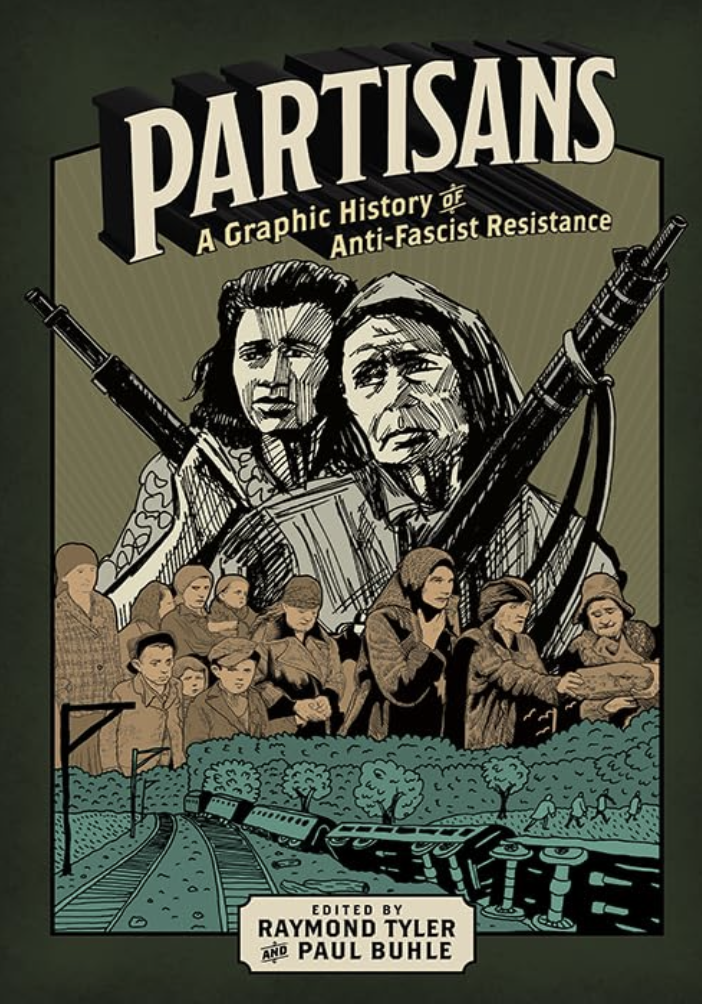
Partisans, the graphic anthology with an international cast of artists and writers, is perhaps the first of a new genre, published (in Canada) in time for the new anti-fascist movement growing in the U.S. It is also notable for building upon the recent scholarship on 1940s Europe and the many Partisan movements, a scholarship that has stressed national and ethnic particularities but especially the role of communities, women and children, in the Resistance effort.
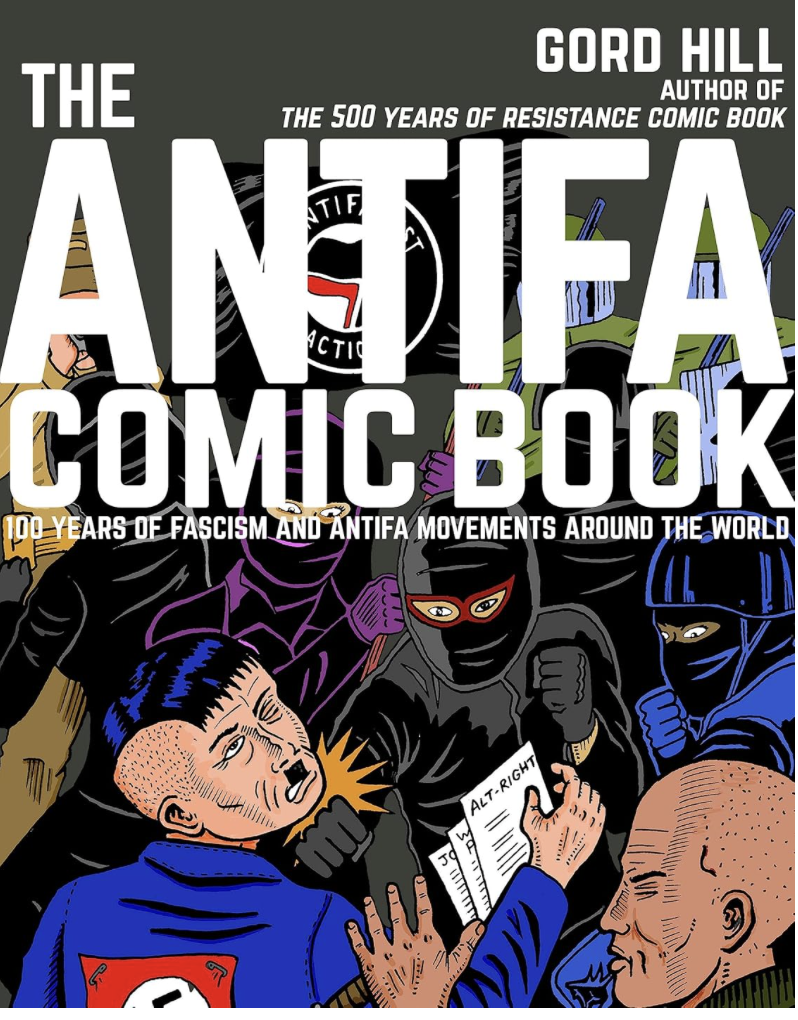
Partisans, as a North American creation, does have one remarkable precedent: The Antifa Comic Book (2018) by Gord Hill, with an introduction by Mark Bray, offers a large overview that goes back a century to cover the rise of Fascism world-wide, and attributes the violent resistance to it everywhere with the broad brush of “Antifa.” Not so much about the 1940s or for that matter, the U.S. scene, it reached a global audience, appearing in time to publicize (or glorify) the Antifa activists in the Black Lives Matter events of 2020 — to the dismay of some activist readers. Drawn in non-realist Superhero style completely unlike Partisans or the comics on the Spanish Civil War, The Antifa Comic Book captured a popular culture moment and a new edition appearing in 2023 has attracted further interest.
[Retired historian Paul Buhle is a radical comics publisher. A former senior lecturer at Brown University, Buhle was active in the civil rights movement and worked with SDS in the Sixties. He was founding editor of the influential journal, Radical America (1967-1999) and his Radical America Komiks, produced in collaboration with underground comix pioneer Gilbert Shelton of Austin, helped introduce the radical new medium to the American Left.]





