
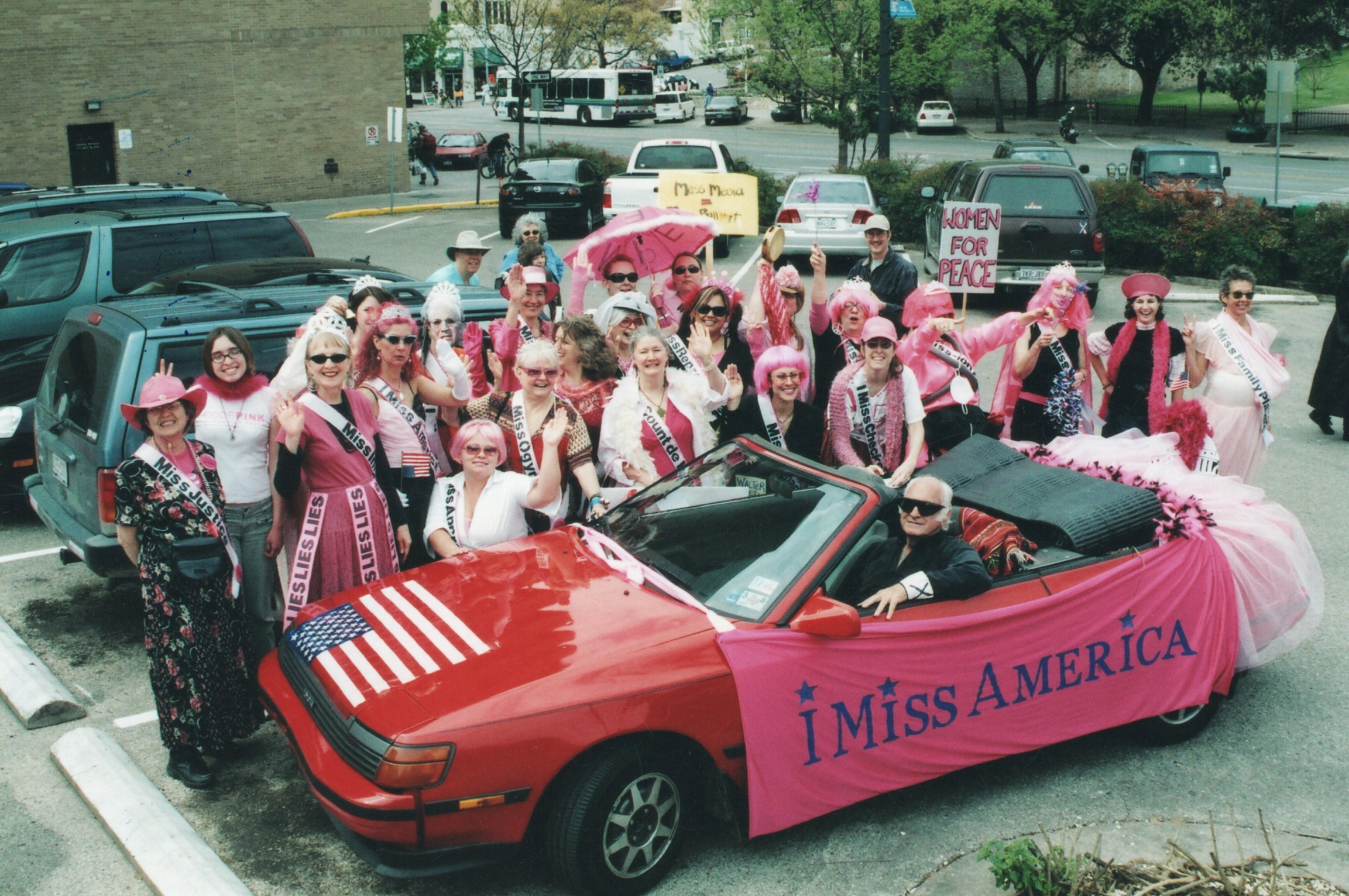
CodePink Austin at “I Miss America” pageant in Million Musicans March, March 17, 2007. Photo by Jim Turpin.
By Susan Van Haitsma / The Rag Blog / November 27, 2025
AUSTIN — With the current U.S. administration trying to excise and falsify U.S. history, we, the people who make history are more determined than ever to write, preserve, and make known our individual and collective experience as peace and social justice activists.
I’ve been inspired by Rag Blog writers and publishers, Alice Embree and Thorne Dreyer, who have been carefully and persistently documenting through their writings and presentations the social justice movements they’ve been part of in Austin and beyond. I was especially interested in Alice’s excellent memoir, “Voice Lessons,” since she is an Austin native and has been active in many intersecting movements here, including CodePink Austin, in which I also was involved.
Her conscientious work in helping to establish and support the GI Rights Coffee House, Under the Hood (2009 – 2015) in Killeen was an important element of CodePink Austin’s activism. Alice’s Substack writing continues to inspire me, and her archiving projects — her own, The Rag’s, and now her late friend, Glenn Scott’s — have been part of the impetus to collect our CodePink Austin files into an archive.
Alice’s archive is housed at the Briscoe Center for American History at UT, which has a Civil Rights and Political Activism section. While considering that institution, I also thought about the Austin History Center (AHC) as a fitting archive for the CodePink Austin materials because I had seen an AHC display of local photographs called “Taking it to the Streets” at the Bullock Museum in 2020, shown in conjunction with the exhibit, “This Light of Ours: Activist Photographers of the Civil Rights Movement.”
Because our CodePink Austin actions had been all about “taking it to the streets,” I contacted the AHC to describe what CodePink Austin had done in our years of activity (2004-2014), and the AHC Collections Manager responded with interest right away.
At the time, the AHC was beginning its move from the older, smaller building on Guadalupe Street into the larger, former Faulk Central Library right next door, and they could not accept physical archival materials until the move was complete. That gave me time to get together the folks who had been most active with CodePink Austin to share the files we had saved about our antiwar actions during the Iraq and Afghanistan wars and compile the papers into a cohesive archive. We met several times with the staff at the AHC, who were very helpful at every stage, and I am glad to report that the archive is now catalogued, partially digitized, and ready for anyone to research!
Most of the materials, such as fliers, meeting notes, news clippings, articles and physical photos taken before the use of digital cameras are organized in folders that one can only see by going to the AHC in person. We also included artifacts, such as a “Pink Police” uniform, several banners, buttons, stickers, etc. as part of the physical archive. However, a number of PDFs and scanned photographs are available to see online as “born digital” descriptions of our CodePink actions, and one can see these by navigating the archive online. For example, a descriptive PDF synopsis of CodePink Austin’s group history can be seen at this link:

International Womens Day March in San Antonio, March 2014, Jim Turpin, Marilyn White, Fran Clark, Heidi Turpin.
The Austin History Center held a well-attended open house for the public on September 7 as a “soft opening” of the Faulk Center space, and the reading room opened for limited hours, Thursdays through Saturdays from noon to five, with expanded hours expected soon. I have been twice to the AHC since their reopening and have found it a welcoming, light-filled space. The first floor features displays of artifacts with plaques in English and Spanish explaining the archiving process. The knowledgeable, friendly AHC staff in the reading room on the second floor help folks determine what they are looking for and retrieve the materials from the shelves of files in the upper floors.
For the past 20 years, the AHC has placed a special emphasis on Community Archiving, helping to preserve Austin’s Black, Latinx and Asian-American histories. AHC staff have produced a number of excellent exhibits for our libraries and several outdoor venues helping to illuminate the local civil rights movements that have shaped Austin. I am pleased that our Austin CodePink archive joins those collections.
Every group and every movement for creative, nonviolent social change will develop their own methods of activism in response to the circumstances of their time. Knowing what kinds of actions have been done in the past can inform and inspire in all kinds of ways. Let’s keep these important People’s Histories alive.





