
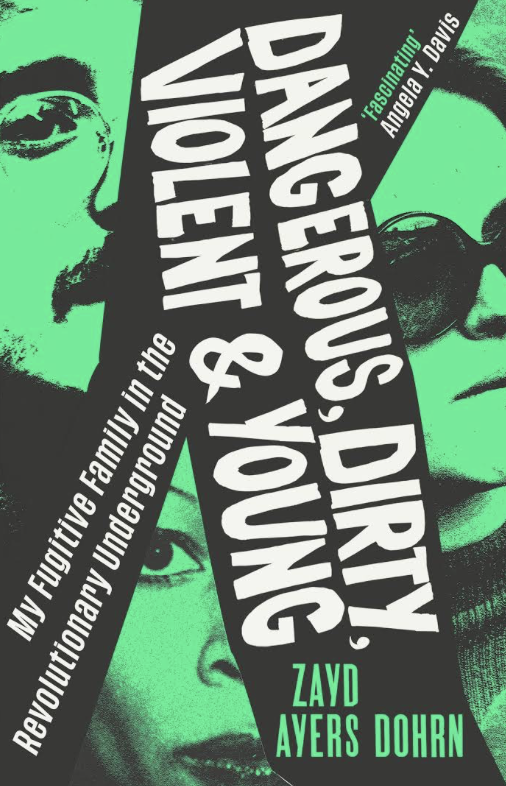
Dangerous, Dirty, Violent, and Young: A Fugitive Family in the Revolutionary Underground. By Zayd Ayers Dohrn; W. W.Norton & Company, 2026
By Jonah Raskin / The Rag Blog / February 26, 2026
On July 26, 1982, the 23rd anniversary of the Cuban Revolution, a young mother wrote to her young son to tell him, “When you meet new people, grown ups, you must say hello and look at them.” She added — as though to say it wasn’t only a matter of good manners — “it is a way of respecting people and being part of the human community.” That letter might not seem unusual. My own mother expressed the same sentiments to me when I was a boy. But the July 26th letter was unusual.
It was written by Bernardine Dohrn who was behind bars, having been held in contempt of court for failing to cooperate with a grand jury investigating radicals. Bernardine wrote the letter to Zayd, the older of her two sons, who was named after Zayd Shakur, the Minister of Information for the Bronx Black Panther Party, shot and killed in 1973 by New Jersey cops.
Zayd Ayers Dohrn was then four years and already a veteran of the Weather Underground, the clandestine organization whose members mostly evaded capture by the FBI for a decade and who planted and set off bombs in the US Capitol, The Pentagon, the headquarters of ITT and police stations from coast to coast.
In case you don’t remember or perhaps never knew, Zayd’s parents had been charismatic stars of Students for A Democratic Society (SDS) who helped to forge Revolutionary Youth Movement (RYM) I, which morphed into Weatherman and then into the Weather Underground.
In his new profoundly personal and yet intensely political memoir, Dangerous, Dirty, Violent and Young, Zayd offers a history of what’s been called the “Long Sixties,” the era of sex, drugs, rock and rebellion that began in 1955 and that came to an end in 1975.
At the same time, Zayd presents a narrative about his own biological family, their friends and allies and that includes a complex portrait of his parents, Bernardine and Bill, who aimed to make a revolution in “Babylon,” as the Panthers called the U.S. and also to live life to the fullest, and squeeze joy from every moment.
The title for Zayd’s book, which might well be called explosive, comes from a song by the Jefferson Airplane, the rock band that Bill befriended and that their lyricist Paul Kanter reciprocated with songs like “Diana,” an anthem for weatherwoman Diana Oughton who died in a bomb blast in an Manhattan apartment building in March 1970 that also ended the lives of Teddy Gold and Terry Robbins. The full title for the song includes the words, “Hideous” and “obscenity,” which don’t exactly fit Weatherman or the Weather Underground, though some actions bordered on the obscene and the repulsive.
I don’t accept all of Zayd’s accounts of the underground, especially his account of what was called in code “The Big Top.” I lived in the Weather “safe house” on Amity Street in Brooklyn in 1971. I watched the fugitive who made the explosive devices that went off in the Capitol.
I saw him connect wires safely. I saw the team get into their red Volvo with the bomb and set off for Washington, D.C. I heard the story of what happened next — the failure of the bomb to go off and the return of the team who added a small booster bomb that triggered the first big bomb. Kathy Boudin was not involved, though Zayd suggests that she was. I won’t name names.
When Zayd asked Bernardine about The Big Top, she said, “I’m not going to tell you who put it there, And I’m not going to tell you who worked on it.” If he had asked me, I’d have explained what I just explained. I also watched a fugitive burn in the fireplace the wrappers for the sticks of dynamite used in the explosion.
But I would echo Zayd’s assertion that “the first few years in the underground would wind up being some of the weirdest, wildest, and most fun parts of my parents’ story.” They were the most fun part of my Weather underground years.
Teachers now, as in the past, often urge students to ” write what you know.” Zayd has taken that advice to heart and made it his credo. He probably knows more about the Weather Underground than anyone else alive today. His mother, now 84, was recently diagnosed with dementia and is, as she has said, “on the road to Alzheimers.”
Her memories of her years underground are frayed. Bill’s memory is selective; ditto for most of the members of the organization who have in the interest of survival intentionally erased memories. Some matters are best forgotten.
Zayd lived the underground life as a child and as a boy. He understands its machinations better than anyone I know. Bill explained to him that going underground was a “state of mind.” He added that it’s what exists “on the fringe,” and that there are right wing as well as leftwing undergrounds.
Zayd has interviewed everyone who could be interviewed, read almost all of the books and articles on the subject and thought deeply about it for more than a decade. More than 10 years ago, he wrote and produced an 11-part podcast about his parents and their comrades titled Mother Country Radicals, with the subtitle “A Family History of the Weather Underground” produced by Crooked Media.
That podcast anticipated some of the same material contained in Dangerous, Dirty, Violent and Young, though it’s not as in-depth and doesn’t have what might accurately be called the “soul searching” of the book. There isn’t an action, a gesture or a political statement by Weatherman and the Weather Underground that Zayd doesn’t interrogate. He accepts nothing at face value and always goes behind the scenes.
But if he seems eminently suited to write about mother country radicals he’s also very much an odd man for the job. “I could never quite reconcile my own resistance to a mass movement with my radical upbring,” he writes. “I’ve always prefered solitude to the crowd.” With that attitude, there would be no crowds and no revolutions.
A few pages on, Zayd expresses what might be called heresy in some radical circles: “too many revolutions have led to repressive regimes.” And he offers a quotation from Frederick Nietzsche who said, “Beware when fighting monsters, lest you become a monster.” In these pages, Terry Robbins appears as a young idealist who became a monster.
Probably the words that appear more often than any other words in the text are “contradiction” and “contradictions.” Zayd sees them, along with paradoxes and ambivalences, almost everywhere he looks: in himself, in his family and in the revolution itself.
The last 100 pages of Dangerous, Dirty, Violent and Young can be rough going. Zayd describes the implosion in the Weather Underground, the rise of an internal ideological sect that denounced Bernardine and Bill, followed by Bernardine’s denunciation of herself that included a confession about her “counterrevolutionary actions.” Her comrade, Kathy Boudin, told her, “If you go above ground you’re a racist.” Ouch. In the fall out, The Ayers- Dohrn family cracked up and was nearly destroyed.
It’s painful to read how Bernardine’s ideological foes broke her down; painful to read that she agreed to denounce herself and her friends and in writing. In hindsight she observed, “It makes me sick that I wrote that.” Her worst enemy wasn’t Hoover and the FBI but her so-called revolutionary sisters. So Zayd’s book is a cautionary tale about the dangers of movements and ideologies, though it’s also a plug for honorable family ties and legacies.
I knew Zayd before he knew me. That was in the late 1970s before his parents surfaced, and when they visited me in Sonoma County and we went swimming and sunbathing at a neighbor’s pool. When Bill changed Zayd’s diapers I asked him how he liked it. “I love it,” he said. Zayd wasn’t always sure that his father loved him unconditionally.
At times, Bill seemed to love the revolution more than he loved his own flesh and blood. That sounds like my Ukrainian-born socialist grandfather Aaron who, it was said by his own children, would rather take the shirt of his own back and give it to a stranger than clothe my mother and her sister. Ah, yes, contradictions! Can’t live with them. Can’t live without them.
Please please do read Zayd’s exciting, thoughtful book which explores the undergrounds, both Black and white, of the Long Sixties, and that explores the terrible beauty of the revolutionary movement that rose and fell and that will rise again.





