
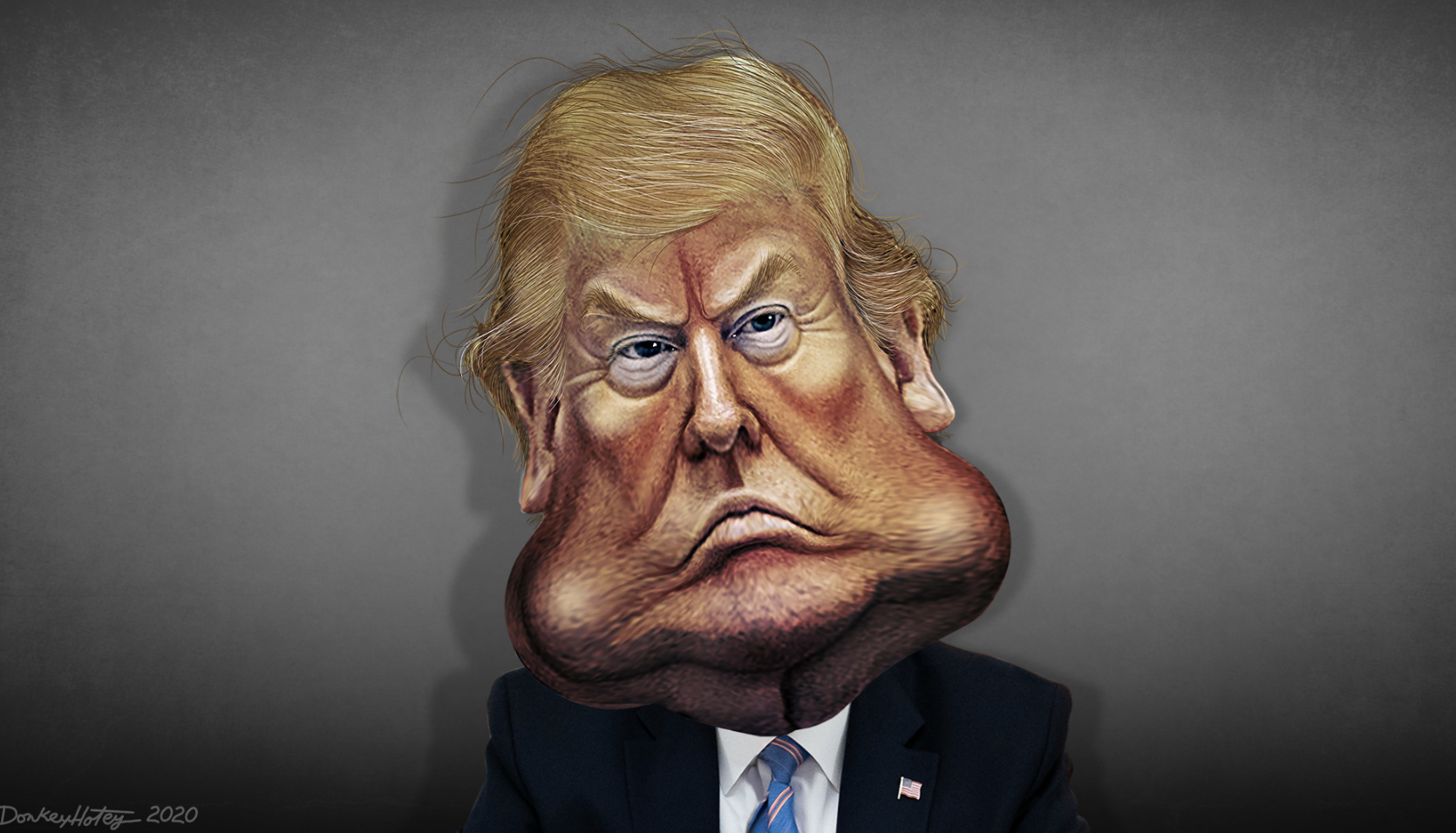
Caricature by DonkeyHotey
SPECIAL TO THE RAG BLOG
By Michael Meeropol / The Rag Blog / March 23, 2026
People in the media have been scrambling in an attempt to actually figure out the reasoning behind Trump’s decision to launch a full-scale war against Iran. And they are right to note the many different versions of the justification: Israel was going to do it so decided to do it first (Secretary of State Rubio). No, we [the U.S.] pre-empted Israel because we knew Iran was going to attack us (President Trump). One of Trump’s former national security advisors, Nadia Schadlow, was recently interviewed by Ezra Klein.
The long (ridiculously long) transcript is available but I advise people not to bother reading it. Her main argument is that Iran was always a “threat” — which she defines as attempting to acquire a nuclear weapon and supporting various militias in the area — Hezbollah in Lebanon, Hamas in Palestine. What she never explains (and Klein lets her get away with it) is why it suddenly became so urgent now.
For a detailed blow by blow description of the often self-contradictory justifications presented by Trump and his administrative spokespeople, see this very comprehensive reporting from The Guardian: https://www.theguardian.com/us-news/2026/mar/07/trump-rationale-war-iran-story.
If we recognize the Trump Administration justifications for what they are — garbage — then how do we explain this war of choice? I think it might be possible to make a case on U.S. empire grounds. As readers of my work know, I am a follower of the historian William Appleman Williams whose book The Tragedy of American Diplomacy was widely read in the years when the movement struggled to stop the U.S. from making war against the peoples of Indochina. His explanation of the U.S. “ruling class’s” desire for an open door for markets and investments in the entire world led to U.S. expansionism beyond the continentalUnited States — first in Latin America and Asia – Cuba and the Phillipines — and later in the entire world
Williams points out that this became a recipe for conflict — whether with Mexican revolutionaries after the 1910 revolution, or with the Bolsheviks after 1917. Later the rising Japanese empire led to our entry into World War II. Finally, after partnering with the Soviet Union to win the war, the desire for an open door in Eastern Europe and post-war Asia led toboth the Cold War and two mini-hot wars.
As a general rule, according to Williams’ analysis, nationalists who stand in the way of such expansionism are considered dangers to long run American prosperity. This applied to Vietnamese nationalist-communists fighting the French in the early 1950s, Iranian or Guatemalan nationalists in 1953 and 1954, or Cuban Nationalist-Communists in the 1960s.
[For a cliff notes discussion of the original Open Door Notes from the State Department see https://history.state.gov/milestones/1899-1913/hay-and-china. Williams’ main point is that the principles articulated in those notes became the basis of U.S. foreign policy from that point forward.]
With the victory of the U.S. in the Cold War, it seems there was an initial hope that the entire world would soon be open for the United States international corporations. Eastern Europe and Russia were wide open after 1990, and 11 years of negotiation later, China joined the World Trade Organization which set limits on the amount of state intervention by the government into the economy. When George W. Bush was president he announced that there was an “axis of evil” in the world — which included Iraq, Iran, and North Korea. The plan of his brain trust was to quickly defeat Saddam Hussein in Iraq and then turn attention to Iran. In addition, he tightened the long U.S. embargo on Cuba hoping to put enough pressure on them to change their political and economic system. With these pesky dots of nationalism out of the way, the entire world would be open to U.S. expansion.
Unfortunately for the celebratory leaders of the Bush II foreign policy, Iraq proved a quagmire, China remained a highly controlled economy, and Vladimir Putin came to power in Russia and solidified control. Thus, many of the so-called “open doors” were closing or remained closed. If the U.S. political and economic leadership continues to believe we need “open doors” all over the world, then the idea of defeating the nationalist government of Iran remained high on the “to do” list. If this interpretation is correct, an administration like Trump’s would only be waiting for the “right moment” to attempt to deliver a death blow to the Iranian regime. But it’s hard to imagine Trump and Hegseth having the sophistication to even understand this rationale.
Thus, I do not for a minute believe Trump or Hegseth (or even Rubio) have thought this out. Rubio actually is hoping that success in Iran will lead Trump to take over Cuba – and he has personal reasons for that. For Trump and Hegseth they are just flexing their muscles like a teenage bully in the playground — with disgusting dire consequences for thousands of Iranians and many others, including some American military personnel.
In December of 2014, I presented a commentary to WAMC-FM which focused on the imperial nature of American Foreign Policy. In it, I made the argument that the costs of creating and maintaining an American Empire amounts to a massive redistribution of income from ordinary taxpayers to those particular businesses which benefit from supplying the war machine and those that benefit from the control of international sources of raw materials and access to foreign markets. We the people get nothing out of having an empire — except that from time to time our young people have to fight and bleed and die for it.
It is ridiculously ironic and as I prepare this article, we are four weeks into President Trump’s seventh military assault of his second term. And this is the man who makes believe he has “ended” a whole bunch of wars (most of which we Americans had never heard of — and most of which are still going on) and deserves the Nobel Peace Prize. On the contrary, he has already unilaterally attacked six separate countries plus boats on the high seas. Since most of these attacks did not provoke retaliation one can hardly call them wars but they certainly are not the acts of a peace-maker. Let’s remind ourselves what he has done: shooting boats out of the water claiming (falsely) that they were bringing drugs to the United States — invading Venezuela to kidnap its president — illegally blockading Cuba, attempting to destroy their economy by keeping out oil — bombing assaults on Syria, Iraq, Yemen (the Houthi rebels) and now we have that full scale war with Iran.
Why is he doing this? I noted above that it is highly unlikely that Trump, Hegseth, and others have developed the “case for the American empire” that I summarized. Instead, I think there are two potential reasons to explain why Trump has started this war: First, he is doing this because he can. As commander in chief of the armed forces he has a great deal of leeway. Congressional Republicans have so far enabled him. What are the arguments we hear in favor of these activities? Well, most of them are lies but let’s see.
NY Times columnist Bret Stephens presented his case in the NY Times on February 22. [The article is available at https://www.nytimes.com/2026/02/22/opinion/iran-military-strike-trump.html.]
Here are three points he makes: “Iran poses a threat to global order by way of its damaged but abiding nuclear ambitions, its deep strategic ties to Moscow and Beijing, its persistent threats to maritime commerce and its support for international terrorism.”
One could argue that should Iran acquire nuclear weapons, that would stabilize things because countries like Israel and the U.S. would think twice before attacking them. Notice that after a few exchanges of letters between Trump and the dictator of North Korea, Kim Jong-Un, there appears to be no danger of war on that Korean peninsula. The idea about persistent threats to maritime commerce is laughable. Iran has proven that it can close off the Strait of Hormuz anytime it wishes to and it has not done so at any time since the end of the Iran-Iraq war in 1988. It is Trump’s war that has closed off the Strait of Hormuz.
Stephens again: “[Iran] poses a threat to regional stability, not just through its support for anti-Israel proxies like Hamas and Hezbollah, but also by its meddling in Lebanon, Iraq, Yemen and (until the overthrow of the Bashar al-Assad regime) Syria.” One could make the case that Israel is the real threat to regional stability with its many interventions in Lebanon in particular. As for meddling in Iraq — wasn’t it the United States that invaded Iraq deposing Saddam Hussein and turning the country into a cauldron of internal conflict? Iran’s interventions in the various civil wars in that region is not the only cause of on-going conflict.
And finally, Stephens plays the “humanitarian intervention” card: “And [Iran is] a mortal threat to the life and safety of its own people, many thousands of whom it slaughtered last month.
There was a time not long ago when Americans, both left and right, cared enough about human rights to believe it could, in some circumstances, justify military intervention.” Humanitarian intervention is all the rage ever since the Bosnian Civil War of the 1990s. It rarely works out the way its supporters claim. Trying to effect regime change in Iran would be a major undertaking — making the American lives and treasure expended in Iraq and Afghanistan look like chump change. One could make the case that the best way to support democracy in Iran is to renegotiate the deal that President Obama made with the Iranians about keeping their nuclear ambitions limited.
After that and the dropping of sanctions, Iran could rejoin the family of nations so it can prosper — a prosperous country might loosen the grip of the religious autocracy on the population. Certainly, what the U.S is doing in Iran now is not helping the Iranian people get out from under the jack-boots of the religious autocracy.
Another not-so-far fetched reason for Trump’s war-making, however, is that the war is getting (at least temporarily) the Jeffery Epstein scandal off the front pages. And this is just when information is finally coming out about a source the FBI interviewed who claimed she was sexually exploited by Trump himself when she was a teenager.
Based on recent testimony from Epstein’s accountant, that same alleged victim received a settlement payment from the Epstein estate. See Daily Beast, “Epstein Accountant Spills Bombshell Payout to Alleged Trump Victim.” And according to recent polling data, it appears my “guess” is not all that “crazy.”
This piece is being published after 27 days of war. At times during this period, Trump has asserted that the war is “almost over” that he has achieved “almost all” of his objectives — mind you, this is without ever explaining those objectives — though at least once he said he wanted “unconditional surrender” — a complete impossibility without total occupation of the entire territory of Iran, just as happened at the end of World War II in Germany and Japan. But during the period from March 14 to 21 Iran kept most shipping from going through the Strait of Hormuz and the U.S. kept bombing more and more sites in Iran.
During the weekend of March 14-15, Trump suddenly began to demand that his allies (and even non-allies like China) send ships to escort tankers through the Gulf of Hormuz. He had plans to send ships to escort vessels through that narrow passage. Thus, the price of oil continued to rise and the inability of ships (carrying all sorts of things besides oil) to traverse that passage remained the centerpiece of Iran’s resistance to the U.S. attack.
A number of writers have made it clear that as the chance of a quick end to the war has receded, the main dynamic is that the Iranian regime “wins” merely by surviving. Meanwhile, the United States is in no position to “declare victory” and end the war because the Iranians can continue to make shipping through the Strait of Hormuz impossible for the foreseeable future. In other words –- Iran needs some kind of “deal” with the United States before it will let shipping resume through the Strait.
On Tuesday, March 17, Joe Kent, the head of the National Counter-Terrorism Center resigned because he could not, “in good conscience” support Trump’s war. In his resignation letter, which he made public, he asserted what virtually everyone watching Trump’s absurd assertion that Iran was about to attack the U.S. knew to be true. There was no such threat from Iran — the argument of an imminent attack was “a lie.”
https://www.nytimes.com/interactive/2026/03/17/us/joe-kent-resignation-letter-iran.htm
Kent was a strong supporter of Trump’s “America First” foreign policy. Many Democrats opposed his confirmation because he was a 2020 election denier who claimed the people who stormed the capitol on January 6, 2021, were “political prisoners.” He, in other words, was not opposed to Trump and had happily served his Administration in Trump’s first term. But he saw what he saw and he knew what he knew and — unlike many of the cowards who still enable Trump from within his administration — he had the courage to say, enough.
(Unfortunately, he also is an anti-semite as is made clear in the following article: https://www.vox.com/politics/482918/joe-kent-iran-war-resign-trump-antisemitism. He is part of a group that goes back to Patrick Buchanan’s opposition to Bush II’s Iraq War which he (Buchanan) laid at the doorstep of the “amen corner” — a clear reference to American Jews who support Israel. I think Kent and Buchanan are both wrong that Israel called the shots on U.S. foreign policy in the Middle East. Netanyahu has attempted to persuade many American presidents to go to war against Iran — only Trump with his cowboy mentality decided to do it!)
On Wednesday the 18th of March, economist Paul Krugman took a deep dive into the idea that investments by petro-states (particularly Saudi Arabia) which have enriched the Trump family as well as promising to increase economic activity within the US have perhaps been a major influence on Trump’s decision to go to war in Iran.
On March 19, the British Guardian published an article reporting that a British expert who had attended the US-Iran talks in Geneva right up to the point where the Israelis and Americans launched this war claimed that real progress towards a deal was being made. This suggests that the U.S. and Israel launched the war to head off a possible deal.
Sometime during the week of March 16-20, the issue of occupying some Iranian territory with ground troops arose — a major escalation and one that might actually lead to significant U.S. casualties and a split in the Republican Party.
I wonder how long it will take the American public to get so mad about this war that they force. Trump to (falsely) claim victory and declare a full cease fire. And I wonder how long after that the Iranians will keep the Strait of Hormuz closed — they will have a say as to when this war actually ends. This means, as the N Y Times asserts in an opinion piece from March 17, 2026, Trump Cannot Spin His Way Out Of This War.
Finally, I wonder if between the time I submit this article and the time it is published, Trump will have committed a marine expeditionary force to attempt to take over Iranian territory. It would be a disaster for him politically but he just might have the arrogance to do it anyway.
Hear Michael Meeropol on Rag Radio, KOOP 91.7 FM on Trump’s War of Choice.





This is an informative article. Thanks for putting it on the blog. As Michael points out wisely, a lot of what Trump does is about money. His evil goes way beyond that, as we all know. I’m saddened by all the death of people I do not know, but they don’t deserve to die at the hands of this evil lunatic.