
By Alice Embree / The Rag Blog / March 3, 2026
Clyde W. Barrow, a professor of political science at the University of Texas Rio Grande Valley, is the author of a recent article in Jacobin, “Reading C. Wright Mills in the Age of Trump.” Barrow’s article, published February 5, 2026, has stirred up memories of C. Wright Mills and his influence among an older generation of 60s activists. More importantly though, it has brought C. Wright Mills to the attention of contemporary activists. As Barrow points out, C. Wright Mills’ description of a powerful elite has not lost relevance:
Seventy years ago, C. Wright Mills published The Power Elite, a scathing indictment of corporate executives, state officials, and their academic apologists. His analysis has lost none of its bite as we confront an increasingly degenerate US power elite.
Rag Radio will broadcast an interview with Clyde Barrow.
Friday, March 6, 2026, 2:00-3:00 p.m., KOOP 91.7 FM.
If you came of age in the turbulent 60s, you will likely be familiar with C. Wright Mills book, The Power Elite. But you may not know he was a Texan. Mills was born in Waco, Texas, in 1916. He studied briefly at Texas A&M before making his way to the University of Texas in Austin, where he began his studies of sociology. By the time he got his undergraduate degree, he had published two articles in sociology journals. Wright earned his Ph.D. at the University of Wisconsin at Madison; in 1946, he became an assistant professor at Columbia University. As Barrow notes, he stood out:
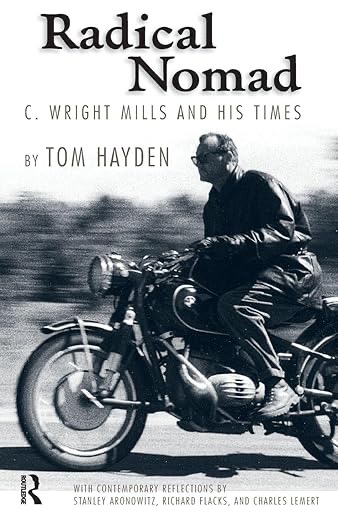
Profiles of Mills often portrayed him as an angry and rebellious lone wolf, cast in the 1950s image of an intellectual James Dean or Marlon Brando. Mills played to this image as he rode to his office each day on a BMW motorcycle dressed in a black leather jacket and work boots, rather than the suit, bow tie, and Oxford shoes customary among his Columbia University colleagues.
Mills also stood out for his plainspoken style of writing and his departure from academic norms. Barrow elaborates:
Mills castigated mainstream sociology and political science for having devolved into “a set of bureaucratic techniques,” “methodological pretensions,” and “obscurantist conceptions,” which disguised the fact that contemporary social scientists were obsessively preoccupied “with minor problems unconnected with publicly relevant issues.”
Organized Irresponsibility
In a section titled, “Organized Irresponsibility,” Barrow quotes Mills:
As he put it in The Power Elite:
The men of the higher circles are not representative men; their high position is not a result of moral virtue; their fabulous success is not firmly connected with meritorious ability. Those who sit in the seats of the high and the mighty are selected and formed by the means of power, the sources of wealth, the mechanics of celebrity, which prevail in their society. . . . Commanders of power unequaled in human history, they have succeeded within the American system of organized irresponsibility.
Mills’ critique of the powerful is a spot-on description of the incompetents in power today and the apparent impunity they face as we learn about the Epstein disclosures. Here’s Barrow’s reflections:
Mills brilliantly exposed to the public the reality that members of the US “power elite” were not geniuses, nor even exceptionally talented individuals. They were often incompetent and regularly engaged in reckless and self-aggrandizing behavior that led them to make monumental mistakes. Those mistakes resulted in catastrophic consequences for ordinary people, who seemed helpless in the face of the enormous and irresponsible power wielded by the power elite, while those who committed crimes in the name of the people typically walked away with more money and celebrity.
Influence on SDS
C. Wright Mills was a major influence on early members of Students for a Democratic Society (SDS). Tom Hayden is a case in point. Hayden co-authored The Port Huron Statement, in 1962. In that document, SDS laid out a vision of participatory democracy. The same year, Hayden finished a master’s thesis on the intellectual work of C. Wright Mills. Hayden’s thesis, along with a collection of essays, was published in 2006 under the title Radical Nomad: C. Wright Mills and His Times.
Other early SDSers chimed in on a list serve when Bruce Schmeichan posted a link to Barrow’s Jacobin article. Here’s what Schmeichan said:
C. Wright Mills had a profound impact on early SDS – Hayden was immersed in his work. I happened to read The Power Elite in high school. In tandem with getting involved in CORE in St. Louis, it was transformative.
I remember printing up hundreds copies of Mills’ “Letter to the New Left” in the [SDS] National Office. It was among the top two or three most requested pieces of literature, prior to Paul Potter’s speech at the April 1965, march on Washington. This current article on Mills from Jacobin is the best thing I’ve seen on him recently.
Jim Russell, an early SDS member, wrote:
Mills had a charismatic effect on me. I first heard of him at an off-campus discussion group on Marx at the University of Oklahoma. We read his The Marxists. I then read and tried to understand everything I could by him, including one pamphlet I picked up in the New York SDS national office.
Al Haber, an SDS founder, shared this memory:
SDS had a debate arranged between C. Wright Mills and Daniel Bell for the Spring of 1962. We were hoping this would be a notable public opportunity to clarify our new left politics and critique of liberalism. Sadly, Mills died just before the debate could happen.
On the list serve, Bruce Schmeican also shared “C. Wright Mills: Before His Time,” written by Dan Wakefield and published in the Nation 3/18/2009. Wakefield, a former student of Mills, wrote:
Against the awful image of Willy Loman’s wasted life which haunted our dreams of the future in the 1950s, against the lock-step fate of The Lonely Crowd and The
Organization Man which seemed to lie in wait for us after graduation, Mills gave us more hopeful possibilities. His withering critique of the stifling elements he saw in society (as expressed in White Collar, on the American middle class, and in The Power Elite, on the ruling circles) was not simply negative. The very audacity of Mills’s attacks on the status quo carried with it a promise of something better.
Power and Agency
It was the optimism that Mills conveyed in “Letter to the New Left,” the pamphlet that rolled off the SDS press, that made it so popular. He spoke to the 60s generation of activists about the “sickness of complacency”:
It is no exaggeration to say that since the end of World War II in Britain and the United States smug conservatives, tired liberals and disillusioned radicals have carried on a very wearied discourse in which issues are blurred and potential debate muted; the sickness of complacency has prevailed, the bi-partisan banality flourished.
In “Letter to the New Left,” Mills railed against the “end of ideology.” He also wrestled with the idea of agency – who could make change. He was a Marxist but found the industrial proletariat to be an inadequate vehicle for transformation. Mills died in 1962 just as a student left emerged – a movement propelled by the Student Non-Violent Organizing Committee (SNCC) and Students for a Democratic Society (SDS). Mills never witnessed the returning GIs who made the Vietnam Veterans Against the War (VVAW) such an effective voice against a “forever war.”
Influence on Power Structure Research
Two weeks after Barrow’s C. Wright Mills article appeared in Jacobin, the magazine published “The Power of Power Structure Research.” It featured an interview with Mike Locker who had been a founder of the North American Congress on Latin America (NACLA) in New York.
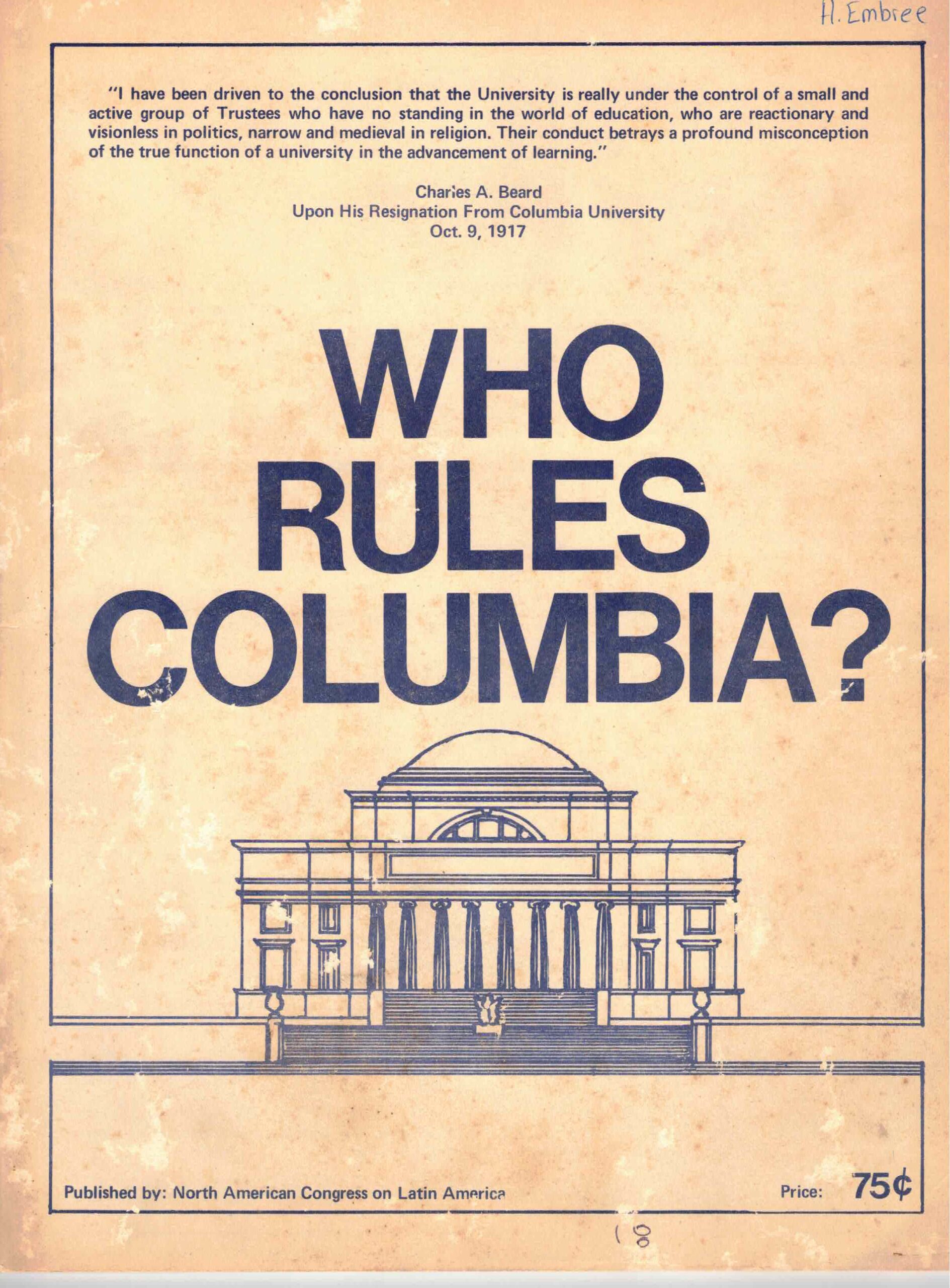
I had read The Power Elite and taken it to heart when I joined up with NACLA in New York in 1967. I worked with Mike Locker on the pamphlet, Who Rules Columbia?, published during the student strike of 1968. Six years after C. Wright Mills’ death, student radicals mapped out the power elite at the same campus where Mills had taught.
A large, folded insert connected the dots of Columbia’s Board of Trustees, showing their nodes of power, and intersections on corporate and foundation boards. I’m sure that Mills would have found it to be a delightfully practical application of his theory.
In the Jacobin’s interview, Mike Locker spoke of Mill’s impact:
Voting is, of course, one way to achieve political objectives. But social movements are another way to achieve those objectives. And how do you give social movements the tools to create a strategy and tactics that are effective for creating change? That’s the overarching theme of how I was beginning to approach power research.
That’s also what Mills was talking about. He wanted to understand what was controlling US politics and economics that the American people were not aware of. And he thought that more awareness and consciousness of this would allow people to… develop a strategy and tactics to challenge that power.
Clyde W. Barrow’s article on C. Wright Mills sheds new light on his insight and lasting impact.





