
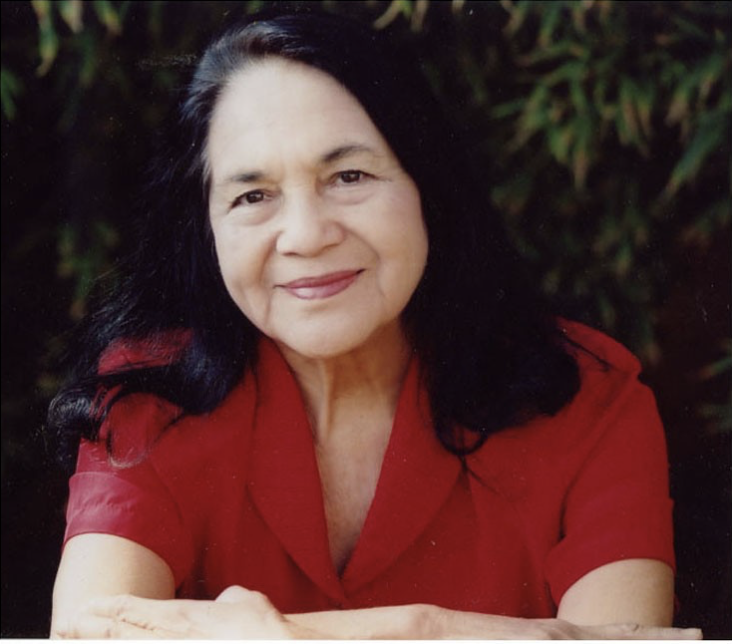
Dolores Huerta. Image from Flickr.
By Lamar Hankins / The Rag Blog / March 21, 2026
At age 20, all I knew about migrant farmworkers was found in Woody Guthrie’s song “Plane Wreck at Los Gatos.” Earlier in 1965 I had applied to VISTA (Volunteers in Service to America). I was impatient with college and wanted to become part of the effort to bring forth a more just, fair, and equality-oriented America. VISTA offered me an opportunity to become a participant in a nonprofit project in Florida that was working to improve the lives of farmworkers. I learned a great deal more about the system that was built on the backs of an underclass that had largely escaped my attention.
Throughout the United States, migrant farmworkers — braceros, the poor of all colors (men, women, and children), workers from Puerto Rico, Filipinos, and a few others — rose early each morning wherever there were crops to be harvested, rode on trucks and buses to farming fields, and worked in all conditions gathering crops to feed families in America who could afford to shop at grocery stores and super markets for produce, whether fresh, canned, dried, or frozen. Historically, farmworkers included Japanese immigrants, Filipinos, and Mexicans brought in under various government-sponsored efforts to help farmers harvest their crops.
These farmworkers, wherever they came from, often followed harvests from the warmest parts of the United States, where harvests began early in the year, moving northward as crops were harvested later. There were what were called migrant streams that began in Florida and moved up the east coast to New Jersey and beyond. Farmworkers in Texas might work their way to the Midwest. Others might begin harvesting crops in Arizona and southern California before heading to the northern west coast states as crops were ready to harvest there.
Three years before my arrival in southern Florida to begin six weeks of VISTA training, Cesar Chavez, Dolores Huerta, Gilbert Padilla, and others, building on 60 years of efforts, had begun organizing a farmworkers’ union in Delano, California. To pressure farmers who owned table-grape orchards in California to pay a living wage to farmworkers, they began a table-grape boycott. Eventually, the boycott was successful, and farmworkers in the grape orchards around Delano negotiated a contract to provide better pay and working conditions for those farmworkers. Even after the grape boycott ended, I felt so strongly about their cause that, for several decades, I could not eat table grapes.
Until I saw the exploitation of these human beings first hand, it was difficult to imagine how they were forced to live. They were 20th-century slaves working and, in many cases, living on or near successive plantations. The people who gathered the food we put on our tables often could not afford more than subsistence food for themselves. Children were often, maybe usually, under-nourished or malnourished. Growers often provided places to live that were hovels, places little bigger than a jail cell with one bare light bulb. Their clothing was mostly that cast off by the affluent. Medical care was minimal, usually dependent on what a county or state might provide, which meant that it was available only occasionally, if at all. In south Florida, cooking fuel was usually kerosene, a smelly petroleum product that left a lingering, unmistakable odor, especially when mixed with cooked food odors. They often lived in isolated areas without access to reasonably-priced grocery stores.
Few of these workers had their own transportation, which often meant they relied on crew leaders, who had contracted with farmers to supply workers. The farmers blamed the crew leaders for these conditions and abusing migrant farmworkers, who were made to pay exorbitant prices for food and drink to the crew leaders because of their isolation; the crew leaders blamed the farmers. Congressional representatives never acknowledged their subservience to the powerful farmer organizations that lobbied them for protection from the vagaries of the marketplace and the weather. I blamed the politicians for allowing such abuse to continue in this land of the free and home of the brave. I still blame the politicians.
As Woody put it in his song:
Some of us are illegal, and some are not wanted
Our work contract’s out and we have to move on;
Six hundred miles to that Mexican border
They chase us like outlaws, like rustlers, like thieves
We died in your hills, we died in your deserts
We died in your valleys and died on your plains
We died ‘neath your trees and we died in your bushes
Both sides of the river, we died just the same . . .
Is this the best way we can grow our big orchards?
Is this the best way we can grow our good fruit?
To fall like dry leaves to rot on my topsoil
And be called by no name except “deportees”?
One wall of my home office is covered with pictures of people who have influenced me on my eight-decade journey. Instead of removing the picture of Cesar Chavez from my wall, I have covered it with a picture of Dolores Huerta. There is no question that Chavez influenced my life, but in light of the apparently true allegations of his sexual exploitations and abuse, I no longer want to see his picture each day. I would rather credit another person who deserves such personal recognition.
Viva Huerta! Viva United Farm Workers! Viva La Huelga!





