In an attempt to reinvent the Vietnam War, President Obama and the Pentagon have launched a “multi-year national public relations campaign to justify, glorify, and honor Washington’s catastrophic, aggressive, and losing war against Vietnam.” Jack Smith lays bare this cynical attempt at revisionist history, including the fabricated and long-debunked claims of widespread mistreatment of Vietnam vets by antiwar forces.

Posted in RagBlog | Leave a comment

Jack A. Smith : Reversing the Vietnam War Verdict

Demonstrators at the October 21, 1967 march on the Pentagon carry a banner that says, “Support our GIs, Bring Them Home Now.”

Reversing the Vietnam War verdict

Most of the allegations about insults directed at soldiers or vets from war opponents have been fabrications to discredit the antiwar forces.

By Jack A. Smith | The Rag Blog | June 7, 2012

The Pentagon has just launched a multi-year national public relations campaign to justify, glorify, and honor Washington’s catastrophic, aggressive, and losing war against Vietnam — America’s most controversial and unpopular military conflict.

President Barack Obama opened the militarist event, which was overwhelmingly approved by Congress four years ago, during a speech at the Vietnam Wall on Memorial Day, May 28. The entire campaign, which will consist of tens of thousands of events over the next 13 years, is ostensibly intended to “finally honor” the U.S. troops who fought in Vietnam. The last troops were evacuated nearly 40 years ago.

In reality, the unprecedented project — titled the Vietnam War Commemoration — will utilize the “pro-veteran” extravaganza to accomplish two additional and more long lasting goals:

  • The first is to legitimize and intensify a renewed warrior spirit within America as the Pentagon emerges from two counterproductive, ruinously expensive, and stalemated unjust wars in Iraq and Afghanistan, and prepares for further military adventures in Asia, the Middle East, and Africa. Within days of Obama’s speech, for instance, Defense Secretary Leon E. Panetta announced a big increase of U.S. Navy forces in the Pacific, a move obviously targeting China. At the same time the Obama Administration’s drone wars are accelerating as the Oval Office’s kill list expands, and the president engages in cyber sabotage against Iran.
  • The second is to dilute the memory of historic public opposition to the Vietnam war by putting forward the Pentagon’s censored account of the conflict in public meetings, parades, and educational sessions set to take place across the nation through 2025. These flag-waving, hyper-patriotic occasions will feature veterans, active duty military members, government officials, local politicians, teachers, and business leaders who will combine forces to praise those who fought in Vietnam and those on the home front who supported the war. There won’t be much — if any — attention focused on the majority of Americans who opposed this imperialist adventure, except as a footnote describing how tolerant U.S. democracy is toward dissent.

The principal theme of the president’s address was that American troops have not received sufficient laurels for their efforts to violently prevent the reunification of North and South Vietnam. He did not point out that there would have been no war had the United States permitted nationwide free elections to take place in Vietnam in 1956 as specified by the 1954 Geneva Agreement ending the French colonialism in Indochina. Washington recently decided that the war “officially” began in 1962 (although U.S. involvement dates back to the 1950s), allowing the commemoration to begin during the “50th anniversary” year.

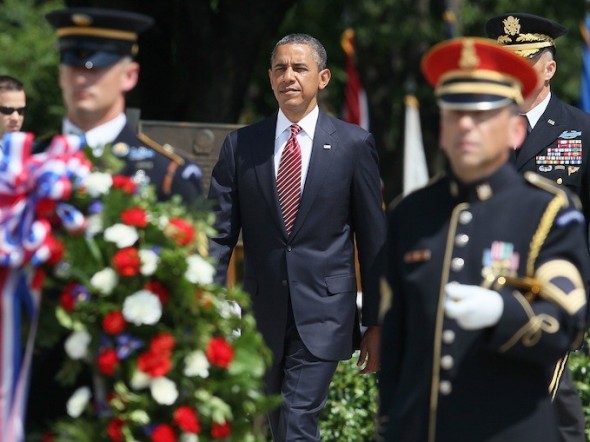
President Obama lays a commemorative wreath during Memorial Day ceremony at the Tomb of the Unknowns at Arlington National Cemetery, May 28, 2012 in Arlington, Virginia. Photo by Mark Wilson / Getty Images.

President Obama told the large, cheering crowd of veterans and their families at the Vietnam Wall exactly what they — and all those who still resented the era’s large antiwar movement — wanted to hear:

One of the most painful chapters in our history was Vietnam — most particularly, how we treated our troops who served there….

You were often blamed for a war you didn’t start, when you should have been commended for serving your country with valor. (Applause.) You were sometimes blamed for misdeeds of a few, when the honorable service of the many should have been praised. You came home and sometimes were denigrated, when you should have been celebrated. It was a national shame, a disgrace that should have never happened. And that’s why here today we resolve that it will not happen again. (Applause.)….

[Y]ou wrote one of the most extraordinary stories of bravery and integrity in the annals of military history. (Applause.)…. [E]ven though some Americans turned their back on you — you never turned your back on America… And let’s remember all those Vietnam veterans who came back and served again — in the wars in Iraq and Afghanistan. You did not stop serving. (Applause.)

So here today, it must be said — you have earned your place among the greatest generations. At this time, I would ask all our Vietnam veterans, those of you who can stand, to please stand, all those already standing, raise your hands — as we say those simple words which always greet our troops when they come home from here on out: Welcome home. (Applause.) Welcome home. Welcome home. Welcome home. Thank you. We appreciate you. Welcome home. (Applause.)….

May God bless you. May God bless your families. May God bless our men and women in uniform. And may God bless these United States of America.

There was virtually no criticism in the corporate mass media about the president’s gross exaggerations concerning the “mistreatment” of Vietnam era veterans. True, there were no victory parades, but that was because the U.S. Armed Forces were defeated by a much smaller and enormously outgunned adversary — the guerrilla forces of the South Vietnamese National Liberation Front (NLF) and regular forces from North Vietnam.

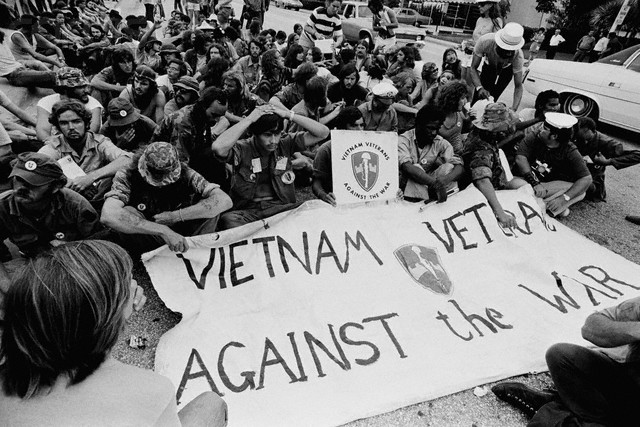
Members of the Vietnam Veterans Against the War (VVAW) hold a peaceful demonstration outside the 1972 Democratic National Convention in Miami. Photo by JP Laffont / Sygma / Corbis.

By the time many vets returned home the American people had turned against the war and wanted it over, as did a significant portion of active duty troops, including the many who identified with the peace movement or who mutinied or deserted. Undoubtedly some veterans were disrespected — but to a far lesser extent than Obama and pro-war forces have suggested over the years.

Whenever the U.S. conducts unpopular invasions, as in Vietnam, Afghanistan, and Iraq, Washington and the mass media invariably insist that it is the duty of patriotic citizens to “support the troops” even if they oppose the war. But to manifest the kind of support the government seeks inevitably implies support for the war. This is why the peace groups came up with the slogan “Support the Troops — Bring ’em home NOW!”

According to the Pentagon, which is in charge of staging the Vietnam War Commemoration, the main purpose is

To thank and honor veterans of the Vietnam War… for their service and sacrifice on behalf of the United States and to thank and honor the families of these veterans. To highlight the service of the Armed Forces during the Vietnam War and the contributions of Federal agencies and governmental and non-governmental organizations that served with, or in support of, the Armed Forces. To pay tribute to the contributions made on the home front by the people of the United States during the Vietnam War…”

Thousands of community, veteran, and various nongovernmental organizations throughout the U.S. are expected to join the Commemorative Partner Program

to assist federal, state and local authorities to assist a grateful nation in thanking and honoring our Vietnam Veterans and their families. Commemorative Partners are encouraged to participate… by planning and conducting events and activities that will recognize the Vietnam Veterans and their families’ service, valor, and sacrifice.

In addition the government and its “partners” will be distributing educational materials about the war, according to the Pentagon, but it is unlikely that the Vietnamese side of the story or that of the multitude of war resisters in the U.S., civilian and military, will receive favorable attention. Many facts, including the origins of the war will undoubtedly be changed to conform to the commemoration’s main goal of minimizing Washington’s defeat and maximizing the heroism and loyalty of the troops.

Officially, the Vietnam war lasted 11 years (1962-1973), but U.S. involvement actually continued for 21 years (1954-1975). The U.S. financially supported the restoration of French colonial control of Vietnam and all of Indochina after the defeat of Japanese imperialism in 1945 (Japan earlier displaced French rule). By 1954, Washington not only supplied money and advisers but sent 352 Americans to Vietnam in a “Military Assistance Advisory group” supporting the French against liberation forces led by the Vietnamese Communist Party. The liberators defeated the French army at the historic battle of Dien Bien Phu that same year.

The Geneva Conference of 1954, facilitating impending French withdrawal, established that Vietnam would be divided temporarily into two halves until free elections were held in 1956 to determine whether the liberation forces, led by Ho Chi Minh, or Emperor Bao Dai, who had collaborated with both French and Japanese occupation forces and was a puppet of the U.S., would rule the unified state.

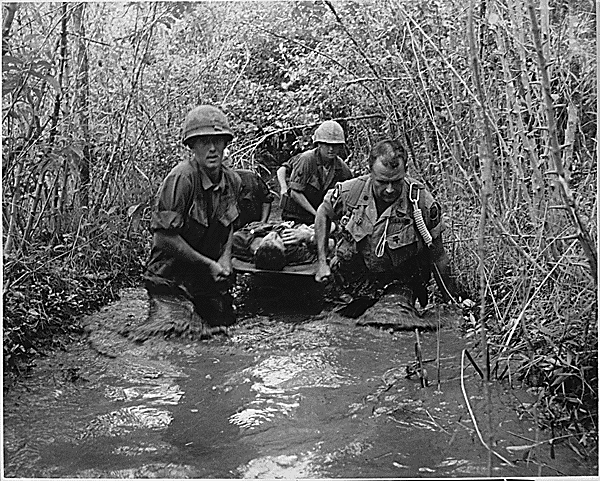
American soldiers carry a wounded comrade through a Vietnam Swamp. Photo by Paul Halverson, 1969. Image from The Veterans Hour.

It is doubtful that the commemoration is going to emphasize the fact that the U.S., led by President Dwight D. Eisenhower, used its power to prevent nationwide elections from taking place when it became clear that Ho Chi Minh would win 80% of the vote. Eisenhower acknowledged this in his memoirs. Instead, Washington allied itself to right wing forces in the southern sector to declare “South Vietnam” to be a separate state for the first time in history and set about financing, training and controlling a large southern military force to prevent reunification. The U.S. dominated the Saigon government throughout the following war.

When Paris withdrew remaining French troops in April 1956, according to John Prados in Vietnam: The History of an Unwinnable War, 1945-1975 (2009), “their departure made America South Vietnam’s big brother,” i.e., overlord and military protector against popular liberation forces in the southern half of the country.

By June 1962, 9,700 U.S. “military advisers” plus a large number of CIA agents were training and fighting to support the corrupt U.S.-backed regime in Saigon (now Ho Chi Minh City), at which time President Kennedy’s Defense Secretary, Robert McNamara, announced that “every quantitative measure shows that we’re wining the war.”

By 1968, when the number of U.S. troops attained their apogee of 535,040, Washington was obviously losing to its tenacious opponent. This is when Democratic President Lyndon B. Johnson decided not to seek reelection rather than face the humiliation of defeat. Republican President Richard M. Nixon succeeded to the presidency and vastly increased the bombings while also calling for negotiations to end the war.

Facing an impending defeat and political catastrophe, American troops pulled out in 1973. The CIA and some U.S. military personnel and political advisers remained in diminished South Vietnam assisting the right wing government in Saigon until April 1975 when the entire country was liberated.

The U.S. lost 58,151 troops in the war. Between four and five million Vietnamese civilians and soldiers were killed on both sides in a catastrophe that could have been entirely avoided had Washington allowed the free elections to take place. Over a million civilians in neighboring Laos and Cambodia also were killed or wounded by U.S. firepower.

Vietnam, north and south, was pulverized by U.S. bombs and shells. The Pentagon detonated 15,500,000 tons of ground and air munitions on the three countries of Indochina, 12,000,000 tons on South Vietnam alone in a failed effort to smash the National Liberation Front backed by the North Vietnamese army. By comparison, the U.S. detonated only 6,000,000 tons of ground and air munitions throughout World War II in Europe and the Far East. All told, by the end of the war, 26,000,000 bomb craters pockmarked Indochina, overwhelmingly from U.S. weapons and bombers.

The Pentagon also dumped 18,000,000 gallons of herbicides to defoliate several million acres of farmland and forests. Millions of Vietnamese suffered illness, birth defects, and deaths from these poisonous chemicals. The AP recently reported from Hanoi, Vietnam’s capital, that “More than 100,000 Vietnamese have been killed or injured by land mines or other abandoned explosives since the Vietnam War ended nearly 40 years ago, and clearing all of the country will take decades more.”

It should also be mentioned — since it will be suppressed during the commemoration — that U.S. forces, including the CIA and the Pentagon-controlled South Vietnamese military, tortured many thousands of “suspected” supporters of the liberation struggle, frequently with portable electrical current. An estimated 40,000 “Vietcong” (suspected members or supporters of the NLF) were murdered during the long-running “Operation Phoenix” assassination campaign conducted by the CIA, Special Forces, and killer units of the Saigon forces.

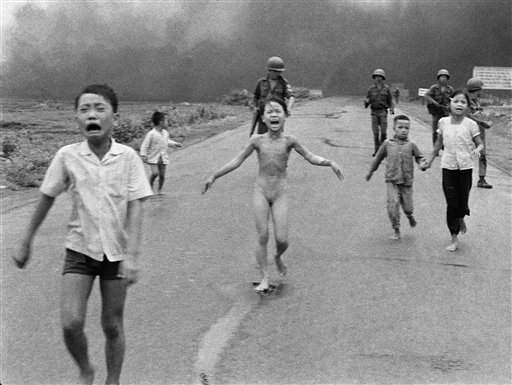
Iconic photo of crying Vietnamese children after an aerial napalm attack near near Trang Bang, Vietnam, June 8, 1972, Photo by Nick Ut / AP.

There were three main fronts in the Vietnam war, in this order: First, the battlefields of Indochina. Second, the massive antiwar movement within the United States and international support for Vietnam. Third, the Paris Peace Talks. Well over 60% of the American people opposed the war by the late 1960s-early ’70s. The first peace protest took place in 1962; the first very large protest took place in Washington in 1965. Subsequently there were thousands of antiwar demonstrations large and small in cities, towns, and campuses all over America.

[Disclosure; This writer was a war opponent and a conscientious objector during this period. His information about the war derives from when he functioned as the news editor, managing editor and then chief editor of the largest independent leftist paper in the U.S. at the time, the weekly Guardian. This publication thoroughly covered the war, peace movement, antiwar veterans (Vietnam Veterans Against the War [VVAW] was founded in 1967 and is still active today), the extraordinary resistance of active duty troops in Vietnam and at U.S. bases and COs in prison or in Canada and Europe throughout the period of conflict.]

Most of the allegations about insults directed at soldiers or vets from war opponents have been fabrications to discredit the antiwar forces — falsehoods Obama chose to repeat as part of the Pentagon’s campaign to reverse history’s negative verdict on the war in Vietnam. The peace movement’s targets were the warmakers in Washington and their allies abroad, not members of a largely conscript army. Perhaps the most notorious of the false accusations were frequent reports about antiwar individuals “spitting” at GIs and vets. The rumors were so wild that sociologist Jerry Lembcke wrote a book exposing the lies — The Spitting Image: Myth, Memory, and the Legacy of Vietnam, New York University Press, 1998.

It’s extremely doubtful that the war commemoration will dare touch honestly upon the movement of active duty troops against the war and the hundreds of cases killing their own officers.

Historian Howard Zinn included this paragraph on the opposition to the Vietnam War by American soldiers in his People’s History of the United States:

The capacity for independent judgment among ordinary Americans is probably best shown by the swift development of antiwar feeling among American GIs — volunteers and draftees who came mostly from lower-income groups. There had been, earlier in American history, instances of soldiers’ disaffection from the war: isolated mutinies in the Revolutionary War, refusal of reenlistment in the midst of hostilities in the Mexican war, desertion and conscientious objection in World War I and World War II. But Vietnam produced opposition by soldiers and veterans on a scale, and with a fervor, never seen before.

According to the Washington Peace Center:

During the Vietnam War, the military ranks carried out mass resistance on bases and ships in Southeast Asia, the Pacific, U.S., and Europe. Military resistance was instrumental in ending the war by making the ranks politically unreliable. This history is well documented in Soldiers in Revolt by David Cortright and the recent film Sir! No Sir!

One of the key reports on GI resistance was written by Col. Robert D. Heinl Jr. and published in the Armed Forces Journal of June 7, 1971. He began:

The morale, discipline and battle worthiness of the U.S. Armed Forces are, with a few salient exceptions, lower and worse than at anytime in this century and possibly in the history of the United States.

By every conceivable indicator, our army that now remains in Vietnam is in a state approaching collapse, with individual units avoiding or having refused combat, murdering their officers and non-commissioned officers, drug-ridden, and dispirited where not near mutinous. Elsewhere than Vietnam, the situation is nearly as serious.

Intolerably clobbered and buffeted from without and within by social turbulence, pandemic drug addiction, race war, sedition, civilian scapegoatise, draftee recalcitrance and malevolence, barracks theft and common crime, unsupported in their travail by the general government, in Congress as well as the executive branch, distrusted, disliked, and often reviled by the public, the uniformed services today are places of agony for the loyal, silent professions who doggedly hang on and try to keep the ship afloat.

According to the 2003 book by Christian Appy, Patriots: The Vietnam War Remembered from All Sides, Gen. Creighton Abrams — the U.S. military commander in Vietnam — made this comment in 1971 after an investigation: “Is this a god-damned army or a mental hospital? Officers are afraid to lead their men into battle, and the men won’t follow. Jesus Christ! What happened?”

Another former Army colonel in Vietnam, Andrew J. Bacevich Sr. (now a professor of international relations at Boston University and a strong opponent of U.S. foreign/military policy) wrote a book about how the U.S. military labored for a dozen years after the defeat to revamp its war strategy and tactics. (The New American Militarism: How Americans Are Seduced by War, Oxford University Press, 2005.)

One major conclusion was that a conscript army may become unreliable if the war is considered unjust in nature and unpopular at home. This is why conscription was ended for good and the Pentagon now relies on better paid professional standing military supplemented by a large number of contractors and mercenaries, who perform many duties that were once handled by regular soldiers.

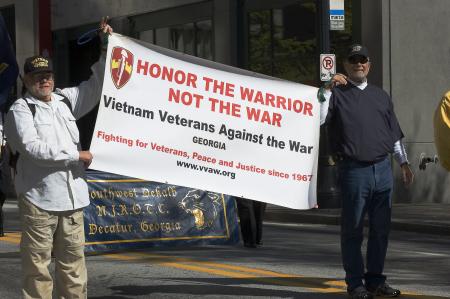
Vietnam Veterans Against the War at 2009 Atlanta Veterans Dav Parade. Photo by David Howell.

Veterans’ movements from the professional military of contemporary wars, such as Iraq Veterans Against the War and March Forward, as well as from the Vietnam era, are still out in the streets opposing imperialist wars, and public opinion polls reveal that over 60% of the American people oppose the Afghan adventure.

Despite the colossal damage the U.S. inflicted on Vietnam and its people during the war years, the country has emerged from the ashes and is taking steps toward becoming a relatively prosperous society led by the Communist Party. The Hanoi government has received no help from Washington. During the Paris Peace Talks of 1973, Nixon promised Prime Minister Pham Van Dong in writing that the U.S. would pay Vietnam $3.5 billion in reparations. This promise turned out to be worthless.

What strikes visitors to Vietnam in recent years, including this writer, is that the country appears to have come to terms with what it calls the American War far better than America has come to terms with the Vietnam War. Despite the hardships inflicted upon Vietnam, the government and people appear to hold no grudges against the United States.

Hanoi has several times extended the welcome mat to former antagonists, urging Americans and residents of southern Vietnam who now live abroad to “close the past and look to the future.” Wherever touring U.S. citizens — including former GIs — travel in Vietnam, they are met with the same respect as visitors from other countries.

In the U.S., the Vietnam war still evokes fighting words in some quarters. Some Americans still argue that the U.S. “could have won if it didn’t have one hand tied behind its back” (i.e., used nuclear weapons), and some continue to hate the antiwar protesters of yesteryear, just as they do demonstrators against today’s wars. And some others — in Congress, the White House and the Pentagon — still seem to continue fighting the war by organizing a massive propaganda effort to distort the history of Washington’s aggression and unspeakable brutality in Vietnam.

[Jack A. Smith was editor of the Guardian — for decades the nation’s preeminent leftist newsweekly — that closed shop in 1992. Smith now edits the Hudson Valley Activist Newsletter. Read more articles by Jack A. Smith on The Rag Blog.

The Rag Blog
Posted in Rag Bloggers | Tagged , , , , , , , | 32 Comments

INTERVIEW / Jonah Raskin : Paul Krassner Is Still Smokin’ at 80


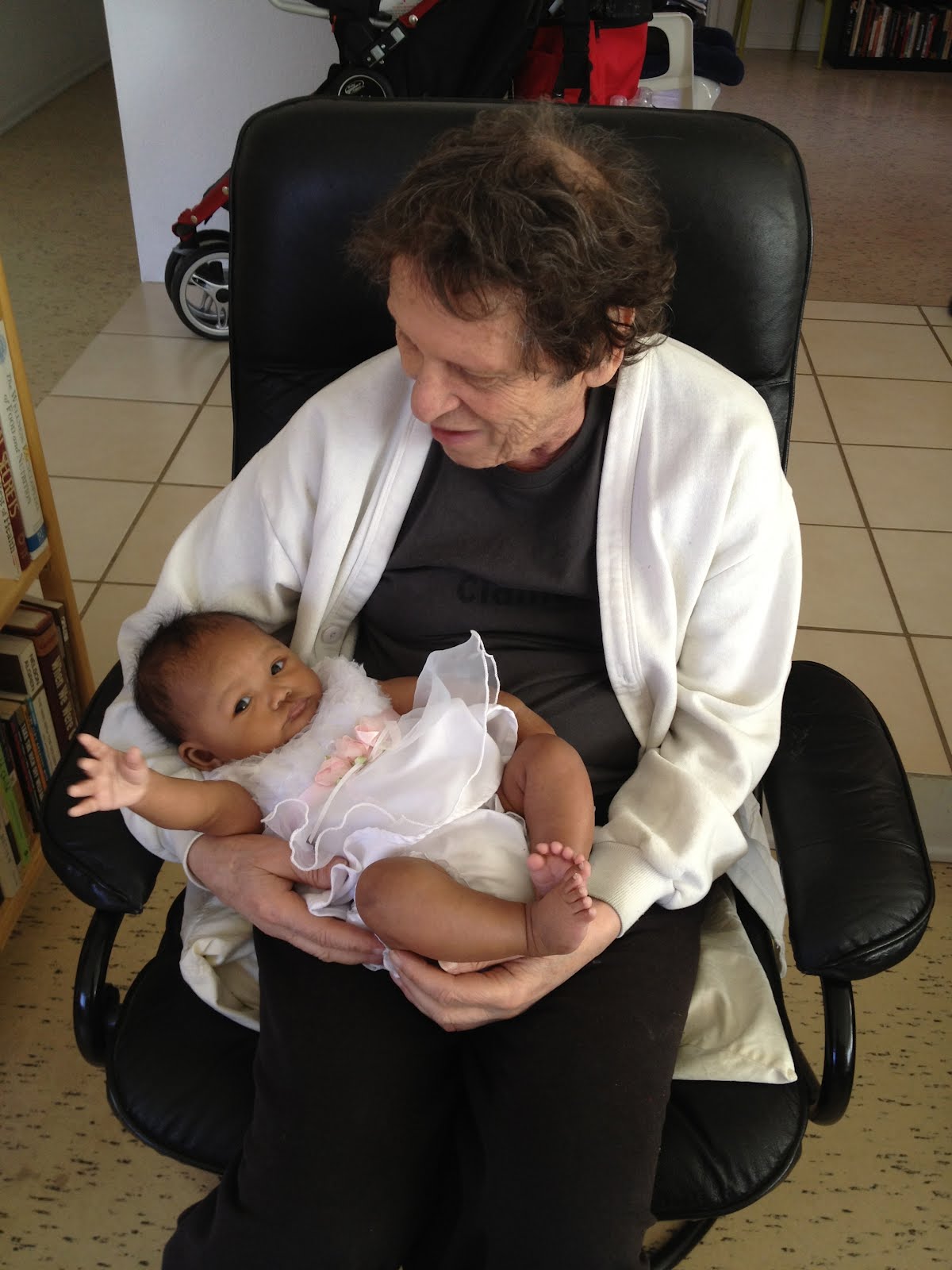
Paul Krassner at his 80th birthday party.

The counterculture was
a spiritual revolution:

A Rag Blog interview with Paul Krassner 

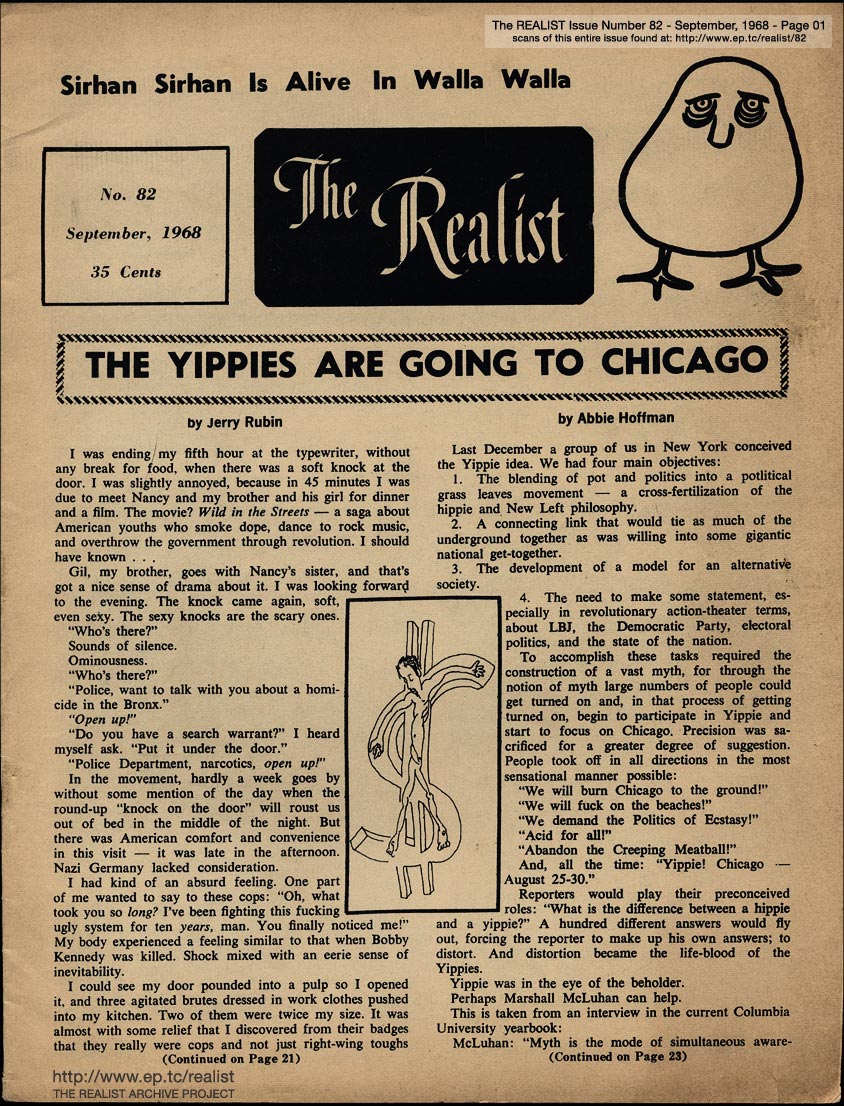
As the editor of The Realist, Krassner taught me not to take myself too seriously and not to gaze with absolute reverence at the icons of the Sixties.

By Jonah Raskin | The Rag Blog | June 7, 2012

Alive and well and still kicking, with a satirical brand of biting humor that’s right on-target and as deadly as ever, Paul Krassner is an American national treasure.

In April 2012, he celebrated his 80th birthday with his daughter and grandchild. During the first week of June, he published, in a new, updated edition, his 1999 marijuana compendium, Pot Stories for the Soul. (Soft Skull Press; $17.95).

Right about here, and now, the ethics of the profession demand that I make a full disclosure. Krassner and I belong to the vast American underground that began before 1776 and that like him is still going strong. I’m also in his new book, along with Kate Coleman, Lynn Phillips, Robert Anton Wilson, and the usual suspects: Tommy Chong, Hunter S. Thompson, Wavy Gravy, Allen Ginsberg, and more.

The provocative editor of The Realist, as well as one of the zaniest of the zany Yippies, and a founding brother of the underground press, Krassner surely needs no introduction, at least not to survivors of the Sixties, readers of The Rag Blog (to which he is a semi-regular contributor), and to lovers of political satire from any generation.

Still, it might be helpful to remind the old, the young, the in-between, and even those in the know, that Krassner belonged to Ken Kesey’s band of outlaws, the Merry Pranksters, that he testified at the Chicago Conspiracy Trial, and that he has written or edited 11 books, several of them classics of American humor: Confessions of a Raving, Unconfined Nut; The Winner of the Slow Bicycle Race; and the superlative, Who’s to Say What’s Obscene?: Politics, Culture, and Comedy in America Today.

Unafraid to poke fun at himself and unafraid to move at the pace of a turtle, not a rabbit, he has outlived many of his hilarious and deadly serious co-conspirators including Jerry, Abbie, Phil, and Stew (Rubin, Hoffman, Ochs, and Albert). As the editor of The Realist, Krassner taught me not to take myself too seriously and not to gaze with absolute reverence at the icons of the Sixties.

In 1970, when I submitted an article to The Realist about my experiences in Algeria with Eldridge Cleaver and Timothy Leary, he promptly changed my title and published it as “Eldridge & Tim & Kathleen & Rosemary.”

The previous year, moviegoers had flocked to theaters to see Paul Mazursky’s romantic comedy, Bob & Carol & Ted & Alice, with Natalie Wood, Elliot Gould, Robert Culp, and Dyan Cannon. Ads for the movie depicted the two couples in the same bed together. With a sharp eye on the sense and nonsense of pop culture and an unerring sense of satire, Krassner ran, on the cover of The Realist, a cartoon of Eldridge, Tim, Kathleen, and Rosemary in bed together.

I don’t know if they laughed, but I did, and thanks to Paul I have been laughing ever since, as much as I can, even when it hurts.

Jonah Raskin: The new, updated version of your old book is entitled Pot Stories for the Soul. Why the “the soul” and not “the head”?

Paul Krassner: It was a takeoff on the series of books entitled Chicken Soup for the Soul. I suppose if those books had been called Chicken Soup for the Head, then my book would be titled Pot Stories for the Head.

Why do you think that President Obama — a pot smoker as a teenager — is so opposed to pot now?

Fear of losing the election. Maybe Big Pharma threatened not to fund his campaign. But it’s still a mystery. After all, his position on same-sex marriages “evolved” because of the polls. The irony is that if he had been busted as a teenager, he would never have been elected president.

In the title of your book, why do you call it pot and not weed, marijuana, cannabis, or grass?

It just felt right: the rhythm and the informality.

Do you really think that pot has medicinal values, or is that concept just a stalking horse for legalization for recreational purposes?

I absolutely believe it has medicinal values, not only because of research, but also from my own experience. Even if it could only relieve stress, the cause of so much disease is stress. Medical vs. recreational is a false distinction — it’s the anti-pleasure movement in action. Nobody ever says you should drink red wine and eat dark chocolate for their medical properties, but not for enjoyment.

Is there any truth to the rumor that The Realist was published on hemp paper?

It’s a great rumor, though false, but if I had to do it all over again, it would be true.

Do you think that there’s a Yippie gene and that some are born with it and some not?

I think that every child is born with innocent irreverence, but it’s canceled by the osmosis of cultural repression. It’s retrieved by those of us fortunate enough to break through society’s brainwashing.

Few if any plants take more abuse than marijuana. Why is that? What’s so funny about marijuana?

What’s funny is that Prozac is expensive and a side effect is suicidal tendencies, whereas marijuana can be grown in your window box for free, and the “worst” side effect is the munchies.

In 1968, the Yippies called for the legalization of marijuana. It’s almost 45 years later. Why didn’t legalization happen?

The influence of anti-pot propaganda, and the fact that Richard Nixon ignored the advice of the commission that he authorized.

If pot makes you forget what would you most like to forget after taking a hit?

I’d like to forget, but can’t, that there are so many prisoners serving time, as Lenny Bruce said, “for smoking flowers.” The abuse of power without compassion extends to the injustice and inhumanity of American drones killing children in Pakistan.

I suppose at your age you don’t think pot will be legalized in your lifetime?

It’s not impossible. All the president has to do is have it removed from Schedule One of dangerous drugs. Maybe I’m just optimistic from smoking too much pot. High Times once published a questionnaire, and one of the questions was, “Is it possible to smoke too much pot?” A reader responded, “I don’t understand the question.”

Is there pot in Heaven, in Hell? Who’s more likely to smoke it: god, the goddess, the devil?

There’s pot in Heaven on Earth, not in Hell on Earth. Only the Goddess of Reefer Madness knows why it’s called Devil Weed.

Who are the leading pot smokers in your Hall of Fame?

Willie Nelson, Bill Maher, Jack Herer, Ken Kesey, Allen Ginsberg, Valerie Corral… the list goes on.

And what enforcement figures are the main figures in your Hall of Shame?

Bill Clinton, Barack Obama, Eric Holder, Ronald Reagan, the DEA, and the prison guards’ union.

In a group, how can you tell the pot smokers, growers, and smugglers on trial from the lawyers who defend them?

The defendants are the ones who supply their lawyers.

Are you stoned now?

Of course, it was on my to-do list.

Can you tell me where I can buy a righteous joint or two?

Most likely from your students.

You were born before TV, before the fax, email, the cellphone, Facebook, Google, and Twitter. Would you like to return to the golden age of radio?

I prefer to live in the present; it’s a matter of choice. I decided to quit Facebook after I reached 5,000 “friends.” It just became too much of a distraction.

What were the 1960s about, other than sex, drugs, and rock ‘n’ roll?

At its core, the counterculture was a spiritual revolution, replacing religions of control with disciplines of liberation.

What would Lenny Bruce say about pot if he were alive today?

“Hey, this shit is fucking powerful.”

[Jonah Raskin, a regular contributor to The Rag Blog, is the author of Marijuanaland: Dispatches from an American War, For the Hell of It: The Life and Times of Abbie Hoffman, and American Scream: Allen Ginsberg’s “Howl” and the Making of the Beat Generation. Read more articles by Jonah Raskin on The Rag Blog.]

The Rag Blog

Posted in Rag Bloggers | Tagged , , , , , , , , , , | 5 Comments

Ronnie Dugger : LBJ, The Texas Observer & Me

Former Texas Observer editor Ronnie Dugger with President Lyndon Johnson. Photo by Yoichi Yokamoto / Courtesy LBJ Library / Texas Observer.

LBJ, The Texas Observer & Me

None of us knew it yet, but we Americans were about to be trapped in the history that Lyndon Johnson would make.

By Ronnie Dugger / The Texas Observer / June 6, 2012

Ronnie Dugger, founding editor of The Texas Observer, will be Thorne Dreyer‘s guest on Rag Radio, Friday, June 8, from 2-3 p.m. (CDT) on KOOP 91.7-FM in Austin, and streamed live on the web. The show will be rebroadcast on WFTE in Scranton and Mt. Cobb, PA, Sunday, June 10, at 10 a.m. (EDT). After broadcast, all Rag Radio interviews are posted as podcasts at the Internet Archive.

[This article was originally published by The Texas Observer on August 21, 2008, and was reposted at The Rag Blog the next day.]

The confrontation between Lyndon Johnson on one side and The Texas Observer and me on the other arrived on its own terms at his ranch in the Hill Country in 1955.

He was the senior United States senator from Texas and the new majority leader of the Democrats in the Senate. He had developed his concept of journalism as the editor of his college paper sucking up to the college president, and by 1955 he was hell-bent on the presidency.

A group of national liberal Democrats and I, chosen as editor, had launched the Observer the preceding December. I had been editor of my high school and college newspapers, a sportswriter, columnist, an occasional correspondent for the San Antonio Express-News, and a hanger-out with Edward R. Murrow’s boys at CBS News in London when I was studying in England. Johnson was 47; I was 25.

None of us knew it yet, but we Americans were about to be trapped in the history that Lyndon Johnson would make, and I was about to be trapped in his persona and career. He was not an idealist, but he served ideals when it suited and expressed him. He was not a reactionary, but he fanned reaction when it helped him advance himself.

As I wrote in my 1982 book about him, “Lyndon Johnson was rude, intelligent, shrewd, charming, compassionate, vindictive, maudlin, selfish, passionate, volcanic and cold, vicious and generous. He played every part, he left out no emotion; in him one saw one’s self and all the others. I think he was everything that is human. The pulsing within him, his energy, will, daring, guile, and greed for power and money, were altogether phenomenal, a continuous astonishment.”

Ahead of us lay his ascension to the presidency after the assassination of John Kennedy and his calamitous Vietnam presidency, but also his presidency of Medicare, Medicaid, the Voting Rights Act, the Fair Housing Act, Head Start, federal aid for the education of the poor, bilingual education, affirmative action, and the establishment of public radio and television.

Lyndon was the driven son of an ambitious, all-empowering mother and a failed liberal politician who made it no higher than elected membership in the Texas House of Representatives. After a lot of hell-raising, Lyndon, following his mother’s lead, took $100 from his folks and enrolled at Southwest Texas State Teachers’ College in San Marcos. The 700 students there came from the farms and towns in the area. They were almost all white, only a few Mexican-American.

Already aiming to be president, Lyndon was set on getting power even in school, and having watched his father, he knew how to try and how not to try for it. Since he got not another nickel from his parents, he had to work his way through Southwest Texas, but after a stint janitoring around the campus, he simply strode into the office of Cecil Evans, the president of the school, and talked his way into a slightly better job.

Walking on campus with his cousin Ava, Lyndon divulged to her his theory of how to get ahead. “The first thing you want to do,” he told her, “is to know people — and don’t play sandlot ball; play in the big leagues …get to know the first team.”

“Why, Lyndon,” she exclaimed, “I wouldn’t dare to go up to President Evans’ office.”

“That’s where you want to start,” he told her.

“I knew there was only one way to get to know him, and that was to work for him directly,” Johnson told me later in the White House. For most of his time at Southwest Texas, he was special assistant to the president’s secretary, with his desk next to the secretary’s. This paid him $37.50 a month, but he wanted to be editor of the student paper because that would pay him another $30.

In his first signed editorial in the student paper, the College Star, Lyndon rebuked fellow students– “celebrities,” he called them — who were using the college bulletin board for personal messages. The board “must be kept free for school matters,” he wrote, of course thereby pleasing Cecil Evans. Lyndon “knew how to ingratiate himself,” as one of the English teachers there said, and when the student council made him editor of the Star, he demonstrated further that he would use the paper as a tool for personal advancement. Profiling his own boss, Lyndon wrote: “Dr. Evans is greatest as a man,” what with “his depth of human sympathy… unfailing cheerfulness, geniality, kind firmness,” and so on.

Throughout his career on the make, Johnson cottoned up to selected powerful political leaders, both accommodating and abetting them, and thus predictably becoming a favored protégé. He did this, for example, with House Speaker Sam Rayburn, President Roosevelt, and Sen. Richard Russell, as well as with business leaders such as contractors George and Herman Brown. In flattering Dr. Evans in the college paper that he edited, he was just warming up his game of protegeship through the opportunities provided him by his temporary status as a journalist.

In 1955, Rayburn and Johnson, the Democratic Party’s bosses over the two branches of the distant Congress, were gigantic figures in one-party Texas politics. The Democrats in Texas were venomously divided between the “loyal Democrats” — also called national Democrats, who generally favored the policies advanced by Roosevelt and Truman — and the reactionary governor, Allan Shivers, and his fellow segregationists and conservatives, who had total control of the state Democratic Party.

The previous October, a group of about 100 “loyal,” that is, national, Democrats in Texas, sensing that Shivers and his followers would go for Eisenhower for president in 1956 (as they did), gathered in Austin to found a liberal journal and asked me to edit it.

They knew, of course, that my views were liberal. They had some knowledge of my years of reporting on the thoroughly corrupt Texas Legislature in The Daily Texan, the student paper at the University of Texas in Austin, and my year as editor there championing racial integration, repeal of the oil depletion allowance, and other liberal causes. For a year my columns from abroad, laced with some of my policy opinions, had run in the San Antonio daily. A speech I had given to the Houston Rotary Club advocating, among other things, national health insurance, had provoked the physicians in the club to issue an outraged written objection.

Most of the liberals who had assembled in the hotel downtown, however, appeared to want a party organ, its editorial voice subordinated to the calculations of the national Democrats in Texas. My models for reporting were: the great muckrakers; Ed Murrow; James Reston. My idea of journalism included standing enough apart from government and political parties to report independently of them and to criticize any institution when that was called for. Although party organs have their place, I did not want to work on one.

Acting through Jack Strong, a lawyer in East Texas, the liberals offered me the editorship on the Friday before the Monday when I was leaving for Corpus Christi to work on a shrimp boat and jump ship in Mexico, eventually to write a novel about the Mexicans who (then as now) were wading, swimming, and drowning in the Rio Grande in search of work.

That night I batted out a long letter to the group addressed to Mrs. R.D. Randolph, one of the group’s leaders who was an heiress to the Kirby lumber fortune in East Texas, outlining what sorts of stories I would want the Observer to investigate and what sorts of editorial crusades we likely would launch, but also my position on a party organ. Addressing the group in the hotel downtown, I told them I was not interested in editing a party organ, but I would stay and edit the new journal, provided I had exclusive control of all the editorial content. The paper’s publisher could fire me at any time for any reason, but as long as I was the editor, I would determine the editorial content.

This arrangement, which protects the journalists and the journalism from politics or the business of publishing, I later, as Observer publisher until 1994, explicitly ceded to every editor who succeeded me.

Bob Eckhardt, the great legislator of my generation in Texas and soon to become one of my closest friends, told me later that a fierce debate occurred after I left the hotel. He said that Mark Adams, a New Dealer and a yeoman printer, said that “if ever a rattlesnake rattled before he struck, Dugger has.” Mark, who became my first printer at the Observer, denied saying it.

But they accepted my terms, and as we prepared to begin, I settled on a motto for the front-page masthead, Thoreau’s “The one great rule of composition is to speak the truth,” and wrote a policy credo that contained the sentence, “We will serve no group or party but will hew hard to the truth as we find it and the right as we see it.”

I had no sting out for Johnson, far from it. While a student at UT, I had worked downtown in Austin as a reporter and news announcer for his and Lady Bird’s radio station, KTBC. His senatorial office, that is, he, had helped me get a job in Washington one summer in the division of international organizations at the Department of State. Returning from abroad, I had applied unsuccessfully for a job on his Senate staff. I learned that Horace Busby, one of his top advisers, had said to him something like, “Ronnie’s not our kind of guy,” but I didn’t know that for many years.

The first year or so at the Observer, I was the only reporter and editor, and we had one subscription person. The founding group watched quietly as I did my best to begin to wreak havoc on racism, corruption, poverty, discrimination, and the rancidness of the plutocratic ideals blatted forth by the allegedly Democratic Gov. Allan Shivers.

When I reported the racial murders of two black children in Mayflower, Texas, near Tyler, I was told that one of the Observer founders, Franklin Jones Sr., a very successful plaintiff’s lawyer in Marshall, exploded profanely on seeing my photograph of the body of one of the dead children on the front page: “Here I am working my ass off getting subscriptions for the Observer, and Dugger sends us pictures of dead Negroes all over the front page.” But if Franklin did say that, or something like it, he said nothing to me.

A new Democratic National Committee member from Texas had to be chosen, and it became known that Sen. Johnson had exerted his power to achieve the selection for that honor of the reactionary and racist Lt. Gov. Ben Ramsey, who presided as the dictator over the Texas Senate to the purring pleasure, protection, and profit of every corporate fat cat in the state, the oilmen most of all. In editorials, I damned Johnson to hell and back for it.

Johnson had been opposing the Texas liberals — on Ben Ramsey, by effectively favoring conservative Price Daniel over the liberal Ralph Yarborough for governor, and in other ways — to get Texas reactionaries behind him, or at least to quiet them down, for his candidacy for president, which Rayburn and he would soon make public.

Nearly all of us at the Observer and all our readers were in agreement on a new drive to build a grassroots uprising of the liberal and populist Democrats to throw Ramsey and his ilk — Shivers, Sen. Daniel, the lot of them — into the Republican Party where they belonged. Obviously a Democratic Party answering to well-organized Democrats in the cities directly challenged and would at least diminish the boss-rule powers that Rayburn and Johnson exercised and enjoyed, and Johnson went to calling all of us involved in this organizing effort “the redhots.”

At some point that fall, with the Ramsey controversy smoking, I received a phone call that Sen. Johnson would like to see me, and would I call on him at the ranch at a certain hour on a certain afternoon. I had never been out there. After wheeling my family’s 1948 Chevrolet, which we called the Green Hornet, through the Pedernales River muscling itself shallowly over Johnson’s low-water bridge, I pulled up in front of his grand spread and saw that he was swimming in the pool, off to the right there. We greeted, nodding, and for some time I shifted from one foot to the other by the pool, feeling rather high in the air, as he continued his swim and, desultorily, we talked.


Toweling off and sitting us down on the pool furniture, cocking his long face toward me, Sen. Johnson asked me:

“Ronnie, what’s the circulation of your paper?”

“Oh, about 6,000.”

“Stick with me and we’ll make it 60,000,” Johnson said.

I knew at once what he meant. “Stick with me” meant support his policies and decisions, about Ben Ramsey and anything else, celebrate his sagacity and wisdom in all that I wrote about him, and support his presidential ambitions; “and we’ll make it 60,000” meant that in return, he would employ his standing, power, and connections to build up the Observer. The one great rule of composition would be to promote Lyndon Johnson. The Observer would be not a party organ, but a Johnson pipe organ that his nod could cause to bellow forth with Wagnerian splendor

The senior senator from Texas and the Democratic majority leader of the U.S. Senate had called me out here to propose straightforwardly that the Observer and I replace journalistic integrity with loyalty to him. He was trying to bribe me and The Texas Observer, or, if this was not to be a bribe, the deal — the secret understanding — the quid pro quo, obedient loyalty and feigned adulation in return for the other’s use of his power on your behalf, would have been not different from a bribe by a dime.

Johnson’s problem was, he would soon make public his campaign for the presidency. He knew the Observer was a novelty, conspicuous in reactionary Texas, reporting long-covered-up events and expressing unpredictable opinions; he knew that national newspeople, traipsing to and from his ranch from Austin, would often drop by the Observer offices for inside dope or just for the devilment of it, as in fact they were to do for the rest of the decade; and he knew that if his sellouts to the Texas yahoos and rednecks on the way to the White House became clear to the national Democrats, they might not nominate him for president.

My problem was how to get out of there. I could have just said, “I’m sorry, senator, no deal,” but this was not my style while practicing rebellious journalism in Texas. I extended myself and taxed my fellow Observer reporters to be fair and accurate, both in order to be fair and accurate and in self-defense, although, that done, in editorials I let miscreants and villains have it straight on.

In person, in my life day after day, I was carefully polite and civil with all parties. If I was formally polite to a fault, well, it was a kind of protective coloration. On this afternoon with Johnson, I realized that the Observer and I had been misgauged and underestimated, but that for the rest of the occasion my part was to avoid any accusative remarks or implications, any incautious, offensive, or popinjay responses, and to graciously take my leave as soon as that might appear mannerly.

Sitting there side by side on plastic chaise lounges — someone brought us cold drinks, I believe lemonades — we talked along gingerly for maybe an hour. Well, senator, it’s an honor to have met you, and I appreciate your having me out — don’t want to overstay, I’d better be getting back to town — I said something like this, starting to rise to head back to my Green Hornet.

No, he said, why don’t you stay to dinner. No trouble, Bird’ll have plenty.

Although I had nothing more to say to him, I had not said no, and he had something more to say to me.

After an interim during which nothing happened, I sat down to dinner in a half-dark chamber at the center of the Johnsons’ well-staged home with Lady Bird Johnson and Johnson’s personal secretary, Mary Margaret Wiley, who had been my managing editor in high school in San Antonio when I had edited the Brackenridge Times. Mary Margaret is a beautiful person. While I had perceived no romantic flash in our friendship and work together in high school, we admired and respected each other; I was glad she was there.

As Johnson sat down at my left at the head of his table, though, I realized, silently appalled, “My God, the subject is at hand, all I can do is explain journalism to him as if he actually doesn’t know what it is.” If the situation had not been unbelievable, it would have been incredible.

I struck forth uncertainly, as if we were dining on a pitching log, addressing only Johnson to describe, as best I could, the role of journalism, the Fourth Estate, separation from government, providing facts and explanations, democracy’s inexpendable need for an independently informed electorate. I may even have quoted Jefferson.&

I might as well have been talking to the log I was riding. Johnson said to me, No, the thing a smart young reporter does, and should do, is survey the field of candidates, pick the best one, and enter into a deal to help that one win whatever office and prevail in whatever controversy, subordinating his reporting and comment to the interests of the candidate.

Johnson was far too smart to really think that is what journalism is or should be. He was feigning adherence to a theory of journalism, a blend of his own practice on his college paper and his political strategy of protegeship upended for the advance of his juniors, that might work somewhat, with me and others, as a disguise for his use of journalists to serve his will to power.

Later it became embarrassingly clear that he had induced some of the leading reporters and columnists in Texas and the nation to make some such a deal with him or assent to some such understanding: Leslie Carpenter, William S. White, Joseph Alsop, some of the authors of those surprising articles in the big magazines in the late 1950s promoting the lanky Lyndon Johnson of Texas for president of the United States.

I remember (I am not referring, for this essay, to my notes on all of this) that neither Lady Bird nor Mary Margaret said one word all evening. Oh, perhaps one or two, but I don’t remember even one. They sat silent and still as good women of old were supposed to during an argument among the men. Yet both Bird and Mary Margaret were highly intelligent.

How strange the evening must have seemed to them, their guy trying to turn a journalist into his secretly bought public promoter, their senator and this younger guy battling over irreconcilable opinions, completely missing each other, reaching no agreement.

Many’s the time since that evening there has replayed on the stage in my mind a vivid re-seeing of what happened upon my departure that evening. I am five or six feet away from Lyndon and me, watching the two of us illuminated by the ranch-house lighting locked in animated argument in front of his house at his low wire fence, he inside the fence, I outside, our knees braced against it and each other, intensely disputing directly into each other’s faces a few inches apart, he leaning first a little into my face, and then a little more, and then so much my head is bent back, and I shift my heels backward to be able to stand up straight to him again.


My first associate editor at the Observer, Billy Lee Brammer, a reporter on the Austin daily (and later the author of the classic Texas novel The Gay Place), started showing up unbidden evenings and helping me clip the 3-foot-high mounds of the rotgut Texas daily newspapers of that era, then quit downtown and came on staff. He flourished in reporting Texas politics for us, most memorably “the Port Arthur story” and the Austin lobby’s junket for Texas legislators to the Kentucky Derby, until Johnson hired him onto his Washington staff.

The liberal Democratic organizing of the ’50s caught hold in the cities, especially in Houston and San Antonio. In the 1956 Democratic state convention, over the furious objections of Johnson and his operatives there, the delegates elected Mrs. Randolph, who had become the de facto publisher of the Observer, to the Democratic National Committee.

Four years later, favorite son Johnson trounced his opponents in Texas and swept into that year’s state convention, where he had Mrs. Randolph replaced. In one of these conventions, Mrs. Randolph told me, Johnson sent her word asking her to call on him, and when she did he asked expansively, “Well, Mrs. Randolph, what can I do for you?” She replied: “Nothing.”

Texas labor leaders Fred Schmidt and Hank Brown told me that, when they lobbied the Democrats’ Senate leader in Washington, he railed against the Observer and me, on some specified occasion with a copy of the journal on his desk. Mrs. Randolph said that when he asked her to get me to do something or other she replied, “Talk to him.” At least I could think, when for example I wrote a series of columns on the horrors of nuclear weapons, or during the Vietnam war when I ran a headline across the front page, “Will Johnson Bomb China?” that the man himself might be reading it.

During one state Democratic convention, I was running tandem some with Mark Sullivan, the Southwest bureau chief for Time-Life, for which I was a stringer. Mark and I approached Johnson on the convention floor for an interview. Johnson barked out that he wouldn’t talk to us with me there because “that boy prints lies about me.” We left him — or at least I did; I am not sure what Mark did.

That was the first and has been the only time in my life when I have directly experienced from another person the will to ruin me. The Time-Life connection was enabling me to hold up my financial end with my wife and children despite my annual Observer salary of $6,500. With this one ferocious remark to my boss at Time-Life, Johnson surely meant to kill me professionally. Deep in my convention story in the Observer, I reported the scene and what Johnson had said about me. I was deeply offended, and a year or two had to pass before my anger about it subsided. But Time-Life stood by me (in fact in 1961, after a lunch with Henry Luce, I was invited to join the staff of Time, which I did not).

In 1959, preparing a special focus for the Observer on Johnson’s candidacy for president, I asked him for an interview in Washington, and he granted it. I remember that on my way into his regal office as majority leader, I saw Mary Margaret at her desk, and we exchanged cautious smiles and slight nods when my eyes briefly met hers as I passed. The interview went well enough. This time I got the full Johnson treatment of persuasion, charm, raillery, and menace — stories, brags, ridicules of his colleagues, jokes, hands on my knees — again and again the leaning into my face.

Perhaps I should also record that, in the early 1960s when Johnson was vice president, I became a correspondent in Texas for the then-liberal Washington Post, and I intuitively suspect on the basis of the facts and context of what happened, but I have no evidence, that Johnson used his extremely close ties to that newspaper’s executives to have them eventually drop me.

The Observer never endorsed Johnson for president except in his contest with Barry Goldwater in 1964. In columns, I was for Estes Kefauver in 1956, Averell Harriman in 1960.

Except for an oblique column in the Observer full of obscurities after the confrontation at the ranch, this is the first report I have written about these events since they occurred half a century ago. Initially there was the off-the-record problem, but that’s gone now. I have not wanted to write about it, too, because how could I without being perceived as possibly self-serving? I relate them here now because the Observer editor asked me to.

In November 1965, I was one of the eight speakers who addressed the first massive demonstration against Johnson’s escalation of the Vietnam war, and afterward I typed out a copy of my speech and sent it to President Johnson (the Observer ran the text of it). Johnson had George Reedy, then his press secretary, send me a note that “the President asked me to tell you he seeks no wider war,” the first time I saw or heard him hide behind that lying bromide.

In 1967, having signed a contract with W.W. Norton for a book on Johnson, I wrote him asking him for biographical interviews and telling him that I intended a fair and accurate book worthy of the attention of serious people, and he gave me extensive interviews in the White House in late 1967 and 1968. He introduced me around the White House as “the leading liberal in the Southwest.” Discounting that as the Texas blarney it was, he had given off accusing me, or the Observer, of printing lies about him.

He tried to bring you into his field of overmastering personal power; that failing, he tried to ruin you; that failing, well, OK, he would deal with you again. In my last interview with him in the White House, on March 23, 1968, we were carrying along merrily. He was telling me a story when he suddenly interrupted himself and said, “Now, Ronnie, I’m giving you all these great stories, I want a friendly book!” I leaned forward and began, “Well, now, Mr. President — ” but he shut me off and continued with the story.

He was so charming, engaging, such an engrossing person, funny, fun to be with, such a good raconteur, I did not remember that he had said that until I was outside the White House that night. I went on back in and spoke with his press secretary then, my old friend George Christian, whom I had reported alongside years earlier in the offices of the International News Service in the Texas Capitol.

I reminded George I had told Johnson I intended to write a fair and accurate book worthy of the interest of serious people, but that during our interview that evening he had said he wanted “a friendly book.” Oh, hell, George said, you know Lyndon, he didn’t mean anything by it. Maybe George was right, but “Yes, he did,” I said, “and please tell him from me, on that point, no deal.”

The next day, I suspected pro forma in light of what had occurred, I asked that my next interview with the president be scheduled, and then I waited some days in the Hay-Adams Hotel across Lafayette Park from the White House, where I was staying. No call came. A week later Johnson quit the presidency. Another week later, he began his interviews with Doris Kearns.

The Observer maintained its integrity and its independence of Lyndon Johnson before and during his presidency. He was who and what he was, the Observer and I were what and who we were and are, and this is the story of Lyndon Johnson, The Texas Observer, and me.


[Ronnie Dugger, founding editor of the Texas Observer and, later its publisher, was also co-founder of the Alliance for Democracy. Dugger is the author of Dark Star, Hiroshima Reconsidered (World, 1967), Our Invaded Universities (W.W. Norton, 1973), The Politician: The Life and Times of Lyndon Johnson (W.W. Norton, 1982), and On Reagan (McGraw Hill, 1983), and has written for Harper’s Magazine, The Nation, The New Yorker, The Atlantic Monthly, The Progressive, and other periodicals.]

The Rag Blog

Posted in RagBlog | Tagged , , , , , , , | Leave a comment

Former Texas Observer editor Ronnie Dugger with President Lyndon Johnson. Photo by Yoichi Yokamoto / Courtesty LBJ Library / Texas Observer.

‘None of us knew it yet, but we Americans were about to be trapped in the history that Lyndon Johnson would make’
By Ronnie Dugger / August 22, 2008

The confrontation between Lyndon Johnson on one side and The Texas Observer and me on the other arrived on its own terms at his ranch in the Hill Country in 1955.

He was the senior United States senator from Texas and the new majority leader of the Democrats in the Senate. He had developed his concept of journalism as the editor of his college paper sucking up to the college president, and by 1955 he was hell-bent on the presidency. A group of national liberal Democrats and I, chosen as editor, had launched the Observer the preceding December. I had been editor of my high school and college newspapers, a sportswriter, columnist, an occasional correspondent for the San Antonio Express-News, and a hanger-out with Edward R. Murrow’s boys at CBS News in London when I was studying in England. Johnson was 47; I was 25.

None of us knew it yet, but we Americans were about to be trapped in the history that Lyndon Johnson would make, and I was about to be trapped in his persona and career. He was not an idealist, but he served ideals when it suited and expressed him. He was not a reactionary, but he fanned reaction when it helped him advance himself. As I wrote in my 1982 book about him, “Lyndon Johnson was rude, intelligent, shrewd, charming, compassionate, vindictive, maudlin, selfish, passionate, volcanic and cold, vicious and generous. He played every part, he left out no emotion; in him one saw one’s self and all the others. I think he was everything that is human. The pulsing within him, his energy, will, daring, guile, and greed for power and money, were altogether phenomenal, a continuous astonishment.” Ahead of us lay his ascension to the presidency after the assassination of John Kennedy and his calamitous Vietnam presidency, but also his presidency of Medicare, Medicaid, the Voting Rights Act, the Fair Housing Act, Head Start, federal aid for the education of the poor, bilingual education, affirmative action, and the establishment of public radio and television.

Lyndon was the driven son of an ambitious, all-empowering mother and a failed liberal politician who made it no higher than elected membership in the Texas House of Representatives. After a lot of hell-raising, Lyndon, following his mother’s lead, took $100 from his folks and enrolled at Southwest Texas State Teachers’ College in San Marcos. The 700 students there came from the farms and towns in the area. They were almost all white, only a few Mexican-American. Already aiming to be president, Lyndon was set on getting power even in school, and having watched his father, he knew how to try and how not to try for it. Since he got not another nickel from his parents, he had to work his way through Southwest Texas, but after a stint janitoring around the campus, he simply strode into the office of Cecil Evans, the president of the school, and talked his way into a slightly better job.

Walking on campus with his cousin Ava, Lyndon divulged to her his theory of how to get ahead. “The first thing you want to do,” he told her, “is to know people—and don’t play sandlot ball; play in the big leagues … get to know the first team.”

“Why, Lyndon,” she exclaimed, “I wouldn’t dare to go up to President Evans’ office.”

“That’s where you want to start,” he told her.

“I knew there was only one way to get to know him, and that was to work for him directly,” Johnson told me later in the White House. For most of his time at Southwest Texas, he was special assistant to the president’s secretary, with his desk next to the secretary’s. This paid him $37.50 a month, but he wanted to be editor of the student paper because that would pay him another $30.

In his first signed editorial in the student paper, the College Star, Lyndon rebuked fellow students—“celebrities,” he called them—who were using the college bulletin board for personal messages. The board “must be kept free for school matters,” he wrote, of course thereby pleasing Cecil Evans. Lyndon “knew how to ingratiate himself,” as one of the English teachers there said, and when the student council made him editor of the Star, he demonstrated further that he would use the paper as a tool for personal advancement. Profiling his own boss, Lyndon wrote: “Dr. Evans is greatest as a man,” what with “his depth of human sympathy . . . unfailing cheerfulness, geniality, kind firmness,” and so on.

Throughout his career on the make, Johnson cottoned up to selected powerful political leaders, both accommodating and abetting them, and thus predictably becoming a favored protégé. He did this, for example, with House Speaker Sam Rayburn, President Roosevelt, and Sen. Richard Russell, as well as with business leaders such as contractors George and Herman Brown. In flattering Dr. Evans in the college paper that he edited, he was just warming up his game of protegeship through the opportunities provided him by his temporary status as a journalist.

In 1955, Rayburn and Johnson, the Democratic Party’s bosses over the two branches of the distant Congress, were gigantic figures in one-party Texas politics. The Democrats in Texas were venomously divided between the “loyal Democrats”—also called national Democrats, who generally favored the policies advanced by Roosevelt and Truman—and the reactionary governor, Allan Shivers, and his fellow segregationists and conservatives, who had total control of the state Democratic Party. The previous October, a group of about 100 “loyal,” that is, national, Democrats in Texas, sensing that Shivers and his followers would go for Eisenhower for president in 1956 (as they did), gathered in Austin to found a liberal journal and asked me to edit it.

They knew, of course, that my views were liberal. They had some knowledge of my years of reporting on the thoroughly corrupt Texas Legislature in The Daily Texan, the student paper at the University of Texas in Austin, and my year as editor there championing racial integration, repeal of the oil depletion allowance, and other liberal causes. For a year my columns from abroad, laced with some of my policy opinions, had run in the San Antonio daily. A speech I had given to the Houston Rotary Club advocating, among other things, national health insurance, had provoked the physicians in the club to issue an outraged written objection.

Most of the liberals who had assembled in the hotel downtown, however, appeared to want a party organ, its editorial voice subordinated to the calculations of the national Democrats in Texas. My models for reporting were: the great muckrakers; Ed Murrow; James Reston. My idea of journalism included standing enough apart from government and political parties to report independently of them and to criticize any institution when that was called for. Although party organs have their place, I did not want to work on one.

Acting through Jack Strong, a lawyer in East Texas, the liberals offered me the editorship on the Friday before the Monday when I was leaving for Corpus Christi to work on a shrimp boat and jump ship in Mexico, eventually to write a novel about the Mexicans who (then as now) were wading, swimming, and drowning in the Rio Grande in search of work. That night I batted out a long letter to the group addressed to Mrs. R.D. Randolph, one of the group’s leaders who was an heiress to the Kirby lumber fortune in East Texas, outlining what sorts of stories I would want the Observer to investigate and what sorts of editorial crusades we likely would launch, but also my position on a party organ. Addressing the group in the hotel downtown, I told them I was not interested in editing a party organ, but I would stay and edit the new journal, provided I had exclusive control of all the editorial content. The paper’s publisher could fire me at any time for any reason, but as long as I was the editor, I would determine the editorial content. This arrangement, which protects the journalists and the journalism from politics or the business of publishing, I later, as Observer publisher until 1994, explicitly ceded to every editor who succeeded me.

Bob Eckhardt, the great legislator of my generation in Texas and soon to become one of my closest friends, told me later that a fierce debate occurred after I left the hotel. He said that Mark Adams, a New Dealer and a yeoman printer, said that “if ever a rattlesnake rattled before he struck, Dugger has.” Mark, who became my first printer at the Observer, denied saying it.

But they accepted my terms, and as we prepared to begin, I settled on a motto for the front-page masthead, Thoreau’s “The one great rule of composition is to speak the truth,” and wrote a policy credo that contained the sentence, “We will serve no group or party but will hew hard to the truth as we find it and the right as we see it.”

I had no sting out for Johnson, far from it. While a student at UT, I had worked downtown in Austin as a reporter and news announcer for his and Lady Bird’s radio station, KTBC. His senatorial office, that is, he, had helped me get a job in Washington one summer in the division of international organizations at the Department of State. Returning from abroad, I had applied unsuccessfully for a job on his Senate staff. I learned that Horace Busby, one of his top advisers, had said to him something like, “Ronnie’s not our kind of guy,” but I didn’t know that for many years.

The first year or so at the Observer, I was the only reporter and editor, and we had one subscription person. The founding group watched quietly as I did my best to begin to wreak havoc on racism, corruption, poverty, discrimination, and the rancidness of the plutocratic ideals blatted forth by the allegedly Democratic Gov. Allan Shivers. When I reported the racial murders of two black children in Mayflower, Texas, near Tyler, I was told that one of the Observer founders, Franklin Jones Sr., a very successful plaintiff’s lawyer in Marshall, exploded profanely on seeing my photograph of the body of one of the dead children on the front page: “Here I am working my ass off getting subscriptions for the Observer, and Dugger sends us pictures of dead Negroes all over the front page.” But if Franklin did say that, or something like it, he said nothing to me.

A new Democratic National Committee member from Texas had to be chosen, and it became known that Sen. Johnson had exerted his power to achieve the selection for that honor of the reactionary and racist Lt. Gov. Ben Ramsey, who presided as the dictator over the Texas Senate to the purring pleasure, protection, and profit of every corporate fat cat in the state, the oilmen most of all. In editorials, I damned Johnson to hell and back for it.

Johnson had been opposing the Texas liberals—on Ben Ramsey, by effectively favoring conservative Price Daniel over the liberal Ralph Yarborough for governor, and in other ways—to get Texas reactionaries behind him, or at least to quiet them down, for his candidacy for president, which Rayburn and he would soon make public. Nearly all of us at the Observer and all our readers were in agreement on a new drive to build a grassroots uprising of the liberal and populist Democrats to throw Ramsey and his ilk—Shivers, Sen. Daniel, the lot of them—into the Republican Party where they belonged. Obviously a Democratic Party answering to well-organized Democrats in the cities directly challenged and would at least diminish the boss-rule powers that Rayburn and Johnson exercised and enjoyed, and Johnson went to calling all of us involved in this organizing effort “the redhots.”

At some point that fall, with the Ramsey controversy smoking, I received a phone call that Sen. Johnson would like to see me, and would I call on him at the ranch at a certain hour on a certain afternoon. I had never been out there. After wheeling my family’s 1948 Chevrolet, which we called the Green Hornet, through the Pedernales River muscling itself shallowly over Johnson’s low-water bridge, I pulled up in front of his grand spread and saw that he was swimming in the pool, off to the right there. We greeted, nodding, and for some time I shifted from one foot to the other by the pool, feeling rather high in the air, as he continued his swim and, desultorily, we talked.


Toweling off and sitting us down on the pool furniture, cocking his long face toward me, Sen. Johnson asked me:

“Ronnie, what’s the circulation of your paper?”

“Oh, about 6,000.”

“Stick with me and we’ll make it 60,000,” Johnson said.

I knew at once what he meant. “Stick with me” meant support his policies and decisions, about Ben Ramsey and anything else, celebrate his sagacity and wisdom in all that I wrote about him, and support his presidential ambitions; “and we’ll make it 60,000” meant that in return, he would employ his standing, power, and connections to build up the Observer. The one great rule of composition would be to promote Lyndon Johnson. The Observer would be not a party organ, but a Johnson pipe organ that his nod could cause to bellow forth with Wagnerian splendor. The senior senator from Texas and the Democratic majority leader of the U.S. Senate had called me out here to propose straightforwardly that the Observer and I replace journalistic integrity with loyalty to him. He was trying to bribe me and The Texas Observer, or, if this was not to be a bribe, the deal—the secret understanding—the quid pro quo, obedient loyalty and feigned adulation in return for the other’s use of his power on your behalf, would have been not different from a bribe by a dime.

Johnson’s problem was, he would soon make public his campaign for the presidency. He knew the Observer was a novelty, conspicuous in reactionary Texas, reporting long-covered-up events and expressing unpredictable opinions; he knew that national newspeople, traipsing to and from his ranch from Austin, would often drop by the Observer offices for inside dope or just for the devilment of it, as in fact they were to do for the rest of the decade; and he knew that if his sellouts to the Texas yahoos and rednecks on the way to the White House became clear to the national Democrats, they might not nominate him for president.

My problem was how to get out of there. I could have just said, “I’m sorry, senator, no deal,” but this was not my style while practicing rebellious journalism in Texas. I extended myself and taxed my fellow Observer reporters to be fair and accurate, both in order to be fair and accurate and in self-defense, although, that done, in editorials I let miscreants and villains have it straight on. In person, in my life day after day, I was carefully polite and civil with all parties. If I was formally polite to a fault, well, it was a kind of protective coloration. On this afternoon with Johnson, I realized that the Observer and I had been misgauged and underestimated, but that for the rest of the occasion my part was to avoid any accusative remarks or implications, any incautious, offensive, or popinjay responses, and to graciously take my leave as soon as that might appear mannerly.

Sitting there side by side on plastic chaise lounges—someone brought us cold drinks, I believe lemonades—we talked along gingerly for maybe an hour. Well, senator, it’s an honor to have met you, and I appreciate your having me out—don’t want to overstay, I’d better be getting back to town—I said something like this, starting to rise to head back to my Green Hornet.

No, he said, why don’t you stay to dinner. No trouble, Bird’ll have plenty.

Although I had nothing more to say to him, I had not said no, and he had something more to say to me.

After an interim during which nothing happened, I sat down to dinner in a half-dark chamber at the center of the Johnsons’ well-staged home with Lady Bird Johnson and Johnson’s personal secretary, Mary Margaret Wiley, who had been my managing editor in high school in San Antonio when I had edited the Brackenridge Times. Mary Margaret is a beautiful person. While I had perceived no romantic flash in our friendship and work together in high school, we admired and respected each other; I was glad she was there.

As Johnson sat down at my left at the head of his table, though, I realized, silently appalled, “My God, the subject is at hand, all I can do is explain journalism to him as if he actually doesn’t know what it is.” If the situation had not been unbelievable, it would have been incredible.

I struck forth uncertainly, as if we were dining on a pitching log, addressing only Johnson to describe, as best I could, the role of journalism, the Fourth Estate, separation from government, providing facts and explanations, democracy’s inexpendable need for an independently informed electorate. I may even have quoted Jefferson. I might as well have been talking to the log I was riding. Johnson said to me, No, the thing a smart young reporter does, and should do, is survey the field of candidates, pick the best one, and enter into a deal to help that one win whatever office and prevail in whatever controversy, subordinating his reporting and comment to the interests of the candidate.

Johnson was far too smart to really think that is what journalism is or should be. He was feigning adherence to a theory of journalism, a blend of his own practice on his college paper and his political strategy of protegeship upended for the advance of his juniors, that might work somewhat, with me and others, as a disguise for his use of journalists to serve his will to power. Later it became embarrassingly clear that he had induced some of the leading reporters and columnists in Texas and the nation to make some such a deal with him or assent to some such understanding: Leslie Carpenter, William S. White, Joseph Alsop, some of the authors of those surprising articles in the big magazines in the late 1950s promoting the lanky Lyndon Johnson of Texas for president of the United States.

I remember (I am not referring, for this essay, to my notes on all of this) that neither Lady Bird nor Mary Margaret said one word all evening. Oh, perhaps one or two, but I don’t remember even one. They sat silent and still as good women of old were supposed to during an argument among the men. Yet both Bird and Mary Margaret were highly intelligent. How strange the evening must have seemed to them, their guy trying to turn a journalist into his secretly bought public promoter, their senator and this younger guy battling over irreconcilable opinions, completely missing each other, reaching no agreement.

Many’s the time since that evening there has replayed on the stage in my mind a vivid re-seeing of what happened upon my departure that evening. I am five or six feet away from Lyndon and me, watching the two of us illuminated by the ranch-house lighting locked in animated argument in front of his house at his low wire fence, he inside the fence, I outside, our knees braced against it and each other, intensely disputing directly into each other’s faces a few inches apart, he leaning first a little into my face, and then a little more, and then so much my head is bent back, and I shift my heels backward to be able to stand up straight to him again.

My first associate editor at the Observer, Billy Lee Brammer, a reporter on the Austin daily (and later the author of the classic Texas novel The Gay Place), started showing up unbidden evenings and helping me clip the 3-foot-high mounds of the rotgut Texas daily newspapers of that era, then quit downtown and came on staff. He flourished in reporting Texas politics for us, most memorably “the Port Arthur story” and the Austin lobby’s junket for Texas legislators to the Kentucky Derby, until Johnson hired him onto his Washington staff.

The liberal Democratic organizing of the ’50s caught hold in the cities, especially in Houston and San Antonio. In the 1956 Democratic state convention, over the furious objections of Johnson and his operatives there, the delegates elected Mrs. Randolph, who had become the de facto publisher of the Observer, to the Democratic National Committee. Four years later, favorite son Johnson trounced his opponents in Texas and swept into that year’s state convention, where he had Mrs. Randolph replaced. In one of these conventions, Mrs. Randolph told me, Johnson sent her word asking her to call on him, and when she did he asked expansively, “Well, Mrs. Randolph, what can I do for you?” She replied: “Nothing.”

Texas labor leaders Fred Schmidt and Hank Brown told me that, when they lobbied the Democrats’ Senate leader in Washington, he railed against the Observer and me, on some specified occasion with a copy of the journal on his desk. Mrs. Randolph said that when he asked her to get me to do something or other she replied, “Talk to him.” At least I could think, when for example I wrote a series of columns on the horrors of nuclear weapons, or during the Vietnam war when I ran a headline across the front page, “Will Johnson Bomb China?” that the man himself might be reading it.

During one state Democratic convention, I was running tandem some with Mark Sullivan, the Southwest bureau chief for Time-Life, for which I was a stringer. Mark and I approached Johnson on the convention floor for an interview. Johnson barked out that he wouldn’t talk to us with me there because “that boy prints lies about me.” We left him—or at least I did; I am not sure what Mark did.

That was the first and has been the only time in my life when I have directly experienced from another person the will to ruin me. The Time-Life connection was enabling me to hold up my financial end with my wife and children despite my annual Observer salary of $6,500. With this one ferocious remark to my boss at Time-Life, Johnson surely meant to kill me professionally. Deep in my convention story in the Observer, I reported the scene and what Johnson had said about me. I was deeply offended, and a year or two had to pass before my anger about it subsided. But Time-Life stood by me (in fact in 1961, after a lunch with Henry Luce, I was invited to join the staff of Time, which I did not).

In 1959, preparing a special focus for the Observer on Johnson’s candidacy for president, I asked him for an interview in Washington, and he granted it. I remember that on my way into his regal office as majority leader, I saw Mary Margaret at her desk, and we exchanged cautious smiles and slight nods when my eyes briefly met hers as I passed. The interview went well enough. This time I got the full Johnson treatment of persuasion, charm, raillery, and menace—stories, brags, ridicules of his colleagues, jokes, hands on my knees—again and again the leaning into my face.

Perhaps I should also record that, in the early 1960s when Johnson was vice president, I became a correspondent in Texas for the then-liberal Washington Post, and I intuitively suspect on the basis of the facts and context of what happened, but I have no evidence, that Johnson used his extremely close ties to that newspaper’s executives to have them eventually drop me.

The Observer never endorsed Johnson for president except in his contest with Barry Goldwater in 1964. In columns, I was for Estes Kefauver in 1956, Averell Harriman in 1960.

Except for an oblique column in the Observer full of obscurities after the confrontation at the ranch, this is the first report I have written about these events since they occurred half a century ago. Initially there was the off-the-record problem, but that’s gone now. I have not wanted to write about it, too, because how could I without being perceived as possibly self-serving? I relate them here now because the Observer editor asked me to.

In November 1965, I was one of the eight speakers who addressed the first massive demonstration against Johnson’s escalation of the Vietnam war, and afterward I typed out a copy of my speech and sent it to President Johnson (the Observer ran the text of it). Johnson had George Reedy, then his press secretary, send me a note that “the President asked me to tell you he seeks no wider war,” the first time I saw or heard him hide behind that lying bromide.

In 1967, having signed a contract with W.W. Norton for a book on Johnson, I wrote him asking him for biographical interviews and telling him that I intended a fair and accurate book worthy of the attention of serious people, and he gave me extensive interviews in the White House in late 1967 and 1968. He introduced me around the White House as “the leading liberal in the Southwest.” Discounting that as the Texas blarney it was, he had given off accusing me, or the Observer, of printing lies about him.

He tried to bring you into his field of overmastering personal power; that failing, he tried to ruin you; that failing, well, OK, he would deal with you again. In my last interview with him in the White House, on March 23, 1968, we were carrying along merrily. He was telling me a story when he suddenly interrupted himself and said, “Now, Ronnie, I’m giving you all these great stories, I want a friendly book!” I leaned forward and began, “Well, now, Mr. President—” but he shut me off and continued with the story. He was so charming, engaging, such an engrossing person, funny, fun to be with, such a good raconteur, I did not remember that he had said that until I was outside the White House that night. I went on back in and spoke with his press secretary then, my old friend George Christian, whom I had reported alongside years earlier in the offices of the International News Service in the Texas Capitol. I reminded George I had told Johnson I intended to write a fair and accurate book worthy of the interest of serious people, but that during our interview that evening he had said he wanted “a friendly book.” Oh, hell, George said, you know Lyndon, he didn’t mean anything by it. Maybe George was right, but “Yes, he did,” I said, “and please tell him from me, on that point, no deal.”

The next day, I suspected pro forma in light of what had occurred, I asked that my next interview with the president be scheduled, and then I waited some days in the Hay-Adams Hotel across Lafayette Park from the White House, where I was staying. No call came. A week later Johnson quit the presidency. Another week later, he began his interviews with Doris Kearns.

The Observer maintained its integrity and its independence of Lyndon Johnson before and during his presidency. He was who and what he was, the Observer and I were what and who we were and are, and this is the story of Lyndon Johnson, The Texas Observer, and me.

Click for larger image.

Ronnie Dugger, founding editor of the Observer and, later, its publisher until 1994, is the author of Dark Star, Hiroshima Reconsidered (World, 1967), Our Invaded Universities (W.W. Norton, 1973), The Politician: The Life and Times of Lyndon Johnson (W.W. Norton, 1982), and On Reagan (McGraw Hill, 1983). His work on stealing elections by manipulating computer-counted votes, beginning in The New Yorker and the Observer in 1988 and continuing since in other periodicals, initiated the reporting that predicted the potential for the current scandals and laid the foundation for needed reforms on that subject. He now works in Cambridge, Massachusetts, on books and his poetry; his e-mail is rdugger123@aol.com.

Source / Texas Observer

The Rag Blog
Source /

The Rag Blog

Posted in RagBlog | Leave a comment

BOOKS / Bill Meacham : Sam Harris’ ‘The Moral Landscape’


The Moral Landscape:
Science and human values

Harris is on to something very important here: that careful observation of what actually works has a great deal to tell us about what is good and valuable.

By Bill Meacham | The Rag Blog | June 6, 2012

[The Moral Landscape: How Science Can Determine Human Values by Sam Harris (2010: Free Press); Hardcover; Hardcover; 291 pp.; $26.99.]

In The Moral Landscape: How Science Can Determine Human Values, Sam Harris, a noted New Atheist, asks us to consider two lives:

Life A: Imagine that you are an illiterate and homeless African woman whose husband has disappeared. You have just seen your seven-year-old daughter raped and murdered at the hands of drug-crazed soldiers, and now you’re fearing for your life. Unfortunately, this is not an unusual predicament for you. From the moment you were born, your life has been marred by cruelty and violence.

Life B: Imagine that you are a respected professional in a wealthy country, married to a loving, intelligent and charismatic mate. Your employment is intellectually stimulating and pays you very well. For decades your wealth and social connections have allowed you immense personal satisfaction from meaningful work which makes a real difference in the world. You and your closest family will live long, prosperous lives, virtually untouched by crime, sudden bereavements, and other major misfortunes.

Which is the better life? We would all no doubt say Life B. Harris takes this as evidence that there is an objective way to determine what is morally good and bad. In fact, as the subtitle of the book indicates, he claims that scientific inquiry can tell us what we should and should not value.

Harris can say this because he asserts that the proper meaning of “value” with respect to human life — that is to say, the proper meaning of morality — is what leads to human flourishing, to living a good, satisfying life. Once he makes that move, the rest of his argument is straightforward and cogent.

Careful observation of what in fact fulfills people is not a matter of religious or philosophical debate; it is a matter of scientific inquiry. We can tell, objectively, what leads to happiness and what leads to misery. Facilitating good lives is what morality is about, says Harris, and that’s why science can tell us what we should value and what we should not.

As Harris says:

“[H]uman well-being entirely depends on events in the world and on states of the human brain. Consequently, there must be scientific truths to be known about it.” (p.2) “Once we see that a concern for well-being (defined as deeply and as inclusively as possible) is the only intelligible basis for morality and values, we will see that there must be a science of morality… As we come to understand how human beings can best collaborate and thrive in this world, science can help us find a path leading away from the lowest depths of misery and toward the heights of happiness for the greatest number of people.” (p.28)

There may be problems about the details, but the overall goal of peaks of happiness is quite achievable, says Harris.

Harris’ metaphor of a moral landscape is instructive. By “moral landscape,” he means the conceptual space of all possible experience. The peaks represent the heights of well-being, and the valleys the worst suffering. Different cultures and ethical practices are different ways of moving across this landscape — they can lead either up or down, and their effects are empirically knowable.

Harris notes that there is no single best way for people to live: there are many peaks in the moral landscape, not just one. Morality is here like food. There is no one best food to eat, but there is still an objective difference between poison and tasty, nutritious cuisine. Similarly, there is no one best way to live; but there is an objective, specifiable difference between circumstances, actions, and policies that lead to lives like Life A, and those that lead to lives such as Life B.

If we want a life like B, and if we want that life for others too, then we should pay attention to what scientific inquiry tells us about how to get there, and take action accordingly.

It is a striking and plausible vision. But it depends, as I said, on the initial move, which defines “moral” as that which concerns well-being (and not just human well-being, but that of all conscious creatures: “maximizing the well-being of conscious creatures… [is] the only thing we can reasonably value” (p.11)). To say that morality is exclusively concerned with well-being is a strong claim, and one which Harris does not quite pull off.

Harris certainly recognizes that it is an issue. His argument goes like this:

  1. Talk about value makes sense only for conscious creatures.
  2. Well-being is all that we can intelligibly value.
  3. Hence the only sense the concept of “value” has is the well-being of conscious creatures, and that is what morality should be concerned with.

He starts by claiming that consciousness is the only intelligible domain of value. But he does not so much argue for this proposition as deny its contrary: “I invite you to try to think of a source of value that has absolutely nothing to do with the (actual or potential) experience of conscious beings.” (p.12) Whatever such a source would be, it would by definition have no effect on the experience of any creature, and hence would be the least interesting thing in the universe.

This first premise is problematic, but the problems are not fatal for his argument. Are plants conscious creatures? No? But adequate sunlight, water, and nutrients are good for plants, and hence could be considered sources of value for the plants. How about amoebas? Adequate nutrients and water of a certain salinity are good for amoebas, that is to say, of value for amoebas.

If plants or amoebas are not conscious, yet can still be subject to things of value to them, then Harris’s first argument fails. (We could be generous here and say that “conscious” means something like “able to take into account one’s surroundings.” This would encompass plants and amoebas. But Harris does not say this.)

Harris then asserts, “the concept of ‘well-being’ captures all that we can intelligibly value. And ‘morality’… really relates to the intentions and behaviors that affect the well-being of conscious creatures.” (pp.12-13).

Again, he does not so much argue for this proposition as deny and disparage its contraries. For example, to someone who says that it is important to follow God’s law for its own sake, Harris says they are really acting out of concern for the consequences to themselves, either in this life or another. To someone who says it is important to act according to duty, fairness, justice, or some other moral principle, Harris says that this can be so only because of the consequences of doing so.

But he gives little evidence for these assertions, and in fact admits that he is defining his terms to mean this: “At bottom, this is purely a semantic point: I am claiming that whatever answer a person gives to the question ‘Why is religion important?’ can be framed in terms of a concern about someone’s well-being (whether misplaced or not).” (p.199) or “to say that we ought to treat children with kindness seems identical to saying that everyone will tend to be better off if we do.” (p.38)

There is a serious meta-ethical issue here which Harris does not adequately address. Throughout the history of philosophy there have been two competing domains of discourse regarding ethics, which have been called the Right and the Good.(1) The Right pertains to duty and obligation — the obligation to obey moral rules which are taken to be applicable universally and independent of one’s own preferences. The Good pertains to benefits and harms — that is, to the consequences of actions, which may be good or bad for the moral agent or others.

Harris is solidly in the Goodness camp, and he does an admirable job of spelling out the implications of that position, particularly the value of a careful, disciplined, objective examination of reality, in short, of science, for determining what is good and bad, beneficial and detrimental, for humans and other conscious creatures. But he only asserts that Goodness trumps Rightness — that it makes more sense or is more cogent to speak of morality in terms of benefits and harms than to speak of it in terms of duty and obligation — he does not demonstrate his thesis.

To his credit, Harris does address the use of the terms “right” and “wrong.” By right he means “factually correct or true,” and by wrong he means the opposite: “just as it is possible for individuals and groups to be wrong about how best to maintain their physical health, it is possible for them to be wrong about how to maximize their personal and social well-being.” (p.62) Thus, claims about what is good for humans and other conscious creatures can be right or wrong in the sense of being true or false.

So far, so good; but then Harris says that there are “right and wrong ways to move from our current position on the moral landscape toward one peak or the other…” (p.74) Now the term “right” usually connotes one-and-only: there is one right answer to the question “What is 37 times 42?,” and many wrong ones.

To say that there are right ways (plural) to move could connote several morally-acceptable methods to get to a happiness peak, but this does not fit the usual concept of rightness. No doubt what Harris really means is that there are more and less workable methods for moving up the landscape to a peak of flourishing.

But what about this? “We care more about creatures that can experience a greater range of suffering and happiness — and we are right to…”(p. 198) On Harris’ definition of “right” this should mean that caring more about creatures with a greater range of experience is a reliable way to increase our well being. Perhaps it is, but Harris does not make that argument. Instead he equivocates, using the term in a way that in common usage refers to adherence to a moral law.

The most problematic passage is this: “physicians have a moral obligation to handle medical statistics in ways that minimize unconscious bias” (p.143). How does he get from the observable fact that minimizing bias has good effects, to saying the we have a moral obligation to do so?

Unless we radically redefine what we mean by “obligation,” we are not morally obliged to minimize harm in Harris’s view. Instead, we are merely better advised to do so. Harris wants to redefine the concept of “moral obligation” in terms of probable benefits and harms, but he does not make the argument for doing so clearly enough.

It is certainly easy to confuse the notions of Right and Good because both are used to evaluate, recommend, command, or prohibit policies or courses of action. Despite his best efforts, Harris here falls into that confusion and strays from the paradigm in which his argument makes the most sense — the Goodness paradigm.

Even within the Goodness paradigm, he does not successfully make the move he wants to make — to the value of a concern, not just for one’s own self, or for all humans, but for conscious beings generally.

It is clear that a thoughtful and intelligent concern for one’s own well-being would lead one to take actions intended to increase that well-being, and careful observation of what works and what doesn’t would tend to increase one’s skill in doing so. One of the things we observe is that we do not live in isolation: “Our own happiness requires that we extend the circle of our self-interest to others — to family, friends, and even to perfect strangers whose pleasures and pains matter to us” (p.57).

But what about perfect strangers whose pleasures and pains do not matter to us? And what about dolphins, whales, chimps, elephants, dogs and cats, ants, termites and microbes? (Again, where do we draw the line about which ones are conscious?) It is not at all clear why, starting from a desire to enhance one’s own well-being, we should move to a concern for the well-being of conscious creatures generally. A premise is missing.

The missing premise might be something like an assertion of connectedness among all beings, such that an injury to one is in some sense an injury to all. But Harris does not assert such a premise. Instead he universalizes the concern for one’s own well-being, presumably because of the Kantian belief that moral premises should be consistent and generalizable. But he does not make that move explicit either.

Despite its flaws, at least half this book is worthwhile reading indeed. A quarter, the rant on religion, which takes up a whole chapter, is mere recapitulation of points made elsewhere by Harris and others. Another quarter, the chapter on belief and brain structure, is intriguing and germane, but lacking in some important details. One hopes for a whole book on the subject. As is usual in books like these, the bibliography provides fertile territory for further research.

I do not want to be overly harsh. Harris is on to something very important here: that careful observation of what actually works has a great deal to tell us about what is good and valuable. Thus despite not demonstrating the book’s central premise, Harris provides a thought-provoking and highly readable account of a topic of great relevance: how we can survive and thrive in a world of increasing confusion and complexity.

[Bill Meacham is an independent scholar in philosophy. A former staffer at Austin’s 60s underground paper, The Rag, Bill received his Ph.D. in philosophy from the University of Texas at Austin. Meacham spent many years working as a computer programmer, systems analyst, and project manager. He posts at Philosophy for Real Life, where this article also appears. A version of this review was published in Philosophy Now magazine, Issue 90. Read more articles by Bill Meacham on The Rag Blog.]

Notes
(1) Abraham Edel, ‘Right and Good’, Dictionary of the History of Ideas. On-line publication, originally at etext.lib.virginia.edu, now archived at http://www.bmeacham.com/whatswhat/OP/Edel_RightAndGood.htm.


References
Harris, Sam. The Moral Landscape: How Science Can Determine Human Values. New York: Free Press, 2010. 291 pages, ISBN 978-4391-7121-91

The Rag Blog

Posted in Rag Bloggers | Tagged , , , , , , | Leave a comment

Bill Freeland : The Marx Brothers Are Reforming Public Education

Graphic by Bill Freeland / The Rag Blog.

The Marx Brothers are
reforming public education

Hilarious, but as Groucho himself might have observed, the joke’s on us!

By Bill Freeland / The Rag Blog / June 6, 2012

CONCORD, New Hampshire — While the relentless right-wing war on everyone else’s rights rages on, you may yearn for a moment of comic relief.

To wit I offer the great state of New Hampshire where, with the help of the reincarnated Marx Brothers, its Tea Party-dominated legislature is determined to “reform” the state’s public education system.

But more than that, what follows is, in fact, a microcosmic glimpse of a movement growing in strength all across the nation.

  1. Start with a bill that no longer makes public school attendance a requirement for any student. (Parents rule!)
  2. If, however, a student actually wants to go to public school, at least postpone the trauma by killing off kindergarten. (All they really need is Sesame Street, right?)
  3. But once in school, what if parents disagree with what’s taught — like, say, that the earth goes around the sun? Give them the right to demand a special curriculum. (Science is for sissies!)
  4. Of course, they might not like that curriculum either and decide on a private school. In that case why should they pay taxes to support the public school their child no longer attends? (Tax refund!)
  5. But imagine if a student foolishly stays in public school. Then at least we can lower the dropout age. (More time to prepare for a career at McDonald’s.)
  6. And what about the millions in education dollars the state gets from the federal “No Child Left Behind” program? Send it back! (The feds can surely find better uses for all that money than we can.)
  7. And to make things really simple, why not transfer all rule-making authority from the state’s Department of Education to the legislature. (Obviously that’s where the real experts on our schools reside.)

Hilarious, but as Groucho himself might have observed, the joke’s on us! Because incredibly, bills designed to do all of this and more have been introduced in the New Hampshire legislature in just the last 18 months alone.* And not just in New Hampshire but across the country. (Still laughing?)

Who cares if only bill number three has actually become law. (Apparently there are still enough grownups in the state Senate to rein in the 10-year-olds now running the state House.) But they’re working on more. Much more!

For example, on May 16 the legislature authorized the transfer of up to $130 million of public school funds to private and religious schools over 10 years in the form of tax credits to businesses that provide “scholarships” for students who attend these schools.

These scholarship dollars will be deducted from state funding for the school districts from which these students withdraw. Which means local property taxes will make up for the loss. Or not. The measure passed with a veto-proof majority.

Of course, why pass mere laws when you can do something more substantial, like changing the state constitution!

Under a proposed amendment now under consideration (CACR 12), for example, it would no longer be the state’s responsibility to provide New Hampshire children an adequate public education. Which means that the legislature could change the rules and just, you know, decide to leave it all up to local municipalities — including funding — regardless how poor a given community might be. (Shared responsibility? Where do you think you are, Massachusetts!)

So between this amendment and the 50 measures lawmakers introduced during the past year, the direction is clear: starve public schools while subsidizing private and religious schools, even home schooling.

But here’s the point: This push is not coming primarily from people within the state. Lawmakers are responding to some 20 national organizations — like the Cato Institute, ALEC (American Legislative Exchange Council) and FreedomWorks. And these organizations are not just operating in New Hampshire. They have public education in their sights in state houses across the country.

This school year is nearly over. But the fight to make the next year better for our children continues. Which means it’s time we all do some homework — and then do some real work — in our local communities!

*To read the bills cited above simply Google “N.H. bill” plus the appropriate number: 1) HB595, 2) HB631, 3) HB542, 4) SB340, 5) HB429, 6) HB1413 and 7) HB1360. For the constitutional amendment, see: CACR 12.

[In the Sixties, Bill Freeland was a contributor to The Rag in Austin and Liberation News Service in New York. Read more articles by Bill Freeland on The Rag Blog.]

The Rag Blog

Posted in Rag Bloggers | Tagged , , , , | 1 Comment

Beyond Citizens United:
Politics Is an Industry, Not Just A Campaign

By Danny Schechter / The Rag Blog / June 5, 2012

NEW YORK — In theory, American elections traditionally get going after Labor Day, but, as we can see by the daily overkill media “coverage,” polls and constant reporting about who has raised what — to the degree that anyone really knows in the age of Super PACS — that the political horses for the 2012 are off and running.

Lots of the “analysis” seems absurd on its face even as everyone who follows politics knows it’s much too early to spot key trends. The race will tighten with what happens in October crucial. Example: the recent survey that found — voila — “cell phone users prefer Obama; landline users like Romney.” All of this reflects the obsession the press and its senior wise men have on reporting domestic politics over all other issues. They are like sports fanatics in this respect.

The candidates have been in motion for years. It‘s known as the “permanent campaign,” an idea attributed to one of Jimmy Carter’s advisors, Pat Cadell, who said in 1979 that just because you have been elected doesn’t mean you stop campaigning.

He wrote in his “Initial Working Paper on Political Strategy” that “it is my thesis governing with public approval requires a continuing political campaign.”

Journalist Sidney Blumental, before he joined the Clinton White House, wrote The Permanent Campaign in 1980, revealing that political parties were dead and had been replaced by political consultants and other campaign professionals. (Disclosure: I helped get the book published by Beacon Press.)

In other words, politics had changed fundamentally: the old style bosses were out and a new style media-driven system was in. Politics had also become a business with a whole retinue of advertising specialists, market researchers, and pollsters.

Today, political journalist Joe Hagen labels this new army of experts for hire a “presidential electoral complex” — almost on the same scale as the military industrial complex.

Their advice does not come cheap, with the tail today wagging the dog. Any serious candidate hires his team and then has to raise millions to pay for it. When politics spawned a profession, the big money that’s transformed politics no longer went just to candidates but to the industry around them.

They also developed a stake in fostering polarization and continuing crisis so that their counsel will be solicited more often. Increasingly political campaigns were run like military commands with centralized top-down direction, defensive and offensive strategies and tactics, as well as psychological warfare. The campaign gurus are well schooled in the techniques of perception management.

This industry is bipartisan with hired guns always shopping for the best deal irrespective of party. One time dirty trickster Roger Stone who worked first for Richard Nixon ended up advising everyone from Al Sharpton to Donald Trump, to Libertarian Gary Johnson.

Some of these advisors step over the legal line — like GOP operative Alan Raymond — but few get caught.

The New York Times reported that, in New Hampshire’s hotly contested 2002 Senate race, Democratic get-out-the-vote phone banks were jammed with incoming calls on Election Day. The Republican John Sununu, won reelection by under 20,000 votes, and Allen Raymond, a Republican Party operative, went to jail for his role in the jamming.

Mr. Raymond has now written a book about his experiences, How to Rig an Election: Confessions of a Republican Operative. In it, he paints a picture of the corruption of modern politics that should leave no doubt about the creativity and cynicism of operatives like Mr. Raymond or the need for tough new election-reform legislation.

Wikipedia had two other examples of the focus on permanent campaigns:

A famous example that illustrates just how strongly this mind-set has come to influence politics was during the Clinton Administration when pollster Dick Morris asked voters to help decide where Bill Clinton would go on vacation. In the words of columnist Joe Klein, “The pressure to ‘win’ the daily news cycle — to control the news — has overwhelmed the more reflective, statesmanlike aspects of the office.”

(After getting caught in a sex scandal, Morris was fired by Clinton and later resurfaced as a pundit at Fox News.)

Scott McClellan, former White House Press Secretary for U.S. President George W. Bush, wrote in his 2008 memoir What Happened: Inside the Bush White House and Washington’s Culture of Deception that the Bush White House suffered from a “permanent campaign” mentality, and that policy decisions were inextricably interwoven with politics.

Many of the press secretaries and campaign managers work hard to contain mistakes. The bookshelves are filled with advice about how to do that.

This is from an email promoting interviews with a campaign expert turned author:

“Every word and action on the campaign trail from a televised debate to a town meeting, to an innocent question from a voter to a pointed question from the media… all of these daily events call for immediate, strategic communication. “Any blunder should be a wake-up call: communication has power. But as with any form of power, it needs to be harnessed effectively or it can all too often backfire.

“This year’s primaries were riddled with missteps and over-reaching. As the focus shifts from primaries to the general elections, Romney will have to walk the line between connecting to the audience and pandering. On the other hand, President Obama will be less under scrutiny for potential gaffes, but more for his inattention to issues that are brewing, followed by a dramatic game-changing address. However, this can all change in a split-second, as proven by the undeniable power of word choice,” comments Fred Garcia, President of the crisis management firm Logos Consulting Group and the Executive Director of the Logos Institute for Crisis Management and Executive Leadership.

Garcia, who teaches now at NYU, discusses strategies that might be useful in a new book on the Power of Communication, or is it manipulation?:

  • Leaders are judged on the fulfillment of expectations. Leaders must resist saying what merely sounds good in the moment and creating a say-do gap.
  • The only reason for communication is to change something — to influence the way audiences think and feel. Before you communicate, know what it is you want to change.
  • Facts do not speak for themselves. If we speak only facts, the audience will either not pay attention to those facts or will provide their own context to make sense of the facts, which could trigger a negative frame.
  • Communication is a continuation of business by other means. You need to engage your audience to enhance your position, thereby improving your competitive advantage.
  • Leaders must conquer the first mover advantage — a maneuver that prevents critics and adversaries from framing the situation. This has become increasingly more important in today’s world of social media.

    This same techniques are also used to sell war, as Mother Jones reported: “as long as the United States appears to be on the move against foreign adversaries, the question of whether any action is actually taken becomes of secondary interest. As Blumenthal suggested two decades ago, results and concrete proposals are less important than perception and image.”

    Even as Blumenthal was partial to Hillary Clinton who hired him for her unsuccessful primary campaign in 2008, The Economist noted that his description of a permanent campaign soon became President Obama’s prescription:

    Mr. Obama is currently deploying the formidable resources he built up during his campaign — including contact details for 10m donors, supporters and volunteers — to sell his policies. David Plouffe, the man who managed Mr. Obama’s presidential campaign, has sent millions of e-mails to encourage them to support the White House’s agenda.

    One of them contains as good a definition of the permanent campaign as any: “In the next few weeks we’ll be asking you to do some of the same things we asked of you during the campaign — talking directly to people in your communities about the president’s ideas for long-term prosperity.” Another, which includes a video of the president, asks supporters to put pressure on their congressman to pass Mr. Obama’s budget, by calling his or her office and reciting a little pro-Obama speech.”

    The Republicans have learned these lessons too and now have more money than Democrats to invest in them. Politics is now a growing industry with money and politics more joined at the hip than ever and an interest in keeping the big money flowing into its bank account.

    [News Dissector Danny Schechter blogs at Newsdissector.net. His recent books are Occupy: Dissecting Occupy Wall Street and Blogothon (Cosimo Books). He hosts News Dissector Radio on PRN.fm Fridays at 1 p.m. His latest film is Plunder: The Crime of Our Time. Email Danny at dissector@mediachannel.org. Read more articles by Danny Schechter on The Rag Blog.]

    Type rest of the post here

    Source /

    The Rag Blog

    Posted in RagBlog | Leave a comment

    Harry Targ : The Ideology of U.S. Hegemony in the Hemisphere

    Indiana Senator Albert Beveridge articulated what was to become the new ideology of American empire. Image from the Library of Congress.

    The ideological dimension:
    U.S. Hegemony in the Western Hemisphere

    In relations with Latin America, and particularly Cuba, policy has been built upon economic interest, geopolitics, and ideology.

    By Harry Targ | The Rag Blog | June 6, 2012

    [The following article by Harry Targ is adapted from a presentation to be given at a conference co-sponsored by the Radical Philosophy Association and the University of Havana in Cuba between June 18 and 22. Revisiting the remarks of key foreign policy elites from the 1890s until now suggests the commonality of outlook that pervades how the United States views the Global South and particularly Cuba. Ironically not much has changed in that outlook.]

    U.S. policymakers believe and/or propagate various illusions or rationales for United States foreign policy that become part of common political discourse. In relations with Latin America, and particularly Cuba, policy has been built upon economic interest, geopolitics, and ideology.

    The ideological discourse justifying U.S. hegemony in the Western Hemisphere can be traced back to the nineteenth century. Its modern exposition is surprisingly similar to significant declarations by foreign policy elites during the era of the Cuban war against Spanish colonialism.

    For example, shortly after the U.S. victory in the Spanish/Cuban/American war, Indiana Senator Albert Beveridge articulated what was to become the new ideology of American empire linking economics to Godly purpose:

    “We will establish trading posts throughout the world as distributing points for American products… Great colonies, governing themselves, flying our flag and trading with us, will grow about our posts of trade, And American law, American order, American civilization, and the American flag will plant themselves on shores hitherto bloody and benighted.” (in Greg Jones, Honor in the Dust: Theodore Roosevelt, War in the Philippines, and the Rise and Fall of America’s Imperial Dream, 2012, 93)

    In a campaign speech in Indianapolis, Beveridge articulated a spiritual call and rationale for a global policy that transcended mere economic gain. America’s destiny required the U.S. “…to set the world its example of right and honor…We cannot retreat from any soil where providence has unfurled our banner. It is ours to save that soil, for liberty, and civilization” (in Jones, 96). And speaking before the Senate justifying the colonization of the Philippines he proclaimed a U.S. mission that transcended politics:

    “It is elemental… it is racial. God has not been preparing the English-speaking and Teutonic peoples for a thousand years for nothing but vain and idle self-contemplation and self-admiration. No! He has made us the master organizers of the world to establish system where chaos reigns. He has given us the spirit of progress to overwhelm the forces of reaction throughout the earth.” (Congressional Record, 56 Congress, I Session, pp.704-712)

    Within a few years of the U.S. colonization of Cuba and the Philippines, President Theodore Roosevelt elaborated on the U.S. world mission. He spoke of the necessity of promoting peace and justice in the world: a project that required adequate military capabilities both for “securing respect for itself and of doing good to others.”

    To those who claim that the United States seeks material advantage in its activist policy toward the countries of the Western Hemisphere, Roosevelt responded that such claims were untrue. The U.S., he said, is motivated by altruism: “All that this country desires is to see the neighboring countries stable, orderly, and prosperous. Any country whose people conduct themselves well can count upon our hearty friendship.”

    Cuba was an example, he said:

    “If every country washed by the Caribbean Sea would show the progress in stable and just civilization which with the aid of the Platt Amendment Cuba has shown since our troops left the island, and which so many of the republics in both Americas are constantly and brilliantly showing, all questions of interference by the Nation with their affairs would be at an end.”

    He assured Latin Americans in this address to Congress in 1904 that if “…they thus obey the primary laws of civilized society they may rest assured that they will be treated by us in a spirit of cordial and helpful sympathy. We would interfere with them only in the last resort…” (“Roosevelt Corollary to the Monroe Doctrine,” President’s Annual Message to Congress, December 6, 1904).

    During a presentation in Norway in 1910 Roosevelt praised the U.S. for leaving Cuba as promised after the war to return only temporarily because of …a disaster…a revolution” such that “…we were obliged to land troops again.”

    The President proudly declared that:

    “And before I left the Presidency Cuba resumed its career as a separate republic, holding its head erect as a sovereign state among the other nations of the earth. All that our people want is just exactly what the Cuban people themselves want — that is, a continuance of order within the island, and peace and prosperity, so that there shall be no shadow of an excuse for any outside intervention.” (“The Colonial Policy of the United States,” an Address Delivered at Christiania, Norway, May 5, 1910)

    Earlier on January 18, 1909, to the Methodist Episcopal Church (“The Expansion of the White Races”) throughout the world. The indigenous peoples of the Western Hemisphere have been assimilated with their “intruders” with the end result “that the Indian population of America is larger today than it was when Columbus discovered the continent, and stands on a far higher plane of happiness and efficiency.”

    And to highlight the missionary message Roosevelt added:

    “Of course the best that can happen to any people that has not already a high civilization of its own is to assimilate and profit by American or European ideas, the ideas of civilization and Christianity, without submitting to alien control; but such control, in spite of all its defects, is in a very large number of cases the prerequisite condition to the moral and material advance of the peoples who dwell in the darker corners of the earth.”

    Before the reader dismisses these simplistic, racist statements, it is useful to examine more recent proclamations of the motivations for United States foreign policy, particularly toward Latin America. It is worth remembering that recent U.S. presidents, including Barack Obama, quote favorably from the words of Theodore Roosevelt on various subjects.

    For example, in March, 1961, and clearly as a response to the Cuban revolution, President John Kennedy announced the creation of a new “Alliance for Progress” in Latin America, “a vast cooperative effort, unparalleled in magnitude and nobility of purpose, to satisfy the basic needs of the American people for homes, work, and land, health and schools.”

    The Alliance was to be a 10-year program of social and economic development that would transform the hemisphere “into an historic decade of democratic progress.” Representatives of participating countries would prepare plans for their own development that would “establish targets and priorities, insure monetary stability, establish the machinery for vital social change, stimulate private activity and initiative, and provide for a maximum national effort.”

    JFK promised U.S financial contributions to stimulate economic reform and in the end transform “the fragmentation of Latin American economies.” The variety of programs — education, land reform, tax reform — would rebuild the region.

    The United States also pledged its assistance to those countries whose independence might be threatened. And, of course, the President proclaimed that the United States supports an alliance of free governments and will work to eliminate “tyranny.” JFK expressed “our special friendship to the people of Cuba and the Dominican Republic and the hope they will soon rejoin the society of free men…”

    Sixty years after the proclamations of Teddy Roosevelt the United States remained committed to offer the blessings of freedom and democracy to the peoples of Cuba. (President John F. Kennedy, “Preliminary Formulations of the Alliance for Progress,” March 13, 1961)

    Twenty-two years later President Reagan again underscored the U.S. presumption of its special role in the Hemisphere, restating the U.S. role more in the language of Roosevelt than the subtler Kennedy. The speech was presented at a gathering of Cuban-Americans. Reagan praised assembled Cuban-Americans, such as Jorge Mas Canosa, who came to the United States motivated by a passion for liberty.

    Reagan spoke of descendants of pioneers and emigrants from various locales who started “fresh” in the “New World”; people who “share the same fundamental values of God, family, work, freedom, democracy, and justice.” (“Perhaps the greatest tie between us can be seen in the incredible number of cathedrals and churches found throughout the hemisphere. Our forefathers took the worship of God seriously.”)

    Reagan then warned of the “new colonialism that threatens the Americas.” This, of course, was represented by the revolutionary government of Nicaragua, the revolutionaries fighting against dictatorship in El Salvador, and the enduring threat to freedom, Cuba.

    In the latter, the independent labor movement was destroyed in 1959, churches suppressed, all free speech eliminated, and young Cubans sent to faraway places to defend unpopular regimes. And remembering the sacrifices of the United States in the Cuban war against Spanish colonialism, Reagan regretted that “Cuba is no longer independent.” He promised that “we will not let this same fate befall others in the hemisphere…”

    After endorsing 1980s policies such as the Caribbean Basin Initiative and Radio Marti President Reagan reminded his audience of the perpetual burden Americans face in defending freedom. He quoted Teddy Roosevelt: “We, here in America, hold in our hands the hope of the world, the fate of the coming years; and shame and disgrace will be ours if in our eyes the light of high resolve is dimmed, if we trail in the dust the golden hopes of men.”

    And Reagan ended: “finally, let us pledge ourselves to meet this sacred responsibility. And let us pledge ourselves to the freedom of the noble, long suffering, Cuban people.” (“Text of President Reagan’s Speech on Threat to Latin America, New York Time, May 21, 1983)

    President Obama’s opening remarks at the Summit of the Americas (April 14, 2012) were different in tone than those cited above. He celebrated economic development in the region, encouraged continued economic globalization, praised the growth of Latin American nations such as Brazil and Colombia proving that “a lot of the old arguments on the left and the right no longer apply.”

    The challenge for the future, he said, was to continue distributing the benefits of globalization to more and more people and “giving businesses opportunities to thrive and create new products and new services and enjoy the global marketplace.”

    The President called on the Hemisphere nations to continue training people to compete in the global economy, stimulate trade, establish more mutually beneficial trade agreements like the one he signed with the President of Colombia, become more energy efficient, and promote education.

    He concluded with some of the more traditional presidential language, albeit in less than messianic terms, about core principles of governance: “democracy and rule of law, human rights being observed, freedom of expression.” In addition, he mentioned “personal security, the capacity for people to feel as if they work hard then they’re able to achieve, and they have motivation to start a business and to know that their own work will pay off.”

    President Obama emphasized the connections between “clean, transparent open government that is working on behalf of its people.” These features, he said, were important for business.

    “The days when a business feels good working in a place where people are being oppressed — ultimately that’s an unstable environment for you to do business. You do business well when you know that it’s a well-functioning society and that there’s a legitimate government in place that is going to be looking out for its people.”

    With that said, Obama praised both the governments of Colombia and Brazil.

    The Obama comments at the opening Summit of the Americas in 2012, more paralleling the language of President Kennedy’s Alliance speech than the missionary statements of Beveridge, Roosevelt, and Reagan, still suggest that the United States, and some Latin American political and economic elites, reflect the interests and values of the masses of Latin America’s citizens.

    All the speeches offer a common standard to judge what is best for the vast majorities of the peoples of the Hemisphere; whether the region is moving toward or away from God, Democracy (defined in very selective ways), and Markets. And, whether stated or implied, the polar opposite of this standard is most starkly represented by the Cuban revolution.

    [Harry Targ is a professor of political science at Purdue University who lives in West Lafayette, Indiana. He blogs at Diary of a Heartland Radical — and that’s also the name of his new book which can be found at Lulu.com. Read more of Harry Targ’s articles on The Rag Blog.]

    The Rag Blog

    Posted in Rag Bloggers | Tagged , , , , , | Leave a comment

    Peter Dreier : How the Big Bucks Won in Wisconsin


    Walker spent 88% of the money
    to get 53% of the vote

    The real winner in Wisconsin on Tuesday was not Gov. Scott Walker, but Big Money. And the real loser was not Milwaukee Mayor Tom Barrett, but democracy.

    By Peter Dreier / Reader Supported News / June 6, 2012

    Here’s a headline you won’t see, but should: “Scott Walker Spent 88% of the Money to Get 53% of the Vote.”

    Political pundits will spend the next few days and weeks analyzing the Wisconsin recall election, examining exit polls, spilling lots of ink over how different demographic groups — income, race, religious, union membership, gender, party affiliation, independents, liberals/conservatives/moderates, etc. — voted on Tuesday.

    But the real winner in Wisconsin on Tuesday was not Gov. Scott Walker, but Big Money. And the real loser was not Milwaukee Mayor Tom Barrett, but democracy.

    Walker’s Republican campaign outspent Barrett’s Democratic campaign by $30.5 million to $4 million — that’s a 7.5 to 1 advantage. Another way of saying this is that of the $34.5 million spent on their campaigns, Walker spend 88% of the money.

    Walker beat Barrett by 1,316,989 votes to 1,145,190 votes — 53% to 46% (with 1% going to an independent candidate).

    Here’s another way of saying that: Walker spent $23 for each vote he received, while Barrett spent only $3.47 per vote.

    But the reality is even worse than this, because the $34.5 billion figure does not include so-called independent expenditures and issue ads paid for primarily by out-of-state billionaires (like the Koch brothers, Sheldon Adelson, and Joe Rickets), business groups, and the National Rifle Association, which were skewed even more heavily toward Walker.

    Once all this additional spending is calculated, we’ll see that total spending in this race could be more than double the $34.5 billion number, that Walker and his business allies outspent Barrett by an even wider margin, and that he had to spend even more than $23 for each vote.

    In other words, business and billionaires bought this election for Walker. The money paid for non-stop TV and radio ads as well as mailers. There’s no doubt that if the Barrett campaign had even one-third of the war-chest that Walker had, it would have been able to mount an even more formidable grassroots get-out-the-vote campaign and put more money into the TV and radio air war.

    Under those circumstances, it is likely that Barrett would have prevailed.

    Pundits can have a field day pontificating about the Wisconsin election, but in the end its about how Big Money hijacked democracy in the Badger State on Tuesday, and how they’re trying to do it again in November.

    [Peter Dreier is E.P. Clapp Distinguished Professor of Politics and director of the Urban Environmental Policy program at Occidental College. He is the co-author of Place Matters: Metropolitics for the 21st Century and The Next Los Angeles: The Struggle for a Livable City.” He writes regularly for the Los Angeles Times, The Nation, and American Prospect. His next book, The 100 Greatest Americans of the 20th Century: A Social Justice Hall of Fame, will be published by Nation Books in the spring. This article was first published at and distributed by Reader Supported News.]

    The Rag Blog

    Posted in RagBlog | Tagged , , , , | 2 Comments

    Thorne Webb Dreyer :
    ‘Flat-picking rabble-rouser’ David Rovics on Rag Radio

    Amy Goodman called David Rovics ‘the musical version of Democracy Now!’

     
    Singer/songwriter David Rovics on Rag Radio, Friday, June 1, 2012. Video produced and edited by Jeff Zavala and filmed by Grace Alfar of ZGraphix at the KOOP studios in Austin.

    By Thorne Webb Dreyer | The Rag Blog | June 6, 2012

    David Rovics, noted American indie singer/songwriter and activist for peace and social justice, was our guest on Rag Radio, Friday, June 1, 2012, first broadcast on KOOP-FM, Austin’s cooperatively-run all-volunteer community radio station, and streamed live to a worldwide Internet audience. The show included live performance.

    You can listen to it here:

     
    David Rovics lives in Portland, Oregon, and tours regularly on four continents, performing at cafes, pubs, universities, churches, union halls, and protest rallies. His music has been featured on Democracy Now!, BBC, Al-Jazeera, and other major media outlets.

    His essays have been published on CounterPunch and Truthout, and the 200-plus songs he makes available for free on the web have been downloaded more than a million times.

    Rovics grew up in a family of classical musicians in Wilton, Connecticut. By the early 90’s he was a full-time “busker,” performing in the Boston subways, and by the mid-90’s he was traveling the world as a “professional flat-picking rabble-rouser.”

    Amy Goodman called David Rovics “the musical version of Democracy Now!” And Andy Kershaw of the BBC said, “If the great Phil Ochs were to rise from the dead today, he would probably be hailed as the new Daivd Rovics.”

    On Rag Radio, Rovics discussed his career and his commitment to social activism, and the relationship between his politics and his art. Rovics, who became involved in the anti-nuclear movement when he was 12, says of his work: “I’m doing what songwriters have been doing for millenia — which is writing songs about what’s happening in the world.”

    We also covered subjects ranging from the power (and limitations) of computer technology (and why Rovics makes his work available online for free), why he doesn’t call himself a “protest singer” (“a white guy with an acoustic guitar”), and the inherent politics of punk rock, which evolved as a response to the highly polished “guitar gods.” (Punk was like rock and roll at its most basic, he said: “Three chords and the truth.”)

    And we talked about Rovics’ recent trip to Europe where he toured from Scotland and Ireland to Germany and Scandanavia, playing before crowds ranging from the single digits to the hundreds, in venues with names like the Wee Folk Club and Filthy McNasty’s, in school classrooms and at mass political rallies — including the May Day festivities in Denmark.

    In Belfast, he performed in an occupied bank building with legendary Irish singer and activist Tommy Sands, and he did a show with squatters in a dilapidated old building in Amsterdam. And he played at a protest against a coal mine in rural Cologne, where his contact, he laughs, was “a young man on a bicycle wearing a pink skirt.”

    Rovics, who played at more than 30 Occupy Wall Street camps around the country, says he thinks the Occupy Movement “changed the whole scope of the discussion in the mainstream media” about power and wealth in the country.

    About the political scene today, Rovics, who calls himself a “libertarian socialist,” told the Rag Radio audience that “both political parties are almost entirely bought and sold by the banks and oil companies. And the banks and oil companies are duking it out to figure out who can dominate the world.” He says we face a choice “between a corrupt Democratic Party and an absolutely lunatic — and corrupt — Republican Party.”

    Rovics calls our current options “dismal,” and says that our only real solution is to build a mass movement for social change outside the political system.

    Find out more about David Rovics — and download free music — at DavidRovics.com.

    rovics crop

    Rag Radio’s Tracey Schulz, from left, and Thorne Dreyer with David Rovics in the KOOP studios, Friday, June 1, 2012. Photo by James Retherford / The Rag Blog.

    Rag Radio, which has aired since September 2009 on KOOP 91.7-FM, a cooperatively-run all-volunteer community radio station in Austin, Texas, features hour-long in-depth interviews and discussion about issues of progressive politics, culture, and history.

    Hosted and produced by Rag Blog editor and long-time alternative journalist Thorne Dreyer, a pioneer of the Sixties underground press movement, Rag Radio is broadcast every Friday from 2-3 p.m. (CST) on KOOP and streamed live on the web. Rag Radio is also rebroadcast on Sundays at 10 a.m. (EST) on WFTE, 90.3-FM in Mt. Cobb, PA, and 105.7-FM in Scranton, PA. After broadcast, all Rag Radio shows are posted as podcasts at the Internet Archive.

    Rag Radio logo smallRag Radio is produced in the KOOP studios, in association with The Rag Blog, a progressive internet newsmagazine, and the New Journalism Project, a Texas 501(c)(3) nonprofit corporation. Tracey Schulz is the show’s engineer and co-producer.

    [Thorne Dreyer edits The Rag Blog, hosts Rag Radio, and is a director of the New Journalism Project. He can be contacted at editor@theragblog.com. Read more articles by and about Thorne Dreyer on The Rag Blog.]

    Coming up on Rag Radio:

    THIS FRIDAY, June 8, 2012: Author and crusading journalist Ronnie Dugger, Founding Editor of The Texas Observer.
    June 15, 2012: American Botanical Council Director Mark Blumenthal on Herbal and Alternative Medicine.
    June 22, 2012: Gay Marriage in America with Gail Leondar-Wright and Betsy Leondar-Wright.

    The Rag Blog

    Posted in Rag Bloggers | Tagged , , , , , , , , | Leave a comment

    Lamar W. Hankins : Obama’s ‘Rage’ and Other Fairy Tales

    Ragin’ Obama: The right-wing view.

    Obama’s ‘rage’ and other fairy tales

    When I think of Barack Obama, I never think rage. I have raged against him on more than one occasion, but Obama never rages back. In fact, he is ridiculed by the same right wing for being too cool.

    By Lamar W. Hankins | The Rag Blog | June 5, 2012

    The man with so much money he doesn’t know what to do with it, Joe Ricketts, is bankrolling a documentary based on the book by Dinesh D’Souza, The Roots of Obama’s Rage. This book is further evidence that the right wing has no sense of irony.

    When I think of Barack Obama, I never think rage. I have raged against him on more than one occasion, but Obama never rages back. In fact, he is ridiculed by the same right wing for being too cool. It appears that the right wing is just confused, in an Orwellian sort of way — rage is cool, war is peace, etc.

    D’Souza’s book posits the thesis that Obama has a “Kenyon, anti-colonial” world view. Republican presidential aspirant Newt Gingrich was channeling D’Souza during his campaign when he said: “What if [Obama] is so outside our comprehension, that only if you understand Kenyan, anti-colonial behavior, can you begin to piece together [his actions]? That is the most accurate, predictive model for his behavior.”

    Of course, if Obama really did have an anti-colonial world view, I would be enthusiastic about him, but that is not the case. An anti-colonialist would have already ended the occupation of Iraq and Afghanistan by American military forces. An anti-colonialist would not have joined NATO in the bombing of Gaddafi’s forces in Libya. An anti-colonialist would not be using drones regularly in Pakistan, Yemen, and elsewhere.

    An anti-colonialist would not be continuing the decades-long involvement of this country in Colombia. An anti-colonialist would not maintain the 50-year embargo against Cuba. An anti-colonialist would not be funding the expansion of military bases in the Middle East. An anti-colonialist would not continue funding the wide-spread violation of human rights by the military in Colombia.

    An anti-colonialist would not be maintaining 900 military installations in 130 countries around the world. An anti-colonialist would not be expanding the military, whose primary use historically has been colonial expansion on behalf of American commercial and economic interests.

    D’Souza, Gingrich, Ricketts, and all the other anti-Obama zealots seem incapable of seeing Obama for what he really is — a mainstream American exceptionalist with a colonialist mentality. Every president in my lifetime has pursued a colonialist agenda, some more than others. Obama fits right in the middle of this group — not the most expansionist, but not anywhere close to being the least expansionist.

    Unlike the earlier colonialism, where we actually controlled the apparatus of government in other countries, we now use our military might and economic leverage (directly and through the World Bank and the United States Agency for International Development) to control the policies of other countries. None of this has changed under Obama.

    Ricketts’ other raps against Obama are economic. Ricketts believes that Obama is promoting socialism, driving up the deficit, and spending too much. This view is based on the bank and auto bailouts and a cursory look at spending and debt increases since Obama has been in office.

    Ricketts seems to have forgotten that it was Bush who began the auto and bank bailouts, and it was during Bush’s terms that the federal debt almost doubled. Bush also increased entitlements — mostly his Medicare prescription drug program. Of course, Congress shares responsibility for all of these debt increases.

    As the Associated Press has noted, the public debt tripled under President Reagan, and has gone up by half under President Obama. I’m not arguing that debt is not a problem. I am arguing that Obama’s performance is not what his critics claim.

    Many economists take the position that debt needs to be addressed, but this should be done gradually. But people like Ricketts, Paul Ryan, and Romney favor austerity at a time when the lack of government spending will keep the economy from recovering quickly. Economists Paul Krugman, Joseph Stiglitz, Robert Reich, Simon Johnson, and others believe that the lackluster economic recovery is due largely to limited government spending where it counts the most, and that declining federal government revenues are a result largely of the supposedly temporary Bush tax cuts that have been continued.

    Simon Johnson, an MIT professor with vast worldwide economic experience, has written:

    Our modern debt surge is much more about declining federal government revenue than it is about runaway spending… The smart approach is to begin the long and not-so-nice work of controlling deficits while allowing the economy to grow… The kind of austerity now being experienced in Europe is absolutely not what is called for in the United States. We have time and space for a fiscal adjustment, particularly because the world remains favorably inclined to buy United States government debt, and this holds down our long-term interest rates.

    Helping state and local governments keep teachers, police, and firefighters on the job, as well as funding infrastructure projects will be a greater boost to the economy than has bailing out the banks.

    Ricketts’ (and D’Souza’s) claims that Obama is a socialist and anti-colonialist have been rejected by two bellwethers of conservative thought — columnist George Will and The Weekly Standard. The oft-cited socialism indicator — the Affordable Care Act — is no more socialist than the health care proposals of Harry Truman and Richard Nixon, and its most controversial aspects were originally Republican ideas.

    Ricketts justifies his alliance with D’Souza by pointing to what he believes is D’Souza’s great scholarly work. That work is based on a ridiculous syllogism that is partly fact, partly speculation:

    1. Obama admired his father and wanted to emulate his views;
    2. Obama’s father grew up in Kenya as an anti-colonialist; therefore,
    3. Obama wants to be an anti-colonialist and change this country’s foreign policy accordingly.

    Even if this syllogism were accurate, it would contradict, not explain, Obama’s pursuit of a colonialist agenda as outlined above. Far from being predictive of Obama’s behavior, as D’Souza claims, it explains nothing about Obama because its base assumptions are wrong: Obama was actually disillusioned with the anti-colonialist ideas of his birth father and has followed a foreign policy path trod by most of his modern predecessors.

    U.S. foreign policy would be far different if the U.S. actually respected the autonomy of other countries and engaged other countries through bargaining and mutual benefits, rather than through economic manipulation, military threat, covert interventions, and war.

    The arc of justice that Obama likes to talk about is working against the U.S. in many parts of the world. In South America, for instance, countries are electing leaders who are willing to combat colonialism in all of its manifestations. Bolivia, Brazil, Venezuela, and to a lesser extent Chile and Ecuador, are seeking control over their own resources and moving toward greater economic justice and cultural rights for their indigenous people.

    Joe Ricketts, Dinesh D’Souza, the Tea Party true believers, and others who despise Obama may have available to them the great wealth that it takes to produce slick video attacks on the objects of their wrath, but that doesn’t give their views authenticity or accuracy.

    The one thing that we can know for certain is that their rage is far greater than any emotion or action we have seen from Obama to date, and that rage is directed at their own delusions.

    [Lamar W. Hankins, a former San Marcos, Texas, city attorney, is also a columnist for the San Marcos Mercury. This article © Freethought San Marcos, Lamar W. Hankins. Read more articles by Lamar W. Hankins on The Rag Blog.]

    The Rag Blog

    Posted in Rag Bloggers | Tagged , , , | Leave a comment