Condemned to the Unexamined Life

Surely, If We Believed Life Was Worth Living …
by E.R. Bills / December 22nd, 2007

French-Algerian writer, philosopher and 1957 Nobel Prize Laureate Albert Camus once suggested that the most important question philosophy had to answer is whether or not we should kill ourselves.

It’s a stupendous claim that’s easy to dismiss, especially without careful consideration.

It’s controversial. It’s spiritually and biologically blasphemous. It cuts to the metaphysical quick.

It’s such an abrupt statement that it seems like an attack; but it’s not. It’s simply the ultimate reality check.

In the grand scheme of things, we may be specks of dust gravitationally attached to a spinning pebble that’s flying thru the universe at approximately 16,000 mph, surrounded by billions of other speeding, spinning pebbles powdered with trillions of other specks of space dust. Cosmically speaking, everything we do may be futile.

Making matters worse, our smallish, brief existences are regimented by petty, slavish vocational requirements, ludicrous societal expectations and frivolous material wants. Instead of living, we are preoccupied with “making” a living. Instead of making sure we have what we need, we obsess over getting what we want. Instead of being ourselves, we resign ourselves to being who we’re expected to be.

Clearly, ours is what Socrates condemned as the unexamined life — and our political, religious and economic institutions are ill-fatedly designed to ensure that things stay that way. Camus simply pointed out the obvious.

Much of our existence is absurd. Too much of it runs contrariwise to our own innate wisdom and natural integrity. We are asked to accept and resign ourselves to travesties and incongruities that every cell of our being cries out against, but we ignore our internal unrest and assume our ignorance is simply a fundamental step towards growing up, gaining maturity and mustering prudence. The utter inanity of our surrender is what makes things absurd, and this absurdity is what begs Camus’ heretical question. It doesn’t matter if we despise his claim or resent the resultant query. Once the proposition of life or death is boiled down to a simple value judgment, we are compelled to weigh in.

Obviously, most of us weigh in affirmatively, quickly finding ways to justify our lives. Many rationales may be shallow or contrived, but they’re safe and sustainable, and they allow us to function as conventionally productive individuals.

On an individual level then, our answer to Camus’ question is a resounding “Yes.” Life is worth living. We teach it, we preach it and we cling to it. We live our lives as if there’s more to us than meets the eye, as if there’s a reason we’re here, as if we have something to contribute. We affirm our lives every day, from the minute we get out of bed to the moment we fall asleep.

Unfortunately, even as we individually clamor to proclaim that life is worth living, we collectively indicate the opposite.

Collectively, we live self-destructively as if life is not worth living, much less preserving. We poison and pollute our natural habitat for the sake of mass production and steeper profit margins. We squander our natural resources to maintain cultures of indulgence and material extravagance. We base our politics on greed and brutishness. We base our economics on carbon-based fuels and war-mongering. We mortgage our future well-being for instant gratifications, short-term gains, and perpetual modes of entertainment, leisure and general escapism.

Surely, if we collectively believed life was worth living, we’d be interested in conserving and protecting our natural resources for future generations. Surely, if we collectively believed life was worth living, we wouldn’t allow our political representatives to obstruct progress on climate talks, emissions reductions and renewable energy. Surely, if we collectively believed life was worth living, we’d be more committed to getting to the bottom of extraordinary renditions, outed CIA agents, destroyed interrogation tapes, nonexistent WMDs, Abu Ghraib, Guantanamo, Blackwater, etc.

Surely, if we collectively believed life was worth living, the ruling economic elite wouldn’t be permitted to reduce the middle and lower classes to Capitalist-sanctioned wage slaves. Surely, if we collectively believed life was worth living, we wouldn’t have a healthcare system based on exclusion instead of inclusion. Surely, if we believed life was worth living, purchasing power wouldn’t be prized over conscience and the dollar wouldn’t be mightier than the pen. Surely, if we collectively believed life was worth living, we wouldn’t live as though we were specks of dust with no hope of making a difference.

Surely, if we believed life was worth living, we’d live more deliberately, more accountably, more responsibly.

Surely, if we believed life was worth living, we’d live more worthwhilely instead of selfishly, cynically and fatalistically.

E. Bills is a writer from Ft. Worth, Texas. His work appears regularly in The Paper of South Texas, Fort Worth Weekly, etc. He can be reached at: accentelect@yahoo.com.

Source

Posted in RagBlog | Leave a comment

And Maybe Even Save the World

From Kant to John Lennon: a Christmas Story
War is Over! (If Only We Really Wanted It)

By TIMOTHY J. FREEMAN


It was thirty eight years ago today,
that John and Yoko gave us all something to play,
a message that’s never really been in style,
though its guaranteed to raise a smile. . . .

. . . and maybe even save the world, if only we really listened. . .OK, sorry about that (Oh, and I know its not even a Lennon song).
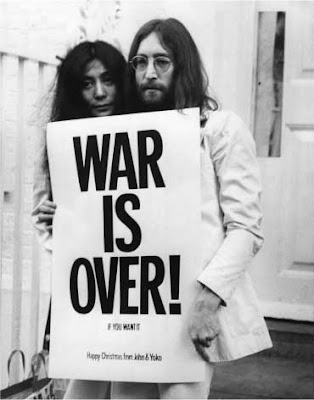
Thanks to a recent viewing of the film, The U.S. vs John Lennon, the simple message in John Lennon and Yoko Ono’s campaign for peace at Christmas 1969-later turned into the song Happy Xmas (War is Over)-keeps playing over and over again in my mind. At Christmas in 1969 over 47,000 American soldiers had already perished in Vietnam, and over 10,000 more would die before the war was really over. Yet in seven different languages in eleven different cities around the world, Lennon and Ono had posted on giant billboards the bold declaration: “WAR IS OVER!” along with, of course, the whispered proviso in small print: “If you want it.”

Now thirty eight years later, with the U.S. mired in a “war on terrorism” in Afghanistan and Iraq which seems to have no end in sight, and which-despite the recent National Intelligence Estimate refuting Iran’s purported nuclear threat-still could escalate into a wider and far more dangerous war, the plaintive plea in Lennon and Ono’s message might seem to raise only a painful smile. With conflict over shrinking resources-oil and water especially-surely inevitable in the century ahead, and with the current direction of U.S. power almost certainly bound to lead to confrontation with China and Russia in the future, the thought that war really could be over if only we really wanted it to be seems hopelessly naive, at best a quaint idealism completely out of step with the demands of the real world. “Sure, a nice thought,” most Americans probably think, “war could be over, but only if they wanted it-those terrorists, Islamo-fascists, communists, and whatever other “ists” who haven’t recognized the value of freedom and the God-appointed destiny of the American way.” War is a part of human nature anyway, its been a part of human history from the beginning and that isn’t likely to change. Its just a pie in the sky to think that war really ever could be over.1

So maybe I, too, am hopelessly naive; but I can’t get John and Yoko’s words out of my head-especially as sung in the chorus by the children of the Harlem community choir in Happy Xmas (War is Over)-and thus I am led to this further reflection. Could war really be over if only we really wanted it to be? Is it really possible to “give peace a chance”?

Give Peace a Chance?

This question leads me to reflect on the essay Toward Perpetual Peace written by Immanuel Kant at the end of the 18th century.2 Kant’s philosophy is something like a watershed in the history of Western thought, marking a turning point which influences all subsequent philosophy. Kant has been described as both “the paradigmatic and culminating figure of the European Enlightenment,” which, of course, is that intellectual movement noted for its optimistic faith in human reason, and which gave us, among other things, our faith in democracy.3 Kant is a paradigmatic figure of the enlightenment both for his defense of reason against the skepticism of Hume, which required a theory of knowledge which revolutionized the understanding of the human mind, and for his ethics, which is founded on the conviction that the freedom of choice and action in accordance with the dictates of reason is our highest value, that which Kant holds to be even the very definition of humanity. He is also the culminating figure of the Enlightenment in drawing the limits to human reason, both in his theory of knowledge and his ethics. For Kant, the freedom to choose implies the freedom to do evil as well as good, and thus there are no laws of nature or dialectic of history which can guarantee that good will triumph. That hope will always depend upon human choice.

Both of these paradigmatic and culminating Enlightenment convictions surface in Toward Perpetual Peace. Kant actually begins the essay with something of a little joke, telling us about a Dutch Innkeeper’s sign which had the inscription ‘The Perpetual Peace’ next to a picture of a graveyard. Kant is clear that there is certainly no guarantee that humanity will be able to avoid the perpetual peace of the graveyard, but the gist of his essay is that if humanity really wants a lasting peace in this world-if humanity really wants to give peace a chance-this is what the nations of the world ought to do.

Now maybe in our post-Enlightenment, postmodern times it might be easy to dismiss Toward Perpetual Peace as it betrays as much of the Enlightenment’s naivete as well as hope. It would at least be interesting, however, to reflect on the merit of the ideas Kant puts forward, and then to consider what it is that stands in the way of giving them a chance.

Kant presents what he considers to be the necessary conditions of a perpetual peace as if it were a peace treaty among the nations of the world. The treaty is divided into two sections. The first part, consisting of six “preliminary articles of a perpetual peace among states,” are to be considered as prohibitive laws which aim to reduce the probability of warfare . The second part contains the “definitive articles” which aim, not just at eliminating potential provocations to war, but at establishing a permanent federation of states, thus providing a foundation for international law. It is here, of course, where Kant’s essay has proved most influential, as we find the first articulation of the idea which came to fruition with the establishment of the United Nations.

The Preliminary Articles of a Perpetual Peace

Three of the preliminary articles Kant specifies should be treated as strictly prohibitive laws and thus the abuses which are prohibited should be abolished immediately if the nations of the world really wanted peace. The first article prohibits any peace treaties made with “secret reservation of the material for a future war.” It’s easy to understand Kant’s reasoning here as any peace agreement is not likely to last if the parties involved were secretly preparing for another war of aggression. We know, of course, what a threat to world peace Saddam’s secret stockpiles of WMDs were, as well as the secret nuclear ambitions of the Iranian mullahs are today. Oh, that’s right, they weren’t and aren’t-but at least Americans do understand what a threat to world peace secret preparations for wars of aggression can be. I guess peace might really have a chance if all those other nations stopped making secret preparations for war. Of course, ours is a just nation and our leaders would never think of doing such a thing. Oh, that’s right, I’d forgot about all those secret preparations for the invasion of Iraq before the Bush Administration even took office. I guess it was just naive of Kant to include this article in his world peace treaty. Actually, it’s interesting that Kant acknowledges that the prohibition of secret preparations for war “will certainly appear academic and pedantic” if “in accordance with ‘enlightened’ notions of political expediency, we believe that the true glory of a state consists in the constant increase of its power by any means whatsoever.”

The next thing that Kant recommends should be abolished immediately is any forcible interference by one state in the “constitution and government of another state” (article 5). Well this one is certainly not hard to understand either, as Americans surely wouldn’t stand for any external interference in our constitution and government. I guess it’s easy to see that peace really could have a chance if the nations of the world could agree to this article; but, of course, this doesn’t seem possible in our world, and for reasons of ‘enlightened’ political expediency, the U.S. in the last century has certainly mastered the art of such interference. Well, at least we can say that the U.S. has had plenty of experience in this regard, from San Juan Hill and the numerous more recent interventions in Latin America and Southeast Asia to the current interventions in Afghanistan and Iraq. Unfortunately, few Americans have really understood what the political expediency really amounts to.

The last of the strictly prohibitive laws in Kant’s treaty forbids any “acts of hostility as would make mutual confidence impossible during a future time of peace” (article 6). Here Kant refers explicitly to things like the employment of assassins and poisoners, the breaking of treaties and the instigation of treason within another state; but we can extrapolate from what Kant says to understand that he has in mind any acts of hostility that would make mutual trust impossible. Once again, the idea is certainly not hard to understand, though, once again, for reasons of political expediency, the U.S. has certainly had a lot of experience in assassinations and attempted assassinations, the abrogations of treaties, and other such acts of hostility. I wonder if the Iraqi people will ever trust the U.S. again after the obliteration of much of their cultural heritage in the aftermath of the fall of Baghdad, after the torture palace of Abu Ghraib, after the wholesale slaughter of civil war that has ensued in the wake of our ‘liberation’ of Iraq.

The other preliminary articles of a perpetual peace, Kant states, “allow some subjective latitude according to the circumstances” and though they “need not necessarily be executed at once,” their execution should “not be put-off to a non-existent date.” The first of these articles prohibits the acquisition of independently existing states as if they were private property (article 2). I suppose Kant found it impractical to call for the immediate prohibition of such acquisitions as it was such a commonplace practice in the Europe of his day for states to be acquired through marriage and other family alliances among the ruling class. Of course, if such a prohibition were to be a part of any global peace treaty today, considerable latitude would have to be allowed to the U.S. as it is essentially the product of the acquisition of territory as private property, and, at least in the case of Hawaii, of the acquisition of an independently existing state. But at least we might be able to say that this is a problem of the past, as political expediency no longer calls for the acquisition of independently existing states-especially as the forcible interference in the constitution or government of other states can meet that expediency.

The last two of Kant’s preliminary articles of peace are very much relevant today; however, and due to political expediency, it is still very difficult to imagine how they could be executed at once, or even at some future date. Here Kant suggests that if the nations of the world really want peace then standing armies should be gradually abolished (article 3) along with the accumulation of national debt “in connection with the external affairs of the state” (article 4). Regarding the former, Kant foresees an arms race in which states seek “to outdo one another in arming unlimited numbers of soldiers, and since the resultant costs eventually make peace more oppressive than a short war, the armies are themselves the cause of wars of aggression.” Kant even warns that such an arms race might compel states “to mount preventative attacks.” Some hundred and fifty years before Eisenhower, Kant seems to have seen the danger of the Industrial Military complex: “for of the three powers within a state-the power of the army, the power of alliance and the power of money-the third is probably the most reliable instrument of war.”

Kant’s prohibition against the incurrence of national debt for foreign military adventures seems perhaps even more prescient. The neo-con adventure in Iraq would, of course, be completely inconceivable without the tremendous debt which has been accumulated.4 Kant’s explanation for this article of peace seems as if he had in mind precisely the case with the U.S. today:

There is no cause for suspicion if help for the national economy is sought inside or outside the state (e.g. for improvements to roads, new settlements, storage of foodstuffs for years of famine, etc.). But a credit system, if used by the powers as an instrument of aggression against one another, shows the power of money in its most dangerous form. For while the debts thereby incurred are always secure against present demands (because not all the creditors will demand payment at the same time), these debts go on growing indefinitely. This ingenious system, invented by a commercial people in the present century, provides a military fund which may exceed the resources of all the other states put together. It can only be exhausted by an eventual tax-deficit, which may be postponed for a considerable time by the commercial stimulus which industry and trade receive through the credit system. This ease in making war, coupled with the warlike inclination of those in power (which seems to be an integral feature of human nature), is thus a great obstacle in the way of perpetual peace. Foreign debts must therefore be prohibited by a preliminary article of such a peace, otherwise national bankruptcy, inevitable in the long run, would necessarily involve various other states in the resultant loss without their having deserved it, thus inflicting upon them public injury. Other states are therefore justified in allying themselves against such a state and its pretentions.

The Definitive Articles of a Perpetual Peace

While the preliminary articles in Kant’s treaty certainly provide much food for thought in considering whether it is possible to give peace a chance, it is with the definitive articles that we come, I think, to the real crux of the challenge of peace in our time. What Kant says here is, on the one hand, quite influential, while on the other hand, very problematic. The influential part is the second article in which Kant lays out his idea for a league or federation of nations.

Kant is clearly influenced here by the political theory of the early Modern philosopher Thomas Hobbes, to whom we owe the idea of government as a social contract. In order to provide a justification for the social contract, Hobbes conceived of a hypothetical “state of nature” which would be what human society would be like without government. As Hobbes had a basically pessimistic understanding of human nature, human beings being hard-wired, so to speak, to seek only their own self-interest, the state of nature, as he conceived it, is a state of war. Everyone would have an unlimited right to get away with anything, and thus everyone would live in constant fear and danger of violent death. The life of man in the state of nature, as Hobbes famously put it, is thus “solitary, poor, nasty, brutish, and short.”5 It is thus to get out of this state of nature that human beings would rationally choose to surrender this unlimited right, and to form a government by social contract.

The early modern political theorists such as Hobbes and John Locke were concerned only with the formation of the nation-state and did not extend their reflection to the international arena. Kant’s essay extends social contract political theory to the relations between states. Kant begins the second section of his essay introducing the idea of an international social contract:

A state of peace among men living together is not the same as the state of nature, which is rather a state of war. For even if it does not involve active hostilities, it involves a constant threat of their breaking out. Thus the state of peace must be formally instituted, for a suspension of hostilities is not in itself a guarantee of peace.

Kant follows Hobbes here more than Locke in conceiving the state of nature as a state of war (Locke conceived the state of nature as bound by natural law, and thus it is not necessarily a state of war, though it is still inconvenient enough to require a social contract to get out of the state of nature). Kant argues that if the people of the world want to get out of the constant state of war among nations, then the nations of the world ought to form a federation of nations:

Each nation, for the sake of its own security, can and ought to demand of the others that they should enter along with it into a constitution, similar to the civil one, within which the rights of each could be secured. This would mean establishing a federation of peoples.

Kant is clear that he is not thinking of an “international state” or one world government. Each state retains its sovereignty in the same way that individuals retain their rights in entering the social contract (Kant follows Locke here more than Hobbes in arguing that states and individuals have rights that cannot be given up). Kant argues that the only way of giving a perpetual peace a chance is through such an agreement between nations:

But peace can neither be inaugurated nor secured without a general agreement between the nations; thus a particular kind of league, which we might call pacific federation, is required. It would differ from a peace treaty in that the latter terminates one war, whereas the former would seek to end all wars for good. This federation does not aim to acquire any power like that of a state, but merely to preserve and secure the freedom of each state in itself, along with that of the other confederated states, although this does not mean that they need to submit to public laws and to a coercive power which enforces them, as do men in a state of nature. It can be shown that this idea of federalism, extending gradually to encompass all states and thus leading to perpetual peace, is practicable and has objective reality.

Kant’s idea of a particular kind of league of nations which would seek to end all wars for good was, of course, first proposed as the League of Nations at the end of the first world war. The U.S., of course, didn’t participate in the League of Nations because the Senate, controlled by Republicans after the election of 1918, voted against the ratification of the Treaty of Versailles. The League of Nations came to an end with the onset of the second world war, but was resurrected in its aftermath as the United Nations.

The problem with the League of Nations, as well as its successor, is that there is no coercive power to enforce international law. The success of the federation, as Kant makes clear, depends upon the mutual agreement of the member nations. The main weakness of the United Nations today is that the most powerful nation in the world, led by the neo-cons in the Bush Administration, has shown utter contempt for the United Nations and clearly operates as if the international arena were a Hobbesian state of nature.

Hobbes was quite explicit that in the state of nature the question of justice and injustice cannot even arise: “To this war of every man against every man, this is also consequent; that nothing can be unjust. The notions of right and wrong, justice and injustice have there no place. Where there is no common power, there is no law: where there is no law, no injustice.”6 Although the Bush Administration has tried to justify its wars of aggression to the American public, it’s clear from everything they did in the run-up to the war in Iraq-when instead of doing everything in their power to avoid war and find a peaceful solution, they, in fact, did everything in their power to avoid a peaceful solution and find a reason for war-as well as their disregard of the Geneva Conventions concerning the treatment of prisoners during the occupation of Iraq, that their real position is that they need not be concerned with the question of justice and injustice and the restrictions of international law.7 Kant had this to say about people like these architects of the Iraq war who have chosen to reject international law and the federation of nations and instead plunge the nations of the world into a state of nature in which the future of humankind seems likely to be nasty, brutish, and short:

We look with profound contempt upon the way in which savages cling to their lawless freedom. They would rather engage in incessant strife than submit to a legal constraint which they might impose upon themselves, for they prefer the freedom of folly to the freedom of reason. We regard this as barbarism, coarseness, and brutish debasement of humanity. We might thus expect that civilized peoples, each united within itself as a state, would hasten to abandon so degrading a condition as soon as possible. But instead of doing so, each state sees its own majesty (for it would be absurd to speak of the majesty of a people) precisely in not having to submit to any external legal constraint, and the glory of its ruler consists in his power to order thousands of people to immolate themselves for a cause which does not truly concern them, while he need not himself incur any danger whatsoever. . . .

There remains one further aspect of Kant’s essay which is necessary to discuss and that is the problematic first definitive article of a perpetual peace. Kant argues that for this federation of nations to be possible it is first necessary that the constitution of every state be a republic. Fortunately, it proved not to be necessary to wait for this to come to pass for the establishment of the United Nations. Unfortunately, this requirement can be construed as a reason not to take the United Nations seriously, and even more perniciously, as a justification for wars of aggression in the name of democracy. However, Kant’s argument is not based on the intrinsic superiority of a republic in itself (he argues for a republic over a pure democracy for the essentially the same reason Madison did, and the reason why the U.S. Constitution is a republic-and that is the danger of the tyranny of the majority, which could not be avoided if a simple majority vote of the people decided every issue and the executive and legislative powers were not separated). Kant’s argument is rather that war would be less likely if the government were accountable to the people as in a republic:

If, as is inevitably the case under this constitution, the consent of the citizens is required to decide whether or not war is to be declared, it is very natural that they will have great hesitation in embarking on so dangerous an enterprise. For this would mean calling down on themselves all the miseries of war, such as doing the fighting themselves, supplying the costs of the war from their own resources, painfully making good the ensuing devastation, and, as the crowning evil, having to take upon themselves a burden of debt which will embitter peace itself and which can never be paid off on account of the constant threat of new wars. But under a constitution where the subject is not a citizen, and which is therefore not republican, it is the simplest thing in the world to go to war. For the head of state is not a fellow citizen, but the owner of the state, and a war will not force him to make the slightest sacrifice so far as his banquets, hunts, pleasure palaces and court festivals are concerned. He can thus decide on war, without any significant reason, as a kind of amusement, and unconcernedly leave it to the diplomatic corps (who are always ready for such purposes) to justify the war for the sake of propriety.

Not surprisingly there has been much discussion of this point, and sometimes it has been argued that Kant’s whole scheme has been undermined by the unfolding of history since Kant’s day with numerous examples of republics making war upon one another. Two replies to this objection, however, have been offered. The first is that it is not so clear that there has been war between states that “really do satisfy Kant’s own highly stringent definition of a republic” and secondly, “it must always be remembered that Kant never argues that even a worldwide federation of republics makes permanent peace necessary; his view is rather that only such a federation makes permanent peace even possible. Kant’s final word, after all, is that human beings have free will, and no matter what remain free to choose to do what is right, but equally free, alas, to choose evil over good.”8

The example set by the U.S., in the last half-century at least, does not necessarily refute this last point; however, it does raise the question of whether a republican form of government is enough to protect a democracy against the problem of the tyranny of the majority. I don’t imagine that Kant ever foresaw a republic such as ours, where the people could be so oblivious to the real costs and miseries of war. What Kant says above about the despotic owner of a state applies just as easily to our leaders in Washington today. What value is there in a republic today, as far as avoiding unnecessary wars, if the people can be so insulated from the devastating effects of war?

One of the principle reasons the U.S. is in Iraq today is that the American people never really learned the lesson from the Vietnam War. As soon as the troops came home and the protests ended, the corporate controlled media began a reactionary counter-movement which pretty much successfully obliterated the memory of what happened in Vietnam. This came home to me most powerfully in one of my Introduction to Western Philosophy courses last year. During our review of the issue of the ethics of war and peace, I had the students watch the film The Fog of War. Before watching the film, I said that most Americans probably know about how many Americans died in the war, but probably don’t know how many Southeast Asians perished. So I asked them. There was a few minutes of silence, and then one young woman raised her hand and hesitatingly responded: “10,000?” That about sums up the problem for me. How many Americans really understand that millions died, and-as Robert McNamara seems to acknowledge in The Fog of War-for really no good reason.9 What was the reason? Oh, that’s right, all those millions died so that we could stop the dominoes from falling and halt the spread of communism. McNamara admits that the U.S. just simply never understood that the Vietnamese saw it as a war of independence. The U.S. has still never come to terms with the terrible moral failure that was the war in Vietnam.

Our corporate controlled “free press” tells us that the “surge” in Iraq is going great. They won’t tell us; however, what is really going on in Iraq. The majority of Americans may be tiring of the war, like they tire of yesterday’s news; yet they still don’t really understand what a moral failure it is once again that U.S. troops are engaged in a war for no good reason. The fear of communism was replaced by the fear of terrorism in leading the American people to support another unnecessary war. It certainly doesn’t help put out the fires of terrorism by participating in terrorism. When it is understood that over a million Iraqis have already perished, supposedly as a response to the threat of terrorism and in retaliation for the 3000 that died in New York on 9/11, when it turned out that Iraq was never really a threat and certainly had nothing to do with the atrocity of 9/11, then it must be recognized that the invasion and occupation of Iraq has been, itself, an act of terrorism that dwarfs what happened on 9/11. Americans are simply as oblivious to the real causes of the problem of terrorism as they are to the real costs and miseries of war.

The majority of Americans may want to bring the troops home, but what value is there in our republic if the only candidates who have a chance of being elected President next fall are not going to bring the troops home, and are committed to continuing the general direction of U.S. foreign policy? What value is there in our republic if a candidate like Dennis Kucinich, the only candidate who is committed to giving peace a chance, and understands what it would take to do so, is excluded from even participating in the debate?

How many Americans have the slightest inkling of what political expediency really drives the U.S. war machine? It certainly isn’t a defense of democracy, as our leaders have been more than willing to overthrow democratically elected leaders if it suits that political expediency-as the assassination of Allende in Chile ought to have made clear. It certainly isn’t a defense of our freedom-as the Vietnam War and now the war in Iraq should make abundantly clear. That political expediency which has made the U.S. the greatest obstacle to peace in the world today is simply the preservation and dissemination of an economic system which seeks, above all, to maximize wealth in the hands of the very few. The $400 million retirement package doled out to the former CEO of Exxon Corporation in 2005 perhaps stands as the best illustration of what our troops are really dying and killing for.10 In the century ahead, with unparalleled crises facing humanity, that expediency is beyond abominable. John Lennon hit the nail on the head when he said, as recorded in The U.S. vs John Lennon, “our society is run by insane people for insane objectives.”

What is really absurd is that this Christmas, like every Christmas, churches all across America will be filled with those who most believe that America is a just nation-those who most stridently think of themselves as followers of the “prince of peace”-and yet they will elect more insane people for these same insane objectives and thus peace will never have a chance.

The problem with the U.S. is that Americans have never really understood what the key to democracy is. If one were to take a poll across America and ask everyone what is more important, faith or the love of wisdom-the capacity to question and to critically think about the important issues of the day, there isn’t much doubt about what the result would be. Such a poll would reveal the contradiction within the heart of America. The first colonists were mostly religious fundamentalists who certainly had no idea of founding a democracy. That idea came more than a century later, during the height of the Enlightenment. Perhaps this was the Enlightenment and Kant’s greatest naivete. The Enlightenment hope in democracy, and Kant’s conviction that a republican form of government would be the best hope of giving peace a chance, both are founded on the assumption that the people are capable of the love of wisdom -and have thus, not just the freedom to choose good over evil, but the courage and strength to take up the burden of conscience in thinking through the problem of good and evil. All those Christians who think that faith is the key to democracy should read Dostoevsky’s short story “The Grand Inquisitor” from The Brothers Karamazov. Then maybe they would understand how, if faith is blind, one can have faith in the precisely the opposite of what one thinks one has faith in.

Given the state of affairs in the world today it certainly seems naive to think that a perpetual peace can ever be achieved. There is certainly no hope for Kant’s plan for a perpetual peace if the most powerful nation in the world cannot come to its senses and set a better example for the nations of the world to follow in living up to the requirements of international law. Maybe, just maybe, war could be over-if we just wanted it. Imagine that.

Timothy J. Freeman teaches philosophy at the University of Hawaii at Hilo. He can be reached at freeman@hawaii.edu.

Notes

1. The origin of the phrase “pie in the sky” comes from Joe Hill’s radical song Preacher and the Slave from 1911 .

2. Immanuel Kant, “Toward Perpetual Peace,” in Kant: Political Writings, 2nd. ed., H Reiss, ed. (Cambridge University Press, 1991).

3. Paul Guyer, “Immanuel Kant: Introduction,” in Political Philosophy: The Essential Texts. Steven M. Cahn, ed. (Oxford: Oxford University Press, 2005), p. 376. My summary here is indebted to Guyer’s introduction to Kant’s essay.

4. See the costs of the Iraq war at the National Priorities Project.

5. Thomas Hobbes, Leviathan, ed. Michael Oakeshott (New York: Macmillan, 1946), ch. 13, p. 82.

6. Leviathan, ch. 13, p. 83.

7. See my previous essays which have elaborated on this point: Timothy J. Freeman, “The Terrible Truth about Iraq,” CounterPunch, September 17, 2003. Timothy J. Freeman, “The Price of Freedom,” CounterPunch, November 26/27, 2005.

8. Paul Guyer, “Immanuel Kant: Introduction” in Political Philosophy: The Essential Texts, pp. 378-379.

9. Documents declassified by the Vietnamese government in 1995 put the total casualties at 5.1 million.

10. http://abcnews.go.com/GMA/story?id=1841989

Source

Posted in RagBlog | Leave a comment

The Protected and the Damned

The Shock Doctrine in Action in New Orleans
by Naomi Klein

Readers of The Shock Doctrine know that one of the most shameless examples of disaster capitalism has been the attempt to exploit the disastrous flooding of New Orleans to close down that city’s public housing projects, some of the only affordable units in the city. Most of the buildings sustained minimal flood damage, but they happen to occupy valuable land that make for perfect condo developments and hotels.

The final showdown over New Orleans public housing is playing out in dramatic fashion right now. The conflict is a classic example of the “triple shock” formula at the core of the doctrine.

* First came the shock of the original disaster: the flood and the traumatic evacuation.

* Next came the “economic shock therapy”: using the window of opportunity opened up by the first shock to push through a rapid-fire attack on the city’s public services and spaces, most notably it’s homes, schools and hospitals.

* Now we see that as residents of New Orleans try to resist these attacks, they are being met with a third shock: the shock of the police baton and the Taser gun, used on the bodies of protestors outside New Orleans City Hall yesterday.

Democracy Now! has been covering this fight all week, with amazing reports from filmmakers Jacquie Soohen and Rick Rowley (Rick was arrested in the crackdown). Watch residents react to the bulldozing of their homes here.

And footage from yesterday’s police crackdown and Tasering of protestors inside and outside city hall here.

That last segment contains a terrific interview with Kali Akuno, executive director of the People’s Hurricane Relief Fund. Akuno puts the demolitions in the big picture, telling Amy Goodman:

This is just one particular piece of this whole program. Public hospitals are also being shut down and set to be demolished and destroyed in New Orleans. And they’ve systematically dismantled the public education system and beginning demolition on many of the schools in New Orleans–that’s on the agenda right now–and trying to totally turn that system over to a charter and a voucher system, to privatize and just really go forward with a major experiment, which was initially laid out by the Heritage Foundation and other neoconservative think tanks shortly after the storm. So this is just really the fulfillment of this program.

Akuno is referring to the Heritage Foundation’s infamous post-Katrina meeting with the Republican Study Group in which participants laid out their plans to turn New Orleans into a Petri dish for every policy they can’t ram through without a disaster. Read the minutes on my website.

For more context, here are couple of related excerpts from The Shock Doctrine: The Rise of Disaster Capitalism:

The news racing around the shelter [in Baton Rouge] that day was that Richard Baker, a prominent Republican Congressman from this city, had told a group of lobbyists, “We finally cleaned up public housing in New Orleans. We couldn’t do it, but God did.” Joseph Canizaro, one of New Orleans’ wealthiest developers, had just expressed a similar sentiment: “I think we have a clean sheet to start again. And with that clean sheet we have some very big opportunities.” All that week the Louisiana State Legislature in Baton Rouge had been crawling with corporate lobbyists helping to lock in those big opportunities: lower taxes, fewer regulations, cheaper workers and a “smaller, safer city”–which in practice meant plans to level the public housing projects and replace them with condos. Hearing all the talk of “fresh starts” and “clean sheets,” you could almost forget the toxic stew of rubble, chemical outflows and human remains just a few miles down the highway.

Over at the shelter, Jamar Perry, a young resident of New Orleans, could think of nothing else. “I really don’t see it as cleaning up the city. What I see is that a lot of people got killed uptown. People who shouldn’t have died.” He was speaking quietly, but an older man in line in front of us in the food line overheard and whipped around. “What is wrong with these people in Baton Rouge? This isn’t an opportunity. It’s a goddamned tragedy. Are they blind?”

A mother with two kids chimed in. “No, they’re not blind, they’re evil. They see just fine.”

At first I thought the Green Zone phenomenon was unique to the war in Iraq. Now, after years spent in other disaster zones, I realize that the Green Zone emerges everywhere that the disaster capitalism complex descends, with the same stark partitions between the included and the excluded, the protected and the damned.

It happened in New Orleans. After the flood, an already divided city turned into a battleground between gated green zones and raging red zones–the result not of water damage but of the “free-market solutions” embraced by the president. The Bush administration refused to allow emergency funds to pay public sector salaries, and the City of New Orleans, which lost its tax base, had to fire three thousand workers in the months after Katrina. Among them were sixteen of the city’s planning staff–with shades of “de Baathification,” laid off at the precise moment when New Orleans was in desperate need of planners. Instead, millions of public dollars went to outside consultants, many of whom were powerful real estate developers. And of course thousands of teachers were also fired, paving the way for the conversion of dozens of public schools into charter schools, just as Friedman had called for.

Almost two years after the storm, Charity Hospital was still closed. The court system was barely functioning, and the privatized electricity company, Entergy, had failed to get the whole city back online. After threatening to raise rates dramatically, the company managed to extract a controversial $200 million bailout from the federal government. The public transit system was gutted and lost almost half its workers. The vast majority of publicly owned housing projects stood boarded up and empty, with five thousand units slotted for demolition by the federal housing authority. Much as the tourism lobby in Asia had longed to be rid of the beachfront fishing villages, New Orleans’ powerful tourism lobby had been eyeing the housing projects, several of them on prime land close to the French Quarter, the city’s tourism magnet.

Endesha Juakali helped set up a protest camp outside one of the boarded-up projects, St. Bernard Public Housing, explaining that “they’ve had an agenda for St. Bernard a long time, but as long as people lived here, they couldn’t do it. So they used the disaster as a way of cleansing the neighbourhood when the neighbourhood is weakest. … This is a great location for bigger houses and condos. The only problem is you got all these poor black people sitting on it!”

Amid the schools, the homes, the hospitals, the transit system and the lack of clean water in many parts of town, New Orleans’ public sphere was not being rebuilt, it was being erased, with the storm used as the excuse. At an earlier stage of capitalist “creative destruction,” large swaths of the United States lost their manufacturing bases and degenerated into rust belts of shuttered factories and neglected neighbourhoods. Post-Katrina New Orleans may be providing the first Western-world image of a new kind of wasted urban landscape: the mould belt, destroyed by the deadly combination of weathered public infrastructure and extreme weather.

Since the publication of The Shock Doctrine, my research team has been putting dozens of original source documents online for readers to explore subjects in greater depth. The resource page on New Orleans has some real gems.

Naomi Klein is the author of many books, including her most recent, The Shock Doctrine: The Rise of Disaster Capitalism, which will be published in September.Visit Naomi’s website at www.naomiklein.org, or to learn more about her new book, visit www.shockdoctrine.com.

© 2007 Huffington Post

Source

Posted in RagBlog | Leave a comment

And Some Will Rob You with a Fountain Pen

Bush’s Class Warfare
by Peter Dreier

Just a week before Christmas, President Bush gave corporate America two big presents. On Tuesday, his Federal Communications Commission changed the rules to allow the nation’s giant conglomerates to further consolidate their grip on the media by permitting them to purchase TV and radio stations in the same local markets where they already own daily newspapers. As a gift to the country’s automobile industry, Bush’s Environmental Protection Agency ruled Wednesday, over the objections of the agency’s staff, that California, the nation’s largest and most polluted state, and 16 other states, can’t impose regulations to limit greenhouse gases from cars and trucks that are stronger than the federal government’s own weak standards.

So far, no major politicians or editorial writers have labeled these actions “class warfare,” although this is precisely what Bush is engaged in — helping the already rich and powerful at the expense of everyone else. Class warfare is, in fact, the very essence of Bush’s tenure in the White House. In thousands of ways, big and small, Bush has promoted the interests of the very rich and the largest corporations. Corporate lobbyists have the run of the White House. Their agenda – tax cuts for the rich and big business, attacks on labor unions, and the weakening of laws protecting consumers, workers and the environment from corporate abuse – is Bush’s agenda.

For example, Bush has handed the pharmaceutical industry windfall profits by restricting Medicare’s ability to negotiate for lower prices for medicine. He targeted huge no-bid federal contracts to crony companies like Haliburton to supply emergency relief, reconstruction services and materials to rebuild Katrina while attempting to slash federal wage laws for reconstruction workers. He repealed Clinton-era “ergonomics” standards, affecting more than 100 million workers, that would have forced companies to alter their work stations, redesign their facilities or change their tools and equipment if employees suffered serious work-related injuries from repetitive motions. He opposed stiffer health and safety regulations to protect mine workers and cut the budget for federal agencies that enforce mine safety laws. Not surprisingly, under Bush, we’ve seen the largest number of mine accidents and deaths in years. Bush’s Food and Drug Administration lowered product-labeling standards, allowing food makers to list health claims on labels before they have been scientifically proven. His FDA chief announced that the agency would no longer require claims to be based on “significant scientific agreement,” a change that the National Food Processors Association, the trade association of the $500 billion food processing industry, had lobbied for. Bush resisted efforts to raise the minimum wage (which had been stuck at $5.15 an hour for nine years) until the Democrats took back the Congress earlier this year.

Virtually every week since he took office, the Bush administration has made or proposed changes in our laws designed to help the rich and powerful while harming the most vulnerable people in society and putting the middle class at greater economic risk. The list of horrors can be so numbing that one can lose sight of the cumulative impact of these actions. Taken together, they add up to the most direct assault on working people, the environment and the poor that the country has seen since the presidency of William McKinley over a century ago.

Bush has been a persistent practitioner of top-down class warfare , but the media rarely characterize his actions that way. In contrast, when progressive activists, unions, environmental groups, community organizations and politicians support legislation and rules to redress the balance of power and wealth, they are inevitably described as engaging in c lass warfare . Top-down class warfare seems to be OK, but bottom-up class warfare is apparently a no-no.

The class warfare rap is now being used against John Edwards, when he talks about challenging the power of the insurance and drug corporations. In a recent speech, Edwards said that his campaign was about challenging “the powerful, the well-connected and the very wealthy.” But wary of being criticized for fueling class resentments, even Edwards felt it necessary to say “This is not class warfare. This is the truth.”

Yes, the truth is that the rich have been at war with the rest of the country. It isn’t a question of “”rich against the poor,” which is often how leftists describe things. That leaves out most Americans. Its the very rich versus everyone else.

As Robert Kuttner observes in his new book, The Squandering of America, from 1966 to 2001, the wealthiest one-tenth of all Americans captured the lion’s share of society’s productivity growth. But it was the top one tenth of 1 percent that gained the very most. Those between the 80th and 90th percentiles about held their own. Those between the 95th and 99th percentiles gained 29 percent, while those between the top 99 and 99.9 percentile, gained 73 percent.

“But,” Kuttner writes, “it was those at the very pinnacle –the top one tenth of 1 percent of the population – one American in a thousand – who gained a staggering 291 percent.”

Wealth has become even more concentrated during the Bush years. Today, the richest one percent of Americans has 22 percent of all income and about 40 percent of all wealth. This is the biggest concentration of income and wealth since 1928. In 2005, average CEO pay was 369 times that of the average worker, compared with 131 times in 1993 and 36 times in 1976. At the pinnacle of America’s economic pyramid, the nation’s 400 billionaires own 1.25 trillion dollars in total net worth – the same amount as the 56 million American families at the bottom half of wealth distribution.

Meanwhile, despite improvements in productivity, the earnings of most workers have been stagnant, while the cost of health care, housing, and other necessities has risen. The basics of the American Dream – the ability to buy a home, pay for college tuition and health insurance, take a yearly vacation, and save for retirement – have become increasingly slippery. And for the 37 million Americans living below the official poverty line – $17,170 a year for a family of three – the dream has become a nightmare.

In many ways, America today resembles the conditions in the late 1800s that was called the Gilded Age. It was an era of rampant, unregulated capitalism. It was a period of merger mania, increasing concentrations of wealth among the privileged few, and growing political influence by corporate power brokers called the Robber Barons. During the Gilded Age, new technologies made possible new industries, which generated great riches for the fortunate few, but at the expense of workers, consumers, and the environment. The gap between the rich and other Americans widened dramatically.

It was also an era of massive immigration to the US from people fleeing political persecution and economic hardship. In the growing cities of the early 20th century, there were terrible poverty, child labor, sweatshops, slums, and serious public health crises, including major epidemics of contagious diseases.

But out of that turmoil, activists created a “Progressive” movement, forging a coalition of immigrants, unionists, middle-class reformers, settlement house workers, muckraking journalists, clergy, and upper-class philanthropists. They fought for, and won, better working conditions, better housing, better schools, and better public services like sanitation and public health laws. Those reforms began at the local and state levels, but eventually laid the foundation for a wave of reform at the federal level – the New Deal.

In 1939, in the midst of the Great Depression, the balladeer Woody Guthrie wrote a song about bank robbers and outlaws. “Yes, as through this world I’ve wandered, I’ve seen lots of funny men,” Guthrie wrote, “Some will rob you with a six-gun, and some with a fountain pen.”

Throughout his Presidency, Bush has used his pen to sign regulations and laws that make the rich richer, allow big business to pollute the environment, reduce wages, and rip-off borrowers and consumers.

But Americans finally seem to have caught on. Iraq, Katrina, Enron, the current wave of foreclosures, and other events have helped wake them up to the reality that Bush’s top-down class warfare has done great damage to our country. We now may be on the brink of another progressive era. Bubbling below the surface is a new wave of social activism.

Today’s progressive movement is almost invisible to the mainstream media, but it is obvious to anyone involved in the struggle for social justice. It has many of the same elements as 100 years ago. There is a new wave of activism across America among labor unions, community organizations, environmental groups, immigrant rights activists, and grassroots housing and health care reformers. In the last decade, for example, more than 150 cities, dozens of counties, and now one state (Maryland) have adopted “living wage” laws to lift low-wage workers out of poverty, the result of solid organizing efforts by networks of unions, religious congregations, and community groups like ACORN and the Los Angeles Alliance for a New Economy. Environmentalists and unions – who were barely on speaking terms for many years – are now forging alliances to push for “green” jobs and waging joint campaigns, such as the coalition of Teamsters and environmental activists working together to clean up the Los Angeles/Long Beach port, the nation’s largest port and also its most polluted, and unionize the immigrant truck drivers.

Like the Progressive and New Deal eras, there is now a growing number of politicians at the local, state and national level who help give voice to this burgeoning movement. When they do, they are accused of engaging in “class warfare.” They should wear it as a badge of honor.

Peter Dreier is E.P. Clapp Distinguished Professor of Politics, and director of the Urban and Environmental Policy program, at Occidental College in Los Angeles.

Source

Posted in RagBlog | 1 Comment

Shut Up ! We Told You This Would Happen !

Global Warming Will Save America from the Right … Eventually
by Dave Lindorff

Say what you will about the looming catastrophe facing the world as the pace of global heating and polar melting accelerates. There is a silver lining.

Look at a map of the US.

The area that will by completely inundated by the rising ocean – and not in a century but in the lifetime of my two cats – are the American southeast, including the most populated area of Texas, almost all of Florida, most of Louisiana, and half of Alabama and Mississippi, as well as goodly portions of eastern Georgia, South Carolina and North Carolina. While the northeast will also see some coastal flooding, its geography is such that that aside from a few projecting sandbars like Long Island and Cape Cod, the land rises fairly quickly to well above sea level. Sure, Boston, New York and Philadelphia will be threatened, but these are geographically confined areas that could lend themselves to protection by Dutch-style dikes. The West Coast too tends to rise rapidly to well above sea level in most places. Only down in Southern California towards the San Diego area is the ground closer to sea level.

So what we see is that huge swaths of conservative America are set to face a biblical deluge in a few more presidential cycles.

Then there’s the matter of the Midwest, which climate experts say is likely to face a permanent condition of unprecedented drought, making the place largely unlivable, and certainly unfarmable. The agribusinesses and conservative farmers that have been growing corn and wheat may be able to stretch out this doomsday scenario by deep well drilling, but west of the Mississippi, the vast Ogallala Aquifer that has allowed for such irrigation is already being tapped out. It will not be replaced.

So again, we will see the decline and depopulation of the nation’s vast midsection-noted for its consistent conservatism. Only in the northernmost area, around the Great Lakes (which will be not so great anymore), and along the Canadian border, will there still be enough rain for farming and continued large population concentrations, but those regions, like Minnesota, Wisconsin and Illinois, are also more liberal in their politics.

Finally, in the Southwest, already parched and stiflingly hot, the rise in energy costs and the soaring temperatures will put an end to right-wing retirement communities like Phoenix, Tucson and Palm Springs. Already the Salton Sea is fading away and putting Palm Springs on notice that the good times are coming to an end. Another right-wing haven soon to be gone.

So the future political map of America is likely to look as different as the much shrunken geographical map, with much of the so-called “red” state region either gone or depopulated.

There is a poetic justice to this of course. It is conservatives who are giving us the candidates who steadfastly refuse to have the nation take steps that could slow the pace of climate change, so it is appropriate that they should bear the brunt of its impact.

The important thing is that we, on the higher ground both actually and figuratively, need to remember that, when they begin their historic migration from their doomed regions, we not give them the keys to the city. They certainly should be offered assistance in their time of need, but we need to keep a firm grip on our political systems, making sure that these guilty throngs who allowed the world to go to hell are gerrymandered into political impotence in their new homes.

There will be much work to be done to help the earth and its residents-human and non-human-survive this man-made catastrophe, and we can’t have these future refugee troglodytes, should their personal disasters still fail to make them recognize reality, mucking things up again.

It should be considered acceptable, in this stifling new world, to say, “Shut up. We told you this would happen.”

Dave Lindorff is an investigative journalist and columnist. His latest book, co-authored by Barbara Olshansky, is “The Case for Impeachment” (St. Martin’s Press, 2006 and now available in paperback, suitable for a last-minute Christmas gift). His work is available at www.thiscantbehappening.net.

Source

Posted in RagBlog | Leave a comment

A Society Obsessed with Greed and Gratification

Holiday Season Hypocrisy
by Stephen Lendman
December 22, 2007

Christmas is observed December 25 by Christians and others celebrating the spirit of the season while for those of the Eastern Orthodox faith the holiday falls on January 7. It’s to honor the birth of Jesus Christ even though it’s widely acknowledged not to be his birthday. Along with its religious significance, the season is also for other celebratory events like winter festivals, parties, family get-togethers and Kwanzaa from December 26 – January 1 for Africans Americans to reconnect to their cultural and historical heritage. Jews as well celebrate the season with the Hanukkah Festival of Lights. It’s to commemorate their struggle for survival, but for Jewish children it’s their Christmas with gifts from parents like their Christian friends get.

Christmas is also the time when the national obsession to shop and consume reaches its zenith. It traditionally begins the day after Thanksgiving, runs through Christmas eve, and after the holiday continues into January with plenty of extra buying power from holiday gift cards, year-end bonuses and other resources gotten or borrowed. It’s for everything people never knew they wanted until creative advertising wizardry made their lives incomplete without them.

Perhaps this single dominant trait characterizes American culture more than any other. It’s a variant of the kind of consumerism economist/sociologist Thorstein Veblen called “conspicuous” in his 1899 book “The Theory of the Leisure Class.” F. Scott Fitzgerald explained that “the very rich….are different from you and me.” Veblen wrote about their spending habits and coined the phrase “conspicuous consumption.” Today, it’s called “keeping up with the Joneses” or consumerism, and it’s practiced by status-seeking people obsessed with personal gratification. But not just by the rich. Most people, except the poor, do it and to excess.

The term “consumption” originated hundreds of years ago. Then, it referred to infectious tuberculosis or TB. But its original meaning is relevant in today’s acquisitive society where consuming for essentials is worlds apart from gluttonous consumerism. This variant refers to overindulgent shopping and spending for things people buy irrespective of need but not without consequences for themselves and society.

Untreated TB, or consumption, consumes its victims in a slow, painful death. Consumerism mimics it with it’s similarly harmful fallout: ecological destruction; unhealthy and unsafe consumer products; corporate empowerment; profits pursued over people; militarism and foreign wars; health, education and other essential needs neglected; and democratic decay in a corporatist state disdaining the public interest.

People take pride saying “when the going gets tough, the tough go shopping” – but not without consequences. The personal fallout is over-indebtedness millions can’t handle in the wake of unexpected medical emergencies or loss of employment. The toll: since the early 1980s one in seven families forced into bankruptcy, over 2 million in 2005 alone (30% above 2004), and millions more ahead from unchecked borrow and binge-spending made worse by the subprime crisis.

Overindulgent spending is what clinicians call an obsessive-compulsive disorder (OCD). At its worst, it’s pathologically characterized by obsessive, repetitive thoughts that need compulsive tasks and rituals to relieve. For addicted consumers, it’s an obsession to shop and spend and a compulsion to buy and accumulate. In excess, it’s clinically pathological and destructive when it causes bankruptcy.

In America and the West, tens of millions of otherwise normal people shop excessively for what they never knew they wanted until Madison Avenue mind manipulators convinced them. Economist Paul Baran described the process as making us “want what we don’t need (all unessential consumer goods and services) and not….what we do (good health care, education, clean air and water, safe food, and good government providing essential services).”

Future insolvency is risked, but few consider the possibility until it’s too late. It’s worst at Christmas when it becomes a pathological orgy of frenzied spending dismissively called getting into the holiday spirit. Maybe for merchants, but not when bills come due with growing millions unable to pay them or needing more debt to delay for later what they can’t handle now.

Institutionalized consumerism also plays into social control. It’s empowered when people are focused on bread and circus distractions that include the sights and sounds of the season. Media theorist Neil Postman once called Americans the most over-entertained and under-informed people in the world and wrote about it in books like “Amusing Ourselves to Death.” Attracted to self-gratification and its reinforcing images, they’re diverted from what matters most – challenging wars of aggression, loss of civil liberties and human rights, violations of law, gutted social services, environmental harm, and policies benefitting the privileged at the expense of beneficial social change.

Consumerism also lets corporate power prosper and grow. It feeds unfettered capitalism and out-of-control greed. It helps direct our tax dollars to a militarized state instead of going for essential social needs. It diverts the national wealth to an imperial juggernaut that consumers finance through overindulgence. The more we shop, the stronger it gets and is better able to exploit new markets, resources and cheap labor at the expense of the more expensive kind at home whose future consumption is endangered by today’s self-gratifying excesses.

Adam Smith was capitalism’s ideological godfather who was also concerned about concentrated wealth and wrote about it in “The Wealth of Nations.” He explained an “invisible hand” of unseen forces worked best in a free market with many small businesses competing locally against each other. He contrasted them with concentrated mercantilism and wrote about the “merchants and manufacturers” who used their power to wreak “dreadful misfortunes” and grave injustices on the vast majority of people using the British East India Company as a case study example.

Today’s monopoly capitalism would have been unimaginable in his day, but he’d recognize it. He wrote that throughout history we find the wreckage of the “vile maxim of the masters of mankind….All for ourselves and nothing for other people….unless government takes pains to prevent” this outcome. No invisible hand works in manipulated markets where governments sanction Smith’s “vile maxim,” and the greater good is nowhere in sight. Under neoliberal rules, capital wins, people lose, and consumerism makes things worse. It’s most extreme at Christmas when shopping trumps the holiday’s meaning and seasonal sights and sounds drown out everything else.

The toll is tragic. Whatever Christmas was, it no longer is, and our behavior corrupts it and the spirit of the man it honors. He spread it in deeds and teachings from his Sermon on the Mount and message to “turn the other cheek,” love thy neighbor, not kill, and do unto others as you’d want them doing to you. The consumerist ethic glorifies receiving, not giving; condoning predatory capitalism and ignoring its harm; neglecting the greater good; sanctifying overindulgence while forgetting those most in need throughout the year. In the spirit of the season, thoughts should be on helping others and giving thanks. In an unfettered marketplace, it’s impossible.

It’s a sad testimony to a society obsessed with greed and gratification at the expense of beneficial social change. At Christmas, it defiles the holiday spirit and forgets the needy. For them, Christmas is “Bah Humbug,” and Santa Scrooge – all take and no give.

New Year’s Day

New Year’s day is one week after Christmas and concludes the long holiday season. It starts after Thanksgiving, reaches a climax around Christmas, ebbs for a day and builds again for a final celebratory new year’s welcome with more overindulgent eating, drinking, partying, and binge-shopping for nonessentials.

The new year is also a traditional time for resolutions that include some with merit like losing weight, quitting smoking and getting fit. Most are forgotten, and those most important never made: working for peace, good will toward others, loving they neighbor, respecting everyone, and treating people as we want to be treated in a society of caring and sharing with equity and justice for all. Wouldn’t that be a wonderful resolution for the new year. Long ago in simpler times before the old world became America, it was that way. It can be again, but wishing won’t make it so.

Stephen Lendman lives in Chicago and can be reached at lendmanstephen@sbcglobal.net.

Also visit his blog site at sjlendman.blogspot.com and listen to The Steve Lendman News and Information Hour on TheMicroEffect.com Mondays at noon US Central time.

Source

Posted in RagBlog | Leave a comment

Institutionalized Racism Has Not Ended

Most Democratic Candidates are Ignoring African Americans
by Jesse Jackson, Sr.
December 21, 2007, Chicago Sun Times

Can Democrats get the votes they need simply because they’re not Republicans? You might think so in this presidential campaign. African-American and urban votes are critical to any Democratic victory. Bill Clinton won two terms without winning the most white votes. His margin was the overwhelming support of black voters. George Bush learned that lesson; that’s why his campaigns spent so much effort suppressing the black vote in key states like Florida in 2000 and Ohio in 2004. His victory margin was the tally of votes suppressed or uncounted.

Yet the Democratic candidates — with the exception of John Edwards, who opened his campaign in New Orleans’ Ninth Ward and has made addressing poverty central to his campaign — have virtually ignored the plight of African Americans in this country. The catastrophic crisis that engulfs the African-American community goes without mention. No urban agenda is given priority. When thousands of African Americans marched in protest in Jena, La., not one candidate showed up.

Democratic candidates are talking about health care and raising the minimum wage, but they aren’t talking about the separate and stark realities facing African Americans.

The civil rights movement succeeded in ending segregation and providing blacks with the right to vote. But the end of legal apartheid did not end the era of discrimination. And the ending of institutionalized violence did not end institutionalized racism.

Patterns of discrimination are sharply etched. African Americans have, on average, about half of the good things that whites have, and double the bad things. We have about half the average household income and less than half the household wealth. On the other hand, we’re suffering twice the level of unemployment and twice the level of infant mortality (widely accepted as a measure of general health).

African Americans are brutalized by a system of criminal injustice. Young African Americans are more likely to be stopped, more likely to be searched if stopped, more likely to be arrested if searched, more likely to be charged if arrested, more likely to be sentenced to prison if charged, less likely to get early parole if imprisoned. Every study confirms that the discrimination is systemic and ruinous. And yet no candidate speaks to this central reality.

African Americans are more likely to go to overcrowded and underfunded schools, more likely to go without health care, more likely to drop out, less likely to find employment. Those who do work have less access to banks and are more likely to be ripped off by payday lenders, more likely to be stuck with high-interest auto and business loans, and far more likely to be steered to risky mortgages — even when adjusting for income. And yet, no candidate speaks to this central reality.

The result is visiting a catastrophe on the urban black community. I and many others campaign for young people to stay in school, to graduate and not to make babies until they are prepared to be parents. My son and I write and teach about personal financial responsibility. Personal responsibility is critical. But personal responsibility alone cannot overcome the effects of a discriminatory criminal justice and economic system in generating broken families and broken dreams.

The Rev. Martin Luther King saw the movement to end segregation and gain voting rights as the first stage of the civil rights movement. The second stage — to gain economic justice and equal opportunity in fact — he knew would be more difficult. Now, 40 years later, it is no longer acceptable for candidates to turn a blind eye and a deaf ear to entrenched discrimination and still expect to reap our votes.

jjackson@rainbowpush.org

Source

Posted in RagBlog | Leave a comment

Junior Doesn’t Get It – We’re Killing the Kids in Iraq

UNICEF: War has taken a toll on Iraq’s children
By Jamie Gumbrecht | McClatchy Newspapers
Posted on Friday, December 21, 2007

BAGHDAD — More than four years after the United States invaded Iraq, the country’s children continue to face a litany of problems from disrupted educations to unsafe drinking water, detentions and violence, UNICEF reported Friday.

Violence and displacement often kept Iraqi children out of school this year. The organization estimates that 2 million educations were interrupted, especially among primary-school students.

The report says that only 28 percent of 17-year-olds in Iraq took final exams this summer, and fewer than half passed. However, UNICEF-supported programs to distribute classroom materials, rebuild schools and provide more learning opportunities benefited 4.7 million children, the agency reported.

Health took a hit, too, as children living in remote areas were faced with poor nutrition and diseases such as cholera. Those living in remote areas were often cut off from health services, although a door-to-door immunization campaign protected 4 million from polio and 3 million from measles, mumps and rubella.

The full report, based on statistics from UNICEF, Iraq’s government and the U.S. military, will be released in early 2008.

UNICEF spokeswoman Claire Hajaj said the United Nations children’s agency is better poised to help next year, thanks to security improvements, better organization among aid groups and more awareness of the issues facing Iraqi children.

“Improved security does not equal secure, but it has lifted people’s spirits here,” Hajaj said. “Humanitarian agencies are working in Iraq now, capitalizing on the ability to work together. There’s a renewed will and recognition of humanitarian needs in Iraq.”

Among the preliminary report’s findings:

* Twenty-eight percent of Iraq’s 17-year-olds took final exams this summer; 40 percent in south and central Iraq passed.

* Eighty percent of children outside Baghdad don’t have working sewers in their communities, limiting access to safe water.

* An average of 25,000 children per month were displaced within Iraq by violence or intimidation.

* An estimated 760,000 children were out of primary school in 2006, and 220,000 more displaced children had their educations interrupted in 2007.

* By the end of 2007, about 75,000 children were living in camps or temporary shelter.

* About 1,350 children were detained by military and police, “many for alleged security violations.”

(Gumbrecht reports for the Lexington Herald-Leader.)

UNICEF Preliminary Report

Source

Posted in RagBlog | Leave a comment

Lakota Secede from US

*Freedom! Lakota Sioux Indians Declare Sovereign Nation Status
Threaten Land Liens, Contested Real Estate Over Five State Area in U.S.
West Dakota Territory Reverts back to Lakota Control According to U.S., International Law *

*FOR IMMEDIATE RELEASE*
DECEMBER 20, 2007, 9:02 AM

WASHINGTON, DC – December 20 – Lakota Sioux Indian representatives declared sovereign nation status today in Washington D.C. following Monday’s withdrawal from all previously signed treaties with the United States Government. The withdrawal, hand delivered to Daniel Turner, Deputy Director of Public Liaison at the State Department, immediately and irrevocably ends all agreements between the Lakota Sioux Nation of Indians and the United States Government outlined in the 1851 and 1868 Treaties at Fort Laramie Wyoming.

“This is an historic day for our Lakota people,” declared Russell Means, Itacan of Lakota. “United States colonial rule is at its end!” “Today is a historic day and our forefathers speak through us. Our Forefathers made the treaties in good faith with the sacred Canupa and with the knowledge of the Great Spirit,” shared Garry Rowland from Wounded Knee. “They never honored the treaties, that’s the reason we are here today.” The four member Lakota delegation traveled to Washington D.C. culminating years of internal discussion among treaty representatives of the various Lakota communities. Delegation members included well known activist and actor Russell Means, Women of All Red Nations (WARN) founder Phyllis Young, Oglala Lakota Strong Heart Society leader Duane Martin Sr., and Garry Rowland, Leader Chief Big Foot Riders.

Means, Rowland, Martin Sr. were all members of the 1973 Wounded Knee takeover. “In order to stop the continuous taking of our resources – people, land, water and children – we have no choice but to claim our own destiny,” said Phyllis Young, a former Indigenous representative to the United Nations and representative from Standing Rock. Property ownership in the five state area of Lakota now takes center stage. Parts of North and South Dakota, Nebraska, Wyoming and Montana have been illegally homesteaded for years despite knowledge of Lakota as predecessor sovereign [historic owner]. Lakota representatives say if the United States does not enter into immediate diplomatic negotiations, liens will be filed on real estate transactions in the five state region, clouding title over literally thousands of square miles of land and property.

Young added, “The actions of Lakota are not intended to embarrass the United States but to simply save the lives of our people”. Following Monday’s withdrawal at the State Department, the four Lakota Itacan representatives have been meeting with foreign embassy officials in order to hasten their official return to the Family of Nations. Lakota’s efforts are gaining traction as Bolivia, home to Indigenous President Evo Morales, shared they are “very, very interested in the Lakota case” while Venezuela received the Lakota delegation with “respect and solidarity.”

“Our meetings have been fruitful and we hope to work with these countries for better relations,” explained Garry Rowland. “As a nation, we have equal status within the national community.” Education, energy and justice now take top priority in emerging Lakota. “Cultural immersion education is crucial as a next step to protect our language, culture and sovereignty,” said Means. “Energy independence using solar, wind, geothermal, and sugar beets enables Lakota to protect our freedom and provide electricity and heating to our people.” The Lakota reservations are among the most impoverished areas in North America, a shameful legacy of broken treaties and apartheid policies. Lakota has the highest death rate in the United States and Lakota men have the lowest life expectancy of any nation on earth, excluding AIDS, at approximately 44 years. Lakota infant mortality rate is five times the United States average and teen suicide rates 150% more than national average. 97% of Lakota people live below the poverty line and unemployment hovers near 85%. “After 150 years of colonial enforcement, when you back people into a corner there is only one alternative,” emphasized Duane Martin Sr. “The only alternative is to bring freedom into its existence by taking it back to the love of freedom, to our lifeway.” We are the freedom loving Lakota from the Sioux Indian reservations of Nebraska, North Dakota, South Dakota and Montana who have traveled to Washington DC to withdraw from the constitutionally mandated treaties to become a free and independent country. We are alerting the Family of Nations we have now reassumed our freedom and independence with the backing of Natural, International, and United States law.

For more information, please visit our new website at www.lakotafreedom.com.

*CONTACT: Lakota Freedom
*Naomi Archer, Communications Liaison
(828) 230-1404
lakotafree@gmail.com or
press@lakotafreedom.com

Posted in RagBlog | 1 Comment

The Breakdown of Our Modern-Day Banking System

Staring into the Abyss: The Collapse of the Modern Day Banking System
By Mike Whitney, Dec 21, 2007, 12:40

In past financial crises… the Fed has been able to wave its magic wand and make market turmoil disappear. But this time the magic isn’t working. Why not? Because the problem with the markets isn’t just a lack of liquidity — there’s also a fundamental problem of solvency.” – Paul Krugman

Stocks fell sharply last week on news of accelerating inflation which will limit the Federal Reserves ability to continue cutting interest rates. On Tuesday the Dow Jones Industrials tumbled 294 points following the Fed’s announcement of a quarter point cut to the Fed Funds rate. On Friday, the Dow dipped another 178 points when government figures showed consumer prices had risen 0.8% last month after a 0.3% gain in October. The stock market is now lurching downward into a “primary bear market”. There has been a steady deterioration in retail sales, commercial real estate, and the transports. The financial industry is going through a major retrenchment, losing more than 25% in aggregate capitalization since July. The real estate market is collapsing. California Gov. Arnold Schwarzenegger announced on Friday that he will declare a “fiscal emergency” in January and ask for more power to deal with the $14 billion budget shortfall from the meltdown in subprime lending. Economists are beginning to publicly acknowledge what many market analysts have suspected for months; the nation’s economy is going into a tailspin which will inevitably end in a hard landing.

Morgan Stanley’s Asia Chairman, Stephen Roach, made this observation in a New York Times op-ed on Sunday:

This recession will be deeper than the shallow contraction earlier in this decade. The dot-com-led downturn was set off by a collapse in business capital spending, which at its peak in 2000 accounted for only 13 percent of the country’s gross domestic product. The current recession is all about the coming capitulation of the American consumer — whose spending now accounts for a record 72 percent of G.D.P.

Most people have no idea how grave the present situation is or the disaster the country will face if trillions of dollars of over-leveraged bonds and equities begin to unwind. There’s a widespread belief that the stewards of the system—Bernanke and Paulson—can somehow steer the economy through this “rough patch” into calm waters. But they cannot, and the presumption shows a basic misunderstanding of how markets work. The Fed has no magical powers and will it allow itself to be crushed by standing in the path of a market-avalanche. As foreclosures and bankruptcies increase; stocks will crash and the fed will step aside to safety. That much is certain.

In the last few weeks, Bernanke and Paulson have tried a number of strategies that have failed miserably. Paulson concocted a plan to help the major investment banks consolidate and repackage their nonperforming mortgage-backed junk into a “Super SIV” to give them another chance to unload their bad investments on the public. The plan was nothing more than a public relations ploy which has already been abandoned by most of the key participants. Paulson’s involvement is a real black eye for the Dept of the Treasury. It makes it look like he’s willing to dupe investors as long as it helps his well-heeled Wall Street buddies.

Paulson also put together an “industry friendly” rate freeze that is supposed to help struggling homeowners avoid foreclosure. But the plan falls well short of providing any meaningful aid to the estimated 3.5 million homeowners who are facing the prospect of defaulting on their loans if they don’t get government assistance. Recent estimates by industry experts say that Paulson’s plan will only help a meager 140,000 mortgage holders, leaving millions of others to fend for themselves. Paulson has proved over and over that he is just not up to the task of confronting an economic challenge of this magnitude head-on.

Fed chief Bernanke hasn’t done much better than Paulson. His three-quarter point cut to the Fed’s Funds rate hasn’t lowered interest rates on mortgages, stimulated greater home sales, stabilized the stock market or helped banks deal with their massive debt-load. It’s been a flop from start to finish. All its done is weaken the dollar and trigger a wave of inflation. In fact, government figures now show energy prices are rising at a whopping 18.1% annually. Bernanke is apparently following Lenin’s injunction that “The best way to destroy the Capitalist System is to debauch the currency.”

On Wednesday, the Federal Reserve initiated a “coordinated effort” with the Bank of Canada, the Bank of England, the European Central Bank, the and the Swiss National Bank to address the “elevated pressures in short-term funding of the markets.” The Fed issued a statement that “it will make up to $24 billion available to the European Central Bank (ECB) and Swiss National Bank to increase the supply of dollars in Europe.” (Bloomberg) The Fed will also add as much as $40 billion, via auctions, to increase cash in the U.S. Bernanke is trying to loosen the knot that has tightened Libor rates in England and reduced lending between banks. The slowdown is hobbling growth and could send the world into a recessionary spiral. Bernanke’s “master plan” is little more than a cash giveaway to sinking banks. It has no chance of succeeding. The Fed is offering $.85 on the dollar for mortgage-backed securities (MBSs) and collateralized debt obligations (CDOs) that sold last week in the E*Trade liquidation for $.27 on the dollar. At the same time, the Fed has promised to keep the identities of the banks that are borrowing these emergency funds secret from the public. Thus, accountability and transparency have been both been shattered by one shortsighted action. The Fed is conducting its business like a bookie.

Unfortunately, the Fed bailout has achieved nothing. Libor rates–which are presently at seven-year highs–have not come down at all. This is causing growing concern among the leaders of the Central Banks around the world, but there’s really nothing they can do about it. The banks are hoarding cash to meet their capital requirements. They are trying to compensate for the loss of value to their (mortgage-backed) assets by increasing their reserves. At the same time, the system is clogged with trillions of dollars of bad paper which has brought lending to a grinding halt. The massive injections of liquidity from the Fed have done nothing to improve lending or lower interbank rates. It’s been a complete flop. Bernanke has lost control of the system. The market is driving interest rates now. If the situation persists, the stock market will crash.

STARING INTO THE ABYSS

One of Britain’s leading economists, Peter Spencer, issued a warning on Saturday: “The Government must suspend a set of key banking regulations at the heart of the current financial crisis or risk seeing the economy spiral towards a future that could make 1929 look like a walk in the park”.

Spencer is right. The banks don’t have the money to loan to businesses or consumers because they’re desperately trying to raise more cash to meet their capital requirements on assets that continue to be downgraded. (The Fed may pay $.85 on the dollar, but investors are unwilling to pay anything at all.) Spencer correctly assumes that the reason the banks have stopped lending is not because they “distrust” other banks, but because they are capital-strapped from all their “off balance” sheets shenanigans. If the Basel regulations aren’t modified, money markets will remain frozen, GDP will shrink, and there’ll be a wave of bank closings.

Spencer said:

“The Bank is staring into the abyss. The Financial Services Authority must go round and check that all banks are solvent, and then it should cut the Basel capital requirement level from 8pc to about 6pc.” (”Call to Relax Basel Banking Rules,” UK Telegraph)

Spencer confirms what we already knew; the banks are seriously under-capitalized and will come under growing pressure as hundreds of billions of dollars of mortgage-backed securities (MBSs) and collateralized debt obligations (CDOs) continue to lose value and have to be propped up with additional capital. The banks simply don’t have the resources and there’s going to be a day of reckoning.

Pimco’s Bill Gross put it like this: “What we are witnessing is essentially the breakdown of our modern day banking system.” Gross is right, but he only covers a small portion of the problem.

Economist Ludwig von Mises is more succinct in his analysis: “There is no means of avoiding the final collapse of a boom brought on by credit expansion. The question is only whether the crisis should come sooner as a result of a voluntary abandonment of further credit expansion, or later as a final and total catastrophe of the currency system involved.”

The basic problem originated with the Federal Reserve when former Fed chief Alan Greenspan lowered interest rates below the rate of inflation for 31 months straight which pumped trillions of dollars of low interest credit into the financial system and ignited a speculative frenzy in real estate. Greenspan has spent a great deal of time lately trying to avoid any blame for the catastrophe he created. He is a first-rate “buck passer”. In Wednesday’s Wall Street Journal, Greenspan scribbled out a 1,500-word defense of his actions as head of the Federal Reserve pointing the finger at everything from China’s “low cost workforce” to “the fall of the Berlin Wall”. The essay was typical Greenspan gibberish. In his trademark opaque language, Greenspan tiptoes through the well-documented facts of his tenure as Fed chief to absolve himself of any personal responsibility for the ensuing disaster.

Greenspan’s polemic is a masterpiece of circuitous logic, deliberate evasion, and utter denial of reality. He says:

I do not doubt that a low U.S. federal-funds rate in response to the dot-com crash, and especially the 1% rate set in mid-2003 to counter potential deflation, lowered interest rates on adjustable-rate mortgages (ARMs) and may have contributed to the rise in U.S. home prices. In my judgment, however, the impact on demand for homes financed with ARMs was not major.

“Not major”? 3.5 million potential foreclosures, 11 month inventory backlog, plummeting home prices, an entire industry in terminal distress pulling down the global economy is not major?

But Greenspan is partially correct. The troubles in housing cannot be entirely attributed to the Fed’s “cheap credit” monetary policies. They were also nursed along by a Doctrine of Deregulation which has permeated US capital markets since the Reagan era. Greenspan’s views on how markets should function were–to great extent–shaped by this non-interventionist/ non-supervisory ideology which has created enormous equity bubbles and horrendous imbalances. The former-Fed chief’s support for adjustable-rate mortgages (ARMs) and subprime lending; shows that Greenspan thought of himself as more as a cheerleader for the big market-players than an impartial referee whose job was to monitor reckless or unethical behavior.

Greenspan also adds this revealing bit of information in his article:

The value of equities traded on the world’s major stock exchanges has risen to more than $50 trillion, double what it was in 2002. Sharply rising home prices erupted into major housing bubbles world-wide, Japan and Germany (for differing reasons) being the only principal exceptions. (“The Roots of the Mortgage Crisis”, Alan Greenspan, WS Journal)

This admission proves Greenspan’s culpability. If he knew that stock prices had doubled their value in just 3 years, then he also knew that equities had not risen due to increases in productivity or demand.(market forces) The only reasonable explanation for the asset inflation, therefore, was monetary policy. As his own mentor, Milton Friedman famously stated, “Inflation is always and everywhere a monetary phenomenon”. Any capable economist would have known that the explosion in housing and equities prices was a sign of uneven inflation. Now that the bubble has popped, inflation is spreading like mad through the entire economy.

Greenspan is a very sharp man. It is crazy to think he didn’t know what was going on. This is basic economic theory. Of course he knew why stocks and housing prices were skyrocketing. He was the one who put the dominoes in motion with the help of his well-oiled printing press.

But Greenspan’s low interest credit is only part of the equation. The other part has to do with way that the markets have been transformed by “structured finance”.

What’s so destructive about structured finance is that it allows the banks to create credit “out of thin air”, stripping the Fed of its role as controller of the money supply. Author David Roache explains how this works in an excerpt from his book New Monetarism which appeared in the Wall Street Journal:

The reason for the exponential growth in credit, but not in broad money, WAS SIMPLY THAT BANKS DIDN’T KEEP THEIR LOANS ON THEIR BOOKS ANY MORE—AND ONLY LOANS ON BANK BALANCE SHEETS GET COUNTED AS MONEY. Now, as soon as banks made a loan, they “securitized” it and moved it off their balance sheet.

There were two ways of doing this. One was to sell the securitized loan as a bond. The other was “synthetic” securitization: for example, using derivatives to get rid of the default risk (with credit default swaps) and lock in the interest rate due on the loan (with interest-rate swaps). Both forms of securitization meant that the lending bank was free to make new loans without using up any of its lending capacity once its existing loans had been “securitized.”

So, to redefine liquidity under what I call New Monetarism, one must add, to the traditional definition of broad money, all the credit being created and moved off banks’ balance sheets and onto the balance sheets of nonbank financial intermediaries. This new form of liquidity changed the very nature of the credit beast. What now determined credit growth was risk appetite: the readiness of companies and individuals to run their businesses with higher levels of debt. (Wall Street Journal)

This is truly mind-boggling.

The banks have been creating trillions of dollars of credit (by originating mortgage-backed securities, collateralized debt obligations and asset-backed commercial paper) without maintaining the proportional capital reserves to back them up. That explains why the banks were so eager to provide mortgages to millions of loan applicants who had no documentation, no income, no collateral and a bad credit history. They believed their was no risk, because they were making enormous profits without tying up any of their capital. It was, quite literally, money for nothing.

Now, unfortunately, the mechanism for generating new loans (and fees) has broken down. The main sources of bank revenue have either been seriously curtailed or dried up entirely. (Mortgage-backed) Commercial paper (ABCP) one such source of revenue, has decreased by a full-third (or $400 billion) in just 17 weeks. Also, the securitization of mortgage-backed securities is DOA. The market for MBSs and CDOs and other complex bonds has followed the Pterodactyl into the history books. The same is true of structured investment vehicles (SIVs) and other “off balance-sheet” swindles which have either gone under entirely or are presently withering with every savage downgrade in mortgage-backed bonds. The mighty gear that was grinding out the hefty profits (“structured investments”) has suddenly reversed and—like a millstone that breaks free from its support-axle–is crushing everything in its path.

The banks don’t have the reserves to cover their downgraded assets and the Federal Reserve cannot simply “monetize” their bad bets. There’s no way out. There are bound to be bankruptcies and bank runs. “Structured finance” has usurped the Fed’s authority to create new credit and handed it over to the banks. Now everyone will pay the price.

Wary investors have lost their appetite for risk and are steering-clear of anything connected to real estate or mortgage-backed bonds. That means that an estimated $3 trillion of securitized debt (CDOs, MBSs and ASCP) will come crashing to earth delivering a withering blow to the economy.

And it’s not just the banks that will take a beating either. As Professor Nouriel Roubini points out, the broker dealers, the investment banks, money market funds, hedge funds and mortgage lenders are in the crosshairs as well.

Nouriel Roubini:

Non-bank institutions do not have direct access to the Fed and other central banks liquidity support and they ARE NOW AT RISK OF A LIQUIDITY RUN as their liabilities are short term while many of their assets are longer term and illiquid; so the risk of something equivalent to a bank run for non-bank financial institutions is now rising. And there is no chance that depository institutions will re-lend to these to these non-banks the funds borrowed by central banks as these banks have severe liquidity problems themselves and they do not trust their non-bank counterparties. SO NOW MONETARY POLICY IS TOTALLY IMPOTENT IN DEALING WITH THE LIQUIDITY PROBLEMS AND THE RISKS OF RUNS ON LIQUID LIABILITIES OF A LARGE FRACTION OF THE FINANCIAL SYSTEM. (Nouriel Roubini’s Global EconoMonitor)

As the downgrades on CDOs and MBSs continue to accelerate, there’ll likely be a frantic “flight to cash” by investors, just like the recent surge into US Treasuries. This will be followed by a series of spectacular bank and non-bank defaults. The trillions of dollars of “virtual capital” that was miraculously created through securitzation when the market was buoyed-along by optimism; will vanish in a flash when the market is driven by fear. In fact, the equity bubble has already been punctured and the process is well underway.

Source

Posted in RagBlog | Leave a comment

Fostering Nuclear Sanity

Foiled Again: The Defeat of the Latest Bush Administration Plan for New Nuclear Weapons
by Lawrence S. Wittner
December 20, 2007, History News Network

Advocates of a U.S. nuclear weapons buildup received a significant setback on December 16, when Congressional negotiators agreed on an omnibus spending bill that omitted funding for development of a new nuclear weapon championed by the Bush administration: the Reliable Replacement Warhead (RRW). Coming on the heels of Congressional action in recent years that stymied administration schemes for the nuclear “bunker buster” and the “mini-nuke,” it was the third–and perhaps final–defeat of George W. Bush and his hawkish allies in their attempt to upgrade the U.S. nuclear weapons arsenal.

The administration’s case for building the RRW–a newly-designed hydrogen bomb–pivoted around the contention that the current U.S. nuclear stockpile is deteriorating and needs to be replaced by new weaponry.

But studies by scientific experts revealed that this stockpile would remain reliable for at least another fifty years. In addition, critics of the RRW scheme pointed to the fact that building new nuclear weapons violates the U.S. commitment under the nuclear Non-Proliferation Treaty (NPT) to pursue nuclear disarmament and that such a violation would encourage other nations to flout their NPT commitments.

Naturally, peace and disarmament organizations were among the fiercest opponents of the RRW, arguing that it was both unnecessary and provocative. Groups like the Council for a Livable World, Friends Committee on National Legislation, Peace Action, and Physicians for Social Responsibility published critiques of the administration plan, mobilized their members against it, and lobbied in Congress to secure its defeat. Activists staged anti-RRW demonstrations and, despite the nation’s focus on the war in Iraq, managed to draw headlines with protests at the University of California and elsewhere.

Members of Congress also were skeptical of the value of the RRW, particularly its utility in safeguarding U.S. security in today’s world, where the Soviet Union–once the major nuclear competitor to the United States–no longer exists. “Moving forward on a new nuclear weapon is not something this nation should do without great consideration,” noted U.S. Representative Peter Visclosky (D-IN), chair of the House subcommittee handling nuclear weapons appropriations. With the end of the Cold War and the rise of terrorism, the U.S. government needed “a revised stockpile plan to guide the transformation and downsizing of the [nuclear weapons] complex . . . to reflect the new realities of the world.”

But is the defeat of the RRW a momentous victory for nuclear disarmers? After all, the U.S. government still possesses some 10,000 nuclear weapons, with thousands of them on launch-ready alert. Moreover, the Bush administration is promoting a plan to rebuild the entire U.S. nuclear weapons complex. Called Complex 2030 and intended to provide for U.S. nuclear arsenals well into the future, this administration scheme is supposed to cost $150 billion, although the Government Accountability Office maintains that this figure is a significant underestimate.

Also, the RRW development plan might be revived in the future. Brooding over the Congressional decision to block funding for the new nuclear weapon, U.S. Senator Pete Domenici (R-NM) — a keen supporter of the venture–remarked hopefully that he expected the RRW or something like it to re-emerge “sooner rather than later.”

This situation, of course, falls short of the 1968 pledge by the United States and other nuclear powers, under article VI of the NPT, “to pursue negotiations in good faith on effective measures relating to . . . nuclear disarmament.” It falls even farther short of their subsequent pledge, made at the NPT review conference of 2000, to “an unequivocal undertaking . . . to accomplish the total elimination of their nuclear arsenals.”

Thus, this December’s Congressional decision to zero out funding for the RRW is only a small, symbolic step in the direction of honoring U.S. commitments and fostering nuclear sanity. If the United States and other nations are serious about confronting the menace of nuclear annihilation that has hung over the planet since 1945, it will require not only the scrapping of plans for new nuclear weapons, but the abolition of the 27,000 nuclear weapons that already exist in government arsenals, ready to destroy the world. Until that action occurs, we will continue to default on past promises and to live on the brink of catastrophe.

Lawrence S. Wittner is Professor of History at the State University of New York/Albany. His most recent book, co-edited with Glen H. Stassen, is Peace Action: Past, Present, and Future (Paradigm Publishers).

Source

Posted in RagBlog | Leave a comment

More on the NIE

Military Intervention against Iran?
Implications of the National Intelligence Estimate

By Stefan Simanowitz

12/20/07 “ZNet” — — The findings of the US National Intelligence Estimate (NIE) which state “with high confidence” that Iran halted its nuclear weapons programme in 2003 clearly represent a major set-back to those arguing for military intervention against Iran in the coming months. However, if unchallenged, it is possible that the report might strengthen the case for military action against Iran in the coming years. By recognising that Iran has no current nuclear weapons programme the findings undermine the central argument of those arguing for tougher sanctions and precipitant military strikes. But the claim that Iran had a nuclear weapons programme in the past not only allows that Iran has breached its obligations under the nuclear Non-Proliferation Treaty, but also that it could restart its weaponisation programme at any moment. To welcome this intelligence as wholly accurate is to concede the much disputed question of whether Iran has ever had a nuclear weapons programme.

Whilst the culminative findings of 16 intelligence agencies cannot be ignored, it is difficult to treat the findings with full confidence after the failings of these same agencies that preceded the invasion of Iraq. The report is also compromised by the fact that the 2005 NIE found “with high confidence” that Iran was intent on developing nuclear weapons. A more reliable source of intelligence would surely be the International Atomic Energy Association (IAEA), the only international authority qualified to study Iran’s nuclear dossier. The IAEA were accurate in their assessment of Iraq’s WDM capacity in 2003 and they are continuing to conduct exhaustive inspections on all of Iran’s nuclear enrichment sites. Despite nearly 3,000 person-hours of inspections, the IAEA have found no evidence, past or present, that Iran has diverted its nuclear programme to military purposes.

Whilst we should be glad that this intelligence on the absence of WMDs in Iran has surfaced now rather than being discovering it in the aftermath of a military attack as was the case with Iraq, we should not think that this alone will stall those intent on military intervention against Iran. Although weakened, the neo-Conservative case for military strikes on Iran is not dependent on the existence of a nuclear weapons programme. The concept that Iran might develop weapons at some point in the future, combined with accusations that Tehran is supporting terrorists in Iraq, Syria and Lebanon, and has threatened Israel could yet be used to establish a causis belli.

Iran’s Revolutionary Guard has recently been put on the US list of “terrorist organisations” and Iran has been accused repeatedly of supplying weapons and intelligence to terrorists in Iran. Despite these accusations, no evidence has been produced to demonstrate a definite link between the Iranian government and insurgent or terrorist groups. Indeed General Peter Pace, chairman of the Joint Chiefs of Staff, admitted at a Pentagon news conference this year that he had no evidence of the Iranian government sending any military equipment into Iraq and US commanders in Iraq suggest Iran is now limiting the flow of weapons to Shia militias.

The claim that Iran has threatened “to wipe Israel off the face of the map” has been repeated so often that it has almost become received wisdom. However the much mistranslated Farsi phrase used by President Amadinejad was “Imam ghoft een rezhim-e ishghalgar-e qods bayad az safheh-ye ruzgar mahv shavad.” This translates directly as “The Imam said this regime occupying Jerusalem must vanish from the page of time. This statement is very wise”. Whatever the interpretation of this translation, “a regime vanishing from the page of time” is very different from a threat to wipe a nation off the map.

Much of the debate is now centering on how long it might take for Iran to produce a nuclear weapon should she be intent to do so. The NIE suggests if she were to ‘restart’ her weaponisation programme, Iran might be able to produce warheads by 2010 or 2015. There is little dispute that Iran’s current low-level uranium enrichment is barely adequate for reactor fuel, let alone the highly enriched uranium necessary for a nuclear weapon. It is also agreed that Iran’s 3,000 centrifuges are running far below capacity and there are problems with contaminated feedstock. But arguments about the possible timeline for Iran to acquire a nuclear weapons capacity become academic if we ensure the continued Iranian cooperation with the IAEA and their inspections regime. Novembers’ report by the IAEA states that all of the enriched uranium produced to date “remains under Agency containment and surveillance” and there is no suggestion of a covert weaponisation programme.

Whilst the NIE report does not fit neatly into the Bush/Cheney plan for building a case for military intervention against Iran, it might still be used to their advantage. A consensus of opinion that Iran had a secret nuclear weaponisation programme in the past which could be restarted at any time, combined with predictions that Iran could manufacture a nuclear warhead within the space of 2 years could be used to justify attacks. The NIE reports suggestions that Iran had a nuclear weapons programme should be treated with a degree of scepticism and debates around hypothetical timelines should not be allowed to distract us from the important task of diffusing this dangerous standoff between those intent on military intervention and an Iranian government determined not to back down from its legitimate enrichment activities.

Founded in London in 2006 the Westminster Committee on Iran is an independent cross-party committee which aims to increase dialogue and understanding between Tehran and British parliamentarians and with a view to preventing military intervention against Iran. Stefan Simanowitz – Chair, Westminster Committee on Iran – London

Source

Posted in RagBlog | Leave a comment


