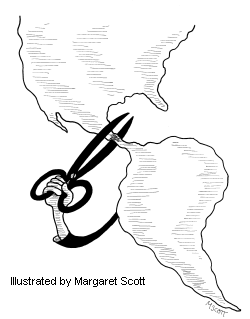
It’s Two Cities, You Know?

New Orleans After 24 Months: ‘They wanted them poor niggers out of there.’
By Greg Palast

09/01/07 “ICH” — — “They wanted them poor niggers out of there and they ain’t had no intention to allow it to be reopened to no poor niggers, you know? And that’s just the bottom line.”

It wasn’t a pretty statement. But I wasn’t looking for pretty. I’d taken my investigative team to New Orleans to meet with Malik Rahim. Pretty isn’t Malik’s concern.

We needed an answer to a weird, puzzling and horrific discovery. Among the miles and miles of devastated houses, rubble still there today in New Orleans, we found dry, beautiful homes. But their residents were told by guys dressed like Ninjas wearing “Blackwater” badges: “Try to go into your home and we’ll arrest you.”

These aren’t just any homes. They are the public housing projects of the city; the Lafitte Houses and others. But unlike the cinder block monsters in the Bronx, these public units are beautiful townhouses, with wrought-iron porches and gardens right next to the tony French Quarter.

Raised up on high ground, with floors and walls of concrete, they were some of the only houses left salvageable after the Katrina flood.

Yet, two years later, there’s still bars on the windows, the doors are welded shut and the residents banned from returning. On the first anniversary of the flood, we were filming this odd scene when I saw a woman on the sidewalk, sobbing. Night was falling. What was wrong?

“They just messing all over us. Putting me out our own house. We come to go back to our own home and when we get there they got the police there putting us out. Oh, no, this is not right. I’m coming here from Texas seeing if I can get my house back. But they said they ain’t letting nobody in. But where we gonna go at?”

Idiot me, I asked, “Where are you going to go tonight?”

“That’s what I want to know, Mister. Where I’m going to go – me and my kids?”

With the help of Patricia Thomas, a Lafitte resident, we broke into an apartment. The place was gorgeous. The cereal boxes still dry. This was Patricia’s home. But we decided to get out before we got busted.

I wasn’t naïve. I had a good idea what this scam was all about: 89,000 poor and working class families stuck in Homeland Security’s trailer park gulag while their good homes were guarded against their return by mercenaries. Two decades ago, I worked for the Housing Authority of New Orleans. Even then, the plan was to evict poor folk out of this very valuable real estate. But it took the cover of a hurricane to do it.

Malik’s organization, Common Ground, wouldn’t wait for permission from the federal and local commissars to help folks return. They organized takeovers of public housing by the residents. And, in the face of threats and official displeasure, restored 350 apartments in a destroyed private development on the high ground across the Mississippi in the ward called, “Algiers.” The tenants rebuilt their own homes with their own sweat and their own scraps of cash based on a promise of the landlords to sell Common Ground the property in return for restoring it.

Why, I asked Malik, was there this strange lock-out from public housing?

Malik shook his dreds. “They didn’t want to open it up. They wanted them closed. They wanted them poor niggers out of there.”

For Malik, the emphasis is on “poor.” The racial politics of the Deep South is as ugly as it is in Philadelphia, Pa. But the New Orleans city establishment has no problem with Black folk per se. After all, Mayor Ray Nagin’s parents are African-American.

It’s the Black survivors without the cash that are a problem. So where New Orleans once stood, Mayor Nagin, in connivance with a Bush regime more than happy to keep a quarter million poor folk (i.e. Democrats) out of this swing state, is creating a new city: a tourist town with a French Quarter, loose-spending drunks, hot-sheets hotels and a few Black people to perform the modern version of minstrel shows.

Malik explained, “It’s two cities. You know? There’s the city for the white and the rich. And there’s another city for the poor and Blacks. You know, the city that’s for the white and rich has recovered. They had a Jazz Fest. They had a Mardi Gras. They’re going to have the Saints playing for those who have recovered. But for those who haven’t recovered, there’s nothing.”

So where are they now? The sobbing woman and her kids are gone: back to Texas, or wherever. But they will not be allowed back into Lafitte. Ever.

And Patricia Thomas? The middle-aged woman, worked sweeping up the vomit and beer each morning at a French Quarter karioke joint. Not much pay, no health insurance, of course. She died since we filmed her – in a city bereft of health care. New Orleans has closed all its public hospitals but for one “charity” make-shift emergency ward in an abandoned department store.

And the one bright star, Malik’s housing project? The tenants’ work was done this past December. By Christmastime, they received their eviction notices – and all were carried out of their rebuilt homes by marshals right after the New Year, including a paraplegic resident who’d lived in the Algiers building for decades.

Hurricane recovery is class war by other means. And in this war of the powerful against the powerless, Mr. Bush can rightly land his fighter plane in Louisiana and declare that, unlike the war in Iraq, it is, indeed, “Mission Accomplished.”

Greg Palast is an investigative journalist and author of the New York Times bestseller, ARMED MADHOUSE: From Baghdad to New Orleans — Sordid Secrets and Strange Tales of a White House Gone Wild. Visit Greg’s website.

Source

Posted in RagBlog | Leave a comment

From Our Sportswriter – C. Loving

FOOTBALL IS BACK
Charlie Loving

This is the real meat of society – nothing else matters.

Gak! what a horrid game. The UTEP Miners and New Mexico Lobos were on television? The Miners have got to have the worst looking football suits of any team on the planet. They look like full body Speedos. The tubby guys really look really tubby. And those colors on my tube were horrific; red and white with silly blue slashes. And then there was the game which put viewers to sleep by the third quarter. I am from El Paso (fours years in HS) and I can’t see either team doing much of anything.

A good game was Cal and Tennesse which Cal won 45-31 despite a run by Tennessee at the end. I liked ‘ol’ Brent Musburger sending the sideline reporter to the cheapskate hill and a visit to the “blue haze” fans, pretty funny. Musburger is a good announcer who is into the whole package.

My view, Pete Carroll (Southern Cal) looks like he will run the table with maybe a scare from Cal which really looked good.

LSU will roll over Va Tech on Sept 8th. The Hokies my favorite team in the land looked lost. Beamer ball was all that saved them from defeat.

Texas was for crap. I listened to that game on the radio and even the homer announcers couldn’t make the Horns sound good. If the Ark State guys hadn’t had an illegal formation for an onsides kick toward the end it might have been upset city. The Ark. State QB said he wanted to play them again after a rest of course. The Texas offense sucked big time. Four running plays inside the ten and nothing on the board in the third quarter. The Ark. State defense was super. The game was always in doubt for the Horns. I think that Texas avoided being lumped in with Michigan.

Bob Stoops (OU 79, NSTU 10) has to be relishing the game to come with Texas. Texas if they don’t revive will be easy prey. TCU which romped over an improved Baylor (a team that can’t score) will be a tough opponent next week. I recall as a Boy Scout being an usher at Memorial Stadium (It was Memorial Stadium in those day) and watching TCU (TCU 27 BAYLOR 0) whip Texas. “Hey, Hey, Hoh, Hoh, TCU to the Cotton Bowl.”

I should be a Texas fan of course, but I love to see those pompus orange bloods drop games with a few exceptions. A&M, Tech and OU are those. It doesn’t look good after the first week for Coach Brown, Colt and company.

Colt Brennan had 3,549 yards going into Saturday is the guy at QB for Hawaii a team that used to be called Rainbows, which it seems was a little to gay and not mean enough. He passed fot four touchdowns in the first quarter (11 minutes) and six in the first half which gives him 99 so far.

You have to speak about the mother of all upsets. How could it happen? Michigan with the huge stadium full of Michiganders and all the money in the world lost to, whom? The Mountaineers of Ap State. The Ap State blocked kick at the end was super. I had Michigan as having a good offense last week but that turned out to be wrong. And their defense is suspect. Really suspect now. I will now have to burn my Michigan hat.

What happened to Notre Dame? Is coach Weis such a control freak and jerk as Sports Ilustrated says? His guys do not seem to relate to his professional NFL style. ND had zero offense against the Georgia Tech puppies who had all of ten months to study Weis and his team. Touchdown Jesus is shamed in Southbend.

LSU won easily 45-0, Missouri has 358 yards and won 40-34 over the Illini.

As Plema says the national championship will be Georgia Tech and SC. Well maybe but it is still early in the year. We know for sure Texas won’t be there.

Posted in RagBlog | Leave a comment

Celebrate Labour Day – Unionise

Labor Day Hypocrisy
by Stephen Lendman, September 01, 2007

Labor Day is commemorated on the first Monday in September each year since the first one was celebrated in New York in 1882. Around the world outside the US, socialist and labor movements are observed on May 1 to recognize organized labor’s social and economic achievements and the workers in them. This day gets scant attention in the US, but where it’s prominent it’s commonly to remember the Haymarket Riot of May 4, 1886 in Chicago. It followed the city’s May 1 general strike for an eight hour day that led to violence breaking out on the 4th.

Labor Day became a national federal holiday when Congress passed legislation for it in June, 1894 at a time working people had few rights, management had the upper hand, only wanted to exploit them for profit, and got away with it. It took many painful years of organizing, taking to the streets, going on strike, holding boycotts, battling police and National Guard forces, and paying with their blood and lives before real gains were won. They got an eight hour day, a living wage, on-the-job benefits and the pinnacle of labor’s triumph in the 1930s with the passage of the landmark Wagner Act establishing the National Labor Relations Board (NLRB). It guaranteed labor the right to bargain collectively on equal terms with management for the first time ever.

All of it was won from the grassroots. Management gave nothing until forced to and neither did government. It always sides with business never yields a thing unless threatened with disruptive work stoppages or possible insurrection. All this is in a democracy that claims to be a government of the people, by the people and for the people, most of whom are ordinary working class ones.

Since a worried Congress passed the 1935 Wagner Act during The Great Depression, the state of organized labor declined, especially post-WW II. It accelerated precipitously during the Reagan years under an administration openly hostile to worker rights in its one-side support for management. It continued unabated, under Republican and Democrat administrations, and today stands at a multi-generational low.

Under George Bush conditions got much worse. Since coming into office in 2001, he sided with management openly on policies to strip workers of their right to organize and be able to bargain for a living wage and essential benefits. He hired anti-union officials, denied millions overtime pay, cut pay raises for 1.8 million federal workers claiming a “national emergency,” and schemed to end Social Security as we know it by plotting (unsuccessfully so far) to let Wall Street sharks take it over.

Since labor’s ascendency decades earlier, corporate America, in league with government, shamelessly denigrated unions and the rights of working people in them. In 1958, 34.7% of the work force was unionized, but now the figure is around 12% overall, and only 7.4% in the private sector – the lowest it’s been in seven decades.

Even worse, most jobs are low-pay service sector ones because the nation’s manufacturing base and many higher-paying positions in finance and technology have been offshored to low-wage developing nations. Workers there can be hired for a fraction of the pay scales here or as virtual serfs at below poverty wages as low as $2 a day or less and no benefits. They fill legions of sweatshop factory jobs in countries prohibiting unions and fair worker practice standards for Wal-Mart’s “Always low prices” on the backs of ruthlessly exploited working people.

Nonetheless, on the first Monday each September, this nation “remembers” working Americans with a federally-mandated holiday in their “honor.” Who’s celebrating when it’s disingenuously commemorated at a time worker rights are threatened, ignored, forgotten, and uncared about by heartless governments beholden to capital. They scorn working people who are no longer as deceived with meaningless bread and circus droppings at the expense of what they need most: good jobs at good pay, essential benefits, job security, and a government on their side doing what counts most – supporting their rights with worker-friendly legislation.

Workers are reminded every day that backing like that is off the table by governments shamelessly mocking their day. It’s commemorated in name only by a nation beholden to capital, the corporate giants controlling it, and the best democracy their money can buy for them alone.

Stephen Lendman lives in Chicago and can be reached at lendmanstephen@sbcglobal.net.

Also visit his blog site at sjlendman.blogspot.com and listen to The Steve Lendman News and Information Hour on TheMicroEffect.com Saturdays at noon US central time.

Source

Posted in RagBlog | Leave a comment

NGO’s – The Left Arm of Imperialism

NGOs and Imperialism
by Yves Engler, September 02, 2007

Foreign Affairs 501 – Take Home Exam

Any individual working for an aid organization is required to pass this exam and a B+ or higher must be achieved to attain “left wing” status.

Please write 500 words answering each of three of the following questions.

1) Do people really feel better when their elected government is destroyed by democracy promotion rather than subversion?

2) Should it be called “aid” or “aiding and abetting” when you give a country weapons of mass destruction?

3) Why is it called a non-governmental organization (NGO) when it gets most of its funding from governments?

4) Why do progressive people, who think privatized medical and social welfare services are a right wing plot in their own wealthy countries, donate money to organizations that replace government-run services in poor countries?

5) Are some major Western non-governmental organizations really just an arm of imperialism?

Bonus marks will be awarded if you answer all five.

Facing the reality that most development NGOs are heavily reliant on Western government “aid,” which is usually directed towards countries of geopolitical importance to the captains of capitalism, may be unpleasant for some “progressives,” but it is true nonetheless.

A major principle of Canadian foreign aid, for example, has been that where the USA wields the big stick, Canada carries a police baton and offers a carrot. The major recipient of Canadian aid in 1999/2000 was the former Yugoslavia; Iraq and Afghanistan were top two recipients in 2003/2004; today Afghanistan and Haiti are Nos. 1 and 2. The intervention-equals-aid principle also exists for other western countries.

Post-coup Haiti has been a bonanza for Canadian (mostly Quebec-based) NGOs.

They have received tens of millions of dollars from the Canadian government.

Montreal-based Alternatives, usually on the left of the NGO world, is but one example. With no operations in Haiti before 2004, the post-coup influx of Canadian “aid” dollars was too good an opportunity to pass up. The Haiti file was given to an Alternatives employee who was having difficulty raising money for his Africa dossier. Canadian imperialism showed a definite preference for media work in Haiti over Ghana and Alternatives was rewarded when it obliged. (Alternatives also made its way to Afghanistan.)

According to the Canadian International Development Agency’s (CIDA) website, Alternatives has received $2.1 million for Haiti work over the past couple of years. Coincidentally, Alternatives has parroted the neoconservative narrative about Haiti. Their guest speaker on Haiti at the recent Quebec Social Forum was Chavanne Jean-Baptiste, an advisor for right-wing business candidate, Charles Henry-Baker’s failed presidential campaign. (It has been alleged that Baptiste’s organization provided support to the ex-military who lead the armed assault against the elected government in February 2004.) Alternatives other main Haitian invitee was Rene Colbert, editor of AlterPresse, who told this author in a private conversation there was no coup in February 2004 since Jean Bertrand Aristide was never elected.

Many of the other Canadian NGOs that benefited from the coup called for Aristide’s overthrow. The Concertation Pour Haiti (CPH), an informal group of half a dozen NGOs, branded Aristide a “tyrant,” his government a “dictatorship,” and a “regime of terror” and in mid-February 2004 called for Aristide’s removal. This demand was made at the same time CIA-trained thugs swept across the country to oust Aristide.

Quebec (and Haitian) NGO’s hysterical opposition to Aristide was certainly influenced by the politics of their government donors. An understanding that intervention would lead to increased aid also likely influenced it. The 1994 US invasion, which restored Aristide to office, created a boom for development NGOs in Haiti (making it the world leader in NGOs per square kilometer, according to some). Yet, securing financing became more difficult as international funding was curtailed along with foreign troops (and US police trainers) in the late 1990s and with the “intransigent” Aristide’s 2000 election. Not until Aristide was gone, and a post-coup government installed by the USA, France and Canada, did the aid spigot once gain turn back on for Canadian and Haitian NGOs.

Haiti was not unique. In another part of the world, many NGOs supported “humanitarian intervention.” In her book, Fools’ Crusade, Diana Johnstone decries NGO support for Western imperialism in the former Yugoslavia. She points out: “When, as in Bosnia-Herzegovina or Kosovo, military intervention leads to an international protectorate, Western NGOs are granted a prominent role in local administration and receive a large share of public and private donations.” (Fools Crusade, Page 13)

Of course imperialism is not only about military intervention. In Promoting

Polyarchy: Globalization, US Intervention and Hegemony, William I. Robinson argues that “democracy promotion” is an important aspect of modern imperialism. It’s a change in US foreign policy from “earlier strategies to contain social and political mobilization through a focus on control of the state and governmental apparatus” to a process in which “the United States and local elites thoroughly penetrate civil society, and from therein, assure control over popular mobilization and mass movements…”

The colored revolutions in Eastern Europe are high-profile recent examples of “democracy promotion” at the service of western aims. In Haiti, as well, a variety of NGOs were funded to promote the US and Canadian version of democracy. Politics Without Sovereignty explains: “From 1998, USAID and DFID [the UK’s Department For International Development], among others, began to systematically subcontract to international NGOs including CARE, ActionAid, Save the Children, Oxfam, and Concern International to ‘build civil society capacity.’”

According to a recent Vancouver Sun article, nearly a fifth of the Canadian International Development Agency’s budget, some $600 million, is now spent on initiatives directed towards “promoting democracy.” Last October CIDA established an Office of Democratic Governance. Of course, the US is the largest democracy promotion donor with the National Endowment for Democracy at the forefront. Its Democracy Projects Database coordinates 6,000 projects worldwide.

The economic and social sides of imperialism also benefit NGOs. The neo-liberalism pushed by the IMF, World Bank, USAID, CIDA etc. breeds NGOs.

As structurally adjusted states withdraw social services, NGOs flood in.

Take Ghana, for instance. Since the late 1980s, a series of structural adjustment programs have diminished the state’s role in the economy. The donors that push neoliberalism argue that while reforms may bring with them social ills, their aid and NGOs will help to resolve these side effects.

Back in the late 1980s the former president of CIDA, Margaret Catley-Carlson, explained to the Ghanaians: “We know that if you take on this [IMF] program of reform it will cost you. Your food prices are going to shoot up, and in the urban areas that is going to be very destabilizing. So we will put in some food aid [likely administered by NGOs] and help you out over this very difficult period.”

The process of withdrawing the state has resulted in ever-growing dependence. With a hint of pride, Jeanine Cudmore, an employee of the CIDA-funded Social Enterprise Development Foundation, recently told the Montreal Gazette that in northern Ghana “the government relies on NGOs.”

When the U.S. returned Aristide to office in 1994, it was on condition that he implement an economic agenda focused on further downsizing the state.

International creditors argued that the flipside of this government downsizing would be increased aid, particularly to private sector NGOs. This “aid” money was to be channeled towards projects such as schools and hospitals run by private (usually non-profit) NGOs.

A CIDA report released in 2005 stated that by 2004, “non-governmental actors [for-profit and not-for-profit] provided almost 80 percent of [Haiti’s] basic services.” While an NGO-run school may be better than no school at all, a cluster of privately run schools is not an ideal development model.

Canada’s development agency has admitted as much. According to CIDA, “Supporting non-governmental actors contributed to the creation of parallel systems of service delivery. … In Haiti’s case, these actors [NGOs] were used as a way to circumvent the frustration of working with the government … this contributed to the establishment of parallel systems of service delivery, eroding legitimacy, capacity and will of the state to deliver key services.”

NGOs are significant beneficiaries of modern imperialism: They soften the edges of neoliberalism, while democracy promotion and military interventions alike bring a windfall of contracts.

Perhaps the question to be asked is: Are development NGOs compatible with real democracy?

In Canada and many other countries, most people, including all of those who are on the left, oppose private health clinics, seeing them as a threat to our universal, government-run systems of medical care. People everywhere see public schools as an important part of democracy. Citizens in all First World countries demand social services provided by their governments.

Yet the “development” model favored in the Third World for the past two decades involves destroying government services and handing them over to NGOs that willingly participate in this undermining of democracy

If you see anything progressive about that, you’ll get a failing grade in the test above.

Yves Engler is the author of two books: Canada in Haiti: Waging War on the Poor Majority (with Anthony Fenton) and Playing Left Wing: From Rink Rat to Student Radical. Both books are published by RED/Fernwood and available at www.turning.ca.

Source

Posted in RagBlog | Leave a comment

Five More Years Until Iraq Has Power

Note the wording of the headline, as though it’s clearly the fault of Iraq, its government, or at least, someone other than the US, with its bellicosity and arrogance in invading Iraq in the first place. The MSM continues to show its true colours on a daily basis – cheerleaders for BushCo and all the fraud and corruption for which it stands.

Iraq Far From U.S. Goals for Energy: $50 Billion Needed To Meet Demand
By Dana Hedgpeth, Washington Post Staff Writer
Sunday, September 2, 2007; Page A01

Iraq’s crucial oil and electricity sectors still need roughly $50 billion to meet demand, analysts and officials say, even after the United States has poured more than $6 billion into them over more than four years.

Since the U.S. invasion of Iraq in 2003, the Bush administration has focused much of its $44.5 billion reconstruction plan on oil and electricity. Now, with the U.S.-led reconstruction phase nearing its close, Iraq will need to spend $27 billion more for its electrical system and $20 billion to $30 billion for oil infrastructure, according to estimates the Government Accountability Office collected from Iraqi and U.S. officials.

Even with the funding, the GAO notes that it could take until 2015 for Iraq to produce 6 million barrels of oil a day and have enough electricity to meet demand. A commanding general of the Army Corps of Engineers says it could have enough electricity sooner — 2010 to 2013.

“The U.S. money was intended to get those industries started on recovery,” said Stuart W. Bowen Jr., the U.S. special inspector general for Iraq reconstruction, who is charged with finding waste, fraud and abuse in the multibillion-dollar effort. “We were working with a dilapidated, run-down system. It still has a long, long way to go.”

A former top-level Pentagon official who was involved in rebuilding the oil and electricity sectors put it more bluntly. “People said the money was to rebuild the country, but it was just a down payment,” said the official, who spoke on condition of anonymity because he still works for the government. “The money was never enough to handle all that was there. It was merely a Band-Aid.”

If the problems aren’t fixed, it will be difficult to establish a strong economy and improve the standards of living, and could cause people to lose confidence in the government.

Oil and electricity are two of Iraq’s most important industries, each depending heavily on the other. Iraq imports about $2.6 billion worth of petroleum products a year. Oil exports account for 90 percent of the Iraqi government’s revenue, but oil production is crippled without enough electricity for refineries and pipelines. Electricity, in turn, cannot be generated without the fuel that powers most of Iraq’s power plants.

U.S. officials say they found the country’s infrastructure in worse shape than they expected, hit hard by the Persian Gulf War of 1990-91 and a decade of economic sanctions. Oil wells hadn’t been cleaned. Power plants had antiquated equipment and no parts available for repairs. One U.S. auditor said he spent a day with 22 Iraqi electrical engineers who proudly showed him how they jury-rigged a generator using the sawed-off bottom of a Pepsi can.

The Americans put $4.6 billion into more than 2,600 projects to repair electricity-generation facilities, transmission lines and distribution networks. They put $1.75 billion into improving the country’s oil infrastructure.

Another huge problem: Armed groups regularly attack oil and electricity facilities.

Analysts say Iraq needs to invest money to improve its infrastructure for pumping and processing oil, upgrade and maintain equipment, and train workers at power plants and refineries. One U.S. adviser said, “They need more of everything.”

“Our piece was to jump-start the infrastructure here,” Brig. Gen. Michael J. Walsh, commanding general of the Army Corps of Engineers’ Gulf Region Division, said in a telephone interview from Baghdad. “Everything we’ve been doing in the last four years was just enough to start it. Now the Iraqi government needs to continue.”

Read all of it here.

Posted in RagBlog | 1 Comment

Surprise!!! Don Rumsfeld Is Intellectually Bankrupt

General attacks ‘flawed’ U.S. Iraq policy: Tensions between allies rise to fever pitch
By Rupert Hamer, Defence Correspondent 02/09/2007

A second British General has attacked America’s “fatally flawed” policy in Iraq, ratcheting up the tension between the two allies on the issue.

Major General Tim Cross – the most senior British officer involved in planning post-war Iraq – said he raised serious concerns with former US Defence Secretary Donald Rumsfeld BEFORE the invasion.

But he says his worries were dismissed out of hand.

The comments follow ex-Army chief General Sir Mike Jackson’s attack on Mr Rumsfeld as “intellectually bankrupt”.

General Cross, 56, said: “Right from the very beginning we were all very concerned about the lack of detail that had gone into the postwar plan – and there is no doubt that Rumsfeld was at the heart of that process.

” I had lunch with Rumsfeld in Washington before the invasion in 2003 and raised concerns about the need to internationalise the reconstruction of Iraq and work closely with the United Nations.

“I also raised concerns over the numbers of troops available to maintain security and aid reconstruction. He didn’t want to hear that message. The US had already convinced themselves that Iraq would emerge reasonably quickly as a stable democracy.

“Anybody who tried to tell them anything that challenged that idea – they simply shut it out.” The general, who was deputy head of the coalition’s Office Of Reconstruction And Humanitarian Assistance in 2003, added: “Myself and others were suggesting things simply would not be as easy as that.

“But he ignored my comment. He dismissed it. There is no doubt with hindsight the US post-war plan was fatally flawed – and many of us sensed that at the time.” General Jackson calls Mr Rumsfeld’s postwar plan “intellectually bankrupt” in an autobiography. And he described Mr Rumsfeld’s flippant claim that “US forces don’t do nation building” as “nonsensical”.

Yesterday General Cross, who retired from the Army earlier this year, said he backed everything General Jackson had said. And that view was shared by Liberal Democrat leader Menzies Campbell, who said: “There was no plan for what was to happen after a military victory. British military personnel are paying with their lives for that lack of foresight”

Former Tory defence secretary Sir Malcolm Rifkind and Major General Patrick Cordingley, who led the Desert Rats in the 1991 Gulf War, also backed the general.

Source

Posted in RagBlog | Leave a comment

We Have a Broken Health Care System – A. Embree

Sick of our Health System?
By Alice Embree

A capacity crowd filled the AFL-CIO auditorium Sunday, August 26th, to hear a panel discuss “Improving Access to Health Care in Texas: Next Steps.” The Gray Panthers of Austin sponsored the forum. Gray Panthers advocates for social and economic justice, affordable housing, universal health care, peace, education improvement, and environmental preservation under the slogan: “Age and Youth in Action!”

The forum struck a chord with citizens who see their health care costs soar while their coverage shrinks. Panel moderator Bonnie Gardner began with statistics that should alarm every reader. This country, despite its spending on health care, ranks 37th among nations in positive health care outcomes. Texas ranks 49th among the 50 states! One of four Texans has no health insurance. And, as Michael Moore’s movie “Sicko” illustrates, even those with health insurance find their coverage isn’t what they need when it matters.

The panelists examined the health of our state’s health care and prescribed remedies. The first speaker was former Judge Scott McCown of the Center for Public Policy Priorities. Judge McCown focused on the policy problems caused by rising health care costs. In 2003, the Texas legislature drastically cut state resources for the Children’s Health Insurance Program (CHIP), a program that uses state and federal funds to make health insurance available to low income children. The Center for Public Policy Priorities was an effective advocate for CHIP. That advocacy was rewarded during the 2007 legislative session when state funding was expanded. The legislature also improved the CHIP eligibility process and eliminated a privatized call center that proved to be a disastrous hurdle for Texans attempting to get their children insured. Unfortunately, Congressional hurdles to securing federal funds for CHIP remain and the two Texas Senators have not voted to approve federal appropriations for an expansion of CHIP.

Ann Kitchen, the second panelist, represents the Indigent Care Collaboration (ICC). The ICC is a local alliance of public and private organizations that includes the Travis County Hospital District, the People’s Community Clinic and public and private provider groups concerned about indigent care. Kitchen noted that 60% of the indigent and uninsured visits to emergency rooms in this area are for potentially preventable health emergencies. The classic example is the child with treatable asthma who doesn’t receive treatment at a less expensive clinic and ends up in an expensive emergency room, competing for attention with trauma victims. This problem strains the emergency care system. The Indigent Care Collaboration advocates a community-designed solution. ICC focuses on technology to lower costs, preventative health care through clinics, and ways of subsidizing insurance premiums, particularly for small businesses that can no longer afford group insurance plans. Kitchen said this country is trying to provide health care through insurance companies that are designed around two goals – profit and minimizing risk.

The third panelist spoke of mental health needs. Denise Brady is a lobbyist for Mental Health America. This group advocates for mental health services. Unfortunately, Texas insurance companies cover only 8 mental illnesses and often restrict treatment for those illnesses. Untreated mental disorders ripple through the community and affect a high proportion of the homeless population. Brady described the problem police have when they pick up someone in need of in-patient treatment only to find no beds available in the local state hospital. The impact of untreated mental illness on law enforcement was a powerful argument before the legislature. In 2007, the state legislature allocated $82 million for crisis mental health care. While Brady hopes funding will ultimately be increased to provide preventative health care for mental illness, she is encouraged that providers can expand services for those in crisis beginning September 1.

The final speaker was Dr. Amina Haji representing Health Care for all Texas (HCFAT). Dr. Haji said that 45 million people in this country are uninsured and lack of health care is the 5th leading cause of death in the United States. Health Care for All Texans advocates single-payer national health insurance. Specifically, they support “The U.S. National Health Insurance Act” (HR 676), now before Congress.

The United States has the highest health care spending in the world, but millions of citizens have no health insurance or are under-insured. The U.S. is the only industrialized country has tried to rely on an employers to access coverage. As costs soar, small employers opt out and large employers are increasingly uncompetitive in the global marketplace. Worse, the U.S. is the only industrial country that lets for-profit insurance companies act as middlemen in the health care system. These companies screen out patients in need and focus instead on profit and limiting their own risk. They waste millions on billing and marketing. Dr. Haji argues that replacing private insurance companies with a single-payer public program would save enough money to provide comprehensive health care. She made a persuasive argument for a publicly funded, privately administered system. Health care providers would not work for the government under the system Dr. Haji describes. Instead, the government would reimburse providers the way the Medicare system is works.

Almost everyone has a personal health care nightmare or has heard one from friends or family. This forum focused on both problems and solutions. The diagnosis was clear. We have a broken health care system. Everyone offered remedies – expansion of CHIP for low-income children, local collaborations, and expansion of mental health services. Dr. Haji advocates a major overhaul – single-payer national health insurance.

So, what can readers do? Join forces with activists from the Gray Panthers and Health Care for All Texans (HCFAT). Statewide, the Gray Panthers and HCFAT will continue to press for legislative health care initiatives already underway and will emphasize access to dental care. These groups will take action locally to ensure that the Health Care District improves its 23 Health Centers and lobby for increased health care funding form the City and County. The Gray Panthers mapped out a two year action plan on health care with coalition partners that include HCFAT, AARP and the Texas Senior Advocacy Coalition.

To get involved, visit: www.healthcareforalltexas.org or austingp.hypermart.net.

Appeared first in NOKOA newspaper, Austin, Texas, August 30, 2007.

Posted in RagBlog | Leave a comment

Cutting the Ties That Strangle

Venezuela’s Financial Mission in the Caribbean Basin
Thursday, Aug 30, 2007, By: Venezuelanalysis.com

While crowds of cheering supporters gathered outside the National Assembly in Venezuela on Wednesday, August 15, President Hugo Chávez outlined what could be the most radical phase of his proposed amendments to the constitution yet, the elimination of any term limits on the re-election of any candidate as well as lengthening each presidential term from six to seven years. These proposals reflect concerns in the Chávez camp over the shortcomings of the present constitution, which mandates that he will not be able to run again in 2012 when his third term comes to an end, according to the current constitution that was drafted under Chávez’s supervision in 1999.

Since winning the presidency for a third term in 2006 (by a confirmed democratic vote of almost 60 percent out of the 75 percent of the electorate that chose to cast their ballot), Chávez has aggressively nationalized the oil, telecommunications and electricity sector. He also introduced land reform and is now moving to end the autonomy of Venezuela’s central bank in order to gain access to the country’s foreign reserves, which he plans to use towards his ambitious social programs for the poor. Before any of this can happen, though, Chávez’s proposed constitutional reforms must first be passed by the National Assembly, almost all 167 of whom are pro-Chávez, to be followed by putting the new amendments before a popular national referendum. If all goes to plan, the referendum could be voted upon in several months time, which leaves scant opportunity for the State Department to mobilize a campaign to thwart Chávez’s ambitions.

Creating a Constituency

Aside from drafting constitutional amendments and initiating dramatic domestic energy strategies, the Venezuela President has been busy making house calls to important trading partners around the region and the world. For several years, his bold socialist economic objectives have to an extent escaped being under the magnifying glass of U.S. suspicion, due in large part to the Bush Administration’s preoccupation with its “War on Terror” in Iraq and elsewhere in the Middle East, but now with more countries gradually signing up to join Venezuela’s innovative development initiatives, Washington is finally mobilizing itself in a battle for influence throughout Latin America.

Venezuela’s Alternative to the FTAA: The “Dawn” of a New Generation of Regional Cooperation

In an attempt to draw-out any further progress in creating the U.S.-sponsored Free Trade Agreement of the Americas (FTAA), the Venezuelan government has been adamantly pushing for a more integrated and dependable trade and financial system for Latin America. For the last several years, Chávez’s cure for economic dependency on the part of under-developed states, ALBA (Bolivarian Alternative for the Americas or Alternativa Bolivariana par las Américas), has been slowly drawing support and gaining members throughout South and Central America. Promoted as a humane alternative to the profit-maximizing logic of the FTAA, ALBA, which translates to “dawn” in Spanish, aims not only on improving the region’s economic integrity, but also to create a vision of social welfare and mutual aid. Using the European Union as a model to decant his visions, Chávez claims that encouraging developing countries in Latin America to work in unison will decrease the number of trade disadvantages for small economies, enable better economic planning as a whole, and provide the region with a stronger international pollination of ideas.

Since ALBA is far from being hemispheric-wide in its acceptance, Venezuela, Cuba, Bolivia and Nicaragua also have entered into a People’s Trade Agreement (Tratado de Comercio de los Pueblos or TCP) that points toward the same aforementioned general principals, but leaves the door open to new members. Due to the expansion of Venezuela’s social and economic programs in recent years, as well as the large number of Latin Americans who have directly benefited from Caracas’ bilateral trade pacts, numerous countries—parties who are now receiving bilateral largesse from Venezuela— still remain uneasy about jumping on the ALBA bandwagon, fearing adverse reactions from Washington.

The Union of South American Nations (UnaSur), formerly the South American Community of Nations (CSN), is an alternative regional integration body in the form of an intergovernmental union. Combining MERCOSUR and the Andean Community (CAN), UnaSur, in the long-run, is attempting to adopt most of the same strategies as the EU, including the creation of a common currency, free movement of all South American nationals and the future elimination of tariffs on non-sensitive goods and services. The new Latin American bloc would comprise approximately 17.6 million square miles of territory and a population of over 400 million. The obvious difference between ALBA and the strictly South American UnaSur, is that under the latter, certain Central American and Caribbean countries, such as Cuba, would not be included. This poses a major problem for those who already have signed onto the Chávez-sponsored bloc, because attention will likely be drawn towards the larger and more influential South American trade union.

An Overview: The Members

Cuba, having close ties with Venezuela, was the first to sign onto ALBA in 2004, and has provided a substantial amount of medical and agricultural resources to its effort. For example, the Miracle Operation, which provides free eye surgery to tens of thousands of Latin American and Caribbean citizens each year, has brought positive attention to the politically controversial country as well as ALBA as a whole. The Brazil Report observed that on April 29, 2006, the newly elected president of Bolivia, Evo Morales, who is known to be the leading ideological partner in crafting Chávez’s “21st century socialism,” signed the TCP agreement and soon after enacted his plans to nationalize the country’s enormous gas resources at the encouragement of President Chávez. In a similar feint, President Daniel Ortega of Nicaragua, who having previously rejected Brazilian offers of ethanol technology, signed the pact and soon witnessed a $31 million dollar debt-forgiveness plan from Venezuela going into effect in January 2007. This made for an attractive contrast in terms of Managua’s somewhat cautious participation in the Central American Free Trade Agreement (CAFTA). Other countries considering joining the TCP in the near future include Ecuador, Honduras, and the tiny island nations of St. Vincent, Antigua and Barbuda, Dominica and the Grenadines.

A Risky Partner

In addition to economic factors, there are also political implications that go along with becoming a member of ALBA, most of which stem from the close partnership between Venezuela and Cuba.

For decades, Cuba has helped stir up an array of controversial feelings within the international community. One of the most contentious of these issues has been Havana’s continued explosive relationship with the U.S., policy long advocated as well as stimulated by the conservative exile community in Miami, Florida, just 90 miles away from the socialist island nation. However, even though long-time Cuban strongman Fidel Castro has always been open to talking to the U.S. about economic integration and trade expansion, he realized that most of the miniature Caribbean island nations lack some very important natural resources and natural skills in order to participate in the market place. On December 14, 2004, the Cuba-Venezuela Agreement was signed into action. As a result, Venezuela now delivers approximately 96,000 barrels of oil per day from its state-owned petroleum reserves to Cuba at a very favorable price. In return, Cuba has posted around 20,000 medical personnel to Venezuelan slums. This was, in almost any case, the first step in their progressive partnership in ALBA, since they have been linked up in, what Chávez likes to call, twenty-first century socialism. It seems as though this strong political strategizing by Chávez has not only withstood the negative backlash from Washington, but also has turned heads and brought attention to Latin America as an increasingly important player in world, let alone in regional, politics.

Early this summer, Cuban Agriculture Minister Maria de Carmen Perez and her Venezuelan counterpart Elias Java signed an ALBA-linked agreement to create five joint farming companies in hopes of further reducing their dependence on foreign imports. Located in Venezuela, the farms will produce top priority food and barnyard yields, such as leguminous plants, milk and yogurt, rice and poultry. Since then, five more agreements have been drafted, integrating food producing companies in the two countries and increasing their total bilateral trade to more than $1.8 billion.

The progress being shown in these collaborative programs is closely linked to another Chávez initiative, PetroCaribe, which held its third summit in Caracas on August 11, 2007. After meeting with several PetroCaribe leaders, Chávez said, in referring to future oil needs in the Caribbean Basin region, “the Caribbean shouldn’t have problems this century and beyond.” The populist leader also called for a new underwater pipeline connecting Venezuela to the neighboring islands of Haiti, Puerto Rico and Cuba. According to the Venezuelan president, “If we [Latin America] truly unite…the grandchildren of our grandchildren will have no energy problems.”

The Proposed Programs

Chávez has proposed a variety of different initiatives directed towards improving the social and economic status of regional countries, as well as lowering the extent of their dependence on foreign aid and on multinational corporations. One of the first regional projects was the development of TeleSur, a Pan Latin American television network, which went on the air in October 2005, adding to U.S.-owned CNN, Fox and Univision, among several other similar enterprises, as a round-the-clock TV cable information station. Later that year, PetroCaribe, a Caribbean oil alliance with Venezuela, was established, allowing the sometimes heavily-indebted countries to trade agricultural goods for concessionary oil prices. However, there are many critics of this agreement who believe that Cuba is receiving preferential treatment from Venezuela due to the unusually close relationship between Chávez and Cuban President Fidel Castro. In June 2007, in one of the latest initiatives unfurled by Chávez at the ALBA Summit in Caracas, the idea of launching Banco del Sur was presented. If implemented, the bank would largely take the place of the International Monetary Fund, which for decades has put harsh economic qualifications and restrictive standards on loans being granted to developing countries.

Economic and Political Hurdles: Trade Union Competition and U.S. Initiatives

Several member states aligned with the two main trading blocks in South America, Mercosur and CAN (in 2006 Chávez pulled Venezuela out of the Andean Community because he believed it required making too many concessions to Washington), have joined ALBA. Chávez has been actively soliciting the approval of Brazil, by far the largest economy in South America. Brazil’s success in the biofuel industry has allowed for growing economic self-sufficiency as well as an increased number of trade opportunities with medium economies in the region, including Chile and Colombia. Like those two nations, Brazil is a strong trading partner of the U.S., and Lula has expressed misgivings over a potential negative reaction from Washington if Venezuelan’s trade programs are accepted by Brasilia. Instead, Lula has focused on technology deals, such as expanding the production of ethanol with Mexico and Honduras. Despite quiet efforts made to distance itself from Chávez, Brazil may have another budding relationship to worry about, which is coming from its southern MERCOSUR neighbor, Argentina.

Unlike Brazil, Argentina has been warmly welcoming Venezuelan petrol-dollars. In the past two years, Venezuela has purchased a total of $5 billion in debt relief investments from Argentina, recently adding another one billion dollars in government bonds purchased from Buenos Aires, securing Caracas’ chief lender status to the region. Although criticisms at home and from abroad have been levied against President Kirchner’s decision to further ally himself with Chávez, the Argentine leader decided to meet again earlier this summer in Bolivia, where Chávez and Morales created more oil and gas deals, which this time included Argentina. Plans to transport $16 billion of Bolivian gas to Argentina is already underway, and with one of coldest winters on record taking a heavy toll on the country, the timing couldn’t be better for Chávez’s grand design for the region. Presidential hopeful Christina Kirchner, wife of President Nestor Kirchner, has also made comments supporting Chávez’s initiatives, linking herself all the more to populist ideals.

Venezuela’s oil wealth also has generated energy deals with innovation-minded Evo Morales, signing a $600 million joint venture with Venezuela which consisted of investments involving state-owned Petróleos de Venezuela (PDVSA) and Bolivia’s Yacimientos Petrolíferos Fiscales Bolivianons (YPFB). Not only did Chávez bring his country’s checkbook to La Paz, but he also provided alternative production ideas for Bolivia’s industries, including the cultivation of coca leaves, that have countered U.S. anti-drug strategies. At the same time, plans are underway in Ecuador to build a major oil refinery with the help of around $5 billion in loans from Venezuela. To the south in Uruguay, which in recent years has been one of the most hesitant countries in forming economic and political ties with Venezuela, has now accepted special petroleum conditions that will allow for Uruguay to pay 75 percent up front for its fuel bill and the remaining 25 percent over a period of 15 years, at a convenient two percent interest. At the same time, Uruguay has begun to export dairy cows to Venezuela as a part of several agreements signed between the two countries since 2005. All in all, Latin American governments are finding Venezuelan deals to be too good to pass up, and with the U.S. unwilling to come forth with similarly attractive provisions, the decision for prospective partners has become an increasingly easy one to make.

Meanwhile, a sluggish State Department has been trying to counteract Chávez’s plans by advocating more FTAs in the Americas. However, planning for these has not been going as smoothly as Washington would have liked. In early March 2007, U.S. President George W. Bush began a tour of several Latin American countries (Brazil, Uruguay, Colombia, Guatemala and El Salvador) in hopes of catalyzing the process for jump-staring a sequence of FTAs by promising additional aid to the region, but what he was greeted with in turn were noisy protests rather than warm receptions.

More Latin American Worries for Washington: First Cuba…Then Venezuela…Next…

In July 2007 Iran’s president, President Mahmud Ahmadinejad, announced (via an Iranian website) that his country will join ALBA as an “observer.” In a related development, The New York Times reported that in the past several months Nicaragua has accepted finances from Iran in order to construct a $350 million ocean port as well as promises to choose a site for a $120 million hydroelectric project in hopes of solving the nation’s current energy crisis. These moves were not particularly well received by all Nicaraguans, being seen by some as yet another foreign investment scheme to challenge national sovereignty with ambitious funding operations.

Though it seems improbable that a fiercely Islamic country thousands of miles away would be so interested in Latin America, President Ahmadinejad has forcefully linked Iran’s Islamic revolution to Chávez’s secular revolution that is a mix of socialism and vague ideas drawn from Simon Bolivar. Economically, Iran has been contributing to ALBA since 2005, starting with Iran’s participation in the construction of a tractor manufacturing company, which was jointly inaugurated in Venezuela by Chávez and Ahmadinejad. The factory can annually produce 5,000 tractors and agricultural machinery, of which some already have been exported to Bolivia and 170 of which are now being shipped to Nicaragua. In return for these shipments, Nicaragua and Bolivia have pledged to increase the amount of foodstuffs they export to Iran, including coffee, meat and bananas. Venezuelan Energy Minister Rafael Ramirez, in a July 3 interview with the Iranian newspaper Shargh, announced an agreement to start exporting an undetermined amount of gasoline to Iran. Although Iran produces large volumes of crude oil, it lacks adequate refineries to process the raw crude into gasoline. Ramirez has estimated that the new $4 billion project, set to be built in the Orinoco region, would begin yielding a final product in 2009.

The political implication of having Iran as an ALBA member could bring as many problems as solutions to the table. The U.S. already is wary of Venezuela’s growing relationship with Nicaragua, but now that Iran has come into the mix, particularly when it comes to energy ties, it may make being affiliated with ALBA even trickier for other Latin American states to get too close to the Caracas-led pact.

This analysis was prepared by COHA Research Associate Katie Dickson.

Source

Posted in RagBlog | Leave a comment

Bush and His Brownshirt Administration

The War Criminal in the Living Room
By Paul Craig Roberts

08/31/07 “ICH” — — The media is silent, Congress is absent, and Americans are distracted as George W. Bush openly prepares aggression against Iran.

US Navy aircraft carrier strike forces are deployed off Iran.

US Air Force jets and missile systems are deployed in bases in countries bordering or near to Iran.

US B-2 stealth bombers have been refitted to carry 30,000 pound “bunker buster” bombs.

The US government is financing terrorist and separatist groups within Iran.

US Special Forces teams are conducting terrorist operations inside Iran.

US war doctrine has been altered to permit first strike nuclear attack on Iran and other non-nuclear countries.

Bush’s war threats against Iran have intensified during the course of this year. The American people are being fed a repeat of the lies used to justify naked aggression against Iraq.

Bush is too self-righteous to see the dark humor in his denunciations of Iran for threatening “the security of nations everywhere” and of the Iraqi resistance for “a vision that rejects tolerance, crushes all dissent, and justifies the murder of innocent men, women, and children in the pursuit of political power.” Those are precisely the words that most of the world applies to Bush and his Brownshirt administration. The Pew Foundation’s world polls show that despite all the American and Israeli propaganda against Iran, the US and Israel are regarded as no less threats to world stability than demonized Iran.

Bush has discarded habeas corpus and the Geneva Conventions, justified torture and secret trials, damned critics as anti-American, and is responsible, according to Information Clearing House, for over one million deaths of Iraqi civilians, which puts Bush high on the list of mass murderers of all time. The vast majority of “kills” by the US military in Iraq and Afghanistan are civilians.

Now Bush wants to murder more. We have to kill Iranians “over there,” Bush says, “before they come over here.” There is no possibility that Iranians or any Muslims who have no air force, no navy, no modern military technology are going to “come over here,” and no indication that they plan to do so. The Muslims are disunited and have been for centuries. That is what makes them vulnerable to colonial rule. If Muslims were united, the US would already have lost its army in Iraq. Indeed, it would not have been able to put an army in Iraq.

Meanwhile the US media focuses on whether Republican Senator Larry Craig is a homosexual or has offended gays by denying to be one of them. The run-up for the public’s attention is why a South Carolina beauty queen cannot answer a simple question about why her generation is unable to find the United States on a map.

The war criminal is in the living room, and no official notice is taken of the fact.

Lacking US troops with which to invade Iran, the Bush administration has decided to bomb Iran “back into the stone age.” Punishing air and missile attacks have been designed not merely to destroy Iran’s nuclear energy projects, but also to destroy the public infrastructure, the economy, and the ability of the government to function.

Encouraged by the indifference of both the American media and Christian churches to the massive casualties inflicted on Iraqi civilians, the Bush administration will not be deterred by the prospect of its air attacks inflicting massive casualties on Iranian civilians. Last summer the Bush administration demonstrated to the entire world its total disdain for Muslim life when Bush supported Israel’s month-long air attack on Lebanese civilian infrastructure and civilian residences. President Bush blocked the attempt by the rest of the world to halt the gratuitous murder of Lebanese civilians and infrastructure destruction. Clearly, turning the Muslim Middle East into a wasteland is the Bush policy. For Bush, civilian casualties are a non-issue. Hegemony uber alles.

The Bush administration has made its war plans for attacking Iraq and positioned its forces without any prior approval from Congress. The “unitary executive” obviously doesn’t believe that an attack on Iran requires the approval of Congress. By its absence and quietude, Congress seems to agree that it has no role in the decision.

In the improbable event that Congress were to make any fuss about Bush’s decision to attack yet another country, the State Department has devised legalistic cover: simply declare Iran’s military to be a “terrorist organization” and go to war under the cover of the existing resolution.

The “Iran issue” has been created by the Bush administration, not by Iran. Iran, like many other countries, has a nuclear energy program to which it is entitled as a signatory to the Nuclear Non- Proliferation Treaty. Inspectors of the International Atomic Energy Agency have found no evidence of a nuclear weapons program in Iran.

The Bush administration has brushed away this fact, which should be determining, just as the Bush administration brushed away the fact that weapons inspectors reported, prior to Bush’s invasion of Iraq, that there were no weapons of mass destruction in Iraq.

The Bush administration managed to disrupt the work of the pesky IAEA weapons inspectors in Iran. Iran has been working successfully with the IAEA and has achieved what a senior IAEA official recently described as a milestone agreement. The Bush administration instantly went to work to discredit the agreement and unleashed its new lapdog, French President Nicolas Sarkozy, to threaten “the bombing of Iran.”

The Bush administration’s position is legally untenable and is really nothing but a contrived excuse to start another war. Bush claims that Iran, alone among all the signatories of the Nuclear Non- Proliferation Treaty, must be denied its right under the pact to develop nuclear energy, because Iran, along among all the other signatories, will be the only country able to deceive the IAEA inspectors and develop nuclear weapons. Therefore, Iran must be denied its rights under the agreement.

Bush’s position on the Nuclear Non-Proliferation Treaty is as legally untenable as his position on every other issue–the Geneva Conventions, the Foreign Intelligence Surveillance Act, habeas corpus, the constitutional separation of powers, and presidential signing statements that he cavalierly attaches to new laws in order to override the legislative power of Congress. Bush’s position is that the meaning of laws and treaties varies with his needs of the moment.

Bush has declared himself to be the “decider.” The “decider” decides whether Americans have any rights under the Constitution and whether Iran has any rights under the Nuclear Non-Proliferation Treaty. As the “decider” has decided that Iran has no such rights, the “decider” decides whether to attack Iran. No one else has any say about it. The people’s representatives are just so much chaff in the wind.

Whatever form of government Bush is operating under, it is far outside an accountable constitutional democratic government. Bush has transitioned America to caesarism, and even if Bush leaves office in January 2009, the powers he has accumulated in the executive will remain. Unless Bush and Cheney are impeached and convicted, there is no prospect of the US Congress and federal judiciary ever again being co-equal branches of government.

Paul Craig Roberts was Assistant Secretary of the Treasury in the Reagan administration. He was Associate Editor of the Wall Street Journal editorial page and Contributing Editor of National Review. He is coauthor of The Tyranny of Good Intentions.

Source

Posted in RagBlog | Leave a comment

Funding Texas Highways

[Here is something I posted on the ANC (Austin Neighborhoods Council list) yesterday, intended to raise the key issue of just where TxDOT plans to go to borrow the half billion dollars they need but don’t have, to build the roads they still want.

The roads in TxDOT’s new “financially constrained” TIP plan are very nearly the same toll roads they wanted earlier, but now with a billion dollars suddenly shaved off the cost.

How can you POSSIBLY plan a road without knowing the interest rate on your loan and thus the tolls and the toll revenues needed to pay back the loans? Are costs not a vital and integral part of the planning?

TxDOT evades this key issue by assuming that money will appear when they will turn over the issue of financing to the CTRMA. The CTRMA will wave a magic wand and the roads TxDOT wants will somehow be affordable and bankers will be lined up to offer the loans to build the roads.

The truth is that the CTRMA is an unelected puppet agency closely controlled by TxDOT, and functions as a sort of financial firewall, so that when the toll road bonds default due to rising energy costs, TxDOT won’t have to bail out the roads. The angry bond lenders will have to try to squeeze the money out of the CTRMA.

But this only shifts the question of where the CTRMA is going to find lenders stupid enough to bankroll roads designed to facilitate many decades of hypothetical future sprawl growth.

As I see it, these roads are a publicly funded roadway construction bubble struggling to prop up a suburban sprawl home building bubble.

Has anyone noticed that Mayor Will Wynn, who has started to channel Al Gore on the topic of global warming (and McCracken here too), never mentions global warming at the CAMPO meetings? Even though these roads are a giant leap in the direction of making global warming worse. In this way Wynn reminds me of a preacher preaching against sin on Sunday but occupied in sinning the rest of the week. — Roger]

************************************

I basically agree that transportation shapes the city and its issues in many ways. In all large growing cities, car mobility breaks down, and this syndrome leads to gentrification, which is another hot button issue on this list.

Traffic and congestion are directly tied to land use and mixed use development and smart growth issues. In other words transportation/land use policies are tied to most neighborhood issues in one way or another.

Since car congestion generally keeps getting worse as car-centric cities grow, public transportation is eventually forced to play a mobility-preserving role, as the only other important option available (even bikes become unsafe where cars rule). Light rail doesn’t work as well as it could in Houston, but its better than nothing as a new alternative; they did it for lack of any better alternative now that car congestion is insoluble.

And it is also true that TxDOT and the road lobby are now engaged in a strong and well-funded political campaign to pressure CAMPO to approve about a billion dollars worth of toll roads for construction on Oct. 12.

These would if built permanently change the future of Austin by hugely subsidizing travel to and between the suburbs. Some core city roads like US 183 and 71 to the airport will be tolled by the CTRMA to help generate the cash to build other more directly sprawl- stimulating roads like US 290 W, which is largely designed to stimulate new development in Hays County.

Only federal environmental regulations are slowing down the letting of these road contracts (when you change a free road to a toll road, federal regulations force you to redo the environmental studies, which takes years).

You can surmise that from all the spots on KUT being sponsored by ‘TakeOnTraffic’, which is the Chamber of Commerce’s wing of the road lobby. The road lobby is supported by many special interests, but in particular the big road contractors and their local beneficiaries, the land developers and the banking interests.

Whenever there are big money and special interests involved, they often tend to win out in Texas. Even in Austin, as those involved in fighting WalMart at Northcross can see. And in the latter case they are a relatively united neighborhood group.

If the road lobby wins and TxDOT builds its big sprawl-magnet toll roads extending along both ends of US 290, then we local taxpayers will be on the hook if anything goes wrong. There are serious local bond-lender penalties if the traffic doesn’t show up and the bonds default. (Tony Sanchez’s public/private toll road in South Texas defaulted, forcing TxDOT to bail it out with public money).

The big problem with actually building the toll road network that TxDOT and the road lobby are now trying to get approved is that these roads are based on a combination of easy credit, cheap oil, and stupid bond lenders!

Their construction costs and the funding shortfalls both have been skyrocketing. The funding gap announced by TxDOT to CAMPO went up a billion dollars in one month! Most of the funding gap is ironically because we are fighting a war in Iraq (to satisfy what Bush has termed our “addiction” to oil).

And the costs of the war are so great that they are forcing the feds to take back promised federal gas tax revenues. Plus road maintenance costs are going up and road paving done with asphalt has gone up sharply with the price of oil, since asphalt is derived from petroleum. In other words the road funding gap is largely due to oil.

So assume we tie the future of Austin to all these proposed but increasingly unaffordable toll roads, would congestion get any better? No, according to TxDOT and CAMPO, congestion will get much worse in Austin even if we do build these roads.

In other words, if there was ever a blue ribbon example of “costs too much, does too little”, it would be these $1.5 billion worth of toll roads that TxDOT and the road lobby are now heavily, and I believe desperately, promoting.

In this context, rail-bashing should be seen as an attempt to draw attention away from the far worse cost-benefit failings of the roads being proposed as the alternative to any rail.

Assuming we do find bankers actually willing to lend us the bond money at a cost we can afford, and all goes exactly as planned, then the resulting congestion will be far worse than today.

So we’re screwed, right?

No, because the price of oil and thus the cost of driving is going to go up much faster than the bonds can be paid off. I think most bond lenders can see that now.

But the other toll road bond killer is that current credit conditions are rather abruptly causing nearly all long term bond lenders to reevaluate the rose-tinted optimism behind these very kinds of projects. Remember that even in the easier-credit days when the CTRMA financed US183A, its bonds were rated little better than junk bonds.

But what will the proposed toll bond ratings and interest rate be two years from now when TxDOT finally gets its environmental clearances? Will we still find bond lenders willing to front cash for major new toll roads linked to TxDOT’s future sprawl development projections?

Below is a link that might be relevant to that question.

Roger Baker, Delwood II

************************************

After oil supplies dry up, what’s Plan B? Extreme scarcity could be disastrous for U.S. economy
Erica Etelson, San Francisco Chronicle
Sunday, August 26, 2007

When Hurricane Katrina struck two years ago, Americans learned just how ill-equipped the government is to respond effectively to natural disasters. But if you think the government’s response to Katrina was inept, brace yourself for peak oil.

Global oil production will hit its peak in the next few years, at which point oil prices will skyrocket and voracious consumers like the United States, China and Europe will quickly drain every last barrel they can afford to buy. Our per-capita oil consumption is double that of most European nations and more than triple Mexico’s, and shows no sign of slowing. As supplies dwindle, an economic disaster on a par with Katrina will start to unfold.

Global oil demand is at 84 million barrels a day and rising, and there are at most a trillion barrels’ worth still in the ground, most of which is very difficult and expensive to recover. Do the math, and you’ll see that the end of oil is, at most, 30 years away.

But long before oil actually runs out, economists and energy analysts warn that extreme scarcity will cause prices to soar so high that it will no longer be feasible to use petroleum on a wide scale. It is the imminence of this supply-demand shortfall that has people like National Petroleum Council member Matthew Simmons and Reps. Roscoe Bartlett, R-Md., and Tom Udall, D-N.M., worried – very worried – about our economy’s ability to withstand the end of oil.

Cheap and plentiful oil is the foundation of our economy. Everything from food production and distribution to the manufacture of clothing, footwear, medications and plastic goods relies heavily on petroleum. You name it, and we need oil to produce it, ship it and, in many cases, run it.

In February, the U.S. Government Accountability Office dropped a quiet little bombshell: a report on peak oil concluding that there is an urgent need for a swift, coordinated government strategy to assess and develop alternative energy technologies to avert “severe economic damage.”

The agency concluded: “(T)he United States, as the largest consumer of oil and one of the nations most heavily dependent on oil for transportation, may be especially vulnerable among the industrialized nations of the world.” Stark though its conclusion is, the GAO may in fact be understating the gravity of the situation.

The report followed on the heels of a 2005 peak oil risk management report commissioned by the Department of Energy, which warned of the “extremely damaging” and “chaotic” impacts that will ensue if “intensive,” “aggressive” and “expensive” mitigation measures are not put in place at least 10 years ahead of time. Both reports landed with a dull thud and have been dutifully ignored. In other words, there is no Plan B.

Source

Posted in RagBlog | Leave a comment

Announcement

Posted in RagBlog | Leave a comment

Nooky’s Bakery

Thanks to Mariann Wizard for sharing this with us.

Flour and Sugar and Eggs – Oh My!
Susan DuQuesnay Bankston

Most of you are familiar with our local Spirit of Freedom Republican Women. They are real; they meet monthly. They are one of the few local Republican clubs that doesn’t have a website of its own. I suspect that’s because they’re pretty much positive that the Internet is a tool of the devil, secular humanists, and Jennifer Anniston.

About five years ago, I took to calling them The Belles of Heaven Republican Women’s Club. It kinda stuck and local folks – even Republicans – started calling them that. Well, the Belles have gotten their brassiere straps all uptight and grotesquely twisted over a new locally-owned female-run business: a mother and daughter bakery.

Specifically, Nooky’s Erotic Bakery.

No, I’m not joking. Nooky’s opened a couple of months ago on Highway 6 right in the heart of Sugar Land, within frosting distance of Tom DeLay’s home. It’s in a strip shopping center with other businesses. A mother and daughter team own and run it. They make bakery goods for wedding showers, birthdays, and people too grown up for a Cinderella or Spiderman cake but not so grown up that they don’t want a birthday party.

It’s not something I’d want, but you might and I respect your birthday wishes.

The Belles had their monthly meeting last week and Nooky’s got some free advertising. One blogger described the Belles as being “outraged” over Nooky’s. I can understand that. Women. Baking. Free enterprise. That’s the Trifecta of Torrid. Outrage is a valuable commodity and, bless their hearts, the Belles have cornered the market.

So, poor Criminal District Attorney John Healey, who is a man with absolutely no sense of humor – I mean that literally, we think he had a humorectomy – shows up at the Belles’ meeting and gets cornered by some really pissed-off women who want to know what he’s going to do RIGHT NOW to rid their fair city of the horror of cake.

Healey, as the blogger put it, was “rather put on the spot when he was asked to explain how this occurred.” Well, I imagine so! Envision yourself trying to explain how batter formed itself into a set of ta-tas. You gotta start with that whole spring form cake pan thing, oven temperature, food coloring, and then some other stuff that Julia Childs probably took to her grave.

I would think that not having a sense of humor would be a help in these situations. However, one of my newly found spies tells me that poor Healey walked out of the meeting smelling of Eau de Pious and carrying 40 pounds of grief. It didn’t occur to him that icing is not a criminal act in Texas. In a rare moment of bureaucratic irony, it truly is not his job to do anything about this.

Personally, I think the Belles knew that but brought it up just to hear dirty talk and get themselves all aquiver with outrage. This passes for foreplay in many Republican homes.

By three o’clock that afternoon, County Commissioner Andy Meyers, a man far too obsessed with other people’s hoochy-koochy activities to have much of his own, was issuing press releases and getting everybody in the county drawing a taxpayer salary to quit whatever they were doing and get —- well, outraged!

Andy contends that Nooky’s Bakery is a sexually oriented business.

Dude, it’s flour, sugar, and eggs. If that gets you frisky then you’ve got bigger problems than your diet. I don’t even think that the Mayor of Spokane is that perverted.

Look, there’s a simple solution to this whole thing. Let’s take Andy over to Nooky’s and let him look at the cakes. If Andy gets unduly excited and will sign an affidavit attesting to such, then I’ll help close the place down. I don’t know how we’ll certify Andy’s level of “excitement.” I haven’t worked that out yet. We asked Thelma to help and she said, “Not even for a three-layer dinky cake.”

You would think that at some point Republican women would realize that they should just shut-up about sex. The more they talk, the more Republican men get caught doing really kinky stuff — and I mean kinky in more than running for Governor.

Thelma, Verdelia, and I are going to Commissioners Court when they discuss this just so we can sit in the audience to point and giggle every time a commissioner says “nooky.” The county will probably have to hire a consultant to explain to one commissioner what nooky is and remind the rest.

Now I know that people in foreign states think I’m making this up. I am not. You can’t make this stuff up. That’s why I live here. It’s like living in Wonderland!

Posted in RagBlog | 1 Comment


