
Most retiring presidents go on the speaking tour, or become involved in international affairs. But Dick and George have something else in mind.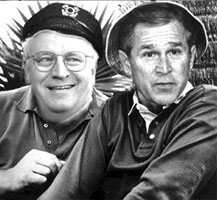
Thorne Webb Dreyer, Editor

RECENT POSTS
Most retiring presidents go on the speaking tour, or become involved in international affairs. But Dick and George have something else in mind.
That war’s over — it’s time to get your tax rebate
By PURVA PATEL
Copyright 2006 Houston Chronicle
It’s taken nearly a century, but the federal government has finally dropped part of a tax it initially levied on telephone customers to help fund the Spanish-American War.
That’s the good news.
The better news is the Internal Revenue Service expects to return $13 billion in refunds to taxpayers next year.
Known as the “federal excise tax” on phone bills, the 3 percent surcharge on long-distance and bundled service was dropped in August. Refunds will be calculated on phone bills back to March 2003.
The tax will still be assessed on local phone service.
For an explanation of the refunds, reporter Purva Patel talked to Dick Hansen, president of Technology Change Management, whose firm advises businesses on billing issues.
Q: How does one claim this refund?
A: Basically, the way you’re going to claim it is through income tax forms. You can only get the credit on the 2006 forms. So as an individual, I personally will send in my 1040, and there’s a new line on that tax return that asks “What is your credit?” and you take it off your taxes.
So if I owed $1,000 and calculate a $200 excise tax refund, I’ll only owe the government $800. Some people think it’s a deduction, but it’s not. It’s actually a credit. For companies it’s the same way. They’ll have a line on the corporate tax forms.
Read it here.
Dear friends:
Above is a link to an article in the Houston Chronicle Business Section this morning. The text of the message is below in case you have any problem opening the website. This is the first time I have spammed out a message. If you are not interested, please delete it and go on with your busy day. (However, I hope that you will at least file for the standard $50 credit on your 2006 income tax.)
I think that all of you know me personally, so this is not a scam message from a con artist saying that he/she is from another country and their FBI has millions of dollars for you. But millions of dollars will be available. Let me explain.
As you will see in the Chronicle article, the US federal government has ended the “war tax” on your telephone bill. Many of you who are “old (ie., honored) activists” refused to pay this tax during the Viet Nam war. The IRS now has the responsibility of returning a refund to those who paid this “surcharge” on their telephone bills from 2003 to now. At a minimum, you can fill for a standard refund and get $50. If you have your phone bills you can “itemize” and get a couple of
hundred dollars.
For all of us who used to say that we would prefer to pay our taxes to those organizations which promoted peace, community, and health; here is your chance. May I suggest that you file for your refund and then redirect it to your favorite non-profit organization.
May I also suggest that you do this in name of our friend, Wayne Vogel (Cerek). Many of you will remember Cerek from the Houston Food Coop, Pacifica Radio, and other community- based local peace organizations. Cerek was a local Houstonian. He was a gentle and effective promoter of change. He was one of my moral compasses (along with Thelma Meltzer). He authored a book, “Water flowing over Stone.” Later in his life, moved to Washington state to live a less complicated life on a small island, where the community grew and marketed garlic. He there died several years ago. He was survived by his parents, Mr. and Mrs A. F. Vogel; a brother, Allan; a wife, Betsy; a daughter, Rowan; and many loving friends.
So, why should we donate these refunds to your favorite charity in Cerek’s name? In the seventies, Cerek (who never drove a car) had his bicycle confiscated by the IRS for non-payment of this particular tax. Every month, Cerek would pay his phone bill minus the (very few) pennies that he owed for the “war tax.” I don’t remember the actual amount that was delinquent. I think it was less than $50 (perhaps one of you know the exact amount) and the war was almost at the end. This confiscation left Cerek without transportation for quite some time.
Now, I must apologize for taking up so much of your time and for any duplication in distributing this message (as I am working off several lists).. But I hope that you will file for your refund; consider donating it to a peace group; and take a minute to reflect on a life well lived. For those of you who were Cerek’s friends, what a
wonderful experience we shared in having this thoughtful and gentle man for a friend.
Peace and love to you all,
Eileen Harcher
By opposing war in all forms, we have more influence than we recognize.
Anti-war movement deserves some credit – Some call it marginal, but organized push swayed world opinion
Tom Hayden
Sunday, November 26, 2006
Although rarely credited, the anti-war movement has been a major factor in mobilizing a majority of the American public to oppose the occupation and killing in Iraq.
To many observers, the movement seems feckless and marginal, its rallies an incoherent bazaar of radical sloganeering. Yet according to Gallup surveys, a majority of Americans came to view Iraq as a mistake more rapidly than they came to oppose the Vietnam War more than three decades ago. So how could there be a peace majority without a peace movement?
Foreign Affairs, the journal of the foreign policy establishment, wondered about this riddle in a 2005 essay by John Mueller reporting a precipitous decline in public support for the war even though “there has not been much” of a peace movement.
In January, when congressional opinion was shifting against the war, a Washington Post analysis made eight references to “public opinion,” as if it were a magical floating balloon, without any mention of organized lobbying, petitioning, protests or marches. That was consistent with a pattern beginning before the invasion, when both the New York Times and National Public Radio reported that few people attended an October 2002 rally in Washington, only to admit a week later that 100,000 had been in the streets.
It is not in the nature of elites to acknowledge people in the streets. Foreign policy is seen as the reserve of the privileged and sophisticated, protected from populist influence. But if anti-war sentiment is truly unimportant, why has there been so much government secrecy and domestic spying?
Read it here.
Our Honor
Began then abandoned three attempts to write about Iraq, or what’s left of it. Maybe I’ve hit a wall when it comes to the war, or maybe there’s nothing left to say. When I read all the reports and analysis about the slaughterhouse we helped to erect, I feel paralyzed. I don’t know how others can keep offering opinions about this human disaster. At this point, especially for Americans, we should be shamed into silence.
Which is not to suggest, of course, that people do or say nothing about the war. Pressure to find alternatives to the present madness must be maintained, or else it’ll never end. Perhaps what I’m trying to say is that I no longer have anything to add to the chorus. I feel somewhat guilty about this, being a political blogger who’s expected to pop off at daily headlines. But that’s where I’m currently at, for what it’s worth. Besides, there are others, like Juan Cole and Patrick Cockburn, who keep their eyes and ears on the chaos. And my pal Jon Schwarz, who knows quite a bit about US involvement in Iraqi affairs, from pre-Saddam time to now, will always have something to say. Though how he keeps his sense of humor about it eludes me.
I will offer this: the notion that the US held “honorable intentions” as it tore the lid off of Iraq is not only self-serving piety, it’s a widespread sociopathic delusion. Yet, US politicos from Chuck Hagel to Russ Feingold utter this line whenever possible, keeping a straight face while another thousand or so Iraqis are blown to bits, and a few dozen more US soldiers and Marines have their heads, arms or legs blown off by IEDs, or are felled by snipers. “Honorable”? Are you fucking kidding me? Criminal would be the first word out of my mouth, but then, I’m not trying to appease the fantasies of the political elite nor those among the greater mass who seriously buy into this insane logic. Recall that Richard Nixon called for “Peace With Honor” in Vietnam, then invaded Cambodia and Laos while continuing to rip apart Vietnamese society. If I was someone who lived in the crosshairs of US foreign policy and heard American politicians talk about “honorable intentions,” I’d either start building a bomb shelter or pack what I could grab and hit the road.
Read the rest here
Our question is, “How does (good ol’ boy) W define dramatic improvement?”
“Some worry that a change of leadership in Iraq could create instability and make the situation worse. The situation could hardly get worse, for world security and for the people of Iraq. The lives of Iraqi citizens would improve dramatically if Saddam Hussein were no longer in power.” – George W. Bush, October 2002
h/t Today in Iraq
Experts Concerned as Ballot Problems Persist
By Ian Urbina and Christopher Drew
Dec 1, 2006, 08:02
After six years of technological research, more than $4 billion spent by Washington on new machinery and a widespread overhaul of the nation’s voting system, this month’s midterm election revealed that the country is still far from able to ensure that every vote counts.
Tens of thousands of voters, scattered across more than 25 states, encountered serious problems at the polls, including failures in sophisticated new voting machines and confusion over new identification rules, according to interviews with election experts and officials.
In many places, the difficulties led to shortages of substitute paper ballots and long lines that caused many voters to leave without casting ballots. Still, an association of top state election officials concluded that for the most part, voting went as smoothly as expected.
Over the last three weeks, attention has been focused on a few close races affected by voting problems, including those in Florida and Ohio where counting dragged on for days. But because most of this year’s races were not close, election experts say voting problems may actually have been wider than initially estimated, with many malfunctions simply overlooked.
That oversight may not be possible in the presidential election of 2008, when turnout will be higher and every vote will matter in what experts say will probably be a close race.
Voting experts say it is impossible to say how many votes were not counted that should have been. But in Florida alone, the discrepancies reported across Sarasota County and three others amount to more than 60,000 votes. In Colorado, as many as 20,000 people gave up trying to vote, election officials say, as new online systems for verifying voter registrations crashed repeatedly. And in Arkansas, election officials tallied votes three times in one county, and each time the number of ballots cast changed by more than 30,000.
Read the rest here.
NATO’s plan for continual war
By Alex Callinicos
Nov 30, 2006, 01:10
We live in an age of imperialism. The mess into which the US and Britain have got themselves in Iraq is unlikely to change this.
Take the case of Nato—the North Atlantic Treaty Organisation—which holds its summit in Riga, the capital of Latvia, this week. Nato was founded in 1949, supposedly as a defensive military alliance against the Soviet Union, in reality as a means of maintaining the US as the dominant power in postwar western Europe.
This is why Nato wasn’t scrapped at the end of the Cold War. Instead of disappearing, it expanded to incorporate eastern and central Europe, drawing close to Russia’s borders. Latvia was part of the Soviet Union until 1991.
But Nato doesn’t just help the US to encircle Russia. At its relaunch summit in Washington in April 1999 the alliance adopted a new mission statement that committed it to “out of area” operations. European forces would act as junior partners of US imperialism globally.
To judge by the “comprehensive political guidance”, a document for the Riga summit that appeared in the Financial Times last week, Nato now wants to take this further. “Large-scale conventional aggression against the alliance will continue to be highly unlikely,” the document says, but “future attacks may originate from outside the Euro-Atlantic area and involve unconventional forms of assault”.
Hence the importance of enhancing Nato’s “ability to deter, disrupt, defend and protect against terrorism”. To that end, Nato should be able to conduct more than one big operation at a time, as well as a number of small-scale tasks. Some 40 percent of the alliance’s land forces should be able to undertake overseas missions.
It’s hard to know how seriously to take all this. Nato was, notoriously, given the bum’s rush by Donald Rumsfeld after 11 September 2001. The US relied on his “coalitions of the willing” in Afghanistan and Iraq.
Subsequently, however, an increasingly beleaguered George Bush has become keener on support from US allies. One of the first things he did after being re-elected was to visit Nato’s headquarters in Brussels.
France and Germany blocked serious Nato involvement in Iraq. But Nato has become increasingly involved in Afghanistan, where it has recently taken over the International Security Assistance Force occupying the country.
Afghanistan is hardly a shop window for Nato. US, British, and Canadian troops have been involved in very tough fighting with a resurgent Taliban in southern Afghanistan, while the 2,700 German troops based in the north have rules of engagement that stop them from leaving their bases for any offensive operation.
An article in last week’s Financial Times predicts that discontent against Hamid Karzai’s government could spread to the north. The US defeated the Taliban in 2001 through a combination of airpower and huge amounts of money that was used, as the intelligence website Stratfor put it, to “rent” the forces of the Northern Alliance.
But now Northern Alliance leaders excluded and squeezed by Karzai are scenting his weakness, stockpiling weapons, and rebuilding their militias.
Read it here.
Crab, Pine Nut and Gorgonzola Lasagna (25 March 2004)
Now this is interesting !! As lasagna is the simplest pasta to make, this is a very good starting point for beginners. Thanks to Nick Peirano and Saveur magazine (March 2004) for the inspiration.
Béchamel Sauce
1 small, sweet red bell pepper
4 cloves garlic, peeled
Sprinkle of olive oil
3/4 cup of milk
1/4 cup of cream
Zest of a 1/4 to 1/3 lemon, grated or julienned (wash it, eh?)
Salt to taste
3 tablespoons butter
1/8 cup all purpose flour, sifted
Preheat the oven to 350° F. Cut carefully around the stem of the red pepper to remove its core, then pull the core straight out to remove it. Briefly rinse the inside of the pepper (I assume you already washed the outside), then drop the garlic cloves inside. Place the pepper in foil, sprinkle with oil, then loosely wrap it and roast for about 45 or 50 minutes until soft.
Pop the roasted pepper into a bowl and seal tightly with plastic wrap. After about 15 minutes, remove the garlic cloves from the pepper and mash them with a fork, mince to molecular size, and reserve. Peel the pepper and julienne it. It is part of the filling below.
Heat the milk, cream, lemon zest, roasted and mashed garlic, and salt until just hot, not boiling, stirring to mix it thoroughly.
In another pot, heat the butter until melted, add the flour and create a roux by whisking vigorously for a couple of minutes (be sure the flour is cooked, but not burnt).
Add the hot liquid mixture to the roux and whisk constantly until it has become as thick as sour cream, about 5 to 10 minutes. Cover and keep just warm to prevent skim from forming, whisking a little occasionally.
9 sheets of fresh lasagna, 9-inches by 3 inches
In a pot of salted, boiling water, drop the lasagna and cook for just 90 seconds or two minutes until al dente. You can use dry pasta if you do not have the proper equipment for fresh pasta. Cook dried lasagna for 8 to 10 minutes for desired doneness.
Filling
Butter
4 ounces pine nuts (use unseasoned, uncoloured pistachios for a very exotic dish)
3 tablespoons gorgonzola, crumbled
12 to 16 small porcini or button mushrooms, cleaned and sliced thinly
10 ounces fresh crab meat (cut the larger pieces)
Reserved julienned red pepper
1/4 cup each romano and parmegiano regiano, grated
2 to 3 teaspoons dried basil
Fresh-ground pepper to taste
Preheat oven to 375° F. Coat a 9-inch square deep baking dish with butter. Make a layer of three cooked lasagna sheets, then spoon a quarter of the béchamel sauce evenly over the pasta. Sprinkle half each of the gorgonzola, crab, red pepper, and mushrooms evenly over this. Sprinkle a third each of the pine nuts, romano and parmegiano mix, basil and fresh-ground pepper on, then spoon another quarter of the sauce on.
Make another layer of lasagna, béchamel, and filling. Top all of it with the final layer of lasagna, then sprinkle the rest of the romano/parmegiano mix, pine nuts, basil and pepper on top.
Bake for about 30 minutes until golden brown and bubbly.
Serve with a green salad.
Richard Jehn
This article raises some burning issues for serious bloggers, and many other Internet entities. We’ll be following this case and other similar cases closely in the coming months.
Threats To Internet Freedom All Too Real
Published on Thursday, November 30, 2006.
Source: Prison Planet – By Paul Joseph Watson
Cyberspace police state dismissed by some, yet agenda for regulated, controlled, patrolled “Internet 2” advances
The Internet is the last true unregulated outpost of freedom of speech but moves are afoot to stifle, suffocate and control the world wide web. These threats are not hidden nor are they hard to deduce and yet a significant minority of truth seekers and activists remain naive as to their scope.
Following our publication of yesterday’s article, RIAA Legal Ruling Could Shut Down The Internet, we received a mixed response. Many were aware of the imminent dangers that threaten to change the face of the Internet but others were more hostile to the supposition that the world wide web could be devastated by landmark copyright case rulings as well as plans to develop “Internet 2.”
Some accused us of yellow journalism and scaremongering yet the warning that the Elektra vs. Barker case could criminalize the very mechanism that characterizes the Internet was not concocted by Alex Jones or Paul Joseph Watson, it was a statement made by the very lawyer fighting the case, Ray Beckerman.
It was a danger also reported on by one of the UK’s biggest technology news websites, the Inquirer, which also yesterday highlighted the frightening development in an article entitled, RIAA wants the Internet shut down.
The RIAA’s argument is that defendant Tenise Barker downloaded music files and made them available for distribution by placing them in a shared folder. Though Barker paid for the files and downloaded them legally, and the files were not copied by anyone, the RIAA’s motion states that simply making the files available constitutes copyright infringement.
As Beckerman points out, the entire Internet is nothing more than a giant network of hyperlinks making files ‘available’ to other people. If we link to CNN.com, we are making the file that constitutes the CNN homepage ‘available’ to other users. We don’t own the copyright to any of CNN’s material therefore if the RIAA’s argument is accepted, by simply making that CNN file available from our website, even if no one clicks on the link, we are committing a breach of copyright.
At no point in our article did we suggest that the ruling definitely would shut down the Internet, we highlighted the fact that hundreds of transnational corporations like Amazon.com who solely rely on Internet trade would scream bloody murder. But what the ruling would grease the skids for is the move towards a strictly regulated Internet whereby government permission would be required to run a website and that website would be subject to censoring and deletion if it violated any “terms of use.”
The example I highlighted yesterday on the Alex Jones Show was that running a blog would be like having a You Tube account – any politically sensitive or controversial information that the owners dislike would immediately be removed as it is frequently on You Tube.
In addition, the slide towards a licensed Internet that will be sold using fear of identity and credit card fraud could lead to mandatory biometric thumb or finger scanning simply to access the world wide web.
This is hardly a stretch of the imagination, since numerous public services and functions of society are increasingly accessible only through providing some form of biometric identification. Credit passes for travel, ATM terminals and access to theme parks like Disneyland are just a few of the many services we use that are shifting towards mandatory biometric gatekeeping.
Furthermore, Pay By Touch Online and other companies have already developed and launched keyboard biometric finger scanning terminals that require users to submit their biometric print before they can access the Internet or buy online.
Piggybacking the net neutrality debate, Internet 2 is being shaped to replace the old Internet, which will be allowed to self-destruct as it labors under the pressures of being relegated to slower and slower pipes and users will simply desert a painstaking system.
Earlier this year under the headline, The End of the Internet?, The Nation magazine reported,
“The nation’s largest telephone and cable companies are crafting an alarming set of strategies that would transform the free, open and nondiscriminatory Internet of today to a privately run and branded service that would charge a fee for virtually everything we do online.”
Read all of it here.
Actually, Glenn Beck is a moronic asshole and little more than a common North American bigot. Dime a dozen ’round these hya parts. But he plays a fine part for CNN, we’re sure. Glad we disconnected the television more than a year ago.
If you want a little humour to temper your temper, here’s Jon Stewart’s take on the whole deal.
And this may also go part of the way to explaining why any sort of constitutional rights have become irrelevant.
Psychotics 4 Bush!
Posted by Melissa McEwan at 9:04 AM on November 28, 2006.
Study finds the more psychotic the voter, the more likely they were to vote for Bush.
To be filed under duh:
[Christopher Lohse], a social work master’s student at Southern Connecticut State University, says he has proven what many progressives have probably suspected for years: a direct link between mental illness and support for President Bush.
…Lohse’s study, backed by SCSU Psychology professor Jaak Rakfeldt and statistician Misty Ginacola, found a correlation between the severity of a person’s psychosis and their preferences for president: The more psychotic the voter, the more likely they were to vote for Bush.
The study began in part as an advocacy project “designed to register mentally ill voters and encourage them” to vote, while assessing “knowledge of current issues, government and politics.” The Bush trend emerged in the course of the study, according to Lohse, who describes himself as a “Reagan revolution fanatic” who nonetheless finds Bush “beyond the pale.” During the course of the study, it emerged that “Bush supporters has significantly less knowledge about current issues, government and politics than those who supported Kerry,” and that greater levels of psychosis predicted Bush support.
“Our study shows that psychotic patients prefer an authoritative leader,” Lohse says. “If your world is very mixed up, there’s something very comforting about someone telling you, ‘This is how it’s going to be’.”
None of this is actually new information. That liberal voters tend to be much better informed as a group and tend to reject authoritarianism is well documented, from both the chicken came first angle and the egg came first angle. But it’s nonetheless amusing to have further evidence that the people constantly calling progressives unhinged lunatics are, you know, way more likely to be nutzoid than the targets of their gleeful finger-pointing.
Via Tom Tomorrow, who dryly notes: “Anyone who’s spent any time reading right wing blogs already understood this to be true.” Indeed.
Today’s theme is trashing constitutional rights. Yeh, trash-talk Thursday. Even fits with what our venerable leaders actually do. Well, we’ll just leave it at that, and let the facts speak for themselves.
1,245 Secret CIA Flights Revealed by European Parliament
November 28, 2006 4:56 PM
Brian Ross and Maddy Sauer Report:
The report is the result of a year-long investigation into secret CIA “extraordinary rendition” flights and prisons in Europe.
No European country has officially acknowledged being part of the program.
But citing records from an informal meeting of European and NATO foreign ministers last December that included Secretary of State Condoleezza Rice, the Parliament’s draft report concludes “member states had knowledge of the programme of extraordinary rendition and secret prisons.”
The report said the recently fired head of Italian intelligence, General Nicolo Pollari, “concealed the truth” when he appeared before the Parliament’s investigating committee and stated “that Italian agents played no part in any CIA kidnapping.”
Read the rest of it here.
And there’s this, although you may think animals and their militant advocates don’t fall under the Constitution:
Analysis: New animal rights terror law
By SHAUN WATERMAN
UPI Homeland and National Security Editor
WASHINGTON, Nov. 29 (UPI) — A new law that comes into force this week gives federal authorities expanded powers to prosecute animal rights militants — as the State Department is warning that their activities eclipse terrorism as a day-to-day security problem for U.S. companies in Western Europe.
Bush signed S 3880, the Animal Enterprise Terrorism Act, without fanfare at the White House Monday morning, before flying to the Baltic for a NATO summit.
The bill is designed to make it easier for the FBI and Justice Department to wire-tap and prosecute animal rights extremists who mount campaigns of low-level criminal harassment against animal researchers both in the commercial and educational sectors.
Animal rights campaigners and their supporters say it will chill legal protest, and accuse lawmakers of ramming the bill through during the waning days of the lame-duck congress. But supporters retort that there were hearings in both the House and Senate last year and that the ACLU dropped objections to the new law after amendments it backed were incorporated by the bill’s authors.
A State Department security briefing earlier this month for U.S. companies with overseas operations highlighted the threat from animal rights extremists as a major one in Western Europe and the United States.
Read it here.
How about a stroll through the archives, with a few reminders of our leaders past (mis)deeds:
Iran/contra: 20 Years Later and What It Means
It’s the 20th anniversary of the Iran-contra scandal. Two decades ago, the public learned about the bizarre, Byzantine and (arguably) unconstitutional actions of high officials in the post-Watergate years. But many Americans did not absorb the key lesson: the Iran/contra vets were not to be trusted. Consequently, most of those officials went on to prosperous careers, with some even becoming part of the squad that has landed the United States in the current hellish mess in Iraq.
Before tying the then to the now, let’s revisit the basic narrative. When Congress, by fair vote, decided in the 1980s that the United States should not assist the contras fighting the socialist Sandinista government of Nicaragua, the Reagan White House concocted several imaginative ways to pull an end-run around democracy. This mainly entailed outsourcing the job to a small band of private sector covert operators and to foreign governments, which were privately requested or pressured by the Reaganites to support the secret contra support operation. The “Iran” side of the scandal came from President Ronald Reagan’s covert efforts to sell weapons to Iran to obtain the release of American hostages held by terrorist groups supposedly under the control of Tehran–at a time when the White House was publicly declaring it would not negotiate with terrorists. The two clandestine projects merged when cash generated from the weapons transactions with Iran was diverted to the contra operation.
Conservatives for years–make that decades–have argued there was nothing really criminal about the Iran/contra affair and that it was merely a political dispute between the pro-contras Republicans in the White House and the Democrats controlling Congress. Yet at the time the architects of these schemes worried they were breaking laws and placing Reagan in jeopardy of being impeached. Look at how the National Security Archive, a nonprofit outfit that gathers national security records, summarizes a memo documenting a key White House meeting on the clandestine contras program:
At a pivotal meeting of the highest officials in the Reagan Administration [on June 25, 1984], the President and Vice President [George H.W. Bush] and their top aides discuss how to sustain the Contra war in the face of mounting Congressional opposition. The discussion focuses on asking third countries to fund and maintain the effort, circumventing Congressional power to curtail the CIA’s paramilitary operations. In a remarkable passage, Secretary of State George P. Shultz warns the president that White House adviser James Baker has said that “if we go out and try to get money from third countries, it is an impeachable offense.” But Vice President George Bush argues the contrary: “How can anyone object to the US encouraging third parties to provide help to the anti-Sandinistas…? The only problem that might come up is if the United States were to promise to give these third parties something in return so that some people could interpret this as some kind of exchange.” Later, Bush participated in arranging a quid pro quo deal with Honduras in which the U.S. did provide substantial overt and covert aid to the Honduran military in return for Honduran support of the Contra war effort.
Read the rest of this fascinating piece, which recounts specific roles of a number of key present-day administration players, here.
Thorne Webb Dreyer, Editor




