
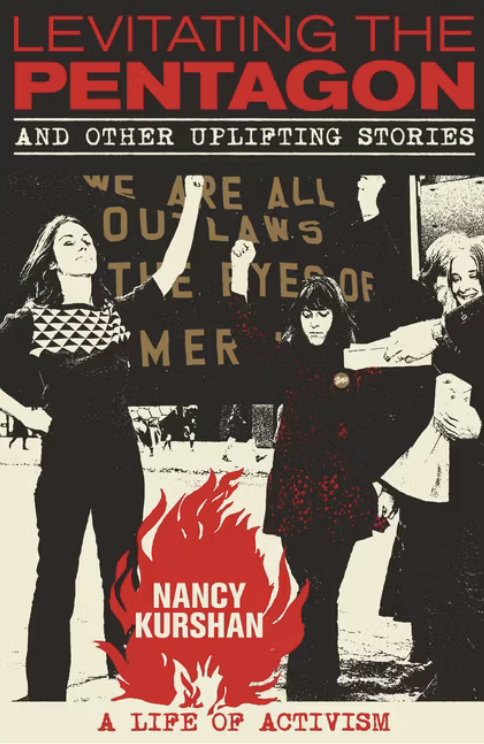
Levitating the Pentagon, and Other Uplifting Stories: A Life of Activism By Nancy Kurshan; Three Rooms Press; 2025
By Jonah Raskin / The Rag Blog / December 29, 2025
Nancy Kurshan might have carved out and published a big chunk of her own story soon after the dramatic protests at the Pentagon in 1967, and in the wake of the 1969-1970 Chicago Conspiracy Trial. If she had done that, her book would have appeared in print at about the same time that those two Yippie classics became best sellers: Jerry Rubin’s Do It! and We Are Everywhere and Abbie Hoffman’s Revolution for the Hell of it and Woodstock Nation.
Kurshan wisely waited decades to provide her account of the rambunctious Sixties and Seventies, a time when she was in the thick of the anti-war movement and a driving force in righteous causes against racism and injustice that afflicted Black, brown and Native American communities. She seemed to know intuitively which way political and cultural winds were blowing, how to ride ideological storms and keep her wits about her.
The first hundred or so pages of her memoir, Levitating the Pentagon and other Uplifting Stories — which has just been published by Three Rooms Press — describe her membership in Yippie, her relationships with Jerry Rubin, Abbie Hoffman, and their ilk, along with her exhilarating moments in Hanoi, Moscow, and Havana. Plus her birth in 1944 to parents who belonged to the American Communist Party and who helped to shape her world view from an early age.
Three Rooms Press also published Judy Gumbo’s memoir Yippie Girl. The two books, Gumbo’s and Kurshan’s, complement one another.
Kurshan’s memoir might have stopped at the end of the 1970s. After all, as she writes near the end of her story, “Born a Red Diaper Baby who morphed into a Yippie, and joined the Weather Underground, I love the life I’ve lived.” She wisely doesn‘t stop with her membership in the Weather Underground and its offshoot — The Prairie Fire Organizing Committee. With passion and clarity, Kurshan explores her participation in the 1990s in the movements that aided political prisoners and decried the inhumane conditions that existed behind bars. She also recounts her personal life: her romantic relationships with other radicals; marriage to fellow activist, Steve Whitman, their family life together and her children. Howie Emer, with whom she had a long, trusting relationship — and a largely unsung, longtime radical — is the father of her children.
In an interview with author Pat Thomas, who has written about Jerry Rubin, the Black Panthers, and Allen Ginsberg, Kurshan says, “I don’t think I was a natural Yippie.” (That interview with Thomas appears near the end of her memoir.) Granted, she didn’t appear before the House Committee on UnAmerican Activities (HUAC) as dramatically and as effectively as Abbie and Jerry did when they were in costume. Abbie in a shirt made from an American flag. Jerry dressed as an American patriot circa 1776 and later as a member of the Viet Cong and later still as Santa Claus.
Nor did Nancy take part, as Jerry and Abbie did, in guerrilla theater inside Judge Julius Hoffman’s Chicago courtroom. But she exhibited a natural affinity for the theatrical and the dramatic. She and Anita Hoffman, Abbie’s second wife, set fire to black judicial robes outside the federal building in Chicago with a banner in the background that read “We Are All Outlaws in the Eyes of Amerika.” Using the German spelling was essential in those days when the U.S. seemed to be on the cusp of Nixon-style fascism.
Along with three other Yippie women — Robin Morgan, Roz Payne and Sharon Krebs — Kurshan created the Women’s International Terrorist Conspiracy from Hell (WITCH). In Washington, D.C., they wore witch hats, and armed with brooms, burned incense, and cast “evil hexes on HUAC.” In Moscow she and Judy Gumbo and Genie Plumondon of the White Panthers donned costumes and staged what she calls a “spunky” protest. “We are the Ameri-Cong!” the Yippie women chanted. “End the war in Vietnam!” and “Ho, Ho, Ho Chi Minh, the NLF is Gonna Win.”
Nancy also wrote and published articles in Dragonfire under the alias, “Wanda The Wippie Witch.” She has panhandled, hitchhiked, gone on rent strike, and on International Women’s Day a long time ago, she and her comrades dipped their hands in red paint and left their prints on the federal building in Chicago. They also went into the Chicago River in canoes and dyed it red “to represent the blood of the Central American people.” Kurshan adds, “we made sure the dye was biodegradable.” If all the above doesn’t show that she was a dyed-in-the-wool Yippie I don’t know what would.
In the Foreword to Levitating the Pentagon, Bernardine Dohrn aptly calls Kurshan “a born internationalist.” Dohrn adds, “Buy or borrow or Steal this Book.” She has a sense of humor. In a preface, Jose E. Lopez, the Executive Director of the Puerto Rican Cultural Center in Chicago, quotes Che Guevara who noted that “the true revolutionary is guided by great feelings of love.” Lopez adds, “this is Nancy’s life.”
Levitating is infused with love, generosity, and kindness. Kurshan doesn’t say that she loved Jerry Rubin, but she was definitely devoted to him even though he abused and mistreated her. Of Jerry she writes, “I felt my identity being expropriated.” She knows too that she participated in that process and was no innocent bystander. “I was the one actively oppressing myself,” she writes. Her candor and truth-telling is admirable. “Jerry had some serious personal work to do,” she adds. Indeed, he did.
Kurshan does not withhold self-criticism and revelations about her inner self. During the Chicago Conspiracy Trial she says that she sometimes felt “dreadful and paralyzed” and later that she could be ”nervous and cautious.” At times in this memoir she has a tendency to belittle herself. Her style, she says, was a “general frumpiness.” If so, she made frumpiness fashionable.
She also idealizes activists she writes about. Bernardine, she writes, was “exotic.” Fiery yes, defiant yes, exotic no, at least not in my experience. The young woman from Whitefish Bay who became the figurehead of the Weather Underground and later a professor of law with a husband and three boys to raise, Bernardine was not exotic. Not as a fan of her boys when she watched them play softball or when she made them matzo ball soup. Nancy points out that Bernardine’s appearance and her whole “demeanor” changed when she went underground. As a fugitive who had to evade law enforcement, the Weatherwoman who was “strikingly different” lost much of her conspicuous strikingness.
Nancy is critical of some aspects of the political movements of the Sixties, which she says were “shot through with male supremacy.” Levitating the Pentagon describes her evolution as a feminist and her recognition of the destructive factionalism in the Weather Underground Organization (WUO) and its “offshoots” which “suffered from macho bravado.” That was also my experience. Growing up in a family of independent-minded women — Fanny, Clara, Francine and her mother, Charlotte — she had a sturdy feminist foundation to build on.
A psychology major in college, she turns to Freud not to Lenin — the author of Left-Wing Communism: an Infantile Disorder — when she writes about the splits in the WUO. “Sigmund Freud’s ‘narcissism of small differences’ comes to mind when I think of how we suffered from a sectarianism that made us less attractive to people outside the organization,” she writes. Through the splits, the animosities, the police agents, and the “sexism and the homophobia,” Nancy persevered with her eyes wide open.
Unlike some former comrades — Bill Ayers for example — she says that she doesn’t think there will be a revolution in her lifetime, though she adds “revolution is still something I aspire to.” Perhaps what’s most surprising, given her years of prison activism, is that she does not believe “that we can abolish police or prisons completely.” So, she wants to “fight for a more just system” that does not harbor “terrible inequities.” In an email to me she wrote, “I believe in fighting hard to shrink the footprint of the criminal justice system, fighting against its most egregious aspects and for whatever ameliorations we can achieve.”
A realist and an authentic survivor, she belongs in the pantheon of the American left along with Emma Goldman and Mother Jones. She is wrong when she writes, “I am not exceptional.” You are exceptional, Nancy; your memoir is also exceptional and outstanding.
When I’m asked to recommend a book about the American left over the past 60 or so years, I will suggest readers turn to Levitating the Pentagon which is indeed packed with “uplifting stories” and doesn’t sink into nostalgia, sentimentality, and movement jargon. That’s a feat worth celebrating. Yippie!
[Jonah Raskin is the author of For The Hell of It: The Life and Times of Abbie Hoffman. He is a regular contributor to The Rag Blog.]





