
By Allen Young / The Rag Blog / December 3, 2025
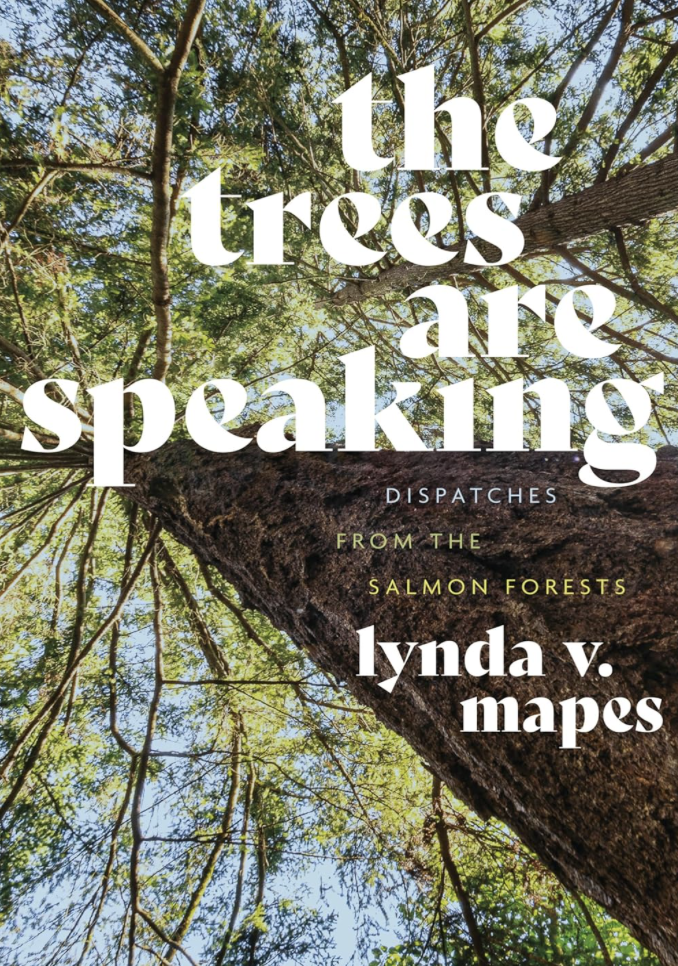
“The Trees Are Speaking: Dispatches from the Salmon Forest,” by Lynda Mapes, University of Washington Press, 2024.
Well, we all know that trees cannot talk. But we also know how important trees are. Just about everyone, no matter where they live, has admired a beautiful tree. It’s hard to imagine a landscape painting that doesn’t have at least one picturesque tree in it. We also know that trees give us wood for many uses, yield pulp for paper, and provide homes for wildlife. In addition, we’ve learned that trees can grow old and attain amazing height, can die from disease, can burn in forest fires – and more.
So when journalist Lynda Mapes entitled her book The Trees Are Speaking, she was using figurative vocabulary, filling 250 pages with good writing to educate us about these amazing living things that share the planet with us.
If you love nature, and especially if you are interested in environmental politics, this is a book for you.
The subtitle, “Dispatches from the Salmon Forest,” may seem a little strange, but we learn that there actually is a biological connection between the forest and the salmon that swim up fresh-water rivers (from both the Atlantic and Pacific oceans) to spawn and serve as food for wildlife.
Mapes is based in Seattle and recently retired from her reporter’s position at the Seattle Times, where her beat was both the environment and Native American affairs. She has won several awards, including the 2021 National Outdoor Book Award for Orca: Shared Water, Shared Home.
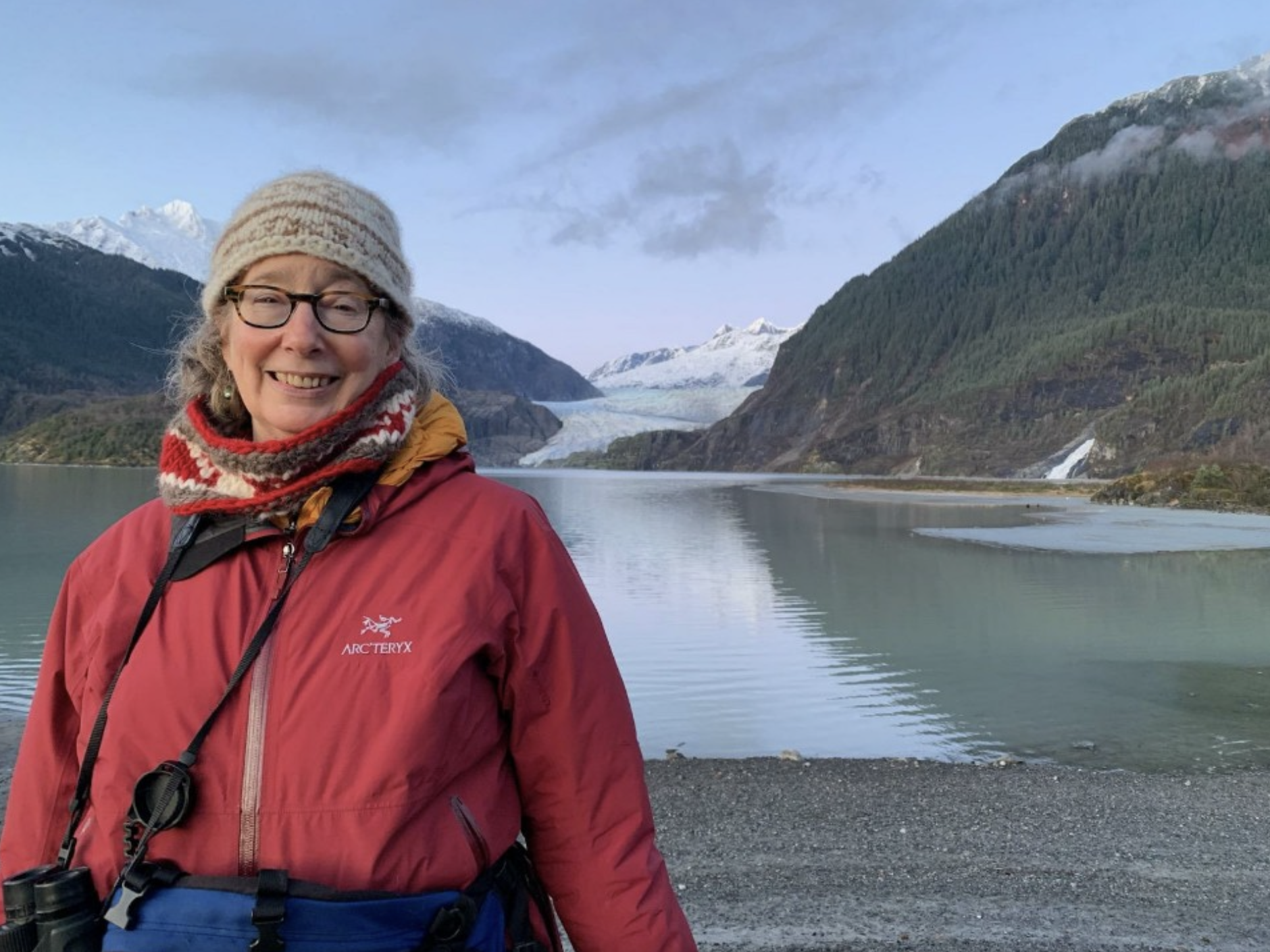
Author Lynda Mapes at the Mendenhall Glacier near Juneau, Alaska. Photo courtesy of Mary Catharine Martin.
She continues her work as an articulate, creative journalist sponsored by foundations and other media outlets, recently exploring the enormous Tongass National Forest in Alaska.
Full disclosure: I established a friendship with Mapes a few years ago when she came to the Harvest Forest in Petersham, Mass., near my home, where she got to know professional foresters and ecology academics and authored a book entitled “Witness Tree.”
To accomplish her goal of understanding the message the trees have for us humans, Mapes spent considerable time in the Pacific Northwest (primarily British Columbia, Canada) as well as in the northeastern state of Maine.
With narratives in both of these locations, she introduces the reader to experienced foresters and forest ecologists as well as to Native Americans, all of whom share their knowledge, hopes and dreams. One of the writers she quotes is Henry David Thoreau, whose book on the north woods of Maine was previously unfamiliar to me, even though I was aware of other works by Thoreau.
Mapes is not reserved in her approach to the people, the trees and the rivers. This might be called participatory journalism. She climbed one of the ancient Douglas fir trees, for example, just as she slept one night in the oak that was the subject of her earlier “Witness Tree” brook.
Mapes plays with language, adding to our enjoyment.
For example, she juggles and alters nouns and verbs and adjectives, using them in unexpected ways to help the reader experience what she experienced.
Here’s a sample:
“Over their lifetimes these grand old trees self-prune, dropping their branches from the bottom up, resulting in long, straight, branch free trunks towering to a short crown with a wind-blasted top. The bark, as the tree ages, becomes more than a foot thick and deeply grooved and takes on a dark, rich, reddish-brown color. Its twigs are densely quilled with needles and the cones, two to four inches long, are perfectly symmetrical. They make fine food for animals, including chipmunks, mice, shrews, red squirrels, and songbirds that poach seeds right out of the cone.”
In the Pacific side, Mapes paid special attention to the Douglas fir, writing this:
“As a living tree, it is the anchor species of the moist forests westof the Cascades. So this was royalty that I was about to encounter,a Douglas fir soaring more than twenty stories. Armored with thickplates of bark, the Discovery Tree glowered with gravitas. It has stoodfor some four centuries. And here stood I, hoping not to show that Iwas nervous. No. It was way worse than that. I was hoping to survive this encounter that loomed large as this tree in my tiny, short little marshmallow-soft mammalian life.”
I felt a sense of relief when Mapes’ climb up this big tree came to a safe ending, whereupon she wrote: “With a thump, my feet were back on the ground. I unclipped from the rope and harness, bewildered at the abrupt change of worlds. The tree’s motion stayed with me, the same way being at sea stays in the legs. I was still feeling the sky river of wind.”
While calling upon academic research as needed, there is playful delight at times, as in this paragraph:
“A calypso orchid lights the gloaming beneath a gnarled cedar, its magenta and white blossom a vision of tiny perfection, from its striped throat to the delicate pink spray of its bloom. This orchid’s common name isfairy slipper. If there are fairies here, I am pretty sure this is wherethey live, donning fairy slipper blossoms for midnight ballets amidqueen’s cup lilies and lady ferns on full-moon nights.”
And her choice of words creates a mood and a sensation, as in this excerpt:
“It was a perfect August day, the sea wind tangy, the water green glass.Rocky islets were hatted with forests and porpoises knifed the water.Trees along the shoreline were sculpted to the blow of the wind. The mountaintops were quilled with old-growth trees, their silvered andbroken tops spearing the forest canopy and giving the land a porcupine back.”
The messaging in the book is mildly anti-capitalist as she describes how paper mills in Maine led to so much damage in the woods and, upon closing, caused havoc and despair in the mill towns. We learn about the infestation of insects, past and present, crossing oceans via international commerce. These are the bugs that killed and are still killing millions of trees – Dutch elm disease in the early 20th century and the emerald ash borer and wooly adelgid of today (killing ash and hemlock, respectively).
The reader rides a roller coaster of sadness and joy. In early chapters, the focus is on old growth forests – how much has been cut down, and the struggles to preserve those that remain. Later in the book, there is progress to celebrate, as society benefits from the awareness of climate change and the pride of both Native American tribes and tree-hugging environmentalists.
[Allen Young has lived in rural North Central Massachusetts since 1973 and is an active member of several local environmental organizations. Young worked for Liberation News Service in Washington, D.C., and New York City, from 1967 to 1970. He has been an activist-writer in the New Left and gay liberation movements, including numerous items published at The Rag Blog. He is author or editor of 15 books, including his 2018 autobiography, Left, Gay & Green; A Writer’s Life.]





