
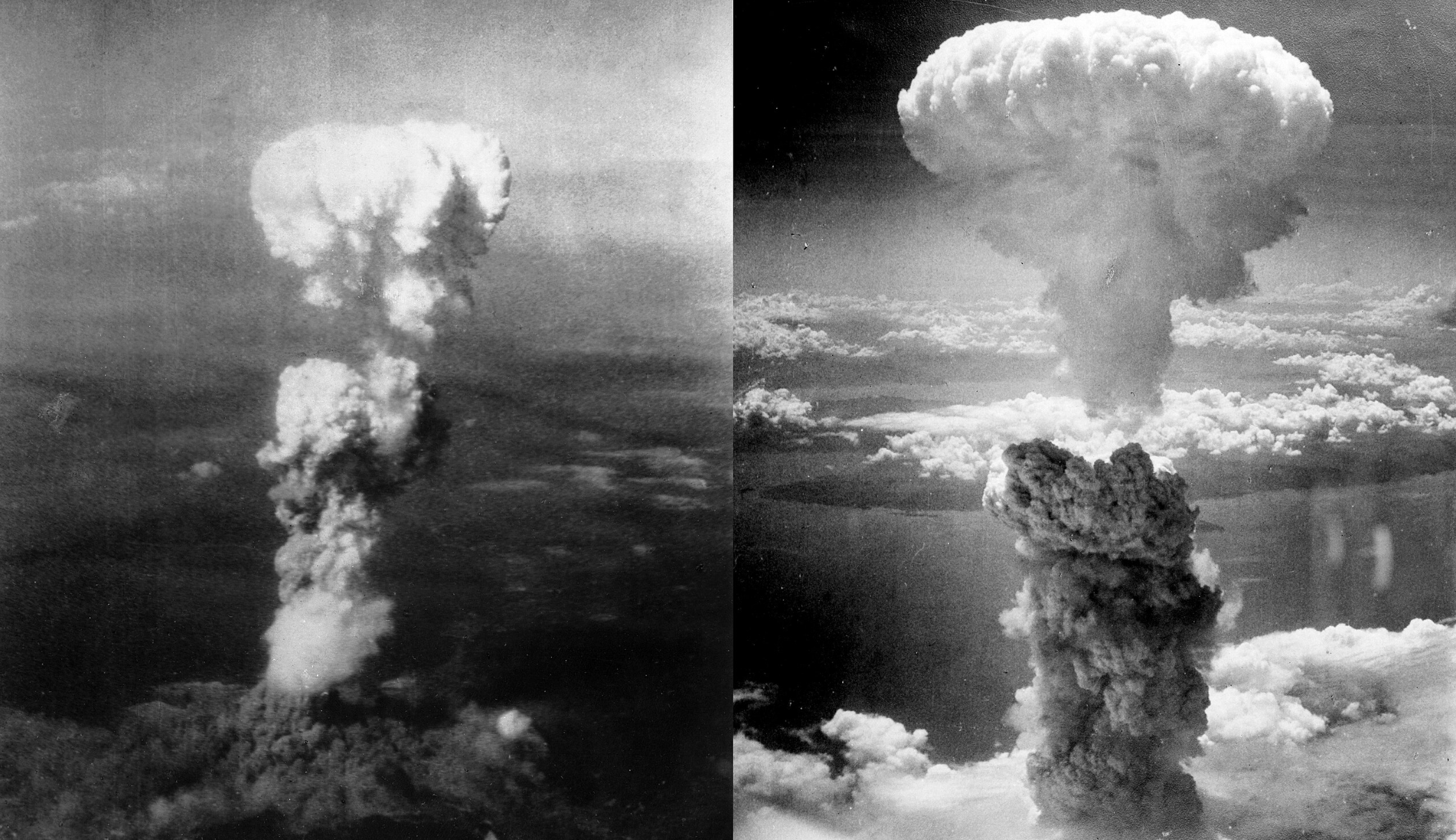
The bombings of Hiroshima, left, and Nagasaki. Photos in the public domain.
By Lamar Hankins / The Rag Blog / July 27, 2025
I have lived now for 80 years in the only country that has used an atomic bomb against another people. It is not something I am proud of. It was a major catastrophe that extended a policy based on the idea that the United States was so special that it had the right, if not the duty, to control (rule) North America. That idea is rooted in a belief termed “manifest destiny.”
The belief in Manifest Destiny supposedly ended with the conclusion of the Mexican War of 1848, which solidified our boundaries to what became the lower 48 states. That belief has now expanded to include most of the world. Historians sometimes call its current incarnation the “New Manifest Destiny.”
We began our nearly 250 years as a nation obliterating the native inhabitants of this semi-continent and found war a good tool to maintain our hegemony over as much of mankind as possible. What was not possible was to control China and the USSR (which was somewhat reduced after the official end of the Cold War).
Of course, I realize that it was Japan that attacked Pearl Harbor in a foolish attempt to overcome U.S. economic sanctions that prevented it from securing the oil it needed to pursue its own foreign policy. Here we see the new U.S. manifest destiny working its way around the globe to control Japan’s own beliefs in its “right” to control others.
One side of my family has been in this country since my ninth great grandfather immigrated here from England in 1670 as an indentured servant. Various degrees of grandfathers and relatives supported the revolution against King George from their land holdings in Virginia, and fought on both sides in the Civil War. Some owned a few slaves along the way, and one branch spun off several Methodist ministers in Arkansas in later generations. I tell this only to assure my patriotic readers that I come from a long history of red, white, and blue Americans (a word I try to use sparingly because there are a lot of people who are “Americans” who do not live in the 50 states). To add to my family’s patriotic story, my spouse is related to Francis Scott Key, the slave-owning author of “The Star-Spangled Banner.” Of course, we all have skeletons in our closets.
My antipathy to war, beginning early in my life, was brought into clear focus when the United States role in controlling Vietnam became an obsession of our leaders, starting with Eisenhower. It was a conflict that a later president, who did so much good, could not see a way out of without appearing to appease communists, though I always saw Ho Chi Minh as more of a nationalist than a communist. Even presidents can be blinded by their own propaganda.
I have talked with soldiers and sailors who were fighting for the U.S. in the Pacific Theater during World War II; some of them were close friends. All of them held the view promoted by the government and most media in 1945 and thereafter that using atomic bombs was necessary to prevent the loss of 46,000 American lives (a worst-case estimate made by military authorities) if the U.S. invaded Japan to end the war. This remains the view of most Americans.
But historians know that this narrative is false. Records released by the government over the past four decades reveal facts that belie the official version of events leading up to these atomic bombings on August 6 and 9, 1945.
The late Howard Zinn explained most of this 30 years ago. But many people have never learned anything beyond the propaganda widely disseminated by the government and the media during and after the war in the Pacific. Zinn argues that the atomic bombings were acts of terror. The most widely accepted description of terrorism is “the indiscriminate use of violence against human beings for some political purpose.” This is a fair and accurate description of the use of the atomic bombs known as Little Boy and Fat Man detonated over Hiroshima and Nagasaki, respectively.
It was claimed that the U.S. wanted to convince the Japanese to surrender (even though our leaders knew months before the bombings of their willingness to surrender), and we know now that the government wanted to keep the Soviet Union out of the Pacific Theater (which it was days away from doing) to diminish its influence and demonstrate the superior weaponry of the U.S. After all, what good is a weapon if other people don’t know how well it works to kill people?
To be sure, in World War II, the U.S. fought against fascism — international aggression — while failing to acknowledge the aggression previously carried out by the U.S., England, and France with their “long history of imperial domination in Asia, in Africa, the Middle East, [and] Latin America,” as Zinn described it.
The self-determination that our government claimed to support at the end of World War II did not end the colonization of Indochina by the French, of Indonesia and South Africa by the Dutch, of Malaysia and elsewhere by the British, and of the Philippines by the U.S.
In the 1950s, the U.S. gave extraordinary aid to the French, who were trying to maintain their dominance over the people of Indochina and secure for themselves and the U.S. tin, rubber, and oil needed by our industries. The Defense Department’s own official history of the Vietnam War revealed that in 1942 President Roosevelt gave assurances to the French that our government agreed that French sovereignty would be reestablished over its colonial conquest as soon as possible.
By the time the atomic bombs were dropped on Hiroshima and Nagasaki, the American people had been conditioned by war propaganda to accept almost any atrocity. And in June 1945, right after the US defeated Japanese fighters at Okinawa, the Japanese Supreme War Council authorized its Foreign Minister to contact the Soviet Union, America’s ally at the time, with the intention of terminating the war by September.
On July 13, Japanese Ambassador Sato wired Foreign Minister Togo that the Emperor of Japan wanted a swift termination of the war, a message intercepted by the U.S. government. The secret diaries kept by President Truman, released in 1978, verify this message. The bombs were dropped just days before the Soviets were planning to enter the Pacific Theater against Japan, portending a final death knell for the Japanese. But the U.S. rushed to use their new weapon before the Soviets could claim any credit for ending the war in the Pacific theater.
From 800 pages of secret documents released in 1994, the historian and economist Gar Alperowitz reported that President Truman had learned of the Japanese peace initiatives at least three months before Hiroshima and Nagasaki were bombed. A German diplomat notified Berlin in May 1945 that large sections of the Japanese armed forces were willing to capitulate. This information was passed up the U.S. chain of command by U.S. intelligence analysts.
A U.S. invasion of Japan was never going to be necessary, so there was no need to drop the atomic bombs to preserve American lives in an invasion. Our most revered general, Dwight Eisenhower, explained his feelings about the proposed atomic bombing when the plan was revealed to him by Secretary of War Henry Stimson, who headed up the “Interim Committee” assigned the task of deciding on the targets for the bombing:
During the recitation of the relevant facts, I had been very conscious of feelings of depression and so I voiced to him [Stimson] my grave misgivings, first on the basis of my belief that Japan was already defeated and that dropping the bomb was completely unnecessary, and secondly because I thought that our country should avoid shocking world opinion by the use of a weapon whose employment was, I thought, no longer mandatory as a measure to save American lives.
In a similar vein, Admiral William D. Leahy, Chairman of the Joint Chiefs of Staff, explained his views:
The use of this barbarous weapon at Hiroshima and Nagasaki was of no material assistance in our war against Japan. The Japanese were already defeated and ready to surrender.
While President Truman announced that the bomb was dropped on a military base, the facts reveal that Truman was less than truthful. While there were 43,000 Japanese military personnel in Hiroshima, there were 250,000 civilians. The bomb killed all who were in what Zinn called “its circle of death,” both military and civilian, including many U.S. prisoners of war held there by the Japanese, as revealed by war documents.
It is irrational to blame Japanese civilians for the attack on Pearl Harbor (a frequent justification given for the use of the atomic bombs) any more than it is to blame German refugees slaughtered in Dresden for the holocaust. All Americans cannot be blamed for the horrors committed against the Vietnamese, just as all Muslims cannot be blamed for the terrorism of a few who subscribe to that religion. The blame belongs with those who make the decisions to engage in such terror.
When we join together to create a government, we cannot know how badly that government might behave in the future. America’s founders explicitly opposed creating a government that would send its military around the world to force its will on a substantial portion of that world. But before we can do anything about the inexcusable behavior of our government, we must recognize war propaganda for what it is — information or ideas methodically and deliberately spread to promote the desire for war or the acquiescence to war.
The government, with the cooperation and collaboration of the media, used propaganda to justify the use of atomic bombs 80 years ago. We can work against such manipulation by educating ourselves, by speaking out, by standing against manipulation, by demanding honesty from our elected and appointed officials, as well as corporations, and by openly and directly challenging the deceit of all of them.
History suggests that we have not been very successful in this endeavor to date. Maybe the future will be different, but there is little about the world today that convinces me this will be so. Some days, I feel that human evolution has run its course and it is time for the molecules of life to begin again.





Really nice recounting that brings to light how clearly dropping the atomic bombs was simply another coverup of the relentless and unflagging imperialism of the United States and the equally relentless and unflagging as well as well honed and highly effective propaganda machine that presents it as another case of America doing the right thing, being the most wonderful country in the world and simply knowing how to do the right thing better than any other country ever.
I’m 79 now and have lived through a lot. I’ve lived through a huge shift in awareness in the U.S. since my childhood in post-World War II America. Many are becoming aware 0f what Lamar Hankins along with Howard Zinn have been saying and realize the veracity of their total upending of the America First myth spinoff from our manifest destiny. Unfortunately, the broadening awareness hasn’t worked.
The majority of voters in the United States elected Trump and his minions. Clearly, most people in the country still want to believe in the myths that came to full flower when I was a child. Simply putting it out there so all will know the “truth” hasn’t worked to change the tide. I don’t expect more of the same to change things today either. So we find ourselves today in a terrifying place and time. After many years of believing in our ability to “make things right” I no longer have any faith in that approach. I’ve definitely bailed from being a well-informed, and active public citizen attempting to make our democracy what we were told it could be. Long ago we were all indigenous and most of those long-ago people, rather than believing in any “doctrine,” simply were part of an infinite universe that simply was. All of my efforts today go towards reacquiring that awareness realizing fully that “a hard rain’s gonna fall.”
Thanks for your comments. I just went back and read your story about events surrounding a march in Del Rio in 1969 . We seem to be kindred spirits, who have reached similar conclusions based on our own life experiences. Your thoughts are a good afterward to my article. The hope for our country that I felt in the 1960s has not died, but it is tempered by a long life that has witnessed injustice beyond what I had ever imagined. Viva la Causa!