
By Lamar Hankins / The Rag Blog / March 2, 2026
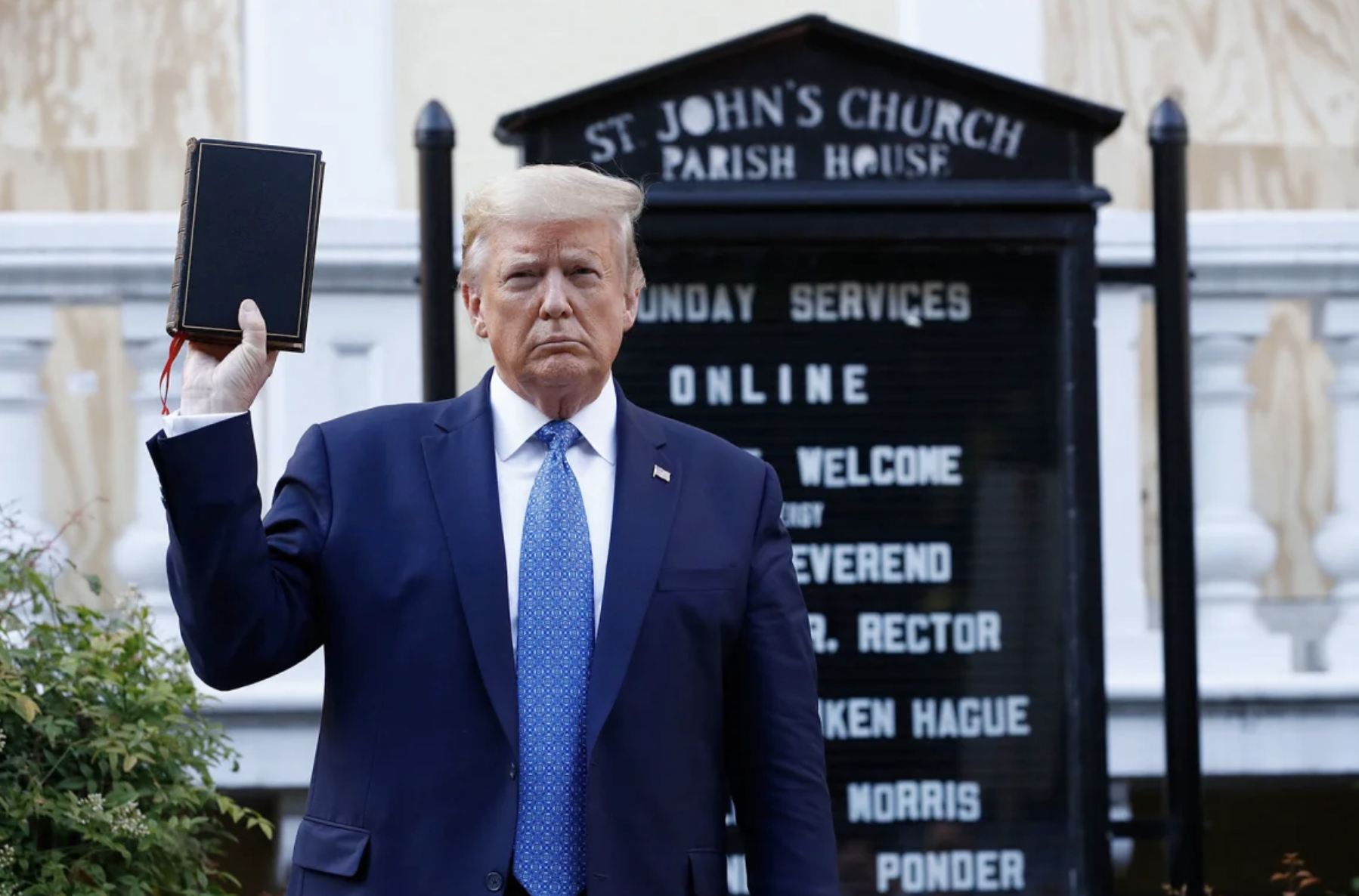
It is increasingly likely that Republicans will make Texas the first state in the country to mandate all public school students read passages from the bible. There are several reasons for this. One is that legislators don’t believe in the U.S. Constitution’s proscription against forcing one religion or any religion on citizens.
In the nearly unanimous (8-1) 1963 Supreme Court decision, Abington School District v. Schempp, the court held that mandatory bible readings and prayer in public schools were unconstitutional, in violation of the Establishment Clause of the First Amendment. The decision emphasized the separation of church and state, ensuring that public schools cannot promote religious activities. The Establishment Clause prohibits the government favoring any religion. The Court reasoned that, to avoid violation of the Establishment Clause, legislation must serve a legitimate secular purpose, which is the supposed basis for the new law: it will help public school students understand literary and historical references.
Another reason for the passage of the compulsory bible-reading law is that many legislators are Christian Nationalists, self-identified Christians who want to increase their power using their religion and their belief in Jesus to control others, who nevertheless have the right to freely practice and follow any religion or none at all. If there is any tenet in Christianity that sums up Jesus’s teaching it is that Christians should love all people, regardless of their creed or the lack thereof. But Christian Nationalists don’t want to follow that tenet. They don’t want the government to be free from religion. They want the government to favor one over others, demonstrating hostility to any religious viewpoint that differs from theirs. This is the opposite of the principle of separation between government and church, as found in the First Amendment. It is unfair and degrading to all non-Christians for the government to promote Christianity and its scripture.
I’ve always been confused by the eagerness of some people, including Christian Nationalists, to push the bible on children. I’ve concluded that such people must not have read the bible themselves, or they are reckless about subjecting children to injustice, immorality, lasciviousness, indiscriminate murder, and other less-than-virtuous behavior, much of it commanded by God.
Some bible reading suggestions
Nevertheless, to assist Republicans in their changes to public school curriculum, I offer some selections from the bible to aid in educating our children about our history and culture for the past 3,200 years or so.
We could begin with the “Ten Commandments” (maybe more than 10, maybe less) that offer ethical and religious requirements. They are presented in Exodus 20, another set in Deuteronomy 5, and a third known as the “Ritual Decalogue” from Exodus 34, though it prescribes only eight items. However, I doubt that the points the Republicans want to get across to children have anything to do with how a goat is cooked or teaching about the Festival of Unleavened Bread. And there is the problem of wording, order, and emphasis between the Catholic and Protestant versions, though Lutherans generally follow the Catholic version.
Some religious people might want to begin with Genesis, the first book of what Christians call the Old Testament. To do so, however, creates enormous problems that might require a lot of theological dialogue to explain to children the violence and sexual degradation of women, but in the interest of understanding our cultural history, we can’t overlook what is found in the first book.
We begin then with the efforts of the two daughters of Lot, who want to pass on what we now know as the DNA of their great father. They got their father very drunk on two consecutive nights so that each could become pregnant with their father’s child. See Genesis 19:33-36 for the details. This story may aid children’s understanding if they read F. Scott Fitzgerald, William Faulkner, Vladimir Nabokov, and numerous other authors. It seems that incest is a regular feature in the canon of western literature.
A quasi-incestual theme can be found in Genesis 35:22, where one of Jacob’s sons, Reuben, had a sexual encounter with Bilhah, his father’s concubine (a sort of secondary wife). In another instance recorded in 2 Samuel 16:22 (for those with little familiarity with bible references, that is spoken as Second Samuel, Chapter 16, Verse 22), Absalom apparently had his way sexually with many of his father’s concubines for all to see.
While there may be few concubines in our modern country, we do have men and women who have extra-marital affairs, some of which might be shared between members of the same family. The Graduate is one such story that comes to mind, wherein recent college graduate Benjamin Braddock is seduced by Mrs. Robinson while he is having a relationship with her daughter, Elaine.
The behavior of another of Jacob’s sons, Onan, has led to a great confusion in modern times about masturbation, as in the phrase “spill one’s seed upon the ground.” Onan was compelled by the Law to have a child with a deceased brother’s widow to give the brother an heir, which is how property was transferred back then upon a man’s death. Each time Onan has intercourse with his widowed sister-in-law, according to Genesis 38:8-10, Onan ejaculates outside of her body because he doesn’t want to have a child with her. As far as we can tell, his actions have nothing to do with masturbation, but such sexual matters get confused in re-telling the story and lead to misunderstandings about, in this case, masturbation. I’m sure understanding the true story will be a great relief to our teenage children, though it should be explained to them that “pulling out” before ejaculation will not assure that a particularly robust, virile sperm will not make it to an ovum and fertilize it.
Another question that has occurred to me about forcing public school children to read bible passages is whether legislators intend to push on children passages that belittle women. There are, at least, two verses from the bible that clearly denigrate women. 1 Corinthians 14:34-35 reads “The women should keep silent in the churches. For they are not permitted to speak, but should be in submission, as the Law also says. If there is anything they desire to learn, let them ask their husbands at home. For it is shameful for a woman to speak in church.” Similarly, in 1 Timothy 2:12, “I do not permit a woman to teach or to exercise authority over a man; rather, she is to remain quiet.” I doubt these verses will be well-received by our young students, whether they are male or female.
There are also verses in the bible about prostitution (Genesis 38:15-18); Samson and a prostitute (Judges 16:1, along with countless other stories of prostitution); rape (2 Samuel 13:11-14); the sensual descriptions in Solomon’s “Song of Songs” with a special focus on describing breasts; and the sexually stimulating story in Proverbs 7:7-22; women as property (Deuteronomy 22:28-29); slaves as property (Exodus 21:20-21); and so on.
A loving God?
But the passages that I have never been able to reconcile with a loving God include Joshua 6:21 in which God commands the Israelites to destroy all of Jericho during the conquest of Canaan, “both men and women, young and old, oxen, sheep, and donkeys, with the edge of the sword.” How can a loving and merciful deity endorse violence and genocide, including the indiscriminate killing of animals? That’s a question our school children should be required to wrestle with. Perhaps they will conclude that parts of the bible encourage inhumanity, or that the bible provides the context for much of our bloody history. Gaza comes immediately to mind as a modern example.
Another bible story that has always sickened me can be found in Judges 19-21, at a time when Israel was not united as a righteous people. A man, a Levite, was journeying some distance to his home with a concubine, servant, and two donkeys. The concubine found him repulsive and left him to return to her father’s house in Bethlehem. After four months, the Levite went after her and was welcomed by the concubine’s father into his home, where he stayed for several days before heading toward Jerusalem with his now reconciled concubine, servant, and donkeys. One evening, they decided to stay in Gibeah, part of the territory of Benjamin, but found no place to stay and stopped in the town square, where a farmer came along on his way home. Upon learning their story, he invited them to his home where they could be cared for.
While they were at the farmer’s house enjoying his largesse, a group of rowdy, worthless men approached the house and demanded that the Levite be brought out so that they could use him for homosexual rape. The farmer refused their demand, offering to make available instead the man’s concubine and the farmer’s virgin daughter for them to rape and do with as they pleased. When the group of men were not satisfied with the offer, the Levite nevertheless took his concubine to the group of men and they raped and abused her for the rest of the night. At dawn, the concubine made her way to the farmer’s door step, where she was found dead later in the morning by the farmer. The Levite then left for his home with the dead concubine.
When the Levite finally arrived at his home, he cut up the dead concubine’s body into twelve pieces, which he sent throughout the territory of Israel in an attempt to get Israel to repent such a horror. The Benjaminites chose to protect the guilty parties and refused to turn them over for justice. This led to a civil war against Gibeah, which the forces of the tribes of Israel, minus Benjamin, won with some difficulty, killing essentially all of the women and children, with 600 male survivors, who were allowed to steal wives with help from the other tribes from Jabesh Gilead and Shiloh, thus assuring the continuation of the tribe of Benjamin. The Benjaminites’ reputation was then restored along with Israel’s relationship with God. As Judges 21:25 relates, “In those days Israel had no king; everyone did as they saw fit.” I suppose that the biblical moral as detailed in the story is that this is what happens when the law is spurned and everyone does as they wish.
The story of the Levite and his concubine in Gibeah is an abhorrent story, but one that should be included for our children to consider if bible reading is made compulsory, even though its use would require a great deal of teaching about the history of Israel and theology, something public school teachers are generally unqualified to undertake, which is true of many other stories in the bible. Can there be a better reason to reject bible reading in public school classrooms?
One commentary offers this lesson: “Judges 19-21 serves as a stark reminder of the dangers of moral relativism and the necessity of collective responsibility in upholding justice and righteousness.”
While that is a lesson worth learning, as others have suggested, we should not turn public schools into Sunday schools. Leave that for the religious groups to pursue. This was essentially the back story of the Abington School District v. Schempp case.
Promoting only bible stories discriminates against other religions
Two things seem clear from the Schempp decision. Requiring only bible verses to be read in public schools discriminates against the literature of other religions. Some people argue that to the extent a bible passage is related to secular curriculum, it may be permissible. Watership Down, a book on a list of works to be read by public school students, is about two groups of rabbits warring against one another. But while there are some superficial similarities between that book and the Gibeah story, mainly a civil war of sorts among two groups of rabbits and a shortage of mates for one group, reading about Gibeah may do little that is necessary to inform students about Watership Down. Perhaps the proponents of bible reading can suggest some bible verses or other classic stories that are more appropriate.
Another text that will be required reading in public schools is Ulysses S. Grant’s Civil War address to the U.S. Army in 1865, in which he thanked the soldiers for their “patriotic devotion” and bravery, emphasizing their role in maintaining the Union and enforcing the laws of the nation. Grant recognized the sacrifices the soldiers made, including the many soldiers who had died. Grant also called for unity, emphasizing the importance of peace and the need for order to be restored now that the conflict had ended. Once again, I can identify one or two superficial similarities with the civil war in Gibeah, but nothing that would be essential for understanding Grant’s speech, providing another opportunity for proponents of bible reading to suggest some bible verses that are related and necessary to help students understand Grant’s remarks.
It is clear, however, that what those who promote bible reading in public schools want is for this Supreme Court to overturn Schempp, just as it overturned Roe v. Wade. I will not be surprised if that happens. But I will still want my bible verse choices included in any bible-reading curriculum. If the bible is a wonderful educational document, we should not leave out these parts.
[Rag Blog columnist Lamar W. Hankins, a former San Marcos, Texas, City Attorney, has a Doctor of Jurisprudence degree from the University of Houston.]





