Another Forgotten Victim of 911

Dr. Sami Al-Arian vs Big Brother
by Eileen Fleming / March 15th, 2008

American Palestinian Professor Dr. Sami Amin Al-Arian, has spent the last five years behind bars although NO jury ever returned a single guilty verdict against him. On March 3, 2008 he began his third hunger strike in Northern Neck Regional Jail in Warsaw, Va. after learning he would face a third grand jury, instead of being released and deported this April.

After losing fifteen pounds, the diabetic Dr. was moved to Butner Medical Center. I phoned the center [919- 575-3900] on March 14, 2008, seeking a condition update, but only got as far as leaving a voice mail.

I then phoned Melva Underbakke, who was driving to Phoenix to show the documentary USA vs Al-Arian.

Melva informed me, “I have known Sami for fifteen years, we both taught at the University of South Florida. When he was indicted he lost his tenure. We lived a mile from each other and were both on the educational committee of HOPE, a volunteer organization in the community that works to strengthen the community. Sami and I were both on the committee that helped the public schools develop an alternative to out of school suspension by keeping the suspended kids in the school system.

“After 9/11, Sami was instrumental in outreaching to the entire community by inviting the churches and all others to the mosque to express our shared grief and sorrow.

“Sami has won many awards for teaching. He worked to get people out to vote and he lobbied in Washington.

“It’s a big loss to our community–a big loss to our country to lose such a person as Sami.

“Even during his pretrial incarceration the conditions were very harsh. He was always behind a glass; no physical contact was allowed, even for his family. I think maybe once a year they were allowed to be in the same room with him. The last time I saw him was just after his second hunger strike. He was still joking and in good spirits. He was strong and it was a happy visit.

“Sami was always a big believer in the American system. He felt justice would be done. But, I think because this case goes all the way to Washington, and they have been loosing these terror cases, they want to save face and don’t want to give up persecuting Sami.”

Dr. Al-Arian has stated:

“To be patriotic is to be able to question government policy in times of crisis. To be patriotic is to stand up for the bill of rights and the Constitution in times of uncertainty and insecurity. To be patriotic is to speak up against the powerful in defense of the weak and the voiceless. To be patriotic is to challenge the abuses of the PATRIOT Act.”

“A great nation is ultimately defined and judged by its system of justice. When the system is manipulated by the powerful and tolerates abuses against the minorities or the weak members of society, the government not only loses its moral authority and betrays future generations, but will also be condemned by history.”

The diabetic Dr.’s first hunger strike, lasted 140 days, he survived on nutritional liquids and lost 45 pounds. In 2007, he went on a two month hunger strike, drank only water and lost 55 pounds. His third hunger strike began March 3, 2008 and he is refusing fluids.

The documentary USA vs Al-Arian that Melva is taking around the country, details “the absurdity of the show trial held in Florida and the hollowness of the government’s case against Al-Arian. When the film was awarded Best Nordic Documentary at the Nordic Panorama in Finland the jury wrote: ‘The film shows precisely how a common man becomes a victim of the situation in the contemporary world, where the Big Brother is watching you even when you’re ordering pizza.’”

The film is also “a close portrait of an Arab-American family facing terrorism charges leveled by the U.S. Government. The film shows a personal story of a family living in a society where fear of terrorism has resulted in increasing stigmatization and discrimination against Muslims. For years, Nahla Al-Arian and her children have been fighting to prove the innocence of husband and father Sami, a Palestinian refugee, university professor and civil rights activist, who has lived in the USA for more than thirty years. In 2003, Sami Al-Arian was accused of giving material support to a terrorist organization and held in solitary confinement for over three years. His six-month trial ended without a single guilty verdict. The failure to convict Dr. Al-Arian was seen as a stinging rebuke for the federal government. While the Bush administration considered this a landmark case in its campaign against international terrorism, Sami Al-Arian claims he has been targeted in an attempt to silence his political views. Because the jury hung on some of the counts, however, Dr. Al-Arian remained in jail as the prosecution threatened to retry him. In May 2006, he agreed to a plea bargain with the US Government in order to put an end to the ordeal and to be reunited with his family. A federal judge sentenced him to 57 months in prison and subsequent deportation… The case of Sami Al-Arian is one of the first major tests of the USA Patriot Act, a controversial law passed hastily after September 11, 2001.”

So far the American taxpayer has provided approximately $50 million dollars to persecute Dr. Al-Arian. “The government has called 80 witnesses and subjected the jury to hundreds of hours of often absurd phone transcriptions and recordings made over a 10-year period, which the jury dismissed as “gossip.” Of the 17 charges against Al-Arian—including “conspiracy to murder and maim persons abroad”—the jury acquitted him of eight and was hung on the rest. The jurors disagreed on the remaining charges, with 10 of the 12 jurors favoring his full acquittal… Following the acquittal, a disaster for the government, especially because then-Attorney General John Ashcroft had announced the indictment, prosecutors threatened to retry Al-Arian. The Palestinian professor, under duress, accepted a plea bargain agreement that would spare him a second trial, saying in his agreement that he had helped people associated with Palestinian Islamic Jihad with immigration matters. It was a tepid charge given the high profile of the case.”

*****

USA vs Al-Arian
Contact Melva Underbakke to schedule a screening in your city.
Call (813) 215-3403
E-mail: melvau@earthlink.net

Eileen Fleming is the author of Keep Hope Alive and Memoirs of a Nice Irish American Girl’s’ Life in Occupied Territory and the producer of 30 Minutes With Vanunu. Email her at ecumei@gmail.com.

Source

Posted in RagBlog | Tagged , , , | Leave a comment

When Will We Finally Stop Meddling?

For God’s Sake, Don’t…!
by Dr. Haider Mehdi / March 15th, 2008

The news all over the media is that the US army “is developing a plan to send around 100 trainers to work with a Pakistani para-military force that is the vanguard in the fight against Al Qaida and other groups in Pakistan’s restive tribal areas.” This report further states that “US trainers initially would be restricted to training compounds, but with Pakistani consent could eventually accompany Pakistani troops on missions ‘to the point of contact’ with militants as American trainers now do with Iraqi troops in Iraq.” Eventually, the Pentagon plans to build a training base and spend more than $400 million over the next several years on this project. US officials are giving the impression that all of this is being planned as a benevolent act of American altruism and generosity to help a friendly country (Pakistan) to fight a counterinsurgency that is threatening its very existence.

In other words, in America’s view (and of the apologists for Musharraf’s and the US perspective in Pakistan), Pakistan is facing so-called “extremism” and “terrorism” on its soil and the war against it will have to continue indefinitely. The implicit message is that the “war on terror” is neither only an American war nor one of General (retd) Musharraf’s exclusively designed political doctrine — it is Pakistan’s war, where a specific segment of its citizenry (especially Pashtuns in the northern area of the country) have gone ideologically berserk (because Islam is violent) seeking martyrdom for “hoors” (heavenly beauties) in the life hereafter. The road to this imaginary Heavenly Kingdom is sought by these misled miscreants by identifying Bush’s noble and cavalier America as the enemy. In addition, all those who support Bush’s so-called worthy enterprise of democracy and freedom are on the death list of these gone-mad Muslim terrorists.

Indeed, this whole approach is absurd. In fact, all this anti-Islamic propaganda is a set-up to plan American military presence in Pakistan that will expand gradually with time and finally give the Americans a permanent military base (or bases) from which to conduct its global agenda of economic-military-political expansion all the way to the Central Asian Islamic States. It is precisely for this reason that the Americans are supporting Musharraf’s presidency and prefer to deal with a dictator rather than a democratic establishment in Islamabad.

If Pakistan has to survive as a peaceful progressive democratic nation then four matters will have to be settled at once: First, General (retd) Pervez Musharraf will have to go immediately; this will deprive the Americans of their vital contact and present control over instant decision-making in Islamabad (in accordance with their dictates). Equally important is the need to develop political processes by which all matters relating to any kind of military or civil engagement with the United States will have to be decided in the Pakistani parliament by a competent and appropriate legislative body. Three, Pakistan’s military establishment from now on should have only an advisory role (through parliamentary hearings) even when business with the US is purely of a military nature. Fourth, in all matters pertaining to American engagement with Pakistan, the media’s involvement as a forum of debate will have to be an integral mechanism of political decision-making in this country. This will promote the democratic process and public input in national policy-making.

However, the immediate concern that Pakistan’s newly elected parliament should have is the Pentagon’s plan to send over 100 American trainers to the work with and train the Frontier Corps, paramilitary forces of nearly 85,000 members recruited from ethnic groups on the border. For God’s sake, don’t let this happen. It is a plan, if it materializes, that will have catastrophic effects and lasting impacts on Pakistan’s recently elected democratic establishment’s ability to promote its own independence, free of American pressures, and to pursue its national interests in all of its political-military decision-making vis-à-vis the US.

Read all of it here.

Posted in RagBlog | Leave a comment

South by Southwest : Music to the Ears

Lou Reed photo: Jonathan Snyder/Wired

1,700 Bands, Rocking as the CD Industry Reels
By Jon Pareles / New York Times / March 15, 2008

AUSTIN — “I don’t want to feel like I don’t have a future,” sang the Shout Out Louds, one of more than 1,700 bands that have been performing day and night at Austin’s clubs, halls, meeting rooms, parking lots and street corners since Wednesday.

The Shout Out Louds, from Stockholm, were singing about a romance, but they could have been speaking for thousands of people attending the 22nd annual South by Southwest Music Festival. It is America’s most important music convention, particularly for rising bands, gathering a critical mass of musicians and their supporters and exploiters from the United States and across the world. While major labels have a low profile at this year’s gathering, other corporations are highly visible, using sponsorships to latch on to music as a draw and as a symbol of cool.

Southwest is a talent showcase and a schmoozathon, a citywide barbecue party and a brainstorming session for a business that has been radically shaken and stirred by the Internet. For established recording companies, the instantaneous and often unpaid distribution of music online is business hell; CD album sales are on an accelerating slide, and sales of downloads aren’t making up for the losses. But for listeners, as well as for musicians who mostly want a chance to be heard, the digital era is fan heaven.

As major labels have shrunk in the 21st century, South by Southwest has nearly doubled in size, up to 12,500 people registered for this year’s convention, from 7,000 registered attendees in 2001, not including the band members performing. In an era of plummeting CD sales and short shelf lives even for current hit makers, the festival is full of people seeking ways to route their careers around what’s left of the major recording companies.

Sooner or later, public forums and private conversations at this year’s festival end up pondering how 21st-century musicians will be paid. For nearly all of them, it won’t be royalty checks rolling in from blockbuster albums. Musicians’ livelihoods will more likely be a crazy quilt of what their lawyers would call “alternative revenue streams”: touring, downloads, ringtones, T-shirts, sponsorships, Web site ads and song placements in soundtracks or commercials. Festival panels offer practical advice on all of them, for career-minded do-it-yourself-ers.

The key is to gain enough recognition to find an audience. Over its four days, SXSW, as the festival is called, is like MySpace moved to the physical realm: more music than anyone could possibly hear, freely available and clamoring to be heard.

Major labels used to help create stars through promotion and publicity, but their role has been shrinking. Multimillion-selling musicians who have fulfilled their major-label contracts — Radiohead, the Eagles, Nine Inch Nails — are deserting those companies, choosing to be free agents rather than assets for the system that made them famous.

Even a moderately well-known musician can reach fans without a middleman. Daniel Lanois, who has produced U2 and Bob Dylan and is also a guitarist and songwriter, noted during his set that he now sells his music directly online in high fidelity at the Web site redfloorrecords.com.

“We can record something at night, put it on the site for breakfast and have the money in the PayPal account by 5,” he said. “With all due respect for my very great friends who have come up in the record-company environment, it’s nice to see that technology has opened the doors to everybody.”

South by Southwest has insisted, ever since it started in 1987 as a gathering for independent and regional musicians, that major-label contracts have never been a musician’s only chance. Musicians who have had contracts are lucky if they recoup their advances through royalties. Lou Reed, who gave an onstage interview as a convention keynote, was terse about getting a label contract. “You have the Internet — what do you need it for?”

There’s never a shortage of eager musicians. Many bands drive cross-country by van or cross an ocean to perform an unpaid showcase at South By Southwest, and the most determined ones play not only their one festival slot but also half a dozen peripheral parties as well, hoping to be noticed. Sixth Street and Red River, two downtown streets lined with clubs, are mobbed with music-hopping pedestrians until last call.

Musicians make the trek even though discovering a local band from another town or another country is just a few clicks away. That spread of information opens new career paths, from tours stoked by blog buzz to recognition for a song tucked into a commercial or a soundtrack. South by Southwest draws like Ingrid Michaelson and Sia got big breaks through songs that appeared in television shows, while Yael Naim found an international audience through a MacBook Air commercial.

With music whizzing across the Internet, South by Southwest probably has fewer completely unknown so-called baby bands, but hundreds of more toddlers. They have unlikely allies now. If record labels can’t help them, corporations might. Few musicians worry about selling out to a sponsor; now it’s a career path. This year’s festival has brand-name sponsors everywhere, from Citigroup and Dell to wineries, social-networking Web sites and the chef Rachael Ray (who is the host of her own day party).

Read all of it here.


SXSW : The Return of R.E.M.
By Angela Watercutter / Wired / March 14, 2008

AUSTIN — It’s been almost four years since we’ve seen a proper R.E.M. studio album and it’s felt like a long time, even with last year’s live record to curb the hunger. And, frankly, the time span since the last really great R.E.M. record has felt even longer.

But if R.E.M.’s performance at Stubb’s for SXSW is any indication, the band seems to be be back in top form. “Seems to be” is important to note here because Michael Stipe and co. have always been an amazing live rock band, so judging their level of “back”-ness is hard because it’s easy to be sucked in to Stipe’s easy charisma and get swept away (the concert is available for streaming from NPR.org if you want to experience it for yourself).

That said, the new songs they played from their upcoming album Accelerate (out April 1) sound like classic R.E.M., but for the new millennium. In this clip from an interview with music site Mog, Stipe himself mentions that the band has been working better as a cohesive unit on the upcoming record and that level of tightness was definitely on stage at Stubb’s. This clip is the first of a few where the frontman discusses the new album, the rest are here.

Really what seems to be back with the new R.E.M. is their passion. During the set Stipe made quite a few references — in both words and song — to the state of the world, particularly the political climate in America. (New track “Houston,” for example, is a response to Barbara Bush’s comments following Hurricane Katrina. Stipe didn’t say which comments, but it wouldn’t be a stretch to say these were the ones.)

“I know Austin came out strong for Barack Obama and I want to salute you for that,” Stipe told the cheering crowd at Stubb’s, becoming the latest rock star to throw his weight behind the presidential hopeful.

Not everyone appreciates rock stars telling them who to vote for or how to feel about the issues, but you have to admit when a band like R.E.M. is excited about something the music is better. And one of the things that R.E.M. does best is have a message without sounding overly preachy, so the new fire in the belly could be a strong indicator of good things to come.

Source.

Lou Reed : Shove it in a Cow!
By Daily Dish / SF Gate.com / March 14,2008

Surly Lou Reed admonished a fan when his cell phone rang during the rocker’s keynote speech at the South By Southwest Festival in Texas on Thursday.

The former Velvet Underground star, who inducted Leonard Cohen into the Rock and Roll Hall of Fame on Monday, lost his patience before a packed Austin Convention Center when he heard the ringtone.

He barked, “What does ‘Turn off your cell phone’ mean in Texas? Do you have to say it differently, like ‘Howdy?’ Shove it in a cow.” AP Photo/Jack Plunkett

Source.

Posted in RagBlog | Leave a comment

Bush and Afghanistan Envy

Napolean’s invasion of Egypt. Front lines. Very romantic.

Bush’s romantic notions about serving on the front lines.

By Fred Kaplan / Slate / March 14, 2008

If further proof were needed that President Bush resides in a dream world, he settled the issue on Thursday definitively.
Speaking by videoconference with U.S. military and civilian personnel in Afghanistan about the challenges posed by war, corruption, and the poppy trade, the president unleashed this comment:

I must say, I’m a little envious. If I were slightly younger and not employed here, I think it would be a fantastic experience to be on the front lines of helping this young democracy succeed. It must be exciting for you … in some ways romantic, in some ways, you know, confronting danger. You’re really making history, and thanks.

Go ahead, dear reader, pour yourself a stiff one before trudging on.

Someone with such a jaunty vision of war—concocted from who knows what brew of Rudyard Kipling, John Wayne, and sheer fantasy—has no business leading young men and women into real-life battle, no business serving as the armed forces’ commander in chief.

It only compounds the insult to reflect that Bush, when he was younger and not employed anywhere, passed up his chance for a romantic fling with danger in the jungles of Southeast Asia.
Many U.S. soldiers, Marines, and aid workers in Afghanistan (and Iraq) are proud of the work they’re doing. They volunteered for duty. They accept the hardships and tolerate the sacrifices to a degree that’s truly awesome to behold. But I suspect very few of these men and women see themselves as indulging in enviable adventures from The Green Berets or Gunga Din.

According to Reuters reporter Tabassum Zakaria, who was permitted to observe the exchange between Washington and Kabul, Bush sat at the head of a conference table in the White House, where he was flanked by Vice President Dick Cheney, Defense Secretary Robert Gates, and others. Neither of them had ever experienced combat, either. (Gates served in the Air Force, at a Minuteman ICBM base.) But one hopes, for their sake, that their jaws dropped at least a little.

The president and all other combat fantasists would do well to read Elizabeth Rubin’s chilling dispatch in the Feb. 24 New York Times Magazine, chronicling the not-at-all fantastic experiences of a Battle Company from the 173rd Airborne Brigade in Afghanistan’s desolate Korengal Outpost.

If that doesn’t sober him up, there is a cure for his wistful envy. He won’t be employed in the White House for much longer. He is 62, too old, alas, to join the military. But a spot could probably be found for him on an A.I.D. mission, a Provisional Reconstruction Team, or, perhaps through his vice president, some contractor’s expedition. He put our soldiers over there, and, as we all know, there aren’t enough of them. If he pines for a taste, let him have one.

Fred Kaplan is Slate’s “War Stories” columnist and the author of Daydream Believers: How a Few Grand Ideas Wrecked American Power. He can be reached at war_stories@hotmail.com.

Posted in RagBlog | Leave a comment

Tweet! Tweet!

Thanks to Harry Edwards / The Rag Blog

Posted in RagBlog | Leave a comment

Are Conservatives Losing Their Marbles?

Remembering What Nixon Learned
by David Sirota

A half-century ago, Richard Nixon spearheaded his party’s national congressional campaign in the face of a recession like the one we face today. Then Dwight Eisenhower’s vice president, he decided that as a way to defeat Democrats the GOP would champion anti-worker laws pioneered in the segregationist South. Specifically, he rolled out “right to work” ballot initiatives to weaken the labor movement. These measures ban contracts that compel employees who benefit from union representation to contribute union dues.

When the 1958 election came, Nixon’s blame-workers-first initiatives bombed, and Republicans lost 48 congressional seats, handing the party “its worst year ever,” as historian Rick Perlstein recounts in his brilliant new book, “Nixonland.”

“Right-to-work wasn’t popular with a general public that understood how a strong labor movement had rocketed millions of voters into the middle class,” Perlstein writes.

Fifty years later, conservatives are ignoring history’s teachings and resurrecting Nixon’s failed strategy in a place that could decide a close presidential election. In Colorado, one of the most contested “swing” states, a group of zealots is hoping a “right to work” ballot initiative will drive up GOP turnout and help John McCain keep nine electoral votes in the Republican column.

The strategy is bold in its desperation. Right-wingers are betting that Colorado citizens will vote to cut their own pay. After all, according to the Economic Policy Institute, employees in right-to-work states make between 4 and 8 percent less per year than those in other states.

Already, a poll shows that 56 percent of Coloradans oppose “right to work” laws. Even one of Colorado’s most influential business groups has said it has “no desire” for such irrational measures. But the right is not in a rational frame of mind.

Colorado conservatives are reeling after Republicans lost both the Legislature and governor’s mansion for the first time in more than four decades. The state Republican Party is so unhinged that it hired a buffoon named Dick Wadhams to save it-the same Dick Wadhams who most recently made headlines running Sen. George “Macaca” Allen’s 2006 re-election campaign into the ground, effectively ending the Virginia lawmaker’s political career. Clearly, these are dire times for the right, and despair tends to deify the Nixons and the Wadhamses by embracing irrational extremism-whether YouTube-amplified racism or worker persecution inherent in right-to-work schemes.

Adding to conservatives’ troubles is Colorado’s emboldened labor movement. Rather than crouching in a defensive posture, unions are preparing two initiatives that could drive up turnout for Democrats and serve as a model for other states across the nation.

One forces the right to defend criminals-literally. The initiative would make a corporate executive personally liable under the law if he or she “engages in, authorizes, solicits, requests, commands or knowingly tolerates the business’s criminal conduct.”

According to union polling, 84 percent of Colorado citizens back the measure. Nonetheless, the Denver Chamber of Commerce is trying to keep the initiative off the ballot, claiming that punishing corporate criminals is “a direct assault on our business climate.” Yes, conservatives say lawbreaking is not an “assault on our business climate”-prosecuting lawbreakers is. Next thing you know, these shills will argue that locking up violent criminals hurts the “business climate” because, when not killing people, murderers contribute to the local economy.

The other labor-backed initiative would require employers to have a “just cause” when laying off an employee. The unions’ poll shows 70 percent of Colorado voters support the concept-not surprising, considering that many voters are probably shocked to discover that most states allow employers to terminate workers for any reason not already outlawed by existing anti-discrimination statutes. Your boss doesn’t like that you root for a particular professional sports team? Unless the ballot initiative passes, you can be fired “at will” for that and more in Colorado-and the initiative’s conservative opponents will be arguing that’s A-OK by them.

Perlstein notes that after Nixon’s anti-labor strategy backfired in 1958, he “hardly said an ill word about the labor movement in public again.” He learned a lesson that today’s conservatives have forgotten-namely, that the public punishes those who overtly denigrate workers. If these initiatives end up on the ballot in a state garnering so much election attention, voters will have the chance to teach the right that crucial lesson once again.

David Sirota is a bestselling author whose newest book, “The Uprising,” will be released in June of 2008. He is a fellow at the Campaign for America’s Future and a board member of the Progressive States Network-both nonpartisan organizations. His blog is at www.credoaction.com/sirota.

© 2008 Creators Syndicate Inc.

Source

Posted in RagBlog | Leave a comment

The Vatican’s Dirty Laundry

Cardinal Giovanni Lajolo assures reporters at a Vatican press conference that it is far too late for club soda.

Shroud Of Turin Accidentally Washed With Red Shirt
The Onion / March 10, 2008

VATICAN CITY—The Shroud of Turin, an ancient linen cloth believed to bear the image of Christ and considered by many clerics and devotees to be one of the holiest relics of the Christian faith, was inadvertently dyed a light shade of pink after being washed with a red T-shirt, sources reported Tuesday.

The holy antiquity, thought by some to be the very garment Jesus Christ was buried in, was discovered in 1354. Though it has suffered oxidation and fire damage over the centuries, this is the first time that the shroud has been harmed in a laundry-related mishap.

“Simply because the shroud has been given a slight pinkish tint does not in any way diminish its sanctity,” Vatican spokesman Cardinal Giovanni Lajolo said during a press conference held to address the spiritual repercussions of the shroud’s staining. “It is still very much the icon of the suffering of the innocent of all times.”

The Vatican stressed that nothing out of the ordinary happened to the shroud during the initial preparations for its monthly laundering in Rome. As is custom, on the third Sunday of the month, the priceless relic—which is kept in the royal chapel of the Cathedral of Saint John the Baptist in Turin, Italy—was taken from its hermetically sealed, bulletproof glass case and stuffed into the Blessed Papal Laundry Sack, and it was then transported by a retinue of Swiss Guards to Vatican City without incident.

According to Lajolo, the damage occurred when Pope Benedict XVI, whose turn it was to do the Vatican laundry, did not notice that a brand-new, bright-red Hanes Beefy-T belonging to Cardinal Angelo Sodano had been placed inside of the consecrated cleansing vessel, the Holy Whirlpool 24934 top-load washer.

The pope then started a load of white vestments, including the shroud, only realizing what had happened when he returned to remove the sacred artifact, which is always line-dried.

“His Holiness was distracted with trying to scrub a tough Blood of Christ stain out of Cardinal Nicora’s miter,” Lajolo said. “Not that this was some sort of mistake on his part. The pope is still infallible. We have to keep in mind that this is all part of God’s greater plan.”

“And who are we to question or reject the ways the Lord works through our laundry?” Lajolo continued.

The papal laundry room where the shroud had been washed thousands of times without incident.

Church officials said that the shroud’s staining was not in any way due to negligence on the Vatican’s part. An investigation into the matter showed that the detergent had been properly blessed before the laundering, and the holy water softener that was installed last summer was working perfectly.

“We must not allow ourselves to fall into despair, for, as sinners, we are flawed and must seek forgiveness in the Lord alone,” said Lajolo, who later hinted that the damage to the shroud was possibly God’s response to the sins of the world, and especially homosexuality. “As Christ teaches, let he who has never overly starched, shrunk, or rent his garments cast the first stone.”

Though the discoloring of the Shroud of Turin has come as a shock to many Catholics, it is not the first time that a holy relic has been damaged. In 1983, several pieces of the True Cross were water-stained after being used as coasters during Pope John Paul II’s birthday party, and in 1572, the knucklebone of St. Olaf was accidentally thrown out with a plate of half-eaten chicken wings.

In the wake of the incident involving Christ’s death shroud, the Vatican has been exploring possible ways to restore the raiment back to its original color.

“We do not want to attempt to use caustic cleaning agents for fear of turning the blessed shroud an unholy bright orange,” Lajolo said. “We continue to look to God for divine guidance as to the purity and virtue of using a color-safe bleach.”

Source.

Posted in RagBlog | Leave a comment

Junior’s REAL Legacy of Blood and Chaos

The Cult of the Suicide Bomber
By Robert Fisk

14/03/08 “The Independent” — – Khaled looked at me with a broad smile. He was almost laughing. At one point, when I told him that he should abandon all thoughts of being a suicide bomber – that he could influence more people in this world by becoming a journalist – he put his head back and shot me a grin, world-weary for a man in his teens. “You have your mission,” he said. “And I have mine.” His sisters looked at him in awe. He was their hero, their amanuensis and their teacher, their representative and their soon-to-be-martyred brother. Yes, he was handsome, young – just 18 – he was dressed in a black Giorgio Armani T-shirt, a small, carefully trimmed Spanish conquistador’s beard, gelled hair. And he was ready to immolate himself.

A sinister surprise. I had travelled to Khaled’s home to speak to his mother. I had already written about his brother Hassan and wanted to introduce a Canadian journalist colleague, Nelofer Pazira, to the family. When Khaled walked on to the porch of the house, Nelofer and I both realised – at the same moment – that he was next, the next to die, the next “martyr”. It was his smile. I’ve come across these young men before, but never one who so obviously declared his calling.

His family sat around us on the porch of their home above the Lebanese city of Sidon, the sitting room adorned with coloured photographs of Hassan, already gone to the paradise – so they assured me – for which Khaled clearly thought he was destined. Hassan had driven his explosives-laden car into an American military convoy at Tal Afar in north-western Iraq, his body (or what was left of it) buried “in situ” – or so his mother was informed.

It’s easy to find the families of the newly dead in Lebanon. Their names are read from the minarets of Sidon’s mosques (most are Palestinian) and in Tripoli, in northern Lebanon, the Sunni “Tawhid” movement boasts “hundreds” of suiciders among its supporters. Every night, the population of Lebanon watches the brutal war in Iraq on television. “It’s difficult to reach ‘Palestine’ these days,” Khaled’s uncle informed me. “Iraq is easier.”

Too true. No one doubts that the road to Baghdad – or Tal Afar or Fallujah or Mosul – lies through Syria, and that the movement of suicide bombers from the Mediterranean coasts to the deserts of Iraq is a planned if not particularly sophisticated affair. What is astonishing – what is not mentioned by the Americans or the Iraqi “government” or the British authorities or indeed by many journalists – is the sheer scale of the suicide campaign, the vast numbers of young men (only occasionally women), who wilfully destroy themselves amid the American convoys, outside the Iraqi police stations, in markets and around mosques and in shopping streets and on lonely roads beside remote checkpoints across the huge cities and vast deserts of Iraq. Never have the true figures for this astonishing and unprecedented campaign of self-liquidation been calculated.

But a month-long investigation by The Independent, culling four Arabic-language newspapers, official Iraqi statistics, two Beirut news agencies and Western reports, shows that an incredible 1,121 Muslim suicide bombers have blown themselves up in Iraq. This is a very conservative figure and – given the propensity of the authorities (and of journalists) to report only those suicide bombings that kill dozens of people – the true estimate may be double this number. On several days, six – even nine – suicide bombers have exploded themselves in Iraq in a display of almost Wal-Mart availability. If life in Iraq is cheap, death is cheaper.

This is perhaps the most frightening and ghoulish legacy of George Bush’s invasion of Iraq five years ago. Suicide bombers in Iraq have killed at least 13,000 men, women and children – our most conservative estimate gives a total figure of 13,132 – and wounded a minimum of 16,112 people. If we include the dead and wounded in the mass stampede at the Baghdad Tigris river bridge in the summer of 2005 – caused by fear of suicide bombers – the figures rise to 14,132 and 16,612 respectively. Again, it must be emphasised that these statistics are minimums. For 529 of the suicide bombings in Iraq, no figures for wounded are available. Where wounded have been listed in news reports as “several”, we have made no addition to the figures. And the number of critically injured who later died remains unknown. Set against a possible death toll of half a million Iraqis since the March 2003 invasion, the suicide bombers’ victims may appear insignificant; but the killers’ ability to terrorise civilians, militiamen and Western troops and mercenaries is incalculable.

Never before has the Arab world witnessed a phenomenon of suicide-death on this scale. During Israel’s occupation of Lebanon after 1982, one Hizbollah suicide-bombing a month was considered remarkable. During the Palestinian intifadas of the 1980s and 1990s, four per month was regarded as unprecedented. But suicide bombers in Iraq have been attacking at the average rate of two every three days since the 2003 Anglo-American invasion.

Read the rest of it here.

Posted in RagBlog | Leave a comment

Winter Soldier – Live Video and Audio Streams

Winter Soldier: Iraq & Afghanistan 2008

The horrible, honest reality of the American occupations of Iraq and Afghanistan like you haven’t heard it before.

Winter Soldier: Iraq and Afghanistan., features testimony from U.S. veterans who served in those occupations, giving an accurate account of what is really happening day in and day out, on the ground. Read more

Streaming Live Audio Video – Fri 3/14 (9AM-7PM EST); Sat 3/15 (9AM-7PM EST) and Sun 3/16 (10AM-4PM EST)

Visit War Comes Home

More information

Posted in RagBlog | Leave a comment

Police State Amerikkka – A New, Unsurprising Episode

FBI Found to Misuse Security Letters: 2003-06 Audit Cites Probes of Citizens
By Dan Eggen, Washington Post Staff Writer

14/03/08 ” Washington Post” — — The FBI has increasingly used administrative orders to obtain the personal records of U.S. citizens rather than foreigners implicated in terrorism or counterintelligence investigations, and at least once it relied on such orders to obtain records that a special intelligence-gathering court had deemed protected by the First Amendment, according to two government audits released yesterday.

The episode was outlined in a Justice Department report that concluded the FBI had abused its intelligence-gathering privileges by issuing inadequately documented “national security letters” from 2003 to 2006, after which changes were put in place that the report called sound.

A report a year ago by the Justice Department’s inspector general disclosed that abuses involving national security letters had occurred from 2003 through 2005 and helped provoke the changes. But the report makes it clear that the abuses persisted in 2006 and disclosed that 60 percent of the nearly 50,000 security letters issued that year by the FBI targeted Americans.

Because U.S. citizens enjoy constitutional protections against unreasonable searches and seizures, judicial warrants are ordinarily required for government surveillance. But national security letters are approved only by FBI officials and are not subject to judicial approval; they routinely demand certain types of personal data, such as telephone, e-mail and financial records, while barring the recipient from disclosing that the information was requested or supplied.

According to the findings by Justice Department Inspector General Glenn A. Fine, the FBI tried to work around the Foreign Intelligence Surveillance Court, which oversees clandestine spying in the United States, after it twice rejected an FBI request in 2006 to obtain certain records. The court had concluded “the ‘facts’ were too thin” and the “request implicated the target’s First Amendment rights,” the report said.

But the FBI went ahead and got the records anyway by using a national security letter. The FBI’s general counsel, Valerie E. Caproni, told investigators it was appropriate to issue the letters in such cases because she disagreed with the court’s conclusions.

In total, Fine said, the FBI issued almost 200,000 national security letters from 2003 through 2006, and they were used in a third of all FBI national security and computer probes during that time. Fine said his investigators have identified hundreds of possible violations of laws or internal guidelines in the use of the letters, including cases in which FBI agents made improper requests, collected more data than they were allowed to, or did not have proper authorization to proceed with the case.

Fine also pointed to the FBI’s “troubling” use of the letters to obtain vast quantities of telephone numbers or other records with a single request. Investigators identified 11 such cases, involving information related to about 4,000 phone numbers, that did not comply with USA Patriot Act requirements or that violated FBI guidelines.

The latest findings reignited long-standing criticism from Democrats and civil liberties groups, who said the FBI’s repeated misuse of its information-gathering powers underscores the need for greater oversight by Congress and the courts.

“The fact that these are being used against U.S. citizens, and being used so aggressively, should call into question the claim that these powers are about terrorists and not just about collecting information on all kinds of people,” said Jameel Jaffer, national security director at the American Civil Liberties Union. “They’re basically using national security letters to evade legal requirements that would be enforced if there were judicial oversight.”

Justice spokesman Dean Boyd said in a statement that Fine’s report “should come as no surprise” because the survey ended in 2006, before the FBI introduced procedural changes to better control and keep track of requests for the security letters.

FBI Assistant Director John Miller said a new automated system will keep better tabs on the letters, and they are now reviewed by a lawyer before they are sent to a telephone company, Internet service provider or other target. “We are committed to using them in ways that maximize their national security value while providing the highest level of privacy and protection of the civil liberties of those we are sworn to protect,” Miller said.

Fine said that FBI employees “self-reported” 84 possible violations of laws or guidelines in the use of the letters, in 2006, which “was significantly higher than the number of reported violations in prior years.” But he noted that his office already had begun its initial investigation into the letters by then, which might have contributed to the increase.

About a quarter of the reported incidents were because of mistakes made by telephone or Internet providers, including some in which they provided either the wrong information or disclosed more than the FBI requested. But many of those cases should have been caught by the FBI earlier, Fine said.

© 2008 The Washington Post Company

Source

Posted in RagBlog | Leave a comment

Not When the Great Game Is at Stake

The First Sixth-Anniversary-of-the-Iraq-War Article
By Tom Engelhardt, posted March 13, 2008 09:51 am

Please don’t write in with a correction. I know just as well as you do that we’re approaching the fifth, not the sixth, anniversary of the moment when, on March 19, 2003, George W. Bush told the American people:

“My fellow citizens, at this hour, American and coalition forces are in the early stages of military operations to disarm Iraq, to free its people and to defend the world from grave danger… My fellow citizens, the dangers to our country and the world will be overcome. We will pass through this time of peril and carry on the work of peace. We will defend our freedom. We will bring freedom to others and we will prevail.”

At that moment, of course, the cruise missiles meant to “decapitate” Saddam Hussein’s regime, but that killed only Iraqi civilians, were on their way to Baghdad. I’m perfectly aware that articles galore will be looking back on the five years since that day. This is not one of them.

Think of this piece as in the spirit of Senator John McCain’s recent request that Americans not obsess about the origins of the Iraq War, but look forward. “On the issue of my differences with Senator Obama on Iraq,” he typically said, “I want to make it very clear: This is not about decisions that were made in the past. This is about decisions that a president will have to make about the future in Iraq. And a decision to unilaterally withdraw from Iraq will lead to chaos.”

The future, not the past, is the mantra, which is why I’m skipping next week’s fifth anniversary of the Iraq War entirely. Now, let me ask you a future-oriented question:

What’s wrong with these sentences?

On March 19, 2009, the date of the sixth anniversary of President Bush’s invasion of Iraq, as surely as the sun rises in the East I’ll be sitting here and we will still have many tens of thousands of troops, a string of major bases, and massive air power in that country. In the intervening year, more Americans will have been wounded or killed; many more Iraqis will have been wounded or killed; more chaos and conflict will have ensued; many more bombs will have been dropped and missiles launched; many more suicide bombs will have gone off. Iraq will still be a hell on Earth.

Prediction is, of course, a risky business. Otherwise I’d now be commuting via jet pack through spire cities (as the futuristic articles of my youth so regularly predicted). If you were to punch holes in the above sentences, you would certainly have to note that it’s risky for a man of 63 years, or of any age, to suggest that he’ll be sitting anywhere in a year; riskier yet if you happen to live in those lands extending from North Africa to Central Asia that Bush administration officials used to call the “arc of instability” — essentially the oil heartlands of the planet — before they turned them into one. It’s always possible that I won’t be sitting here (or anywhere else, for that matter) on March 19, 2009. Unfortunately, when it comes to the American position in Iraq, short of an act of God, the sixth anniversary of George Bush’s war of choice is going to dawn much like the fifth one.

As a start, you can write off the next 10 months of our lives, right up to January 20, 2009, inauguration day for the next president. We know that, last fall, Secretary of Defense Robert Gates was considering bringing American troop strength in Iraq down to 100,000 by the end of George Bush’s second term. However, that was, as they evidently love to say in Washington, just a “best case scenario.” Since then, the administration has signaled an end-of-July drawdown “pause” of unknown duration after American troop strength in Iraq, now at 157,000, hits about 142,000.

The President is clearly dragging his feet on removing even modest numbers of American troops. As he leaves office, it seems likely that there will be at least 130,000 U.S. troops in the country, about the same number as there were before, in February 2007, the President’s surge strategy kicked in. In addition, in the past year, U.S. air power has “surged” in Iraq — and continues to do so — while U.S. mega-bases in that country continue to be built up. As far as we know, there are no plans to reverse either of these developments by January 20, 2009. No presidential candidate is even discussing them.

Any official “best case” scenario for drawdowns or withdrawals assumes, by the way, that the version of Iraq created during the surge months — at best, an unstable combination of Sunni, Shia, Kurdish, and American plans and desires — remains in place and that Iraqi carnage stays off the front pages of American papers. This is anything but a given, as British journalist Patrick Cockburn reported recently in a piece headlined, “Why Iraq Could Blow Up in John McCain’s Face.” Indeed it could.

Best Case Scenarios

If Senator McCain were elected president, the American position in Iraq on March 19, 2009 will certainly be as described above — and, if he has anything to say about it, for many anniversaries thereafter. But, when it comes to the sixth anniversary of the Iraq War, the truth is that it probably doesn’t matter much who is elected president in November.

Take Hillary Clinton, she’s said that she’ll task the Joint Chiefs, the new Secretary of Defense, and her National Security Council with having a plan for (partial) withdrawal in place within 60 days of coming into office. Since inauguration day is January 20th, that means… March 21st or two days after the sixth anniversary; by which time, of course, nothing would have changed substantially.

Barack Obama has promised to remove U.S. “combat” troops at a one-to-two-brigades-a-month pace over a 16 month period. So it’s possible that troop levels could drop marginally before March 19, 2009 in an Obama presidency, but again there is no reason to believe that anything essential would have happened to change that “anniversary.”

In addition, the stated plans of both Democratic candidates, vague and limited as they may be, might not turn out to be their actual plans. Note the recent comments of Obama foreign policy advisor Samantha Powers, who resigned after calling Clinton a “monster” in an interview with the Scotsman during a book tour. Since name-calling will always trump substantive policy matters in American politics, less noted were her comments in an interview with the BBC on her candidate’s Iraq withdrawal policy. “He will, of course, not rely on some plan that he’s crafted as a presidential candidate or a U.S. Senator,” Powers said and then she referred to Obama’s plan as nothing more than a — you guessed it — “best-case scenario.”

Similarly, a Clinton sometime-advisor on military matters, retired General Jack Keane, also one of the authors of President Bush’s surge strategy, told the New York Sun that, in the Oval Office, “he is convinced [Hillary Clinton] would hold off on authorizing a large-scale immediate withdrawal of American soldiers from Iraq.” And Clinton herself, though less directly, has certainly hinted at a similar willingness to reconsider her policy promises in the light of an Oval Office morning.

So let’s face it, barring an Iraqi surprise, the next year in that country may be nothing but a wash (and the lubricant, as in past years, is likely to be blood). It will be — best case scenario — a holding action on the road to nowhere, another woefully lost year in what has now become something like a ghost country.

The Children of War

To put this in more human terms: Imagine that a child born on March 19, 2003, just as Baghdad was being shock-and-awed, will be of an age to enter first grade when the sixth anniversary of George Bush’s war hits. He or she will have gone from babbling to talking, crawling to walking, and will by then possibly be beginning to read and write. Of course, an Iraqi child born on that day, who managed to live to see his or her sixth birthday, might be among the two million-plus Iraqis in exile in Syria or elsewhere in the Middle East, or among the millions of internal refugees driven from their homes in recent years and not in school at all. (Similarly, a child born on October 7, 2001, when the President first dispatched American bombers to strike Afghanistan, will be in second grade in March 2009; of course, seven-and-a-half years after being “liberated,” an Afghan child, especially one now living in the southern part of that failed narco-state, is unlikely to be in school at all. As with Iraq, we could take some educated guesses about the situation in Afghanistan a year from now and they would be grim beyond words.)
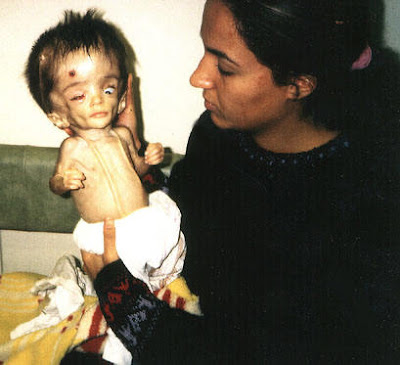
Depleted uranium baby, Iraq

For those children, the real inheritors of the Bush war era that is not yet faintly over, the Iraq War has essentially been the equivalent of an open-ended prison sentence with little hope of parole; for some Americans and many Iraqis, including children, it is a death sentence without hope of pardon. All this for a country which, even by the standards of the Bush administration, never presented the slightest national security threat to the United States of America. Only this week, an “exhaustive,” Pentagon-sponsored study of 600,000 captured Iraqi documents confirmed, yet again, that there were no operational links whatsoever between Saddam Hussein’s regime and al-Qaeda.

With those children in mind, here’s what’s so depressing: In mainstream Washington, hardly anyone has taken a step outside the box of conventional, inside-the-Beltway thinking about Iraq, which is why it’s possible to imagine March 19, 2009 with some confidence. For them, the Washington consensus, such as it is, is the only acceptable one and the disagreements within it, the only ones worth having. And here are its eight fundamentals:

*A belief that effective U.S. power must invariably be based on the threat of, or use of, dominant force, and so must centrally involve the U.S. military.

*A belief that all answers of any value are to be found in Washington among the serried ranks of officials, advisors, former officials, pundits, think-tank operators, and other inside-the-Beltway movers and shakers, who have been tested over the years and found never to have a surprise in them. Most of them are notable mainly for having been wrong so often. This is called “experience.”

*A belief that the critics of Washington policy outside Washington and its consensus are, at best, gadflies, never worth seriously consulting on anything.

*A belief that the American people, though endlessly praised in political campaigns, are know-nothings who couldn’t think their way out of a proverbial paper bag when it comes to the supposedly arcane science of foreign policy, and so would certainly not be worth consulting on “national security” matters or issues involving the sacred “national interest,” which is, in any case, the property of Washington. Like Iraqis and Afghans, the American people need good (or even not so good) shepherds in the national capital to answer that middle-of-the-night ringing phone and rescue them from impending harm. (The very foolishness of Americans can be measured by opinion polls which indicated that a majority of them had decided by 2005 that all American troops should be brought home from Iraq at a reasonable speed and that the U.S. should not have permanent military bases in that country.)

*A belief that no other countries (or individuals elsewhere) have anything significant or original to offer when it comes to solving problems like the situation in Iraq (unless, of course, they agree with us). They are to be ignored, insists the Bush administration, or, say leading Democrats, “talked to” and essentially corralled into signing onto, and carrying out, the solutions we consider reasonable.

*A belief that local peoples are incapable of solving their own problems without the intercession of, or the guiding hand (or Hellfire missile) of, Washington, which means, of course, of the U.S. military.

*A belief that the United States — whatever the problem — must be an essential part of the solution, not part of the problem itself.

*And finally, a belief (though no one would ever say this) that the lives of those children of George Bush’s wars of choice, already of an age to be given their first lessons in global “realism,” don’t truly matter, not when the Great Game of geopolitics and energy is at stake.

Of course, the most recent Washington solution, involving the endless military occupation (by whatever name) of alien lands, can “solve” nothing. The possibilities of genuine improvement in Iraq or Afghanistan under the ministrations of the U.S. military are probably nil. And yet, because the only solutions entertained are variations of the above, little better lurks in our future at this moment.

Who would want to speculate on just how old those children of March 19, 2003 will actually be before the Iraq War is ended? So here’s my next question: What’s wrong with this sentence?

On March 19, 2010, the date of the seventh anniversary of President Bush’s invasion of Iraq, as surely as the sun rises in the East I’ll be sitting here and we will still have…

Tom Engelhardt, who runs the Nation Institute’s Tomdispatch.com, is the co-founder of the American Empire Project. His book, The End of Victory Culture (University of Massachusetts Press), has been thoroughly updated in a newly issued edition that deals with victory culture’s crash-and-burn sequel in Iraq.

Copyright 2008 Tom Engelhardt

Source, including links to additional references

Posted in RagBlog | Leave a comment

Saturday! March 15! Be an Instrument for Peace!

For more information, Instruments for Peace.

Posted in RagBlog | 1 Comment


