Assessing the Human Cost

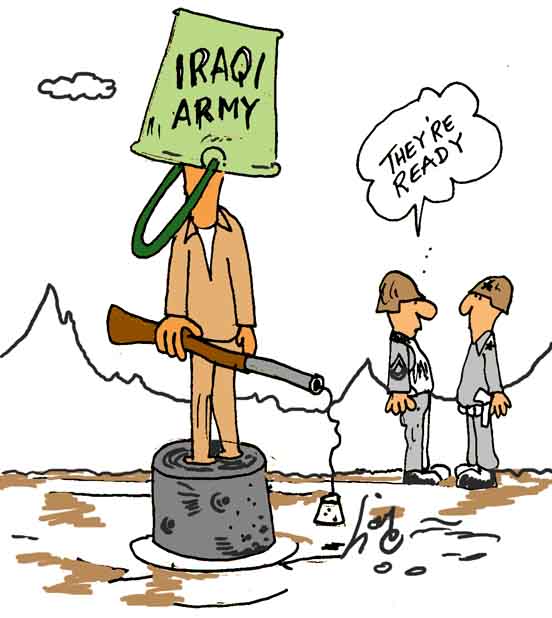
And of course, since we are arrogant Amerikans, we ignore the cost in Iraqi lives (dead, maimed, injured) for our permanent military bases in the Middle East.

How much Blood for Oil?
Published on Monday, January 01, 2007.
By Michael Munk

To bring the cost of the invasion and occupation of Iraq to the public, antiwar groups across the country are organizing to mark the 3,000th death of a member of its military components (at this writing the total is 2,991).

But by focusing only on the number of dead Americans we are being manipulated along with the media and public by the administration’s determination to minimize the cost in blood of establishing permanent military bases in the heart of the Middle East oil patch. That public relations strategy consists of prohibiting images of the dead and wounded returning home and those of US casualties in Iraq in the US media as well as aggressive efforts to prevent such coverage by foreign media—including deadly attacks on Al-Jazeera reporters and offices. It also plants stories and interviews, leaks to FOX and other Pentagon-friendly reporters and provides generous payola to foreign (especially Iraqi) news sources.

Still, the most consistent propaganda effort since the invasion aims to keep public attention away from the actual amount of blood being shed by the military victims of the war and their families. That cost now exceeds 50,000 casualties—a far cry from the 3,000 to which most of the public is restricted to know.

“Casualties” in the military sense is the total number made unavailable for duty from all causes, including deaths and wounds suffered in combat as well as injuries, accidents and illness. So whether caused by “hostile” (24,965 as of Dec.27) or “non-hostile” (25,406 as of Dec. 2) causes the Pentagon’s own web sites record more than 50,000 so far in Iraq.

Read the rest here.

Posted in RagBlog | Leave a comment

Another Monday Movie – Al Qaeda is a Myth, Too

There’s no such thing as al Qaeda, or al Qaida, or however you want to spell it. It’s a fraud perpetrated on the American people by our own government to scare us into submission. This is a clip from the excellent three-part BBC documentary “The Power of Nightmares”. You can watch the whole thing on Google Video (see here) or download it at scholarsfor911truth.org.

Al Qaeda Doesn’t Exist

Posted in RagBlog | Leave a comment

Unreasonable Search and Seizure Is Now Reality

US ‘licence to snoop’ on British air travellers
By David Millward, Transport Correspondent
Last Updated: 1:35am GMT 01/01/2007

Britons flying to America could have their credit card and email accounts inspected by the United States authorities following a deal struck by Brussels and Washington.

By using a credit card to book a flight, passengers face having other transactions on the card inspected by the American authorities. Providing an email address to an airline could also lead to scrutiny of other messages sent or received on that account.

The extent of the demands were disclosed in “undertakings” given by the US Department of Homeland Security to the European Union and published by the Department for Transport after a Freedom of Information request.

About four million Britons travel to America each year and the released document shows that the US has demanded access to far more data than previously realised.
advertisement

Not only will such material be available when combating terrorism but the Americans have asserted the right to the same information when dealing with other serious crimes.

Read the rest here.

Posted in RagBlog | Leave a comment

Riverbend Is Indignant

And she recognizes George Bush for what he is – a cheap, tawdry, ‘all hat, no cattle’ brand of Texas cowboy, where lynching is standard practise.

A Lynching…

It’s official. Maliki and his people are psychopaths. This really is a new low. It’s outrageous – an execution during Eid. Muslims all over the world (with the exception of Iran) are outraged. Eid is a time of peace, of putting aside quarrels and anger – at least for the duration of Eid.

This does not bode well for the coming year. No one imagined the madmen would actually do it during a religious holiday. It is religiously unacceptable and before, it was constitutionally illegal. We thought we’d at least get a few days of peace and some time to enjoy the Eid holiday, which coincides with the New Year this year. We’ve spent the first two days of a holy holiday watching bits and pieces of a sordid lynching.

America the savior… After nearly four years and Bush’s biggest achievement in Iraq has been a lynching. Bravo Americans.

Maliki has made the mistake of his life. His signature and unhidden glee at the whole execution, especially on the first day of Eid Al Adha (the Eid where millions of Muslims make a pilgrimage to Mecca), will only do more to damage his already tattered reputation. He’s like a vulture in a suit (or a balding weasel). It’s almost embarrassing. I kept expecting Muwafaq Al Rubaii to run over and wipe the drool from the corner of his mouth as he signed for the execution. Are these the people who represent the New Iraq? We’re in so much more trouble than I ever thought.

Read it here.

Posted in RagBlog | Leave a comment

Amerikan Morality Is a Myth

In Iraq, the losses Americans don’t see: We focus so much on the deaths of our troops that we don’t understand the suffering of Iraqis
BY JOHN TIRMAN (John Tirman is executive director of the Massachusetts Institute of Technology’s Center for International Studies.)
December 31, 2006

For all the talk about the violence in Iraq, Americans are focusing little attention on the human costs to the Iraqis. The Iraq Study Group report, for example, which is a kind of national temperature gauge of the public’s mood, fails to express much sympathy or regret for the chaos and colossal loss of Iraqi lives. In this oversight, if that’s what it is, an essential lesson is lost about this war.

The Iraq Study Group includes a number of references to the hardship and danger for U.S. forces. It speaks of growing violence caused by insurgents, militias and criminals. But where is the analysis of the role of the U.S. military in the violence and carnage suffered by the Iraqi people?

This skewed perspective is reflected among think tank analysts and news commentators. What matters in most of these accounts is that U.S. troops are caught in the crossfire of ancient rivalries within Islam. The major opinion pollsters have not asked about Americans’ concerns about the carnage in Iraq except as it relates to Americans. The slew of journalists’ reports of the war have essentially ignored Iraqi fatalities as well.

[snip]

For now, however, the silence persists. The regrettable, but unavoidable, conclusion: Americans do not care how many people are killed there. In the end, for us, that may be the biggest tragedy of the war.

Read all of it here.

Posted in RagBlog | Leave a comment

Applying the MCA to American Journalism

Why I Object to Testifying Against Lt. Watada
By Sarah Olson
Published: December 30, 2006 1:50 PM ET

OAKLAND (Commentary) In May of this year, I conducted an interview with Ehren Watada while working as a freelance journalist. Watada is a 1st Lieutenant in the U.S. Army and is the first commissioned officer to publicly refuse orders to deploy to Iraq.

In the interview, Lieutenant Watada asserted that he had a duty as an officer to evaluate the legality of his orders and conduct himself accordingly. He said that he could not participate in the Iraq War because it was “manifestly illegal” and that his participation would make him a party to war crimes.

In June, Lieutenant Watada made national headlines when he refused to deploy to Iraq.

Lieutenant Watada continues to report for duty at Fort Lewis in the state of Washington while awaiting a February 2007 court-martial on one charge of “missing movement” and four charges of “conduct unbecoming an officer and a gentleman.” Each of the latter four charges is based entirely on political speech. If convicted on all charges, Lieutenant Watada could spend up to six years in prison.

The U.S. Army has cobbled together portions of my interview with Lieutenant Watada and these statements comprise the foundation of one charge of conduct unbecoming an officer. To substantiate this alleged crime, the Army has subpoenaed me to testify on behalf of their prosecution.

The dynamics of the situation are clear. When the military chooses to prosecute a soldier for expressing dissenting political positions to a member of the press, that journalist is unwittingly and inevitably forced into the middle of the conflict.

Among multiple issues this raises, it begs one central question: Doesn’t it fly in the face of the First Amendment to compel a journalist to participate in a government prosecution against a source, particularly in matters related to personal political speech?

It is my job as a professional journalist to report the news, not to act as the eyes and ears of the government. I am repelled by this approach that jeopardizes my credibility and seeks to compel my participation in muting public speech and dissenting personal opinion.

Further, it is stunningly ironic that the Army seeks my testimony – the testimony of a journalist – in a case against free speech itself. What could be more hostile to the idea of a free press than a journalist participating in the suppression of newsworthy speech?

When journalists are subpoenaed to confirm the veracity of their reporting, they typically agree to this limited request. What makes this case different is that the thing in question is the political nature of Lieutenant Watada’s speech. Participating in the U.S. Army’s court-martial forces me to build the case against my source and contribute to an act of suppression against the media’s ability to report the news.

Read the rest of what Sarah Olson says here.

Posted in RagBlog | Leave a comment

George Bush’s Version of Due Process

The number of international and US laws violated in this entire fiasco is mind-boggling. And the magnitude of hypocrisy expressed in the words of those involved is beyond comment. “Flexibility and freedom,” indeed !! Assholes !!

For Guantánamo Review Boards, Limits Abound
By TIM GOLDEN
Published: December 31, 2006

GUANTÁNAMO BAY, Cuba — At one end of a converted trailer in the American military detention center here, a graying Pakistani businessman sat shackled before a review board of uniformed officers, pleading for his freedom.

The prisoner had seen just a brief summary of what officials said was a thick dossier of intelligence linking him to Al Qaeda. He had not seen his own legal papers since they were taken away in an unrelated investigation. He has lawyers working on his behalf in Washington, London and Pakistan, but here his only assistance came from an Army lieutenant colonel, who stumbled as he read the prisoner’s handwritten statement.

As the hearing concluded, the detainee, who cannot be identified publicly under military rules, had a question. He is a citizen of Pakistan, he noted. He was arrested on a business trip to Thailand. On what authority or charges was he even being held?

“That question,” a Marine colonel presiding over the panel answered, “is outside the limits of what this board is permitted to consider.”

Under a law passed by Congress and signed by President Bush in October, this double-wide trailer may be as close to a courtroom as most Guantánamo prisoners ever get. The law prohibits them from challenging their detention or treatment by writs of habeas corpus in the federal courts. Instead, they may only petition a single federal appeals court to examine whether the review boards followed the military’s own procedures in reviewing their status as “enemy combatants.”

But an examination of the Guantánamo review boards by The New York Times suggests that they have often fallen short, not only as a source of due process for the hundreds of men held here, but also as a forum to resolve questions about what the detainees have done and the threats they may pose.

Some limitations have long been evident. The prisoners have no right to a lawyer, or to see classified evidence, or even to know the identity of their accusers. What has been less visible, however, is what many officials describe as a continuing shortage of information about many detainees, including some who have been held on sketchy or disputed intelligence.

Behind the hearings that journalists are allowed to observe is a system that has at times been as long on government infighting and diplomatic maneuvering as it has been short on hard evidence. The result, current and former officials acknowledged, is that some detainees have been held for years on less compelling information, while a growing number of others for whom there was thought to be stronger evidence of militant activities have been released under secret arrangements between Washington and their home governments.

Military officials emphasize that the boards are an administrative forum and were never intended to replicate judicial standards of fairness. But they say the hearings offer prisoners a viable opportunity to rebut the government’s evidence.

“At the end of the day, it’s about giving the detainee the flexibility and freedom to present his case,” said Capt. Philip L. Waddingham, a former Navy pilot who oversees the operations of the panels at Guantánamo.

Read the rest of it here.

Posted in RagBlog | Leave a comment

Josh Marshall On the Execution

It’s a hornet’s nest. But I’m game. So why not jump in.

[snip]

This whole endeavor, from the very start, has been about taking tawdry, cheap acts and dressing them up in a papier-mache grandeur — phony victory celebrations, ersatz democratization, reconstruction headed up by toadies, con artists and grifters. And this is no different. Hanging Saddam is easy. It’s a job, for once, that these folks can actually see through to completion. So this execution, ironically and pathetically, becomes a stand-in for the failures, incompetence and general betrayal of country on every other front that President Bush has brought us.

Try to dress this up as an Iraqi trial and it doesn’t come close to cutting it — the Iraqis only take possession of him for the final act, sort of like the Church always left execution itself to the ‘secular arm’. Try pretending it’s a war crimes trial but it’s just more of the pretend mumbojumbo that makes this out to be World War IX or whatever number it is they’re up to now.

The Iraq War has been many things, but for its prime promoters and cheerleaders and now-dwindling body of defenders, the war and all its ideological and literary trappings have always been an exercise in moral-historical dress-up for a crew of folks whose times aren’t grand enough to live up to their own self-regard and whose imaginations are great enough to make up the difference. This is just more play-acting.

These jokers are being dragged kicking and screaming to the realization that the whole thing’s a mess and that they’re going to be remembered for it — defined by it — for decades and centuries. But before we go, we can hang Saddam. Quite a bit of this was about the president’s issues with his dad and the hang-ups he had about finishing Saddam off — so before we go, we can hang the guy as some big cosmic ‘So There!’

Marx might say that this was not tragedy but farce. But I think we need to get way beyond options one and two even to get close to this one — claptrap justice meted out to the former dictator in some puffed-up act of self-justification as the country itself collapses in the hands of the occupying army.

Read all of it here.

Posted in RagBlog | Leave a comment

Facts About the "Combat" – IED’s

Relentless toll to US troops of roadside bombs: The IED has caused over a third of the 3,000 American GI deaths in Iraq.
By Brad Knickerbocker | Staff writer of The Christian Science Monitor

Almost every day, Sgt. First Class Joel Jacobs comes to the Third Infantry Division’s “Warriors’ Walk” at Fort Stewart, Ga. Among the eastern redbud trees – each commemorating one of the more than 300 division soldiers killed in Iraq – it’s a chance for him to honor his fallen comrades.

Like many, Sergeant Jacobs greets the news of American casualties with sorrow and resolve. He retired from the Army a few months ago, and you might think the prosthetic leg would slow him down. But asked how he’s doing, this 21-year veteran who faced danger in Haiti, Bosnia, Afghanistan, and Iraq says , “I’m absolutely fine, sir.”

“When you come home, you remember the ultimate sacrifices some of your fellow soldiers have made,” he says of his regular walk.

Of the 3,000 American GIs lost in Iraq as of midday Sunday, more have been killed by roadside bombs – improvised explosive devices (IEDs) – than any other cause. More than by rifle fire, mortar attack, or car bomb.

It’s a danger that has bedeviled Pentagon war planners for months, one to which they’ve responded with a high-level task force headed by a retired four-star general, $6.7 billion in research and development, new high-tech equipment and vehicles, and – perhaps most important – intelligence efforts to get inside the decisionmaking of an insurgency that is sophisticated, if largely low-tech.

If anything, the danger is increasing despite efforts to counter it.

IEDs are “the enemy’s most effective weapon,” Army Gen. John Abizaid, commander of all US forces in the Middle East, told the Senate Armed Services committee last March. “They are the perfect asymmetric weapon – cheap, effective, and anonymous.”

Improvised bomb attacks on US troops now top 1,000 a month, four times the rate in 2004. Insurgents have become more sophisticated in their bombmaking, placement, and means of detonation. The British military has determined that there are enough stocks of illegal explosives to continue the same level of attack for years without resupply, reports DefenseNews.com.

Read it here.

IEDs: The Lazy Man’s Insurgency
By Gary Brecher ( war_nerd@exile.ru )

It’s time to take another look at Iraq, because there’s been a big change in insurgent tactics in 2005. That’s inevitable. War makes people on both sides think faster. Peacetime armies never learn anything; wartime armies learn new tricks faster than a hungry raccoon.

The big change is that the insurgents have decided to rely on IEDs rather than ambushes with shoulder-fired weapons to kill the two or three GIs per day they figure they need to wear down the US public’s will to stay in the fight. And it’s working, way too well.

The stats are clear: IED victims make up a bigger chunk of our casualties every month. Over the last six months, IEDs have caused 63% of US combat deaths. Last month (October 2005) was typical: out of 96 US troops killed, IEDs were responsible for 57.

Compare that with April 2004, a terrible month when we lost 140 troops. Back then the insurgents relied on RPGs and small arms. Only 19 of our 140 KIA that month-barely more than a tenth-were killed by IEDs.

The insurgents have decided to do it the easy way. As long as they can use IEDs, their low-tech standoff weapon, why should they risk close combat?

The real question is why they can get away with it. And here-well, I hate to keep saying this, but somebody needs to. The reason they can do it is because we still have NO INTEL on them. It’s the biggest failure of the war, and nobody talks about it. CI warfare is about people, not hardware. We’re all hardware and no intelligence, like a Tim Allen show. Makes me sick.

That makes the decision to go with IEDs a no-brainer for the insurgents. In the standard ambush, the kind we were facing a year ago, the insurgents detonated an IED under a convoy, then opened up on the stalled survivors with RPG and small arms fire. It probably made them feel good, sort of their version of shock and awe, but the rifle fire was ineffective and by concentrating their forces, the insurgents made themselves vulnerable to our air power.

The problem in any guerrilla battle is the getaway. Anybody can pull a trigger; the trick is getting your men home safe, while enemy choppers zoom through the sky and every street is full of troops and armor looking for men of military age. That’s the tough part.

An IED ambush has none of those risks. Only one man needs to be on the spot-the triggerman. He detonates the IED from a car parked down a side street and drives away before the occupiers can even start their search. No risk. No casualties. Very demoralizing for the occupiers, especially since they know damn well that everybody in the neighborhood was in on the attack but they can’t level the locals’ shacks like they’re dying to.

What makes this wave of IEDs worse is that the devices are getting more effective. Frankly I’ve been shocked at how good the Iraqis are with these things right from the start. I mean, after that shameful performance in GW I, did you expect these bastards to be so sneaky, patient, and smart? I knew this war was a bad idea, but even I never realized what we’d be up against.

The scariest tech development of all is that the insurgents have learned how to make shaped-charged IEDs. To understand why shaped charges are such a powerful weapon, we have to go into the incredibly cool world of explosive physics. I love this stuff. I mean, what red-blooded American boy didn’t experiment with explosives? The only reason I ever opened my Chem book was to see if it mentioned TNT or dynamite in the index. (It didn’t-goddamn hippie teachers.) And naturally I used the local wildlife, like toads and bees, in my experiments with the killing power of firecrackers.

Read it here.

Posted in RagBlog | Leave a comment

Bringing Democracy to the Middle East

Iraq shuts TV channel for inciting sectarianism
01 Jan 2007 18:04:23 GMT
By Claudia Parsons

BAGHDAD, Jan 1 (Reuters) – The Iraqi government ordered the closure of a popular independent television channel on Monday for inciting sectarianism, two days after the hanging of Saddam Hussein sparked anger among his fellow Sunni Arabs.

Sharkiya is owned by a London-based Iraqi businessman and says it takes an independent editorial line, though many viewers see it as leaning toward the minority Sunni Arab viewpoint.

The channel was still showing programming on Monday, as it broadcasts from Dubai, and it was not immediately clear what impact the government’s order would have.

Interior Ministry spokesman Brigadier Abdul Karim Khalaf said the government had ordered the channel to close indefinitely.

“We have warned them many times not to broadcast any false news that would increase tension in Iraq,” Khalaf told Reuters, declining to specify which particular reports were false.

The order comes two days after Saddam’s execution for crimes against humanity over the killing of Shi’ite Muslims.

The execution, which was rushed through by Iraq’s Shi’ite-led government at the start of a religious holiday, and video of the hanging that showed Shi’ite officials taunting Saddam before his death, have raised fears of a backlash.

Asked if the move was prompted by Sharkiya’s coverage of the execution, Khalaf said: “In the last three days if you watch their channel you can see they are leading people to violence and increasing the sectarian tension.”

A well-known news reader on the channel has been wearing black mourning clothes for the past two days.

Read the rest here.

Posted in RagBlog | Leave a comment

Fields of Hope in a New Year

The Monday Movie

“Possibly we humans can exist without actually having to fight. But, many of us have chosen to fight. For what reason? To protect something? Protect what? Ourselves? The future? If we kill people to protect ourselves and this future then what sort of future is it and what will we have become? There is no future for those who have died. And what of those who did the killing? Is happiness to be found in a future that is grasped with blood stained hands? Is that the truth?”

“Whatever human beings have begun, other human beings can then put a stop to.”

This video goes out to everyone who hopes for a better future. Jessica S.

Fields of Hope

Posted in RagBlog | Leave a comment

Stern Report – A Message of Hope

The Hidden Opportunity in Global Warming
By Marjorie Kelly, Tellus Institute
Dec 21, 2006, 06:48

The U.S. media might have missed the significance of the Stern Review on the Economics of Climate Change, but the public shouldn’t miss the message: It’s about hope.

While the Baker-Hamilton report from the Iraq Study Group dominates the news in recent weeks with its rebuke of the colossal mess the United States has made in Iraq, there is another report released at the end of October — even more vital in its import — that has gone virtually unnoticed. I’m referring to the Stern Review on the Economics of Climate Change, released by the U.K. government, which has received far too little attention in the U.S. press. It too is about a colossal mess we’ve made, not in a single nation but in the atmosphere of the entire planet, with possible consequences for all life on earth.

If the news in the Stern Review is scary to think about, it’s ultimately a message of hope: It’s not too late to act on global warming — provided we take strong, united global action, starting now and increasing over the next 10 years. Indeed, “delay would be dangerous and much more costly,” the Review warns. What’s powerful about the report is that it positions the issue in easy-to-grasp economic terms. It estimates that acting now to stabilize climate change could cost 1 percent of global GDP each year — which is relatively manageable — but not acting could create losses that dwarf that. Likely the losses from inaction, the Review estimates, would reach 5 percent to 20 percent of global GDP year after year, “now and forever.”

For politicians who argue that taking action now to reduce global warming emissions is too costly in economic terms, the Stern Review offers a stern rebuke: The real economic damage will come not from action but inaction. And as a measure of the report’s economic credibility, it was commissioned by the British Chancellor of the Exchequer, was prepared by one of the world’s leading economists, Sir Nicholas Stern, and has been endorsed by four Nobel Prize-winning economists plus the president of the World Bank.

The Stern Review offers powerful economic ammunition for the global warming debates that will play out in politics in coming months and years. But as useful as it is, it takes us only part of the way. An analysis by my colleagues at the Tellus Institute shows that the report stops short on two counts.

First, it looks only at environmental damages that can be monetized and quantified, when the risk of catastrophic changes in the climate and ecological systems are far more unknowable. “The Stern Review should be considered a conservative estimate of the dangers,” says Tellus President Paul Raskin. By using only monetized values, he added, “it’s like looking at a mountain through a pinhole.”

Second — and more consequential — is the question of how we get to a world of reduced emissions. The Stern Review concludes that climate stabilization will require that annual greenhouse gas emissions be brought down more than 80 percent below current levels. And it predicts that this can be achieved without significantly compromising world economic growth — since the shift to a low-carbon economy will create huge business opportunities in developing low-carbon and high-efficiency products. As the U.K. Treasury put it in a public statement,

“Tackling climate change is the pro-growth strategy.”

While this optimistic assessment may in an economic sense prove true, it underplays the enormous lifestyle changes that will ultimately be necessary if massive global climate change is to be averted. “It’s a question of both necessity and opportunity,” Raskin says. The necessity is that we can’t get to a sustainable world by any other pathway than that of deep and fundamental changes in how we live. The opportunity is that this could lead us “to a world of greater human fulfillment,” he adds.

Read the rest here.

Posted in RagBlog | Leave a comment