David McReynolds : In Defense of Independent Politics / 1

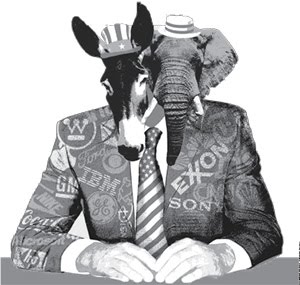
Dynamic duo: Does the answer lie elsewhere? Image from Gulf Business.

EdgeLeft:
In defense of independent politics / 1

What is certain is that neither candidate is willing to make a real break with the military/industrial complex which dominates this country.

By David McReynolds | The Rag Blog | November 4, 2012

Part one of two.

This is Sunday night, and my only excuse, weak though it may be, for this late intervention in the 2012 election discussion is that I was in California for three weeks, then found myself engulfed by Sandy (that is, with no power, phones, internet, etc.).

There will be two parts to this, the second to be written after the election (not because the election will change my thinking, but because the two parts are too much for one post).

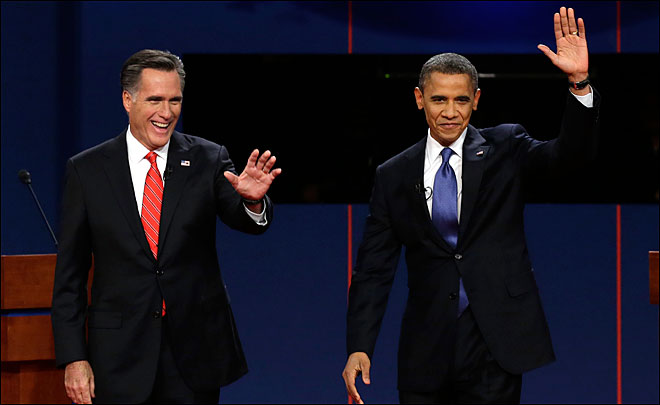
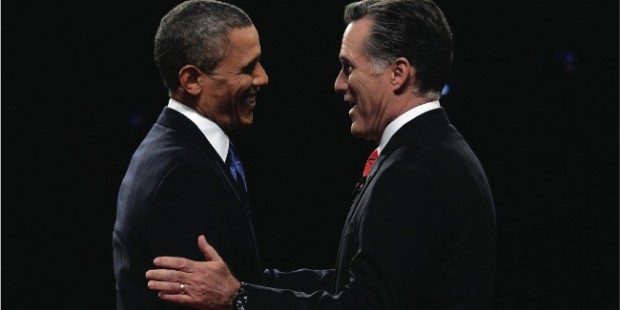
First, on the essential issue, no I won’t vote for Obama. I’m in a “safe state” (New York) where a vote for Obama is truly wasted. Since the Socialist Party is not on the ballot here, I’ll vote for the Green candidate. I think there is a difference in who wins — not much, but some.

(Sometimes a great deal — I doubt Al Gore would have invaded Iraq — but as a twist on this, I doubt that, if Stevenson had been elected in 1952, he could have ended the Korean War — and remember that it was Eisenhower who vetoed Nixon’s eagerness to use nuclear weapons in Indochina and it was Johnson who plunged us so deeply into that war.)

By the end of the campaign we are swept up as if the fate of the world depended on which candidate wins. The old radical position is still true — there isn’t that much difference. I remember the Communist Party (and much of the Left) being convinced that if Eisenhower won in 1952 we would have a military dictatorship — and if memory serves (which it often doesn’t) it was I.F. Stone who supported Eisenhower in that year.

I like Obama. And I refuse to hate Romney. One doesn’t know enough about him to even know whether or not to like him. He is all things to all people, depending on the situation. I worry most about the neocons in his foreign policy camp, but he might ignore them.

What is certain is that neither candidate is willing to make a real break with the military/industrial complex which dominates this country. Neither candidate dares suggest the need to abolish the CIA. Neither candidate is willing to support the rights of the Palestinians if it risks a clash with the Israeli lobby.

I can list several other areas which both candidates have dodged, areas that are truly urgent. Let’s take the developing prison industrial complex — we call ourselves a free nation but we have more men and women in prison than any other nation on the planet. Let’s look at the drug wars, which have failed dismally, yet neither candidate was prepared to discuss legalizing marijuana and treating heroin addiction as a medical problem.

On the issue of military spending, which is more complex than the peace movement seems to realize, Romney is surely out of his mind to urge an increase in such spending. But Obama did not propose closing down the military bases the U.S. has in Europe, Japan, South Korea, Okinawa, etc. etc.

And have we realized that if we simply call for a 50% cut in military spending (or even a 5% cut) we will immediately increase unemployment — unless there is a government program to provide alternative employment? How ironic that the conservatives, so opposed to any and all government spending for any useful purpose, are not only happy with military spending but want to increase it!

There is one solid reason for voting for Obama in you are in a swing state — the Supreme Court nominations.

If you live in a state that is considered “safe” for either candidate, then voting for that candidate is an utterly wasted vote. Any conservative in Texas who votes for Romney when they could vote for the Libertarian does not increase the chance of Romney to win, but only endorses the sad failure of the GOP to adapt to modern times.

And any of my friends who vote for Obama in California, or Washington, or Oregon, Illinois, New York, etc., are losing a chance to vote for candidates — socialist or green — who would, without any risk of losing the election of Obama, show that there is a body of citizens who want serious change.

What is happening that I find most disturbing is not Romney, but the gradual growth of the Tea Party apparatus at local levels around the nation. They made a concerted effort to limit voting by minority groups. And, when one looks at some of the Tea Party members of Congress, led by Michele Bachman, along with Todd Aiken, Joe Walsh, Allen West, etc., we are looking, not at conservatives, but at nuts.

While, taken as a whole, the Tea Party is racist, that is too simple, since one of their heroes is Allen West, an African American from Florida, who insists there are nearly a hundred members of the Communist Party in Congress.

Liberals should remember that it was not so long ago that the nuts who didn’t believe in evolution, or racial equality, were in the Democratic Party — until the Civil Rights Revolution in the 60’s and the shift in the Democratic Party drove these folks into the GOP. But what is disturbing is how comfortable Romney seems to be with these people, with the support of someone such as Donald Trump. It may sound elitist of me, but I’m bothered as much by the sheer vulgarity of Trump as I am by his politics.

What I know, at 83, is that it was foolish of me, in 1964, to support LBJ when it was clear he would win. I had thought my vote — and the rallying of liberals and radicals in his support — would be a referendum in favor of civll rights and peace. Sadly he plunged a half million men and women into Vietnam. How much better if we had given our support to any candidates on the left in the election.

I know my position is alien to the three socialist groups of which I’m a member. The Socialist Party will be upset that I support voting for the Greens in a swing state where our party is not on the ballot. Democratic Socialists of America and the Committees of Correspondence for Democracy and Socialism will (not all of them — I am not the only member in dissent on this issue) be distressed that I do not see the historic imperative of full support for Obama.

What I think those of us on the Left need to do is to realize, first, how small our forces are. Obama will win or lose even if all the members of the groups I’ve named above simply sat this race out. Other, much more powerful forces will determine the outcome. The Black Churches, the Hispanic community, the trade unions, the independent liberals who do not belong to any radical group. (And, of course, on Romney’s side are other powerful forces, some quite dangerous and essentially anti-democratic.)

The second thing we must do is realize that major changes in our culture never originate within the major parties. The Civil Rights movement, the women’s movement, the Vietnam Peace movement, the Gay and Lesbian movement, the environmental movement — all of these began outside either major party, and only by their growth did they force their issues on the political agenda.

So our work is local. It is slow. It is educational as well as political. And our goal is not to achieve the victory of liberalism, but of a radical change in the economic and social culture of our times. Yes, for me that means democratic socialism — clearly a discussion for another time, even though the failures of capitalism are by now clear to many.

One final thought, which is on the late entrance of the abortion issue into the campaign. In some ways this is a secondary issue, as I do not think even a Romney victory would result in banning abortion. But there is something about the Tea Party support of “right to life” (and remember that Aiken’s positions on this are very much the same as those of Romney’s running mate) which is deeply dangerous.

I do understand the profound moral issue this poses for Mormons, Catholics, Orthodox Jews, and evangelicals. I do not mock their concern. I do not take abortion lightly (and by and large neither do women). I will leave to one side the obvious — that men, from the leaders of the Mormon Church to the Pope in Rome, do not face this problem in any immediate way.

What is important is that to make one’s moral position a matter of law — to decide that not only will good Catholics not have abortions, but that laws should be passed making it impossible for secular women to make that decision– is to pass from being a secular and democratic society to one which takes on the tinge of the Taliban. That is why we keep Church and State separate — something the current Republican Party no longer accepts.

Part Two will come later. Meanwhile, I do hope you vote — that right was won at great cost. Just make your vote as meaningful as possible.

[David McReynolds is a former chair of War Resisters International, and was the Socialist Party candidate for President in 1980 and 2000. He is retired and lives with two cats on the Lower East Side of Manhattan, and is happy power has been restored.. He posts at Edge Left and can be reached at davidmcreynolds7@gmail.com. Read more articles by David McReynolds on The Rag Blog.]

The Rag Blog

Posted in Rag Bloggers | Tagged , , , , | Leave a comment

Steve Russell : Citizens United and ‘Scandalgate’

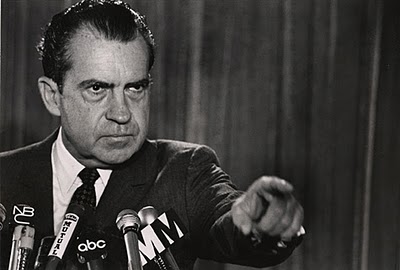
Richard Nixon: “I am not a crook!”

Scandalgate

The Citizens United case has put us in a situation where Watergate is such small potatoes that it’s almost quaint.

By Steve Russell | The Rag Blog | November 2, 2012

Luke Russert, son of the late and much admired journalist Tim Russert, recently referred to Watergate as “the mother of all political scandals.” He’s right, given our predilection to add “-gate” when we describe any serious scandal. That rhetorical flourish is of a piece with “mother of…” — a superlative lifted from our late and unlamented adversary, Saddam Hussein.

Russert’s Watergate remark reminded me of the night at The Daily Texan, my undergraduate student newspaper, when I led an editorial “We take no pleasure in the resignation of President Nixon…”

My conservative critics attacked that as rank hypocrisy, given my role in longstanding and public criticism of Nixon on grounds related and unrelated to Watergate.

What they did not understand is that no serious person could find joy in a situation where the President of the United States could announce “I am not a crook!” and a majority of the country would be thinking “Oh yes, he is!”

The Citizens United case, where limitations on corporate spending in elections were held to violate the free speech rights of corporate persons, has now put us in a situation where Watergate is such small potatoes that it’s almost quaint.

In Watergate, Nixon had to beat the bushes to come up with a million bucks in his slush fund for the burglars, since it contained a mere $700,000. We say “slush fund” because it came from wealthy donors who were buying the kind of access donations always buy in politics without identifying themselves.

In the post-Citizens United world, a million dollars won’t get it. We have billions pouring into our politics with no fingerprints on the billions.

George Soros, the boogeyman of big political money from the right’s point of view, is so down on President Obama that he actually threatened to fund a primary challenge from the left. This nicely demonstrates the great irony of this election: much of the left is holding its collective nose very hard to vote for Obama and that’s “vote for” as distinguished from “support.”

I personally had decided to merely “vote for” rather than “support” based on my disgust with Obama’s negotiation style, where he seems to throw the best ideas under the bus at the front end. Then I read Obama’s book and discovered he really did believe that most Republicans want the best for the country. I presume that illusion has been shattered by these years of autopilot veto.

I sat down and made a list of Obama’s first term accomplishments against overwhelming odds. I watched the GOP scream “socialism!” over mainstream Keynesian economics, the normal method of handling fiscal policy since FDR gave us a clinic in the role of aggregate demand in a capitalist economy.

I listened to the GOP critique of the very idea of government responsibility for everyone’s access to health care. I remembered that this party that never met a war it didn’t like tried mightily to prevent Sen. Jim Webb’s update of the greatest engine of social mobility in American history, the GI Bill.

That finally brought me to the fact of the matter. As much as I find this flabbergasting, as much as it turns my knees to jelly and my brain to mush… we are refighting the election between FDR and Herbert Hoover! We are in a time warp.

Keynes is no longer conventional wisdom.

The National Labor Relations Act, Social Security, the Environmental Protection Agency, the Civil Rights Act of 1964, the Voting Rights Act of 1965, Griswold v. Connecticut (access to birth control)… everything we worked for but, more importantly, everything our parents worked for, is now once again controversial.

Dwight Eisenhower, the hero of WWII, chose to run as a Republican and led the nation to essentially ratify the New Deal. The worst pullback of the Eisenhower years, Landrum-Griffin, was a tinkering at the margins that did not challenge the fundamental right to independent unions.

Keynesian economics was taken for granted because it had worked, and you could follow the aggregate demand curve when FDR briefly succumbed to attacks on temporary deficits and the recovery started to falter, only to be revived by the unbridled demand of WWII.

I remember when the John Birch Society got written out of the Republican establishment for calling Eisenhower a Communist.

Now Obama does things Eisenhower would have approved and gets attacked as un-American.

An incumbent President is about to be substantially outspent by a challenger with invisible money. Contrary to the criticism mouthed by Justice Samuel Alito during the State of the Union, the money could damn well come from foreign corporations because Citizens United has given us a world where we don’t know where the money comes from.

I’m not so concerned about money from overseas. In our times, national borders have become technicalities unrecognized by corporate power.

I’m concerned about the kind of money that turned public opinion for to against Hillarycare with the Harry and Louise ads. I’m concerned with the kind of money that has rendered the obvious fact of global warming controversial. The kind of money telling us that Obama has increased taxes and government regulation in the face of hard facts to the contrary.

Watergate may have been the mother of all political scandals, but what is happening in our time puts Watergate in the shade. And the most scandalous thing is that it’s all perfectly legal.

[Steve Russell lives in Sun City, Texas, near Austin. He is a Texas trial court judge by assignment and associate professor emeritus of criminal justice at Indiana University-Bloomington. Steve was an activist in Austin in the sixties and seventies, and wrote for Austin’s underground paper, The Rag. Steve, who belongs to the Cherokee Nation of Oklahoma, is also a columnist for Indian Country Today, where this article first appeared. He can be reached at swrussel@indiana.edu. Read more articles by Steve Russell on The Rag Blog.]

The Rag Blog

Posted in Rag Bloggers | Tagged , , , , , , , , | Leave a comment

RAG RADIO / Thorne Dreyer : Historian Martin Duberman on ‘Howard Zinn: A Life on the Left’

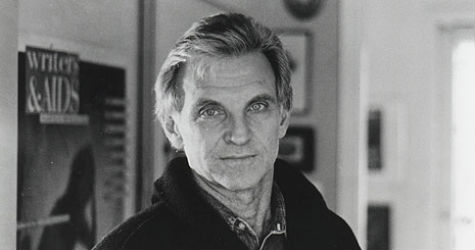
Martin Duberman. Image from Lambda Literary.

Rag Radio podcast:
Historian Martin Duberman discusses
his new biography of Howard Zinn

By Rag Radio | The Rag Blog | November 1, 2012

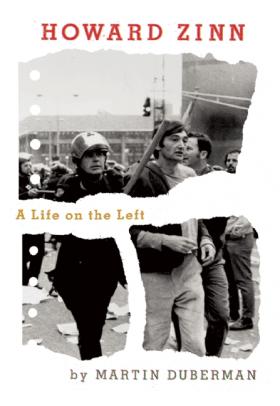
Historian Martin Duberman discussed his new book, Howard Zinn: A Life on the Left, on Rag Radio, Friday, October 26. Rag Radio, a syndicated radio show, is produced in the studios of KOOP-FM, a cooperatively-run all-volunteer community radio station in Austin, Texas.

You can listen to the interview here.


Martin Duberman is Distinguished Professor Emeritus of History at the City University of New York (CUNY) Graduate School, where he founded and for a decade directed the Center for Lesbian and Gay Studies. The author of more than 20 books, Duberman has won a Bancroft Prize and been a finalist for both the National Book Award and the Pulitzer Prize. He lives in New York City.

Howard Zinn: A Life on the Left, is the first major biography of the late social activist and author of “A People’s History of the United States.” Zinn was a larger-than-life figure who stood at the center of the key social movements of the 20th century.

Duberman was the first scholar to gain access to Zinn’s personal papers after he died in 2010. Duberman provides a character study of an individual whose complex personal life was sometimes at odds with the change he effected.

Noam Chomsky wrote that Howard Zinn “changed the consciousness of a generation.” Harvard University History Professor Timothy Patrick McCarthy wrote that “Martin Duberman is America’s most daring and creative living biographer.”

Duberman was also the author of the dual biography, A Saving Remnant: The Radical Lives of Barbara Deming and David McReynolds, published in 2011 by The New Press. Duberman and McReynolds were our guests on Rag Radio on March 5, 2011.

Rag Radio features hour-long in-depth interviews and discussion about issues of progressive politics, culture, and history. It is broadcast live Fridays at 2 p.m. (CDT) on KOOP, 91.7-FM in Austin, and streamed live on the Internet, and is rebroadcast on WFTE-FM in Mt. Cobb and Scranton, PA., on Sunday mornings at 10 (EDT).

The show, which has aired since September 2009, is produced in association with The Rag Blog, a progressive internet newsmagazine, and the New Journalism Project, a Texas 501(c)(3) nonprofit corporation.

The host and producer of Rag Radio is Rag Blog editor and long-time alternative journalist Thorne Dreyer, a pioneer of the Sixties underground press movement. Tracey Schulz is the show’s engineer and co-producer.

All Rag Radio shows are posted as podcasts and can be listened two at the Internet Archive.

Rag Radio can be contacted at ragradio@koop.org.

Coming up on Rag Radio:
THIS FRIDAY, November 2, 2012: Jan Reid Author of Let The People In: The Life and Times of Ann Richards.”
November 9, 2012: Our Berlin correspondent David MacBryde reports on Germany and the Eurozone.
November 16, 2012: Singer-Songwriter Guy Forsyth.

The Rag Blog

Posted in Rag Bloggers | Tagged , , , , , , , | Leave a comment

Alan Waldman : Anglo-Welsh Sitcom ‘Gavin & Stacey’ is Wacky Gem

Waldman’s film and TV
treasures you may have missed:

Englishman James Corden and Welshwoman Ruth Jones wrote and performed in one of the freshest, wackiest TV comedies in years: the award-gobbling, Anglo-Welsh sitcom Gavin & Stacey

By Alan Waldman | The Rag Blog | November 1, 2012


[In his weekly column, Alan Waldman reviews some of his favorite films and TV series that readers may have missed, including TV dramas, mysteries, and comedies from Canada, England, Scotland, and Ireland. Most are available on DVD and/or Netflix.]

In the wildly popular, extremely hilarious romantic/family Britcom Gavin & Stacey, twentysomethings Gavin (Mathew Horne) and Stacey (Joanna Page) fall in love and marry, but they have to cope with bizarre friends and family who all have strong opinions about their love life.

Their chubby, highly unusual best friends are brilliantly played by the series’ shockingly original co-authors James Corden (Smithy) and Ruth Jones (Nessa). The terrific cast includes Alison Steadman (winner of two major awards for the wonderful 1990 Mike Leigh film Life is Sweet) as Gavin’s mum Pam and Rob Brydon (15 awards and noms for various works, including 2011’s The Trip) who virtually steals the show in each of the 20 episodes as Stacey’s earnest, eccentric Uncle Bryn.

Gavin & Stacey ran for three seasons and a Christmas special, from May 13, 2007, to January 1, 2010. Gavin, his parents, and Smitty live in Billericay, in Essex, England, where half of the episodes unfold, while Stacey, her mother, Uncle Bryn, Nessa, and a randy old neighbor lady live on Barry island in Glamorgan, Wales — where the other half erupt.

The series was nominated for 25 major British awards (12 for Jones, 11 for Corden, two for Brydon and one each for Page and Horne). It won 11, including Best TV Comedy, Best New Scripted Comedy, Most Popular Comedy Programme, Best Comedy/Entertainment, Best Satellite/Digital Programme and Best Comedy Series — plus the Writers’ Guild of Britain’s Best Television Comedy/Light Entertainment.

More than 92.4% of the 3,831 viewers who rated it at the Internet Movie Database (imdb.com) gave it thumbs-up and 35.9% gave it a 10 out of 10.

If you have any difficulty with the Welsh and English accents, closed captioning in English makes them clear, and also allows you to back up and hear/read the quicker or more unexpected lines again.

The theatrical high point of 2012 for me was seeing Corden’s tour-de-force performance on Broadway in The National Theatre of Great Britain’s One Man, Two Guvnors, for which he won the “Best Actor in a Play” Tony award — beating out James Earl Jones, Philip Seymour Hoffman, Frank Langella, and John Lithgow!

I once wrote a major article for Hollywood Reporter on why Britcoms were far superior to American sitcoms. One reason: their writers assume their audience is smarter and write more intelligent and surprising scripts. Second: Most British comedy series are only six or eight episodes long, so the original genius writes them all and the quality is consistently high. (John Cleese and Connie Booth wrote every gem-like episode of Fawlty Towers, for instance.)

But U.S. TV comedies are 22 or 23 episodes long, so the original writer does four of them, the producer’s mistress writes three, and the network executive’s idiot nephew pens three more.

I confess that I haven’t really liked a U.S. sitcom since 1992 (Cheers and Night Court), whereas I have adored lots of Britcoms, including Blackadder, The Thin Blue Line, Not Going Out, The Vicar of Dibley, Fawlty Towers, Are You Being Served?, Absolutely Fabulous, League of Gentlemen, As Time Goes By, and Gavin & Stacey.

This one is a real treat; it’s available via Netflix and YouTube and I recommend it (and the others in the previous list) very highly.

Here’s a bit from One Man, Two Gov’nors.

[Oregon writer and Houston native Alan Waldman holds a B.A. in theater arts from Brandeis University and has worked as an editor at The Hollywood Reporter and Honolulu magazine. Read more of Alan Waldman’s articles on The Rag Blog.]

The Rag Blog

Posted in Rag Bloggers | Tagged , , , , | Leave a comment

VERSE / Don Paul : Word Passed Down through Forbidden Radio

Don Paul and Chuck Kinder at Stanford, January 2002. Photo by April Smith.

Word Passed Down
through Forbidden Radio

for Chuck Kinder and John Sinclair on their birthdays, October 2012

The voices beside your pillow, friends past midnight,
Wailing from the River, whistling through the Gaps,
Bring tales and tones so pure and sexual they lift you like a knife.
Their guitars and drums like Indians, slaves and Gospels freed,
Raise heroes from the outlaw, racing in the streets,
All they say truer than what’s on your parents’ new TV.

     The Hill!–the Hill!–shines beyond Highways’ humming fins
     The Hill!–the Hill!–gives you Muddy Waters and Hazel Dickens
     The Hill!–the Hill!–is gained by going out past Main Street
     The Hill!–the Hill!–asks you to dance like one who can’t be seen
               Ree-bel! Ree-bel!                Ree-bel! Ree-bel!

What is this America but promises
That those left out
May rise according to their worth?
What is it but best minds and hearts
In red jackets ripped apart?
What Wars and wars haunt Desks of Insurance agents?
What results are outright when the Road is open,
Fields are level, and choices abundant?
What more might happen to Motor Cities
After Bebop, Doowop, and John Coltrane chords–
Yes, chords from notes–
Joined with Highland melodies?
What more might you do with your pillows’ pain,
Hungry ears’ wound and bow?

John reached out to make Rock free as jazz.
John reached out to bring White into Black.
John reached out to smoke and drink and fuck
Upside-down or any other way he liked.
John risked his life for all he felt gave some light.
Chuck punched his way out of West Virginia parking-lots.
Chuck claimed seven Armed Robberies when age seventeen.
Chuck dove into Elizabethans, Matthew Arnold,
The Golden Bough, and McCluhan with the same drive.
Chuck brought friends West to share in edges’ glow.

Decades pass. Partners split and losses wrench.
Knives of Indians and Blacks show up outside bars.
Water Follies lap against corpses found in the Ocean.
Jimmy Carter, Ronald Reagan, a Bush and a Clinton
Are President. John and Chuck smoke and drink,
Teach, create, promote and inspire
More who listen and talk around their tables. They maintain
Forbidden radio.
They can be ignored but not stopped.
Their beards thin to catch light.

     What is that word abideth Night?
     What is that sound of Spirit bright?
     What holds the hand that grips your hand
     On what might have been your death-bed?
     What plays the horns of devotees who want to be
     For all time and a force for good?
     What is that force made strangers by your pillow friends?
     What is that word? That word is Love.

     Gather round the company,
          Share the love around.

     Bring on wine. Bring on Fats. Bring on Eric
     And thousands welcome gamblers and clowns.
     Bring on Jack, bring on herb.
     Bring on Aunt Tee, bring on Aunt Bea. Bring on
     Demons of basepaths and night-sweats. Bring on
     Mardi Gras Black Indians’ gifts every year
     Of brilliance sewn into design.
     Bring on the giant night and whole works of sunsets over water.
     The word–the thing, the thing we know,
     Beyond our words, at last, that thing we heard
     So ‘way back when, our out and light and balm,
     That thing is Love.

     Gods bless this merry company,
          Share the love around.

Don Paul
October 2012
New Orleans

Don Paul met Chuck Kinder when Don was the youngest winner of the Wallace Stegner Fellowship in Creative Writing at Stanford, 1971. He met John Sinclair in 1989 when they first performed together in Detroit. He moved to New Orleans in January 2006 to help with preserving a culture that lets Mardi Gras Indians flourish. Please go here for many albums and books. His performance at New Orleans’ Cafe Istanbul of a poem “for and from Bob Kaufman” is here.

Chuck Kinder is the author of four acclaimed novels, Snakehunter, The Silver Ghost, Honeymooners, and The Last Mountain Dancer. He taught for 30 years at the University of Pittsburgh and became a beloved advisor to dozens of students who kept writing fiction after taking his class. He performs with the Deliberate Strangers in Pennsylvania and West Virginia. Please go here.

John Sinclair is a poet, musicologist, and touring artist who has celebrated deep and lively alternatives for the Western world over more than 50 years. He was co-founder of the White Panther Party and the Ann Arbor Blues Festival and was manager of the MC-5. He was the subject of John Lennon’s song “Ten for Two.” He recently brought out an homage to John Coltrane as book and CD. Please go here for many links.

Barry Kaiser, John Sinclair, Don Paul, and Tom Worrell, March 2011, outside Louisiana Music Factory, New Orleans.

The Rag Blog

Posted in Rag Bloggers | Tagged , , , , | Leave a comment

Kate Braun : Samhain Is a Time for Transformation

Time for transformation: Acorn Carved with Dremmel Tool. Image from Skull-A-Day.

Celebrating Samhain:
A time for transformation

By Kate Braun | The Rag Blog | October 31, 2012

“Under the moonlight we dance/ Spirits dance, we dance/ Holding hands we dance…”

Wednesday, October 31, 2012, is Halloween, aka Samhain, Third Harvest, All Hallows Eve. It marks a time for transformation and growth of the soul while in a spiritual hibernation between Samhain and Yule (Winter Solstice, when life begins to bloom again on Mother Earth).

This is the beginning of the agrarian year, a time of “being in the womb of the earth.” We now have time to study, to reflect, to prepare land and soul for the next cycle that will begin at Yule. Honor the Crone (old, wise woman): she holds the tribal lore, stores the records of the clan. Now is the time to listen to the wisdom of the ancestors. Use this knowledge/lore to make plans for the coming year, not only for work, but also for your own spiritual growth and enrichment.

Samhain is also a time of great magick, when the veil between worlds is at its thinnest. Do not be surprised if you sense contact with spirits that have crossed this veil or are in transition between the worlds. If you choose to enhance whatever possibilities of communication might be, there are many methods: you may scry, using either a black mirror or water placed in a dark-colored bowl or cauldron; or contemplate the flame of a single candle in an otherwise-unlit room; or create a dumb supper, to name just three.

Be sure to use the colors black and orange in your decorating scheme. You may also use red, brown, and/or golden yellow as accent colors.

If possible, celebrate outdoors and have a fire. Begin your outdoor activities by sweeping the area with a besom or straw broom. This symbolically cleanses the area, sweeping away the past and opening the door to the future. If you invite your guests to each bring a broom or besom, this could become a group activity that could be turned into a celebratory dance.

Lighting a new candle for the “new year” that is now in gestation is also something that could be incorporated into your activities.

Serve your guests a bountiful feast that may include pumpkins, apples, nuts, turnips, all gourds, squash, beets, corn, mulled wines, cider, beef, poultry, pork. Any crops not harvested by this date should be considered taboo and left in the ground, and it is also taboo to share leftovers at this festival. You may, however, bury apples along a road or path for spirits who are lost or who have no descendants to provide for them. Apples are food for the dead.

Decorate with pumpkins, jack-o-lanterns, cornstalks, cauldrons, brooms and besoms, apples, root veggies, images of black cats. Throw any bones from your feast into the fire as an offering to the Gods/Goddesses for healthy and plentiful livestock in the coming year. Then, when the ashes are cool, spread them over your garden. This blesses the land as well as nourishes the soil.

Be aware that various Nature Sprites are out and about and are said to enjoy playing tricks on humans. In olden times people dressed in white or wore disguises to fool these entities; today we put on costumes just for the fun of it.

[Kate Braun‘s website is www.tarotbykatebraun.com. She can be reached at kate_braun2000@yahoo.com. Read more of Kate Braun’s writing on The Rag Blog.]

The Rag Blog

Posted in Rag Bloggers | Tagged , , , , , , , | Leave a comment

Harry Targ : The Real Romney Foreign Policy

Will the real Mitt Romney please stand up? Image from Foreign Policy.

Unleashing the military:
The real Romney foreign policy

Military spending would grow in a Romney administration, especially because of ties to the neocons and a hawkish Congress which promotes military spending district by district.

By Harry Targ | The Rag Blog | October 30, 2012

After the outbreak of fighting on the Korean peninsula, NSC 68 was accepted throughout the government as the foundation of American foreign policy — U.S. Department of State, Office of the Historian.

The third and last presidential debate of the 2012 election season, October 22, 2012, addressed issues of foreign policy and their connections to the United States economy. The debates reflected the idiosyncrasies of American politics, 2012, as well as the enduring features of the United States empire.

As to the candidate’s realization that he needed to “move to the center,” Mitt Romney tried to portray himself as peace-oriented. This approach contradicted the neo-conservative vision of the 17 of 24 key foreign policy aides advising him. These former Bush advisors and associates of the Project for a New American Century or (PNAC), stand for a foreign policy designed to reestablish United States global hegemony.

PNAC, formed in the 1990s, in its official positions argued that the United States, as the last remaining super power, must use that power to remake the world. The PNAC vision combines the ideology of the United States as the “City on the Hill” and the “Beacon of Hope” for the world, with the advocacy of using overwhelming military force to achieve imperial goals.

Romney, contrary to prior statements, endorsed the Obama administration plans for withdrawal from Afghanistan in 2014. He, like President Obama, supported the Syrian opposition short of U.S. direct military intervention. He called for maintaining sanctions against Iran to force the latter to end its alleged nuclear program while avoiding war. And Romney, like Obama, endorsed challenging China’s trade policy while engaging in constructive diplomacy with the burgeoning new superpower.

These and other Romney statements mirrored (for better or worse) the foreign policies of President Obama. The flexible Republican candidate “moved to the center” on foreign policy because of his perceived need to present an image of wisdom and caution to the America voters who oppose a continued presence in Afghanistan, getting directly involved in wars against Syria and Iran, and the wars on “terrorism,” “drugs,” and other crusades.

However, candidate Romney was firm in his commitment to increasing U.S. defense spending over the next decade, while he would cut domestic programs. The Center for Budget and Policy Priorities reported in September 2012 that a President Romney would cap total federal spending at 20 percent of GDP by 2016, maintain defense spending at 4 percent of GDP, and rapidly repeal the Affordable Care Act (Richard Kogan and Paul N. Van de Water, “Romney Budget Proposals Would Necessitate Very Large Cuts in Medicaid, Education, Health Research and Other Programs”).

President Obama claims that the Romney military project would add $2 trillion to military spending over the next decade. Even though figures are loosely introduced to debates, it is clear that a Romney presidency would add enormously to naval programs, maintain high levels of troops, and continue drone programs that were expanded during the Obama presidency.

In short, military spending would grow in a Romney administration, especially because of ties to the neocons and a hawkish Congress which promotes military spending district by district.

The Obama defense budget projected for fiscal year 2013 would total $525 billion, a 2.5 percent decline from the 2012 budget (if inflation is considered). The basic DOD budget request does not include ongoing war costs, U.S. nuclear weapons systems, homeland security, military assistance, or other elements of security.

The DOD recommended cuts in troop strength in the army, marines, and reserves. The National Priorities Project reports that an Obama defense budget would modestly increase from about $525 billion in 2013 to just less than $530 billion at the end of a second term.

A Romney administration would unleash the military in terms of expenditures, and, if he listens to his neocon advisors, worldwide adventures. But, President Obama’s defense budget proposals continue the basic parameters of military spending into the future. As the National Priorities pie chart notes, the 2013 proposed federal budget allocates 57 percent of discretionary spending directly to the military, with 6 percent for education, 6 percent for housing and community, 5 percent for veterans benefits, 3 percent for science, 2 percent for labor, 2 percent for transportation, and 1 percent for food and agriculture.

National Security Council Document 68, written in the bleak Cold War winter of 1950 before the onset of the Korean War recommended that military spending should be the number one priority of every president before he/she discussed any other program or activity of government. NSC 68, just a wild proposal that winter, became policy after the Korean War started and has for the most part continued ever since, costing American workers trillions of dollars in taxes.

The Romney proposal, based on a vision of reestablishing the United States as the global hegemonic power, is based on the principle articulated in NSC 68. Spend more and more on the military and pay for it by cutting everything else. The Obama budget, while more circumspect and committed to the military contributing “their fair share” to the health and well-being of the nation, maintains the same commitment to prioritizing the military.

The task of the peace movement over the coming weeks is to first challenge the candidacy of Mitt Romney, who is committed to reinstituting the principle of NSC 68, and then, if the President is re-elected, to demand that President Obama reject the 60-year tradition of privileging unnecessary military spending over the basic needs of the American people.

[Harry Targ is a professor of political science at Purdue University who lives in West Lafayette, Indiana. He blogs at Diary of a Heartland Radical — and that’s also the name of his book from Changemaker Press which can be found at Lulu.com. Read more of Harry Targ’s articles on The Rag Blog.]

The Rag Blog

Posted in Rag Bloggers | Tagged , , , , , | Leave a comment

IDEAS / Bill Meacham : Is Religion a Parasitic Meme or a Helpful Adaptation?

Moai at Easter Island. Moai are the living faces of deified ancestors. Image from Wikimedia Commons.

Religion:
Parasitic meme or helpful adaptation?

That humans are religious is indisputable. Like morality, religion in one form or another seems to be a universal aspect of human culture.

By Bill Meacham | The Rag Blog | October 30, 2012

It can be a bit daunting to draw philosophical conclusions from the state of scientific belief. Scientific theories change with the addition of new evidence. Different theorists sometimes disagree, and the informed but non-expert onlooker does not know which to take as grounds for philosophizing.

And the issue is particularly vexing in the social sciences, which do not lend themselves as easily as the physical sciences to experimental verification. Case in point: the evolutionary origins of religion.

That humans are religious is indisputable. Like morality, religion in one form or another seems to be a universal aspect of human culture.

By “religion” I mean any form of socially-organized relationship to what we might call an unseen realm of disembodied agency, including ancestors who are no longer living in the flesh; totemic spirits associated with places or objects; genies, angels and demons; deities such as the gods of the Greek pantheon; the all-knowing, all-powerful and eternal God of monotheism; and the All or Universal Soul of advanced mysticism.(1)

An intimate social relationship between living people and supernatural beings of some sort is characteristic of human societies everywhere.(2) The question for evolutionary psychology is twofold: how did religion come to be and what advantages did it provide to our ancestors?

The advantages seem straightforward. One aspect of religion is social cohesion; it “served as an extra cohesive force, besides the bonds of kinship, to hold societies together for such purposes as punishing freeloaders and miscreants or uniting in war.”(3)

Evolutionary theorists are divided on the historical causes of this effect. Does the explanation require the controversial notion of group selection, that genes can become fixed or spread in a population because of the benefits they bestow on groups, regardless of their effect on the fitness of individuals within that group?(4) Or is it instead merely that all humans benefit by being members of groups, and exhibit genetic or cultural traits that have evolved to enhance the ability to function well in a group, any group?

In either case religion, like language and sensitivity to norms, may well be one such adaptation.

Another advantage is a sense of hope or confidence in the face of adverse circumstances. When confronted with danger or something fearsome, the believer does not succumb to despair and hopelessness. (Those who did, who gave up, did not survive to produce offspring.) Instead he or she calls on God — or the ancestors or the gods or guardian spirits, etc. — for help.

As a person feels that help, he or she carries on and is more likely to survive and thrive. (This is the case regardless of whether the entity called on actually exists or not.) It is a survival characteristic to feel that God is with you.

But how did this characteristic evolve in the first place? We can only speculate, as there is little archeological evidence.

The so-called “New Atheists” — those who invoke science to denigrate religion with much the same fervor as some believers defend their faith — view religious beliefs not as useful adaptations, but as parasitic memes that have embedded themselves in human minds. (A meme is an idea, behavior, or style that replicates from person to person within a culture much like genes replicate from generation to generation of living organisms.[5]) Such beliefs started out as mistakes but then took on a life of their own, they say.

Daniel Dennett, one such atheist, believes it had to do with an extension of our species’ aptitude for theory of mind, the ability to attribute mental states like our own to others. Humans have such an advanced capacity for what he calls the “intentional stance,” the propensity to attribute beliefs, desires, and a certain amount of cunning to anything that moves and seems to do so with intention, that we have difficulty turning it off.(6)

Citing other researchers, Dennett calls it a “hyperactive agency detection device,” a term that is widely used to mean a cognitive module that readily — perhaps too readily — ascribes events in the environment to the behavior of agents. Such a tendency confers a survival benefit: it is better to avoid an imaginary predator than be killed by a real one.(7) We are the descendents of those whose agency detectors were overly, not insufficiently, vigilant.

Dennett’s argument, in brief is this:

  • When a person died, our ancestors got rid of the body, but had the persistent memory of the living person, so they thought of him or her as still existing as a ghost or spirit.(8) That is the hyperactive agency detector at work.
  • Then they started asking the deceased or the spirits for advice.(9)
  • From there it is short step to divination — ceremonies and rituals to find out what the gods know — and then to appeasement and prayer, to try to influence the gods to be good to us. At this point humans were treating the gods not just as disembodied beings who know things, but as agents who do things, who cause things to happen to us, both calamities and good fortune.(10)
  • Finally we get self-serving shamans and priests who promote belief in their authority as ways to enhance their own self-esteem, power, and wealth.(11)

Once religion is born, other mechanisms ensure its propagation. One is the natural tendency of people to believe what others in the group believe. Science writer Robert Wright observes, “If you are surrounded by a small group of people on whom your survival depends, rejecting the beliefs that are most important to them will not help you live long enough to get your genes into the next generation.”(12)

Another thing that helps is that the very idea of gods or a God is catchy. As Wright puts it,

[W]e would expect the following kinds of memes to be survivors in the dog-eat-dog world of cultural evolution: claims that (a) are somewhat strange, surprising, counterintuitive; (b) illuminate sources of fortune and misfortune; (c) give people a sense that they can influence these sources; (d) are by their nature hard to test decisively. In this light, the birth of religion doesn’t seem so mysterious.(13)

Memetic replication can, paradoxically, favor ideas that are hard to confirm. Truth-value is not the only attribute that causes memes to jump from mind to mind. Ideas that contribute to group cohesion, of course, tend to be reinforced within the group. And finally we get full-blown rationales such as that belief in God is the foundation of morality and in any case is important for its own sake.(14)

On this view, particularly in light of the sorry history of much of organized religion, religion and religious beliefs are outmoded and dangerous residues of our evolutionary heritage. If they ever did serve a useful purpose, that purpose has long been superseded, say the New Atheists. At best, God is a social hallucination or, to put it more kindly, something constituted intersubjectively. Belief in God is as mistaken as the belief in an external, objective morality.

But there is another view, equally steeped in evolutionary psychology, that says that religion has positive benefits.

Psychologist Jonathan Haidt, in his intellectually superb The Righteous Mind, claims that religion has been evolutionarily adaptive because it binds groups together in a way that enhances the survival prospects of their members. He observes that despite our innate tendency to favor ourselves human beings are able at times to be quite unselfish in service to the group or groups of which they are a member. We are not only selfish, we are also groupish:

We love to join teams, clubs, leagues, and fraternities. We take on group identities and work shoulder to shoulder with strangers toward common goals so enthusiastically that it seems as if our minds were designed for teamwork. … Our minds contain a variety of mental mechanisms that make us adept at promoting our group’s interest in competition with other groups. We are not saints, but we are sometimes good team players.(15)

He attributes this trait to group competition.

[G]roups compete with groups, and that competition favors groups composed of team players — those who are willing to cooperate and work for the good of the group, even when they could do better by slacking, cheating, or leaving.(16)

He goes on to give a number of reasons for believing that the tendency to be a team player is not only cultural but has become a physical, genetic trait. This is a group selection theory: some groups fare better than others in the competition to turn resources into offspring(17) and members of those groups come to have specific genetic traits that help the group survive, traits such as a tendency to be loyal to the group and feelings of sanctity for the things others in the group value. “[G]roups in which these traits are common will replace groups in which they are rare, even if those genes impose a small cost on their bearers (relative to those that lack them within each group).”(18)

Can group membership really influence the genetic makeup of its members? Consider this (one among several arguments that Haidt advances): If you want to increase egg output, you would breed only those chickens that lay the most eggs, right? Actually that doesn’t work. In the egg industry, where chickens live in crowded cages, the best layers are also the most aggressive, and breeding such hens causes more aggression and fewer eggs. A geneticist tried a different approach:

He worked with cages containing 12 hens each, and he simply picked the cages that produced the most eggs in each generation. The he bred all of the hens in those cages to produce the next generation. Within just three generations, aggression levels plummeted. … Total eggs produced per hen jumped from 91 to 237 [after several more generations], mostly because the hens started living longer, but also because they laid more eggs per day. The group-selected hens were more productive than were those subjected to individual-level selection.(19)

Haidt claims humans have become adapted to group living in much the same way. Natural, not artificial, selection has caused us to be groupish as well as selfish. As Haidt puts it, we are 90 percent ape and 10 percent bee.(20)

I am not going to adjudicate whether this phenomenon would better be called group selection, multi-level selection, or “individual selection in the context of groups.”(21) But it is undeniable that humans function best in groups and it does seem plausible that natural selection has produced specific adaptations in us to serve that end. One of them is the propensity to submerge self-interest in favor of service to the group. Dennett, in fact, recognizes the same phenomenon, but chalks it up to cultural evolution — memes, not genes.(22)

What Haidt adds to the debate is the recognition that it is not just our behavior that inclines us to service to the group; it is our experience as well. It can be quite agreeable to lose our sense of individuality in a feeling of unity with something larger than ourselves. He gives a number of examples: the sense of well-being felt by soldiers when drilling in close order; the ecstasy of collective dancing; awe in nature; the effect of certain hallucinogenic drugs; and more.(23)

He does not mention the rhythmic movements and breath practices of the Sufis, the chanting and hand-clapping of Hindu bhajan and kirtan (devotional singing and dancing), nor the similar enthusiasm of certain evangelical Christians, but they certainly qualify as well. From the point of view of the phenomenology of lived experience, it seems that we thrive on ecstasy.

Haidt calls this experience being in a sort of hive mind, “a mind-set of ‘one for all, all for one’” in which we are willing to work for the good of the group as a whole, not solely for our own advancement within it.(24) Just as evolution has caused sweets to taste good to us, it has caused the experience of being in harmony with others, of moving in unison and sensing that we are part of a larger whole, to be profoundly satisfying.

And religion is one of the ways we do that. This version of the story of the rise of religion starts in the same place as that of the New Atheists: our hyperactive agency detection device gave rise to belief in disembodied ancestors, spirits, gods, and the like. But far from being memetic parasites, such beliefs served a positive benefit: the cohesion of the group. The gods condemn selfish and divisive behaviors, and the gods can see what you are doing.

It is a fact verified by experiment that people act more ethically when they think somebody is looking and less ethically when they think nobody can see them. “Creating gods who can see everything, and who hate cheaters and oath-breakers, turns out to be a very good way to reduce cheating and oath breaking.”(25) And if those gods are said to punish the group for its members’ infractions, then people in the group will be more vigilant towards and gossipy about each other’s behavior. “Angry gods make shame more effective as a means of social control.”(26)

The upshot is this:

[T]he very ritual practices that the New Atheists dismiss as costly, inefficient, and irrational turn out to be a solution to one of the hardest problems humans face: cooperation without kinship.(27) … Gods and religions … are group-level adaptations for producing cohesiveness and trust.(28)

And there is evidence that religious people are more kind, generous, and charitable than non-religious people. This is true regardless of the specifics of the theology. What really matters is how enmeshed people are in relationships with their fellow religionists. It is religious belonging that matters for neighborliness, not religious believing.(29)

The New Atheists have it wrong; certainly many religious beliefs are irrational, but that is not the point. The point is that religious belonging, regardless of belief, triggers altruism, although it is often a parochial altruism, aimed at members of the in-group.(30)

Does this mean that religion is a good thing, and we should embrace it? Well, no, not necessarily. We need to be choosy. Evolution has equipped us with a desire for and a response to being subsumed in something greater than our individual selves. But that instinct can be triggered by all sorts of things: football games, social clubs, political movements, religious congregations, and more.

The yearning to be absorbed in the hive can be exploited by a fascist rally as well as evoked by a mystical dance. Devotion to the in-group can be seen in a mafia gang as well as a Quaker meeting. Given that we have an innate predilection to lose ourselves in something greater, it is up to us to decide where to place our allegiance.

There is no question that hideous things have been done in the name of religion: the slaughter of infidels; the abuse of children and women; lies, deceit, and hypocrisy; arrogant exercise of domineering power. And there is no question that many beautiful and noble things have been done in the name of religion: feeding the hungry; clothing the naked; housing the homeless; comforting the afflicted; standing up for the oppressed against the abuses of the dominators. If you feel drawn to religion, you get to choose which it will be.

As Bob Dylan says, you’re gonna have to serve somebody.(31) Will it be the monolith of a fascist state or the community of the faithful? Will it be the rigidity of a top-down institution or the living flexibility of a decentralized organism?

Best of all would be the fellowship of those committed to working for the good in all things.

[Bill Meacham is an independent scholar in philosophy. A former staffer at Austin’s ’60s underground paper, The Rag, Bill received his Ph.D. in philosophy from the University of Texas at Austin. Meacham spent many years working as a computer programmer, systems analyst, and project manager. He posts at Philosophy for Real Life, where this article also appears. Read more articles by Bill Meacham on The Rag Blog.]

Notes
(1) Buddhism and Taoism, arguably non-theistic religions, nevertheless stress the importance of something nonphysical that influences human affairs, which can be understood as an attenuated form of more-than-human agency.
(2) King, Evolving God, p. 13.
(3) Wade, Before the Dawn, pp. 72-73.
(4) Wikipedia, “Group selection,”
(5) Wikipedia, “Meme.”
(6) Dennett, Breaking the Spell, pp. 108-112.
(7) Wikipedia, “Evolutionary psychology of religion.”
(8) Dennett, Breaking the Spell, pp. 112-113.
(9) Ibid., pp. 125-131.
(10) Ibid., pp. 132-135.
(11) Ibid., pp. 167-173.
(12) Wright, The Evolution of God, p. 464.
(13) Ibid., p. 468.
(14) Dennett, Breaking the Spell, chapters six through eight, pp. 153-246.
(15) Haidt, The Righteous Mind, pp. 190-191.
(16) Ibid., pp. 191-192.
(17) Ibid., p. 217.
(18) Ibid., p. 195.
(19) Ibid., p. 214.
(20) Ibid., p. 220.
(21) Pinker, “The False Allure Of Group Selection.”
(22) Dennett, Breaking the Spell, p. 184.
(23) Haidt, The Righteous Mind, pp. 221-233.
(24) Ibid., p. 223.
(25) Ibid., p. 256.
(26) Ibid.
(27) Ibid., p. 257.
(28) Ibid., p. 264.
(29) Ibid., p. 267.
(30) Ibid., p. 265.
(31) Dylan, “Gotta Serve Somebody.”

References
Dennett, Daniel C. Breaking the Spell: Religion as a Natural Phenomenon. New York: Penguin Books, 2006.
Dylan, Bob. “Gotta Serve Somebody” on Slow Train Coming. New York: Columbia Records, 1979. Lyrics available at http://www.bobdylan.com/us/songs/gotta-serve-somebody as of 5 October 2012.
Haidt, Jonathan. The Righteous Mind: Why Good People Are Divided by Politics and Religion. New York: Pantheon Books, 2012.
King, Barbara J. Evolving God: A Provocative View of the Origins of Religion. New York: Doubleday, 2007.
Pinker, Steven. “The False Allure Of Group Selection.” Online publication, URL = http://edge.org/conversation/the-false-allure-of-group-selection as of 19 September 2012.
Wade, Nicholas. Before the Dawn: Recovering the Lost History of Our Ancestors. New York: The Penguin Press, 2006.
Wikipedia. “Evolutionary psychology of religion.” Online publication, URL = http://en.wikipedia.org/wiki/Evolutionary_psychology_of_religion as of 21 October 2012.
Wikipedia. “Group selection.” Online publication, URL = http://en.wikipedia.org/wiki/Group_selection as of 6 December 2009.
Wikipedia. “Meme.” Online publication, URL = http://en.wikipedia.org/wiki/Meme as of 21 October 2012.
Wright, Robert. The Evolution of God. New York: Little, Brown and Company, 2009. The appendix, “How Human Nature Gave Birth to Religion,” is also available as an online publication, URL = http://www.evolutionofgod.net/excerpts_appendix/ as of 20 August 2009.

The Rag Blog

Posted in Rag Bloggers | Tagged , , , , , , | 2 Comments

Lamar W. Hankins : Paul Ryan Makes War Against People, Not Poverty

President Lyndon Johnson marked the start of the War on Poverty with a visit to Tom Fletcher’s front porch in Martin County, Kentucky, in April 1964. Photo by Walter Bennett / Time magazine. Image from Daily Yonder.

Paul Ryan’s war:
Not against poverty, but against people

In 1964, long before Paul Ryan was ever swaddled in a diaper, President Lyndon Johnson declared that because America is a great nation, it should not have nearly one quarter of its people living in poverty.

By Lamar W. Hankins | The Rag Blog | October 30, 2012

In a hackneyed play on words, Paul Ryan, Mitt Romney’s extremist vice-presidential running mate, declared, “In this war on poverty, poverty is winning.” His claim created an enticing sound bite for the evening news, but it is factually incorrect.

Ryan’s argument:

With a few exceptions, government’s approach has been to spend lots of money on centralized, bureaucratic, top-down anti-poverty programs. The mindset behind this approach is that a nation should measure compassion by the size of the federal government and how much it spends. The problem is, starting in the 1960s, this top-down approach created and perpetuated a debilitating culture of dependency, wrecking families and communities.

Correspondent John Nichols of The Nation took a look at the census data and found a different reality:

In 1959, 22.1 percent of Americans lived below the poverty line. In 1969, 13.7 percent of Americans lived below the poverty line. The poverty level has varied since 1969. It has gone as high as 15 percent. But it has never again gotten anywhere near where it was in 1959.”

In 1964, long before Paul Ryan was ever swaddled in a diaper, President Lyndon Johnson declared that because America is a great nation, it should not have nearly one quarter of its people living in poverty. I was a junior in college then. Lyndon Johnson’s vision of an America in which all people had adequate food, clothing, shelter, and work moved me to drop out of college for a year to join Volunteers in Service to America (VISTA). I was assigned to a migrant labor project developed by a local nonprofit organization in South Florida.

While we helped many migrant farm workers in a modest way, what we did was a drop in the ocean of America’s poverty. But programs and agencies like Medicare, Food Stamps, Job Corps, the Office of Economic Opportunity, and Head Start made a vast difference in the lives of the elderly poor, impoverished families, poor youth in need of job skills, and the young children of America’s poor families.

After graduating from college, I spent seven years working for a local nonprofit agency in Texas that operated Head Start centers, job training programs, summer programs for poor teens, family planning and women’s health programs, and a host of projects developed by VISTA volunteers working for our local nonprofit agency — housing programs, a credit union, employment services, tutorial programs, recreation programs, buying clubs, food distribution, and more. What was done was limited only by the imagination of the participants and those who wanted to help them, and available funds.

What I experienced in those years was far more than what Paul Ryan blithely describes as “centralized, bureaucratic, top-down anti-poverty programs.” After getting a law degree, I spent over three years working for a local nonprofit legal services program operating in six counties in the Bryan-College Station area. It, too, was created by Lyndon Johnson’s anti-poverty initiative to provide a modicum of civil justice to poor families.

From my personal experience, I know that what Paul Ryan said is an outright lie. He might not have intentionally lied, but he did intentionally parrot the Republican, right-wing position against making America a better, more prosperous country by correcting many of the deficiencies, injustices, and inequities in our economic, social, and legal systems.

Ryan’s opponent in his other political race (he is running also to keep his seat in Congress), Rob Zerban, had this to say about Ryan’s views on anti-poverty programs:

If poverty’s winning the war, it’s because of policies Paul Ryan supports. By doubling down on his radical plot to gut Medicaid, privatize Social Security, and decimate food assistance programs, Paul Ryan is betting against working families — all to hand out new tax breaks for millionaires and Big Oil.

As John Nichols points out,

Paul Ryan has taken a side in the war on poverty. He’s against what works. Ryan has a right to take the positions that he does. But no one should confuse those positions with a sincere commitment to fighting, let alone ending, poverty.

And that about sums up Paul Ryan as a politician and a human being.

Like Ryan and so many cut from his mold, I can tell anecdotes from personal experience about people unmotivated to take advantage of available opportunities, but I can tell far more about people who eagerly made the most of opportunities that were available — about children who received health and dental care as they learned what they needed to prepare for public school; about their parents, who learned how to help their children be more successful in life than they ever imagined was possible; about people with few marketable skills who acquired job skills that lasted a lifetime.

Stories about high school dropouts who obtained their GEDs and went on to colleges or jobs that enriched their lives, not just with money, but with hope made possible by opportunity; about families with renewed pride because they helped to build their own homes; about women whose lives were saved by having access to preventive health care for the first time in their lives; about elderly people who, because of Medicare and Medicaid, avoided the misery their parents experienced in old age.

In the spring of 1969, the local nonprofit agency I worked for received a crudely-written letter addressed only to “Headstart, Washington, D.C.” It had been received at the national offices of the Office of Economic Opportunity (OEO), the agency responsible for the Head Start program at that time. The Washington office sent it to the regional OEO office in Dallas, which forwarded it to my agency. It had been sent by a man who lived with his family of four children and his wife in rural Williamson County, Texas, where we provided services.

The man had heard a public service announcement on the radio promoting Head Start, the pre-school OEO program. His letter stated simply that “he needed a headstart.” While he had not correctly understood the announcement, he had heard that there might be an opportunity for him and his family to get some relief from their misery, and he desperately wanted that opportunity. The director of my agency, Rawleigh Elliott, a former mayor of Georgetown and businessman, asked me to find the family and offer help.

After a bit of searching, a friend and I found the family’s house — a shack with a wood-fired stove, no insulation, and no paint on its weather-worn clapboards. We talked with the family, assessed their needs, and started finding them the help they needed to get their own “headstart.” Such families exist all over this country, even as many politicians dismiss their plight and even their existence.

One such politician is Paul Ryan, who has a deformed and myopic view of life. Ryan has never believed the words of his party’s progenitor Abraham Lincoln, that our government is of, by, and for the people. Many things are wrong in this country, but none of them involve actions by “we, the people” to make everyone’s lives less degrading, less impoverished, and less unjust, with more decency and opportunity for all.

It will be a sad day for America if someone like Ryan is put in charge of our government.

[Lamar W. Hankins, a former San Marcos, Texas, city attorney, is also a columnist for the San Marcos Mercury. This article © Freethought San Marcos, Lamar W. Hankins. Read more articles by Lamar W. Hankins on The Rag Blog.]

The Rag Blog
Posted in Rag Bloggers | Tagged , , , , , , , | 1 Comment

The Kinkster, who was our guest on Rag Radio, said he’s seriously considering a second try for governor of Texas in 2012, this time as a Democrat. Singer-songwriter, mystery writer, and social satirist Friedman talks about politics, music, “political correctness,” and much more — and performs live. Read the story and listen to the podcast.

Posted in RagBlog | Leave a comment

Rag Blog Digest: “Weimar Moment?” by Jay Jurie; Dreyer interviews Kinky Friedman; “Reds Under Romney’s Bed!” by Mike Davis; Jonah Raskin on “Uncle Tom Vs. Simon Legree” — plus Alan Waldman, “Texas Cheerleaders for Jesus,” “Do the Romneys Own Your E-Vote,” & two remembrances of George McGovern.

Posted in RagBlog | Leave a comment

Jay D. Jurie : ‘Weimar Moment’ or Chicken Little?

“Pillars of Society.” Painting by militantly anti-Nazi German Dadaist George Grosz, 1926, during the Weimar Republic. Image from Alpha History.

It can’t happen here:
A ‘Weimar moment’ or Chicken Little?

Whether or not the U.S. is at a ‘Weimar moment,’ those who are concerned about such a possibility should not be accused of needlessly worrying that “the sky is falling.”

By Jay D. Jurie | The Rag Blog | October 25, 2012

“When and if fascism comes to America…it will not even be called fascism; it will be called, of course, ‘Americanism.'” — Prof. Halford E. Luccock, Yale University Divinity School, quoted in The New York Times, September 12, 1938.

“…fascism will come to America in the name of national security.” —Jim Garrison, Playboy magazine interview, October 1967

Is fascism imminent in the United States? This is a not a new question, it has been debated for decades. For more than 100 years it’s been argued that a serious crisis threatening the political and economic order may well lead to a right-wing takeover.

When such a crisis reaches a prospective tipping point, the question becomes: will society pull back at the last minute, or will it take the plunge into authoritarianism? This potential tipping point is sometimes referred to as a “Weimar” moment, after the German republic that led up to Hitler and the Nazis.

Even before the term fascism was coined, an authoritarian takeover in the U.S. was the inspiration for Jack London’s 1908 novel The Iron Heel. When fascism did come about in Europe, the fictional theme was picked up by Sinclair Lewis in his 1935 It Can’t Happen Here, and in 1962 it even found its way into science fiction, with Philip K. Dick’s The Man in the High Castle. Perhaps sensing a rekindled interest in this subject, in 2004 Phillip Roth wrote of a fascist electoral victory in his The Plot Against America.

Whether or not fascism or authoritarianism is at hand has also been of interest to social researchers, historians, and other non-fiction writers, as in Herbert Marcuse’s 1972 Counterrevolution in Revolt, Bertram Gross’s 1980 landmark Friendly Fascism, and Sheldon S. Wolin’s 2008 Democracy Inc.

Reportedly, a plot was hatched in 1934 against the “New Deal” government of Franklin D. Roosevelt. Quoted in a 2005 Daily Kos article, U.S. Ambassador to Germany William Dodd wrote that

a clique of U.S. industrialists is hell-bent to bring a fascist state to supplant our democratic government…a prominent executive of one of the largest corporations told me point blank that he would be ready to take definite action to bring fascism into America if President Roosevelt continued his progressive policies. Certain American industrialists had a great deal to do with bringing fascist regimes into being in both Germany and Italy.

How and when such a takeover might occur is often framed with a comparison of the current U.S. experience with the Republic of 1919-1933, named Weimar after the town where it was formed. In one final desperate bid for a World War I victory, Germany’s naval high command decided in October 1918 to attack the blockading British fleet. Influenced by the Soviet revolution the preceding year, having already had enough of the war, and viewing the proposed attack as suicidal, the sailors of the German fleet anchored at Kiel revolted.

On November 7, a popular revolt against the war and in favor of a popular government to replace the monarchy of Wilhelm II broke out in Munich. These revolts, combined with a destitute economy and exhausted population, left Germany with little choice but to sue for peace. An armistice, the Versailles Treaty, was imposed that was very favorable toward the victorious Allies and was widely viewed as a humiliation within Germany. Although both revolts were crushed, on November 9 the monarchy of William II was brought down.

From the beginning Weimar was unpopular. According to historian Louis Snyder, its initial leaders were held responsible for ending the war on unfavorable terms, while the monarchy and military escaped blame for the disaster that had befallen the country. A split within the ruling Social Democratic Party soon ensued, with the minority Spartacist faction under the leadership of Karl Liebknecht and Rosa Luxemburg forming the Communist Party of Germany. In factional fighting that broke out on January 11, 1919, Liebknecht and Luxemburg were murdered by right-wing troops with whom the majority had sided.

An uneasy coalition of Social Democrats with those to their right prevailed for the next 14 years. During this period, of all the industrialized nations, the German economy was hit the hardest by the Great Depression. By November 1923, the German mark had sunk to its lowest value; stories abound of how money was used as wallpaper, to fire up stoves, and so on. That same month, the Nazis staged their infamous Beer Hall Putsch.

1925 proved to be a critical election year. Rather than rallying around Wilhelm Marx, the centrist candidate, the left was split, with Communists running their own candidate, Ernst Thalmann. As a result, Paul von Hindenburg, the candidate of the nationalists, monarchists, religious traditionalists, and conservatives, was elected president. Under the aging and relatively ineffective Hindenburg, the Republic limped along until its last election in 1932.

Between 1925 and 1932 the Nazis grew tremendously. They not only blamed external forces for Germany’s predicament, but internal enemies such as the Social Democrats and the Communists, as well as scapegoats such as the Jews. By the 1932 elections, the Nazis were Germany’s single largest party. Hindenburg had once been viewed as a rightist candidate, but now his candidacy was supported by those seeking to block the Nazis. According to William Allen, the Social Democrats actively campaigned for Hindenburg as the “lesser evil.”

The Communists again ran Thalmann as their candidate. Louis Snyder relates that the Social Democrats “hated the Communists even more than they hated the Nazis.” Hindenburg won a narrow plurality in 1932. On January 30, 1933, he appointed Hitler as chancellor, effectively ending the Weimar Republic.

In the United States, there have been two other periods since World War II where the far right has made significant gains. The first was during McCarthyism in the 1950s and 1960s. Wisconsin Senator Joe McCarthy manipulated anti-Soviet Cold War fears to create a climate of repression. This receded when it became apparent his self-serving motives had gone too far and public attention shifted to the “New Frontier” of President John F. Kennedy, the emerging civil rights movement, and the onset of the Vietnam War.

The second period, which might be termed a long-term sweep, began in the late 1960s under President Nixon as a so-called “silent majority” backlash against the civil rights and anti-war movements, women’s liberation, and anti-establishment politics generally. While there was no underlying economic crisis, elite groups and their right-wing allies were fearful that the gains of these movements threatened the overall system.

Herbert Marcuse labeled this reaction a counterrevolution:

The counterrevolution is largely preventive and, in the Western world, entirely preventive. Here, there is no recent revolution to be undone, and there is none in the offing. And yet, fear of revolution which creates the common interest links the various stages and forms of the counterrevolution.

Initiatives to roll back gains achieved by the left picked up speed in the mid-1970s through the early 1980s with the formation of the political New Right and the religious “Moral Majority.” Through direct mail techniques, organizing for local elections, and with a base in religious fundamentalism, the “counterrevolution” built strength and enjoyed some successes. All of this groundwork played a key role in the 1980 election of Ronald Reagan, who in turn substantially contributed to the expansion of the right-wing agenda.

There have been brief interludes that have slowed the advance of the counterrevolution, including the elections of Democrats Jimmy Carter and Bill Clinton. Here, a comparison with the Social Democrats of the Weimar Republic may be apt. Like the Social Democrats, while safeguarding some progressive gains, the Democrats also generally represent the interests of the prevailing economic elite. Like the Social Democrats, they are hostile toward those to their left.

These trends were all exacerbated by the terrorist attacks of September 11, 2001, and more explicitly, by the onset of the economic crisis and the election of Barack Obama in 2008. Largely funded by elite business interests and organized by their operatives, the Tea Party undertook vociferous opposition to Obama, the Democrats, and the left. Through an orchestrated effort, right-wing thugs disrupted town hall forums on health care.

Tea Party members began showing up at political events wearing guns, or carrying signs denouncing President Obama as a socialist or communist, or employing racist caricatures of him. Threats of violence were made against other Democrats, and violent acts were carried out, including the 2009 assassination of Kansas abortion provider Dr. George Tiller. As the Nazis had scapegoated those who were relatively powerless, most particularly the Jews, far-right elements in the U.S. began to scapegoat Muslims, immigrants, and women seeking to exercise their rights, among others.

President Obama has shown no interest in protecting the Bill of Rights or repealing legislation put in place since 2001. Indeed, violations of civil liberties and human rights have increased under his watch. Police attacks against Occupy demonstrators showed evidence of national coordination and an intolerance of dissent. Regulations against demonstrations on federal property have been tightened.

While obvious comparisons can be made between the Weimar experience and what is taking place in the U.S. today, no two historical circumstances are exactly the same. Theses that speak of an encroaching authoritarianism can readily find supporting evidence. It can also be said that, like the Weimar Republic, the Democratic Party is in a role somewhat analogous to that of the Social Democrats.

As Marcuse pointed out, there is evidence of a long-term trend to firmly establish a permanent counterrevolution. Virtually every Republican presidency since that of Nixon has promoted this tendency, and every Democratic presidency has moderately slowed its advance while willingly or grudgingly giving ground.

Whether or not the U.S. is at a “Weimar moment,” those who are concerned about such a possibility should not be accused of needlessly worrying that “the sky is falling.” It should be regarded as prudent to act as if such a “moment” may be a distinct possibility, and to do all that is possible to stop it from happening. If there is one lesson to be taken from the Weimar Republic, it is to act effectively before it is too late.

[Jay D. Jurie graduated from the University of Colorado and Arizona State University. He researches and writes in the areas of public policy, public administration, and urban and regional planning, and lives in Sanford, Florida. Read articles by Jay D. Jurie on The Rag Blog.]

References and sources for further reading:

Allen, William S. 1965. The Nazi Seizure of Power: The Experience of a Single German Town 1930-1935. Chicago: Quadrangle.
D., Steven. February 27, 2005, “The Real Plot to Overthrow FDR’s America,” Daily Kos: http://www.dailykos.com/story/2005/02/27/95580/-The-Real-Plot-to-Overthrow-FDR-s-America
Evans, Richard J., 2005, The Coming of the Third Reich. NY: Penguin.Freeman, Robert, March 15, 2009, “The U.S. is Facing a Weimar Moment,” Common Dreams: https://www.commondreams.org/view/2009/03/15
Gross, Bertram, 1980, Friendly Fascism: The New Face of Power in America. NY: M. Evans.
Hedges, Chris, June 7, 2010, “The Christian Fascists are Growing Stronger,” Truthdig: http://www.truthdig.com/report/item/the_christian_fascists_are_growing_stronger_20100607//
Henwood, Doug, November 5, 2012, “Why Should the Left Support Obama?” in The Nation: http://www.thenation.com/article/170650/why-should-left-support-obama#
Marcuse, Herbert, 1971, “The Movement in a New Era of Repression: An Assessment,” Berkeley Journal of Sociology, vol. 16, pp. 1-14.
Marcuse, Herbert, 1972, Counterrevolution and Revolt. Boston: Beacon.
Snyder, Louis L., 1966, The Weimar Republic. NY: Van Nostrand.
Whitehead, John M., “Occupy Wall Street and ‘Friendly Fascism’: Life in the Corporate Police State,” The Huffington Post:  
http://www.huffingtonpost.com/john-w-whitehead/occupy-wall-street_b_1067166.html
Wolin, S.S., 2008, Democracy Incorporated: Managed Democracy and the Specter of Inverted Totalitarianism. Princeton, NJ: Princeton University.

The Rag Blog

Posted in Rag Bloggers | Tagged , , , , | 5 Comments