

Thorne Webb Dreyer, Editor

RECENT POSTS

AUSTIN — There’s nothing and no one to stop Trump from disregarding all and every convention, practice, protocol and law. If you believe otherwise, then who and what, pray tell?
And this is what I think he will do regarding the election no matter what any court says. He will violate and upend everything worth cherishing about our country and that which we require to have a viable stable nation. He’s going for the coup d’etat. Why wouldn’t he?
He simply doesn’t care what happens to the country. The only thing that matters to Trump is Trump. That’s who he is. That’s long been established.
Continue reading

“You Are What You Eat.” Thread on fabric by P.Nosa / Wikimedia Commons.
SONOMA COUNTY, California — Voters were definitely on edge Election Day, but not so edgy that they couldn’t or didn’t abstain from eating. From coast-to-coast and in what’s known as “fly over country,” Joe Biden supporters watched the results trickle in on TV, enjoyed supper, and kept it down. In many cases the results were sickening, but not really nauseating.
I can’t speak for Trump supporters. I don’t know many, though according to the political grapevine members of the Trump team enjoyed hor d’oeuvres, “White House fries” (French fries were apparently unacceptable) and sliders, perhaps hoping that the president would easily slide into a second term in the White House.
Continue reading
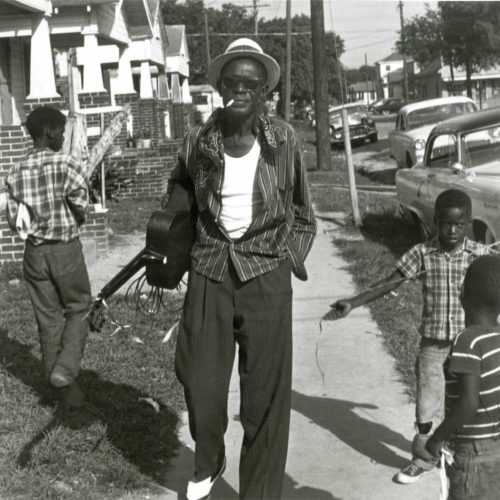
Lightnin’ Hopkins in Houston’s Third Ward.
HOUSTON — Texas blues legend Samuel “Lightnin’” Hopkins was 66 years of age in 1978, when he was booked by television producer Terry Lickona, to be included in the fourth season of the nationally syndicated PBS TV program,” Austin City Limits.” The idea to have Hopkins perform was pitched to Lickona by Ron R. Wilson, Hopkins’ bassist who, at age 23, was elected to the Texas State Legislature the prior year. Also, inconspicuously on board for the taping to fill out the rhythm section was Austin drumming luminary, William G. “Bill” Gossett.
“That was the year we began to branch out from the show’s roots of ‘Texas Progressive Country’,” said Lickona from his office in Austin. “When I was promoted from assistant producer to producer, I just wanted to stir things up a little bit. Lightnin’ was a Texan, but not quite like the other musicians that had been previously booked on the show in its early days.”
The engagement would be one of the highlights of Hopkins’ career; a career that spanned more than 35 years beginning in 1946, when he moved away from his hometown of Centerville, Texas, to the segregated inner-city Houston neighborhood of Third Ward. Once considered to be the epicenter of African-American business, politics, and culture, it was where Hopkins now called home and where he was celebrated by his friends and neighbors as the cultural icon he had become.
Continue reading

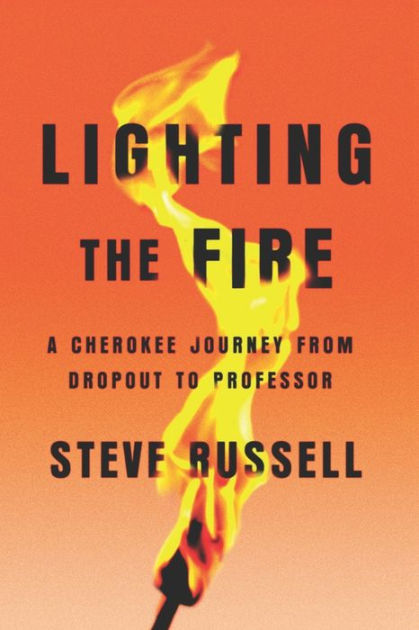
[Lighting The Fire: A Cherokee Journey From Dropout To Professor, by Steve Russell. (McLean, VA: Miniver Press, 2020); paperback; 340 pages; $15 on Amazon.com.]
AUSTIN —Regular Rag Blog readers know Steve Russell as a witty and insightful commentator on current events with particular expertise in Indian affairs. Oh, and prolific as well. I tried to count his contributions to this fine platform and gave up at around 89 because I got tired of scrolling through pages and pages of them.
Russell wanted to be a writer from an early age, and has succeeded admirably. I know of his youthful ambition because I have just finished his memoir, Lighting the Fire. My objective in this review is to convince you to acquire and read it, for two reasons: 1.) I expect you will thoroughly enjoy it, as I have; and 2.) it is an inspiring testament to grit, determination, character, and the power of love, compassion, and community.
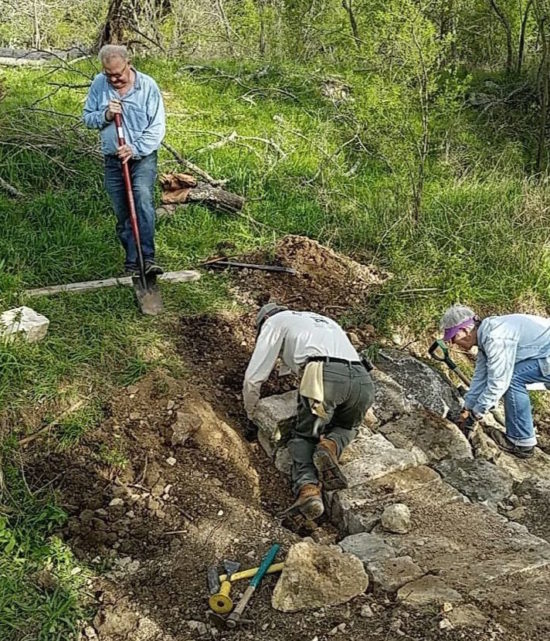
Sherwood Bishop, top, at Schulle Canyon in San Marcos Texas.
SAN MARCOS, Texas — Sherwood Bishop, ever humble, says it is a bit embarrassing to be elected a hero when so many real-life pandemic heroes are saving lives, keeping grocery lines stocked, and teaching children in classrooms.
The president of The Rag Blog‘s own New Journalism Project, Sherwood Bishop did receive hero’s recognition for his 22-year stewardship of the San Marcos Greenbelt Alliance. The alliance received the 2020 Cox Conserves Heroes national grand prize of $50,000 as well as an additional $10,000 as a regional winner.
Although the election didn’t capture headlines the way the Trump-Biden election has, Sherwood and his compatriots won 1,495 of the 4,506 votes cast nationally. It was the first time that a Texan had been nominated. Each regional contestant put together a video about their work in the community.
Continue reading
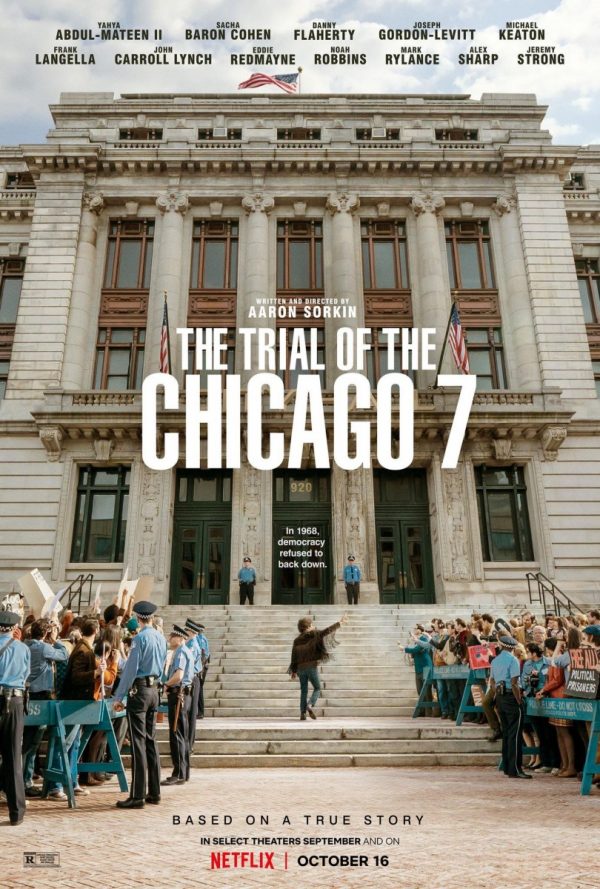
The Trial of the Chicago 7.
I attended and worked at the Trial of the Chicago 7. I think Sorkin’s movie is terrific. Here’s why: It’s a blockbuster Hollywood movie in which the Yippies and the anti-war movement come off as heroes.
Sorkin’s narrative focuses on conflict — between those who protest for a righteous cause and cops, Attorney General John Mitchell, and the Nixon administration. Sorkin raises the racist treatment of my friend, the defendant Bobby Seale, so boldly his audience is forced to pay attention. I heard that Sorkin consulted with my late friend, the defendant Tom Hayden. Which explains Tom’s movie character and the movie’s focus on nonviolence vs. violence. As a Yippie I am especially delighted that Yippie characters and history are so prominent. It’s about time.
Continue reading
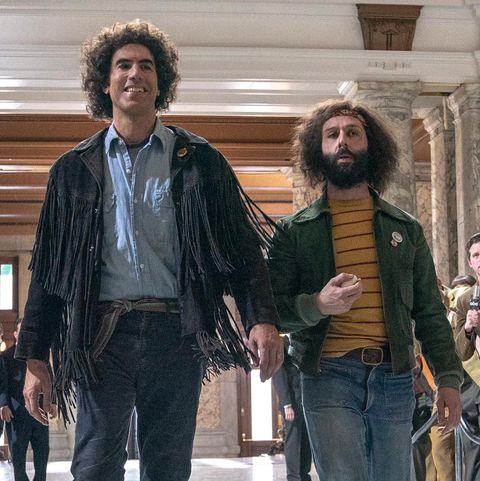
I would feel a whole lot better about Aaron Sorkin’s movie if he had titled it The Trial of the Chicago 8. After all it started as the trial of eight young men, all of them radicals of one sort or another.
Alhough Bobby Seale was severed from the other defendants and hardly had anything to do with the protests during the 1968 Democratic National Convention in Chicago, he served as the sole/soul representative of the Black Power movement. His demands to have his lawyer present in the courtroom, and Judge Julius Hoffman’s order that he be bound and gagged, is still one of the most electrifying moments in American jurisprudence.

Previous installments are archived at
http://www.joshbrownnyc.com/ldw.htm
Founding Fathers at Mt. Rushmore. Creative Commons image.
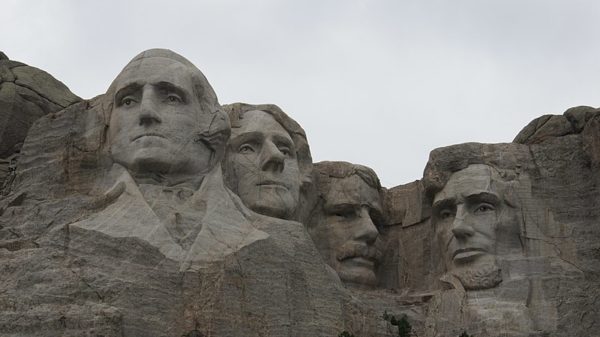
AUSTIN — Perhaps it is obvious, but it bears repeating. The Founding Fathers were men. They envisioned a democracy run by “free, white men.” The first U.S. Census in 1790 spells it out by revealing how the categories were delineated and not delineated:
The original blueprint was this: 21% of the 3.9 million inhabitants could participate in democracy by voting. As we head for the polls, we must remember that democracy in the U.S. has always been defined by the struggle to expand (or suppress) participation in that democracy.
Continue reading

[Up Against the Wall: The Case for Opening the Mexican-American Border by Peter Laufer, PhD; Foreword by Vicente Fox (Anthem; $38)]
Build a wall and human beings will want to go under it, around it, over it, and aim to dismantle it. That’s one of the conclusions that journalist and teacher Peter Laufer has reached after a lifetime of observing what might be called “wall lives.” Another observation is this: make a law and human beings will violate it, be punished by it, and seek to reform it and abolish it.
The wall between the USA and Mexico is one of the biggest boondoggles in contemporary America, with corruption extending all the way from mega construction companies in the West to the White House, and involving Donald Trump, Stephen Bannon, and others. In August 2020, the former White House chief of staff was charged with fraud in fundraising for the border wall.
Continue reading
Thorne Webb Dreyer, Editor




