Beyond the Causal Veil
by Bill Meacham

Quantum indeterminacy operates inside your brain. What does that say about the nature of human will and decision-making?(1)

We’ve taken a look at the world of quantum physics before, but a little recap is in order in case you missed it. The quantum level is where thing are quite tiny, less than about 100 nanometers long. Here things behave very strangely. We can describe their properties and behavior mathematically by a formula called the “wave function,” and under certain circumstances the wave function divides into two or more pairs or branches, each with its own consequences. Each of these branches represents a potential future or a potential version of reality. When observed, only one of these branches is perceived; that is, only one of the potential futures becomes the actual perceived present.

Double-Slit experiment resultsA famous experiment, widely replicated, called the Double-Slit experiment reveals the strangeness of this level of reality. It consists of sending light through two side-by-side vertical slits to a recording medium, such as film; and it shows, among other things, that light can behave both as a stream of particles and as a wave. When light is sent through one slit at a time, a vertical band appears. In this case light acts like a series of particles that go through the slit, hit the recording medium and make an impression. If you open the slit on the right, the band appears on the right, and if you open the slit on the left, the band appears on the left. You would expect that if both slits were opened, the result would be two side-by-side bands. In fact, however, the result is a strong band in the middle, the expected bands on the left and right, and then dimmer bands extending outward in each direction. Light in this case acts like waves that cause interference patterns. That is, when a crest meets a crest, a more intense crest results; and when a crest meets a trough they cancel out. The bands of light are from the crests reinforcing each other, and the darkness in between is the from crests and troughs canceling each other out.

Even more interesting, when light is emitted one photon at a time and aimed at the two slits, it shows the same interference pattern. You would expect that a photon would go through one slit or the other. In fact it appears to act like a wave that goes through both slits, interferes with itself, and results in an impression in one and only one of the bands.

And you cannot predict in advance where the photon will make an impression.

You can predict that given a great number of photons, they will result in bands. That is, they won’t all end up in the same place, but rather in various places according to their probability distribution. But there is only a probability, not an absolute certainty, that any single photon will end up in one place or another.

We might well ask what causes the wave, which is mathematically described as a collection of probabilities of being detected in various places, to be in fact detected at only one place. I’ll return to this question shortly. For now, note the quantum indeterminacy, our inability to predict the final location of any single photon. The sequence in which the singly-emitted photons will arrive is completely unpredictable. We have a radical discontinuity of causality.

In ordinary life and in classical (non-quantum) physics, we have a clear concept of causality: a cause is something that reliably produces an effect. Given the same or a similar set of circumstances, we expect the same results to appear. Hitting a billiard ball at a certain angle and with a certain force will always cause it to move in a certain direction and at a certain speed. This conception of causality has three parts:

Regularity – A cause always produces its effect according to physical laws that can be discovered by observation and experiment.
Temporal sequence – The cause always precedes its effect in time. The cause never follows the effect.
Spatial contiguity – There is always some physical connection or spatial contact between the cause and its effect, or a chain of such connections.

At the quantum level, the regularity is missing. There is no set of circumstances that causes the photon always to be detected in a specific place. (And, as we have seen, sometimes spatial contiguity is missing as well.)

Once the photon has been detected then the ordinary chain of causality takes over. The beginning of a macroscopic event can certainly be dependent on a microscopic event. In that case, each microscopic possibility at the beginning can lead to a different chain of macroscopic events at the end.

This becomes important when we consider that some events in the brain happen at the quantum level.

The human brain is a mass of electrochemical activity. It contains approximately 100 billion nerve cells, or neurons, and up to five quadrillion connection points between them. Neurons are the fundamental elements of the brain; they transmit electrochemical impulses to and from other neurons, sense organs or muscles. Some impulses are triggered by sense organs, and some by the excitation of neighboring neurons. Some impulses excite or inhibit neighboring neurons and some cause muscle contractions that move the body.

Parts of a neuronA neuron consists of several parts: numerous dendrites, which look vaguely like trees with many branches, a cell body, and a single axon, a tube that divides at the end to many terminals. Dendrites are the incoming channels; they receive electrochemical impulses from other cells, which then pass through the body and out the axon terminals. Between the axon terminals and the dendrites of the neighboring neurons are gaps, called synapses, only twenty nanometers wide. On the other side of the synaptic gap from the axon is a receptor area on a dendrite of a neighboring cell. An axon can have many terminals, and each dendrite can have many receptor areas. Thus each neuron transmits impulses to and receives impulses from a great many neighboring neurons. Some neurons receive impulses from up to 10,000 neighbors. Some in the cerebellum receive up to 100,000. Clearly the brain is an organ of almost unimaginable complexity.

The impulse traveling through the neuron is an electrical charge. A neuron either transmits the impulse (we say it fires) or it does not; it is a binary element, either on (firing) or off (not firing). When the electrical charge reaches the synaptic gap, it triggers the release of chemicals, neurotransmitters, which is why we call brain activity electrochemical. A single release of a neurotransmitter might be too weak to trigger the receiving neuron, but since each neuron forms outgoing synapses with many others and likewise receives synaptic inputs from many others, the combination of several inputs at once can be enough to trigger it. Or the receipt of an inhibitory neurotransmitter can prevent an impulse that otherwise would have fired. The output of a neuron thus depends on the inputs from many others, each of which may have a different degree of influence depending on the strength of its synapse with that neuron.

What is interesting for the present discussion is what happens to cause the neurotransmitters to travel across the synapse. The chemistry is a bit complex, but basically neurotransmitter chemicals sit docked in little pockets, called vesicles, waiting for something to release them. When the electrical impulse arrives at the terminal, it opens up channels that let calcium ions in. The calcium makes the vesicle fuse with the cell wall and open up so the neurotransmitters go out into the synaptic gap and then hit the receiving neuron.

The channels through which calcium ions enter the nerve terminal from outside the neuron are tiny, only about a nanometer at their narrowest, not much bigger than a calcium ion itself. The calcium ions migrate from their entry channels to sites within the nerve terminal where they trigger the release of the contents of a vesicle. At this submicroscopic level of reality, quantum indeterminacy is in play. A given calcium ion might or might not hit a given triggering site; hence, a given neurotransmitter might or might not be released; hence the receiving neuron might or might not get excited (or inhibited).

In other words, at the most fundamental level, brain functioning is not causally determined.

And since the ordinary chain of causality takes over after the quantum event happens, quantum uncertainty at the synaptic level can lead to causal uncertainty at the level of the whole brain. And that means – since the state of the brain at least heavily influences, if not causally determines, our perceptions, thoughts, feelings and actions – that human conduct is not fully causally determined in the physical world.

What causes a quantum event – in this case the impact of a calcium ion on a triggering site – to cease being merely a probability and start being something that happens at a certain place? Not anything in the physical world. There is a causal discontinuity in nature. Events at the quantum level of reality have no physical cause, but are themselves causes of subsequent events. What is on the other side of the causal discontinuity?

At this point we move beyond what physics can tell us, but clearly it leaves open the possibility that human will is free and even that something that transcends our ordinary notion of the physical – a soul, perhaps, or a god or a plethora of deities – intervenes in the physical world.

Some protest that the causal uncertainty at the quantum level of reality is merely statistical. Events happen randomly; hence, we can draw no conclusions about nonphysical causality, free will, the existence of a soul or of God, or any such thing. In particular, they say, a decision that is initiated by a random occurrence is no more free than one initiated by physical causality. But random as they may be individually, quantum events considered as a group certainly do exhibit regularities. Light passed through double slits exhibits distinct patterns, not random noise.

Consider a pointillist painting, which consists of distinct dots of pigment. If you look at it up close, all you see is random dots. When you view it from afar, you see identifiable forms and shapes, recognizable objects, patterns. So what are the patterns that we find in the behavior that issues from the firing of our brain cells? Does what is outside the bounds of physical causality have any regularity or structure of its own that we can use to understand and predict what it will do? Are there any categories of causal explanation that might be applicable?

The answer is, yes, of course there are: the concepts that pertain to agents. We explain the behavior of agents not in terms of physics and chemistry but in terms of their perceptions, beliefs, desires and goals.

By “agent” I mean the usual: something with will and intention, something that initiates movement without an external nudge, something that acts or has the power to act on its own rather than merely reacting to events. Agency is a different category of causation from physical causation. What agents do is not uncaused, but what causes agents to act is their beliefs and desires, not mechanical or chemical forces. And what agents do is not completely predictable. We try to influence people by persuasion, but we can only influence them, we cannot completely control them. Rather like a single photon, we can never be sure what somebody will do until they have done it. Nor can we be sure what we ourselves will do until we have done it. And afterwards we recognize that we could have done differently.

We are agents not automata. In other words, we have free will. Now the question is, what shall we do with it?

———–

Notes

(1) What follows is summarized from my paper “The Quantum Level of Reality,” located here: http://www.bmeacham.com/whatswhat/Quantum.html. That paper contains more detail and all the footnotes and references. See also “Do Humans Have Free Will?” here: http://www.bmeacham.com/whatswhat/FreeWill.html.


Type rest of the post here

Source /

The Rag Blog

Posted in RagBlog | Leave a comment

Harry Tarq : Does U.S. Foreign Policy Respect Human Life?

Libyan men and children queue up to view the corpse of Muammar Qaddafi. Photo from Getty Images.

U.S. foreign policy and
the respect for human life

By Harry Targ / The Rag Blog / October 26, 2011

“The Oriental doesn’t put the same high price on life as does a Westerner…We value life and human dignity. They don’t care about life and human dignity.” — Gen. William Westmoreland interviewed in Hearts and Minds (1974), a documentary about the Vietnam War.

This past week American politics took a peculiar turn. A new narrative about the Obama administration began to be systematically presented to the liberal media audience. Reviewing his three-year-old administration, the new construction is that on the national security front Obama is markedly more tough and effective than Republicans claim.

The brutal murder of Muammar Qaddafi by rebellious opponents on global television, followed by celebratory remarks by the president, his secretary of state, and other members of the administration, capped three years of U.S. violence on people of the Global South.

Many critics of Obama’s less than forceful advocacy of economic justice have shifted their focus to a frame of the president as resolute in protecting American national security in the face of a challenging world. They even have implied that Obama is more of a tough guy than his predecessor ever was.

What is the evidence for this? Frankly, President Obama has unleashed new variants of the U.S. killing machine. Violence against Asian, Middle Eastern, and African people has been visibly celebrated in public view. The numbers of victims killed may not be greater than that of prior administrations but the celebration of public murders seem to have increased.

Early in the Obama administration, the president made a decision to assassinate Somali pirates, pirates who had kidnapped westerners off the Horn of Africa. Last May, with the president’s diplomatic team staring at a television screen during a nail-biting meeting, Navy Seals invaded the compound housing Osama Bin Laden who was unceremoniously killed and dumped in the sea. The media highlighted Americans who celebrated this killing.

Four months after the successful murder of Bin Laden, Obama’s crack team assassinated Anwar al-Awlaki, American citizen and alleged leader of Islamic terrorists, who threatened the United States. Abdul Rahman al-Awlaki, his teenage son, and others were summarily executed for crimes for which they had not been accused or tried.

In addition, President Obama agreed to work with allies, Great Britain and France, who held colonial empires in the Middle East and North Africa in the twentieth century. They mobilized a campaign in the United Nations to gain public legitimacy for military intervention in Libya to overthrow the long-time idiosyncratic leader, Qaddafi, whose tiny nation from time to time supported dissidents in the Arab and African worlds.

The initial claim was that the force, a NATO operation, would be humanitarian, saving the lives of those who were rebelling against the Libyan dictatorship.

The rebels, unlike the nonviolent activists in Tunisia and Egypt where western support was minimal, were armed, probably by the West, and launched a civil war against the regime. Then NATO air power was used for seven months to pound Libya until the Qaddafi military collapsed.

The “humanitarian” intervention took between 30,000 and 50,000 lives, dissidents as well as Qaddafi loyalists. Shortly after the war ended with the death and mutilation of the dictator’s body on a street in Sirte, President Obama declared victory for the Libyan people — although who the rebels are remains unclear — and pronounced what he referred to as a new measured and wise U.S. foreign policy.

The new foreign policy, what might be called the “Obama Doctrine,” has four parts. First, the United States, as the last remaining superpower, and as the defender of the global moral standard, could once again assume the right and responsibility to intervene militarily to preserve and enhance human rights around the world. As the president put it, reflecting on the recent killings in a press conference after the death of Qaddafi was announced, U.S. actions have demonstrated “…the strength of American leadership across the world.”

Second, U.S. humanitarian interventions will be carried out in conjunction with military operations with our friends, presumably equally committed to high moral standards. In Obama’s words; “We’ve demonstrated what collective action can achieve in the 21st century.” NATO, an alliance established in 1949 to protect Western Europe and North America from security threats from “international communism,” now will police the world.

Third, new technologies make it possible for the United States to police the world without “boots on the ground.” Given the new technology, the free world can intervene virtually anywhere, anytime, through the use of incredibly sophisticated drone warfare. In the Libyan case, as the president said, “without putting a single service member on the ground, we achieved our objectives, and our NATO mission will soon come to an end.”

U.S./NATO warriors can target enemies without personal danger to themselves while working in antiseptic offices in the United States or Europe, or on small bases in the Indian Ocean, the Middle East, or Africa. Nick Turse, author of The Complex (2008) estimates that at least 60 drone bases are operational around the world, ready to hit enemy targets virtually anywhere.

Fourth, the Obama Doctrine makes it clear that human life is not sacred and that due process, the hallmark of western legal traditions, is now superseded by the unilateral right of key decision-makers to kill potential, as well as actual, enemies of the United States. To paraphrase the old definition of the state as that institution that holds the monopoly of the legitimate use of force, the state now holds the monopoly of legitimate use of murder.

In the end, the oft-quoted remark by General William Westmoreland about the Vietnamese enemy in the 1960s may more accurately be restated: “The United States government does not put the same high price on human life as other countries.”

Fortunately for progressives, mass movements exist that show the world that many Americans do not stand with their government’s use of violence. Progressives oppose mass murder, targeted executions, the death penalty anywhere, and despicable drone warfare. Progressives also respect the right and responsibilities of others to choose their own political destinies.

[Harry Targ is a professor of political science at Purdue University who lives in West Lafayette, Indiana. He blogs at Diary of a Heartland Radical — and that’s also the name of his new book which can be found at Lulu.com. Read more of Harry Targ’s articles on The Rag Blog.]
The Rag Blog

Posted in Rag Bloggers | Tagged , , , , | 1 Comment

Joan Wile : Granny for Peace Welcomes Iraq Withdrawal

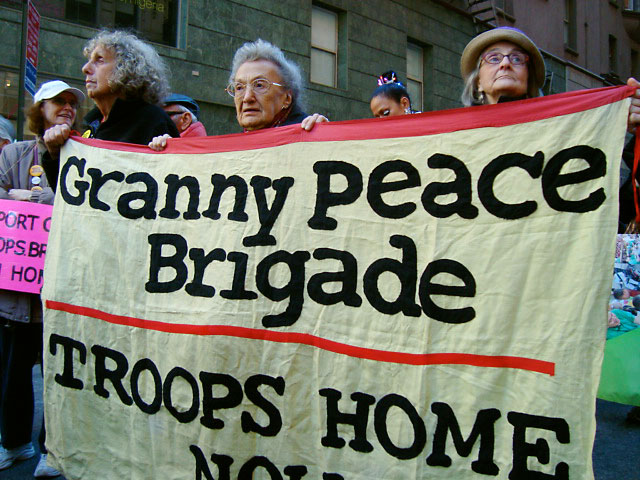
Members of Granny Peace Brigade at Lincoln Center. Photo from the New York Observer.

As Iraq troops come home:
Peace granny is ‘cautiously optimistic’

By Joan Wile / The Rag Blog / October 26, 2011

NEW YORK — The news hit me like an electric shock. Was this for real? I stared at the words on the TV screen in disbelief: “President Obama says all U.S. troops in Iraq will be home by the end of the year.” That meant that 41,000 troops will be leaving Iraq.

This welcome announcement was somewhat tempered when further news reports produced the information that on January 1, 2012, the State Department will command a hired army of about 5,500 security contractors, all to protect the largest U.S. diplomatic presence anywhere overseas. There will also apparently be a “significant C.I.A. presence,” according to The New York Times.

What was I to make of that?

Since the fall of 2003, my anti-war grandmother friends and I had been struggling, demonstrating, petitioning, organizing, yelling, marching, traveling, with one singular objective — to end the illegal, immoral war and occupation in Iraq causing so much death and destruction. We later added ending the war in Afghanistan to our agenda.

When we first hit the streets, we were a small minority and met with anger. Most Americans backed the war. CNN promoted it like it was the latest blockbuster action movie, and the public cheered as the news channel repeatedly showed the fires ignited by our bombs lighting up the Baghdad sky.

I began Grandmothers Against the War with a vigil in front of Rockefeller Center with just two of us nervous, shivering old ladies on Jan. 14, 2004. Gradually, more and more people joined us — mostly grannies, but also Veterans for Peace and other lone individuals sick about the war. We endured hecklers who would shout such things as “Traitors” at us. One of our Vets for Peace almost got into a fist fight with a particularly obnoxious and persistent passerby.

But, we kept on, heartened that more and more of the crowd gave us thumbs up and yelled “Thank you” as the public began to realize what a debacle our occupation was. Foreigners, in particular, applauded us — an Italian man came over to us one day and kissed all 24 grannies standing there on the cheek.

We decided to ramp up our opposition when we became aware that the Bush administration was impervious to the growing public outcry to end the war. Eighteen grandmothers, me included, tried to enlist at the Times Square recruiting station on Oct. 17, 2005, in order to replace young people in harm’s way for a lie.

Actually, none of us had grandkids in the military. We did it as a matter of principle on behalf of America’s grandchildren. We figured they were entitled to long lives like we had all enjoyed and should not be forced to endanger their lives and limbs for an unjust cause.

When we were denied entrance into the recruiting station, we sat down on the ground and refused to move. The police arrested us and took us to jail. We knew we were entitled to peaceably dissent, but the cops apparently didn’t! After a six-day trial in criminal court, defended by eminent civil liberties attorney Norman Siegel and his co-counsel Earl Ward, we were acquitted. The resultant world-wide publicity put the peace grannies on the map, and I like to think that our action was perhaps the first significant anti-war protest with legs.

And, that was just the beginning. We launched a mind-boggling series of actions and never paused — even only three days ago, the Granny Peace Brigade, an outgrowth of Grandmothers Against the War, held a silent vigil at Lincoln Center which received wide attention from the media.

Over the years, we went on a 10-day trek to Washington, D.C., traveled abroad to speak before peace groups, sent 100 grannies to lobby 100 U.S. senators, orchestrated colorful marches across Brooklyn Bridge, performed a whole show written and performed by us, and did numerous other creative actions (it’s all chronicled in my book, Grandmothers Against the War: Getting Off Our Fannies and Standing Up for Peace.

I must say, painfully, that though I enthusiastically supported President Obama during his election campaign, I became disillusioned and disappointed at his failure to bring our troops home from both Iraq and Afghanistan. At times as I stood in front of Rockefeller Center, often in heavy rain or blazing heat, I would wonder if there was any point in putting myself through such discomfort. I began to feel discouraged and doubted these wars would ever end in my lifetime. I fully expected to be out there standing on Fifth Avenue until the day I died.

But, now, with this hopeful and unexpected news, I feel that perhaps it’s all been worthwhile. I like to think our granny efforts have been part of the pressure that contributed to Obama’s decision. I don’t know the political maneuvers behind his move — maybe it has to do with tangled foreign policy machinations I can’t begin to understand. Maybe it’s designed to help him get reelected. Or maybe — just maybe — he did it out of sheer moral principle. I like to think that is his main reason, anyway.

Of course, the more urgent matter is Afghanistan. He says he will bring them home soon. My long immersion in the anti-war struggle, however, has taught me that we can’t count on his doing so unless we keep the pressure on him to end that occupation as well. It will inevitably end some day, but more quickly if we stay mobilized. We can’t clap our hands with joy, unfortunately, until it does.

For now, I will be cautiously optimistic. Dare I say “Mission Accomplished” in Iraq, with reservations, as far as the peace grannies are concerned?

I dare.

[Joan Wile is the author of Grandmothers Against the War: Getting Off Our Fannies and Standing Up for Peace (Citadel Press, May 2008) This article was originally published at Waging Nonviolence. Read more articles by Joan Wile on The Rag Blog.]

The Rag Blog

Posted in Rag Bloggers | Tagged , , , , , | Leave a comment

Type your summary here

Type rest of the post here

Source /

The Rag Blog
Thorne Dreyer

http://en.wikipedia.org/wiki/Thorne_Webb_Dreyer

Posted in RagBlog | Leave a comment

Texas’s Hidden History Revisited—Part 6: 1860-1865

In 1861, the slave-owning Anglo political leaders of Texas decided that the state should secede from the United States and join the Confederacy during the U.S. Civil War. According to Alwyn Barr’s Black Texans book, “as their declaration of causes repeatedly proclaimed, white Texans seceded in 1861, primarily to defend `the servitude of the African to the white race.’” And “as Union armies pushed into Arkansas and Louisiana,” the “slaveholders from each state became refugees to Texas” and “they brought their slaves,” according to Barr’s “Black Texans During the Civil War” essay that appeared in Donald Willett and Stephen Curley’s Invisible Texans book. As a result, “by 1864, the slave population” in Texas “probably grew to 250,000.” In addition, in 1862, in Texas’s Smith County, authorities “arrested over 40 slaves and hanged one after hearing rumors of a plot to revolt,” according to the same essay.

White opponents of Texas seceding from the United States to join the Confederacy who lived in Texas were also repressed between 1861 and 1865. As Randolph Campbell’s Gone To Texas recalled, for example, “some of the more vocal Unionists had to leave Texas” and “James P. Newcomb, editor of the San Antonio Alamo-Express, fled to New Mexico after a mob attacked his press.”

Although most white Texans “continued throughout the war to support the Confederacy as they had supported secession in the first place,” according to Gone To Texas, some organized support for the U.S. government’s Lincoln Administration and the cause of the Union Army did develop inside Texas during the Civil War. As the same book recalled:

“Small groups of Unionists living in regions that voted against secession organized internal opposition to the Confederacy…Germans in the Hill County northwest of San Antonio formed a Union Loyal League with its own military companies…In the Spring of 1862 Confederate officials sent Texas troops into the region to disband the military companies and enforce the conscription law, whereupon 61 of the Unionists, mostly Germans led by Frederick `Fritz’ Tegener, decided to go to Mexico and from there join the United States Army. They…were overtaken by a detachment of 91 Texas Partisan Rangers…while camped on the Nueces River. Attacking before dawn on Aug. 10, 1862, the Confederates killed 19 of the Germans and captured 9 who were badly wounded. The remaining Unionists escaped…After the battle, state troops executed the 9 wounded Germans, and 9 of those who escaped were caught and killed before they reached Mexico…”

Armed Anglo supporters of the Confederacy in Texas also repressed supporters of the North and the Union in Cooke County between 1861 and 1865. As Gone To Texas also notes:

“In Cooke County…the passage of conscription led to the formation of a secret Peace Party that opposed the draft and supported the Union. Rumors that the Peace Party planned to…foment a general uprising led to the arrest on October [1862] of more than 150 suspected insurrectionists by state troops…An extralegal `Citizen’s Court’…found 7 leading Unionists guilty of treason and sentenced them to death. At this point, a mob…lynched 14 more of the prisoners and killed 2 who tried to escape…When unknown assassins killed Col. Young [of the Eleventh Texas Cavalry]…the jury then sentenced another 19 men to hang, bringing the total number of victims to 42. Texas authorities condoned this `Great Hanging at Gainesville’…”

The military conscription law that provoked more organized internal opposition in Hill County and Cooke County, Texas to the South’s Confederate Government had been passed in April 1862 by the Confederate Congress. As a result, all white males in Texas who were between 13-years-old and 46-years-old in 1860—except for any white males whose work involved them in supervising 20 or more slaves—were now in danger of being drafted into the Confederate Army for as long as the U.S. Civil War continued. So, not surprisingly, “nearly 5,000 Texans deserted from Confederate and state service, and an unknown number avoided conscription” by hiding “in isolated areas throughout the state—for example, the Big Thicket in Hardin County and the swamp bottoms of northeast Texas” or “in the northwestern frontier counties,” according to Gone To Texas. And, according to David Humphrey’s Austin: An Illustrated History, “draft-dodging was especially common among Austin’s unionists.”

But slightly more than 50 percent of the white males in Texas who were subject to the Confederate government’s draft during the Civil War were still unable to avoid being drafted; and between 1861 and 1865 between 60,000 to 70,000 white men in Texas served in either the Confederate Army or in Texas state military units. And thousands of these military conscripts from Texas died during the U.S. Civil War. As Gone To Texas observed:

“Approximately 20 to 25 percent of Texas soldiers died while in the army. More than half of these deaths resulted from a variety of illnesses…Deaths in battle and Union prisoner-of-war camps accounted for the other lives lost. The final death toll can be estimated at between 12,000 and 15,000 men, most of them in their twenties and thirties.”

According to Austin: An Illustrated History, Texas’s “loss `in bone and blood’” during the Civil War was “proportionately higher than that of any northern state.”

While between 12,000 and 15,000 people in Texas lost their lives as a result of the Civil War, some other people in Texas, however, apparently made some good money between 1861 and 1865 in Texas, as a result of the Civil War. As W.E.B. Du Bois’s Black Reconstruction 1860-1880 recalled:

“Texas was one of the Southern states that had considerable prosperity during the war. She was outside the area of conflict; excellent crops were raised and slave labor was plentiful. Many slaves were deported to Texas for protection…so that Texas could furnish food and raw material for the Confederate States; and on the other hand, when the blockade was strengthened, Texas became the highway for sending cotton and other goods to Europe by way of Mexico.”


Type rest of the post here

Source /

The Rag Blog

Posted in RagBlog | Leave a comment

PEACE GRANNY CAUTIOUSLY OPTIMISTIC AT IRAQ WAR’S END
by Joan Wile, Author
“Grandmothers Against the War: Getting Off Our Fannies and Standing Up for Peace” (Citadel Press)

The news hit me like an electric shock. Was this for real? I stared at the words on the TV screen in disbelief — PRESIDENT OBAMA SAYS ALL U.S. TROOPS IN IRAQ WILL BE HOME BY THE END OF THE YEAR. That meant that 41,000 troops will be leaving Iraq.

This welcome announcement was somewhat tempered when further news reports produced the information that on January 1, 2012, the State Department will command a hired army of about 5,500 security contractors, all to protect the largest U.S. diplomatic presence anywhere overseas. There will also apparently be a “significant C.I.A. presence,” according to the New York Times.

What was I to make of that?

Since the fall of 2003, my anti-war grandmother friends and I had been struggling, demonstrating, petitioning, organizing, yelling, marching, traveling with one singular objective — to end the illegal, immoral war and occupation in Iraq causing so much death and destruction. We later added ending the war in Afghanistan to our agenda. When we first hit the streets, we were a small minority and met with anger. Most Americans backed the war. CNN promoted it like it was the latest blockbuster action movie, and the public cheered as the news channel repeatedly showed the fires ignited by our bombs lighting up the Baghdad sky.

I began Grandmothers Against the War with a vigil in front of Rockefeller Center with just two of us nervous. shivering old ladies on Jan. 14, 2004. Gradually, more and more people joined us — mostly grannies, but also Veterans for Peace and other lone individuals sick about the war. We endured hecklers who would shout such things as “Traitors” at us. One of our Vets for Peace almost got into a fist fight with a particularly obnoxious and persistent passerby.

But, we kept on, heartened that more and more of the crowd gave us thumbs up and yelled “Thank you” as the public began to realize what a debacle our occupation was. Foreigners, in particular, applauded us — an Italian man came over to us one day and kissed all 24 grannies standing there on the cheek.

We decided to ramp up our opposition when we became aware that the Bush administration was impervious to the growing public outcry to end the war. Eighteen grandmothers, me included, tried to enlist at the Times Square recruiting station on Oct. 17, 2005, in order to replace young people in harm’s way for a lie. Actually, none of us had grandkids in the military. We did it as a matter of principle on behalf of America’s grandchildren. We figured they were entitled to long lives like we had all enjoyed and should not be forced to endanger their lives and limbs for an unjust cause.

When we were denied entrance into the recruiting station, we sat down on the ground and refused to move. The police arrested us and took us to jail. WE knew we were entitled to peaceably dissent, but the cops apparently didn’t! After a six-day trial in criminal court, defended by eminent civil liberties attorney Norman Siegel and his co-counsel Earl Ward, we were acquitted. The resultant world-wide publicity put the peace grannies on the map, and I like to think that our action was perhaps the first significant anti-war protest with legs.

And, that was just the beginning. We launched a mind-boggling series of actions and never paused — even only three days ago, the Granny Peace Brigade, an outgrowth of Grandmothers Against the War, held a silent vigil at Lincoln Center which received wide attention from the media. Over the years, we went on a ten-day trek to Washington DC, traveled abroad to speak before peace groups, sent 100 grannies to lobby 100 U.S. senators, orchestrated colorful marches across Brooklyn Bridge, performed a whole show written and performed by us and did numerous other creative actions (it’s all chronicled in my book, Grandmothers Against the War: Getting Off Our Fannies and Standing Up for Peace (Citadel Press)).

I must say, painfully, that though I enthusiastically supported Pres. Obama during his election campaign, I became disillusioned and disappointed at his failure to bring our troops home from both Iraq and Afghanistan. At times as I stood in front of Rockefeller Center, often in heavy rain or blazing heat, I would wonder if there was any point in putting myself through such discomfort. I began to feel discouraged and doubted these wars would ever end in my lifetime. I fully expected to be out there standing on Fifth Avenue until the day I died.

But, now, with this hopeful and unexpected news, I feel that perhaps it’s all been worthwhile. I like to think our granny efforts have been part of the pressure that contributed to Obama’s decision. I don’t know the political maneuvers behind his move — maybe it has to do with tangled foreign policy machinations I can’t begin to understand. Maybe it’s designed to help him get re-elected. Or maybe — just maybe — he did it out of sheer moral principle. I like to think that is his main reason, anyway.

Of course, the more urgent matter is Afghanistan. He says he will bring them home soon. My long immersion in the anti-war struggle, however, has taught me that we can’t count on his doing so unless we keep the pressure on him to end that occupation as well. It will inevitably end some day, but more quickly if we stay mobilized. We can’t clap our hands with joy, unfortunately, until it does.

For now, I will be cautiously optimistic. Dare I say “Mission Accomplished” in Iraq, with reservations, as far as the peace grannies are concerned?

I dare.

(This article was originally published in Waging Nonviolence.)

Type rest of the post here

Source /

The Rag Blog

Posted in RagBlog | Leave a comment

Harvey Wasserman : Occupy Nukes!

Occupy Wall Street image from eleven degrees north.

Merge and win:
Occupy Wall Street and
the ‘No Nukes’ movement

By Harvey Wasserman / The Rag Blog / October 25, 2011

The global upheaval that is the Occupy Movement is hopefully in the process of changing — and saving — the world. Through the astonishing power of creative nonviolence, it has the magic and moxie to defeat the failing forces of corporate greed.

A long-term agenda seems to be emerging: social justice, racial and gender equality, ecological survival, true democracy, an end to war, and so much more. “When the power of love overcomes the love of power,” said Jimi Hendrix, “the world will know peace.”

Such a moment must come now in the nick of time, as the corporate ways of greed and violence pitch us to the precipice of self-extinction. At that edge sits a sinister technology, a poisoned cancerous power that continues to harm us all even as three of its cores melt and spew at Fukushima. Atomic energy, the so-called “Peaceful Atom,” has failed on all fronts.

Once sold as “too cheap to meter,” it’s now the world’s most expensive electric generator. Once embraced as a corporate bonanza, it cannot obtain private liability insurance. Once hyped as the world’s energy savior, it cannot attract private investment.

Once worshiped as a technology of genius, it cannot clean up its own radioactive messes. Once described as the “magic bullet” that could power the Earth, it’s now the lethal technology threatening to destroy it.

The nonviolent campaign against this agent of the apocalypse has helped raise the use of peaceful mass action to an entirely new level.

In the wake of the movements for labor unions, nuclear disarmament, civil rights — including minorities, women, and gays — peace in Southeast Asia, and more, the messages of Eugene V. Debs, Dorothy Day, Martin Luther King, and so many great apostles of nonviolence have become part of an emerging new culture.

For decades, the No Nukes campaign has conducted hundreds of demonstrations involving thousands of arrests in dozens of countries. Violence has been renounced and almost entirely avoided. Injuries have been present but minimal. There’s been at least one murder, that of the anti-nuclear activist Karen Silkwood. But overall, given the magnitude of the movement over more than 40 years of confrontation, individual casualties have been slight.

And the accomplishments have been historic. Whereas Richard Nixon once promised 1,000 U.S. reactors by the year 2000, there are now 104. These dangerous relics are now under attack, especially at Vermont Yankee and Indian Point, New York.

Worldwide we have seen Germany renounce atomic energy and commit to renewables. Siemens, once a corporate nuclear flagship, has turned instead toward Solartopian technologies. Like Japan, now horribly contaminated by Fukushima, Switzerland, Italy, Spain, and others are following suit.

But the final fight remains to be won. While pouring billions into cornering the global solar market, China is still poised to build some 30 reactors. India, Britain, Korea, and a few others are also toying with more. But especially in the wake of Fukushima, they are not a done deal.

In the United States, the key is to deny the nuclear industry the federal funding without which it can’t build new reactors.

And here is where the Occupy and No Nukes movements intersect. Wall Street has actually retreated, and will not finance new commercial reactors.

So the industry has gone straight to the White House and Congress to force taxpayers to underwrite new construction loans. In the past decade reactor backers have spent more than $60 million per year lobbying Congress and the White House to get this money. With no such budget, the national No Nukes movement has been defeating these give-aways.

Now comes the turning point. In 2011, for the first time, solar and wind are being recognized by mainstream economists as cheaper than new nukes. And renewables overall in the United States generate more usable power than operating reactors.

If we can hold off these loan guarantees for another year or two, and shut some older reactors like Vermont Yankee and Indian Point, the dam will break, and the corporate impetus to build new reactors may finally go away.

Atomic energy is, after all, a means of centralizing power in corporate hands. But there is only so far the one-percenters can ride a dead horse, especially if it’s radioactive.

Our struggle then comes with fighting to keep the Solartopian conversion in the people’s hands. We will love defeating fossil and nuclear fuels. But we want to guarantee our energy supply — even if it’s driven by the wind and sun — is controlled by the community, not the corporations.

And here is where Occupy/No Nukes can jump the power of democracy to a whole new level.

Human society is on the brink of its most significant technological conversion ever. Green power will be a multi-trillion-dollar industry, outstripping even computers and the internet.

But who will own the sun? Will the corporations again monopolize a nascent revolution? Or can the Occupy and No Nukes movements keep this technology decentralized, with the power Mother Earth gives us resting in the hands of the people?

In this struggle, longevity is the key. The grassroots No Nukes campaign is some four decades young and going strong. Every few years the corporate media runs features about how it has died and gone away, and they have always been wrong. We will not disappear until the nukes do.

The same must be the case for Occupy. Any day now the Foxists will proclaim the movement dead and failed. It will be nonsense. But in the long term, it’s up to us to prove them wrong. All the bright futures above come true only if we stay with it as long as it takes.

At the intersection of No Nukes and Occupy, we know that true democracy can only come when our energy supply is owned by the people. A grassroots-based energy supply is at the core of a sustainable Solartopian future.

In the 1970s a grassroots movement led by the Clamshell Alliance nonviolently occupied a reactor site at Seabrook, New Hampshire, and sparked a global green powered revolution whose completion may be in sight.

This year the Occupy movement took to Wall Street, and has exploded into a global democratic revolution with unbound potential.

There are innumerable hurdles along the way.

But as these two movements flow together like a mighty stream, let them wash away forever the corporate plague of atomic energy, and free at last the path to a democratized, green-powered Earth.

[Harvey Wasserman’s Solartopia! Our Green-Powered Earth is at www.harveywasserman.com. His “Solartopia! Green-Power Hour” is podcast from www.talktainmentradio.com. Read more of Harvey Wasserman’s writing on The Rag Blog.]

The Rag Blog

Posted in Rag Bloggers | Tagged , , , , , , | 1 Comment

Texas’s Hidden History Revisited—Part 6: 1860-1865

In 1861, the slave-owning Anglo political leaders of Texas decided that the state should secede from the United States and join the Confederacy during the U.S. Civil War. According to Alwyn Barr’s Black Texans book, “as their declaration of causes repeatedly proclaimed, white Texans seceded in 1861, primarily to defend `the servitude of the African to the white race.’” And “as Union armies pushed into Arkansas and Louisiana,” the “slaveholders from each state became refugees to Texas” and “they brought their slaves,” according to Barr’s “Black Texans During the Civil War” essay that appeared in Donald Willett and Stephen Curley’s Invisible Texans book. As a result, “by 1864, the slave population” in Texas “probably grew to 250,000.” In addition, in 1862, in Texas’s Smith County, authorities “arrested over 40 slaves and hanged one after hearing rumors of a plot to revolt,” according to the same essay.

White opponents of Texas seceding from the United States to join the Confederacy who lived in Texas were also repressed between 1861 and 1865. As Randolph Campbell’s Gone To Texas recalled, for example, “some of the more vocal Unionists had to leave Texas” and “James P. Newcomb, editor of the San Antonio Alamo-Express, fled to New Mexico after a mob attacked his press.”

Although most white Texans “continued throughout the war to support the Confederacy as they had supported secession in the first place,” according to Gone To Texas, some organized support for the U.S. government’s Lincoln Administration and the cause of the Union Army did develop inside Texas during the Civil War. As the same book recalled:

“Small groups of Unionists living in regions that voted against secession organized internal opposition to the Confederacy…Germans in the Hill County northwest of San Antonio formed a Union Loyal League with its own military companies…In the Spring of 1862 Confederate officials sent Texas troops into the region to disband the military companies and enforce the conscription law, whereupon 61 of the Unionists, mostly Germans led by Frederick `Fritz’ Tegener, decided to go to Mexico and from there join the United States Army. They…were overtaken by a detachment of 91 Texas Partisan Rangers…while camped on the Nueces River. Attacking before dawn on Aug. 10, 1862, the Confederates killed 19 of the Germans and captured 9 who were badly wounded. The remaining Unionists escaped…After the battle, state troops executed the 9 wounded Germans, and 9 of those who escaped were caught and killed before they reached Mexico…”

Armed Anglo supporters of the Confederacy in Texas also repressed supporters of the North and the Union in Cooke County between 1861 and 1865. As Gone To Texas also notes:

“In Cooke County…the passage of conscription led to the formation of a secret Peace Party that opposed the draft and supported the Union. Rumors that the Peace Party planned to…foment a general uprising led to the arrest on October [1862] of more than 150 suspected insurrectionists by state troops…An extralegal `Citizen’s Court’…found 7 leading Unionists guilty of treason and sentenced them to death. At this point, a mob…lynched 14 more of the prisoners and killed 2 who tried to escape…When unknown assassins killed Col. Young [of the Eleventh Texas Cavalry]…the jury then sentenced another 19 men to hang, bringing the total number of victims to 42. Texas authorities condoned this `Great Hanging at Gainesville’…”

The military conscription law that provoked more organized internal opposition in Hill County and Cooke County, Texas to the South’s Confederate Government had been passed in April 1862 by the Confederate Congress. As a result, all white males in Texas who were between 13-years-old and 46-years-old in 1860—except for any white males whose work involved them in supervising 20 or more slaves—were now in danger of being drafted into the Confederate Army for as long as the U.S. Civil War continued. So, not surprisingly, “nearly 5,000 Texans deserted from Confederate and state service, and an unknown number avoided conscription” by hiding “in isolated areas throughout the state—for example, the Big Thicket in Hardin County and the swamp bottoms of northeast Texas” or “in the northwestern frontier counties,” according to Gone To Texas. And, according to David Humphrey’s Austin: An Illustrated History, “draft-dodging was especially common among Austin’s unionists.”

But slightly more than 50 percent of the white males in Texas who were subject to the Confederate government’s draft during the Civil War were still unable to avoid being drafted; and between 1861 and 1865 between 60,000 to 70,000 white men in Texas served in either the Confederate Army or in Texas state military units. And thousands of these military conscripts from Texas died during the U.S. Civil War. As Gone To Texas observed:

“Approximately 20 to 25 percent of Texas soldiers died while in the army. More than half of these deaths resulted from a variety of illnesses…Deaths in battle and Union prisoner-of-war camps accounted for the other lives lost. The final death toll can be estimated at between 12,000 and 15,000 men, most of them in their twenties and thirties.”

According to Austin: An Illustrated History, Texas’s “loss `in bone and blood’” during the Civil War was “proportionately higher than that of any northern state.”

While between 12,000 and 15,000 people in Texas lost their lives as a result of the Civil War, some other people in Texas, however, apparently made some good money between 1861 and 1865 in Texas, as a result of the Civil War. As W.E.B. Du Bois’s Black Reconstruction 1860-1880 recalled:

“Texas was one of the Southern states that had considerable prosperity during the war. She was outside the area of conflict; excellent crops were raised and slave labor was plentiful. Many slaves were deported to Texas for protection…so that Texas could furnish food and raw material for the Confederate States; and on the other hand, when the blockade was strengthened, Texas became the highway for sending cotton and other goods to Europe by way of Mexico.”


Type rest of the post here

Source /

The Rag Blog
Posted in RagBlog | Leave a comment

Where Occupy & No Nukes merge & win

By Harvey Wasserman / The Rag Blog / October 25, 2011
The global upheaval that is the Occupy Movement is hopefully in the process of changing — and saving — the world. Through the astonishing power of creative nonviolence, it has the magic and moxie to defeat the failing forces of corporate greed.

A long-term agenda seems to be emerging: social justice, racial and gender equality, ecological survival, true democracy, an end to war, and so much more. “When the power of love overcomes the love of power,” said Jimi Hendrix, “the world will know peace.”

Such a moment must come now in the nick of time, as the corporate ways of greed and violence pitch us to the precipice of self-extinction. At that edge sits a sinister technology, a poisoned cancerous power that continues to harm us all even as three of its cores melt and spew at Fukushima. Atomic energy, the so-called “Peaceful Atom,” has failed on all fronts.

Once sold as “too cheap to meter,” it’s now the world’s most expensive electric generator. Once embraced as a corporate bonanza, it cannot obtain private liability insurance. Once hyped as the world’s energy savior, it cannot attract private investment.

Once worshiped as a technology of genius, it cannot clean up its own radioactive messes. Once described as the “magic bullet” that could power the Earth, it’s now the lethal technology threatening to destroy it.

The nonviolent campaign against this agent of the apocalypse has helped raise the use of peaceful mass action to an entirely new level.

In the wake of the movements for labor unions, nuclear disarmament, civil rights — including minorities, women, and gays — peace in Southeast Asia, and more, the messages of Eugene V. Debs, Dorothy Day, Martin Luther King, and so many great apostles of nonviolence have become part of an emerging new culture.

For decades, the No Nukes campaign has conducted hundreds of demonstrations involving thousands of arrests in dozens of countries. Violence has been renounced and almost entirely avoided. Injuries have been present but minimal. There’s been at least one murder, that of the anti-nuclear activist Karen Silkwood. But overall, given the magnitude of the movement over more than 40 years of confrontation, individual casualties have been slight.

And the accomplishments have been historic. Whereas Richard Nixon once promised 1,000 U.S. reactors by the year 2000, there are now 104. These dangerous relics are now under attack, especially at Vermont Yankee and Indian Point, New York.

Worldwide we have seen Germany renounce atomic energy and commit to renewables. Siemens, once a corporate nuclear flagship, has turned instead toward Solartopian technologies. Like Japan, now horribly contaminated by Fukushima, Switzerland, Italy, Spain, and others are following suit.

But the final fight remains to be won. While pouring billions into cornering the global solar market, China is still poised to build some 30 reactors. India, Britain, Korea, and a few others are also toying with more. But especially in the wake of Fukushima, they are not a done deal.

In the United States, the key is to deny the nuclear industry the federal funding without which it can’t build new reactors.

And here is where the Occupy and No Nukes movements intersect. Wall Street has actually retreated, and will not finance new commercial reactors.

So the industry has gone straight to the White House and Congress to force taxpayers to underwrite new construction loans. In the past decade reactor backers have spent more than $60 million per year lobbying Congress and the White House to get this money. With no such budget, the national No Nukes movement has been defeating these give-aways.

Now comes the turning point. In 2011, for the first time, solar and wind are being recognized by mainstream economists as cheaper than new nukes. And renewables overall in the United States generate more usable power than operating reactors.

If we can hold off these loan guarantees for another year or two, and shut some older reactors like Vermont Yankee and Indian Point, the dam will break, and the corporate impetus to build new reactors may finally go away.

Atomic energy is, after all, a means of centralizing power in corporate hands. But there is only so far the one-percenters can ride a dead horse, especially if it’s radioactive.

Our struggle then comes with fighting to keep the Solartopian conversion in the people’s hands. We will love defeating fossil and nuclear fuels. But we want to guarantee our energy supply — even if it’s driven by the wind and sun — is controlled by the community, not the corporations.

And here is where Occupy/No Nukes can jump the power of democracy to a whole new level.

Human society is on the brink of its most significant technological conversion ever. Green power will be a multi-trillion-dollar industry, outstripping even computers and the internet.

But who will own the sun? Will the corporations again monopolize a nascent revolution? Or can the Occupy and No Nukes movements keep this technology decentralized, with the power Mother Earth gives us resting in the hands of the people?

In this struggle, longevity is the key. The grassroots No Nukes campaign is some four decades young and going strong. Every few years the corporate media runs features about how it has died and gone away, and they have always been wrong. We will not disappear until the nukes do.

The same must be the case for Occupy. Any day now the Foxists will proclaim the movement dead and failed. It will be nonsense. But in the long term, it’s up to us to prove them wrong. All the bright futures above come true only if we stay with it as long as it takes.

At the intersection of No Nukes and Occupy, we know that true democracy can only come when our energy supply is owned by the people. A grassroots-based energy supply is at the core of a sustainable Solartopian future.

In the 1970s a grassroots movement led by the Clamshell Alliance nonviolently occupied a reactor site at Seabrook, New Hampshire, and sparked a global green powered revolution whose completion may be in sight.

This year the Occupy movement took to Wall Street, and has exploded into a global democratic revolution with unbound potential.

There are innumerable hurdles along the way.

But as these two movements flow together like a mighty stream, let them wash away forever the corporate plague of atomic energy, and free at last the path to a democratized, green-powered Earth.

[Harvey Wasserman’sSolartopia! Our Green-Powered Earth is at www.harveywasserman.com. His “Solartopia! Green-Power Hour” is podcast from www.talktainmentradio.com. Read more of Harvey Wasserman’s writing on The Rag Blog.]

The Rag Blog

Posted in RagBlog | Leave a comment

Lamar W. Hankins : Free Speech and the Texas Confederate License Plate

Speciality license plate proposed by the Sons of Confederate Veterans. Image from the Texas Department of Motor Vehicles.

Texas Confederate Battle Flag:
License plates, racism, and free speech

By Lamar W. Hankins / The Rag Blog / October 25, 2011
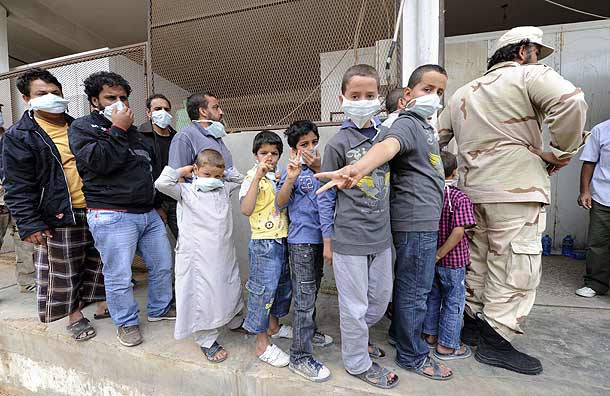
At first glance, the effort by the Sons of Confederate Veterans to have a Confederate Battle Flag license plate approved by the Texas Department of Motor Vehicles may seem like a conflict between offensive speech and free speech, but the matter is more complicated than that simple contrast suggests.

By way of disclosure, I am a descendant of Confederate soldiers, but I have never considered participating in a group that sought in any way to promote that war as a brave, noble, and just venture. To me, the Confederacy engaged in treason against the United States. A founder of Texas, Sam Houston, opposed secession, but was overridden by those concerned with the economics of slavery, a practice that permeated at least half of what is now the State of Texas.

As recently as 30 years ago, I knew where old slave quarters were located in Georgetown, Texas. The artifacts of slavery can be found all over the eastern half of the state, along with Confederate relics. These reminders of a tragic past are not a part of history in which I take any pride.

The Confederate Battle Flag has been to me a symbol less of the Confederacy than of the Ku Klux Klan. Rightly or wrongly, whenever I see that symbol, I assume the person displaying it is racist. I avoid such people if I can.

But even if that flag had never been used by those opposed to civil rights, I would not see it as something to revere. Why would I revere a symbol of treason that is inextricably tied to the maintenance and promotion of slavery unless I favored those positions? I don’t want to honor my progenitors for their willingness to go to war against the United States of America to preserve a system that permitted the owning of other human beings.

Bravery and courage on behalf of folly are nothing to be proud of. Confederate Texans weren’t defending Texas, as Texas Land Commissioner Jerry Patterson asserts in support of the Confederate Battle Flag license plate. They were trying to destroy the Union. They set in place animosities that linger to this day.

Their insurrection was a terrible mistake, and I’d like to keep that mistake in perspective, not celebrate it. But that is a personal choice, deeply rooted in the right of all Americans to engage in speech of their own choosing, no matter how offensive it is to others. But the Texas organizational vanity license plate system creates a problem even broader than whether the Confederate Battle Flag should appear on a Texas license plate.

The way the Texas Legislature chose to establish organizational vanity plates is at least foolish, if not unconstitutional, but it was another way to raise some money for the state without raising taxes, an approach dear to the heart of almost all legislators. If a tax-exempt, nonprofit organization wants to have its own organizational vanity plate, it must find a state agency to sponsor the vanity plate or get the Department of Motor Vehicles to sponsor it. Once a cooperative state agency is found, the application is presented to the Department for approval.

The Sons of Confederate Veterans secured the sponsorship of Patterson’s Texas General Land Office for its application for their vanity license plate. The Texas Department of Motor Vehicles license board reached a tie vote (4-4) when the matter came up for consideration this past summer, so for now the application has not been approved. But Gov. Rick Perry has appointed a ninth person to the board, so if it comes up for another vote, the matter could remain the same if the new appointee abstains, or be decided one way or the other.

The problem with this system is that an organization is required to get a governmental agency to support its application. This requirement is deeply offensive because it will usually, if not always, assure that organizations promoting controversial views will not be able to have organizational vanity plates.

If a group favoring a woman’s right to choose an abortion wants an organizational vanity plate that has a logo that says “Support a woman’s right to choose,” which governmental agency will be its sponsor? I can’t imagine that any state agency would do so. What if an atheist group wants a vanity plate that says “You can be good without God”? Is there any state agency that would ever sponsor that message?

What about a socialist group that wants to promote its message “Jesus was a Socialist”? No state agency would touch that one. If the Texas Medical Association wanted a special license plate that read “Support Medical Marijuana,” I doubt that any state agency would be the sponsor. And what about a plate that honors the service of conscientious objectors who have done alternate service in lieu of serving in the military? About a dozen specialty plates honor veterans of various sorts, but none honor conscientious objectors.

A few other ideas that would not likely find support from any Texas government agency are “Jews for Jesus,” “Ban all abortions,” “Keep the races pure,” “Republicans for interposition and nullification,” “Wives should obey their husbands,” “Government prayer pleases God,” “The Bible is infallible,” “Gays violate God’s law,” “Evolution is a lie,” and dozens of other bumper-sticker thoughts supported by one group or another, but not popular with everyone.

The Texas organizational vanity license plate scheme discriminates against unpopular viewpoints, just as it may discriminate against the views of the Texas Sons of Confederate Veterans. It’s a tossup right now just how unpopular their viewpoint is, about the only content standard the Department has to follow.

The law provides in part: “The department may refuse to create a new specialty license plate if the design might be offensive to any member of the public, … or for any other reason established by rule.” The Department could not point me to any such rules it has adopted regarding content (though there are rules about size and legibility), and I could find no content rules in the Texas Administrative Code, where such rules would be published.

Many specialty plates are offensive to me, and I’m a member of the public. There is one for the Boy Scouts, for instance. I find the Boy Scouts license plate offensive because the Boy Scouts discriminate against atheists, agnostics, and gays. I don’t like the ones with religious messages: “God Bless America,” “God Bless Texas,” “Knights of Columbus,” and “Texas Masons.” But apparently the Texas Department of Motor Vehicles didn’t take my offense into consideration, in spite of the law.

With such an amorphous, broad, non-specific standard, discrimination on the basis of the message proposed by some organizations is inevitable. In fact, I don’t see any way to avoid content discrimination on proposed speech under this scheme.

It is never permissible for the government or an agency of government to censor the views of its citizens. To arbitrate the views we can express on license plates is an improper role for government to play. But short of eliminating organizational vanity license plates, there may be a solution to this constitutional dilemma.

The Texas Department of Motor Vehicles could produce a generic design that leaves a small block of an appropriate size into which anyone with such a plate could paste whatever message the person chooses. In this way, all Texans — including the Texas Sons of Confederate Veterans — would be free to let everyone know their position on any issue, no matter how offensive or how popular. With this arrangement, the government can make some extra money and the Texas Sons of Confederate Veterans should be as pleased as a hog in mud.

[Lamar W. Hankins, a former San Marcos, Texas, city attorney, is also a columnist for the San Marcos Mercury. This article © Freethought San Marcos, Lamar W. Hankins. Read more articles by Lamar W. Hankins on The Rag Blog.]

The Rag Blog
Posted in Rag Bloggers | Tagged , , , , , | 5 Comments

Mike Davis sees prophesies of today’s Occupy Wall Street movement in John Carpenter’s classic “date-night terror” flick, They Live. “As Carpenter foresaw, force enough Americans out of their homes and/or careers… and something new and huge will begin to slouch toward Goldman Sachs.” In assessing the surging movement, scholar/activist Davis notes that, “although old radicals like me are too apt to declare each new baby the messiah, this child has the rainbow sign.”

Posted in RagBlog | Leave a comment

An exclusive Rag Blog interview with Bernardine Dohrn — the leader of late Sixties SDS and the Weather Underground who now teaches law at Northwestern University and is an advocate for children and family justice — by an old colleague, Jonah Raskin. When asked why Americans are so docile today, Dohrn says, “The trick is to avoid cynicism. Ordinary people have the wisdom but they don’t know they have the power.”

Posted in RagBlog | Leave a comment