Inaugration 2009 : A ‘Citizen’s’ Oath of Office

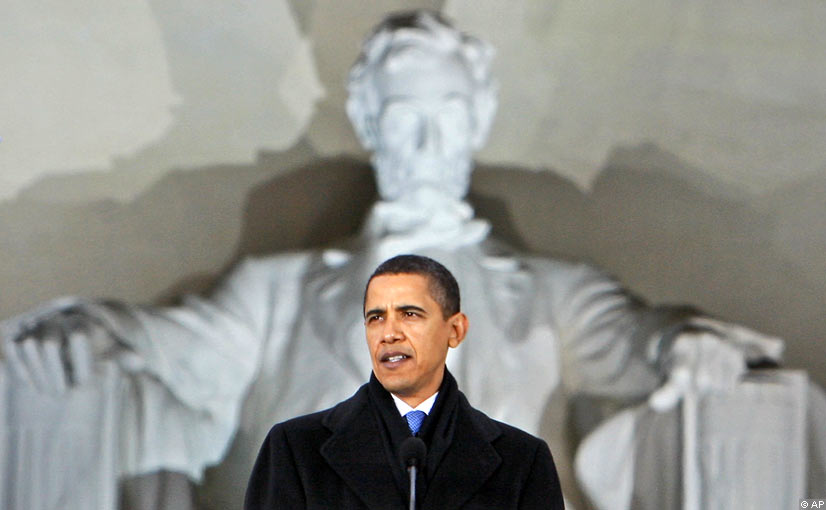
“I do solemnly pledge…” Photo by Charles Dharapak / AP.

As we celebrate the end of an eight-year disaster, we should recommit to the ongoing work required to create a truly just and sustainable world. With that work in mind, here’s my suggestion for a 2009 Citizen’s Oath of Office.

By Robert Jensen / The Rag Blog / January 19, 2009

Eight long years ago at a counter-inaugural event in Austin, Texas, I administered a “Citizen’s Oath of Office” to the people who had come together on the steps of the state Capitol to challenge the legitimacy of the incoming Bush administration and its right-wing agenda. In 2005 I offered a revised version that expanded on our duties during even more trying times.

In 2009, we welcome a far saner administration but also face far deeper problems, and hence such a citizen’s oath is as necessary as ever. The Obama administration will no doubt step back from the reckless and reactionary policies of the past eight years, but the core problems of empire and economics — U.S. domination around the world and corporate domination at home and abroad — remain as threatening as ever. The robotic talk among Democrats of pressing on in “the right war” in Afghanistan (allegedly to fight terrorism) and a continued faith in the predatory capitalist system (albeit softened slightly in the face of potential collapse) offer little hope for meaningful change at the deep level so desperately needed.

As we celebrate the end of an eight-year disaster, we should recommit to the ongoing work required to create a truly just and sustainable world. With that work in mind, here’s my suggestion for a 2009 Citizen’s Oath of Office, with new language added in brackets:

“I do solemnly pledge that I will faithfully execute the office of citizen of the United States, and that I will, to the best of my ability, help create a truly democratic world by (1) going beyond mainstream corporate news media to seek out information about important political, economic, and social issues; (2) engaging fellow citizens, including those who disagree with me, in serious discussion and debate about those issues; (3) committing as much time, energy, and money as possible to help build [authentic] grassroots political organizations that can pressure politicians to put the interests of people over profit and power; and (4) connecting these efforts to global political and social movements fighting the U.S. empire abroad, where it does the most intense damage. I will continue to resist corporate control of the world, resist militarism, resist any roll-back of civil rights, and resist illegitimate authority in all its forms. [And I will commit to collective efforts in my local community to help build joyful alternatives to an unsustainable consumer society.]”

I think these bracketed additions are crucial. First, adding “authentic” as a modifier of “grassroots political organizations” reminds us that the campaign to elect Obama was not a movement, no matter how many times he uses that term. It was a campaign to elect a candidate from one of the country’s two major parties, both of which are committed to imperial domination and predatory capitalism. That isn’t to argue there is no difference between candidates, but to remind us that a slogan-driven electoral campaign for such a party is not a people’s movement. Authentic movements for justice do not arise out of the Republican or Democratic parties but from people coming together to challenge illegitimate authority rather than accommodate it. Strategic decisions about voting do not replace organizing.

Second, in addition to traditional movement building, it’s clearer than ever that we must focus some of our resources on strengthening on-the-ground alternatives to an extractive industrial economy that is undermining the ability of the ecosystem to sustain life. Those local experiments, such as worker-owned cooperatives and community-supported agriculture, will be increasingly important as the dominant culture proves itself unable to cope with economic and ecological collapse that is no longer a matter for speculation regarding the distant future but a reality we must face now.

We can’t predict the exact texture and timing of that collapse, but we can know it is coming and confront the need for real change. Imagine we are riding on a train hurtling 100 miles per hour on tracks that end at the edge of a cliff. The engineer is replaced by someone who wants to slow the train down to 50 miles per hour but is committed to staying on the same tracks. Slowing down may buy us some time, but the cliff remains.

So, like many others on Tuesday I will breathe a sigh of relief when Obama is sworn in, but I won’t breathe easy.

[Robert Jensen is a journalism professor at the University of Texas at Austin and board member of the Third Coast Activist Resource Center. His latest book, All My Bones Shake, will be published in 2009 by Soft Skull Press. Jensen can be reached at rjensen@uts.cc.utexas.edu and his articles can be found online here.]

The Rag Blog

Posted in Rag Bloggers | Tagged , | 1 Comment

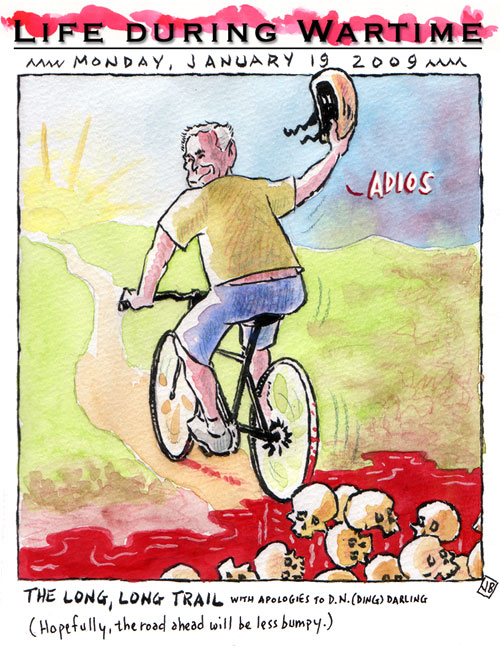
Adios

Political cartoon by Joshua Brown / Historians Against the War / The Rag Blog

Thanks to Dr. S. R. Keister / The Rag Blog

Posted in Rag Bloggers | Tagged , , | Leave a comment

Health Care in the USA : Go Team! We’re 26th!

US Rep. John Conyers (D-MI), sponsor of HR 676, with filmmaker Michael Moore and US Rep. Dennis Kucinich (D-OH)on Capitol Hill in June, 2007. All are supporters of single-payer universal health care. Photo by AFP / Getty Images.

As a retired physician I am ashamed of health care in the United States, and having had first hand or collateral experience with health care in France, the U.K., and Italy I can well understand why we rank #26 in the industrialized world.

By Dr. Stephen R. Keister / The Rag Blog / January 18, 2009

As a retired, 87 year old physician, with 40 years of practice behind me, and in addition post-retirement working part time at the V.A. and subsequently at a neighborhood free clinic, I found Luke Mitchell’s article in the February issue of Harpers very comprehensive and illuminating. Yet, one critical element was missing and that was any allusion to Physicians For A National Health Program, a 20 plus year old organization, with 15,000 members, from which evolved Rep. Conyer’s HR 676. PNHP provided the basic studies incorporated in HR 676, and subsequently received the endorsement of the 125,000 member American College of physicians, The California Nurses Association, and numerous civic and labor groups.

As a retired physician I am ashamed of health care in the United States, and having had first hand or collateral experience with health care in France, the U.K., and Italy I can well understand why we rank #26 in the industrialized world. In no other country with universal care is it established for profit of the insurance industry. It is a travesty that any person with any foresight would envision a system in the United States that includes, even in part, the insurance and pharmaceutical industries, rather than being established for the citizenry as a whole.

Unfortunately if one does a bit of research at OpenSecrets.org one will discover how intensely prostituted many of our elected representatives are to the insurance/pharmaceutical complex. Our current health care system is merely a continuation of the economic theories that have currently brought our nation near to a disaster similar to that of 1929.

I have a series of articles on The Rag Blog that explores the problems involved in providing our country with health care. I am sure any one interested can further their knowledge of this area by checking into this web-site.

The Rag Blog

Posted in Rag Bloggers | Tagged , , , | Leave a comment

War Crimes Accusations Going to World Court

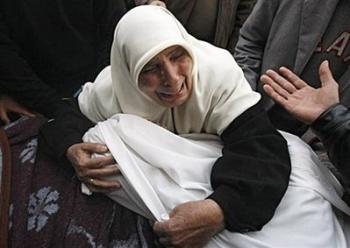
A woman cries as she holds the body of one of her relatives at the mortuary of Al-Shifa hospital on January 16, 2009. An international group of lawyers and jurists said Saturday they would ask the International Criminal Court to probe alleged “war crimes” committed by Israel during its offensive in the Gaza Strip. Photo: AFP/File/Mahmud Hams.

Israel accused of war crimes over 12-hour assault on Gaza village
By Fida Qishta in Khuza’a and Peter Beaumont in London / January 18, 2009

White flags ignored and houses bulldozed with families inside, claim residents

Israel stands accused of perpetrating a series of war crimes during a sustained 12-hour assault on a village in southern Gaza last week in which 14 people died.

In testimony collected from residents of the village of Khuza’a by the Observer, it is claimed that Israeli soldiers entering the village:

  • attempted to bulldoze houses with civilians inside;
  • killed civilians trying to escape under the protection of white flags;
  • opened fire on an ambulance attempting to reach the wounded;
  • used indiscriminate force in a civilian area and fired white phosphorus shells.

If the allegations are upheld, all the incidents would constitute breaches of the Geneva conventions.

The denunciations over what happened in Khuza’a follow repeated claims of possible human rights violations from the Red Cross, the UN and human rights organisations.

The Israeli army announced yesterday that it was investigating “at the highest level” five other attacks against civilians in Gaza, involving two UN facilities and a hospital. It added that in all cases initial investigations suggested soldiers were responding to fire. “These claims of war crimes are not supported by the slightest piece of evidence,” said Yigal Palmor, an Israeli foreign ministry spokesman.

Concern over what occurred in the village of Khuza’a in the early hours of Tuesday was first raised by the Israeli human rights group B’Tselem. Although an Israeli military spokesman said he had “no information that this alleged incident took place”, witness statements collected by the Observer are consistent and match testimony gathered by B’Tselem.

There is also strong visible evidence that Khuza’a came under a sustained attack from tanks and bulldozers that smashed some buildings to pieces.

Pictures taken by photographer Bruno Stevens in the aftermath show heavy damage – and still burning phosphorus. “What I can tell you is that many, many houses were shelled and that they used white phosphorus,” said Stevens yesterday, one of the first western journalists to get into Gaza. “It appears to have been indiscriminate.” Stevens added that homes near the village that had not been hit by shell fire had been set on fire.

The village of Khuza’a is around 500 metres from the border with Israel. According to B’Tselem, its field researcher in Gaza was contacted last Tuesday by resident Munir Shafik al-Najar, who said that Israeli bulldozers had begun destroying homes at 2.30am.

When Rawhiya al-Najar, aged 50, stepped out of her house waving a white flag, so that the rest of the family could leave the house, she was allegedly shot by Israeli soldiers nearby.

The second alleged incident was on Tuesday afternoon, when Israeli troops ordered 30 residents to leave their homes and walk to a school in the village centre. After travelling 20 metres, troops fired on the group, allegedly killing three.

Further detailed accounts of what occurred were supplied in interviews given to a Palestinian researcher who has been working for the Observer, following the decision by Israel to ban foreign media from the Gaza Strip. Iman al-Najar, 29, said she watched as bulldozers started to destroy neighbours’ homes and saw terrified villagers flee from their houses as masonry collapsed.

“By 6am the tanks and bulldozers had reached our house,” Iman recalled. “We went on the roofs and tried to show we were civilians with white flags. Everyone was carrying a white flag. We told them we are civilians. We don’t have any weapons. The soldiers started to destroy the houses even if the people were in them.” Describing the death of Rawhiya, Iman says they were ordered by Israeli soldiers to move to the centre of the town. As they did, Israeli troops opened fire. Rawhiya was at the front of the group, says Iman.

Marwan Abu Raeda, 40, a paramedic working for the Nasser hospital in Khan Younis, said: “At 8am we received a phone call from Khuza’a. They told us about the injured woman. I went immediately. I was 60 or 70 metres away from the injured woman when the Israeli forces started to shoot at me.” As he drove into another street, he came under fire again. Twelve hours later, when Rawhiya was finally reached, she was dead.

Iman said she ended up in an area of rubble where a large group of people had sought cover in a deep hole among the debris of demolished houses. It is then, she says, that bulldozers began to push the rubble from each side. “They wanted to bury us alive,” she said.

Source / The Guardian

The Rag Blog

Posted in RagBlog | Tagged , , , , | 2 Comments

BOOKS / ‘We Lost the Vietnam War Because We Didn’t Understand That They Were Poets’

A detail of “Guerrilla Warfare: A Surprise Attack,” 1966. To see several other images from “Mekong Diaries,” click here (PDF file). Graphic: Ho Chi Minh City Fine Arts Museum.

Christian Appy on ‘Mekong Diaries’
By Christian G. Appy / January 16, 2009

“We lost the war because the Vietnamese just flat out beat us. And we lost the war because we didn’t understand that they were poets.” I was offered this Delphic explanation of American defeat in Vietnam by Larry Heinemann, a novelist who survived some of the war’s fiercest fighting in 1967 and 1968 as a soldier with the 25th Infantry Division near the Cambodian border in Tay Ninh province. The inspiration for his enigmatic comment came years later when he revisited Vietnam and met a professor of literature whose wartime service included lectures on American writers to Vietnamese troops as they traveled down the Ho Chi Minh Trail. Professor Lien told the young soldiers about Walt Whitman and Ernest Hemingway and William Faulkner.

“Now what Vietnamese literature did the American military teach to you?” Lien asked in all sincerity. “I laughed so hard I almost squirted beer up my nose,” Heinemann recalls. He explained that American military training did not place a premium on the prose or poetry of any culture, even its own.

But how could poetry, or any kind of art, help explain one of history’s most astonishing victories? I think what Heinemann meant was that the Communist-led cause in Vietnam mobilized not just bodies, but souls. How else to explain the will of millions of Vietnamese to fight for years under unimaginably difficult conditions—under the most massive bombing in world history, in jungle camps and tunnels, on a diet of rice and cassava, for year after year after year. It was common for people to fight for five or even 10 years if they lived long enough. I met one man who was away from home for 29 years fighting the French and then the Americans. When he finally returned, his mother insisted that he show her a familiar mole on the back of his head to confirm that he was, in fact, her son.

To maintain morale, the government of the Democratic Republic of Vietnam (North Vietnam) deployed hundreds of artists, writers, actors, singers, photographers, puppeteers and dancers. These members of the “Literature and Arts” section of the military (Van Nghe) did not just visit combat troops, or lecture to them; they lived with them, moved with them, camped with them, and sometimes fought along with them. They were military artists in residence, only the residence was a war zone, not a campus. When combat was imminent they might move to the rear, but, when necessary, they picked up arms and fought, and died.

What a contrast to the morale-boosting efforts of the U.S. military. In his memoir, commander William Westmoreland, sounding very much like a corporate personnel manager, claimed that the morale of his troops remained high because they had a one-year tour of duty, a one-week R & R in an Asian capital like Bangkok, well-stocked PXs and other “creature comforts.” That, and an occasional USO show featuring Bob Hope and young starlets like Joey Heatherton and Ann-Margret, pretty much exhausted the command’s prescription for morale. Of course, the strongest morale is built on an enduring commitment to a clear and convincing underlying moral purpose, a cause, and the military was no more successful than U.S. policymakers at identifying a cause in Vietnam that could sustain the faith of its citizens and its soldiers.

Sherry Buchanan’s new book, “Mekong Diaries: Viet Cong Drawings & Stories, 1964-1975,” gives us a stunning look at some of the wartime art produced by the Vietnamese soldier-artists who served in the “American War” to drive out the U.S., topple the American-backed government in Saigon and reunite Vietnam. The book’s title is a bit misleading. This is not a collection of diaries. There are a few scraps of moving wartime correspondence and some wartime poems by Nguyen Duy, but this is, primarily, a collection of watercolors and sketches created during the war by soldier-artists.

To provide some context for the images, Buchanan has included several introductory essays and reminiscences from each of the 10 featured artists. The essays are written by Buchanan, a former features editor at The Wall Street Journal who now works independently on Asian art and culture, and two of her collaborators—Nam Nguyen (a Vietnamese-American who left Vietnam as a refugee in 1975 at age 7), and Nguyen Toan Thi, a war artist who was, until 2005, the director of the Ho Chi Minh City Fine Arts Museum.

Most of the featured artists were born in southern Vietnam, and a number of them served in the war of resistance to French rule (1946-1954)—the First Indochina War—as well as the American War. After the Geneva Accords divided Vietnam in 1954, they “regrouped” to the North, where they received training at the Hanoi School of Fine Arts; a few trained in the Soviet Union as well. As the United States escalated its military intervention to prevent the collapse of the government it had backed in South Vietnam since 1954, Hanoi began to send artists on the four-month trip down the Ho Chi Minh Trail to the southern “Front.” During the course of the American War, about 100 soldier-artists served with units of the People’s Liberation Armed Forces (the southern guerrillas known to Americans as the Viet Cong) and units of the People’s Army of Vietnam (the North Vietnamese army). Sixty-two of them died in the war.

Much of the art they produced during the war has been lost or destroyed. Many works that survive were stored in abandoned U.S. ammunition boxes—the driest and tightest containers the artists could find. After the war, what remained was tucked away in trunks and largely forgotten, in part because the postwar artistic establishment regarded most of it as crude and unfinished, created under duress with the most rudimentary supplies—with pencils, worn-out brushes or twigs, with inferior ink, children’s watercolor kits or dirt and saliva, on cheap paper, newsprint or cardboard. In the postwar era some of it was reworked into larger, more polished watercolor, lacquer and oil paintings, but the great bulk of it was ignored for many years. At least part of the explanation for its recovery has been the interest expressed in it by foreigners, especially American veterans, art collectors, scholars and tourists (and quite a lot has been sold to them).

Many of the works gathered here are simply beautiful—amazingly so given the conditions of their creation—the kind of art you could hang in a dining room without risk of distressing your dinner guests. Indeed, one of the most obvious things to say about this work is that it defies almost every common American or Western conception of war-related art. There is very little here that evokes the horrifying human, animal and physical wreckage of war that is the subject of Picasso’s “Guernica,” Goya’s “The Disaster of War” etchings, or Delacroix’s “The Massacre at Chois.” Nor does it resemble the searing and violence-haunted work produced by America’s Vietnam veteran artists and collected by the National Vietnam Veterans Art Museum (examples of this art have been published as “Vietnam: Reflexes and Reflections,” edited by Eve Sinaiko and published by Harry Abrams Inc., 1998). Nor does it even resemble most of the propaganda poster art that was produced in Hanoi during the war and meant to celebrate the heroism and righteousness of “people’s war.”

Instead, most of it is surprisingly serene. For example, several watercolors feature an adolescent boy or girl sitting calmly on the ground. They look perfectly at ease with a tranquil, somewhat faraway gaze, posed as if on a picnic or a school outing with a hint of foliage in the background. The only indication that they are guerrilla fighters is the striking fact that they are holding automatic rifles. Yet, they are holding them as lightly and casually as you might hold a parasol. While a few images depict Vietnamese guerrillas aiming and presumably firing their rifles, there are no exploding bombs or napalm, no scenes of civilian massacres, no images of the bloody aftermath of battle, no severed limbs, no children screaming in agony or grieving mothers, certainly nothing resembling the images (mostly from photography) that most characterize American visual memory of the war. Nor, even, do they match Vietnamese accounts of the war’s harder realities.

Fragment from “Crossing Bas Sac River,” 1970. Graphic: Ho Chi Minh City Fine Arts Museum.

Looking at those calm, well-fed teenagers in the war art made me think of five women I met who had, as teenagers, volunteered to serve in the jungles of the Truong Son Mountains, building and repairing the many branches of the Ho Chi Minh Trail. In the rainy season they were almost never dry. Sometimes they stood for hours up to their waists in water trying to damn rushing streams that threatened the trails. The work was backbreaking. Some girls were rendered infertile. Food was so scarce many became malnourished. Everyone eventually got malaria. It killed some. Most survived, but the disease made their hair fall out. Sometimes after a bombing attack they would form “dare to die” squads to defuse an unexploded bomb. One day, a bomb fell nearby and they had to dig five people out of a shelter that had suffered a direct hit. “We were on our hands and knees clawing at the dirt. Our arms were smeared with blood. There were five people in that shelter. Four of them just turned to porridge. We couldn’t tell them apart. Only one body was recognizable. That woman was holding her child so tightly we couldn’t separate them. We buried them together.” Finally, after years, the girls, now women, were able to go home. “Living in the jungle for so many years made us look terrible. After the war we came home hairless with ghostly white eyes, pale skin, and purple lips.”

How then can we understand what Sherry Buchanan fully acknowledges as the “romantic,” “dreamy” and “idyllic” quality of much of this art? As she points out, “Life in the damp, dark, snake-infested chambers of the Cu Chi tunnels is made to look cozy, with a scarf used as a pillow, a teapot, a bottle of rice wine.” By way of explanation, she and Nam Nguyen suggest that the serenity of the work reflects both an immersion in French-influenced art training along with a deeper Vietnamese cultural predisposition to seek mental peace amid physical and emotional turmoil. And even the length of the war may have reinforced a tendency toward a wishful, wistful art meant to deflect attention from the apparently endless hardship. “I didn’t want to portray suffering,” artist Thai Ha recalled. “You must keep on living an ordinary life to be able to fight a long war.”

There are important exceptions. In 1965, from Hanoi, Le Lam did some drawings of U.S.-supported torture based on reports from the South. One of them shows a woman lying on the ground, naked to the waist, with two snakes crawling out of her trousers and a third posed to strike her face, an image reminiscent of the torture inflicted by South Vietnamese soldiers on Le Ly Hayslip after she was caught spying for the Viet Cong (as described in her memoir, “When Heaven and Earth Change Places”).

And artist Huynh Phuong Dong told Buchanan, “As an artist, I went to record the agony of the war. My drawings are history through painting.” His scarlet and orange watercolor, “Crossing the Saigon River Late at Night,” has a kind of lurid turbulence that powerfully signals impending violence without directly depicting it. The same might be said of Vo Dong Minh’s pastels of the Tet offensive. And perhaps one reason we don’t see more images of combat scenes is that they have been eagerly snapped up by private collectors.

Even so, virtually all of this art avoids death and suffering. Dong’s work doesn’t really evoke much “agony”—the goal he claimed—and even Le Lam seems to dismiss the significance of his torture sketches: “A photographer documents atrocities, the artist must portray life.” Still, the serenity of the art remains puzzling. “What calmness of mind,” Buchanan wonders, “allowed them to create stunning landscapes and elegant portraits as B-52s dropped their arsenals?”

The question she poses circles back on itself, but perhaps extraordinary calmness is a key explanation of this art. As Quach Phong put it, “The soldiers liked to watch me draw. I was calm, it helped calm them down. They asked to have their portraits done in case they died. It made them feel part of history.” Pham Thanh Tam said something very similar: “They liked to have me around to watch me draw. It seemed to calm them, and make them feel special.” After a body of work was completed, the soldier-artists would have an exhibition. They would tie a clothesline between two trees and hang their work with clothespins. It doesn’t take too great a leap to imagine that an art exhibit in the middle of the jungle, in the midst of war, could have a powerful emotional effect.

Though the artists do not say as much, it is also surely true that there were clear orders from political officers to keep this art as positive and inspiring as possible. These were, after all, artists with a political mission. That they produced great work in spite of constrictions on subject matter is a tribute to their skill and passion. And it is also probable that many, if not all of the artists, shared the official desire to accentuate the positive. As Buchanan suggests, the artists’ personal beliefs and artistic vision seem to have “coincided with official propaganda.”

Regardless of why and how this art was produced, Buchanan was clearly drawn to it for the effect it might have on Americans. “If people could see these graceful images by the ‘savage’ Viet Cong,” she thought, “they would understand that war is a psychotic episode … not a policy choice to solve conflicts.” That’s dubious at best, I think, but it is certainly true that American culture has produced way too many cartoon images of the Vietnamese “enemy” as a ruthless and fanatical demon. As Gen. Westmoreland said, “The Oriental doesn’t put the same high price on life as does the Westerner. … Life is cheap in the Orient.”

And yet, does such an exclusive focus on Vietnamese serenity truly humanize them? My only concern is that it might invite us to an equally reductive conclusion: that the Vietnamese were, even in the midst of war, entirely noble and saintly. That is not unlike the image that surfaced in some quarters of the anti-war movement of the 1960s when valiant guerrilla revolutionaries were said to be so pure they “stole neither a needle nor a piece of thread from the people” (to use the Maoist expression). However disciplined and mentally serene, this was not a nonviolent revolution. Communist commanders ordered countless mass-wave attacks on U.S. and South Vietnamese bases, and their troops generally fought with extraordinary commitment. And, like soldiers in all wars, they could be utterly ruthless. One of them, a guerrilla fighter named Nguyen Thi Gung, was the only woman in her unit and one of its most celebrated members. She was given a decoration with the title “Valiant Destroyer of American Infantrymen.” She is not abashed about the killing she did: “I can’t imagine how many GIs I killed. After all, I detonated land mines and threw grenades, both of which could kill many men at a time.”

My point is that we need to consider the possibility that the romantic wartime art was not merely an escape from war, but served the war. Perhaps more effectively than the cant-filled propaganda of political speeches and poster art, these works may well have connected deeply with a people who undeniably believed they were participating in a sacred cause linked to a long history of struggles for national independence and unification. Vietnamese culture has a powerful strain of romanticism that coincides with other “isms,” sometimes serving them, sometimes not. Ho Chi Minh himself deeply reflected that strain. Consider this short poem he wrote in 1948 called “Full Moon in January.” It was written in the midst of war against the French:

Now comes the first full moon of the year

Rivers rise in mists to join spring skies.

We talk of strategy in high places.

Yes, sell the compass, come on the boat of the full moon.

Perhaps Heinemann’s right: We lost because we didn’t understand that they were poets.

[Christian G. Appy, a professor of history at the University of Massachusetts, Amherst, is the author of “Patriots: The Vietnam War Remembered From All Sides” (Penguin).]

Source / TruthDig

Thanks to Jeffrey Segal / The Rag Blog

Posted in RagBlog | Tagged , , , , | 3 Comments

Jonah Raskin : Red Bard: ‘The Poems of Mao Zedong’

If I had to compare Mao to an American I’d say he was akin to Whitman, though I’d add that Whitman’s lines are longer, that the rhythms feel different and the voices aren’t the same. Mao is never as tender or as sexual or as democratic as Walt. Still, like Walt, Mao sings a song of himself.

By Jonah Raskin / The Rag Blog / January 18, 2008

The Poems of Mao Zedong
Translations, Introduction, and Notes by Willis Barnstone
University of California Press.168 pages; $24.95

“Exterminate the brutes!,” Mr. Kurtz exclaims in Heart of Darkness, Joseph Conrad’s hair-raising novella about “ethnic cleansing” in the Belgian Congo that inspired Francis Ford Coppola to make Apocalypse Now, his Technicolor extravaganza about the killing fields in Vietnam. The fictional Mr. Kurtz was ahead of the tidal wave of genocide that swept around the world; the 20th century’s real warlords, dictators and megalomaniacs in Vietnam, Cambodia, Bosnia, China, and beyond followed in his bloody footsteps and piled up the corpses of their enemies. Like him, the agents of mass murder often started out as cultured Europeans.

Take, for example, the Bosnian Radovan Karadzic. Captured after years as a fugitive and in hiding, and a forthcoming defendant in The Hague for crimes against humanity, Karadzic is a published poet and the author of a charming book for children. He also worked as a humanistic therapist. The contradictions are mind-boggling, and they are even more so in the case of Mao Zedong, the chairman, and once absolute dictator of the Peoples’ Republic of China. A man of prodigious contradictions — his most influential essay is entitled “On Contradiction” — Mao knew volumes about the subject. If he wanted to see his own he could not have found a better place to look then in his poetry, perhaps the one place in the world that would not allow him to lie about himself.

What are we to think of Chairman Mao — a fellow who makes Mr. Kurtz seem almost tame — and what of his poems which have been newly translated by Willis Barnstone? At the Poetry Foundation they were asking much the same question about Mao the poet. On their web site you can read the views of Rachel Aviv. “His poetry can hardly be seen as a weapon for national liberation,” Aviv writes, oddly unaware that Mao’s poems were effective propaganda for the masses. In The Washington Post J. D. O’Hara called Mao’s poems “political documents,” but added, “it is as literature that they should be considered.” Separating the political from the literary, however, just isn’t possible in Mao’s work. “We woke a million workers and peasants,” he wrote boastfully in the 1931 poem “First Siege,” and though all his lines aren’t as explicit about the power of the Chinese revolution many of them are.

Born into a peasant family in 1893, Mao grew up loving the classics of Chinese literature and at times he could be enlightened about culture. “Questions of right and wrong in the arts and sciences should be settled through free discussion in artistic and scientific circles,” he wrote. “They should not be settled in summary fashion.” But he ruled tyrannically in cultural as in economic matters, and insisted that artists serve the class interests of peasants and proletarians, even as he promoted his own career and created a cult of his all-powerful personality. American writers and artists played a decisive role in aggrandizing that immense personality and making him look respectable. Edgar Snow, the Missouri-born reporter, gave Mao a big boost in his classic of revolution, Red Star Over China (1937), and in the 1960s Andy Warhol turned Mao into a global icon. Frederic Tuten wrote a brilliant Dadaesque novel, The Adventures of Mao on the Long March, published in 1971. John Updike reviewed it favorably in The New Yorker and Susan Sontag, called it “a violently hilarious book.”

Perhaps all of us who were alive then colluded in making the myth of Mao. “I wrote The Adventures of Mao at a most political time,” Tuten would explain. “China was near, its revolution still fresh and seemingly uncorrupted.” Tuten’s contemporaries saw the Chinese revolution as incorruptible even as they browbeat one another with quotations from The Little Red Book. I never went that far though I caught the Mao bug, and joined the Cultural Revolution that spread from Beijing to Paris, and beyond. Finally, the Beatles interjected a necessary note of sanity. “If you go carrying pictures of Chairman Mao, you ain’t going to make it with anyone anyhow,” they sang in “Revolution.” Oddly enough, Mao made it big with President Richard M. Nixon, the arch anti-communist who visited China in 1972 and made a big production of reciting Mao’s poetry to Mao himself. Then, he and Zhou Enlai discussed the meaning of the poems — as though they were two diligent students and Mao their master.

When Mao died at 83, the world began a thoroughgoing reappraisal of his life. In book after book — in both compelling memoirs and comprehensive histories — the mighty Mao was redefined as an egomaniac. Mao: The Untold Story (2005), co-authored by Jon Halliday, and Jung Chang — a former Red Guard who won international acclaim for The Wild Swans – provides a shocking account of his cultural and political crimes. “Mao cornered the book market by forcing the entire population to buy his own works, while preventing the vast majority of writers from being published,” the authors write.

In his introduction to The Poems of Mao Zedong Willis Barnstone says nothing about the millions Mao made from his books, and nothing about his crimes, sticking mostly to literary matters. “He was a major poet, an original master,” Barnstone says. Mao had a more modest view — perhaps falsely modest — of his poetry, which he dismissed as “scribbles.” Nevertheless, he allowed them to be printed when he was 65. I wish that Barnstone had said more about Mao the dictator than what he does say — that he created a “new dynasty.” When I interviewed him he was refreshingly candid. “I have never ceased thinking what a bastard Mao was!,” Barnstone said. “Almost everything he did was a failure and millions of people died of starvation because of him. He was a horror for China. I have thought that perhaps some of the same energy that went into his horrendous politics went into his beautiful poetry.”

Barnstone is the most fitting American to bring Mao’s work to Americans now, as China emerges as a world power. A life long teacher, writer, poet, scholar of Borges and Sappho, and gifted translator, he has written insightfully about translating in The Poetics of Translation. Barnstone has a keen poetic imagination, and, as Stephen Kessler observes in “What Does it Take to Translate Poetry, collected in Moving Targets, “it is through imagination (or faithful re-imagining) that the greatest translations are created.” In “Forgery & Possession” Kessler also observes that for a good translation, “Familiarity with the culture and the history of the originally is also vitally useful.” Barnstone is an old China hand. He lived in China during the Cultural Revolution — Zhou Enlai invited him — and in the 1980s he taught literature in Beijing. He’s old enough — 80 — and wise enough — he’s lived through the horrors of the twentieth century — to know that if we only read poets who were perfect human beings and didn’t endorse one brutal system or another, we’d read precious few poets.

Thirty-six poems are here, some as brief as three lines, others much longer. About half the poems were written after Mao and the Communists came to power. All are in Chinese and English, and on matching pages. Barnstone includes examples of Mao’s calligraphy, footnotes to each poem, and a note on translation. “Chinese poetry depends very much on images and images translate more readily and with less loss than other poetic devices,” he writes. In a note on versification, he adds that Mao took his models mainly from the Tang (618-907) and Song (960-1127) poets, which shows how far back the poetry tradition goes in China, where writing poetry was expected of emperors.

A young reader coming upon this work for the first time might not connect Mao the poet to Mao the dictator. As Barnstone pointed out during our interview, some of Mao’s best poems are intensely personal, as in “The Gods” which is for his wife and sister who were beheaded in 1930 by Mao’s opponents – the Chinese Nationalists. The poem ends with a powerful image – “Tears fly down from a great upturned bowl of rice” – that exposes his vulnerability and the immensity of his loss. Many of the poems are overtly political, even propagandistic and it would be hard to read them and not think of war and revolution. “The Long March” begins “The Red Army is not afraid of hardship,” and seems to have been written to inspire the troops. “Militia Women” is directed at the “Daughters of China” and means to bring them into the fold of revolution. “Tingzhou to Changsha” is covertly political; “soldiers of heaven” tie up and defeat “the whale.” The symbolism is explicitly political.

Mao enjoyed the beauty of nature all through the hardships of the Long March. War did not curtail his aesthetic appreciation of flowers, snow, horses, geese, sky, rivers, and the moon. The mountains are almost always pleasing to his eye as in “Snow,” his most popular poem, in which he writes, “Mountains dance like silver snakes.” In “To Guo Moruo,” the last poem in the volume, Mao seems to reflect on the vanity of the human will to conquer: “On our small planet/ a few houseflies bang on the walls. They buzz, moan, moon, and ants climb the locust tree/ and brag about their vast dominion.” Did he have a kind of epiphany and realize the futility of ruling absolutely? “To Guo Moruo” suggests that he did.

Unlike the poems of the Bosnian nationalist warlord Radovan Karadzic, Mao’s poems do not reveal an obsession with violence, though he romanticizes weapons in the image of a “forest of rifles.” Karadzic’s poems are cultish and diabolical; “I am the deity of the dark cosmic space,” he boasts. Mao’s work reminds me of the poems that other Asian Communist leader, Ho Chi Minh, who wrote while imprisoned in 1942, and that were published under the title Prison Diary. Ho disguised his revolutionary views lest his jailors confiscate his work and pile additional punishment on him. “When the prison doors are open, the real dragon will fly out,” he wrote in what is his best-known and most frequently quoted line.

If I had to compare Mao to an American I’d say he was akin to Whitman, though I’d add that Whitman’s lines are longer, that the rhythms feel different and the voices aren’t the same. Mao is never as tender or as sexual or as democratic as Walt. Still, like Walt, Mao sings a song of himself. There’s an all-powerful “I” as well as an all-seeing eye, and the “I” can be wistful and sad as in “I see the passing, the dying of the vague dream.” In “Swimming” Mao writes, “I taste a Wuchang fish in the surf/ and swim across the Yangzi River.” He identifies himself with China itself in much the same way that Whitman identified himself with America, and that seems fitting. Twentieth century China was like 19th-century America: a country developing economically at a furious pace, with huge social dislocation, and the unleashing of immense creative as well as destructive forces, all of which were embodied in Mao himself. I don’t mean to excuse the violence in America during our Civil War and industrial revolution, or the violence in China during its Civil War and cultural revolution. By making the comparison I hope to illuminate the Chinese experience, and make it seem less exotic, foreign, and yes, even less Oriental. If Mao’s poems express universal feelings, so, too, the Chinese have pushed ahead for all of humanity in their exuberant and misguided revolution. If they fail disastrously we’ll all fail.

In Mao: The Unknown Story, Halliday and Chang describe Mao as a megalomaniac aiming to destroy Chinese culture. Barnstone shows him as a poet who borrowed from and helped to preserve the old China, even as he aimed to overturn it and start anew. The Beatles rightly warned us against the hagiography of Mao, but I’d like to think that they’d want to read him now. They might even wave Barnstone’s compact, handsome volume above their heads. It’s that good!

[Jonah Raskin is a prominent author, poet, educator and political activist. His most recent book is The Radical Jack London: Writings on War and Revolution.]

Find The Poems of Mao Zedong, by Zedong Mao, translated by Willis Barnstone, on Amazon.com.

The Rag Blog

Posted in Rag Bloggers | Tagged , , , , , , , | 2 Comments

Documenting the End of the Petroleum Age


Click on arrow to play the ‘one-minute times millions’ video © 2009 jim otterstrom

A One-Minute Reminder From The Lorax!
By Jim Otterstrom / January 14, 2009

Time is running out for the Petroleum Age…

…and none too soon if you ask me!

Every day I walk past dozens of trucks, big, and bigger, as they just sit there idling, blowing what’s left of the world’s oil from their exhaust pipes into my face, my lungs, and the biosphere of our planet.

As you read these words, millions of huge trucks, this very minute, are idling away precious fuel in every corner of the world (from oil that people are killing each other over). And it goes on 24 hours a day, while billions of other stench-spewing vehicles speed past in an exponentially spiraling pattern of blind destruction.

A stunning thing to witness as the world reaches peak everything, and descends into cataclysmic resource wars, in the waning days of the short-lived Age Of Petroleum.

In a not too distant future the rusted hulks of shiny behemoths like the one above will be weathering away among the ruins of our civilization much like the statues of Easter Island, and, for any survivors, will be a stark reminder of our supreme foolishness.

Mark My Words…

Source / Earth Home Garden

The Rag Blog

Posted in RagBlog | Tagged , , , | Leave a comment

South America Report: Protest Under Scrutiny

The interest in this article lies in the author’s description of how the private media treat incidents such as this.

Richard Jehn / The Rag Blog


Venezuela – Opposition students “peacefully” set alight national park
By Arturo Rosales / January 16, 2009

Opposition students from the Metropolitan University, the Santa María University, Monte Avila and the Catholic University “Andres Bello”- all private, fee paying entities – deliberately set alight part of the Avila national park (Guaraira Repano) on Wednesday. The events were recorded on video.

These acts of unbridled ecological vandalism occurred during a freeway blocking protest against the proposed constitutional amendment removing all postulation term limits contained in the 1999 Bolivarian Constitution. It took place on the Avenida Boyacá freeway (Cota Mil) which accesses the main freeway to Guarenas, a satellite town approximately 15 miles from Caracas.

Mind boggling jams built up as frustrated motorists tried to reach their work places. Even though it is illegal to block public highways in Venezuela and prejudice the civil rights of others, the bourgeois students act in this uncivil manner as a matter of course. There were no arrests and no injuries on the student side, but 3 Metropolitan Police officers were injured after being hit by rocks on the head and in the face. Impunity is widespread in Venezuela which encourages this kind of criminal behavior.

As if by magic the private media was there to give maximum coverage to this protest and no comments was made about the illegal nature of blocking the freeway or that this protest did not have a permit. However, the students did not count with the fact that strict instructions had been given to the Metropolitan Police and the National Guard not to repress the protest. The tear gas seen in the accompanying video was thrown by the students who came prepared for a battle with the authorities armed with stones, gas bombs, gas masks and gasoline.

Readers – please note that although the vast majority of the Venezuelan population is of mixed race (mestizo in Spanish) one can observe that almost all the students are from European white stock, who are a minority in the country but form the largest section of the privileged middle classes.

The video was filmed by the police and played on national television and radio by orders of President Chavez himself. The question is what does setting fire to a national park have to do with a street protest for political reasons? Is it pure mindless vandalism? Are these thugs a future part of the Venezuelan hierarchy waiting in the wings?

As an aside consider the following social commentary. The Bolivarian movement is soundly ecologically based and thousands of people from the barrios participate in “Mission Tree”. This mission is part of the participatory ecological policy of the Ministry of the Environment and encourages mainly young people to collect native seedlings and plant them in the Guaraira Repano (Avila) national park in the case of Caracas.

Nationwide, since 2006, over 3 million seeds and saplings have been planted north of the Rivero Orinoco. Now, the destructive nature of repugnant middle class vandals, opposed to anything “Bolivarian”, manifests itself by setting fire to the national park, which is the “lung” of Caracas and is being partly maintained by the voluntary work and dedication of Venezuelans who really love their homeland. This is really food for thought for readers used to being influenced by just “bad news” about Venezuela in the corporate media.

Freedom of Expression or Freedom to Misinform?

The private media covering the story deliberately failed to mention the fire raising fun and classified the protest as “peaceful” as students “peacefully” threw “democratic” rocks and “peacefully” poured gasoline on to the vegetation. The following day’s newspapers misinformed the public stating that the protest was dispersed by tear gas and water cannons. Nothing could be further from the truth.

The President of the Ecological and Environmental Commission of the National Assembly, Earle Herrera, will issues citations to the owners of these private universities to testify before the National Assembly. These people will have to explain the fire raising acts of vandalism committed by their students. Those responsible for allowing protests of students to get out of hand and commit illegal acts – fire raising, blocking public highways and protesting without a permit – could be held accountable for being remiss in not applying rules and regulations to their students, since the protest originated from their campuses.

© Copyright 2009 by AxisofLogic.com

Source / Axis of Logic

The Rag Blog

Posted in RagBlog | Tagged , , | Leave a comment

The Zapatistas Write a Tiny Ray of Light for Gaza


Gaza Will Survive
By Subcomandante Insurgente Marcos / January 14, 2009

Two days ago, the same day we discussed violence, the ineffable Condoleezza Rice, a US official, declared that what was happening in Gaza was the Palestinians’ fault, due to their violent nature.

The underground rivers that crisscross the world can change their geography, but they sing the same song.

And the one we hear now is one of war and pain.

Not far from here, in a place called Gaza, in Palestine, in the Middle East, right here next to us, the Israeli government’s heavily trained and armed military continues its march of death and destruction.

The steps it has taken are those of a classic military war of conquest: first an intense mass bombing in order to destroy “strategic” military points (that’s how the military manuals put it) and to “soften” the resistance’s reinforcements; next a fierce control over information: everything that is heard and seen “in the outside world,” that is, outside the theater of operations, must be selected with military criteria; now intense artillery fire against the enemy infantry to protect the advance of troop to new positions; then there will be a siege to weaken the enemy garrison; then the assault that conquers the position and annihilates the enemy, then the “cleaning out” of the probable “nests of resistance.”

The military manual of modern war, with a few variations and additions, is being followed step-by-step by the invading military forces.

We don’t know a lot about this, and there are surely specialists in the so-called “conflict in the Middle East,” but from this corner we have something to say:

According to the news photos, the “strategic” points destroyed by the Israeli government’s air force are houses, shacks, civilian buildings. We haven’t seen a single bunker, nor a barracks, nor a military airport, nor cannons, amongst the rubble. So–and please excuse our ignorance–we think that either the planes’ guns have bad aim, or in Gaza such “strategic” military points don’t exist.

We have never had the honor of visiting Palestine, but we suppose that people, men, women, children, and the elderly–not soldiers–lived in those houses, shacks, and buildings.

We also haven’t seen the resistance’s reinforcements, just rubble.

We have seen, however, the futile efforts of the information siege, and the world governments trying to decide between ignoring or applauding the invasion, and the UN, which has been useless for quite some time, sending out tepid press releases.

But wait. It just occurred to us that perhaps to the Israeli government those men, women, children, and elderly people are enemy soldiers, and as such, the shacks, houses, and buildings that they inhabited are barracks that need to be destroyed.

So surely the hail of bullets that fell on Gaza this morning were in order to protect the Israeli infantry’s advance from those men, women, children, and elderly people.

And the enemy garrison that they want to weaken with the siege that is spread out all over Gaza is the Palestinian population that lives there. And the assault will seek to annihilate that population. And whichever man, woman, child, or elderly person that manages to escape or hide from the predictably bloody assault will later be “hunted” so that the cleansing is complete and the commanders in charge of the operation can report to their superiors: “We’ve completed the mission.”

Again, pardon our ignorance, maybe what we’re saying is beside the point. And instead of condemning the ongoing crime, being the indigenous and warriors that we are, we should be discussing and taking a position in the discussion about if it’s “Zionism” or “anti-Semitism,” or if Hamas’ bombs started it.

Maybe our thinking is very simple, and we’re lacking the nuances and annotations that are always so necessary in analyses, but to the Zapatistas it looks like there’s a professional army murdering a defenseless population.

Who from below and to the left can remain silent?

Is it useful to say something? Do our cries stop even one bomb? Does our word save the life of even one Palestinian?

We think that yes, it is useful. Maybe we don’t stop a bomb and our word won’t turn into an armored shield so that that 5.56 mm or 9 mm caliber bullet with the letters “IMI” or “Israeli Military Industry” etched into the base of the cartridge won’t hit the chest of a girl or boy, but perhaps our word can manage to join forces with others in Mexico and the world and perhaps first it’s heard as a murmur, then out loud, and then a scream that they hear in Gaza.

We don’t know about you, but we Zapatistas from the EZLN, we know how important it is, in the middle of destruction and death, to hear some words of encouragement.

I don’t know how to explain it, but it turns out that yes, words from afar might not stop a bomb, but it’s as if a crack were opened in the black room of death and a tiny ray of light slips in.

As for everything else, what will happen will happen. The Israeli government will declare that it dealt a severe blow to terrorism, it will hide the magnitude of the massacre from its people, the large weapons manufacturers will have obtained economic support to face the crisis, and “the global public opinion,” that malleable entity that is always in fashion, will turn away.

But that’s not all. The Palestinian people will also resist and survive and continue struggling and will continue to have sympathy from below for their cause.

And perhaps a boy or girl from Gaza will survive, too. Perhaps they’ll grow, and with them, their nerve, indignation, and rage. Perhaps they’ll become soldiers or militiamen for one of the groups that struggle in Palestine. Perhaps they’ll find themselves in combat with Israel. Perhaps they’ll do it firing a gun. Perhaps sacrificing themselves with a belt of dynamite around their waists.

And then, from up there above, they will write about the Palestinians’ violent nature and they’ll make declarations condemning that violence and they’ll get back to discussing if it’s Zionism or anti-Semitism.

And no one will ask who planted that which is being harvested.

[Subcomandante Marcos is regarded as spokesman for the Mexican rebel movement, the Zapatista Army of National Liberation (EZLN). He is also an author, political poet, and outspoken opponent of globalization, capitalism and neo-liberalism.]

Source / CounterCurrents

Thanks to Jeff Segal and Mariann Wizard / The Rag Blog

Posted in RagBlog | Tagged , , , | Leave a comment

Acting Like the Nazis

When some Jewish folks themselves start saying this, perhaps it is time to start listening. Israel says it plans to halt the Gaza assault – stop the planning and just do it !!! And next time, don’t even start the war, for the sake of all of us. When will humans finally stop the violence that gains us absolutely nothing?

Richard Jehn / The Rag Blog

The Grandchildren of Holocaust Survivors from World War II Are Doing to the Palestinians Exactly What Was Done to Them by Nazi Germany …
By Norman G. Finkelstein / January 16, 2009

Building Walls and Fences to Keep People in Prisons


See all of these striking images here.

Thanks to Diane Stirling-Stevens / The Rag Blog

Posted in RagBlog | Tagged , , , , | 1 Comment

Did the Mormons Cross the Line with Prop. 8?

Thanks to Jeffrey Segal / The Rag Blog

Posted in RagBlog | Tagged , , | Leave a comment

MUSIC / Texas : The Big Squeeze

Click for larger image.

Accordian Dudes: It’s a Squeeze-Off!

See Video Below.

AUSTIN — Texas Folklife and Hohner, Inc. have announced the third annual Big Squeeze accordion contest for up-and-coming musicians in Texas and Louisiana. The contest was started in 2007 as a way to promote the growth and development of young accordionists in the region.

Any genre of music, including Cajun; German, Czech, and Polish polka; Tejano; Western; and Zydeco; to name a few, that incorporates the use of the accordion will be accepted and all are encouraged to apply. Finalists will perform at Texas Folklife’s highly acclaimed Accordion Kings & Queens concert at Houston’s Outdoor Miller Theatre on June 6, 2009, where the Big Squeeze winner will be announced.

Next year’s concert, the 20th annual Accordion Kings and Queens concert, will feature accordion greats Sunny Sauceda, Santiago Jimenez Jr., Cedryl Ballou, Mark Halata, and Lady “D,” and will be emceed by popular Texas journalist Joe Nick Patoski.

“The Big Squeeze contest allows us to fulfill our mission to preserve, promote, and celebrate Texas culture in a very real way,” said Texas Folklife Executive Director Nancy Bless. “By supporting these young musicians we hope to encourage them to continue playing the accordion, an instrument that is central to Texas traditional music. It is gratifying to help inspire a younger generation of musicians, literally put them on the stage, and help assure the future of ‘the national instrument of Texas.’”

Texas Folklife is a statewide non-profit organization dedicated to presenting and preserving the diverse cultures and living heritage of the Lone Star State. For nearly twenty-five years, Texas Folklife has honored the authentic cultural traditions passed down within communities and explored their importance in contemporary society. Texas Folklife has been called “one of the state’s true cultural treasures” by the Austin American-Statesman for the accessible, joyful arts experiences we provide.

Source / Zydeco Online

Thanks to Marty Manning and Joe Nick Patoski / The Rag Blog

Posted in RagBlog | Tagged , , , | Leave a comment