Low Hanging Fruit for the Progressive Movement

Low Hanging Fruit / Copyright © 2008 Borderrose Images

We have here the potential for a coalition of health reform as demanded by our public health organizations, immigration reform (this is also the cause of Mexican farmers being driven off their land), water preservation in the rivers and the sea.

By Janet Gilles / The Rag Blog / January 14, 2008

Perhaps the most progressive movement in US history was the populist, made up of farmers who were quite sophisticated about economics. Self employed, they were on their own and they knew, but formed a movement. The Green Revolution, by taking advantage of Americans’ respect for and lack of grasp of science, has destroyed this independent voice for sanity by subsidizing mega agriculture and driving the independents off the land.

Yes, there is more corn per acre with giant tractors, special seeds, nitrates, and planting to the edge of the stream banks.

Yes we are at far greater risk for crop failure with a mono agriculture.

Nutrition per acre has collapsed, resulting in diseases rare a generation ago, heart disease, cancer (see also pesticides, herbicides) and autoimmune disorders, especially diabetes from the high sugar contents.

Water use has skyrocketed as soil without humus cannot absorb the water, letting most of it run off, causing the Death of the Oceans.

Those environmental groups concerned with the oceans now say that nitrate runoff kills more fish than over fishing, and is the most serious threat to the oceans.

Remember, all this is caused by taxpayer support to corporate agriculture, which would be entirely unviable without the $50 billion dollar A YEAR subsidy. Spread that around the country, and the poor would be buying local produce instead of junk food.

We have here the potential for a coalition of health reform as demanded by our public health organizations, immigration reform (this is also the cause of Mexican farmers being driven off their land, leading to the biggest immigration in history) water preservation in the rivers and the sea. And no cost, just stop supporting the junk food agriculture.

Here is an easy issue, the money is there, the support is there, but the groups are all separately working to stop the farm subsidy.

Can progressives get on board?

The Rag Blog

Posted in Rag Bloggers | Tagged , , , | 3 Comments

Musings on Barkley : Death, Society and an English Black Lab

Not Barkley, but close enough. Photo by Will, UK.

Rag Blog compadre and correspondent Larry Ray passed along this wonderful essay that came to him from a friend’s friend, a retired radiologist. Surely we can take a pause from all the dark news for a finely-honed shot of sweet wisdom.

About the author, Larry Ray comments: “The doctor’s ability to see things in X-rays most of us cannot see, clearly extends to his vision into the soul of man and the world around us. His dog, Barkley, helps tell this cautionary tale of life’s mysteries and the foibles of man. It is appropriate to these times.”

New Year musings on my dog Barkley, 2009
By O’Neal Chandler
/ The Rag Blog / January 14, 2009

My dog Barkley is an English black lab who is now turning six. He has short legs and a sweet disposition, especially gentle with children – although very aggressive about his food. When I walk with him on our Florida beach he makes instant friends, with his wagging tail, uplifted nose, and expectant eyes. He unfortunately has occasional petit mal seizures, but controlled on daily medication. He was found on the internet by my daughter Celia, having been transferred from somewhere in Alabama to a local adoption agency. If not adopted by us, he might have been put to death. Not too long ago I told someone whom I know very well that I thought Barkley is smart, even smarter than I, possibly also smarter than they. I don’t think they liked the pronouncement very much. What I meant to express pertains to the basic human conundrum.

Ernest Becker, in his classic book on the meaning of death, suggests that the fear of death – human anxiety hovering around the certain knowledge of one’s own eventual death – is the root of human misery. Most people actually do not gain this knowledge in any profound way until around age ten. When they do, they quickly forget it. But repressed knowledge does not vanish. The happy-go-lucky extrovert, the overly serious introvert, act out their individual personas in response to this repression. Becker also suggests that death anxiety is behind most religion, a cause of wars, the source of much human misunderstanding and conflict, and the fundamental cause of much social injustice. In addition, it may have something to do with alcoholism, compulsive gambling, and marital affairs.

If the above ideas about death repression sound like psychobabble to you, perhaps you nonetheless love dogs, are interested in their mental states, and will probably agree that repression is a conundrum spared Barkley. Ignorance, for dogs, may be bliss but for human society it can lead to enormous suffering. For a mountain gorilla living wild on a forested crater in Rawanda (perhaps above a vast field of human genocide below), and also for domesticated Barkley, there is no future time. They live and survive, find food and reproduce — in an eternal present – a sort of perilous earthly paradise. Perhaps we humans somehow fundamentally, but unconsciously, envy them. Otherwise, why all the religious fantasies (particularly Christian and Muslim) invoking images of heaven and eternal life after death?

This writing is supposed to be a rumination on the New Year, involving resolutions, new insights, renewed hope, and optimism. I have made some resolutions, but the hope and optimism come harder. One insight, gleaned from Jeffers, is that it is better to tell the truth. Nietzsche said that the poets lie too much. It is best not to lie to yourself. So I will confess: I fear that I may be becoming a misanthrope. I’ll blame it all on my reading of Thoreau. Beethoven said that he liked a tree better than a man. Why so? Reinhold Niebhur reminds me not to get too optimistic.

Barack Obama has mercifully been elected President, but remember, societies essentially make no moral progress. Obama heads one branch of a huge bureaucratic institution with lots of inertia. Tactical changes will be easier than strategic changes. Individuals can have moral epiphanies, can gain knowledge from history, can learn to have empathy and feel solidarity with others — but societies never do. Individuals can even learn to love the earth, our only home in the universe and the planet whose biosphere is the foundation and source of all life. Societies, however, and society’s cultural institutions, are incapable of love. Do not expect it. Society has made no moral progress since Socrates. I wonder about Ashoka in India. Does anyone know if he really did abrogate violence?

Before this year deserts me, I have one story to tell. It is about my brother-in-law Marty who died in December. One year ago Marty was in his usual state of fairly poor health. I must tell you that at one time Marty was the president of a major construction firm, but financial difficulties arose in hard times, and Marty lost the company. Although vastly overqualified, Marty later took a job as a grocery store clerk, sacking groceries, I imagine, mainly to retain health benefits. He needed that insurance because he had developed hypertension, and subsequently suffered bouts of transient cerebral ischemia. Then, about fifteen years ago Marty had a stroke which left him with some mild speech impediment.

All of this, naturally, was difficult for Marty, as well as his family. Marty had lost physical prowess, money, prestige, and all the sense of security he had growing up and as a father and community leader. Physical loss in abundance, but Marty never lost his great spirit. Instead of giving up, Marty decided to indulge his lifelong ambition to become a stand-up comedian. Growing up Marty was always known for his unusual deadpan humor. In high school he entertained friends by impersonations and his original but understated antics. At Vanderbilt he was elected to the student council as Emahtram Srednas, his real name, Marthame Sanders, spelled backward. When he started performing in public he often appeared at the Punch Line in Atlanta. I remember a particular routine in which he walked slowly onto the stage and announced, in his usual slow somewhat slurred speech, that he was depressed. He then admitted that he had suffered a stroke, but, fortunately, as a stand-up comedian, it had only affected his speech.

The great thing about Marty’s humor was that it was always turned upon himself. He told often embarrassing stories about himself, from his ordinary experience. He was never sarcastic, or even very ironic. He never made fun of others. His was an imminently human act. Marty managed to sublimate his own suffering into humor, and I am certain this helped others. Marty had, and communicated, great empathy. About six weeks before his death Marty fell, hitting his head, causing a small intra-cranial bleed, which soon cleared completely on MRI. Later he suffered pulmonary embolism, but survived that acute episode, even with minimal treatment.

The family wished for no heroic treatment to extend a deteriorating quality of life, so Marty was sparred IV’s and feeding tubes, but Marty never gave up. Until the very end, he tried to be cheerful, even joke, to comply with his family’s wishes, and always be a good father. Marty died after a short stay in hospice. I still do not understand the reasons why Marty left us so soon. I will always admire his gentle and loving spirit, and I feel some guilt about not spending more time in his presence in recent years. The loss is mine. Marty’s death, although tragic, as all death seems at the time, helps me to realize how sweet and wonderful life is, if we can but appreciate it. Even with all our human problems, including pain, life itself is our greatest gift. How dare I be in a New Year’s funk — as long as I am alive and have my mind and health!

Barkley lies beside me, snuggling. He is happy, and dumb. He descended from a wolf, and did not inherit the large brain and opposable thumbs that, for us humans, make symbolizing culture possible. But he is spared the repression of the knowledge of death. He experiences life directly, without cultural filtering. And what have we humans done with our culture that is so wonderful? Society’s endless wars, coercive violence, overpopulation of the globe and condemnation of at least a third of humans to abject poverty, pollution and destruction of the biosphere, etc. – on and on. Yes, I know that we have developed the scientific method, and that is a great achievement. But we have also developed some bad technology, like nuclear weapons. Sweet Barkley, or the wild deer in the forest who survives, without complaining, with a sort of wild courage I could never muster, will never practice war, which is murder writ large – although they will suffer and go extinct because of our wars and usurpation of their habitat.

Our animal cousins in their natural habitat never overpopulate or despoil the planet. Barkley will live his life and die, just as I, and we will go back into the atmosphere and earth from whence we came. This, ultimately, is not a tragedy. It is the sustainable way of nature. But we humans have a special obligation to which we are only beginning to awake, which is: Preserve the biosphere which supports us, and all life. Up until now we have only been taking and diminishing. The empathy that we naturally feel for our children and grandchildren must come to extend forward to unborn generations. Otherwise, there will be no future anyone would want to experience.

Today we have the technical means to enable all humans to live a happy and productive life, to fulfill the potential of our big brains and our language. But we must learn to live as enlightened individuals within societies that care about social justice. We may have to give up on nation states that applaud when the patriot proclaims, My Country Right or Wrong. If you make war, if you destroy the biosphere, if you practice coercive violence to maintain your social privilege – you are always wrong.. We can learn to love ourselves, and our neighbors as ourselves, but we will do it as individuals living in smaller groups within just societies. We can even learn to love the earth. Yes, we can.

Someday, perhaps, I might even become as smart as my dog Barkley.

The Rag Blog

Posted in Rag Bloggers | Tagged , | 4 Comments

Washington’s Dark Climate and the Death of Rove’s Computer Guru

Michael Connell. Photo courtesy of The Raw Story.

Reporter Larisa Alexandrina thought that Mike Connell, who died in a mysterious palne crash, was about to talk. She said, ‘Mr. Connell has confided that he was being threatened, something that his attorneys also told the judge in the Ohio election fraud case.’

By Sherman DeBrosse / The Rag Blog / January 14, 2009

Michael Connell was a Republican activist in Ohio and an information technology expert. He operated New Media Incorporated, a firm that created Republican web sites. His other firm was GovTech Solutions. Both firms were very important providers of IT services to Republican Congressmen, state committees, the RNC, and candidates. He was Karl Rove’s IT guy.

Michael “Mike” Louis Connell died when his single-engine Piper Saratoga crashed near the Akron-Canton airport on December 19, 2008. He was getting ready to land, and it was said that he ran out of fuel. Connell was returning from College Park, Maryland. He left behind a wife and four children.

An unnamed source said Connell had twice cancelled flights because of threats to his life.

On September 22, 2008 he was served with a subpoena in the King Lincoln Bronzeville Neighborhood Association v. Blackwell case, in which plaintiffs claimed there had been vote tampering in 2004. The original suit was subsequently amended to include events in 2006. J.Kenneth Blackwell was Ohio’s Republican Secretary of State and head of the George W. Bush campaign in 2004. It also involved the purging of minority people from voter lists and sending faulty and too few voting machines to minority precincts.

Plaintiffs additionally claimed that Connell had been paid hundreds of thousands to provide an election returns server system for Ohio election returns in 2004 and 2006. However it was claimed that Connell diverted raw results to SmarTech in Chatanooga, Tennessee in both elections. The Ohio results appeared on servers hosted by SmarTech, not Connell’s firms. One reason for sending all the Ohio raw data to a partisan location in Tennessee was to have the data hacked.

There is no air-tight proof of wrong doing, but it raises many questions. SmarTech hosted many Republican sites and was also involved with domains on which a great deal of White House e-mail had been lost. One domain seemed to be used by White House people to evade the Freedom of Information Act when corresponding about the firing of US Attorneys. It might be recalled that this e-mail involved many matters Congress was unsuccessfully probing.

In 2006, Connell had fought efforts to compel him to produce records regarding the 2004 and 2006 elections. At an Oct. 11, 2008 meeting he asked an expert about how to destroy hard drives. This could have been a reference to hard drives containing White House e-mails.

On Sept. 17, 2008, Stephen Spoonamore, a Republican and an expert witness in the case, filed a sworn affadavit in which he said that “that he (Connell) is afraid some of the more ruthless partisans of the GOP may have exploited systems he in part worked on for this purpose [fixing election results].” Spoonamore went on to add:
“I believe however he knows who is doing that [election rigging] work, and has likely turned a blind eye to this activity. Mr. Connell is a devout Catholic. He has admitted to me that in his zeal to “save the unborn” he may have helped others who have compromised elections. He was clearly uncomfortable when I asked directly about Ohio 2004.
Spoonamore and Connell had worked together on improving election technology abroad.

Allegedly, Connell was advised to take the fall, and that failure to comply could mean that his wife, Heather, might be prosecuted for illegal lobbying.

Earlier, on July 24, the lead attorney for the plaintiffs had asked U.S. Attorney General Michael Mukasey to provide protection for Connell because his life had been threatened.
We have been confidentially informed by a source we believe to be credible that Karl Rove has threatened Michael Connell, a principal witness we have identified in our King Lincoln case in federal court in Columbus, Ohio, that if he does not agree to “take the fall” for election fraud in Ohio, his wife Heather will be prosecuted for supposed lobby law violations.
Jennifer Brunner, Ohio Attorney General, also asked the US Attorney General to protect Connell. One source suggested that a tip came from the McCain campaign that Rove had threatened Connell.

Protection was not provided. Connell appeared in federal Court on Oct. 31, 2008, where he was ordered to reappear to give a deposition on Nov. 3. That first deposition was to be limited to two hours. By then, he had first-rate representation and did not seem as nervous as previously about testifying. He even agreed to appear before the House Judiciary Committee, but committee staff did not reply to his offer. He appeared to give the deposition, and an attorney who was present told a McClatchy-Tribune reporter that Connell said he knew of no efforts to rig the 2004 election.

Reporter Larisa Alexandrina, who knew Connell, thought he was getting ready to talk. She added that Mike and his wife Heather were good people, caught up in a bad situation. Alexandrovna became aware of Connell when she was investigating the political prosecution of Governor Don Siegelman in Alabama. Connell has some connection to the e-mail system Rove was using to avoid full disclosure in that case. She wrote that “Mr. Connell has confided that he was being threatened, something that his attorneys also told the judge in the Ohio election fraud case.”

This is probably another plane crash — like those of John Heinz and Paul Wellstone — that will remain a mystery. Some remember April 26, 2003, when Wesley Vance, a senior Diebold executive and devout Mormon, died in another Ohio plane crash. Still another coincidence –The Mel Carnahan crash — occurred in very bad weather, and the family thinks it can identify the mechanical failures that caused the accident.

We are inclined to ask questions about the Wellstone crash because of the dark climate in Washington and the character of leading figures like Karl Rove, George W. Bush, and Dick Cheney. Who could trust any of them?

So many ugly and unexplainable things have happened. People in the NSA and CIA who disagreed with this crew have had their lives ruined. A whistle-blower in the Justice Department has had his wife, children, and family harassed. Honest US Attorneys who refused to abuse their offices for political purposes are fired. A former FBI employee with evidence of massive graft as well as useful information on terrorist activities is muzzled, and an important covert operative whose husband criticized White House policy is outed. (In this case, however, one could build a strong argument that there were reasons to derail the anti-proliferation program that was beginning to work.)

Who can forget the string of political prosecutions, the worst of which was that of Alabama Governor Don Siegelman. President Obama would do well to appoint a special legal counsel with the task of addressing as many of these matters as possible.

It has been a grim and disastrous period for our beloved institutions. Government should quietly, painstakingly investigate all abuses of power and thoroughly document what is learned. The demands of national unity in this time of crisis would prevent prosecutions and we can only hope that historians will document it fully, following the footsteps of the ancient historians Tacutus and Dio.

[Sherman DeBrosse, the pseudonym for a retired history professor, is a regular contributor to The Rag Blog and also blogs at Sherm Says and on DailyKos.]

The Rag Blog

Posted in Rag Bloggers | Tagged , , , | 1 Comment

Afghanistan: Reminders of Why We’ve Already Lost

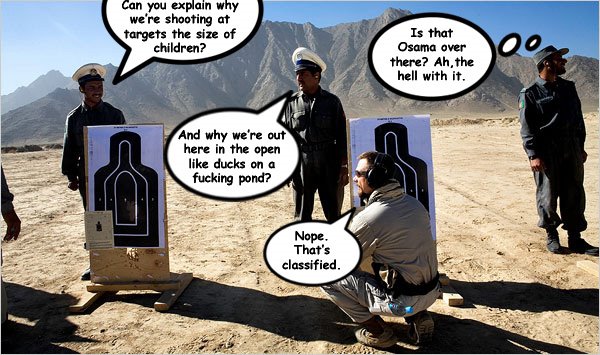
NY Times caption: A DynCorp worker, kneeling, trained policemen recently near Kabul, Afghanistan. DynCorp got 94 percent of $2.2 billion in police training and drug eradication contracts from a State Department bureau. (Fake dialogue by The Enchanted Porkfist.)

The Afghan Scam: The Untold Story of Why the U.S. Is Bound to Fail in Afghanistan
By Ann Jones / January 11, 2009

The first of 20,000 to 30,000 additional U.S. troops are scheduled to arrive in Afghanistan next month to re-win the war George W. Bush neglected to finish in his eagerness to start another one. However, “winning” the military campaign against the Taliban is the lesser half of the story.

Going into Afghanistan, the Bush administration called for a political campaign to reconstruct the country and thereby establish the authority of a stable, democratic Afghan central government. It was understood that the two campaigns — military and political/economic — had to go forward together; the success of each depended on the other. But the vision of a reconstructed, peaceful, stable, democratically governed Afghanistan faded fast. Most Afghans now believe that it was nothing but a cover story for the Bush administration’s real goal — to set up permanent bases in Afghanistan and occupy the country forever.

Whatever the truth of the matter, in the long run, it’s not soldiers but services that count — electricity, water, food, health care, justice, and jobs. Had the U.S. delivered the promised services on time, while employing Afghans to rebuild their own country according to their own priorities and under the supervision of their own government — a mini-Marshall Plan — they would now be in charge of their own defense. The forces on the other side, which we loosely call the Taliban, would also have lost much of their grounds for complaint.

Instead, the Bush administration perpetrated a scam. It used the system it set up to dispense reconstruction aid to both the countries it “liberated,” Afghanistan and Iraq, to transfer American taxpayer dollars from the national treasury directly into the pockets of private war profiteers. Think of Halliburton, Bechtel, and Blackwater in Iraq; Louis Berger Group, Bearing Point, and DynCorp International in Afghanistan. They’re all in it together. So far, the Bush administration has bamboozled Americans about its shady aid program. Nobody talks about it. Yet the aid scam, which would be a scandal if it weren’t so profitable for so many, explains far more than does troop strength about why, today, we are on the verge of watching the whole Afghan enterprise go belly up.

What’s worse, there’s no reason to expect that things will change significantly on Barack Obama’s watch. During the election campaign, he called repeatedly for more troops for “the right war” in Afghanistan (while pledging to draw-down U.S. forces in Iraq), but he has yet to say a significant word about the reconstruction mission. While many aid workers in that country remain full of good intentions, the delivery systems for and uses of U.S. aid have been so thoroughly corrupted that we can only expect more of the same — unless Obama cleans house fast. But given the monumental problems on his plate, how likely is that?

The Jolly Privateers

It’s hard to overstate the magnitude of the failure of American reconstruction in Afghanistan. While the U.S. has occupied the country — for seven years and counting — and efficiently set up a network of bases and prisons, it has yet to restore to Kabul, the capital, a mud brick city slightly more populous than Houston, a single one of the public services its citizens used to enjoy. When the Soviets occupied Afghanistan in the 1980s, they modernized the education system and built power plants, dams, factories, and apartment blocs, still the most coveted in the country. If, in the last seven years, George W. Bush did not get the lights back on in the capital, or the water flowing, or dispose of the sewage or trash, how can we assume Barack Obama will do any better with the corrupt system he’s about to inherit?

Between 2002 and 2008, the U.S. pledged $10.4 billion dollars in “development” (reconstruction) aid to Afghanistan, but actually delivered only $5 billion of that amount. Considering that the U.S. is spending $36 billion a year on the war in Afghanistan and about $8 billion a month on the war in Iraq, that $5 billion in development aid looks paltry indeed. But keep in mind that, in a country as poor as Afghanistan, a little well spent money can make a big difference.

The problem is not simply that the Bush administration skimped on aid, but that it handed it over to for-profit contractors. Privatization, as is now abundantly clear, enriches only the privateers and serves only their private interests.

Take one pertinent example. When the inspectors general of the Pentagon and State Department investigated the U.S. program to train the Afghan police in 2006, they found the number of men trained (about 30,000) to be less than half the number reported by the administration (70,000). The training had lasted eight weeks at most, with no in-the-field experience whatsoever. Only about half the equipment assigned to the police — including thousands of trucks — could be accounted for, and the men trained were then deemed “incapable of carrying out routine law enforcement work.”

The American privateer training the police — DynCorp — went on to win no-bid contracts to train police in Iraq with similar results. The total bill for American taxpayers from 2004 to 2006: $1.6 billion. It’s unclear whether that money came from the military or the development budget, but in either case it was wasted. The inspectors general reported that police incompetence contributed directly to increased opium production, the reinvigoration of the Taliban, and government corruption in general, thoroughly subverting much ballyhooed U.S. goals, both military and political.

In the does-no-one-ever-learn category: the latest American victory plan, announced in December, calls for recruiting and rearming local militias to combat the Taliban. Keep in mind that hundreds of millions of dollars, mostly donated by Japan, have already been spent to disarm local militias. A proposal to rearm them was soundly defeated last fall in the Afghan Parliament. Now, it’s again the plan du jour, rubber-stamped by Afghan President Hamid Karzai.

Afghans protest that such a plan amounts to sponsoring civil war, which, if true, would mean that American involvement in Afghanistan might be coming full circle — civil war being the state in which the U.S. left Afghanistan at the end of our proxy war against the Soviet Union in the 1980s. American commanders, however, insist that they must use militias because Afghan Army and police forces are “simply not available.” Maj. Gen. Michael S. Tucker, deputy commander of American forces, told the New York Times, “We don’t have enough police, [and] we don’t have time to get the police ready.” This, despite the State Department’s award to DynCorp last August of another $317.4 million contract “to continue training civilian police forces in Afghanistan,” a contract DynCorp CEO William Ballhaus greeted as “an opportunity to contribute to peace, stability and democracy in the world [and] support our government’s efforts to improve people’s lives.”

America First

In other areas less obviously connected to security, American aid policy is no less self-serving or self-defeating. Although the Bush administration handpicked the Afghan president and claims to want to extend his authority throughout the country, it refuses to channel aid money through his government’s ministries. (It argues that the Afghan government is corrupt, which it is, in a pathetic, minor league sort of way.)

Instead of giving aid money for Afghan schools to the Ministry of Education, for example, the U.S. Agency for International Development (USAID) funds private American contractors to start literacy programs for adults. As a result, Afghan teachers abandon the public schools and education administrators leave the Ministry for higher paying jobs with those contractors, further undermining public education and governance. The Bush administration may have no particular reason to sabotage its handpicked government, but it has had every reason to befriend private contractors who have, in turn, kicked back generously to election campaigns and Republican coffers.

There are other peculiar features of American development aid. Nearly half of it (47%) goes to support “technical assistance.” Translated, that means overpaid American “experts,” often totally unqualified — somebody’s good old college buddies — are paid handsomely to advise the locals on matters ranging from office procedures to pesticide use, even when the Afghans neither request nor welcome such advice. By contrast, the universally admired aid programs of Sweden and Ireland allocate only 4% and 2% respectively to such technical assistance, and when asked, they send real experts. American technical advisors, like American privateers, are paid by checks — big ones — that pass directly from the federal treasury to private accounts in American banks, thus helping to insure that about 86 cents of every dollar designated for U.S. “foreign” aid anywhere in the world never leaves the U.S.A.

American aid that actually makes it abroad arrives with strings attached. At least 70% of it is “tied” to the purchase of American products. A food aid program, for example, might require Afghanistan to purchase American agricultural products in preference to their own, thus putting Afghan farmers out of business or driving even more of them into the poppy trade. (The percentage of aid from Sweden, Ireland, and the United Kingdom that is similarly tied: zero.)

Testifying before a congressional subcommittee on May 8, 2001, Andrew Natsios, then head of USAID, described American aid as “a key foreign policy instrument [that] helps nations prepare for participation in the global trading system and become better markets for U.S. exports.” Such so-called aid cuts American business in right from the start. USAID has even developed a system for “preselecting” certain private contractors, then inviting only those preselected companies to apply for contracts the agency wants to issue.

Often, in fact, only one of the preselected contractors puts in for the job and then — if you need a hint as to what’s really going on — just happens to award subcontracts to some of the others. It’s remarkable, too, how many former USAID officials have passed through the famed revolving door in Washington to become highly paid consultants to private contractors — and vice versa. By January 2006, the Bush administration had co-opted USAID altogether. The once independent aid agency launched by President Kennedy in 1961 became a subsidiary of the State Department and a partner of the Pentagon.

Oh, and keep in mind one more thing: While the private contractors may be in it for the duration, most employees and technical experts in Afghanistan stay on the job only six months to a year because it’s considered such a “hardship post.” As a result, projects tend not to last long and to be remarkably unrelated to those that came before or will come after. Contractors collect the big bucks whether or not the aid they contracted to deliver benefits Afghans, or even reaches them.

These arrangements help explain why Afghanistan remains such a shambles.

The Afghan Scam

It’s not that American aid has done nothing. Check out the USAID website and you’ll find a summary of what is claimed for it (under the glorious heading of “Afghanistan Reborn”). It will inform you that USAID has completed literally thousands of projects in that country. The USAID loves numbers, but don’t be deceived by them. A thousand short-term USAID projects can’t hold a candle to one long, careful, patient program run, year after year, by a bunch of Afghans led by a single Swede.

If there has been any progress in Afghanistan, especially in and around Kabul, it’s largely been because two-thirds of the reconstruction aid to Afghanistan comes from other (mostly European) countries that do a better job, and partly because the country’s druglords spend big on palatial homes and services in the capital. But the one-third of international aid that is supposed to come from the U.S., and that might make a critical difference when added to the work of others, eternally falls into the wrong pockets.

What would Afghans have done differently, if they’d been in charge? They’d have built much smaller schools, and a lot more of them, in places more convenient to children than to foreign construction crews. Afghans would have hired Afghans to do the building. Louis Berger Group had the contract to build more than 1,000 schools at a cost of $274,000 per school. Already way behind schedule in 2005, they had finished only a small fraction of them when roofs began to collapse under the snows of winter.

Believe me, given that same $274,000, Afghans would have built 15 or 20 schools with good roofs. The same math can be applied to medical clinics. Afghans would also have chosen to repair irrigation systems and wells, to restore ruined orchards, vineyards, and fields. Amazingly enough, USAID initially had no agricultural programs in a country where rural subsistence farmers are 85% of the population. Now, after seven years, the agency finally claims to have “improved” irrigation on “nearly 15%” of arable land. And you can be sure that Afghans wouldn’t have chosen — again — the Louis Berger Group to rebuild the 389-mile long Kabul/Kandahar highway with foreign labor at a cost of $1 million per mile.

As things now stand, Afghans, as well as Afghan-Americans who go back to help their homeland, have to play by American rules. Recently an Afghan-American contractor who competed for reconstruction contracts told me that the American military is getting in on the aid scam. To apply for a contract, Afghan applicants now have to fill out a form (in English!) that may run to 50 pages. My informant, who asked to remain anonymous for obvious reasons, commented that it’s next to impossible to figure out “what they look for.” He won a contract only when he took a hint and hired an American “expert” — a retired military officer — to fill out the form. The expert claimed the “standard fee” for his service: 25% of the value of the contract.

Another Afghan-American informed me that he was proud to have worked with an American construction company building schools with USAID funds. Taken on as a translator, he persuaded the company not only to hire Afghan laborers, but also to raise their pay gradually from $1.00 per day to $10.00 per day. “They could feed their families,” he said, “and it was all cost over-run, so cost didn’t matter. The boss was already billing the government $10.00 to $15.00 an hour for labor, so he could afford to pay $10.00 a day and still make a profit.” My informant didn’t question the corruption in such over-billing. After all, Afghans often tack on something extra for themselves, and they don’t call it corruption either. But on this scale it adds up to millions going into the assumedly deep pockets of one American privateer.

Yet a third Afghan-American, a businessman who has worked on American projects in his homeland, insisted that when Bush pledged $10.4 billion in aid, President Karzai should have offered him a deal: “Give me $2 billion in cash, I’ll kick back the rest to you, and you can take your army and go home.”

“If Karzai had put the cash in an Afghan bank,” the businessman added, “and spent it himself on what people really need, both Afghanistan and Karzai would be in much better shape today.” Yes, he was half-joking, but he wasn’t wrong.

Don’t think of such stories, and thousands of others like them, as merely tales of the everyday theft or waste of a few hundred million dollars — a form of well-organized, routine graft that leaves the corruption of Karzai’s government in the shade and will undoubtedly continue unremarked upon in the Obama years. Those multi-millions that will continue to be poured down the Afghan drain really represent promises made to a people whose country and culture we have devastated more than once. They are promises made by our government, paid for by our taxpayers, and repeatedly broken.

These stories, which you’ll seldom hear about, are every bit as important as the debates about military strength and tactics and strategy in Afghanistan that dominate public discourse today. Those promises, made in our name, were once said to be why we fight; now — broken — they remind us that we’ve already lost.

[Ann Jones wrote at length about the failure of American aid in Kabul in Winter (Metropolitan Books), a book about American meddling in Afghanistan as well as her experience as a humanitarian aid worker there from 2002 to 2006. For more information, visit her website. For a concise report on many of the defects in international aid mentioned here, check out Real Aid (pdf file), a report issued in 2005 by the South African NGO Action Aid.]

Copyright 2009 Ann Jones

Source / TomDispatch

The Rag Blog

Posted in RagBlog | Tagged , , | 2 Comments

The Duty to Stand Up and Fight Against Tyranny

Anti-war activist Betty McKenzie protests the Republican National Convention (RNC) outside the Minnesota State Capitol August 31, 2008 in St. Paul, Minnesota. McKenzie was later arrested. Photo: Getty Images.

The Militarized Crackdown on Political Protesters: No Victors in the War on Dissent
By Coleen Rowley and William James Cox / January 13, 2009

Among the wars currently being fought by the American government is one in which there can be no winners. Our prior law enforcement experiences warn us that the “war on terrorism” has spawned an internal “war on dissent” in which everyone loses.

Author William John Cox’s law enforcement career spanned 40 years, the early part of which was spent as a Los Angeles police officer and which included direct policing of both the riots and terrorist incidents in that city in the late 60’s to early 70’s. One of the first assignments given to author Coleen Rowley as a new FBI agent was to help in the processing and releasing of the numerous files improperly gathered by J. Edgar Hoover after the National Lawyer’s Guild won its FOIA lawsuits against the FBI in the early 1980’s.

The Church Committee unearthed evidence in 1976 that the Viet Nam War had provided cover for the domestic infiltration and wiretapping of civil rights and anti-war groups and resulted in legislation and regulations against the worst abuses. However, the history of government repression and spying on those who dissent against its policies and practices seems to be repeating itself.

Following 9-11, the Bush Administration erased or circumvented many of these hard-won legal restraints. Warrantless searches under the PATRIOT Act and illegal electronic surveillance swept up more than terrorist threats as the government increasingly confused dissent, which builds up a free and democratic society, with terrorism, which seeks to tear it down.

The law enforcement response has become increasingly harsh and heavy-handed since the anti-globalization protests in 1999 in Seattle against the World Trade Organization. In November 2003, as many as 40 different law enforcement agencies invaded Miami during meetings relating to the Free Trade Area of the Americas. Protest groups were infiltrated by the police, the corporate media was “embedded” with law enforcement, and the independent media was suppressed.

The New York City police department used “Miami” tactics in 2004 at the Republican National Convention (RNC) during which hundreds of peaceful demonstrators and innocent bystanders were illegally arrested, fingerprinted, photographed, and subjected to prolonged detention in wire cages before being released without prosecution. Repressive tactics were also used the same year as a counter-terrorism measure at the Democratic National Convention, where Boston police established a designated fenced enclosure topped by razor wire as the “free speech zone.”

Despite this recent history, the militarized crackdown and persecution of protest at the RNC in September took many by surprise especially in an otherwise progressive city like St. Paul (which pioneered the concept of “community policing”). It was a terrible shock to see the riot-clad Robo-cops lined up two and three rows deep, helmet visors down, their police identification gone or not visible, and their tasers and chemical weapon guns pointed at the various members of the Twin Cities Peacemakers and other social justice groups who marched on the first day of the RNC.

More than 800 citizens were arrested (including 40 journalists, one of whom was “Democracy Now!” radio host Amy Goodman) and hundreds of peaceful protesters were pepper sprayed, tasered, or otherwise brutalized.

Thousands more who conscientiously wished to demonstrate opposition to government policies and the illegal war, were too scared to leave their homes. Not only were they intimidated from marching, but they were prevented from participating in other totally peaceful artistic and music events scheduled in the Twin Cities during the week of the RNC.

More evidence for historians that the “war on terror” has morphed into a “war on dissent” can be found in the recently leaked reports establishing that both the Pentagon’s Northern Command (NORTHCOM) and the National Geospatial-Intelligence Agency participated in planning RNC convention security and were possibly involved in crowd control strategies.

At the very least, the intimidating presence of armor-clad police officers at political demonstrations is a visible manifestation of the fascist threat. More pernicious would be any unwarranted, secret collection of information on the various social justice, peace, independent media, musical performance, artistic and legal groups in the lead-up to the RNC. We are currently in the process of determining, through freedom of information type requests, if this in fact, occurred here.

Recent revelations of how the Maryland State Police infiltrated nonviolent groups and falsely labeled dozens of pacifists, environmentalists and Catholic Nuns as terrorists highlights the risks of using undercover law enforcement officers and paid informants to spy on domestic groups. Pressure to produce arrests and convictions justifying the expenditure of hundreds of thousands of dollars in precious tax revenues can result in the elevation of rhetoric into threats and dissent into terrorism.

The mind-numbing repetition of the term “anarchists” in recent newspaper coverage of the $300,000, year-long infiltration of protest groups prior to the convention fails to obscure the great lengths to which law enforcement officials went to prevent “street blockades” and other disruptions in St. Paul. Before the RNC even started, authorities executed pre-emptive raids and “preventive detentions”—controversial concepts originally concocted for the “war on terror” that have no place in our Constitution’s criminal justice system.

Thanks to Minnesota’s version of the PATRIOT Act, the local “war on dissent” has elevated boastful threats to “swarm” the Republican convention and to “shut it down” into charges of conspiracy to riot “in furtherance of terrorism.” However, there is no evidence that any of the so-charged “RNC Eight” ever personally committed acts of violence or damaged property. If they were really ready to “destroy” the City of Saint Paul as alleged, why did they operate so openly? Why was their rhetoric, albeit taunting, for the entire world to see on their website?

Real terrorists are usually much more secretive. Think back to the most significant recent cases of actual domestic terrorism in the United States: Oklahoma Federal Building bomber Timothy McVeigh; Olympic Park and abortion clinic bomber Eric Robert Rudolph; Unabomber (for 18 years) Ted Kaczynski; Ft. Detrick military scientist-anthrax killer Bruce Ivins; and the DC sniper terrorist duo. Most of these and other American terrorists operated alone or with one main accomplice. That’s because secrecy is critical to the success of an actual terrorist act. That means, also, that it’s different from protest and even civil disobedience where mass numbers of participants (instead of secrecy) is the key.

The prosecution of the RNC eight flies in the face of what Nobel Peace Prize winner Al Gore recently urged (to heavy applause)—for young people to engage in “civil disobedience” (he was talking about stopping the construction of coal plants). And only a few days ago, Thomas Friedman bemoaned in his New York Times column (with respect to the national economy) that “Our kids should be so much more radical than they are today.” (Emphasis added).

Dr. David Harris, a leader of one of the peace marches at the RNC as well as someone who has engaged in civil disobedience, assessed it as follows (in his comment on the Petition to Defend the RNC 8):

Nonviolent civil disobedience is the logical action for peace loving people who have tried in every way to work within the legal system only to find that those in power refuse to listen to the voices of the oppressed. I do not agree with destruction of other people’s property as a means of expressing opinion, but direct violence against living creatures is a far greater offense. In the case of the RNC protests, by far the greatest perpetrators of violence were law enforcement officials.

No one could have analyzed this paradox more astutely than Supreme Court Justice Louis Brandeis when he observed:

In a government of law, the existence of the government will be imperiled if it fails to observe the law scrupulously. Our government is the potent, the omnipresent teacher. For good or for ill, it teaches the whole people by example. Crime is contagious. If the government becomes a lawbreaker, it breeds contempt for the law; it invites every man to become a law unto himself; it invites anarchy.

It is very difficult to believe that anyone in this country—police or citizen—wants to again see the government unleash the over-reactive, repressive and violent tactics of the 1960s to squelch domestic dissent. Ironically that would be the real recipe for inviting anarchy.

Irrespective of our political views, all of us must be concerned about the current prosecution of young people, who sincerely oppose an illegal war being fought by an unrepresentative government and who believe it’s better to have no government at all rather than one that commits international war crimes. They stand accused of being terrorists because they naively call themselves “anarchists.” In a free society, we all have the duty to stand up and fight against tyranny, and to speak out in defense of others who do.

[Coleen Rowley is a former legal counsel at the FBI Minneapolis field office. She earned national recognition for helping expose some of the pre 9-11 intelligence failures.

William John Cox is a retired supervising prosecutor for the State Bar of California. As a police officer he wrote the Policy Manual of the Los Angeles Police Department and the Role of the Police in America for the National Advisory Commission on Criminal Justice Standards and Goals.]

Source / CounterPunch

The Rag Blog

Posted in RagBlog | Tagged , , | 1 Comment

Bush Is a Puppet and Ehud Olmert Holds the Strings


Israeli PM Ehud Olmert Claims to be Able to Order Bush Around
By Juan Cole / January 13, 2009

So outgoing Israeli Prime Minister Ehud Olmert was speaking in Ashkelon on Monday, and he said the most amazing thing. The USG Open Source Center translated the relevant passage from his speech, in which he claimed he had the ability to control US foreign policy and summarily over-rule the Secretary of State.


“Olmert Says Israel Determined To Go On, Recalls Phone Talk on UNSC Vote With Bush
Telephone report from Ashqelon by political correspondent Shmu’el Tal — liveA
Voice of Israel Network B
Monday, January 12, 2009 . . .
Document Type: OSC Translated Text

[Olmert:] “It transpired all of a sudden that a vote would be held in 10 minutes’ time. I tried to find President Bush, and I was told he was attending an event in Philadelphia.”

‘I know that if somebody tried to find me on the phone right now, it would have to be something unusual and extraordinary for them to say: Leave it all and go to some room to talk to me. In this case, I said: I don’t care, I have to talk to him right now.

He was taken off the podium and brought to a side room. I spoke with him; I told him: You can’t vote for this proposal.

He said: Listen, I don’t know, I didn’t see, don’t know what it says.

I told him: I know, and you can’t vote for it!

He then instructed the secretary of state, and she did not vote for it.

It was a proposal she had put together, one she formulated, one she organized, one she maneuvered. It left her rather embarrassed, abstaining in the vote on a proposal she herself had put together. That was why the French and the Brits said she had pulled a fast one on them, she having been the one to spur them to submit the proposals.”

Olmert’s account cannot be accurate as to detail. Bush was not interrupted during his speech in Philadelphia, and the speech was given many hours before the UN vote. But that kind of discrepancy is easily resolved if we want to believe that Olmert is telling the truth. When he called the White House, he may have initially gotten a staffer who said something like, Bush is away at Philadelphia for a speech. Olmert could have misunderstood the staffer to say that Bush was still giving the speech.

But that Condi Rice worked hard to get that UN resolution and that the other diplomats were shocked when she suddenly instructed Zalmay Khalilzad to vote against it is well known and was reported in the Arabic press at the time. Raghida Dergham wrote in the London-based pan-Arab daily, al-Hayat, on Jan. 10, 2009 (OSC trans.):

French Foreign Minister Bernard Kouchner chaired the session, since his country is the UNSC’s chairman this month, which was attended by US Secretary of State Condoleezza Rice, British Foreign Secretary David Miliband . . . [etc.]

Rice surprised the meeting by abstaining from voting after the Americans had left a clear impression during the negotiations of their intention to vote in favour of the resolution. . .

British diplomacy played a consensual and leading role which contributed to breaking the cycle of delay and procrastination by French diplomacy. Reporting on the penultimate session of the ministers, sources said Kouchner tried to postpone the voting until today on the pretext that Presidents Husni Mubarak and Nicola Sarkozy approved this delay but the Egyptian foreign minister replied back immediately denying this was true about the Arab stand. The sources said the Saudi foreign minister demanded that Kouchner put his country’s stand aside and respond to the demand to hold a session for voting. The British foreign secretary was on the point of presenting the consensual resolution regardless of the French and US stand. Russia intervened at the last moments and told the Arab side it was ready to participate with Britain in putting up the draft resolution officially for a vote. US Ambassador Zalmay Khalilzad arrived suddenly at the meeting to report his country’s stand. . .

So Dergham’s account, gleaned from UN sources in New York, shows that Rice had been more in favor of the cease-fire resolution than Bernard Kouchner of France, who used his position as chair to attempt to delay it coming up for a vote. You could imagine Olmert calling up Sarkozy and urging this delay. But Kouchner could not stand against the combined pressure of Britain, Russia and Saudi Arabia, and had to allow the vote to go forward. Then everyone was surprised by Rice’s about-face. And it was reported at the time that she changed her mind after a phone call from Bush.

So the substance of Olmert’s allegations are consistent with Dergham’s account, gleaned from interviews with eyewitnesses to the process among the Arab participants: “Rice surprised the meeting . . .”

It is therefore reasonable to think that Olmert did talk to Bush last Thursday, and that he did have Rice over-ruled. One can only imagine that he had tried hard to dissuade Rice from participating in the drafting process at all, and had tried to have her veto the resolution, in accordance with standard US procedure of shielding Israel from the UNSC. She must have blown him off or been evasive, alarming him that there would be a UN ceasefire resolution before which Israel might have to bow. My own guess is that Olmert had Bush tell her to veto it altogether, but you have to wonder whether she and Khalilzad engaged in their own little final rebellion and so just voted “present,” which allowed the resolution to pass. (Olmert has ignored it.)

Olmert reports that Bush had no idea what the substance of the resolution was, and this anecdote is consistent with what we know about how this White House has functioned. Bush admitted to Bob Woodward that an important decision on sending some troops to Iraq had been made by National Security Adviser Stephen Hadley and that Bush had not sat in on the relevant meetings. So Rice was at the UN on her own, thinking she was a plenipotentiary of Bush, and Olmert was annoyed at this attitude and decided to put her in her place.

Why did Olmert spill the beans on his backroom maneuvering against Rice? It is a very damaging thing that he said. As Daniel Levy, who had been a Labor Party adviser on peace negotiations, told The Los Angeles Times’s Paul Richter:

This is terrible for the United States . . . This confirms every assumption they have in the Arab world about the tail wagging the dog. . . . It’s a story you’re likely to hear quoted there for years to come.” Levy also accused Olmert of “unparalleled arrogance.”. . .”There are some things you don’t say, even in Ashkelon, even in Hebrew . . .

The likelihood is that Olmert was stung by severe criticism of his government for allowing the UNSC cease-fire resolution to be passed. His Kadima Party is in a neck and neck race with the even more hard line and far rightwing Likud Party, with elections to be held on February 10. Presumably Olmert was trying to deflect the Likudniks’ charges that Kadima was inept or impotent, and to improve the standing of his would-be successor, Tzipi Livni (now the Foreign Minister).

Olmert is having to step down as prime minister because of a corruption scandal that blew up in his face and made him look petty and greedy. As a mediocre politician with an over-sized ego, he doesn’t have many opportunities left to try to rehabilitate his reputation. If he pushed W. around for Israel’s sake while she warred with the Hamas terrorists (his way of thinking), then maybe that would take some of the edge off his unseemly money-grubbing and massive list of failures, which include the 2006 Lebanon War.

Finally we come to the really big mystery. If the substance of what Olmert said is correct, even if he got some details wrong, then why in the world did Bush listen to him? Bush is outgoing and faces no new elections. His party cannot benefit or suffer with the Israel lobbies from a decision he took in relative secrecy since it won’t even face another election for 2 years, by which time this Gaza war will be completely forgotten.

Why in the world would Bush over-rule the US Secretary of State, for the sake of Olmert, in the midst of delicate negotiations with European and Arab allies? Here are the only possibilities I can think of:

1. Bush is as dumb as he looks and just agrees with the last person he spoke to.

2. Bush hates it when the roar of cannon dies down, and is a sadist who enjoys prolonging war far too much to ever actively back a ceasefire.

3. Olmert has something over Bush. I remember that Bush had taken on Sharon in September of 2001, calling for a Palestinian state and ordering Sharon to stop colonizing the West Bank. Sharon was so furious that he compared Israel’s situation to that of Czechoslovakia in 1938, when the rest of Europe let Hitler grab part of it. But by spring of 2002 Bush was bending over backward to please the Likud. What changed? Something did. There is a mystery to be explained here. I only point out that along with the previous two explanations, this one would make sense of otherwise baffling behavior on Bush’s part.

Precisely because his overly frank speech raises these sorts of questions, I expect Olmert to deny the entire address, and then it will be expunged from the public record and never spoken of again.

In any case, this slippage of the veil over the way US foreign policy is being dictated by a foreign country reinforces the need for a Peace PAC or ‘For America’ PAC to counter-act the American Israel Public Affairs Committee, which is obviously way too powerful for Israel’s own good. J-Street and Brit Tzedik Ve Shalom and Tikkun and other liberal Jewish-American organizations are trying to do the right thing here. Whereas AIPAC gets plenty of help from the evangelicals, the rest of us are letting down the majority of the Jewish community that supports the peace process by not helping it lobby on this issue.

That resolution Olmert tried to spike means that his government’s continued war on Gaza (he ordered 60 airstrikes on Monday through early Tuesday) is even more illegal than the whole enterprise was to begin with.

Source / Informed Comment

The Rag Blog

Posted in RagBlog | Tagged , , , , | Leave a comment

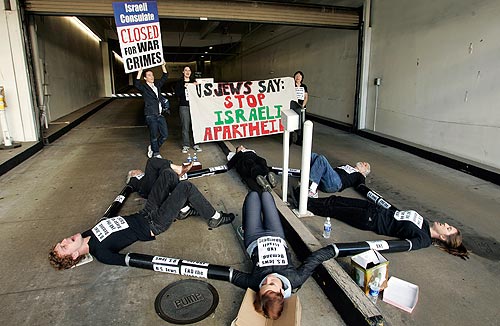
US Congress: Accused of War Crimes


I Accuse! An Open Letter to Congress
By Sarah Shields / January 13, 2009

I accuse you, the US Congress, of having voted for US House Resolution 34 by an overwhelming margin, 390-5. In the name of protecting Israel’s security, this Resolution instead protects Israel’s “right” to hold a whole population accountable for the violations of a few. By condoning Israel’s behavior over the past two weeks as self-defense, HR 34 condemns one and a half million Gazans to capital punishment without trial for crimes they have not committed. By publicly acknowledging and approving Israel’s behavior, you now share responsibility for the outcomes.

I accuse you of having the blood of hundreds of innocent children on your hands. I accuse you of the death of Shahd Abu Halemeh, an infant of 18 months, whose corpse was found badly burned in the wreckage of Gaza. I accuse you of the deaths of the four Salha children, Rola (1), Baha (4), Rana (12), and Dyia (14), who died when the Israelis dropped a missile on their house. I accuse you of the deaths of those killed while seeking refuge from constant bombardment, people who sought protection at a school run by the United Nations. Despite the clear UN markings and flags, Israelis attacked the sanctuary, killing 30 and wounding 50. And I hold you responsible for the lives of the 252 other children killed in the first sixteen days of Israel’s attack on Gaza, and the deaths of those who will be killed as a result of your encouragement.

I accuse you of violating the laws made by the Congress of the United States, laws like the Arms Export Control Act of 1976, which insist that American-made weapons may not be used against civilian populations.

I accuse you of supporting flagrant violations of human rights. The combatants you voted to support are required by international law to care for civilian victims of war. Yet the Israeli government denied the International Committee of the Red Cross access to the sites they bombed for four days. The nightmares that resulted are too horrific to be imagined. Perhaps you could contemplate what the ICRC found when it was finally allowed to provide relief for the victims of Israeli bombing: four children, so starved that they could not stand up, huddled by their dead mothers. Food and water have become hard to find, and medicine is vanishing as the need for medical care explodes as more and more missiles land in Gaza. Israel has, nonetheless, targeted not only a UN school, but also a UN convoy bringing desperately needed supplies. The result, according to the ICRC’s director of operations, is catastrophic. “There is no doubt in my mind,” he stated, “that we are dealing with a full blown and major crisis in humanitarian terms. The situation for the people in Gaza is extreme and traumatic as a result of ten days of uninterrupted fighting. In that sense, their situation has clearly become intolerable.”

I accuse you of transgressing international law. The United States, as one of the High Contracting Parties to the Fourth Geneva Convention, is required to protect civilians in war, and to call to account anyone who targets them. You have instead voted to support behavior considered criminal according to international law.

I accuse you of making our ally, Israel, less secure than ever before, as the orphans of today seek vengeance in the future. Instead of seeking a real peace, a peace of mutual security and prosperity, you have chosen to support only one side in this ongoing struggle, condemning the others to enormous suffering.

I accuse you of putting politics before humanity, of condoning the slaughter of innocents, of supporting war crimes instead of standing up for the most basic human right: the right to live without the terrifying fear of immediate death.

I hold you responsible, each of these 390 members of America’s 111th Congress. I accuse you of complicity in the most serious transgressions that humans can commit.

Source / Informed Comment

The Rag Blog

Posted in RagBlog | Tagged , , , , | Leave a comment

Is the Gaza Invasion About Its Offshore Gas Fields?

Interestingly, one of our readers asks in a comment, “This doesn’t mean I agree with the invasion of Gaza which seems self-defeating – not because of the numbers killed (though that’s awful), but because tactically what is it going to get them?” Well, the answer could lie under the Mediterranean Sea offshore of the Gaza Strip, and Michel Chossudovsky helps us a little by reviewing some fairly recent history.

Richard Jehn / The Rag Blog


War and Natural Gas: The Israeli Invasion and Gaza’s Offshore Gas Fields
By Michel Chossudovsky / January 8, 2009

The military invasion of the Gaza Strip by Israeli Forces bears a direct relation to the control and ownership of strategic offshore gas reserves.

This is a war of conquest. Discovered in 2000, there are extensive gas reserves off the Gaza coastline.

British Gas (BG Group) and its partner, the Athens based Consolidated Contractors International Company (CCC) owned by Lebanon’s Sabbagh and Koury families, were granted oil and gas exploration rights in a 25 year agreement signed in November 1999 with the Palestinian Authority.

The rights to the offshore gas field are respectively British Gas (60 percent); Consolidated Contractors (CCC) (30 percent); and the Investment Fund of the Palestinian Authority (10 percent). (Haaretz, October 21, 2007).

The PA-BG-CCC agreement includes field development and the construction of a gas pipeline.(Middle East Economic Digest, Jan 5, 2001).

The BG licence covers the entire Gazan offshore marine area, which is contiguous to several Israeli offshore gas facilities. (See Map below). It should be noted that 60 percent of the gas reserves along the Gaza-Israel coastline belong to Palestine.

The BG Group drilled two wells in 2000: Gaza Marine-1 and Gaza Marine-2. Reserves are estimated by British Gas to be of the order of 1.4 trillion cubic feet, valued at approximately 4 billion dollars. These are the figures made public by British Gas. The size of Palestine’s gas reserves could be much larger.

Who Owns the Gas Fields

The issue of sovereignty over Gaza’s gas fields is crucial. From a legal standpoint, the gas reserves belong to Palestine.

The death of Yasser Arafat, the election of the Hamas government and the ruin of the Palestinian Authority have enabled Israel to establish de facto control over Gaza’s offshore gas reserves.

British Gas (BG Group) has been dealing with the Tel Aviv government. In turn, the Hamas government has been bypassed in regards to exploration and development rights over the gas fields.

The election of Prime Minister Ariel Sharon in 2001 was a major turning point. Palestine’s sovereignty over the offshore gas fields was challenged in the Israeli Supreme Court. Sharon stated unequivocally that “Israel would never buy gas from Palestine” intimating that Gaza’s offshore gas reserves belong to Israel.

In 2003, Ariel Sharon, vetoed an initial deal, which would allow British Gas to supply Israel with natural gas from Gaza’s offshore wells. (The Independent, August 19, 2003)

The election victory of Hamas in 2006 was conducive to the demise of the Palestinian Authority, which became confined to the West Bank, under the proxy regime of Mahmoud Abbas.

In 2006, British Gas “was close to signing a deal to pump the gas to Egypt.” (Times, May, 23, 2007). According to reports, British Prime Minister Tony Blair intervened on behalf of Israel with a view to shunting the agreement with Egypt.

The following year, in May 2007, the Israeli Cabinet approved a proposal by Prime Minister Ehud Olmert “to buy gas from the Palestinian Authority.” The proposed contract was for $4 billion, with profits of the order of $2 billion of which one billion was to go the Palestinians.

Tel Aviv, however, had no intention on sharing the revenues with Palestine. An Israeli team of negotiators was set up by the Israeli Cabinet to thrash out a deal with the BG Group, bypassing both the Hamas government and the Palestinian Authority:

Israeli defence authorities want the Palestinians to be paid in goods and services and insist that no money go to the Hamas-controlled Government. (Ibid, emphasis added)

The objective was essentially to nullify the contract signed in 1999 between the BG Group and the Palestinian Authority under Yasser Arafat.

Under the proposed 2007 agreement with BG, Palestinian gas from Gaza’s offshore wells was to be channeled by an undersea pipeline to the Israeli seaport of Ashkelon, thereby transferring control over the sale of the natural gas to Israel.

The deal fell through. The negotiations were suspended:

Mossad Chief Meir Dagan opposed the transaction on security grounds, that the proceeds would fund terror. (Member of Knesset Gilad Erdan, Address to the Knesset on “The Intention of Deputy Prime Minister Ehud Olmert to Purchase Gas from the Palestinians When Payment Will Serve Hamas,” March 1, 2006, quoted in Lt. Gen. (ret.) Moshe Yaalon, Does the Prospective Purchase of British Gas from Gaza’s Coastal Waters Threaten Israel’s National Security? Jerusalem Center for Public Affairs, October 2007)

Israel’s intent was to foreclose the possibility that royalties be paid to the Palestinians. In December 2007, The BG Group withdrew from the negotiations with Israel and in January 2008 they closed their office in Israel. (BG website).

Invasion Plan on The Drawing Board

The invasion plan of the Gaza Strip under “Operation Cast Lead” was set in motion in June 2008, according to Israeli military sources:

Sources in the defense establishment said Defense Minister Ehud Barak instructed the Israel Defense Forces to prepare for the operation over six months ago [June or before June] , even as Israel was beginning to negotiate a ceasefire agreement with Hamas. (Barak Ravid, Operation “Cast Lead”: Israeli Air Force strike followed months of planning, Haaretz, December 27, 2008)

That very same month, the Israeli authorities contacted British Gas, with a view to resuming crucial negotiations pertaining to the purchase of Gaza’s natural gas:

Both Ministry of Finance director general Yarom Ariav and Ministry of National Infrastructures director general Hezi Kugler agreed to inform BG of Israel’s wish to renew the talks.

The sources added that BG has not yet officially responded to Israel’s request, but that company executives would probably come to Israel in a few weeks to hold talks with government officials. (Globes online- Israel’s Business Arena, June 23, 2008)

The decision to speed up negotiations with British Gas (BG Group) coincided, chronologically, with the planning of the invasion of Gaza initiated in June. It would appear that Israel was anxious to reach an agreement with the BG Group prior to the invasion, which was already in an advanced planning stage.

Moreover, these negotiations with British Gas were conducted by the Ehud Olmert government with the knowledge that a military invasion was on the drawing board. In all likelihood, a new “post war” political-territorial arrangement for the Gaza strip was also being contemplated by the Israeli government.

In fact, negotiations between British Gas and Israeli officials were ongoing in October 2008, 2-3 months prior to the commencement of the bombings on December 27th.

In November 2008, the Israeli Ministry of Finance and the Ministry of National Infrastructures instructed Israel Electric Corporation (IEC) to enter into negotiations with British Gas, on the purchase of natural gas from the BG’s offshore concession in Gaza. (Globes, November 13, 2008)

Ministry of Finance director general Yarom Ariav and Ministry of National Infrastructures director general Hezi Kugler wrote to IEC CEO Amos Lasker recently, informing him of the government’s decision to allow negotiations to go forward, in line with the framework proposal it approved earlier this year.

The IEC board, headed by chairman Moti Friedman, approved the principles of the framework proposal a few weeks ago. The talks with BG Group will begin once the board approves the exemption from a tender. (Globes Nov. 13, 2008)

Gaza and Energy Geopolitics

The military occupation of Gaza is intent upon transferring the sovereignty of the gas fields to Israel in violation of international law.

What can we expect in the wake of the invasion?

What is the intent of Israel with regard to Palestine’s Natural Gas reserves?

A new territorial arrangement, with the stationing of Israeli and/or “peacekeeping” troops?

The militarization of the entire Gaza coastline, which is strategic for Israel?

The outright confiscation of Palestinian gas fields and the unilateral declaration of Israeli sovereignty over Gaza’s maritime areas?

If this were to occur, the Gaza gas fields would be integrated into Israel’s offshore installations, which are contiguous to those of the Gaza Strip. (See Map 1 above).

These various offshore installations are also linked up to Israel’s energy transport corridor, extending from the port of Eilat, which is an oil pipeline terminal, on the Red Sea to the seaport – pipeline terminal at Ashkelon, and northwards to Haifa, and eventually linking up through a proposed Israeli-Turkish pipeline with the Turkish port of Ceyhan.

Ceyhan is the terminal of the Baku, Tblisi Ceyhan Trans Caspian pipeline. “What is envisaged is to link the BTC pipeline to the Trans-Israel Eilat-Ashkelon pipeline, also known as Israel’s Tipline.” (See Michel Chossudovsky, The War on Lebanon and the Battle for Oil, Global Research, July 23, 2006)

Source / Global Research

Thanks to Jeffrey Segal / The Rag Blog

Posted in RagBlog | Tagged , , , , | 2 Comments

Even Israelis Are Asking : Who Will Save Israel From Itself?

The Israeli government’s justifications for the war are being scrutinised. Photo by Gallo / Getty.

Israeli commentators and scholars, self-described ‘loyal’ Zionists who served proudly in the army in wars past, are now publicly describing their country, in the words of Oxford University professor Avi Shlaim, as a ‘rogue’ and ‘gangster’ state led by ‘completely unscrupulous leaders.’

By Mark LeVine / January 12, 2008

One by one the justifications given by Israel for its latest war in Gaza are unravelling.

The argument that this is a purely defensive war, launched only after Hamas broke a six-month ceasefire has been challenged, not just by observers in the know such as Jimmy Carter, the former US president who helped facilitate the truce, but by centre-right Israeli intelligence think tanks.

The Intelligence and Terrorism Information Center, whose December 31 report titled “Six Months of the Lull Arrangement Intelligence Report,” confirmed that the June 19 truce was only “sporadically violated, and then not by Hamas but instead by … “rogue terrorist organisations.”

Instead, “the escalation and erosion of the lull arrangement” occurred after Israel killed six Hamas members on November 4 without provocation and then placed the entire Strip under an even more intensive siege the next day.

According to a joint Tel Aviv University-European University study, this fits a larger pattern in which Israeli violence has been responsible for ending 79 per cent of all lulls in violence since the outbreak of the second intifada, compared with only 8 per cent for Hamas and other Palestinian factions.

Indeed, the Israeli foreign ministry seems to realise that this argument is losing credibility.

During a conference call with half a dozen pro-Israel professors on Thursday, Asaf Shariv, the Consul General of Israel in New York, focused more on the importance of destroying the intricate tunnel system connecting Gaza to the Sinai.

He claimed that such tunnels were “as big as the Holland and Lincoln tunnels,” and offered as proof the “fact” that lions and monkeys had been smuggled through them to a zoo in Gaza. In reality, the lions were two small cubs that were drugged, thrown in sacks, and dragged through a tunnel on their way to a private zoo.

Israel’s self-image

The claim that Hamas will never accept the existence of Israel has proved equally misinformed, as Hamas leaders explicitly announce their intention to do just that in the pages of the Los Angeles Times or to any international leader or journalist who will meet with them.

With each new family, 10, 20 and 30 strong, buried under the rubble of a building in Gaza, the claim that the Israeli forces have gone out of their way to diminish civilian casualties – long a centre-piece of Israel’s image as an enlightened and moral democracy – is falling apart.

Anyone with an internet connection can Google “Gaza humanitarian catastrophe” and find the UN’s Office for the Coordination of Humanitarian Affairs in the Occupied Territories and read the thousands of pages of evidence documenting the reality of the current fighting, and the long term siege on Gaza that preceded it.

The Red Cross, normally scrupulous in its unwillingness to single out parties to a conflict for criticism, sharply criticised Israel for preventing medical personnel from reaching wounded Palestinians, some of whom remained trapped for days, slowly starving and dying in the Gazan rubble amidst their dead relatives.

Meanwhile, the United Nations has flatly denied Israeli claims that Palestinian fighters were using the UNRWA school compound bombed on January 6, in which 40 civilians were killed, to launch attacks, and has challenged Israel to prove otherwise.

War crimes admission

Additionally, numerous flippant remarks by senior Israeli politicians and generals, including Tzipi Livni, the foreign minister, refusing to make a distinction between civilian people and institutions and fighters – “Hamas doesn’t … and neither should we” is how Livni puts it – are rightly being seen as admissions of war crimes.

Indeed, in reviewing statements by Israeli military planners leading up to the invasion, it is clear that there was a well thought out decision to go after Gaza’s civilian infrastructure – and with it, civilians.

The following quote from an interview with Major-General Gadi Eisenkot that appeared in the Israeli daily Yedioth Ahronoth in October, is telling:

“We will wield disproportionate power against every village from which shots are fired on Israel, and cause immense damage and destruction. From our perspective these [the villages] are military bases,” he said.

“This isn’t a suggestion. This is a plan that has already been authorised.”

Causing “immense damage and destruction” and considering entire villages “military bases” is absolutely prohibited under international law.

Eisenkot’s description of this planning in light of what is now unfolding in Gaza is a clear admission of conspiracy and intent to commit war crimes, and when taken with the comments above, and numerous others, renders any argument by Israel that it has tried to protect civilians and is not engaging in disproportionate force unbelievable.

International laws violated

On the ground, the evidence mounts ever higher that Israel is systematically violating a host of international laws, including but not limited to Article 56 of the IV Hague Convention of 1907, the First Additional Protocol of the Geneva Convention, the Fourth Geneva Convention (more specifically known as the “Geneva Convention relative to the Protection of Civilian Persons in Time of War of 12 August 1949”, the International Covenant on Economic, Social and Cultural Rights, and the principles of Customary International Humanitarian Law.

None of this excuses or legitimises the firing of rockets or mortars by any Palestinian group at Israeli civilians and non-military targets.

As Richard Falk, the UN special rapporteur, declared in his most recent statement on Gaza: “It should be pointed out unambiguously that there is no legal (or moral) justification for firing rockets at civilian targets, and that such behavior is a violation of IHR, associated with the right to life, as well as constitutes a war crime.”

By the same logic, however, Israel does not have the right to use such attacks as an excuse to launch an all-out assault on the entire population of Gaza.

In this context, even Israel’s suffering from the constant barrage of rockets is hard to pay due attention to when the numbers of dead and wounded on each side are counted. Any sense of proportion is impossible to sustain with such a calculus.

‘Rogue’ state

Israeli commentators and scholars, self-described “loyal” Zionists who served proudly in the army in wars past, are now publicly describing their country, in the words of Oxford University professor Avi Shlaim, as a “rogue” and gangster” state led by “completely unscrupulous leaders”.

Neve Gordon, a politics professor at Ben Gurion University, has declared that Israel’s actions in Gaza are like “raising animals for slaughter on a farm” and represent a “bizarre new moral element” in warfare.

“The moral voice of restraint has been left behind … Everything is permitted” against Palestinians, writes a disgusted Haaretz columnist, Gideon Levy.

Fellow Haaretz columnist and daughter of Holocaust survivors, Amira Haas writes of her late parents disgust at how Israeli leaders justified Israel’s wars with a “language laundromat” aimed at redefining reality and Israel’s moral compass. “Lucky my parents aren’t alive to see this,” she exclaimed.

Around the world people are beginning to compare Israel’s attack on Gaza, which after the 2005 withdrawal of Israeli forces and settlers was turned literally into the world’s largest prison, to the Jewish uprising in the Warsaw Ghetto.

Extremist Muslims are using internet forums to collect names and addresses of prominent European Jews with the goal, it seems clear, of assassinating them in retaliation for Israel’s actions in Gaza.

Al-Qaeda is attempting to exploit this crisis to gain a foothold in Gaza and Palestinian refugee camps in Lebanon and Syria, as well as through attacking Jewish communities globally.

Iran’s defiance of both Israel and its main sponsor, the US, is winning it increasing sympathy with each passing day.

Democratic values eroded

Inside Israel, the violence will continue to erode both democratic values in the Jewish community, and any acceptance of the Jewish state’s legitimacy in the eyes of its Palestinian citizens.

And yet in the US – at least in Washington and in the offices of the mainstream Jewish organisations – the chorus of support for Israel’s war on Gaza continues to sing in tight harmony with official Israeli policy, seemingly deaf to the fact that they have become so out of tune with the reality exploding around them.

At my university, UCI, where last summer Jewish and Muslim students organised a trip together through the occupied territories and Israel so they could see with their own eyes the realities there, old battle lines are being redrawn.

The Anteaters for Israel, the college pro-Israel group at the University of California, Irvine, sent out an urgent email to the community explaining that, “Over the past week, increasing amounts of evidence lead us to believe that Hamas is largely responsible for any alleged humanitarian crisis in Gaza”.

I have no idea who the “us” is that is referred to in the appeal, although I am sure that the membership of that group is shrinking.

Indeed, one of the sad facts of this latest tragedy is that with each claim publicly refuted by facts on the ground, more and more Americans, including Jews, are refusing to trust the assertions of Israeli and American Jewish leaders.

Trap

Even worse, in the Arab/Muslim world, the horrific images pouring out of Gaza daily are allowing preachers and politicians to deploy well-worn yet still dangerous and inciteful stereotypes against Jews as they rally the masses against Israel – and through it – their own governments.

What is most frightening is that the most important of Israel’s so-called friends, the US political establishment and the mainstream Jewish leadership, seem clueless to the devastating trap that Israel has led itself into – in good measure with their indulgence and even help.

It is one that threatens the country’s existence far more than any Qassam rockets, with their 0.4 per cent kill rate; even more than the disastrous 2006 invasion of southern Lebanon, which by weakening Israel’s deterrence capability in some measure made this war inevitable.

First, it is clear that Israel cannot destroy Hamas, it cannot stop the rockets unless it agrees to a truce that will go far to meeting the primary demand of Hamas – an end to the siege.

Merely by surviving (and it surely will survive) Hamas, like Hezbollah in 2006, will have won.

Israel is succeeding in doing little more than creating another generation of Palestinians with hearts filled with rage and a need for revenge.

Second, Israel’s main patron, the US, along with the conservative Arab autocracies and monarchies that are its only allies left in the Muslim world, are losing whatever crumbs of legitimacy they still had with their young and angry populations.

The weaker the US and its axis becomes in the Middle East, the more precarious becomes Israel’s long-term security. Indeed, any chance that the US could convince the Muslim world to pressure Iran to give up its quest for nuclear weapons has been buried in Gaza.

Third, as Israel brutalises Palestinians, it brutalises its own people. You cannot occupy another people and engage in violence against them at this scale without doing even greater damage to your soul.

The high incidence of violent crimes committed by veterans returning from combat duty in Iraq is but one example of how the violence of occupation and war eat away at people’s moral centre.

While in the US only a small fraction of the population participates in war; in Israel, most able-bodied men end up participating.

The effects of the latest violence perpetrated against Palestinians upon the collective Israeli soul is incalculable; the notion that it can survive as an “ethnocracy” – favouring one ethnic group, Jews, yet by and large democratic – is becoming a fiction.

Violence-as-power

Who will save Israel from herself?

Israelis are clearly incapable. Their addiction as a society to the illusion of violence-as-power has reached the level of collective mental illness.

As Haaretz reporter Yossi Melman described it on January 10, “Israel has created an image of itself of a madman that has lost it”.

Not Palestinians, too many of whom have fallen prey to the same condition.

Not the Middle East Quartet, the European Union, the United Nations, or the Arab League, all of whom are utterly powerless to influence Israeli policy.

Not the organised Jewish leadership in the US and Europe, who are even more blind to what is happening than most Israelis, who at least allow internal debate about the wisdom of their government’s policies.

Not the growing progressive Jewish community, which will need years to achieve enough social and political power to challenge the status quo.

And not senior American politicians and policy-makers who are either unwilling to risk alienating American Jewish voters, or have been so brainwashed by the constant barrage of propaganda put out by the “Israel Lobby” that they are incapable of reaching an independent judgment about the conflict.

During the US presidential race, Barack Obama was ridiculed for being a messiah-like figure. The idea does not sound so funny now. It is hard to imagine anyone less saving Israel, the Palestinians, and the world from another four years of mindless violence.

[Mark LeVine is a professor of Middle East history at the University of California, Irvine, and is the author of Heavy Metal Islam: Rock, Resistance, and the Struggle for the Soul of Islam and the soon to be published An Impossible Peace: Israel/Palestine Since 1989.]

Source / Al Jazeera

Thanks to Col. Jeffrey Segal / The Rag Blog

Posted in RagBlog | Tagged , , , , , | 3 Comments

Los Angeles and Owens Valley : An Epic Struggle Over Water

Harry Williams, member of the Paiute Tribe, wants to protect the Owens Valley from development. Photo by Jennifer I. Fenton / WIP.

The struggle over Owens Valley’s water resources is spattered with tales reminiscent of an old Hollywood Western starring John Wayne. The story’s origins can be found in the long struggle of indigenous peoples to maintain their lands and way of life.

By Jennifer I. Fenton / January 12, 2009

“Steal my horse, run off with my wife, but damn you, don’t touch my water.” — Unknown

Unlike many modern cities and towns across the United States, the town of Bishop, California bursts in failed attempts to sprawl across the landscape that surrounds it. Pressed into the floor of the Owens Valley, and hedged in by looming mountain ranges to the East and West, Bishop’s city limits have remained virtually unchanged for decades. But while Bishop’s population remains stagnant, to the South, the city of Los Angeles continues to grow at breakneck speeds — growth that would be impossible without the clear gold that flows from the Sierra, through the Owens Valley, and into the gaping mouth of the City of Angels.

When Los Angeles was incorporated in 1850, it was a small city of 8,900. With no immediate water sources to support a larger population or agriculture, it’s placement in the desert of Southern California borders on the absurd.

I don’t remember when I became aware that Los Angeles was the identified villain in our town, but I do know I was young. My grandmother, a survivor of The Great Depression and a staunch conservationist, remembers drawing me a shallow bath as a child. This was not an unusual practice, as a resident of Los Angeles herself, she was required to pay a fee for the water she used. Apparently I was not particularly fond of the idea. “I want more water in my bath Grandma!” I demanded, to which she replied, “Water is a natural resource and we don’t want to waste it.”

History

The struggle over Owens Valley’s water resources is spattered with tales reminiscent of an old Hollywood Western starring John Wayne. The story’s origins can be found in the long struggle of indigenous peoples to maintain their lands and way of life. Harry Williams, a life-long resident of the Owens Valley, member of the Paiute Tribe, environmental activist, and self-taught historian, knows the area like the back of his hand.

Driving through the brush covered valley floor, Harry reveals the many channels – laboriously carved, created, and maintained long before the displacement of his ancestors began. “I love this land,” he tells me as we kneel beside a small sage brush, “and like the people who lived here before me, I want to protect it.”

With the gravel and sand crunching beneath our feet, Harry shows me how the area’s natives created a small piece of heaven by directing the flow of water pouring down from the Sierra into irrigation canals. These canals were then used to create Riparian areas throughout the valley floor, which in turn attracted game for hunting. As he talks, an expression of longing and pride overcomes his face, “We knew how to irrigate this land, and make it work, and look at what the City of Los Angeles has done – it was green and now it is desert.”

Local reports from long-time residents validate Harry’s claim. At 89 years old, Barbara S. makes no effort to hide her feelings about the Los Angeles Department of Water and Power (LADWP). “They were sneaky when they came here to buy land. Some of them even posed as young couples looking for farm land.” With disdain in her voice, she goes on, “Hell, they even made people believe they were buying land under the Reclamation Act – it was all bull crap!”

Enacted June 17, 1902, The Reclamation Act was put in place as the demand for water infrastructure from settlers grew. The intent of the legislation was to reclaim arid, uninhabitable lands and turn them into areas suitable for settlement, farming and “homemaking,” and the Owens Valley was recognized as an ideal location by the US Reclamation Service. As farmers and ranchers unwittingly sold their land and water rights to LADWP, the Reclamation Service abruptly ended the irrigation project. Acts of protest and violence became sport for locals, with some even going so far as to blast portions of the Los Angeles Aqueduct with dynamite. General distrust for the actions of LADWP among Owens Valley residents endures to this day.

The Fight for Water

As the years passed, Los Angeles grew, and so did its thirst for water. With the unregulated ability to divert surface water and pump groundwater, the desertification of the Owens Valley was well under way by the early 1920s. The Owens Lake and fifty miles of the Owens River dried up and by the early 1930s, LADWP left a mere 5 percent of land in the hands of local farmers and ranchers.

Decades passed and residents of the Owens Valley watched as the valley became more barren; springs, marshes, seeps, and wetland meadows began to dry up and disappear. With less vegetation and ground water, dust storms increased. However, when the California Environmental Quality Act of 1970 was enacted, Inyo County decision makers and concerned citizens were finally given the legal means to fight back. In 1980, the voters of Inyo County passed an ordinance to regulate groundwater pumping that was later ruled unconstitutional. Nevertheless, the county was able to form The Water Department in 1981, an agency charged with monitoring the effects of groundwater pumping.

And with its formation came employment for my mother. Looking back now, I have to chuckle at the strangeness of it all. She was hired as a secretary, but in reality she was more of a secretary/biologist. When school was out for the summer, my mother would take me with her on days she “worked in the field.” Sitting on the hot, brown vinyl seat of a 1960s Dodge truck with no air conditioning, I would watch as she carried a yellow case marked with a radioactive sign to a thin pipe sticking up out of the ground. With a clipboard in her hand and a cigarette hanging from her mouth, she would place a perfectly fitted cylinder device down the tube, and then jot something down. At the age of eleven, I had little understanding of what she was doing (measuring water tables), but now I laugh when she proudly calls herself an “accidental environmentalist.”

The information my mother collected would be presented to the newly formed Water Commission that would then make recommendations to the Inyo County Board of Supervisors. “The recommendations we provided in the first Water Management Plan were right,” she tells me, “but it was shut down by court hearings, injunctions, and stalling tactics by LADWP.” In the midst of negotiation, litigation, and passionate disagreements, the Inyo County Board of Supervisors met with LADWP to develop a groundwater management plan. The meetings took place behind closed doors, much to the chagrin of residents. When they emerged with a proposal, it was discovered the recommendations of both the Inyo County Water Commission and a citizen’s advisory committee were ignored and that no enforcement measures for LADWP were in place.

In late 1983, a handful of concerned individuals formed a non-profit citizens group — the Owens Valley Committee (OVC). The group committed itself to educating the public and monitoring both local officials and LADWP. Ceal Klinger, a volunteer for the group, talks passionately about the accomplishments of the OVC. “There has been a long history with Inyo County being ignored by LADWP and we now have the resources to challenge them in court if we need to.” And that is exactly what the Owens Valley Committee in conjunction with other citizens groups has done. A Memorandum of Understanding between the OVC, LADWP, the Sierra Club, the California Department of Fish and Game and the California State Lands Commission, was enacted in June of 1997. The MOU provided for a number of measures meant to mitigate the long-term impacts years of ground pumping have had on the area.

In spite of the accomplishments of the OVC and other groups, perhaps the most egregious impact of LADWP’s water diversion is in the form of air pollution from the Owens Valley Lake bed. Ted Schade from the Great Basin Air Pollution Control District spent some time with me to explain what his agency’s role is in the Owens Valley.

Sitting behind his neat desk, Ted launches into a story that starts with tiny dust particles called PM10. Driven by high-speed winds traveling through the valley and into the lungs of residents, safe levels of PM10 are in the low hundreds, but residents were breathing in levels as high as ten thousand. Another MOU was approved by the Environmental Protection Agency in October of 1999, “We made three recommendations for LADWP to mitigate the damage to air quality. They chose to allow previously diverted water back into the dry lake, and PM10 is now in the hundreds.” Ted pauses momentarily. “They will need to do more to get it to acceptable levels, but we are getting there.”

Though united in their fight against LADWP, one contradiction continued to make its way into every conversation I had with Owens Valley locals. Among those who expressed feelings of frustration, anger, and resentment were also feelings of appreciation and gratitude for the agency’s existence. The land LADWP has owned for the past decades remains undeveloped. As I drove past the sweeping vistas of the Sierra and White Mountain ranges, untouched by the hand of progress, that same mixture of feelings overcame me as well.

[Jennifer Fenton lives with her family in Pacific Grove, California. She has a Master’s Degree in Counseling Psychology and works with gang entrenched youth, addressing social and individual issues that lead to gang violence. Jennifer writes about politics with an emphasis on how national and international political decisions influence people’s daily lives.]

Source / Women’s International Perspective

Thanks to Casey Porter / The Rag Blog

Posted in RagBlog | Tagged , , , , , , | 1 Comment

Democracy, Israeli Style : Arab Parties Banned from Elections

photo of Avigdor Lieberman

Avigdor Lieberman the head of ultra-nationalist party Yisrael Beitenu shown during a party meeting in Jerusalem 23 October 2006, is the driving force behind the ban of the Balad party in Israel. Photo by AFP / Getty Images.

The Arab parties earned the ire of the most hawkish elements in the Israeli government by publicly opposing the ongoing war in the Gaza Strip. Balad likewise made enemies by explicitly calling for equal rights for all citizens of Israel, regardless of national or ethnic identity.

By Jason Ditz | January 12, 2008

By a margin of 26-3, the Israeli Central Elections Committee decided to ban the Balad Party from running in next month’s election. By a margin of 21-8, they also banned the United Arab List-Ta’al (UAL-T). The two bans will prevent more than half of the current Arab members of Israel’s Parliament, the Knesset, from running for reelection.

The Arab parties earned the ire of the most hawkish elements in the Israeli government by publicly opposing the ongoing war in the Gaza Strip. Balad likewise made enemies by explicitly calling for equal rights for all citizens of Israel, regardless of national or ethnic identity, which the ruling Kadima Party said would “undermine Israel’s identity as a Jewish state.”

A handful of Arabs will remain on the ballots across Israel, running for as-yet-unbanned Jewish majority parties, but with the general consensus among most of the population that Israeli Arabs are traitors based purely on their ethnic background, they would seem to have an uphill battle. Many disillusioned Arab voters may not vote at all, now that the only significant Arab parties aren’t allowed on the ballot.

During the discussion, Balad Chairman Jamal Zahalka called the move to ban his party “a test for Israeli democracy” and asked Avigdor Lieberman, the driving force behind the ban, “Why are you afraid of democracy?” Lieberman declared Balad a terrorist organization and said “whoever values life” would understand the need to ban it.

Israeli Central Elections Committee decided to ban the Balad Party from running in next month’s election. By a margin of 21-8, they also banned the United Arab List-Ta’al (UAL-T). The two bans will prevent more than half of the current Arab members of Israel’s Parliament, the Knesset, from running for reelection.

The Arab parties earned the ire of the most hawkish elements in the Israeli government by publicly opposing the ongoing war in the Gaza Strip. Balad likewise made enemies by explicitly calling for equal rights for all citizens of Israel, regardless of national or ethnic identity, which the ruling Kadima Party said would “undermine Israel’s identity as a Jewish state.”

A handful of Arabs will remain on the ballots across Israel, running for as-yet-unbanned Jewish majority parties, but with the general consensus among most of the population that Israeli Arabs are traitors based purely on their ethnic background, they would seem to have an uphill battle. Many disillusioned Arab voters may not vote at all, now that the only significant Arab parties aren’t allowed on the ballot.

During the discussion, Balad Chairman Jamal Zahalka called the move to ban his party “a test for Israeli democracy” and asked Avigdor Lieberman, the driving force behind the ban, “Why are you afraid of democracy?” Lieberman declared Balad a terrorist organization and said “whoever values life” would understand the need to ban it.

Source / Antiwar News

Thanks to Carl Davidson / The Rag Blog

Posted in RagBlog | Tagged , , | 1 Comment

Juan Cole Proposes a Different Approach to Curbing the Influence of AIPAC

AIPAC controls Washington now. Photo: source.

Only an America First PAC Can Stop the Madness
By Juan Cole / January 12, 2009

I want to follow up today on my postings over the weekend on how organizing to defend progressive congressional representatives and punish reactionary ones is far superior to street protests as political action on the Israeli-Palestinian issue.

People wrote to defend street protests or minded that I said I was annoyed. I stand by what I said. Street protests have not stopped the US Congress from turning Israel into a massive arms arsenal in the Middle East or from granting it $3 billion a year, in part for such military purposes. (Israel has received the lion’s share of US foreign aid in recent decades, even though people in Rwanda need the help more and even though the Israeli per capita income in the early zeroes has been something like $17,000 a year, more than Portugal or Poland and similar to Greece.) Protests have not stopped US complicity in the creeping Israeli colonization of the West Bank, including the area around Jerusalem. They have not stopped the 2006 or 2009 wars of their client on weak and virtually defenseless opponents such as the south Beirut tenement buildings or Gaza hospitals.

Street protests have their uses as a means of creating a political movement, but they are helpless in this case because the important decisions are taken on Capitol Hill. I wrote on Saturday:

Europe has ceded dealing with the Israelis to the United States. The people of the United States have ceded dealing with the Israelis to the US Congress. The US Congress generally abdicates its responsibilities when faced with large powerful single-issue lobbies such as . . . the Israel lobbies. So Congress has ceded Israel, and indeed, most Middle East, policy to the American Israel Public Affairs Committee and its myriad organizational supporters, from the Southern Baptist churches to the Jewish Institute for National Security Affairs. The Israel lobbies take their cue on what is good policy from the Israeli government and the Likud Party. So, US Israel policy is driven by . . . the Israeli rightwing. That is why Congress voted 309 to five to support Israel’s war on the people of Gaza, with 22 abstaining.

The US Senate and the US House of Representatives are not afraid of street protests in San Francisco. And why should they be? What sort of threat is it to them, that we say if they don’t change their legislation we will . . . walk in the street? Their response would be, “Make sure you have comfortable shoes; now, I have to see this nice lobbyist in my office in a thousand dollar suit and alligator shoes who has an enormous check for my current political campaign.”

The representative would say to us, “I want to be reelected. You cannot stop that by walking in the street, nor can you help me win by doing so. This televangelist from an Israel lobby, in contrast, is going to help me buy loads of television commercials dissing my opponents in the next election. And, if I don’t help the gentleman out, he’s threatening to give the money instead to my rival and unseat me. So you’ll forgive me if I turn my back on you and wish you well with your, uh, walking. But I’ve got an election to win, rather than to lose, and you are irrelevant to that task.”

And the big oak door in the Dirksen building slams in our faces.

The US Congress is the best proof of evolution. Its members are constantly subjected to unnatural selection by single-issue lobbies.. Run for office demanding gun control, and you will likely lose, because the National Rifle Association will arrange for its members to fund your opponent’s campaign. If you do win, the NRA will redouble its efforts for the next time, which if you are a representative, is only 2 years later. After a while, there just aren’t a lot of strong gun control proponents in Congress.

It is the same with the Israel lobbies, which are just as single-minded. We have had people in Congress who dared criticize Israel. They were Paul Findley, Charles Percy, William Fulbright, Roger Jepson, Pete McCloskey, Earl Hilliard, and Cynthia McKinney. They were all successfully ousted by AIPAC-coordinated campaigns. US political races are close and candidates have flaws, so AIPAC often denies in public that it made the difference and implies with high dudgeon that there is something wrong with alleging that it did. In private, AIPAC officials boast endlessly on the HIll about how no one messes with them and survives.

The reason AIPAC and its constituencies among the Evangelicals and American Likudniks has been so successful is that there is virtually no countervailing political force. Madison and other Founding Fathers set up the US, as Ian Lustick has argued, on the assumption that on most important issues there would be opposing factions who would check each other in the legislature. The drawback of their system is that when there is only one effective faction on an issue, it completely dominates politically. Madison’s system worked to prolong the heyday of Big Tobacco far beyond what was reasonable. Anti-smoking campaigners who knew that smoking kills you dead could not make headway with Congress because the tobacco-growing and cigarette industries would counter-lobby.

But on some issues there is no one on the other side of it to lobby and threaten Congressmen. Thus, there was not much precentage until recently in pushing for an end to the boycott on Communist Cuba, since the Florida Cuba lobby would punish you politically and virtually no one would reward you.

Sometimes it is alleged that AIPAC is so successful because those Americans who support Zionism are extremely wealthy. But this thesis is wrong on two counts.

First, the general society in the US generates $13 trillion a year, and no small single-issue faction can compete with that vast public wealth. The general public could always out-fund a smaller single-issue opponent if the general public was motivated to do so. While in the past, raising small $25 and $50 contributions from large numbers of people was difficult, Obama showed that it can now be done.

Second, AIPAC does not manage to get its affiliated PACs to give that much money to individual campaigns (pdf), as the Washington Report on Middle Eastern Affairs points out.

Sometimes it is just $1000 or $2000, sometimes it is much more. Of course, one has to take into account that they might fund a rival with much more money if the congressperson defied them.

I wrote on Saturday:

a lot of US congressional races, which happen every two years, are close, and [even] $4000 is very welcome, especially when there are no costs to signing AIPAC letters and supporting AIPAC positions because there is nobody to speak of on the other side. And if the money comes in every campaign, along with lots of office visits and letters and local community support, it builds loyalty over time.

AIPAC gets in before the ground floor, introducing potential candidates to big donors and has its supporters in the Democratic party machine, e.g., vet candidates. Tom Hayden, a leftist American if there ever was one, had to be approved of by the Bermans to amount to anything in southern California Democratic politics, and it led to his taking an unfortunate stand on the 1982 Lebanon War of which he came to be ashamed. If all this is true for Hayden, imagine how it is with some used car salesman in southern Indiana.

So I am proposing a coordinating committee that would have two purposes:

1. It would develop a large database of leaders of concerned civic organizations so as to tip them when big votes in Congress were coming. These organizations would then tip their members, who would deluge Congress with millions of emails on what is at stake. There are lots of allies in US civil society for this enterprise, including religious congregations (liberal synagogues, Presbyterians, Catholics, Quakers, Mennonites, Muslim mosques, Unitatiran Universalists, etc.). Such an effort could also mobilizer Greens, Libertarians, and Socialists, as well as sections of the Democratic and Republican Parties.

2. It would direct sympathetic PACs to donate money in close races to anti-war candidates,and to defend representatives and senators who dared buck the Israel lobbies from reprisals. It would also try to unseat hawks like Joe Lieberman and Saxby Chambliss.

This America First Public Affairs Committee could easily be organized and could quickly become very influential. All we would need to do is win a couple of rounds with AIPAC and suddenly congressional votes would be much closer.

It would also coordinate the lobbying of those existing small PACs which are more narrowly focused but which have a strong interest in the peace process — J Street, the Peace Action Political Action Committee, the Arab American Political Action Committee, the National Iranian American Council, etc., etc.

From looking at the reaction to my post on Saturday, I can see that a lot of people just don’t understand how all this happens. They don’t know that the US Congress is arming Israel to the teeth and passing laws that implicitly enable colonization of the Palestinians and make it impossible for the Palestinians effectively to resist, even peacefully. Others accept the argument but think that Congress can’t be changed in this regard. But of course it can be changed.

There is also a false meme that I am talking about blogging here. I am not. I am talking about a lobby, an organization with brick and mortar offices.

I pointed out Saturday,

I underline that such an organized push in American politics for more equitable policies in the Middle East is not anti-Israel, but rather intended to help Israel find a way forward with its neighbors that does not involve continued displays of sado-masochistic politics on both sides. Make no mistake. AIPAC and other rightwing Israel lobbying organizations are enablers and drug dealers, hooking Israeli politicians on the high of power and violence, and we can only heal Israel and Palestine by cutting off that supply.

Such an effort would also have wider implications for US foreign policy. In the coming two or three decades, the US military industrial complex will want to fight several ruinous wars on major oil-producing and gas-producing states not in the US political orbit, such as Iran. At the moment, the US public is helpless before such ambitions, because the War Lobby is even more effective than the Israel lobbies are.

With regard to protecting and rewarding the principled members of Congress who do put America first the collective blog Journalscape understood exactly what I am talking about and tried to dig up donation or contact information for the five who voted “no”:

Donate to Dennis Kucinich, D-Ohio

Gwen Moore, D-Wisconsin (no obvious link for donation page: tel. 202-225-4572)

Donate to Ron Paul, R-Texas

Nick Rahall, D-West Virginia. Tel. 202-225-3452

Maxine Waters, D-California. Tel. 202-225-2201

These 5 and the 22 who voted ‘present’ are now on the endangered species list. (I did not find that anyone made a similar list of donation/ contact information for the 22; they are in danger, too). AIPAC officials are as we speak holding secret meetings with donors to strategize how to turn them or get rid of them even as we speak. But since the parts of the blogosphere that care about rights for Palestinians, about demilitarizing the Middle East, and about helping Israel attain its potential as a positive factor in Middle Eastern affairs instead of attack dog for people like Dick Cheney in the region, don’t seem to understand how pivotal lobbying, Congress, and loyalty to political friends are– likely we will go on losing 309 to 5.

Source / Informed Comment

The Rag Blog

Posted in RagBlog | Tagged , , , | 1 Comment