Crassnerd Reporting on Harry and Jenna

Prince Harry Spared Service In Iraq

Jenna Bush to Not Go, As Well

Queen Elizabeth II May Go Instead, Say Brits

London, UP
May 16, 2007
by Paul Crassnerd, Ragblog News Svc

A final decision by the British Military Command has determined that Prince Harry, whose last name apparently is unknown, but who remains consistently in the British press anyway, will not be going to Iraq with the soldiers with whom he has trained over the past year.

“I just don’t think so,” said General Sir Richard Dennett, Chief of Staff of Military Personnel of the British Army. “I mean, he’s third in line for the British throne. If he were to be killed, the fourth in line would move up, and no one really knows who that is,” he added. “It would be a terrible mess.”

“But I really, really, wanted to go,” said the Prince. “I mean: who wouldn’t want to carry the flag of a failed empire in a place where the sun never shines. I mean, never set. Once, anyway,” said the Prince, who said he had been taking elocution and rhetoric lessons from “an unnamed friend of Tony Blair from Texas.”
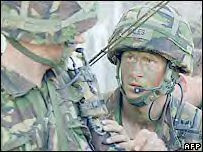
“You first,” the Prince told a US GI.

The prince said his non-deployment would be consistent with the non-deployment of offspring of other privileged elites in freedom-loving nations, such as America. “Jenna Bush isn’t going, either, so there,” said the prince. General Dannatt said the prince’s deployment would pose a threat to him and those serving alongside him.

The announcement, which represents a U-turn on an earlier decision, was made amid reports militant groups in Iraq planned to kill or kidnap the prince.

Clarence House said Prince Harry was “very disappointed” but would not be leaving the Army as a result.

The decision sparked some derision among American troops in Iraq.

“Not leaving the army because he’s not being sent to Iraq?” asked US Army Pvt. Sitting Duck, of Shawnee, Oklahoma. “I wish I had a choice about whether to leave the army based on whether they sent me to this Hell-hole,” said Duck. This is my third trip,” he added.

“As far as plans to kill or kidnap the prince, hell, the insurgents plan to kill or kidnap us all, and to me it looks like they’re doing it, even if it’s taking them longer than it looked like it might at first,” said Duck.

“Not sending Prince Harry is an operational decision taken by the military which we of course respect,” said a second Downing Street spokesperson, spared military service in exchange for being a mouthpiece for the British monarchy.

But Republic, a group which campaigns for an elected head of state, said the decision showed that “the prince should never have joined the Army”.

In a statement it said: “This is a scandalous waste of taxpayer’s money, brought on by the Windsor family’s obsession with linking themselves to the military.”

Vet’s Father Calls Decision Distasteful

Reg Keys – whose son Thomas was killed while on active service in Basra in 2003 – said he found the decision distasteful and questioned whether insurgents could have told the prince apart from other service personnel.

“It would appear that Harry’s life is more valuable than my son or the other nearly 150 service personnel who’ve given their lives,” Mr Keys added.

“A whiner,” said Gen. Dannatt. “Where is the famous stiff upper lip of our yeomen? What has happened to the ‘Do or die’ ethic of Rudyard Kipling’s time? Where is the “I regret that I have but one life to give for my country” of an earlier day?”

Reminded that that last statement was made by a patriot fighting against — not for — the British in another, earlier, colonial war, Dannatt said the point was the same: that war is fraught with risk.

Jenna Bush Takes, Then Declines, Prince’s Place

Attention of the press had ping-ponged across the Atlantic earlier in the afternoon briefly when a Pentagon spokesperson, speaking on condition of anonymity, announced that the US President’s daughter Jenna Bush had volunteered to take the prince’s place.

That offer was subsequently withdrawn, said a second Pentagon spokesperson, also speaking on condition of anonymity, when the Bush daughter learned that the identity of the soldier was a different prince that what she first had assumed.

“I’m rethinking this,” said Ms. Bush.

“Ohmigod,” said Ms. Bush, “I thought you meant Prince Prince — you know, the rock star. I wouldn’t go anywhere for some stuffy whitebread dude playing bang-bang boy in muckyville.”

Informed that her offer had already been conveyed to the British royal family, Ms. Bush seemed surprised. “Ohmigod, whatever,” said Ms. Bush. “You mean they still have, like royalty there? That’s weird,” she added. “I’m going shopping.”

Army Says Queen To Go Instead

In a response to critics that temporarily shocked reporters assembled in the Downing Street press room, Gen. Dannatt announced that because of the controversy surrounding the legitimacy of the monarchy — generated by the on-again, off-again deployment of the prince, Prime Minister Tony Blair has decided that in leiu of Prince Harry going to Iraq, his place in the volatile region will be taken by Queen Elizabeth II.

That announcement briefly caused no small amount of consternation and disbelief among the reporters assembled in the press room, with one reporter challenging General Dannatt to provide proof of what he called “an absurd statement whose jestful nature belittles the service of those British soldiers fighting in the Middle East.”

Asked if the Queen were not above the age of those accepted for duty in war zones, General Dannatt clarified his statement.

“The boat, lads, the boat is going,” said Gen. Dannatt. Dannatt said the HMS Queen Elizabeth II — converted in 1979 to a passenger cruise ship, but leased as a charter ship last week by the British military, will be leaving London Harbor shortly, to briefly and symbolically join American warships in the Persian Gulf.

HMS Queen Elizabeth 2 will sail on Friday.

“It’s a regal ship, lads, and if it gets blown up, well, the disposal costs will be less than the expense of a funeral for a prince,” said Dannatt, presenting the move as a combination of strategically smart realpolitik and economic common sense. “We’re still paying for Diana’s funeral, you know,” he added.

Posted in RagBlog | 1 Comment

Disowning a "Colleague"

Dear Attorney General Gonzales:

Twenty-five years ago we, like you, graduated from Harvard Law School. While we arrived via many different paths and held many different views, we were united in our deep respect for the Constitution and the rights it guaranteed. As members of the post-Watergate generation who chose careers in law, we understood the strong connection between our liberties as Americans and the adherence of public offi cials to the law of the land. We knew that the choice to abide by the law was even more critical when public officials were tempted to take legal shortcuts. Nowhere were we taught that the ends justified the means, or that freedoms for which Americans had fought and died should be set aside when inconvenient or challenging. To the contrary: our most precious freedoms, we learned, need defending most in times of crisis.

So it has been with dismay that we have watched your cavalier handling of our freedoms time and again. When it has been important that legal boundaries hold unbridled government power in check, you have instead used pretextual rationales and strained readings to justify an ever-expanding executive authority. Witness your White House memos sweeping aside the Geneva Conventions to justify torture, endangering our own servicemen and women; witness your advice to the President effectively reading Habeas Corpus out of our constitutional protections; witness your support of presidential statements claiming inherent power to wiretap American citizens without warrants (and the Administration’s stepped-up wiretapping campaign, taking advantage of those statements, which continues on your watch to this day); and witness your dismissive explanation of the troubling firings of numerous U.S. Attorneys, and their replacement with others more “loyal” to the President’s politics, as merely “an overblown personnel matter.” In these and other actions, we see a pattern. As a recent editorial put it, your approach has come to symbolize “disdain for the separation of powers, civil liberties and the rule of law.”

As lawyers, and as a matter of principle, we can no longer be silent about this Administration’s consistent disdain for the liberties we hold dear. Your failure to stand for the rule of law, particularly when faced with a President who makes the aggrandized claim of being a unitary executive, takes this country down a dangerous path.

Your country and your President are in dire need of an attorney who will do the tough job of providing independent counsel, especially when the advice runs counter to political expediency. Now more than ever, our country needs a President, and an Attorney General, who remember the apt observation attributed to Benjamin Franklin: “Those who would give up essential Liberty to purchase a little temporary Safety, deserve neither Liberty nor Safety.” We call on you and the President to relent from this reckless path, and begin to restore respect for the rule of law we all learned to love many years ago.

THE SIGNATORIES ARE ALL MEMBERS OF THE HARVARD LAW SCHOOL CLASS OF 1982

Source

Posted in RagBlog | Leave a comment

The Worst Assignment at State

Embassy staffers assail U.S. security
BY LEILA FADEL
McClatchy News Service

Dismayed employees at the U.S. Embassy complained about their security as they work within Baghdad’s Green Zone.

BAGHDAD — U.S. Embassy employees in Iraq are growing increasingly angry over what they say are inadequate security precautions in the heavily fortified Green Zone, where recent mortar and rocket attacks have claimed the lives of six people, including two U.S. citizens.

In spite of the attacks, Embassy employees complain, most staff members still sleep in trailers that one described as ”tin cans” that offer virtually no protection from rocket and mortar fire. The government has refused to harden the roofs because of the cost, one employee said.

NEGLIGENCE ALLEGED

A second official called it ”criminally negligent” not to reduce the size of the embassy staff, which a year ago was estimated at 1,000, in the face of the increasing attacks and blamed the administration’s failure to respond on concerns that doing so might undermine support for President Bush’s Iraq policy.

”What responsible person and responsible government would ask you to put yourself at risk like that? We don’t belong here,” the employee said, adding, “They’re not going to send us home because it’s going to be another admission of failure.”

Embassy employees have been ordered not to talk about security concerns or precautions with reporters, but three State Department employees in Baghdad discussed the issue with McClatchy Newspapers. All three asked not to be identified for fear that they’d lose their jobs.

PUBLICIZED VISITS

The officials also complained that important security precautions appeared to have been set aside during highly publicized official visits. During a March 31 visit from Sen. John McCain, R-Ariz., a high-profile presidential candidate, the embassy lifted a requirement that bulletproof vests and helmets be worn at all times. When a rocket landed outside the U.S. Embassy while Vice President Dick Cheney and several reporters visited last week, no warning sirens were sounded.

”Where were the sirens then?” one official asked. “We don’t belong here, and people are afraid to say it.”

Official spokesmen have rebuffed requests for information about the embassy, citing security concerns, and repeated requests for comment from the Embassy and the State Department in Washington went unanswered Monday. On Sunday, State Department spokesman Sean McCormack called security the ”utmost priority for” Secretary of State Condoleezza Rice and Ambassador to Iraq Ryan Crocker.

The Green Zone, which is home to the U.S. Embassy and many Iraqi government offices and officials, has long been touted as an oasis of relative peace amid the chaos of Baghdad. Entry into the zone, which covers about four square miles in central Baghdad, requires special permits, and visitors must pass through a maze of checkpoints. Attacks have been relatively rare.

SUICIDE BOMBER

But in the past several months, security in the zone has deteriorated. On April 12, a suicide bomber set off an explosion in the Iraqi parliament’s cafeteria, killing a lawmaker.

Rocket and mortar attacks also have become more frequent since the United States began a surge of additional American troops into Baghdad. On March 27, a rocket that landed behind the embassy killed an American security contractor and a U.S. soldier. On May 3, a rocket attack killed four foreign contractors.

Read it here.

Posted in RagBlog | Leave a comment

From the Front Lines – Paul Crassnerd

War Emperor Appointed to Oversee War Tsar

“I’m the appointer guy,” President Bush reminds public

Military experts express confusion, question propriety

Washington, May 16 2007
Paul Crassnerd (Spars & Straps News Syndicate)

It remains unclear exactly what Gen Lute’s Real function will be

The new, extra-Constitutional executive position of “War Tsar” created to oversee American wars has been assumed by Lt. General Douglas Lute, President Bush announced on Wednesday.

“Lutey, you’re doing a fine job,” said the President at the Rose Garden ceremony.

Contacted in Baghdad’s Green Zone, Lt. General David Petraeus, the four-star general commanding all US forces in Iraq, was asked how he felt about having a three-star general commanding him, and if he was aware of a precedent for such a command structure, or if it were even a legitimate and recognizable command under current military protocol.

“What in the world is this?” asked the Marine general. “You’re kidding, right?”

Asked for clarification, General Petraeus seemed stunned. Then this reporter asked the general if he thought the appointment could have anything to do with his statement of a month ago that the war in Iraq did not have a military solution.

“I’ve been asked to clear all my future statements about the war through White House Deputy Spokesperson Dana ….. Dana ….. whatever,” said Petraeus.

Asked if that were a case of the blind leading the blind, Petraeus shot back, “No, it’s a case of the blonde leading the benighted, who fortunately or not, can see all too clearly.”

The War Tsar position will, in turn be overseen by the position of War Emperor (WE). Chosen Wednesday by President Bush to fill the WE role was Brigadier General Richard Nofzinger III, a former Texas National Guard motor pool maintenance specialist originally from Nubuck, Arkansas.

The War Emperor position will, in its own turn, be overseen by a third-level oversight position to be known as the War Omnipotent Enlistee (WOE), announced Gen. Nofzinger. That role will be filled by an enlisted man to be chosen from among recent enlistees, said the WOE.

Asked by this reporter if that meant WE will be led by WOE, and whether responsibility for US wars in the Middle East seemed to be becoming something of a political hot potato, Gen. Nofzinger replied obliquely. “Well, you got an enlisted man, you got someone you can actually pin something on who can’t, you know, fly a plane into Camp David, and say, ‘Hey, dude, we gotta talk about this'” he noted.


“Besides, you don’t hear a lot about Alberto Gonzalez on a day like today,” he said. “Most news anchors are talking about why the President used the old spelling for Czar.”

“But wasn’t Alberto being left to twist slowly in the wind so we wouldn’t hear a lot about Iraq?” asked Gen. Lute.

At this point, Generals Lute and Nofzinger excused themselves.

“We go in search of that elusive leader who will take responsibility, not just assume command,” said Lute.

Posted in RagBlog | 1 Comment

Iraqi Oil Workers Oppose the Robbery of Their Nation

Benchmark as Theft: Iraq Oil Workers Strike to Stop Privatization
By BEN TERRALL

In ongoing negotiations between Congress and President Bush about continued funding of the Iraq war, the President late last week began to make accommodating statements about negotiating on “benchmarks” for the Iraqi government.

On May 10, the New York Times reported:

“After a briefing at the Pentagon, Mr. Bush said he had instructed Joshua B. Bolten, the White House chief of staff, to reach “common ground” with lawmakers of both parties over setting firm goals, or benchmarks, to measure progress in Iraq. Mr. Bush had previously insisted that he wanted about $95 billion for the military with no strings attached.

“‘It makes sense to have benchmarks as a part of our discussion on how to go forward,’ Mr. Bush said, even as he threatened to veto the House plan, approved on a 221-to-205 vote Thursday night, which would require him to seek approval in two months for the balance of the war money.”

But these benchmarks are hardly a compromise for the Bush Administration, and the Times, along with most other U.S. news outlets, continue to ignore one of most important of the criteria being used to judge Iraq’s “progress”: legislation imported from the U.S. that threatens to give most of Iraq’s oil to Western oil giants.

Antonia Juhasz, analyst for Oil Change International and author of The Bu$h Agenda: Invading the World One Economy at a Time, notes,

“What this law does is open up at a minimum, two thirds of Iraq’s oil to private, foreign, corporate investment on terms that are literally the most generous available, just about anywhere in the world. Generous to the oil companies, that is. () The foreign oil companies do not need to transfer any technology. They don’t need to share any of their skills. They don’t need to train Iraqi workers, and () they don’t need to invest any of their money in Iraq.”

Though some observers argue that given the instability in Iraq, extracting oil without significant sabotage and resistance damaging operations will be unlikely, Juhasz points out, “If the law passes first of all it offers [the oil companies] as long as 35-year contracts. In addition, the law gives the companies two years within which they could sign the contract but then not even get to work.”

Raed Jarrar, Iraq consultant of the American Friends Service Committee and author of the widely-read “raed in the middle” blog, commented, “The new oil law is a direct intervention in Iraq’s domestic policies. It will result in nothing more than increasing the Iraqi-Iraqi imposed violence, and the Iraqi occupation fight. The best oil law is the law that the Iraqis will choose after the last U.S. soldier leaves.”

The Iraqi Federation of Oil Unions recently announced to the Iraqi government its decision to strike on Monday, May 14th to demonstrate strong opposition to the law now before the Iraqi parliament.

Federation President Hassan Jumaa Awad al Assadi said: ‘The oil law does not represent the aspirations of the Iraqi people. It will let the foreign oil companies into the oil sector and enact privatization under so-called production sharing agreements. The federation calls for not passing the oil law, because it does not serve the interests of the Iraqi people.”

The Union is joined in its condemnation of the pending law by all of Iraq’s other trade unions, a number of political parties, and over 60 senior Iraqi oil experts.

In announcing a San Francisco demonstration (organized on very short notice) in solidarity with the oil workers, National Coordinator of U.S. Labor Against the War Michael Eisenscher wrote,

“The Congress is being sold the idea that Iraq’s adoption of the oil law will assure equitable distribution of the oil revenues, but what they are not being told (or refuse to acknowledge) is that the law has one sentence about equitable distribution, but page after page about how foreign oil companies can secure contracts to control the 2/3 of Iraq’s oil that is yet to be developed and retain that control for a generation or more. To the extent there is equitable distribution, it will be only of the profits that are left after Big Oil takes their cut. The Bush administration and IMF are pressing Iraq to adopt this law. It is shameful for the Congress to become partners in shoving a law that was conceived by, drafted for, and will benefit only the rapacious oil corporations down the throats of the Iraqi people.”

Speaking at the demonstration of veteran labor and anti-war activists in front of the San Francisco Federal Building, Eisenscher, added: “This law is unprecedented in the Middle East. Since the beginning of the war we’ve seen the looting of Iraq’s antiquities. This is a second looting. Iraq’s oil is the cheapest to extract in the world, hence it is the world’s most profitable supply of oil.”

Eisenscher concluded, “It is unjust and immoral for the U.S. to stay there one more day.”

Clarence Thomas, a long-time activist with local 10 of the International Longshore and Warehouse Union, spoke about his respect for oil workers he met on a labor delegation to Iraq. Thomas recalled that in 2003, one of the major concerns of Iraqi workers he spoke to was privatization, and told the assembled protestors, “this is an example of corpocracy, an alliance of banks, corporations and government promoting the interests of American oil companies.” Thomas saluted the militancy and resilience of the workers, and noted oil worker pay was so low their children were selling gasoline on the sides of highways.

Before the group of thirty or so activists posed for a photo to send to the strikers in Iraq, writer Ted Nace, author of the book Gangs of America: The Rise of Corporate Power and the Disabling of Democracy, took the microphone.

Nace, who maintains a website focused on the law, stressed the long history of U.S. foreign policy shafting the Iraqi people, from Washington’s 1980’s support for Saddam Hussein, to the first gulf war and the subsequent sanctions regime which killed more than a million Iraqis. Nace explained, “What we’re doing by publicizing the law is buying time to slow down the passage of this law in the Iraqi parliament. We have to continue to get the word out. Democrats like Ted Kennedy still say this is about revenue sharing absolutely not! This law has no redeeming features.”

The protest then formed a picket line which marched in a circle in front of the entrance to the Federal Building and chanted demands that Speaker of the House and San Francisco Congresswoman Nancy Pelosi stop supporting the oil law.

On a related front, last week a majority of Iraqi parliamentarians rejected the continued occupation of their country by signing a legislative petition calling on the U.S. to set a timetable for withdrawal. This has long been the sentiment of the majority of Iraqis: In September 2006, a World Public Opinion poll found that 71% of Iraqis wanted the Iraqi government to ask for U.S.-led forces to be withdrawn within a year or less. The emerging nationalist bloc behind the anti-occupation parliamentary vote is also opposed to the U.S. setting up permanent bases or privatizing Iraq’s oil.

Ben Terrall is a freelance writer based in San Francisco. He can be reached at bterrall@igc.org

Source

Posted in RagBlog | Leave a comment

Tortillas in the Ungrand Scheme of Things

Starving the poor
By Noam Chomsky

The chaos that derives from the so-called international order can be painful if you are on the receiving end of the power that determines that order’s structure. Even tortillas come into play in the ungrand scheme of things. Recently, in many regions of Mexico, tortilla prices jumped by more than 50 per cent.

In January, in Mexico City, tens of thousands of workers and farmers rallied in the Zocalo, the city’s central square, to protest the skyrocketing cost of tortillas.

In response, the government of President Felipe Calderon cut a deal with Mexican producers and retailers to limit the price of tortillas and corn flour, very likely a temporary expedient.

In part the price-hike threat to the food staple for Mexican workers and the poor is what we might call the ethanol effect — a consequence of the US stampede to corn-based ethanol as an energy substitute for oil, whose major wellsprings, of course, are in regions that even more grievously defy international order.

In the United States, too, the ethanol effect has raised food prices over a broad range, including other crops, livestock and poultry.

The connection between instability in the Middle East and the cost of feeding a family in the Americas isn’t direct, of course. But as with all international trade, power tilts the balance. A leading goal of US foreign policy has long been to create a global order in which US corporations have free access to markets, resources and investment opportunities. The objective is commonly called “free trade,” a posture that collapses quickly on examination.

It’s not unlike what Britain, a predecessor in world domination, imagined during the latter part of the 19th century, when it embraced free trade, after 150 years of state intervention and violence had helped the nation achieve far greater industrial power than any rival.

The United States has followed much the same pattern. Generally, great powers are willing to enter into some limited degree of free trade when they’re convinced that the economic interests under their protection are going to do well. That has been, and remains, a primary feature of the international order.

The ethanol boom fits the pattern. As discussed by agricultural economists C Ford Runge and Benjamin Senauer in the current issue of Foreign Affairs, “the biofuel industry has long been dominated not by market forces but by politics and the interests of a few large companies,” in large part Archer Daniels Midland, the major ethanol producer. Ethanol production is feasible thanks to substantial state subsidies and very high tariffs to exclude much cheaper and more efficient sugar-based Brazilian ethanol. In March, during President Bush’s trip to Latin America, the one heralded achievement was a deal with Brazil on joint production of ethanol. But Bush, while spouting free-trade rhetoric for others in the conventional manner, emphasized forcefully that the high tariff to protect US producers would remain, of course along with the many forms of government subsidy for the industry.

Despite the huge, taxpayer-supported agricultural subsidies, the prices of corn — and tortillas — have been climbing rapidly. One factor is that industrial users of imported US corn increasingly purchase cheaper Mexican varieties used for tortillas, raising prices.

The 1994 US-sponsored NAFTA agreement may also play a significant role, one that is likely to increase. An unlevel-playing-field impact of NAFTA was to flood Mexico with highly subsidised agribusiness exports, driving Mexican producers off the land.

Mexican economist Carlos Salas reviews data showing that after a steady rise until 1993, agricultural employment began to decline when NAFTA came into force, primarily among corn producers — a direct consequence of NAFTA, he and other economists conclude. One-sixth of the Mexican agricultural work force has been displaced in the NAFTA years, a process that is continuing, depressing wages in other sectors of the economy and impelling emigration to the US.

It is, presumably, more than coincidental that President Clinton militarised the Mexican border, previously quite open, in 1994, along with implementation of NAFTA.

The “free trade” regime drives Mexico from self-sufficiency in food towards dependency on US exports. And as the price of corn goes up in the United States, stimulated by corporate power and state intervention, one can anticipate that the price of staples may continue its sharp rise in Mexico.

Increasingly, bio fuels are likely to “starve the poor” around the world, according to Runge and Senauer, as staples are converted to ethanol production for the privileged — cassava in sub-Saharan Africa, to take one ominous example. Meanwhile, in Southeast Asia, tropical forests are cleared and burned for oil palms destined for bio fuel, and there are threatening environmental effects from input-rich production of corn-based ethanol in the United States as well.

The high price of tortillas and other, crueler vagaries of the international order illustrate the interconnectedness of events, from the Middle East to the Middle West, and the urgency of establishing trade based on true democratic agreements among people, and not interests whose principal hunger is for profit for corporate interests protected and subsidised by the state they largely dominate, whatever the human cost.

Source

Posted in RagBlog | 1 Comment

Warrantless Eavesdropping – No Surprise Here

Domestic spying program was `without legal basis,’ ex-official says
By Jonathan S. Landay and Marisa Taylor
McClatchy Newspapers, (MCT)

WASHINGTON – The Bush administration ran its warrantless eavesdropping program without the Justice Department’s approval for up to three weeks in 2004, nearly triggering a mass resignation of the nation’s top law enforcement officials, the former No. 2 official disclosed Tuesday.

In testimony to the Senate Judiciary Committee, former Deputy Attorney General James Comey said that those he believed were prepared to quit included then-Attorney General John Ashcroft and FBI Director Robert Mueller.

Comey said then-White House Counsel Alberto Gonzales and former White House Chief of Staff Andrew Card visited Ashcroft as he lay gravely ill in a hospital bed on March 10, 2004, and pressed him to re-certify the program’s legality. Ashcroft refused.

“I was angry. I thought I had just witnessed an effort to take advantage of a very seriously sick man, who did not have the powers of the attorney general because they had been transferred to me,” Comey recalled. “I thought it was improper.”

Comey, who’d assumed Ashcroft’s powers on an acting basis, had raced ahead of Gonzales and Card to the George Washington University Hospital, his car’s emergency lights flashing, and dashed up the stairs to Ashcroft’s room, trailed by his security detail.

“That night was probably the most difficult time of my professional life,” Comey recalled.

Vice President Dick Cheney and his chief counsel, David Addington, also challenged the Justice Department’s stand on the legality of the program, which was intended to detect terrorist threats and would have expired on March 11, 2004, if Bush hadn’t reauthorized it, he said.

The revelations dealt a new blow to Gonzales’ efforts to keep his job as Ashcroft’s successor amid congressional and Justice Department investigations into whether he’s politicized his agency with the pursuit of alleged voter fraud, the screening of job applicants based on their party affiliations, and the firings of eight U.S. attorneys, which Gonzales said Tuesday were overseen by Comey’s successor, Paul McNulty.

Comey’s testimony also raised new questions about the administration’s repeated assurances that the monitoring program has been conducted legally and that Americans’ constitutional right to privacy has been fully respected.

Read it here.

Posted in RagBlog | 1 Comment

Gone, Period

Disappeared without a trace: more than 10,000 Iraqis
By Shashank Bengali
McClatchy Newspapers

BAGHDAD, Iraq – When her heart is heaviest, Sahira Kereem tries to think of the little things her husband did that annoyed her. She remembers times when she suggested they visit her parents, and he just rolled his eyes.

The mental trick rarely brings her comfort. The fact remains that Riyadh Juma Saleh, her husband of nearly 15 years, went missing one day nearly three years ago and Kareem has no idea what became of him.

Over the past four years, as sectarian kidnappings and killings have gripped Iraq and U.S. forces have arrested untold numbers in an effort to pacify the country, tens of thousands of Iraqis have vanished, often in circumstances as baffling as that of Kereem’s husband, a Shiite Muslim father of three.

There’s no accurate count of the missing since the war began. Iraqi human rights groups put the figure at 15,000 or more, while government officials say 40 to 60 people disappeared each day throughout the country for much of last year, a rate equal to at least 14,600 in one year.

What happened to them is a frustrating mystery that compounds Iraq’s overwhelming sense of chaos and anarchy. Are they dead? Were they kidnapped or killed in some mass bombing? Is the Iraqi government or some militia group holding them? Were they taken prisoner by the United States, which is holding 19,000 Iraqis at its two main detention centers, at Camp Cropper and Camp Bucca?

Read it here.

Posted in RagBlog | Leave a comment

Ending Empire Before It Ends Us

From TomDispatch

Tomgram: Chalmers Johnson, Ending the Empire

Way back in 1999, when I was still a Tomdispatch-less book editor, I read a proposal from Chalmers Johnson. He was, then, known mainly as a scholar of modern Japan, though years earlier I had read his brilliant book on Chinese peasant nationalism — about a period in the 1940s when imperial Japan was carrying out its “3-all” campaigns (kill-all, burn-all, loot-all) in the northern Chinese countryside. The proposal, for a book to be called “Blowback” — a CIA term of tradecraft that, like most Americans, I had never heard before — focused on the “unintended consequences” of the Agency’s covert activities abroad and the disasters they might someday bring down upon us. Johnson began with an introduction in which he reviewed, among other things, his experiences in the Vietnam War era when, as a professed Cold Warrior, a former CIA consultant, and a professor of Asian studies at Berkeley, he would have been on the other side of the political fence from me.

In that introduction, he recalled his dismay with antiwar activists who were, he felt (not incorrectly), often blindly romantic about Asian communism and hadn’t bothered to do their homework on the subject. “They were,” he wrote, “defining the Vietnamese Communists largely out of their own romantic desires to oppose Washington’s policies.” He added:

“As it turned out, however, they understood far better than I did the impulse of a Robert McNamara, a McGeorge Bundy, or a Walt Rostow. They grasped something essential about the nature of America’s imperial role in the world that I had failed to perceive. In retrospect, I wish I had stood with the antiwar protest movement. For all its naïveté and unruliness, it was right and American policy wrong.”

It was a reversal of sentiment to which no other American of his age and background, to the best of my knowledge, had admitted. It reflected a mind impressively willing to reconsider and change — and, as it happened, it also reflected a man on a journey out of the world of Cold War anti-communism and into the heart of the American empire. When Blowback: The Costs and Consequences of American Empire finally came out in 2000, it was largely ignored (or derided) in the mainstream — until, that is, September 11th, 2001. Then, “blowback,” and the phrase that went with it, “unintended consequences,” entered our language, thanks to Johnson, and the paperback of the book, now seen as prophetic, hit the 9/11 tables in bookstores across the United States, becoming a bestseller.

Johnson’s intellectual odyssey had begun when the Cold War ended, when the Soviet Union disappeared and the American imperial structure of bases (and policy) in Asia remained standing, remarkably unchanged and unaffected by that seemingly world-shaking event. An invitation, five years later, to visit the heavily American-garrisoned Japanese island of Okinawa, in turmoil over a case in which two U.S. Marines and a sailor had raped a 12 year-old Okinawan girl, also strongly affected his thinking. There, Johnson saw firsthand what our global baseworld looked like and what it did to others on this planet. (“I was flabbergasted by the 37 American military bases I found on an island smaller than Kauai in the Hawaiian Islands and the enormous pressures it put on the population there… As I began to study it, though, I discovered that Okinawa was not exceptional. It was the norm. It was what you find in all of the American military enclaves around the world.”)

Now, five and a half years after the 9/11 attacks, Johnson has reached the provisional end of his quest and the single prophetic volume, Blowback, has become “The Blowback Trilogy.” In 2004, a second volume, The Sorrows of Empire, arrived, focused on how the American military had garrisoned the globe and how militarism had us in its grip; and finally, this year, a magisterial third and final volume, Nemesis: The Last Days of the American Republic, appeared. No one should miss it. It lays out in chilling detail the ways in which imperial overstretch imperils the American republic and what’s left of our democratic system as well as the American economy.

Now, in a step beyond even his latest book, Johnson considers whether we can end our empire before it ends us. Tom

**************

Evil Empire: Is Imperial Liquidation Possible for America?
By Chalmers Johnson

In politics, as in medicine, a cure based on a false diagnosis is almost always worthless, often worsening the condition that is supposed to be healed. The United States, today, suffers from a plethora of public ills. Most of them can be traced to the militarism and imperialism that have led to the near-collapse of our Constitutional system of checks and balances. Unfortunately, none of the remedies proposed so far by American politicians or analysts addresses the root causes of the problem.

According to an NBC News/Wall Street Journal poll, released on April 26, 2007, some 78% of Americans believe their country to be headed in the wrong direction. Only 22% think the Bush administration’s policies make sense, the lowest number on this question since October 1992, when George H. W. Bush was running for a second term — and lost. What people don’t agree on are the reasons for their doubts and, above all, what the remedy — or remedies — ought to be.

The range of opinions on this is immense. Even though large numbers of voters vaguely suspect that the failings of the political system itself led the country into its current crisis, most evidently expect the system to perform a course correction more or less automatically. As Adam Nagourney of the New York Times reported, by the end of March 2007, at least 280,000 American citizens had already contributed some $113.6 million to the presidential campaigns of Hillary Rodham Clinton, Barack Obama, John Edwards, Mitt Romney, Rudolph Giuliani, or John McCain.

If these people actually believe a presidential election a year-and-a-half from now will significantly alter how the country is run, they have almost surely wasted their money. As Andrew Bacevich, author of The New American Militarism, puts it: “None of the Democrats vying to replace President Bush is doing so with the promise of reviving the system of check and balances…. The aim of the party out of power is not to cut the presidency down to size but to seize it, not to reduce the prerogatives of the executive branch but to regain them.”

George W. Bush has, of course, flagrantly violated his oath of office, which requires him “to protect and defend the constitution,” and the opposition party has been remarkably reluctant to hold him to account. Among the “high crimes and misdemeanors” that, under other political circumstances, would surely constitute the Constitutional grounds for impeachment are these: the President and his top officials pressured the Central Intelligence Agency to put together a National Intelligence Estimate (NIE) on Iraq’s nuclear weapons that both the administration and the Agency knew to be patently dishonest. They then used this false NIE to justify an American war of aggression. After launching an invasion of Iraq, the administration unilaterally reinterpreted international and domestic law to permit the torture of prisoners held at Abu Ghraib prison in Baghdad, at Guantánamo Bay, Cuba, and at other secret locations around the world.

Nothing in the Constitution, least of all the commander-in-chief clause, allows the president to commit felonies. Nonetheless, within days after the 9/11 attacks, President Bush had signed a secret executive order authorizing a new policy of “extraordinary rendition,” in which the CIA is allowed to kidnap terrorist suspects anywhere on Earth and transfer them to prisons in countries like Egypt, Syria, or Uzbekistan, where torture is a normal practice, or to secret CIA prisons outside the United States where Agency operatives themselves do the torturing.

On the home front, despite the post-9/11 congressional authorization of new surveillance powers to the administration, its officials chose to ignore these and, on its own initiative, undertook extensive spying on American citizens without obtaining the necessary judicial warrants and without reporting to Congress on this program. These actions are prima-facie violations of the Foreign Intelligence Surveillance Act of 1978 (and subsequent revisions) and of Amendment IV of the Constitution.

These alone constitute more than adequate grounds for impeachment, while hardly scratching the surface. And yet, on the eve of the national elections of November 2006, then House Minority Leader, now Speaker, Nancy Pelosi (D-Calif.), pledged on the CBS News program “60 Minutes” that “impeachment is off the table.” She called it “a waste of time.” And six months after the Democratic Party took control of both houses of Congress, the prison at Guantánamo Bay was still open and conducting drumhead courts martial of the prisoners held there; the CIA was still using “enhanced interrogation techniques” on prisoners in foreign jails; illegal intrusions into the privacy of American citizens continued unabated; and, more than fifty years after the CIA was founded, it continues to operate under, at best, the most perfunctory congressional oversight.

Promoting Lies, Demoting Democracy

Without question, the administration’s catastrophic war in Iraq is the single overarching issue that has convinced a large majority of Americans that the country is “heading in the wrong direction.” But the war itself is the outcome of an imperial presidency and the abject failure of Congress to perform its Constitutional duty of oversight. Had the government been working as the authors of the Constitution intended, the war could not have occurred. Even now, the Democratic majority remains reluctant to use its power of the purse to cut off funding for the war, thereby ending the American occupation of Iraq and starting to curtail the ever-growing power of the military-industrial complex.

One major problem of the American social and political system is the failure of the press, especially television news, to inform the public about the true breadth of the unconstitutional activities of the executive branch. As Frederick A. O. Schwarz and Aziz Z. Huq, the authors of Unchecked and Unbalanced: Presidential Power in a Time of Terror, observe, “For the public to play its proper checking role at the ballot box, citizens must know what is done by the government in their names.”

Instead of uncovering administration lies and manipulations, the media actively promoted them. Yet the first amendment to the Constitution protects the press precisely so it can penetrate the secrecy that is the bureaucrat’s most powerful, self-protective weapon. As a result of this failure, democratic oversight of the government by an actively engaged citizenry did not — and could not — occur. The people of the United States became mere spectators as an array of ideological extremists, vested interests, and foreign operatives — including domestic neoconservatives, Ahmed Chalabi and his Iraqi exiles, the Israeli Lobby, the petroleum and automobile industries, warmongers and profiteers allied with the military-industrial complex, and the entrenched interests of the professional military establishment — essentially hijacked the government.

Some respected professional journalists do not see these failings as the mere result of personal turpitude but rather as deep structural and cultural problems within the American system as it exists today. In an interview with Matt Taibbi, Seymour Hersh, for forty years one of America’s leading investigative reporters, put the matter this way:

“All of the institutions we thought would protect us — particularly the press, but also the military, the bureaucracy, the Congress — they have failed… So all the things that we expect would normally carry us through didn’t. The biggest failure, I would argue, is the press, because that’s the most glaring…. What can be done to fix the situation? [long pause] You’d have to fire or execute ninety percent of the editors and executives.”

Veteran analyst of the press (and former presidential press secretary), Bill Moyers, considering a classic moment of media failure, concluded: “The disgraceful press reaction to Colin Powell’s presentation at the United Nations [on February 5, 2003] seems like something out of Monty Python, with one key British report cited by Powell being nothing more than a student’s thesis, downloaded from the Web — with the student later threatening to charge U.S. officials with ‘plagiarism.'”

As a result of such multiple failures (still ongoing), the executive branch easily misled the American public.

Read the rest here.

Posted in RagBlog | Leave a comment

Shirking the Middle East Peace Process

Let’s be clear. Elliot Abrams is a convicted perjurer; he lied to Congress, no less, and was forbidden from ever holding a high office in government. What he is tacitly admitting here is that BushCo has killed the Middle East peace process: they have no interest in helping create a peace agreement between Israel and the Palestinians. All they are interested in doing is keeping the Europeans and Arab states quiet about it.

U.S. official: Peace effort aimed at lessening Arab, EU pressure
By Shmuel Rosner

U.S. Deputy National Security Advisor Elliott Abrams told a group of Jewish Republicans Thursday that the effort the United States is investing in the Israeli-Palestinian conflict is aimed at lessening the pressure from Arabs and Europeans who weren’t happy with the U.S. in its past approach.

Abrams was quoted by sources at the meeting as saying that Arab and European countries want to see that there is at least an attempt or energy being exerted by the U.S. to move the peace process forward.

Abrams said the talks are sometimes not more than “process for the sake of process.”

The comments were made during a breakfast meeting of a forum of Jewish Republicans directed by Congressman Eric Cantor of Virginia, chief deputy minority whip.

Some of the attendees understood Abrams’ comments as an assurance that the peace initiative promoted by Secretary of State Condoleezza Rice doesn’t have the full backing of President George W. Bush.

“He was basically telling us that he [the President] will not let it get out of hand,” one of them said.

Abrams has long been seen by Americans and Israelis as the more skeptical member of the team responsible for Middle East diplomacy.

About two weeks ago, Haaretz reported that “Rice even has to contend with skeptics within the ranks of her own department, most notably Deputy National Security Advisor Elliott Abrams, who holds the Israeli-Palestinian portfolio in the White House. Israeli Foreign Ministry sources say that Abrams believes her plan will likely fail.”

However, people close to Abrams say it is wrong to portray him as someone who is not in tune with Rice.

The National Security Council, in a statement released Thursday, claimed that it “is inaccurate to suggest that the White House and State Department are at odds on this issue, for the entire administration – including Mr. Abrams – is committed to pursuing it and the rest of the President’s agenda.”

A Washington diplomat commenting on Abrams’ remarks told Haaretz that “it might make him uncomfortable because of the tone, but he really didn’t say anything new.”

The diplomat pointed to comments made by Foreign Minister Tzipi Livni during a visit to Washington two weeks ago that “we should negotiate because it’s better than sit and do nothing.”

This is, the diplomat said, the same approach expressed by Abrams. There are reasons to negotiate even if you don’t expect a lasting peace to come out of it.”

Source

Posted in RagBlog | Leave a comment

North Amerikkkan Press Shows Its Allegiance

To capitalist corruption and hegemony, once again.

Wall Street Journal Claims Chavez Oil Policy “Aims to Weaken US”
By Stephen Lendman
May 13, 2007, 21:10

The Wall Street Journal’s main Hugo Chavez antagonist is its self-styled Latin American “expert” Mary Anastasia O’Grady who makes up for in imagination and vitriol what she lacks in knowledge and journalistic integrity. She, however, wasn’t assigned to write the May 1 Journal attack piece reporters David Luhnow in Mexico City and Peter Millard in Caracas got to do titled “How Chavez Aims to Weaken US.” Of course, when it comes to Venezuela, the issue is oil and Chavez’s having the “audacity” to want his people to benefit most from their own resources, not predatory foreign oil companies the way it used to be when the country’s leadership only served the interests of capital ignoring essential social needs. No longer.

Chavez, of course, announced months ago his government would complete renationalizing his country’s oil reserves when state oil company PDVSA became the majority shareholder May 1 in four Orinoco River basin oil projects with a minimum 60% ownership in joint ventures with foreign partners. The plan was broadly denounced in the US major media with Journal columnist O’Grady writing April 16 “Chavez (was) brimming with bravado as he shredded (the) oil contracts (telling) foreigners to step aside because he’s in charge now (but the move will likely) end up hitting the ‘commandante of the revolution’ in the pocketbook (because of) corruption, incompetence and mismanagement” meaning Venezuela will now run all its own oil operations and forge its own future, not Big Oil O’Grady wants sole right to do it. No longer indeed, and O’Grady’s not pleased. She’s also dead wrong in her outlook for Venezuela’s oil future run by PDVSA with foreign partners, but don’t ever expect her to admit it.

So is the New York Times agreeing April 10 with O’Grady and other corporate media Big Oil cheerleaders. The Times used charged language condemning Chavez’s “revolutionary flourish (and his) ambitious (plan to) wrest control of several major oil projects from American and European companies (with a) showdown (ahead for these) coveted energy resources….” The Times went on to claim this action would undermine Venezuela’s growth hinting Big Oil’s threat to leave might get Chavez to back down enough to get them to stay. It never happened as this writer suggested April 12 in an article titled “Wall Street Journal and New York Times Attack journalism.” The article made it clear oil exploration and production in Venezuela is so profitable that even with a smaller share of the profits US, European and other Big Oil investors wouldn’t dream of leaving. Whine plenty, leave, not likely, and now we know they won’t.

AP’s Natalie Obiko Pearson reported April 26 that “Four major oil companies (stopped whining April 25 and) agreed to cede control of Venezuela’s last remaining (majority-owned) privately run oil projects to President Hugo Chavez’s government” with ConocoPhillips coming around May 1 showing it, too, was all bark and no bite. Those agreeing through signed memorandums of understanding were Chevron, BP(Amoco) PLC, France’s Total SA, Norway’s Statoil ASA, ConocoPhillips, and with most antagonistic of all to the idea ExxonMobil finally doing it privately as was almost certain to happen and then did.

AP reported ConocoPhillips has the most Orinoco basin exposure in two of four projects, Ameriven and Petrozuata with a (former) 50.1% stake in the latter. It was inconceivable the company would abandon them, and on May 1 it announced it would stay on. The one remaining issue to be resolved is compensation with foreign investors having until June 26 to negotiate terms for their reduced stakes. Expect more Big Oil whining followed by capitulation again to Venezuelan Energy Ministry’s expected offer of fair and equitable takeover terms.

On April 26, PDVSA’s web site reported a total of 10 foreign oil companies agreed to transfer majority control of their “Oil Belt” operations to the state-run oil company. Further, the company expects to achieve a daily capacity of 5.85 million barrels in 2012 and said its January 1 taking control of 32 oil fields will advance the country “toward full national sovereignty over (its) natural energy reserves.”

In response to these actions, and on the day it took effect, the Journal went on the attack again with more ahead certain to be as false and misleading. Its writers called Chavez a “self-proclaimed Maoist (wanting to) reshape the global oil business by sidelining the US and making China his country’s chief strategic energy partner” for investment and export. The Journal also accused Chavez of using “oil as a political weapon” since taking office in 1999 offering discounted oil “to dozens of Latin American countries” as his weapon of choice plus forging alliances with US “economic rivals like China and political rivals like Iran.”

Hugo Chavez, in fact, is a self-proclaimed social democrat charting his own independent course toward progressive “21st century socialism” along the lines Latin American expert James Petras calls the “pragmatic left” in contrast to the more “radical left” of Colombia’s FARC guerrillas; elements of “teachers and peasant-indigenous movements in Oaxaca, Guerrero and Chiapas in Mexico;” many “small Marxist groups in Argentina, Bolivia, Chile and elsewhere;” and Venezuela’s “peasant and barrio movements,” among others. Other Latin American leaders Petras calls “pragmatic” leftists include Bolivia’s Evo Morales, Cuba’s Castro and many “large electoral parties and major peasant and trade unions in Central and South America” including Mexico’s PRD party, El Salvador’s FMLN, Chile’s Communist Party, “the majority in Peruvian (Ollanta) Humala’s parliamentary party;” and others including “the great majority of left Latin American intellectuals.”

Unlike what the Wall Street Journal and rest of the US corporate media report or imply, Chavez and others on the “pragmatic left” aren’t aiming to destroy capitalism, just tame it. They also plan no wholesale renunciation of accumulated IMF, World Bank and other international lending agency debt, only calling for it to be on more equitable terms; restructuring it to make their nations’ debt burden fair; and aiming to become free from its repressive yoke as Venezuela did paying it off completely with Chavez announcing May 1 his country is pulling out of the IMF and World Bank, formally breaking free from the kind of debt slavery these institutions impose on countries they lend to guaranteeing their people continued impoverishment.

It’s an important move that may encourage other countries to follow as Ecuador’s President Raphael Correa already did ousting the country’s World Bank representative saying “we will not stand for extortion by this international bureaucracy.” Look for more IMF-World Bank resentment to surface ahead as Chavez’s and Correa’s courage may embolden other leaders to move in the same direction or at least begin by openly voicing public discontent as a first step to possible policy change to follow.

Read the rest here.

Posted in RagBlog | Leave a comment

BushCo – Old Tactic, Typical Target

U.S. lawyers slam Guantanamo plan

WASHINGTON — The Bush administration is trying to evade responsibility for problems at the Guantanamo Bay prison by falsely blaming defense lawyers for the trouble, the New York City Bar says.

The group’s president leveled the criticism in asking Attorney General Alberto Gonzales to abandon a U.S. Justice Department proposal to limit lawyers’ access to the nearly 400 detainees.

In a court filing this month, the department said attorney access via the mail system has “enabled detainees’ counsel to cause unrest on the base by informing detainees about terrorist attacks.”

The mail system was “misused” to inform detainees about military operations in Iraq, activities of terrorist leaders, efforts in the war on terror, the Hezbollah attack on Israel and abuse at Abu Ghraib prison, the department said in this month’s court filing.

“This is an astonishing and disingenuous assertion,” the association president, Barry M. Kamins, wrote Attorney General Alberto Gonzales.

Kamins said many detainees have been held in solitary confinement for prolonged periods and have lost hope of a fair hearing to demonstrate their innocence.

“Blaming counsel for the hunger strikes and other unrest is a continuation of a disreputable and unwarranted smear campaign against counsel,” according to the letter Friday.

Read it here.

Posted in RagBlog | Leave a comment


