
By Michael Meeropol / The Rag Blog / August 20, 2026
Mike Meeropol, Professor Emeritus of Economics at Western New England University, comments on Juliet B. Schor’s groundbreaking analysis on working too much and the possibilities of a four-day workweek. Meeropol is a frequent contributor to The Rag Blog and guest on Rag Radio.
About a month ago I received the following short article in my inbox from Portside: It was entitled “America’s Workers Deserve a Four-Day Week.”
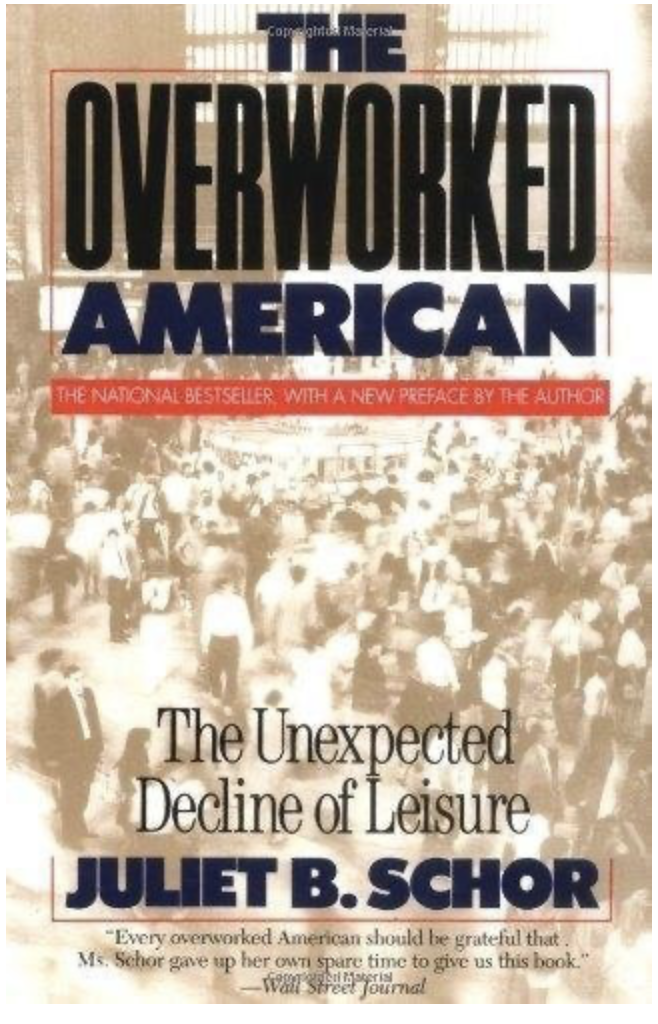
This article took me back over 30 years to 1992 when that same author, Dr. Juliet Schor of Harvard University, published an outstanding book entitled The Overworked American. Back then I was blown away by the information and conclusions of this book. I even reviewed it for the economics journal, Challenge. My review was in the July-August 1992 issue, and one can get access to it at JSTOR.
Juliet B. Schor, The Overworked American, The Unexpected Decline in Leisure, 2008, ISBN 978-0465054343, is still in print.
Building on her insights when she researched her 1992 book, Dr. Schor began in 2022 a long-term research effort to document the effects of experiments with a 4-day workweek, making 32 hours to norm. So far, the evidence is overwhelming. Workers report less burn-out, more ability to concentrate on the job and businesses report that productivity improvements have meant that even though the weekly pay has remained the same, the reduce 8 hours is more than made up for the most part.
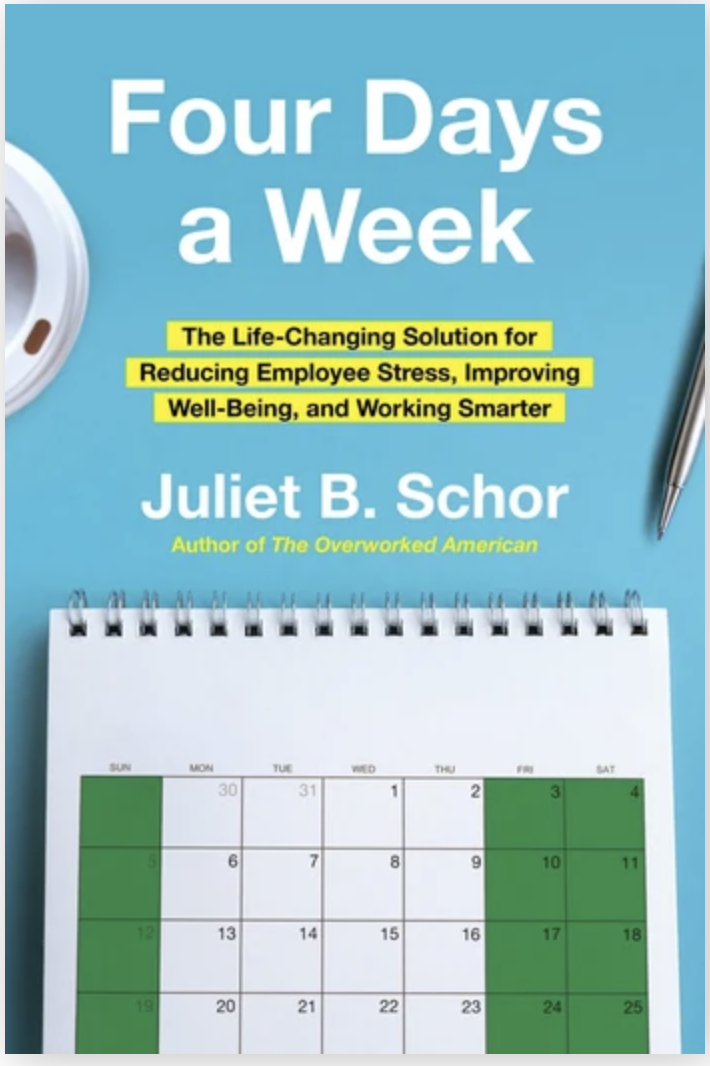
The book reporting on the first three years of research is entitled Four Days a Week: The Life-Changing Solution for Reducing Employee Stress, Improving Well-Being, and Working Smarter (Harper Business, 2025).
My education on this issue began back in 1992. I learned from The Overworked American that contrary to popular myths, the industrial revolution with its increased productivity in both agriculture and manufacturing did not translate into increased leisure for workers. In fact, the opposite happened. Medieval work had been highly regulated by the myriad feast days that slowed down the pace of work over the seasons. And in the fields, that pace was set by the serf or the peasant. There were no overseers pushing the pace of work as had occurred under Roman slavery and would later be the method of control on large plantations in the American slave south.
Per Schor’s book, required work for the Lord in medieval times was about 150 days a year but there was always self-sufficiency work (milking the cows, feeding the sheep, making sure the fences were mended, etc.) that was done all the time, even on holiday or feast days. Historians continue to debate the question of what was required work as this AdamSmith.org blog illustrates.
With the coming of the Industrial Revolution, the length of the workday was set and the speed of the work was also set. The numbers of days worked rose dramatically as well. Even more important, there was increased intensity of work – time in the factory or performing wage labor on farms (the first step in the transformation of the British labor force that transformed peasants into wage laborers occurred in the agricultural sector) was focused on making sure that time on the job was spent actually working — there was supervision.
Of course, this increase in the intensity with which people were expected to provide work produced resistance on the part of the workers. They organized labor unions which over the 19th and 20th centuries fought for shorter work weeks, better working conditions and rising wages. For much of the 19th century, that fight focused on making 10 hours the normal working day. More of this is available at IndustrialRevolution.org.
Fast forward to the middle of the 20th century. When I was growing up, I remember a fragment of a song celebrating the 8-hour day:
I’m a lucky son-of-a-gun. I work 8 hours, sleep 8 hours and have 8 hours for fun.
The 8-hour-day became the normal work week in the United States with the passage in 1940 of an amendment to the Fair Labor Standards Act. What that law explicitly did was it required employers to pay extra (the usual rule was “time and a half” – a $2 per hour wage would have to be $3 per hour) once the 40 hours of work had been satisfied.
I doubt I have to remind people that this change in the “rules” making the 8-hour day the norm, was fought tooth and nail by the leaders of American industry.
And that’s where it stood. Beginning in 1970, with gig work, temporary work, the decline of Union density in the private sector, and spread of “salaried work” up and down middle management, the actual number of hours worked per week and year has crept upward. That was the evidence that Schor focused on to write her book — and it was shocking.
Teamster.org gives an example about how much of the workforce routinely exceeds the 40-hour work week.
Since 2022, Dr. Schor and her colleagues have studied 245 organizations in seven countries. They report that for many employees, “…it’s a “life-changing” innovation.
- Sixty-nine percent of participants experience reduced burnout, and nearly 40 percent are less stressed and anxious.
- More than half experience fewer negative emotions, and nearly two-thirds feel more positive emotions.
- Forty-two percent have better mental health, and 37 percent see improvements in physical health.
- People also score much higher on work-family and work-life balance.
Okay you might ask – workers are happy to get paid the same amount to work less hours. How about the businesses who hire workers to produce enough to earn profits? Well, it appears to be helping the majority of companies who have tried this experiment. Looking at revenue, absenteeism, and resignations, the four-day week (for the most part – there are some exceptions) has been a huge win for the companies.
According to Schor, “We ask them to rate the trials, and they give consistently high scores—an average of 8.2 out of 10. Employers are mindful of the fact that their employees are thriving. As one wrote, ‘We’ve just done our annual happy check, and it’s our best employee engagement result in twenty-seven years (across twenty questions). And I think a lot of that is down to the four-day week.’.”
By the summer of 2024, 245 organizations and more than eighty-seven hundred employees have been part of Schor’s team’s research. They have done trials in the United States, Canada, Ireland, the U.K., Australia, New Zealand, and South Africa. There are research trials in Portugal, Brazil, and Germany, with more countries on the way.
Reports from the completed trials are available on the 4 Day Week Global website and for the U.K., on the Autonomy Institute website under their research tabs.
These aren’t retrospective answers. Schor’s team surveys people before the trial begins and track their individual responses at three, six, twelve, and twenty-four months. They have done statistical modeling on why people are so much better off as they work less, and find that it’s a combination of inside- and outside-of-work factors. Thirteen percent of their sample say they wouldn’t go back to a five-day schedule for any amount of money.
In measuring the judgement of the companies who have tried the experiment, Schor points to the fact that only twenty companies discontinued their four-day week by the one-year mark. These represent just 10 percent of the total.
These great results don’t happen automatically. There’s a strong focus in the trials on maintaining or improving productivity, and the expectation for many organizations is that they will get five days’ work done in four. To that end, the trials begin with a two- month period of “work reorganization” to eliminate time-wasting and low-value activities. As one participant commented, “In business, we plan better, utilize our time wisely. More productive. Everyone pulls their weight.” [All direct quotes and paraphrases are from the Introduction to Four Days a Week.]
Schor and her team have also found that some things they feared don’t materialize. Positive features of work, such as people’s sense of autonomy and control of their schedules, are stable or improve. The productivity results aren’t mainly due to speedup. People are not taking on second jobs. A measure of workplace sociability does not decline.
In another, perhaps unexpected result, customers seem to be fine with it. A senior customer-facing employee told the researchers that when she informed her main client she wouldn’t be working on Fridays, their reaction was “That’s great” and they would respect it. The four-day week now feels like common sense.
Check out the following links from more details.
- https://www.forbes.com/sites/adiaharveywingfield/2026/07/21/want-happier-more-productiveworkers-consider-a-four-day-work-week/ and
- https://www.newamerica.org/insights/juliet-schor-makes-the-case-for-a-four-day-work-week/
I was inclined to respond positively to Schor’s analysis and research but I wanted specifically to know how the improvements in productivity to offset the shorter work week would work with traditional blue-collar jobs. To keep the machines running to make sure productivity doesn’t lag would require actually hiring more workers.
One of the important points Schor made in her 1992 book was that businesses would prefer to have workers work longer hours than to hire an extra worker to fill in those hours. The reason is because workers do not just get paid an hourly wage, they get a benefit package. (Health insurance, disability insurance, maybe even life insurance or long-term care insurance.). This benefit package costs more the more workers you hire. Thus, one might think that a mandated 8-hour day and 4-day work week would be resisted by business.
However, these costs at the employer level might be changed dramataically with a national healthcare plan such as Medicare For All.
But in fact, even absent such a reform, some businesses would be able to thrive in a 4-day work week environment. One example I found in Four Days a Week refers to a Brewery named Pressure Drop Brewing. [the story is told on pages 73-78.]. The best short summary is that the ownership of the business found that there was a (small) increase in the pace of work but mostly the “savings” were from re-organizing work and “working smarter.”
Now of course this is a sample of one and the skeptical observer might find that a traditional manufacturing business with an assembly line would be forced to hire the extra workers necessary to keep the line moving with each worker getting an extra day off a week. And then there is the argument that if there were all these increased efficiencies available to companies that go from a five to a four-day work week, why haven’t they already instituted them? Schor spends a significant amount of time in the book developing the reasoning that answers these claims and I for one found it convincing. [See Pages 84-121.]
I would urge anyone whose interest is peaked by Schor’s policy brief to pick up the book. You will not be disappointed.





