
By Michael Meeropol / The Rag Blog / July 6, 2026

Michael Meeropol and Gerald Markowitz talk about David Rosner’s contributions to the defense of Public Health on Rag Radio. Gerald Markowitz and David Rosner co-authored groundbreaking books on industrial pollution, silicosis, and lead poisoning.
Listen to the interview on Rag Radio 91.7 FM.
On May 25, 2026, the Public Health and History Community lost David Karl Rosner — a great scholar and citizen — while the family lost a loving husband, father and grandfather. He was a long-time friend who I first met in the summer of 1962. That year, he was a 15-year-old maintenance man at a summer camp where I was a 19-year-old folk-music counselor. His sister Adrienne was also working at the same camp. During that summer she met and later married my closest friend Jerry Markowitz. Two years later, Adrienne introduced me to the woman who would become my wife for 53 years.
David received his PhD from Harvard University in the field of the History of Medicine. His dissertation was published as “A Once Charitable Institution.” This was an exploration of how NYC charitable hospitals succumbed to the for-profit model of institutional medicine in the early years of the 20th century. For the rest of his career, in many of his projects, he used his formidable skills as a historian-investigator to illuminate the methods by which powerful economic institutions channeled technology to make sure that profit was king — oftentimes to the detriment of the health and safety of workers and the public.
Beginning in the 1990s, he embarked on decades of collaboration with Jerry Markowitz, an outstanding historian in his own right. They wrote or edited 10 books together.

In addition to work on how businesses hid the truth about their products (in the book Deceit and Denial for example) they also wrote about the social activism of the great couple Kenneth and Mamie Clark. The Clarks, one might remember, did the famous doll study that was used by the Supreme Court in its ruling against segregated schools. They also founded a wonderful institution, the Northside Center for child development, which David and Jerry described in Children Race and Power.
What follows is a list of their collaborative book-length works:
Lead Wars: The Politics of Science and the Fate of America’s Children (Berkeley: University of California Press/ Milbank Memorial Fund, 2013)
The Contested Boundaries of Public Health, (co-edited with James Colgrove and David Rosner), Rutgers University Press, 2008.
Are We Ready? Public Health Since 9/11 (Berkeley: University of California Press/ Milbank Memorial Fund, 2006).
Deadly Dust: Silicosis and the On-Going Struggle to Protect Workers’ Health (New and Expanded edition) (Ann Arbor: University of Michigan Press, 2006).
Deceit and Denial: The Deadly Politics of Industrial Pollution, Berkeley: University of California Press/Milbank Memorial Fund, 2002; paper, 2003; new expanded edition, 2012)
Children, Race, and Power: Kenneth and Mamie Clarks’ Northside Center, (Charlottesville: University Press of Virginia, 1996; Paperback: New York: Routledge, 2000)
World Civilizations, Sources, Images, and Interpretations, volumes 1 and 2 (ed. Western Hemisphere selections) (NY: McGraw Hill, Inc, 1994, 4th edition, 2005).
Deadly Dust: Silicosis and the Politics of Industrial Disease in Twentieth Century America, (Princeton: Princeton University Press, 1991; paperback ed. Fall 1994). (Noted as an “Outstanding Academic Book of 1991” by Choice).
“Slaves of the Depression”: Workers Letters About Life on the Job (Ithaca: Cornell University Press, 1987,)
Dying for Work: Workers’ Safety and Health in Twentieth Century America (ed. with D. Rosner) (Bloomington: Indiana University Press, 1987; paperback ed. 1989). (Noted as an “Outstanding Academic Book of 1987” by Choice).
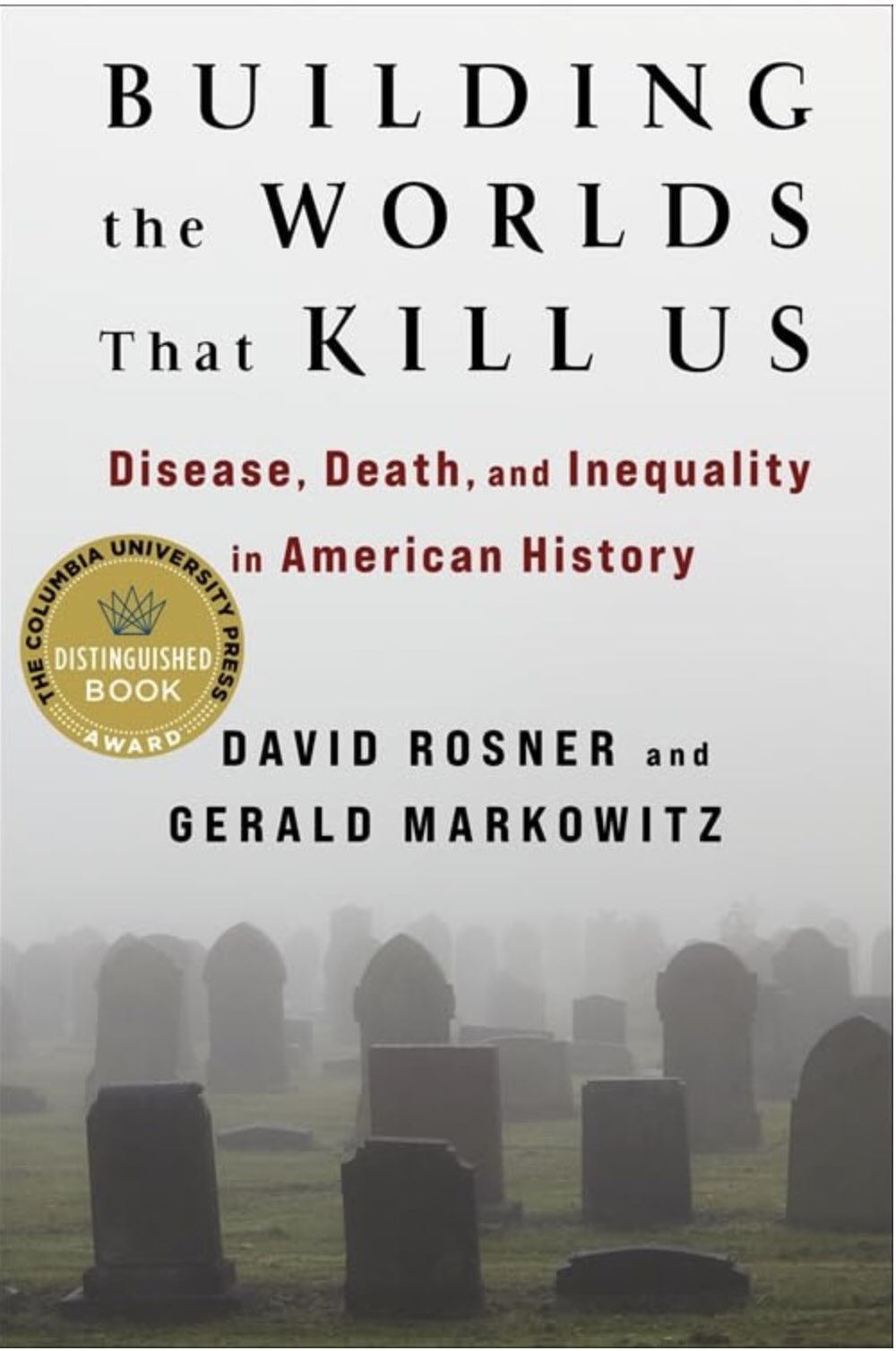
In 2024 capping off a phenomenal career, they published Building the Worlds that Kill Us: Disease, Death, and Inequality in American History ( (New York: Columbia University Press, 2024). This work investigated occupational health and community health issues over the entire scope of United States history.
If you want to read one book by these two twentieth century heroes, start with that one.
David was recognized within his field having been a Guggenheim Fellow, a recipient of a Robert Wood Johnson Investigator Award, a National Endowment for the Humanities Fellow and a Josiah Macy Fellow. He was elected to the National Academy of Medicine in 2010. He has been awarded the Distinguished Scholar’s Prize from the City University, the Viseltear Prize for Outstanding Work in the History of Public Health from the APHA and the Distinguished Alumnus Award from the University of Massachusetts. He has also been honored at the Awards Dinner of the New York Committee on Occupational Safety and Health. He and Jerry have been awarded the Upton Sinclair Memorial Lectureship “For Outstanding Occupational Health, Safety, and Environmental Journalism by the American Industrial Hygiene Association.”
Much of David and Jerry’s research work delved deeply into the ability of businesses to hide the dangerous nature of their products (sometimes for decades). The expertise shown by David and Jerry caught the attention of the former Attorney General of Rhode Island, now Senator Sheldon Whitehouse. Soon David and Jerry found themselves in demand as expert witnesses as state governments tried to hold those corporations accountable for the dangers posed by — for example — lead paint in homes. In these legal cases, their job was to pore over thousands of pages of documents delivered by corporate defendants in the discovery process of lawsuits. They sought to find the revelatory gems that nail down their efforts to cover up the dangers of their products.
Their expert testimony led to a landmark decision in Rhode Island on just that issue. Though the Rhode Island Supreme Court reversed the jury’s verdict, David and Jerry were vindicated in a similar case brought by the State of California against, among other companies, Sherwin Williams. The jury awarded over a billion dollars in damages which led the defendant companies to settle for over $100 million.
[For a detailed discussion of David and Jerry’s work in both Rhode Island and California, see https://substack.com/home/post/p-199129748]
For a fantastic radio interview with the great Terry Gross which focused on David’s and Jerry’s role in unearthing internal documents from company records that proved they knew how dangerous lead would be in paint but continued to market it aggressively and dishonestly, see https://www.npr.org/transcripts/469039064
Their work also caught the attention of none other than iconic journalist Bill Moyers who had them on his television show where he labelled them 20th century heroes. Pretty heady stuff for academics who usually toil anonymously among old dog-eared records in libraries, etc.
Up until the present, as governments continue to attempt to hold companies to account, David and Jerry have been flying all over the country to testify at numerous trials. In those confrontations, their job was to stick to the facts that they uncovered and not let themselves be bullied or diverted by clever lawyers. The corporations attempting to defend themselves have bottomless pits of money to hire teams of lawyers to attempt to discredit David and Jerry’s research — and every once in a while a hired gun historian comes along to try and poke holes in their efforts.
Back in 2004, two years after the publication of Deceit and Denial when Jerry was scheduled to testify in a case involving , Dow, Monsanto, Goodrich, Goodyear, Union Carbide, and other manufacturers or users of vinyl chloride monomer, the major constituent of PVC plastics, the defense subpoenaed the records of all the reviewers of the book and hired historian Philip Scranton, director of the Hagley Museum and Library’s Center for the History of Business, Technology, and Society and University Board of Governors Professor of History at Rutgers University in Camden. In a 41-page hatchet job, he accused David and Jerry of ethical and research misconduct in writing that book. David and Jerry fought back with a website which posted the 41-page attack, their defense, as well as the documents themselves so readers could make up their own minds about who was right.
In the attack, Scranton accused David and Jerry of having inadequate documentation, despite the fact that their book included 81 pages of footnotes. He accused them of having “repeatedly violated the AHA’s and the NCPH’s [National Council on Public History] guidelines in six specific areas: I. Integrity and Accuracy; II. Misrepresentation and Omission; III. Advocacy and Oversimplification; IV. Inadequate Documentation; V. Qualification and Interpretation; and VI. Professional Ethics.”
[Scranton’s 41-page attack is available at the website www.deceitanddenial.org It is available in Court papers as well: Philip B. Scranton, Affidavit, Douglas M. Spann, et al., United States District Court for the District of Mississippi, Jackson Division, Case No. 3:02-CV-1645WS, August 3, 2004]
Scranton attacked every aspect of David and Jerry’s professional lives. In addition to David and Jerry’s personal responses on their website, the historian Jon Weiner reviewed the controversy for The Nation. In it, he evaluated the reliability of Scranton’s claims on behalf of the industry that their work violated the AHA’s Statement of Professional Conduct. The vice president for research of the AHA, Roy Rosenzweig, at that time the Distinguished Professor of History at George Mason University, commented for the record: “I’ve read the AHA Statement on Standards, . . . I see nothing in Markowitz and Rosner’s book that’s a violation of the AHA Standards. In my opinion, the book represents the highest standards of the history profession. Scranton should be embarrassed to make the claim that there’s an ethical violation here — as opposed to the claim that he disagrees with their interpretation.” [The Weiner article is available at https://www.thenation.com/article/archive/cancer-chemicals-and-history/]
Despite the almost universal dismissal of Scranton’s claims by the historical profession, he continued to serve as a defense expert for industrial firms in subsequent toxic tort and product liability lawsuits no doubt for hefty fees.
I had a chance to bring Jerry to the law school of my college, Western New England College, during the height of this controversy and it was a pleasure to see him take apart the absurd arguments that Scranton leveled against him and David.
I am extremely proud to have known David for the past 64 years — to have watched him grow to an adult and then thrilling as he and Jerry soared to a heights only dreamed of by most history graduate students. He and Jerry used their expertise to expose how businesses producing lead-based products, silica, etc., hid the dangers and profited from that success.
We in the public are extremely grateful for the life he lived and extremely saddened by our and his family’s loss because he left us much too soon.
Michael Meeropol, Professor Emeritus of Economics at Western New England University, is a frequent contributor to The Rag Blog and guest on Rag Radio.

On July 14, 2026, you can participate in a special “One Night Only” virtual screening of the acclaimed documentary ASK E. JEAN, followed by a live Q&A with director Ivy Meeropol and actor Busy Philipps.
Date & Time: July 14 at 6:00 PM CT (7:00 PM ET)
Where to Watch: The film is streaming virtually and tickets are available via Gathr Films. (Check virtual cinema details and updates on the ASK E. JEAN Official Website.)





