
By Susan Van Haitsma / The Rag Blog / June 15, 2026
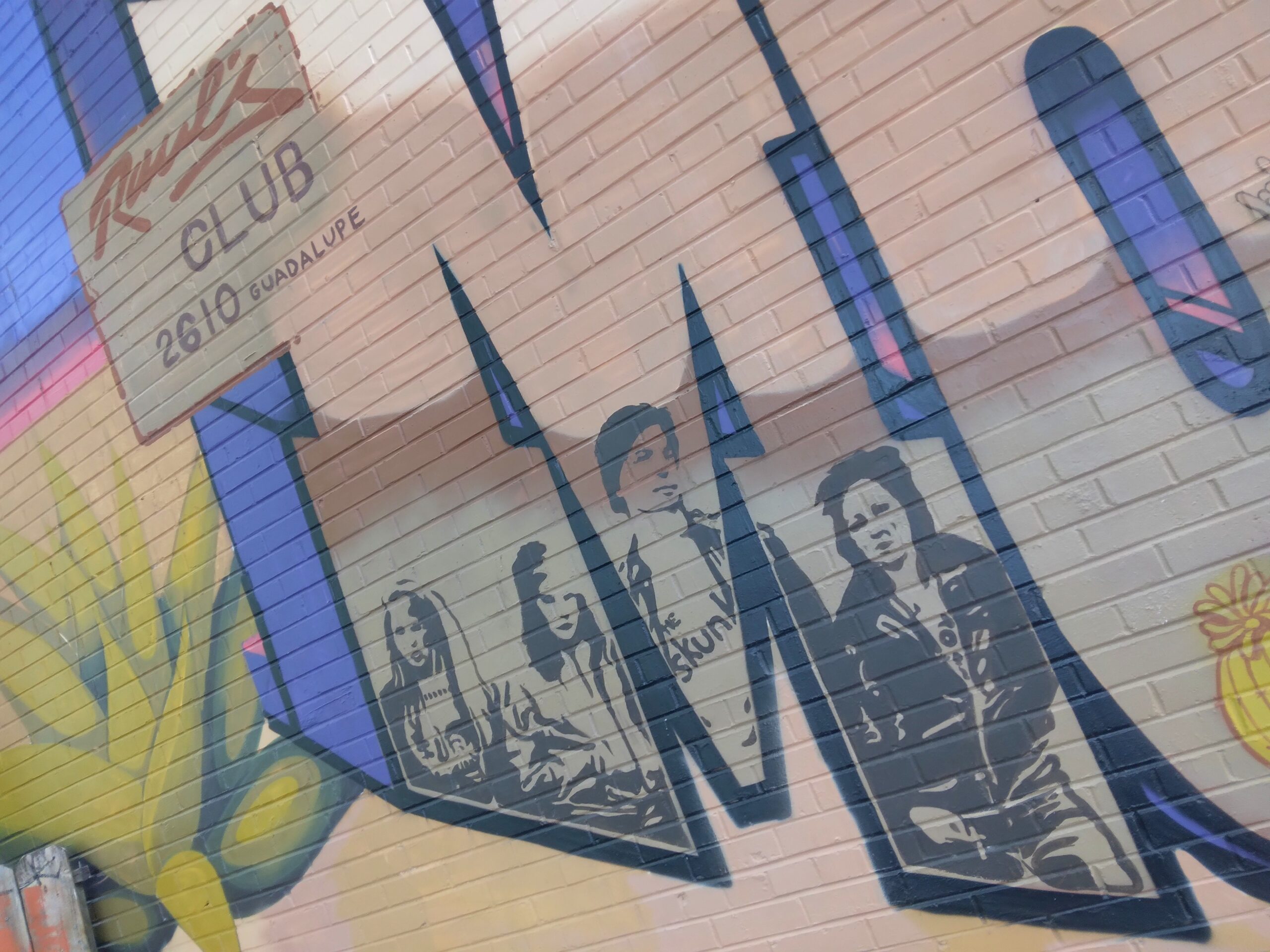
Photo by Susan Van Haitsma.
I love learning about the place, people and history of where I live. I often wonder about the people who once walked where I walk and who lived where I live in the vibrant central city of Austin, Texas. On June 6, I and a small group of others had the opportunity to learn more about the cultural history of the main Drag bordering the west side of the University of Texas campus, a primary artery that I walk or bus almost every day. A walking tour sponsored by Preservation Austin and led by Texas State music historian, Jason Mellard, made history come alive as we visited a string of venues where Austin earned its claim as the Live Music Capital of the World.
For this tour, “Down on the Drag: Sites of Austin Music History,” Jason put together an excellent itinerary of stops along Guadalupe Street that began at the iconic 23rd Street mural by Kerry Awn, wound briefly through the UT campus and finished inside legendary Antone’s Records at 29th Street. Jason arranged a surprise appearance at the store by longtime music impresario Eddie Wilson and musician/Antone’s Records co-owner, Eve Monsees, representing our remarkable span of Austin-born music.
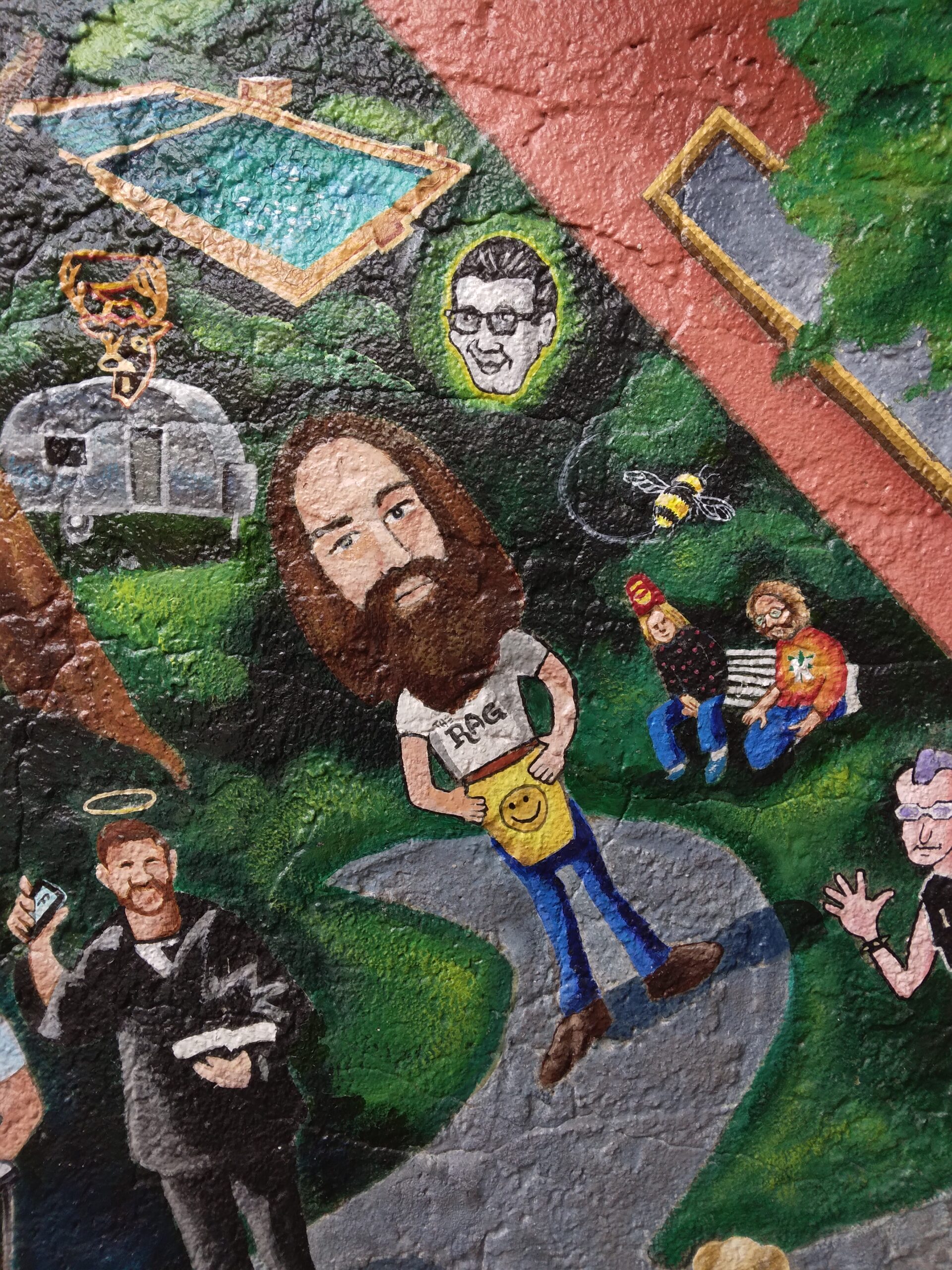
Built on his careful research, Jason’s animated narration at every stop wove together the evolution of Austin’s music scene with what was happening in student and community activism on and off campus. Austin’s civil rights, anti-war and student free-speech movements were intertwined with what musicians and music venues were doing. A handout compiled by Preservation Austin also listed dates and architectural information about the venues themselves – some buildings no longer in existence and others replaced or restored.
As we stopped in front of the restored Hogg Auditorium on the UT campus, Jason called up for us on his phone an excerpt from the final public performance recorded there by legendary blues artist, Lead Belly (Huddie Ledbetter) on June 15, 1949. Lead Belly’s music career was significantly influenced by early Texas ethnomusicologists, John Lomax and his son, Alan Lomax (born in Austin in 1915), who studied and preserved much Texas music history. Jason tied the 1949 Lead Belly performance to the racial discrimination court battle being fought at that time by UT law school applicant, Heman Sweatt. Seven years later, UT administrators, pressured by State legislators, disallowed one of UT’s first Black music students, Barbara Smith Conrad from performing opposite a white student in an operatic role in Hogg Auditorium in 1957. The university’s decision ignited widespread protest. Harry Belafonte offered Conrad funding to transfer to any other school, but Conrad decided to stay at UT, graduated and went on to have an acclaimed operatic career. In 2009, the Texas Legislature officially apologized to Conrad through a resolution in her honor. The documentary film, “When I Rise,” produced by the Briscoe Center in 2010 recounts her triumphal story.
The University YMCA, formerly at 2200 Guadalupe (where the massive Church of Scientology stands now) was a staging ground for desegregation action, and the Y’s second location at 2330 Guadalupe was a beehive of student counter-culture activity. The second floor housed The Rag offices for several years, a women’s reproductive rights hotline, draft counseling services and the Austin Women’s Center. Just up the Drag, the Methodist Student Center (now a parking lot), was likewise a hub of civil rights, peace and justice activity.
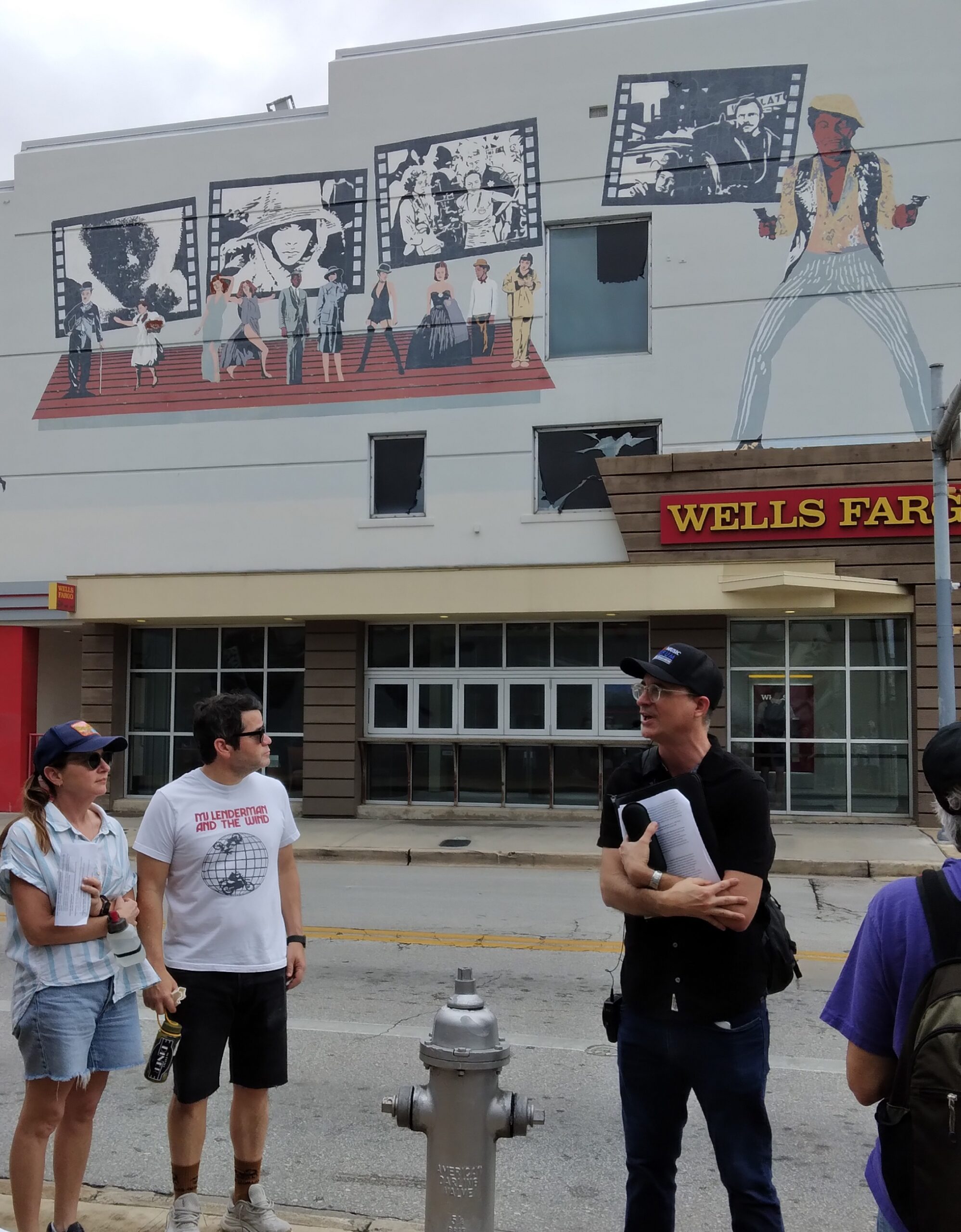
Our tour group stepped along the sidewalks where desegregation actions had happened in the 1950s and 1960s, including pickets and “stand-ins” at the Varsity Theatre. Jason stopped to discuss the mural featuring Jimmy Cliff painted on the Varsity’s (now a CVS) south side by local artist, activist and music documentarian, Carlos Lowry. Carlos had also designed posters for the punk band, The Dicks, which tied in with our next stop at the site of the former Raul’s club at 2610 Guadalupe, where The Dicks and other early punk bands performed in the 1970’s. Raul’s had taken the place of a segregationist bar, Roy’s Lounge, which had defied open accommodations law and later closed partly due to student pickets in 1965.
As we walked up to view a mural on the side of the former Raul’s depicting members of early Austin punk band, The Violators, Jason introduced a special guest: one of those band members, in the present, Jesse Sublett. Jesse, a handsome 72, his once-punkish voice subdued by a bout with throat cancer, shared stories from his Raul’s days. He explained that the venue and the punk scene helped create more GLBTQIA+ openness in Austin and beyond through the 1970s and 1980s, and he recalled jamming with Patti Smith at Raul’s when she toured in Austin. Jesse and his later band, The Skunks, toured widely, headlining shows and opening for other punk bands like The Clash and The Ramones.
Members of The Clash were influenced by Joe Ely and his hard-driving rockabilly music, and they came to Austin to perform at the Armadillo World Headquarters in 1979 with Joe Ely opening, and again in 1982 at the City Coliseum. In fact, as Jason moved our tour group along to the next stop in a parking lot off 29th Street, he passed around a photo taken from the parking lot in 1982 showing that a scene in the Austin-shot music video for “Rock the Casbah” was filmed right there during a break between The Clash’s two nights at the Coliseum.
Across from where we stood, the newly rebuilt Texas French Bread was almost ready to reopen. Its earlier incarnations included The Rome Inn, an Italian restaurant that became a blues venue and hosted Austin legends as they were just starting out, including Stevie Ray Vaughan, The Fabulous Thunderbirds, and Paul Ray and The Cobras. The building later had a brief life as punk club called Studio 29, and we learned that the convenience store, Friendly Rio Market, in whose parking lot we were standing, transforms on occasion into a punk music venue at night.
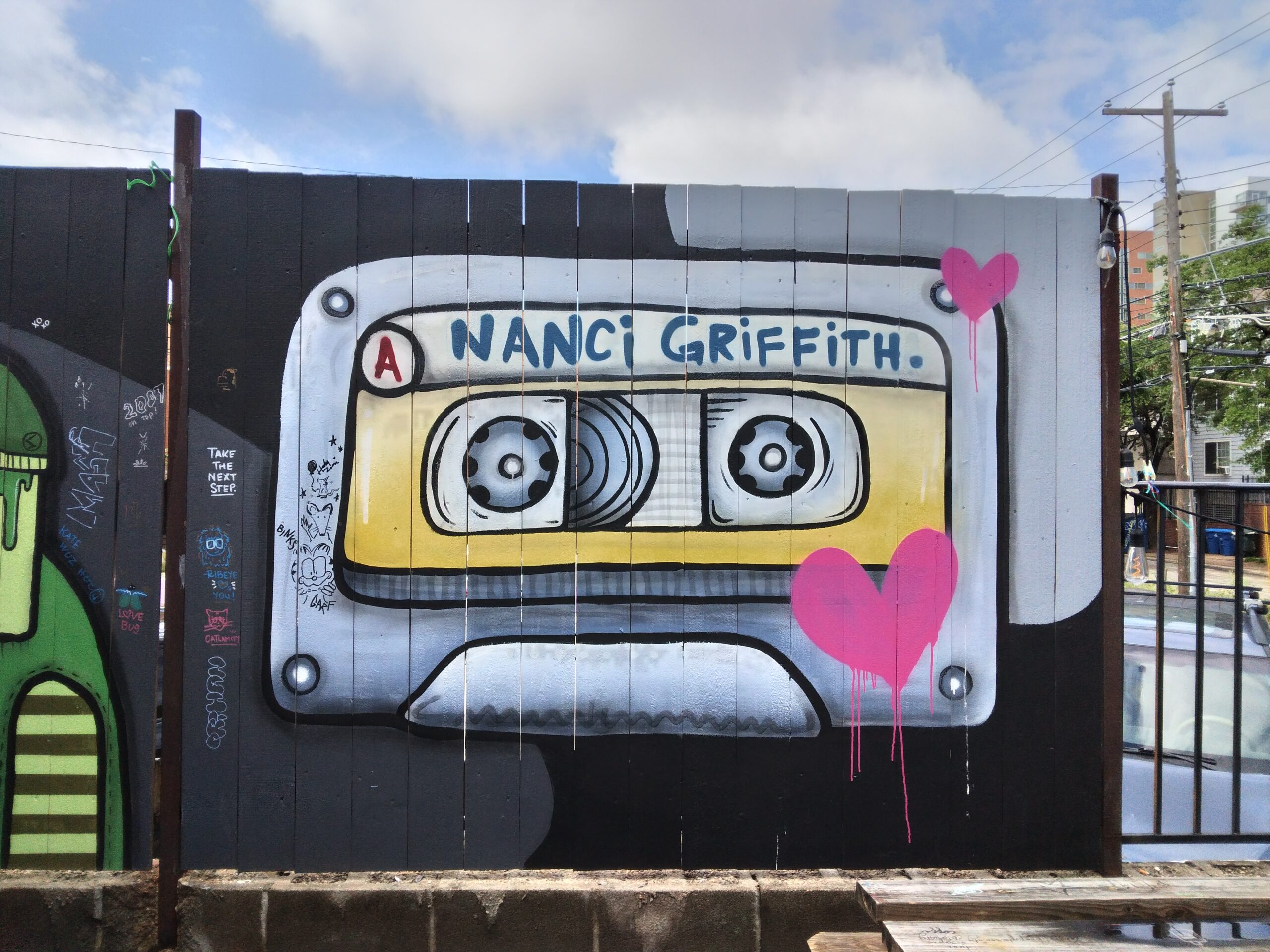
With his well of knowledge, Jason made informed connections with every stop on the tour, even as he kept us on track, elaborating as time allowed. He also arranged for a mid-tour break for refreshments and shade in the back room of The Hole in the Wall, the beloved music venue established in 1974 at 2538 Guadalupe and considered a performance incubator for Austin natives like Nanci Griffith, one of my favorite singer-songwriters. I had not been inside the Hole in the Wall for years, but I felt immediately at home again amidst the crazy collection of memorabilia, artwork and band posters that cover the walls, inside and out. The friendly bartender and the new owner of the club welcomed our group and reaffirmed my sense that the creative, humane spirit that music and activism have given to Austin will live on.
Susan Van Haitsma is an artist, a photographer, and an Austin peace activist. She has been a contributor to The Rag Blog for many years. See her recent post about CodePink Austin’s archival collection at the Austin History Center.





