HISTORY / Bob Feldman : A People’s History of Egypt, Part 3, 1805-1849

Muhammad Ali Pasha, Ottoman ruler of Egypt. Painting by Auguste Couder, 1841 / Wikimedia Commons.  

A people’s history:
The movement to democratize Egypt

Part 3: 1805-1849 period — The autocratic rule of Muhammad Ali Pasha.

By Bob Feldman | The Rag Blog | July 21, 2013

[With all the dramatic activity in Egypt, Bob Feldman’s Rag Blog “people’s history” series, “The Movement to Democratize Egypt,” could not be more timely. Also see Feldman’s series on The Rag Blog.]

Nearly two years after Muhammad Ali began ruling the Ottoman Turkish Empire’s Egyptian province, UK troops landed in Alexandria in March, 1807, and attempted to establish a permanent military base in Egypt.

But “when the British sought to extend their control…the result was fiasco” and “many British soldiers were killed” by Muhammad Ali’s troops; and the remaining UK troops in Egypt were compelled to withdraw from Egypt after September 1807, according to Jason Thompson’s A History of Egypt.

Then, according to the same book, in 1811 Muhammad Ali ended the remaining influence of the neo-Mamluk military elite in Egyptian society in the following way:

…Muhammad Ali held a celebration in the Citadel [royal palace] on Mar. 1, 1811… He invited all the principal people of Cairo, including nearly 500 Mamluk amirs. Afterward, as the Mamluks were leaving through the Citadel’s descending Interior Road…they found the exit locked… Sharpshooters [of Muhammad Ali’s loyal troops] appeared on the walls and shot them dead. Another thousand were hunted down and killed in Cairo over the next few days…

Egyptian Pasha Muhammad Ali next confiscated “the vast estates” of the slain Mamluks and the 20 percent of all Egyptian agricultural land that was owned by the religious endowments, or waqfs, and revised the Egyptian tax structure, so that “almost all of Egypt’s land came under state ownership” and he “could decree what to plant, then purchase the produce at a low price set by the state and export it for cash,” according to A History of Egypt.

Instead of just subsistence crops being grown on Egyptian agricultural land, more cash crops that earned foreign exchange — like the cotton that became Egypt’s major export crop in the years after it was introduced in Egypt in 1821 — were now grown on the state-owned land; and Muhammad Ali used the foreign exchange income to attempt to modernize Egypt’s economy by “building…factories and canals,” according to The Rough Guide To Egypt.

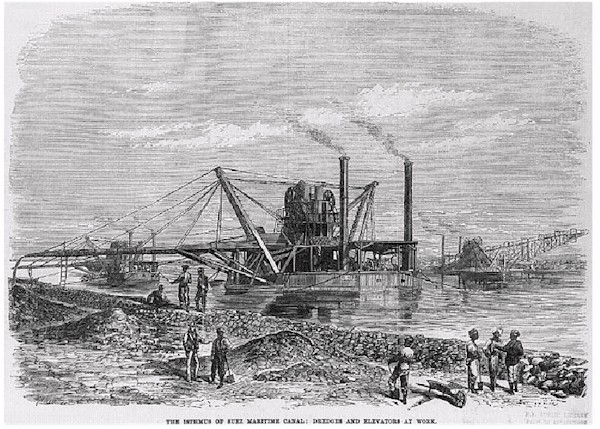
Muhammad Ali’s public works program of constructing 32 canals, 10 dikes, and 41 dams and barrages with conscripted Egyptian workers brought large amounts of new agricultural land into cultivation. In addition, as a result of his public works program of building factories in Egypt that produced textile, sugar, munitions, ships, and other manufactured goods, “Egypt became the leading industrial nation in the eastern Mediterranean” by the late 1830s, according to A History of Egypt.

By also conscripting Egyptian peasants into his military force, Muhammad Ali increased its size to 250,000 men and used his military force to occupy Sudan in the 1820, and “Egypt became the major military power in the eastern Mediterranean, making Muhammad Ali much stronger than his nominal master, the sultan in Istanbul,” according to the same book.

But after “the pasha became impatient with recognizing the sultan as his master” and “decided to move for independence” for Egypt in 1838, “a British force anchored at Alexandria” in 1839 and compelled him to reduce the size of his Egyptian military and no longer seek Egyptian independence from the Ottoman Empire of Turkey (which the UK government then supported), according to A History of Egypt.

Large numbers of Egyptians who were also drafted to work on Muhammad Ali’s various public works projects, however, lost their lives while working on the canal construction projects. As A History of Egypt,  recalled:

One of the canals, the Mahmudiya, ran for 72 kilometers between Alexandria and the western branch of the Nile. It was constructed between 1817 and 1820 with…labor of as many as 300,000 conscripted workers (of whom between 12,000 and 100,000 are said to have died, according to widely varying accounts)…

And the same book also reported how large numbers of Egyptians suffered under Muhammad Ali’s undemocratic rule and his “modernization” policies:

Muhammad Ali’s accomplishments came at a heavy price to the Egyptian people. The degree of control that the pasha exerted in Egypt was probably unprecedented since ancient times… Every productive strip of land, every palm tree, every donkey, everything that could represent value was assessed and taxed at the maximum it could bear… The people complained incessantly, but they obeyed, for the pasha’s authority was absolute. A simple horizontal motion of his hand meant execution…

Although an “outbreak of bubonic plague in 1834-35 carried away as much as a third of Cairo’s population” during the years that Muhammad Ali undemocratically ruled people in Egypt, according to A History of Egypt, some improvement in Egypt’s health care system was achieved by the end of this pasha’s rule in 1848 (when he became insane) and his subsequent death in August 1849.

[Bob Feldman is an East Coast-based writer-activist and a former member of the Columbia SDS Steering Committee of the late 1960s. Read more articles by Bob Feldman on The Rag Blog.]

The Rag Blog

Posted in Rag Bloggers | Tagged , , , , | Leave a comment

Jay D. Jurie : ‘Approved Killing’ in Florida

Emmett Till, left, and Trayvon Martin. Image from Tumblr.

Intimations of Emmett Till:
A ‘shocking story of 
approved killing’ in Florida

Today the pre-1960s explicit racial ‘code’ has been supplanted by the implicit code upon which ‘profiling’ is based.

By Jay D. Jurie | The Rag Blog | July 18, 2013

The Rag Blog‘s Jay Jurie will discuss issues raised in this article with Rag Blog editor Thorne Dreyer on Rag Radio, Friday, July 26, 2013, from 2-3 p.m. (CDT) on KOOP 91.7-FM in Austin, and streamed live to the world. The show is rebroadcast by WFTE-FM in Mt. Cobb and Scranton, PA, Sunday mornings at 10 a.m. (EDT), and all podcasts are posted at the Internet Archive after broadcast.

SANFORD, Florida — Inevitable comparisons between Emmett Till and Trayvon Martin have been made by several observers, including Lecia Brooks of the Southern Poverty Law Center and Ben Jealous of the NAACP.

What happened to Emmett Till has been described in numerous accounts. By way of brief recap: In 1955 Till, a 14-year-old African-American from Chicago, was sent by his mother to stay with relatives in rural Money, Mississippi. That August, he entered a “mom and pop” grocery store where an encounter ensued between him and the proprietor, a young white woman named Carolyn Bryant.

What happened isn’t exactly clear. Till supposedly whistled at, or flirted with, the woman. While whatever he said or did may have been inappropriate, only in the South at that time would it have warranted a death sentence. Elsewhere, it would at most have been seen as a minor offense.

Even in 1950s racially-segregated Mississippi, Till had every legal right to be where he was. However, he overstepped the bounds of the “code” of subservient behavior imposed by the white majority on Southern African-Americans at that time. Although his relatives reportedly schooled him on the code, perhaps fueled by the impudence characteristic of teen-aged boys of any race, Till may have had little or no idea of the gravity of his “offense.”

Word of what occurred soon reached the husband of the store owner, Roy Bryant, and several nights later, with his half-brother, J.W. Milam, and possibly another companion, he kidnapped Till from the home of his great-uncle. Till was savagely beaten and tortured, and then shot. A 70-pound cotton mill fan was tied to his neck with barbed wire, and his body was dropped into the nearby Tallahatchie River.

Several days later, his body was discovered in the river and then was shipped back to Chicago. His mother ordered it placed in an open casket, so the extent of Till’s injuries could be seen. This created a sensation, with thousands viewing the body and the story receiving nationwide media coverage.

Seated in the racially-segregated courtroom at the subsequent trial of Bryant and Milam was an all-white jury selected from a part of the county known to be disposed against African-Americans. Not surprisingly, Bryant and Milam were acquitted. Protected against double jeopardy, Milam later admitted in a magazine interview they had in fact murdered Till.

The interview, by journalist William Bradford Huie, was published in Look magazine under the title, “The Shocking Story of Approved Killing in Mississippi” :

As long as I live and can do anything about it, niggers are gonna stay in their place. Niggers ain’t gonna vote where I live. If they did, they’d control the government. They ain’t gonna go to school with my kids. And when a nigger gets close to mentioning sex with a white woman, he’s tired o’ livin’. I’m likely to kill him. Me and my folks fought for this country, and we got some rights.

I stood there in that shed and listened to that nigger throw that poison at me, and I just made up my mind. “Chicago boy,” I said, “I’m tired of ’em sending your kind down here to stir up trouble. Goddam you, I’m going to make an example of you — just so everybody can know how me and my folks stand.”

Milam’s revelation sent shock waves across much of the country, and in its wake, the first of the major post-Reconstruction federal laws, the Civil Rights Act of 1957, was passed to secure the rights of African-Americans. It’s now widely contended the South is a far different place than it was prior to the Civil Rights Movement of the 1960s. Florida, some have argued, was always a much different place than Mississippi. However, that’s not entirely accurate, either then or now.

It can be argued that’s particularly not the case when it comes to Sanford, Florida, where 17-year old African-American Trayvon Martin was shot dead by Neighborhood Watch coordinator George Zimmerman on February 26, 2012. Sanford was historically an agricultural community with an African-American population employed as farm labor. When the agriculture industry declined, this population was left stranded economically.

One more time. Image from Tumbler.

A very recent movie, 42, about Jackie Robinson, the first African-American major league baseball player, features scenes from Sanford in the late 1940s. One scene, of Robinson being thrown off a playing field by the police chief, is represented as taking place in nearby Deland, when it actually occurred in Sanford. Another scene, showing Robinson being forced to flee Sanford due to threatened Ku Klux Klan violence, is accurate (Goldsboro Historical Museum).

Sanford is where fatally-injured civil rights pioneers Harry T. and Harriette V. Moore were taken after their nearby home was bombed by the Klan in 1951. Sanford filled in its downtown public swimming pool rather than allow it to be integrated, and to this day, the only public swimming pool is in a predominantly African-American part of town.

Like the rest of Florida, and the South, Sanford has experienced change. However, not only is the past still present, but ongoing efforts preserve the status quo ante. While Sanford possesses several diverse neighborhoods, most of the town remains divided into sectors which are either predominantly white or predominantly African-American. Sanford has been the scene of several instances of police abuse or neglect of the African-American population, which have lately been extensively covered in the mass media.

Explicit, hard-core racism, as epitomized by the Milam quote above, is largely part of the past. Nonetheless, even more insidious, and more intractable, is implicit, soft-core racism. Illustrating this is the debate in 1998 to build a hotel-conference center in the same downtown park as the filled-in swimming pool.

Testimony from white residents in support of this proposal was based on the claim that the park was only used by drug-dealers, pimps, and prostitutes. Yet, no evidence was ever produced in support of this assertion, whereas many of the park users consisted of African-American boys and young men playing basketball.

Although not overtly stated that way, this was a not-so-transparent means for whites to reclaim “their” park. Similarly, until met with considerable protest, a recent city ordinance prohibited fishing along portions of the city’s river front, when clearly the large majority of the people who fished there were African-American.

A prominent white citizen, while campaigning for city council, proposed running the homeless out of downtown, and building a shelter on 13th Street, which is the heart of Goldsboro, the most prominent African-American neighborhood in Sanford. This proposal did not meet with success, but instead, Sanford’s imposing new police center was put in the heart of the community.

Incidentally, Goldsboro was once a separate and distinct African-American municipality, which over the objections of its residents, was incorporated into Sanford.

Trayvon Martin was murdered at the Retreat at Twin Lakes subdivision, in a rapidly developing part of Sanford, a somewhat diverse part of town alongside Interstate 4 also featuring other newer housing developments, big box stores, strip malls, including the 7-11 where he bought his last Skittles and iced tea, and auto dealerships. Not far to the east is Goldsboro, placing the newer and unstable identity of the Retreat in proximity to “old” Sanford.

It was into this admixture of past and present that George Zimmerman stepped in his self-appointed role as Neighborhood Watch captain. Speculatively, Zimmerman may be uncertain about, or conflicted with, his own ethnic identity. Of Jewish and Hispanic background, it is unlikely the explicitly racist white supremacists would consider him one of their own.

In addition to being a “wannabe cop,” Zimmerman may also have been asserting his desire for acceptance by “white culture,” he may have sought to protect both this identity, and community, which may have helped frame and foster implicit racist presumptions.

Today the pre-1960s explicit racial “code” has been supplanted by the implicit code upon which “profiling” is based. When Trayvon Martin sought to return to where he was staying with his father, even less knowingly than Emmett Till he violated that code. In today’s “New South,” perhaps especially in “purple” Florida, he may have thought he was more free than he was, not understanding he did not “belong” in that neighborhood, and was expected to react obsequiously if confronted by a “creepy-ass cracker.”

Validation: George Zimmerman congratulated by attorneys Don West and Lorna Truitt after verdict. Photo by Joe Burbank / Reuters.

Implicit racism should be regarded as part of an entrenched system of values. Like its unwritten code, this system sustains itself through the denial of its existence. Granting a defense motion in the Zimmerman case, Judge Debra Nelson ruled the prosecution could not use the word “race” in describing “profiling.” In a CNN interview with Anderson Cooper after the trial, “Juror A-37” claimed “we didn’t talk about race” during the jury deliberations.

While the jury at the Emmett Till trial, was all white, the jury in the Zimmerman case, with one Hispanic exception, was all white. An interesting question, which the prosecution apparently was not allowed to ask during voir dire, even if they wanted to, was the extent to which prospective jurors might identify with “white culture and values,” or to what extent they were familiar with, or subscribed to, the “code.”

Seminole County, the pool from which the jury pool was drawn, is 81% white, including 65% non-Hispanic white, and 12% African-American (U.S. Census).

A closely-related question not considered is Seminole County’s political climate. Whereas in 2012 Barack Obama won Florida, Mitt Romney won Seminole County 53% against 46% for Obama (Politico.com). Aside from Democratic pockets of the County consisting largely of African-American and Hispanic voters, and a scattering of white liberals, the white population is fairly solidly conservative.

A jury drawn from this political background is more likely to identify with the narrative spun by George Zimmerman, and be unaware of the influence of the “code” or even deny its existence.

Some argue the problem today is no longer race, but gun laws such as “stand your ground” that must be changed. There can be little doubt that such laws cry out desperately for change. But, especially here, the race factor is inescapable.

Critics contend Zimmerman was tried on the grounds of self-defense, not stand your ground. Regardless, it was Zimmerman’s stand your ground claim that allowed him to walk free for a month and a half before public pressure resulted in his arrest.

Evidence at trial indicated Sanford Police believed and supported Zimmerman’s claim, which implicitly denied Trayvon Martin’s legitimate right to be where he was, and dismissed the possibility that an unarmed Martin unsuccessfully attempted to stand his own ground.

Preliminary research has found that stand your ground laws are predominantly biased in favor of whites at the expense of African-Americans (Richard Florida, The Atlantic Cities).

There’s the current case of Marissa Anderson, a black woman in Florida who produced no injury when she fired a warning shot at her abusive husband, but when she claimed a stand your ground defense, received a 20-year prison sentence on a charge brought by Angela Corey, the same state attorney who unsuccessfully prosecuted George Zimmerman.

What happened to Trayvon Martin is not simply an anomaly. Some racial progress has been made. Sanford, Florida, in 2013 is not Money, Mississippi in 1955. But we are not as far removed from that time or place as many would misleadingly have us believe. We need look no further than the approved killing of Trayvon Martin.

[Jay D. Jurie, Ph.D., is an associate professor of public administration and urban and regional planning at the University of Central Florida. He lives in Sanford, Florida. Read articles by Jay D. Jurie on The Rag Blog.]

Also see “Walking while black: Trayvon Martin’s fatal shortcut” by Jay D. Jurie on The Rag Blog, March 22, 2012.

Citations and References:
Richard Florida, The Atlantic Cities article:  http://www.theatlanticcities.com/politics/2013/07/its-not-just-zimmerman-race-matters-lot-stand-your-ground-verdicts/6195/
Goldsboro Historic Museum, Sanford, on Facebook:  https://www.facebook.com/Foliver1961
Huie, William Bradford, PBS: http://www.pbs.org/wgbh/amex/till/sfeature/sf_look_confession.html
Robin D.G. Kelley article on systematic racism: http://www.counterpunch.org/2013/07/15/the-us-v-trayvon-martin/
Sanford, FL: a place to wait for a verdict: http://tv.msnbc.com/2013/07/12/in-black-sanford-a-place-to-gather-and-wait-for-a-verdict-2/
SPLC compares Emmett Till and Trayvon Martin: http://www.splcenter.org/get-informed/news/statement-from-civil-rights-memorial-center-director-lecia-brooks-in-response-to-v
Washington Post article on the Zimmerman trial verdict and justice: http://www.washingtonpost.com/opinions/ruth-marcus-zimmerman-verdict-in-martin-case-shows-justices-flaws/2013/07/14/7f7eae6a-ecc7-11e2-a1f9-ea873b7e0424_story.html

The Rag Blog

Posted in Rag Bloggers | Tagged , , , , , , , , , , | 3 Comments

Tom Hayden : Is Obama Really in Control?

This plane carrying Bolivian President Evo Morales was forced to land in Vienna despite Obama’s earlier comment that he “wouldn’t scramble jets against a 29 year old hacker.” Photo by Andres Gutierrez / AP.

Refs being ‘worked’?
Does Obama control the State?

The executive branch has aided in the unaccountable growth of a Frankenstein-like Leviathan which now is beyond the control of its own makers, operating outside the levers of democratic oversight and control

By Tom Hayden | The Rag Blog | July 18, 2013

It seemed weird, off-handed, President Obama’s comment that he “wouldn’t scramble jets against a 29 year old hacker,” just two days before the U.S. forced down a Bolivian plane carrying Evo Morales on the suspicion that Edward Snowden was smuggled aboard. Diplomatic hell broke loose, with Brazil, Venezuela, Nicaragua, Ecuador, and others all accusing the U.S. of violating their sovereignty.

With all the talk of Big Data, it’s hard to believe that Snowden couldn’t be detected enroute from the Moscow transit lounge to the departure gate for a Bolivian airliner. That aside, one wonders what if any was the connection between Obama’s remark and the forcedown which subsequently happened.

Obama presumably was trying to squelch rumblings coming from within the national security state. After all, if some of the U.S. hardliners want Julian Assange, Snowden, and their ilk executed, or tried for treason before being executed, the same types might contemplate a Special Operation to render Snowden off a foreign airliner.

As for Evo Morales, I was told by a U.S. ambassador during the Clinton administration that he was a “very bad guy” who had tried to kill American diplomats, a good example of our intelligence demented..

The problem revealed by the incident is not a new one, and not for this president alone. Can we be confident that the president controls the permanent executive branch, especially the “intelligence” apparatus? Or is it not possible that key elements of the apparatus have been fabricating intelligence, pulling strings, “working the refs,” boxing in the White House, asking forgiveness rather than permission, whatever one calls it, and running a foreign policy of their own?

If anyone is shocked by this, it’s all happened before. Several presidents were threatened with blackmail by FBI director J. Edgar Hoover who ran what one U.S. senator called a “Gestapo-operation.” John and Robert Kennedy had to go around their own generals and conspire with the Soviets to cool down the Cuban missile crisis when it was at the brink.

JFK circumvented the generals and CIA by fudging an agreement in Laos. Richard Nixon and the China Lobby foiled Lyndon Johnson’s election-year plan for peace talks by getting the Saigon generals to hold out until after the election. Jimmy Carter was forced to keep diplomacy with Cuba secret from his own State Department negotiators in the late Seventies. Bob Woodward’s Obama’s Wars documents how generals Petraeus and McChrystal tried to trap the president into a “forever war.”

And before all of them, President Eisenhower warned that, “In the councils of government, we must guard against the acquisition of unwarranted influence, whether sought or unsought, by the military-industrial complex. The potential for the disastrous rise of misplaced power exists and will persist.” [1961]

And now this: starting with the Bush era, the top-secret Foreign Intelligence Surveillance Court [FISA] has morphed into a de facto parallel Supreme Court writing and implementing a virtual constitution for the War on Terrorism era. This secret court, appointed in its entirety by the right-wing Supreme Court Justice John Roberts, has approved 1,800 surveillance orders during the past year alone, while rejecting none.

There is no adversary proceeding in this new equivalent of a Star Chamber. There are virtually no public findings. The FISA court has ruled, in secret proceedings, that the vacuuming up of “meta data” on many millions of citizens is a “special needs” exception to the Fourth Amendment ban on state searches and seizures without a warrant.

Some of the secret court’s opinions are said to be nearly 100 pages in length, issued without adversarial proceedings and virtually beyond appeal. Just because Obama is a constitutional lawyer doesn’t mean that he’s devoted detailed attention to this runaway construction of a new constitution — until something like the Snowden revelations force his attention.

“It has quietly become almost a parallel Supreme Court,” according to Eric Lichtblau in The New York Times [July 7], providing a veritable new constitutional framework for every agency engaged in activities under the umbrella of “national security.” A similar extra-constitutional project has been underway for decades to rewrite the rules of private marketplace governance in the era of corporate globalization.

Both thrusts, toward privatization and intelligence wars, represent a gradual movement towards a new legal framework for Empire which minimizes or circumvents democratic processes. The NSA plus the WTO are the “new world order” that George Bush I mused about.

Obama, who is responsible for this mushroom cloud of secrecy, seems occasionally to cry for help at his recognition that it’s spiralling out of control. Since 2012, Obama has officially “welcomed” public conversation, debate, and Congressional drafting of a “new legal architecture” in order to “rein in” his growing imperial presidency and those which are likely to follow.

His inability to implement meaningful change, however, is a remarkable illustration of the limits of the presidency. There is no sign either of Congressional willingness to re-draft the 1973 War Powers Act to cover drones, secret wars like Libya, or the growth of executive-branch cyberwar. The federal courts are complicit in the private rewriting of the Fourth Amendment and the democratic guarantees of the Constitution.

It is not only the shadow of secrecy over democracy, but the apparent grip of secret forces in the executive branch over public policy. Last week the U.S. supported a military coup in Egypt in express violation of Congressional funding restrictions, and without public hearings. Last month, the President reiterated his five-year old pledge to close Guantanamo, get detainees off life-threatening hunger strikes, and repatriate many who already are cleared for release.

As of now, those straightforward orders have not been carried out. Someone is blocking them.

A secret coup hasn’t fully happened yet, and may not, given the nature of American pluralism. But the executive branch has aided in the unaccountable growth of a Frankenstein-like Leviathan which now is beyond the control of its own makers, operating outside the levers of democratic oversight and control.

Obama’s occasional comments welcoming a “conversation” may be seen as muted alarms. If he cannot “rein in” the new Imperial Presidency, a populist protest could be slowly building toward either an insurgency presidential campaign, an uprising, or both.

[Tom Hayden is a former California state senator and leader of Sixties peace, justice, and environmental movements. He currently teaches at Pitzer College in Los Angeles. His latest book is The Long Sixties. Hayden is director of the Peace and Justice Resource center and editor of The Peace Exchange Bulletin. Read more of Tom Hayden’s writing on The Rag Blog.]

The Rag Blog

Posted in Rag Bloggers | Tagged , , , , , , , , , , | 4 Comments

Special Correspondent : Rag Blog Editor Dreyer Has Alleged Birthday!

Ridiculous graphic by James Retherford / The Rag Blog.

Unprecedented development:
Dreyer has another birthday!

Rag Blog editor Thorne Dreyer’s alleged ‘birthday’ event to be held Friday, August 2, from 6-9 p.m., at Maria’s Taco Xpress, 2529 S. Lamar Blvd in Austin.

By Our Special Correspondent / July 18, 2013

AUSTIN, Texas — In a surprising development, usually reliable sources close to the subject report that Rag Blog editor and Rag Radio host Thorne Dreyer actually intends to celebrate another birthday. This will be the 68th straight year that this unprecedented event has occurred.

Dreyer did not return our phone calls, but a close associate, who asked not to be identified, had the following response: “Shameful! He has one every year, and he does it in public!”

Records show that Dreyer was actually born on August 1st, 1945, in Houston, Texas, but, in another twist to this developing story, he has asked his friends and “extended community” (he would also appear to be delusional) to join him Friday, August 2nd, from 6-9 p.m., at Maria’s Taco Xpress, 2529 S. Lamar Blvd in Austin.

Dreyer allegedly suggested that friends and followers, in lieu of gifts, make a small donation to the New Journalism Project, the Texas nonprofit that publishes The Rag Blog. (Like that’s going to happen!)

Maria’s food menu and full bar will be available and blues-rock singer Leeann Atherton and her band will perform — reportedly under protest –- at 7 p.m. on Maria’s patio.

Proprietress Maria, when reached for comment, would only say, “Thorne who?”

The Rag Blog

Posted in RagBlog | Tagged , , , , | 2 Comments

Lamar W. Hankins : Voter Suppression is Republican Hallmark

Political cartoon by John Darkow / Columbia Daily Tribune. Image from FireIntheBelly.

Voter suppression is a hallmark 
of today’s Republicans

If it took nearly 100 years to assure racial fairness in voting under law, then it might take longer than 48 years to remedy that problem in actual practice.

By Lamar W. Hankins | The Rag Blog | July 17, 2013

I have never seen a modern definition of democracy that was not based on near-universal suffrage. It seems that the five Republicans on the Supreme Court prefer a political system that allows states to pass voting laws that suppress the vote, denying voting to many U.S. citizens.

They found section 4(B) of the Voting Rights Act (VRA) unconstitutional because it was not based on current data about voting rights violations in the nine states identified by Congress that have historically engaged in race discrimination in voting. As a result, those nine states, including Texas, no longer are required to get pre-clearance of changes to their voting laws from the attorney general or a three-judge court (section 5) until, or unless, the old data are updated.

Because section 2 of the act was unchanged, state and local governments continue to be prohibited from engaging in election practices that discriminate against and disenfranchise minority voters. However, without pre-clearance, costly and time-consuming lawsuits must be brought against discriminatory voting practices to enforce Section 2.

Congress decided in 1965, and most recently in 2006, that section 2 was not a sufficient remedy for voting discrimination. That’s why it established the pre-clearance requirement.

The U.S. began as a political system that distrusted universal suffrage, limiting the right to vote to those who owned property, were male, were not slaves, and were 21 years of age or older. One of our most revered founders and later president, John Adams, explained in a letter written in May 1776, why women, those under 21, and those who do not own property should be excluded from the voting franchise:

But why exclude women? You will say, because their delicacy renders them unfit for practice and experience, in the great business of life, and the hardy enterprises of war, as well as the arduous cares of state. Besides, their attention is so much engaged with the necessary nurture of their children, that nature has made them fittest for domestic cares. And children have not judgment or will of their own.

True. But will not these reasons apply to others? Is it not equally true, that men in general in every society, who are wholly destitute of property, are also too little acquainted with public affairs to form a right judgment, and too dependent upon other men to have a will of their own? If this is a fact, if you give to every man, who has no property, a vote, will you not make a fine encouraging provision for corruption by your fundamental law?

Such is the frailty of the human heart, that very few men, who have no property, have any judgment of their own. They talk and vote as they are directed by some man of property, who has attached their minds to his interest…”

In 1969, an acquaintance who rented an apartment and wanted to vote in a bond election in the City of Georgetown went to City Hall and rendered his wrist watch for taxation and paid the taxes so that he could vote in the election. At that time, only those who paid property taxes were allowed to vote in bond elections in that town. That same year, the Supreme Court found such voting restrictions violated the Equal Protection clause of the Fourteenth Amendment and thereafter bond elections were open to voting by all citizens.

The Voting Rights Act was renewed by Congress in 2006 by overwhelming margins (Senate — 98-0; House — 390-33). The data used in 2006, when the act was reauthorized were data from 1975. However, extensive hearings conducted before the 2006 vote yielded 15,000 pages of new testimony showing that persistent voting discrimination based on race continued to exist in the nine targeted states after the 1975 data were compiled.

And the VRA prevented more than 700 discriminatory laws from taking effect in the last 30 years — over 100 of them occurred in Shelby County, Alabama, since 1982. Shelby County was the plaintiff in the case just decided. Now, many recently-passed laws that suppress the vote (such as the Texas voter ID law) or unfairly discriminate against minorities (such as redistricting that dilutes minority voting) are being implemented.

More than 140 billboards, playing on the myth of “voter fraud,” were placed in black and Latino neighborhoods in Ohio and Wisconsin in 2012. Image from Colorlines.

While the VRA eliminated explicit legal barriers to minority voting registration (such as poll taxes and discriminatory literacy tests), the dissent recognized newer forms of discrimination, such as racial gerrymandering to dilute minority votes; at-large voting in cities with large minority populations, which prevent representative elections; and racially-discriminatory annexation by cities to dilute minority votes.

And more recently, we have experienced voter identification laws that require obtaining expensive documents (which may be impossible for poor people to pay for, even if the documents are available), purges of voting rolls aimed at minorities (which often erroneously delete eligible voters from the voting rolls), voter intimidation at the polls, and practices that have yet to be addressed in most jurisdictions, such as tricking voters to vote on non-election days or at the wrong locations, all of which have the effect of reducing minority voting.

Since the voting rights decision, some states are making plans to eliminate early voting, same-day registration, and Sunday voting hours. But the voter ID laws, which are now being rushed into place (including in Texas) are the least justified because there is almost no in-person voter fraud in the U.S. according to a national investigative reporting project funded by the Carnegie Corporation of New York and the John S. and James L. Knight Foundation, which called such fraud “infinitesimal.”

It found that the “photo ID laws disproportionately affect minorities, students, the disabled and the elderly,” which is just what today’s Republicans want.

Of course, it was Chief Justice John Roberts’ predecessor, Republican William Rehnquist, who was accused by four witnesses, during his 1986 confirmation hearings as Chief Justice, of voter intimidation and harassment at polling locations in Phoenix in the early 1960s. So it is not surprising that the Republican members of the Supreme Court are insensitive to, or look favorably on, minority voting discrimination.

Another insensitive Republican and Arizona member of the Supreme Court famously ridiculed voters in Florida during the 2000 presidential election case decided by the court in favor of George W. Bush. Justice Sandra Day O’Connor thought that any voters who could not follow voting instructions were too stupid to have their votes counted, even if their intent could be determined by a close examination of the ballots. Evidently, she thought confusing ballot presentations should be blamed on the voters, not the election officials who created the confusion.

But not all Republicans seem to agree with the Supreme Court about the Voting Rights Act. House Speaker John Boehner, commenting on the act’s renewal in 2006, said that it is “an effective tool in protecting a right that is fundamental to our democracy.” It is gratifying to see that a majority of Americans seem to agree with Boehner’s assessment. An ABC/Washington Post poll released near the end of June showed that one-third of those polled approve of the Supreme Court’s decision, but just over half (51%) disapprove.

Paul Krugman had this to say in a recent column about voting rights:

America today… (is) a place where everyone celebrates the right to vote, yet many politicians work hard to disenfranchise the poor and nonwhite… But that very hypocrisy is, in a way, a good sign. The wealthy may defend their privileges, but given the temper of America, they have to pretend that they’re doing no such thing. The block-the-vote people know what they’re doing, but they also know that they mustn’t say it in so many words. In effect, both groups know that the nation will view them as un-American unless they pay at least lip service to democratic ideals — and in that fact lies the hope of redemption.

I wish I shared Krugman’s optimism. But I view the likelihood that America will be redeemed from its sins of hypocrisy about discrimination about as much as I believe that most Republicans will embrace the Affordable Care Act. The Americans who work to deny voting rights and disenfranchise minorities without admitting that this is what they are doing are like those who will not utter racially and ethnically derogatory names in polite company, but who are under their skin vicious racists. I know these people because some of them are my relatives and acquaintances.

A few years ago, these people who would deny fundamental rights if they have sufficient cover to do so included both Democrats and Republicans. But now, most of these hypocrites have moved over to the Republican Party or are members of fringe groups. This movement is as true of Supreme Court Justices as it is of politicians. The Republicans on today’s court torture logic and routinely ignore precedent in their efforts to justify their political conclusions. They often seek indirect ways to achieve the results they favor, as they have done in the VRA case.

Justice Ginsburg’s dissent to the VRA ruling raised the point that it took nearly 100 years after passage of the Fourteenth Amendment (adopted in 1866 to guarantee equal protection of the laws for African-Americans) and the Fifteenth Amendment (adopted in 1870 to guarantee the right to vote for African-American men), to pass the Voting Rights Act to end the discrimination those amendments were intended to address.

If it took nearly 100 years to assure racial fairness in voting under law, then it might take longer than 48 years to remedy that problem in actual practice. Fixing society is not a mechanical process like fixing a car that has broken down. Human beings and societies are more difficult to fix than engines.

Republicans want to suppress the vote of people who may vote for Democrats. That is the clear purpose of unneeded and unjustified laws that impact the voter turnout for elections. And gerrymandering is almost always used to reduce the election of members of the opposite party. The evidence supports these facts, even if most Republicans are too disingenuous to admit it.

[Lamar W. Hankins, a former San Marcos, Texas, city attorney, is also a columnist for the San Marcos Mercury. This article © Freethought San Marcos, Lamar W. Hankins. Read more articles by Lamar W. Hankins on The Rag Blog.]

The Rag Blog

Posted in Rag Bloggers | Tagged , , , , , , | 1 Comment

VERSE / Larry Piltz : Spurred by Love

Lonesome cowboy, Kiev, Ukraine, 2009. Photo by Phil Douglis / PBase.

Spurred by Love

[For Buck Ramsey, Cowboy Poet Laureate]

On his last mount
the cowboy cries
a lonesome roller
and practitioner
of the riding
roping arts
also known
as its poet
laureate supreme
one late night
saying goodbye
please stay
won’t you
please

sobbing alone
one more time
to bay at the soul
of the lifeless moon
alone by the range
in the kitchen
of his exile
from the life
he’d loved
for an accident
thrown by life
from his horse
into the irony
of being the iconic
sad troubadour
of all the cowboys
lonesome yet
for a while
with no end
in sight
and poetry
to write

Larry Piltz / The Rag Blog
Indian Cove
Austin, Texas
July 17, 2013

[Larry Piltz is an Austin-based writer, poet, and musician. Find more articles and poetry by Larry Piltz on The Rag Blog.]

The Rag Blog

Posted in Rag Bloggers | Tagged , , | Leave a comment

RAG RADIO / Thorne Dreyer : Texas Law Prof Gerald Torres on Voting Rights, Affirmative Action & More

University of Texas law professor Gerald Torres in the studios of KOOP-FM in Austin, Texas, Friday, July 12, 2013. Photos by Roger Baker / The Rag Blog.

Rag Radio podcast:
UT-Austin law prof Gerald Torres
joins us on Rag Radio

We discuss the recent U.S. Supreme Court decisions on voting rights and affirmative action, plus immigration reform, Atmospheric Trust litigation, Native American sovereignty, and much more.

By Rag Radio | The Rag Blog | July 17, 2013

University of Texas law professor Gerald Torres was Thorne Dreyer’s guest on Rag Radio, Friday, July 12, 2013. Torres, who holds the Bryant Smith Chair in Law at the University of Texas, is an expert on environmental and agricultural law, critical race theory, and federal Indian law.

And he plays a mean harmonica!

Rag Radio is a syndicated radio program produced at the studios of KOOP 91.7-FM, a cooperatively-run all-volunteer community radio station in Austin, Texas.

Listen to or download this episode of Rag Radio here:


Among issues that Professor Torres discusses with us on the show are the recent U.S. Supreme Court decisions on voting rights and affirmative action, plus immigration reform, Atmospheric Trust litigation, and Native American sovereignty.

Gerald Torres, who was associate dean of the University of Minnesota Law School before coming to UT-Austin, has served as deputy assistant attorney general for the Environment and Natural Resources Division of the U.S. Department of Justice in Washington, D.C., and as counsel to then U.S. Attorney General Janet Reno.

His book, The Miner’s Canary: Enlisting Race, Resisting Power, Transforming Democracy (Harvard University Press), written with Harvard Law Professor Lani Guinier, was described by Publisher’s Weekly as “one of the most provocative and challenging books on race produced in years.”

Gerald Torres in performance!

Professor Torres is a past president of the Association of American Law Schools. He has served on the board of the Environmental Law Institute, the National Petroleum Council, and on EPA’s National Environmental Justice Advisory Council. He is a member of the Council on Foreign Relations and the American Law Institute.

Torres was honored with the 2004 Legal Service Award from the Mexican American Legal Defense and Educational Fund (MALDEF) for his work to advance the legal rights of Latinos. He currently is Board Chair of the Advancement Project, the nation’s leading social and racial justice organization. He is also on the board of the Natural Resources Defense Council and is Vice-Chairman of the Board of Earth Day Network.

He has been a visiting professor at Harvard, Stanford, and Yale law schools.

Rag Radio is hosted and produced by Rag Blog editor and long-time alternative journalist Thorne Dreyer, a pioneer of the Sixties underground press movement.

The show has aired since September 2009 on KOOP 91.7-FM, an all-volunteer cooperatively-run community radio station in Austin, Texas. Rag Radio is broadcast live every Friday from 2-3 p.m. (CDT) on KOOP and is rebroadcast on Sundays at 10 a.m. (EDT) on WFTE, 90.3-FM in Mt. Cobb, PA, and 105.7-FM in Scranton, PA.

The show is streamed live on the web by both stations and, after broadcast, all Rag Radio shows are posted as podcasts at the Internet Archive.

Rag Radio is produced in association with The Rag Blog, a progressive Internet newsmagazine, and the New Journalism Project, a Texas 501(c)(3) nonprofit corporation. Tracey Schulz is the show’s engineer and co-producer.

Rag Radio can be contacted at ragradio@koop.org.

Coming up on Rag Radio:
THIS FRIDAY,
July 19, 2013: Sociologist, media critic, and author Todd Gitlin.
Friday, July 26, 2013: Sanford, FL-based political science prof Jay D. Jurie, on the consequences of the Trayvon Martin verdict.

The Rag Blog

Posted in Rag Bloggers | Tagged , , , , , , , , , , , | Leave a comment

Type your summary here

Type rest of the post here

Source /

The Rag Blog

Posted in RagBlog | Leave a comment

TRAVEL / David P. Hamilton : What We Won’t See Driving Across France

Driving in rural France. Image from InterNations.

What Americans won’t see
while driving across France

Near Paris, there are extensive wheat fields for kilometers without fences, interspersed with old mixed deciduous forests, pastures of fat cows, and the occasional 12th century abbey.

By David P. Hamilton | The Rag Blog | July 16, 2013

PARIS — These thoughts arose during a recent drive to a friend’s country cottage three hours south of Paris, on every road type from superhighways to one lane, unpaved country lanes. What’s missing from the landscape in France that I would see routinely while traveling across Texas?

1. “Manufactured housing,” aka trailer houses. This is not a relative matter. It is an absolute. You never see trailer houses in France. I’m told that they are illegal, in violation of national building codes. You do see vacation campers that can actually be towed behind cars. Some people doubtless live in them, but that is illegitimate usage.

There is no such thing as cheap prefabricated housing in France. The carcases of such dwellings do not litter the landscape. Hence, there is no direct French translation of “trailer trash”. As an alternative, they have affordable public housing.

2. Houses constructed on 2×4 wood frames. In the U.S., the typical house is built using a 2×4 wood frame on a concrete slab with siding outside and sheetrock inside. They don’t build houses like that in France. Apparently, such houses aren’t good enough to satisfy the building codes or the French commitment to quality.

The idea of producing houses that wear out in a generation seems to have never caught on here. Instead, houses in France are typically built of reinforced cinder block and stone covered by stucco inside and out. The older ones are usually stone and mortar with heavy rough-cut wooden beams that are more like 12x12s. This reminds one of the central theme of “The Three Little Pigs.” Along comes a wolf (or tornado) and down goes that stick version.

Most U.S. housing has built-in planned obsolescence so that the construction industry gets to sell a new one to every generation and the banks get a new secured loan. Stone houses that, with proper maintenance, can last for centuries are part of the socialist conspiracy to undermine the proper market functioning of the housing industry.

3. Pickup trucks. As a pickup truck owner, I can’t really explain this, but there are almost no pickup trucks in France. Instead, there are panel trucks, often completely covered with extravagant graffiti. No French car maker produces a pickup. Neither do the Germans or Italians. There are a few Nissans and Toyotas here, but not the pickup models. I was told that pickups are “stupid” because they don’t provide security. If nothing else, this aversion to pickups means less highway litter.

I suspect that many pickup trucks parked in suburban U.S. driveways primarily satisfy the symbolic function of identifying the owner with his lost rural past and manly physical work; a reactionary cultural tendril reaching back toward the mythic old West in an attempt to replicate the supposed values of yore in the absence of horses, cows, and sweat.

4. American-made cars. There are a few Fords and Chevys that are made in Europe, but it doesn’t look like American made cars are imported in quantity. There may be Mercedes dealers all over the U.S., but there are no Cadillac dealers in Germany.

Almost the only American-made cars I’ve seen in Paris were collector items — the late 60’s Mustang convertible being transported on a flatbed truck or the Hummer parked off-street in upscale western Paris, probably seldom used since it is impossible to park on the street (too wide, automatic ticket) and exorbitant to operate.

About 70% of the cars in France are French-made, either Renault, Citroen, or Peugeot. They all make very fine cars these days, mostly clean-burning diesel-powered sedans that get about 70 kilometers per gallon. All are exported widely, but not to the U.S. The high percentage of diesel powered cars here is also due to diesel being significantly cheaper than gasoline, logical since diesel is much easier to refine. The lower price here for diesel points up the fact that diesel owners in the U.S. are getting screwed.

Gasoline in France currently costs about 1.60 euros per liter or about $8 per gallon. Most of that is taxes, which are used to develop and promote public transportation. The super-mini smart cars are a big hit in Paris. But the metro (1.5 billion rides a year), hundreds of buses, the bateaubus river boats, public electric cars, and thousands of public bicycles are much bigger hits.

5. Bumper stickers. I can’t recall ever seeing a political bumper sticker on a car in France — or a joke bumper sticker either — or any kind of sign or bumper sticker other than very occasionally “Bebe Aborde.” An American friend who has lived in Paris 35 years says that is because bumper stickers are “tacky”.

Regardless, it is clear that while the French are willing to demonstrate in massive numbers at the drop of a political hat, they are not ostentatious about those beliefs while driving. Nor do they brag about their child’s accomplishments in kindergarten or flaunt their twisted sense of humor or advertise their favorite band.

I’ve never seen a French car with a French flag sticker either, let alone flying French flags on little plastic poles attached to the windows — not even on Bastille Day. I guess they don’t feel that their patriotism is in question, so it doesn’t require perpetual demonstration. Or maybe patriotism isn’t so cool here anymore after they lost a few million citizens during several centuries of “patriotic” wars.

6. College affiliation stickers. The French equivalent of my University of Texas Alumni Association sticker seems not to exist. There is nothing like the ubiquitous orange Longhorn decal one sees continually in Austin. No “Sciences Po” on the back window.

I suspect this has to do with French schools somehow managing to educate young people without fostering spectator sports addiction among them. It could also be partly explained by all French public schools having the same curriculum and teacher pool.

Publicly flaunting your supposed educational accomplishments in the U.S. is primarily a means to express your particular tribal allegiance. Such tribalism is encouraged in the U.S. as a diversion from the danger of people becoming unified around shared interests rather than divided over Longhorns vs. Aggies, Cowboys vs. Redskins, etc, ad nauseum. The French instead teach something called “solidarity.”

7. Junked cars. There are no roadside car burial grounds, aka, junk yards. In fact, I didn’t see any junk cars at all. I don’t really know what is done with them, but I suspect some communal solution that takes place in the dead of night in some remote industrial area. Cars parked in one spot too long on a Paris street, evidenced by deep layers of bird poop and parking tickets, seem to disappear on specially constructed flatbed trucks equipped with car-sized forklifts that scour the streets in the early morning.

Of course, there were old cars parked beside houses in the countryside that were not in motion. But none of them were up on bricks, had flat tires, were rusted out, had tall weeds growing around them, or were otherwise obviously debilitated. My friend’s car on this trip was a 25-year-old Volvo.

So maybe they just keep them going, oblivious of the fact that such a lack of consumer “confidence” jeopardizes capitalism’s need for perpetual renewal and expansion.

8. Billboards. There are evidently strict laws regulating “outdoor advertising” in France. There are only a few commercial signs decorating the roadsides, perhaps 1% of what you see in the U.S. The roadside signs you normally see are small ones clustered on the edge of towns and around commercial centers. These are typically one meter by two meters or less and refer to local establishments.

If you drive through large industrial and commercial areas outside major towns, there are more and they are bigger. But there are no commercial signs at all on superhighways and there are no U.S. billboard-size commercial signs anywhere. The public authorities apparently recognize that such signs are a distraction to drivers and have opted for safety over sales, another significant socialist infringement on your God-given right to consume without restraint.

9. Fences, especially barbed wire fences. There are fences along superhighways that attempt to impede animals from crossing them, but once on secondary roads, fences become scarce, generally only surrounding pastured animals and almost never with barbed wire. It seems that the French commitment to property rights doesn’t go so far as barbs. In the U.S., real property is almost always fenced. In France it usually is not.

On the back roads, kilometers roll by among fields, forests, and little villages without a fence in sight. I’m told that France long ago required rural property owners who “enclosed the commons” to provide the public with a means to cross that land. That tradition remains. We walked hours along paths over rolling hills beside fields and through forests without encountering a fence or a “Keep Out” sign. There was strangely no question as to whether we had a right to be there.

10. “No Trespassing” or “Posted: Keep Out” signs. I did see a couple of “Chemin privee” signs, which mean “private road.” But as we took our walks through the countryside, I never saw a sign saying “No Trespassing” or anything of the kind. I am told such signs do exist, but since property owners must provide a means to cross their land, they are uncommon.

Clearly, property rights are not well-respected in this country. This lack of separation between mine and yours also reflects that French “fraternity,” which contrasts markedly with the state religion of individualism practiced by much of the population in the U.S.

11. Any reference to interscholastic or intercollegiate athletics. No sign pops up on the edge of a quaint village saying “Go Hippos!” No billboard screams “Gig Um Aggies!” — whatever that might mean. This is due largely to the utterly inconceivable sacrilege committed by French educational institutions by not sponsoring competitive athletic teams. Here, if you want to play football on a team (aka soccer in the U.S.), you must actually join a football club that has no formal connection to a school.

You also will find no reference to “American football” whatsoever, anywhere in France. I know it is hard to imagine how the male population here endures life without it, but football, as only Americans conceive it, literally does not exist in France — or really anywhere else other than the U.S. Can you possibly imagine the pathetic state to which my own suburban high school would descend without its $50 million dollar football stadium, its $200,000-a-year football coach, the pep rallies, the cheer leaders – the “traditions”?

12. Highway Patrol cars. It’s not that France doesn’t have highway cops and enforce its highway traffic laws. They just don’t do it with high-powered vehicles driven by power-drunk young men lurking beside the road. In the course of several thousand miles of driving across France, I’ve seen perhaps two incidents where motorcycle cops stopped vehicles on highways.

One rarely sees marked highway police vehicles at all. France does have unmarked traffic cop cars that will photograph your license plate while you are committing an offense and send you a fine in the mail. They also have radar in fixed sites that do the same thing. But very rarely does anyone actually pull you over. This no-stopping policy cuts down on problematic cop-citizen interactions on the roadside leading to more serious issues, such as the common U.S. criminal offense of young black male driving a Mercedes.

13. Tractor/trailer trucks outside the right lane on superhighways. A tractor-trailer strays out of the right hand lane on a high-speed highway only when one slow truck is passing an even slower one. It is rare, momentary, and often results in flashing lights and blaring horns from passing cars. This is due to the simple fact that trucks are restricted to a maximum speed of 90 kph (56 mph) on superhighways while cars can go 130 kph (81 mph).

The left lane is used exclusively by cars due to the simple fact that they are allowed to go so much faster than trucks. This segregation of cars and trucks makes superhighways in France much safer. Due to very tight restrictions on money in politics, ( i.e., bribes), the trucking industry lobby in France obviously lacks the political clout of its American counterpart.

14. Fly-overs. You never encounter a high speed curving road 100 feet in the air in France. You know how fun those are with a couple of those tractor trailers doing 80 on your butt. Tunnels are the preferred alternative. My acrophobic wife much prefers the French highways for their ground hugging approach to traffic management.

15. Long stretches of superhighway with no facilities. The roadside facilities include fuel, edible food, decent coffee, clean toilets that don’t require getting a key from a surly teenager, playgrounds, picnic tables, ample parking, green space, and various other amenities. They are regular built-in features of major highways, occurring about every 25 kilometers.

These “aires” are publicly owned and leased out to private companies to operate. Superhighways are almost all toll roads and you don’t exit them in order to visit an “aire.” This means that these highways usually don’t have “frontage roads,” which means that they are not lined with commercial enterprises. And that means that such enterprises stay in the towns nearby so those towns are less likely to dry up and blow away like so many small towns in the U.S. that had the misfortune to be located a mile or so from the interstate highway.

16. Fields of GMO corn or GMO anything else. In the U.S., over 90% of the corn, cotton, and sorghum raised is genetically modified. In France, food products that contain greater than 0.1 percent GMO components must be labeled to indicate the use of GMOs. If so labeled, people won’t buy them in sufficient quantities to make their sale profitable. Hence, they hardly exist.

Many packaged food products here do have labels that prominently declare that they have no GMO components, apparently a major selling point. The average French person spends a much higher percentage of their disposable income on food than does the average American, despite having similar incomes and food prices.

Here, being a “foodie” has deep cultural roots. There are hundreds of registered types of French cheese. Despite the proliferation of supermarkets, it remains very common for consumers to patronize specialty food stores and street markets almost exclusively, even though they are more expensive. People here who are serious about their food, don’t buy perishable food products in supermarkets and are willing to spend more for better quality products.

17. Empty fields and unused farmland. If you drive from Austin to Dallas or Houston, you will likely see only two or three different crops being raised commercially. Corn and hay mainly. Maybe some cotton or sorghum. You will see great expanses of land that could be farmed, not being farmed. Or grazing land with nothing grazing.

Here, the land is used much more intensively. Even if the purpose is to keep an area natural, that purpose is pursued with intent. Forests are distinct, usually surrounded by equally distinct planted fields. Near Paris, there are extensive wheat fields for kilometers without fences, interspersed with old mixed deciduous forests, pastures of fat cows, and the occasional 12th century abbey. The whole countryside looks purposeful. In Burgundy, the vines of the world’s best wines stretch across rolling hills mixed with yellow blooming rape seed (canola oil) and green wheat fields, a checkerboard of color that would make a Baylor fan ecstatic.

18. Dying small towns. France had about 20 million inhabitants in 1300. 300 years of plague and war diminished that number by about half. Hence, many villages in France today are very old and have a medieval core. There are so many quaint and charming thousand-year-old villages dotting the French countryside, they become a cliché. There are volumes entitled “the 100 most picturesque villages in (fill in the region of your choice)” and the competition to get listed is stiff.

Most small towns in rural France are not drying up and blowing away. They instead are experiencing a resurgence as the trends of second homes and urban dwellers retiring to the country grow and large numbers of foreigners continue to invest in French real estate, 250,000 British alone. We have rented apartments in France that were owned by expat-Americans, British, Irish, and Italians as well as French.

In addition, the French have the world’s highest rate of second home ownership, mostly in rural settings. Towns of a few hundred people have excellent restaurants and charming boutique hotels set in 200-year-old farmhouses. Village street markets present a cornucopia of locally produced food items to eager crowds of generally older folk.

We lined up at the weekly street market in the public square of the small town of Levroux, hardly a common destination, to buy the local white asparagus and goat cheeses with the other seniors. This market offered a considerable array of gourmet food products in a town of roughly 3,000 inhabitants. Most of our fellow shoppers had walked to the market pulling their little two-wheeled grocery carts, a device about as common in the U.S. as walking to the grocery store.

The “supermarket” across the street from this market is the size of a U.S. convenience store and was quiet on market day.

19. Exception (something you see more of in France): Road rage. You will see a lot more road rage while driving in France. People yell, honk, and shoot the finger with relative abandon compared to the U.S. French drivers are aggressive and vocal. I attribute this to Latin temperament and the extreme rarity of handguns. And it’s all bluster.

There are occasional moments when the French landscape is unattractive. Industrial areas and large commercial centers are growing on the outskirts of the larger of those lovely villages. The French retailer Carrefour is second only to Walmart. Some parts of the “banlieu” outside Paris are notorious for their grimness.

The “outdoor advertising” industry is small, but growing. McDonalds, Subway, and Starbucks are plentiful in cities. The Americanization of France is a continuous force. But the American driving through rural France should be warned in advance that things are different there in ways that don’t necessarily reflect well on what they assume is “the best of all possible worlds.”

[David P. Hamilton, a graduate of the University of Texas at Austin in history and government was an activist in 1960s-’70s Austin and was a contributor to the original Rag. David and wife Sally spend part of every year in France. Read more articles by David P. Hamilton on The Rag Blog.]

The Rag Blog

Posted in Rag Bloggers | Tagged , , , , | 4 Comments

BOOKS / Ron Jacobs : ‘Fire and Flames’ is History of German Autonomist Movement

‘Fire and Flames’:
Spontis, squats, and West Germany

The squats served as living spaces and community meeting places. By 1973, they would become the site of some of the fiercest street battles ever seen in postwar Frankfurt.

By Ron Jacobs | The Rag Blog | July 16, 2013

[Fire and Flames: A History of the German Autonomist Movement by Geronimo, Introduction by George Katsiaficas, Afterword by Gabriel Kuhn (2012: PM Press); Paperback; 256 pp; $19.95.]

My latest novel is situated in Frankfurt am Main in what was then West Germany (or the Bundesrepublik Deutschland for you German speakers). The time period is 1971-1972 and two of the main protagonists live in a squatted building across from the U.S. military’s Post Exchange.

This squat really existed. In fact, there were several squatted buildings in Frankfurt, especially in the part of the city known as the Westend. The squats served as living spaces and community meeting places. By 1973, they would become the site of some of the fiercest street battles ever seen in postwar Frankfurt. The battles took place because the police had been instructed to take the buildings back by the banks that owned them and the politicians that served those banks.

I mention this because I just finished reading a testament to the movement that grew up in the wake of the early 1970s squatting movement, the demise of the German New Left, and the rise of the West German terror groups like the Rote Armee Fraktion (Red Army Faction).

This testament, written by a participant in this movement who goes by the name Geronimo, is titled Fire and Flame. Originally published in Germany in 1990, it was translated from the original German in 2012 and published by the left/anarcho PM Press out of Oakland, CA.

The book is a brief survey of the numerous left and anarchist movements that characterized extraparliamentary West German politics in the 1970s until the end of East Germany in 1989. The squats, the red cell groups, the antinuclear movement, the Spontis, the Red Army Faction, and the alternative movement are presented and briefly discussed. In addition to relating stories of actions and events, Geronimo also discusses the politics of the different groups from what can best be termed a libertarian left perspective.

Unlike in the United States, the left libertarian and anarchist groups in Europe tend to have a clear understanding of how capitalism works. Instead of identifying as anti-capitalist without the theory to back that position up, the groups discussed in Fire and Flames (who would become known as Autonomen) usually professed their anti-capitalism in clear Marxist terms.

The areas where the Autonomen differed the most with Marxist organization, whether they were small and cadre-oriented like the Rote Zellen and the Rote Zora, or larger party organizations bearing the term Kommunistische somewhere in their name, was in how they organized. In short, the Autonomen were against leaders and against cooperation with the authorities. They expressed their politics through protest, lifestyle, and attitude. Naturally, this frustrated those with more long term goals.

Fire and Flames is introduced by George Katsiaficas, author of The Global Imagination of 1968 and several other books examining various protest movements around the globe, including his look at the European squatters’ movement of the 1980s.

The choice of Katsiaificas is an intelligent one. His approach to modern social movements extends well beyond a traditional Marxist-Leninist or anarchist understanding. The phenomenon he calls the “eros effect” is similar to what Immanuel Wallerstein calls “antisystemic movements.” While incorporating a Marxian analysis of capitalism and its history and its mechanics, both reject the approach to systemic change experienced in previous modern revolutions.

In other words, for these men the vanguardist model is dead. Meanwhile, both consider the changes in consciousness and culture brought on by the events of 1968 (and in Wallerstein’s thesis, 1848 as well) to be intrinsically revolutionary in a perhaps even greater sense than the bourgeois revolutions of the late 18th century and the Leninist ones of the 20th.

One of the most intense protests I ever attended was in spring of 1973. A German-American friend of mine had introduced me to a squatted set of apartments in the Westend of Frankfurt am Main. The main attraction for me was a small Gasthaus and meeting room on the ground floor of one of the buildings. I would occasionally visit the place to listen to music, drink beer, smoke hash, and maybe talk to a German girl.

That spring there was an impending sense that a showdown with the authorities was coming. The speculators who had purchased the buildings were tired of letting squatters live in them. They wanted to tear them down to build much more profitable office buildings. The Social Democratic city council was ready to cave and the Polizei were ready to kick ass.

I convinced myself that I was ready for whatever happened and took the streetcar to a stop near the protest that April weekend. The fight was already underway when I got off the tram. I lasted perhaps four hours and left when a couple hundred more cops arrived.

This protest was an early part of the movement described by Geronimo. From the squats to protests against nuclear power; from struggles against prison terror to rallies against abortion laws and more. This quick catalog of the West German street movements of 1968-1989 suffers from only one thing: its brevity. Thanks to PM Press for introducing it to the English-speaking audience.

[Rag Blog contributor Ron Jacobs is the author of The Way The Wind Blew: A History of the Weather Underground. He recently released a collection of essays and musings titled Tripping Through the American Night. His novels, The Co-Conspirator’s Tale, and Short Order Frame Up will be republished by Fomite in April 2013 along with the third novel in the series All the Sinners Saints. Ron Jacobs can be reached at ronj1955@gmail.com. Find more articles by Ron Jacobs on The Rag Blog.]

The Rag Blog

Posted in Rag Bloggers | Tagged , , , , , , , | Leave a comment

Steve Russell : Unfriendly Fire at Fort Hood

Police car outside judicial hearing at Fort Hood, Texas, July 9, 2013. Photo by Tony Gutierrez / AP.

Workplace violence:
Unfriendly fire at Fort Hood, Texas

I am gobsmacked by a particular elevation of form over substance being practiced before our eyes by the Army.

By Steve Russell | The Rag Blog | July 16, 2013

The Rag Blog‘s Steve Russell — a Texas trial judge by assignment and a member of the Cherokee Nation of Oklahoma — will hold a book signing event at Austin’s Black Star Co-op Brewpub, Thursday, July 18, 2013, from 4:30-7:30 p.m. He will sign his three books — Sequoyah Rising: Problems in Post-Colonial Tribal Governance, Wicked Dew, and Ceremonies of Innocence: Essays from the Indian Wars — and all three books will be available for purchase. The Black Star Co-op is located at 7020 Easy Wind Drive, Austin, Texas.

Meanings vary when people repeat that things can be done “the right way, the wrong way, or the Army way.” “The Army way” may represent teamwork so instinctive that orders are not necessary. For most GIs, “the Army way” is elevation of form over substance.

I am gobsmacked by a particular elevation of form over substance being practiced before our eyes by the Army. The substance began on November 5, 2009. My son was due back from his second tour in Iraq any day and the question in the family was whether he would be home for the holidays.

Ft. Hood is covered by local media in Austin, so when Maj. Nidal Malik Hasan walked into the Soldier Readiness Processing Center and opened fire, I was probably paying attention before the firing stopped. Where was Paul? Iraq? Kuwait? Or was he in SRP, though which every soldier passes being deployed or coming home?

My son was not in SRP, but of those who were, 13 died. The victims were soldiers ranging in age from 21 to 56 and in rank from PFC to Lt. Colonel, as well as one civilian, 62 year old Michael Cahill, who died trying to stop the shooter. The youngest soldier killed, PFC Francheska Velez, was pregnant, and the fetus also died. Another 31 soldiers were wounded by gunfire, along with civilian police Sgt. Kimberly Munley, who was wounded while exchanging gunfire with the shooter.

The shooter was seriously wounded in the gunfight with civilian police. While waiting for him to recover so he could be put on trial for mass murder, we learned that Maj. Hasan admired the teachings of Anwar al-Awlaki, the New Mexico born imam who had presided at his father’s funeral. Hasan and al-Awlaki had substantial email communication before the killings at Ft. Hood.

In March 2010, al-Awlaki released a statement complaining that the Obama administration was failing to credit him properly, saying in part:

Until this moment the administration is refusing to release the e-mails exchanged between myself and Nidal. And after the operation of our brother Umar Farouk the initial comments coming from the administration were looking the same — another attempt at covering up the truth. But Al Qaeda cut off Obama from deceiving the world again by issuing their statement claiming responsibility for the operation.

The “brother” referred to was Umar Farouk Abdulmutallab AKA “the underwear bomber” because he was inspired by al-Awlaki to attempt blowing up an airliner but succeeded only in lighting up his tidy whities.

A month later, to a chorus of criticism, Obama placed al-Awaki on the CIA “kill list.” His father filed a lawsuit to get him removed from the “kill list” on due process grounds, but the case was thrown out because the father lacked standing. al-Awaki himself would, of course, have had standing, but if he came to court, the reason he was on the list would disappear.

When al-Awaki was not directly counseling on how to kill Americans, he was overseeing the editing of Inspire, Al Qaeda’s English language organ where the Boston Marathon bombers allegedly read, “Make a Bomb in the Kitchen of Your Mom.” The criticism of Obama fired up again when a CIA drone strike nailed al-Awaki in September of 2011.

At the time of the drone strike, al-Awaki was hiding in the lawless areas of Yemen and a Yemeni court had issued a warrant for his arrest on terrorism charges. Obama is supposed to have violated his rights by putting him on the “kill list,” but the way I read the law, a violent felon who poses a continuing danger and cannot be arrested can be killed.

This is the case without regard to citizenship and across national borders in the sense that a violation of state sovereignty is a beef between governments, not between the U.S. government and the individual targeted. Further, the standard for deciding the fact of the matter — that he’s a continuing danger and can’t be taken into custody — is not “beyond a reasonable doubt.” It’s “probable cause,” or what a reasonable person would believe about the facts as they sit. If the target wants more facts developed and the reasonable doubt standard met, then he can come to court, where more process is due.

Therefore, the only reason there’s any more legal or moral problem with the drone strikes than with the cops shooting a fleeing robber or rapist is the secrecy. You can’t turn yourself in if you don’t know you are wanted. But secrecy was not an issue in al-Awaki’s case. I’m sure he considered himself a soldier who died on an active battlefield, which is highly ironic given that the whole argument about the unlawfulness of drone strikes turns on claiming there was no active battlefield where he was killed and therefore he was simply assassinated.

But I digress.

After Hasan became physically able to come to court, the first military judge assigned to the case elevated form over function by engaging in a six-month battle with a dead man over shaving his full fundamentalist Muslim beard.

Nidal Hasan is a dead man rolling, since he can no longer walk as a result of his gunshot wounds. Apparently proud of his “accomplishment, “ he wished to plead guilty, but the Army won’t allow a guilty plea in a capital case and the prosecutors won’t waive the death penalty.

Those of us who oppose the death penalty can’t make an exception for Hasan like most of us did for Osama bin Laden, because Hasan would not be a hostage magnet if allowed to live in custody. But the posture of the case is what it is, and if you want to attack the death penalty, Nidal Hasan is not your poster child.

Since there is no question that Hasan did the shooting, the lawyers tasked with defending him must bring forward evidence of his mental state — a complete defense if he’s legally insane or a mitigating circumstance if he’s sane. Understandably, Hasan does not wish to litigate his mental state, so he fired his lawyers.

Hasan informed the new and more goal-directed judge that he wishes to argue that his conduct was justified as “defense of third parties.” What third parties? Mullah Omar and the rest of the Taliban.

This will not fly because the soldiers murdered were not about to harm Mullah Omar, among many other reasons. One of the more interesting reasons is that a defender of a third party can have no more right to use deadly force than the third party would have had. Nidal Hasan is stretching for some way to put the Afghanistan war on trial, since the force he was allegedly defending against would have to be “unlawful.”

U.S. soldiers are taught that they must refuse unlawful orders, and I remember no war in my lifetime when somebody did not refuse deployment for the purpose of making a court rule on the legality. They lost, but they got to make the argument. I don’t think you can raise that argument as a justification for shooting fellow soldiers.

I understand why we generally don’t let people plead guilty in a death penalty case. We want to see the evidence. We don’t want innocent persons executed even if they volunteer to save guilty persons. In the Hasan case, that can’t happen.

Not accepting his guilty plea turns the “trial” into a slow motion guilty plea and a political circus. I’m OK with the political circus part, having been the ringmaster of several. It’s the nature of our system that trials are political, even though many of us try to pretend otherwise. But I am offended by a slow motion guilty plea.

Meanwhile, the Army has categorized the shootings as “workplace violence” rather than terrorism. There are substantial benefits for the families of soldiers killed or wounded in combat. These benefits are not available to the soldiers who signed up to fight the “war on terror” and then got shot by a turncoat whose stated purpose was to protect the enemy from his fellow soldiers on the instructions of a radical imam who repeatedly called killing Americans a religious duty.

Had my son been in the SRP that day, I would have to sue the Army for the good of my daughter in law and my grandchildren. Because he wasn’t, I’m just another opinion from the cheap seats when I say that respect for the law is the right way, but denying benefits to the victims’ families is the wrong way, and this entire process is making a mockery of the Army way.

[Steve Russell lives in Sun City, Texas, near Austin. He is a Texas trial court judge by assignment and associate professor emeritus of criminal justice at Indiana University-Bloomington. Steve was an activist in Austin in the sixties and seventies, and wrote for Austin’s underground paper, The Rag. Steve, who belongs to the Cherokee Nation of Oklahoma, is also a columnist for Indian Country Today. He can be reached at swrussel@indiana.edu. Read more articles by Steve Russell on The Rag Blog.]

The Rag Blog

Posted in Rag Bloggers | Tagged , , , , , , | Leave a comment

Michael James : Sunrise on Lake Michigan, 1961

Sunrise on Lake Michigan, 1961. Photo by Michael James from his forthcoming book, Michael Gaylord James Pictures from the Long Haul.

Pictures from the Long Haul:
Sunrise on Lake Michigan,
Lake Forest, Illinois, 1961

In Chicago I am introduced to Polish sausages at a hot dog stand on North Avenue by Bill “Notso” Smart, who also took me to a strip club in Calumet City. I visit the Art Institute and I start going to jazz and blues clubs on the South Side.

By Michael James | The Rag Blog | July 14, 2013

[In this series, Michael James is sharing images from his rich past, accompanied by reflections about — and inspired by — those images. This photo will be included in his forthcoming book, Michael Gaylord James’ Pictures from the Long Haul.]

There I was 33 miles outside Chicago, learning, meeting, hearing, and seeing so many new things. Yet the most dominant theme-issue-memory of my first year at Lake Forest College is of being 948 miles away from my girlfriend Susan who was at U Conn — not Siberia, but seemingly so.

I too wanted to go to U Conn, but my dad encouraged (forced) me to go to “away to school,” away from my Connecticut homeland. His influence is why I had driven to California in the summer of 60, instead of staying home close to my team dream girlfriend.

We called each other regularly; we wrote each other almost daily, and to this day I have a giant envelope of letters Sue returned many moons back. Someday I may read them.

The Phi Deltas got me a job washing dishes at Lake Forest Academy, a private school for bourgeois lads. This was where influential trumpeter and jazz legend Bix Beiderbecke had been sent off to school from Davenport back in the 1920’s, and from where he snuck out of to go to Chicago to make music.

And on another musical note, the Academy was not far from a bar out on Illinois Route176 that older guys on the football team took me to. A Black woman performer sang a song with the unforgettable line “who put the sand in the petroleum jelly?”

Later I took a job as an assistant counselor at Arden Shore, a home for gifted boys with behavioral and emotional problems. My dormmate was David George, an ex-Marine from a pottery making family in Canonsburg, Pennsylvania. He helps me get over my dislike of cheese, and we make many a grilled cheese sandwiche late at night in the cafeteria. And he teaches me to drink my coffee black.

In search of a gym off campus I make my way north, past the Great Lakes Navel Training Center (years later I’ll help organize a demonstration at a park nearby, SOS — Stop our Ships, Save Our Sailors!). I go past Abbott Labs in North Chicago (an incubator for high drug prices) ending up at the Waukegan YMCA.

 I am a product of YMCA activities. I have a letter of introduction from the Director of my hometown Y. I will do a sociology paper at LFC on the YMCA as and Occupational Institution.

Ahh, but the Waukegan YMCA is segregated. I check out and then get a part time job instructing weight lifting and working with little kids at the all-Black (except now for me) Genesee Street Branch YMCA in North Chicago.

Venturing further off campus I go to the Friday afternoon cattle auctions further west out on Route 176, and join others on a run to Madison where we drink beers in the Student Union. I head to Grinnell, Iowa, and visit my hometown friend and writer Ken Schiff during a folk fest at Grinnell College. I remember the legendary “Blind” Reverend Gary Davis pinching a coed’s ass.

In Chicago I am introduced to Polish sausages at a hot dog stand on North Avenue by Bill “Notso” Smart, who also took me to a strip club in Calumet City. I visit the Art Institute and I start going to jazz and blues clubs on the South Side.

There was the Wonder Inn where wordsmith Ken Nordine performed his “word jazz,” and the Sutherland Lounge where I am thrilled by the likes of Sonny Stitt, Gene Ammons, and the amazing Roland Kirk who played multiple instruments at once, including strange saxophones, the stritch, and the manzello.

Reading Downbeat Magazine I learn of “Crow Jim,” reverse segregation in jazz circles. The article says that the phenomenal Ira Sullivan, who played with Charlie Parker, cannot get a gig. I start working on a sociology paper: “The Socialization of the Negro Jazz Musician.”

On a Saturday on Chicago’s Near North Side I talk with Sullivan at his home. I am still in a time in my life where you dress up and I am wearing a sport jacket and tie. Sullivan seemed preoccupied, and he and others were probably high. I asked questions; he did not bad mouth any Black brothers, basically dismissing the issue.

At McKey Fitzhugh’s Disc Jockey Show lounge on Cottage Grove I try and talk with drummer Chico Hamilton, who basically laughed me off. (I still play his music.) At another club I met Johnny Hartman who would later sing beautiful vocals with John Coltrane.

The U.S. Marine recruiters show up on campus. I wanted to be a Marine, years earlier practicing crawling around on my stomach in kid war games, and learned to play “From the Halls of Montezuma” on the piano. I signed up for their Platoon Leader’s Corp, the plan being that I would spend summers training at Camp Lejeune in North Carolina and then serve two years as an officer in that fighting force.

However, an event on campus began to move me in another direction. There was something going on in the World called the San Francisco to Moscow Peace March. The American Friends Service Committee (AFSC), an outfit that I was being introduced to while checking out religion (Unitarians, Bahia, Quakers, etc.), sponsored a two-day peace walk in March of 1961.

A scraggly band of beatnik types showed up on campus, and I talked with them about peace and atomic testing. I credit this encounter with encouraging me to move in a new direction. I never did follow through and become a member of the Marine Corps and I am grateful for that.

I was still missing Susan and began trying to transfer to a school back East. She came to visit and I was happy. I photographed her smoking a cigar on the same morning we attended an Easter morning sunrise service at the Lake Forest beach.

Yet when I visited her a short time later in Storrs, Connecticut, that was not fun. She was becoming friendly with my childhood pal Doug Fenton’s roommate. I took solace in following my 4H club instincts, visiting the campus’s dairy barns.

Another major and transformational shift-event in my life was about to take place.

[Michael James is a former SDS national officer, the founder of Rising Up Angry, co-founder of Chicago’s Heartland Café (1976 and still going), and co-host of the Saturday morning (9-10 a.m. CDT) Live from the Heartland radio show, here and on YouTube. He is reachable by one and all at michael@heartlandcafe.com. Find more articles by Michael James on The Rag Blog.]

The Rag Blog

Posted in Rag Bloggers | Tagged , , , , , , | Leave a comment