Harry Targ : Celebrate the ‘Historical Revisionists’ / 1

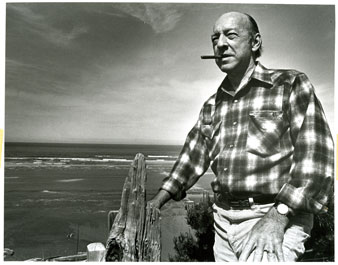
Historian William Appleman Wiliams circa 1986. Image from Oregon State University Libraries Special Collections / Daily Barameter / The Nation.

Celebrate the ‘Historical Revisionists’ / 1

William Appleman Williams’ classic text, The Tragedy of American Diplomacy, broke new ground in the early 1960s as opponents of the Cold War and the escalating Vietnam War policy began to challenge reigning orthodoxy.

By Harry Targ / The Rag Blog/ February 12, 2013

First of a two-part series.

The first modern organized opposition to U.S. global expansion began with the war on the Philippines in 1898. The Anti-Imperialist League, with such distinguished spokespersons as Mark Twain, decried United States expansion to Asia, the Pacific, and the Caribbean. Later, critics of U.S. foreign policy, such as Eugene V. Debs, opposed President Woodrow Wilson’s decision to enter World War I in 1917. In the 1930s journalists and activists raised concerns about the United States role in world affairs, particularly its seeming indifference to the rise of fascism in Italy, Spain, and Germany.

After World War II, skeptics about a U.S. policy that was leading to Cold War with the Soviet Union arose, coalescing around the third party presidential candidacy of Henry Wallace. After President Truman won election in 1948, opposition to the direction the United States was taking in the world was steadily silenced. A virulent anti-communist repressive environment in academia, the media, and electoral politics ensued. By the 1950s analyses of United States foreign policy that focused on the U.S. as an imperial power virtually disappeared.

The Wallace candidacy which was soundly defeated was followed by the 1949 purge of 11 unions from the Congress of Industrial Organizations (CIO) for their left-wing politics and during the 1950s anti-communist purges in radio, television, the movies and educational institutions. Labor organizers, cultural performers, educators, government employees and others tarnished with the charge of being “communists” lost jobs, livelihoods, and access to broad publics.

Academic fields were transformed to provide training grounds and ideological support for America’s mission in the world. In history and social science new scholarly works emphasized consensus versus class struggle, pluralist democracy rather than political elitism, and groups and political activity rather than class and class interests. Few remaining critical analysts of United States foreign policy highlighted economic interest, the pursuit of empire, or over-reaction to a Soviet threat.

However, some academic programs, such as the Department of History, University of Wisconsin, began to educate young scholars to examine the economic taproots of United States foreign policy. William Appleman Williams’ classic text, The Tragedy of American Diplomacy, broke new ground in the early 1960s as opponents of the Cold War and the escalating Vietnam War policy began to challenge reigning orthodoxy.

Williams, for many budding anti-war activists, provided information about an American empire that had grown ever since the end of the civil war. He and his students connected U.S. empire building with the conquest of the North American continent, the slaughter of millions of Native people, the taking of large amounts of the land mass from Mexico, and global expansion from the Philippines to the Caribbean and Central America.

In The Tragedy of American Diplomacy, The Contours of American History, and The Roots of the Modern American Empire, Williams elaborated on the rise of agricultural production and the need for the American economy to find markets overseas. In addition, domestic outlets for U.S. productivity had been capped with the end of the “frontier.” Drawing upon Frederick Jackson Turner’s “frontier thesis,” U.S. leaders, he wrote, believed that a new global American empire was needed to sell products, secure natural resources, and find investment opportunities.

Williams claimed that the so-called “open door” policy toward China proclaimed in the 1890s signified what the U.S. imperial vision was to be. This policy resulted from the disintegration of and civil war in China which was used as an opportunity by European powers and Japan to establish their own spheres of influence on the Asian mainland.

In response to the nations that were carving up Chinese territory, the U.S. Secretary of State, John Hay, issued a warning to Europe demanding the right to have open access to markets in China. By implication the closing of such markets to U.S. goods might lead to confrontation.

For revisionists, such as Williams, the Open Door Notes illustrated the emerging U.S. global imperial vision. The demands that the world respect the U.S. right to penetrate economies everywhere would become the standard for the U.S. role in the world ever since.

Again, the driving force behind the image of the Open Door was economics. Some of Williams’ writings seemed to emphasize material reality, the needs of capitalism. Other of his writings implied that United States behavior was motivated by elite beliefs that markets were a necessity.

In the 1960s several newer scholars began publishing their research emphasizing the connections between the necessities of U.S. capitalism and expansion or the belief foreign policy elites had that such expansion was necessary for economic survival.

Gabriel Kolko who authored The Politics of War, and co-authored with Joyce Kolko, The Limits of Power: United States Foreign Policy From 1945 to 1954, presented in compelling, graphic, and precise terms the material underpinnings of United States Cold War policy. The Kolkos emphasized the threat to the West that international communism, particularly the example of the Soviet Union and popular Communist parties in Europe, represented to the reconstruction of a global capitalist empire after World War II.

According to the Kolkos and other revisionists, the expansion of socialism constituted a threat to capital accumulation. After World War II, wartime demand for U.S. products might decline, leaving in its wake economic stagnation and a return to the economic depression of the 1930s. The Marshall Plan, applauded as a humanitarian economic assistance program for the reconstruction of war-torn Europe, was really a program to increase demand for U.S. products.

With an engineered international communist threat, military spending, another source of demand, would help maintain customers, including the government itself, for U.S. products. The idea of empire, stressed in Williams’ work, was underscored by the materiality of capitalist dynamics.

The Kolkos described the motivations of the Soviet Union and the United States. The former was not driven by a demonic ideology to dominate the world, they said. In addition, United States foreign policy was not driven by principle. As to the former: “The Soviets played an essentially opportunistic, non-ideological role in Eastern Europe’s initial postwar development. They cared little about the previous policies or the ideology of the men in power in the coalition governments so long as they were not anti-Soviet in the post war period.”

And the United States made “a sincere effort to secure the area for its framework of multilateral trade and an open door for American investment.” When this failed the Kolkos said, the United States “chose instead a policy of harassment and employed the image of an iron curtain to blur, for strictly political purposes, the variations in an area whose political experiences at the time ranged from pluralist Czechoslovakia to Bolshevik Yugoslavia.”

To expand the reach of post-war U.S. capitalism and oppose any resistance to it, the East-West conflict “became a self-fulfilling prophecy.”

“Celebrate the Historical Revisionists: Part 2” will discuss the enduring significance of their findings for understanding the United State’ role in the world today.  

[Harry Targ is a professor of political science at Purdue University and is a member of the National Executive Committee of the Committees of Correspondence for Democracy and Socialism. He lives in West Lafayette, Indiana, and blogs at Diary of a Heartland Radical. Read more of Harry Targ’s articles on The Rag Blog.]
The Rag Blog

Posted in Rag Bloggers | Tagged , , , , , , , , , , | Leave a comment

Lamar W. Hankins : Drone Assassinations and Our Misguided Foreign Policy

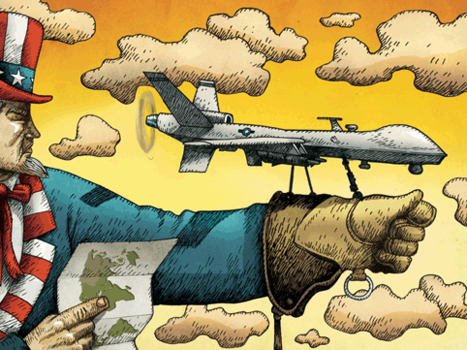
Political cartoon from AFP / Getty Images.

Drone assassinations:
The latest misguided U.S. foreign policy

The American belief in technology as our savior, even in carrying out assassinations, knows no bounds.

By Lamar W. Hankins | The Rag Blog | February 11, 2013

Ever since homo sapiens walked in East Africa 200,000 years ago and feared the rustling in the grass, we have known that this is a dangerous world. If we are lucky, we are taught by those who raise us how to avoid the dangers or deal effectively with them.

Now that we have “advanced” civilizations, we deal with the world’s dangers at many levels. Danger is no longer a problem of the individual, the family, the clan, the village, or the city-state; it is now a problem for the country in which we live.

I have no illusions about the dangers in the world, though as an American living in a small city, I have to worry less about those dangers on a day-to-day basis than do my relatives and friends who live in major cities and metroplexes. But worrying about dangers for the country as a whole is a far different problem. One of the factors that makes this problem more different than it has to be is an assumption that has driven American foreign policy at least since World War II.

We decided after Hitler had his day and lost it and the Japanese acted recklessly and paid a terrible price, that the U.S. had to have a hand (if not a fist) in running the affairs of the entire world — so that we would never have to fight another world war and so that our corporations could get access to all of the products, goods, and resources they needed to prosper.

We decided that too few people in the world would make the civilized decisions that Americans would make. Most of the rest of the world could not be trusted to let us exploit their natural resources and their people, so we had to intervene forcefully almost everywhere on a regular basis.

For many years, the U.S. had an official policy prohibiting assassination as a tool of this foreign policy, but a practice of planning and/or doing precisely what we officially condemned. There is little evidence that assassination has had any lasting benefits. What it requires is more and more assassinations, all of which violate our own legal principles.

As Thomas Jefferson School of Law professor Marjorie Cohn has written: “Targeted or political assassinations — sometimes known as extra-judicial executions — run afoul of the Geneva Conventions, which include willful killing as a grave breach. Grave breaches of Geneva are punishable as war crimes under the U.S. War Crimes Act.”

So widespread have U.S. assassinations become that Prof. Gordon L. Bowen, a political science professor at Mary Baldwin College in Virginia, teaches an entire course on America’s targeted assassination programs. The killings of elected Guatemalan President Jacobo Arbenz Guzman and others were discussed within the CIA as early as 1951. Arbenz resigned from office in 1954. Assassination planning proceeded to the point of drawing up “hit lists” of Guatemalan officials, selecting assassins, and beginning their training.

The U.S. Senate’s Church Committee reported in 1975 that at least five foreign leaders were targeted for assassination, including Fidel Castro of Cuba, Patrice Lumumba of the Congo, and Rafael Trujillo of the Dominican Republic. Just before the Church Committee’s Report, Chile’s President Salvador Allende and Armed Forces Chief of Staff Rene Schneider were assassinated with the assistance of U.S. officials, though the CIA blamed Schneider’s death on others.

After the report, President Gerald Ford issued an executive order banning such assassinations. This order was renewed by both Presidents Jimmy Carter and Ronald Reagan. In 1995, President Bill Clinton approved creation of a list of foreign terrorists who were to be captured or killed, and the use of lethal force was authorized against Osama bin Laden and several others in his organization. In 1998, a Tomahawk missile was fired into a training camp in Afghanistan in an attempt to kill bin Laden.

Between 1949 and 2011, according to author and U.S. foreign policy critic William Blum, the U.S. planned to assassinate or did assassinate at least 40 foreign leaders, including Kim Koo, Korean opposition leader (1949); Chou En-lai, prime minister of China (1950s); Sukarno, president of Indonesia (1950s); Kim Il Sung, premier of North Korea (1951); Mohammed Mossadegh, prime minister of Iran (1953); Jawaharlal Nehru, prime minister of India (1955); Gamal Abdul Nasser, president of Egypt (1957); Brig. Gen. Abdul Karim Kassem, leader of Iraq who was succeeded by Saddam Hussein (1960); José Figueres, president of Costa Rica (two attempts on his life — 1950s to 1970s); Ngo Dinh Diem, president of South Vietnam (1963); Che Guevara, Cuban leader (1967); Mobutu Sese Seko, president of Zaire (1975); Miguel d’Escoto, foreign minister of Nicaragua (1983); and the nine comandantes of the Sandinista National Directorate in Nicaragua (1984), among others.

In Confessions of an Economic Hitman, author John Perkins not only details the schemes to make third-world countries so indebted that they could not repay loans and would be at the mercy of U.S. corporations in collaboration with U.S. intelligence agencies and the World Bank, he also explains how assassinations throughout the world were used to eliminate political leaders who would not bend to the will of the U.S. and U.S. corporations.

Assassinations have a long history in U.S. policy. They are accomplished by a lone assassin, by teams of assassins, through the use of missiles, or through the use of drones. The current discussion of drone assassinations is but one aspect of that broader policy to use assassinations to kill political figures who impede U.S. political and economic interests, especially those in the Middle East.

A widely-accepted view, sometimes expressed during the confirmation hearings for John Brennan to head the CIA, is that our assassination policy via drones is counterproductive. That is, it results in many more enemies than we eliminate because we kill many innocents when we take out a targeted person. But Brennan believes we are getting better at killing our presumed enemies with drones, so presumably we will be making fewer enemies in the future.

The American belief in technology as our savior, even in carrying out assassinations, knows no bounds. However, even the staid New York Times editorial board is against this policy:

We do not buy the administration’s claim to have the authority to kill Americans, and other suspects, far beyond any battlefield with no oversight and no review. Mr. Brennan’s assertions that the government only resorts to lethal force when “there is no other alternative” is at odds with reports of vastly increased drone strikes.

But some, for instance commentator David Brooks, have bought into the notion that in all the drone attacks since the program started, we have killed only three innocents as he said on NPR last week. And both the administration and Sen. Diane Feinstein claim that the attacks have led to the deaths of innocents in the single digits. However, Medea Benjamin of Code Pink and nearly three dozen other Americans went to Pakistan recently and talked to the families of 176 children slain in U.S. drone attacks there.

And then there is the policy of killing American citizens who are alleged to have encouraged terror by words and/or by deeds. The administration will not release the evidence to support conclusions of their guilt, so there is no way to judge the conduct of assassinating American citizens while they are on foreign soil except to note that the 4th, 5th, and 8th Amendments to the Constitution seem to forbid such conduct.

But, at the least, there should be a high burden of proof required for assassinating at a cafe in Yemen a 16-year old American such as Abdulrahman al-Awlaki, born in New Mexico, who had no ties to terrorism that have been made public or claimed by the administration. All we know is that his father, Anwar al-Awlaki, had been killed by a drone attack two weeks earlier because of alleged terrorist activities and that the son had been trying to find him before his assassination.

Because John Brennan, who worked in the war on terror for President George W. Bush, will not even acknowledge that waterboarding is torture, his statements on other matters are suspect. I find it difficult to accept that Brennan, as he claims, really “agonizes” about each and every drone assassination he has recommended to President Obama.

It is more difficult still to believe that he agonizes for the hundreds of innocent men, women, and children who are killed at restaurants, weddings, and funerals and have become the collateral damage of this policy that Brennan glibly supports, implements, and lies about openly before the Senate.

Those with real moral scruples would talk and act more like Dietrich Bonhoeffer than Dick Cheney. John Brennan is an immoral actor in an amoral world. We should not have someone with his callousness running the CIA, but he is Barack Obama’s choice, and that choice says as much about Obama as it does about the nominee.

The history of American assassination policy may be the best example to show that the slippery-slope theory sometimes is a reality. What began as assassination planning in 1949 has grown to periodically carrying out assassinations for U.S. policy purposes, and then funding major operations so that surrogates do the killing, and now, because of missile and drone technology, making them easy and widespread to do directly. It may have taken 50 years to achieve the same number of assassination-related deaths, collateral and otherwise, that we now achieve each week.

There is no better way to end this column than to quote from Bill Moyers’ brief comment made at the end of his broadcast last Friday:

This week, The New York Times published a chilling account of how indiscriminate killing remains bad policy even today. This time, it’s done not by young G.I.’s in the field but by anonymous puppeteers guiding drones by remote control against targets thousands of miles away, often killing the innocent and driving their enraged families and friends straight into the arms of the very terrorists we’re trying to eradicate.

The Times told of a Muslim cleric in Yemen named Salem Ahmed bin Ali Jaber, standing in a village mosque denouncing Al Qaeda. It was a brave thing to do — a respected tribal figure, arguing against terrorism. But two days later, when he and a police officer cousin agreed to meet with three Al Qaeda members to continue the argument, all five men — friend and foe — were incinerated by an American drone attack.

The killings infuriated the village and prompted rumors of an upwelling of support in the town for Al Qaeda, because, the Times reported, “such a move is seen as the only way to retaliate against the United States.” Our blind faith in technology combined with a sense of infallible righteousness continues unabated. It brought us to grief in Vietnam and Iraq and may do so again with President Obama’s cold-blooded use of drones and his seeming indifference to so-called “collateral damage,” otherwise known as innocent bystanders. By the standards of slaughter in Vietnam the deaths by drone are hardly a blip on the consciousness of official Washington.

But we have to wonder if each one — a young boy gathering wood at dawn, unsuspecting of his imminent annihilation, the student picking up the wrong hitchhikers, that tribal elder standing up against fanatics — doesn’t give rise to second thoughts by those judges who prematurely handed our president the Nobel Prize for Peace. Better they had kept it on the shelf in hopeful waiting, untarnished.

Moyers’ comment may be President Obama’s Walter Cronkite moment — when a respected journalist declares that a misguided foreign policy needs to end. Let’s hope it doesn’t take another six or seven years for that to happen.

[Lamar W. Hankins, a former San Marcos, Texas, city attorney, is also a columnist for the San Marcos Mercury. This article © Freethought San Marcos, Lamar W. Hankins. Read more articles by Lamar W. Hankins on The Rag Blog.]

The Rag Blog

Posted in Rag Bloggers | Tagged , , , , | 2 Comments

Bob Feldman : Union Growth in Texas Followed by Crackdown, 1940-1953

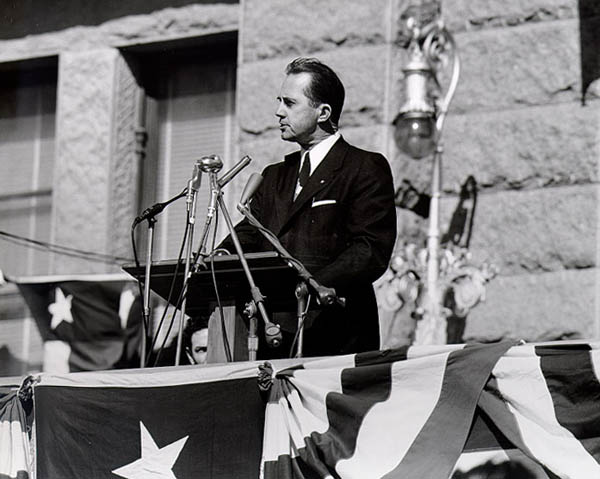
After a 1953 CIO-led strike in Port Arthur, Texas Gov. Allan Shivers, here shown addressing a campaign rally in Austin, led a move to make membership in the Communist Party illegal. Image from AlternativeHistory.com.

The hidden history of Texas

Part 12: 1940-1953/1 — Union growth followed by backlash against collective bargaining.

By Bob Feldman | The Rag Blog | February 11, 2013

[This is the first section of Part 12 of Bob Feldman’s Rag Blog series on the hidden history of Texas.]

Between 1939 and 1953 the percentage of non-agricultural workers in Texas who were members of labor unions increased from 10.3 to 16.8 percent; and 375,000 workers in Texas were labor union members by 1953. Between 1941 and 1945, CIO-affiliated labor unions “gained nearly 40,000 members in 4 years,” according to F. Ray Marshall’s Labor in the South. The same book also recalled:

Membership expansion occurred in petroleum refining, and in the Dallas-Fort Worth area, where, in 1945, the CIO claimed 25,000 new members in one year. Important victories there included the organization of the huge North American Aviation Company to the UAW, the Armour plant by the packinghouse workers, Conroe Manufacturing by the ACWA, and several steel fabricators by the steelworkers. PWOC Local 54 and storehandlers’ Local 59 acquired bargaining rights under a master agreement with Armour. During the war [World War II], the packinghouse workers’ strength in Texas was confined largely to this plant.

The CIO had 115 locals in Texas in March 1944, the most numerous of which were: autoworkers, 8 locals; oil workers, 30 locals; and steelworkers, with 12 locals. The textile workers had only two locals in Texas in 1944…

By the 1942 convention, the oil workers’ organization committee had achieved significant results. The most important victory was the Texas Company at Port Arthur… In March 1942, the OWIU won an election at the Southport refinery in Texas City… It also signed up 84 percent of the workers at Standard of New Jersey’s Humble refinery at Baytown, Texas…

The UCAPAWA (Canning, Agricultural, Packing and Allied Workers)’s strongest base in Texas was in Houston, where it had 5 contracts covering over 600 Negro and Mexican-American workers, organized by March 1942. UCAPAWA contracts in Houston covered about 150 employees at the Houston Millinery Company and 400 Negro and Spanish-speaking workers in 4 cotton companies, three of which were owned by the Anderson Clayton company… In addition, UCAPAWA had locals among pecan workers at San Antonio, spinach workers at Mathis, and cannery workers at Sugarland…UCAPAWA…organized fruit and vegetable workers in the Rio Grande Valley of Texas, where its contracts covered 1,000 employees during peak seasons.

As Randolph Campbell’s Gone To Texas observed, “under the auspices of the National War Labor Board,” Texas labor movement “organizers unionized more of the state’s industries by 1945…” And during World War II, “workers at Shell in Pasadena, Texas” even “struck spontaneously” in June 1943 “to secure the reinstatement of a discharged union member,” according to Labor in the South; and there was also a strike by workers at a B.F. Goodrich plant in Texas in February 1944.

The white corporate power structure in Texas (and its ultra-conservative, white supremacist Texas political establishment in Austin) apparently then began to feel that this growing militancy and level of unionization of workers in Texas threatened both its class interests and its ability to continue to economically exploit and politically dominate most people who lived in Texas.

So after the CIO organized plant after plant across Texas in 1946-47,” the Texas “legislature responded in early 1947 by passing a right-to-work law that prohibited requiring union membership as a condition of employment,” according to Gone To Texas, and “the legislature also passed other anti-union laws, including one that prohibited pickets at strikes from being within 50 feet of each other or the entrance of the plant being picketed.”

Public employees in Texas were also denied the right to bargain collectively in 1947. And following a 1953 CIO-led strike in Port Arthur, the then-Democratic Texas Governor Allan Shivers even “called a special session of the legislature in the spring of 1954, which passed a bill making membership in the Communist Party a felony punishable by a fine of $20,000 and 20 years in the penitentiary,” according to the same book.

Coincidentally, according to Ronnie Dugger’s The Politician: The Life and Times of Lyndon Johnson, in Texas “the program of lobbying against labor was carried forward and financed largely by allies of Lyndon Johnson.” As The Politician recalled:

The public did not know about an even more significant business convert to Johnson, anti-union contractor Herman Brown who, with his brother George, ran the contracting and engineering firm of Brown & Root… A stream of gifts from the Browns to the Johnsons can be traced through the decade starting in 1940… Lyndon was Brown & Root’s kept politician…

By 1947 Brown & Root was so powerful in Texas it led a many-aspected campaign against unions which made Texas one of the most anti-union states in the Union and the only major industrial state that had a law prohibiting workers from voting to be all-union… The Brown brothers were largely responsible for the enactment from 1947 on, of the state’s anti-union laws.

War Department or Department of Defense contractors like Brown & Root apparently made a lot of money during World War II and the Korean War of the early 1950s from the U.S. government contracts that were thrown their way. But at the same time, “22,022 Texans died or suffered fatal wounds in battle” during World War II and “the Texas Division suffered one of the highest casualty rates of any in the Army — 3,717 killed, 12,685 wounded, and 3,064 missing in action,” according to Going To Texas.

In addition, “the 19th Division, a Texas unit… suffered nearly 18,500 casualties, including 2,963 killed, many of the deaths coming in close fighting in the hedgerow country of Normandy,” according to the same book. And around 1,800 people from Texas were also killed in action after the Democratic Truman Administration decided to intervene militarily on the side of the right-wing Syngman Rhee dictatorship during the civil war in Korea .

Of the 750,000 people from Texas who served in the U.S. military during World War II, about 88,000 were African-Americans from Texas and about 12,000 were women from Texas; and “Texas, which had 5 percent of the nation’s population, provided 7 percent of those who served,” with most Texans serving in the army and air force and “about one-quarter” serving in the navy, marines and coast guard, according to Going To Texas.

[Bob Feldman is an East Coast-based writer-activist and a former member of the Columbia SDS Steering Committee of the late 1960s. Read more articles by Bob Feldman on The Rag Blog.]

The Rag Blog

Posted in Rag Bloggers | Tagged , , , | 1 Comment

Anne Lewis : UT-Austin Ponders Privatizing Staff

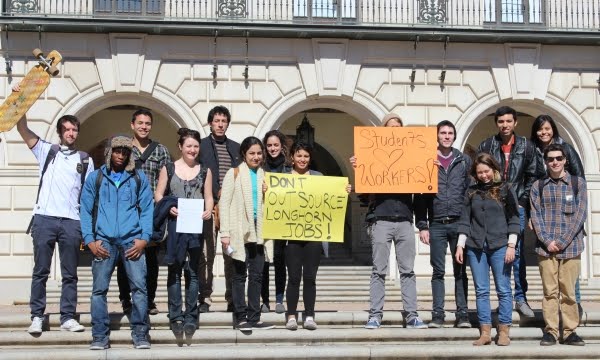
Members of the Make UT Sweatshop-Free Coalition gather at the UT-Austin Tower Wednesday, February 6, to protest the University’s consideration of job privatization for staff members. Photo by David Maly / The Horn.

‘Culture war’ at UT-Austin: 
President Powers considers privatization

The most deeply-rooted problem with Powers’ plan for cost cutting through privatization, consolidation, and commercialization is that it does not respect the rights of workers.

By Anne Lewis | The Rag Blog | February 8, 2013

AUSTIN, Texas — On January 29, 2013, University of Texas at Austin President Bill Powers convened the UT-Austin community to make recommendations about increasing our efficiency that would include job privatization for university staff.

President Powers’ speech led to despair, anger, and confusion across our campus. Despair and anger came from threatened loss of health care, state pensions, jobs, and community; confusion from the contradiction posed by the projected image of Powers as our defender against the likes of Governor Rick Perry and the University of Texas Board of Regents.

Powers is presented as an administrator who wants both affordability and high quality in a February 2, 2013, Associated Press article, “Texas Fight Highlights Higher Ed Culture Clash.” The article — which says that, “If colleges were automobiles, the University of Texas at Austin would be a Cadillac: a famous brand, a powerful engine of research and teaching” — defines Texas as ground zero in a culture war to preserve educational quality and research, but degenerates towards the end when it quotes Peter Flawn, our emeritus president:

“Universities are by their very nature elite,” he said. “Their job is to separate the sheep from the goats and the goat-sheep from the sheep-goats, and try to produce people who are knowledgeable and can reason, think and solve problems.”

And that, it seems, is the intellectual quality of this particular thread of discussion. I would not characterize my students as sheep, goats, sheep-goats, goat-sheep, nor would I consider the role of a university to be a sorter of the forenamed critters. It is not true that the enemy of our enemy is our friend. I think it’s critical that we look hard at what President Powers said.

The United Nations Declaration of Human Rights, which lays the groundwork for “an existence worthy of human dignity,” states in Article 23:

Everyone has the right to work, to free choice of employment, to just and favorable conditions of work and to protection against unemployment. Everyone has the right to form and to join trade unions for the protection of his interests.

The most deeply-rooted problem with Powers’ plan for cost cutting through privatization, consolidation, and commercialization is that it does not respect the rights of workers.

The plan is based on a report from the Committee on Business Productivity which convened for the first time in April 2012. Committee Chair Steve Rohleder is part of the executive leadership of Accenture, a global outsourcing company that cost the state of Texas more than $800 million in a failed effort to privatize food stamp and TANF eligibility. Other members of the committee are tied to equity firms TPG, Capital Royalty, HM Capital, Falconhead Capital, and Bull Ventures; and to Boeing, StarTex, Dell, and Susser.

President Powers says that the only way that UT-Austin can become “the very best public university in America” is to operate like a business through outsourcing and privatization of services; market costs to students for meal plans, housing, and parking; job reductions through consolidation of human resources, technology, and financial processing; and commercialization of intellectual property. He calls this a moral imperative.

President Powers states, “We’ve been outsourcing all along: we don’t have a fleet of airplanes used by faculty to get to meetings; we use Southwest Airlines.”

UT probably should not own a fleet of airplanes and pay the pilots with public funds. But the relationship of pilots to our university is quite different from that of workers who serve food, clean buildings, support our offices and technical facilities, and generally keep the university running.

These workers (who include many students) will lose and lose big — guaranteed pay levels and advancement possibilities, state pensions and benefits, safety and environmental standards, rules against discrimination in employment, and the right to join a union.

I also question the assumption that cost-saving experiments endorsed by finance capital are best for the citizens of Texas. Accenture’s failed contract needlessly increased the suffering of thousands of poor and working class Texans and their children. The attempt to take over management of the Kerrville State Hospital last year by Geo Group, the private prison corporation, was resolved when State Health Commissioner David Lakey stated that reductions in staffing would put both the patients and the State of Texas at risk.

The notion that a business model is the only way for human endeavors to succeed seems strange at best. Cost cutting business practices have contributed to economic inequality, disregard of safety and environmental standards, and discrimination in employment. It’s why we need laws, government regulation, and labor unions where workers can have a collective voice.

It’s often more — not less — expensive when neoliberals turn not-for-profit into profit-making ventures. The savings that come from lower pay, lower health care costs, and erosion of pensions for workers will most likely benefit the company more than our university. That’s part of the margin of profit. The other part is increased cost for services.

We already see Powers’ suggestion that students should pay the market value — 50% more for their privatized meal plans; 113% more for privatized parking for staff and students; more for privatized student housing — all going towards the profits of contracted corporations and none benefiting our community.

President Powers boasts that “over the past five years, some 4,000 people left the payroll voluntarily. That’s 20 percent of UT’s core staff workforce.” Those jobs and positions have not been replaced. The thought of an additional 20 percent cutback is feared not only by workers who may not leave voluntarily but also by their co-workers who have added workloads and sometimes have impossible jobs.

Go to any office in our university at 7 p.m. and you will find workers who have been there since 8 a.m.. The work of support staff is necessary for the university to function properly. It’s wrong to balance a budget on job loss and inadequate staffing.

Finally, in an unfortunate example, President Powers compares the effort, which will be led by Chief Financial Officer Kevin Hegarty, to the Pope moving an obelisk in 1586. As a union woman who respects the dignity of work both intellectual and manual, I ask who exactly carried that 344-ton obelisk and under whose organizational authority.

We’re sure that Mr. Hegarty would agree that he has none of the moral authority of a pope. Our university is not a 344-ton obelisk. We who devote our intellect, energy, and care to UT should have a voice in these decisions that so deeply impact our lives, our families, and our community.

I would suggest another approach. President Powers should go to the Texas legislature and demand that Texas pay its share with the same force he used to promote Austin taxpayer funding of a new medical school.

The Texas Constitution (1876) states:

The Legislature shall establish, organize and provide for the maintenance, support and direction of a university of the first class, styled “The University of Texas.”

Thirty years ago, Texas funded more than half of the budget of UT-Austin. It’s now down to 13%. President Powers should join us at the Capitol on April 10 for a march and rally in defense of the public good and public workers.

Will Rogers once said, “When you’re in a hole, stop digging.”

[Anne Lewis, a senior lecturer at the University of Texas and a member of TSEU-CWA Local 6186 and NABET-CWA, is an independent filmmaker associated with Appalshop. She is co-director of Anne Braden: Southern Patriot, associate director of Harlan County, U.S.A, and the producer/director of Fast Food Women, To Save the Land and People, Morristown: in the air and sun, and a number of other social issue and cultural documentaries. Her website is annelewis.org.]

The Rag Blog

Posted in Rag Bloggers | Tagged , , , , , , , , | 4 Comments

Nancy Miller Saunders : They Tried to Tell Us

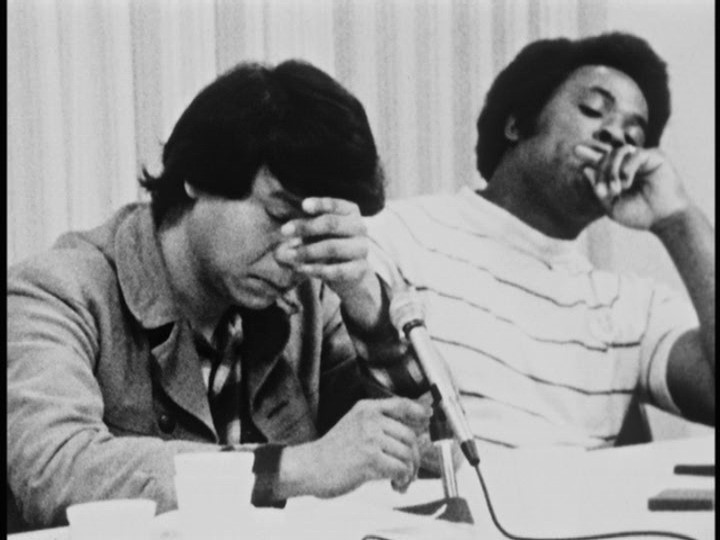
Vietnam veterans testify at the Winter Soldier Investigation in 1972. Image is a screen grab from the film, Winter Soldier, produced by the Winterfilm Collective.

Winter Soldiers:
They tried to tell us

We as a nation did not want to know the horrible truth of what we asked our children to do in Vietnam. To acknowledge it was to admit complicity, to take responsibility for it.

By Nancy Miller Saunders | The Rag Blog | February 8, 2013

Forty-two years ago, the Vietnam Veterans Against the War tried to do what Nick Turse seems to have accomplished, judging by Jonathan Schell’s review of Turse’s book, Kill Anything that Moves, in The Nation and online at TomDispatch.com.

The veterans did not have access to the classified information or Pentagon reports Turse used to document the brutal horror the war really was as a result of government pressures. All the vets had were their personal experiences and DD214s (discharge papers that listed their assignments), which about 100 of them took to Detroit in the winter of 1971 for what they called the Winter Soldier Investigation (WSI).

Every veteran who testified had to provide proof of service and whenever possible their testimony was corroborated by other veterans. VVAW was trying to tell the nation for which they had fought, killed, and sacrificed that My Lai was not an aberration, that it was U.S. policy they were ordered to carry out.

I was a member of the film collective, Winterfilm, that had come together to document the WSI, VVAW’s second major demonstration. Most of us had gotten to know the vets while filming their first action over Labor Day weekend 1970.

Video cameras had not yet come into their own for documentaries, so we were using 16mm film. Since the audio was taped separately, my job at the WSI was to take notes of the testimony so that our editors could synchronize picture and sound for our film, Winter Soldier. Thus, except for one panel, I listened closely to all three days of mind-wrenching testimony from men I had learned to respect.

In the process I saw the kind of documentation I needed to believe them. I looked at their firm, youthful cheeks, none completely hidden under beards. And then I looked into their eyes, which were those of old men who had seen too much grief in long lives.

I saw hardened combat veterans weeping on each others’ shoulders. I watched one veteran lean against a wall and slide down in moaning, “It’s no use. It’s no use.” And I watched other veterans kneel beside him, hold him, comfort him, and let him talk.

None of this was acting. Also none of it was the kind of documentation required to prove a point to those who were not there.

Winterfilm’s editors did their best to communicate this documentation while also including clips of the care VVAW took to confirm veterans’ stories before it would let them testify. In one debriefing a former Marine sergeant, Scott Camil, is being questioned while another Marine from his unit corroborates and adds to Camil’s stories.

But these debriefings were not credible documentation for those who did not want to believe that our troops — our brothers and sons, friends and neighbors — could possibly have done what these men were saying they had done and seen others do.

Therefore, the consensus had to be — as veterans in cities around the country held their own WSIs — that the men testifying were a handful of dangerous men, homegrown terrorists, a threat to national security. Either that or they were peaceniks smearing the reputation and dedication of our troops. Either way, the Vietnam Veterans Against the War were not to be believed.

The Nixon administration saw them as a threat to its credibility. Twice VVAW’s exposure of military movements forced changes of plans. I can almost hear Nixon paraphrasing King Henry II: “Will no one rid me of these turbulent vets?”

Local and federal spies and provocateurs were infiltrated into VVAW. I knew two of them — Bill Lemmer of Arkansas and Karl Becker of New Orleans. I personally saw both try to provoke the veterans into fights. I also saw FBI reports picturing VVAW as dangerously violent.

Six of VVAW’s Southern leaders, including Scott Camil, were indicted for conspiracy to provoke riots at the 1972 Republican convention, when VVAW had actually undertaken responsibility for keeping the peace among demonstrators at both conventions to avoid a repeat of the riots at the Democrats’ 1968 convention in Chicago just four years earlier. After two more defendants were added in a superseding indictment, they became known collectively as the Gainesville 8.

Lemmer and Becker were two of the FBI informers called by the prosecution to testify against the 8. Because I knew both of them, the defense attorneys hired me to help them with their cross-examinations of the two. Because the judge refused to admit the 8’s defense arguments — that their plans were purely defensive, the result of information supplied by local and federal provocateurs — cross-examinations to reveal the truth were crucial to their defense. The jury quickly returned a blanket acquittal.

The campaign against VVAW was revived during John Kerry’s 2004 presidential campaign by the Swiftboat nay-sayers. The corroboration of Camil’s testimony they said was “proof” that Camil had been “coached.” Kerry’s interview with Pitkin, who had now turned against VVAW, was “proof” Kerry helped to slander our gallant troops

Despite condemnation of the Vietnam Veterans against the War, there seemed to be a national schizophrenia about the Vietnam War and its veterans. On the one hand they were our troops whom we should all honor for their dedication and sacrifice. On the other, they were “baby burners,” the villains in TV shows night after night. Scriptwriters no longer needed to provide motives for crimes the bad guys committed. All that was needed was a mention that a certain character was a Vietnam veteran and the audience knew he was the villain.

We as a nation did not want to know the horrible truth of what we asked our children to do in Vietnam. To acknowledge it was to admit complicity, to take responsibility for it. Peter Michelson, who attended the WSI, wrote in the February 27, 1971, New Republic,

As the testimony flooded over me for three days I kept saying, “I don’t want to hear this.” I knew that what I was hearing was true; I knew it from other veterans, from published accounts, and from my own brother who had been there. What I was resisting were the ethical obligations that knowledge imposes. Like most people, I didn’t want to have to work out what I ought to do… I am afraid of what I ought to do.

[Nancy Miller Saunders is the author of Combat by Trial: An Odyssey with 20th Century Winter Soldiers in which she tells of her years of working with Vietnam Veterans Against the War (VVAW) and includes stories entrusted to her by veterans to tell, which she lets them do whenever possible in their own words. Read more articles by Nancy Miller Saunders on The Rag Blog.]

The Rag Blog

Posted in Rag Bloggers | Tagged , , , , | 1 Comment

RAG RADIO / Thorne Dreyer : ‘Austin Noir’ with Musician and Author Jesse Sublett

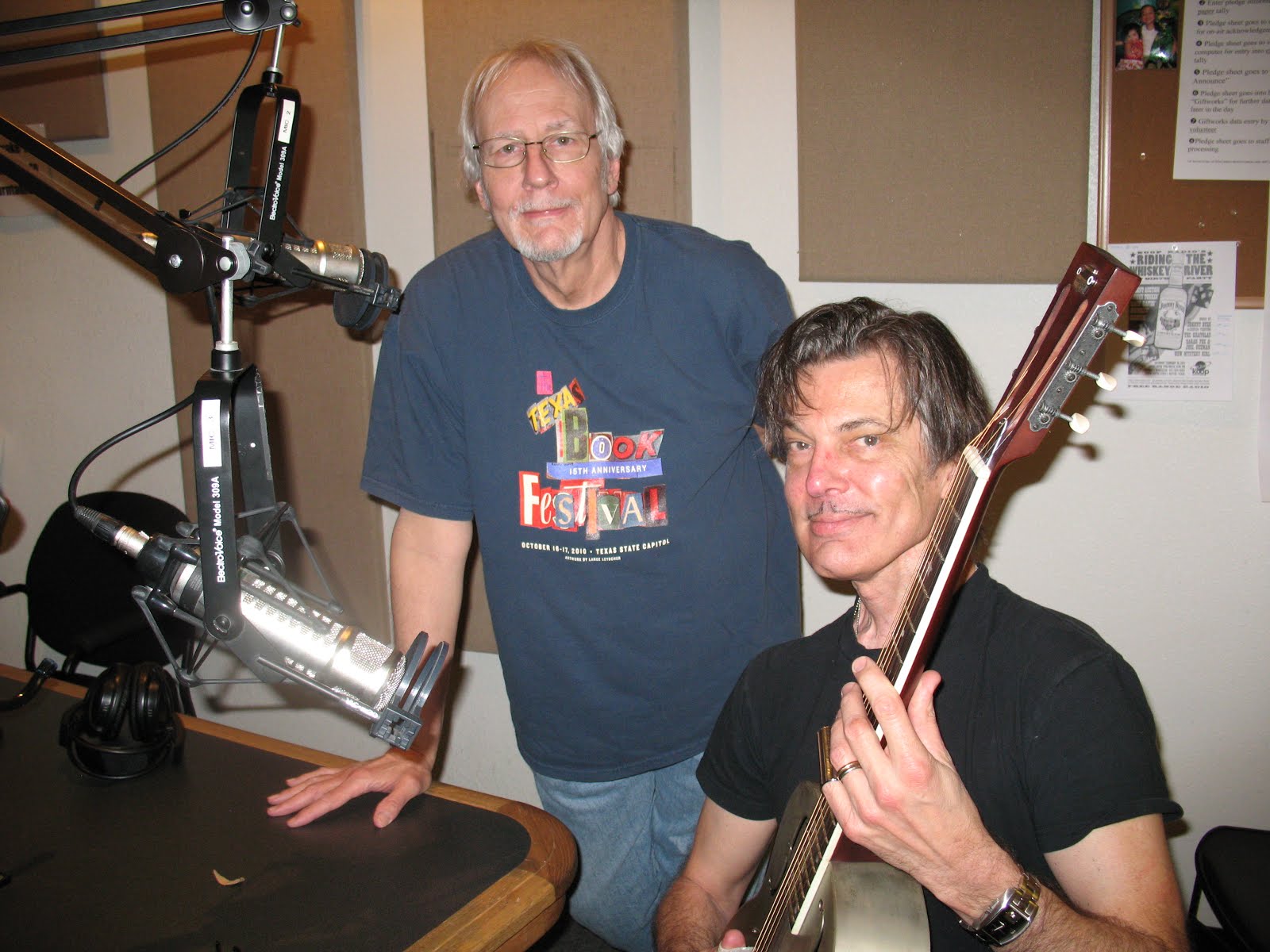
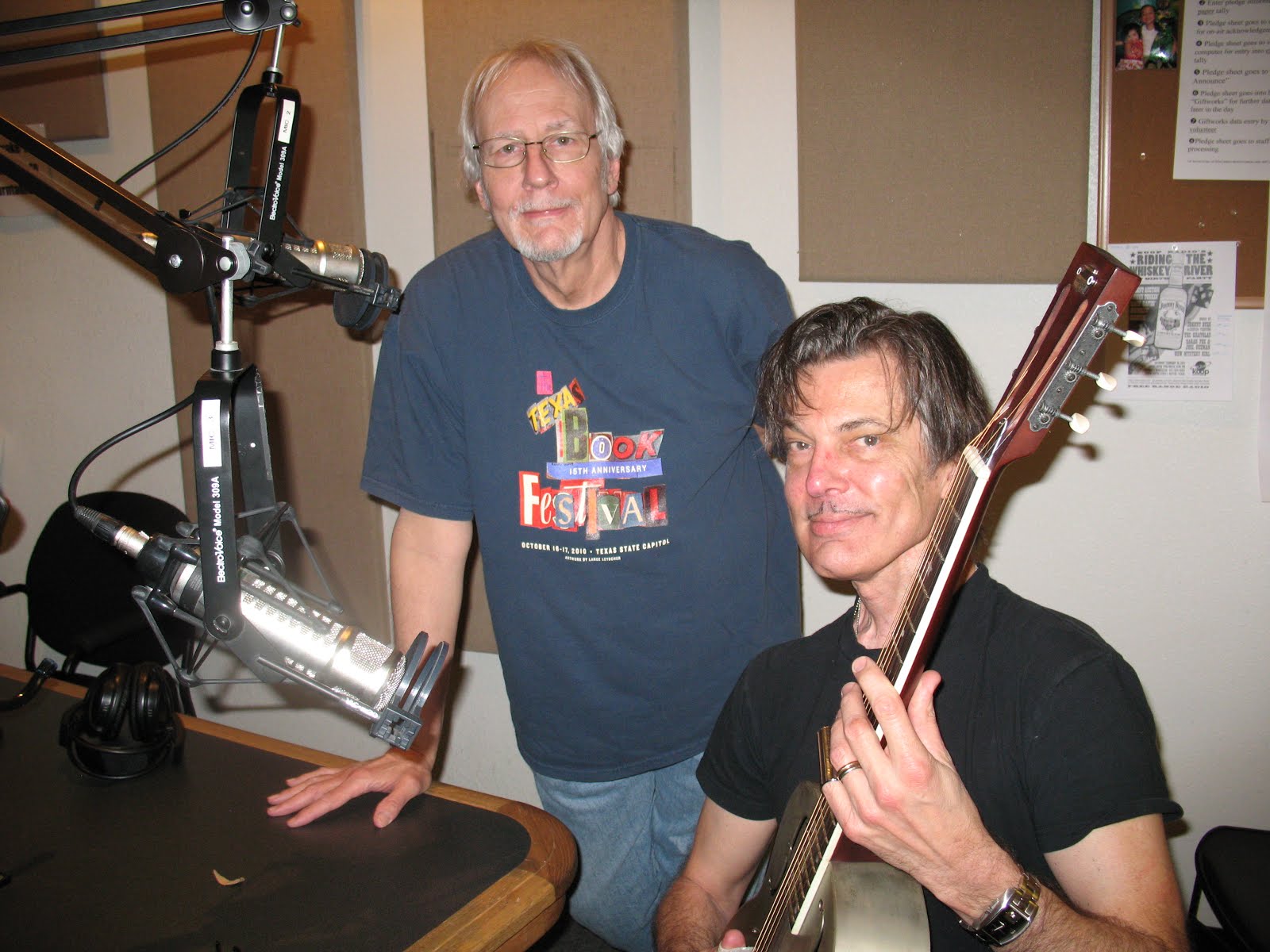
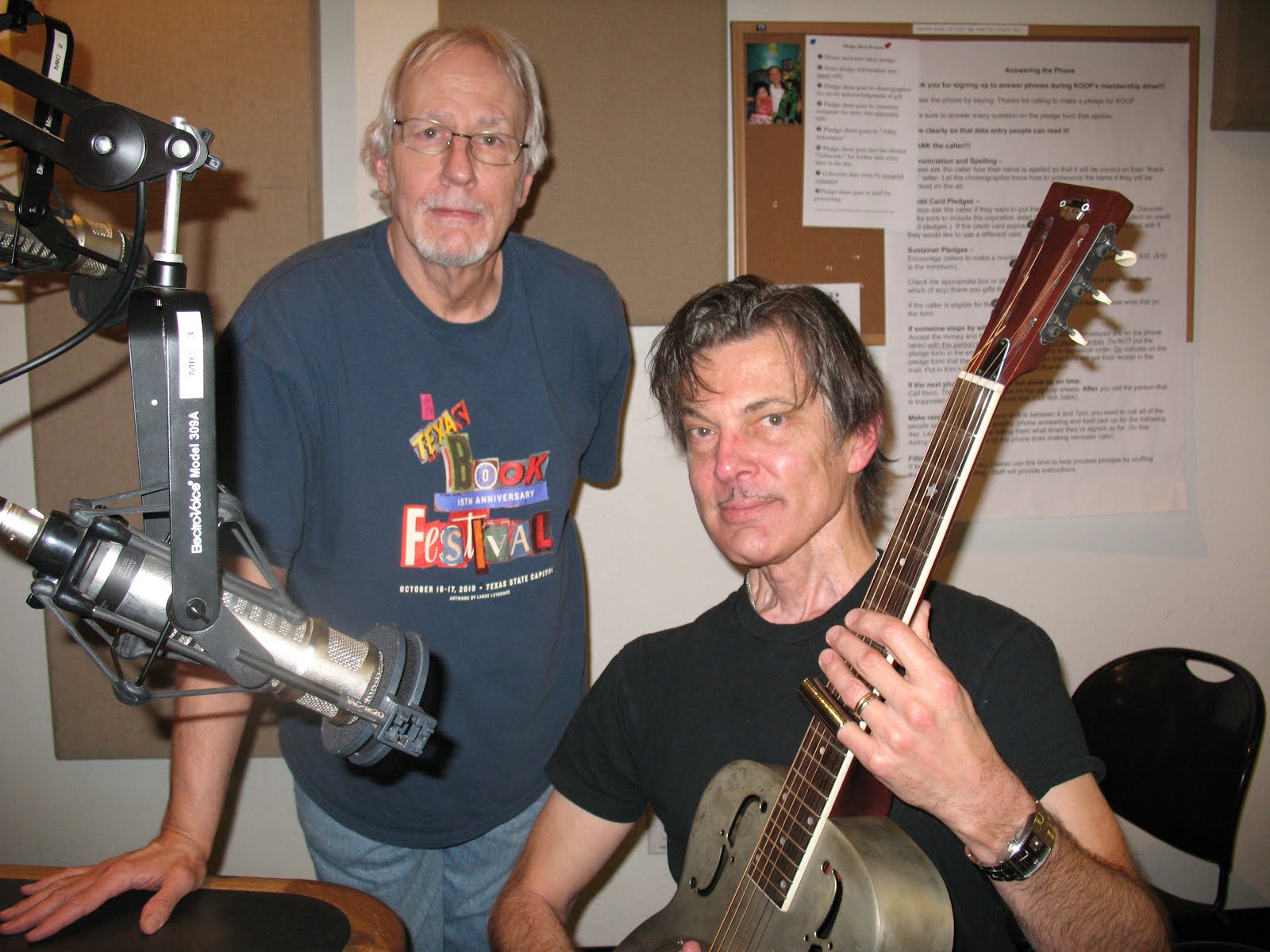
Musician and author Jesse Sublett, on right, with Rag Radio host Thorne Dreyer, in the studios of KOOP-FM in Austin, Texas, Friday, February 1, 2013. Photo by Charlie Martin / KOOP.

Rag Radio podcast:
‘Austin Noir‘ with musician and writer 
Jesse Sublett, author of ‘Grave Digger Blues

By Rag Radio | The Rag Blog | February 7, 2013

Austin-based musician and author Jesse Sublett was Thorne Dreyer’s guest Friday, February 1, 2013, on Rag Radio, a syndicated radio show produced at the studios of KOOP 91.7-FM in Austin, Texas. The show includes live musical performance by Sublett, and spoken-word performance by Sublett and host Dreyer.

Jesse Sublett is a historical figure in the Austin music scene; his influence dates to the late 1970s, when he founded the seminal punk band, The Skunks, and continues today. His published books include three crime novels set in the Austin music scene, a critically-acclaimed memoir, and the new eBook, Grave Digger Blues, a post-apocalyptic detective story.

Listen to Thorne Dreyer’s interview with Jesse Sublett, here:


Jesse Sublett’s Austin-noir novels, Rock Critic Murders, Tough Baby, and Boiled In Concrete — which were written in the late ’80s and early ’90s — featured bass-playing sleuth Martin Fender, a character based loosely on Jesse himself. His memoir, Never the Same Again, in which Sublett dealt with his personal bout with throat cancer and with his investigation into the murder of his girlfriend, was hailed by artists like James Ellroy, Michael Connelly, and Rick Linklater.

Jesse has been experimenting with combining music and pulp fiction since the mid-1980s, and his blog, Jesse Sublett’s Little Black Book, combines crime fiction, film, art, and liberal politics. Recently he has been active in social media and ePublishing, where he has channeled the old punk/DIY spirit into the new digital age.

His latest eBook, Grave Digger Blues — available on Kindle, iPad, and in a bare-bones version at Smashwords — “is a wild joy ride that Jesse’s longtime fans will recognize for its relentless lyrical drive, dark humor, bright splashes of violence and absurdity.” The iPad version includes more than an hour of audio, with an original blues soundtrack and audio chapters produced by Jesse and the Fort Worth jazz musician, Johnny Reno.

Jesse performs three songs live on the Rag Radio show, which also features a snippet of audio from the eBook and a live reading of a chapter from Grave Digger Blues, performed by Sublett and host Dreyer.

Also, go here to listen to an earlier Rag Radio interview with Jesse Sublett — featuring more about the Skunks and Jesse’s musical career — originally recorded on April 8, 2011, at the KOOP studios.

Rag Radio has aired since September 2009 on KOOP 91.7-FM in Austin. Hosted and produced by Rag Blog editor and long-time alternative journalist Thorne Dreyer, a pioneer of the Sixties underground press movement, Rag Radio is broadcast every Friday from 2-3 p.m. (CST) on KOOP, and is rebroadcast on Sundays at 10 a.m. (EST) on WFTE, 90.3-FM in Mt. Cobb, PA, and 105.7-FM in Scranton, PA.

The show is streamed live on the web by both stations and, after broadcast, all Rag Radio shows are posted as podcasts at the Internet Archive.

Rag Radio is produced in association with The Rag Blog, a progressive internet newsmagazine, and the New Journalism Project, a Texas 501(c)(3) nonprofit corporation. Tracey Schulz is the show’s engineer and co-producer.

Rag Radio can be contacted at ragradio@koop.org.

Coming up on Rag Radio:
THIS FRIDAY, February 8, 2013:
Marjorie Heins, author of Priests of our Democracy: The Supreme Court, Academic Freedom, and the Anti-Communist Purge.

The Rag Blog

Posted in Rag Bloggers | Tagged , , , , , , , , | 2 Comments

RAG RADIO / Thorne Dreyer : Austin Noir with Musician Jesse Sublett, Author of ‘Grave Digger Blues’

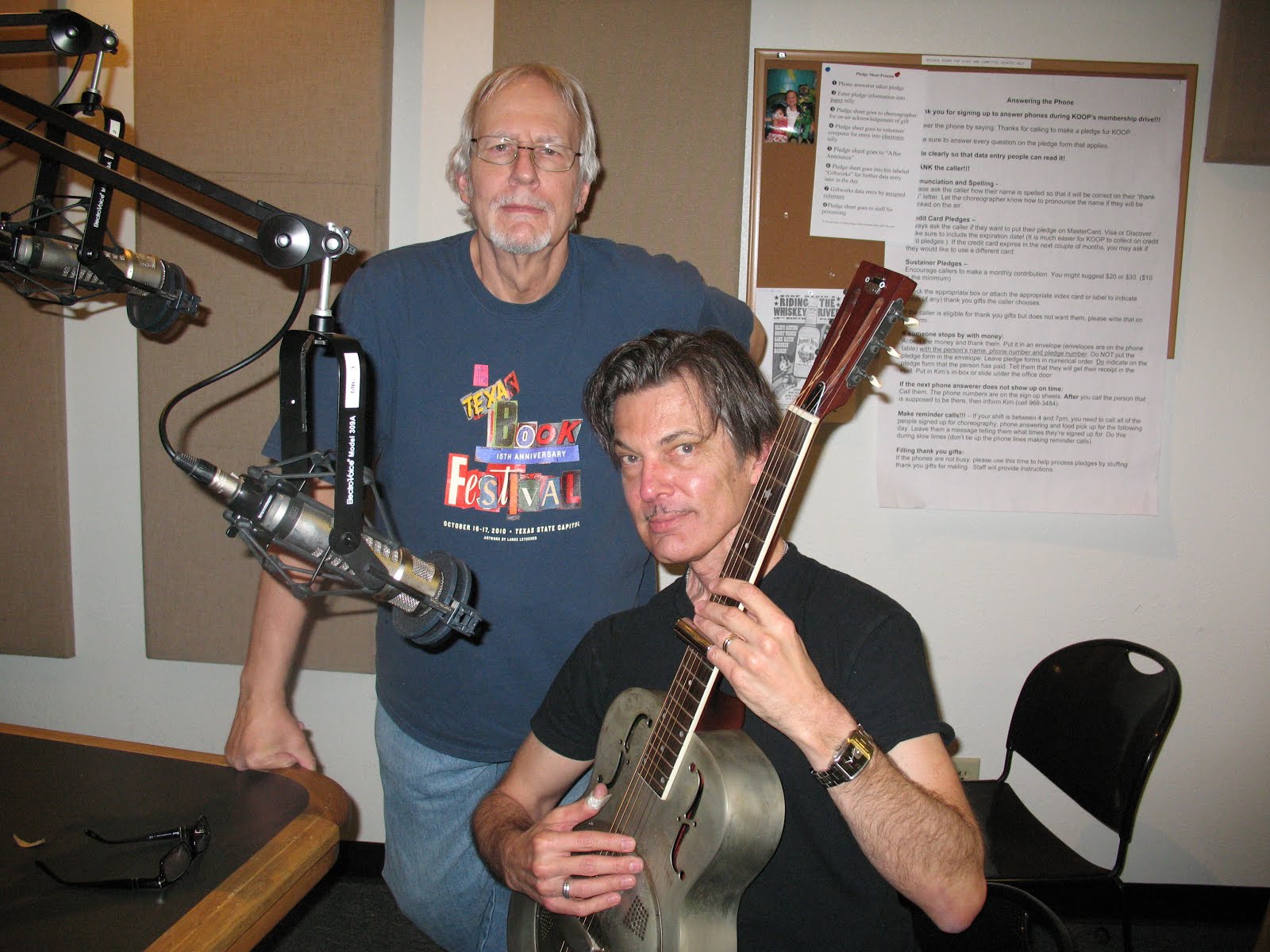
Musician and author Jesse Sublett, on right, with Rag Radio host Thorne Dreyer, in the studios of KOOP-FM in Austin, Texas, Friday, February 1, 2013. Photo by Charlie Martin / KOOP.

Rag Radio podcast:
Austin Noir‘ with musician and writer 
Jesse Sublett, author of ‘Grave Digger Blues

By Rag Radio | The Rag Blog | February 7, 2013

Austin-based musician and author Jesse Sublett was Thorne Dreyer’s guest Friday, February 1, 2013, on Rag Radio, a syndicated radio show produced at the studios of KOOP 91.7-FM in Austin, Texas. The show includes live musical performance by Sublett, and spoken-word performance by Sublett and host Dreyer.

Jesse Sublett is a historical figure in the Austin music scene; his influence dates to the late 1970s, when he founded the seminal punk band, The Skunks, and continues today. His published books include three crime novels set in the Austin music scene, a critically-acclaimed memoir, and the new eBook, Grave Digger Blues, a post-apocalyptic detective story.

Listen to Thorne Dreyer’s interview with Jesse Sublett, here:


Jesse Sublett’s Austin-noir novels, Rock Critic Murders, Tough Baby, and Boiled In Concrete — which were written in the late ’80s and early ’90s — featured bass-playing sleuth Martin Fender, a character based loosely on Jesse himself. His memoir, Never the Same Again, in which Sublett dealt with his personal bout with throat cancer and with his investigation into the murder of his girlfriend, was hailed by artists like James Ellroy, Michael Connelly, and Rick Linklater.

Jesse has been experimenting with combining music and pulp fiction since the mid-1980s, and his blog, Jesse Sublett’s Little Black Book, combines crime fiction, film, art, and liberal politics. Recently he has been active in social media and ePublishing, where he has channeled the old punk/DIY spirit into the new digital age.

His latest eBook, Grave Digger Blues — available on Kindle, iPad, and in a bare-bones version at Smashwords — “is a wild joy ride that Jesse’s longtime fans will recognize for its relentless lyrical drive, dark humor, bright splashes of violence and absurdity.” The iPad version includes more than an hour of audio, with an original blues soundtrack and audio chapters produced by Jesse and the Fort Worth jazz musician Johnny Reno.

Jesse performs three songs live on the Rag Radio show, which also features live audio from the eBook and a live reading of a chapter from Grave Digger Blues, performed by Sublett and host Dreyer .

Also listen to our earlier Rag Radio interview with Jesse Sublett, originally recorded on April 8, 2011, here.

Rag Radio has aired since September 2009 on KOOP 91.7-FM in Austin. Hosted and produced by Rag Blog editor and long-time alternative journalist Thorne Dreyer, a pioneer of the Sixties underground press movement, Rag Radio is broadcast every Friday from 2-3 p.m. (CST) on KOOP, and is rebroadcast on Sundays at 10 a.m. (EST) on WFTE, 90.3-FM in Mt. Cobb, PA, and 105.7-FM in Scranton, PA.

The show is streamed live on the web by both stations and, after broadcast, all Rag Radio shows are posted as podcasts at the Internet Archive.

Rag Radio is produced in association with The Rag Blog, a progressive internet newsmagazine, and the New Journalism Project, a Texas 501(c)(3) nonprofit corporation. Tracey Schulz is the show’s engineer and co-producer.

Rag Radio can be contacted at ragradio@koop.org.

Coming up on Rag Radio:
THIS FRIDAY, February 8, 2013:
Marjorie Heins, author of Priests of our Democracy: The Supreme Court, Academic Freedom, and the Anti-Communist Purge.


Type rest of the post here

Source /

The Rag Blog

Posted in RagBlog | Leave a comment

Type your summary here

Type rest of the post here

Source /

The Rag Blog

Posted in RagBlog | Leave a comment

IDEAS / Bill Meacham : Free Will or Free Won’t?

Image from InspireD2.

Free Will or Free Won’t?

Human beings act on their desires and beliefs, and the way we predict what people will do is not by examining their brain waves but by understanding what they want and what they think is true.

By Bill Meacham | The Rag Blog | February 7, 2013

I’ve heard a number of people say that a well-known experiment performed by neuroscientist Benjamin Libet proves that human beings do not have free will. It doesn’t. As is often the case with such research the experimental results are replicable, but the theoretical implications are subject to interpretation. Interpretations differ, and the one given by free-will deniers is, I believe, shortsighted.

Benjamin Libet was a researcher in the physiology department of the University of California, San Francisco who was intrigued by the difficulty of investigating human consciousness.(1) The difficulty is this: unlike most of what science investigates, consciousness, or subjective experience, is not available for public inspection. Scientific advance depends on researchers’ being able to replicate experiments, to observe the same things that others observe. The public, or objective, world is out there for anybody (or anybody with suitable training) to see. But subjective experiences are, in Libet’s words, “available only to the individual subject who is experiencing them.”(2)

We can observe brain activity through the means of electroencephalography (EEG), positron emission tomography (PET), magnetic resonance imaging (MRI), and the like. We have reason to believe that brain activity is correlated with subjective experience. But we have no way of observing subjective experience publicly. It is private, detectable only by the person whose experience it is. So how can we correlate the two?

Libet’s answer was to observe what people report about their experience. He would wire a subject up in order to observe brain activity and then apply a stimulus and ask the subject to report on what he or she experienced. In this way he could tell how strong the stimulus needed to be and how long it had to be applied in order to produce a conscious experience of it. He could distinguish between how long it took for someone to detect an event, as evidenced by their involuntary reaction to it, and how long it took for someone to become conscious of it, as evidenced by their report.

As it turns out, we take about a half a second to become conscious of something after it happens, but we can react to it without being conscious of it much more rapidly (for example, blinking our eye when something flies toward it).(3) That finding raises interesting questions about our knowledge of the world — Are we always a half-second behind what really happens? If so, how is it that we get around in the world successfully? — but they are not my topic in this essay.

The experiment that has gotten the most attention was an attempt to find out something about voluntary acts, acts in which the subject consciously and deliberately does something. Are voluntary acts similarly delayed?

Prior research had established that shortly before a voluntary act is done, such as flexing one’s wrist at a time of one’s own choosing, electrical activity in the brain arises, an event termed “readiness potential” (RP). The RP occurs in the brain up to 800 milliseconds before the physical act.(4) Libet wanted to find out when the subject becomes conscious of the will to act, when consciously wanting or wishing or willing to act occurs, an event he termed “W.” W certainly happens before the physical act, but does it occur before or after the RP?

Here is the experiment. The subject, who is wired up, sits before a clock-like device in which a dot of light sweeps around a circle quite rapidly, about two and half seconds per revolution instead of the usual 60 seconds. This device allows measurement of time differences in the hundreds of milliseconds. The subject is told to flex their wrist whenever they choose — a voluntary act — and to note the position of the dot of light when they decide to do it.

The experimenter can detect and record when the RP happens and can detect and record when the physical movement happens. The experimenter also records the subject’s report of when W happens, so the experiment gathers three data points. The results are then averaged over many trials.(5) The findings are surprising:

What we found, in short, was that the brain exhibited an initiating process beginning 550 msec [milliseconds] before the freely voluntary act; but the awareness of the conscious will to perform the act appeared only 150-200 msec before the act. The voluntary process is therefore initiated unconsciously, some 400 msec before the subject becomes aware of her will or intention to perform the act.(6)

So how can we be said to have free will if our choice is actually initiated by brain activity before we even know it? Many people take these results as evidence that our will is not in fact free, but is determined by physical events in the brain.

Libet himself had his doubts. He devised another experiment in which the subject was told to prepare to act at a certain time on the clock-like device, but to veto that expected act when the device reached 100 to 200 milliseconds before the preset time. In this case the RP for the act developed, but then flattened just as the subject was vetoing the act. “This at least demonstrated that a person could veto an expected act within the 100-200 msec before the preset time … .”(7)

Commentators have called this phenomenon “free won’t”;(8) and Libet thought it demonstrated that we do have free will, but it is limited to vetoing processes that are initiated unconsciously. He distinguishes between an initiation process and a control process, the former being unconscious and the latter conscious.(9)

That distinction seems dubious to me, as the experiments are not directly comparable. In one case the subject is told to act when he (or she) chooses; and in the other case he is told to act, not whenever he wants, but at a certain time and to veto the act at a slightly earlier time.

On the face of it, it seems as if our will is indeed determined and not free, but there are numerous objections to this conclusion. The most obvious, perhaps, is that we have no warrant to generalize from the results of a simplified experiment to our experience of willing in general. Libet responds that it is common in science to study a simple system and then find similar behavior in more complicated systems, and the fact that other experimenters have found similar results in variants of the original experiment give us justification to believe that the findings apply to voluntary acts in general.(10)

OK, but there are other ways to challenge Libet’s conclusions says the author of the blog Conscious Entities:

We could… question whether RPs really have the significance attributed to them. We could question whether the unusual circumstances of the experiment, with subjects thinking in advance about making a decision, and then making one for no reason whatever, properly represent normal thought processes. We could take the view that the experiments involve at least two mental reporting processes, one to do with the occurrence of the decision, one to do with the state of the clock, which makes any judgement of simultaneity highly problematic.(11)

A stronger objection is this:

Libet often seems to take it for granted that every free act is preceded by a specific act of will, but that isn’t really the case. Often the conscious mind sets a general plan, on which we then act more or less automatically. A tennis player has thought in general terms about how to play the next stroke long before the need for actual action; drivers have a kind of running rule in the back of their mind to the effect that if something suddenly appears in front of them, they hit the brake.

Free will operates at this higher level, with all our actions being managed in detail by unconscious processes. I don’t have to think about where I want to hit the ball at the very moment of decision in order to control my game of tennis any more than I have to think separately about each of the individual muscles I am implicitly proposing to contract.(12)

As this objection suggests, when we think that brain activity causes what we do, we are not looking in the right place for free will. It has to do with who is acting, who the agent is. When we say “I made the choice” and “I did not make the choice, my brain did it” we are using the term “I” to mean different things.

In the former case, when we say “I made the choice,” I means the whole constellation of elements that constitutes me. I, and not someone else, made the choice; and I am an ongoing pattern of decisions, reactions, thoughts, feelings, emotions, and so forth, not to mention a physical body. But in the latter case, when we say “I did not make the choice; it was determined by brain activity,” I seems to mean some subset of the elements that constitute me.

It’s as if we are thinking of ourselves as a tiny person who lives in the nooks and crannies of the brain and gets buffeted by electrical activity and forced to take action. But that’s not who we are. We are (each of us is) a whole person, and the ascription of agency and free will is properly made to the whole person, not a subset.

Libet has discovered one of the mechanisms by which choice operates in a specific, constrained situation. But you are not the mechanism, you are the agent who incorporates the mechanism; and the laws of agency operate at a higher level than the laws governing the mechanism. The laws that most usefully describe us as whole persons are agential, not mechanical, laws.

By “agential laws” I mean that human beings act on their desires and beliefs, and the way we predict what people will do is not by examining their brain waves but by understanding what they want and what they think is true. And, as I have written elsewhere,(13) the way we get them to do something, especially if we want their willing cooperation, is by influencing their desires and beliefs. We change their desires through enticement, persuasion, cajoling, bribery, offers of exchange, reward or punishment and so forth; or we provide evidence to convince them of certain facts; or we do both.

Artificial intelligence researcher Ray Kurzweil makes the point that it is important to model systems at the right (by which he means the most useful) level.

Although chemistry is theoretically based on physics and could be derived entirely from physics, this would be unwieldy and infeasible in practice, so chemistry has established its own rules and models. Similarly, we should be able to deduce the laws of thermodynamics from physics, but once we have a bunch of particles, solving equations for the physics of each particle interaction becomes hopeless, whereas the laws of thermodynamics work quite well. Biology likewise has its own rules and models. A single pancreatic islet cell is enormously complicated, especially if we model it at the level of molecules; modeling what a pancreas actually does in terms of regulating levels of insulin and digestive enzymes is considerably less complex.(14)

Similarly, it works much better to think of ourselves as agents with free will, the ability to decide for ourselves what to do, than to think of ourselves as the effects of neural mechanisms. And in fact even those who profess a belief in determinism act in actual practice as if they can make choices. We have found out a lot about the workings of the brain, and no doubt we will find out more. But knowing how the carburetor works is not the same as being able to drive the car skillfully.

That said, it is certainly useful to know how the mechanisms work so we can notice when they are operating and what they are doing and decide what to do about it. There are other mechanisms besides brain activity that influence our behavior, a topic to which I hope to return next time.

[Bill Meacham is an independent scholar in philosophy. A former staffer at Austin’s ’60s underground paper, The Rag, Bill received his Ph.D. in philosophy from the University of Texas at Austin. Meacham spent many years working as a computer programmer, systems analyst, and project manager. He posts at Philosophy for Real Life, where this article also appears. Read more articles by Bill Meacham on The Rag Blog.]

Notes
(1) Wikipedia, “Benjamin Libet.”
(2) Libet, Mind Time, p. 1.
(3) Ibid., chapter two.
(4) Ibid., p. 124.
(5) Ibid., pp. 126-129.
(6) Ibid., pp. 123-124.
(7) Ibid., pp. 138-139.
(8) Wikipedia, “Benjamin Libet.”
(9) Libet, Mind Time, pp. 143-147.
(10) Ibid., p. 148.
(11) Conscious Entities, “Astonishing Experiments.”
(12) Conscious Entities, “Libet’s short delay.”
(13) Meacham, “Do Humans Have Free Will?”
(14) Kurzweil, How To Create A Mind, p. 37.

References
Conscious Entities. “Astonishing Experiments.” Online publication http://www.consciousentities.com/experiments.htm as of 27 January 2013.
Conscious Entities. “Libet’s Short Delay.” Online publication http://www.consciousentities.com/libet.htm as of 27 January 2013.
Kurzweil, Ray. How To Create A Mind: The Secret of Human Thought Revealed. New York: Viking, 2012.
Libet, Benjamin. “Do We Have Free Will?” Journal of Consciousness Studies, 6, No. 8-9, 1999, pp. 47-57. Online publication http://www.centenary.edu/attachments/philosophy/aizawa/courses/intros2009/libetjcs1999.pdf as of 27 January 2013.
Libet, Benjamin. Mind Time: The Temporal Factor in Consciousness. Cambridge: Harvard University Press, 2004. The crucial fourth chapter appears in substantially the same form in Libet, “Do We Have Free Will?”
Meacham, Bill. “Do Humans Have Free Will?” Online publication, http://www.bmeacham.com/whatswhat/FreeWill.html .
Wikipedia. “Benjamin Libet.” Online publication http://en.wikipedia.org/wiki/Benjamin_Libet as of 29 January 2013.

The Rag Blog

Posted in Rag Bloggers | Tagged , , , , , | Leave a comment

IDEAS / Bill Meacham : Free Will or Free Won’t?

Image from InspireD2.

Free Will or Free Won’t?

Human beings act on their desires and beliefs, and the way we predict what people will do is not by examining their brain waves but by understanding what they want and what they think is true.

By Bill Meacham | The Rag Blog | February 7, 2013

I’ve heard a number of people say that a well-known experiment performed by neuroscientist Benjamin Libet proves that human beings do not have free will. It doesn’t. As is often the case with such research the experimental results are replicable, but the theoretical implications are subject to interpretation. Interpretations differ, and the one given by free-will deniers is, I believe, shortsighted.

Benjamin Libet was a researcher in the physiology department of the University of California, San Francisco who was intrigued by the difficulty of investigating human consciousness.(1) The difficulty is this: unlike most of what science investigates, consciousness, or subjective experience, is not available for public inspection. Scientific advance depends on researchers’ being able to replicate experiments, to observe the same things that others observe. The public, or objective, world is out there for anybody (or anybody with suitable training) to see. But subjective experiences are, in Libet’s words, “available only to the individual subject who is experiencing them.”(2)

We can observe brain activity through the means of electroencephalography (EEG), positron emission tomography (PET), magnetic resonance imaging (MRI), and the like. We have reason to believe that brain activity is correlated with subjective experience. But we have no way of observing subjective experience publicly. It is private, detectable only by the person whose experience it is. So how can we correlate the two?

Libet’s answer was to observe what people report about their experience. He would wire a subject up in order to observe brain activity and then apply a stimulus and ask the subject to report on what he or she experienced. In this way he could tell how strong the stimulus needed to be and how long it had to be applied in order to produce a conscious experience of it. He could distinguish between how long it took for someone to detect an event, as evidenced by their involuntary reaction to it, and how long it took for someone to become conscious of it, as evidenced by their report.

As it turns out, we take about a half a second to become conscious of something after it happens, but we can react to it without being conscious of it much more rapidly (for example, blinking our eye when something flies toward it).(3) That finding raises interesting questions about our knowledge of the world — Are we always a half-second behind what really happens? If so, how is it that we get around in the world successfully? — but they are not my topic in this essay.

The experiment that has gotten the most attention was an attempt to find out something about voluntary acts, acts in which the subject consciously and deliberately does something. Are voluntary acts similarly delayed?

Prior research had established that shortly before a voluntary act is done, such as flexing one’s wrist at a time of one’s own choosing, electrical activity in the brain arises, an event termed “readiness potential” (RP). The RP occurs in the brain up to 800 milliseconds before the physical act.(4) Libet wanted to find out when the subject becomes conscious of the will to act, when consciously wanting or wishing or willing to act occurs, an event he termed “W.” W certainly happens before the physical act, but does it occur before or after the RP?

Here is the experiment. The subject, who is wired up, sits before a clock-like device in which a dot of light sweeps around a circle quite rapidly, about two and half seconds per revolution instead of the usual 60 seconds. This device allows measurement of time differences in the hundreds of milliseconds. The subject is told to flex their wrist whenever they choose — a voluntary act — and to note the position of the dot of light when they decide to do it.

The experimenter can detect and record when the RP happens and can detect and record when the physical movement happens. The experimenter also records the subject’s report of when W happens, so the experiment gathers three data points. The results are then averaged over many trials.(5) The findings are surprising:

What we found, in short, was that the brain exhibited an initiating process beginning 550 msec [milliseconds] before the freely voluntary act; but the awareness of the conscious will to perform the act appeared only 150-200 msec before the act. The voluntary process is therefore initiated unconsciously, some 400 msec before the subject becomes aware of her will or intention to perform the act.(6)

So how can we be said to have free will if our choice is actually initiated by brain activity before we even know it? Many people take these results as evidence that our will is not in fact free, but is determined by physical events in the brain.

Libet himself had his doubts. He devised another experiment in which the subject was told to prepare to act at a certain time on the clock-like device, but to veto that expected act when the device reached 100 to 200 milliseconds before the preset time. In this case the RP for the act developed, but then flattened just as the subject was vetoing the act. “This at least demonstrated that a person could veto an expected act within the 100-200 msec before the preset time … .”(7)

Commentators have called this phenomenon “free won’t”;(8) and Libet thought it demonstrated that we do have free will, but it is limited to vetoing processes that are initiated unconsciously. He distinguishes between an initiation process and a control process, the former being unconscious and the latter conscious.(9)

That distinction seems dubious to me, as the experiments are not directly comparable. In one case the subject is told to act when he (or she) chooses; and in the other case he is told to act, not whenever he wants, but at a certain time and to veto the act at a slightly earlier time.

On the face of it, it seems as if our will is indeed determined and not free, but there are numerous objections to this conclusion. The most obvious, perhaps, is that we have no warrant to generalize from the results of a simplified experiment to our experience of willing in general. Libet responds that it is common in science to study a simple system and then find similar behavior in more complicated systems, and the fact that other experimenters have found similar results in variants of the original experiment give us justification to believe that the findings apply to voluntary acts in general.(10)

OK, but there are other ways to challenge Libet’s conclusions says the author of the blog Conscious Entities:

We could… question whether RPs really have the significance attributed to them. We could question whether the unusual circumstances of the experiment, with subjects thinking in advance about making a decision, and then making one for no reason whatever, properly represent normal thought processes. We could take the view that the experiments involve at least two mental reporting processes, one to do with the occurrence of the decision, one to do with the state of the clock, which makes any judgement of simultaneity highly problematic.(11)

A stronger objection is this:

Libet often seems to take it for granted that every free act is preceded by a specific act of will, but that isn’t really the case. Often the conscious mind sets a general plan, on which we then act more or less automatically. A tennis player has thought in general terms about how to play the next stroke long before the need for actual action; drivers have a kind of running rule in the back of their mind to the effect that if something suddenly appears in front of them, they hit the brake.

Free will operates at this higher level, with all our actions being managed in detail by unconscious processes. I don’t have to think about where I want to hit the ball at the very moment of decision in order to control my game of tennis any more than I have to think separately about each of the individual muscles I am implicitly proposing to contract.(12)

As this objection suggests, when we think that brain activity causes what we do, we are not looking in the right place for free will. It has to do with who is acting, who the agent is. When we say “I made the choice” and “I did not make the choice, my brain did it” we are using the term “I” to mean different things.

In the former case, when we say “I made the choice,” I means the whole constellation of elements that constitutes me. I, and not someone else, made the choice; and I am an ongoing pattern of decisions, reactions, thoughts, feelings, emotions, and so forth, not to mention a physical body. But in the latter case, when we say “I did not make the choice; it was determined by brain activity,” I seems to mean some subset of the elements that constitute me.

It’s as if we are thinking of ourselves as a tiny person who lives in the nooks and crannies of the brain and gets buffeted by electrical activity and forced to take action. But that’s not who we are. We are (each of us is) a whole person, and the ascription of agency and free will is properly made to the whole person, not a subset.

Libet has discovered one of the mechanisms by which choice operates in a specific, constrained situation. But you are not the mechanism, you are the agent who incorporates the mechanism; and the laws of agency operate at a higher level than the laws governing the mechanism. The laws that most usefully describe us as whole persons are agential, not mechanical, laws.

By “agential laws” I mean that human beings act on their desires and beliefs, and the way we predict what people will do is not by examining their brain waves but by understanding what they want and what they think is true. And, as I have written elsewhere,(13) the way we get them to do something, especially if we want their willing cooperation, is by influencing their desires and beliefs. We change their desires through enticement, persuasion, cajoling, bribery, offers of exchange, reward or punishment and so forth; or we provide evidence to convince them of certain facts; or we do both.

Artificial intelligence researcher Ray Kurzweil makes the point that it is important to model systems at the right (by which he means the most useful) level.

Although chemistry is theoretically based on physics and could be derived entirely from physics, this would be unwieldy and infeasible in practice, so chemistry has established its own rules and models. Similarly, we should be able to deduce the laws of thermodynamics from physics, but once we have a bunch of particles, solving equations for the physics of each particle interaction becomes hopeless, whereas the laws of thermodynamics work quite well. Biology likewise has its own rules and models. A single pancreatic islet cell is enormously complicated, especially if we model it at the level of molecules; modeling what a pancreas actually does in terms of regulating levels of insulin and digestive enzymes is considerably less complex.(14)

Similarly, it works much better to think of ourselves as agents with free will, the ability to decide for ourselves what to do, than to think of ourselves as the effects of neural mechanisms. And in fact even those who profess a belief in determinism act in actual practice as if they can make choices. We have found out a lot about the workings of the brain, and no doubt we will find out more. But knowing how the carburetor works is not the same as being able to drive the car skillfully.

That said, it is certainly useful to know how the mechanisms work so we can notice when they are operating and what they are doing and decide what to do about it. There are other mechanisms besides brain activity that influence our behavior, a topic to which I hope to return next time.

[Bill Meacham is an independent scholar in philosophy. A former staffer at Austin’s ’60s underground paper, The Rag, Bill received his Ph.D. in philosophy from the University of Texas at Austin. Meacham spent many years working as a computer programmer, systems analyst, and project manager. He posts at Philosophy for Real Life, where this article also appears. Read more articles by Bill Meacham on The Rag Blog.]

Notes
(1) Wikipedia, “Benjamin Libet.”
(2) Libet, Mind Time, p. 1.
(3) Ibid., chapter two.
(4) Ibid., p. 124.
(5) Ibid., pp. 126-129.
(6) Ibid., pp. 123-124.
(7) Ibid., pp. 138-139.
(8) Wikipedia, “Benjamin Libet.”
(9) Libet, Mind Time, pp. 143-147.
(10) Ibid., p. 148.
(11) Conscious Entities, “Astonishing Experiments.”
(12) Conscious Entities, “Libet’s short delay.”
(13) Meacham, “Do Humans Have Free Will?”
(14) Kurzweil, How To Create A Mind, p. 37.

References
Conscious Entities. “Astonishing Experiments.” Online publication http://www.consciousentities.com/experiments.htm as of 27 January 2013.
Conscious Entities. “Libet’s Short Delay.” Online publication http://www.consciousentities.com/libet.htm as of 27 January 2013.
Kurzweil, Ray. How To Create A Mind: The Secret of Human Thought Revealed. New York: Viking, 2012.
Libet, Benjamin. “Do We Have Free Will?” Journal of Consciousness Studies, 6, No. 8-9, 1999, pp. 47-57. Online publication http://www.centenary.edu/attachments/philosophy/aizawa/courses/intros2009/libetjcs1999.pdf as of 27 January 2013.
Libet, Benjamin. Mind Time: The Temporal Factor in Consciousness. Cambridge: Harvard University Press, 2004. The crucial fourth chapter appears in substantially the same form in Libet, “Do We Have Free Will?”
Meacham, Bill. “Do Humans Have Free Will?” Online publication, http://www.bmeacham.com/whatswhat/FreeWill.html .
Wikipedia. “Benjamin Libet.” Online publication http://en.wikipedia.org/wiki/Benjamin_Libet as of 29 January 2013.

Type rest of the post here

Source /

The Rag Blog

Posted in RagBlog | Leave a comment

Type your summary here

Type rest of the post here

Source The Rag Blog

Posted in RagBlog | Leave a comment

FILM / Jonah Raskin : ‘Django Unchained’ is Quentin Tarantino in Blackface

Django Unchained:
Quentin Tarantino in Blackface

At times, the movie seems like an advertisement for integration on the bounty hunting circuit, and for friendship between a black and a white man who both kill without compunction.

By Jonah Raskin / The Rag Blog / February 7, 2013

The director, Quentin Tarantino, appears on screen near the end of his new movie, Django Unchained, that has been nominated for several Oscars including best picture, best original screenplay, and best cinematography. In Django Unchained, Tarantino plays the kind of low-life character that he also plays in his classic, Pulp Fiction, which starred Samuel Jackson and John Travolta as a couple of hipster hit men.

Jackson appears in Django Unchained as an old, white-haired servant (yes, an African-American) on a sinister plantation in Mississippi before the American Civil War. He’s as sinister as the white master himself and he dies an agonizing death, as do almost all of the other characters in this retro shoot-‘em-up.

Tarantino makes his actors suffer so, or at least makes them sound as though they’re suffering. They scream and shout and wail as though they’re in extreme pain as they wriggle about bloodstained floors and bloodstained soil. You might think the director was sadistic.

Alas, John Travolta doesn’t make an appearance in this new film, though the two main characters in Django Unchained are hit men as they are in Pulp Fiction. One of them — Dr. King Schultz — is German-born; the other — Django himself — is a black slave, or rather an ex-slave. Schultz liberates him. He’s the Great Liberator.

For a time, the two men team up to kill outlaws who have prices on their heads and then collect the hefty financial rewards. It’s a good living, though they don’t ever spend it or have the opportunity to enjoy it. At times, the movie seems like an advertisement for integration on the bounty hunting circuit, and for friendship between a black and a white man who kill without compunction.

The bounty hunting life wears thin after a season and the two vicious, albeit virtuous, hit men travel into the belly of the beast of slavery to liberate Django’s slave wife who has a beautiful face, and, on her black back, another kind of beauty, if you can call the scars of a brutal beating beautiful.

Quentin Tarantino’s latest movie is his first set in the American South and it’s the first to have a large cast of African-American actors playing the roles of mostly subservient African-American slaves. Still, in many ways Django Unchained is like many of his previous movies, including Pulp Fiction. Django Unchained offers more pulp fiction — this time with an historical setting and historical costumes. The dresses are very lovely.

From nearly the first scene to nearly the last, there’s violence on the screen and almost uninterrupted violence all the way through. In that sense, Django Unchained duplicates Pulp Fiction. There are no chase scenes, but there’s a barrage of bullets, buckets of blood, and plenty of unpatriotic gore.

At the end, there’s a big explosion. Django blows up the plantation mansion with its stately white columns and rides off into the night — not the sunset — with his wife, whom he has liberated and who speaks German as well as English, but doesn’t seem to have any kind of street smarts.

All on their own, the two carpetbagger gunslingers bring a civil war of their own making to what would soon become the Confederate States of America.

Django’s pal, Dr. Schultz, dies fighting the good fight against the nasty slave owners and for the downtrodden slaves, who don’t lift a black finger to free themselves in this comic melodrama. No, sir, there is no black slave revolt in this picture. The back masses don’t seem to know what freedom is or where to find it. Dr. Schultz has to tell them to follow the North Star to freedom after he gives a group of black men the opportunity to escape bondage.

Here, as in the Westerns of old, it’s the lone gunman who makes a difference, and, though Django’s skin is black, he’s not much different, if at all, from lone white gunmen. He wears a cowboy hat and a holster, rides a horse, carries a gun, and, as one of the characters says of him, he’s “the fastest gun in the South.”

Jamie Foxx plays Django as Samuel Jackson might have played him if he were still a young man. Christoph Waltz plays a wry Dr. Schultz and Leonardo DiCaprio inhabits the role of the white plantation owner, Calvin Candie, a sadistic, sexually perverted Southern Calvinist.

Kerry Washington doesn’t speak much. But she does an admirable job as Broomhilda, Django’s long-suffering wife. Beaten, bound, gagged, and sold down the river, she’s freed by her husband who slays the dragon of slavery — on one plantation — and rescues her. She’s the archetypal black maiden; he’s the knight without shining armor but with the virtues of a Christian warrior.

Tarantino offers something for film students, something for lovers of Westerns, and something for his own cult followers. I suppose students and scholars of American history will find scenes to analyze and interpret. The best parts of the movie are pure comedy, as in the very last scene in which one of the characters looks at Django as he rides off, and asks, “Who is that black man?” Those who watched the Lone Ranger on TV will get the reference. Those who love old Westerns will also notice allusions to High Noon.

I found the whole film largely predictable. I knew that Django would rescue his wife and that they would live happily ever after. Surprisingly, I found the torture scenes more graphic and more realistic than the torture scene in Zero Ground Thirty which tracks 10 years or so in the life of the war on terrorism.

Tarantino always was effective depicting both psychological and physical torture. In Django Unchained he shows that he hasn’t lost his touch. Once again, he’s a master, and for all his gestures toward freedom and tolerance, his latest picture feels like yet another exercise in black-faced comedy.

There are no white characters who darken their faces to play black men. But the whole film feels like master Tarantino in blackface, making fun of Hollywood Westerns, Southern crackers, and the kind of Uncle Toms who first appeared in Harriet Beecher Stowe’s Uncle Tom’s Cabin. How many clichés did I count in Django? There were so many I lost count.

[Jonah Raskin is a professor emeritus at Sonoma State University, a frequent contributor to The Rag Blog, and the author of For the Hell of It: The Life and Times of Abbie Hoffman, and the editor of The Radical Jack London: Writings on War and Revolution. Read more articles by Jonah Raskin on The Rag Blog.]

The Rag Blog

Posted in Rag Bloggers | Tagged , , , , , | 1 Comment