
Type rest of the post here
Source /
 |
| Falling dominoes. Image from ANS Nuclear Cafe. |
Two reactors down, others teetering:
Our atomic dominoes are falling
This latest stretch of shutdowns does not mean the death of the industry. Both Georgia and Florida are being assaulted with legislation that would allow utilities to build new reactors while ratepayers foot the bill.
By Harvey Wasserman | The Rag Blog | February 19, 2013
Two more atomic dominoes have hit the deck.
At least a half-dozen more teeter on the brink, which would take the U.S. reactor count under 100.
But can we bury them before the next Fukushima erupts? And will we still laugh when Fox “News” says there’s more sun in Germany than California?
Wisconsin’s fully licensed Kewaunee reactor will now shut because it can’t compete in the marketplace. Florida’s Crystal River will die because its owners poked holes in the containment during a botched repair job.
UBS and other financial experts say Entergy is bleeding cash at Vermont Yankee. After blacking out the Super Bowl, Entergy has no problem stiffing a state that has sued to shut its only reactor. But in the face of being crushed by renewables and gas, the money men may finally pull the plug.
The same could happen to New York’s Fitzpatrick and Ginna reactors, as well as the two at Indian Point, which need water permits and more from an increasingly hostile state. New Jersey’s Oyster Creek, slammed by Hurricane Sandy, and Nebraska’s Ft. Calhoun, recently flooded, are also on the brink.
The list of crippled, non-competitive and near-dead reactors lengthens daily. Few are more critical than San Onofre Units Two and Three, perched on an ocean cliff in the earthquake-tsunami zone between Los Angeles and San Diego.
More than 8 million people live within a 50-mile radius of where San Onofre’s owners botched a $600 million steam generator replacement. As radiation leaked, they may have lied to federal regulators, prompting U.S. Senator Barbara Boxer (D-CA) and Representative Ed Markey (D-MA) to demand an investigation.
After being down more than a year, Unit Three will almost certainly never reopen. Unit Two may well stay shut at least through the summer. If a rising grassroots movement can bury them both, it will mark a huge turning point in a state where renewables are booming with new revenue and jobs.
Which gets us to the Murdochian weather report. A recent “Fox & Friends” was mystified by Germany’s popular (and very profitable) decision to phase out nukes while turning to solar, wind, increased efficiency, and other Solartopian technologies.
Finally, Shibani Joshi figured it out: “They’re a small country, and they’ve got lots of sun. Right? They’ve got a lot more sun than we do.”
The staggering laugh line that cold, dark Germany has more sunlight than a nation stretching from Hawaii to California to Florida could come only from an industry at dangerous odds with the planet on which it malfunctions.
This latest stretch of shutdowns does not mean the death of the industry. Both Georgia and Florida are being assaulted with legislation that would allow utilities to build new reactors while ratepayers foot the bill.
And some activists concerned about global warming still dream of carbon-free reactors they hope might some day alleviate the situation. But they miss the reality that such plants will likely never exist. Every promise this industry has made — from “too cheap to meter” to “reactors don’t explode” to “radiation is good for you” — has turned toxic.
They also forget that a fragile pool laden with enough fuel rods to poison countless millions still sways 100 feet in the air at Fukushima. It remains horrifically vulnerable to seismic activity that could send it crashing down to a permanently contaminated earth.
Overall the industry’s back is dangerously to the wall. We know it will squeeze every last cent from these dying reactors with less and less care for safety, especially since the federal government still insures them against the financial consequences of a major catastrophe. Every day they operate heightens the odds on something truly apocalyptic to follow in the wake of Three Mile Island, Chernobyl, and Fukushima.
Meanwhile they continue to spew out huge quantities of heat and waste. They divert precious capital from the proven green technologies that are now revolutionizing our energy economy in the only ways that can possibly save us from climate chaos.
This may yet become the first year in decades that the U.S. has fewer than 100 operating commercial reactors. It will also be the biggest year worldwide for the booming Solartopian industries that are transforming how we get our energy, create our jobs and grow our economy.
Lets just make sure we win that transition before the next reactor disaster does its worst.
[Harvey Wasserman edits www.nukefree.org. His Solartopia! Our Green-Powered Earth is at www.solartopia.org, along with Harvey Wasserman’s History of the United States. His Solartopia Green Power and Wellness Show is at www.prn.fm. Read more of Harvey Wasserman’s writing on The Rag Blog.]
 |
| Neptune Society mailer. Image from Boing Boing. |
Consumer beware!
Selling cremation door-to-door
I was treated to a sales pitch full of misleading or outright false claims, all to get me to pay more than double the cost for a simple cremation in the Austin area.
By Lamar W. Hankins /The Rag Blog / February 19, 2013
SAN MARCOS, Texas — I just had the opportunity to be a “secret shopper” — from the convenience of my dining room table.
Over the years, I have occasionally received solicitations from funeral homes or cremation services to encourage me to “pre-arrange” funerals or cremations. In recent months, I received two such solicitations from the Neptune Society. I responded to the last one, sending back their card and checking the box that indicated I wanted to receive more information.
That information came through a phone call a couple of weeks ago asking if one of their representatives could visit me in my home. I said “yes” and a nice fellow showed up. His card identified him as an “Austin Area Counselor,” for Neptune Society, “America’s Most Trusted Cremation Services.” I was treated to a sales pitch full of misleading or outright false claims, all to get me to pay more than double the cost for a simple cremation in the Austin area.
It was obvious that he knew nothing about me, or he probably would not have made the 45-minute drive to my home from his Austin location. I have spent the last 20 years as a volunteer advocate for funeral consumers with the Austin Memorial & Burial Information Society (AMBIS), as well as 18 years working as a volunteer with the national organization with which AMBIS is an affiliate, Funeral Consumers Alliance (FCA), and writing about the funeral business.
The counselor and I spent an hour and a half discussing pre-arrangement options that Neptune offers. The best one, from Neptune’s perspective, is being offered right now at a $150 discount, so the cost to me would be only $2,255.
Leading up to my request to know the price of the service was about an hour of information about the plan, and information he had gathered about what a few other funeral homes in the Austin area charge. The counselor had no way of knowing that just four days earlier, Nancy Walker (President of the AMBIS board) and I had finished surveying the prices of funerals and cremations for the 51 funeral services located in the Austin area.
It is noteworthy that the counselor mentioned that Neptune is owned by SCI, the largest funeral provider in the world. Based on his inflection and the look on his face, I think I was supposed to be impressed by this. But I have written about SCI many times over the last 20 years, discussed legal problems with SCI’s legal staff, and had my own battles with them on behalf of my family over cemetery plots. Their world-wide activity and reputation was not news to me.
It surprised me that Neptune uses the outrageous charges at SCI facilities to show how much better its prices are — its counselor cited rates at several SCI locations that were much higher than Neptune’s. But it wasn’t a fair comparison; in most cases, what the counselor showed me were prices for elaborate cremation and related services, not Direct Cremation prices. Direct Cremation is universally defined as a simple cremation without a viewing or ceremony.
When the counselor did show me a price from other providers for Direct Cremation, he pointed out that there were many hidden costs not covered by their prices (e.g., refrigeration, crematory fee). But all of his examples were for prices higher than Neptune’s.
For a few people, the best part of Neptune’s plan is that it includes — for $474 — a “Transportation and Relocation Plan.” This is worthwhile if you are traveling overseas and die on the trip, but the contract for transportation services is not with Neptune. Instead Neptune is a third-party seller for the Medical Air Services Association (MASA). Based on the contract, it appears that MASA will transport the body to the nearest licensed crematory and will return the cremated remains as per the Neptune agreement.
The counselor tried to convince me that the transport agreement was also very useful in the event I died while on a trip to the Texas coast (about a three and a half hour drive). He explained that a funeral home at the coast would have to take custody of my body and be paid for shipping it back to Austin for cremation. He did not know that I knew this was complete nonsense.
If I die down at the coast, my chosen cremation provider in the Austin area could merely arrange for a funeral home, mortuary service, or crematory in the area where I died to handle the cremation for a low wholesale trade price — probably about $400 — and send the cremated remains to the Austin area funeral service. My family would pay my chosen provider’s cost for direct cremation and receive my cremated remains.
I’ve had personal experience with this. When my brother died 12 years ago, an Austin funeral home arranged his cremation in the county of his death, and my parents, who lived in that county, picked up his cremated remains directly from the local funeral provider where he died, paying the Austin funeral home for the entire cost.
Next, the counselor tried to shock me by saying that funeral prices double every seven to 10 years. I happen to have funeral cost surveys that AMBIS has done for many years, so I compared the costs from 2000 with those in 2012. Direct cremation averaged $1,468 in our 2000 survey. In 2012, the average cost was $1,899 – a 29% increase, not twice the cost from12 years earlier. Of course, a lot of those increased costs can be attributed to SCI funeral homes. Their cremation costs rose about 62% during this same period.
In addition, the counselor told me that cremation in Central Texas averages $2,700-plus, which is just not true. The 2013 AMBIS annual survey just published and available online shows the average cost of cremation for the 51 funeral providers priced is $2,053, nearly $650 less than the counselor claimed.
Of course, the counselor also did not tell me that I do not have to pay the average price. I can get Direct Cremation for as little as $695 from two providers, and for $775 or less from three others. This compares favorably with 2000 prices, which were $725 from two providers and $740 from another. So competition has made the lowest-cost Direct Cremation less in 2013 than in it was in 2000.
But those were not the only misleading statistics the counselor gave me. He told me that most funeral homes have two price increases yearly. Because we do an annual survey, we know that this is not true for most funeral homes. A handful have annual price increases, but many go two or three years without increases. In my experience, the number of increases has more to do with the general economy and the popularity of cremation, which takes business away from funeral services, than with any other factors.
However, one funeral director told me recently that SCI was the best thing that ever happened to him. Because of SCI’s high prices, he can charge more and still offer a better deal than SCI funeral homes. Most of the Cook-Walden chain, which is owned by SCI, charges $2,740 for Direct Cremation at four of its five locations.
I was a bit startled when the counselor told me that Clark Howard, the radio consumer advisor, recommends the Neptune Society. For many years, Howard was a member of the Honorary Advisory Board of the Funeral Consumers Alliance (FCA), for which I spent about eight years serving as a member of its board of directors, including four as President. To my knowledge, Howard has never endorsed pre-paying for funerals or cremation. A search of his website turned up no mention of the Neptune Society. One entry by Howard in 2010 had this to say:
Pre-paying for funerals not a Clark Smart option
RIP-OFF ALERT: The Wall Street Journal reports some 20 million people have pre-paid for funerals to relieve their survivors of the obligation at the time of their death. While that sounds good in theory, pre-paying for a funeral in practice has involved bad purchases, theft of funds, insolvency and other assorted gotchas.
What exactly are the problems? To begin, Americans move a lot. Where you live at age 50 — when people typically start pre-paying for funerals — may not be where you’ll be living at the time of death. Unfortunately, when you move in the future, the way pre-paids work is that you forfeit much of the money.
Second, your end-of-life wishes may change over time. It used to be that only one in four people opted for cremation. That’s become about one in three in recent years.
Meanwhile, future projections show that cremation may soon become the dominant method of disposition, perhaps because a cremation can be much cheaper than a traditional burial.
Another problem has been outright theft of money by shady funeral home operators — despite state efforts to crack down on shenanigans. . . .
So what should you do? Clark prefers that you pre-plan (but not necessarily pre-pay) through a local non-profit memorial society. Visit Funerals.org for more info.
That link is to the FCA website.
To help understand better Clark Howard’s advice, it is instructive to look at what happens to the $2,255 the Neptune Society charges during their special promotion:
It appears, then, that at least half of the funds paid for the pre-arrangement contract can be spent by Neptune, perhaps years before it performs any service other than providing the merchandise to the purchaser. A purchaser of such prepaid services could lose a substantial amount of money if the purchaser’s plans change a year or two later.
However, Neptune does offer a unique benefit at no additional cost. If the purchaser has a child or grandchild who dies before that person’s 21st birthday, Neptune will provide an identical cremation for the deceased child or grandchild. It is difficult to find the data on deaths of those under 21 years of age in the U.S., but it is unlikely that this should be a major incentive for purchasing a pre-paid cremation, though it may have emotional appeal for some.
The counselor made the customary pitch that paying in advance will give both me and my family peace of mind, and everything will be paid for. However, the contract identifies 12 items that may require additional payments at the time of death, such as placement of obituaries, flowers, and other service-related expenses. It is simply wrong to mislead families with a sales pitch that is belied by the very contract used in the transaction.
The total contract and related documents run to 13 pages, all of which need to be carefully reviewed. The counselor told me that Neptune gives customers a full 30 days to change their minds. However, I could find nothing about this 30-day rescission promise in any of the contract documents.
Neptune’s counselor offered another tidbit of false information, as well. He claimed that one of the funeral services in San Marcos required a casket for cremation, rather than the less expensive cardboard container used by Neptune. However, the price lists for all three funeral homes in San Marcos offer a cardboard container for Direct Cremation. Besides, both federal and state regulations bar funeral homes from requiring a casket for cremation.
The bottom line regarding pre-paid funeral and cremation contracts is the same today as it was 20 years ago when I started doing funeral consumer advocacy work. Only those in very unusual or special circumstances — someone with no family or friends to make disposition arrangements, or someone who is making final arrangements before becoming eligible for Medicaid — actually need to pre-pay for burial or cremation. As always — Buyer Beware!
[Lamar W. Hankins, a former San Marcos, Texas, city attorney, is also a columnist for the San Marcos Mercury. This article © Freethought San Marcos, Lamar W. Hankins. Read more articles by Lamar W. Hankins on The Rag Blog.]
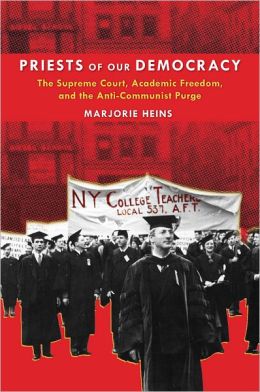
Priests of Our Democracy:
Marjorie Heins on Academic Freedom
and the Red Scare of the ’50s
“There were only a few exceptions to university collaboration in the Cold War heresy hunt.” — Marjorie Heins
By Jonah Raskin | The Rag Blog | February 18, 2013
[Priests of Our Democracy: The Supreme Court, Academic Freedom, and the Anti-Communist Purge by Marjorie Heins (February 2013: New York University Press); Hardcover; 384 pages; $35.]
Noted civil Liberties lawyer, teacher, and author Marjorie Heins discussed Priests of Our Democracy and the larger issue of academic freedom in our society with Rag Blog editor Thorne Dreyer on Rag Radio, Friday, February 8, 2013. Listen to or download Dreyer’s interview with Marjorie Heins, here.
In 1952, U.S. Supreme Court Justice Felix Frankfurter called teachers “the priests of our democracy” and noted that it was their special task “to foster those habits of open-mindedness and critical inquiry which alone make for responsible citizens.”
Frankfurter was an odd character, indeed, as Marjorie Heins shows in her fact-filled, balanced, and yet thought-provoking book about the battles for academic freedom that have been waged for decades in and out of classrooms, courtrooms, and in front of local and national investigating committees.
The battles go on; almost every week a book is banned by a school board somewhere in the U.S., though book bannings often don’t make it onto network news.
In an early chapter in which she profiles the members of the Supreme Court in the period after World War II, Heins chronicles Frankfurter’s epic journey from Austria, where he was born in 1894, to Ellis Island, the gateway to America, and from there to Harvard Law School and then to Washington, D.C. where he sat on the bench along with Hugo Black, once a Ku Klux Klan member, and William Douglas who came down on the side of the First Amendment and Freedom of Speech throughout his long judicial career.
It was an exceptional court by all accounts.
In 1952, when Frankfurter called teachers “priests,” priests were held in much higher esteem than they are today by the American public, and so were teachers. For the past 60 years, the church and academia have both lost much of the prestige and status that they once enjoyed in part because of scandals that have often involved sex and money. Remember Jerry Sandusky? Now, both academia and the church routinely go about cleaning their respective houses; they have to if they want to remain in business.
Once upon a time, teachers — including many that Heins writes about — believed that they were on a holy mission to foster “open-mindedness and critical inquiry.” Some of them were communists, others were pacifists, Quakers, Trotskyites, and plain old subversives.
They were often the best of teachers, so Heins suggests, and they were often the teachers most beloved by their students. But parents, politicians, and priests, too, viewed them with suspicion, accused them of heresy, disloyalty, and treason, along with minor crimes and misdemeanors.
Perhaps parents, priests in the Catholic Church, and virulently anti-communist politicians were jealous of the genuine bonds that existed between teachers and pupils and felt that they had to destroy them. Far more than ideology was at work here; pettiness, pride, and ego rose to the surface.
In the first nuclear age, The United States went berserk, though not everyone did, of course. Justice Douglas remained relatively sane and so did Justice Frankfurter. Their sanity is part of the picture that Heins paints. In the White House, Harry Truman lost his grip even as he tightened the screws; in 1945 he approved the dropping of atomic bombs on Japan, and in 1947 he made loyalty oaths obligatory for federal employees. The U.S. seemed to want to do what the Soviet Union had done under Stalin — “purge” anyone and everyone suspected of failing to worship the leader.
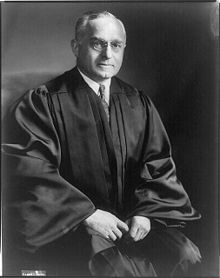 |
| Justice Felix Frankfurter. |
As Marjorie Heins — a long time civil liberties lawyer — shows Americans obsessed about loyalty and disloyalty in the era of President Harry Truman, Senator Joseph R. McCarthy, and a young California Congressman named Richard R. Nixon who made loyalty the name of the political game that catapulted him into the national spotlight.
Nixon, Truman, McCarthy, and dozens of local Nixon’s, Truman’s and McCarthy’s, demanded that the priests of the democracy prove their undying, unswerving fealty, and name the names of those whom they suspected of disloyalty — or whom they just didn’t like.
Heins writes about the activities of the House Un-American Activities Committee (HUAC) and those of the Rapp-Coudert Committee that operated in New York State and brought about the dismissal of outstanding teachers at City College of New York such as Philip Foner and his twin brother, Jack, both brilliant historians and both Old Lefties, though they were young lefties in the 1940s. Heins has a fondness for Old Lefties like the Foners and for the tireless lawyers of the Old Left such as Victor Rabinowitz and Leonard Boudin.
The historical period reeks with flamboyant characters and colorful cases. It has fascinated writers and scholars for decades, and no doubt will go on fascinating writers and scholars such as Heins who see it as a time that was put aside explicitly to hunt for heretics and then to purge them as unhealthy, unsavory, and un-American.
In Priests of Our Democracy, a suspenseful drama unfolds in which diabolical men persecute mostly good men and women, and in which the nine justices on the Supreme Court make momentous rulings that affect the lives of hundreds if not thousands of school teachers. Unfortunately, the justices were often too slow to act; they too were caught up in the hysteria of the period, and were cowed by politicians who were determined to root out so-called subversives. Political climate is a powerful thing, and Heins does an excellent job of mapping it.
To read this book is to live, or relive, the era of the Cold War, when American society as a whole reverted to the kind of Medieval thinking and acting that was prevalent during the fifteenth-century Spanish Inquisition. Indeed, historians such as Cedric Belfrage have called the phenomenon just that — “an Inquisition.” Hollywood screenwriter Dalton Trumbo labeled it “the time of the toad” and Columbia Professor Eric Bentley, a scholar of Berthold Brecht, borrowed from the language of the investigators themselves and counted it up as a disastrous “thirty years of treason.”
Others, such as playwright Arthur Miller — once Marilyn Monroe’s husband — likened it to a “witch-hunt” in his 1953 play The Crucible that lost him his career as a budding playwright for many years. Defending those accused of witchcraft and subversion was dangerous and guilt by association ruined many a career.
The virtue of Heins’s book is that it focuses on largely unknown, unsung teachers and librarians such as Harry Adler, Oscar Shaftel, Vera Shlakman, George Starbuck — who complained about “them damn loyalty oaths” — and Leon Josephson, an ex-communist and the lawyer for Harlem’s biracial nightclub, Café Society, where the likes of Billie Holiday and Lena Horne performed.
The Priests of Our Democracy mostly describes the anti-communist “crusade” (there’s another metaphor for you) that took place in and around New York in the 1950’s, and in and among the city’s Jewish population. Jews, many of them the sons and daughters of immigrants, tended to be union members and to believe in union solidarity.
Priests of Our Democracy also offers sections about earlier purges in American history — during the Civil War and the Red Scare of the 1920s — when politicians demanded absolutely loyalty from citizens. Then, too, crusades and inquisitions took place in other parts of the country, including New Hampshire and the State of Washington.
Heins is passionate about her subject, but levelheaded, too. She doesn’t romanticize communism, communists, the Old or the New Left of which she once was a part. Her research is compelling, the richness of the details absorbing, and the photos endearing. The index is excellent and the bibliography — which includes the pioneering work of Ellen Schrecker, author of No Ivory Tower: McCarthyism and the Universities — is helpful. Heins credits the work of pioneering authors in her field.
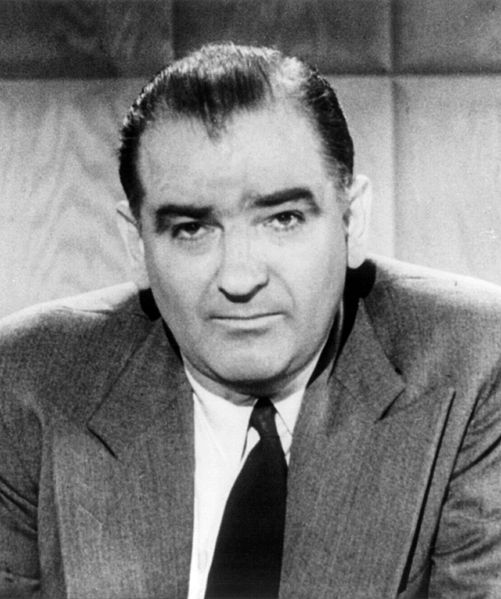 |
| Sen. Joseph McCarthy. |
She points out the lingering affects of McCarthyism, the witch-hunts, and the purges — whatever you want to call them — on American culture as a whole. History, she understands, doesn’t move in a straight line and rarely follows the path of progress. “There were only a few exceptions to university collaboration in the Cold War heresy hunt,” she writes in a chapter she calls “The Laughing Stock of Europe.”
In her conclusion, she describes what she calls “the continuing vacuum in American political discourse” which she attributes to the purges, investigating committees, betrayals, and punishments. American teachers, Heins shows, paid a heavy price if and when they refused to play the game of conformity. Booted out of academia, they scrambled to survive at all kinds of jobs.
They were also, she points out, a resilient and a resourceful group of people who were proud that they refused to knuckle under to the demagogic anti-communists who posed as idealists but who aimed to promote themselves and their careers. Some fired and discharged teachers were exonerated, and even honored — decades later.
I lived through the period of the 1950s and remember it well. My aunts worked for the pubic school system in New York and were investigated as Communists. My father, who was a lawyer, defended them and succeeded in preventing the board of education from firing them.
My college roommate, Eric Foner, now an illustrious historian, is the son of Jack Foner, and the nephew of Philip Foner. I spent my college days in the company of the Foners who continued to conduct research, write, and teach. It would be fair to say that they were my mentors and role models.
Many of my own teachers at Columbia had been radicals in the 1930s; by the 1950s they were no longer on the Left and no longer Marxists. In fact, they wanted to convert us to Freud and to Freudian concepts and to have us understanding that the U.S. was the best of all possible worlds.
I recommend this book to students, scholars, and citizens who care about academic freedom and about the fate of public discourse in America. I also recommend Priests of Our Democracy to those who worry that the war against terror has become in part a war against civil rights and civil liberties at home. Several states, including Ohio brought back loyalty oaths in the wake of 9/11.
When I first went to work for the State of California as a college teacher I had to sign a loyalty oath. I did so without protest. I wanted the job. The muckraking reporter, Jessica Mitford — whom I knew in Oakland — didn’t sign the oath when she was asked. She took on the oath itself and the administrators who enforced it as a matter of moral principle. She had far more resources than I and her husband, Bob Treuhaft, was an outstanding civil liberties lawyer. I might have asked my own father to take my case — and he would have been happy to do so — but he died long before I was hired.
The Priests of Our Democracy is also meant for those who work for colleges and corporations and at hospitals, radio stations, and elsewhere and who feel that in order to keep their jobs they have to censor themselves. Heins offers a telling quotation from Edwin Harold Eby, a lefty professor, who spoke for many Americans when he said, “If I was going to make a living in the U.S. I had to shut up — that was part of the job.”
Self-censorship is, as Marjorie Heins knows, perhaps the most effective and noxious kind of censorship on the face of the earth, and, unfortunately, it’s alive and well today from New York to Moscow and from Cairo and Los Angeles to Shanghai and Caracas.
[Jonah Raskin is a professor emeritus at Sonoma State University, where he taught First Amendment law. He is a regular contributor to The Rag Blog and the author of For the Hell of It: The Life and Times of Abbie Hoffman, and American Scream: Allen Ginsberg’s Howl and the making of the Beat Generation. Read more articles by Jonah Raskin on The Rag Blog.]
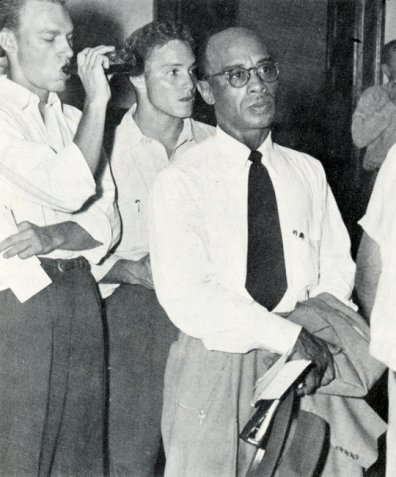 |
| Herman Sweatt was the first African American to attend the University of Texas after a 1950 Supreme Court decision. Photo courtesy of UT Press / Daily Texan. |
The hidden history of Texas
Part 12: 1940-1953/2 — Population growth and some significant civil rights victories.
By Bob Feldman | The Rag Blog | February 18, 2013
[This is the second section of Part 12 of Bob Feldman’s Rag Blog series on the hidden history of Texas.]
As Texas’s manufacturing industry expanded to produce more weapons and supplies for U.S. government needs during World War II, the need for factory workers in Texas increased; and more people in Texas moved from rural areas into cities and towns between 1940 and 1953.
By 1950, over 7.7 million people now lived in Texas and around 60 percent of all people in Texas now lived in urban areas. By 1950, for example, 596,163 people lived in Houston, 434,462 in Dallas, 408,407 in San Antonio, and 278,728 in Fort Worth; however, Austin’s population was still only 132,459 in 1950.
According to Alwyn Barr’s Black Texans, “World War II almost doubled the number of black industrial workers” in Texas — from 159,000 to a peak of 295,000 in 1943. But during World War II “the Consolidated Vultee plant” still “segregated its assembly line; and Baytown oil refineries paid blacks less than whites for the same work,” according to Randolph Campbell’s Going To Texas.
Many Texas-born African-Americans continued to leave white supremacist Texas society between 1940 and 1953 for states in the Northeast, Midwest, or West in which racial segregation was not legalized and where they had often been able to find factory jobs during World War II. But in Houston — where the total population had grown from 384,514 to 596,163 between 1940 and 1950 — the “black population increased from 86,302 to 125,400” during the 1940s, according to Merline Pitre’s In Struggle Against Jim Crow.
And — despite an anti-black riot by white racist Texans that occurred on June 15, 1943, in Houston — African-American civil rights activists in Houston and elsewhere in Texas between 1940 and 1953 began to win a few victories in their campaigns for an end to legalized racial discrimination, white supremacy, institutional racism, and interpersonal racism in Texas society and daily life.
In 1943, for example, a Houston NAACP “boycott against Winegarten Store [Sic: Correct spelling is “Weingarten’s”] led to the dismissal of one of the store’s security guards, who had struck a black customer” and “an NAACP-led demonstration made it possible for blacks to attend a production of Porgy and Bess at the Houston Music Hall and be seated on the same floor levels as whites,” according to In Struggle Against Jim Crow.
In addition, “on Apr. 6, 1943… representatives of the Negro Committee of the Houston Teachers Association presented the school board with a petition for pay equalization” and “on Apr. 13, 1943, rather than take a chance on a… lawsuit, the Houston school board agreed to make the salaries of black teachers and principals equal to those of their white counterparts who possessed the same credentials and performed the same duties,” according to the same book.
Then in 1944, the U.S. Supreme Court declared Texas’s white Democratic primary law to be illegal in its Smith v. Allwright decision in a legal case that African-American civil rights groups in Texas had initiated. And in 1946 — when 5,000 new members were recruited into the Houston chapter of the NAACP — African-American civil rights activists in Texas began to challenge the racist admissions policy of the University of Texas in Austin.
As In Struggle Against Jim Crow recalled:
Lulu B. White… executive secretary of the NAACP’s Houston branch, and the NAACP’s state director… led fight…to integrate the University of Texas… Urged on by the NAACP and accompanied by Lulu White and other supporters, Herman Sweatt attempted to register at UT in Austin on Feb. 26, 1946. After a discussion with [then-University of Texas] President Theophilus Painter and other university officials, Sweatt left his application at the campus and returned to Houston… Sweatt sued university officials on May 16, 1946 for denying him admission…
In April 1949, Joseph J. Rhoades, president of Bishop College, organized a mass registration attempt sending 35 black college seniors from across the state to apply to various professional programs at UT… When they arrived at the registrar’s office seeking admission, they were told that they could apply at TSUN [Texas State University for Negroes; later renamed Texas Southern University]. These students then decided to stage a demonstration, marching from the university to the State Capitol. They carried placards… One sign read, “Texas Can’t Afford a Dual System of Graduate and Professional Education” Another proclaimed, “Separate and Equal Education Is a Mockery.”…
The Supreme Court announced its findings in Sweatt v. Painter on June 5, 1950. In a unanimous decision the Court ordered Sweatt admitted to UT.
Also, “during the summer of 1946… the death of a black man gave rise to the largest mass protest demonstration that the city of Houston had ever witnessed” and “the NAACP… converted the funeral for Berry Branch, killed by a white bus driver, into a rally” in which “all labor unions in the city were represented,” according to the same book.
Yet despite the legal victories, there was still a poll tax in Texas that was utilized to block many African-Americans from being able to vote and the “only civil service positions” African-American residents were allowed to hold in Houston before 1945 “were in the post office,” according to In Struggle Against Jim Crow.
In addition, in 1948 only 15 of Houston’s 503 police officers were African-Americans and the “custom” of “the most blatant among the Houston companies” in its discriminatory policies between 1940 and 1953 — Hughes Tool — was still “to hire whites at 60 cents an hour and blacks at 50 cents an hour, although they were performing the same tasks,” according to the same book.
And, “Austin in 1951 changed its city council representatives from geographical districts to an at-large basis which guaranteed control of all seats by the white majority,” according to Black Texans.
The number of African-Americans who lived in Texas only increased from 924,391 to 977,458 between 1940 and 1950, as many African-Americans left Texas for the West Coast, Midwest, or Northeast; and as late as 1945 there were still only about 45,000 people of Jewish religious background who lived in Texas.
But by 1950, the number of Latinos of Mexican descent living in Texas — 1 million — now exceeded the number of African-Americans who lived in the state.
[Bob Feldman is an East Coast-based writer-activist and a former member of the Columbia SDS Steering Committee of the late 1960s. Read more articles by Bob Feldman on The Rag Blog.]
 |
| “Exterminating angel” overlooking a Gothic cemetery in Comillas, Cantabria. Image from Nitehawk Hatched. |
Exterminating angels
If Dorner had been standing on a skyscraper ledge or holding Rupert Murdoch hostage, the world might have paid more attention to the injustices that he chronicles.
By Mike Davis | The Rag Blog | February 15, 2013
Racism, as readers of Richard Wright and Chester Himes know, sometimes drives its victims homicidally mad as in the cases of Bigger Thomas in Native Son or the anonymous sniper in Himes’ extraordinary short story “Prediction.”
But then again, “mad” may be a cowardly liberal euphemism for a radical defiance that would rather kill and die than submit to further lies and humiliation. Both stories are so unsettling because they leave the reader to divide unendurable injustice by the horror of its redress and then ponder the terrifying quotient.
Christopher Dorner’s Facebook “Manifesto,” the product we’re told of the acute depression that descended on the author after his dismissal from the LAPD, veers between bipolar extremes. In one section, Dorner taunts his former comrades in sneering acronyms that boast his expertise: “Your APC is defunct… My POA is always POI.”
But the rant is followed by sentimental acknowledgements to friends and several pages of fan notes to eclectic heroes who include Hilary Clinton (his first choice for president in 2016), Chris Christie (his second choice), Dave Brubeck, General Petraeus, and Ellen DeGeneres. He also passionately advocates (and provides an argument for) gun control.
Perhaps his brain synapses were misfiring for a long time, but the core of Dorner’s Manifesto is a coherent account of how a police Explorer Scout realized his life’s dream as a LAPD rookie and then had his reputation and career destroyed for being an honest cop. He debunks the myth — propagated by the Times, Los Angeles Mayor Villaraigosa, and most of the city’s liberal establishment — that thanks to Saint William Bratton (its former chief) a kinder, gentler, and more diverse LAPD now protects and serves Los Angeles.
Indeed Dorner’s eyewitness account of routine sadism, racism, and conspiracy in the department is totally in line with its historical institutional culture and was inadvertently fact-checked by the LAPD’s wild shooting of two innocent women and Chief Beck’s knee-jerk exculpation of the officers involved. (Those who think that there are no more Rodney Kings should look carefully at the case of the LAPD cop who killed a mentally-ill woman last summer by stomping on her genitals.)
If Dorner had been standing on a skyscraper ledge or holding Rupert Murdoch hostage, the world might have paid more attention to the injustices that he chronicles. But he chose instead to make his enemies’ homes his “war space” and their families his targets. Thus his spree began — not with his Barrett ’50 aimed at LAPD headquarters — but with the chilling murder of a cop’s adult daughter and her fiancée.
Outlaw heroes are not this pitiless and there is no warrior honor in killing helpless family members. So who was Dorner? He will undoubtedly be buried in multiple coffins by competing theories and explanations. Some will fit him for serial killer lunatic, while on the AM dial he’ll be denounced as liberalism’s Timothy MacVeigh. Obama will be blamed.
But I’m haunted by an eerie precedent to Dorner’s story: the legend of Mark Essex.
Essex was a monster in the same mould as Dorner: his rage at injustice and humiliation grew into annihilating violence. A young Black Navy veteran who, unlike Dorner, had almost no formal weapons training, Essex boldly attacked the headquarters of the New Orleans Police Department on New Years Eve, 1972. After killing a Black police cadet and wounding a white lieutenant, Essex escaped to a nearby warehouse where he ambushed a K-9 unit and killed another cop.
For a week he eluded a vast manhunt before suddenly reappearing in the Downtown Howard Johnson Hotel across the street from City Hall. Going floor to floor, always warning the housekeepers to flee, he shot down hotel managers and white guests, setting rooms afire as he climbed toward the roof.
The New Orleans police rushed the hotel, but Essex with uncanny accuracy shot cops off fire ladders, mowed them down in stairwells and killed them as they stepped out of elevators or got out of their cars in the streets below.
By nightfall on 7 January 1973, Essex — now bunkered on the roof of Howard Johnson — had militarily defeated the entire New Orleans Police Department. He had shot 10 police officers (killing five, including a deputy chief) and 11 white civilians (killing four) while withstanding thousands of rounds of police fire without a wound.
Ultimately a Marine helicopter was brought in and after taking numerous hits from Essex in three runs at the hotel, a police sharpshooter finally killed the one-man Black liberation army. When the coroner received what remained of Essex he counted 200 bullet wounds.
Throughout his lonely combat Essex was probably inspired by the example of a spiritual grandfather, Robert Charles. In 1900, the capstone year of Jim Crow legislation in Louisiana, Charles had been attacked by a New Orleans cop, whom he wounded in self-defense. A proud Black nationalist and supporter of return to Africa, Charles refused to turn himself over to a lynch mob.
In four days of gun battles with an army of 1,000 police and even larger groups of white vigilantes, he shot 27 whites, including 16 police, before being killed as he emerged from his burning hiding place. Ida B. Wells, the pioneer African-American journalist and anti-lynching activist, wrote a brave account of Charles’ martyrdom. (Mob Rule in New Orleans: Robert Charles and his Fight to the Death [1900] available at Project Gutenberg.)
 |
| Mark Essex. |
Essex’s Armageddon was the subject of Peter Hernon’s superb A Terrible Thunder: The Story of the New Orleans Sniper, first published in 1978, but still in print. Indeed Hernon anticipates some of the key questions that may confront Dorner’s biographer. Essex grew up in Emporia, Kansas, the child of a blue-collar Black family in an otherwise almost all white town. (Dorner emphasizes that he was the only Black child in his classes until middle school.)
Hernon finds nothing traumatic or disturbed in Essex’s life until he joins the Navy in the late 1960s and trains in San Diego as a dental technician with the hope of someday going to dental school. The white Navy dentist whom Essex assisted recalls him rather fondly to Hernon as a cheerful 19-year-old from Kansas.
But the Navy in 1969 was anything but cheerful. In the white ranks there was seething hostility against promotion of Blacks and race riots had erupted on the flight decks of the big carriers. Many Black sailors, as well as a minority of whites, are alienated by the War in Vietnam and the Nixon backlash at home.
Essex was stationed at a small naval base in Imperial Beach (last exit before Tijuana and the site of the hugely subversive and accordingly short-lived HBO series, John from Cincinnati) where he and other Blacks were constantly taunted by racist CPOs. (Hernon quotes one as loudly proclaiming “God, it must have been beautiful 20 or 30 years ago. When a nigger went to sea it was below the decks, in the galley.”) Finally after one slur too many, Essex decked a white sailor.
He was doomed. Like Bob Jones, the Black shipyard worker, in Chester Himes’ ferocious 1945 novel If He Hollers Let Him Go, a single misstep and his life spiraled downward. In face of unfair punishments and continuing abuse, Essex lost faith in a naval career. After going AWOL he was kicked out of the service. Unlike Dorner however, Essex was able to place injustice in a political framework; there are plenty of radical cats in the Navy in 1970 and he ultimately gravitated toward the Black Panthers, first in New York and then in New Orleans.
Police attacks on the Desire projects and the killing of local activists convinced Essex that it was time for war. Hernon is very clear, however, that this was a solo project, “revolutionary suicide” in the terminology of the time. But Essex didn’t die entirely alone. As he killed cops from the rooftop of the Howard Johnson, young Black people in the street cheered him.
If few actually cheered Dorner, public sympathy with his grievances has stunned the LAPD and its supporters. Over the last week, Police Chief Charlie Beck and Mayor Villaraigosa repeatedly went to the podium to remind viewers that Dorner was the bad guy not the hero. Mysterious posters appeared with Dorner’s photo and the word: HOPE. The blogosphere is crowded with personal testimonies about police brutality and the fraud of LAPD reform.
Dorner, however horrible his method, reopened the debate. He was Rodney King in body armor.
In the last hours of his life, he declined the opportunity to take a hostage, telling a white guy in a pick-up truck to simply take his dog and walk away. A few minutes later he shot two San Bernardino County sheriffs. Then like “Mad Dog” Roy Earle, played by Humphrey Bogart in Raoul Walsh’s High Sierra (1941), he hunkered down to die.
The San Bernardino SWAT Team ultimately chose to “burn the motherfucker” by lobbying pyrotechnic military CS gas canisters into the cabin where Dorner was making his last stand. The resulting inferno resurrected dark memories of the LAPD’s incineration of six members of the Symbionese Liberation Army in South Central L.A. in 1975 and the FBI’s auto de fe of Branch Dravidians at Waco in 1993. (CS grenades — notorious fire starters — were used in both cases.)
Disturbing new precedents have also been set. The use of heat-imaging reconnaissance drones to hunt for Dorner — who was repeatedly categorized as a “domestic terrorist” (eve, in one blog, a homegrown “Bin Laden”) — opens the way to Predators, Hellfire missiles, and domestic kill lists. The attempted murder of three innocent civilians (two women and a white guy) by the LAPD and the Torrance police prefigures the likely “collateral damage” that will be tolerated in future American Afghanistans.
In any event, Christopher Dorner’s ghost will be around for a very long time.
[Mike Davis is a Distinguished Professor in the Department of Creative Writing at the University of California, Riverside. An urban theorist, historian, and social activist, Davis is the author of City of Quartz: Excavating the Future in Los Angeles and In Praise of Barbarians: Essays against Empire. Read more articles by Mike Davis on The Rag Blog.]

We Indians cut our own throats when we discourage academic ambition, but it’s time that non-Indians understand when they tolerate Indian mascots, they cut our children’s throats with imaginary tomahawks.
By Steve Russell | The Rag Blog | February 15, 2013
Lots of things have followed me into my second retirement. Some, like continuing work with Indian graduate students, are a source of delight. Others less so. I am reminded that I failed to change the world.
The National Science Foundation just sent me the 2011 report on earned PhDs. I immediately headed for the graph that breaks down the numbers by race/ethnicity.
Like all credentials, the PhD can represent more aspiration than reality, but the aspiration is worthy by any measure. The objective of a doctoral dissertation is to add to the total store of human knowledge in a measurable way.
It’s true that some PhD granting schools are more rigorous than others, the same as undergraduate schools.
My claim is not that the credential is infallible evidence of the accomplishment it is supposed to represent. We all know better than that. But it’s also more than just the union card for the professoring trade, and the more tribal citizens with advanced degrees — PhD, MD, JD, or others — the more 21st century possibilities are open to the tribe, not just the individuals who get the degrees. So, yes, if my academic career has involved advancing Indians on the micro level, one student at a time, I remain highly interested in the macro level.
I remember a discussion about the minimum number of Indian lawyers it would take to form a section of the American Bar Association and realizing it would require us to literally sign up every known Indian with a law degree (at the time) to what is a voluntary and quite expensive organization (to which I currently do not belong). I remember talking with a non-Indian MD who was working off his school debts with the Indian Health Service and coming to the realization that he did not think much of Indians. I don’t like the view at the bottom of the barrel.
In the 2011 numbers, I noted that Hispanics, at 2,006 new PhDs, surpassed African-Americans, at 1,953. This has been a continuing trend because Hispanics (16.7% of the population) outnumber blacks (13.1%). American Indians, even by the expansive new definition that doubled the numbers, and even adding Native Hawaiians, are only 1.4% of the population. Number of new PhDs? 136.
Let’s review.
African-Americans are about 13.1% of the population and produced about 6.14% of the new PhDs.
Hispanics are about 16.7% of the population and produced 6.31%.
Indigenous persons are, on paper, 1.4% of the population, a number that is greatly overstated by self-reporting from the Elizabeth Warrens of the world. We produced .43% of the new PhDs.
I watched similar numbers for years involving the JD degree. We are growing in absolute numbers, and we’ll continue to get better because education is as hereditary as lack of education. I am a first generation college student and all four of my kids went to college. So, are we satisfied?
I’m not satisfied, and every time I hear a bright Indian kid accused of “thinking white” for the sin of thinking, I want to revert to savage stereotype.
When Indians do something positive, we are quick to offer cultural explanations for our superiority. It’s about time culture took some of the rap for our academic underperformance.
You want more evidence? Asians are about 5% of the population and snagged over 9% of the new PhDs. I’ve never heard of an Asian kid being accused of “thinking white” or of trying to elevate herself above her peers.
Speaking of savage stereotypes, some people would say that the problem of our lack of success in education is a problem way bigger than, say, Indian mascots.
With that painful sight of Robert Griffin III going down on his knee the wrong way, I was reminded that I care about him as an exciting rookie player from my neck of the woods while I root for the Washington team to lose, always.
RGIII played his high school ball at Copperas Cove and his college ball at Baylor. He’s one of those new wave running quarterbacks. You never know if he is going to hand it to the running back, throw it, or take off. More to the point, neither does the defense.
So why, oh why, did he have to get drafted by the Washington team?
In 2008, a refereed article appeared in the journal Basic and Applied Psychology, “Of Warrior Chiefs and Indian Princesses: The Psychological Consequences of American Indian Mascots.” Like most science, it contains more mathematics than opinions, but I’ll skip the math and go to the money shot in the abstract:
We suggest that American Indian mascots are harmful because they remind American Indians of the limited ways others see them and, in this way, constrain how they can see themselves.
We Indians cut our own throats when we discourage academic ambition, but it’s time that non-Indians understand when they tolerate Indian mascots, they cut our children’s throats with imaginary tomahawks.
The public Indian comes in two versions, primitive relic or romantic warrior, both doomed. Historical figures, feared in the past, pitied in the present, irrelevant to the future.
When I was a professor at the University of Texas-San Antonio, they still had an affirmative action plan. It did not call for the recruitment of Indians, citing the lack of Indian PhDs in the talent pool. There was a hiring goal for Asian males, but none for Indians of any gender.
There were two Indians on the faculty. The other guy did not get tenured. I did, but I took an offer at a Research I school… where I was one of two Indians. Again, I was the only one of the two of us to get tenured, but they hired three more and we discovered another who had never before made himself known. Two of the three hires left by the time I did.
If Indian students did not get mentored by non-Indians, they would never get mentored. Not that the lack of mentors is the major problem. The major problem is that most research universities contain more dead Indians as “scientific data” than live Indians as students.
I was born in a small town in Oklahoma where the most numerous minority was Indians. Only one in my age cohort finished high school. I myself made it only to the ninth grade. We expected no more of ourselves than the public schools expected of us, and we had no educated role models.
That has not changed, and we’ve had about all the “honoring” by turning us into mascots that we can stand.
I wish RGIII all the best for a quick recovery, and for the day he plays for a team that does not disadvantage Indian children.
[Steve Russell lives in Sun City, Texas, near Austin. He is a Texas trial court judge by assignment and associate professor emeritus of criminal justice at Indiana University-Bloomington. Steve was an activist in Austin in the sixties and seventies, and wrote for Austin’s underground paper, The Rag. Steve, who belongs to the Cherokee Nation of Oklahoma, is also a columnist for Indian Country Today. He can be reached at swrussel@indiana.edu. Read more articles by Steve Russell on The Rag Blog.]
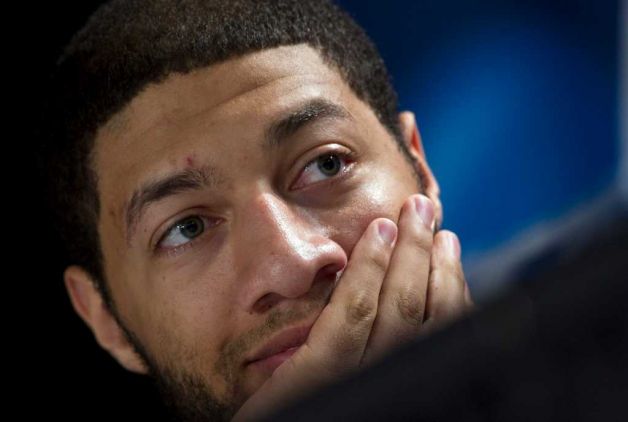 |
| The Houston Rockets’ Royce White. Image from Hoopspeak.com. |
White has become a crusader for change, calling out the NBA for disregarding mental illness and treating him like ‘a commodity.’
By Dave Zirin | The Rag Blog | February 14, 2013
Read Ron Jacobs’ Rag Blog review of Dave Zirin’s new book, Game Over: How Politics Has Turned the Sports World Upside Down.
This week, the most famous NBA player yet to play in the NBA finally took the court. Royce White, rookie forward for the Houston Rockets, suited up for their D-League team, the esteemed Rio Grande Valley Vipers. In 18 minutes, he had seven points, eight rebounds, and four assists.
But the bigger story was that White played at all. For months, the 21-year-old has been sitting out the season in protest: a rebel with a cause. White has been battling the Rockets over how they would deal with issues surrounding his mental health. The first-round-draft-pick has an anxiety disorder that affects how he handles everything from flying to practices.
He has made it clear amidst an avalanche of criticism that his mental health is more important that his contract or career. Throughout this difficult fall, White has become a crusader for change, calling out not just the NBA for disregarding mental illness and treating him like “a commodity,” but also the fans that have sent him “hundreds” of violent and especially homophobic threats. White isn’t gay but apparently, for some, caring about your mental health is the equivalent.
Until a recent interview, however, it wasn’t clear just how politically thoughtful, serious, and even revolutionary an athlete we have in Royce White. For White, this isn’t just about his struggle or changing how NBA teams treat mental illness. It’s about something far greater. In his interview on the ESPN spin-off site Grantland with journalist Chuck Klosterman, White said that the question we are scared to ask in the United States is, “How many people don’t have a mental illness?” Klosterman responded, “Why wouldn’t we want to talk about that?”
White’s reply is one for the ages:
Because that would mean the majority is mentally ill, and that we should base all our policies around the idea of supporting the mentally ill because they’re the majority of people. But if we keep thinking of them as a minority, we can say, “You stay over there and deal with your problems over there.”…
[T]he problem is growing, and it’s growing because there’s a subtle war — in America, and in the world — between business and health. It’s no secret that 2 percent of the human population controls all the wealth and the resources, and the other 98 percent struggle their whole life to try and attain it. Right? And what ends up happening is that the 2 percent leave the 98 percent to struggle and struggle and struggle, and they eventually build up these stresses and conditions.
As if this wasn’t enough for one interview, White also said that he wants to use basketball as a platform to fight for universal mental health coverage with clinics in every community. He claimed that he is willing to “die for this.”
When athletes use their hyper-exalted positions to fight for something greater than themselves they are, consciously or not, laying claim to a powerful tradition. It’s a tradition marked by people like Billie Jean King, Bill Russell, an, of course, Muhammad Ali.
In listening to White, I was reminded of something Ali once said:
All of my boxing, all of my running around, all of my publicity, was just the start of my life. Now my life is starting — fighting injustice, fighting racism, fighting crime, fighting indecency, fighting poverty. Using this face that the world knows through fame and going out and representing truth.
White as well is that rare person who wants to use his fame to represent truth. There is, of course, an ocean of difference between Royce White and Muhammad Ali in terms of athletic accomplishment and cultural capital. But there’s a subtler difference as well. Ali at his political apex was part of a massive anti-war wave. Even though the boxing establishment and much of the media despised him, he had an army of supporters.
Contrast that to today. There is no wave of people standing up for the rights of the mentally ill. There is no one in mainstream politics talking about the mental health crisis that pulses beneath daily life in this country. There is no one on Capitol Hill pointing out what’s in plain sight every day.
Think about all the massive attention we are paying to gun violence and the absence of attention to what makes people crack and become violent in the first place. Think about the tragic shootings in Chicago and the absence of discussion about the poverty and racism that define the parts of that city where the murders are taking place. Think about the mental stress that precedes so much of the violence in communities around the country.
This is the discussion Royce White wants us to have and the 21-year-old seems like the only person in public life who wants to have it. In other words, if Ali, like no one else, brilliantly rode the rapids of a tumultuous era, Royce White is attempting something far for daunting. He’s trying to change the direction of the whole damn river.
This article was also posted at The Nation blog.
[Dave Zirin is the author of the new book Game Over: How Politics Has Turned the SportsWorld Upside Down (The New Press). Receive his column every week by emailing dave@edgeofsports.com. Contact him at edgeofsports@gmail.com. Read more articles by Dave Zirin on The Rag Blog.]
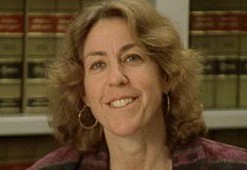 |
| ‘First Amendment Hero’ Marjorie Heins. |
Rag Radio podcast:
Civil liberties lawyer Marjorie Heins,
author of ‘Priests of Our Democracy‘
By Rag Radio | The Rag Blog | February 14, 2013
Coming next week: Jonah Raskin reviews Priests of Our Democracy.
Marjorie Heins, a civil liberties lawyer, writer, and teacher — and author of the new book, Priests of Our Democracy: The Supreme Court, Academic Freedom, and the Anti-Communist Purge — was Thorne Dreyer’s guest Friday, February 8, 2013, on Rag Radio, a syndicated radio show produced at the studios of KOOP 91.7-FM in Austin, Texas.
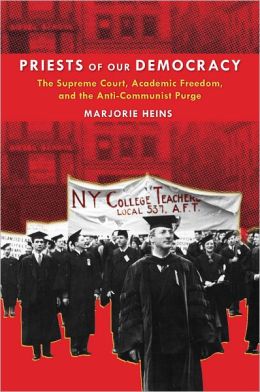 |
| Priests of Our Democracy. |
Heins’ new book, Priests of Our Democracy, “tells of the teachers and professors who resisted the witch hunt of the early ’50s, those who collaborated, and those whose battles led to landmark Supreme Court decisions.” The book tells how the anti-communist excesses of the 1950’s “impoverished political discourse in ways that are still being felt,” and how “First Amendment academic freedom… is in peril today.”
Listen to or download Thorne Dreyer’s interview with Marjorie Heins, here:
Her earlier book, Not in Front of the Children, won the American Library Association’s 2002 Eli Oboler Award for best published work in the field of intellectual freedom. Her other books include Strictly Ghetto Property: The Story of Los Siete de la Raza; Cutting the Mustard: Affirmative Action and the Nature of Excellence; and Sex, Sin, and Blasphemy: a Guide to America’s Censorship Wars
A graduate of Harvard Law School, Heins has taught as a visiting professor at Boston College Law School, Florida State University Law School, the University of California-San Diego, New York University, Tufts University, and the American University of Paris.
Marjorie Heins was also active in the ‘60s-‘70s New Left and underground press movement and was a contributor to New York’s RAT and a staff writer at the San Francisco Express-Times.

Rag Radio has aired since September 2009 on KOOP 91.7-FM, an all-volunteer cooperatively-run community radio station in Austin, Texas. Hosted and produced by Rag Blog editor and long-time alternative journalist Thorne Dreyer, a pioneer of the Sixties underground press movement, Rag Radio is broadcast every Friday from 2-3 p.m. (CST) on KOOP, and is rebroadcast on Sundays at 10 a.m. (EST) on WFTE, 90.3-FM in Mt. Cobb, PA, and 105.7-FM in Scranton, PA.
The show is streamed live on the web by both stations and, after broadcast, all Rag Radio shows are posted as podcasts at the Internet Archive.
Rag Radio is produced in association with The Rag Blog, a progressive internet newsmagazine, and the New Journalism Project, a Texas 501(c)(3) nonprofit corporation. Tracey Schulz is the show’s engineer and co-producer.
Rag Radio can be contacted at ragradio@koop.org.
Coming up on Rag Radio:
THIS FRIDAY, February 15, 2013: Musician and Music Journalist Hector Saldaña of The Krayolas.
Waldman’s film and TV
treasures you may have missed:
Enjoy 10 seasons of a great, well-made thriller ripped from the headlines.
By Alan Waldman | The Rag Blog | February 13, 2013
[In his weekly column, Alan Waldman reviews some of his favorite films and TV series that readers may have missed, including TV dramas, mysteries, and comedies from Canada, England, Ireland, and Scotland. Most are available on DVD and/or Netflix, and some episodes are on YouTube.]
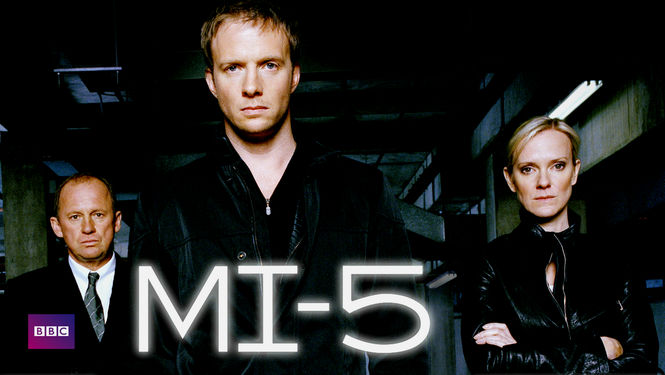
For many Americans — me included — the finest recent British drama or crime series is MI-5, which deals with crises faced by the English intelligence agency which is the equivalent of the FBI (and which also has some of the responsibilities of the CIA). This brilliantly produced, acted, and written TV series is titled MI-5 in the U.S., Canada, and France; Spooks in the UK; Erikoisioukke in Finland and Tainiacy in Poland.
Due to its glossy high production values, outstanding scripts and rapidly paced spy intrigue and action-adventure story lines, it has been a critical and popular success for a decade. It has screened in 25 countries, including India, Serbia, Iceland, and Brazil.
Before its cancellation in 2011, it aired 86 exciting episodes over 10 seasons — all of which are available on Netflix, DVD, and Netflix Instant. Here is the first 60-minute episode.
Over the decade, MI-5 has seen several major cast changes, but it has always featured outstanding talents, including Matthew MacFadyen, Keeley Hawes, Nicola Walker, David Oyelowo, Jenny Agutter, Andy Serkis, and Hugh Laurie. It has been nominated for 36 major honors, winning eight — including six Best Drama Series awards and acting statuettes for Hermione Norris and Rupert Penry-Jones. Acting noms went to Richard Armitage, Gemma Jones, and series lead Peter Firth. It has had 24 gifted writers and 26 directors.
It was interesting watching Firth and Agutter work together on TV, 26 years after seeing them perform nude on Broadway in Equus.
More than 94.7% of viewers gave MI-5 thumbs-up at imdb.com, and more than 40.2% rated it 10 out of 10. The series has a great contemporary feel, as it deals convincingly with today’s real security threats, including arms smuggling, terrorism, assassination attempts, race riots, drug trafficking, protecting a visiting U.S. president, hostage crises, Hindu nationalist plots to attack Muslims, bank robbery, and CIA-MI-5 tensions.
This smart, outstanding series is highly enjoyable on many levels, and I heartily recommend it to you.
[Oregon writer and Houston native Alan Waldman holds a B.A. in theater arts from Brandeis University and has worked as an editor at The Hollywood Reporter and Honolulu magazine. Read more of Alan Waldman’s articles on The Rag Blog.]
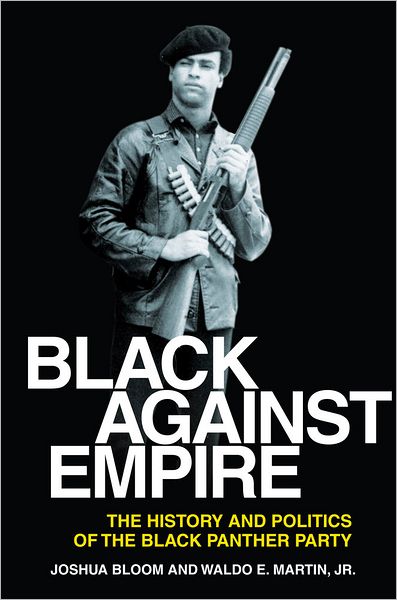
Black Against Empire:
The legacy of the Black Panther Party
“We didn’t preach to the people, we worked with them.” — Former Black Panther Mumia Abu Jamal
By Ron Jacobs | The Rag Blog | February 12, 2013
[Black against Empire: The History and Politics of the Black Panther Party by Joshua Bloom and Waldo E. Martin Jr. (George Gund Foundation Imprint in African American Studies) (2013: University of California Press); 560 pp; $34.95.]
Once again, it’s Black History Month in the United States. Since the inception of this celebration, its meaning has unfortunately been diminished as the myth of post-racialism becomes gospel, even though it shares none of a gospel’s truths.
In schools and libraries, well-meaning teachers and library workers create displays, bring in speakers, and teach lessons on the history of African-Americans. All too often, this means a look at the words of Martin Luther King, Jr., a discussion of the Emancipation Proclamation, and maybe a lesson about Rosa Parks. Only rarely, do students and library patrons get a look beyond these conventional topics that are usually taught in a manner that highlights white America’s tolerance and sense of fair play.
This is why books like the recently released Black Against Empire: The History and Politics of the Black Panther Party are so important. They remove the pretense that the Black liberation movement in the United States was something everyone except the KKK and its allies supported. Books like this tell the truth. Blacks Against Empire does so concisely, engagingly, and honestly.
Black Against Empire is a political history that is simultaneously objective and radical. Despite the efforts of historians to obfuscate and obliterate the party from history, describing it as a hate group and gun-obsessed when mentioning it at all, the fact is the Panthers’ legacy is unique and important to not only the history of Black America, but to the history of the entire United States. It is best described in the words of Mumia Abu Jamal: “We didn’t preach to the people, we worked with them.”
The relationship between the primarily white New Left and the Panthers is explored in a fair-minded and realistic manner, as is the relationship between the Panthers and other Third World revolutionary organizations, both in the United States and around the world. The authors expand the narrative of the movement against the U.S. war in Vietnam, showing clearly the early involvement of black organizations, especially that of the Student Nonviolent Coordinating Committee (SNCC). It was this organization that actually began resisting the draft, months before the predominantly white anti-war movement.
Furthermore, as the authors make clear, opposition to the U.S. war in Vietnam was one of the Black Panthers’ fundamental positions.
Like most revolutionary organizations the Panthers struggled with issues of gender and sexuality. While the participation of men in the breakfast programs sensitized them to the realities of child-rearing and associated aspects of human life (think of the film Salt of the Earth, when the women replace men on the picket lines and the men take over household tasks forcing them to see the relationship of domestic tasks to the capitalist dynamic), the living situations of many Panthers reinforced traditional gender roles.
Joshua Bloom and Waldo E. Martin, Jr., the authors of Black Against Empire, have written a comprehensive and compelling history of the Black Panther Party. As close to complete as one text can possibly be, it is the book I would recommend to anyone wanting to read just one book about the Black Panthers. The book concludes with a chapter speculating as to why the Black Panthers developed when they did, why they commanded the support they did, and why their influence waned so quickly.
Of course, the role of the government counterinsurgency program called COINTELPRO is discussed; the frame-ups, misinformation, jacketing, and murders. In light of current concerns about domestic “terrorists,” one wonders if the Panthers would be considered drone assassination targets under the current Justice Department guidelines if they were around today?
Other reasons provided by the authors for the Panthers’ demise borrow from the Italian Antonio Gramsci’s thoughts on revolutionary movements and end up asking more questions than they answer.
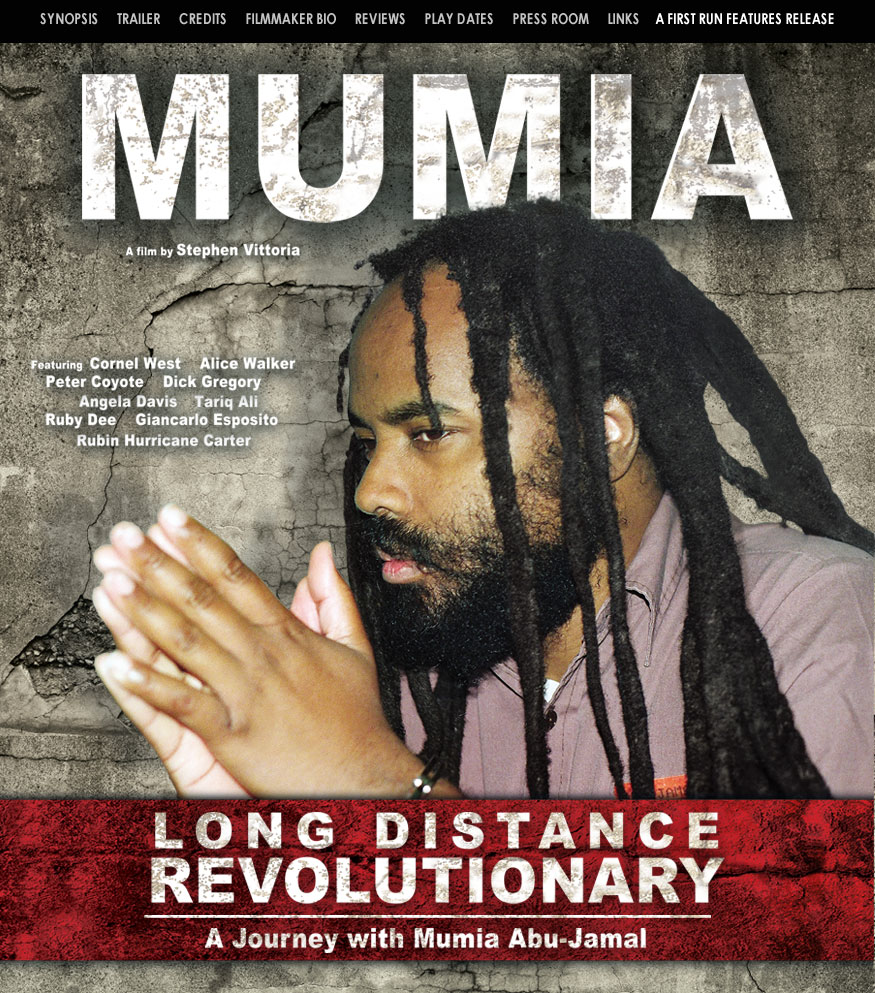
Long Distance Revolutionary
Back to Mumia Abu Jamal. One of the youngest Panthers in the nation, he continued his revolutionary activism and reportage long after the Black Panthers had become history. Indeed, his post-Panther trajectory could serve as a microcosm of many leftist revolutionaries who came of age during the Panthers’ heyday.
He didn’t give up his radicalism while pursuing a career after the Party. Because of this, he ended up paying for his history and his refusal to compromise. He continues paying even today. For those who have forgotten (or never paid attention), Mumia has been on Pennsylvania’s death row for more than two decades. Accused and convicted of killing a Philadelphia policeman in a prosecution involving the sketchiest of evidence and numerous prosecutorial and judicial missteps, Mumia’s life and situation is the subject of a new feature film titled Long Distance Revolutionary.
When I was helping organize antiwar activities in the late 1990s and the 2000s, I learned that many of the younger radicals I was working with came to their politics after learning of Mumia’s case. Thanks in no small part to his eloquence and the support of popular musicians like Rage Against the Machine, these young people saw through the intense desire of the State to keep Jamal in prison and kill him. This understanding opened their eyes to the realities of the system and made them radical.
As the film shows, this trajectory is similar to Jamal’s. Mumia is a political prisoner. The Panthers were a political organization. The story of both is a story that needs to be heard. The film is part biography, part commentary from supporters and Jamal himself, and part drama. The sum of these parts is a film that provokes and entertains.
The Black Panthers were bold. The Black Panthers were smart. The Black Panthers were anti-imperialists. The Black Panthers were revolutionaries. This book and this film remind us of that. They also remind us that this world, this nation, could use something with the Panthers’ appeal and power now. Read this book, ask your library to buy it; watch this film.
Black history isn’t just for black people. It’s for everyone who wants to understand the history of the United States.
[Rag Blog contributor Ron Jacobs is the author of The Way The Wind Blew: A History of the Weather Underground. He recently released a collection of essays and musings titled Tripping Through the American Night. His latest novel, The Co-Conspirator’s Tale, is published by Fomite. His first novel, Short Order Frame Up, is published by Mainstay Press. Ron Jacobs can be reached at ronj1955@gmail.com. Find more articles by Ron Jacobs on The Rag Blog.]
Thorne Webb Dreyer, Editor





