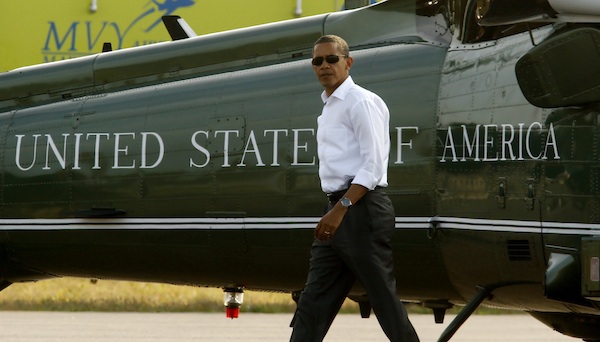
Harry Targ : The War on Afghanistan is Our Biggest Fantasy

Image from Reuters.

The war on Afghanistan:
Our longest war and biggest fantasy

Obama’s announcement sounded eerily like the policy of ‘Vietnamization’ which President Nixon put in place in 1969.

By Harry Targ | The Rag Blog | May 9, 2012

On May Day 2012 President Obama made a secret trip to Afghanistan and spoke to the nation and the troops on the ground about past, present, and future policy. What the speech revealed was a replication of a 10-year fantasy narrative about why we went to war on Afghanistan, what our goals were, and what the future holds in the region for the United States and, most important, the Afghan people.

The President announced he was signing an agreement between the two countries which will define “a new kind of relationship” in which Afghans will assume primary responsibility for their security and “we build an equal partnership between two sovereign states.” The future of this relationship will be bright as “the war ends, and a new chapter begins.”

The announcement sounded eerily like the policy of “Vietnamization” which President Nixon put in place in 1969; handing over ground action to the South Vietnamese government while the United States escalated the bombing of targets in North and South Vietnam and invaded neighboring Cambodia. The South Vietnamese government and military were incapable of assuming “primary responsibility” and in the end were overthrown by powerful forces in the countryside.

The President explained that President Bush correctly launched a war on Afghanistan in October 2001, because the country allowed terrorist leader Osama Bin Laden an al Qaeda “safe-haven” for terrorist planning and attacks, ultimately leading to the tragedy of 9/11. While Bin Laden escaped to Pakistan, the U.S. continued fighting the Taliban who have “waged a brutal insurgency.”

Subsequently, he claimed, using the dehumanized language of violence-prone discourse, the U.S. military has “taken out over 20 of their top leaders” including bin Laden himself. But the war continues. While the United States downsizes its troop commitments policy will include:

  • a transition of the war to our Afghan military allies. Importantly, Obama proclaimed that at the NATO summit this month in Chicago, “our coalition will set a goal for Afghan forces to be in the lead for combat operations across the country next year.” However, “international troops will continue to train, advise and assist Afghans, and fight alongside them when needed.”
  • training of Afghan Security Forces, leading to an Afghan force of 352,000 troops which NATO will support to create “a strong and sustainable long-term Afghan force.”
  • increasing US/NATO/Afghan cooperation “including shared commitments to combat terrorism and strengthen democratic institutions.” President Obama declared that these commitments, in the short run involving counter-terrorism and continued training, do not include the building of permanent U.S. bases.
  • pursuing a negotiated peace with the Taliban if they break with al Qaeda, renouncing violence and to “abide by Afghan laws.”
  • working towards stability in South Asia, including partnering with neighboring Pakistan. The President assured viewers that “America has no designs beyond an end to al Qaeda safe-havens and respect for Afghan sovereignty.” In short, the central goal of United States policy is to destroy al Qaeda, in the short run to stabilize Afghanistan, and “to finish the job we started in Afghanistan…”

The speech reflects the classic pattern of U.S. military globalization coupled with tortured ahistorical fantasy narratives that have characterized policy since the end of World War II.

The President rationalized a 10-year war on a nation in which terrorists resided because Afghan leaders refused to hand over alleged perpetrators without some evidence of the connection between them and 9/11.

Also, the initial narrative, reflected in the President’s speech last week, conflated the al Qaeda terrorists with the so-called Taliban. The Taliban ruled Afghanistan in the 1990s with support from the United States. Some of these Afghan government officials had been recipients of military aid in the 1980s when they fought against the regime in Kabul that was allied with the former Soviet Union.

Neither Bush nor Obama has ever explained to the public who our enemy is. Has al Qaeda been clearly defined? What political, ethnic, and regional constituencies do the Taliban come from? Do we know much about the political forces in Afghanistan the Karzai regime represents?

Is the president correct to suggest that the United States and the Karzai government are winning the hearts and minds of the people outside Kabul, despite consistently negative reports to the contrary in the media?

Along with not telling us who the enemy is and why they are the enemy, neither Bush nor Obama has described how many of them there are, where they are located, how they are connected in a presumed worldwide network, and, most basically, how we know that a worldwide network of terrorists really exists.

Recently released documents from the bin Laden compound suggest that while he wanted to promote terrorist attacks on the United States there was a communications disconnect between the alleged worldwide terrorist leader and various related organizations around the world.

Mother Jones reported on its website on May 4 devastating statistics concerning the U.S war on Afghanistan since 2001. These included costs for military operations since 2001 of $443.3 billion; an estimated cost per soldier in country in 2011 of $694,000; 1,507 U.S. soldiers killed in action and 15,560 wounded. Also U.S military spending has doubled since 2000.

And between 2004-2112 there have been 296 drone attacks in Afghanistan and Pakistan; 17 percent of those killed were not affiliated with targeted enemies. And the number of civilians killed in Afghanistan between 2006 and 2011 totaled 12,793.

Former Senator J. William Fulbright, chair of the Senate Foreign Relations Committee, was interviewed in the Vietnam documentary Hearts and Minds about why he turned against the war in Vietnam in 1965. His friend, President Lyndon Johnson, dramatically escalated U.S. military action in Vietnam, with Congressional approval, after the Gulf of Tonkin incident allegedly occurred.

Johnson claimed that the North Vietnamese engaged in unprovoked attacks on two U.S. naval vessels in international waters on August 2 and 4, 1964. Johnson used these claims to get Congressional approval of military escalation in Vietnam.

Fulbright said in the documentary that, “We always hesitate in public to use the dirty word lie, but a lie is a lie. It is a misrepresentation of fact. It is supposed to be a criminal act if it’s done under oath. Mr. Johnson didn’t say it under oath. He just said it. We don’t usually have the president under oath.”

The war on Afghanistan since October 2001 has been a lie and U.S troops, the Afghan people, and all those who could have been served by a more just allocation of our national treasure have been victims of this lie.

There are many reasons to support President Obama’s reelection. However, the peace movement must increase its attack on U.S. policy toward Afghanistan, as the U.S. continues to repeat the mistakes of the past.

[Harry Targ is a professor of political science at Purdue University who lives in West Lafayette, Indiana. He blogs at Diary of a Heartland Radical — and that’s also the name of his new book which can be found at Lulu.com. Read more of Harry Targ’s articles on The Rag Blog.]
The Rag Blog

Posted in Rag Bloggers | Tagged , , , , | 1 Comment

BOOKS / Tom Hayden : Was LBJ More Lear Than Machiavelli?

Was LBJ more Lear than Machiavelli?
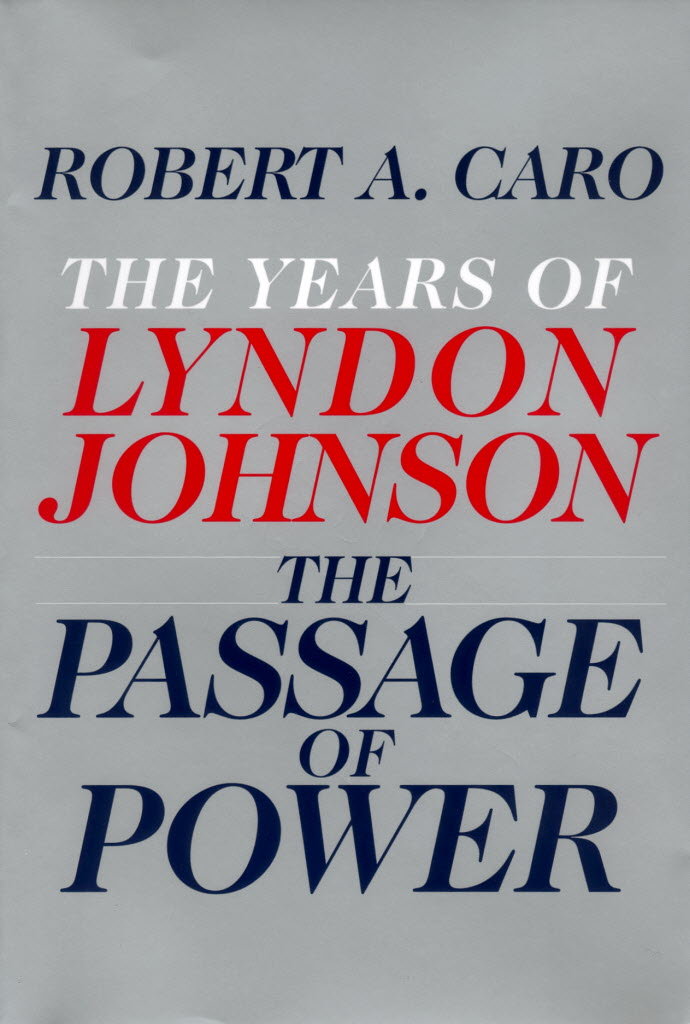
Reflection on Robert Caro’s The Passage of Power

By Tom Hayden | The Rag Blog | May 8, 2012

[The Passage of Power: The Years of Lyndon Johnson by Robert A. Caro (2012: Knopf); Hardcover; 736 pp.; $35.]

Robert Caro’s impressive biography of Lyndon Johnson seems beyond the reach of criticism, having won the National Book Critics Circle Award and been described as a “monument” (Michael Beschloss) and “at the summit of American historical writing.” (The Washington Post) Yet Caro may have identified far too much with his subject, a form of Stockholm Syndrome, perhaps, in which a prisoner identifies with his jailer.

Hardly mentioned in Caro’s latest 700 pages are two crises, each which left an indelible stain on the Johnson presidency:

  1. His secret deal-making to deny the Mississippi Freedom Democratic Party seating at the 1964 Democratic convention;
  2. The famous White House deceits leading to the Vietnam War after candidate Johnson promised not to send ground troops.

Rather than minor errors, these judgments led to the polarizations that eventually destroyed LBJ and the potential of the Great Society.

Regarding Mississippi, Caro says virtually nothing about the 1964 Democratic convention controversy; the word “Mississippi” appears only three times in the Index. Yet Johnson’s backroom pressure prevented the convention delegates from voting for Fannie Lou Hamer and other MFDP delegates opposed to the all-white Mississippi delegation that was pledged to segregation and defiance of the federal government. Johnson dispatched Hubert Humphrey to “put a stop to this hell-raising,” and to “get his Reuthers and the rest of ‘em in here — and Joe Rauh — and make ‘em behave.”[1]

By all accounts, LBJ was testing Humphrey’s loyalty, and that of his closest liberal allies, before agreeing to name him the vice-presidential running mate. These machinations, including wiretaps on the MFDP and Bobby Kennedy, were stunning errors of judgment by Caro’s master politician, for they alienated the MFDP and SNCC, sickened many northern liberals, led the next year to the formation of the Black Panther Party in Lowndes County, Alabama, and, indirectly as least, four consecutive summers of black urban insurrections — and the gradual transformation of the Goldwater movement into the very white backlash Johnson feared but couldn’t prevent.

Caro mentions none of this, emphasizing instead LBJ’s masterful tactics in passing the 1964 civil rights bill.

On the tapes, LBJ reveals his control-driven fear of a floor fight over seating the MFDP, saying, “they’ll have a roll call… [and] the Northern states will probably prevail.”[2] Instead of accepting the convention’s majority choice, LBJ turned to his dark and questionable tactics, surrounded by his seeming lackeys. Humphrey told him, “We’re just not dealing with emotionally stable people on this.”[3] Reuther warned the president, “we can reduce the opposition to this to a microscopic faction so that they’ll be completely unimportant.”[4] LBJ was driven by exaggerated fears, at least at the time, of losing white Southern states if he appeared to cave in to the Mississippi Freedom Democrats. He defeated Barry Goldwater handily that November. But granting his fear for the sake of the argument, the question is why he delegated the MFDP decision to Humphrey and others who were desperate for his favor.

A last-minute White House compromise proposal for two non-voting seats for MFDP observers was bound to be rejected as too little, too late — “Didn’t come all this way for no two seats,” Ms. Hamer said in leaving. Another promise being floated — to seat the two non-voting MFDP observers and publicly guarantee a four-year track to full integration of southern delegations in 1968 — just might have succeeded if LBJ had used all his private and political powers in the weeks leading up to the convention. Instead LBJ was stubborn to the end.

“The only thing that can really screw us good is to seat that group of challengers from Mississippi… I’ll guarantee the Freedom delegation somebody representing their views like that will be seated four years from now. But we can’t do it all before breakfast,” Johnson privately said to Reuther on August 9. When the UAW leader tried to interject, “we’ll lose Mississippi, but the impact on the other southern states…” LBJ cut him off.

Whether SNCC, COFO, or the MFDP would have accepted a four-year enforceable transition is impossible to know, and probably doubtful. But the point here is that Johnson’s behind-the-scenes behavior was emotional and petulant, not that of a sophisticated Machiavellian genius. Throughout, he was convinced without evidence that Bobby Kennedy was plotting the MFDP challenge — “I rather think that this Freedom Party was born in the Justice Department.”[5] After several days of tantrums, LBJ told his aides he had drafted a lengthy retirement statement and, sunk in depression, went to bed.

The Vietnam Debacle

Beschloss’ LBJ book includes tapes exposing White House confusion and unmistakable deceit around the August 1964 Gulf of Tonkin “incident” in North Vietnam’s waters, which LBJ quickly used to push a war authorization through a gullible Congress, with only two senators voting against, Oregon’s Wayne Morse and Alaska’s Ernest Gruening. Caro mentions none of this.

Caro provides evidence for the view that Johnson’s Vietnam escalation decision occurred immediately after John Kennedy’s assassination, marking a sharp turn in U.S. policy while masked in the rhetoric of continuity. Intriguingly, Caro promises to examine Vietnam decision-making in greater depth in the next volume of his history, including the question of whether the course of events in Vietnam would have been different had Kennedy lived, and whether other options were feasible.[6]

Caro writes that LBJ concealed his plans from both Congress and the American people. In Caro’s account, on October 2, Kennedy appointees Maxwell Taylor and Robert McNamara reported after a trip to Vietnam that 1,000 U.S. advisers could be withdrawn in 1963 and “it should be possible to withdraw the bulk of U.S. personnel” by the end of 1965, one year after JFK’s presumed re-election.“We need a way to get out of Vietnam, and this is a way of doing it,” McNamara said, according to Caro.

President Kennedy endorsed the McNamara-Taylor recommendations the next day through his press secretary Pierre Salinger.

It may be just coincidental, but McGeorge Bundy was drafting a new National Security Action Memorandum on Vietnam on November 21, the day before Kennedy’s murder.[7] Four days later, on November 26, the new U.S. president approved the memo as NSM 273.

While the main thrust of NSM 273 was to emphasize consistency with Kennedy’s Vietnam policy, it included a proposal for “possible [increased] military activity,” a reference to the recommendations of a secret committee, led by Marine General Victor “Brute” Krulak, who were proposing “progressively escalating pressure” on North Vietnam.[8] The Krulak paper was presented to Johnson at his Texas ranch on January 2, just before the inauguration. The Krulak plan recommended one year of commando raids along the North Vietnamese coast, and shelling by U.S. ships around the waters of the Gulf of Tonkin.

Those operations were to begin on February 1, just as LBJ was “juggling the figures” to make it appear that the withdrawal of the 1,000 advisers was on schedule.[9]

Once again, the Bechloss tapes were available to Caro, but are not referred to. LBJ made his famous pledge to “seek no wider war” on August 4, ironically on the same day that the bodies of three civil rights workers were found buried in a Mississippi swamp. Johnson already was implementing the Krulak recommendations to attack North Vietnam’s coastal facilities and oil refineries — “there have been some covert operations in that area we’ve been carrying on… we’ve been playing around up there,” he confided.[10]

Defense secretary McNamara formally advised LBJ on Aug. 8 that the Tonkin matter was “a very delicate subject,” and, “one that you have to dissociate from and certainly not admit that any such incident took place, but neither should you get in a position of denying it,” since it was part of “that covert operational plan.”[11]

In Caro’s perspective, Johnson’s decision to escalate was based on his desire “to keep Vietnam from becoming a major political issue” in the 1964 election. Caro fails to explain how such an historically fateful and ultimately irrational decision fits with Caro’s narrative of LBJ as the master politician of his time. Instead it proved to be one of the worst blunders in American foreign policy history.

It is quite possible that Caro will pivot to depicting LBJ as a modern King Lear in the next volume. But for now, when similar controversies over military secrecy have surrounded both the Bush and Obama presidencies, Caro regrettably gives his Lyndon Johnson a pass.

[Tom Hayden is a former California state senator and leader of Sixties peace, justice, and environmental movements. He currently teaches at Pitzer College in Los Angeles. His latest book is The Long Sixties. This article was also published at Tom Hayden’s Peace and Justice Resource Center. Read more of Tom Hayden’s writing on The Rag Blog.]

References

[1] Beschloss, Michael. Taking Charge. 1997, p. 485-6.
[2] Ibid, p. 516.
[3] Ibid, p. 515
[4] Ibid, p. 535
[5] Ibid, p. 532
[6] Caro, Robert. The Years of Lyndon Johnson, The Passage of Power. Knopf, 2012. p. 434.
[7] Caro, p. 403
[8] Caro, p. 533
[9] Caro, p. 403
[10] Beschloss, p. 493-494
[11] Beschloss, p. 509

The Rag Blog

Posted in Rag Bloggers | Tagged , , , , , , | Leave a comment

Bernardine Dohrn and Bill Ayers : Looking Back at Kent State and Jackson State

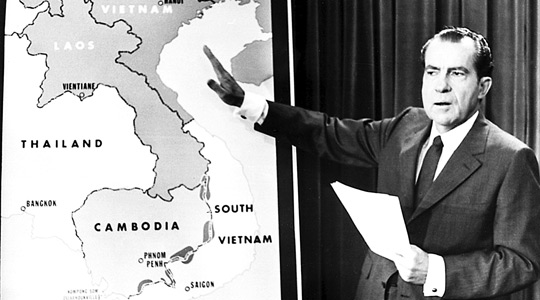
President Richard Nixon, pointing to a Cambodian map, announces the entry of American soldiers into Cambodia, on April 30, 1970.

Kent State and Jackson State:
Looking back / leaning forward

Richard Nixon and the political class had denounced students as thugs and subversives for their resistance to the pervasive U.S. war crimes.

By Bernardine Dohrn and Bill Ayers | The Rag Blog | May 8, 2012

Again and again we learn that war and empire abroad will find a way home.

On April 30, 1970, Richard Nixon announced the U.S. invasion of Cambodia, a sovereign nation the U.S. had been secretly bombing for several months. It was a saturation campaign involving 120 strikes a day by B-52s carrying up to 60,000 pounds of bombs each.

But in the common doublespeak of war, the president claimed: “This is not an invasion of Cambodia… once enemy forces are driven out of these sanctuaries and once their military supplies are destroyed, we will withdraw…”

Nixon’s aggression against Cambodia was accompanied by a verbal assault on those inside the U.S. opposing the war: “we live in an age of anarchy, both abroad and at home,” he intoned.

The next day, Nixon went to the Pentagon to clarify the point: “you see these bums…blowing up the campuses…burning up the books, I mean storming around about this issue… you name it, get rid of the war, there’ll be another one.”

On the rolling spring lawns of Kent State in the American heartland, students continued to press against an illegal, immoral war of occupation. The first entering classes of Black students formed themselves into what was to become a growing wave of Black student unions, even at Kent State. Returning veterans were throwing their medals back at the warmongers, and themselves becoming students.

Two days after the official invasion of Cambodia, 900 National Guardsmen amassed on the Kent State campus. M-1 rifles were raised, and within 13 seconds, 61 shots were fired on unarmed students — four were dead, nine wounded. It was, the official Presidential Commission on Campus Unrest later found, “a nation driven to use the weapons of war upon its youth.”

The outright murder of (white) college students engaged in peaceful protest at Kent State University, and the lesser-recognized but equally tragic murder of (Black) unarmed college students at Jackson State University that same week, were shocking although forewarned. Richard Nixon and the political class had denounced students as thugs and subversives for their resistance to the pervasive U.S. war crimes in Viet Nam, to the secret wars against Laos and Cambodia, to the flagrant arming and supporting of tyrants throughout Latin America, and to the lavish funding of apartheid and colonialism in Africa.

Invasion, lawlessness, military occupation and counter-insurgency, displacement, and systematic violence visited on others necessarily created its domestic corollary: a militarized national security state promoting heightened cruelty and callousness at home, the shredding of constitutional liberty and rights, and the unleashing of armed violence on its own citizens. The 10-year war against Viet Nam and the murderous (secret) assault on the Black freedom movement were blood cousins, Kent and Jackson State its offspring.

Today the permanent wars carried out by the U.S. military and its NATO spawn bring home their own violence and tragedy. Witness the mass killings at Fort Hood, astronomical suicide rates for returning veterans, widespread rape and assault on women in the military by their fellow soldiers, attempted assassinations of politicians, and the galloping arms race among ordinary citizens and residents who are increasingly arming up and carrying concealed weapons to work and play.

Add to that the quiet violence of a 20% child poverty rate in the richest nation in history, a prison gulag of mass incarceration sweeping up 2½ million people, harsh economic “austerity” resulting in severe slashing and degradation of education, health care, housing, public transportation and jobs at home — all of it hitting people of color disproportionally.

Empire and constant military wars not only squander the public wealth and directly destroy the lives of millions, they inevitably bring about a Panopticon-like national security state and a militarized domestic life at home.

At Kent State, students met with state violence and terror previously directed almost exclusively at the Black and Latino freedom movements. In response, 80% of U.S. colleges and universities called for some form of strike. Four million students were involved in protests, willing to face being beaten, gassed, or even shot. The National Guard was called out at 21 colleges and universities, 500 campuses cancelled classes, and 51 did not reopen until the fall. In Washington, D.C., 130,000 students mobilized against war and repression.

It was all merely prelude: greater repression and disintegration at home will accompany the long wars in Iraq, Afghanistan, Yemen, Bahrain, and Pakistan; Occupy, Madison, Trayvon, and inevitable resistance will surely follow.

[William Ayers is Distinguished Professor of Education and Senior University Scholar at the University of Illinois at Chicago. Bernardine Dohrn is Clinical Associate Professor of Law and director and founder of the Children and Family Justice Center at Northwestern University. Both Ayers and Dohrn were leaders in SDS and the New Left, and were founders of Weatherman and the Weather Underground. Find more articles by and about Bill Ayers and Bernardine Dohrn on The Rag Blog.]

The Rag Blog

Posted in Rag Bloggers | Tagged , , , , , , , , , , | 1 Comment

In a fascinating intersection of history, real estate, and the legacy of a 1960s guru, Ivan Kuper tells the story of the Heaven on Earth Inn, an abandoned hotel in downtown Houston that was purchased by former Beatles spiritual guide, the Maharishi Mahesh Yogi, for use as a santuary for the Transcendental Meditation movement. But the hotel fell on rough and seedy times and eventually came to resemble — and be called — Houston’s “Beirut Hilton.”

Posted in RagBlog | Leave a comment

BOOKS / Ken Wachsberger : ‘Second Chances’ is Pro-Choice Novel

The pro-choice novel:
‘Love Means Second Chances’

By Ken Wachsberger | The Rag Blog | May 3, 2012

[Love Means Second Chances by Susan Elizabeth Davis (2011: Bread and Roses Collaborative); Paperback; 256 pp.; $16]

Susan Elizabeth Davis has written a self-consciously political novel complete with website and blog that she hopes will become a literary weapon in the pro-choice arsenal. At a time when women are having to defend themselves from humanist instincts straight out of the Dark Ages, her timing couldn’t be better. As a life-long activist for women’s rights, in particular to control their own bodies, she is the right person to write it.

Love Means Second Chances takes place in 1992 with flashbacks to 1972. Christy gets pregnant with Ramon even though she’s on the pill because for a brief period she was on antibiotics for strep and the antibiotics rendered the pill ineffective. Impending motherhood puts a crimp on Christy’s ambition to be an opera singer, not a pipe dream by any means as she is currently a student at Juilliard.

Christy tries to keep the news from Carole, her mother, a devout Catholic, because Christy’s game plan includes getting an abortion. To complicate matters, Christy herself is the result of an accidental pregnancy that Carole chose to not terminate over the objections of her impregnator-turned-reluctant-husband Jimmy, whose own dream of becoming a football player, along with Carole’s dream of becoming a nurse, was terminated by the pregnancy that wasn’t.

In addition to alienating her from Jimmy, Carole’s pregnancy led to a split between Carole and her father — her mother already was dead. So Carole became close to her mother-in-law, Mary Louise, a strong advocate of the woman’s right to choose, who supported Carole over her son Jimmy during Carole’s pregnancy and is now supporting Christy over Carole during Christy’s pregnancy even though the first case led to a non-abortion and the second is leaning toward an abortion.

The book revolves around the interactions among the three generations of women and their different responses to Christy’s pregnancy and decision to have an abortion. To Carole especially, it awakens long-suppressed anger that stemmed from her own pregnancy in 1972. Hence the flashbacks.

A side issue but one almost equally perplexing to the avid Catholic Carole is the announcement by her sister Liz, a divorced mother of three teenage boys, that she finally has found true love to Barbara — not, if you are confused, a man with a woman’s name.

The story begins during the Christmas season. In fact, it is Christy’s vomit attack in her parents’ bathroom Christmas morning that finally confirms Carole’s suspicion that Christy is pregnant.

The strength of this novel is less on the action than on the dialogue. Davis becomes every one of the women when they are speaking. She gets inside their heads and their hearts and enables them all to be sympathetic, believable characters. As a life-long feminist activist in abortion rights, there is no doubt where Davis stands on the issue of a woman’s right to choose. Nevertheless, she attempts to be fair with all of the women.

But she doesn’t confuse “fairness” with leaving the reader thinking that all positions are equal. Davis wrote Love Means Second Chances in order to be a voice for choice in the abortion debate. With confidence and no modesty, she admits that she wants her book to join the long list of those that have changed social conditions and perceptions, including Uncle Tom’s Cabin, The Jungle, Invisible Man, and The Women’s Room.

So, in a cathartic scene, Liz asks Carole, “Will you love [Christy] less if she has an abortion?” Carole admits she hadn’t even considered that line of thought but, no, of course, she would not love her less. “The pain in her heart felt like it was being ripped out of her chest. Giving in, Carole sobbed uncontrollably, gasping for air as her worst fears dive-bombed her like demons.”

Davis chooses this moment to place the Catholic Church’s opposition to abortion into historical perspective when she speaks through Barbara, who tells Carole

Before 1869, the Church did not consider abortion a mortal sin. In fact, during the Middle Ages Thomas Aquinas wrote that abortions could be performed until the time of quickening — when the baby begins to move in the fourth month. So it’s only been since the Church felt its power and influence were waning in the 19th century that it took a stand against abortion.

Going beyond Catholicism, Barbara continues

Abortion is as old as civilization. Women have been giving themselves abortions in every culture on every continent since the beginning of time… Abortion was the primary means of birth control in this country until it was outlawed in the 19th century. It was only after doctors began to specialize in gynecology and obstetrics and wanted to stop midwives from interfering with their business that it became illegal.

As a kicker she notes that Italy has the highest abortion rate of the European countries. “Those sisters are not afraid to take care of themselves if they don’t want to be pregnant.”

I can see the old men who head the Catholic Church hierarchy attacking the credibility of that entire scene. After all, who is it who is attacking Church doctrine? A lesbian! Whether intended or not, good for Davis for showing no fear here in mixing controversial issues.

But to her credit she never treats the abortion issue lightly. Davis agrees with anti-choicers who would argue that abortion can hurt women emotionally. A powerful scene takes place in Christy’s home when Carole comes over to talk after she has had time to cool off and reflect. As Christy prepares tea in the kitchen, Carole waits in the front room. They both pray to the same religious icon as they psych themselves up to represent different sides of the conversation:

Carole: “Holy Mary, Mother of God, help me… find the right words… to tell Christy that I love her, even though I don’t like what she’s doing.”

Christy: “Holy Mary, Mother of God, please don’t let Mom overpower me… Help me stay strong.”

Later, in the clinic after the abortion, Christy waits with other women who have undergone the same experience. There is not a whole lot of laughing. As each woman is discharged, the attendant says, “I don’t want to see you here again” (as opposed to what an anti-choice novel might have the attendant saying: “Shall we make an appointment for your next visit?”).

Six months later, seemingly a long time after the abortion, Christy experiences an emotional breakdown when singing an aria from Madame Butterfly where Cio-Cio San gives up her love child and kills herself.

The message from these scenes is clear. Not every pro-choicer uses abortion as birth control. It is a painful process even for women who choose to undergo it. These women actually experience real feelings of grief, anger, and sadness. No one is evil and no one “wins.”

Nevertheless, each woman has to make her own choice, for her own personal reasons, and deal with the resulting consequences, not have it mandated by the church or the state and deal with those resulting consequences, which, anti-choicers choose to ignore, also are painful.

I have to admit I’m happy that Davis confronts the Catholic Church directly. I don’t care what practicing Catholics do relative to their own abortions or non-abortions. I do care that Catholics and other religious anti-choicers think they can tell Jews what to do about ours.

In Arizona, for instance, Governor Jan Brewer recently put her signature on a “life begins at menstruation” bill. The joke by Yippie Abbie Hoffman was that “Jews don’t believe a fetus has life until it gets its graduate degree.” A funny joke perhaps but, in the abortion debate, when life begins is a non-issue for Jews.

Menstruation, you say? Fine if that gives you some perverted thrill. But don’t deny women from my religious family the right to control their own bodies, as our religion permits, just because your religion claims that ownership of your women’s bodies should be in the hands of old men who supposedly don’t have sex.

Catholic law as argued by the hierarchy and their followers is absolute on the issue of abortion: “We don’t give a damn what it does to the woman; all power to the fetus.” The position on abortion in Jewish law is nuanced but it ultimately comes down to “The mother’s life comes first.” Catholics call what they want to practice religious freedom but when they force their mythology and their dogma onto us it becomes religious imperialism.

So which is better, fetus-first Catholicism or mother-first Judaism? There obviously is no correct answer to please everyone, which is why the First Amendment right to freedom of religion is so important. But that right doesn’t apply only to Catholics. If Catholic law has a valid place in the debate about health care, so must other religions, and no religion’s dogma should be enshrined in federal or state law to the detriment of any other.

I look forward to reading my first Jewish pro-choice novel. Love Means Second Chances is a model of how that can be done.

[Ken Wachsberger is a long-time writer, editor, political activist, and member of the National Writers Union. He is the editor of the four-volume Voices from the Underground series.

The Rag Blog

Posted in Rag Bloggers | Tagged , , , , , , | 9 Comments

Chris Mooney : The Republican Brain on ‘The Republican Brain’

Image from Grist.

The Republican Brain on ‘The Republican Brain’
(And how my conservative critics prove the point)

By Chris Mooney / Truthout / May 3, 2012

Chris Mooney, author of The Republican Brain: The Science of Why They Deny Science — and Reality, will be Thorne Dreyer‘s guest on Rag Radio, Friday, May 4, 2012, from 2-3 p.m. (CDT), on Austin’s community radio station, KOOP 91.7-FM, and streamed live on the Internet. The show is rebroadcast on WFTE, 90.3-FM in Mt. Cobb, PA, and 105.7-FM in Scranton, PA., Sundays from 10-11 a.m. (EDT).

In my new book The Republican Brain, I argue that if you want to understand why conservatives are so factually wrong right now — not just about science, but also about things like, say, whether President Obama is a Muslim — then you can’t just look on the surface of politics (at things like the influence of interest groups, say, or conservative philosophy). You also have to look at the deep-seated psychological traits that differentiate the left from the right.

When you do this, I further argue, you realize that there are some psychological traits that tend to accompany conservatism — especially in its current form in the United States — that naturally conflict with the nuanced, uncertainty-laden thinking style of scientists and liberals alike (members of the “reality based community”). These traits include authoritarianism — seeing the world in black and white, intolerant of uncertainty — but also a lack of openness to experience (a personality trait), a higher need for closure, and so on.

So far, so good. But I always knew that this book, this argument, would create a conundrum. If these traits truly describe political conservatism, then how would political conservatives respond to a book demonstrating that? My publisher went even further, promising that the book would, “add to the lengthy list of persuasive scientific findings that Republicans reject and deny.” Was that really true?

Well, the book has now been out for a few weeks, and the answer is emerging. So far, it doesn’t look very good for the theory that conservatives want to learn more about the growing body of research on conservatism.

The truth is that even before the book was out, conservatives were attacking it without reading it — claiming that I was calling them abnormal. I most certainly was not. All the scientific research on what is called the “psychology of ideology” shows that we vary in a natural range on a number of traits, some of which predispose us towards liberalism, some of which have the opposite effect. But the range itself is natural and normal. It may even be a standard feature of humanity’s operating system.

Once the book was out, the phenomenon continued at Amazon.com, where none of the one-star book reviews indicate a familiarity with the subject matter. Fortunately, the liberals over there are having a field day with this, and I find myself well defended.

Then there was S.E. Cupp on MSNBC. Her response to the idea that conservatives or Republicans attack science was to call it “infuriating,” and then … to attack science. In particular, she echoed Rick Santorum in the false claim that climate research is based on “phony studies.”

And then there was Judith Curry, the climate blogging contrarian. She admitted she hadn’t read the book, then claimed I was asserting that defensiveness is “hardwired” into conservatives’ brains. This is not what I’m arguing.

There is one conservative who has read the book and offered some reasonable criticisms — but the example sort of proves the point. His name is Kenneth Silber, and he’s a moderate, or even a RINO (“Republican in Name Only”), who reviewed it for David Frum’s book club at The Daily Beast. Yes, David Frum: the conservative apostate. I praise Frum in the book; neither he nor Silber seem to me representative of Santorum-style psychological conservatism of the sort that now dominates the GOP. Which is why it’s totally predictable that Silber would, you know, read the book before criticizing it. (I appreciate his engagement.)

In fact, there was every reason to expect that conservatives and Republicans would attack the book without reading it — based on a 2003 episode reported on in… none other than the book itself. In it, I describe how National Review attacked a massive and important study on the psychological underpinnings of political ideology by calling it the “Conservatives are Crazy” study. But of course, the study did not ever assert that conservatives are crazy or claim anything of the kind.

In fact, all the researchers I interviewed for the book stressed that conservative psychology is perfectly normal and has many advantages to it (although also, of course, some disadvantages). The conservative critics either seemed not to have actually read the research in question, or were, for some other reason, unable to take such a nuanced view of it.

The irony, in this case, sends you reeling: the study in question itself associated conservatism, versus liberalism, with a lack of nuance and an intolerance for ambiguity! My favorite quotation on the matter comes, naturally, from Ann Coulter, who manages to write about nuance without showing any:

Whenever you have backed a liberal into a corner – if he doesn’t start crying – he says, “It’s a complicated issue.” Loving America is too simple an emotion. To be nuanced you have to hate it a little. Conservatives may not grasp “nuance,” but we’re pretty good at grasping treason.

Now, to some extent, this is all pretty amusing. But it also raises a serious question. Like it or not, science is increasingly uncovering deep differences in psychology and even physiological responses between those who opt for the political left and those who lean right. And the question is: is only one side of the political spectrum going to explore and embrace this body of knowledge? Is the other going to automatically interpret it as an attack, even though it isn’t? Will our next political science battle be over the science of politics? And is that itself reflective of what science is revealing about politics?

The sad thing here is that the new research could lead to greater tolerance and understanding — and could even help us depolarize, but that won’t happen unless we all bother to understand and talk about what it does — and doesn’t — mean.

One thing is clear: whatever Republicans and conservatives might say, you can’t un-ring this bell. You can’t stop the march of scienc– nor should you want to. It drives ahead, generating new knowledge, just as it always does and whether you like it or not.

The Republican Brain itself tries to add a little to our growing body of knowledge. The book closes with a new psychology experiment, designed by the political psychologist Everett Young and run on a group of 144 college undergraduates. We were trying to test the idea that conservatives reason more defensively than liberals — doubling down on their beliefs. We found some modest supportive evidence for this idea, at least when it comes to political topics like global warming and nuclear power (although the effect was not present on apolitical topics).

But that turned out not to be our biggest finding. The biggest finding came out of nowhere and slapped us in the face.

Here’s what our data showed: The conservatives in the study were spending a lot less time reading our essays than liberals. Unbeknownst to them, we had a timer, measuring down to the millisecond how long each student spent on each page of essay material we gave them to read (on a computer screen). And it didn’t matter whether it was an essay that supported their beliefs or one that opposed them. It didn’t matter if it was a political topic or an apolitical one. And it didn’t matter if they were an economic conservative, a social conservative, an authoritarian, and so on. Across the board, all kinds of conservatives spent less time reading our essays.

Being a good liberal and appreciating scientific uncertainty and the need for nuance, I must caution that this finding needs to be replicated in subsequent research. We only found it once, in one group of undergraduates, at one university. So, one must careful.

Still, I can’t help thinking about this result now that the book itself is out and conservatives are attacking it without reading it.

Copyright, Truthout.org. Reprinted with permission.

[Chris Mooney is the bestselling author of The Republican Brain: The Science of Why They Deny Science — and Reality, and The Republican War on Science. Scientific American calls Mooney “one of the few journalists in the country who specialize in the now dangerous intersection of science and politics.” The Republican Brain was a “Progressive Pick” at Truthout; you can get the book, and support Truthout’s progressive journalism, here.]

The Rag Blog

Posted in RagBlog | Tagged , , , , , | 3 Comments

Type your summary here

Type rest of the post here

Source /

The Rag Blog

Posted in RagBlog | Leave a comment

Ivan Koop Kuper : The Maharishi’s Bad Houston Karma

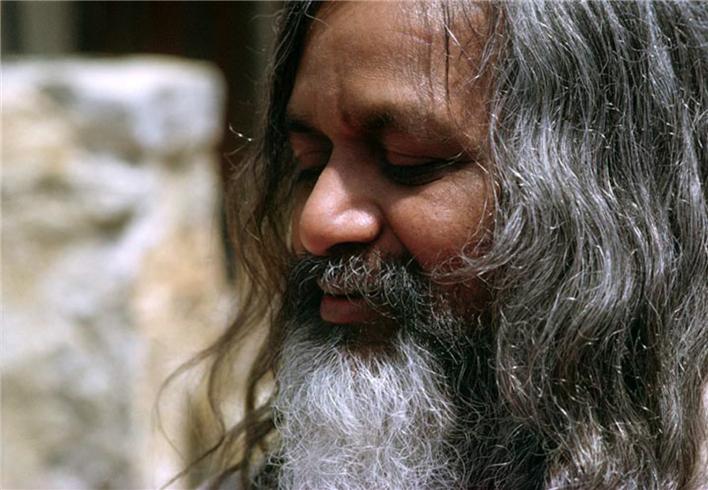
The Guru Maharishi Mahesh Yogi: The late Houston real estate mogul.

The Heaven on Earth Inn:
Bad Karma in Houston

The Guru’s utopian vision somehow took a turn in the wrong direction.

By Ivan Koop Kuper / The Rag Blog / May 2, 2012

HOUSTON — The 1970s were a time in Houston’s history when the population began to boom and employment opportunities in the petrochemical arena saw no limits as a result of the Arab Oil Embargo.

To accommodate this influx of mostly northerners to the “Bayou City,” developers borrowed large sums of venture capital from lending institutions hoping to cash in on the new-found prosperity, and new construction could be seen rising from the barren landscape from the suburbs to the inner city. In addition, several mid-rise hotels were erected in the immediate downtown area.

By the mid-1980s, as oil prices fell, Houston experienced its first major recession which put a halt to job growth and adversely affected the city’s real estate market. It was a time when businesses closed and a significant portion of the population left town in mass for job opportunities elsewhere. It was also a time when investors simply walked away from their mortgage commitments and their real property holdings.

Heaven on Earth

An abandoned hotel on the southern fringe of downtown Houston with the physical address of 801 St. Joseph Parkway began its life as a Holiday Inn in 1971. By 1984 the Holiday Inn was sold to the Days Inn, a hotel chain created by eccentric real estate mogul and Christian philanthropist, Cecil B. Day. It was sold again 1992 to the Maharishi Global Development Fund for a price tag of $2 million and reincarnated into the Heaven on Earth Inn.

The Maharishi Global Development Fund is a nonprofit, 501(c)(3) organization owned by the 1960s Indian mystic and former spiritual guide to the Beatles, the Guru Maharishi Mahesh Yogi. The 600-room hotel was purchased with the intent of having a spiritual sanctuary and a learning center for members of the Transcendental Meditation movement, complete with an upscale vegetarian restaurant, in downtown Houston.

The Guru’s utopian vision somehow took a turn in the wrong direction over the next three years, and by 1995, and in need of extensive renovation, the HOE evolved into an extended-stay residential shelter for Houston’s homeless and the underemployed. It also became a magnet for individuals with backgrounds in petty crime and drug abuse.

By 1998, the city of Houston forced the hotel to close its doors for safety reasons and building code violations. The hotel has been vacant and for sale for the 14 years since it ceased operating. Due to the need for extensive renovation, including asbestos abatement, the sale of this 33-story mid-rise edifice has become cost prohibitive and the building remains an eyesore on Houston’s skyline.

Maharishi’s legacy : Heaven on Earth no more.

Beirut Hilton

Timothy Bleakie, a former resident of the Heaven on Earth in the mid-1990s, remembers what life was like living in this unusual extended-stay hotel where the elevators seldom worked and room break-ins were a frequent occurrence.

“Seven to eight of us bicycle messengers occupied the entire 14th floor back in 1995,” said the former HOE resident and well-known downtown Houston bicycle courier. “We paid $275 per month with double occupancy and our utilities were included. We mainly kept to ourselves because, believe it or not, there was a lot of crack and heroin use among the tenants back then and there was a lot of crime as a result.”

“The owners thought they would attract a higher caliber of resident by offering on-site lessons in Transcendental Meditation, but that wasn’t the case. Very few of the tenants took them up on the offer. It was an ill-conceived business project. The average stay was about one month but I ended up living there for six. I became a model tenant and I even ended up maintaining the swimming pool on the 7th floor.”

The Heaven on Earth was one of several investment properties purchased by the MGDF throughout the United States in the 1990s that included other vacant hotels in Chicago, Tulsa, Detroit, Hartford, and Avon Lake, Ohio. Like the one in Houston, these spiritual sanctuaries and learning centers were christened “peace palaces” whose mission was to “improve humanities’ global consciousness” as well as realize a substantial profit.

Ironically, near the end of its demise, the HOE became known as the “Beirut Hilton” by its residents and downtown neighbors because of its rundown appearance and its resemblance to the infamous, bullet-riddled hotel in war-torn Lebanon. According to Houston Police Department records, by 1998, the HOE had been the scene of multiple drug busts, assaults, and one homicide.

“It got rougher toward the end of my six month stay,” Bleakie said. “Most of the tenants didn’t have any money and were substance abusers. By the time I moved in, the vegan restaurant had already closed. They were still offering classes in TM on the top floor but very few tenants took them up on the offer.”

“There was a lot of paranoia among the residents regarding break-ins. The room keys were very easy to duplicate and you could easily enter a room with a credit card or driver’s license. There was a man who lived there with his daughter and he was a junkie. The man used to trick out his daughter just to pay the rent.”

Because of the Maharishi’s strict eastern religious beliefs and the fact that he subscribed to the principles of Vedic architecture, the residents were not allowed to use the actual entrance to the building. These architectural principles govern the orientation of a building and designate from what direction one may enter. “The residents were forbidden from using the main entrance on the building’s south side,” Bleakie explained, “so we used a small service entrance facing west on Milam Street instead.”

“My biggest fear was that one day there would be a fire and we wouldn’t be able to get out. I remember that all the elevators quit working for two weeks one time and there weren’t any phones in the rooms, only in the lobby. There was also a woman in a wheel chair that lived on the 25th floor. She had to have her food brought to her until they were fixed. I remember that the cops and the fire department were there quite often.”

Spiritual default

In 2004, the Houston Business Journal reported that the hotel was sold to LandCo Investments, LLC, for $8.5 million. However, by 2005, the Colorado-based investment group defaulted on its promissory note to the MGDF, thereby reverting ownership of the hotel back to the Maharishi.

On February 5, 2008 the Guru Maharishi Mahesh Yogi died leaving his investments and his spiritual movement in the hands of his multiple family members and business associates. The Maharishi Global Development Fund reported that at the time of his death, the Guru’s United States real estate assets alone were valued at more that $300 million.

According to the Harris County Appraisal District, effective October 4, 2011, the Heaven on Earth Inn changed hands once again, and has been renamed the Beanmont Medical Center Hotel, LLC. It is still vacant and in need of extensive renovation.

[Ivan Koop Kuper is a real estate broker and a graduate student at the University of St. Thomas in Houston, and maintains a healthy diet of music, media, and popular culture. He can be reached at kuperi@stthom.edu. Find more articles by Ivan Koop Kuper on The Rag Blog.]

The Rag Blog

Posted in Rag Bloggers | Tagged , , , , | 3 Comments

RAG RADIO / Thorne Dreyer : Theologian and Social Ethicist Gary Dorrien

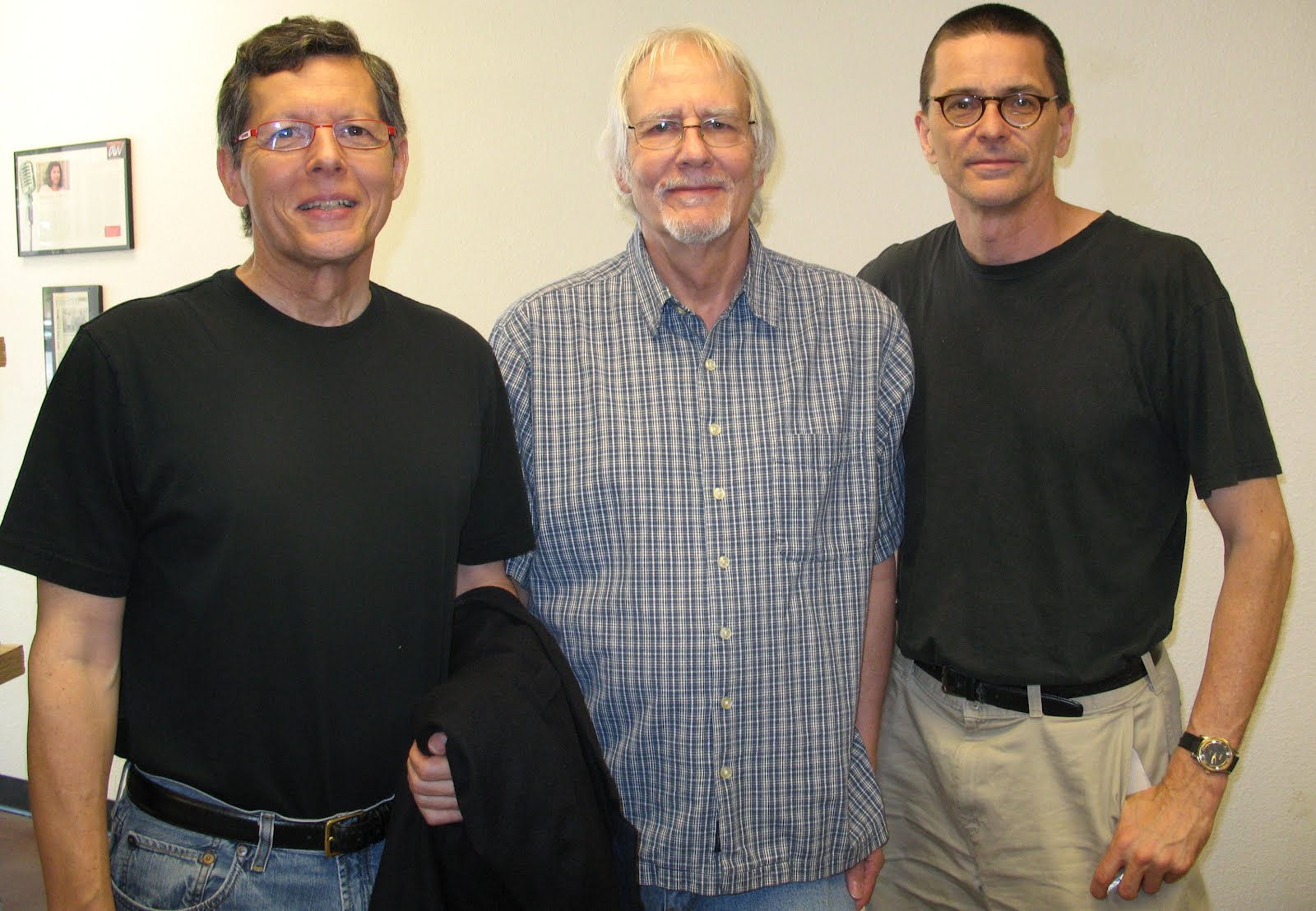
From left: Theologian Gary Dorrien, Rag Radio host Thorne Dreyer, and Robert Jensen, UT-Austin journalism professor and Rag Blog contributor, in the KOOP studios, Friday, April 27, 2012 . Photo by Tracey Schulz / Rag Radio.

Rag Radio:
Theologian and social ethicist Gary Dorrien on
the social gospel and contemporary politics

By Rag Radio / The Rag Blog / May 2, 2012

Theologian and Social Ethicist Gary Dorrien, an Episcopal priest and professor at Union Theological Seminary and Columbia University, was Thorne Dreyer’s guest on Rag Radio, Friday, April 27, 2012, on Austin community radio station KOOP 91.7-FM, and streamed live on the Internet.

Gary Dorrien has been described by Cornel West as “the preeminent social ethicist in North America today.” On Rag Radio Dorrien discussed liberal Christian theology and the social gospel in relation to contemporary politics and progressive political movements and issues of social and economic justice.

You can listen to the show here.


Dorrien, a frequent speaker and commentator on programs such as Bill Moyers’ Journal, is the author of 16 books, including Economy, Difference, Empire: Social Ethics for Social Justice; Imperial Designs: Neoconservatism and the New Pax Americana; Social Ethics in the Making: Interpreting an American Tradition; and The Making of American Liberal Theology. His latest books are The Obama Question: A Progressive Perspective, and Kantian Reason and Hegelian Spirit: The Idealistic Logic of Modern Theology.

Dorrien was in Austin to speak on “Breaking the Oligarchy,” at University United Methodist Church in Austin, keynoting a weekend gathering on economic justice and faith, April 27-29, 2012.

Rag Radio, which has aired since September 2009 on KOOP 91.7-FM, a cooperatively-run all-volunteer community radio station in Austin, Texas, features hour-long in-depth interviews and discussion about issues of progressive politics, culture, and history.

Hosted and produced by Rag Blog editor and long-time alternative journalist Thorne Dreyer, a pioneer of the Sixties underground press movement, Rag Radio is broadcast every Friday from 2-3 p.m. (CST) on KOOP and streamed live on the web. Rag Radio is also rebroadcast on Sundays at 10 a.m. (EST) on WFTE, 90.3-FM in Mt. Cobb, PA, and 105.7-FM in Scranton, PA.

Rag Radio is produced in the KOOP studios, in association with The Rag Blog, a progressive internet newsmagazine, and the New Journalism Project, a Texas 501(c)(3) nonprofit corporation. Tracey Schulz is the show’s engineer and co-producer.

After broadcast, all episodes are posted as podcasts and can be downloaded at the Internet Archive.

THIS FRIDAY, May 4, 2012 on Rag Radio: Chris Mooney, author of The Republican Brain: The Science of Why They Deny Science, and Reality.

WE’RE TAKING A BREAK: Rag Radio will be on hiatus May 11 and May 18.

The Rag Blog

Posted in RagBlog | Tagged , , , , , | Leave a comment

Danny Schechter : Drones Don’t Talk Back

Predator drone crew at Creech AFB in Nevada. Image from Drone Wars UK.

Robots ‘R’ Us:
Military-style drones reported
on 63 bases in the USA

By Danny Schechter / The Rag Blog / May 2, 2012

NEW YORK CITY — It’s easy to understand why presidents, politicians, and the military love robots. They don’t talk back. They follow orders. You press a button and they do what they are told. They are considered so efficient, and so lethal.

These modern killing machines represent science fiction reborn as science “faction.”

Robots and drones don’t burn Korans or pose with the heads of their captives on the battlefield. (Robots also don’t protest wars.) Lose the human factor and you get silent-but-deadly total destruction.

And that’s why drone warfare has become such a weapon of choice. You have video game jockeys sitting on their asses in front of consoles of digital displays at an Air Force base outside Las Vegas, targeting suspected terrorists in Afghanistan. After a couple of quick kills, they take the rest of the day off.

It’s only later, that we get the reports of civilians decimated as collateral damage.

Oops!

These new lethal toys are used both for surveillance and targeted assassinations.

In Congress, according to Code Pink’s Medea Benjamin, there’s even a bipartisan caucus to encourage more building of drones cheered on by the military industrial complex. She has just written a book about it. She told me, “instead of having a caucus to feed preschool children, they decided it was more important to have a Drone Caucus and that’s because all the manufacturers in their districts are funding them.”

I asked Medea if this is more evidence that President Eisenhower was right when he warned of a growing military-industrial complex?

“Eisenhower was so right,” she replied,

and he was so right when he said it steals money, it robs us of food for our children, of healthcare for our parents, he was so right. And it’s just worse and worse. And you get the little puppets in Congress, and I’m in Washington now, so I see these little puppets, and wish that they were like the NASCAR drivers that got to have their corporations on their suits, but they don’t rule America. The corporations obviously rule America.

And when it comes to war and peace, those corporations are so powerful that they’ve kept us for the last decade and more and if we don’t do something about it, they will keep us more for the next decade.

Anti-war activist and author David Swanson has been tracking this phenomenon too, telling me that

members of Congress have created a caucus for drones, where they openly promote the use and sale of drones at home and abroad. They have now authorized the flight of up to 30,000 drones in U.S. skies for whatever purpose — this is in contrast to the lack of any caucus for senior citizens, for children, for health coverage, for green energy, for human beings — there’s a caucus for robots.

Soon we will have an arms race in drones of all kinds. The crash of a U.S. drone in Iran has allowed that country to reverse-engineer one, probably leading to Iran soon making their own.

The Russians and Chinese, even the North Koreans, can’t be far behind.

More worrying to Americans should be a report saying that there are already 63 drone bases inside the United States.

The Air Force released a new video game on its recruitment website aimed at teenagers. Image from Drone Wars UK.

The Washington Post reports,

Big things can happen in Congress — as long as no one is watching.

Lobbying records released last week show that there wasn’t much opposition this winter when Congress quietly opened up U.S. airspace to aerial drones, which some advocates for civil liberties say raise a host of concerns about privacy.

Drone technology, advanced by the military for surveillance and elimination of terrorists in war zones, is set to come back to the home front in a big way in coming years, with possible uses for law enforcement, first responders, and agriculture and environmental monitoring.

Select companies and ask local governments around the country already have permission to test drones, which can sometimes stay aloft for days at a time at a fraction of the cost of helicopters and airplanes.

What assisted all of this drone fever?

Remember the NDAA bill passed last year that was signed quietly into law on New Year’s Eve by President Obama?

The Administration assured one and all that it would not apply to military operations on U.S. soil or against American citizens.

It now turns out that the NDAA is being interpreted as authorization to deploy military drones (unmanned aerial vehicles or UAVs) into domestic airspace. A major overhaul of the Federal Aviation Administration’s control system is permitting the deployment of drones

Recently, Alexander Higgins.com reported:

A lawsuit has forced the FAA to reveal the location of 63 Secret Drone bases located inside the United States some of which will be the starting point for more drone warfare.

While the information released shows an alarming number of bases being used for military and local law enforcement drones, perhaps the most startling revelation is that the United States is allowing Canadian Border Patrol drones to operate across the Canadian border.

Odds are that there are many more drone bases inside the United States whose locations have been kept secret for various national security reasons and the lawsuit only forced the government to release the names and locations of permitted U.S. drone operators.

That means that the type of drones — be they for targeted killing, guiding missiles, or general surveillance — and the number of drones at each location still remains a secret although the FAA says they plan on releasing such information at a later date.

England’s Daily Mail has more information:

Most of the active drones are deployed from military installations, enforcement agencies and border patrol teams, according to the Federal Aviation Authority.

But, astonishingly, 19 universities and colleges are also registered as owners of what are officially known as unmanned aerial vehicles.

It is thought that many of institutions, which include Cornell, the University of Colorado, Georgia Tech, and Eastern Gateway Community College, are developing drone technology.

There are also 21 mainstream manufacturers, such as General Atomics, who are registered to use drones domestically.

As well as active locations, the FAA also revealed 16 sites where licenses to use spy planes have expired and four where authorizations have been disapproved, such as Otter Tail County, Minnesota.

However, the FAA is yet to reveal what kinds of drones might be based at any of these locations. The agency says it will release this data later.

Robot technology has other uses too, says financial journalist Max Keiser, who told me in a recent appearance on my Progressive Radio Network show that algorithm based technology is now actually writing stories, perhaps even like this one.

He explained,

Forbes Magazine wrote a story a couple of weeks ago about computers that are able with narrative software to take prices from the exchange and create stories in any of the ways that they want in their magazine. So it can be like, okay, write a story about the prices that — the closing prices in the technology sector in the voice of Danny Schechter. And they’ll create a story and it’ll appear in the magazine.

So it’s a computer that’s writing the stories, but the computers are also reading the stories.

Oops, Delete!

[News Dissector Danny Schechter blogs at Newsdissector.net. His recent books are Occupy: Dissecting Occupy Wall Street and Blogothon (Cosimo Books). He hosts News Dissector Radio on PRN.fm. His latest film is Plunder: The Crime of Our Time. Email Danny at dissector@mediachannel.org. Read more articles by Danny Schechter on The Rag Blog.]

The Rag Blog

Posted in Rag Bloggers | Tagged , , , , | Leave a comment

BOOKS / Ron Jacobs : ‘More Powerful Than Dynamite’

Occupy 1914?
‘More Powerful Than Dynamite’

By Ron Jacobs | The Rag Blog | May 2, 2012

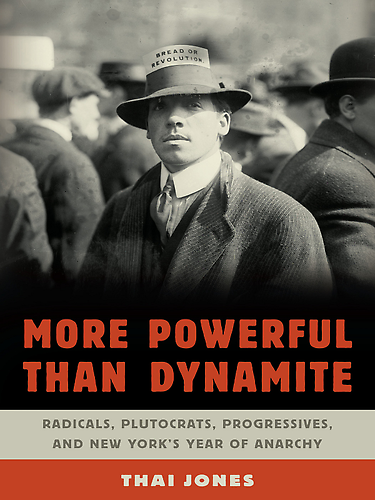
[More Powerful Than Dynamite: Radicals, Plutocrats, Progressives and New York’s Year of Anarchy by Thai Jones (2012: Walker and Company); Hardcover; 416 pp.; $28.]

Anti-capitalist protests in Union Square brutally attacked by police. Economic hardship among the workers. Ostentatious expenditure by the wealthy. This scenario sounds like the news headlines of the past couple of years, yet the period referred to is the year 1914 and the story is the one told in More Powerful Than Dynamite: Radicals, Plutocrats, Progressives and New York’s Year of Anarchy.

This book is a history that includes some of history’s most famous anarchists and a progressive president determined to use government for good but indebted to the finance house of Wall Street. That indebtedness leads him into war and repression.

There’s also a progressive mayor of the world’s largest city whose plans include using government to lift people from poverty and despair. His social engineering ends up making very few people happy: not the wealthy and not the poor.

The city was New York. The year was 1914. The anarchists included Alexander Berkman and Emma Goldman. The mayor was John Mitchel and the president was Woodrow Wilson.

Despite the best-laid plans, it was as if the weather itself conspired with the plutocrats in a relentless effort to prevent Mitchel from ending the corrupt tradition of politics in Manhattan known colloquially as Tammany Hall. The economy that had already shrunk the employment rolls worsened in the wake of a series of snowstorms and bitterly cold weather that forced thousands into the streets without work, shelter or income.

When a city agency decided to use the unemployed to shovel snow out of the streets and sidewalks, not only did the task turn out to be beyond the capabilities of those involved, the measly pay offered became one more cause for radicals to organize around. The popularity of the cause proved the rationale of the organizers.

There was no communist party in the United States in 1914. The lead in the protests was taken by the anarchists. Their success at engaging the urban unemployed while enraging the wealthy and middle class encouraged the leadership to take increasingly provocative actions. This in turn intensified the wrath of the wealthy and their guardians, the police.

After it was determined that the aggressive and violent tactics of the police only served to increase the popularity of the protests, a new chief was appointed who changed tactics. He allowed protests while simultaneously building an intelligence network among the radicals.

This network involved the recruiting of spies, provocateurs and, ultimately, the use of those provocateurs to instigate actual crimes designed to incriminate individual radicals, thereby painting the entire movement as criminal. In short, anarchists were the “terrorists” of the period and the tactics used by the authorities against them were the same as those being used against today’s “terrorists” and radicals.

Jones, whose previous work includes a memoir (A Radical Line) that is partially about his childhood growing up underground with his Weather Underground parents, provides the reader with an incredibly detailed, impeccably researched look at this period in New York’s history.

Not only do the characters come alive in Jones’ telling, so do the issues. Of course, this is in part due to the fact that the issues continue to be relevant in today’s climate of corporate domination and willful destruction of the dreams of working people.

For many people, reading history can be a chore. A good history text must either tell a story so good that one puts up with the dryness of the text or it must be told in a way that keeps the reader’s interest. In More Powerful Than Dynamite, Thai Jones provides both, thereby creating a compellingly written tale of an incredibly interesting time.

[Rag Blog contributor Ron Jacobs is the author of The Way The Wind Blew: A History of the Weather Underground. He recently released a collection of essays and musings titled Tripping Through the American Night. His latest novel, The Co-Conspirator’s Tale, is published by Fomite. His first novel, Short Order Frame Up, is published by Mainstay Press. Ron Jacobs can be reached at ronj1955@gmail.com. Find more articles by Ron Jacobs on The Rag Blog.]

The Rag Blog

Posted in Rag Bloggers | Tagged , , , , , | Leave a comment

Lamar W. Hankins : Republican Mind is Terrible Thing to Waste

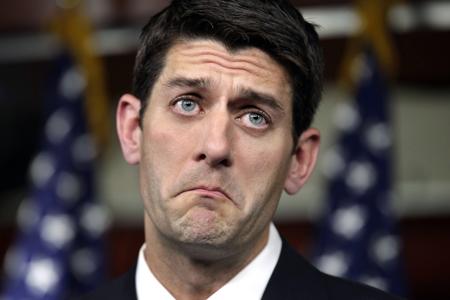
Congressman Paul Ryan: A terrible thing to waste. Image from rrstar.com.

A Republican mind is
a terrible thing to waste

By Lamar W. Hankins | The Rag Blog | May 2, 2012

“The GOP has become an insurgent outlier in American politics. It is ideologically extreme; scornful of compromise; unmoved by conventional understanding of facts, evidence and science; and dismissive of the legitimacy of its political opposition.” — Thomas E. Mann and Norman J. Ornstein, The Washington Post

It would be hard to pick the most “ideologically extreme” Republican today, but one of the top five would surely be John Raese, a Republican candidate for the U.S. Senate in West Virginia. Raese thinks that a requirement to place a sign on his building that declares it a smoke-free environment is an atrocity.

That’s a fine sentiment, but you may be shocked at what he believes is the sign’s equivalent: “Remember Hitler used to put Star of David on everybody’s lapel, remember that? Same thing.” Not only is Raese’s statement historically inaccurate, but the building sign is not an equivalency to a precursor of Nazi genocide against Jews, gypsies, and homosexuals. Raese’s mind is clearly going to waste.

Recently, Republicans on the Senate Judiciary Committee have unanimously opposed the historically bipartisan Violence Against Women Act.

Both of Texas’ Republican senators dislike provisions of the bill that would allow tribal courts to adjudicate domestic violence cases that occur on reservations and involve non-Indian suspects. Further, they oppose a provision that would allow more temporary visas to be issued for undocumented immigrant victims of domestic violence. And they don’t want the Violence Against Women Act to be expanded to protect gay, bisexual, or transgender victims of domestic abuse.

While good arguments against these provisions may exist, the two senators from Texas didn’t make them. Although a few Republican senators did vote in favor of the Senate version of the bill, there is little chance that there will be bipartisan support for the bill in the House.

It is increasingly difficult to believe that the Republican Party is the party of “law and order,” as it used to tout itself. Even law and order is too mundane for today’s Republican extremists.

The powerful Republican Chairman of the House Budget Committee, Paul Ryan, decided that he had a winning argument in support of his budget proposal by claiming that it was based on his Catholic heritage: “Our budget offers a better path, consistent with the timeless principles of our nation’s founding and, frankly, consistent with how I understand my Catholic faith.”

He spoke about this recently at the Catholic-run Georgetown University, where almost 90 faculty members and administrators challenged Ryan’s view of Catholic doctrine.

In a press release, Father Thomas Reese, a fellow at the Woodstock Theological Center at Georgetown, is quoted as saying, “I am afraid that Chairman Ryan’s budget reflects the values of his favorite philosopher Ayn Rand rather than the gospel of Jesus Christ. Survival of the fittest may be okay for Social Darwinists but not for followers of the gospel of compassion and love.”

Ryan tried to distance himself from Ayn Rand, claiming his embracing her was a youthful obsession. Yet, it’s hard to forget his earlier pronouncements about Rand:

  • “I give out Atlas Shrugged as Christmas presents, and I make all my interns read it.”
  • “Ayn Rand, more than anybody else, did a fantastic job explaining the morality of capitalism, the morality of individualism, and that, to me, is what matters most.”
  • “The reason I got involved in public service, by and large, if I had to credit one thinker, one person, it would be Ayn Rand.”

Ryan’s budget pronouncements have been opposed not only by Catholics at Georgetown, but by the U.S. Conference of Catholic Bishops and many groups of nuns and Catholic lay workers who have given their lives to helping people most vulnerable to Ryan’s budget cuts — those who use Catholic-run soup kitchens, homeless shelters, and other social service charities.

Ryan’s budget follows the welfare reforms supported by the neoliberal ideas of President Bill Clinton and warmly embraced by almost all Republicans, as well as most Democrats, in the mid-1990s. Those reforms led to greater child poverty rates, but Ryan insists, against the evidence, that the so-called reforms brought down poverty rates.

Such claims, made against verified, non-partisan data, are characteristic of the failure to think logically, and honestly. During the first decade of this century, child poverty rates in the U.S. rose from about 17% to about 22%. This rise occurred after the mid-90s’ welfare reforms took hold — evidence that welfare reform contributed to, not reduced, child poverty.

Ryan’s budget continues the earlier welfare reforms and makes them worse by scaling back food stamps and drastically reducing Medicaid, the primary health care program for the poor. It seems fair to say that Ryan’s Republican mind is as dishonest and wasted as they come.

Another wasted Republican mind is that embodied in Senator Marco Rubio, the up and coming Republican senator from Florida. He is trying to find a way to convince other Republicans that he can put together a DREAM (Development, Relief, and Education for Alien Minors) Act that will satisfy modern Republican goals and still appear to be significant reform.

The original DREAM Act was intended to reform immigration law by providing a path to citizenship and was a Republican idea, first introduced by Republican Senator Orin Hatch of Utah 11 years ago, along with Sen. Dick Durbin (D-IL). Now, Rubio is working on a plan that will create permanent second-class citizens of immigrants to whom it will apply by denying them a path to citizenship, but allowing them to live and work in the U.S. He has yet to explain the details.

The original DREAM Act was from the Republicans of old, who were willing to work with Democrats to make government work for the people. Today’s Republicans mostly like to castigate immigrants who came to this country without an approved, legal status, no matter why they came here.

These Republicans don’t care that a high percentage of these immigrants are children and had no choice but to follow their parents, as children everywhere usually do. After a short while, such children become Americans culturally, if not legally.

Today’s Republicans are focused more on border security than they are on helping mostly Latino immigrants live here legally by allowing them to prove their value to this society before being granted a path to citizenship.

 But even today’s Republicans make exceptions. If you are Cuban and can manage to set foot on American soil, you can stay here in most cases without worrying about being snatched away by ICE (Immigration and Customs Enforcement), an apt acronym for the cold-hearted politicians who would deny to other Latinos what they willingly give to Cubans.

And then there is Republican Representative Virginia Foxx of North Carolina, the chair of the House Subcommittee for Higher Education, who believes that today’s students should be able to do what she did 40 years ago and work their way through college without any help with loans. Never mind that tuition and fees (adjusted for inflation) are three to eight times what they were four decades ago.

Mitt Romney suggests that students just borrow the money needed for college from their parents. Either his mind is wasted or he is out of touch with the fact that few parents have his resources. Neither of these representative Republicans has sympathy for or understanding of the financial needs of today’s students. Doesn’t Romney know that most parents, if they had the money, would pay for their children’s education themselves? They’d give them the money, not lend it to them.

Foxx’s views are important because on July 1, the interest rates on student loans will double, adding about $1,000 per year on average to the cost of a student loan. When the House passed Ryan’s budget last year (it didn’t make it past the Senate), it included the increase in interest rates on student loans. No Democrat voted for it, but 97% of Republicans did, indicating their near-unanimous support for permanently increasing the interest rate on student loans.

In spite of House Speaker John Boehner’s recent histrionic claims that the Republicans have no problem with keeping the interest rates as they are now, Foxx and most Republicans will put up as many roadblocks as possible to the proposal to keep current student loan interest rates.

It is already clear that Republicans want to reduce federal outlays for women’s health and childhood immunizations to compensate for keeping the interest rates low; Democrats want to compensate by eliminating oil and gas subsidies for some of the most profitable corporations in America — subsidies that they don’t need to stay productive. That’s a difference worth contemplating.

At a time when federal banks can borrow money at almost no interest, it is difficult to understand why student loans should double from 3.4% to to 6.8%. But it makes sense if you conclude that Republicans don’t believe in a government that works for the benefit of the public good, rather than the benefit of the 1%, and if you believe that higher education is a public good.

Until the 1970s, tuition was prohibited for higher education in California, but no one ever talks about the benefit to society of universal higher education, so instead we are debating issues like interest rates.

But the most wasted Republican mind of late seems to be that of Rep. Allen West of Florida. He claimed recently that there are “78 to 81” Democrats in Congress who are members of the Communist Party. The late, infamous Sen. Joe McCarthy would have been proud. If his rotten corpse could smile, we’d all be able to see his Cheshire Cat grin.

So far, however, I’ve not heard any Republican condemn this ridiculous false assertion, which is some evidence that all their minds are a wasteland.

Science writer Chris Mooney tries to explain “The Republican Brain” in his new book by that title. Mooney’s research suggests that Republicans tend to be conservative because they are authoritarian (they tend to see things in black and white, without the ambiguities and complexities that non-conservatives wrestle with), lack openness to experience, and have a high need for closure.

As it turns out, Republicans aren’t even interested in learning more about themselves — most Republicans who have critiqued it have panned Mooney’s book without even reading it. But what they really distrust is science.

Science provides a way — arguably the best way — to investigate things we can observe, to acquire new knowledge, and to correct or better understand previously acquired knowledge. Scientific knowledge can be tested repeatedly to determine its truth.

The opinions expressed in this article are not science, but they are based on observable phenomena. I don’t pretend that they are objective, but there is evidence to support my views, if the reader is willing to consider that evidence.

Republican minds were not always the wasteland they are today. I gave up on Republicans as honest brokers of the truth long before I gave up on the Democrats, which happened 20 years ago. So this is an essay on the failure of our political system to produce people who value truth. A scattering of people throughout the political spectrum value truth, but they are few.

I’ve gone easy on the Democrats this time largely because a few more of them favor the people over the corporations. While I will vote in the Republican primary again this year, it won’t be because Republicans are more wedded to the truth. I’d like to help them get over their disdain for science, but I’m not holding my breath.

[Lamar W. Hankins, a former San Marcos, Texas, city attorney, is also a columnist for the San Marcos Mercury. This article © Freethought San Marcos, Lamar W. Hankins. Read more articles by Lamar W. Hankins on The Rag Blog.]

The Rag Blog

Posted in Rag Bloggers | Tagged , , , , , , | Leave a comment