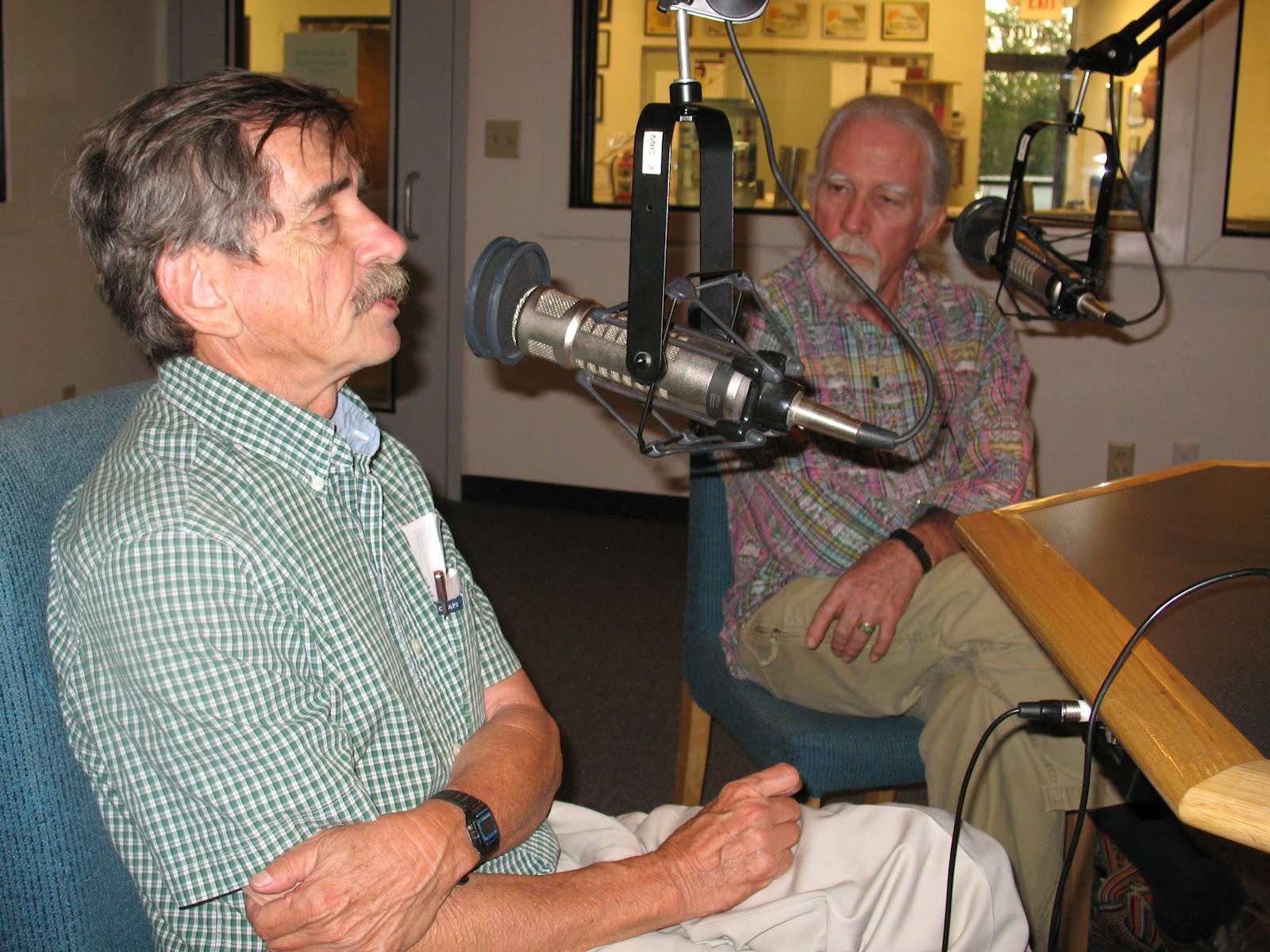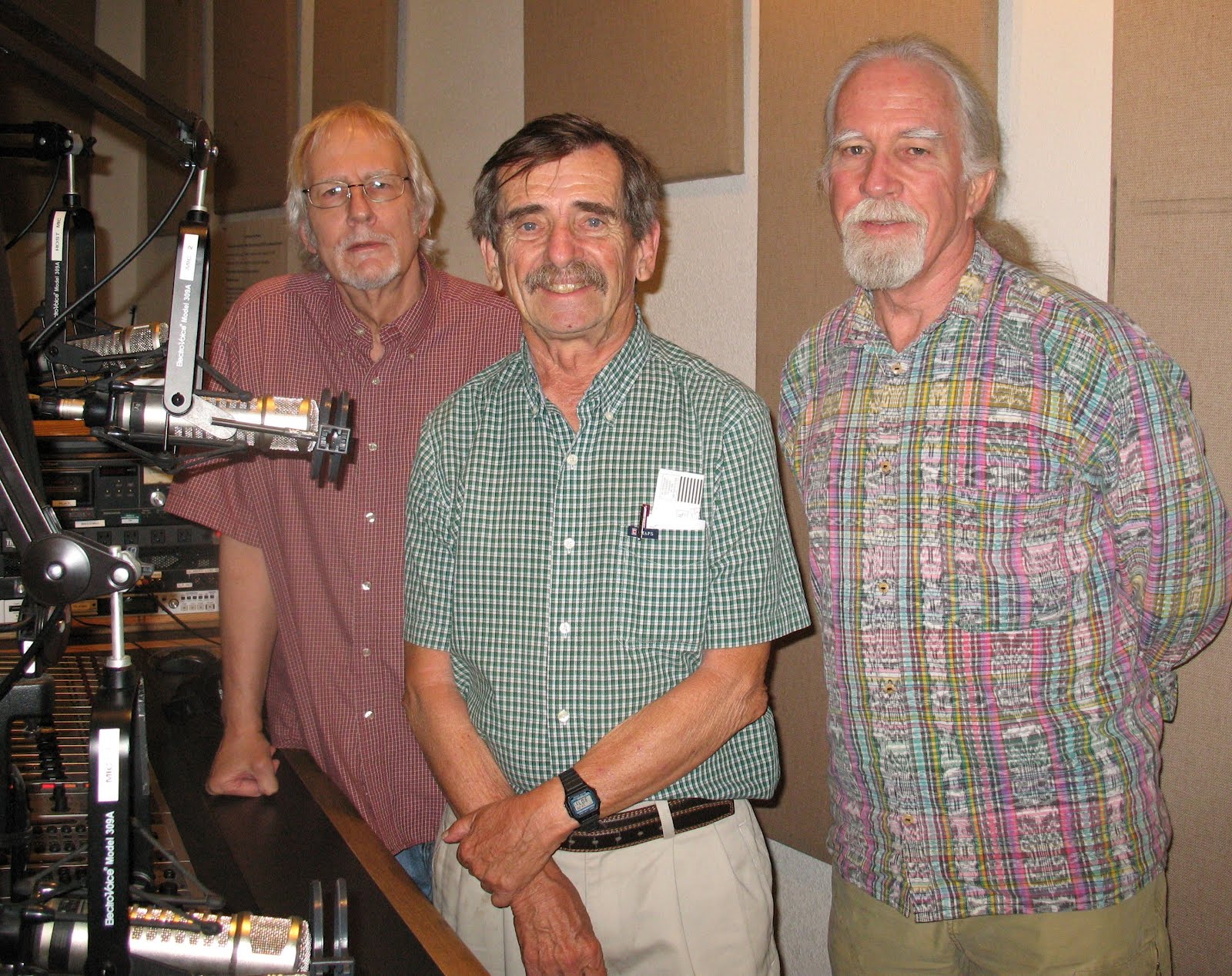
Bill Neiman — a leader in the movement to conserve natural resources and restore the heath of the environment in Texas — was Thorne Dreyer’s guest on Rag Radio, Friday, April 13, originally broadcast on KOOP-FM in Austin.

Neiman is also an environmental landscaper and his Native American Seed is the principal supplier of native wildflower and grass seeds in Texas. An advocate of the use of native species of vegetation in landscaping, Neiman warns that we must have a paradigm shift in our relationship to the land. Listen to the podcast of the interview at this post.

Posted in RagBlog | Leave a comment

Beginning with words from Joseph Conrad’s “Heart of Darkness” — “The horror! The horror!” — Mike Hanks takes us first through the darkness — the horror and futility of the U.S. drug war in Mexico — and then we move towards the “spark of light” Diego Huerta has created with his ambitious photographic project, “31K Portraits for Peace,” on exhibit at Austin’s Mexic-Arte Museum, which features thousands of striking and poignant photos of ordinary Mexican citizens holding origami doves of peace. The post includes a gallery of photos from the exhibit.

Posted in RagBlog | Leave a comment

William Michael Hanks : Darkness and Light

Photo by Diego Huerta, from the 31K Portraits for Peace exhibit at the Mexic-Arte Museum in Austin.

Darkness and Light:
31K Portraits for Peace
(31K Retratos por la Paz)

By William Michael Hanks | The Rag Blog | April 19, 2012

See Gallery of Images from 31K Portraits for Peace, Below.

“I saw on that ivory face the expression of somber pride, of ruthless power, of craven terror — of an intense and hopeless despair … He cried in a whisper at some image, at some vision, — he cried out twice, a cry that was no more than a breath — The horror! The horror!”

These were the last words of Kurtz, in Joseph Conrad’s Heart of Darkness. He may well be speaking of our world today instead of the Belgian Congo of Conrad’s time.

Kurtz was a promising young man with just connections enough to get a job as a station chief for a colonial Africa trading company. He became legendary for his profitable management of the most remote station on the Congo. But as his greed for ivory grew he devolved deeper into the primitive, the savage — deeper into the darkness. In his quest for wealth, he lost his humanity.

It seems much the same has happened today. Our leaders have become consumed with wealth and power. And the world they have made is filled with horror and images of horror.


Every day in Mexico is another day drenched in blood. The cartels have expanded from turf battles to extortion and kidnapping. Daily the warring cartels leave the bodies of their tortured victims in the public streets and squares as a warning to their enemies.

But Mexico’s grief did not begin with the cartels. Going as far back as the 70s, before there were any drug cartels in Mexico, U.S. policy was wreaking havoc with the poor of Mexico. As part of U.S.-financed “Operation Condor,” the Mexican government sent 10,000 soldiers and police to a poverty-stricken region in northern Mexico plagued by drug production and leftist insurgency. Hundreds of peasants were arrested, tortured, and jailed, but not a single big drug trafficker was captured.

The direct ancestor to “Operation Condor” was the “Night and Fog” decree signed by Adolf Hitler on November 7, 1941. It provided for political prisoners to be arrested, held incommunicado, and removed to undisclosed locations for forced labor or to be tortured and killed.

In his Nuremberg trial, General Keital said of all the atrocities he was ordered to commit, this was the hardest to carry out. Hitler and his upper level staff made a critical decision not to have to conform to what they considered unnecessary rules. This same disregard for human rights was the expressed attitude of George W. Bush’s Attorney General, Alberto Gonzales. He felt the Geneva Convention rules were “quaint.”

In recent years, some agencies of the U.S. government have gone dangerously rogue and persist in developing destructive plans, like “Fast and Furious,” without regard for consequences to the Mexican people. The thousands that are dying are paying the price for these ill-conceived and poorly executed operations.

PHOENIX (AP) — Two people accused of participating in a gun smuggling ring are expected to change their pleas in the federal government’s botched investigation known as “Operation Fast and Furious.” Jose Angel Polanco and Dejan Hercegovac are scheduled to change their pleas Monday in Phoenix. Authorities say the two were members of a ring that smuggled guns into Mexico for use by a drug cartel. Two rifles bought by another ring member were found in the aftermath of a 2010 shootout that mortally wounded a Border Patrol agent in southern Arizona.

Operation “Fast and Furious,” a scheme conceived by the ATF, was a debacle from the start. First, a plan to allow illegal arms into Mexico with no ability to track them, then a botched attempt to cover it up, has called into question the honesty of both the Homeland Security director, Janet Napolitano, and Attorney General Eric Holder.

Monterrey, one of the most prosperous cities in Mexico, has turned into Mexico’s most notoriously violent over the past two years. In 2010, the number of murders leapt to 828 across Nuevo Leon, up from 267 the previous year. The figure jumped once more in 2011, to a total of 2,003. The most infamous incident was the murder of 52 casino patrons in August 2010, the result of a fire set by the Zetas as punishment for an unpaid extortion fee. It was the most deadly single attack in recent Mexican history.

Mass graves have been found where the passengers of bus operators who did not pay the extortion to pass through their territory were murdered and buried. Children are being recruited from school campuses to serve as couriers, lookouts, and enforcers.

Politicians and journalists have long been targets of the cartels but they are moving into the transportation industries now as well. Taxi drivers are being assassinated for not paying extortion or, in the case of drivers recruited by a cartel, by rival gangs. And, the cartels are establishing bases in every major U.S. city along the border and further inland.

In the midst of this bloodbath, the Sixth Summit of the Americas was convened in Cartegena, Columbia. just last weekend.

Reuters, April 16– President Barack Obama patiently sat through diatribes, interruptions and even the occasional eye-ball roll at the weekend Summit of the Americas in an effort to win over Latin American leaders fed up with U.S. Policies. He failed.

The Sixth Summit of the Americas was to be a means of strengthening ties among the people of North, Central, and South America. There was much to celebrate. Brazil is emerging as an economic powerhouse. Relative peace is seen in Columbia after so many years of conflict. But the Summit was overshadowed by a fundamental disagreement over drug policy. The same drug policy that is responsible for so many deaths and ruined lives throughout the Americas.

CNN reported that Colombian President Juan Manuel Santos compared continuing the existing policies to address this issue to being on “a stationary bike” — making little progress, despite ample effort.

According to former Presidents Fernando Henrique Cardoso of Brazil, Ernesto Zedillo of Mexico and César Gaviria of Colombia, the United States-led drug war is pushing Latin America into a downward spiral; Mr. Cardoso said in a conference that “the available evidence indicates that the war on drugs is a failed war.” The panel of the Latin American Commission on Drugs and Democracy, headed by Cardoso, stated that the countries involved in this war should remove the “taboos” and re-examine the anti-drug programs.

Latin American governments have followed the advice of the U.S. to combat the drug war, but the policies had little effect. The commission made some recommendations to President Barack Obama to consider new policies, such as decriminalization of cannabis (marijuana) and to treat drug use as a public health problem and not as a security problem. The Council on Hemispheric Affairs states it is time to seriously consider drug decriminalization and legalization, a policy initiative that would be in direct opposition to the interests of criminal gangs. — Mexican Drug War, Wikipedia.

In the face of demands from the entire hemisphere for decriminalization to reduce the cartel violence, the U.S. stubbornly refuses to admit that the “War on Drugs” was misconceived, mismanaged, and lost years ago. Mexico is paying the biggest price today for this failed policy. The success of Columbia’s offensives against the cartels has moved these operations north to Mexico. Now the people of Mexico are living in a daily horror of violence, cruelty, and death.

Spark of light

But, no darkness is entirely without a spark of light. Diego Huerta, a professional photographer in Mexico, committed himself to do something about it. To counteract the thousands of images of the tortured and murdered he had a vision of thousands of images of ordinary Mexican citizens who took the time to stand for peace. To tie the portraits together visually he made an origami dove called “La Huesteca” and each of the people in the portraits is holding the dove of peace.

“Daily we read bad news and more deaths, another dramatic and horrific number on the paper and it seems that nothing else happens in Mexico. Yet, Mexico is such a lovely country with so many good qualities to talk about. We are convinced that the only way to defeat the bad effect that this has caused on Mexico is by taking action and stimulating positive acts on people. So, this is why we have considered art to do so.” — Diego Huerta, 31k Project

Diego’s portraits of the people of Mexico — done in collaboration with project partner Daniela Gutiérrez — are works of art and deserve to be seen for that reason alone. But they should also be seen for what they signify — people doing what they can do to stand up for peace.

Diego’s 31k Project was the 2012 Revolucionario Award Winner at SXSW Interactive. It is a recognition given to Hispanic artists and activists for the creative use of social media. Diego used hashtags, Facebook, Twitter, and a dedicated website to connect with people throughout Mexico and many U.S.and European cities.

In Conrad’s Heart of Darkness Kurtz was overwhelmed by the visions of horror — the light came too late for him. But it’s not too late for you to make a statement, to do something, to add your own spark of light to the thousands of others — together we can brighten the darkness.

Diego Huerta’s “31k Portraits for Peace” exhibit will be at the Mexic-Arte Museum, 418 Congress Ave., in Austin, through Sunday, April 22, 2012.

The Mexic-Arte Museum, designated as the “official Mexican and Mexican American Fine Art Museum of Texas” by the Texas state legislature, “is dedicated to enriching the community through education programs and exhibitions focusing on traditional and contemporary Mexican, Latino, and Latin American art and culture…”

There is an area at the museum to make your own origami dove and an Austin background for your portrait. Stop by, make a dove, take your photograph, and become a part of “31k Portraits for Peace.”

[William Michael Hanks has written, produced, and directed film and television productions for the National Aeronautics and Space Administration, the U. S. Information Agency, and for Public Broadcasting. His documentary film, The Apollo File, won a Gold Medal at the Festival of the Americas. Mike, who worked with the original Rag in Sixties Austin, lives in Nacagdoches, Texas. Read more articles by Mike Hanks on The Rag Blog.]

Links:

Fold it!: Spread the message of peace.

Click on image to enlarge.

Images from Diego Huerta’s 31K Portraits for Peace:


The Rag Blog

Posted in Rag Bloggers | Tagged , , , , , | 2 Comments

David P. Hamilton : French Elections: Francois Hollande and the Socialists

Presidential frontrunner Francois Hollande of the French Socialist Party. Image from Jegoun.net.

The French presidential election:
Francois Hollande offers
an opportunity for the Left

The simple explanation of Sarkozy’s failure is that the majority of the French electorate do not like the man personally and disapprove of his policies.

By David P. Hamilton | The Rag Blog | April 19, 2012

David Hamilton and Philip Russell will discuss the upcoming presidential elections in France and Mexico on Rag Radio with Thorne Dreyer on KOOP 91.7-FM in Austin on Friday, April 20, 2012, from 2-3 p.m. (CDT). The show will be streamed live here.

Voting in this year’s French presidential election begins on April 22 and will provide an important opportunity for the Left. In the first round, there will be candidates representing 10 political parties, half of them leftist, including the Socialist, Left Unity, Green, New Anti-capitalist, and Worker’s Struggle parties.

This is fewer than in 2007 when there were 12 parties and in 2002 when there were 16. If no one wins a clear majority in the first round, an event that has never come close to happening previously, the two leading candidates advance to a run off on May 6.

The French electoral system

There are major differences between the U.S. and French procedures for electing a president.

In stark contrast to the U.S., corporate financing of political campaigns in France is strictly illegal. Individual contributions are limited to about $6,000 and must be thoroughly documented if over 150 euros ($200). This is not to say that political corruption does not exist. Envelopes full of cash are doubtless passed under the table.

Sarkozy is currently being investigated, accused of accepting millions during his 2007 campaign from Colonel Gaddafi of Libya and Liliane Bettencourt, heiress to the L’Oreal cosmetics fortune and the richest woman in France.

High level officials have been prosecuted for political corruption, including recent ex-president Jacques Chirac who was found guilty, but given a suspended sentence. Sarkozy will very likely be prosecuted when he leaves office and looses his immunity.

In the US, thanks to the Supreme Court’s “Citizens United” decision, such political bribery is considered free speech. In France there is an official campaign period of about one month. During this period all candidates are given free and equal media time, 43 minutes each divided into 18 segments of 90 seconds to 3½ minutes during which they may state their case.

They are not allowed to solicit funds or disparage their opponents. No other mass media political advertising, such as inundates the U.S., is permissible. Campaigns thus cost a very small fraction of what they cost in the U.S.

The amount that campaigns can spend is also strictly limited, to only about 20 million euros ($28 million) for each of the two candidates that reach the run off. That’s about as much as Mitt Romney spent in the Florida Republican primary.

The U.S. presidential election of 2012 is predicted to cost the campaigns $3-4 billion, several hundred times more than the French campaign. And the French government reimburses about half of all campaign costs.

The voting is nationwide, not filtered through some intermediary devise such as the Electoral College that distorts the outcome and negates to meaninglessness nearly half the votes cast. The voting always takes place on a Sunday to maximize the turnout, whereas in the U.S. elections are intentionally held on a workday so as to minimize worker participation.

As a result, while the turnout in the most recent French presidential election in 2007 was considered low at 84%, the 70% who voted in the U.S. presidential election in 2008 was considered high. Ballots in France are on paper and counted by hand. As a result of these features of its electoral system and its significantly greater income equality, France’s is a far more democratic country than the U.S.

The French electorate is independent, traditionally polarized, and not centrist. The current most centrist candidate, Francois Bayrou, is running a distant fifth and fading into irrelevance. The most graphic recent example of French polarization was the 2005 vote on the constitution of the European Union which failed by a wide margin despite being strongly favored by all French political parties except the far left and far right.

Many, such as Karl Rove, think there is really no center in U.S. politics either, but this phenomenon is particularly evident in France and has been for centuries, during which time they have on several occasions killed each other mercilously.

The horse race

It is certain that no one will have a majority in the first round and the runoff will be between the incumbent president, Nicolas Sarkozy representing the UMP (Union pour un Mouvemente Populaire) and Francois Hollande representing the Socialist Party.

Third place is now up for grabs. Early in the race, the far right wing National Front candidate, Marine Le Pen, was solidly in third but trailing the top two candidates by more than 10%. She has since been overtaken by the charismatic and fast rising leftist leader, Jean-Luc Mélenchon, representing Left Unity, a coalition to the left of the Socialists, including the Communist Party and other leftist groups.

Mélenchon has made the biggest move of any candidate in the race, moving from an initial 5% to 15% in the most recent polls, while Le Pen dropped from about 15% to 12%. Polls show Mélenchon rising fastest, with Sarkozy rising more slowly, Hollande and Le Pen dropping. Hollande is losing votes to Mélenchon. Le Pen is losing votes to Sarkozy.

Regardless of these trends, the polls have consistently shown for months that Hollande and Sarkozy will both easily make the runoff and Hollande will win that by a wide margin. Despite Sarkozy’s recent gains, every poll for months has shown him losing badly in the second round to Hollande, even if he is able to win the first round. No poll has shown Hollande’s lead at less than 6% in the runoff, outside the margin of error.

Sarkozy’s defeat will make him only the second French president to not be reelected since the founding of the Fifth Republic in 1958. The crucial polls show Sarkozy only getting a minority of the vote of the far-right National Front candidate, Le Pen, in the second round while Mélenchon’s voters overwhelmingly switch to Hollande.

Sarkozy is running to the right in an effort to enhance his standing among Le Pen voters for the second round. But polls continue to show that many Le Pen supporters are unwilling to switch to Sarkozy and many of her ex-leftist supporters (the French analogy to the blue-collar Reagan Democrat) will switch to Hollande.

The simple explanation of Sarkozy’s failure is that the majority of the French electorate do not like the man personally and disapprove of his policies. It is hard to say which is more important. His anti-immigrant measures, austerity advocacy, and militarism in Libya do not represent the political thinking of the majority of the French, where 43% of respondents to a recent poll agreed with the proposition that “capitalism is fundamentally flawed.”

Given that Sarkozy’s father was an immigrant, his anti-immigrant positions seem exemplary of a particularly repellant form of political opportunism.

But in image conscious France, his personality and stature may be his biggest liabilities. He’s hyperactive, aggressive, ostentatious, and short. Take away Sarkozy’s platform shoes and de Gaulle would have been nearly a foot taller.

Napoleon could get away with short, but not Sarkozy. He’s just not the distinguished presidential figure most French want to represent them to the world. Sarkozy is also widely thought to be corrupt, as was his mentor, ex-president Chirac, who now hates him too.

The recent shootings in Toulouse turned the campaign temporarily to the issue of security, considered a strong suit for Sarkozy, but it didn’t help his standing noticeably in subsequent polls. He has flailed fruitlessly trying to find an issue that would resurrect him as his approval ratings sank into the 20’s. Meanwhile French unemployment has crept up to 10% and economic growth has stalled despite Sarkozy’s promises of prosperity.

With only two weeks to go, Sarkozy’s approval ratings have climbed to 40%, but 58% disapprove of him and 57% approve of Hollande. Those numbers have been remarkably static and spell Sarkozy’s political doom.

Before the first round, expect Sarkozy to become ever more desperate in his attempts to attract Islamophobic support from the right. He has recently denied entry into France of Muslim clerics he labels as “extremists,” has ordered the arrest and deportation of several individuals accused of being Muslim terrorist sympathizers, and said that people who log on to jihadist websites should be arrested.

Sarkozy is running a campaign that ignores the center while trying to build and energize a right-wing base. That strategy only works in a low turnout setting, not with 80% or better participation.

What a Hollande victory means

What is the meaning of Francois Hollande being the next president of France? Many Americans will probably say “not much,” since they don’t consider France itself important. That view is ill-informed and often masks envy.

France is the world’s ninth largest economy, but along with Germany, it is the nucleus of the European Union, the world’s largest economy. France is also one of five permanent members of the UN Security Council with a veto and an independent nuclear power. It is and has been for centuries a political and cultural model for others. By having hosted four since the original in 1789, Paris is the cradle of democratic revolutions that have inspired millions around the globe.

Today France has arguably the most sophisticated social welfare system in the world. It is perpetually the world’s number one tourist destination despite the alleged grumpiness of its citizens. Its cuisine is a UNESCO World Heritage cultural phenomenon and it produces the world’s most sought after wines by a very wide margin. Its art is universally revered. It probably provides the world’s most commonly used advertising motif to symbolize chic and fashionable.

In essence, France matters a lot more than even its size and wealth might indicate. The last time a Socialist was newly-elected president of France, it was 1981 and Francois Mitterrand was coming into office in coalition with the Communists and with a long list of nationalizations and other aggressive socialist initiatives.

Francois Hollande will have relatively little of that. He’s running as a moderate and that is what the French leftist intelligencia consider him. However, were he running as a Democrat in the U.S., Labour Party in the UK, or Social Democrat in Germany, his platform would be considered quite leftist indeed.

It goes without saying that he promises very significant differences from Sarkozy. These include France’s position on the European debt crisis, its willingness to cooperate with U.S. militarism, and a range of French domestic issues, particularly in regards to the tax structure. The take-off point to determine what Francois Hollande offers comes from a campaign document containing his “60 pledges.”

These include:

  1. The renegotiation of EU financial arrangements designed to confront the “debt crisis” by including more emphasis on growth relative to austerity.
  2. Re-hiring 60,000 teachers.
  3. Subsidizing 150,000 jobs for youth.
  4. Increasing the number of public sector jobs.
  5. Raising the current top marginal income tax rate from 41% to 45% and creating a new bracket that taxes income over a million euros a year at 75%.
  6. Cutting the minimum age to receive a pension back from 62 years to 60 and a full pension from 67 back to 65.
  7. Capping executive compensation.
  8. Ending tax havens and cutting out 29 billion euros in tax breaks for the wealthy.
  9. Instituting a financial transactions tax.
  10. Taxing investment income at the same rate as wages and salaries.
  11. Creating a public European credit-rating agency.
  12. Forcing banks to separate their retail banking from their investment operations.
  13. Using revenues from the new taxes on the rich to cut the budget deficit to 3% in 2013 and to balance the budget by the end of his first term.
  14. Legalizing gay marriage and adoptions.
  15. Achieving international recognition for the Palestinian state.
  16. Cutting France’s current high use of nuclear energy by replacing it with sustainable nonpolluting energy.
  17. Bringing home all French troops from Afghanistan early — by the end of 2012.
  18. Cutting the salary of the French president by 30%.

For an American presidential candidate, this platform would be radical beyond our wildest dreams. Of course, much of it may be dismissed as campaign rhetoric and there is little doubt that eventually many on the left will be disappointed in Hollande. But much of his program could be accomplished without greater public sector expenditures and his new taxes on the wealthy are popular.

Much depends on whether the Socialist Party and its left allies are able to win enough seats in the National Assembly elections to be held in June in order to avoid divided government. Sarkozy’s UMP now holds 317 of the 577 seats. This gives Hollande two months after winning the presidency to exploit his momentum in order to help the Socialist Party in the National Assembly elections.

A clear Socialist Party majority is unlikely. Although recent regional elections have been trending left, the Socialists would need to win 85 additional seats to gain a majority. A left coalition majority, however, is more within reach. There are currently 25 members to the left of the Socialists in the National Assembly. That number would need to grow along with the Socialists.

Such a left coalition will be necessary in order for Hollande to be able to name a Socialist as prime minister and form a unified government with control of both the executive and legislature. That coalition would necessarily include parties to the left of the Socialists, the forces now being mobilized by the candidacy of Jean-Luc Mélenchon of Left Unity. Having them as coalition partners pushes Hollande’s positions further to the left.

The most obvious and important change a Hollande presidency might bring would be in negotiations within the EU concerning its “debt crisis.” There is currently a consensus among the right-wing-led governments of Germany, France, Italy, Spain, and the UK that cuts in government spending and austerity measures imposed on social services are the sole acceptable means of government debt reduction. As a leftist, Hollande crashes that party with a different perspective that supports greater government expenditures, government sponsored growth and higher taxes on capital and the rich.

How that debate will evolve is the most important issue in Europe. Within the EU, will Hollande demand a new approach that gives greater emphasis to government sponsored growth or will he settle for rhetorical flourishes?

In foreign policy insofar as it relates to affairs outside Europe, Hollande is certain to take France in a new direction. With the disintegration of Libya into warring tribes, the decimation of women’s rights there in the wake of the Sarkozy-led invasion, and the great unpopularity of French involvement with NATO in Afghanistan, one can be confident that French cooperation with U.S./NATO military adventures will be much harder to achieve with Hollande.

This attitude has already been reflected in an adamant statement, given by the man said to be Hollande’s future Minister of Defense, that France pulling its 3,600 soldiers out of Afghanistan this year was non-negotiable. Hollande is also complaining about the French role in the NATO command structure and has floated a concept of “European defense” with reduced reliance on the US.

In addition, his support for Palestinian statehood is a reversal of French policy that will run head-on into U.S. opposition in the UN Security Council. Expect increasing French opposition to Israeli Likud government actions, given the widespread hostility toward Likud and Zionism among the staunchly secular and pro-Palestinian French left.

Domestically, Hollande will primarily be concerned with raising taxes on capital in order to continue funding some of the world’s best social services. Hollande has explicitly said that “my biggest enemy is finance capital” and “I don’t like the rich.”

His support for a cap on executive compensation, a financial transactions tax, taxing capital gains like wages and higher marginal tax brackets at the top signals a radically different approach to solving government debt issues from that advocated by Sarkozy and currently favored by Europe’s conservative leaders.

He will also put greater emphasis on the integration of immigrants into French society in contrast to Sarkozy’s penchant for instigating Islamophobia and Roma roundups. And Hollande’s promised enactment of gay marriage and adoption would be a huge victory for gay rights worldwide.

If Hollande is successful as France’s next president, he will be offering Europe and the rest of the world a social democratic model that will have great appeal. Such a model would stand in sharp contrast to that provided by the U.S.

Hence, the French presidential election may have more important global implications than the one in the U.S. in November, which will again offer two candidates in relatively closer agreement on basic policy issues than the candidates in France, a phenomenon to be expected given the heavy corporate influence on both major U.S. political parties.

[Unabashed Francophile David P. Hamilton, a graduate of the University of Texas at Austin in history and government, spends part of each year in France and writes about France and politics (and French politics) for The Rag Blog. Read more articles by David P. Hamilton on The Rag Blog.]

The Rag Blog

Posted in Rag Bloggers | Tagged , , , , | 3 Comments

Philip L. Russell : Mexican Elections: A Veteran, a Smile, and an Image

A figure of PRI candidate Enrique Pena Nieto, at rally kicking off his presidential campaign in Guadalajara, March 30, 2012. Photo by Edgard Garrido / Reuters.

The Mexican presidential election:
A veteran, a smile, and an image

So far a lack of enthusiasm and hope have characterized the campaign. Moderation, not confrontation, is the dominant theme.

By Philip L. Russell | The Rag Blog | April 19, 2012

Philip Russell and David Hamilton will discuss the upcoming presidential elections in Mexico and France on Rag Radio with Thorne Dreyer on KOOP 91.7-FM in Austin on Friday, April 20, 2012, from 2-3 p.m. (CDT). The show will be streamed live here.

March 30 marked the official start of the Mexican presidential campaign. Prior to that date candidates were officially prohibited from campaigning. The campaign lasts for 90 days, followed by a one-round election on July 1. The candidate with the most votes, even if they are less than a majority, wins.

The current front-runner, with 51 percent of the voters who declared a preference, is Enrique Peña Nieto, the telegenic, 45-year-old candidate of the Revolutionary Institutional Party (PRI).

After graduating from law school he went into politics, following the footsteps of generations of his forbears in his native State of Mexico. During the 1990s he held various positions in state government and later served in the state legislature. This, as well as his family connections, propelled him into the governorship of the state for the 2005-2011 term.

Peña Nieto, who is married to TV star Angélica Rivera, is widely viewed as all image and no content. As columnist Jorge Zepeda Patterson observed, ”People will vote for him because he’s good looking, because he looks presidential. Period. He and his wife form a fairy-tale couple portrayed favorably by the two major TV networks, both of which favor him.”

Peña Nieto stresses that his positive record as governor of the State of Mexico — Mexico’s most populous state — qualifies him to be president. Such a view is far from unanimous. Veteran human rights activist Sergio Aguayo commented that Peña Nieto’s record “oscillated between mediocrity and catastrophe.” In any case, Peña Nieto’s hand-picked successor won the gubernatorial race handily in 2011, bolstering the image of his governorship.

Peña Nieto emphasizes that it’s time to oust the incumbent National Action Party (PAN), since during the 12 years its two presidents have been in office both violence and the number of poor people have increased. He also stresses that as a result of what he calls a “dysfunctional state,” economic growth during the last decade has been slower than it has been during any other decade since the Depression.

Observers have attached the term Teflon candidate to Peña Nieto, since so far none of his gaffes have significantly lowered his approval rating. The most conspicuous of these gaffes was his not being able to — at a book fair yet! — state which three books have most influenced him. His strategy is to avoid unscripted encounters and to refrain from making bold proposals which might cost him some of his heterogeneous base.

Peña Nieto received the nomination of his party by default, after it became obvious that he was far more popular than any other potential candidate. The PRI, which emerged from among the victorious generals of the Mexican Revolution of 1910-1917, is both Peña Nieto’s greatest asset and his greatest liability.

Many feel that if the PRI regains the presidency, there will be a return to the authoritarianism that characterized the party’s 71-year-long hold on the Mexican presidency. A more optimistic view portrays a new PRI constrained by a congress chosen by real elections and by a supreme court which actually rules against the executive branch.

Even though many are wary of a PRI return to Los Pinos, the presidential residence, the party offers by far the best get-out-the-vote machine in Mexico — the result of decades of political control and the 20 governorships currently in PRI hands. Such a machine could prove to be crucial in an election where grass-roots enthusiasm has been in short supply.

Josefina Vázquez Mota plays on her womanhood

Trailing Peña Nieto has been PAN candidate Josefina Vázquez Mota, with 28 percent of those declaring a candidate preference. She received an economics degree and subsequently served as a business consultant and public speaker.

She transitioned to politics after she caught the attention of the wife of the PAN governor of the state of Guanajuato, who introduced her to the governor. This resulted in her being nominated to a seat in Congress. She soon resigned her congressional seat to serve as President Fox’s secretary of welfare, a powerful post in the federal government.

In 2006 she resigned her cabinet post to manage Felipe Calderón’s foundering presidential campaign. After Calderón won his hotly disputed election, he appointed her as secretary of education. She had limited impact while serving in that post because she failed to wrest power from the powerful head of the teacher’s union. In 2009 she returned to the Chamber of Deputes where she became coordinator of the PAN delegation.

Her sights soon turned to the upcoming 2012 presidential race. The PAN alone among the parties staged a primary election to select its presidential candidate this year. Vázquez Mota won 54 percent of the 515,000 votes cast by registered PAN members and supporters, making her the first Mexican woman to be nominated for the presidency by a major party. The two males she defeated quickly united behind her candidacy.

Vázquez Mota is playing on her womanhood, announcing, “We are going to demonstrate that Mexico is ready for its first woman president.” She also noted in her victory speech after winning the primary that her experience raising a family would serve her as president.

She raises the specter of another PRI administration ushering back the authoritarianism and corruption associated with past PRI administrations. She is less clear on what she is for, other than improving education and creating 16 million scholarships so poor children can afford to remain in school longer.

She has proposed a coalition of parties to overcome the lack of decisive government action which has plagued both PAN administrations. Finally, although culture wars are much less significant than in the United States, she has stated her opposition to gay marriage and abortion.

Given widespread rejection of the violence associated with incumbent PAN President Felipe Calderon’s crime-fighting policy and dissatisfaction with slow economic growth, Vázquez Mota’s greatest challenge is to establish her independence from the policies of the incumbent PAN president. At some point she must offer an alternative to what political scientist Silvia Gómez Tagle characterized as “more of the current policies of Felipe Calderón, which haven’t worked.”

The PAN candidate also needs to overcome the perception that she smiles and talks a lot but is weak on content. Her speeches have been compared to those of motivational speakers — full of optimism and positive attitude, but lacking specifics. Columnist Sergio Sarmiento made this biting comment, “She prefers to fill the spaces with words rather than with ideas.”

Her party, the PAN, was organized in the 1930s as a conservative response to government anti-clericalism, President Lázaro Cárdenas’ (1934-1940) reforms, and the lack of democracy. In the last quarter of the 20th century the party saw a massive influx of businessmen, including future president Vicente Fox, who felt the PRI was wrecking the economy.

Since the PAN assumed power at the federal level in 2000, the party has suffered from its failure to achieve promised rates of economic growth and from violence associated with Calderón’s anti-crime campaign. It has become increasingly hard to determine how the PAN is different from the PRI, which it replaced.

Indeed Manuel Clouthier, son of an iconic PAN presidential candidate with the same name, left the party in 2012, declaring the PAN had “sunk to practices exactly like those which the PAN fought before taking power… It has been totally corrupted by power.”

Andrés Manuel López Obrador has moderated his image

The third major candidate is Andrés Manuel López Obrador, widely referred to simply as AMLO. He was the candidate of the Party of the Democratic Revolution (PRD) in 2006 and was declared to have lost the 2006 election by less than a percentage point after having maintained a commanding lead during most of the campaign.

Rather than leading the pack this year, only 20% of those polled expressed a preference for him, in large part due to his having alienated much of his base due to his refusal to recognize his election loss and his leading major protest demonstrations which tied up Mexico City for months.

AMLO first drew national attention protesting stolen elections in his home state of Tabasco and the national oil company’s running roughshod over those whose land and fishing grounds had been ruined by oil operations.

AMLO then moved to the national scene, heading the PRD and serving as mayor of Mexico City. His popularity as mayor positioned him for his 2006 presidential campaign, which was derailed by a massive wave of illegally funded attack ads.

For his 2012 campaign AMLO has attempted to moderate his image, declaring on the opening day of his campaign that “honesty, justice and love — lots of love,” would characterize his administration. Rather than referring to Mexico’s businessmen as a “mafia,” as he did in the past, he now courts them and refers to them as the motor of the economy.

Many question the sincerity of his shift in style between 2006 (and before) when he was much more confrontational. In fact the press often refers to the new López Obrador as AMLOve. Crucial to Lopez Obrador’s pulling out of third place will be convincing the Mexican public he is not a Romney-like flip-flopper who is tailoring discourse to what he believes the Mexican people want to hear.

The three keys to AMLO’s economic plans are lowering energy costs, combating monopolies, and lowering costs of government. Lowering the costs of electricity and gasoline would, although he doesn’t not acknowledge it, increase the already massive subsidy the government provides the middle and upper classes who consume a disproportionate share of energy.

His goal of fighting monopolies is more straightforward, but risky in a campaign. Targeting monopolies would involve the taking on the two media giants controlling television — the very medium which will filter the information the vast majority of Mexicans rely on to make their candidate selection.

While promising not to increase debt, inflation or taxes, AMLO advocates stimulating the economy to create 1.2 million jobs a year. Rather, he promises to finance economic stimulus by ending monopolies, lowering salaries of overpaid government functionaries, and eliminating corruption.

Reversing decades of neoliberal policy, he urges a major role for government in implementing an industrial policy and creating public works. AMLO defends the icon of Mexican nationalism, the national oil company Pemex. In an AMLO administration no private capital will taint it. In addition, he proposes to end oil exports and refine Mexican oil locally in five new refineries.

AMLO shows his left roots in formulating security policy. Instead of advocating more guns and jails, he proposes ending drug-related violence by providing jobs and educational opportunities for young people so that they will not be tempted by employment offered by criminal gangs. More immediately he advocates creating a new federal police force which within six months would replace the military in combating organized crime.

If he is to move up during a short three-month campaign, AMLO must make some bold moves. As of now his economic plans smack of the revolutionary nationalism of 1960s and 1970s. Such policies indeed produced high growth then, but are of questionable relevance in today’s world. Similarly there is sound logic behind his statements on drug-related violence.

However it would take years for his economic policy, even if successful, to offer well-paid jobs to the millions flooding the labor market, the result of record high births in the 1990s. So far AMLO (and the other candidates) have failed to embrace the notion of drug legalization which is building momentum throughout Latin America.

AMLO received the 2012 nomination of the Revolutionary Democratic Party (PRD) after he edged out the mayor of Mexico City in a voter preference poll. Both presidential aspirants had previously agreed that the winner of the poll would be the left’s presidential candidate.

AMLO is not only the candidate of the PRD but of two other small left parties. This is an important advantage in a multiple-candidate one-round election. In 2006, the candidate of a small left party drew more votes than the difference between AMLO’s vote total and that of Felipe Calderón, the declared winner.

In addition AMLO has the support of a nationwide grassroots organization known as MORENA, which he has built up by traveling to all of Mexico’s 2000-plus municipios during the last six years.

While AMLO has the unified left behind him, his being the nominee of the PRD may well prove to be problematic. Coming up with policy suggestions has been difficult for the PRD — a dilemma shared by the left throughout post-Cold War Latin America.

Another challenge faced by the PRD is that the party has been so riven by factions that power struggles within the party often overshadow its policy proposals. Media coverage of the party frequently portrays the factions as “tribes.” Repeatedly the “tribes” have been so intent on gaining control of the PRD that they have attempted to rig elections for party posts. Such shenanigans hardly make the general public feel comfortable with the notion of the party administering Mexico.

Lack of enthusiasm characterizes campaign

The great unknown is what impact the internet and social media will have on the elections. Before March 30 all the candidates were making use of social media to get out their message since it did not fall under the government ban on campaigning before that date.

During the first week of the official campaign social media served to highlight a series of minor campaign snafus by the Vázquez Mota campaign — messages that appeared to be managed by the well-oiled PRI media machine. Social media could shape opinion, get out the vote, or simply get lost in the millions of TV spots Mexicans will be bombarded with before July 1.

As columnist Juan Enríquez Cabot observed, so far a lack of enthusiasm and hope have characterized the campaign. Moderation, not confrontation, is the dominant theme. Disappointment with the results of the transition to democracy in 2000 pervades the electorate. Compounding this is the notion, shared by many U.S. Republicans during the primary season, that the choices on the ballot are less than sterling.

Observers have also commented on the similarity of the candidates’ proposals. Zepeda Patterson declared the security proposals of the three candidates “are vague, ill defined, and virtually interchangeable.” All have proposed higher economic growth and fighting corruption — standard campaign fare for decades.

To close on a positive note, Mexicans do not feel corporations are people. Rather than following the Citizens United line of “reasoning,” Mexico strictly prohibits corporations from funding candidates or buying airtime to influence the election.

The amount private citizens can donate is sharply limited, allowing public financing to pay the bulk of campaign costs. TV campaign ads are broadcast without charge to either candidates or government. As a condition for getting a broadcast license, networks are required to provide a certain percent of airtime to the government. The government then allocates this airtime to campaigns so they can broadcast spots without being beholden to donors.

In addition the government makes substantial cash transfers to the political parties so they can campaign effectively and get their message out.

[Austin-based writer Philip L. Russell has written six books on Latin America. His latest is The History of Mexico: From Pre-Conquest to Present (Routledge). Frequently updated information on the Mexican presidential campaign can be found in chapter 30 of www.mexicofrompreconquesttopresent.com.]

The Rag Blog;”>

Posted in Rag Bloggers | Tagged , , , | 3 Comments

RAG RADIO / Thorne Dreyer : Restoration Ecologist Bill Neiman on Saving our Texas Environment

Environmentalist Bill Neiman at the KOOP studios in Austin, Friday, April 13, 2012. Photo by Tracey Schulz / Rag Radio.

Rag Radio:
Restoration ecologist Bil Neiman
says we need a paradigm shift

By Rag Radio / The Rag Blog / April 18, 2012

Restoration ecologist Bill Neiman, a leader in the movement to conserve natural resources and to restore and maintain the health of the environment in Texas, was Thorne Dreyer’s guest on Rag Radio, Friday, April 13, 2012, on Austin community radio station KOOP 91-7-FM, and streamed live on the Internet.

You can listen to the show here.


Bill Neiman is an environmental landscaper and his Native American Seed is the principal supplier of native wildflower and grass seeds in Texas, much of it used in the highway-beautification programs of the Texas Department of Transportation. The company also provides consulting services for prairie-restoration projects.

An advocate of the use of native species of vegetation, Neiman speaks regularly to school classes and adult groups in his ongoing effort to educate the public about ecologically-sensitive land management.

Neiman — who believes we are at a serious environmental and land use crossroads — points out that we “consume and convert rural land at the rate of 1,000 football fields per day… to sprawling new suburban homes and big box shopping malls.” He says we are at a point were we must “make paradigm shifts in how we connect to outdoor living spaces.”

On the show we discuss the nature of native or indigenous species and the value of using them in landscaping, and Neiman suggests adding “pocket prairie” ecosystems to urban landscapes to serve as wildlife refuges and seed banks. And he talks about the current epidemic invasion of the vegetation known as “bastard cabbage” which is actually native to the Mediterrean, and how to address the continuing problem of invasive species in Texas.

Neiman discusses the recent Texas drought and wildfires, and how we must seriously address water usage, the most critical resource in our lives. He suggests landscaping with native turf instead of St. Augustine and other non-indigenous grasses, and creating sustainable rainwater gardens and water harvesting sites.

And he tells the Rag Radio audience about community efforts in the Texas Hill Country to preserve the “night skies” by addressing light pollution with simple techniques to shield outdoor lighting.

Rag Radio, which has aired since September 2009 on KOOP 91.7-FM, a cooperatively-run all-volunteer community radio station in Austin, Texas, features hour-long in-depth interviews and discussion about issues of progressive politics, culture, and history.

Hosted and produced by Rag Blog editor and long-time alternative journalist Thorne Dreyer, a pioneer of the Sixties underground press movement, Rag Radio is broadcast every Friday from 2-3 p.m. (CST) on KOOP and streamed live on the web. Rag Radio is also rebroadcast on Sundays at 10 a.m. (EST) on WFTE, 90.3-FM in Mt. Cobb, PA, and 105.7-FM in Scranton, PA.

Rag Radio is produced in the KOOP studios, in association with The Rag Blog, a progressive internet newsmagazine, and the New Journalism Project, a Texas 501(c)(3) nonprofit corporation. Tracey Schulz is the show’s engineer and co-producer.

After broadcast, all episodes are posted as podcasts and can be downloaded at the Internet Archive.

The Rag Blog

Posted in RagBlog | Tagged , , , , , , , , | Leave a comment

Jack A. Smith : Big Brother’s Getting Bigger

Another sign of the times. Image from City Limits.

Our civil liberties under attack:
Big Brother’s getting even bigger

Abuses of civil liberties are taking place with increasing frequency, but the public outcry has mainly been muted, an enticement for the authorities to go even further.

By Jack A. Smith | The Rag Blog | April 18, 2012

Government surveillance and attacks on the privacy of American citizens were bad enough under the Bush regime but they are getting even worse during the Obama years.

In addition to his retaining President George W. Bush’s many excesses, such as the Patriot Act, new information about the erosion of civil liberties emerges repeatedly during the era of President Barack Obama from the federal government, the courts, and various police forces.

The Supreme Court added judicial insult to personal injury April 2 when it ruled 5-4 that jail officials may strip-search anyone arrested for any offense, even a trifle, as they are being incarcerated, even if they are awaiting a hearing or trial. The four ultraconservative judges were joined by Justice Anthony M. Kennedy.

According to the ACLU’s Steven R. Shapiro, the “decision jeopardizes the privacy rights of millions of people who are arrested each year and brought to jail, often for minor offenses. Being forced to strip naked is a humiliating experience that no one should have to endure absent reasonable suspicion.”

A day before the strip-search outrage, the New York Times reported that

law enforcement tracking of cellphones… has become a powerful and widely used surveillance tool for local police officials, with hundreds of departments, large and small, often using it aggressively with little or no court oversight, documents show… One police training manual describes cellphones as “the virtual biographer of our daily activities,” providing a hunting ground for learning contacts and travels.

Other abuses of civil liberties are taking place with increasing frequency, but the public outcry has mainly been muted, an enticement for the authorities to go even further. On March 23, the American Civil Liberties Union reported:

The Obama administration has extended the time the National Counterterrorism Center (NCTC) can collect and hold on to records on U.S. citizens and residents from 180 days to five years, even where those people have no suspected ties to terrorism. The new NCTC guidelines, which were approved by Attorney General Eric Holder, will give the intelligence community much broader access to information about Americans retained in various government databases…

Authorizing the “temporary” retention of non-terrorism-related citizens and resident information for five years essentially removes the restraint against wholesale collection of our personal information by the government, and puts all Americans at risk of unjustified scrutiny. Such unfettered collection risks reviving the Bush administration’s Total Information Awareness program, which Congress killed in 2003.

The news, evidently, was underwhelming. Tom Engelhardt wrote April 4:

For most Americans, it was just life as we’ve known it since September 11, 2001, since we scared ourselves to death and accepted that just about anything goes, as long as it supposedly involves protecting us from terrorists. Basic information or misinformation, possibly about you, is to be stored away for five years — or until some other attorney general and director of national intelligence thinks it’s even more practical and effective to keep you on file for 10 years, 20 years, or until death do us part — and it hardly made a ripple.

A week earlier, new information was uncovered about Washington’s clandestine interpretation of the Patriot Act. Most Americans are only aware of the public version of the Bush Administration’s perfidious law passed by Congress in a virtual panic soon after 9/11. But the White House and leaders of Congress and the Justice department have a secret understanding of the Patriot Act’s wider purposes and uses.

Alex Abdo of the ACLU’s National Security Project revealed March 16:

The government has just officially confirmed what we’ve long suspected: there are secret Justice Department opinions about the Patriot Act’s Section 215, which allows the government to get secret orders from a special surveillance court (the FISA Court) requiring Internet service providers and other companies to turn over “any tangible things.” Just exactly what the government thinks that phrase means remains to be seen, but there are indications that their take on it is very broad.

Late last night we received the first batch of documents from the government in response to our Freedom of Information Act request for any files on its legal interpretation of Section 215. The release coincided with the latest in a string of strong warnings from two senators about how the government has secretly interpreted the law. According to them both, the interpretation would shock not just ordinary Americans, but even their fellow lawmakers not on the intelligence committees.

Although we’re still reviewing the documents, we’re not holding our breath for any meaningful explanation from the government about its secret take on the Patriot Act.

The Senators involved were not identified, but they were Ron Wyden (D-Ore.) and Mark Udall (D-Colo.), both of whom went public about the secret Patriot Act last May. Wyden declared at the time: “When the American people find out how their government has secretly interpreted the Patriot Act, they will be stunned and they will be angry.” Udall echoed, “Americans would be alarmed if they knew how this law is being carried out.”

The Obama Administration has not sought to mitigate much less abandon the Patriot Act. Indeed, in the 10 ½ years since the act was passed the law has only become stronger, paving the way for other laws assaulting civil liberties and increasing government surveillance.

Three months ago, for example, Obama signed the National Defense Authorization Act (NDAA) containing a sweeping worldwide indefinite detention law allowing the U.S. military to jail foreigners and U.S. citizens without charge or trial.

Just last month, Wired magazine revealed details about how the National Security Agency “is quietly building the largest spy center in the country in Bluffdale, Utah.”

Investigative reporter James Bamford wrote that the NSA established listening posts throughout the U.S. to collect and sift through billions of email messages and phone calls, whether they originate within America or overseas. The Utah surveillance center will contain enormous databases to store all forms of communication collected by the agency. The NSA previously denied domestic spying was taking place.

In his article Bamford quoted a former NSA official who “held his thumb and forefinger close together” and said: “We are that far from a turnkey totalitarian state.”

The Associated Press has been dogging the New York City police department for several months to uncover its domestic spying activities. On March 23 it reported that “Undercover NYPD officers attended meetings of liberal political organizations [for years] and kept intelligence files on activists who planned protests around the country, according to interviews and documents that show how police have used counterterrorism tactics to monitor even lawful activities.” Some of these snooping activities took place far from New York — in New Orleans in one case.

Commenting on the new guidelines allowing Washington “to retain your private information for five years,” the satirical Ironic Times commented March 26: “If you’re guilty of no crimes, never owed money, don’t have a name similar to that of someone who has been in trouble or owed money and there are absolutely no computer glitches in the government’s ancient computer system during the next five years, then you have nothing to worry about.”

The American people, of course, have a lot to worry about since both ruling political parties are united in favor of deeper penetration into the private lives and political interests of U.S. citizens. The only recourse for the people is much intensified activism on behalf of civil liberties.

[Jack A. Smith was editor of the Guardian — for decades the nation’s preeminent leftist newsweekly — that closed shop in 1992. Smith now edits the Hudson Valley Activist Newsletter, where this article was also posted. Read more articles by Jack A. Smith on The Rag Blog.]

The Rag Blog

Posted in Rag Bloggers | Tagged , , , , , , , , | Leave a comment

Philip L. Russell : Mexican Elections: A Veteran, a Smile, and an Image

A figure of PRI candidate Enrique Pena Nieto, at rally kicking off his presidential campaign in Guadalajara, March 30, 2012. Photo by Edgard Garrido / Reuters.

The Mexican presidential election:
A veteran, a smile, and an image

By Philip L. Russell / The Rag Blog /

March 30 marked the official start of the Mexican presidential campaign. Prior to that date candidates were officially prohibited from campaigning. The campaign lasts for 90 days, followed by a one-round election on July 1. The candidate with the most votes, even if they are less than a majority, wins.

The current front-runner, with 51 percent of the voters who declared a preference, is Enrique Peña Nieto, the telegenic, 45-year-old candidate of the Revolutionary Institutional Party (PRI).

After graduating from law school he went into politics, following the footsteps of generations of his forbears in his native State of Mexico. During the 1990s he held various positions in state government and later served in the state legislature. This, as well as his family connections, propelled him into the governorship of the state for the 2005-2011 term.

Peña Nieto, who is married to TV star Angélica Rivera, is widely viewed as all image and no content. As columnist Jorge Zepeda Patterson observed, ”People will vote for him because he’s good looking, because he looks presidential. Period. He and his wife form a fairy-tale couple portrayed favorably by the two major TV networks, both of which favor him.”

Peña Nieto stresses that his positive record as governor of the State of Mexico — Mexico’s most populous state — qualifies him to be president. Such a view if far from unanimous. Veteran human rights activist Sergio Aguayo commented that Peña Nieto’s record “oscillated between mediocrity and catastrophe.” In any case, Peña Nieto’s hand-picked successor won the gubernatorial race handily in 2011, bolstering the image of his governorship.

Peña Nieto emphasizes that it’s time to oust the incumbent National Action Party (PAN), since during the 12 years its two presidents have been in office both violence and the number of poor people have increased. He also stresses that as a result of what he calls a “dysfunctional state,” economic growth during the last decade has been slower than it has been during any other decade since the Depression.

Observers have attached the term Teflon candidate to Peña Nieto, since so far none of his gaffes have significantly lowered his approval rating. The most conspicuous of these gaffes was his not being able to — at a book fair yet! — state which three books have most influenced him. His strategy is to avoid unscripted encounters and to refrain from making bold proposals which might cost him some of his heterogeneous base.

Peña Nieto received the nomination of his party by default, after it became obvious that he was far more popular than any other potential candidate. The PRI, which emerged from among the victorious generals of the Mexican Revolution of 1910-1917, is both Peña Nieto’s greatest asset and his greatest liability.

Many feel that if the PRI regains the presidency, there will be a return to the authoritarianism that characterized the party’s 71-year-long hold on the Mexican presidency. A more optimistic view portrays a new PRI constrained by a congress chosen by real elections and by a supreme court which actually rules against the executive branch.

Even though many are wary of a PRI return to Los Pinos, the presidential residence, the party offers by far the best get-out-the-vote machine in Mexico—the result of decades of political control and the 20 governorships currently in PRI hands. Such a machine could prove to be crucial in an election where grass-roots enthusiasm has been in short supply.

Trailing Peña Nieto has been PAN candidate Josefina Vázquez Mota, with 28 percent of those declaring a candidate preference. She received an economics degree and subsequently served as a business consultant and public speaker.

She transitioned to politics after she caught the attention of the wife of the PAN governor of the state of Guanajuato, who introduced her to the governor. This resulted in her being nominated to a seat in Congress. She soon resigned her congressional seat to serve as President Fox’s secretary of welfare, a powerful post in the federal government.

In 2006 she resigned her cabinet post to manage Felipe Calderón’s foundering presidential campaign. After Calderón won his hotly disputed election, he appointed her as secretary of education. She had limited impact while serving in that post because she failed to wrest power from the powerful head of the teacher’s union. In 2009 she returned to the Chamber of Deputes where she became coordinator of the PAN delegation.

Her sights soon turned to the upcoming 2012 presidential race. The PAN alone among the parties staged a primary election to select its presidential candidate this year. Vázquez Mota won 54 percent of the 515,000 votes cast by registered PAN members and supporters, making her the first Mexican woman to be nominated for the presidency by a major party. The two males she defeated quickly united behind her candidacy.

Vázquez Mota is playing on her womanhood, announcing, “We are going to demonstrate that Mexico is ready for its first woman president.” She also noted in her victory speech after winning the primary that her experience raising a family would serve her as president.

She raises the specter of another PRI administration ushering back the authoritarianism and corruption associated with past PRI administrations. She is less clear on what she is for, other than improving education and creating 16 million scholarships so poor children can afford to remain in school longer.

She has proposed a coalition of parties to overcome the lack of decisive government action which has plagued both PAN administrations. Finally, although culture wars are much less significant than in the United States, she has stated her opposition to gay marriage and abortion.

Given widespread rejection of the violence associated with incumbent PAN President Felipe Calderon’s crime-fighting policy and dissatisfaction with slow economic growth, Vázquez Mota’s greatest challenge is to establish her independence from the policies of the incumbent PAN president. At some point she must offer an alternative to what political scientist Silvia Gómez Tagle characterized as “more of the current policies of Felipe Calderón, which haven’t worked.”

The PAN candidate also needs to overcome the perception that she smiles and talks a lot but is weak on content. Her speeches have been compared to those of motivational speakers — full of optimism and positive attitude, but lacking specifics. Columnist Sergio Sarmiento made this biting comment, “She prefers to fill the spaces with words rather than with ideas.”

Her party, the PAN, was organized in the 1930s as a conservative response to government anti-clericalism, President Lázaro Cárdenas’ (1934-1940) reforms, and the lack of democracy. In the last quarter of the 20th century the party saw a massive influx of businessmen, including future president Vicente Fox, who felt the PRI was wrecking the economy.

Since the PAN assumed power at the federal level in 2000, the party has suffered from its failure to achieve promised rates of economic growth and from violence associated with Calderón’s anti-crime campaign. It has become increasingly hard to determine how the PAN is different from the PRI, which it replaced.

Indeed Manuel Clouthier, son of an iconic PAN presidential candidate with the same name, left the party in 2012, declaring the PAN had “sunk to practices exactly like those which the PAN fought before taking power… It has been totally corrupted by power.”

The third major candidate is Andrés Manuel López Obrador, widely referred to simply as AMLO. He was the candidate of the Party of the Democratic Revolution (PRD) in 2006 and was declared to have lost the 2006 election by less than a percentage point after having maintained a commanding lead during most of the campaign.

Rather than leading the pack this year, only 20% of those polled expressed a preference for him, in large part due to his having alienated much of his base due to his refusal to recognize his election loss and his leading major protest demonstrations which tied up Mexico City for months.

AMLO first drew national attention protesting stolen elections in his home state of Tabasco and the national oil company’s running roughshod over those whose land and fishing grounds had been ruined by oil operations.

AMLO then moved to the national scene, heading the PRD and serving as mayor of Mexico City. His popularity as mayor positioned him for his 2006 presidential campaign, which was derailed by a massive wave of illegally funded attack ads.

For his 2012 campaign AMLO has attempted to moderate his image, declaring on the opening day of his campaign that “honesty, justice and love — lots of love,” would characterize his administration. Rather than referring to Mexico’s businessmen as a “mafia,” as he did in the past, he now courts them and refers to them as the motor of the economy.

Many question the sincerity of his shift in style between 2006 (and before) when he was much more confrontational. In fact the press often refers to the new López Obrador as AMLOve. Crucial to Lopez Obrador’s pulling out of third place will be convincing the Mexican public he is not a Romney-like flip-flopper who is tailoring discourse to what he believes the Mexican people want to hear.

The three keys to AMLO’s economic plans are lowering energy costs, combating monopolies, and lowering costs of government. Lowering the costs of electricity and gasoline would, although he doesn’t not acknowledge it, increase the already massive subsidy the government provides the middle and upper classes who consume a disproportionate share of energy.

His goal of fighting monopolies is more straightforward, but risky in a campaign. Targeting monopolies would involve the taking on the two media giants controlling television — the very medium which will filter the information the vast majority of Mexicans rely on to make their candidate selection.

While promising not to increase debt, inflation or taxes, AMLO advocates stimulating the economy to create 1.2 million jobs a year. Rather, he promises to finance economic stimulus by ending monopolies, lowering salaries of overpaid government functionaries, and eliminating corruption.

Reversing decades of neoliberal policy, he urges a major role for government in implementing an industrial policy and creating public works. AMLO defends the icon of Mexican nationalism, the national oil company Pemex. In an AMLO administration no private capital will taint it. In addition, he proposes to end oil exports and refine Mexican oil locally in five new refineries.

AMLO shows his left roots in formulating security policy. Instead of advocating more guns and jails, he proposes ending drug-related violence by providing jobs and educational opportunities for young people so that they will not be tempted by employment offered by criminal gangs. More immediately he advocates creating a new federal police force which within six months would replace the military in combating organized crime.

If he is to move up during a short three-month campaign, AMLO must make some bold moves. As of now his economic plans smack of the revolutionary nationalism of 1960s and 1970s. Such policies indeed produced high growth then, but are of questionable relevance in today’s world. Similarly there is sound logic behind his statements on drug-related violence.

However it would take years for his economic policy, even if successful, to offer well-paid jobs to the millions flooding the labor market, the result of record high births in the 1990s. So far AMLO (and the other candidates) have failed to embrace the notion of drug legalization which is building momentum throughout Latin America.

AMLO received the 2012 nomination of the Revolutionary Democratic Party (PRD) after he edged out the mayor of Mexico City in a voter preference poll. Both presidential aspirants had previously agreed that the winner of the poll would be the left’s presidential candidate.

AMLO is not only the candidate of the PRD but of two other small left parties. This is an important advantage in a multiple-candidate one-round election. In 2006, the candidate of a small left party drew more votes than the difference between AMLO’s vote total and that of Felipe Calderón, the declared winner.

In addition AMLO has the support of a nationwide grassroots organization known as MORENA, which he has built up by traveling to all of Mexico’s 2000-plus municipios during the last six years.

While AMLO has the unified left behind him, his being the nominee of the PRD may well prove to be problematic. Coming up with policy suggestions has been difficult for the PRD — a dilemma shared by the left throughout post-Cold War Latin America.

Another challenge faced by the PRD is that the party has been so riven by factions that power struggles within the party often overshadow its policy proposals. Media coverage of the party frequently portrays the factions as “tribes.” Repeatedly the “tribes” have been so intent on gaining control of the PRD that they have attempted to rig elections for party posts. Such shenanigans hardly make the general public feel comfortable with the notion of the party administering Mexico.

The great unknown is what impact the internet and social media will have on the elections. Before March 30 all the candidates were making use of social media to get out their message since it did not fall under the government ban on campaigning before that date.

During the first week of the official campaign social media served to highlight a series of minor campaign snafus by the Vázquez Mota campaign — messages that appeared to be managed by the well-oiled PRI media machine. Social media could shape opinion, get out the vote, or simply get lost in the millions of TV spots Mexicans will be bombarded with before July 1.

As columnist Juan Enríquez Cabot observed, so far a lack of enthusiasm and hope have characterized the campaign. Moderation, not confrontation, is the dominant theme. Disappointment with the results of the transition to democracy in 2000 pervades the electorate. Compounding this is the notion, shared by many U.S. Republicans during the primary season, that the choices on the ballot are less than sterling.

Observers have also commented on the similarity of the candidates’ proposals. Zepeda Patterson declared the security proposals of the three candidates “are vague, ill defined, and virtually interchangeable.” All have proposed higher economic growth and fighting corruption — standard campaign fare for decades.

To close on a positive note, Mexicans do not feel corporations are people. Rather than following the Citizens United line of “reasoning,” Mexico strictly prohibits corporations from funding candidates or buying airtime to influence the election.

The amount private citizens can donate is sharply limited, allowing public financing to pay the bulk of campaign costs. TV campaign ads are broadcast without charge to either candidates or government. As a condition for getting a broadcast license, networks are required to provide a certain percent of airtime to the government. The government then allocates this airtime to campaigns so they can broadcast spots without being beholden to donors.

In addition the government makes substantial cash transfers to the political parties so they can campaign effectively and get their message out.

Austin, Texas-based writer Philip L. Russell has written six books on Latin America. His latest is The History of Mexico: from Pre-Conquest to Present (Routledge). Frequently updated information on the Mexican presidential campaign can be found in chapter 30 of www.mexicofrompreconquesttopresent.com .]

The Rag Blog

Posted in RagBlog | Leave a comment

David P. Hamilton : French Elections: Francois Hollande and the Socialists

Presidential frontrunner Francois Hollande of the French Socialist Party. Image from Jegoun.net.

The French presidential election:
Francois Hollande offers
an opportunity for the Left

By David P. Hamilton / The Rag Blog /

Voting in this year’s French presidential election begins on April 22 and will provide an important opportunity for the Left. In the first round, there will be candidates representing 10 political parties, half of them leftist, including the Socialist, Left Unity, Green, New Anti-capitalist, and Worker’s Struggle parties.

This is fewer than in 2007 when there were 12 parties and in 2002 when there were 16. If no one wins a clear majority in the first round, an event that has never come close to happening previously, the two leading candidates advance to a run off on May 6.

The French electoral system

There are major differences between the U.S. and French procedures for electing a president.

In stark contrast to the U.S., corporate financing of political campaigns in France is strictly illegal. Individual contributions are limited to about $6,000 and must be thoroughly documented if over 150 euros ($200). This is not to say that political corruption does not exist. Envelopes full of cash are doubtless passed under the table.

Sarkozy is currently being investigated, accused of accepting millions during his 2007 campaign from Colonel Gaddafi of Libya and Liliane Bettencourt, heiress to the L’Oreal cosmetics fortune and the richest woman in France.

High level officials have been prosecuted for political corruption, including recent ex-president Jacques Chirac who was found guilty, but given a suspended sentence. Sarkozy will very likely be prosecuted when he leaves office and looses his immunity.

In the US, thanks to the Supreme Court’s “Citizens United” decision, such political bribery is considered free speech. In France there is an official campaign period of about one month. During this period all candidates are given free and equal media time, 43 minutes each divided into 18 segments of 90 seconds to 3½ minutes during which they may state their case.

They are not allowed to solicit funds or disparage their opponents. No other mass media political advertising, such as inundates the U.S., is permissible. Campaigns thus cost a very small fraction of what they cost in the U.S.

The amount that campaigns can spend is also strictly limited, to only about 20 million euros ($28 million) for each of the two candidates that reach the run off. That’s about as much as Mitt Romney spent in the Florida Republican primary.

The U.S. presidential election of 2012 is predicted to cost the campaigns $3-4 billion, several hundred times more than the French campaign. And the French government reimburses about half of all campaign costs.

The voting is nationwide, not filtered through some intermediary devise such as the Electoral College that distorts the outcome and negates to meaninglessness nearly half the votes cast. The voting always takes place on a Sunday to maximize the turnout, whereas in the U.S. elections are intentionally held on a workday so as to minimize worker participation.

As a result, while the turnout in the most recent French presidential election in 2007 was considered low at 84%, the 70% who voted in the U.S. presidential election in 2008 was considered high. Ballots in France are on paper and counted by hand. As a result of these features of its electoral system and its significantly greater income equality, France’s is a far more democratic country than the U.S.

The French electorate is independent, traditionally polarized, and not centrist. The current most centrist candidate, Francois Bayrou, is running a distant fifth and fading into irrelevance. The most graphic recent example of French polarization was the 2005 vote on the constitution of the European Union which failed by a wide margin despite being strongly favored by all French political parties except the far left and far right.

Many, such as Karl Rove, think there is really no center in U.S. politics either, but this phenomenon is particularly evident in France and has been for centuries, during which time they have on several occasions killed each other mercilously.

The horse race

It is certain that no one will have a majority in the first round and the runoff will be between the incumbent president, Nicolas Sarkozy representing the UMP (Union pour un Mouvemente Populaire) and Francois Hollande representing the Socialist Party.

Third place is now up for grabs. Early in the race, the far right wing National Front candidate, Marine Le Pen, was solidly in third but trailing the top two candidates by more than 10%. She has since been overtaken by the charismatic and fast rising leftist leader, Jean-Luc Mélenchon, representing Left Unity, a coalition to the left of the Socialists, including the Communist Party and other leftist groups.

Mélenchon has made the biggest move of any candidate in the race, moving from an initial 5% to 15% in the most recent polls, while Le Pen dropped from about 15% to 12%. Polls show Mélenchon rising fastest, with Sarkozy rising more slowly, Hollande and Le Pen dropping. Hollande is losing votes to Mélenchon. Le Pen is losing votes to Sarkozy.

Regardless of these trends, the polls have consistently shown for months that Hollande and Sarkozy will both easily make the runoff and Hollande will win that by a wide margin. Despite Sarkozy’s recent gains, every poll for months has shown him losing badly in the second round to Hollande, even if he is able to win the first round. No poll has shown Hollande’s lead at less than 6% in the runoff, outside the margin of error.

Sarkozy’s defeat will make him only the second French president to not be reelected since the founding of the Fifth Republic in 1958. The crucial polls show Sarkozy only getting a minority of the vote of the far-right National Front candidate, Le Pen, in the second round while Mélenchon’s voters overwhelmingly switch to Hollande.

Sarkozy is running to the right in an effort to enhance his standing among Le Pen voters for the second round. But polls continue to show that many Le Pen supporters are unwilling to switch to Sarkozy and many of her ex-leftist supporters (the French analogy to the blue-collar Reagan Democrat) will switch to Hollande.

The simple explanation of Sarkozy’s failure is that the majority of the French electorate does not like the man personally and disapproves of his policies. It is hard to say which is more important. His anti-immigrant measures, austerity advocacy, and militarism in Libya do not represent the political thinking of the majority of the French, where 43% of respondents to a recent poll agreed with the proposition that “capitalism is fundamentally flawed.”

Given that Sarkozy’s father was an immigrant, his anti-immigrant positions seem exemplary of a particularly repellant form of political opportunism.

But in image conscious France, his personality and stature may be his biggest liabilities. He’s hyperactive, aggressive, ostentatious, and short. Take away Sarkozy’s platform shoes and de Gaulle would have been nearly a foot taller.

Napoleon could get away with short, but not Sarkozy. He’s just not the distinguished presidential figure most French want to represent them to the world. Sarkozy is also widely thought to be corrupt, as was his mentor, ex-president Chirac, who now hates him too.

The recent shootings in Toulouse turned the campaign temporarily to the issue of security, considered a strong suit for Sarkozy, but it didn’t help his standing noticeably in subsequent polls. He has flailed fruitlessly trying to find an issue that would resurrect him as his approval ratings sank into the 20’s. Meanwhile French unemployment has crept up to 10% and economic growth has stalled despite Sarkozy’s promises of prosperity.

With only two weeks to go, Sarkozy’s approval ratings have climbed to 40%, but 58% disapprove of him and 57% approve of Hollande. Those numbers have been remarkably static and spell Sarkozy’s political doom.

Before the first round, expect Sarkozy to become ever more desperate in his attempts to attract Islamophobic support from the right. He has recently denied entry into France of Muslim clerics he labels as “extremists,” has ordered the arrest and deportation of several individuals accused of being Muslim terrorist sympathizers, and said that people who log on to jihadist websites should be arrested.

Sarkozy is running a campaign that ignores the center while trying to build and energize a right-wing base. That strategy only works in a low turnout setting, not with 80% or better participation.

What a Hollande victory means

What is the meaning of Francois Hollande being the next president of France? Many Americans will probably say “not much,” since they don’t consider France itself important. That view is ill-informed and often masks envy.

France is the world’s ninth largest economy, but along with Germany, it is the nucleus of the European Union, the world’s largest economy. France is also one of five permanent members of the UN Security Council with a veto and an independent nuclear power. It is and has been for centuries a political and cultural model for others. By having hosted four since the original in 1789, Paris is the cradle of democratic revolutions that have inspired millions around the globe.

Today France has arguably the most sophisticated social welfare system in the world. It is perpetually the world’s number one tourist destination despite the alleged grumpiness of its citizens. Its cuisine is a UNESCO World Heritage cultural phenomenon and it produces the world’s most sought after wines by a very wide margin. Its art is universally revered. It probably provides the world’s most commonly used advertising motif to symbolize chic and fashionable.

In essence, France matters a lot more than even its size and wealth might indicate. The last time a Socialist was newly-elected president of France, it was 1981 and Francois Mitterrand was coming into office in coalition with the Communists and with a long list of nationalizations and other aggressive socialist initiatives.

Francois Hollande will have relatively little of that. He’s running as a moderate and that is what the French leftist intelligencia consider him. However, were he running as a Democrat in the U.S., Labour Party in the UK, or Social Democrat in Germany, his platform would be considered quite leftist indeed.

It goes without saying that he promises very significant differences from Sarkozy. These include France’s position on the European debt crisis, its willingness to cooperate with U.S. militarism, and a range of French domestic issues, particularly in regards to the tax structure. The take-off point to determine what Francois Hollande offers comes from a campaign document containing his “60 pledges.”

These include:

  1. The renegotiation of EU financial arrangements designed to confront the “debt crisis” by including more emphasis on growth relative to austerity.
  2. Re-hiring 60,000 teachers.
  3. Subsidizing 150,000 jobs for youth.
  4. Increasing the number of public sector jobs.
  5. Raising the current top marginal income tax rate from 41% to 45% and creating a new bracket that taxes income over a million euros a year at 75%.
  6. Cutting the minimum age to receive a pension back from 62 years to 60 and a full pension from 67 back to 65.
  7. Capping executive compensation.
  8. Ending tax havens and cutting out 29 billion euros in tax breaks for the wealthy.
  9. Instituting a financial transactions tax.
  10. Taxing investment income at the same rate as wages and salaries.
  11. Creating a public European credit-rating agency.
  12. Forcing banks to separate their retail banking from their investment operations.
  13. Using revenues from the new taxes on the rich to cut the budget deficit to 3% in 2013 and to balance the budget by the end of his first term.
  14. Legalizing gay marriage and adoptions.
  15. Achieving international recognition for the Palestinian state.
  16. Cutting France’s current high use of nuclear energy by replacing it with sustainable nonpolluting energy.
  17. Bringing home all French troops from Afghanistan early — by the end of 2012.
  18. Cutting the salary of the French president by 30%.

For an American presidential candidate, this platform would be radical beyond our wildest dreams. Of course, much of it may be dismissed as campaign rhetoric and there is little doubt that eventually many on the left will be disappointed in Hollande. But much of his program could be accomplished without greater public sector expenditures and his new taxes on the wealthy are popular.

Much depends on whether the Socialist Party and its left allies are able to win enough seats in the National Assembly elections to be held in June in order to avoid divided government. Sarkozy’s UMP now holds 317 of the 577 seats. This gives Hollande two months after winning the presidency to exploit his momentum in order to help the Socialist Party in the National Assembly elections.

A clear Socialist Party majority is unlikely. Although recent regional elections have been trending left, the Socialists would need to win 85 additional seats to gain a majority. A left coalition majority, however, is more within reach. There are currently 25 members to the left of the Socialists in the National Assembly. That number would need to grow along with the Socialists.

Such a left coalition will be necessary in order for Hollande to be able to name a Socialist as prime minister and form a unified government with control of both the executive and legislature. That coalition would necessarily include parties to the left of the Socialists, the forces now being mobilized by the candidacy of Jean-Luc Mélenchon of Left Unity. Having them as coalition partners pushes Hollande’s positions further to the left.

The most obvious and important change a Hollande presidency might bring would be in negotiations within the EU concerning its “debt crisis.” There is currently a consensus among the right-wing-led governments of Germany, France, Italy, Spain, and the UK that cuts in government spending and austerity measures imposed on social services are the sole acceptable means of government debt reduction. As a leftist, Hollande crashes that party with a different perspective that supports greater government expenditures, government sponsored growth and higher taxes on capital and the rich.

How that debate will evolve is the most important issue in Europe. Within the EU, will Hollande demand a new approach that gives greater emphasis to government sponsored growth or will he settle for rhetorical flourishes?

In foreign policy insofar as it relates to affairs outside Europe, Hollande is certain to take France in a new direction. With the disintegration of Libya into warring tribes, the decimation of women’s rights there in the wake of the Sarkozy-led invasion, and the great unpopularity of French involvement with NATO in Afghanistan, one can be confident that French cooperation with U.S./NATO military adventures will be much harder to achieve with Hollande.

This attitude has already been reflected in an adamant statement, given by the man said to be Hollande’s future Minister of Defense, that France pulling its 3,600 soldiers out of Afghanistan this year was non-negotiable. Hollande is also complaining about the French role in the NATO command structure and has floated a concept of “European defense” with reduced reliance on the US.

In addition, his support for Palestinian statehood is a reversal of French policy that will run head-on into U.S. opposition in the UN Security Council. Expect increasing French opposition to Israeli Likud government actions, given the widespread hostility toward Likud and Zionism among the staunchly secular and pro-Palestinian French left.

Domestically, Hollande will primarily be concerned with raising taxes on capital in order to continue funding some of the world’s best social services. Hollande has explicitly said that “my biggest enemy is finance capital” and “I don’t like the rich.”

His support for a cap on executive compensation, a financial transactions tax, taxing capital gains like wages and higher marginal tax brackets at the top signals a radically different approach to solving government debt issues from that advocated by Sarkozy and currently favored by Europe’s conservative leaders.

He will also put greater emphasis on the integration of immigrants into French society in contrast to Sarkozy’s penchant for instigating Islamophobia and Roma roundups. And Hollande’s promised enactment of gay marriage and adoption would be a huge victory for gay rights worldwide.

If Hollande is successful as France’s next president, he will be offering Europe and the rest of the world a social democratic model that will have great appeal. Such a model would stand in sharp contrast to that provided by the U.S.

Hence, the French presidential election may have more important global implications than the one in the U.S. in November, which will again offer two candidates in relatively closer agreement on basic policy issues than the candidates in France, a phenomenon to be expected given the heavy corporate influence on both major U.S. political parties.


Type rest of the post here

Source /

The Rag Blog

Posted in RagBlog | Leave a comment

BOOKS / Ron Jacobs : Vijay Prashad on the Arab Spring


Manipulating the Arab uprising:
Rebellious spring, murderous winter

By Ron Jacobs | The Rag Blog | April 18, 2012

[Arab Spring, Libyan Winter by Vijay Prashad (2012: AK Press); Paperback;168 pp.; $14.95.]

The last 20 or so months have certainly been months of insurrection. This is perhaps no truer anywhere on earth than in the Middle East and northern Africa.

Indeed, there is even a phrase describing this fact. That phrase is “the Arab Spring.” Exactly what the phrase “Arab Spring” means is still open for discussion. Indeed, it can be argued that the real meaning of the phrase and the events it names has yet to be determined.

After the protests, the sit-ins and encampments, the armed assaults and the killings, the only thing certain is that three dictatorial autocrats are no longer in power in the countries they formerly ruled. Ben Ali, Mubarak, and Qaddafi. The unholy trinity of the ancient regimes. What will stand in their stead is still being debated, although the interim regimes that replaced them are doing their best to become permanent.

When the Egyptian people began to gather in Tahrir Square in February 2011, the embers of the immolation that consumed Tunisian street vendor Mohamed Bouazizi had already sparked the prairie fire that overthrew the dictatorial ruler Ben Ali.

The protest in Tahrir Square was the first manifestation of that fire in Egypt but certainly not the last. As everyone must know by now, the fires of protest in Egypt tossed out their dictator less than two months after Mr. Ben Ali was deposed. The feat of that overthrow was not only momentous within the borders of Egypt itself; its repercussions were felt in the halls of Arabia, Asia, Africa, and the Americas.

In Washington, Tel Aviv, London, Berlin, Paris, and Rome and on Wall Street, there was plenty of catching up to do. Neither the eavesdroppers at the National Security Agency nor the black ops mangers of the Central Intelligence Agency predicted the end of the Mubarak regime. Indeed, it wasn’t until the bitter end that the political powers in the aforementioned capitals began to side with (and subvert) the popular uprising in the streets of Egypt.

After Mubarak’s fall, the revolutionary fire spread like flames whipped by warm Santa Ana winds. Bahrain to Libya. Yemen to Syria. London and New York. Athens and Oakland. The insurrectionary wave was in motion and nowhere was it more powerful than in the Arab world.

Also, nowhere was it met with more determined (and murderous) resistance from the powers that be, internally and externally. Underlying the insurrectionary tide were the economic facts of neoliberalism’s struggle to maintain its global dominance. When it became apparent that this goal could not always be accomplished by continuing to support the old regimes, the capitals of capitalism inserted their agents into the opposition and did their best to manipulate the rebellion into serving the agencies of those capitols.

The IMF, World Bank and the rest of the usual suspects saw their moments in each instance and made their moves. As I write, the entire insurrectionary wave is at a stalemate between the forces of popular social justice and just another new face for western imperialism.

Naturally, very little has been written about this aspect of the revolutionary upsurge of 2011-2012 in the organs of neoliberalism. Instead, the fact of IMF arrangements with the post-Mubarak Egypt and the new Tunisia are interspersed with superficial analyses of the rebellions that would have the reader believe that it was social media that provoked them.

Even more revealing of the mainstream media’s allegiance to the imperial regime in the insurrection is its lack of coverage of the continuing popular resistance in the Pentagon’s shipyard Bahrain. Instead, we are presented with an ongoing litany of unconfirmed atrocities committed by the Syrian military and a portrayal of the resistance there as essentially untainted by its affiliation with outside governments and militaries.

Fortunately, we have Vijay Prashad. His latest book, titled Arab Spring, Libyan Winter, attacks the western interpretation of the transitions in Egypt and Libya and explores the actual events from a perspective that explains the players in terms of their allegiances, holdings, and politics.

In Prashad’s work, the differences between the fighters on the ground and the suits on television are not only acknowledged, they are examined in terms of their meaning to the future. In discussing Egypt, Prashad describes the conflagration of Washington’s imperial needs, Tel Aviv’s paranoiac perception of its security, and the Mubarak clique’s desire to maintain power.

He gives lie to the West’s claim that it was interested in democracy (a relatively simple task to be sure), explaining that in the western mindset democracy doesn’t mean democracy, it means a guarantee that the interests and holdings of capital will not be upset. The common term one hears, states Prashad, is stability.

Most of this book is about the battle for Libya. Prashad’s text provides the most detailed description of the events both on the ground and in the office suites. He exposes the humanitarian intervention by NATO for what it was. That is, a means for the western powers to regain unfettered access to Libyan oil and rid themselves of an at best erratic client — Muammar Qaddafi.

Unlike many on the Left, Prashad does not take sides for or against the rebellion. Instead, he explains the uprising as a popular and positive thing that was manipulated by the forces of the G7 and NATO. Simultaneously, he discusses Qaddafi’s reign as one that began with many positive changes yet ultimately was a victim of its own excess and greed.

If there are any good guys in his narrative, it would be the masses that risked their lives to overthrow the autocracy that had Qaddafi at its helm. Their opposite would be the men on both sides of the battle whose only real interest was in keeping their bank accounts plush while serving their masters in the stock exchanges of the neoliberal world.

An interesting, and as yet not very closely examined, aspect is the role of the Gulf Cooperation Council (GCC) states of Bahrain, Kuwait, Oman, Qatar, Saudi Arabia, and United Arab Emirates. Jordan, and Morocco. Prashad makes note of the fact that the western capitals have said very little about the harsh repression visited on the Bahraini uprising or the Saudi intervention there.

He also explores the military role played by Qatar in Libya, its current role in Syria, and the inclusion of some GCC states in a NATO adjunct. Perhaps, writes Prashad, this adjunct of NATO will be able to stand in for NATO in future operations in the Arab world, thereby creating another shadow in the workings of modern imperialism.

Despite the (probably) millions of words written about the Libyan uprising and the NATO intervention, nothing written in English has come near the truth. After reading Arab Spring, Libyan Winter, I believe that, when all is said and done, Prashad’s work will come the closest.

[Rag Blog contributor Ron Jacobs is the author of The Way The Wind Blew: A History of the Weather Underground. He recently released a collection of essays and musings titled Tripping Through the American Night. His latest novel, The Co-Conspirator’s Tale, is published by Fomite. His first novel, Short Order Frame Up, is published by Mainstay Press. Ron Jacobs can be reached at ronj1955@gmail.com. Find more articles by Ron Jacobs on The Rag Blog.]

The Rag Blog
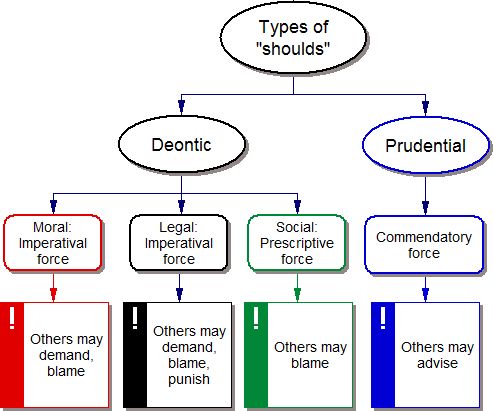
Posted in Rag Bloggers | Tagged , , , , | Leave a comment

INTERVIEW / Jonah Raskin : Judy Gumbo Albert, Yippie Girl

Judy Gumbo Albert. Photo illustrations by James Retherford / The Rag Blog.

Yippie Girl:
A Rag Blog interview
with Judy Gumbo Albert

By Jonah Raskin | The Rag Blog | April 17, 2012

After all these years, she still calls herself “Yippie Girl.” Long, long ago in a world far away, she really was a feisty Yippie and a fiery girl. In many ways, she still is the same young feisty, fiery Yippie Girl she once was, though she’s also older and in many ways wiser about girls and boys, and the revolution.

After all these years, and not losing faith in the Yippie myth, she has as much of a right to the moniker, Yippie Girl, as anyone else. She was there then big time, full-time, and never one of those weekend protesters. She’s here now big time, full time, and not wallowing in 1960s nostalgia for nostalgia’s sake.

Judy Gumbo Albert is a survivor. Many of the founding fathers and mothers — Abbie and Anita Hoffman, Jerry Rubin, and Stew Albert — have gone on to Yippie Heaven. Only a few, such as Paul Krassner and Nancy Kurshan, are still around.

Born Judith Clavir in Canada, Judy became “Gumbo” thanks to Eldridge Cleaver. That was in California in the 1960s, a time and a place that shaped her irrevocably. I must confess, I have always thought of her as a California Girl. I still do, though I didn’t meet her until she moved to New York.

By then everyone in the movement called her Gumbo, including her boy friend and husband-to-be, Stew Albert, a blond-haired Brooklyn-born Jewish intellectual and long-time sidekick of Jerry Rubin.

I met Gumbo soon after I met Stew. I have known her for 42 years, whether she’s lived in Manhattan, the Catskill Mountains in Upstate New York State, in Portland, Oregon, or in Berkeley. For a brief time, I belonged with her, Stew, and a few other friends to a group called “The Catskill Mountain Liberation Front,” a back-to-the-land spin-off from the urban Yippies.

It still exists in the Catskill’s, along with Legends of Sleepy Hollow and that sleepy, subversive Dutchman, Rip Van Winkle who refuses to march in lockstep with his patriotic, hard-working, church-going neighbors.

Ever since I first met her 42 years ago, Judy Gumbo has been a Yippie Girl, a wife, a mother, a college teacher, fundraiser for Planned Parenthood, anti-war organizer, writer, activist, and more. Along with Stew, she edited The Sixties Papers (1984), an anthology that contains essential writings from the era that shaped her and Stew, and that they also played a part in shaping.

Not long ago, she went back to her memories of the Sixties and to the historical record, salvaging Yippie treasures for the book that she’s writing.

She also went back to Berkeley, where she spent some of the happiest and most engaged, enraged times of her life, in the city’s streets and parks, and in the offices of the Berkeley Barb, one of the earliest underground newspapers of the 1960s.

After Stew’s death, she married again, and with her husband, David Dobkin, settled into the unsettled life of newlyweds. Meanwhile, Gumbo’s and Stew’s daughter, Jessica, a real enfant terrible, had grown into an awesome, and awe-inspiring lawyer.

Judy Gumbo’s work has appeared in The Rag Blog and on her website, www.YippieGirl.com. Though I have been talking with her for more than four decades, this is the first formal interview I have ever done with her.


Jonah Raskin: What’s the story about your longtime nickname and moniker “Gumbo”?

Judy Gumbo Albert: One evening in 1968, Eldridge, Stew, and I were cruising San Francisco in Eldridge’s Pontiac. Eldridge kept calling me “Mrs. Stew” and I was pissed. I told him “I am not Mrs. Stew. I am not Mrs. Anybody. I’m me. I’m Judy. Judy Clavir.” I hated using my father’s last name, but I felt I had no choice. “Alright then,” Eldridge said, “I’ll call you Gumbo.” From that day on, in the world of 1960s activists, Stew and Gumbo were a couple.

You were born in Canada and came to the USA in the early 1960s. Are you still Canadian in some way?

I’m still a Canadian citizen. I have a green card. When people ask me to register to vote or sign a petition, I tell them, “I’m an alien.” Born Canadian and growing up as a subject of the British Empire made me hate colonialism. Plus I have a Canadian love of nature and commitment to universal healthcare.

If you had to pick one moment in the 1960s in which you became a new person with a new identity when and where would that be?

When I broke up with Stew as we were driving up the New Jersey Turnpike in September 1970 in my royal blue VW bug. We’d been together for two-and-a-half years. After our break-up I went from calling myself Gumbo to Judy Gumbo.

You lived with and were married to Stew Albert for many years, how did that relationship shape you?

Stew taught me to rebel theatrically, to think outside the box, and to reach for the impossible. He taught me not to look for approval from my parents and not act like a trained seal. Above all, Stew taught me not to tolerate passive aggressiveness in myself or in others but to dig down and be honest with myself.

How did you shape Stew?

I civilized him. That’s what women do to men.

Why did you become a Yippie?

I like to be where the action is. Still do. Stew was the White Rabbit who led me into Yippieland. Because of Stew I met and got involved with Abbie and Anita Hoffman, Jerry Rubin, and Nancy Kurshan and all the Yippies. Yippie gave me the freedom to be theatrical and political, fun-loving and non-serious, a revolutionary who refused to accept restrictions.

In what ways was Yippie sexist?

Yippie was no different from any other movement group. Women were ignored. We did menial tasks; we were not groomed for leadership. Yippie men loved the media spotlight; women were given access to the media at the men’s discretion. I learned by observing Abbie, Jerry, and Stew not as an equal partner. Here’s something I wrote about Stew toward the end of the Chicago Conspiracy Trial in early 1970:

I felt like my formerly mild-mannered lover was taking on Abbie and Jerry’s mantle of self-centered celebrity arrogance that had spread in the trial environment like a pot plant on steroids. I felt invisible to Stew and his friends.

After a bomb was placed in the U.S. Capitol and the Weather Underground claimed credit you and Stew were suspects. You held a press conference and said, “We didn’t do it but we dug it.” How would you modify that comment now?

I still didn’t do it. And I won’t pass judgment on the 27-year-old Judy Gumbo who said she “dug” it. I made that statement 30 years, five months, and 15 days before 9/11. In 1970, the bombing felt to me like a necessary act of theatrical retaliation made legitimate by an impossible war.

Weather Underground bombs damaged property. Not people. I’m a widow. I know the searing pain you go through when your loved one dies. In my opinion, conflating destruction of property with loss of life disrespects the dead. My daughter, Jessica, has asked me the same question about the bombing. I have no good answer beyond: “I dig Occupy.”

If you had to name names — as I’m asking you to do now — who would you name as the all-time most brilliant, insightful individuals in the 1960s?

Of the people I knew personally, I’d say Abbie, Bill Kunstler, and, of course, Stew. Jerry had great insights but I found him more of an entrepreneurial propagandist. Some of Eldridge’s insights were terrific, though his advocacy of rape as a revolutionary act was horrific.

I’d start with Bob Dylan and move on to Aretha Franklin. I’d include Madame Binh and General Vo Nguyen Giap, Malcolm X and Rosa Parks, Franz Fanon and C. Wright Mills. Among my personal faves for insightful feminists are Ti-Grace Atkinson and Shulamith Firestone. Margaret Atwood was and still is my number one favorite author. And that’s not just because we’re both Canadian. She’s a brilliant writer.


Who are your Sixties all-time villains?

Villains: J. Edgar Hoover and his successor Acting FBI Director L. Patrick Grey. Richard Nixon, although compared to George Bush, Nixon was a pussycat. John Mitchell, Nelson Rockefeller, Nguyen Cao Ky, Pol Pot. Henry Kissinger, Mayor Richard M. Daley, and the Chicago cops — especially those who murdered Fred Hampton and Mark Clark.

I used to consider the FBI agents who burglarized my house and put a homing device on my car to be villains but their villainy has faded. Same for Guy Goodwin, the federal prosecutor who subpoenaed me and Stew to a grand jury. If I compare how Goodwin harassed me, Stew, Leslie Bacon, and perhaps 400 others to how civil liberties have been decimated today, I feel more outrage now than I ever felt back then.

When did the Sixties begin and end for you?

They began in 1965 when I came home and found my first husband (not Stew) in bed with another woman. That trauma motivated me to move to Berkeley in late 1967. The rest is history. In some ways the 1960s have never ended for me. I’m an idealist (now tempered by life) and a romantic. I remain committed to the values of progressive activism, which led me to work for Planned Parenthood for close to 20 years. And, now I’m writing my memoir, I spend many hours each day in the 1960s.

You have been a college teacher, a fundraiser, a feminist, and more. How many identities or roles have you played and do you like all of them equally?

It would be difficult to quantify. Daughter, mother, wife, lover, widow are some of them. My roles have felt appropriate to each phase of my life: a Yippie in my 20s, a mother and college professor in my 30s, a fundraiser during my professional career and now a writer. All my roles are challenging and for the most part fun.

I loved being an activist. I loved raising money for Planned Parenthood. I enjoy being a writer. Being a mother is terrific. Being a widow sucks, but I’ve learned a lot.

You have a daughter, Jessica, who is a lawyer. Does she carry on your values and or rebel against them?

Both. Jessica retains the progressive values she grew up with. But she works for electoral candidates and inside the Democratic Party. Admittedly, she is more of a liberal Democrat than a leftist. She has formed her own political beliefs, and has chosen her values as a self-conscious and self-determining human being.

What do you think now about the slogan, “Don’t trust anyone over the age of 60”?

Is 60 the new 30? Every decade seems to add 10 years to the age beyond which you shouldn’t trust people. It has become a liquid and fluid mantra. I think every new generation should look on their elders with skepticism. How else will they learn to trust themselves and make their own decisions about their lives?

What is the most important contribution from the feminist agenda from say 1968 to 1978?

The capacity to control our reproductive lives, especially access to abortion, contraception, and women’s healthcare services.

If you could go back to the past and change one thing about yourself what might it be?

Back in the day, Stew would, on occasion, call me a facile optimist. He meant I assumed everything I did would have a positive outcome and I would jump into things too quickly without covering my ass. If I had a time machine, I’d like to give myself more wisdom and less superficiality. I’d also like to be able to bring my Judy Gumbo energy back to the present.

What do you have to say to the Occupy Movement now?

I love your passion. I admire your commitment to non-hierarchy, collectivity, decision making by consensus and insurrection as performance art. Keep on Truckin’ and Do It!

[Jonah Raskin is the author of For the Hell of It: The Life and Times of Abbie Hoffman and a regular contributor to The Rag Blog. Read more articles by Jonah Raskin on The Rag Blog.

The Rag Blog

Posted in Rag Bloggers | Tagged , , , , | 2 Comments

tdreyer@austin.rr.com

A VETERAN, A SMILE AND AN IMAGE

March 30 marked the official start of the Mexican presidential campaign. Prior to that date candidates were officially prohibited from campaigning. The campaign lasts for 90 days, followed a one-round election on July 1. The candidate with the most votes, even if they are less than a majority, wins.

The current front-runner, with 51 percent of the voters who declared a preference, is Enrique Peña Nieto, the telegenic, 45-year-old candidate of the Revolutionary Institutional Party (PRI). After graduating from law school he went into politics, following the footsteps of generations of his forbears in his native State of Mexico. During the 1990s he held various positions in state government and later served in the state legislature. This, as well as his family connections, propelled him into the governorship of the state for the 2005-2011 term.

Peña Nieto, who is married to TV star Angélica Rivera, is widely viewed as all image and no content. As columnist Jorge Zepeda Patterson observed, ”People will vote for him because he’s good looking, because he looks presidential. Period. He and his wife form a fairy-tale couple portrayed favorably by the two major TV networks, both of which favor him.”

Peña Nieto stresses that his positive record as governor of the State of Mexico—Mexico’s most populous state—qualifies him to be president. Such a view if far from unanimous. Veteran human rights activist Sergio Aguayo commented that Peña Nieto’s record “oscillated between mediocrity and catastrophe.” In any case, Peña Nieto’s hand picked-successor won the gubernatorial race handily in 2011, bolstering the image of his governorship.

Peña Nieto emphasizes that it’s time to oust the incumbent National Action Party (PAN), since during the 12 years its two presidents have been in office both violence and the number of poor people have increased. He also stresses that as a result of what he calls a “dysfunctional state”, economic growth during the last decade has been slower than it has been during any other decade since the Depression.

Observers have attached the term Teflon candidate to Peña Nieto, since so far none of his gaffes have significantly lowered his approval rating. The most conspicuous of these gaffes was his not being able to—at a book fair yet! —state which three books have most influenced him. His strategy is to avoid unscripted encounters and to refrain from making bold proposals which might cost him some of his heterogeneous base.

Peña Nieto received the nomination of his party by default, after it became obvious that he was far more popular than any other potential candidate. The PRI, which emerged from among the victorious generals of the Mexican Revolution of 1910-1917, is both Peña Nieto’s greatest asset and his greatest liability. Many feel that if the PRI regains the presidency, there will be a return to the authoritarianism that characterized the party’s 71-year-long hold on the Mexican presidency. A more optimistic view portrays a new PRI constrained by a congress chosen by real elections and by a supreme court which actually rules against the executive branch.

Even though many are wary of a PRi return to Los Pinos, the presidential residence, the party offers by far the best get-out-the-vote machine in Mexico—the result of decades of political control and the many governorships currently held by PRI members. Such a machine could prove to be crucial in an election where grass-roots enthusiasm has been in short supply.

Trailing Peña Nieto has been PAN candidate Josefina Vázquez Mota, with 28 percent of those declaring a candidate preference. She received an economics degree and subsequently served as a business consultant and public speaker. She transitioned to politics after she caught the attention of the wife of the PAN governor of the state of Guanajuato, who introduced her to the governor. This resulted in her being nominated to a seat in Congress. She soon resigned her congressional seat to serve as President Fox’s secretary of welfare, a powerful post in the federal government. In 2006 she resigned her cabinet post to manage Felipe Calderón’s foundering presidential campaign. After Calderón won his hotly disputed election, he appointed her as secretary of education. She had limited impact while serving in that post because she failed to wrest power from the powerful head of the teacher’s union. In 2009 she returned to the Chamber of Deputes where she became coordinator of the PAN delegation.

Her sights soon turned to the upcoming 2012 presidential race. The PAN alone among the parties staged a primary election to select its presidential candidate this year. Vázquez Mota won 54 percent of the 515,000 votes cast by registered PAN members and supporters, making her the first Mexican woman to be nominated for the presidency by a major party. The two males she defeated quickly united behind her candidacy.

Vázquez Mota is playing on her womanhood, announcing, “We are going to demonstrate that Mexico is ready for its first woman president.” She also noted in her victory speech after winning the primary that her experience raising a family would serve her as president.

She raises the specter of another PRI administration ushering back the authoritarianism and corruption associated with past PRI administrations. She is less clear on what she is for, other than improving education and creating 16 million scholarships so poor children can afford to remain in school longer. She has proposed a coalition of parties to overcome the lack of decisive government action which has plagued both PAN administrations. Finally, although culture wars are much less significant than in the United States, she has stated her opposition to gay marriage and abortion.

Given widespread rejection of the violence associated with incumbent PAN President Felipe Calderon’s crime-fighting policy and dissatisfaction with slow economic growth, Vázquez Mota’s greatest challenge is to establish her independence from the policies of the incumbent PAN president. At some point she must offer an alternative to what political scientist Silvia Gómez Tagle characterized as “more of the current policies of Felipe Calderón, which haven’t worked.”

The PAN candidate also needs to overcome the perception that she smiles and talks a lot but is weak on content. Her speeches have been compared to those of motivational speakers—full of optimism and positive attitude, but lacking specifics. Columnist Sergio Sarmiento made this biting comment, “She prefers to fill the spaces with words rather than with ideas.”

Her party, the PAN, was organized in the 1930s as a conservative response to government anticlericalism, President Lázaro Cárdenas’ (1934-1940) reforms, and the lack of democracy. In the last quarter of the 20th century the party saw a massive influx of businessmen, including future president Vicente Fox, who felt the PRI was wrecking the economy. Since the PAN assumed power at the federal level in 2000, the party has suffered from its failure to achieve promised rates of economic growth and from violence associated with Calderón’s anti-crime campaign. It has become increasingly hard to determine how the PAN is different from the PRI, which it replaced. Indeed Manuel Clouthier, son of an iconic PAN presidential candidate with the same name, left the party in 2012, declaring the PAN had “sunk to practices exactly like those which the PAN fought before taking power… It has been totally corrupted by power.”

The third major candidate is Andrés Manuel López Obrador, widely referred to simply as AMLO. He was the candidate of the Party of the Democratic Revolution (PRD) in 2006 and was declared to have lost the 2006 election by less than a percentage point after having maintained a commanding lead during most of the campaign. Rather than leading the pack this year, only 20% of those polled expressed a preference for him, in large part due to his having alienated much of his base due to his refusal to recognize his election loss and his leading major protest demonstrations which tied up Mexico City for months.

AMLO first drew national attention protesting stolen elections in his home state of Tabasco and the national oil company’s running roughshod over those whose land and fishing grounds had been ruined by oil operations.

AMLO then moved to the national scene, heading the PRD and serving as mayor of Mexico City. His popularity as mayor positioned him for his 2006 presidential campaign, which was derailed by a massive wave of illegally funded attack ads.

For his 2012 campaign AMLO has attempted to moderate his image, declaring on the opening day of his campaign that “honesty, justice and love—lots of love”, would characterize his administration. Rather than referring to Mexico’s businessmen as a “mafia,” as he did in the past, he now courts them and refers to them as the motor of the economy. Many question the sincerity of his shift in style between 2006 (and before) when he was much more confrontational. In fact the press often refers to the new López Obrador as AMLOve. Crucial to Lopez Obrador’s pulling out ot third place will be convincing the Mexican public he is not a Romney-like flip-flopper who is tailoring discourse to what he believes the Mexican people want to hear.

The three keys to AMLO’s economic plans are lowering energy costs, combating monopolies, and lowering costs of government. Lowering the costs of electricity and gasoline would, although he doesn’t not acknowledge it, increase the already massive subsidy the government provides the middle and upper classes who consume a disproportionate share of energy. His goal of fighting monopolies is more straightforward, but risky in a campaign. Targeting monopolies would involve the taking on the two media giants controlling television—the very medium which will filter the information the vast majority of Mexicans rely on to make their candidate selection.

While promising not to increase debt, inflation or taxes, AMLO advocates stimulating the economy to create 1.2 million jobs a year. Rather, he promises to finance economic stimulus by ending monopolies, lowering salaries of overpaid government functionaries, and eliminating corruption. Reversing decades of neoliberal policy, he urges a major role for government in implementing an industrial policy and creating public works. AMLO defends the icon of Mexican nationalism, the national oil company Pemex. In an AMLO administration no private capital will taint it. In addition, he proposes to end oil exports and refine Mexican oil locally in five new refineries.

AMLO shows his left roots in formulating security policy. Instead of advocating more guns and jails, he proposes ending drug-related violence by providing jobs and educational opportunities for young people so that they will not be tempted by employment offered by criminal gangs. More immediately he advocates creating a new federal police force which within six months would replace the military in combating organized crime.

If he is to move up during a short three-month campaign, AMLO must make some bold moves. As of now his economic plans smack of the revolutionary nationalism of 1960s and 1970s. Such policies indeed produced high growth then, but are of questionable relevance in today’s world. Similarly there is sound logic behind his statements on drug-related violence. However it would take years for his economic policy, even if successful, to offer well paid jobs to the millions flooding the labor market, the result of record high births in the 1990s. So far AMLO (and the other candidates) have failed to embrace the notion of drug legalization which is building momentum throughout Latin America.

AMLO received the 2012 nomination of the Revolutionary Democratic Party (PRD) after he edged out the mayor of Mexico City in a voter preference poll. Both presidential aspirants had previously agreed that the winner of the poll would be the left’s presidential candidate. AMLO is not only the candidate of the PRD but of two other small left parties. This is an important advantage in a multiple-candidate one-round election. In 2006, the candidate of a small left party drew more votes than the difference between AMLO’s vote total and that of Felipe Calderón, the declared winner. In addition AMLO has the support of a nationwide grass-roots organization known as MORENA, which he has built up by traveling to all of Mexico’s 2000-plus municipios during the last six years.

While AMLO has the unified left behind him, his being the nominee of the PRD may well prove to be problematic. Coming up with policy suggestions has been difficult for the PRD—a dilemma shared by the left throughout post-Cold War Latin America. Another challenge faced by the PRD is that the party has been so riven by factions that power struggles within the party often overshadow its policy proposals. Media coverage of the party frequently portrays the factions as “tribes.” Repeatedly the “tribes” have been so intent on gaining control of the PRD that they have attempted to rig elections for party posts. Such shenanigans hardly make the general public feel comfortable with the notion of the party administering Mexico.

The great unknown is what impact the internet and social media will have on the elections. Before March 30 all the candidates were making use of social media to get out their message since it did not fall under the government ban on campaigning before that date. During the first week of the official campaign social media served to highlight a series of minor campaign snafus by the Vázquez Mota campaign—messages that appeared to be managed by the well oiled PRI-media machine. Social media could shape opinion, get out the vote, or simply get lost in the millions of TV spots Mexicans will be bombarded with before July 1.

As columnist Juan Enríquez Cabot observed, so far a lack of enthusiasm and hope have characterized the campaign. Moderation, not confrontation, is the dominant theme. Disappointment with the results of the transition to democracy in 2000 pervades the electorate. Compounding this is the notion, shared by many U.S. Republicans during the primary season, that the choices on the ballot are less than sterling.

Observers have also commented on the similarity of the candidates’ proposals. Zepeda Patterson declared the security proposals of the three candidates “are vague, ill defined, and virtually interchangeable.” All have proposed higher economic growth and fighting corruption—standard campaign fare for decades.

To close on a positive note, Mexicans do not feel corporations are people. Rather than following the Citizens United line of “reasoning,” Mexico strictly prohibits corporations from funding candidates or buying airtime to influence the election. The amount private citizens can donate is sharply limited, allowing public financing to pay the bulk of campaign costs. TV campaign ads are broadcast without charge to either candidates or government. As a condition for getting a broadcast license, networks are required to provide a certain percent of airtime to the government. The government then allocates this airtime to campaigns so they can broadcast spots without being beholden to donors. In addition the government makes substantial cash transfers to the political parties so they can campaign effectively and get their message out.

Austin-Texas based writer Philip L. Russell has written six books on Latin America. His latest is The History of Mexico: from Pre-Conquest to Present (Routledge). Frequently updated information on the Mexican presidential campaign can be found in chapter 30 of www.mexicofrompreconquesttopresent.com.

Type rest of the post here

Source /

The Rag Blog

Posted in RagBlog | Leave a comment