Alice Embree : War is Trauma but GIs Have the Right to Heal

“Stop the Deployment of Traumatized Troops.” Members of IVAW demonstrate in Washington, D.C., October 2010. Photo by Rose Marie Berger / rosemarieberger.com.

Operation Recovery and Hoodstock III

By Alice Embree / The Rag Blog / September 28, 2011

The Austin Lounge Lizards headline Hoodstock III, benefitting Under the Hood Café and Outreach Center and IVAW’s Operation Recovery, Sunday, Oct. 2, 2011, 6-9 p.m., at Jovita’s, 1619 South First St., Austin, Texas. For more details, see the poster below.

For more than a decade, two declared wars have raged in Iraq and Afghanistan. War has traumatized civilian populations there and sent thousands of service members home suffering from trauma. With no end in sight to the wars, these servicemen and women face redeployment despite diagnoses of Post Traumatic Stress Disorder (PTSD), Traumatic Brain Injury (TBI), and Military Sexual Trauma (MST).

Iraq Veterans Against the War (IVAW) and their civilian allies have embarked on a campaign that has a simple message: the right to heal. IVAW’s Operation Recovery advocates that service members who experience PTSD, TBI, MST, and combat stress have the right to exit the traumatic situation and receive immediate support and compensation. IVAW organizers talk to soldiers about their right to receive medical care and advice from medical professionals, advice that should trump a commander’s orders.

In Killeen, the G.I. coffeehouse Under the Hood, is the forward operating base for Operation Recovery. Aaron Hughes, an IVAW organizer, was pulled out of the University of Illinois in 2003 and sent into active duty in Iraq with his Illinois Army National Guard unit. Tall and serious, Aaron and other IVAW members have spent many weeks in the brutal summer heat of Killeen, Texas, talking to soldiers at Fort Hood, the largest Army base in the world.

Here, they can find plenty of soldiers who have returned from deployment, been diagnosed with trauma, have not been treated, and have simply been readied for deployment again. There are also many soldiers who have never been appropriately diagnosed. Unfortunately, at Fort Hood, these situations often translate into the worst possible result — suicide.

In January 2011, the Army reported that 22 soldiers had killed themselves or were suspected of doing so, twice the number in 2009. That is a rate of 47 deaths per 100,000, compared with a 20 per 100,000 rate among civilians and a 22 per 100,000 rate Army-wide. “We are at a loss to explain the high numbers,” acting commander Major General William Grimsley told USA Today.

Aaron Hughes and other IVAW organizers have an easier time explaining Fort Hood’s record-breaking stat. The Army is first and foremost committed to keeping troops available for wars that are far from over. They direct inadequate resources to the diagnosis and treatment of traumatized soldiers. Service members often struggle in isolation with the invisible wounds of trauma — wounds that fester in secrecy, wounds that affect spouses and children, families and friends.

Service members return to a country where the wars are invisible to a majority of their fellow citizens — where media attention is lavished on the stupidity of stars and the cacophony of what passes for political debate. War coverage just doesn’t attract advertisers like “Dancing With the Stars.”

In the midst of this, IVAW has a powerful message: “You are not alone.” “You have the right to heal.” If there is one lifeline that can work for soldiers in trauma, it is to tell their story to peers who have walked in their boots.

Since it opened in February 2009, Under the Hood Café and Outreach Center has offered a space for active duty soldiers, military families, veterans, and concerned citizens to socialize, organize, and heal. You can support this space by coming to a benefit from 6-9 p.m., Sunday, October 2, at Jovita’s in Austin. Hear the Austin Lounge Lizards and other musicians and support a great cause

For more on Operation Recovery,
listen to the Rag Radio interview with IVAW soldiers:


[Alice Embree is a long-time Austin activist, organizer, and member of the Texas State Employees Union. A former staff member of The Rag in Austin and RAT in New York, and a veteran of SDS and the women’s liberation movement, she is now active with CodePink Austin and Under the Hood Café. Embree is a contributing editor to The Rag Blog and is treasurer of the New Journalism Project. Read more articles by Alice Embree on The Rag Blog.]


The Rag Blog

Posted in Rag Bloggers | Tagged , , , , , , | 1 Comment

FICTION / Marc Estrin : The Machine

THE MACHINE

By Marc Estrin / The Rag Blog / September 27, 2011

The government murder of Troy Davis this week — under odd evidential circumstances — has once again thrust capital punishment up for public discussion.

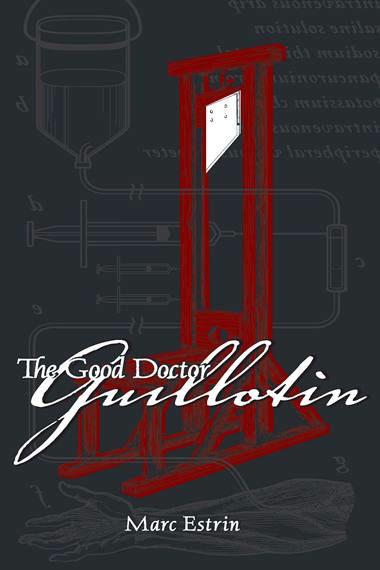
As my contribution to death penalty abolition, I recently wrote The Good Doctor Guillotin, a novel about the first use of the guillotine during the French Revolution — an occasion sufficiently removed from current politics as to allow the issues to be seen more clearly.

Tobias Schmidt was the machine’s builder, a piano maker. And Charles-Henri Sanson was the executioner of Paris.

The novel itself is intricately woven, but here’s a stand-alone short chapter describing the testing of the machine before use. It may provide some food for reflection:

29. The Machine

It was 14 feet high, its beams and posts painted blood-red — a nice touch, that. It would be called “End of the Soup,” “Old Growler,” “Sky Mother,” “the Last Mouthful.” It would be called by the feminine form of someone’s name, someone who had repudiated it. As if it were his daughter. Assemblymen called it the “Timbers of Justice.”

The victim, once attached to the plank, his head in the fatal window, would become a part of it, a cog in the machine of egalitarian justice. His blood would be shed not by the unsteady hand of his fellow man but by this lifeless, insensible, infallible instrument, a doctor’s idea become oak and iron.

The materials gathered, over the course of a week Tobias Schmidt and two hired workers constructed the frame. Two four-sided posts were grooved and chiseled as guides for the falling blade. When the 70-pound holder and 15-pound blade came back from the blacksmith, they were fitted loosely between the posts and the posts joined by an upper crossbar with a hole for the rope. A lower crossbar was angle-braced to its stand for stability. Rope guides were placed.

On the back side of the device, the executioner’s side, another crossbar was attached to hold the lunette — two wooden pieces, each with a half-circular hole to contain the client’s, the patient’s, the package’s neck. The diameter was that of Pelletier’s. A smaller one for women could be substituted as needed. When fitted together, the pieces formed a lovely “little moon” whose upper half could be lifted on a hinge to permit a head to enter.

That was it. Simple. A weighted blade and its frame. Though it required two strong men to carry it, it could be loaded onto a heavy cart and transported wherever it was needed, along with its separate bench, long and strong enough to hold a giant—or an ox—and fitted with thick leather straps.

Before dawn on Tuesday, April 15, 1792, a sound of clattering wheels was heard on southern streets two miles from the center of Paris. It was a four-wheeled wagon, drawn by two horses, carrying a long object covered with heavy black cloth and tightly bound with chains. Four guardsmen with bare swords on horseback rode silently in front of the wagon, and four behind. Bringing up the rear was a smaller wagon with several sheep. If going to market, they were being taken in the wrong direction. They advanced slowly, gray and black in the pale early morning.

The procession was heading for the suburb of Bicêtre, just outside the city gate, home to the great hospital for venereal disease, its hospice for the needy poor, and its maison de correction, locked wards for hardened criminals, some awaiting execution.

When seen from a distance, Louis XIII’s building looks quite imposing. Set on the brow of a hill, from afar it retained something of its former splendor and the look of a royal residence. But now, three Louises later, the palace had in fact become a hovel. Its dilapidated eaves were shameful and its walls diseased. Not a window was glazed but only fitted with crisscrossed iron bars through which, here and there, pressed the harrowed face of a patient or a prisoner.

Already waiting in a small inner courtyard were Charles-Henri Sanson, with two assistants, Tobias Schmidt, and the doctors Antoine Louis and Joseph-Ignace Guillotin, the latter most reluctantly.

Early-morning eyes gawked from behind bars as the first sheep’s head was placed in the lunette, its neck the size of Pelletier’s. The upper half moon was locked in place. One of the assistants let loose the rope from its tie-off so Sanson could better observe.

Disaster: The heavy blade jerked stickily into motion, jolted downward between the grooves, and sliced into the animal without killing it. All mental ears were stopped against its terrifying cry. Sanson was dismayed. He had the blade wound back up and released again. It bit into the neck again but did not sever it. The victim howled. Once again the blade was raised and dropped, but the third stroke only caused a stream of blood to spurt from the sheep’s neck, without the head falling.

Five times the blade rose and fell; five times it cut into the sheep, which cried five times for mercy. It remained standing on the platform, an appalling, terrifying sight. Sanson straddled it and hacked away with a butcher knife at what remained of its neck. Twenty pounds of lead shot were added to the blade-carrier, and three more sheep were neatly dispatched thereby. The march of science.

After nightfall Schmidt took the machine back to his workshop in the Cour du Commerce, Rue St.-André-des-Arts, just opposite the printing shop in Number 8 where Marat’s paper was printed. He lined the grooves with brass for a smoother drop and bolted more weight to the blade assembly.

Two days later, on April 17, assisted by his son and his two brothers, Sanson repeated his experiments on the improved machine, this time with three human cadavers from a military morgue, three well-built men who had died in short illnesses that had not caused them to grow thin.

Among the spectators were the two doctors concerned, along with Michel Cullerier, the chief surgeon of Bicêtre; Philippe Pinel, the resident alienist; several physician members of the National Assembly; and delegates from the Council of Hospitals of Paris. Strapped to the bench, the three corpses, good soldiers all, were successfully beheaded without protesting, to the applause of most of the onlookers.

[Marc Estrin is a writer, activist, and cellist, living in Burlington, Vermont. His novels, Insect Dreams, The Half Life of Gregor Samsa, The Education of Arnold Hitler, Golem Song, The Lamentations of Julius Marantz, and The Good Doctor Guillotin have won critical acclaim. His memoir, Rehearsing With Gods: Photographs and Essays on the Bread & Puppet Theater (with Ron Simon, photographer) won a 2004 theater book of the year award. He is currently working on a novel about the dead Tchaikovsky. Read more articles by Marc Estrin on The Rag Blog.]

The Rag Blog

Posted in Rag Bloggers | Tagged , , , , | Leave a comment

Lamar W. Hankins : The Death Penalty and the Question of ‘Actual Innocence’

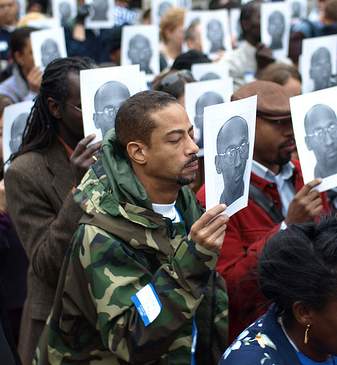
Demonstrators carry pictures of Troy Davis, who was executed Sept. 21, 2011, in Jackson, GA. Image from Politics and Fashion.

When government decides to kill:
The death penalty and the
question of actual innocence

[The Supreme] Court has never held that the Constitution forbids the execution of a convicted defendant who has had a full and fair trial but is later able to convince a habeas court that he is ‘actually’ innocent. — Justices Antonin Scalia and Clarence Thomas

By Lamar W. Hankins / The Rag Blog / September 27, 2011

Almost every high school student and college graduate has thought about capital punishment. It is one of the most common topics to write about in political science, social science, English, and speech classes.

Everyone has an opinion and reasons to be for or against it. In this, I am not different from most other people. But my perspective about capital punishment has come to me over the 45-plus years I have been a participant in the functioning of the criminal justice system. I have learned that it does not function well at any level.

I have concluded that the criminal justice system is so imperfect and unreliable that it is irresponsible to assign it the authority to decide who should live and who should die. I didn’t always think this way. I used to respect the criminal justice system. When I was 20 years old, I spent the summer after my junior year in college working for the Texas prison system.

That summer, the Texas Department of Corrections (now the Texas Department of Criminal Justice) hired about 30 college students to introduce them to the prison system and to provide inexpensive employees to fill in while regular employees took vacations.

I learned that summer, from first-hand experiences, about wide-spread abuse of inmates. Four inmates that I was supervising were taken by prison officials — my immediate supervisor and the head of the prison shops — and beaten with ax handles for working too slowly. When I questioned the beatings, the assistant warden and then the warden told me that they had all fallen down the steps when they were taken away from their work area for about 30 minutes for a discussion about their slow work habits.

Even a naive 20-year old couldn’t accept that explanation after counting the dozens of individual knots that had suddenly appeared on their freshly shorn heads after that 30-minute discussion. The warden threatened me if I persisted in my complaint, and he moved me to other jobs that diminished my contact with inmates. But for the rest of the summer, after word of my complaint got around, I was told stories by inmates and guards about many abuses, including the drowning of inmates by prison officials.

That summer job was the beginning of the end for my unquestioning acceptance of official explanations for government misconduct. A few years later, when my younger brother was led into a marijuana buy by a snitch working off his own arrest for selling drugs by getting others to commit drug crimes so they could be arrested, I learned another lesson about how the criminal justice system functions. It was not enough to arrest people selling drugs; the government had to create the crimes so it could make more arrests.

When I became an attorney, I refused to represent defendants who had become snitches. Partly it was for self-preservation. How could I trust that a client setting up drug cases for law enforcement would not try to set me up? It would be a coup to get a criminal defense attorney arrested. It would not matter that I neither used nor sold illegal drugs. At the very least, I would be tainted for life just for having such an allegation made against me, and I could have lost my license to practice law.

Shortly before I became an attorney — and just after the Supreme Court in 1976 allowed the resumption of capital murder cases after a four-year moratorium while it sorted out some death penalty issues — I was a legal assistant for one of the premier criminal defense attorneys in Houston. He had been appointed to represent a notorious defendant accused of capital murder and other crimes.

The capital murder trial lasted two months. The jury could not reach a decision on punishment. At that time, the law in Texas required that if the jury could not reach a decision on punishment, the entire trial had to be done over. A few months later, we appeared back in the same courtroom for the re-trial. The prosecutor offered a deal on nine charges against the defendant. He received three life sentences and six 99-year sentences, thus avoiding a death sentence.

In 1979, while practicing in Bryan, I was appointed to represent a defendant in another capital murder case. While my client had not actually done the killing, he had participated in actions that led to the death of an innocent man whose truck my client and his cohorts wanted to steal. In Texas, a concept known as “the law of parties” made him equally culpable.

The trial lasted for three months. My client was convicted and sentenced to death, but the case was overturned on appeal because the judge had not allowed me to fully cross-examine a key witness against him. That decision came several years after the first trial. By then, I had moved to San Marcos and other attorneys were appointed to represent the defendant when his case was set for re-trial.

During the first trial, we were allowed to introduce what was termed “mitigating evidence” — evidence that might show why the defendant should not receive the death penalty — but the judge did not explain to the jurors how they should consider and apply that mitigating evidence. That evidence included information that the defendant had voluntarily surrendered to the sheriff by turning himself in at the jail, that he was borderline mentally retarded, that he had grown up in dismal poverty, that he had not before committed a violent crime, and that he was subjected to extreme brutality by his father during his formative years.

I had access to all of that mitigating evidence and was a witness to his surrender to the sheriff. I had located the defendant (I was previously appointed to represent him on a misdemeanor charge) and drove him to the jail the night he turned himself in. I contacted the new defense attorneys and offered to help in any way I could, including being available to testify about his voluntary surrender to the sheriff.

The new attorneys presented no evidence of these mitigating circumstances at the re-trial, even though a newer court opinion had given judges specific instructions about how to explain such mitigating evidence to jurors so that it could be applied fairly by them in their deliberations about whether the defendant should be given a death sentence or a life sentence.

He was again sentenced to death. That punishment was carried out 22 years after the crime had been committed. His death did yield one positive benefit — he donated his body to the University of Texas Medical Branch in Galveston to further the education of those studying to become doctors.

After contacting some of the jurors from the original trial, I had learned that if they had been instructed how to consider and apply the mitigating evidence, they would have voted to give my client a life sentence. In the second trial, no mitigating evidence was presented, even though jurors would have been instructed how to consider and apply it.

As a result, the second set of jurors had no evidence to consider in deciding my former client’s fate. At the time of his death, a habeas corpus petition was pending before the court charging that the attorneys in his second trial had provided less than effective representation by failing to present the mitigating evidence that might have saved his life.

The recent execution of Troy Davis in Georgia after seven of nine witnesses recanted their testimony or admitted that they had lied at his trial brings up other issues of manifest unfairness in the criminal justice system. Troy Davis was convicted of murdering an off-duty police officer and sentenced to death.

In addition to the witness recantations, new evidence suggests that Davis had been inside a nearby pool hall and was part of a crowd that left the pool hall in response to a commotion in the adjacent parking lot where a homeless man was being beaten by a man named Coles, who is believed by many to be the killer of the off-duty officer who came to the homeless man’s aid.

The recanting of false testimony or mistaken eyewitness identification is not unusual, especially when the testimony is stimulated by over-zealous investigators intent on a conviction based largely on their gut instincts or dislike of a defendant. Psychologists have known for at least 50 years that eyewitness testimony is the most unreliable evidence presented in most criminal cases. But the courts in most jurisdictions have not allowed scientific evidence about the unreliability of eyewitness identification to be presented to jurors. That has begun to change.

A primary reason for the change has come from the work of the Innocence Project, which started in 1992 at the Benjamin Cardoza School of Law. When DNA testing became available to analyze blood from a crime scene, it became possible to determine whether a particular accused person could have been the culprit.

Before the early 1990s, many defendants were convicted on eyewitness identification and circumstantial evidence, such as a match between the blood type of an assailant and blood found on the victim, which did not rule out the possible guilt of millions of others with the same blood type as the defendant. The Innocence Project started looking back at some of these old cases where there was blood evidence that had never been subjected to DNA analysis.

Resulting from the use of DNA analysis, 70% of the cases that the Innocence Project has taken back to court have resulted in wrongful convictions because of faulty eyewitness identification of the assailant, usually in cases of murder or sexual assault.

In other cases, faulty scientific analysis of forensic evidence by government laboratories and investigators has resulted in wrongful convictions. The Willingham arson case is one example. The arson investigators misunderstood the forensic evidence and implicated Willingham in the deaths of his three children. He was executed in 2004.

In the early 1990s, a pathologist in west Texas, Ralph Erdmann, is believed to have faked about 100 autopsies and falsified an unknown number of toxicology reports, many of which resulted in wrongful convictions. Erdmann was convicted on several counts of evidence tampering and perjury after defense attorneys and others sparked an investigation into his forensic practices, but it took the appointment of a special prosecutor to uncover most of his misdeeds.

Prosecutors have enormous discretion about whether to charge a defendant with capital murder. The same year that my client in Bryan was charged with capital murder, at least five other cases in the same county could have been prosecuted as capital cases, but were not.

They were murders committed during the commission of kidnapping, burglary, robbery, aggravated sexual assault, or arson. The prosecutor decided, for his own reasons, that the capital murders committed by these defendants did not need to be prosecuted as capital cases. What made my client’s case special was that four black defendants killed a white man. In the other five cases that year, the victims were all black.

The race of the victim and the race of the defendant was the only salient difference in the six cases. (Occasionally, however, a white person does receive the death penalty for killing a black person, as in the horrendous dragging death and decapitation of James Byrd in East Texas a few years ago.)

For many defendants wrongfully convicted, there are no adequate remedies at law. Many federal judges and some Supreme Court Justices believe the Constitution does not require reconsideration of cases that have been fully litigated even when there is evidence that the defendant is actually innocent of the crime charged.

Justices Antonin Scalia and Clarence Thomas wrote in 2009:

This Court has never held that the Constitution forbids the execution of a convicted defendant who has had a full and fair trial but is later able to convince a habeas court that he is “actually” innocent. Quite to the contrary, we have repeatedly left that question unresolved, while expressing considerable doubt that any claim based on alleged “actual innocence” is constitutionally cognizable.

As journalist Ed Brayton explained this point further in 2010:

[T]he 9th Circuit Court of Appeals has decided that the fact that a convicted criminal can now be proven to be innocent does not matter if he filed an appeal in 16 months rather than the 12 months allowed by the statute of limitations. Actual innocence simply does not matter, only technicalities do.

Criminal and appellate procedures, such as deadlines for filing appeals and the rules for how and when to file writs of habeas corpus challenging wrongful incarcerations, are more important in our criminal justice system than proof of the actual innocence of people in our prisons and on our death rows.

These and many similar reasons, including my own experiences as an attorney with faulty eyewitness testimony, have led me to conclude that the criminal justice system is too riven with mistakes to be allowed to put anyone to death. At least a million Texas property owners each year don’t trust the government to decide accurately the value of their property. With so little confidence in government, why would we give that same government the power of life and death over a human being?

Law professor Paul Campos of the University of Colorado at Boulder summed up the Scalia and Thomas position, which is basically the position of the criminal justice system as a whole, in reference to the Troy Davis case:

The defense in this case is claiming that there’s something unusual about Troy Davis’ situation, requiring extraordinary action on the part of the Supreme Court. But there’s nothing unusual about his situation. The American legal system routinely sentences people to long prison terms and even to death on the basis of dubious evidence, in trials featuring overburdened, underfunded, and marginally competent defense lawyers. Obviously under such conditions mistakes are going to be made. If such mistakes make verdicts unconstitutional, then the whole system is unconstitutional.

And that’s a difficult proposition to accept for most people in the land of the free and the home of the brave. But it leads to an inevitable question of morality: “Is this justice?”

[Lamar W. Hankins, a former San Marcos, Texas, city attorney, is also a columnist for the San Marcos Mercury. This article © Freethought San Marcos, Lamar W. Hankins. Read more articles by Lamar W. Hankins on The Rag Blog.]

The Rag Blog

Posted in Rag Bloggers | Tagged , , , , , | 1 Comment

As retired physician Dr. Stephen R. Keister prepares to enter his ninth decade, he reflects on the state of his country — and its corrupted health care system. “Never have I seen my country so fraught with danger and despair,” he confides. “Never have I seen such nihilism and cruelty expressed in public view.” “I look at the Republican ‘debates,'” he says, “and wonder, where did we — as a supposedly enlightened society — dig up this bunch of morons?”

Posted in RagBlog | Leave a comment

Don Swift continues his cautionary tale about Dominionism, the theocratic tendency in right wing Christian thought that is influencing high profile figures like Michele Bachmann, Sarah Palin, and Rick Perry. Retired history prof Swift recounts Dominionism’s history, the theologians who molded it, the different forms it takes, and its growing political clout.

Posted in RagBlog | Leave a comment

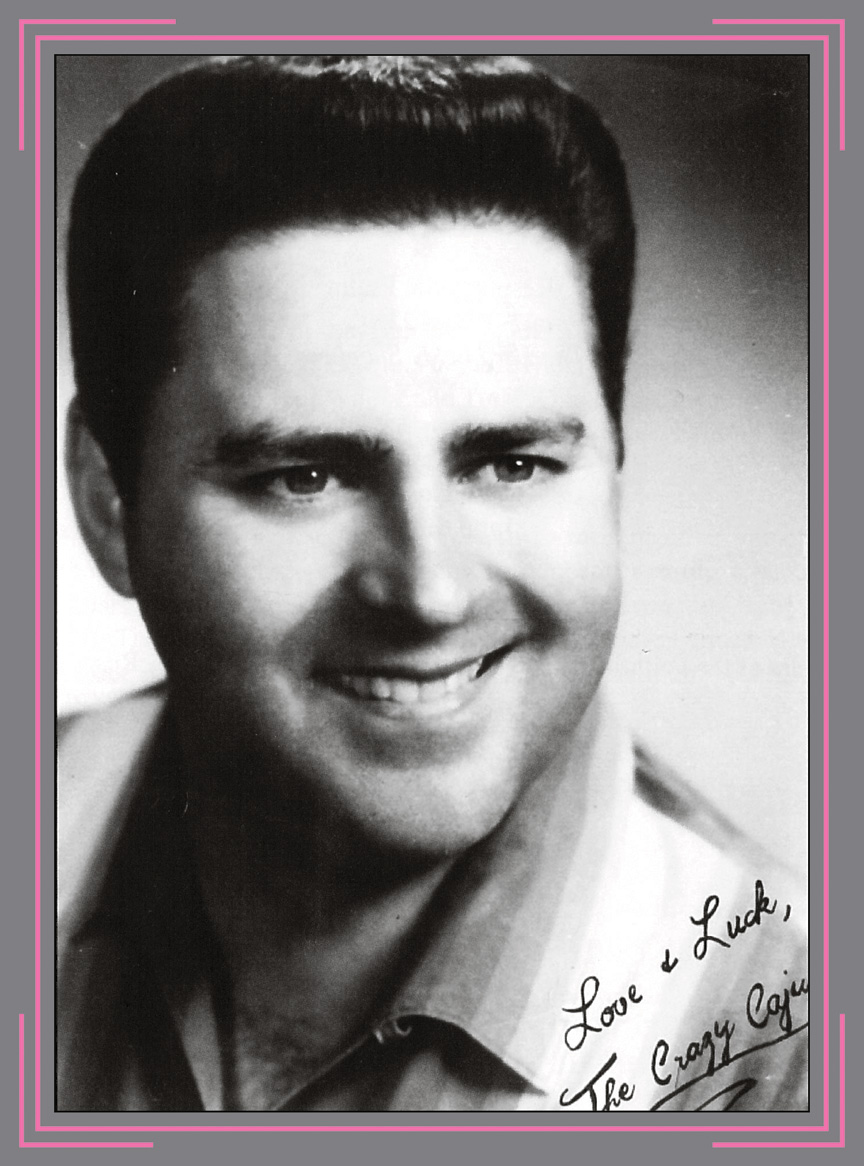
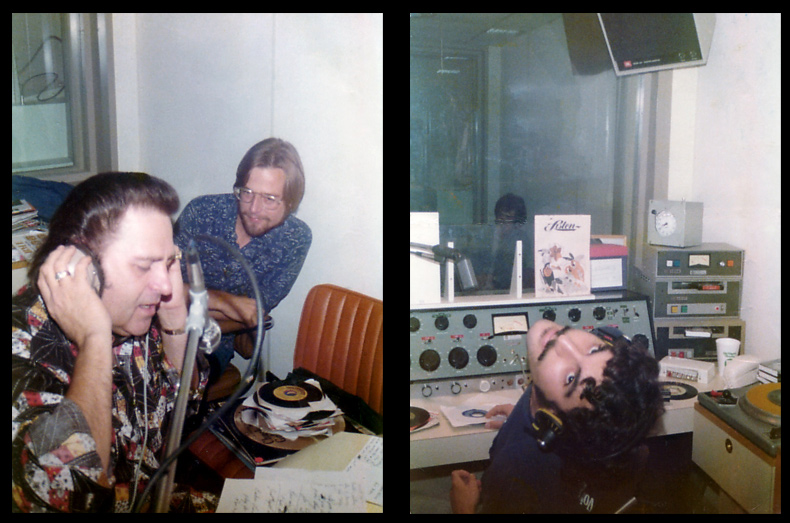
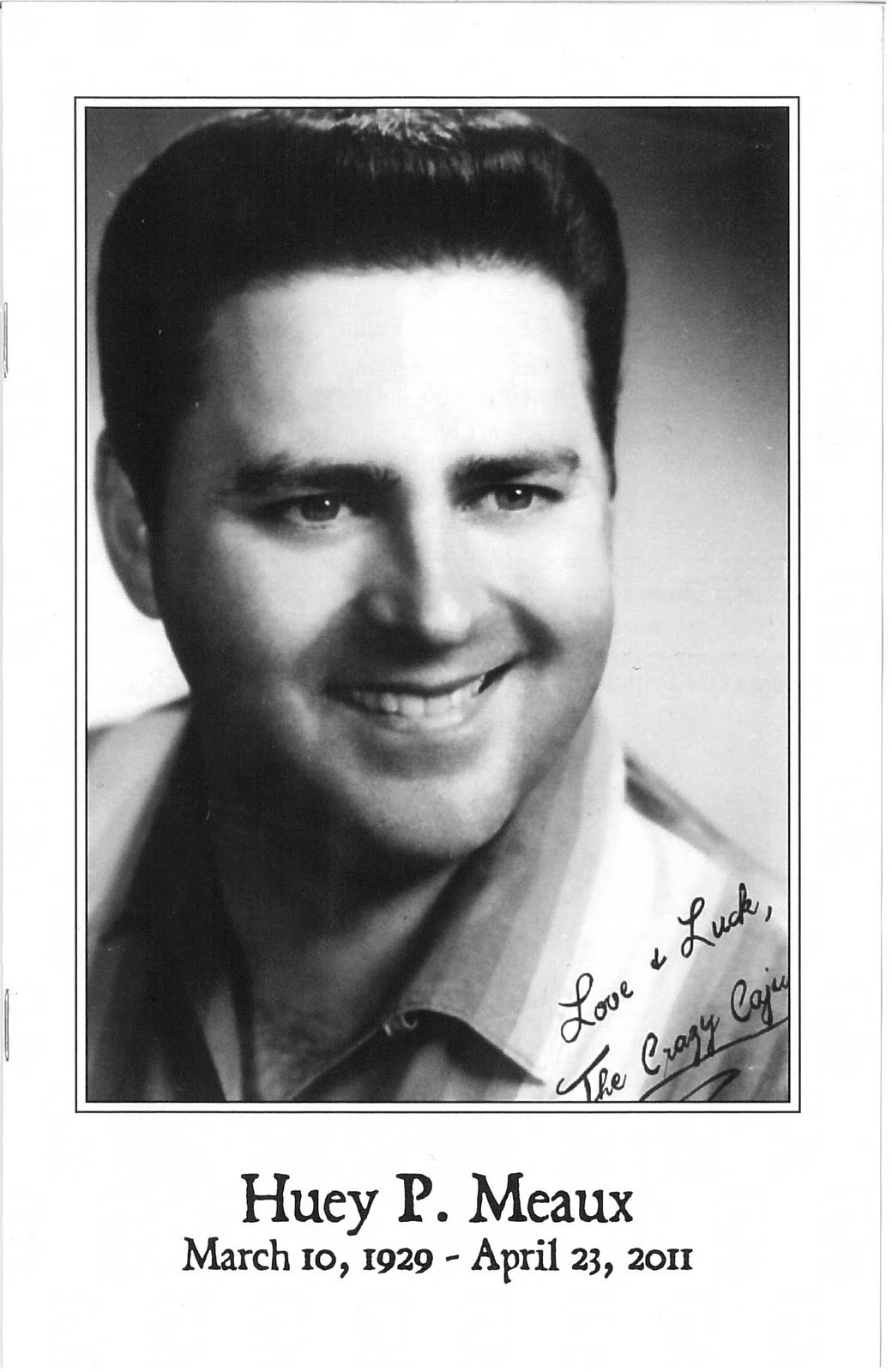
Ivan Kuper was a colleague of “Crazy Cajun” Huey Meaux (the self-proclaimed “producer extraordinaire”) when Meaux hosted a radio show at Houston’s KPFT in the 1970s. Ivan brings us a remarkable story about the life and legacy of the charismatic Meaux, one of the most influential independent music producers of his (or any) time — and a highly-flawed character who twice went to prison for crimes related to drugs, child prostitution, and child pornography.

Posted in RagBlog | Leave a comment

Ivan Koop Kuper : Huey P. Meaux Was the Crazy Cajun


Huey P. Meaux was the Crazy Cajun

By Ivan Koop Kuper / The Rag Blog / September 22, 2011

One Friday evening in 1973, a burly looking biker entered the control room of community radio station KPFT FM, the Pacifica station that broadcast from the second floor of the since demolished Atlanta Life building in downtown Houston.

He was there to visit “The Crazy Cajun Radio Show,” and to ask host Huey P. Meaux to play a track from an old Eddy Arnold album that he brought with him. The biker told Meaux the record was the only possession of his late father’s that he owned, and that it was also the anniversary of his father’s death.

In his thick Cajun-French accent, Meaux dedicated a selection from the album to the memory of the biker’s father, and as the scratchy vinyl record spun on the turntable, the biker stood in the corner of the room and wept. It was from personal experiences like this one that Meaux developed his keen sense of reading people and knowing how music can trigger an emotional response.

Huey Purvis Meaux made his living as an independent record producer. It was a talent he honed in the 1950s while working as both a barber in Winnie, Texas, and a disc jockey at KPAC-AM in Port Arthur. It was there the naïve Meaux was first introduced to the magic of magnetic recording tape and analog reel-to-reel tape recorders.

Meaux’s mission in life was to discover local musical talents, take them into the recording studio, manufacture phonograph records from the master sound recordings, and promote the records to regional radio stations in hopes of receiving the much-coveted radio exposure necessary to make a record into a hit.

Similar to the East Texas “wildcatters” of days-gone-by who drilled oil wells on speculation of striking it rich, Meaux would also speculate on the abundance of homegrown talent, of all musical genres, he found in the night clubs and road houses of East Texas and Louisiana.

Raised “dirt poor” with barely a high school education, Meaux would leave his mark on the music industry and become a significant contributor to popular American culture.

Meaux followed a specific business model that he perfected over 30 years. He learned that after first breaking a single regionally, and with the right amount of radio exposure and sales from independent record distributors, he could then have the leverage necessary to license both the master sound recording and the copyright of the composition to the larger independents and the once prevalent major labels.

Meaux was no novice to this process or to the business of music. Between 1959 and 1985, his name would be associated with 55 gold singles and albums, and eight platinum albums that were produced in recording studios primarily in New Orleans, Houston, and Pasadena, Texas.

“I was so nervous and my hands were shaking as I was fading out that song,” Meaux would always recall when discussing “I’m Leaving It Up To You,” a track he produced from the Louisiana singing duo known as Dale and Grace, “because in my heart I just knew I had a hit on my hands.”

Meaux’s intuition was on target because by October 1963, the remake of the composition originally penned and recorded by California’s Don “Sugarcane” Harris and Dewey Terry, reached the No. 1 position on Billboard Magazine’s Hot 100 chart, and remained on the chart for 12 weeks. The selection that Meaux chose for the Louisiana duo to record resurfaced nine years later when it charted again when it was recorded by America’s “squeaky-clean” brother and sister singing duo, Donny and Marie Osmond.

“My records are so bad that the only reason people buy so many is to keep them off the market,” Meaux would always boast to those held captive by his bravado and flamboyant personality. With his gift for gab, Meaux could charm both his small town radio audience and the most jaded of big city music industry veterans. If you were to ask Huey Meaux how he was doing or how he was feeling at any given time, his stock comeback would be, “If I felt any betta’ bruddah, I’d run for gouvna,’ you betta’ sho’ believe it.”
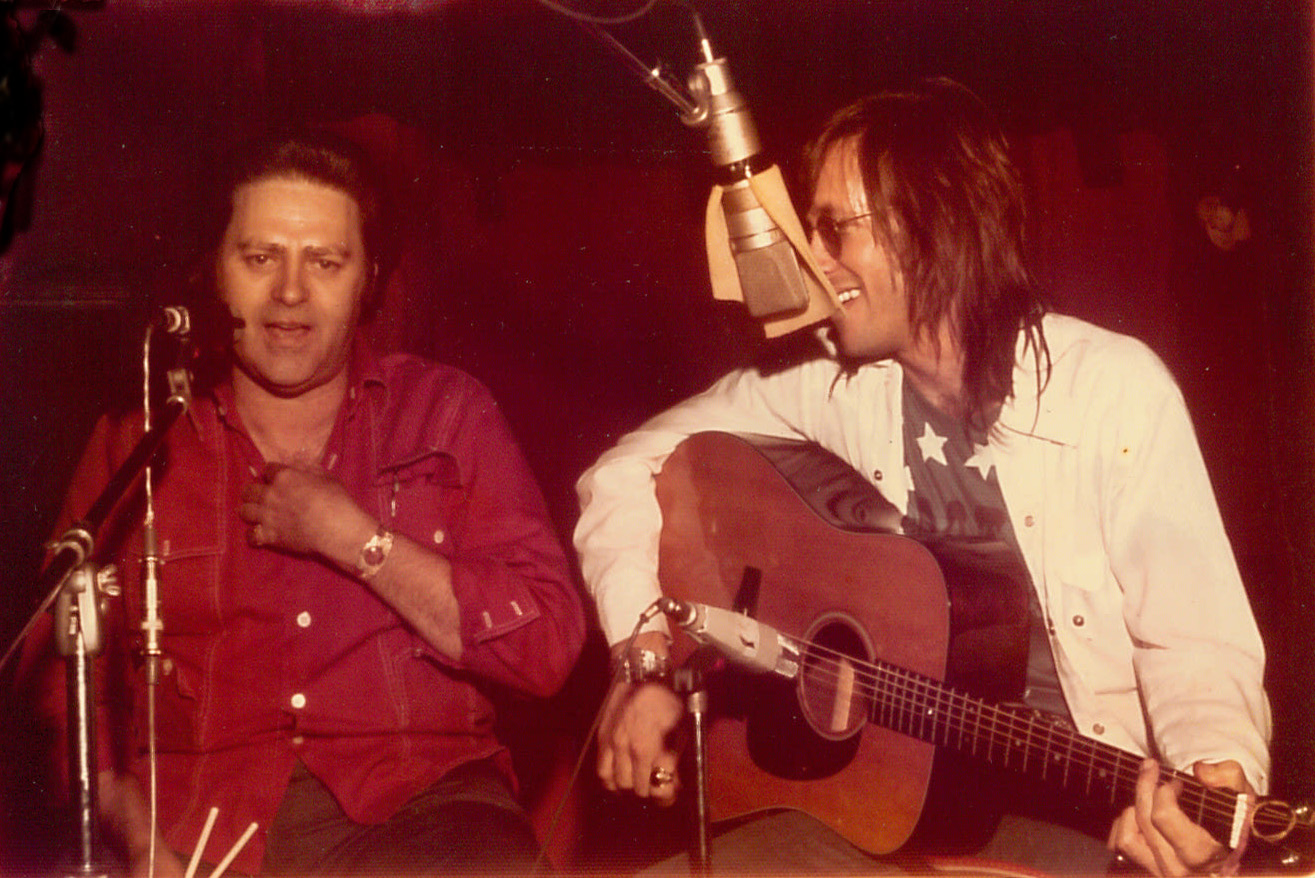
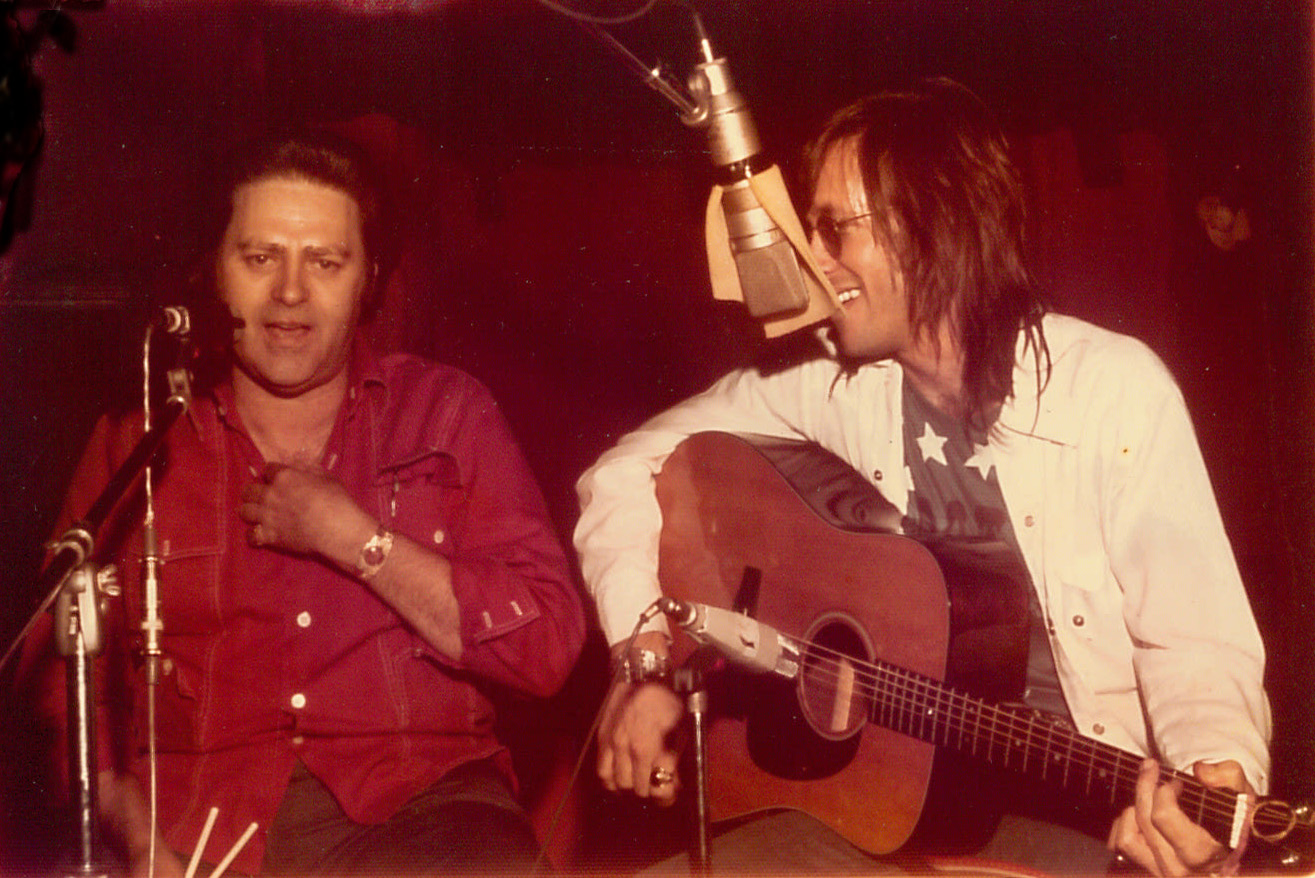
Huey P. Meaux and Doug Sahm at Sugar Hill Studios in Houston, 1974. Photo by Hank Lam.

Meaux would become close friends and business associates with many of the music industry’s power brokers of the era, including the late Shelby Singleton of Mercury Records, the late Jerry Wexler of Atlantic Records, and Aaron Schechter, the low-profile New York-based CPA who Meaux affectionately referred to as “Junior.” The unlikely team of Schecter and Meaux, reminiscent of Felix Ungar and Oscar Madison from the Neil Simon stage play, The Odd Couple, maintained a successful professional relationship and a personal bond that endured for more than 25 years.

“I saved his neck many times from the IRS and on many other occasions and there was never any appreciation shown from him,” said the 85-year-old Schechter who has made a career of keeping the books for a who’s-who of rock royalty.

I quit Huey twice but he chose to ignore me.

I first met Huey way back in 1969 after he got out of jail. He came to New York to visit his lawyer Paul Marshall and he asked Paul to find him a “Jewish New York accountant.” Marshall referred him to me and he came by the office and I began doing business for him. Our first order of business was an audit of Scepter Records owned by Florence Greenberg who owed Huey back royalties.

Huey was a real character. He was fascinating, yet he could also be repulsive at times. The last time I saw him was in 1996, right before he went away to prison again.

Born March 10, 1929, in Wright, Louisiana, and raised in Kaplan in the heart of “Acadiana,” Meaux always recalled a time growing up when only French was spoken at home and English was his second language.” My teachers used to whip your ass if they caught you speaking French in public school,” Meaux would say about his grade school days.

Meaux’s family settled in East Texas in the town of Winnie, 23 miles south of Beaumont, in 1940, when he was 12. Winnie was in the rich, culturally fertile region of East Texas near the Louisiana border known as “The Golden Triangle.” This region incubated the musical talents of Aubrey “Moon” Mullican, George Jones, Johnny Winter, Edgar Winter, “Barbara Lynn” Ozen, Janis Joplin, Johnny Preston, Barbara Mauritz, and J.P. Richardson aka “The Big Bopper.”

Meaux came of age at a time when commercial “terrestrial” radio stations were still independently owned and music programming decisions were made based on local sales figures. It was also a time in history when the frequency of a particular record’s radio airplay could be monetarily manipulated by independent record producers and radio promoters.

“Is it true that payola is dead?” a young man asked Meaux in the lobby of the former Marriott Hotel in downtown Austin after he delivered a colorful keynote address at the South by Southwest Music and Media Conference in 1987. A puzzled-looking Meaux stared at the young man and replied, “Dead? I didn’t even know it was sick, little bruddah.”

Meaux’s special talent in the music business was mastery over the discipline of A & R, or “artist and repertoire” as it was originally known. He had an uncanny knack for selecting the right musical material for the right recording artist to elicit the right vocal interpretation in the recording process.

The objective of this equation was to maximize the greatest profit potential for the master tape owner, the music publisher, the distributing label, the artist manager, and the booking agent. Then as now, it is to one’s financial benefit to wear as many of these “hats” as legally possible, a business philosophy that Meaux subscribed to and practiced throughout his professional career.

Not all of the musical groups Meaux had under contract always agreed with or trusted Meaux’s choice of material. A young, unknown singer from Rosenberg, Texas named Billy Joe Thomas who fronted a band called the Triumphs can still be heard complaining on the eight-track master recording to the studio engineer one evening: “Let’s get this over with and record that damn song just to get Huey off my ass.”

The selection he was referring to was “I’m So Lonesome I Could Cry,” a song penned and originally recorded by Hank Williams. The B.J. Thomas version, released on Meaux’s Pacemaker label and then licensed to New York’s Scepter Records, reached the No. 8 position on Billboard’s Hot 100 by March 1966, and stayed on the chart for 10 weeks before its demise.

Although Meaux was the proud father of an adopted son, he was known to brag about all the musicians and singers he nurtured throughout the years — whom he also referred to as his sons. He especially spoke highly of Douglas Wayne Sahm and August “Augie” Meyers of San Antonio, and would always say, “I raised those boys.”

Meaux would often recall the story of the hyperactive, multi-talented teenage Sahm who was always “pestering” Meaux to record his compositions. This relationship ultimately produced Texas’ contribution to the “British Invasion” in the early 1960s with the creation of the Sir Douglas Quintet and the release of the single, “She’s About a Mover.” It was originally titled “She’s a Body Mover,” but Meaux believed the title sounded too sexually suggestive and made Sahm change it.

The Tribe/London release of this single reached the No. 13 position nationally by April 1965, and remained on Billboard’s Hot 100 chart for nine weeks. “I love Doug like my own son,” Meaux would always say about the late Doug Sahm, “but he was so mean to Augie. Doug used to make Augie carry all the equipment to the gigs and with his bad leg too,” referring to Quintet collaborator and organist Meyers who was afflicted with polio as a child.
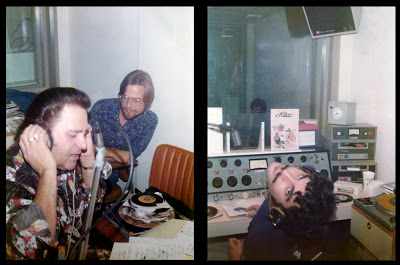
Left to right: Huey P.Meaux, Joe Nick Patoski, and The Rag Blog‘s Ivan Koop Kuper at KUT-FM in Austin, 1975. Photo by Kirby McDaniel.

Life and business were good for Meaux during the 1960s and many of the records he produced became hits. However, in October 1966, the winning streak was interrupted after Meaux and his then business partner, Charlie Booth, attended a disc jockey convention in Nashville accompanied by a 15-year-old girl. Their underage passenger was brought on the trip for the purpose of entertaining the conventioneers with whom they intended to network.

One year later, Meaux and Booth found themselves charged in federal court with conspiracy to transport a minor across state lines for the purpose of prostitution in violation of the Mann Act. Meaux and Booth appealed their case, and although they were represented by high-profile Houston attorney Percy Foreman, their rehearing was denied by the United States Court of Appeals, Fifth Circuit.

In February 1968, Meaux was sentenced to three years in prison. He would only serve eight months at the low security Federal Correctional Institution in Seagoville, Texas, near Dallas, before being released for good behavior.

In January 1981, at the end of his term as 39th President of the United States, Jimmy Carter granted Meaux a full pardon for his transgression. “That’s when I went away to college,” Meaux would always tell those who asked him about the time he spent in prison during this period.

Not all the hit records that Meaux is associated with were a direct result of his personal production efforts. Sometimes he acted as middleman and brokered the licensing deal to larger labels on behalf of other independent producers, as in the case of a track called “Tighten Up” by Archie Bell and the Drells.

Produced by legendary Houston DJ “Skipper” Lee Frazier, this track was licensed to Atlantic Records with Meaux’s help after first being released in Houston on Frazier’s Ovid label. Frazier, like most independent producers, would first sell his records on consignment to retailers “out of the trunk” before they were picked up for distribution by a larger label.

However, with the help of Atlantic Records, while Meaux was serving time in prison, this R&B crossover hit simultaneously reached the No. 1 position on both the Billboard Hot 100 and the Billboard R&B charts for two weeks by April 1968, and remained on the charts for 13 weeks.

“I first met Huey when I was a disc jockey with KCOH-AM radio in Houston,” Frazier recalled.

He had a relationship with most the DJs in Houston and throughout the country for that matter, and Huey was always promoting his records to all the DJs. He was a very personable man and he would bring his records around to the station and ask me to play them.

We had a personal relationship, so when I recorded a record by a band I was managing and it started selling locally, Huey came to me and said, I think can get that record placed with Atlantic Records but I want a piece of the action. I told Huey I wouldn’t mind that because I knew Huey had a good relationship with Atlantic because he recorded “You’ll Lose a Good Thing” by Barbara Lynn, and I also knew that he knew everybody in that New York office.

So Atlantic took the record and boom, it went to number one on the R&B charts and then, boom, it became a million-seller. I found out years later that Huey knew how many records I was selling locally when he contacted me because he kept up with how many records I was ordering from the local record presser.

After Meaux was released from prison in 1968, the magic of producing another hit record eluded him for several years. Music industry insiders told him that he was “beating a dead horse” when he informed them he was thinking of recording “El Be Bop Kid,” Baldemar Huerta from San Benito, Texas — aka Freddy Fender.

“Before The Next Teardrop Falls,” written by the Nashville songwriting team of Vivian Keith and Ben Peters, had been recorded more than a dozen times throughout the years, but had never struck gold. By the mid-1970s, Meaux’s intuitive A&R talent was on target once again with his production of the sentimental bilingual ballad with its Tex-Mex flavor. Originally released on Meaux’s Crazy Cajun label and then licensed to ABC/Dot, “Before the Next Teardrop Falls” would become a No. 1 crossover single on both the Pop and Country charts by March 1975, and would remain on the Billboard Hot 100 chart for another 15 weeks.

The single not only revived Fender’s career, but it also won “Single of the Year” at the 9th Annual Country Music Association Awards in 1975. In addition, the composition also earned nominations for “Best Country Song” and “Best Country Vocal Performance” at the 18th Annual Grammy Awards in 1976.

In 1985, Meaux brokered his last major licensing deal for long-time friend and business associate Floyd Soileau of Ville Platte, Louisiana. Meaux had produced sessions for Soileau with artists Soileau had under contract beginning in the 1950s. In 1984, Soileau brought Meaux the single, “(Don’t Mess With) My Toot Toot” that had broken out in New Orleans when recorded by Zydeco/R & B artist Rockin’ Sydney Simien on Soileau’s label, Maison de Soul.

Meaux arranged a licensing deal for Soileau that year with multinational Epic Records. Although never breaking into Billboard’s Hot 100 Pop chart, the single did reach platinum status and peaked in the No. 19 position on Billboard’s Country chart. “My Toot Toot” would also win a Grammy Award for Soileau and the late Sydney Simien for “Best Ethnic and Traditional Folk Record,” in 1986.

1986 was also the year Meaux surprised friends and industry associates when he appeared on the big screen in the David Byrne feature-length movie True Stories. Meaux made a brief cameo appearance during the “Wild Wild Life” segment of the film, playing the role of a patois-speaking “Crazy Cajun” disc jockey.

Always generous with his time and advice, Meaux was also known to mentor aspiring young music producers because he believed his good deeds would be reciprocated and the relationships he developed would prove to be mutually beneficial. That was not the case however with ZZ Top personal manager and producer, Bill Ham.

Meaux was disappointed that Ham never booked studio time at his Sugar Hill Studios in Houston, choosing to record in Tyler, Texas, and Memphis instead. He would repay the snub in 1986 by suing Ham and ZZ Top for copyright infringement on behalf of Houston songwriter and former rock DJ, Linden Hudson.

Hudson’s composition, “Thug,” found its way onto the multi-platinum ZZ Top album, Eliminator, without the proper writer credit or music publisher credit which, coincidentally, was Crazy Cajun Music. With the assistance of Houston attorney David W. Showalter, Meaux and Hudson (and Showalter) were awarded a $600,000 out-of-court settlement in compensatory damages from Ham and that “Little Ol’ Band from Texas.”

Huey Meaux, Winnie, Texas, April 2011. Photo courtesy of Nick de la Torre.

In 1996, Meaux experienced his second major brush with the law. No one expected what a January 29 raid by Houston police on a backroom of Sugar Hill Studios, which Meaux now leased from its new owners, would reveal. There, HPD found incriminating evidence, including a gynecological examination table, illicit drugs, and photos and videotapes of underage girls in compromising positions.

Meaux would plead guilty to five felony charges including possession of cocaine, possession of child pornography, sexual assault, and jumping bail. The Honorable Judge Michael McSpadden of the 209th District Court of Harris County would assess his punishment at 15 years for cocaine possession and sexual assault, and 10 years for possession of child pornography and bail jumping, to be served concurrently.

However, before Meaux’s criminal trial would begin, the two daughters of Meaux’s former girlfriend filed a civil lawsuit for alleged sexual abuse and emotional distress they were subjected to during the seven years Meaux lived with them and their mother. In mid-February, the now adult McDowell Sisters, represented by attorney Dick Deguerin, brought a suit against Meaux in Harris County’s 61st Civil District Court for the sum of 10 million dollars in punitive damages in their request for relief.

By October, the plaintiffs agreed on a final judgment of $900,000, and to dismiss all further claims against defendant Meaux.

In June 1996, Meaux was sent to prison for his criminal offenses and would remain incarcerated for the next six years. Meaux served time at both the privately owned Lockhart Work Facility near Austin, and the Texas Department of Criminal Justice’s Ellis Unit in Huntsville.

In September 2002, he was paroled to the Beaumont Center Halfway House, and was then placed on “house arrest” with his mobility restricted and was electronically monitored by the Texas Department of Criminal Justice (TDCJ). Meaux was looking forward to freedom after four years of enforced detention on the rural property he owned on the outskirts of Winnie — where he had been living in his double-wide mobile home.

“I go to Beaumont every month now to see my probation officer and go shopping, but I’ll be getting my ankle bracelet off March 4th,” Meaux said during our last telephone conversation in January 2011. “The first thing I’m gonna do is go to New Orleans and get me some gumbo, and after that, I’m going to Austin to see some friends.”

Meaux never made it to New Orleans or to Austin, and on April 23, 2011, at 82, after four months of poor health, Meaux died from multiple organ failure. Meaux was found in his double-wide trailer and scattered about the floor in no particular order were old boxes of magnetic recording tape and photographs that chronicled his 40-plus years in the music business.

Many friends and music industry associates chose to distance themselves from the controversial Meaux, and his funeral service at Broussard’s Funeral Home was attended mainly by immediate family members.

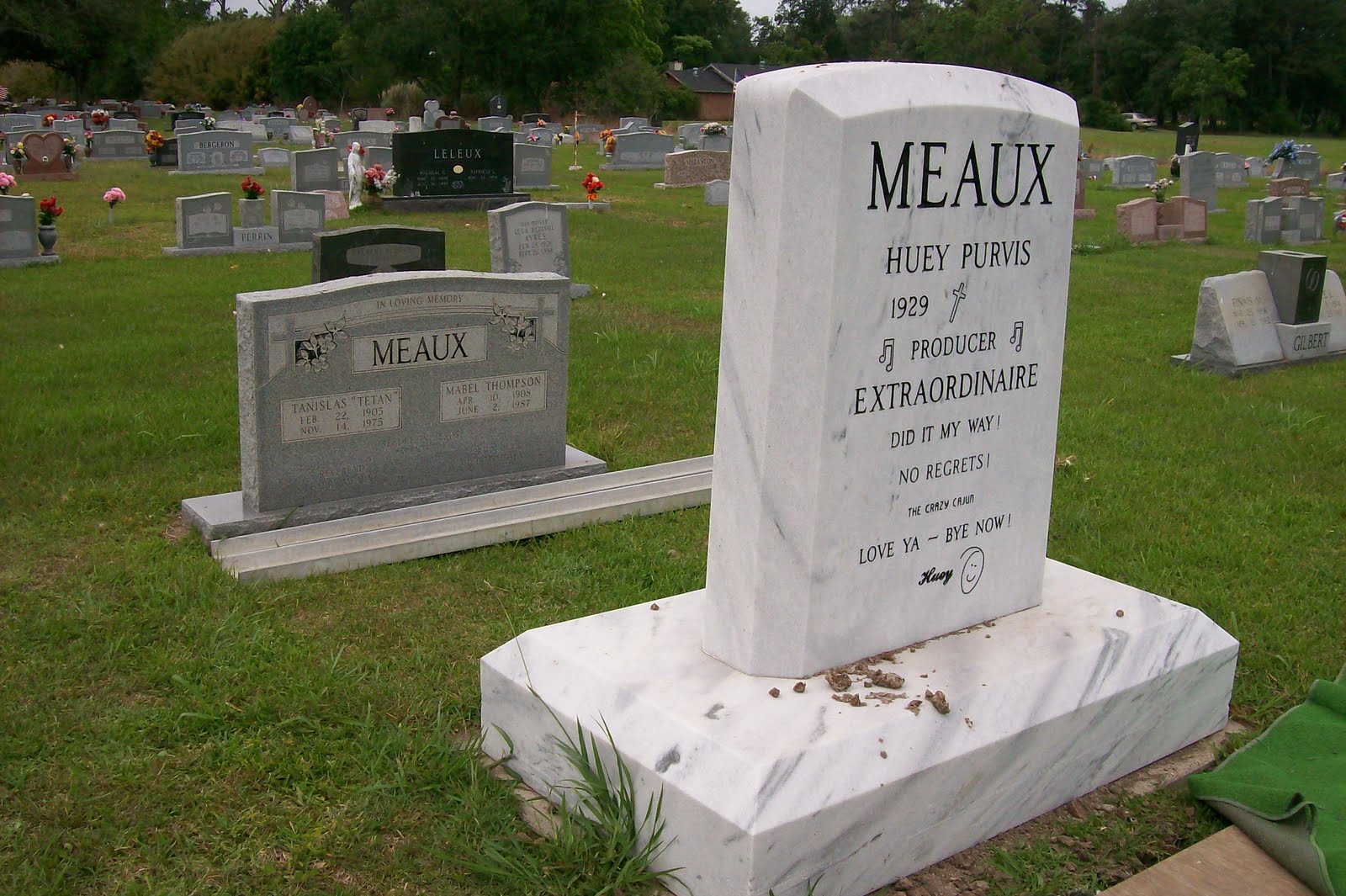
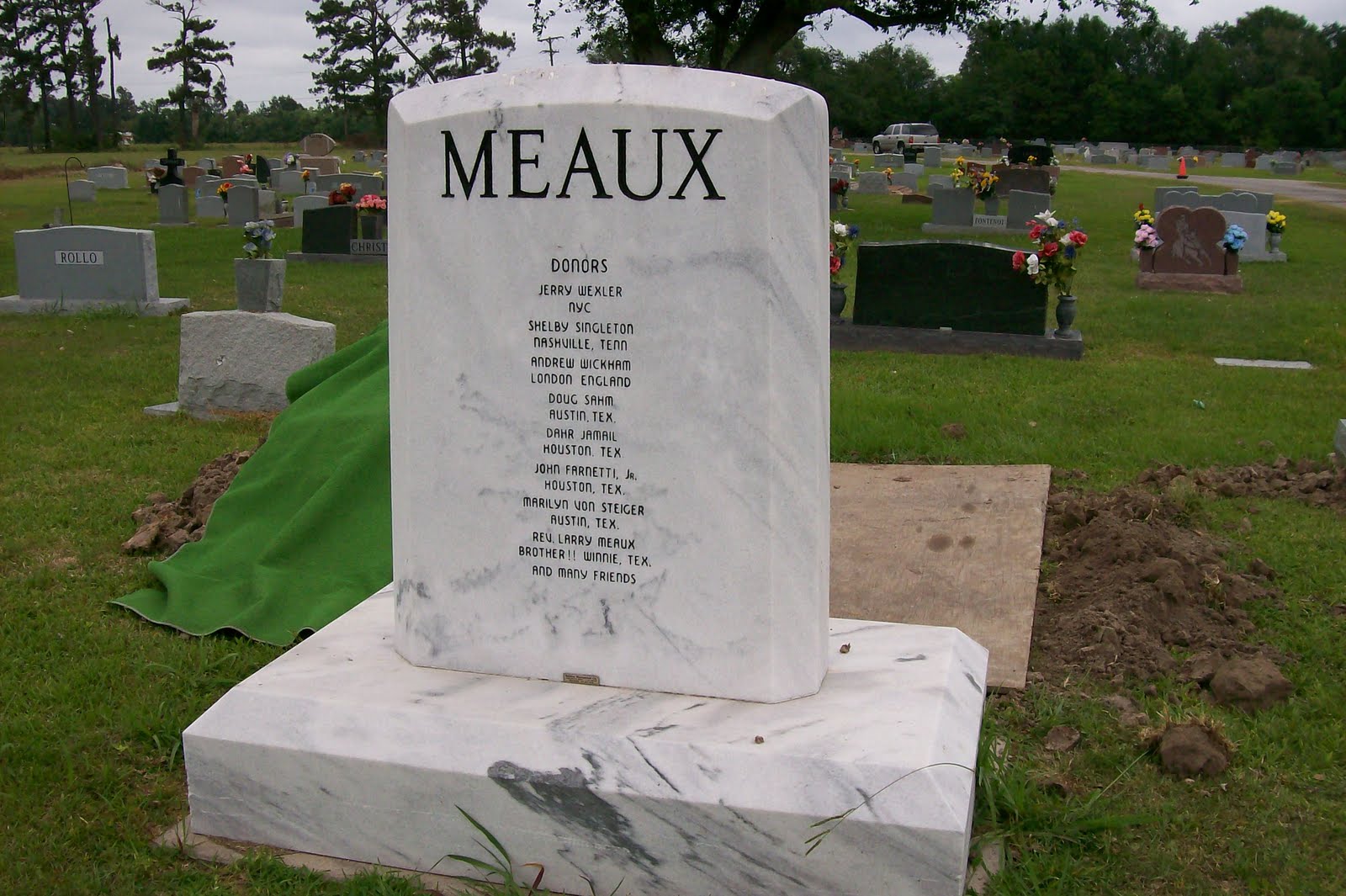
However, even after death, the defiant self-proclaimed “producer extraordinaire” still had the ability to surprise and even shock those in attendance at Winnie’s Fairview Cemetery. Inscribed on the back side of his “supersized” tombstone was a list of underwriters that Meaux had solicited during the time of his incarceration to help defray the cost of his funeral.

On the front side was inscribed an epitaph of Meaux’s personal life philosophy: “Did It My Way – No Regrets – Love Ya – Bye Now – Huey.” Once more Meaux was able to get in the last word, prove he was still an innovator and a proponent of crass commercialism who to the very end never showed any sign of remorse.

[Ivan Koop Kuper is a graduate student at the University of St. Thomas, Houston, Texas, and maintains a healthy diet of music, media, and popular culture. From 1973-1975, Ivan worked with Huey P. Meaux at KPFT-FM in Houston. He can be reached at kuperi@stthom.edu. Find more articles by Ivan Koop Kuper on The Rag Blog.]
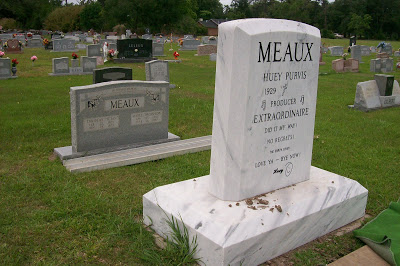
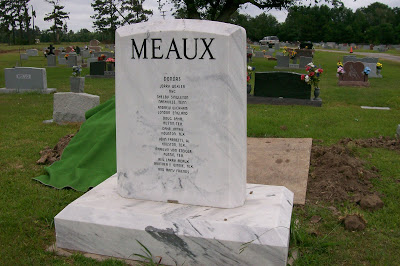
Photos courtesy of Hank Lam.

The Rag Blog

Posted in Rag Bloggers | Tagged , , , , , , | 7 Comments

Sarito Carol Neiman : The Anti-Angels of Health Care

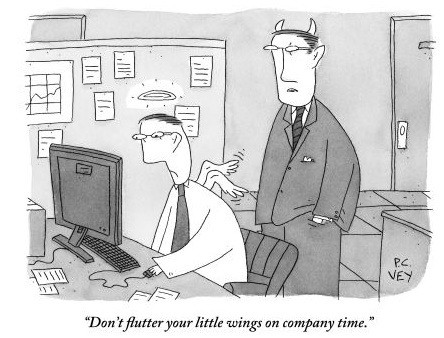
Cartoon from The New Yorker.

Shredding the envelope:
Healthcare on the ground – Part III:

The anti-angel forces

By Sarito Carol Neiman / The Rag Blog / September 22, 2011

[Shredding the Envelope (“Ruminations on news, taboos, and space beyond time”) is Sarito Carol Neiman’s (occasionally) regular column for The Rag Blog. This is the third in a series. Read Part I here.]

The computer workstation in my dad’s room, according to the sales pitches of companies who sell them, was designed with the best of intentions to improve both the efficiency and quality of care in hospitals.

It would allow Dad’s caretakers to enter the latest information about his care (vital signs taken, medications given, observations observed) and to retrieve any information about him and his condition they might need — on the spot, without having to go and fetch it from (or take it to) its central location at the nursing station down the hall.

It would allow them (in theory) to spend a little extra time in the rooms with the patients, as they entered or retrieved their information — assuming they could safely mix “quality time” with the patient and the entry/retrieval of complex data at the same time. (An assumption of multitasking ability whose superhuman dimensions the sales pitches overlook.)

In theory, this computer workstation could be part of a vast network of computers, consolidating input gathered from every healthcare professional who had ever seen my dad for any reason. It could offer a more comprehensive picture of Dad’s medical history and current condition than any single human could possibly manage.

Imagine the possibilities… if such a network had been in place from the beginning of this years-long saga, and if all the professionals involved in Dad’s care had been doing more than just their jobs, he very likely would never have ended up in the hospital in the first place.

Those are some pretty hefty “ifs.” And as good a starting point as any to take a look at the “anti-angel forces” at work in the U.S. healthcare system.

Let’s take care of the big stuff first. Let’s assume that our “inalienable rights” to life, liberty, and the pursuit of happiness include the right to healthcare — not as a consequence of having the money to pay the going market rates for it, but as a consequence of being human. Let’s assume, in other words, that there is no need for private insurance companies, hence no fear that a person’s medical history will be used to deny coverage, or to charge an arm and a leg for it.

Let’s further assume that we can agree that being a healthcare provider is a very special calling indeed, and that those who take up the calling should be honored and rewarded for making that choice, rather than being thrust into indentured servitude by a mountain of postgraduate debt, forced to pay for that debt by performing procedures rather than spending time with and understanding their patients, and being stalked by “ambulance-chasing” lawyers whose primary motive is to make a buck on their mistakes and on the suffering of the victims of those mistakes.

(More about the whole “tort reform”/malpractice thing at another time.)

So now we’ve taken care of the big stuff, we get to the sticky, non-systemic, human bits.

Of course, a universal “inalienable right” to healthcare would need us all — hospital administrators, doctors, nurses, aides, and patients, all of us — to behave sensibly, like grown-ups.

We would understand that sometimes things get broken and can’t be fixed, and not every mistake is the result of malice or incompetence. We would know the futility, even harmfulness, of squandering scarce resources on experimental fixes that are likely to fail, or only extend suffering rather than heal. We would understand that death is a natural and inevitable part of the continuum of life.

We would do our very best to keep ourselves healthy and, when those efforts fail, do our best to comprehend the reasons and take responsibility for whatever part we might play in getting better. We would know when to push on against all odds, and when to call it quits. We would celebrate every small victory, and we would know when to allow ourselves to grieve.

We would, in other words, be able to see every health crisis for the opportunity it brings — to take stock of our priorities, to allow ourselves to love and be loved, to heal the old and untended wounds that so often seem to surface at these times.

To help us get from here to there, though (it’s unlikely we’re just going to wake up and find ourselves there), we’d have to start with a clear-eyed look at what we’ve got now.

The computer workstation in my dad’s room, attached conveniently out of the way on the wall, was a neutral presence, at first glance. And, as advertised, it was undoubtedly a time-saving, mistake-reducing tool. It wasn’t until it broke down for a few days that I began to understand how it was also being used by “anti-angel” forces.

As long as this tool was functioning, nurses came and went with their tasks-to-perform and medications-to-give on what was apparently a rigid, inflexible schedule. It didn’t matter whether Dad was eating his breakfast, having a phone conversation with a loved one, or peacefully asleep — the pills had to be given, the BP cuff strapped on, the thermometer inserted. Toward the end of his stay, when he was better able to move around, he discovered that the only way to assert his right to uninterrupted peace and quiet was to go and sit on the toilet.

When the computer workstation tool stopped functioning (and I confess to an irrational fear that I might be blowing the cover of a complex angel-conspiracy) somehow it became fine to let Dad finish his breakfast, or his phone call. To come back a few minutes later to do whatever was on the nursing agenda to be done. Not a problem, said the gracious smiles and body language of the nurses carrying the pills and thermometers. I’ll come back in a little while when you’re done.

And they didn’t forget, either — it wasn’t as though these important tasks magically disappeared from the “do-list” just for lack of computer assistance.

That’s when it occurred to me that behind the hunched shoulders and grim determination of nursing “business as usual” was a Big Brother element that the nurses were fully aware of, but the workstation sales pitches don’t mention. A function more interesting to hospital administrators and lawyers, say, than to doctors or other actual hands-on providers of Dad’s care.

It works like this: the nurse turns on the computer and scans in her badge (nurse presence accounted for) at a certain time (schedule adhered to and trackable by the minute) followed by scans of medication labels, or keystroke entries of vital signs (asses covered). Checked off the list, tidy and impersonal, easily scanned by those whose interest is that no unpredictable breezes of individual human needs or circumstance should interfere with the hum of the well-oiled (and litigation-protected) hospital machine.

The doctors didn’t have to use this workstation, however. They could, if they wanted to look something up… but they didn’t have to, nor did they have to tell it whatever it was they did while they were there.

My sense was that the whole workstation set-up not only reflects but also reinforces the subordinate and purely functional role of nurses in the system as it is. In most hospitals — with a few notable exceptions, I have heard — nurses are told what to do (“doctor’s orders”), expected to pass along requests or problems from the patients, and rarely if ever encouraged (or even allowed) to express an opinion, make a recommendation, or question a decision by the doctor that their best intelligence tells them might not be a good idea. A bit silly, to put a better face on it than it deserves — given that the nurses spend far more time with patients on an hour-by-hour basis than any doctor can possibly afford to spend.

It also, of course, reflects the fact that as the system is set up now, the actions of doctors and the reasons behind those actions are largely protected from public view, and are not required to be shared with other members of the team unless the doctor chooses to share them.

Doctors.

When I first met Dad’s surgeon, I didn’t like him much. Not because I thought he was incompetent — on the contrary, I was satisfied that he was the best available anywhere near Dad’s home. My dislike was more in the realm of “bedside manner.”

I can’t really blame him for the fact that at our first meeting he was uninterested in knowing who I was or why I was there, to the point of being dismissive. He had, after all, already met and spoken with several members of the family along the way, and at that point I must have seemed like yet another potential burden of irrelevant and time-consuming human interaction that he would just as soon avoid.

Plus, he’s a surgeon after all, not a GP — the skill sets required to do an excellent job in those two realms are different. Even if the skills to do more than the job might overlap or even be the same.

Over subsequent meetings our relationship was rocky, with additions of ego-prickliness alongside any deficits in bedside-manner skills. He didn’t like being questioned, especially in front of his entourage. This dislike, it seemed to me, carried the weight of a reflexive assumption that my questions were posed as a challenge, rather than as a sincere effort to understand.

I did my best to accommodate the lesser angels of his nature, to reassure him that I absolutely trusted his medical expertise, while still honoring my own concerns for the rocky spots in Dad’s recovery and whatever support I might be able to lend as a “person on the ground.” In the end, I didn’t want him to change, really — I thought he could use a good “right-hand” person, more a GP type, whom he trusted and who trusted him, to take care of the squishy bits of listening patiently and explaining things to people like me, and maybe translating my concerns into a language he could better understand and relate to.

We worked it out, somehow — the mutual respect and understanding between him and Dad was undisturbed, and when he finally came in with the happy news that Dad could leave the hospital and go on to the next stage of getting strong enough to go home, I was as fully included in the sharing of that news as was appropriate, given who was most directly affected.

I was also delighted to hear that during Dad’s recent follow-up visit, the doctor showed him “before and after” X-rays of his lung, and the transformation that had taken place. The news nicely balanced what happened that day when Dad was having such a hard time, convinced he wasn’t getting any better and grumbling about having to go downstairs for a new X-ray every morning.

When the doctor came by, I suggested maybe Dad could see a before-and-after picture, so he could look for himself how things were going. The response was a little explosion of exasperated breath, an energetic (if not physical) throwing up of the hands, and a “that’s not so easy, it’s all on computer” before turning around and (energetically) stomping out the door.

I liked it when I heard the news that the doctor had managed that “show and tell” … because I know it helped Dad, as it would have helped him on that day I suggested it in the hospital, to get a handle on whether the whole ordeal had really been worth it. Maybe, I thought, just maybe he had heard me after all. Maybe he’ll remember it the next time one of his patients is having a hard time convincing himself it’s all worth it.

We all have a lot of work to do if we are going to meet the challenges of providing thoughtful, competent, whole-person healthcare in this world.

We’ll have to figure out the best ways to weed out those who are thoughtless and incompetent and in jobs they aren’t suited for. And we’ll have to work on minimizing the harm done by our natural human tendencies to want magic pills, and to substitute a messy and mysterious wholeness with discrete and manageable, but lifeless, parts.

We’ll need to figure out how to shift our focus from avoiding the worst to striving for the best.

We’ll have to take a deep look at the role of lawyers in the healthcare system, and the hopeless, despairing greediness they so often foster in our lives. We’ll need to acknowledge that no amount of money can alleviate pain and suffering, and that often, all any of us really wants is a heartfelt apology, shared grief, and support for moving through a loss. And yes, too, sometimes, the satisfaction of knowing that an incompetent, greedy, or careless practitioner will never be able to harm anyone again.

It’s a lot of work, and it needs us all to do more than just our jobs. And at the moment, for me, it’s right up there among the top jobs on the list of those most important and meaningful.

[Sarito Carol Neiman (then just “Carol”) was a founding editor of The Rag in 1966 Austin, and later edited New Left Notes, the national newspaper of Students for a Democratic Society (SDS). With then-husband Greg Calvert, Neiman co-authored one of the seminal books of the New Left era, A Disrupted History: The New Left and the New Capitalism and later compiled and edited the contemporary Buddhist mystic Osho’s posthumous Authobiography of a Spiritually Incorrect Mystic. Neiman, also an actress and stage director, currently lives in Junction, Texas. Read more articles by Sarito Carol Neiman on The Rag Blog]

The Rag Blog

Posted in Rag Bloggers | Tagged , , | 2 Comments

Don Swift : Dominionists and the ‘Kingdom of God’

Image from The Last Crisis.

A threat to American liberties:
Dominionists and the ‘Kingdom of God’

They want to take over government and create a theocracy. No wonder they see nothing wrong in playing politics from the pulpit.

By Don Swift / The Rag Blog / September 21, 2011

[This is the second in a series on Dominionism by Don Swift. See Part I here.]

Dominionists refuse to accept the separation of church and state. They want to take over government and other areas of society and create a theocracy. No wonder they see nothing wrong in playing politics from the pulpit.

Reverend Ed Kalnins, once Sarah Palin’s pastor at the Wasilla Assembly of God Church, has consigned critics of George W. Bush to hell. He even denounced those who criticized Bush’s handling of Katrina. He doubted that people who voted for John Kerry in 2004 would be welcomed to heaven.

He said: “I’m not going tell you who to vote for, but if you vote for this particular person, I question your salvation. I’m sorry.” Kalnins added: “If every Christian will vote righteously, it would be a landslide every time.

There are different forms of Dominionism. Christian Reconstructionism is one important form. These people believe that the Kingdom of God was established on earth at the time of the Resurrection and that it is their job to complete its work by taking control of society. Then Christ can return in the Second Coming. Scholars concerned with technicalities say this view is rooted in pre-suppositionism, meaning the kingdom must be in place before the Second Coming.

Calvinist theologian J.Rousas Rushdoony founded the movement Christian Reconstructionism back in the 1960s. Author of the three volume Institutes of Biblical Law, Rushdoony was a prolific writer, and he was a founder of the Christian home-schooling movement. He also defended American slavery. He appeared often on Pat Robertson’s television program in the 1980s, but Robertson claims he does not understand what Dominionism is.

Rushdoomy hated the Federal Reserve and was revered by gold hoarders. He thought that American law should be replaced with the Old Testament. The irony is that some of his followers today are vociferous in denouncing shariah law. He wrote in 1982, “With the coming collapse of the humanistic state, the Christian must be prepared to take over…”

This rightist prophet led the Chalcedon Foundation, which carries on his work and is known for its virulent homophobia. His followers are bent on reconstructing “our fallen society,” and the recent efforts of the Tea Baggers to bring down the financial system is an indication of how far they will go.

They take seriously the extreme and harsh punishments in the Old Testament and would apply the death penalty to apostasy, homosexuality, and abortion. Many believe the Bible requires physical punishment of children. Some believe that seven years of slavery would be an acceptable punishment for some offenses today, but none believe that slavery now should be based on race.

The Christian Reconstructionists or Theonomists have influenced numerous Protestant leaders without necessarily making them Dominionists. Jerry Falwell and D. James Kennedy have supported Dominionist books.

They have a “kingdom-now theology.” In the George W. Bush White House, Marvin Olasky, a Christian Reconstructionist, had great influence.

George Grant, former executive director of Coral Ridge Ministry, said that “it is dominion we are after. Not just a voice … It is dominion we are after. Not just equal time … World conquest.” That organization is now called Truth in Action Ministries, and Rep. Michelle Bachmann has close ties to it.

She appeared in one of its documentaries that attacks socialism, and she has espoused the Dominionist position that government has no right to collect more than 10% of a person’s earnings in taxes. She has also promoted Grant’s book on Robert E. Lee, in which the godly Confederacy battled the godless North. It is a pro-slavery book, and Bachmann recommended it on her web site for some time.

Michelle Bachmann has admitted being strongly influenced by a Reconstructionist, John Eidsmore, a Dominionist teaching at Oral Roberts University, a Pentecostal school. Eidsmore spoke to Alabama secessionists last year and defended the right of a state to secede and explicitly endorsed the constitutional views of John C. Calhoun and Jefferson Davis.

Bachmann has also said that she was influenced by the writings of Dominionist Francis Schaeffer. Bachmann said she decided to become a politician after watching one of his films Three years before his death, Schaeffer warned that America would descend into a tyrannical state and that an authoritarian elite would scheme to bring about this terrible result. He believed that only true Christians should rule.

Bachmann has also had good things to say about Dominionist historian David Barton, whose website is WallBuilders. He had followed Rushdoony in defending American slavery. Barton teaches that the Bible provides clear guidance on all public policy matters.

[Don Swift, a retired history professor, also writes under the name Sherman DeBrosse. Read more articles by Don Swift on The Rag Blog.]

Also see:

The Rag Blog

Posted in Rag Bloggers | Tagged , , , , , , | 2 Comments

Bob Feldman : White Supremacist Republic of Texas, 1836-1845

Seal of the Republic of Texas, 1839. Image from Wikimedia Commons.

The hidden history of Texas

Part 4: The independent Republic of Texas, 1836-1845

By Bob Feldman / The Rag Blog / September 21, 2011

[This is Part 4 of Bob Feldman’s Rag Blog series on the hidden history of Texas.]

At the time it became an Anglo settler/colonist-dominated independent republic in 1836, Texas’s population included approximately 30,000 Anglo residents, 14,500 Native American residents, 3,470 Spanish-speaking Latino or Hispanic residents, 5,000 enslaved African-American residents and a small number of free African-Americans.

According to Alwyn Barr’s Black Texans: A History of African Americans in Texas, 1528-1995, “several free blacks and a few slaves served in the Texas Revolution;” and, ironically, some free African-Americans like “Robert Thompson and the Ashworths provided funds and supplies to the Texas cause.”

Yet the new white supremacist Republic of Texas government treated neither free blacks nor enslaved blacks as equals between 1836 and 1845. As black Texans recalled, for example, “under republic laws, free persons of one-eighth Negro blood could not vote, own property, testify in court against whites, or intermarry with them;” and in 1840 the Houston City Council even “denied free Negroes and slaves the right to hold dances without the permission of the mayor” of Houston.

In addition, between 1836 and 1845, no “free person of color” was allowed to live in the Republic of Texas without the permission of Texas’s legislative body.

Given the increased special oppression faced by African-Americans after the Republic of Texas was established, it’s not surprising that “escaped slaves fought with the Cherokees against the Texas army which drove that tribe from East Texas in 1838” (before most Cherokees were soon forced to move out of the Republic of Texas in July 1839 after the Battle of the Neches), according to Black Texans.

Because there were no longer any restrictions placed on the importation of slaves into Texas from the United States after the independent Republic of Texas was established, between 1836 and 1840 the number of African-American slaves residing in Texas increased from 5,000 to 11,323.

According to Black Texans, “about 40 percent of Texas slaves lived along the coast and in the East Texas river valleys where they labored in groups — of from 20 up to 313 primarily field hands — on plantations to produce cotton, corn and a limited amount of sugar in coastal countries below Houston.” And “by 1840 there were 145 slaves among the 850 or so inhabitants” of Austin, Texas, according to David Humphrey’s 1985 book, Austin: An Illustrated History.

The same book also recalled that the Republic of Texas’s “first permanent capitol” in Austin “was constructed in significant part by slaves who were signed on for the job” and “the hiring system provided income for [white Texas] masters who owned more slaves than they had work for.” But as early as the late 1830s, “some of the African-American slaves in Austin resisted their bondage by running away” and “headed for Mexico and the freedom to be gained by crossing the Rio Grande,” according to Austin: An Illustrated History.

It was also in the late 1830s that the first attempt to organize Texas workers into a labor union happened. As F. Ray Marshall’s 1967 book, Labor in the South recalled, “probably the first union organized in Texas was the Texas Typographical Society formed at Houston in 1838.”

In March 1842, Mexican government troops also marched into Texas again, and on Sept. 11, 1842 the Mexican Army actually reestablished Mexican control of San Antonio for a week — until the Republic of Texas’s predominantly Anglo defenders recaptured San Antonio on Sept. 18, 1842.

Two years later a politician named James Polk was elected U.S. President in 1844, after running on a platform which called for the U.S. government to acquire the Republic of Texas. And after Congress invited the Republic of Texas to join the United States as another state, Polk ordered U.S. General Zachary Taylor to lead U.S. troops into position near Texas’s disputed Rio Grande border in June 1845.

The Texas Admission Act was then signed by Polk on Dec. 24, 1845, Mexico’s former territory of Texas officially became part of the United States, and the independent Republic of Texas now ceased to exist.

[Bob Feldman is an East Coast-based writer-activist and a former member of the Columbia SDS Steering Committee of the late 1960s. Read more articles by Bob Feldman on The Rag Blog.]

The Rag Blog

Posted in Rag Bloggers | Tagged , , , | Leave a comment

Sarito Carol Neiman : The Anti-Angels of Health Care

Cartoon from The New Yorker.

Shredding the envelope:
Healthcare on the ground – Part III:

The anti-angel forces.

By Sarito Carol Neiman / The Rag Blog / September 22, 2011

[Shredding the Envelope (“Ruminations on news, taboos, and space beyond time”) is Sarito Carol Neiman’s (occasionally) regular column for The Rag Blog. This is the third in a series. Read Part I here.]

The computer workstation in my dad’s room, according to the sales pitches of companies who sell them, was designed with the best of intentions to improve both the efficiency and quality of care in hospitals.

It would allow Dad’s caretakers to enter the latest information about his care (vital signs taken, medications given, observations observed) and to retrieve any information about him and his condition they might need — on the spot, without having to go and fetch it from (or take it to) its central location at the nursing station down the hall.

It would allow them (in theory) to spend a little extra time in the rooms with the patients, as they entered or retrieved their information — assuming they could safely mix “quality time” with the patient and the entry/retrieval of complex data at the same time. (An assumption of multitasking ability whose superhuman dimensions the sales pitches overlook.)

In theory, this computer workstation could be part of a vast network of computers, consolidating input gathered from every healthcare professional who had ever seen my dad for any reason. It could offer a more comprehensive picture of Dad’s medical history and current condition than any single human could possibly manage.

Imagine the possibilities… if such a network had been in place from the beginning of this years-long saga, and if all the professionals involved in Dad’s care had been doing more than just their jobs, he very likely would never have ended up in the hospital in the first place.

Those are some pretty hefty “ifs.” And as good a starting point as any to take a look at the “anti-angel forces” at work in the U.S. healthcare system.

Let’s take care of the big stuff first. Let’s assume that our “inalienable rights” to life, liberty, and the pursuit of happiness include the right to healthcare — not as a consequence of having the money to pay the going market rates for it, but as a consequence of being human. Let’s assume, in other words, that there is no need for private insurance companies, hence no fear that a person’s medical history will be used to deny coverage, or to charge an arm and a leg for it.

Let’s further assume that we can agree that being a healthcare provider is a very special calling indeed, and that those who take up the calling should be honored and rewarded for making that choice, rather than being thrust into indentured servitude by a mountain of postgraduate debt, forced to pay for that debt by performing procedures rather than spending time with and understanding their patients, and being stalked by “ambulance-chasing” lawyers whose primary motive is to make a buck on their mistakes and on the suffering of the victims of those mistakes.

(More about the whole “tort reform”/malpractice thing at another time.)

So now we’ve taken care of the big stuff, we get to the sticky, non-systemic, human bits.

Of course, a universal “inalienable right” to healthcare would need us all — hospital administrators, doctors, nurses, aides, and patients, all of us — to behave sensibly, like grown-ups.

We would understand that sometimes things get broken and can’t be fixed, and not every mistake is the result of malice or incompetence. We would know the futility, even harmfulness, of squandering scarce resources on experimental fixes that are likely to fail, or only extend suffering rather than heal. We would understand that death is a natural and inevitable part of the continuum of life.

We would do our very best to keep ourselves healthy and, when those efforts fail, do our best to comprehend the reasons and take responsibility for whatever part we might play in getting better. We would know when to push on against all odds, and when to call it quits. We would celebrate every small victory, and we would know when to allow ourselves to grieve.

We would, in other words, be able to see every health crisis for the opportunity it brings — to take stock of our priorities, to allow ourselves to love and be loved, to heal the old and untended wounds that so often seem to surface at these times.

To help us get from here to there, though (it’s unlikely we’re just going to wake up and find ourselves there), we’d have to start with a clear-eyed look at what we’ve got now.

The computer workstation in my dad’s room, attached conveniently out of the way on the wall, was a neutral presence, at first glance. And, as advertised, it was undoubtedly a time-saving, mistake-reducing tool. It wasn’t until it broke down for a few days that I began to understand how it was also being used by “anti-angel” forces.

As long as this tool was functioning, nurses came and went with their tasks-to-perform and medications-to-give on what was apparently a rigid, inflexible schedule. It didn’t matter whether Dad was eating his breakfast, having a phone conversation with a loved one, or peacefully asleep — the pills had to be given, the BP cuff strapped on, the thermometer inserted. Toward the end of his stay, when he was better able to move around, he discovered that the only way to assert his right to uninterrupted peace and quiet was to go and sit on the toilet.

When the computer workstation tool stopped functioning (and I confess to an irrational fear that I might be blowing the cover of a complex angel-conspiracy) somehow it became fine to let Dad finish his breakfast, or his phone call. To come back a few minutes later to do whatever was on the nursing agenda to be done. Not a problem, said the gracious smiles and body language of the nurses carrying the pills and thermometers. I’ll come back in a little while when you’re done.

And they didn’t forget, either — it wasn’t as though these important tasks magically disappeared from the “do-list” just for lack of computer assistance.

That’s when it occurred to me that behind the hunched shoulders and grim determination of nursing “business as usual” was a Big Brother element that the nurses were fully aware of, but the workstation sales pitches don’t mention. A function more interesting to hospital administrators and lawyers, say, than to doctors or other actual hands-on providers of Dad’s care.

It works like this: the nurse turns on the computer and scans in her badge (nurse presence accounted for) at a certain time (schedule adhered to and trackable by the minute) followed by scans of medication labels, or keystroke entries of vital signs (asses covered). Checked off the list, tidy and impersonal, easily scanned by those whose interest is that no unpredictable breezes of individual human needs or circumstance should interfere with the hum of the well-oiled (and litigation-protected) hospital machine.

The doctors didn’t have to use this workstation, however. They could, if they wanted to look something up… but they didn’t have to, nor did they have to tell it whatever it was they did while they were there.

My sense was that the whole workstation set-up not only reflects but also reinforces the subordinate and purely functional role of nurses in the system as it is. In most hospitals — with a few notable exceptions, I have heard — nurses are told what to do (“doctor’s orders”), expected to pass along requests or problems from the patients, and rarely if ever encouraged (or even allowed) to express an opinion, make a recommendation, or question a decision by the doctor that their best intelligence tells them might not be a good idea. A bit silly, to put a better face on it than it deserves — given that the nurses spend far more time with patients on an hour-by-hour basis than any doctor can possibly afford to spend.

It also, of course, reflects the fact that as the system is set up now, the actions of doctors and the reasons behind those actions are largely protected from public view, and are not required to be shared with other members of the team unless the doctor chooses to share them.

Doctors.

When I first met Dad’s surgeon, I didn’t like him much. Not because I thought he was incompetent — on the contrary, I was satisfied that he was the best available anywhere near Dad’s home. My dislike was more in the realm of “bedside manner.”

I can’t really blame him for the fact that at our first meeting he was uninterested in knowing who I was or why I was there, to the point of being dismissive. He had, after all, already met and spoken with several members of the family along the way, and at that point I must have seemed like yet another potential burden of irrelevant and time-consuming human interaction that he would just as soon avoid.

Plus, he’s a surgeon after all, not a GP — the skill sets required to do an excellent job in those two realms are different. Even if the skills to do more than the job might overlap or even be the same.

Over subsequent meetings our relationship was rocky, with additions of ego-prickliness alongside any deficits in bedside-manner skills. He didn’t like being questioned, especially in front of his entourage. This dislike, it seemed to me, carried the weight of a reflexive assumption that my questions were posed as a challenge, rather than as a sincere effort to understand.

I did my best to accommodate the lesser angels of his nature, to reassure him that I absolutely trusted his medical expertise, while still honoring my own concerns for the rocky spots in Dad’s recovery and whatever support I might be able to lend as a “person on the ground.” In the end, I didn’t want him to change, really — I thought he could use a good “right-hand” person, more a GP type, whom he trusted and who trusted him, to take care of the squishy bits of listening patiently and explaining things to people like me, and maybe translating my concerns into a language he could better understand and relate to.

We worked it out, somehow — the mutual respect and understanding between him and Dad was undisturbed, and when he finally came in with the happy news that Dad could leave the hospital and go on to the next stage of getting strong enough to go home, I was as fully included in the sharing of that news as was appropriate, given who was most directly affected.

I was also delighted to hear that during Dad’s recent follow-up visit, the doctor showed him “before and after” X-rays of his lung, and the transformation that had taken place. The news nicely balanced what happened that day when Dad was having such a hard time, convinced he wasn’t getting any better and grumbling about having to go downstairs for a new X-ray every morning.

When the doctor came by, I suggested maybe Dad could see a before-and-after picture, so he could look for himself how things were going. The response was a little explosion of exasperated breath, an energetic (if not physical) throwing up of the hands, and a “that’s not so easy, it’s all on computer” before turning around and (energetically) stomping out the door.

I liked it when I heard the news that the doctor had managed that “show and tell” … because I know it helped Dad, as it would have helped him on that day I suggested it in the hospital, to get a handle on whether the whole ordeal had really been worth it. Maybe, I thought, just maybe he had heard me after all. Maybe he’ll remember it the next time one of his patients is having a hard time convincing himself it’s all worth it.

We all have a lot of work to do if we are going to meet the challenges of providing thoughtful, competent, whole-person healthcare in this world.

We’ll have to figure out the best ways to weed out those who are thoughtless and incompetent and in jobs they aren’t suited for. And we’ll have to work on minimizing the harm done by our natural human tendencies to want magic pills, and to substitute a messy and mysterious wholeness with discrete and manageable, but lifeless, parts.

We’ll need to figure out how to shift our focus from avoiding the worst to striving for the best.

We’ll have to take a deep look at the role of lawyers in the healthcare system, and the hopeless, despairing greediness they so often foster in our lives. We’ll need to acknowledge that no amount of money can alleviate pain and suffering, and that often, all any of us really wants is a heartfelt apology, shared grief, and support for moving through a loss. And yes, too, sometimes, the satisfaction of knowing that an incompetent, greedy, or careless practitioner will never be able to harm anyone again.

It’s a lot of work, and it needs us all to do more than just our jobs. And at the moment, for me, it’s right up there among the top jobs on the list of those most important and meaningful.

[Sarito Carol Neiman (then just “Carol”) was a founding editor of The Rag in 1966 Austin, and later edited New Left Notes, the national newspaper of Students for a Democratic Society (SDS). With then-husband Greg Calvert, Neiman co-authored one of the seminal books of the New Left era, A Disrupted History: The New Left and the New Capitalism and later compiled and edited the contemporary Buddhist mystic Osho’s posthumous Authobiography of a Spiritually Incorrect Mystic. Neiman, also an actress and stage director, currently lives in Junction, Texas. Read more articles by Sarito Carol Neiman on The Rag Blog]

The Rag Blog

Posted in Rag Bloggers | Tagged , , | Leave a comment

Ivan Koop Kuper : Huey P. Meaux Was the Crazy Cajun


Huey P. Meaux was the Crazy Cajun

By Ivan Koop Kuper / The Rag Blog / September 22, 2011

One Friday evening in 1973, a burly looking biker entered the control room of community radio station KPFT FM, the Pacifica station that broadcast from the second floor of the since demolished Atlanta Life building in downtown Houston.

He was there to visit “The Crazy Cajun Radio Show,” and to ask host Huey P. Meaux to play a track from an old Eddy Arnold album that he brought with him. The biker told Meaux the record was the only possession of his late father’s that he owned, and that it was also the anniversary of his father’s death.

In his thick Cajun-French accent, Meaux dedicated a selection from the album to the memory of the biker’s father, and as the scratchy vinyl record spun on the turntable, the biker stood in the corner of the room and wept. It was from personal experiences like this one that Meaux developed his keen sense of reading people and knowing how music can trigger an emotional response.

Huey Purvis Meaux made his living as an independent record producer. It was a talent he honed in the 1950s while working as both a barber in Winnie, Texas, and a disc jockey at KPAC-AM in Port Arthur. It was there the naïve Meaux was first introduced to the magic of magnetic recording tape and analog reel-to-reel tape recorders.

Meaux’s mission in life was to discover local musical talents, take them into the recording studio, manufacture phonograph records from the master sound recordings, and promote the records to regional radio stations in hopes of receiving the much-coveted radio exposure necessary to make a record into a hit.

Similar to the east Texas “wildcatters” of days-gone-by who drilled oil wells on speculation of striking it rich, Meaux would also speculate on the abundance of homegrown talent, of all musical genres, he found in the night clubs and road houses of East Texas and Louisiana.

Raised “dirt poor” with barely a high school education, Meaux would leave his mark on the music industry and become a significant contributor to popular American culture.

Meaux followed a specific business model that he perfected over 30 years. He learned that after first breaking a single regionally, and with the right amount of radio exposure and sales from independent record distributors, he could then have the leverage necessary to license both the master sound recording and the copyright of the composition to the larger independents and the once prevalent major labels.

Meaux was no novice to this process or to the business of music. Between 1959 and 1985, his name would be associated with 55 gold singles and albums, and eight platinum albums that were produced in recording studios primarily in New Orleans, Houston, and Pasadena, Texas.

“I was so nervous and my hands were shaking as I was fading out that song,” Meaux would always recall when discussing “I’m Leaving It Up To You,” a track he produced from the Louisiana singing duo known as Dale and Grace, “because in my heart I just knew I had a hit on my hands.”

Meaux’s intuition was on target because by October, 1963, the remake of the composition originally penned and recorded by California’s Don “Sugarcane” Harris and Dewey Terry, reached the No. 1 position on Billboard Magazine’s Hot 100 chart, and remained on the chart for 12 weeks. The selection that Meaux chose for the Louisiana duo to record resurfaced nine years later when it charted again when it was recorded by America’s “squeaky-clean” brother and sister singing duo, Donny and Marie Osmond.

“My records are so bad that the only reason people buy so many is to keep them off the market,” Meaux would always boast to those held captive by his bravado and flamboyant personality. With his gift for gab, Meaux could charm both his small town radio audience and the most jaded of big city music industry veterans. If you were to ask Huey Meaux how he was doing or how he was feeling at any given time, his stock comeback would be, “If I felt any betta’ bruddah, I’d run for gouvna,’ you betta’ sho’ believe it.”

Huey P. Meaux and Doug Sahm at Sugar Hill Studios in Houston, 1974. Photo by Hank Lam.

Meaux would become close friends and business associates with many of the music industry’s power brokers of the era, including the late Shelby Singleton of Mercury Records, the late Jerry Wexler of Atlantic Records, and Aaron Schechter, the low-profile New York-based CPA who Meaux affectionately referred to as “Junior.” The unlikely team of Schecter and Meaux, reminiscent of Felix Ungar and Oscar Madison from the Neil Simon stage play, The Odd Couple, maintained a successful professional relationship and a personal bond that endured for more than 25 years.

“I saved his neck many times from the IRS and on many other occasions and there was never any appreciation shown from him,” said the 85-year-old Schecter who has made a career of keeping the books for a who’s-who of rock royalty.

I quit Huey twice but he chose to ignore me.

I first met Huey way back in 1969 after he got out of jail. He came to New York to visit his lawyer Paul Marshall and he asked Paul to find him a “Jewish New York accountant.” Marshall referred him to me and he came by the office and I began doing business for him. Our first order of business was an audit of Scepter Records owned by Florence Greenberg who owed Huey back royalties.

Huey was a real character. He was fascinating, yet he could also be repulsive at times. The last time I saw him was in 1996 right before he went away to prison again.

Born March 10, 1929 in Wright, Louisiana and raised in Kaplan in the heart of “Acadiana,” Meaux always recalled a time growing up when only French was spoken at home and English was his second language.” My teachers used to whip your ass if they caught you speaking French in public school,” Meaux would say about his grade school days.

Meaux’s family settled in East Texas in the town of Winnie, 23 miles south of Beaumont, in 1940 when he was 12. Winnie was in the rich, culturally fertile region of east Texas near the Louisiana border known as “The Golden Triangle.” This region incubated the musical talents of Aubrey “Moon” Mullican, George Jones, Johnny Winter, Edgar Winter, “Barbara Lynn” Ozen, Janis Joplin, Johnny Preston, Barbara Mauritz, and J.P. Richardson aka “The Big Bopper.”

Meaux came of age at a time when commercial “terrestrial” radio stations were still independently owned and music programming decisions were made based on local sales figures. It was also a time in history when the frequency of a particular record’s radio airplay could be monetarily manipulated by independent record producers and radio promoters.

“Is it true that payola is dead?” a young man asked Meaux in the lobby of the former Marriott Hotel in downtown Austin after he delivered a colorful keynote address at the South by Southwest Music and Media Conference in 1987. A puzzled-looking Meaux stared at the young man and replied, “Dead? I didn’t even know it was sick, little bruddah.”

Meaux’s special talent in the music business was mastery over the discipline of A & R, or “artist and repertoire” as it was originally known. He had an uncanny knack for selecting the right musical material for the right recording artist to elicit the right vocal interpretation in the recording process.

The objective of this equation was to maximize the greatest profit potential for the master tape owner, the music publisher, the distributing label, the artist manager, and the booking agent. Then as now, it is to one’s financial benefit to wear as many of these “hats” as legally possible, a business philosophy that Meaux subscribed to and practiced throughout his professional career.

Not all of the musical groups Meaux had under contract always agreed with or trusted Meaux’s choice of material. A young, unknown singer from Rosenberg, Texas named Billy Joe Thomas who fronted a band called the Triumphs can still be heard complaining on the eight-track master recording to the studio engineer one evening: “Let’s get this over with and record that damn song just to get Huey off my ass.”

The selection he was referring to was “I’m So Lonesome I Could Cry,” a song penned and originally recorded by Hank Williams. The B.J. Thomas version, released on Meaux’s Pacemaker label and then licensed to New York’s Scepter Records, reached the No. 8 position on Billboard’s Hot 100 by March, 1966, and stayed on the chart for 10 weeks before its demise.

Although Meaux was the proud father of an adopted son, he was known to brag about all the musicians and singers he nurtured throughout the years who he also referred to as his sons. He especially spoke highly of Douglas Wayne Sahm and August “Augie” Meyers of San Antonio and would always say, “I raised those boys.”

Meaux would often recall the story of the hyperactive, multitalented teenage Sahm who was always “pestering” Meaux to record his compositions. This relationship ultimately produced Texas’ contribution to the “British Invasion” in the early 1960s with the creation of the Sir Douglas Quintet and the release of the single, “She’s About a Mover.” Originally titled “She’s a Body Mover,” Meaux believed the title sounded too sexually suggestive and made Sahm change it.

The Tribe/London release of this single reached the No. 13 position nationally by April 1965, and remained on Billboard’s Hot 100 chart for nine weeks. “I love Doug like my own son,” Meaux would always say about the late Doug Sahm, “but he was so mean to Augie. Doug used to make Augie carry all the equipment to the gigs and with his bad leg too,” referring to Quintet collaborator and organist Meyers who was afflicted with polio as a child.

Left to right: Huey P.Meaux, Joe Nick Patoski, and The Rag Blog‘s Ivan Koop Kuper at KUT-FM in Austin, 1975. Photo by Kirby McDaniel.

Life and business were good for Meaux during the 1960s and many of the records he produced became hits. However in October 1966, the winning streak was interrupted after Meaux and his then business partner, Charlie Booth, attended a disc jockey convention in Nashville accompanied by a 15-year-old girl. Their underage passenger was brought on the trip for the purpose of entertaining the conventioneers with whom they intended to network.

One year later, Meaux and Booth found themselves charged in federal court with conspiracy to transport a minor across state lines for the purpose of prostitution in violation of the Mann Act. Meaux and Booth appealed their case, and although they were represented by high-profile Houston attorney Percy Foreman, their rehearing was denied by the United Stated Court of Appeals, Fifth Circuit.

In February, 1968, Meaux was sentenced to three years in prison. He would only serve eight months at the low security Federal Correctional Institution in Seagoville, Texas, near Dallas, before being released for good behavior.

In January 1981, at the end of his term as 39th President of the United States, Jimmy Carter granted Meaux a full pardon for his transgression as Carter was leaving office “That’s when I went away to college,” Meaux would always tell those who asked him about the time he spent in prison during this period.

Not all the hit records that Meaux is associated with were a direct result of his personal production efforts. Sometimes he acted as middle man and brokered the licensing deal to larger labels on behalf of other independent producers, as in the case of a track called “Tighten Up” by Archie Bell and the Drells.

Produced by legendary Houston DJ “Skipper” Lee Frazier, this track was licensed to Atlantic Records with Meaux’s help after first being released in Houston on Frazier’s Ovid label. Frazier, like most independent producers, would first sell his records on consignment to retailers “out of the trunk” before they were picked up for distribution by a larger label.

However, with the help of Atlantic Records, while Meaux was serving time in prison, this R&B crossover hit simultaneously reached the No. 1 position on both the Billboard Hot 100 and the Billboard R&B charts for two weeks by April, 1968, and remained on the charts for 13 weeks.

“I first met Huey when I was a disc jockey with KCOH-AM radio in Houston,” Frazier recalled.

He had a relationship with most the DJs in Houston and throughout the country for that matter, and Huey was always promoting his records to all the DJs. He was a very personable man and he would bring his records around to the station and ask me to play them.

We had a personal relationship, so when I recorded a record by a band I was managing and it started selling locally, Huey came to me and said I think can get that record placed with Atlantic Records but I want a piece of the action. I told Huey I wouldn’t mind that because I knew Huey had a good relationship with Atlantic because he recorded “You’ll Lose a Good Thing” by Barbara Lynn, and I also knew that he knew everybody in that New York office.

So Atlantic took the record and boom, it went to number one on the R&B charts and then, boom, it became a million seller. I found out years later that Huey knew how many records I was selling locally when he contacted me because he kept up with how many records I was ordering from the local record presser.

After Meaux was released from prison in 1968, the magic of producing another hit record eluded him for several years. Music industry insiders told him that he was “beating a dead horse” when he informed them he was thinking of recording “El Be Bop Kid,” Baldemar Huerta from San Benito, Texas aka Freddy Fender.

“Before The Next Teardrop Falls,” written by the Nashville songwriting team of Vivian Keith and Ben Peters, had been recorded more than a dozen times throughout the years, but had never struck gold. By the mid-1970s, Meaux’s intuitive A&R talent was on target once again with his production of the sentimental bilingual ballad with its Tex-Mex flavor. Originally released on Meaux’s Crazy Cajun label and then licensed to ABC/Dot, “Before the Next Teardrop Falls” would become a No. 1 crossover single on both the Pop and Country charts by March, 1975, and would remain on the Billboard Hot 100 chart for another 15 weeks.

The single not only revived Fender’s career, but it also won “Single of the Year” at the 9th Annual Country Music Association Awards in 1975. In addition, the composition also earned nominations for “Best Country Song” and “Best Country Vocal Performance” at the 18th Annual Grammy Awards in 1976.

In 1985, Meaux brokered his last major licensing deal for long-time friend and business associate Floyd Soileau of Ville Platte, Louisiana. Meaux had produced sessions for Soileau with artists Soileau had under contract beginning in the 1950s. In 1984, Soileau brought Meaux the single, “(Don’t Mess With) My Toot Toot” that had broken out in New Orleans by Zydeco/R & B artist, Rockin’ Sydney Simien on Soileau’s label, Maison de Soul.

Meaux arranged a licensing deal for Soileau that year with multinational Epic Records. Although never breaking into Billboard’s Hot 100 Pop chart, the single did reach platinum status and peaked in the No. 19 position on Billboard’s Country chart. “My Toot Toot” would also win a Grammy Award for Soileau and the late Sydney Simien for “Best Ethnic and Traditional Folk Record,” in 1986.

1986 was also the year Meaux surprised friends and industry associates when he appeared on the big screen in the David Byrne feature-length movie True Stories. Meaux made a brief, cameo appearance during the “Wild Wild Life” segment of the film playing the role of a patois-speaking “Crazy Cajun” disc jockey.

Always generous with his time and advice, Meaux was also known to mentor aspiring young music producers because he believed his good deeds would be reciprocated and the relationships he developed would prove to be mutually beneficial. That was not the case however with ZZ Top personal manager and producer, Bill Ham.

Meaux was disappointed that Ham never booked studio time at his Sugar Hill Studios in Houston, choosing to record in Tyler, Texas and Memphis instead. He would repay the snub in 1986 by suing Ham and ZZ Top for copyright infringement on behalf of Houston songwriter and former rock DJ, Linden Hudson. Hudson’s composition “Thug,” found its way onto the multiplatinum ZZ Top album, Eliminator, without the proper writer credit or music publisher credit which, coincidently, was Crazy Cajun Music. With the assistance of Houston attorney David W. Showalter, Meaux and Hudson (and Showalter) were awarded a $600,000 out-of-court settlement in compensatory damages from Ham and that “Little Ol’ Band from Texas.”

Huey Meaux, Winnie, Texas, April 2011. Photo courtesy of Nick de la Torre.

In 1996, Meaux experienced his second major brush with the law. No one expected what a a January 29 raid by Houston police raid on a backroom of Sugar Hill Studios, which Meaux now leased from its new owners, would reveal. There, HPD found incriminating evidence, including a gynecological examination table, illicit drugs, and photos and videotapes of underage girls in compromising positions.

Meaux would plea guilty to five felony charges including possession of cocaine, possession of child pornography, sexual assault and jumping bail. The Honorable Judge Michael McSpadden of the 209th District Court of Harris County would assess his punishment at 15 years for cocaine possession and sexual assault, and 10 years for possession of child pornography and bail jumping, to be served concurrently.

However, before Meaux’s criminal trial would begin, the two daughters of Meaux’s former girlfriend filed a civil lawsuit for alleged sexual abuse and emotional distress they were subjected to during the seven years Meaux lived with them and their mother. In mid-February, the now adult McDowell Sisters, represented by attorney Dick Deguerin, brought a suit against Meaux in Harris County’s 61st Civil District Court for the sum of 10 million dollars in punitive damages in their request for relief. By October, the plaintiffs agreed on a final judgment of $900,000, and to dismiss all further claims against defendant Meaux.

In June 1996, Meaux was sent to prison for his criminal offenses and would remain incarcerated for the next six years. Meaux served time at both the privately owned Lockhart Work Facility near Austin, and the Texas Department of Criminal Justice’s Ellis Unit in Huntsville.

In September, 2002, he was paroled to the Beaumont Center Halfway House, and was then placed on “house arrest” with his mobility restricted and was electronically monitored by the Texas Department of Criminal Justice (TDCJ). After four years of enforced detention, Meaux was looking forward to freedom on the rural property he owned on the outskirts of Winnie where he was living in his doublewide mobile home.

“I go to Beaumont every month now to see my probation officer and go shopping, but I’ll be getting my ankle bracelet off March 4th,” Meaux said during our last telephone conversation in January 2011. “The first thing I’m gonna do is go to New Orleans and get me some gumbo, and after that, I’m going to Austin to see some friends.”

Meaux never made it to New Orleans or to Austin, and on April 23, 2011, at 82, after four months of poor health, Meaux died from multiple organ failure. Meaux was found in his double wide trailer and scattered about the floor in no particular order were old boxes of magnetic recording tape and photographs that chronicled his 40 plus years in the music business.

Many friends and music industry associates chose to distance themselves from the controversial Meaux, and his funeral service at Broussard’s Funeral Home was attended mainly by immediate family members.

However, even after death, the defiant self-proclaimed “producer extraordinaire” still had the ability to surprise and even shock those in attendance at Winnie’s Fairview Cemetery. Inscribed on the back side of his “supersized” tombstone was a list of underwriters who Meaux had solicited during the time of his incarceration to help defray the cost of his funeral.

On the front side was inscribed an epitaph of Meaux’s personal life philosophy: “Did It My Way – No Regrets – Love Ya – Bye Now – Huey.” Once more Meaux was able to get in the last word, prove he was still an innovator and a proponent of crass commercialism who never showed any sign of remorse.

[Ivan Koop Kuper is a graduate student at the University of St. Thomas, Houston, Texas, and maintains a healthy diet of music, media, and popular culture. Ivan worked with Huey P. Meaux at KPFT-FM in Houston. He can be reached at kuperi@stthom.edu. Find more articles by Ivan Koop Kuper on The Rag Blog.]

Photos courtesy of Hank Lam.

The Rag Blog

Posted in Rag Bloggers | Tagged , | Leave a comment