Tom Hayden : Big Push for Peace in Afghanistan

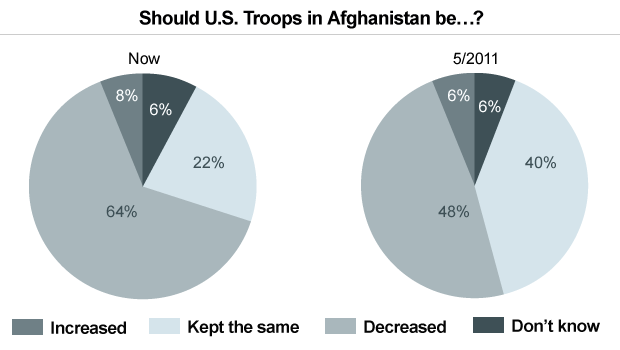
According to CBS News, 64 percent of Americans think the number of troops in Afghanistan should be decreased.

The fight for peace heats up:
Will Obama go for substantial
Afghanistan troop withdrawal?

By Tom Hayden / The Rag Blog / June 12, 2011

The New York Times finally acknowledged this past week that a significant withdrawal from Afghanistan is a real possibility being considered by the White House.

In a lead story on June 6, the Times reported that the Obama administration is considering a “steeper” reduction of troops than previously discussed or acknowledged.

The fact is that Democratic constituencies and leaders, responding to overwhelming public sentiment against the war, have been uniting in recent weeks behind a call for “substantial and significant” troops reductions and a transfer of war funds to job creation at home.

The push began long before the killing of Osama bin Laden, though the al-Qaeda leader’s death has accelerated the momentum towards de-escalation.

In effect, the Democrats finally have chosen to unite and align themselves with public peace sentiment and prepare a climate in which the president can make a bold step this month.

But will Obama himself do so? The answer to that question may reveal the nature of his presidency and determine whether he can win back disillusioned Democrats in 2012.

An Obama refusal to decide on a significant troop reduction may jeopardize his re-election and will reveal much about power in Washington. Is there an institutional mindset firmly committed to the Long War in spite of huge public opposition, or does democratic sentiment matter enough overrule the elites and shorten the war?

Most polls show Democrats and independents favoring a more rapid pullout than Obama’s current proposal of ending combat operations by 2014. Consider the favorable sequence of events since February:

  • A resolution by Rep. Barbara Lee calling for rapid, significant reductions and a transfer of funds to job creation passed the Democratic National Committee without dissent.
  • Legislation by Rep. Jim McGovern calling for an accelerated timetable of withdrawal received 205 House votes, including an overwhelming majority of 178 Democrats.
  • The House voted unanimously against sending any ground troops to Libya, criticized the president’s refusal to abide by the War Powers Act, and gave 148 votes to a Dennis Kucinich resolution which would have ended all support for the NATO military operation in Libya
  • In the Senate, one-time Afghanistan hawks like John Kerry and Richard Lugar called for a fundamental rethink, while conservative Democratic Sen. Max Baucus even proposed pulling all combat troops out by 2012. Last week 15 Senators sent a letter to Obama asking for a substantial drawdawn, with more signing by the day.
  • Obama himself told the Associated Press that his July announcement would order “significant” withdrawals.
  • In addition, Obama reconfigured his national security team by appointing the dovish Tom Donilan as director, replacing Robert Gates with Leon Panetta at Defense, and sending Gen. David Petraeus to the CIA where he might find it more difficult to oppose the president.

Meanwhile, independent think tanks with close ties to the White House, like the Center for American Progress and the Afghanistan Study Group, have pushed for an initial withdrawal in the range of 50-60,000 American troops, 10 times the figure pushed by the Pentagon.

This entire scenario was foretold in Bob Woodward’s book on White House decision making leading up to the 2009 surge, Obama’s Wars. In those pages, Obama repeatedly expressed concern that he couldn’t afford to “lose the entire Democratic Party,” that he needed an exit strategy, and that he expected (and needed) a timetable demand to come from the then-Democratic Congress.

The question now is whether he will bend to the Pentagon and the mainstream media whose voices are loudest in the Beltway, or heed the rank-and-file voters who have soured on the war and losing confidence in his presidency.

Prediction: In one scenario, Obama bookends the competing demands of 15,000 and 50,000 and decides on 30,000, ending the surge. But if he wants a bigger political impact, he pulls all 47,000 troops out of Iraq and cuts the U.S. force in Afghanistan in half by 2012.

Total reduction: 100,000 U.S. troops.

Total direct taxpayer savings: $200 billion through 2012.

The second course is better politics and policy. Committed peace advocates should ask no less.

[Tom Hayden is a former California state senator and leader of Sixties peace, justice, and environmental movements. He currently teaches at Pitzer College in Los Angeles. His latest book is The Long Sixties. This article was also posted at TomHayden.com and the Beaver County Peace Links. Read more of Tom Hayden’s writing on The Rag Blog.]

The Rag Blog

Posted in Rag Bloggers | Tagged , , , , | 1 Comment

With rising fuel prices a constant reminder, it is getting harder for the public to deny that we’re in big energy trouble. This is the first of three essays by The Rag Blog’s Roger Baker on “Peak oil, peak driving, peak cars.” In the first installment, Roger tells us that the USA has, in effect, squandered the decades since the energy crisis of the 1970s in denial of its growing dependence on cheap imported oil, which is now in global decline.

Posted in RagBlog | Leave a comment

The City University of New York has been the scene of what The New York Times called a “firestorm” over its handling of an honorary doctorate awarded to — and temporarily withdrawn from — celebrated playwright Tony Kushner. The tempest involved some controversial Kushner comments on Israel. The Rag Blog’s Meeropol, who teaches at CUNY’s John Jay College of Criminal Justice, was one of those who nominated Kushner, and he gives us the inside story.

Posted in RagBlog | Leave a comment

Roger Baker : Playing ‘Peak-a-Boo’ With the Earth

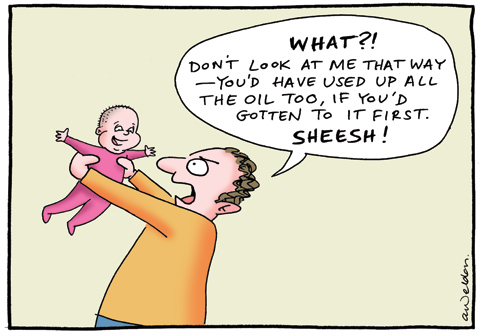
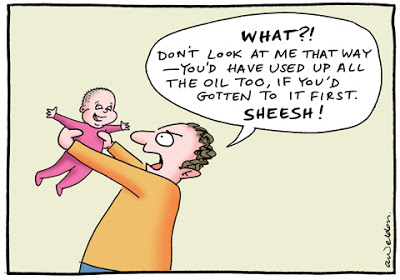
Cartoon by Andrew Weldon / The Age / National Museum of Australia-Canberra.

Coming soon:
Peak oil, peak driving, peak cars

Part I: Fuel prices and the global oil supply

By Roger Baker / The Rag Blog / June 8, 2011

In recent years, we are used to hearing something about oil in the news nearly every day. With rising fuel prices at the gas pump acting as a constant reminder, it is getting harder for the public to deny that the United States is in big energy trouble.

I have written three essays to explain our current situation, with a focus on transportation. This first one explains the global oil supply situation that has been causing fuel prices to go back up.

This will be followed by an essay documenting and explaining the basic shifts in driving and transportation behavior that are already well under way. It is indeed quite possible that the total vehicle miles driven in the United States has already peaked in 2007. Barring something unanticipated, we should plan to drive less, pay more, and begin to envy those with good transit service.

A third essay will focus on the efforts of the “Texas road lobby” to block transportation reform that might move Texas away from the sunbelt syndrome, a mode of growth highly dependent on cars, trucks, and roads to serve suburban sprawl development. When such groups fight progress or change, the skillful use of misleading data always helps. As does a new state leadership unwilling to acknowledge global warming.

Since there is a lot of money involved, and since this is Texas, we now see a new statewide network of Texas road promoters. In Texas, the road builders and their allies are thriving — actually manage to increase their funding at the expense of competing priorities like health care and education.

The road goes on forever, and the party never ends. At least not while the Texas road lobby has its way. — RB

The big picture: The global supply of cheap oil is mostly gone

The USA has, in effect, squandered the decades since the energy crisis of the 1970s in denial of its growing dependence on cheap imported oil. The USA gambled its economic future on the expectation of an eternally abundant supply of liquid fuels needed to power its unusually oil-dependent, low-density suburban lifestyle.

The U.S. energy crisis of the 1970’s was temporarily abated by new Alaskan oil production, and by agreements with the Saudis and other OPEC producers. Market access to cheap OPEC oil was then promised forever, in return for unlimited access to Middle East oil reserves, and for U.S. military protection of the status quo.

Now that the cheap conventional petroleum of our past is in global decline, as reflected in its erratic but stubbornly rising price, keeping the U.S. transportation system functioning as usual is a continuing struggle. Over 95% of the world’s transportation runs on oil-based fuel or its liquid equivalent; essentially all the world’s ships and planes and trucks, and most trains, run on conventional hydrocarbon fuels.

Producing the remaining supply of more expensive nonconventional oil requires that the biggest private companies like BP have to work a lot harder, by going far offshore, by using lower quality sour or heavy oil, or by mining tar sands, etc.

Since most of the richest geological oil deposits have already been located and largely produced, we’re finally getting down to the dregs. Global demand must increasingly be met by these “non-conventional” oil sources, where the energy return on our energy investment from drilling, etc., is much lower than before; perhaps only three-to-one rather than the previous twenty-to-one.

Given the new global oil supply situation, and with especially serious economic and transportation implications for the car-dependent U.S., it is past time to do something. The real issue is how hard we hit the wall as fuel prices keep on rising.
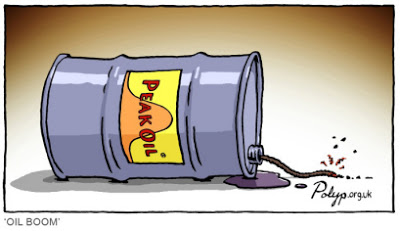
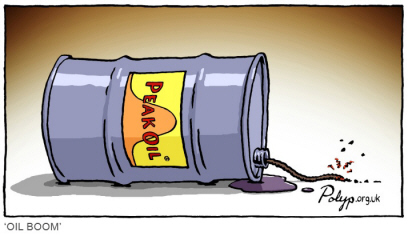
Cartoon by Polyp / UK.

Oil sets a limit on economic recovery

Oil reached its all-time high of $147 per barrel in mid-2008. Since then, the global supply hasn’t gone up much, but demand has shrunk with the recession, and the price has decreased. With a global recovery, a recurrence of another oil price spike is now well underway, to be followed shortly by a second stage of global recession, a continuation or second phase of the Great Recession of 2008.

This time around, after a lot of previous destruction of soft global demand, and due to rapid oil demand growth in China, we should anticipate that oil demand and oil prices will not fall to such a degree as they did in the recession of 2009.

During the entire period from 2005 to the present, the global production of conventional oil has been relatively constant, with oil prices rising and falling with the strength of the dollar and global demand. Global oil demand has been steadily rising during the last year, running up against global production a second time, as reflected in its rising price.

Since about June 2010, we have seen a slow acceleration in price, to the point that Brent crude (the best global price to watch) now sells at about $117 per barrel. Assuming the global economy falls back into recession, oil may get a little cheaper in dollar price, but it will probably keep getting less affordable.

Energy analyst Tom Whipple explains the same situation this way:

There are only a limited number of ways that the current economic recession and the looming prospects of a final decline in oil production can play out. None of these will permit much of an economic revival. The global financial crisis as presently understood is clearly too firmly rooted to be fixed by government bailouts and stimulus packages. The recession will only deepen for the foreseeable future, and the massive deficit financing by the United States and many other countries cannot go on much longer. Although China, with its large reserves of foreign currency, may be able to continue underwriting stimulus packages longer than other countries, it too will succumb to the lack of exports, the need to import energy, and other looming problems

Oil-related thinking and politics at the national level

For anyone living in the U.S., it’s easy to see that we are a car dependent nation. Oil addiction implies a corresponding car addiction. President George W. Bush first used the distressing “A” word toward the end of his term. Obama has now been warning us of the same thing for almost two years, and again last year during the BP spill.

Recently, Obama has proposed a national U.S. goal of reducing oil imports by a third, by 2025. In his words,

The Federal Government operates the largest fleet of light duty vehicles in America. We owe a responsibility to American citizens to lead by example and contribute to meeting our national goals of reducing oil imports by one-third by 2025 and putting one million advanced vehicles on the road by 2015.

This slow pace of of breaking our oil habit, offered here as a top national goal, is one way of admitting that our imported oil dependency will be extremely hard to break.

Along with the difficulty of reducing our import habit through painful economic restructuring over time, a domestic culture of denial persists, giving way to frustration and anger. We like to blame big oil companies like Exxon for holding back on production, or for causing high gasoline prices in some other way that they could easily reverse. It would be better to focus on the long term structural oil dependence of our society that these major producers have encouraged for decades, and which is arguably their major corporate sin.

Of course Republicans like to blame Obama for not encouraging more domestic drilling to hold down our driving costs. The reality is that no possible domestic energy policy can make much difference any more. Adding any plausible amount of new American production can scarcely sway the price on the huge global oil market. The guys still drilling in Texas or the Gulf are not likely to give us much of a price break since they can sell it to Europe for even more.

Oil has become more expensive globally, due to supply and demand in the world oil market — of which the USA is now only about 20%. We might like to blame oil speculators for the oil price bubbles, but they are not a major factor on their own; they can’t move the markets for very long without support from real market supply and demand forces.

The true adequacy of supply is revealed when and if tankers full of Arab oil arrive from the Middle East to undercut the speculative portion of demand. Even speculators have to sell the oil they buy, and they didn’t get to be important players by making stupid bets.

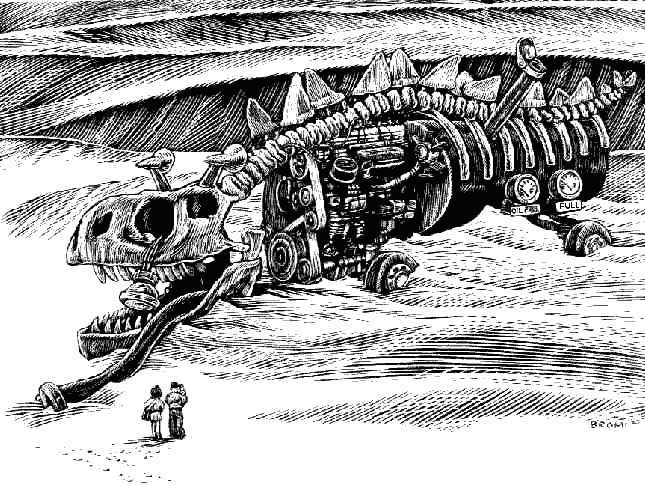
Cartoon by Bromi / Mindfully.org.


European thinking about the oil supply problem

The International Energy Agency — the top energy adviser to Europe — now concedes that global conventional oil production, the ordinary oil you drill for on land, peaked about 2005 and is now in decline. The end of the cheap oil is automatically shifting the market toward more expensive and lower quality oil.

In fact, the IEA is now pleading with the OPEC cartel to raise its oil production enough to prevent a renewed economic crisis. The IEA can see what is happening. Faced with stagnating global oil production and the inability of low grade Saudi oil to make up for Libyan sweet crude losses, the IEA is asking OPEC to increase its oil exports — enough to keep the global economy from slipping back into recession:

In an unusual development, last week the IEA’s governing board called on oil producers to increase their output to “help avoid the negative global economic consequences which a further sharp market tightening could cause.” The Agency’s position is in stark contrast to that of OPEC, and in particular the Saudis, who maintain that the oil markets are adequately supplied and that there is no need for a production increase at this time.

The statement released by the IEA cited a “clear, urgent need for additional supplies.” This time around the IEA seems to be taking the lead in warning that ever since the Saudis pulled back from replacing the lost Libyan exports last month, global demand for oil has been exceeding supply with the difference coming out of stocks.

With respect to world oil supply problems, many experts are now conceding that the days of cheap oil, and cheap driving, are over. The British are starting to face up to their own serious and rapidly worsening energy import problem, which parallels U.S. oil dependency in many respects, though it is not as severe.

By the time the general public understands the problem well enough to trouble the politicians, the situation it will be terribly difficult to deal with because of the long advance time needed to make an economic transition. We saw this during the long energy crisis of the 1970s.

The Hirsch report, published in 2005, concluded that to avoid major disruptions, we need to plan 20 years before the arrival of the oil peak, and that we just don’t have.

The key role of Saudi oil

The Saudis by themselves, by means of their unmatched reserve production capacity, and with their almost 9 million barrels a day in oil exports, or about 10% of the world supply, are the key oil export source. The world has relied on them since the 1970s — to keep the world oil price as low and stable as it is now. Any big loss in Saudi exports, perhaps through spreading “Arab Spring” political instability, would rapidly plunge the world into a global depression.

Since they have already produced their best and cheapest oil, the Saudis are having to produce heavier and more sour crude oil, which is harder to refine. The Saudis are now struggling to maintain even their current level of oil exports to hold down the world price.

“The easy oil is coming to an end,” says Alex Munton, a Middle East analyst for the Scottish energy consulting firm Wood Mackenzie. The major oil fields in the Gulf region, he says, have pumped more than half their oil — the point at which production traditionally begins to decline.

The U.S. Energy Information Administration said earlier this month that world-wide oil consumption would hit a record 88 million barrels a day this year. Turmoil in Libya, combined with slowing production growth in Western countries, will keep supplies tight, boosting prices, the federal agency said. It projects oil prices will average $103 a barrel this year, up 30% from last year, and will be even higher next year.

Meanwhile, there is a growing suspicion that OPEC is holding back on oil production to keep prices high:

There appeared to be signs of growing panic behind the latest declaration from the International Energy Agency. The statement calls on oil producing countries to increase production and reduce costs in order to avert economic crisis. To date Opec members have been insisting that the market is well supplied and that prices are being driven by speculation. Saudi Arabia actually reduced production substantially in April on claimed lack of demand.

However, it is becoming clear that high oil prices are currently attractive to Opec leaders confronted with social unrest as it allows them to increase subsidies and other financial transfers to their populations.

It is mainly the unverified claim of Saudi oil reserve production capacity that the world has been depending on to keep global transportation costs affordable. Thus any move to raise oil prices by withholding production would be bad news. From an economic point of view, $90 oil acts like a new universal tax that puts a floor under the costs of all globally traded goods and commodities.

As the Saudi oil gets harder to produce, the scale of new capital investments needed to keep up production from the aging Saudi fields apparently establishes a new price floor of about $91 per barrel on their oil.

Saudi seen needing $91 oil to fund gov’t spending plans
Bloomberg, arabianbusiness.com, 13 May 2011:

Saudi Arabia, the world’s largest crude exporter, needs oil to trade at about $91 a barrel this year to cover the cost of government programmes, according to the Centre for Global Energy Studies. The country has “ratcheted up” spending and requires high prices to maintain the commitments, CGES chief economist Leo Drollas said on Friday at the Platts Crude Oil Markets conference in London
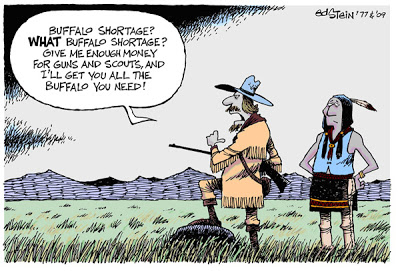
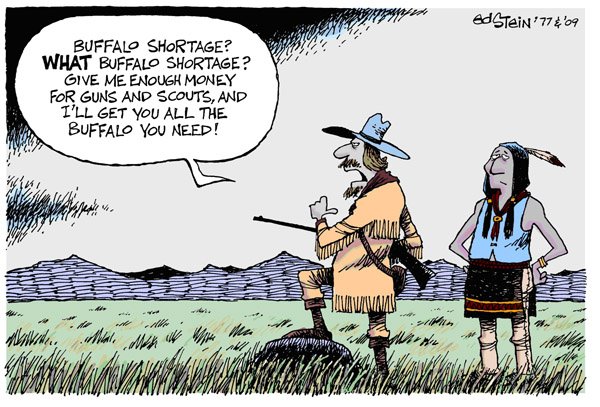
Cartoon by Ed Stein / ASPO-USA.

The latest oil production numbers

The latest world oil production figures show that global oil production has fallen back from a recent high of about 88 to about 87.5 million barrels per day. Nobody can say for sure yet if this is the peak, but these latest global oil production figures are only slightly above the previous global production peak of 2008, when global production reached about 87 million barrels per day, and the price hit $147 a barrel.

Is there any relief from high fuel prices on the horizon? Frankly no. The world economy has now recovered to the previous peak of global trade in 2008, just before the “Great Recession.” With trade recovery comes a parallel recovery in demand for oil. Lacking any fuel alternative, an expansion of global trade implies a proportional expansion of the supply of fuel needed to move the traded goods.

If global oil (or other liquid fuel) production doesn’t increase, then global trade cannot expand (barring perhaps a global readoption of sailing ships, etc). Since trade has recovered, oil has to expand in step, or market demand will raise global oil prices high enough to kill the recovery, as it did in 2008.

There is speculation that global trade has managed to recover (to the degree that it already has) only by tapping into the stockpiles of oil reserves already on hand. Unless world oil production increases to its previous peak of about 88 million barrels per day, something has got to give before too long, likely by the end of this year.

How soon till we hit the peak oil price wall?

How soon before things suddenly get a whole lot worse, as opposed to gradually worse? Probably by sometime in 2012, oil prices will spike high enough to shut down the U.S. economy and send it into recession again. This may be happening already. If you think times are hard now, expect worse next year. Here are some specifics offered by Martenson in this snip from his longer essay, well worth reading to fully appreciate the gravity of the current global oil supply situation.

How the major economies can continue proceeding with a business-as-usual mindset given the oil data is really quite a mystery to me, but that’s just how things happen to be at the moment. At any rate, with Brent crude oil having lofted over $100/bbl at the beginning of February and remained above that big, round number for four months now, we are already in the middle of a price shock. It may not be a perfect repeat of the circumstances of the 2008 oil shock, but it’s close enough that the risk of an economic contraction, at least for the weaker economies, is not unthinkable here. Japan, now in recession and 100% dependent on oil imports, comes to mind.

Looking at the new data and reading even minimally between the lines of recent International Energy Agency (IEA) statements, I am now ready to move my “Peak Oil is a statistically unavoidable fact” event to sometime in 2012, which tightens my prediction from the prior range of 2012-2013.

Upon this recognition, the next shock will drive oil to new heights that are currently unimaginable for most. First, $200/bbl will be breached, then $300, and then more. And these are in current dollar terms; any additional dollar weakness will simply be additive to the actual quoted price. By this I mean that if oil were to trade at $200 but the dollar lost one half of its value along the way, then oil would be priced at $400.

As we now see here, the U.S. economy does appear to be headed down into a double dip recession, with private job creation in serious decline. What bank wants to lend into a faltering recovery, involving a consumer population greatly burdened by existing mortgage debt, high unemployment, and rising food and fuel prices? The biggest banks can do better investing in profitable deals backed up by U.S. government guarantees:

There’s no money going to the private sector. There are no loans, no leases, no venture capital, no anything. It’s another day in the United Socialist States of America, where bankers are paid well for borrowing at 0.25% from the government and lending at 0.5% to the government.

Risk-taking? Never heard of it! Why should anyone take risk, when you can get a tax-advantaged 7.4% yield on the preferred securities of banks who are too big to fail? And why should the banks take risk when they can make a decent living doing nothing?.

If there is no economic recovery and no relief from high oil prices either, it means working longer hours and cutting discretionary spending elsewhere to just support our car habit — no matter what our dollars are finally worth next year.

Next time: Peak Driving and Peak Cars.
[Roger Baker is a long time transportation-oriented environmental activist, an amateur energy-oriented economist, an amateur scientist and science writer, and a founding member of and an advisor to the Association for the Study of Peak Oil-USA. He is active in the Green Party and the ACLU, and is a director of the Save Our Springs Association and the Save Barton Creek Association. Mostly he enjoys being an irreverent policy wonk and writing irreverent wonkish articles for The Rag Blog. Read more articles by Roger Baker on The Rag Blog.]

The Rag Blog

Posted in Rag Bloggers | Tagged , , , , , , | 6 Comments

Type your summary here

Type rest of the post here

Source

The Rag Blog

Posted in RagBlog | Leave a comment

Michael Meeropol : ‘L’Affaire Kushner’ at New York’s City University

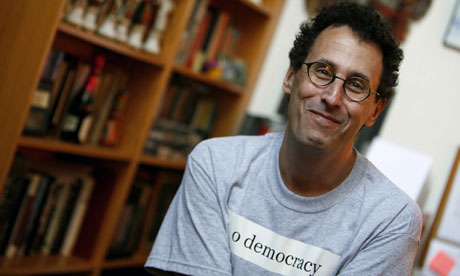
Tony Kushner. Photo by Brendan Mcdermid/Reuters.

L’Affaire Kushner:
Give and take at the
City University of New York

CUNY awards honorary doctorate to playwright Tony Kushner, takes it away, then — after ‘firestorm’ of protest — gives it back.

By Michael Meeropol / The Rag Blog / June 8, 2011

NEW YORK — On June 3, the playwright Tony Kushner, whose work Angels in America has been justly celebrated as an outstanding contribution both to American theater and to our general understanding of life in the late 1980s, received an honorary doctorate from John Jay College of Criminal Justice of the City University of New York (CUNY).

Since this was his seventeenth honorary degree, it probably would not have warranted much attention. However, as he acknowledged in his speech to the graduates that day, this honorary doctorate would remain “the most interesting one I had to work the hardest to get.”

You see what should have been a routine ratification of the decision made by John Jay College by the CUNY Board of Trustees at their May 2, 2011, meeting became anything but.

Their decision that day to table Mr. Kushner’s degree — in effect denying him that degree — launched what The New York Times called a “firestorm” of protest.

At that May 2 meeting, Trustee Jeffrey Wiesenfeld [see picture on right below] attacked Kushner for being “anti-Israel.” He read some snippets of quotes from Kushner that had been assembled as part of an effort to have Brandeis University rescind an honorary degree that Kushner had received in 2006.

”Israel was founded in a program that if you really want to be blunt about it was ethnic cleansing and that today is behaving abominably towards the Palestinian people. I’ve never been a Zionist, I have a problem with the idea of a Jewish state… it would be better if it’d never have happened…” The Israeli reporter questioning Mr. Kushner says, “But you are saying then that the very creation of the state of Israel as a Jewish state was not a good idea,” and Mr. Kushner answered, “It was a mistake.” (1.)

Without a word of discussion, without a word raised in Kushner’s defense, four other members of the CUNY Board joined with Wiesenfeld to block Kushner’s honorary degree. The opinions of the faculty of John Jay College — the college that nominated him and where I am currently working — were swept aside.

To get an idea as to how disrespectful this was to the process by which honorary degrees are awarded, we should note that nominations are made by faculty members at any City University College for degrees to be awarded at that college’s commencement exercise. The nominators are kept secret from the faculty committee that, after extensive deliberations, makes recommendations to the college’s administration.

By the time it gets to the CUNY Board of Trustees, three levels of the academic hierarchy, the faculty of the nominating school, the administration of the nominating school, and the Chancellor of the City University, have all made their considered judgment. The Chair of the Interdisciplinary Studies program, Dr. Amy Green, and I were the two nominators and we wrote a very detailed letter describing Mr. Kushner’s artistic achievements that in our view made him eminently qualified to receive such an award. [See picture of Michael Meeropol on left below.]

The Board’s decision on May 2 was the first of its kind. Since being established in 1961 the Board had NEVER overruled a nomination that had passed all three stages.

Neither Mr. Kushner nor the faculty of John Jay College took this insult lying down. Mr. Kushner penned a vigorous response to Mr. Weisenfeld’s attack, explaining that the views attributed to him were false and that the direct quotes from him had been taken out of context.

The chair of the faculty senate of John Jay sent a strong protest letter demanding that the executive committee of the Board immediately meet to authorize the degree. Had they waited till the next scheduled meeting of the full Board, it would have been too late, as John Jay’s commencement was June 3.

Seventy faculty with the rank of Distinguished Professor from all over the City University signed their own letter of protest.

A number of individuals who had previously received honorary degrees from the City University publicly asked how they could return their degrees in protest at the outrageous action.

Despite his strong differences with Kushner on Israel, former New York Mayor Ed Koch was quoted as saying that not only should the Board reverse the decision, but that Mr. Wiesenfeld should be removed from the Board for abusing his authority.

Trustee Wiesenfeld was clearly expressing an extreme point of view. He was quoted in The Atalantic that his mother would call Tony Kushner a CAPO — a Jewish guard at a Nazi Concentration camp. In an interview with The New York Times he revealed even more about himself:

I [THE REPORTER] tried to ask a question about the damage done by a short, one-sided discussion of vigorously debated aspects of Middle East politics, like the survival of Israel and the rights of the Palestinians, and which side was more callous toward human life, and who was most protective of it.

But Mr. Wiesenfeld interrupted and said the question was offensive because “the comparison sets up a moral equivalence.”

Equivalence between what and what? “Between the Palestinians and Israelis,” he said. “People who worship death for their children are not human.”

Did he mean the Palestinians were not human? “They have developed a culture which is unprecedented in human history,” he said. (2.)

However, all this is beside the point. Though Wiesenfeld grossly mischaracterized Kushner’s views, even if he hadn’t, it would not be grounds for the denial of an honorary degree.

Board Chairman Benno Schmidt candidly acknowledged that the Board’s action had been a violation of principle and called an Executive Board meeting to rectify the error.

He said the following:

Freedom of thought and expression is the bedrock of any university worthy of the name … it is not right for the Board to consider politics in connection with the award of honorary degrees except in extreme cases not presented by the facts here.(3)

The story has a happy ending. On May 9, exactly one week after the outrageous action taken by the trustees, the Executive Committee unanimously approved Mr. Kushner’s honorary degree. Unfortunately, as I and my students watched the proceedings of the Executive Committee meeting, we noted that there was no apology tendered to Mr. Kushner and we feared the experience had left such a bad taste in his mouth that he would refuse the degree. We should not have been concerned.

In an extraordinary display of magnanimity, Mr. Kushner did accept the honorary degree. Chairman Shmidt’s statement served as such an apology.

In an even greater act of generosity, since John Jay has such a large student body, commencement occurs in two sessions. Mr. Kushner agreed to attend both — something honorees rarely do — and he basically gave the same speech twice.(4)

But the story remains a cautionary tale. Four members of the Board allowed themselves to be swayed by Trustee Weisenfeld’s accusations.(5) No one saw fit to respond the way Chairman Schmidt did four days later. And this failure to respond applies to Chairman Schmidt as well. (Though his silence at the first meeting is partially corrected by his decisive action four days later.)

At least one of those four was quoted in The New York Times as changing her mind on this issue, but why did it take a firestorm of protest to wake these people up?

I believe it would be a very legitimate question to ask those members of the Board: What they were thinking when they blindly followed Wiesenfeld after he had launched a vicious and unjust political attack on Mr. Kushner, undeniably a great creative artist and one of our foremost public intellectuals.

What were they thinking?

Photos above: (Right) CUNY Trustee Jeffrey S. Wiesenfeld. Photo by Michael Appleton / New York Times; (Left) Rag Blog contributor Michael Meeropol who, along with Dr. Amy Green, nominated playwright Kushner for the honorary degree. Photo by Thomas Good.

[Michael Meeropol is Visiting Professor of Economics, John Jay College of Criminal Justice, City University of New York. Read more articles by Michael Meeropol on The Rag Blog.]

References:

1. The full transcript of Mr. Weisenfeld’s remarks as relates to Mr. Kushner follows:

Now to Mr. Kushner: I chose with Mr. Kushner not to look at pro-Israel websites that would give insight into his feelings of Israel. Rather, I went to the website of one Norman Finklestein, another discredited individual that mercifully we rid ourselves of at this University and he pridefully displayed key quotes of Mr. Kushner on his website… which are accurately reflected elsewhere and by Mr. Kushner’s record itself and I quote Mr. Kushner.

First while Mr. Finklestein praises the candidate, Kushner also deplores the brutal and illegal tactics of the IDF, which I might add is the only force of its kind in the world that has the high code of ethics that the Israel defense forces has and the deliberate destruction of Palestinian culture in the systematic attempt to destroy the identity of the Palestinian people. He is also on the board of an organization which opposes the security fence, a unified Jerusalem, or military aid to Israel, recommends Norman Finklestein’s notorious books and supports boycotting and divesting from the state of Israel.

Now to Mr. Kushner’s quotes: “Israel was founded in a program that if you really want to be blunt about it was ethnic cleansing and that today is behaving abominably towards the Palestinian people. I’ve never been a Zionist, I have a problem with the idea of a Jewish state… it would be better if it’d never have happened.“ Kushner said that “establish a state means F-U-C-K-I-N-G people over, however I think that people in the late 20th and 21st century having seen the Holocaust, having seen the 20th century and all of its horrors, cannot be complacent in the face of that.” The Israeli reporter questioning Mr. Kushner says, “But you are saying then that the very creation of the state of Israel as a Jewish state was not a good idea,” and Mr. Kushner answered, “It was a mistake.”

I think you get the idea… I don’t want to bore you all with the details. Let me just say that when people identify themselves politically in principal or principally by these types of viewpoints, yes, it could be said by other trustees or by members of faculty that it has a chilling effect when a trustee brings up these types of matters but I think it’s up to all of us to look at fairness and to consider these things especially when the state of Israel, which is our sole democratic ally in the area, sits in a neighborhood that is almost universally dominated by administrations which are misogynist, anti-gay, anti-Christian and societies that are doing today to the Christians what they did to 500,000 Jews who lived in the Arab world in 1948 at the time of the creation of the state of Israel: dispossessing them, murdering them, deporting them.

And so I have to say that even though I am the lone dissenter that it’s time that… It would be much worse for the reputation of the University not to mention this, especially after the appointment of an individual at Brooklyn College, Mr. Overton, who has some equally specious scholarship. Thank you, Mr. Chairman!”

2. The New York Times: A University Trustee Expands on His View of What Is Offensive

3. Board Chairman Schmidt’s full statement issued on May 6, 2011 follows:

I believe the Executive Committee of the Board of Trustees needs to reconsider the Board’s decision to table the motion to approve the award of an honorary degree to Tony Kushner. I would not ordinarily ask for reconsideration of a decision so recently taken. But when the board has made a mistake of principle, and not merely of policy, review is appropriate and, indeed, mandatory.

Freedom of thought and expression is the bedrock of any university worthy of the name. If it were appropriate for us to take politics into account in deciding whether to approve an honorary degree, I might agree with Trustee Wiesenfeld, whose political views on the matters in controversy are not far distant from my own. But it is not right for the Board to consider politics in connection with the award of honorary degrees except in extreme cases not presented by the facts here.

The proposed honorary degree for Mr. Kushner would recognize him for his extraordinary talent and contribution to the American theater. Like other honorary degrees, it is not intended to reflect approval or disapproval for political views not relevant to the field for which the recipient is being honored. Any other view is impractical as well as wrong in principle. Would we want it thought that we approve of the politics of everyone who receives a CUNY honorary degree? Certainly I have moved the approval of honorary degrees for persons with whose opinions I differ.

In addition, I am concerned about the procedural unfairness of our action. The objection arose at the eleventh hour without any opportunity for research and preparation necessary for the presentation of a full and balanced appraisal. Accordingly, the Chancellor and I agree that reconsideration of the motion to table the honorary degree for Mr. Kushner is not only the right thing to do, but is our obligation.

I will ask the Secretary of the Board to convene an Executive Committee meeting to reconsider this matter.

4. In the morning he told the students that he was going to deliver two speeches that day. He asserted that the morning students would get the “good speech” and that the afternoon one ”sucks.” In the afternoon, to great laughter, he referred to what he had told the morning graduates and said, “I lied… you get the good speech.”

5. The four members who voted with Trustee Wiesenfeld are: Judah Gribetz an attorney with a long distinguished record of public service dating back to the 1950s; Peter S. Pantaleo, another lawyer who is Vice Chair of the Board’s Committee on Fiscal Affairs; Carol A. Robles-Roman, Deputy Mayor of the City of New York (the person who changed her mind between Monday, May 2 and Friday, May 6 and who is yet another lawyer who also serves on the Committee on Fiscal Affiars; and Charles A. Shorter who appears to be the only one of the four with ties to the academic side of higher education — he is adjunct associate Professor in the Master of Science Program in Real Estate Development at Columbia University. Members of the Board of Trustees appear to all be political appointments either by the Governor of the State of New York or the Mayor.

Links to New York Times articles:

The Rag Blog

Posted in Rag Bloggers | Tagged , , , , , | 1 Comment

Jay D. Jurie : Orlando Cops in ‘Feeding Frenzy’

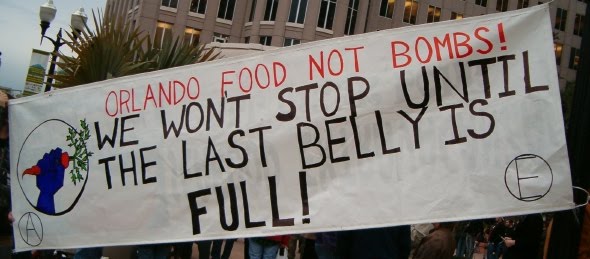
Image from Orlando Food Not Bombs.

Orlando’s feeding frenzy:
Cops bust volunteers feeding the homeless

By Jay D. Jurie / The Rag Blog / June 8, 2011

ORLANDO, Florida — On June 1, 2011, life in downtown Orlando’s Lake Eola Park was pretty much the same as on any other Wednesday this time of year: in one corner of the park a group was set up to dish out food to all comers. What turned out different on this particular occasion was that the Orlando Police Department crashed the line and arrested three members of the anti-militarist and anti-poverty organization, Food Not Bombs (FNB), for the “crime” of providing free food to the homeless.

Arrested were Jessica Cross, formerly a student activist at the University of Central Florida; Ben Markeson, a long-time participant in Orlando FNB and a member of Orlando’s short-lived chapter of Movement for a Democratic Society (MDS); and Keith McHenry, a co-founder of the national FNB organization.

On Monday morning, June 6, after serving doughnuts and pancakes, four more FNB members — Noelle Bivens, Dylan Howeller, Brock Monroe, and Steve Willis — were arrested by Orlando Police. FNB has vowed to continue defying Orlando’s ban against feeding the homeless.

Ben Markeson, arrested along with Jessica Cross (left) and Keith McHenry for feeding the homeless, says that Orlando Food Not Bombs will continue to feed those in need at Lake Eola Park in Orlando. Photo from Orlando Sentinel / Mail Online (U.K).

Food Not Bombs began in 1980 as an offshoot of New England’s anti-nuclear power Clamshell Alliance. For more than 30 years FNB has organized chapters worldwide with a two-fold mission: to graphically illustrate poverty in the face of bloated military spending, and to provide a direct service to those in need.

According to their Facebook page, “Food Not Bombs is a worldwide effort to feed anyone hungry and end violence.”

FNB’s website tells us that “Food Not Bombs shares free vegan and vegetarian meals with the hungry in over 1,000 cities around the world to protest war, poverty and the destruction of the environment.” Then it asks, “With over a billion people going hungry each day how can we spend another dollar on war?”

Beginning in January 2005, Orlando FNB served people in Lake Eola Park without incident. In 2006, reacting to complaints from nearby merchants who wanted the homeless moved “out of sight, out of mind,” the City passed an ordinance that prohibited feedings of more than 25 people at a time without a permit, and limited permits to a twice-yearly basis.

Orlando FNB continued the feedings and as a co-plaintiff with a church organization, filed suit in federal court, alleging violation of First Amendment rights. One member of the group was arrested in 2007, but acquitted at trial.

In 2008, federal judge Gregory Presnell partly ruled in favor of the plaintiffs. He did not find that the City’s feeding ban violated freedom of religion, but found that the ordinance did violate free speech rights. Orlando decided to appeal, and a three-judge panel from the conservative 11th District Court of Appeals in Atlanta sided with the City.

However, in an unusual move, they forwarded their ruling for consideration by the full 10-member appellate panel. Some held out hope that this was a signal that the full court would deny the appeal. In April 2011, that hope was dashed as the Court voted unanimously to uphold the City’s ordinance.

While Orlando FNB continued the feedings, on two separate dates after their court victory, May 18 and May 23, the City “paid” for permits that FNB had not requested and which they rejected. There was one additional “unpermitted” feeding on May 25 before the City apparently decided to move forward with arrests. It remains to be seen how all this will play out.

Meanwhile, the critique made by Food Not Bombs is worthy of serious consideration.

In fiscal year 2010, $9.7 billion was expended on school lunch programs nationwide. The Women, Infants, and Children program spent $6.7 billion on combined food and nutrition services. For fiscal year 2011, it was estimated $85.2 billion would be spent on food stamps. Aggregated, these expenditures aimed at meeting the food needs of the nation’s neediest come to $101.6 billion.

These figures can be contrasted with the Pentagon’s $671 billion budget request for fiscal year 2012, which shows that the totals for low-income food support are less than one-sixth that of the military budget. Taxpayers might wonder why they are not getting a better deal when 19 fanatics armed with box cutters did the most damage to this country since the Japanese attack on Pearl Harbor in 1941, and all the trillions spent on “national security” or “defense” in the intervening decades provided no protection.

If looked at from the local perspective, most are not getting a better deal. While pressing for lower tax rates for business, Florida Governor Rick Scott recently signed legislation that will limit unemployment benefits for the laid-off. He also signed a bill, which he avidly promoted, that will require welfare recipients to be drug-tested.

Food Not Bombs members have been arrested several times over the past few years in Orlando, though all have been acquitted so far. Image from orlandofoodnotbombs.org / Mail Online (U.K.).

Orlando has spent hundreds of millions of taxpayer dollars to build three “venues” that will primarily serve the interests of the affluent at the expense of the middle class. Among these venues is the new arena demanded by billionaire Orlando Magic basketball owner Richard DeVos. His team put up about $60 million while taxpayers footed the remaining $420 million of the bill. Included in the arena are skyboxes the City has reserved for itself, so the same Mayor Dyer and the City Council who passed the anti-homeless feeding ordinance can view the Magic games in luxury.

Ironically, at Lake Eola Park, the locus of the feeding controversy, the fountain which is the park’s central feature was recently repaired at a cost of $1.6 million. While most of the repair was funded by insurance pay-outs, it was yet another reflection of the City’s problem-solving capabilities, at least when it comes to what is viewed as a priority.

As if to underscore the most fundamental point made by Food Not Bombs, according to Richard Reep in the June 2, 2011 issue of New Geography, Orlando has become the host to the nation’s largest war simulation center, with an estimated 18,000 employed in this “growth industry.” Some would argue, along the lines of “trickle down” theory, that all the tax dollars thrown at Orlando’s tourism industry, attractions, venues, and military research are needed to support programs that help the homeless.

In 2009, the City of Orlando Housing and Community Development Department received and dispersed some $7.3 million in federal funds for low-income housing support. Note the emphasis on federal, not local funds. Other low-income housing services are funded and provided by nonprofits, not the City of Orlando. This is also the case with food banks, soup kitchens, and so on, which are provided by nonprofits and charitable organizations.

Any claims that the City is providing for the needs of its less fortunate residents rings hollow in the face of the evidence that the City marginalizes this population while spending hundreds of millions of middle class tax dollars to serve the interests of the most affluent.

Those in the middle class have far more to gain by insisting these priorities be reversed. Given the shape of the economy, far more in the middle class are in need of a social safety net, as the ladder of upward social mobility has been yanked out of grasp.

In upholding the City’s ordinance, the 11th District Court of Appeals has further diminished the rights and liberties of all citizens, not just the homeless and their advocates. As an old labor slogan put it, “an injury to one is an injury to all.” In its ruling, the Court proclaimed the “time, place, and manner” restriction of the ordinance was justified.

It used to be presumed that freedom meant persons were at liberty to act in accordance with First Amendment rights and government was constrained from interfering with the exercise of those rights. Current “time, place, and manner” restrictions have stood this assumption on its head. These days, the presumption is that persons are not at liberty to exercise such rights unless the government says so.

[Jay D. Jurie is a proud Rag Blogger who teaches public administration and urban planning and lives near Orlando, Florida. Read more articles by Jay D. Jurie on The Rag Blog.]

Sources: Orlando Food Not Bombs, Food Not Bombs, New Geography, UK Daily Mail, Orlando Sentinel, the City of Orlando Housing and Community Development Department, the Food Research and Action Project, U.S. Department of Agriculture, and the U.S. Department of Defense.

The Rag Blog

Posted in Rag Bloggers | Tagged , , , , , , , , | 1 Comment

Amanda Marcotte : Does Weinergate Mark an End to Sexual Privacy?

J’accuse! Right wing blogger Andrew Breitbart points the finger. Photo from AP.

The worst thing about Weinergate?
The total obliteration of sexual privacy
by ideologues like Andrew Breitbart

Prior to this scandal, the media and political operatives had to at least pretend that a politician’s sex life had some bearing on the public interest before they picked up the pitchforks.

By Amanda Marcotte / AlterNet / June 7, 2011

Like most political junkies who tuned in to Anthony Weiner’s press conference confession of online flirtations, I went through a series of emotions: irritation at Weiner’s stupidity, anger at Andrew Breitbart’s sleaziness, frustration that this story gets coverage during an economic crisis, and embarrassment for the reporters who thought it appropriate to ask if he’s getting professional help or demand that Weiner’s wife stand around so that everyone can gawk at her.

But one concern rose above all others. This scandal may represent the end of the presumption of sexual privacy for politicians, and possibly even for journalists, activists, and bureaucrats — anyone whose public humiliation could benefit the ideologues wed to the politics of personal destruction.

Prior to this scandal, the media and political operatives had to at least pretend that a politician’s sex life had some bearing on the public interest before they picked up the pitchforks. Being an adulterer wasn’t, in and of itself, a matter of public interest. There had to be a hook.

If you were a social conservative who advocated for using the government to control the sexual behavior of consenting adults, for instance, then you were held to your own standard and your adulteries were considered public business. If you opposed gay rights, your own history of same-sex relations was fair game. If you broke an anti-prostitution law you vigorously enforced on others, like Eliot Spitzer, you had no reasonable expectation of privacy.

Arnold Schwarzenegger had a long past of being accused of sexual harassment, so the state of the marriage he used as a shield matters. Even at the height of the national panic over Bill Clinton and Monica Lewinsky, Clinton’s detractors claimed that it wasn’t the sex that was the issue, but the perjury. No one believed them, of course, but the claim at least paid tribute to the idea that the private sexual choices of those who support sexual privacy are not the public’s business.

But with this Weiner scandal, there’s not even the veneer of an excuse in play. Weiner has an outstanding record supporting sexual rights of others, with 100% ratings from NARAL and Planned Parenthood, and has a strong record of support for gay rights. No laws seem to have been broken, no public trust compromised, no campaign irregularities indicated, and there’s been no suggestion that his flirtations interfered with his ability to do his job.

The entire rationale for the scandal is that Weiner isn’t living in accordance with strict social mores regarding monogamy, and that’s it. Even the whining about how he lied when initially confronted is hollow. In the past, lying when someone asks nosy questions that are none of their business was considered a socially acceptable white lie. (And really, who among us would be a paragon of transparency with Wolf Blitzer waving a penis picture in our face and saying, “Is this yours?”)

The pretense that it has to matter to the public in order for the public to get involved has been dropped.

This loss of privacy should worry people more than whether or not Weiner was right to lie or even how rude it was of Andrew Breitbart to hijack the press conference. The presumption of sexual privacy may have been stretched at times past the point of recognition, but this represents the first time it’s really snapped, at least in my memory.

If this Weiner scandal is more than a blip, and instead the beginning of a free-for-all of rooting through politicians’ trashcans to make sure their private sex lives adhere to someone else’s standards, where will it all end?

There are two main concerns when personal choices — or even failings — become a matter of public interest, even if it doesn’t affect the public. One is that it opens the door to real witch hunts where no one is truly safe, and the other is that it will degrade the quality of the actual work people are doing that actually does affect the public.

The problem with opening the door to conducting sex scandals where simply violating some sexual standard is all that’s needed is that the question arises: Who gets to set the standards? The answer is probably closer to “the religious right” than “Dan Savage,” if only because the more sexually liberal out there don’t bother with feigning outrage at the private behavior of consenting adults.

You saw this problem erupting with the Weiner press conference, where reporters asked questions that implied that a standard of monogamy be applied across the board, regardless of the preferences of the people actually in the marriage, and that failure to comply with monogamy standards constitutes a grievous personality flaw that requires professional intervention. (One shouted question specifically asked if Weiner was seeking professional help.)

Once the standard for a sex scandal moves from “public interest” to “arbitrarily deciding this person’s behavior is gross/immature/offends Jesus,” it’s open season. Today the crime is not following the standards of monogamy set by those outside your marriage (since we don’t know the details of Weiner’s relationship with his wife, these are the only standards really in play).

Tomorrow, it could be that your personal behavior offends people who don’t approve of premarital sex or who think it’s gross or silly for adults to play little private games with each other. Already, half the reason this is a scandal is that Weiner said things while flirting that sound silly in a more public context. Can any of us really say that 100 percent of our flirtations in life would pass the scrutiny of a hostile audience out to maximize our humiliation?

If these new standards come in to play, it will mean a drastic reduction in the number of people willing to risk running for office — or be activists or writers or anyone that Andrew Breitbart deems interesting enough to start a harassment campaign against. Sensible people, realizing their sex lives will be an open book, will choose careers that don’t attract the attention of witch hunters.

Unfortunately, those sensible people are exactly the kind of people we need more of in politics, having already ceded so much ground to the Bible-thumpers and people who believe that Obama is starting secret campaigns to confiscate guns and kill old people. Weiner, for instance, was targeted because he’s willing to fight the good fight on major issues of interest to liberals.

Of course, running sensible people out of politics would suit the ends of Andrew Breitbart and his faux outrage machine just fine, which is all the more reason that he should be resisted.

[Amanda Marcotte co-writes the blog Pandagon. She is the author of It’s a Jungle Out There: The Feminist Survival Guide to Politically Inhospitable Environments. This story was published at and distributed by AlterNet.]

The Rag Blog

Posted in RagBlog | Tagged , , , , , | 1 Comment

Lamar W. Hankins : Medicare and the Corporatist Agenda

The assault of corporatism. Image from The Nation blogs.

Medicare’s backstory:
How corporatism controls the agenda

By Lamar W. Hankins / The Rag Blog / June 7, 2011

Ever since President Lyndon Johnson succeeded in getting Medicare enacted in 1965, corporatist politicians have done their best to make sure that the program would benefit America’s health insurance and pharmaceutical corporations, at the expense of the people. This was true when President George W. Bush proposed a Medicare drug benefit to enhance his reelection bid before the 2004 election, but no one anticipated that the Republicans’ political calculations would backfire as they have in 2011.

This turn of events is due in part to the reasons Republicans voted for a drug benefit for Medicare (Part D), a benefit that was provided with deficit spending. Some supported it because they thought Part D would be so expensive that it would lead to the death of Medicare. And they made sure that it would benefit the pharmaceutical corporations by letting them design the drug coverage that could be offered.

As David Cay Johnston — a journalist who writes about economics — explains in his book Free Lunch, the Republicans were dishonest about the expected cost of Part D. Publicly, they said that it would cost $400 billion over 10 years. But the insiders were told that the cost would be close to double that amount. Some Republicans thought that the actual cost, once it became known, would cause Part D to drag down Medicare as an unsustainable program, a desire high on Republican wish lists for 40 years.

By the time Congress approved Part D, the Bush administration was pumping trillions of dollars into two wars paid for by borrowing. The U.S. deficit was soaring, contributing to further pressures to cut all programs intended to benefit people rather than corporations. Many politicians who do not like people programs thought that in a few years it would be possible to eliminate such programs out of a perceived necessity to control government spending.

Of course, the tax cuts on America’s wealthiest 2-3% created even greater deficits, furthering the same goal. The financial collapse late in Bush’s presidency further encouraged the corporatists to spend money we did not have to bail out the financial sector, putting even more pressure on people programs.

This year, after the Republicans took control of the House of Representatives in the 2010 elections, Paul Ryan (and all but four House Republicans) believed that the time to kill Medicare was at hand.

Ryan proposed a budget that would turn Medicare into a voucher program that would force seniors to purchase their own health insurance in the private market with the help of a so-called Medicare voucher that would come nowhere close to making it affordable for most seniors — paying for perhaps one-third of the cost of health insurance in the corporate marketplace. Their justification for this so-called “reform” was that Medicare costs were out of control.

Ryan’s budget proposed to change the basic character of Medicare — from an inexpensively administered, single-payer health care insurance program — into a way to reward the giant health insurance corporations that have been a mainstay of political funding for the corporatists of both political parties. Ryan wanted to continue to use the name Medicare while altering its basic structure and purpose, leaving only the skeletal remains of what has been an effective public health insurance program.

Political corporatists like Ryan support government schemes that enhance the profits of corporations at the expense of the people. This is what happened with Part D. Instead of following marketplace concepts in which businesses sell their products for the lowest profitable price, the Part D law prohibited Medicare administrators to negotiate drug prices. Instead, Part D drugs would be bought at prices several times higher than the market required.

For example, Lipitor, the golden-goose cholesterol drug owned by Pfizer, is sold in the U.S. for over three times what it sells for in Canada, earning Pfizer $12.4 billion in 2008 in the U.S. alone. A 10 MG tablet of Lipitor sells retail for about $1.33 per day in Canada; in the U.S., for over $4 per day. Competition in the Part D benefit would have yielded lower profits for the pharmaceutical corporations, so the corporatists in Congress and the White House made sure the law would not permit capitalist markets to operate as Adam Smith envisioned them.

When Obama pressed for health insurance reform early in his administration, the corporatists in Congress and in the executive branch held sway and designed a program that assured huge new profits for the giant corporations.

Some of the same people who worked for the corporations when Part D was passed played a similar role in the passage of health care reform in 2010, both inside and outside of government.

One of those people was the Senate Democrat from Montana, Max Baucus; another was Republican representative Billy Tauzin from Louisiana, who left Congress after 2004 to lobby for the pharmaceutical industry and become a part of the health insurance sector; another is former Louisiana Senator John Breaux, a Democrat, who left the Senate after 2004 to become a health industry lobbyist; and another is Republican Representative Bill Thomas of California, who left the Congress in 2007 to work on health care policy for the American Enterprise Institute (a right-wing supporter of corporatism) and become a lobbyist for the health care industry.

The Republicans, including Paul Ryan, are correct about one aspect of Medicare — something must be done to make Medicare sustainable for the future. The passage of Medicare reform last year as part of the health care reform package made a start by limiting payments to corporations that offer Medicare Advantage plans, by gradually providing fuller coverage for prescription drugs, and by implementing quality controls (to avoid duplication of services and better coordination of care) that are expected to lead to cost savings. But more must be done.

Medicare’s hospital insurance trust fund will approach zero in about 10 years, according to most prognostications. But, until Congress and the administration have the fiscal discipline to stop throwing away trillions of dollars on unnecessary wars, tax loopholes for the wealthy, lower taxes for the wealthy, special tax breaks for corporations, and extending corporate welfare at every opportunity, very little can be done to improve Medicare’s solvency without destroying its purpose and its benefit.

Conservative New York Times columnist David Brooks has made some suggestions that are worth considering, beginning with “a bipartisan commitment to reduce the growth of Medicare spending.” Such a commitment will require eliminating Medicare as a golden goose for the health insurance and pharmaceutical corporations, an action agreeable to few politicians now in office.

Brooks also suggests, “Republicans should offer to raise tax revenues on the rich. They should get rid of the interest deductions on mortgages over $500,000 and on second homes. They should close corporate loopholes and cap the health insurance deduction.”

Brooks’s ideas would be a start to solving the long-term fiscal needs of Medicare, but they would be a meager start. We must do much more. First, without universal health insurance for all Americans, significant curbs on the costs of Medicare are unlikely. Further, Congress should increase funding of FBI efforts to detect health care fraud in both Medicare and Medicaid (the program for low-income people) and make the FBI accountable for its fraud investigations, something the corporatists oppose because such actions would harm their favored constituents — the health care and pharmaceutical corporations.

Republicans have opposed Medicare since Harry Truman first proposed a Medicare-type program in 1945. When the program was proposed anew in the 1960s, the opposition was simplistic at best:

Ronald Reagan in 1961: “[I]f you don’t [stop Medicare] and I don’t do it, one of these days you and I are going to spend our sunset years telling our children and our children’s children what it once was like in America when men were free.”

George H.W. Bush in 1964: Medicare is “socialized medicine.”

Barry Goldwater in 1964: “Having given our pensioners their medical care in kind, why not food baskets, why not public housing accommodations, why not vacation resorts, why not a ration of cigarettes for those who smoke and of beer for those who drink.”

Bob Dole in 1996, while running for the presidency, openly bragged that he was one of 12 House members who voted against creating Medicare: “I was there, fighting the fight, voting against Medicare… because we knew it wouldn’t work in 1965.”

These politicians, along with other corporate Republicans and corporate Democrats, don’t believe in programs that benefit people. They believe the purpose of government is to serve the direct interests of the corporations that make it possible for them to continue being elected. Only a massive political uprising by the people can prevent the mutilation and destruction of Medicare.

The tentative evidence is that the people now understand what is at stake in the next election cycle. While we will always have the political corporatists, we may be able to achieve enough balance in the Congress so that people are put first for a change.

[Lamar W. Hankins, a former San Marcos, Texas, city attorney, is also a columnist for the San Marcos Mercury. This article © Freethought San Marcos, Lamar W. Hankins. Read more articles by Lamar W. Hankins on The Rag Blog.]

The Rag Blog

Posted in Rag Bloggers | Tagged , , , , | 3 Comments

Ellen LaConte : A Really Scary Story for Stephen King

Time to be scared straight?

Dear Stephen King:
An open letter to one American who really
could scare the rest of us into action

By Ellen LaConte / The Rag Blog / June 6, 2011

I’ve been participating in an email discussion group that’s tackling urgent issues like population, climate change, and peak oil. There’s one particularly curmudgeonly member who persistently protests the doom and gloom vision members of the group generally share. Recently he suggested that we might as well just get Stephen King to write our posts because fear-mongering is his business and he’d take the doom and gloom up a notch. Which inspired me to write the following open letter to Stephen King.

Dear Stephen King,

Most of your books are too scary for me. They give me nightmares. Call me over-sensitive. But when my son was a teenager and I still lived in Maine (Stockton Springs, not far from you) he devoured your books. So I bought a batch of raffle tickets from the local library, partly to support a good cause but more than a little because a signed hardcover copy of your latest book (I think it was The Stand) was the drawing prize. When I won and gave him the book, for about a week he thought I was the best mom ever.

Well, he’s almost 35 now and along with a lot of other young Americans, he’s wondering what our generation was thinking all these years we didn’t notice we were spending down his only meaningful inheritances: a habitable planet, the company of congenial species and functioning ecosystems, and enough natural resources to get a living on in an economy that doesn’t devour its young.

Even though I edited a national small-farm magazine, wrote scads of articles about organic gardening, homesteaded, heated and cooked with wood, grew most of our veggies, raised some of our meat, put food by, composted, and recycled through the years of his childhood, I was still complicit in and beneficiary of the systems that thoughtful young people like my son now believe have robbed them blind and put their very lives at risk of being nasty, brutish, and short.

And despite my best intentions, I was complicit. We all are who have been fortunate enough to live the American Dream.

In my book, Life Rules (as in, “we don’t”) I write that “we’re stealing our present pleasures from tomorrow’s children.” It’s easier than taking candy from a baby. Like William Catton wrote in Overshoot back in 1982 — which apparently didn’t shake enough folks up because we’re still overshooting the planet’s capacity to support us, living as far beyond Earth’s means as many of us are living beyond our own — “Posterity doesn’t vote and doesn’t exert much influence in the market-place. So the living go on stealing from their descendants.”

The problem is that most Americans don’t realize that’s what they’re doing. They think they’re trying to grab hold of a better future for themselves and their kids and grandkids. They don’t realize that all that grabbing has dramatically reduced what they and their grandkids are going to be able to get. They haven’t caught on to the finite planet thing, the idea that on a finite planet, every resource except sunshine and other forms of radiation from outer space is either a one-shot deal — like fossil fuels, water, minerals and metals — or a timed-release one — like forests, fisheries, topsoil — that we haven’t been giving Life enough time to re-release.

They don’t get it that we can’t keep treating species like pop-up critters in a state fair shooting gallery and ecosystems like toilets and all-you-can-eat buffets. They’ve got it in their heads that some-magic-how, our population can keep growing and so can “the” economy, as if we had a whole bunch more Earth’s we could import stuff from when we run low (like we have now of cheap-easy oil, water, food, minerals, metals, and money) or move to when this one’s used up or its weather is havocked.

Now I know, Mr. King, that you’re familiar with the predicament we’re in, which is scarier even than the hot-housed version of some of our present quandaries you offered up in Under the Dome, which is saying a lot.

And I suspect you’re not any more thrilled than I am or millions of other Americans are with the bickering and dithering of our present crop of leaders who, if they’ve seen the handwriting on the wall — the pending end of Life as we know it if we keep trying to do business as usual — are as clueless about its meaning for them and for us as Babylon’s King Belshazzar was in the book of Daniel when that dead hand, like something right out of one of your stories, wrote mene, mene, tekel u-Pharsin on his palace wall.

And given that you’ve never quit the kindly, off-the-beaten-track, small-town, good-neighbors environs you were born in for the bright lights of a big city, I suspect you also know that where surviving creeping chaos, a critical mass of crises, and pending systemic collapse are concerned, small is not only beautiful but sustainable. And local is a lot more manageable — even when it comes to identifying and punishing the bad guys — than global or even national, whether we’re talking economies or governments.

And it seems to me that, given your influence and the speed with which you can turn out a blockbuster, you might take my feeble attempt to point out the error of our ways, turn the truth of it into fiction and a few million Americans into Committees of Correspondence, planners of a new Declaration of Independence, this time from the global economy and the Powers that run it, and get the lion’s share of the benefit out of it.

So, here’s my contribution to your plot outline:

It’s 2011. The global economy, like any successful meme, has gone viral. It’s doing the same thing to the planet’s human and natural communities that HIV does to the human body. Really. Check this out. Point for point, the economy’s a dead ringer for the virus (pardon the pun).

  • HIV is a tiny package of genetic information, an RNA code without any body attached to it. The global economy is a big package of socio-economic information, a set of ideas about a particular kind of economic system (without any body attached to it).
  • HIV is held together by a protein wrapper like the sugar coating on a pill that makes it taste better. The wrapper acts like a camouflage, making it “taste better,” or at least not taste bad, to the bodies it hopes to infect so that they don’t reject it on first pass. The sugar coating that makes the viral economy taste good and camouflages its intent is a capitalist ideology of perpetual growth and progress and universal prosperity — an easy sell to communities and nations lacking in material well-being
  • Though it has some of the characteristics of living things, HIV is not a living thing. It’s a parasite, a taker. It lives off its hosts’ resources. In the process it weakens and sometimes kills them. Without workers, consumers, and believers, without Earth’s raw materials, other-than-human species and ecological services, the economy couldn’t feed itself, expand or grow. It’s a parasite — a taker — too.
  • As a group, disease-causing agents like viruses are called “pathogens.” The directors, managers, promoters and primary beneficiaries of the global economy are traditionally called “the Powers That Be,” or simply “the Powers.”
  • The secret of a virus’s success is mobility. Viruses need reliable methods of transportation to move them from host to host. Many viruses are airborne. HIV is liquid-borne. It gets around in bodily fluids like semen, blood, and breast milk, and through contact between mucous-lined — moist — tissues. Ditto the global economy. It spreads from community to community, nation to nation, by means of liquid assets and fluid exchanges of money, credit, loans, “floats,” entitlements, tax breaks and incentive, and through money-lined contacts between its participants, particularly the Powers.
  • HIV targets and takes over — it dominates — the immune system, a system distributed throughout the body that protects, defends, heals, and restores health to the body. By means of this domination of the immune system it dominates the whole body. The viral global economy targets and takes over — it dominates the Earth’s equivalent of an immune system — the natural and human communities that in the past have been able to protect, defend, heal, and restore health to themselves, their ecosystems, and the biosphere, the whole body of Life on Earth.
  • HIV invades immune system cells, disables their protective and healing capabilities, and reprograms them to make millions of copies of itself. After it has used up a cell’s resources, its copies disperse to other parts of the body and other hosts, destroying captured cells and whole organ systems in the process. The global economy persuades, buys, cajoles, coerces, or forces its way into human and natural communities. It undermines their ability to provide for and protect themselves, and reprograms them to support its growth and expansion. When it has depleted local resources, it moves on, leaving communities and nations in ruins.
  • HIV makes the body vulnerable to all manner of infection and disease. The global economy makes every place on Earth vulnerable to the environmental, economic, social, and political symptoms that result from contracting Earth’s equivalent of AIDS.
  • Left untreated, the human immunodeficiency virus morphs into AIDS and dies when the host does. Left untreated, the viral economy becomes too big not to fail. It consumes all it can of its host — Life on Earth as we know it — and dies when it’s host does.

In your page-turner, you could turn the viral economy into a virus that attacks the human brain, affecting people according to their adrenalin levels, making some more aggressive and self-interested and others merely more attracted to comfort, convenience, and consumption.

Of course the virus would mutate as it evolved and spread, turning off parts of the brain given to reason and clear perception of reality. You get my drift. As the virus got stronger, humans would become less intelligent and more susceptible to it.

You’d have no end of crises, villains, causes of death, and scenes of mayhem to work with. Bankrupt state and local economies, millions living in the streets of un-TARP-covered cities, killer storms and broke emergency management agencies, the unemployed and homeless wandering zombie-like in the streets, kudzu and ivy growing over Main Street, species going belly up everywhere you look, suicides, murders, thievery, empty store shelves, cars, and trains and planes stalled for lack of fuel, no more plastic anything, people dropping like flies for lack of food and medicine, money worth the paper it’s printed on, governments closed down, their staffs, lobbyists and legislators walking home (like that guy in Cold Mountain who walked home after the Civil War before there were cars and planes), brownouts and power grid failures, invasive species, mutated bacteria and pandemic MRSAs, mass migrations…

The end of Life as we know it has got to be the scariest story you’ve attempted, despite the fact that it’s coming true. And while we non-fiction hacks try desperately, book after book, post after post, and page after page to persuade the not-yet-converted that Americans need to get together and work together to take our future back before there’s nothing left worth taking back, you could pull it off in a thousand pages or less before the 2012 elections.

And you could even give it an uncharacteristic happy ending, where a critical mass of little American cities like Bangor, Maine, and neighborhoods in big cities like Seattle figure out how to ward off and survive the infection. Their leaders and people could become sort of like antibodies — that was Paul Hawken’s idea in Blessed Unrest — dedicated to healing, protecting, and providing for themselves and their natural support systems. And they could discover the joys of resourcefulness, resilience, reciprocity, recycling — and survival against the odds.

But, then, that wouldn’t be a very Stephen King ending, would it? You’ll come up with something better. And scarier. Feel free to take this plot line and run with it.

All best,

Ellen LaConte

[Ellen LaConte, an independent scholar, organic gardener, gregarious recluse, and freelance writer living in the Yadkin River watershed of the Piedmont bioregion of North Carolina, is a contributing editor to Green Horizon Magazine and The Ecozoic. Her most recent book, the controversial Life Rules: Why so much is going wrong everywhere at once and how Life teaches us to fix it (Green Horizon/iUniverse, 2010), is available on order from bookstores and online booksellers. You can learn more about the book, read her recent posts, or sign up for her bimonthly online newsletter, Starting Point, at www.ellenlaconte.com. Read more by Ellen LaConte on The Rag Blog.]

The Rag Blog

Posted in Rag Bloggers | Tagged , , , , , , | 2 Comments

Ted McLaughlin : The Death of Juvenile Justice in Texas

Photo by Robert Essel / Corbis.

It’s a crime:
The death of juvenile justice in Texas

By Ted McLaughlin / The Rag Blog / June 5, 2011

Juvenile Justice in the state of Texas has been on a wild ride for the last few years. It all started when some abuse was discovered in a West Texas state juvenile facility. The newspapers and other media jumped on it and made it sound as though abuse was rampant throughout the system administered by the Texas Youth Commission (TYC).

This was not true, but a good story is better than the truth for many.

Was there abuse at that facility? Yes. But what many failed to report was that several people at that facility reported the abuse and tried to get it stopped. The ball was dropped by the agency’s leadership in Austin, who did not immediately deal with the situation. If they had dealt with it promptly (as previous administrations had done when abuse was uncovered), the current mess might have been avoided. But they didn’t, and the story quickly spiraled out of control.

The Texas Youth Commission has never dealt with a large number of young people in the state. Only about one-half of 1% of juveniles in the state ever came in contact with TYC, and fewer than that were actually incarcerated by the state. At the time the scandal broke there were slightly more than 5,000 students incarcerated by the state (and a few thousand on parole). About half of these juveniles would eventually make their way into prison after becoming adults.

When you think about it that’s a pretty remarkable success record for TYC — considering these were the worst juveniles the state had (and churches, schools, probation, and drug and other treatment programs had not succeeded with them). But that was ignored in the rush to “fix” the system after the scandal broke.

In a way, the perfect storm was created by the convergence of several things — a storm that would result in the virtual destruction of the juvenile justice system.

First was the West Texas scandal. The abuse was not widespread, but media accounts made it seem like it was. Second was the desire of some on the left to reform the system. This is not necessarily a bad thing in and of itself. All justice systems (both juvenile and adult) should be continually examined for ways to improve them.

But in portraying the juveniles as “helpless children,” these reformers ignored the fact that all of them were criminals who had committed serious felonies and posed a danger to their communities.

The third element was the huge budget problems in Texas. While the Republicans (who control the state government) might not agree with the reformers on a philosophical level, they saw the opportunity to save a lot of money by gutting a state agency (in the guise of “reforming” it).

These elements resulted in cutting the number of juveniles incarcerated by half. This was done by cutting the amount of time a juvenile was incarcerated (ignoring whether they were ready to be released or not) and closing down some facilities.

Just last Friday it was announced that an additional three facilities would soon be closed (and many parole offices would be closed). The justification for this was two-fold. Legislators said that juvenile crime was dropping (therefore fewer facilities were needed), and more juveniles would be dealt with on a county level instead of referring them to TYC.

Both of these are bogus arguments.

While it is true that juvenile crime has been falling by a small amount (single-digit percentages), the amount of bed space in the agency has been reduced by a huge percentage (at least 70%). The assumption is that the counties will now deal with most of these juveniles. The problem with that is that the counties were given very little more money (and the money for drug and other treatment facilities was actually reduced). Also ignored was the fact that the counties had already done everything they had the capacity to do before referring the juveniles to TYC.

So the counties have done what they can, and the state has very little capacity for housing the juveniles the counties can no longer control (which is resulting in sentences as short as 90 days — and 30 days for those referred by parole). It is ludicrous to think that a juvenile criminal can be rehabilitated in 90 days (after many local agencies failed to do it in a much longer period of time).

Now the legislators and reformers may think they have done something good by preventing the incarceration of these young criminals, but they haven’t. The police and courts still have to deal with them, and many of them cannot be left in the community (because it would endanger the community).

What is going to be done with them? The answer is obvious and is already starting to take place all over the state — they will be sent to an ADULT PRISON. They might not receive as much help there, but the community will be safer and they will be kept longer.

The truth is that the juvenile justice system in Texas has not been reformed — it has been destroyed. And juvenile justice in the state has been thrown back to the time when most serious juvenile criminals would be sent to a prison rather than a juvenile facility. This means that more juveniles will be abused and placed in danger, not less. And the counties should not be blamed for doing this, since it has been forced on them by the state legislature.

There will be talk of wonderful reform in the coming days. Don’t believe it. What we are really witnessing is the death of the juvenile justice system in Texas.

In the interest of full disclosure, I must tell you that I have spent most of my working life in various forms of law enforcement — including 15 years in the Texas Youth Commission (eight years working in a correctional institution and seven years working in parole). I am currently retired.

[Ted McLaughlin also posts at jobsanger. Read more articles by Ted McLaughlin at The Rag Blog.]

The Rag Blog

Posted in Rag Bloggers | Tagged , , , | 6 Comments

Robert Jensen : Toni Tipton-Martin and the Politics of the Kitchen

The many faces of Aunt Jemima. Image from The Jemima Code.

The Jemima Code:
Toni Tipton-Martin explores the
politics of the kitchen, past and present

By Robert Jensen / The Rag Blog / June 5, 2011

AUSTIN — In the cafeteria-turned-classroom at UT Elementary School, Toni Tipton-Martin struggles to keep six restless boys focused on hot cocoa, the day’s nutrition lesson. She starts with a store-bought cocoa mix, guiding the students through the list of “all those crazy ingredients” — the tongue-twisting list of scary-sounding additives and preservatives — before explaining how they will use four simple ingredients to make their own.

The students are eager to measure and mix, but Tipton-Martin is also teaching critical thinking — and patience — in her SANDE mentoring and training program. She has them examine various kinds of chocolate, encouraging them to “taste with your sense of smell — the cinnamon makes it Mexican chocolate,” trying to engage these youngsters of the digital age in a more embodied way of knowing.

When she is satisfied that they understand what they are doing, the boys go to work with their measuring cups and mixing bowls, producing their cocoa creations that will go home with them in a plastic bag.

When the lesson is over, Tipton-Martin walks the students back to their homeroom, past the vegetable-and-herb garden that is also part of SANDE (the acronym stands for “Spirit, Attitude, Nutrition, Deeds, and Emotions”). She isn’t just trying to teach young people to cook healthy food and understand nutrition, but to understand where food comes from and why it all matters.

Folks in the United States are coming to understand that all this does matter very much. Industrial agriculture and fast food still dominate, but more and more people are shopping at farmers markets, seeking out healthy food, and recognizing the social costs of reckless eating habits.

For Tipton-Martin — an African-American chef teaching mostly black and brown kids — it’s a particularly opportune moment to be working on these issues, as Michelle Obama is using the First Lady’s pulpit to focus attention on childhood obesity. Last June, Tipton-Martin was one of the chefs and nutritionists on the South Lawn of the White House to promote Obama’s “Let’s Move” campaign, and this week she’s front and center at the annual conference of the International Association of Culinary Professionals being held in Austin (she’s chair of the host city committee).

So, all in all, it’s been a good year for Tipton-Martin, as her career takes a turn around another of several bends. Her resume includes newspaper journalism (a food writer/editor, first at The Los Angeles Times and then the Cleveland Plain Dealer), cookbook writing and editing, and non-profit work (a four-year stint at Southern Foodways Alliance , a center dedicated to documenting and celebrating the diverse food cultures of the American South, housed at the University of Mississippi).

Since moving to Austin in 1999, she’s created a niche for herself as a writer/activist/social entrepreneur, a status marked by the Community Leadership Award she received from the University of Texas in 2010.

Yet for all the success, the 52-year-old Tipton-Martin is a woman haunted, not by traumatic memories from her own life but by Aunt Jemima. Not just by the Aunt Jemima caricature — the commercial persona for the “Mammy” figure from plantation life that has sold pancake mix and syrup — but by the real African-American women in kitchens through the centuries, during and after slavery, whose work and wisdom has been ignored.

That’s why, no matter which of her current enterprises is consuming her time, Tipton-Martin is always working on cracking “The Jemima Code,” her phrase for getting past the caricature to the real lives of those women.

Drawing on varied sources — oral and written histories from both slaves and slave-holding families, old cookbooks, and people’s stories — Tipton-Martin has for the past two years been adding stories of those women to her website by that name, convinced that there’s a deep lesson in how white Americans, especially in the South, have dealt with these women.

In one of her blog entries, Tipton-Martin explains that “Aunt Jemima became the embodiment of our deepest antipathy for, and obsession with, the women who fed us with grace and skill.” Many white families depended on Jemima and despised her at the same time, leaving these women who cooked and cared for families on the lowest rung of the social ladder. Rather than merely pity such women as exploited laborers or romanticize them as the ultimate maternal figure, Tipton-Martin wants to tell the stories of their skill and creativity:

Why don’t we celebrate their contributions to American culture the way we venerate the imaginary Betty Crocker? Why wasn’t their true legacy preserved? Can we ever forget the images of ignorant, submissive, selfless, sassy, asexual despots? Is it possible to replace the mostly unflattering pictures of generous waistlines bent over cast iron skillets burned into our eyes? Will we ever believe that strong African women, who toted wood and built fires before even thinking about beating biscuit dough or mixing cakes, left us more than just their formulas for good pancakes?

Tipton-Martin’s interest is not merely historical; by telling the stories of these women, she hopes not only to remind the black community of their strength but also to give white people an opening for honest self-reflection.

When Tipton-Martin says she is haunted by those women, it is really the racism, sexism, and economic inequality they faced that haunt her. And it’s not really those historical forces, but the enduring presence of those inequalities in American life that Tipton-Martin can’t shake.

“These women create ways for me to interact with my own past,” she says, and struggle with the present.

Toni Tipton-Martin talks to UT Elementary students as they head to the garden. Image from UT Blogs.

Tipton-Martin grew up in the middle class in Los Angeles at a time when more opportunities were opening up for some blacks, especially those who were trained to fit into white society. Tipton-Martin was one of them, a good student who took to journalism and early on learned how to live “in costume,” offering a profile that wouldn’t scare white people.

That kind of bargain with the dominant culture can be soothing but is rarely satisfying, and Tipton-Martin’s own struggles run through “Jemima Code.” For example, she tells the story of Vera Beck, who was the test kitchen cook at the Cleveland newspaper. Tipton-Martin writes that Beck “forced me to circle back and confront [my] ‘contrary instincts’”:

I thought I was contented — a thirty-something food editor living far away from home on the eastern shore of Lake Erie, enjoying amazing and exotic world cuisine — the daughter of a health-conscious, fitness-crazed cook whose experiments with tofu, juicing and smoothies predated the fads. In the few short years we had together at the Cleveland Plain Dealer, Vera taught me a few life lessons while showing me the way to light and flaky buttermilk biscuits.

Among those lessons was the recognition that Tipton-Martin’s upbringing in a more integrated world also had cut her off from a tradition based on observation and apprenticeship in the kitchen, which was about more than cooking. “It was entirely possible that I would stumble blindly through the rest of my life without ever discovering the Aunt Jemima spirit living in me, if it hadn’t been for Vera Beck,” she writes.

Tipton-Martin is blunt in describing the complexity of the race and gender politics of her life. Being light-skinned with naturally straight hair — “I look like the Jezebel house servant mulatto girls of slavery” — made it easier to enter the middle class, she says. But at the same time, her appearance meant she had to “overcome the stereotype that I’m Barbie, too.” She speaks about the advantages she’s had, but doesn’t ignore either the racism or sexism of the culture.

As time goes on, Tipton-Martin is less willing to don the costume, less interested in presenting herself and her work in ways that make it easy for others. Rather than cashing in on the moment by writing a breezy recipe book that exploits the women of the Jemima Code — something along the lines of “Mammy’s sassy lessons for healthy cooking” — she wants to write a book that confronts the social and political issues. “Everybody’s intrigued,” she says, when she takes the idea to agents and publishers, but wary.

Tipton-Martin knows well how the white world rewards people of color who fit in, rather than challenge, white norms. But she finds it more and more difficult to smile away the racist or ignorant comments.

An example: At the opening event for the new Foodways Texas project (she’s a board member), Tipton-Martin said a white woman told her that this work on food and nutrition is so important because “those people” come from cultures with bad diets. “I used to just smile” at such comments, she says, “but that day I told her the problem was not ‘their’ cultures but fast food and processed food, which is an American problem.”

Tipton-Martin has increasingly less patience for what we might call “the ignorance of the privileged” — the desire of people with status and wealth to explain away problems of inequality as simply the failure of “those people” rather than think about the injustice of the system, from which the privileged benefit.

But she also recognizes that people struggling in difficult circumstances — especially the kids from poor neighborhoods, disproportionately black and brown — need more than political analysis. She rejects the simplistic “pull yourself up by your bootstraps” prescription of conservatives but believes that young people need role models. That’s where the women of the Jemima Code come in:

For me, they are important role models. They’re the closest I can get to saying to this [younger] generation that there are women who had it harder than you. Even though you think your life is really hard — and it is, and there are all these forces against you — you can persevere. The women of the Jemima Code took control of their lives under circumstances in where they didn’t even have control of their own bodies, but they were able to claim their dignity.

For Tipton-Martin, those women are not just potential role models for young people but for herself as well. She writes, “I discover that the woman I am becoming is a mere shadow of the women they were: patient and loving; smart, talented, hard-working; strong physically and emotionally, compassionate; multi-tasking.”

Tipton-Martin has a habit of engaging in the critical self-reflection that she asks of others, which leads to a professional and personal restlessness. She was raised to assimilate, to fit in, to prove to the dominant culture that she could make it under the rules written by white people, by men, by the wealthy. She was fitted for “the costume,” but found it increasingly uncomfortable.

“As long as I could just keep popping from costume to costume, I didn’t have to reconcile any of this and find out what it is that I hoped to accomplish,” Tipton-Martin says.

Negotiating life without a costume means talking honestly about a history — collective and personal — that the dominant culture desperately wants to ignore. That means not only highlighting the skill and accomplishments of the women of the Jemima Code, but facing the pain, anger and shame that comes with living in a system that still values white people, men, and the wealthy over others.

For Tipton-Martin, that conversation can start at dinner by giving a voice to the women who for so long put food on the table.

LINKS:

[Robert Jensen is a journalism professor at the University of Texas at Austin and board member of the Third Coast Activist Resource Center in Austin. He is the author of All My Bones Shake: Seeking a Progressive Path to the Prophetic Voice, (Soft Skull Press, 2009) and Getting Off: Pornography and the End of Masculinity (South End Press, 2007); Jensen is also co-producer of the documentary film Abe Osheroff: One Foot in the Grave, the Other Still Dancing, which chronicles the life and philosophy of the longtime radical activist. Robert Jensen can be reached at rjensen@uts.cc.utexas.edu. Read more articles by Robert Jensen on The Rag Blog.]

The Rag Blog

Posted in Rag Bloggers | Tagged , , , , , , | 2 Comments