Bob Feldman : A People’s History of Afghanistan /10

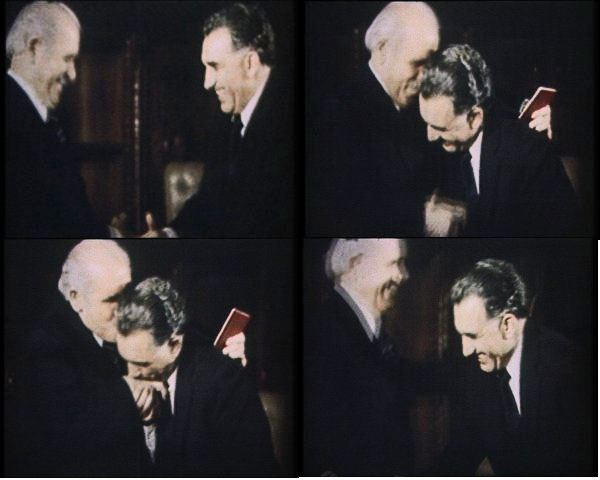
Deputy Premier Hafizullah Amin (on right) is shown in this series of frames swearing his allegiance to Premier Noor Mohammad Taraki in 1979, shortly before arranging to have him assassinated. Image from BBC.

Part 10: 1979-1981
A People’s History of Afghanistan

By Bob Feldman / The Rag Blog / June 14, 2010

[If you’re a Rag Blog reader who wonders how the Pentagon ended up getting stuck “waist deep in the Big Muddy” in Afghanistan (to paraphrase a 1960s Pete Seeger song) — and still can’t understand, “what are we fighting for?” (to paraphrase a 1960s Country Joe McDonald song) — this 15-part “People’s History of Afghanistan” might help you debate more effectively those folks who still don’t oppose the planned June 2010 U.S. military escalation in Afghanistan? The series so far can be found here.]

In 2010 the Democratic Obama Administration is spending another $95 billion on the Pentagon’s endless war in Afghanistan . Yet many viewers of PBS-affiliated television stations or readers of Rolling Stone magazine in the USA still probably know more about the history of rock music since the 1950s than about the hidden history of Afghanistan since 1979.

In September 1979, for example, supporters of People’s Democratic Party of Afghanistan [PDPA]-Khalq Premier Noor Mohammad Taraki discovered that PDPA-Khalq was plotting to kill Taraki — after political disagreements between the two PDPA-Khalq government leaders developed between March 1979 and July 1979, and Amin apparently began appointing just members of his own family to fill important Afghan government posts.

But Amin was still able to force Taraki to resign as Afghan prime minister on September 15, 1979, following Taraki’s return from abroad after attending a conference of leaders of non-aligned nations. And Amin apparently then arranged for former PDPA-Khalq leader Taraki to be killed on October 8 or 9, 1979.

When Taraki had visited Moscow in March 1979 to first request that Soviet ground troops be sent into Afghanistan to help his government’s Afghan army defeat the anti-feminist Mujahdeen guerrillas, the Brezhnev regime had refused at that time to send large numbers of Soviet troops across the border into Afghanistan.

But Taraki — who, along with Amin, had personally signed in Moscow the December 5, 1978, Treaty of Friendship between the Soviet Union and Afghanistan — had apparently been considered friendlier to the Soviet Union than the Columbia University Teachers College and University of Wisconsin-trained Amin

So after Taraki was killed, the Brezhnev regime in the Soviet Union apparently decided that the PDPA-Parcham faction leader that Amin had demoted in late June 1978 — Babrak Karmal — should replace Amin as Afghan head of state (if large-scale Soviet military intervention in Afghanistan was required to prevent the U.S. and Pakistani-backed Afghan Mujahideen militias — which by then controlled 23 of Afghanistan’s 28 provinces — from quickly overthrowing the increasingly unpopular government that had been established by the April 1978 Saur Revolution).

On December 12, 1979, the Brezhnev regime did decide to order large numbers of Soviet ground troops to cross the Soviet-Afghan border and march into Afghanistan on December 23, 1979. One result of this internationally unpopular December 1979 decision was that 13,369 members of the Soviet military would subsequently be killed (and 35,578 troops would be wounded), according to official Soviet government casualty figures.

On December 27, 1979, 300 Soviet commandos then surrounded and attacked Amin’s residence at 7 p.m.– at the same time that other Soviet troops seized Kabul’s radio station. An apparently recorded message from PDPA-Parcham faction leader Karmal, announcing that he was the new head of the Afghan government, was then broadcast over the radio — while Amin and Amin loyalists unsuccessfully fought until 1 a.m. against the 300 Soviet commandos who were attempting to arrest Amin. After being taken to Soviet military headquarters in Kabul, Amin was apparently then executed.

The Democratic Carter Administration next used the Brezhnev regime’s internationally unpopular military response to the Pakistani and U.S. governments’ covert support for regime change and the right-wing Mujahadeen insurgency in Afghanistan as a pretext for once again requiring U.S. men between 18 and 26 years of age to register for a future U.S. military draft. As Democratic President Carter explained in his January 23, 1980 State of the Union speech:

The region which is now threatened by Soviet troops in Afghanistan is of great strategic importance: It contains more than two-thirds of the world’s exportable oil. The Soviet effort to dominate Afghanistan has brought Soviet military forces to within 300 miles of the Indian Ocean and close to the Straits of Hormuz, a waterway through which most of the world’s oil must flow. The Soviet Union is now attempting to consolidate a strategic position, therefore, that poses a grave threat to the free movement of Middle East oil.

This situation demands careful thought, steady nerves, and resolute action, not only for this year but for many years to come… It demands the participation of all those who rely on oil from the Middle East…

I believe that our volunteer forces are adequate for current defense needs, and I hope that it will not become necessary to impose a draft. However, we must be prepared for that possibility. For this reason, I have determined that the Selective Service System must now be revitalized. I will send legislation and budget proposals to the Congress next month so that we can begin registration and then meet future mobilization needs rapidly if they arise…

Former Columbia University Professor and then-National Security Affairs Advisor Brzezinski then visited Pakistan in February 1980 and “met with General Akhtar, the ISI [Inter-Services Intelligence] chief, as well as with [then-Pakistan] president Zia-al-Haq and with CIA station chief in Islamabad John J. Reagan,” according to John Cooley’s Unholy War: Afghanistan, America and International Terrorism.

But because covert CIA aid to the Afghan resistance fighters violated international law, “both Washington and Islamabad went to extraordinary lengths to cover up their” increased military “assistance to the Afghan Mujahideen,” according to Angelo Rasanayagam’s Afghanistan: A Modern History. The same book also noted that “for this reason it was decided that only Warsaw Pact weaponry would be delivered, as such weapons could not be traced back to the US…”

So “the Cold Warriors in Langley, Virginia” then “developed… a top-secret program, codenamed SOVMAT,” which “was probably unknown even to President Zia al-Haq and the holy-war commanders in Pakistan’s ISI,” according to Unholy War. The same book also described how the CIA’s secret SOVMAT program of the early 1980s operated:

Working with a vast army of phony corporations and fronts, the CIA under the SOVMAT program would buy weapons from East European governments and governmental organizations… Their acquisition and testing by the U.S. military and the CIA facilitated development of counter-measures, such as improved anti-tank weapons used by the Mujahideen…

“Officials running the CIA’s SOVMAT program provided wish lists for CIA and ISI officers operating from Pakistan, who sent their Afghan mercenaries to ransack Soviet supply depots… Some Afghan fighters were taught in their CIA-managed training by the ISI in Pakistan to strip Soviet SPETZNAZ or special forces soldiers of their weapons…

Next: “A People’s History of Afghanistan—11: 1981-1987″

[Bob Feldman is an East Coast-based writer-activist and a former member of the Columbia SDS Steering Committee of the late 1960s.]

  • Previous installments of “A People’s History of Afghanistan” by Bob Feldman on The Rag Blog can be found here.

The Rag Blog

Posted in Rag Bloggers | Tagged , , , , , | Leave a comment

Steinbeck Comes to Arizona : Rereading ‘The Grapes of Wrath’


Reading “The Grapes of Wrath” in 2010:
Immigration, capitalism, and
Arizona’s historic moment

By Alex Knight / The Rag Blog / June 14, 2010

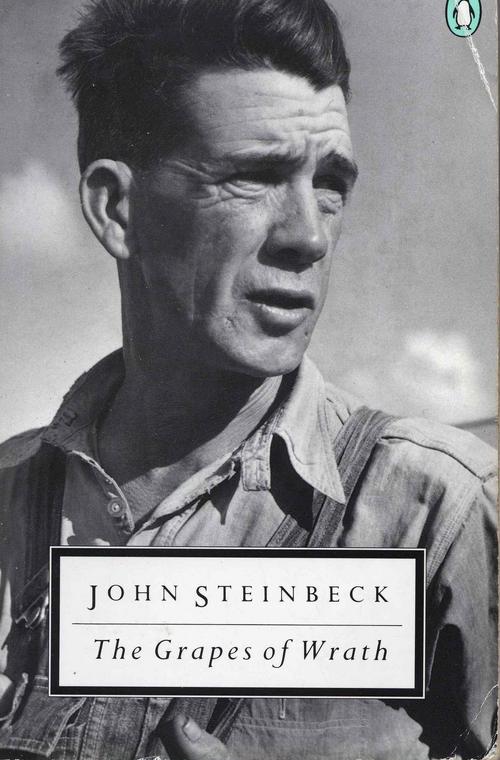
[The Grapes of Wrath by John Steinbeck, published 1939 during the last Great Depression.]

Arizona SB1070, signed into law by Governor Jan Brewer on April 23, 2010, requires Arizona’s local and state law enforcement to demand the immigration status of anyone they suspect of being in the country illegally, and arrest them if they lack documents proving citizenship or legal residency.

Effectively making racial profiling into state policy, this law is the latest in a series of attacks on Latin American immigrants, as well as the entire Latino community, who must live with the fear of being interrogated by police for their brown skin.

Then on May 11, Arizona went one step further, outlawing the teaching of ethnic studies classes, or any classes that “are designed primarily for students of a particular ethnic group or advocate ethnic solidarity.” This same law also states that schools must fire English teachers who speak with a “heavy accent.”

Perhaps these new laws make sense if we imagine that undocumented immigrants are merely “aliens,” a danger to the good, mostly white citizens of this great country. But suppose we look at the problem of immigration from the perspective of the immigrants? Why are they risking life and limb to come to a foreign land, far from their home and families? Why aren’t they deterred from making this trip no matter how many walls we put up, no matter how many police collaborate with ICE, no matter how many angry armed “Minutemen” vigilantes are conscripted to guard the border?

John Steinbeck’s classic novel The Grapes of Wrath, following the Joad family as they migrate to California during the “Dust Bowl” of the 1930s, sheds light on these questions in a way that perhaps every American can relate to. One of the most popular and well-written American books of all time, The Grapes of Wrath gives a very human perspective on the harsh lives of migrants, personified by the Joads — a family of poor sharecroppers from Oklahoma.

Evicted from their family farm, just as the millions of Mexicans who have suffered enclosure from their land and become homeless and jobless because of NAFTA, the Joads travel to California in a desperate search of work, only to encounter the harassment of authorities and the hatred of the local population.

There are important differences between the “Okies” who traveled to the Southwest in the 1930s and Latino inmigrantes of the 2000s. The Joads, of course, were white, and did not cross a national border when they made their exodus. But at its core the story of the Joads is the story of the migrant workers, their troubles, their fears, but also their humanity, and their hope.

It is a story that can inspire us to recognize the historic nature of the moment in which we live, understand why these enormous transformations are occurring, and recognize that justice for the immigrants is justice for everyone, regardless of color or citizenship status.

“Migrant Mother.” Destitute pea picker Florence Thompson with several of her children, photographed in Nipomo, California. Farm Security Administration (FSA) photo by Dorothy Lange (1936) / Wikimedia Commons.

Enclosure

In order to understand the inmigrantes we first have to understand the story of their displacement, or the enclosure of their land, which has left them homeless and with no other options than to leave their homeland in search of a wage. What can The Grapes of Wrath tell us about this reality?

People usually do not resort to risky and desperate moves unless they have nothing left to lose. Steinbeck begins the Joads’ story with the loss of everything they had: the small farm on which they had sustained their family for generations by growing cotton. Young Tom Joad, fresh out of prison, returns to his home to find it deserted.

The Reverend Casy and young Tom stood on the hill and looked down on the Joad place… Where the dooryard had been pounded hard by the bare feet of children and by stamping horses’ hooves and by the broad wagon wheels, it was cultivated now, and the dark green, dusty cotton grew… ‘Jesus!’ he said at last. “Hell musta popped here. There ain’t nobody livin’ there.” (51)

Whether as tenants or small landholders, either for subsistence or for markets, the vast majority of the poor inmigrantes now coming to this country are fleeing the loss of their farms and their livelihoods, just as the Joads. Perhaps for generations, maybe hundreds or even thousands of years, they had lived in connection with the land and had been able to depend on it for the survival of their families and culture. The loss of this land is devastating to those cultures, but larger forces stand to gain by driving these people into homelessness.

The phenomenal book Caliban and the Witch: Women, the Body, and Primitive Accumulation (Autonomedia 2004) details the violent origins of capitalism in 15th-17th century Europe. In it, author Silvia Federici defines the “enclosures” that were necessary for giving birth to capitalism by divorcing the European peasantry from their traditional lands and leaving them with no other choice but to sell their labor for a wage in the emerging industrial economy.

In the 16th century, “enclosure” was a technical term, indicating a set of strategies the English lords and rich farmers used to eliminate communal land property and expand their holdings. [In the footnote she quotes E.D. Fryde:] “[p]rolonged harassment of tenants combined with threats of evictions at the slightest legal opportunity” and physical violence were used to bring about mass evictions… (69)

She goes on, revealing that this enclosure process remains a core element of the capitalist economy we live in:

In the same way in which multinational corporations take advantage of the peasants expropriated from their lands by the World Bank to construct “free export zones” where commodities are produced at the lowest cost, so, in the 16th and 17th centuries, merchant capitalists took advantage of the cheap labor-force that had been made available in the rural areas to break the power of the urban guilds… As soon as they lost access to land, all workers were plunged into a dependence unknown in medieval times, as their landless condition gave employers the power to cut their pay and lengthen the working-day.” (72)

Enclosure is precisely the part of the story we never hear about in the mainstream immigration debate in America. It is never questioned why hundreds of thousands of workers are scrambling to come to the U.S., other than for “our freedom” or to “take our jobs.” But Steinbeck boldly begins The Grapes of Wrath by highlighting the enclosure process as it operated in rural America during the Great Depression.

In the 1930s, Oklahoma was ground zero for the “Dust Bowl.” Unsustainable industrial farming practices such as the monoculture of cotton without crop rotation caused the soil to die, then be picked up by the wind and create enormous dust storms. On page 41, Steinbeck laments, “You know what cotton does to the land; robs it, sucks all the blood out of it.” The settling layers of dust killed the crops and made it harder for small farmers to earn a living, and many were driven into debt and became tenants on land that was then technically owned by the bank.

At the same time, large, wealthy landowners were able to use tractors and other new farming machinery to replace the many tenants who had previously been needed to work the land. “Pa borrowed money from the bank, and now the bank wants the land. The land company — that’s the bank when it has land — wants tractors, not families on the land” (193).

In this passage, Steinbeck brilliantly exposes the evictions as part of the normal functioning of capitalism, as a land owner arrives to evict a tenant family:

Some of the owner men were kind because they hated what they had to do, and some of them were angry because they hated to be cruel, and some of them were cold because they had long ago found that one could not be an owner unless one were cold. And all of them were caught in something larger than themselves…

If a bank or a finance company owned the land, the owner man said, the Bank — or the Company — needs — wants — insists — must have — as though the Bank or the Company were a monster, with thought and feeling, which had ensnared them… [T]he owner men explained the workings and the thinkings of the monster that was stronger than they were. A man can hold land if he can just eat and pay taxes; he can do that. But — you see, a bank or a company can’t do that, because those creatures don’t breathe air, don’t eat side-meat. They breathe profits; they eat the interest on money. If they don’t get it, they die the way you die without air, without side-meat… The bank — the monster has to have profits all the time. It can’t wait. It’ll die. When the monster stops growing, it dies. It can’t stay one size. (40-42)

As far as capitalism is concerned, whatever will maximize profit is the arrangement that must be pursued, regardless of the human consequences. The situation in Mexico today resembles that of Oklahoma 75 years ago. Small family farms are no longer profitable enough, and people are being thrown off their land every year by the thousands.

The North American Free Trade Agreement (NAFTA), signed into law by Bill Clinton on December 8, 1993, created the largest “free trade” zone in the world: Canada, the United States, and Mexico. The treaty stipulated that there could be no “barriers to trade,” such as a tariff/tax on foreign products. In this video [below] MIT professor Noam Chomsky, interviewed by Rage Against the Machine frontman Zack de la Rocha, explains how the modern enclosures in Mexico are a result of NAFTA, which has not had the effect it was promised to have for the U.S. and Mexican economies.

As mentioned by Professor Chomsky, one direct result of NAFTA was the flooding of the Mexican market with artificially cheap agricultural products from the United States, such as corn, which is heavily subsidized by the U.S. government. From 1990-2000, the price of corn in Mexico fell by 58 percent, and as there is simply no way for the vast majority of Mexican tenant farmers to compete with this artificially low cost of American corn and other products, millions were driven into poverty and debt, and soon faced eviction.

This excellent article from the Institute for Food & Development Policy states that “Since NAFTA, 80 percent of rural Mexicans live in poverty, with 60 percent living in extreme poverty.” It also points out that as of 2004, a total of 1.7 million subsistence farmers had been pushed off their land because of NAFTA. So it should be no surprise that the number of Mexican immigrants entering the U.S. increased by 75 percent in the five years after NAFTA became law. The form of the enclosures has changed, but the fact has remained. People driven from their land will search for work in other places.

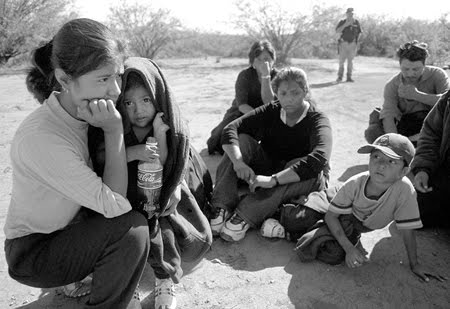
A group of Mexican immigrants await the arrival of authorities after being apprehended in the Arizona desert by members of Civil Homeland Defense, a citizen vigilante group. Photo by Mike Kane (2004) / UT Documentary Center / University of Texas at Austin.

Xenophobia

The second great lesson The Grapes of Wrath reveals about the immigrants is how they are feared and hated, by the local population as well as the authorities, and what it means to endure and overcome this xenophobia.

Once California belonged to Mexico and its land to Mexicans; and a horde of tattered feverish Americans poured in. And such was their hunger for land that they took the land — stole Sutter’s land, Guerrero’s land, took the grants and broke them up and growled and quarreled over them, those frantic hungry men; and they guarded with guns the land they had stolen… And as time went on, the business men had the farms, and the farms grew larger, but there were fewer of them.

Now farming became industry, and the owners followed Rome, although they did not know it. They imported slaves, although they did not call them slaves: Chinese, Japanese, Mexicans, Filipinos. They live on rice and beans, the business men said. They don’t need much. They wouldn’t know what to do with good wages. Why, look how they live. Why, look what they eat. And if they get funny — deport them.
[….]
And then the dispossessed were drawn west — from Kansas, Oklahoma, Texas, New Mexico; from Nevada and Arkansas families, tribes, dusted out, tractored out. Caravans, carloads, homeless and hungry; twenty thousand and fifty thousand and a hundred thousand and two hundred thousand. They streamed over the mountains, hungry and restless — restless as ants, scurrying to find work to do — to lift, to push, to pull, to pick, to cut — anything, any burden to bear, for food. The kids are hungry. We got no place to live…

They had hoped to find a home, and they found only hatred. Okies — the owners hated them. And in the town, the storekeepers hated them because they had no money to spend… The town men, little bankers, hated Okies because there was nothing to gain from them. They had nothing. And the laboring people hated Okies because a hungry man must work, and if he must work, if he has to work, the wage payer automatically gives him less for his work; and then no one can get more. (297-300)

Throughout the book, as the weary Joads meander west on their old jalopy, their eagerness and optimism about finding decent work and a better life in California is dashed against the rocks of poverty and hatred. Early in the book, Tom’s pregnant sister Rose of Sharon Joad goes on about her expectations about life once the family arrives in California.

Well, we talked about it, me an’ Connie… Connie gonna get a job in a store or maybe a fact’ry. An’ he’s gonna study at home, maybe radio, so he can git to be an expert an’ maybe later have his own store… An’ Connie says I’m gonna have a doctor when the baby’s born; an’ maybe I’ll go to a hospiddle. An’ we’ll have a car, little car… (212)

But shortly after crossing the border into California, the Joad family encounters the authorities, who are less than pleased by the arrival of more migrants into their state. After setting up camp by a river, Ma settles down for a nap in the tent, only to be disturbed by a law enforcement agent who gives her a threatening welcome.

“Well, you ain’t in your country now. You’re in California, an’ we don’t want you goddamn Okies settlin’ down.”
Ma’s advance stopped. She looked puzzled. “Okies?” she said softly. “Okies.”
“Yeah, Okies! An’ if you’re here when I come tomorra, I’ll run ya in.” He turned and walked to the next tent and banged on the canvas with his hand. “Who’s in here?” he said. (275)

It becomes clear through the story that the California police and authorities tolerate the presence of the “Okies” so they can be exploited for their extremely cheap labor. Sheriffs and rangers even guard the grounds of large private farms where migrants are bussed in. However, the cops maintain a close eye on the Okies, and are not afraid to resort to violence when they step out of line.

The Joads arrive one night in a “Hooverville,” the name for the slums on the edges of towns during the Great Depression where unemployed would set up camp. Here a contractor comes to find desperate workers, escorted by a deputy sheriff with whom Tom Joad gets into an altercation.

The contractor turned to the Chevrolet and called, “Joe!” His companion looked out and then swung the car door open and stepped out…
“Ever see this guy before, Joe? He’s talkin’ red, agitating trouble…”
“Hmmm, seems like I have. Las’ week when that used-car lot was busted into. Seems like I seen this fella hangin’ aroun’. Yep! I’d swear it’s the same fella.” Suddenly the smile left his face. ‘Get in that car,’ he said, and he unhooked the strap that covered the butt of his automatic.
Tom said, “You got nothin’ on him.”
The deputy swung around. “F you’d like to go in too, you jus’ open your trap once more. They was two fellas hangin’ around that lot.” (338-9).

The goal of the authorities in the story, as in the country today, is to keep immigrants in a constant state of precariousness, where they cannot make waves for fear of being imprisoned or deported. This climate of fear is the real effect of Arizona SB1070, not to actually deport all the undocumented workers from the state, because that would hurt the economy that depends on their cheap labor.

In fact, this CNN video [below] documents that SB1070 has already driven away too many workers from the state and hurting the businesses that had employed them. It seems it has backfired so much that even Russell Pearce, the author of the legislation, has now reversed his stance and is supporting “guest worker” legislation to invite undocumented workers back into the state.

What does the climate of fear surrounding immigrants do for the U.S. capitalist economy and its ruling class?

First, it keeps undocumented immigrants in that precarious state where they will not seek help or point out injustices, nor will they try to organize unions and demand higher pay or working conditions. It guarantees they will mostly toil for less-than-minimum wages and suffer in silence.

Most Americans are not even aware that since NAFTA was enacted, at least 3,000 Mexicans have died trying to cross the border. Every wall that goes up on the border drives the immigrants into more remote deserts to reach their destination, increasing the likelihood of injury and death, but precious few U.S. citizens are willing to stick their necks out to help prevent such unnecessary deaths.

Second, the xenophobia encouraged by measures like SB1070 is useful for the ruling class because it drives a racial wedge into the American working class. Instead of uniting to fight for better jobs, affordable education, health care, housing, an end to environmental nightmare and endless wars, the anger of the common people is directed at the scapegoat of the immigrant.

Steinbeck illustrates this phenomenon when “a crowd of men” “armed with pick handles and shotguns,” confront the Joads after they flee the Hooverville. Interrogating and threatening the Joad family, these self-styled vigilantes act just as the “Minutemen” who today rove the deserts of Arizona, looking for “illegals.”

Though these people’s anger and fear over the state of the U.S. economy is warranted, they are failing to confront the actual thieves and criminals who have plunged the world into a new Great Depression. Because by identifying “foreigners” and people with brown skin and different accents as the reason why wages are low and jobs are lost, corporations and politicians are able to deflect attention away from the real source of economic hardship: themselves.

Conclusion

The crisis in the Southwest in the 1930s is unfortunately similar to the situation today. Hundreds of thousands of poor migrants, their land enclosed and with nowhere to go, facing long trips through the heat of the desert and the ice of xenophobia, are nevertheless persisting to do what they need to do to feed their families.

There is a tidal wave coming north now, which resembles one that three generations ago came west, but like that one there will be no stopping it by putting up walls and threatening people with violence or deportation. Desperate people will always do what they need to do to survive. The only way to stem the flow is to repair the dam that has burst through poverty and enclosure.

Latinos need decent livelihoods in Latin America before they will stop coming here, “scurrying to find work to do.” Repealing NAFTA and ending the massive corn subsidies for U.S. agribusiness would be two huge steps in the right direction. Rather than making the United States into a nasty place that no one will want to come to, why not focus on helping Mexico, Latin America, and the world as a whole, be suitable places to live, work, and raise a family?

The Grapes of Wrath, though it details the hardships of the migrant workers at great length, won the Pulitzer Prize and captured the hearts of the nation because it is ultimately a hopeful book that inspires us to act for positive change.

John Steinbeck, flexing his radical muscles, argues in the book that by targeting the weak and poor with measures such as those currently being enacted in Arizona, capitalism is only putting off its inevitable demise. “The great owners ignored the cries of history.” “[Especially,] the little screaming fact that sounds through all history: repression works only to strengthen and knit the repressed.”

He explains:

The land fell into fewer hands, the number of dispossessed increased, and every effort of the great owners was directed at repression. The money was spent for arms, for gas to protect the great holdings, and spies were sent to catch the murmuring of revolt so that it might be stamped out. The changing economy was ignored; and only means to destroy revolt were considered, while the causes of revolt went on. The tractors which throw men out of work, the machines which produce, all were increased; and more and more families scampered on the highways, looking for crumbs from the great holdings, lusting after the land beside the roads. The great owners formed associations for protection and they met to discuss ways to intimidate, to kill, to gas. And always they were in fear of a principal — three hundred thousand — if they ever move under a leader — the end. Three hundred thousand, hungry and miserable; if they ever know themselves, the land will be theirs and all the gas, all the rifles in the world won’t stop them.” (306-7)

[Alex Knight is an organizer, teacher and writer in Philadelphia. He is currently helping Philly mobilize for the United States Social Forum Source in Detroit this June 22-26. He also maintains the website endofcapitalism.com and is in the process of writing a book called The End of Capitalism. He can be reached at activistalex@gmail.com.]

The Rag Blog

Posted in Rag Bloggers | Tagged , , , , , , , , , , | 2 Comments

VERSE / Larry Piltz : The Wound of the Gulf

The Gulf of Mexico. Photo from Nature’s Portraits.

Oil is the salt in
The wound of the Gulf

By Houma Cayenne

We have saltwater in our veins
and when it pours it biblically rains
God knows we’ve had our losses and gains
had lots of Abels and our share of Cains
but we’re open and we’re warm
and we let our love be our charm
and believe in the power of first do no harm
we believe in the power of first do no harm

There’s a Gulf within
and a Gulf out there
there’s the Gulf my friend
and a Gulf of care
a Gulf between
what we say and do
the silent Gulf we don’t mean
between me and you
the Gulf between
suffering and ease
a wide Gulf that’s bridged
like the old Rigolets

Is ours a Gulf of childhood innocence
or a Gulf of lost dream penitence
or a Gulf of ambiguity
to suffer in perpetuity

A mullet slaps the waves
in the land of the wet and the brave
in a land that cannot be paved
in a land that can still be saved

A black water snake is sunning
and a shrimper’s engine’s gunning
as the tides just keep on running
watch us run on kindness and cunning
in a land where nothing is wanting

Along a backwater mirror glass
a nursery for life from its source to the pass
where fresh and salt make fertile mishmash
the rare conditions for life in a clash
runs a rabbit through the cordgrass
with the hope this day won’t be its last
as hawk circles over the marsh
with an appetite that’s harsh
but the rabbit is hungrier still
for life with her genius stubborn will
and today there’ll be no kill
but for neither will time be standing still
and tomorrow will have its fill
from the rarest cougar to herds of krill
for those with lung and with sifting gill
and with claws and longing and vital quill
in this land without a rock or hill
digesting petroleum’s poison pill
because of a violently negligent spill

Oil is the salt in the wound of the ocean
the salt in the womb of The Gulf in motion
the Womb of Creation not some vague notion
The Gulf a womb of sacred devotion
pierced in its side its bleeding quotient
oil is the salt in the wound of the ocean
the salt in the womb of The Gulf in motion

Huoma Cayenne
As told to Larry Piltz / The Rag Blog
June 14, 2010

The Rag Blog

Posted in Rag Bloggers | Tagged , , , | Leave a comment

Neuroscientist David Eagleman: Portrait of a ‘Possibilian’

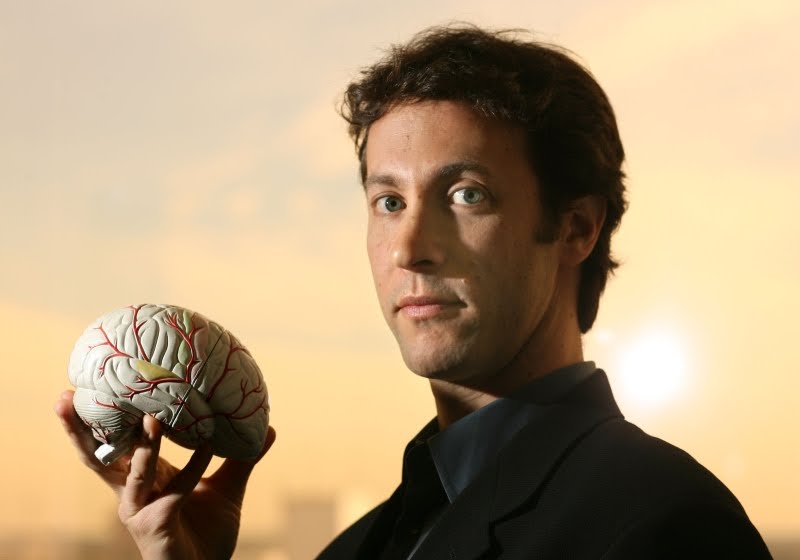
David Eagleman. Image from Researchers and Theories / comcast.net.

Baylor’s David Eagleman:
The Carl Sagan of neuroscience

…in the space between the materialist and mystic, anything’s possible.

By Robert Jensen / The Rag Blog / June 14, 2010

[An edited version of this article appeared in the May 28, 2010, issue of The Texas Observer and is online here.]

There’s a struggle going on inside the brain of David Eagleman for the soul of David Eagleman.

That is, there might be such a struggle if Eagleman’s brain believed that Eagleman had a soul, which he is not sure about. In fact, Eagleman’s brain is not completely sure that there is an Eagleman-beyond-Eagleman’s-brain at all, with or without a soul, whatever that term might mean.

Welcome to the world of “possibilian” neuroscientist-writer David Eagleman, to life in the space between what-is and what-if, between the facts we think we know and the fictions that illuminate what we don’t know.

Eagleman-the-scientist would love to rev up his high-tech neuroimaging machines to answer the enduring questions about the brain and the mind, the body and the soul. But Eagleman-the-writer knows that those machines aren’t going to answer those questions.

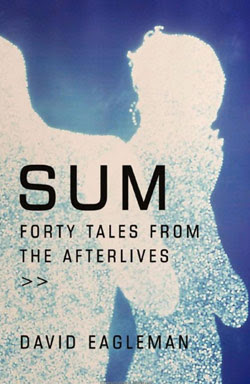
So, while he reports on what-is in scientific journals, his brain and mind run free pondering the what-ifs, as he did in the 2009 book Sum: Forty Tales from the Afterlives, a playful series of short philosophical imaginings of life beyond death. And, if things work out the way Eagleman hopes, someday he’ll get a shot at a larger stage where he can fulfill his dream of becoming the Carl Sagan of the brain, explaining the billions and billions of neurons in our head to a curious public.

Anything’s possible

Though they might seem different, Eagleman’s scientific and literary lives really are part of the same creative endeavor aimed at deepening our understanding of a complex world we can never really come close to understanding. In the spiritual realm, that leads Eagleman to reject not only conventional religion but also the label of agnostic or atheist. In their place, he has coined the term possibilian: those who “celebrate the vastness of our ignorance, are unwilling to commit to any particular made-up story, and take pleasure in entertaining multiple hypotheses.”

Since scientists mostly talk about what they know, Eagleman’s emphasis on our ignorance may seem strange. So, it’s time for an analogy. Eagleman likes analogies.

The work of science is like building a pier out into the ocean, he says. We excitedly add on to the pier little by little, but then we look around and say, “Wait a minute, I’m at the end of the pier but there’s a lot more out there.” The ocean of what we don’t know always dwarfs what we do know, he emphasizes. “During our lifetimes, we will get further on that pier. We’ll understand more at the end of our lives than we do now, but it ain’t going to cover the ocean.”

Settling in at his office at the Baylor College of Medicine in Houston, Eagleman swivels 180 degrees in his chair, his foot pushing off the various pieces of office furniture to propel him around like a kind of wind-up machine, the verbal velocity moving between fast and faster depending on his fascination with a particular idea. Those ideas can range from the latest experiments he’s running in the five fMRI (functional Magnetic Resonance Imaging) machines down the hall, to age-old philosophical questions about free will and implications for the legal system, to those speculations about an afterlife.

His first book, the co-authored the co-authored Wednesday is Indigo Blue: Discovering the Brain of Synesthesia, analyzed the phenomenon of synesthesia (a condition in which one sense, such as sight, is simultaneously perceived by another sense, such as hearing — “hearing a color,” for example). One reviewer recommended the book for those with “a passion for neurology’s wild territory,” which Eagleman is exploring further for a general audience in his third book, the forthcoming Dethronement: The Secret Life of the Unconscious Brain. His central project in that book, and all his scientific work, is to understand how the human brain constructs reality.

In between those two books came Sum, a surprising success in the United States and Britain that is now out in paperback. It also spawned a theatrical adaptation staged at the Sydney Opera House in Australia with an original score written and performed by avant-garde musician-producer Brian Eno. The book’s speculative musings have captured the imagination of a small but lively group of people who claim the possibilian label, leading Eagleman to begin writing Why I’m a Possibilian to flesh out the ideas.

Taking seriously the old saying “the absence of proof isn’t the proof of absence,” Eagleman recognizes that people who don’t believe in God (at least not in God defined as a supernatural force or entity) can never say with certainty what doesn’t exist. So, the difference between agnostic and atheist is typically a matter of attitude, and such is the case with adding possibilian to the mix. Eagleman is not trying to support or rule out any particular claim but simply suggesting that it’s healthy to imagine possibilities.

What if there is an afterlife where we relive all our experiences but shuffled into a new order? What if in an afterlife we confront all the possible versions of our self that could have been? What if we experience death in stages: when the body stops functioning, when we’re buried, and the moment when your name is spoken by another for the last time? Sum offers 40 such what-ifs. [For a video trailer of the book, go here.]

The stories aren’t meant as serious proposals about what an afterlife may be, and are really just a vehicle for Eagleman’s ruminations on the vexing philosophical questions we face in life. When we talked in his Houston office, Eagleman was finishing the last chapter of Dethronement to send off to the publisher, and those questions were on his mind. One of the most basic concerns the mind: Is our consciousness the product of anything beyond the material realm? Is there anything beyond the physical brain? If there is something beyond, is that what we should call the mind? What does all this mean for the concept of the soul?
Pinning down consciousness

Eagleman acknowledged that in labs such as his, neuroscientists work under the assumption that “you are nothing but your brain,” and many scientists and philosophers come close to suggesting that this is not an assumption but a fact. Eagleman refers to this as the “hardcore” reductionist/materialist view — reducing the mental to the material, reducing the mind to the physical brain. That could be the case, he says, but it makes him nervous.

His first hesitation is common; no one could really look at humans as “just a bunch of atoms, or just a bunch of neurons” because of the concept of emergent properties. Eagleman explains: “If you took any piece of an airplane, that piece of metal does not have the property of flight. It’s only when you put it together in exactly the right way that you get something out of it.” The key is the interaction among the components, the properties that emerge from that specific interaction that the individual components don’t have alone.

Here’s a classic example: At room temperature, hydrogen and oxygen are gases. Combine one oxygen and two hydrogen atoms and you get water. Liquidity is an emergent property, which no chemist could have predicted by analyzing the individual atoms. The same can be said of us — we are made up of material components, but what is interesting about humans is not those components but the emergent properties. Consciousness couldn’t be predicted from a list of the elements that make up each one of us.

Eagleman’s second hesitation is more intriguing. We shouldn’t presume, he says, that we know about all the pieces that make us up or all the forces that structure the world in which we operate. Enter the possibilian.

“Almost certainly, we’re missing giant pieces,” he says, just as previous generations were missing a big piece of the puzzle when they attempted to understand the world without the concept of gravity. “We’re in that situation now, and the reason we know we’re in that situation is because for the most fundamental questions we have, like consciousness, we not only don’t know the answer but we don’t even know what the answer could look like.”

The question of consciousness? “How do you put together a bunch of physical pieces and parts, and get private subjective experience out of that? How do you get the taste of feta cheese or the redness of red or the feeling of pain?”

Neuroscience labs are busy mapping neural circuits — the signals within the brain, and between the brain and the rest of the body — but Eagleman emphasizes “that’s just mechanical stuff, and every single discovery in every neuroscience lab is just mechanical stuff.” He’s happy to tell anyone who will listen about the amazing stuff that neuroscience has figured out, but he doesn’t want to get lost in that.

“We’re stuck with this very deep problem, this 800-pound gorilla: If it’s all just mechanical stuff everywhere we look and if every part of the brain is connected to, and driven by, other parts of the brain, then where’s consciousness?” For most folks, the answer might be, “Well, it’s in my mind.” But that begs the question of what we mean by mind, beyond the physical brain. What is a mind? (A quick quiz: Your brain weighs about three pounds. How much does your mind weigh?)

Long before fMRI machines, philosophers have been debating these questions. David Sosa, a professor and philosophy department chair at the University of Texas at Austin, says the materialists dominate the field these days, though he remains a dualist (a type of theory that argues the mind and the brain, the mental and the physical, are different kinds of thing). Sosa is respectful of the work of neuroscientists and agrees philosophers should be engaging their findings, but he’s unwilling to rush to judgment.

Eagleman shares that caution. He has no glib response about the question of consciousness and says there’s not even a clear way to frame questions about private subjective experience — “there’s no equation that can give us the taste of feta cheese,” he says.

That’s why Eagleman, a hardcore neuroscientist who loves the “stuff” coming out of his lab as much as conventional religious believers love the “stuff” in their holy books, isn’t a hardcore materialist. But what could the missing pieces be? Time for another analogy.

Imagine folks with no exposure to modern gadgets find a radio. They hear a human voice coming out, yet there’s no one speaking. They fiddle with the radio, remove the back cover, pull on a wire, and observe that the voice stops. They reconnect the wire, and the voice is back. They touch other parts and the voice changes. Not knowing about the electromagnetic spectrum, these tinkerers would be tempted to assume the voice is coming from the radio itself.

Back to emergent properties. It might be tempting to conclude that the voice is an emergent property of the radio, of the way the parts and pieces are arranged, but that would miss the invisible radio waves. “The physical integrity of the radio is necessary for its proper functioning, but it’s not about the physical thing. That’s just a receiver for things coming from elsewhere,” Eagleman says.

It’s plausible, he concludes, that we could be waiting for the neuroscience equivalent of discovering the law of gravitation, waiting to discover “whole new — I don’t even know what to call them — forces or dimensions or whatever. A hundred years from now people might say, ‘those poor assholes in the 21st century were trying to solve the consciousness problem and they didn’t even know about force X.’”

Eagleman is quick to make it clear he’s not saying there’s a force X; he doesn’t want to be lumped in with the folks peddling New Age flakiness. He just wants to keep an open mind, which is what he thinks science is all about — extend the pier but don’t forget about the vastness of the ocean, expand what we know but remember that what we know is dwarfed by what we don’t know.

Team Eagleman. Members of David Eagleman’s lab. Image from Baylor College of Medicine.

Scientific story-tellers and lock-pickers

At moments like this, the scientific and the literary Eagleman are most clearly one. Human beings, including scientists, he emphasizes, are storytellers. He believes scientists tell some of the best stories humans have come up with to explain how the world works. But the way that the “facts” of the science of one era are replaced by new discoveries should remind us that science is always just telling stories. The earth is pushed out of the center of the universe, Newtonian physics gets nudged by quantum mechanics — science marches on, with lots of “facts” left by the side of the road to rust.

Throw a stone into any contemporary university English department and you’ll hit at least one postmodern literary theorist who will talk about science as narrative, but it’s rare to hear it from a scientist who is as committed to the scientific project as Eagleman. Here’s someone running a lab with five high-test fMRI machines, 16 employees, and a half-million dollar-a-year budget. And it’s all just stories?

“I don’t want to say ‘just stories.’ These are the best stories we have on the planet,” he asserts, the stories that cure disease and make space travel possible. “I’m just saying that they are narratives that can change. Science is a tremendously successful pursuit, but there’s a lot of wiggle room.”

The awareness that there is always potentially a game-changing discovery around the corner is, for Eagleman, the allure of science. “I don’t think people would want to go into science unless they thought there was something big to be discovered. You go in because you think, ‘I want to kick over the whole fucking chessboard.’ That’s what makes a good scientist.”

Growing up in Albuquerque, New Mexico, with a psychiatrist father and biologist mother who both loved books, Eagleman was exposed to lots of discussion about what makes good science and good literature. When he went off to college to major in literature at Rice University in Houston, he dabbled in space physics and engineering but avoided biology; his last biology class had been in the 10th grade, at which time he pronounced the subject “gross.” But late in his undergraduate career he found himself drawn to questions about the brain, and once he started reading he was hooked.

After doctoral work at the highly rated program in neuroscience at Baylor College of Medicine, he spent five years in San Diego in a fellowship at the Salk Institute before taking a faculty job in the University of Texas-Houston Health Science Center. Baylor lured him back three years ago.

With funding from the National Institutes of Health and a few smaller grants, he pays for a lab in which undergraduates, graduate students, and regular staff members work out of a half-dozen cubicles. Conversations about work, along with various pieces of hardware used in experiments, spill over to the office’s combined conference table/lunch room. The whiteboard walls (which are actually a light blue) sport a kind of scientific graffiti — ideas for projects, questions about projects, lists of things to be done on projects — that reflects the serious but anarchic spirit of the lab.

Eagleman brings a possibilian sensibility to the lab. Over lunch, staff members reflected on that sense of openness.

Research assistant Elyse Aurbach, a Rice University grad who is applying to graduate schools in neuroscience, calls Eagleman and the lab “genuinely scientific” — any idea that is intriguing is worth discussing, no matter who proposes it, and the emphasis is on innovation and collaboration.

Don Vaughn was a high school student in San Diego when he met Eagleman at his school’s Science Day. After graduating from Stanford and working in investment banking for a summer (“Banking really wasn’t for me,” says the mohawk-coiffed Vaughn), he bugged Eagleman to give him a job. Now he’s working on a new study on empathetic responses in the brain as he ponders graduate school.

Greg Bohuslav is a University of Houston undergrad who loves the nimbleness of the lab. When people have ideas, Eagleman will let them run a quick experiment to test it, most of which fail. To do that work without big grants, Bohuslav likes to help design devices used in experiments. “We build a stimulator (device that shoots puffs of air to stimulate the skin) for $2,500 that would have cost $35,000 to buy,” he says proudly. “There’s a value placed on ingenuity here, kind of like lock-pickers.”

Although it’s more freewheeling than most, the lab produces conventional science. For all the talk of humans’ intellectual limits — of small piers and vast oceans, of upended chessboards — there’s no doubt that Eagleman believes deeply in science. In theory, he’ll consider possibilities. But in practice, he bets on science.

Back to the radio analogy. Even if there is a force yet to be discovered that would change the way we think about consciousness, as understanding radio waves would change the understanding of a radio, Eagleman points out that we have to know how the radio works. And he wants to know how the brain works. “Understanding the machinery is not a bad pursuit at all,” he says. “It doesn’t rob the myste…, doesn’t rob the awe from everything.”
Why does he stop himself from saying “mystery”? Why replace it with “awe”?

Eagleman explains that Frances Crick, the Nobel laureate biologist whom he got to know at the Salk Institute, once told him, “What we lose in mystery we gain in awe,” and the phrase stuck with him.

“Our goal in some sense is to reduce the mystery, but that doesn’t reduce the awe,” he says. If scientists could produce a neural map that explains why chocolate ice cream tastes good, it would still taste just as good. The mystery would be gone, but the experience wouldn’t be diminished.

That leads Eagleman to make it clear he is a possibilian, not a mysterian (one who believes that there are things we humans can’t understand, problems we can’t solve). Eagleman acknowledges that in his lifetime we won’t come up with the theories to explain it all and that some of science’s stories may turn out to be wrong, but they usually are better than any alternative stories.

I poke a bit. Eagleman flies the possibilian flag, rejecting fundamentalism in religion, politics, economics. But might he be a technological fundamentalist — someone who believes that humans, using science, will always find high-energy/high-technology solutions to problems, including to the problems created by previous high-energy/high-technology processes and gadgets?

Eagleman certainly is upbeat about the possibility of finding significant ways to replace current sources of energy, for example. He believes that the more dire the problem, the more creative humans are; as we get closer to running out of oil, the incentive to solve the problem will pull us through.

Eagleman has confidence in the species, and confidence in himself. When I asked him about his admiration for the late astrophysicist Carl Sagan, he explained that he “would love to turn people on to the big ideas” the way Sagan did through books and the 1980 PBS series “Cosmos: A Personal Voyage.” Although he’s a boyish 38 years old, Eagleman doesn’t hesitate to acknowledge that he wants to carve out for himself that kind of special public place for himself as a scientist.

“Growing up, me and my parents, we never said ‘Someday you can be the president of the United States.’ We always felt like, ‘Someday you can be the next Carl Sagan.’ That was always the goal. That would be the apex for me.” Why such respect for Sagan? “He took the most beautiful ideas that we have in science and laid them out there in a way that any eighth-grader could understand, and that could bring tears to they eyes of any adult,” says Eagleman, noting that watching a DVD copy of “Comos” he recently bought had, indeed, brought tears to his eyes. [To watch the introduction to the series, go here.]

Beyond the joy of knowing about the world, there also are practical reasons we might want to deepen our understanding of how the brain constructs reality. Eagleman also works in the new interdisciplinary field called neurolaw, sorting through the implications of brain science for culpability, sentencing, and rehabilitation.

Imagine, for example, that Charles Whitman had not been shot dead in 1966 after he killed 14 people and wounded dozens with a rifle from the top of the Main Building at the University of Texas at Austin. What if the brain tumor found by an autopsy had instead been revealed by neuroimaging and it had been demonstrated the tumor caused his murderous rampage? If he had lived and gone to trial, should that have affected a legal determination of guilt? The type of sentence? The evaluation of when he might be paroled?

Consider how controversial the existing insanity plea tends to be (recall John Hinckley, Jr.’s successful insanity plea after shooting Ronald Reagan) and it’s easy to imagine the ruckus that is ahead down this road. [To see a video of Eagleman speaking on “The Brain and The Law,” go here.]
Neurolaw: Brain science and culpability. Image from Baylor College of Medicine.

At the end of the pier

On these subjects, the confident Eagleman is on display, talking fast and then faster, offering elegant summaries of complex scientific theories and constructing analogies to explain the firing of our neurons. He hits roadblocks and thinks through solutions on the fly. Conversation with him is just plain fun.

But the more interesting side of Eagleman comes when he runs up against a truly troubling question, when he’s stopped cold by the overwhelming complexity of the world — both outside and inside us — and the limits of human intelligence. Instead of tossing off glib responses, he slows down and reveals the struggle inside Eagleman, between the confidence-bordering-on-hubris of a neuroscientist and the humility-that-produces-doubt of a writer who knows he’s chewing on age-old questions that won’t be solved in this or any other age.

In five hours of interviews, we ran into those walls a handful of times, most notably when I asked whether our big brains might mean we humans are a tragic species. Might our intellectual capacity to achieve great things contain the seeds of our own destruction? Given the multiple crises and threats, especially to the ability of the ecosystem to sustain life into even the near-term future, I ask, “Is the human story a tragic story?”

“That’s interesting. I would say…” he starts before pausing for 20 seconds, an eternity in Eagleman-time. He reframes the question: “Do we hit the solution or the disaster first?”

Here’s Eagleman’s upbeat answer:

My biggest place of hopefulness is in the fact that we’re leveraging human capital more than we’re ever done before. So I feel like that makes it even more likely for solutions to come along. I don’t mean to be a panglossian scientist and say that science progresses, it’s always going to lead to solutions, but yea, I…

His voice trails off. Eagleman may be an upbeat possibilian, but he remains true to possibilianism. He repeats his confidence that we can meet challenges, but he knows the question can’t be dismissed. Being a serious possibilian is exciting, but it also can be scary. Are there any possibilities that scare Eagleman-the-scientist?

I’ve been doing this for 18 years, and I sometimes feel like, oh my god, what if I’ve gone just a little too far? When you reach your arms down into it, sometimes I feel like I’m seeing the matrix in a sense. Oh my god, this is all a construction. So the same question that excites me [how does the brain construct reality?] can also scare the shit out of me a lot of times.

Because it’s much more comfortable to imagine that you open your eyes and the world is full of color and things just exist and time flows like a river. But when you start breaking all that down and seeing that it’s a construction of the brain, it’s kind of awful, I guess because it makes you feel so alien to everything you’ve ever known and loved.

Does that mean Eagleman-the-writer wants to believe that he has both a brain and a soul? How would he respond to the simple question, “Does David Eagleman have a soul?” He pauses again.

So, I can answer that in two ways. I can tell you from my internal experience, and from my scientific training. Internally, I have felt as I’ve gotten older that I am not the same as my body, despite all of the neuroscience. How do I put this? What’s clear is that I depend entirely on the integrity of my body. As things in my brain change — if I were to develop a tumor, for example — that could completely change who I am, how I think.

So I’m somehow yoked to my brain in a very strong way, and the question for all of us is, are we yoked to it 100 percent or is there some other little bit going on? From the inside, I have an intuition that I’m not just equivalent to my body. That said, intuitions always prove to be a very poor judge of reality. So, if you ask me, “do I have a soul?” I would say “you know, I kind of feel like there’s something about me that’s a little separate from the biology.” But I have no evidence for that.

This struggle between the brain of a scientist and the soul of a writer continues in Eagleman. Maybe the brain allows itself to imagine a soul to take the sting out of mortality of the brain. Maybe the soul allows the brain to pretend to be in control, secure in the knowledge that the soul is immortal.

Hard to say, but in the space between the materialist and mystic, anything’s possible.

[Robert Jensen is a journalism professor at the University of Texas at Austin and board member of the Third Coast Activist Resource Center in Austin. He is the author of All My Bones Shake: Seeking a Progressive Path to the Prophetic Voice, (Soft Skull Press, 2009); Getting Off: Pornography and the End of Masculinity (South End Press, 2007); and The Heart of Whiteness: Confronting Race, Racism and White Privilege (City Lights, 2005); Jensen is also co-producer of the documentary film Abe Osheroff: One Foot in the Grave, the Other Still Dancing. Jensen can be reached at rjensen@uts.cc.utexas.edu and his articles, published regularly on The Rag Blog, can also be found online here.]

The Rag Blog

Posted in Rag Bloggers | Tagged , , , , , , , | 1 Comment

Oil and Politics: Reality Comes Home to Roost

Photo montage by Larry Ray / The Rag Blog.

Deregulate this!
Oil, politics, and the Tea Party

I must ask the tea-bag draped folks who insist our government should take a hands-off approach to ‘their lives’ what their reaction is to the increasing disaster along the coastline where I live.

By Larry Ray / The Rag Blog / June 13, 2010

GULFPORT, Mississippi — The black and white logic of “Tea Party” rage with placard-waving people demanding the U.S. government stay out of their lives has suddenly taken on a new color … a multi-hued rainbow sheen.

Nightly video of the uniquely American goofiness of angry folks dressing up in silly hats draped with tea bags calling for an end to government regulation has basically dropped off the nation’s TV screens. The weak metaphor of tea bags was replaced almost overnight with the real-life drama of an out of control sub-sea oil well blowout belching a thick, noxious layer of oil up to the surface of the Gulf of Mexico some 40 miles off Louisiana.

This past April 20th as angry “don’t tread on me” gatherings were demanding government do less regulating, a barely regulated petroleum giant, BP, was reportedly demanding hurried up completion of a deep sea exploratory well a mile beneath its leased drilling rig. We now hear that BP’s hubris in pushing to cut costs and boost profits literally blew up in their faces.

Eleven workers died as the Deepwater Horizon became a floating inferno fed with oil and natural gas from an uncontrollable high pressure well blowout. The unthinkable had happened with fail-safe devices failing at all levels turning the drilling rig into an unquenchable fireball which eventually toppled and sank to the sea floor five thousand feet below.

Today marks 53 days that an estimated 25,000 to 30,000 barrels of oil a day from the well blowout has befouled the Gulf of Mexico waters. By now BP has finally stopped most of their their denials, low-ball estimates and promises that a jury-rigged connecting pipe was “capturing the vast majority” of the oil. Clearly, PR gambits could not keep the oil off the beaches of the Gulf South, or off untold numbers of helpless birds and marine life. It is hard to not see the ugly evidences of a million and a half barrels of oil stretching from Louisiana to Florida … no matter how much dispersant you spray on it.

This is a marine environmental catastrophe the likes of which the United States has never faced, and it it promises to only get worse as it drags on into the Fall as relief wells will attempt to stop the blowout.

President Obama has been portrayed by the Tea Party folks as a “socialist” for thoughtfully beginning to overhaul and reactivate regulatory agencies across government. Departments that have basically done nothing except the bidding of the U.S. Chamber of Commerce and lobbyists for giants of industry like BP for more than a decade are finally getting new marching orders. Unfortunately the disgraced Minerals Management Service with its Bush era staffing had not had their house cleaning yet and had allowed BP to skip past major environmental requirements.

I must ask the tea-bag draped folks who insist our government should take a hands-off approach to “their lives” what their reaction is to the increasing disaster along the coastline where I live. We don’t see the funny hats and tea bags and self-righteous placards down here any more. Any blame game is long over, replaced by a scramble by hard working people and businesses dependent upon the Gulf just to make it day to day.

If anything, there is a quiet, resigned realization here that while BP is being held responsible for picking up the huge tab for the mess they have made, no one genuinely expects this huge corporation will ever pay up in full. They most certainly will tie up their legal responsibilities in the courts for years and years while we face dealing with the unimaginable long term damage they caused.

As we clean up the mess here, there are lessons to be learned from Valdez, Alaska where, twenty years later, their shores are still polluted from the Exxon Valdez tanker spill and once vital fishing industries have vanished.

To help understand the size of our disaster, the amount of the Valdez spill is now being released into the Gulf of Mexico every 8 to 10 days. This ain’t no tea party.

[Retired journalist Larry Ray is a Texas native and former Austin television news anchor. He also posts at The iHandbill.]

The Rag Blog

Posted in Rag Bloggers | Tagged , , , , , , , | 2 Comments

SPORT / John Ross : World Cup as Bread and Circus

Bread and Circus: Circus Maximus in Rome, which seated 200,000, was the site for massive spectacle designed to keep the masses distracted. Image from Santa Barbara County Education.

Copa del Mundo de 2010:
The world’s cup runneth over

Ever since the bad old days of ancient Rome, bread and circuses have been a powerful formula for social control. In South Africa, as in Mexico, the World Cup is designed to make the discontented forget their discontent.

By John Ross / The Rag Blog / June 11, 2010

MEXICO CITY — The Caliente Sports Book down the street is buzzing with betters studying dog and horse races, Major League Baseball, even golf, on the multiple screens. Of particular interest are those channels running wrap-ups of the afternoon match between Mexico and 2006 World Cup champion Italy from which the national team emerged victorious in a final prelim before this year’s edition of the Copa del Mundo gets underway later this week.

Italy, it may be remembered, won the much-coveted cup four years ago on penalty kicks after France was reduced to playing with 10 men on the field when super-star Zenedine Zidane was disqualified for ferociously head-butting a rival who purportedly called his mother and sister “whores.” Beating Italy was a decided plus for Mexico’s downtrodden spirits as the Mundiales approach.

But one group of aficionados was not much interested in Mexico’s fortunes in the upcoming fandango in South Africa. Instead, they gathered around a big screen in one corner of the betting parlor cheering on the Los Angeles Lakers in a National Basketball Association finals match-up with the Boston Celtics. “Forget about football,” sneered “El Guerro” Gonzalez, a regular, “this is where the real money gets made.”

Because pro basketball games routinely rack up hundred point scores, betters have multiple opportunities to wager on winners and losers, over and under point spreads, total points in a quarter, and whether Kobe Bryant will hit the next three-pointer.

But with a maximum of four play-off games left on the NBA calendar, the basketball euphoria will dissipate post haste as the World Cup takes center stage. Although the NBA’s despotic commissioner David Stern promotes his product as the world game, basketball hardly holds a candle to what the U.S. provincially terms “soccer” and the rest of the Planet Earth, football.

Indeed, the “Copa del Mundo” (“Cup of the World”) will soon sweep every other sporting event from the screens, let alone political scandal of which there is plenty in this distant neighbor nation, the upcoming Super Sunday gubernatorial elections July 4th, and even droughts, floods, and other natural disasters.

The interminable drug war that has taken 23,000 lives in the past three years will move to the backburner. Ditto an economy that is tail spinning out of control — a million workers lost their jobs in the first three months of this year alone despite President Felipe Calderon’s rosy claims of “recovery.” Speculation about the disappearance of one of the nation’s most powerful politicians will fade from the prime time news and the first year anniversary of the incineration of 49 babies in a government-run day care center owned in part by the first lady’s cousin, will not even be noticed.

The military takeover of the great Cananea copper mine and the dissolution of the miners union, is not news. New revolutions — this is, after all, the hundredth year anniversary of our landmark revolution — could rock the land but for the next month, but Mexico will live and die on what happens to the national team in South Africa.

“In football, we find our revenge against the adversaries of our lives,” philosophizes sociologist Jose Maria Candia in a recent Contralinea magazine interview, “if it goes badly at work, in the economy, politics, the project of the nation, when 11 boys put on the green jersey and do well in an international tournament, we feel vindicated by life.”

With 32 national teams from all five continents in the competition for the World Cup, the fate of the “seleccion” will have palpable impact on domestic tranquility. The political outfall of the Mundiales is unpredictable. Pumped up on toxic nationalism and xenophobia, football is a blood sport in southern climes. Honduras and El Salvador once fought a full-fledged war over soccer.

If the national team wins or acquits itself well, success will strengthen the government in charge no matter how poorly it has served the country. Likewise, a shoddy performance can topple rulers. In Mexico, increasingly unpopular president Felipe Calderon who won high office in fraud-marred elections three years ago is banking on the national selection’s triumphs in the opening round to invigorate his deteriorating image. Calderon’s bet is hardly a sure thing.

Mexico, Number 17 on the Federation of World Football Federation’s rankings (now the Coca Cola FIFA rankings), plays host South Africa in the inaugural match of the tournament June 11th and “His Excellency” Felipe Calderon (dixit South African president Jacob Zuma) will be a guest of honor. The “Bafana Bafana” (“Boys Boys”) as the locals are worshipped, have won their last four prelim matches and in the 2009 Confederation Cup took Spain, which some football gurus fix as the best team in the world, into overtime. Their fanatics’ incessantly droning “vuvazelas” or plastic trumpets are said to drive opponents mad.

On the other hand, should Mexico beat sentimental favorite South Africa, it will make Calderon few friends on the African continent — five other African teams are in the draw with war-torn Cote d’Ivoire the cream of the crop.

Aside from the Bafana Bafana, France and Uruguay are the real class of Mexico’s four-team group — while the French have appeared lackadaisical of late, whipping the South Americans is improbable. Anything less than reaching the quarterfinals will not rehabilitate Calderon’s popularity.

Mexico has a young team that fluctuates between indifference and playing out of control. It is anchored by seven Mexican players from the European and Turkish leagues, and the wily but slow-footed veteran Cuauhtemoc Blanco. Burned repeatedly by the national team’s poor performances in the Mundiales, many fans such as Manuel Garcia, a waiter at the old quarter Mexico City eatery Café La Blanca, consider that only divine intervention can save Mexico — and Calderon — from ignominious elimination.

When and if Mexico wins its matches though, wild celebrations are guaranteed to erupt around the gilded Angel of Independence on the bustling Paseo de Reforma — drunkenness, fisticuffs, and hooliganism are de rigor. Flag-draped caravans of honking cars will jam the boulevards of this conflictive megalopolis.

On game days, half the population of Mexico, led by its president, will don green jerseys and play hooky from work and school. Saloons will fill to the brim with fans spilling out into the streets, jostling for a peek at the plasma screens. Masses to insure that God is on Mexico’s side, will be pronounced from the altars and saints will be dressed up in the national colors.

Although football is tantamount to religion in this country where 70% of the population lives in and around the poverty line, only the super rich will have the wherewithal to jet off to Africa. Instead, the underclass will monitor the Mundiales at the “FIFA Fan Fest” on giant screens erected in the great Zocalo plaza from which nearly a hundred hunger-striking members of the Mexican Electricity Workers Union (SME), near death after a month of voluntary starvation, will no doubt be evicted so as not to dampen the fiesta.

Televisa and TV Azteca, Mexico’s two-headed television monopoly, which will transmit the games (the premium package includes 3-D) will have the nation eating out of its hands (and guzzling Corona beer.) The TV monoliths have leased rights to broadcast the Mundiales from the Swiss-based FIFA, the absolute dictator of the sport for the past 106 years that counts 204 out of 208 football federations worldwide on its roster. FIFA TV revenues are expected to top $167,000,000 USD for the 2010 World Cup.

This year’s Copa del Mundo is awash with drama. Will the Argentine selection, a perennial favorite, graced by the world’s best player, Leonel “the Flea” Messi, blow up under their sometimes psychotic coach Diego Maradona, himself a Mundiales immortal? Will the first round match between England and the U.S. (14th on the FIFA listings with a world-class star, Landon Donovan, to prove it) invoke the star-crossed Yanqui upset of the Brits 60 years ago in 1950 in Brazil, the only time these two teams have ever met in the World Cup?

If the U.S. gets by England, a match between Mexico and its hated gringo rival would up the drama quotient here considerably. A face-off between South Korea and North Korea, both of which are in the draw albeit in separate groups, could lead to nuclear confrontation.

How will tiny, bruised Honduras, which played through a coup d’etat to qualify, fare against the big guns? What kind of karmic reward is in store for France which slimed its way into the World Cup with mega-star Thierry Henry’s illegal hand-slap goal against the Irish? Will Germany be dispirited by the suicide of its troubled veteran goalie (is this a Wim Wenders’ film?) Will five-time champ Brazil, which is hosting both the 2014 World Cup and the 2016 Olympics, be so overloaded with hubris that the selection will forget to play football?

But unquestionably the drama of dramas is focused on host South Africa, the land of blood and gold, Nelson Mandela, Steve Biko, Joe Slovo, and the last great struggle for liberation from colonialism.

South Africa, an unlikely site for the World Cup, was promised the games by Swiss football impresario Joseph Batter during his 1998 campaign to become the czar of the FIFA — Blatter, who was said to have been backed by Middle East oil money, needed African votes to put him over the top. Although Nigeria and Morocco were also proposed to host the 2010 Cup, South Africa, the continent’s fastest-growing economy, was chosen both as a tribute to African football and to Nelson Mandela. Blatter even flew the frail, aging apostle of African liberation, to London to ballyhoo the designation.

Whether the beloved Mandiba will be well enough to attend the inauguration is the drama within the drama.

In his youth, Nelson Mandela was a keen amateur boxer and enthusiasm for sports has colored his life. Football is indeed the national sport of black South Africans, 75% of the population. During Mandela’s 28 years of imprisonment on Robbin Island for the crime of defying apartheid, his fellow prisoners and comrades in the African National Congress (ANC), played football incessantly, taping up rags into balls, and booting them up and down the narrow prison corridors. But Mandiba was held in isolation and could never participate.

Nelson Mandela’s vision for the new South Africa encompassed sports as a path to racial reconciliation. If football was a black sport in South Africa, rugby is an Afrikaner obsession — the Springboks were the maximum icon of the apartheid regime. As president, Mandela brought the 1995 World Rugby Cup to Johannesburg, a story fictionalized in the film Invictus, and won the hearts and minds of his former persecutors. Now the World Cup 2010 is slated to project South Africa before the world as a dynamic, multi-racial powerhouse.

The truth is always more diffuse. Jacob Zuma, the country’s very corruptible third president, and his predecessors have sunk between $3.7 and $6 billion USD in infrastructure to burnish their images in a nation where 43% of South Africa’s 45.000.000 peoples live on $2 or less a day.

The gleaming $300,000,000 Soccer City Stadium where the July 11th finals will be staged, abuts Soweto, the festering high-crime enclave of 3,000,000 mostly threadbare citizens, 30% of whom suffer from AIDS, according to the World Health Organization. Gangs of orphaned children rule the street.

Similarly, the stadium at Port Elizabeth on Nelson Mandela Bay, which came in at $287,000,000, was built over a slum from which hundreds were evicted. A school complex was demolished to make way for the Neusprot venue (only $140,000,000) — 13 such stadiums have risen from the dust amidst a storm of charges of kickbacks, bribery, and favoritism. Some who have spoken up have been brutalized.

If recent history is any hint, the new stadiums will quickly become certifiable white elephants. Even Beijing’s much-praised “Birds’ Nest” coliseum designed for the 2008 Olympics, is reportedly tenantless, and the Greek economy just collapsed under the burden of debt incurred for infrastructure for its Olympic Games.

With a population scuffling just to feed itself, filling all this dazzling stadia with paying customers is problematic. Even the $18 cheap seats — a week’s wages in the cities and a month’s income in some rural areas — are mostly out of reach in a country where 50% of the work force is out of work. To deflect a grave social crisis in the making, the FIFA is offering 120,000 free admissions, about 2,200 seats for each of the World Cup’s 62 contests. Riots have already occurred at “friendly” preliminary games.

Ever since the bad old days of ancient Rome, bread and circuses have been a powerful formula for social control. In South Africa, as in Mexico, the World Cup is designed to make the discontented forget their discontent. For the next month, the violence, corruption, and class and race hatreds that dominate daily life in Mexico, South Africa, and the rest of what used to be called the third world will disappear beneath the social surface.

Although conflict is my bread and butter, I’m not going to miss the 2010 Mundiales for the world.

[John Ross is at home in the maw of the Monstruo watching the World Cup. You can complain to him at johnross@igc.org.]

The Rag Blog

Posted in Rag Bloggers | Tagged , , , , , , , | Leave a comment

SPORT / World Cup in South Africa : ‘Neoliberal Trojan Horse’?

Thousands of residents from the township of Oukasie, 60 miles north of Johannesburg are marching [on March 21, 2010]… to bring attention to the plight of impoverished areas of the country…

They argue it is wrong for the government to be spending so much on hosting the World Cup when so many South African residents still live in squalor in various townships outside the main cities.Metro.co.uk

‘At least under Apartheid…’:
South Africa on the eve of the World Cup

By Dave Zirin / June 11, 2010

At long last, soccer fans, the moment is here. On Saturday, when South Africa takes the field against Mexico, the World Cup will officially be underway. Nothing attracts the global gaze quite like it. Nothing creates such an undeniably electric atmosphere with enough energy to put British Petroleum, Exxon/Mobil and Chevron out of business for good.

And finally, after 80 years, the World Cup has come to Africa. We should take a moment to celebrate that this most global of sports has finally made its way to the African continent, nesting in the bucolic country of South Africa.

And yet as we celebrate the Cup’s long awaited arrival in the cradle of civilization, there are realities on the ground that would be insane to ignore. To paraphrase an old African saying, “When the elephants party, the grass will suffer.”

In the hands of FIFA and the ruling African National Congress, the World Cup has been a neoliberal Trojan Horse, enacting a series of policies that the citizens of this proud nation would never have accepted if not wrapped in the honor of hosting the cup. This includes $9.5 billion in state deficit spending ($4.3 billion in direct subsidies and another $5.2 billion in luxury transport infrastructure). This works out to about $200 per citizen.

As the Anti-Privatization Forum of South Africa has written,

Our government has managed, in a fairly short period of time, to deliver “world class” facilities and infrastructure that the majority of South Africans will never benefit from or be able to enjoy. The APF feels that those who have been so denied, need to show all South Africans as well as the rest of the world who will be tuning into the World Cup, that all is not well in this country, that a month long sporting event cannot and will not be the panacea for our problems. This World Cup is not for the poor– it is the soccer elites of FIFA, the elites of domestic and international corporate capital and the political elites who are making billions and who will be benefiting at the expense of the poor.

In South Africa, the ANC government has a word for those who would dare raise these concerns. They call it “Afropessimism.” If you dissent from being an uncritical World Cup booster, you are only feeding the idea that Africa is not up to the task of hosting such an event.

Danny Jordaan the portentously titled Chief Executive Officer of the 2010 FIFA World Cup South Africa lamented to Reuters, “For the first time in history, Africa really will be the centre of the world’s attention — for all the right reasons — and we are looking forward to showing our continent in its most positive light.”

To ensure that the “positive light” is the only light on the proceedings, the government has suspended the right to protest for a series of planned demonstrations. When the APF marches to present their concerns, they will be risking arrest or even state violence. Against expectations, they have been granted the right to march, but only if they stay at least 1.5 km from FIFA headquarters in Soccer City. If they stray a step closer, it’s known that the results could be brutal.

You could choke on the irony. The right to protest was one of the major victories after the overthrow of apartheid. The idea that these rights are now being suspended in the name of “showing South Africa… in a positive light” is reality writ by Orwell.

Yet state efforts to squelch dissent have been met with resistance. Last month, there was a three-week transport strike that won serious wage increases for workers. The trade union federation, COSATU, has threatened to break with the ANC and strike during the World Cup if double digit electricity increases aren’t lowered. The National Health and Allied Workers Union have also threatened to strike later this month if they don’t receive pay increases 2% over the rate of inflation.

In addition, June 16th is the anniversary of the Soweto uprising, which saw 1,000 school children murdered by the apartheid state in 1976. It is a traditional day of celebration and protest. This could be a conflict waiting to happen, and how terrible it would be if it’s the ANC wields the clubs this time around.

The anger flows from a sentiment repeated to me time and again when I walked the streets of this remarkable, resilient, country. Racial apartheid is over, but it’s been replaced by a class apartheid that governs people’s lives. Since the fall of the apartheid regime, white income has risen by 24% while black wealth has actually dropped by 1%. But even that doesn’t tell the whole story since there has been the attendant development of a new Black political elite and middle class.

Therefore, for the mass of people, economic conditions — unemployment, access to goods and services — has dramatically worsened. This is so utterly obvious even the Wall Street Journal published piece titled, “As World Cup Opens, South Africa’s Poor Complain of Neglect.” The article quotes Maureen Mnisi, a spokeswoman for the Landless People’s Movement in Soweto saying, “At least under apartheid, there was employment — people knew where to go for jobs Officials were accountable.”

Anytime someone has to start a sentence with “At least under apartheid…” that in and of itself is a searing indictment of an ANC regime best described as isolated, sclerotic, and utterly alienated from its original mission of a South Africa of shared prosperity.

A major party is coming to South Africa. But it’s the ANC that will have to deal with the hangover.

[Dave Zirin is the author of the forthcoming Bad Sports: How Owners are Ruining the Games we Love (Scribner). Receive his column every week by emailing dave@edgeofsports.com. Contact him at edgeofsports@gmail.com.]

Source / The Nation

The Rag Blog

Posted in RagBlog | Tagged , , , , , , | 1 Comment

Connecting the Dots : Theory and History

Audience members listen to a translation through headphones as President Barack Obama speaks at Cairo University on June 4, 2009. Photo from Radio Free Europe.

Connecting the Dots:
Developing a theoretical worldview

By Harry Targ / The Rag Blog / June 11, 2010

The Bewildering Array of Crises

The magnitude and variety of crises that people face seem at times overwhelming. Our experiences of the world, mostly vicarious, are shaped by 24/7 news, Facebook and twitter messages, stories on the internet about endless climatic and social catastrophes, and images of angry people everywhere.

Progressives who claim to be “political” and who engage in political activity as a vocation or avocation gravitate toward one or another issue or crisis as the latest event demands. We, like those around us who are less active, seem to be reacting to an increasingly befuddling world.

To respond to this political and psychic environment, we need to develop a worldview that includes a theoretical orientation. This orientation must include an explanation of what exists and why, and how the past has become the present and could become a better future.

This worldview must show how the various seemingly diverse, incoherent, and random behaviors, events, and structures are in fact connected. Before we can make sense of the world we need to understand it, figure out how it relates to institutions, behavioral dynamics, and practical political activity. In short, we need to “connect the dots.”

These thoughts come to me from time to time, usually as a result of a bewildering array of crises that increasingly impinge on my television and computer screen. Today the crises include the devastating ecological disaster created by corporate oil; the outrageous assault of Israeli troops on a flotilla of ships bringing material aid to the people of Gaza, the expanding U.S. war in Afghanistan, economic disasters from Greece to urban America, and patterns of electoral and polling data about upcoming prospects for elections in the United States and elsewhere.

Fidel Castro’s historical vision

On June 3, 2010 I read an essay by Fidel Castro, “The Empire and the War” which reminded me of how important it was for my psychic well-being and my political activism to “connect the dots.”

Castro opened by referring to the crisis on the Korean peninsula, China’s behavior in the United Nations, and the United States conflict with Iran.

He then referred to President Obama’s famous speech on United States/Muslim relations at the Islamic University of Al-Azhar in Cairo on June 4, 2009.

Castro approvingly referred to aspects of Obama’s speech including the latter’s recognition that colonialism had denied “rights and opportunities” to many Muslims and how Muslims during the Cold War were “often treated as proxies without regard to their own aspirations.”

Castro declared that it was significant that Obama was an African American who spoke in words that “resonated like the self-evident truths contained in the Declaration of Philadelphia of July 4, 1776.”

Obama then, Castro said, admitted that the United States “played a role in the overthrow of a democratically elected Iranian government.” Obama seemed to be aware that the Iranian hostility to the United States ever since, particularly after the Shah of Iran was ousted from power in January, 1979, was intimately connected to the CIA operations against Mohammed Mossadegh in 1953.

According to Castro this hostility spread throughout the Middle East as the U.S. gravitated toward uncompromising support for Israel and its brutal policies toward Palestinians in the West Bank and Gaza.

Castro recalled that Mossadegh was overthrown because his parliament had voted to nationalize Iran’s vital natural resource, its oil, in 1951. Most significantly the target of this effort by the Iranians to gain control of the oil under their ground was the Anglo-Iranian Oil Company, the corporation which had controlled this vital fluid of the industrial revolution since the dawn of the twentieth century. Today, that corporation is called British Petroleum or BP.

For me, Fidel Castro’s essay, in a few paragraphs, “connected the dots” in a variety of ways. For example, by referring to President Obama’s speech in Cairo, Castro was acknowledging that the President was purposefully addressing the peoples of the Global South and that Obama recognized that the United States was connected to colonialism and imperialism.

Castro was suggesting that Obama’s analysis was largely correct and that the President had carefully selected his words because he knew the audience that heard them agreed with the analysis. Obama’s words, Castro suggested, reflected what the President understands to be true and what words were needed diplomatically to mollify a skeptical audience.

Also, Castro was using Obama’s words to articulate the view that the Global South had been historically marginalized and that many peoples, in this case Muslims, had been used as props and victims of the Cold War struggle with the Soviet Union.

Castro, again using Obama’s analysis as a segue, drew connections between imperialism, control of oil, the overthrow of Mossadegh, the intimate ties between the United States and Israel, the sixty year brutality of Israeli regimes against the Palestinian people, the catastrophic environmental disaster caused by the stepchildren of the Anglo-Iranian Oil Company , BP, in the Gulf of Mexico, and the Israeli attack on the Freedom Flotilla, bringing material aid to victims of the global system in Gaza.

In other words, Castro was suggesting to us connections between words, consciousness, and deeds; the past and the present; politics, economics, and war; policy toward Israel, Palestine, Iran; international relations, political economy, and the environment; and imperialism, resistance, and the peace movement.

[Harry Tarq is a professor in American Studies who lives in West Lafayette, Indiana. His blog is Diary of a Heartland Radical.]

The Rag Blog

Posted in Rag Bloggers | Tagged , , , , , , , | 2 Comments

Audience members listen to a translation through headphones as U.S. President Barack Obama speaks at Cairo University on June 4. Radio Free Europe.

Saturday, June 5, 2010
CONNECTING THE DOTS: THEORY AND HISTORY
Harry Targ

The Bewildering Array of Crises

The magnitude and variety of crises that people face seem at times overwhelming. Our experiences of the world, mostly vicarious, are shaped by 24/7 news, Facebook and twitter messages, stories on the internet about endless climatic and social catastrophes, and images of angry people everywhere.

Progressives who claim to be “political” and who engage in political activity as a vocation or avocation gravitate toward one or another issue or crisis as the latest event demands. We, like those around us who are less active, seem to be reacting to an increasingly befuddling world.

To respond to this political and psychic environment, we need to develop a worldview that includes a theoretical orientation. This orientation must include an explanation of what exists and why, and how the past has become the present and could become a better future.

This worldview must show how the various seemingly diverse, incoherent, and random behaviors, events, and structures are in fact connected. Before we can make sense of the world we need to understand it, figure out how it relates to institutions, behavioral dynamics, and practical political activity. In short, we need to “connect the dots.”

These thoughts come to me from time to time, usually as a result of a bewildering array of crises that increasingly impinge on my television and computer screen. Today the crises include the devastating ecological disaster created by corporate oil; the outrageous assault of Israeli troops on a flotilla of ships bringing material aid to the people of Gaza, the expanding U.S. war in Afghanistan, economic disasters from Greece to urban America, and patterns of electoral and polling data about upcoming prospects for elections in the United States and elsewhere.

Fidel Castro’s historical vision

On June 3, 2010 I read an essay by Fidel Castro, “The Empire and the War” which reminded me of how important it was for my psychic well-being and my political activism to “connect the dots.”

Castro opened by referring to the crisis on the Korean peninsula, China’s behavior in the United Nations, and the United States conflict with Iran.

He then referred to President Obama’s famous speech on United States/Muslim relations at the Islamic University of Al-Azhar in Cairo on June 4, 2009.

Castro approvingly referred to aspects of Obama’s speech including the latter’s recognition that colonialism had denied “rights and opportunities” to many Muslims and how Muslims during the Cold War were “often treated as proxies without regard to their own aspirations.”

Castro declared that it was significant that Obama was an African American who spoke in words that “resonated like the self-evident truths contained in the Declaration of Philadelphia of July 4, 1776.”

Obama then, Castro said, admitted that the United States “played a role in the overthrow of a democratically elected Iranian government.” Obama seemed to be aware that the Iranian hostility to the United States ever since, particularly after the Shah of Iran was ousted from power in January, 1979, was intimately connected to the CIA operations against Mohammed Mossadegh in 1953.

According to Castro this hostility spread throughout the Middle East as the U.S. gravitated toward uncompromising support for Israel and its brutal policies toward Palestinians in the West Bank and Gaza.

Castro recalled that Mossadegh was overthrown because his parliament had voted to nationalize Iran’s vital natural resource, its oil, in 1951. Most significantly the target of this effort by the Iranians to gain control of the oil under their ground was the Anglo-Iranian Oil Company, the corporation which had controlled this vital fluid of the industrial revolution since the dawn of the twentieth century. Today, that corporation is called British Petroleum or BP.

For me, Fidel Castro’s essay, in a few paragraphs, “connected the dots” in a variety of ways. For example, by referring to President Obama’s speech in Cairo, Castro was acknowledging that the President was purposefully addressing the peoples of the Global South and that Obama recognized that the United States was connected to colonialism and imperialism.

Castro was suggesting that Obama’s analysis was largely correct and that the President had carefully selected his words because he knew the audience that heard them agreed with the analysis. Obama’s words, Castro suggested, reflected what the President understands to be true and what words were needed diplomatically to mollify a skeptical audience.

Also, Castro was using Obama’s words to articulate the view that the Global South had been historically marginalized and that many peoples, in this case Muslims, had been used as props and victims of the Cold War struggle with the Soviet Union.

Castro, again using Obama’s analysis as a segue, drew connections between imperialism, control of oil, the overthrow of Mossadegh, the intimate ties between the United States and Israel, the sixty year brutality of Israeli regimes against the Palestinian people, the catastrophic environmental disaster caused by the stepchildren of the Anglo-Iranian Oil Company , BP, in the Gulf of Mexico, and the Israeli attack on the Freedom Flotilla, bringing material aid to victims of the global system in Gaza.

In other words, Castro was suggesting to us connections between words, consciousness, and deeds; the past and the present; politics, economics, and war; policy toward Israel, Palestine, Iran; international relations, political economy, and the environment; and imperialism, resistance, and the peace movement.

[Harry Tarq is a professor in American Studies who lives in West Lafayette, Indiana. His blog is Diary of a Heartland Radical.]

The Rag Blog

Posted in RagBlog | Leave a comment

Lefty John Ross, a former New York beatnik, has taken on a daunting task with his new history of Mexico City. Nobody has successfully told the story of this monster of a metropolis in one volume, but John effort is impressive. Despite some flaws (like too much bilingual street slang), it’s lively and vital, and should be required reading for Texans, since the history — and future — of Texas and Mexico are so intertwined. By Dick J. Reavis…

Posted in RagBlog | Leave a comment

Roger Baker on Austin’s Economy : Big Picture Not So Pretty?

Austin: as pretty as a picture. But what about the economy? Image from Nerd Fighters.

Filling in the big picture:
Wither Austin’s economy?

By Roger Baker / The Rag Blog / June 9, 2010

The Bureau of Labor Statistics (BLS) just released its latest jobs report which shows that almost all the jobs being created nationally were due to temporary census hires. Very few were created by private business, which would indicate a solid economic recovery. With most state budgets seriously stressed, it now seems to be largely federal stimulus money that is preventing contraction of the overall U.S. economy.

How is this big picture situation likely to affect Austin, Texas, with the current 7 percent reported unemployment rate?

Let us begin by cautioning against putting a lot of credibility in this rosy economic picture painted by the Greater Austin Chamber of Commerce.

The goal of the chamber site is largely to try to recruit new low-wage industry to Central Texas by bragging about things like low private sector unionization and the low Texas unemployment insurance payouts. One way the chamber misleads is by looking backwards: it uses old 2007 data from the housing boom era, rather than using the new data from the Bureau of Labor Statistics.

In fact, one major value of the chamber site, for purposes of analysis, is that it retains old jobs data, useful for comparison in the same jobs categories used by the BLS site below (i.e., see the chamber chart labeled “Employment by Industry, Austin MSA” to see the comparable numbers for the jobs categories below for 2004-2008).

The basic Austin jobs numbers

We will go on to the more useful and revealing information. Fortunately there are much better sources than the Austin chamber and the local business press.

The best way to drill down is to go to the Texas Workforce Commission website. Their “Tracer” page lets us do a custom search for jobs under the “non-farm employment” category in the Austin Metropolitan Statistical Area (MSA) 2000 area.

This BLS link is really derived from Texas Workforce Commission (TWC) data, but it displays an excellent chart summarizing the employment structures and trends underlying the Austin economy. This allows us to see the growth and shrinkage of jobs in the various Austin area job categories during the last year.

Below are the basic employment numbers reported for April 2010 within the the sprawling Austin/Round Rock/San Marcos MSA, covering the most concentrated area of Austin metropolitan development:

  • Total non-farm employment = 763,200 | up .1% = 763 jobs added
  • Mining, logging, and construction (mostly construction around here) = 38,500 | down 5.6% = 2,156 jobs lost
  • Manufacturing = 46,500 | down 6.3 % = 2,929 jobs lost
  • Trade, transportation, and utilities = 130,000 | down .8% = 1,048 jobs lost
  • Information (software side of IT) = 19,000 | down 4% = 764 jobs lost
  • Financial activities = 43,800 | growth flat = no jobs added or lost
  • Professional and business services (high paying jobs) = 104,700 | down 2.4% = 2,513 jobs lost
  • Education and health services (typically relying on government funds) = 85,900 | up 2.9% = 2,491 jobs added
  • Leisure and hospitality (travel to SXSW, tourism, etc.) = 88,200 | up 6.1% = 5,383 jobs added
  • Other services = 33,800 | up 2.4% = 811 jobs added
  • Government = 172,700 | up 1.4% = 2,417 jobs added

Let us mine this data for economic insights. Overall, we see that the Austin area economic growth is nearly flat, and those seeking work have continued to increase to a currently reported 64,400, which equals 7.0 % unemployment. Such unemployment numbers are notoriously inaccurate; the number of people seeking jobs is uncertain and is almost always higher than what gets reported. Even so, this number seeking jobs clearly overwhelms in scale the total of 763 jobs actually added to the Austin MSA area in the past year.

A better way to understand the jobs situation is to focus on the actual reported employment numbers.

One Important insight that Austin’s highly paid private sector jobs — like manufacturing, information technology, and the high-paying professional jobs — are shrinking. These high-paying private jobs are being replaced by other private — but lower pay — jobs related to tourism and the largely private health care industry (though, in the final analysis, many health care jobs are actually supported through state and federal pensions, Social Security, Medicare, etc.).

The leisure and hospitality job increase of 5,300 jobs is the one bright spot in the Austin area jobs trend picture. It is possible that an increase in mostly tourism-based jobs during the last year is partly due to lower travel costs recovering from the very high energy costs of 2008. Or it could be due to recent hotel expansions started during boom times. This is a good area for further analysis.

A deep budget deficit on the Texas state level

We should know that the biennial Texas state budget is about $180 billion and that it faces what the Sunshine Review website describes as a looming budget deficit:

Texas has weathered the economic downturns better than most states with the Texas State Legislature passing and Gov. Rick Perry signing on June 19, 2009 a 2-year budget (Sept.1, 2009 to Aug. 31, 2011) with a projected $9 billion Rainy Day Fund. The FY 2010-2011 biennium budget of $182.3 billion spends $1.6 billion less in general revenue than the previous biennium…

The state is likely to face severe budget constraints, not just today, but for a long time into tomorrow,” said Dale Craymer, chief economist for the business-backed Texas Taxpayers and Research Association. Stimulus money “allowed us to buy time and to push the problem a little farther out,” said Craymer, who served as budget chief for the late Gov. Ann Richards. “Next session (2011), we’re going to have severe challenges.”Indeed, lawmakers are spending slightly less in state money than they did in the budget they wrote two years ago, but the federal money staved off drastic cuts. “We made a sound budget based on the fact that the economy won’t get worse but it won’t get a lot better in the near future,” he said.

Former House Appropriations Committee chief Talmadge Heflin, R-Houston, said taking $12 billion in stimulus funds “could come back to bite” if lawmakers aren’t willing to cut spending next session. “We could have as much as a $15 billion gap to fill,” said Heflin, now with the conservative Texas Public Policy Foundation. Craymer of the business research group guesses the gap will be $13 billion. While most could be filled by draining the rainy day fund, the politics could be tricky, he said, because two-thirds of both the House and the Senate have to vote to spend it…

This unhappy situation has since gotten worse. The latest shortfall number, according to Texas House appropriations chair Jim Pitts, R-Waxahachie, with concurrence by Lt. Gov. David Dewhurst, is actually about $18 billion, or about 10% of the total Texas budget.

The Austin economy is highly dependent on state jobs

With Austin’s private sector moribund and its wages shrinking, what is the likelihood that new government jobs can be created to fill the gap? It is revealing to analyze the likely trends in Austin government jobs, including local, state, and federal jobs.

What if this looming Texas revenue shortfall caused the various local agencies to lay off 10% of the Austin area workers employed by Texas? How many would that be? These are the basic TWC numbers, non-seasonally adjusted, and for the three main categories of government employees in the Austin MSA, as reported by the TWC for April 1010: Federal jobs = 13,700; Texas state jobs = 74,600; Local government jobs = 84,400.

The thing that stands out from this data is that the Austin MSA area is very highly dependent on state government jobs supported by decades of constant growth of the Texas economy, much as it has been in the past.

The Austin economy depends on Texas state jobs in much the same way that San Antonio as a military city is dependent on federal government jobs. Here is the San Antonio MSA for comparison: Federal jobs = 33,900; Texas state jobs = 19,500; Local government jobs = 109,500.

Of course, the big Austin-area local government jobs category is derived from local taxes. Over time local tax collections reflect the health of the local economy — which, in turn, depends on the state and national economies. (For comparison, the somewhat typical metro government jobs breakdown for the Dallas MSA is roughly 75 percent local government jobs and about an equal split for the remaining 25 percent of state and federal jobs.)

If Austin, reflecting the looming 10% state budget shortfall, should lose 10% of its Texas state jobs — or 7,500 jobs — this loss would equal nearly 10 times the total new jobs created in the whole Austin MSA during the last year.

Bottom line

With Austin’s private jobs and its professional job sector shrinking and the state funding also trending toward deep deficit, what is left to secure Austin’s future job growth? Maybe lots of retirees with good pensions, one might hope?

For now, the Austin economy, by default, seems increasingly reliant on direct and indirect federal funds to fill the widening gap left by the shrinking private and state jobs sectors. If we look at Texas as a whole, the Texas Workforce Commission data shows that the total federal jobs in Texas have been nearly flat over the last year, even as state jobs have increased slightly. Given this lack of total federal jobs growth in Texas and a federal deficit running more than 10%, it seems unlikely that new federal level jobs could increase fast enough to compensate for the worsening state level funding gap.

If the various kinds of federal stimulus funds, like the census jobs that appear to be propping up the national and Austin area economy should shrink much, we would expect the Austin economy also to be hard hit.

This might happen because the Federal Reserve is forced to raise interest rates due to decreased foreign lending. A special concern to those who look at the big picture is the long-range local implications regarding federal support of the programs funded through traditional federal funds, such as Medicare and Social Security.

For example, Austin business and political leaders have been actively promoting an economic development vision of jobs growth based on heath care — as a health and health education center — with training hospitals, etc. This future vision may implicitly be based on an assumption that the past inefficiencies of the current “health care industry” will be supported at past levels. The unsustainable entitlement trends suggest that the federal sector of the U.S. economy may be forced to decrease in relative terms its medical support for an aging U.S. population.

In a similar fashion, if we look at the big picture, the apparently solid growth of the Austin “hospitality industry” in the last year may well be threatened by rising fuel prices and a long-term trend toward a decreased affordability of discretionary tourist travel.

[Roger Baker is a long time transportation-oriented environmental activist, an amateur energy-oriented economist, an amateur scientist and science writer, and a founding member of and an advisor to the Association for the Study of Peak Oil-USA. He is active in the Green Party and the ACLU, and is a director of the Save Our Springs Association and the Save Barton Creek Association. Mostly he enjoys being an irreverent policy wonk and writing irreverent wonkish articles for The Rag Blog.]

The Rag Blog

Posted in Rag Bloggers | Tagged , , , , , , | 5 Comments

BOOKS / ‘El Monstruo : Dread and Redemption in Mexico City’


El Monstruo:
John Ross’ history of Mexico
A must read for Texans

The problem with any informed accounting of Mexico is that its historical figures, like assassins, are often deadly, swift, and seemingly mad.

By Dick J. Reavis / The Rag Blog / June 9, 2010

El Monstruo, or “The Monster,” a work by lefty John Ross, published last fall by Nation Books, is ostensibly a history of Mexico City. As such, it faces an insurmountable challenge.

Founded in 1325 and today with a population of about 23 million, Mexico City has over the past century become to its nation what a combined Washington, D.C., New York, and Hollywood would be to the United States.

It is Mexico’s political, financial, and movie capital, and also the seat of light manufacturing. Though it is possible to write an architectural or art history of the city, no one can compile a political history of Mexico City that is not also a chronicle of the rest of Mexico — and nobody has successfully done that in one volume. The 500 pages of El Monstruo rank Ross with the best of those who have tried.

The problem with any informed accounting of Mexico is that its historical figures, like assassins, are often deadly, swift, and seemingly mad. American historians may forever fret over the question, “Who was our worst president?” — Andrew Johnson? Calvin Coolidge? George W. Bush? But none of them held office for more than two terms.

Antonio Lopez de Santa Anna, by contrast, was president of Mexico 11 times, in periods both before and after his capture at San Jacinto. He’s easy to recognize as Mexico’s worst president, but that only makes the historians’ question more vexing: During which term of office was he at his worst?

The American presidents John F. Kennedy and George H.W. Bush suffered serious injuries in foreign conflicts, but Mexico has had two amputee presidents, both of whom lost their limbs in civil wars. If American history is comparative, Mexico’s history is superlative.

Though he is not a writer whom Mexicans call “indigenist” — one who equates the Conquest with the Fall — in analyzing the Revolution of 1810, Ross sympathizes with Father Hidalgo’s dark-skinned hordes, and he paints the mid-19th-century Zapotec president, Benito Juarez, as nearly a saint. According to Ross, the Revolution of 1910, like a massive freeway pileup, left nothing but death and wreckage in its wake. The Revo, Ross argues, was murdered with Zapata, “although it has lurched around like an untidy zombie ever since.”

By not depicting Mexican history as a series of stumbles towards a better day, he breaks from the tradition of writers on the Left, whose scribes always preach hope. Only a few years ago Ross was an admirer of Subcomandante Marcos and the contemporary Zapatistas, but he has given up most of that. In El Monstruo, he predicts that no revolution is coming in 2010, and that the nation’s dominate left-wing formation, the Partido de la Revolucion Democratico, will probably be mired in internal tiffs when the 2012 presidential election comes.

What especially sets Ross apart from both mainstream and left-wing commentators of both countries in discussing Mexico’s straits is his refusal to grant any quarter — after 1940, anyway — to the Partido Revolucionario Institucional, or PRI, which held congressional majorities and the presidency from 1929 until 2000. His exposition of its evolution is important today because the PRI is climbing into power.

From about 1940 onwards, the orthodoxy upheld by scholars and the press — and even the Mexican Communist Party — was that Mexico was a democracy of a unique kind. Its uniqueness lay in its one-party character. Oddly, what qualified it as a democracy was its “pluralism”: though communism was often illegal, communists did opine in newspaper and magazine columns, teach at universities, and produce films. Mexico was not the home of any Red Channels or Hollywood Ten. But student protesters, and union and peasant organizers who tried to distribute handbills risked their lives.

American enthusiasm for PRI peaked, as Ross points out, during the 1988-1992 presidency of Carlos Salinas de Gortari, whom The New York Times billed as a “brilliant theoretician” and the Dallas Morning News called “a man on a white horse.” In contemporary Mexico, though nobody can challenge Santa Anna, Salinas is on the runner-up list of worst presidents. Ross can claim, to his credit, that he never cut any slack to the PRI.

Now 72, he first saw Mexico City in the late Fifties as a Beat expatriate and poet. He still publishes in its genre today. His latest chapbook, Bomba, includes these lines, bound to be of comfort to anybody of his generation and political stripe. Their import is more universal than anything to that has to do with Mexico.

The Revolution does not begin.
The Revolution has no beginning.
The Revolution is unending.
The Revolution is not like a faucet —
You can’t turn it on and off.
The Revolution leaks all the time —
You can’t call a plumber to fix it.

Since his return to Mexico in 1985, Ross has written dozens, perhaps hundreds of dispatches — many of which have been published on The Rag Blog — plus a half-dozen books, almost all for the left-wing press. The last third of the El Monstruo is liveliest because it deals with events and practices that he observed, not from the airy perches of the Establishment press, but on the sidewalks outside of the creaky downtown hotel where he lives. His best paragraphs are about daily life, as in these lines from Pages 293-294:

At first glance the ambulantaje or street commerce appears to be chaotic — but the chaos is fine-tuned. Associations of street vendors impose their own order. The juice vendors come out early to catch the predawn breakfast crowd, taqueros… are on the streets in time to feed those rushing for work. General merchandise, fayuca (domestic appliances and other pirated goods), set up by mid-morning and carry on until dark. Merengue (homemade candy) vendors appear in the afternoon, and the camoteros — sweet potato people with their peculiar whistling carts — take over in the evening.

The best of John Ross, however, is also often the worst of John Ross. The sentence beginning with “General merchandise” is ungrammatical, and he salts his copy with Spanish words and slang, often defined in parentheses, as if El Monstruo were a language text. Sometimes his Spanish is converted into English in a glossary that his editors no doubt compiled. But they missed a lot. Ross once uses the term jipi, which his glossary correctly defines as “hippie” — but what’s the point, to show that the sound of the English “h” is represented by the Spanish “j”?

When he mentions that “La mota is for sale 25 hours a day,” most Texans his age probably know that “mota” is marijuana, but it’s unlikely that most Americans do — and his glossary doesn’t translate that.

I don’t think it stands in his defense that he sins bilingually. “Rateros… were sometimes stomped to death by their intended vics,” he writes. Though his glossary correctly identifies rateros as thieves, as a literate American, I was momentarily puzzled by “vics,” a particle that apparently means ‘victims.’

“ … Paco Stanley was whacked in the parking lot of a glitzy taqueria, ” Ross reports. A television personality, Stanley was shot, killed on the spot in 1999, Ross afterward lets us know. But pages later, he avers that “Another luminary whacked by the still-secret plague was… Manuel Camacho Solis.” The politician Camacho, a victim of the swine flue, is still very much alive. In bypassing useful if common words like “shot,” “killed,” “murdered,” or “stricken” in favor of less precise slang like “whacked,” Ross may have thought he was paying homage to the Beat tradition. But in my eyes, slanginess signals the descent of a writer into the discourse of everyday speech.

Throughout his book, even in chapters about colonial days, Ross intersperses reports on conversations with the regulars at his downtown Mexico City hangout, a restaurant called La Blanca. These pieces are valuable as slices of mundane modern life, but they belong in another volume, perhaps “Chat and Chew with John Ross.” In El Monstruo they take on the character of television or radio commercials, unwelcome breaks from the business at hand.

Despite these flaws, El Monstruo is vital reading, even in a world in which, until a month ago, Islamology was the hottest game in serious journalism. Especially in the days since Sept. 11, 2001, Mexico has been reported as merely the home of hungry hordes and trigger-happy hoodlums. The panic of Arizona is a reflex of a deepening ignorance among Americans of the facts of Mexican life, something which El Monstruo could do a lot to correct.

In my view, however, the book offers something even more important than that. It ought to be required reading — “guilt” reading, even — for the educated class in Texas. Most of the members of this strata, among whose number I include myself, have read a history of New York City, or if not, at least several tomes set in that metropolis. Many literate Texans are fluent in the differences between Chelsea and Queens, but only a few of them can distinguish between Las Lomas and Iztacalco.

Mexico City, my computer tells me, lies 757 miles from Austin; New York is 1515 miles distant, nearly twice as far. Anyone who reads Texas history — or any Texan who merely looks into the nearest restaurant kitchen or onto the nearest construction site, or listens to hallway or airport chatter — knows that Mexico City is a lot more important to our lives than New York ever was; Texans of Mexican ancestry need only sign their surnames to know that.

Any future happiness for Texas is inconceivable without taking account of Mexico, and any belief that New York is somehow more relevant to the state stands as an obstacle to our self-understanding. Ross, even though he’s an old beatnik from Manhattan, would readily agree to that.

[A native Texan, Dick J. Reavis is an award-winning journalist, educator, and author who teaches journalism at North Carolina State University. He is a former staffer at the Moore County News, The Texas Observer, Texas Monthly, the San Antonio Light, the Dallas Observer, Texas Parks & Wildlife Magazine, the Fort Worth Star-Telegram and the San Antonio Express-News. He also wrote for The Rag in Austin in the Sixties. His latest book is Catching Out: The Secret World of Day Laborers.]

The Rag Blog

Posted in Rag Bloggers | Tagged , , , , , | Leave a comment