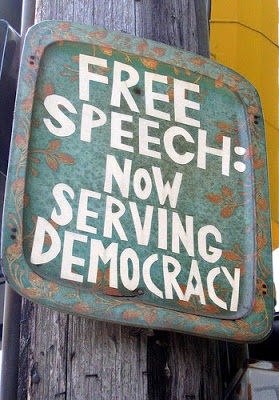
Marc Estrin : Survival Tips for the Bailout Challenged

Photo by Donna Bister / The Rag Blog.

Gotten your bailout yet?

By Marc Estrin / The Rag Blog / April 12, 2010

No? Unemployment insurance running out? Mortgage under water? Yes and yes? Well, fear not. Since the war on terror is chugging along nicely, and the government/military is planning for survival in the face of climate catastrophe, infrastructure decay, financial crisis, disastrous health care, and deepening debt, you — as a free American — are at liberty to look to your survival in your own personal way.

You may need help. Advice. We have therefore undertaken to investigate survival techniques potentially useful to the literary and Facebook-reading classes. Over the past year, your author has been surveying homeless populations in four major cities; this is the first report of information gleaned from their years of human experience in exceedingly trying circumstances. It is hoped that as homeland political, social, and economic circumstances deteriorate, you may be able to take advantage of some of these techniques.

Optimal integration of food, clothing, and shelter

Multiple use of existing materials makes for economy in scarcity situations. Food, for instance, can serve for clothing, insulation, and even privacy. Consider for example the following not uncommon situation:

After a sleepless night in a public shelter or lavatory, exhausted by guarding your possessions, you will surely need a good daytime place to nap. In inclement weather, public libraries are ideal, especially for the well-educated. However, library policy has recently turned draconian, and anyone sleeping rather than reading is usually asked to leave.

Two slices of baloney can solve the problem. Choose a brand as close to your skin tone as possible. In the center of each slice, cut an eye-shaped hole. Choose a good book or journal, open it, sit well-propped in a chair, and place a slice of baloney over each eye. A cap or kerchief low on the forehead will improve the illusion. Then, off to the arms of Morpheus. It will take a sharp-eyed, highly motivated guard to catch you napping, and, what with budget cuts, these are in ever-rarer supply. After your nap, put the baloney away for further use.

Soft white bread, such as Wonder Bread or Tiptop is not only inexpensive, but is also an excellent insulator. Due to trapped air, its R rating is high, comparable to fiberglass or foam: a must investment, even with diminished funds. Slices can be stuffed in clothing, and in key body areas such as the small of the back or lower abdomen to maintain core temperature in hypothermic environments. Don’t forget the head! — 70% of body heat escapes from the scalp. Wonder Bread fits nicely under any hat or cap, or can be trimmed for a custom fit.

Fast food restaurants invariably have packets of yellow mustard available for the taking. You’d be surprised at how well Grandma’s recipe for cold still works! Simply smear yellow mustard over your chest and abdomen, and along your sides (get up under those arms!) for long-lasting, bio-chemical warmth. It’s free — and it’s good for you, too.

Forget Kleenex from now on, and don’t keep a cold in your pocket with cloth hankies. Even the worst exposure-induced upper respiratory condition can be contained by blowing the nose into lettuce leaves, available free in great quantity in supermarket dumpsters. A day’s supply can easily be carried in pocket or purse.

Now here’s a trick: At the end of a long day, when the baloney is a bit soiled and the bread somewhat tamped, scrape a small amount of mustard from the small of your back, whip out a few lettuce leaves, lay meat eye-hiders to bread insulation, and voila — a classical baloney sandwich — utilizing three of the four major food groups — for your evening meal. Well fed, you can re-pack for a nighttime of maximum insulation.

Other food possibilities

It is an open secret among the poor that pet foods are perfectly fit for human consumption. Don’t be embarrassed to survey the huge selection in your supermarket — no one will suspect you are shopping for yourself and not for Fido or Kitty. There are so many choices that it may take a while to discover your favorite brands and flavors. No need to restrict yourselves to “gourmet” varieties. The “gourmet” label is simply a marketing device targeted at upscale pet owners. The contents are virtually the same as that of cheaper brands.

Dry dog or cat food travels well, and can be wetted down at public drinking fountains. It is also ecological, since there is no can to dispose of. For the more affluent, canned cat food is probably your best bet. 9-Lives remains the trend setter, though it is virtually indistinguishable from other canned varieties. For an occasional treat, this writer recommends Sheba Moist Tender Chunks: Salmon Entree.

There do seem to be gender difference in the choice of food types, with men preferring dog food, and women, food for cats. For you he-men out there, we can recommend Mighty Dog — Beef.

A modest proposal

The Obama presidency boasts a radical neo-conservatism combined with a fearless approach to the future, a commitment to institutions of the past, and strong motivation to deal with the problems which lie ahead. In the interests of political clarity, I would urge the president, and his advisors — Messrs. Summers, Geitner, Bernanke, Emmanuel, and Netanyahu — to have the courage of their convictions, and take things all the way.

With bipartisanship guiding all three branches of government, there should be only minor difficulty in bringing back an idea whose time has surely come again. Slavery has gotten a bad name with the liberal press, yet an unprejudiced mind can easily see its many benefits. Who can deny that living in the homes of wealthy families — even without pay — is preferable to a life of hardship, disease, and crime on cruel streets?

Family values would be maintained and promoted as mammys took care of the children, aiding harried executive moms. Cultural diversity would prevail as songs of the old South were heard again, and mixed races and cultures would be seen once again in the more exclusive neighborhoods. This is compassionate conservatism at its best.

However divided liberal opinion here may be, given the advancing pauperization of the middle class, it is not hard to imagine a time in the near future when it, too, could benefit by such a system as greatly as people of color. Congressional debates will be heated, of course, but with a bi-partisan Senate, there should be no problem with having the majority prevail. Another hard-won triumph for democracy.

[Marc Estrin is a writer and activist, living in Burlington, Vermont. His novels, Insect Dreams, The Half Life of Gregor Samsa, The Education of Arnold Hitler, Golem Song, and The Lamentations of Julius Marantz have won critical acclaim. His memoir, Rehearsing With Gods: Photographs and Essays on the Bread & Puppet Theater (with Ron Simon, photographer) won a 2004 theater book of the year award. He is currently working on a novel about the dead Tchaikovsky.]

The Rag Blog

Posted in Rag Bloggers | Tagged , , , , | Leave a comment

Thomas McKelvey Cleaver : Keep on Truckin’

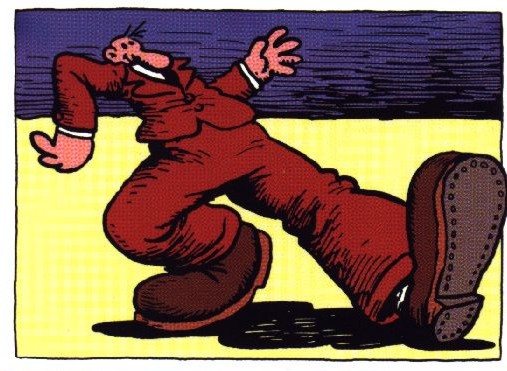
Keep on Truckin’. Classic cartoon by R. Crumb.

The David and Alice debate:
We can’t afford to give up the fight

By Thomas McKelvey Cleaver / The Rag Blog / April 11, 2010

[Austin activist David P. Hamilton announced his “retirement” from political activism in The Rag Blog on March 30, 2010. On April 6, our Alice Embree responded, proclaiming her intention to “carry it on.”]

I’ll say right up front that — at first read — I was surprised by David Hamilton’s announcement of his “retirement” from the movement and radical politics.

I don’t know David face-to-face, as do many readers, but over the past few years that I’ve marginally become re-involved with Austin politics through my involvement with Under The Hood Café [the Killeen-based GI coffee house], I have come to know David through our e-mail conversations. As with many ex-Weathermen I continue to disagree with him on certain important-to-us topics, but he’s a guy who brings intelligence, knowledge, passion, and commitment to what he says and does, making him someone whose thoughts I respect.

It only took me another few minutes to easily identify with what he was saying about his disillusionment with Obama. I’m the guy who spent the better part of five months in 2008 personally raising $350,000 for the Obama campaign from Democrats all over the country, and as a result I know first-hand the enthusiasm that was out there, the longing from “the rest of us” for real change in this country.

Thus, my disappointment as I have watched Obama the Candidate of Promise become Obama the President who takes every position I oppose on just about everything, is pretty damn strong — perhaps even stronger than David’s disillusionment. Most of my friends greet me nowadays by asking “So, what has Obama done to piss you off today?” It’s said as a joke, but sadly it really isn’t that funny. Thus, it’s easy for me to understand where David’s coming from.

I also know well the decision to withdraw from radical politics out of disappointment and disillusionment with the lack of “progress.” I did that myself for a number of years.

I’ve also been privileged to be a Fan of Embree for 44 years now, ever since Alice showed up looking for me at a college in Colorado where I was one of the few radicals and the only anti-war Vietnam vet. Over those years, she’s been one of my models for how one survives as a leftist in America without going nuts, and when I decided I would see what I could do to help the GIs at Fort Hood start a new coffeehouse, she was the first person in Austin I went looking for, knowing that if I could get her involved, things would be done right.

Reading her response to David, I identified with her decision to focus on the small victories that come along, and to keep working for the big one. My reason for coming back from withdrawal was that I found out that — for me personally — doing as Alice does was essential for my physical, mental, moral, and spiritual health.

It’s easy right now to take David’s way. I fight the urge to do so every morning when I read a blog and get outraged over the latest outrage. But we really can’t afford to do this, not now. Not with what’s out there.

The Washington Post recently documented that threats of violence from the Right are way up: 42 in the first three months of 2010, as opposed to 15 in the last three months of 2009. Who are they targeting?

They’re targeting the people David says are worthless (because they mostly are) — the Democratic members of Congress. They’re doing it over the passage of that worthless piece of legislation, the health care reform bill. Go read about the people being arrested for making credible threats against Speaker Pelosi or Senator Murray. These raving lunatics are only the tip of the iceberg, as was the Hutaree “militia.”

Back 20 years ago, I had the privilege from my work in Hollywood to get to know the legendary motion picture director, Billy Wilder. He told me the story of his years in Berlin in the 1920s and early 1930s. He came to the conclusion in 1928 that Hitler and the Nazis were a “credible threat.” Nearly all of his friends disagreed, and over the years he acquired the reputation of being a crank on the subject of those ridiculous Nazis.

On the night Hitler won the election in January 1933, Wilder packed all he owned into a steamer trunk, went to the Berlin train station, and bought a one way ticket on the Paris Express. As he put it, “I didn’t return for 12 years, and when I did, none of the people who had told me I was crazy to worry about Hitler were still alive. They’d been put to death.”

Back in 1933, the German political radicals refused to support the moderates and liberals against the Nazis, with the Communists calling the Social Democrats “Social Fascists” — a term not too far removed from David’s description of Obama and the Democrats. History has shown that attitude and the political strategy it engendered didn’t work out.

Right now, there is every indication that the Republican Party is about to win back nearly all that it lost in the 2006 and 2008 elections, despite the fact that their political platform is “more of the same” — more of the same of everything that nearly destroyed us over eight years.

Anyone with any brains can see clearly that the Obama Presidency and the Democratic Party have largely brought this on themselves with their fecklessness and their unwillingness to actually be “the party of change” that they campaigned on. This has in turn brought about the disillusionment of all those folks I called over the summer of 2008, the people who had never given money to a political campaign before and who really were giving “till it hurt,” and this disillusionment has created the gap that polls are seeing between Democrats and Republicans when it comes to enthusiasm for participating in this fall’s elections.

Consider, however, what a GOP majority in the House and/or Senate will create. Will it create more chances for the kinds of changes we hope to see? Newt Gingrich was cheered when he spoke to the Southern Republican Leadership Conference and called for a Republican congress to de-fund every progressive change that has been put in place by the Obama Administration.

He specifically mentioned the EPA and their plan to deal with climate change under the powers the Supreme Court says they have under the Clean Air Act. And he also mentioned de-funding the Department of Labor, which for the first time in 30 years has people running it who really are working for the interests of working people. Whatever one wants to say about health care reform, what is going on at EPA and DOL are the kinds of things we on the left want.

If we surrender to David’s attitude, if we decide to take our marbles and go home because everything isn’t perfect and the People’s Revolution hasn’t happened, then we are leaving the field uncontested to the people who would be happy as hell to put every one of us in a concentration camp, the people who have been The Enemy for all the history of this country.

If we want to keep the opportunity of doing the kind of work Alice Embree is the embodiment of, we cannot make the choice David Hamilton has. Not in 2010. Not in the face of what is happening.

Your mileage may vary.

[Thomas McKelvey Cleaver, an aviation writer, screenwriter, and social activist, worked hard for the election of President Barack Obama. A Vietnam veteran, he is active in the GI anti-war movement; he was involved in the Oleo Strut, the Vietnam-era coffee house in Killeen, Texas, near Ft. Hood, and helped start its modern day counterpart, Under the Hood. He is a frequent contributor to The Rag Blog.]

Also see:

The Rag Blog

Posted in Rag Bloggers | Tagged , , , , , , , | 1 Comment

THE DAVID AND ALICE DEBATE

By Thomas McKelvey Cleaver / The Rag Blog / April 11, 2010

I’ll say right up front that — at first read — I was surprised by David Hamilton’s announcement of his “retirement” from the movement and radical politics.

I don’t know David face-to-face, as do many readers, but over the past few years that I’ve marginally become re-involved with Austin politics through my involvement with Under The Hood Café [the Killeen-based GI coffehouse], I have come to know David through our e-mail conversations. As with many ex-Weathermen I continue to disagree with him on certain important-to-us topics, but he’s a guy who brings intelligence, knowledge, passion, and commitment to what he says and does, making him someone whose thoughts I respect.

It only took me another few minutes to easily identify with what he was saying about his disillusionment with Obama. I’m the guy who spent the better part of five months in 2008 personally raising $350,000 for the Obama campaign from Democrats all over the country, and as a result I know first-hand the enthusiasm that was out there, the longing from “the rest of us” for real change in this country.

Thus, my disappointment as I have watched Obama the Candidate of Promise become Obama the President who takes every position I oppose on just about everything, is pretty damn strong — perhaps even stronger than David’s disillusionment. Most of my friends greet me nowadays by asking “So, what has Obama done to piss you off today?” It’s said as a joke, but sadly it really isn’t that funny. Thus, it’s easy for me to understand where David’s coming from.

I also know well the decision to withdraw from radical politics out of disappointment and disillusionment with the lack of “progress.” I did that myself for a number of years.

I’ve also been privileged to be a Fan of Embree for 44 years now, ever since Alice showed up looking for me at a college in Colorado where I was one of the few radicals and the only anti-war Vietnam vet. Over those years, she’s been one of my models for how one survives as a leftist in America without going nuts, and when I decided I would see what I could do to help the GIs at Fort Hood start a new coffeehouse, she was the first person in Austin I went looking for, knowing that if I could get her involved, things would be done right.

Reading her response to David, I identified with her decision to focus on the small victories that come along, and to keep working for the big one. My reason for coming back from withdrawal was that I found out that — for me personally — doing as Alice does was essential for my physical, mental, moral, and spiritual health.

It’s easy right now to take David’s way. I fight the urge to do so every morning when I read a blog and get outraged over the latest outrage. But we really can’t afford to do this, not now. Not with what’s out there.

The Washington Post recently documented that threats of violence from the Right are way up: 42 in the first three months of 2010, as opposed to 15 in the last three months of 2009. Who are they targeting?

They’re targeting the people David says are worthless (because they mostly are) — the Democratic members of Congress. They’re doing it over the passage of that worthless piece of legislation, the health care reform bill. Go read about the people being arrested for making credible threats against Speaker Pelosi or Senator Murray. These raving lunatics are only the tip of the iceberg, as was the Hutaree “militia.”

Back 20 years ago, I had the privilege from my work in Hollywood to get to know the legendary motion picture director, Billy Wilder. He told me the story of his years in Berlin in the 1920s and early 1930s. He came to the conclusion in 1928 that Hitler and the Nazis were a “credible threat.” Nearly all of his friends disagreed, and over the years he acquired the reputation of being a crank on the subject of those ridiculous Nazis.

On the night Hitler won the election in January 1933, Wilder packed all he owned into a steamer trunk, went to the Berlin train station, and bought a one way ticket on the Paris Express. As he put it, “I didn’t return for 12 years, and when I did, none of the people who had told me I was crazy to worry about Hitler were still alive. They’d been put to death.”

Back in 1933, the German political radicals refused to support the moderates and liberals against the Nazis, with the Communists calling the Social Democrats “Social Fascists” — a term not too far removed from David’s description of Obama and the Democrats. History has shown that attitude and the political strategy it engendered didn’t work out.

Right now, there is every indication that the Republican Party is about to win back nearly all that it lost in the 2006 and 2008 elections, despite the fact that their political platform is “more of the same” — more of the same of everything that nearly destroyed us over eight years.

Anyone with any brains can see clearly that the Obama Presidency and the Democratic Party have largely brought this on themselves with their fecklessness and their unwillingness to actually be “the party of change” that they campaigned on. This has in turn brought about the disillusionment of all those folks I called over the summer of 2008, the people who had never given money to a political campaign before and who really were giving “till it hurt,” and this disillusionment has created the gap that polls are seeing between Democrats and Republicans when it comes to enthusiasm for participating in this fall’s elections.

Consider, however, what a GOP majority in the House and/or Senate will create. Will it create more chances for the kinds of changes we hope to see? Newt Gingrich was cheered when he spoke to the Southern Republican Leadership Conference and called for a Republican congress to de-fund every progressive change that has been put in place by the Obama Administration.

He specifically mentioned the EPA and their plan to deal with climate change under the powers the Supreme Court says they have under the Clean Air Act. And he also mentioned de-funding the Department of Labor, which for the first time in 30 years has people running it who really are working for the interests of working people. Whatever one wants to say about health care reform, what is going on at EPA and DOL are the kinds of things we on the left want.

If we surrender to David’s attitude, if we decide to take our marbles and go home because everything isn’t perfect and the People’s Revolution hasn’t happened, then we are leaving the field uncontested to the people who would be happy as hell to put every one of us in a concentration camp, the people who have been The Enemy for all the history of this country.

If we want to keep the opportunity of doing the kind of work Alice Embree is the embodiment of, we cannot make the choice David Hamilton has. Not in 2010. Not in the face of what is happening.

Your mileage may vary.


Type rest of the post here

Source /

The Rag Blog

Posted in RagBlog | Leave a comment

Net Neutrality : The Fight Ahead

Image from Francesco Lapenta.

Net Neutrality: All is not lost

By Tim Karr / April 11, 2010

“The Day the Internet Lost” read a full-banner headline on Huffington Post. The New York Times held a wake for the Internet reporting that Internet service providers can now “block or slow specific sites” and demand that content producers now “pay a fee to ensure delivery of material.”

On Tuesday, the DC Circuit court took away the Federal Communications Commission’s to protect our rights on the Internet. The decision has been widely reported as the end of an era for America’s Internet. But what does the future hold? And what can we do to keep the Internet open and democratic?

The ruling echoes the Supreme Court’s Citizens United v. FEC decision, which amounted to a judicial giveaway of our democracy to powerful corporations. Yesterday’s court decision effectively hands the future of communications over to corporations like AT&T, Comcast, Verizon and Time Warner Cable.

This is bad news on several fronts:

Broadband ambitions sidelined: High-speed Internet access is a central component to our economic recovery. Putting high-speed Internet into the hands of the third of the country that now does not connect is Priority #1 of the FCC’s National Broadband Plan. The court decision pulls the carpet from beneath the agency’s plan, effectively leaving this essential job to companies that have failed — by almost every international measure — to deliver a fast and affordable services to Americans stuck on the wrong side of the digital divide.

The end of openness: The decision could mark the beginning of America’s Broadband Dark Age. The court ruled that the FCC has no right to stop carriers from developing a two-tier Internet and blocking Web content that they don’t like. They’ve already indicated their interest in prioritizing certain content over others. As The Economist reported that an ISP could simply “decide to hijack all search queries… and redirect them to its own search site so it could harvest the extra hits, even when users were attempting to use Google or other search engines.” Nice!

It’s Now Their Internet, Not Yours: The decision could bring us a world where Internet users no longer have control over their Internet experience — where we have no protections against ISPs that abuse our Internet rights at will and without repercussions. Increasingly AT&T, Comcast and Verizon have sought to encroach upon user choice online. Net Neutrality is essential to keeping the future of communications in the hands of all Americans — and preventing ISPs from picking winners and losers on the Web. We’ve just lost that guarantee and it’s only a matter of time before the Great Encroachment begins.

But don’t give up hope. There’s a way out of this legal mess. The easiest route to restore an open Internet is for the FCC to simply vote to reclassify broadband under Title 2 of the Communications Act. This move would return to the agency the powers to protect consumers that it had before Bush-era deregulation struck it down.

Other remedies include a Supreme Court appeal or congressional legislation but, as Prof. Jack Balkin notes, such actions run the risk of a conservative Supreme Court that appears to favor corporations over the public interest. And a move in Congress would require 60 votes from a Senate where passing anything is nearly impossible – much less on an issue over which broadband providers like AT&T and Comcast wield a corrupting level of influence in both parties.

The FCC, however, could reclassify by a simple majority vote of commissioners. Chairman Genachowski has made protecting the open Internet a signature effort of his tenure. He has the support of the majority of FCC commissioners on that. He should now move to reclassify with a simple vote at the agency.

Moreover, the Supreme Court case has specifically said the decision to reclassify is up to the FCC, and as long as the Commission gives good reasons for its choice to do so, that action should be upheld in the courts.

Makes sense, right? That’s why Free Press is pushing full throttle to embolden the FCC to reclassify in a way that allows it to protect Net Neutrality and fulfill the universal access goals envisioned in its National Broadband Plan. (You can join the action here.)

In the world of wonky telecommunications policy, reclassification — or returning the Internet to its legal status prior to Bush-era deregulation — is tantamount to declaring World War III with the phone and cable lobby.

That’s a fight that we’re ready to have right now. The future of open communications depends upon it.

Source / Save the Internet / Free Press

Free Press Responds to Comcast Net Neutrality Decision

From Brian Lehrer Live on Vimeo.

Dead? Hardly.
Ruling all but ensures net neutrality

By Johna Till Johnson / March 9, 2010

As I predicted last month, a federal appeals court recently overturned the fines imposed by the Federal Communications Commission on Comcast in 2007. The ruling was overturned on the grounds that the FCC lacks jurisdiction over telco Internet access offerings.

This decision has a number of ramifications, which I’ll go into shortly. But first: Some people are saying this ruling sounds the death knell to net neutrality.

How can I put this delicately? Horsepucky.

The end game is precisely the opposite: This decision has essentially ensured the passage of net neutrality.

Here’s how things are likely to play out. The FCC very likely will move to reclassify Internet services as a Title II common carrier services (which transport people or goods under regulatory supervision). Why? Because the FCC wants to move forward on the broadband stimulus bill, which relies on the ability of the FCC to regulate Internet access providers.

Reclassifying Internet services as a Title II service would provoke a royal catfight with the carriers, which have preemptively warned the FCC not to go there. Back in February, carriers — including Verizon, Time Warner, AT&T, Qwest, the National Cable andTelecommunications Association, and the wireless and phone company trade associations — warned FCC Chairman Julius Genachowski that trying to classify Internet access as a Title II service would provoke “years of litigation and regulatory chaos.”

More pointedly, they indicated such a decision would make them unwilling to invest the billions of dollars required to achieve the government’s goal of 100MBps broadband speeds to 100 million households by 2020.

This is a potent threat, because it shines a spotlight on the real elephant in the corner: Everybody wants broadband Internet access, but nobody knows how to pay for it. Internet connectivity simply doesn’t generate enough profit to justify the investment — whether from carriers, Google, or anyone else. If the carriers decide to pull their investment dollars — or spend them on litigation instead — good luck having a functioning Internet in 2015. (But that’s the subject of another column).

It remains to be seen whether the FCC will cave. I’m betting not — Genachowski doesn’t strike me as the kind of guy who gives in to threats. Regardless, there’s a belt-and-suspenders strategy that the FCC will likely pursue in parallel: petitioning Congress to modify the FCC’s charter to explicitly cover Internet services.

How this will play out depends, of course, on the exact makeup of Congress — and the willingness of lawmakers to cross party lines. My guess, though, is that such a move will ultimately succeed, if for no other reason than common sense. The FCC is set up to regulate “communications,” and it’s ridiculous to argue that the Internet is not a communications service.

And once that happens, the passage of net neutrality is a foregone conclusion. The wild card is how it will be defined. As noted previously, a U.K.-based Web Site recently filed a motion with the FCC requesting enforcement of “open search” rules to complement net neutrality — which could open up a whole new angle.

Pass the popcorn, it’s shaping up to be an interesting couple of years.

Source / Computerworld

Also see:

The Rag Blog

Posted in RagBlog | Tagged , , , , , | 1 Comment

THE DAVID AND ALICE DEBATE

By Thomas McKelvey Cleaver

I’ll say right up front that — at first read — I was surprised by David Hamilton’s announcement of his “retirement” from the movement and radical politics.

I don’t know David face-to-face, as do many readers, but over the past few years that I’ve marginally become re-involved with Austin politics through my involvement with Under The Hood Café, I have come to know David through our e-mail conversations. As with many ex-Weathermen I continue to disagree with him on certain important-to-us topics, but he’s a guy who brings intelligence, knowledge, passion, and commitment to what he says and does, making him someone whose thoughts I respect.

It only took me another few minutes after reading that to easily identify with what he was saying. I’m the guy who spent the better part of five months in 2008 personally raising $350,000 for the Obama campaign from Democrats all over the country, and as a result I know first-hand the enthusiasm that was out there, the longing from “the rest of us” for real change in this country.

Thus, my disappointment as I have watched Obama the Candidate of Promise become Obama the President who takes every position I oppose on just about everything, is pretty damn strong — perhaps even stronger than David’s disillusionment. Most of my friends greet me nowadays by asking “So, what has Obama done to piss you off today?” It’s said as a joke, but sadly it really isn’t that funny. Thus, it’s easy for me to understand where David’s coming from.

I also know well the decision to withdraw from radical politics out of disappointment and disillusionment with the lack of “progress.” I did that myself for a number of years.

I’ve also been privileged to be a Fan of Embree for 44 years now, ever since Alice showed up looking for me at a college in Colorado where I was one of the few radicals and the only anti-war Vietnam vet. Over those years, she’s been one of my models for how one survives as a leftist in America without going nuts, and when I decided I would see what I could do to help the GIs at Fort Hood start a new coffeehouse, she was the first person in Austin I went looking for, knowing that if I could get her involved, things would be done right. Reading her response to David, I identified with her decision to focus on the small victories that come along, and to keep working for the big one. My reason for coming back from withdrawal was because I found out that – for me personally – doing as Alice does was essential for my physical, mental, moral and spiritual health.

It’s easy right now to take David’s way. I fight the urge to do so every morning when I read a blog and get outraged over the latest outrage. But we really can’t afford to do this, not now. Not with what’s out there.

Today’s Washington Post documents that threats of violence from the Right are way up. 42 in the first three months of 2010, as opposed to 15 in the last three months of 2009. Who are they targeting?

They’re targeting the people David says are worthless (because they mostly are) – the Democratic members of Congress. They’re doing it over the passage of that worthless piece of legislation, the health care reform bill. Go read about the people being arrested for making credible threats against Speaker Pelosi or Senator Murray. These raving lunatics are only the tip of the iceberg, as was the Hutaree “militia.”

Back 20 years ago, I had the privilege from my work in Hollywood to get to know the legendary motion picture director, Billy Wilder. He told me the story of his years in Berlin in the 1920s and early 1930s. He came to the conclusion in 1928 that Hitler and the Nazis were a “credible threat.” Nearly all of his friends disagreed, and over the years he acquired the reputation of being a crank on the subject of those ridiculous Nazis. On the night Hitler won the election in January 1933, Wilder packed all he owned into a steamer trunk, went to the Berlin train station, and bought a one way ticket on the Paris Express. As he put it, “I didn’t return for twelve years, and when I did, none of the people who had told me I was crazy to worry about Hitler were still alive. They’d been put to death.”

Back in 1933, the German political radicals refused to support the moderates and liberals against the Nazis, with the Communists calling the Social Democrats “Social Fascists” – a term not too far removed from David’s description of Obama and the Democrats. History has shown that attitude and the political strategy it engendered didn’t work out.

Right now, there is every indication that the Republican Party is about to win back nearly all that it lost in the 2006 and 2008 elections, despite the fact that their political platform is “more of the same” – more of the same of everything that nearly destroyed us over eight years. Anyone with any brains can see clearly that the Obama Presidency and the Democratic Party have largely brought this on themselves with their fecklessness and their unwillingness to actually be “the party of change” that they campaigned on. This has in turn brought about the disillusionment of all those folks I called over the summer of 2008, the people who had never given money to a political campaign before and who really
were giving “till it hurt,” and this disillusionment has created the enthusiasm gap that polls are seeing between Democrats and Republicans when it comes to enthusiasm for participating in this fall’s elections.

Consider however, what a GOP majority in the House and/or Senate will create. Will it create more chances for the kinds of changes we hope to see? Newt Gingrich was cheered when he spoke to the Southern Republican Leadership Conference on Thursday night and called for a Republican congress to de-fund every progressive change that has been put in place by the Obama Administration. He specifically mentioned the EPA and their plan to deal with climate change under the powers the Supreme Court says they have under the Clean Air Act. He specifically mentioned de-funding the Department of Labor, which for the first time in 30 years has people running it who really are working for the interests of working people. Whatever one wants to say about health care reform, what is going on at EPA and DOL are the kinds of things we on the left want.

If we surrender to David’s attitude, if we decide to take our marbles and go home because everything isn’t perfect and the People’s Revolution hasn’t happened, then we are leaving the field uncontested to the people who would be happy has hell to put every one of us in a concentration camp, the people who have been The Enemy for all the history of this country. If we want to keep the opportunity of doing the kind of work Alice Embree is the embodiment of, we cannot make the choice David Hamilton has. Not in 2010. Not in the face of what is happening.

Your mileage may vary.


Type rest of the post here

Source /

The Rag Blog

Posted in RagBlog | Leave a comment

Rabbi Arthur Waskow : Does the Flag Condone Murder?

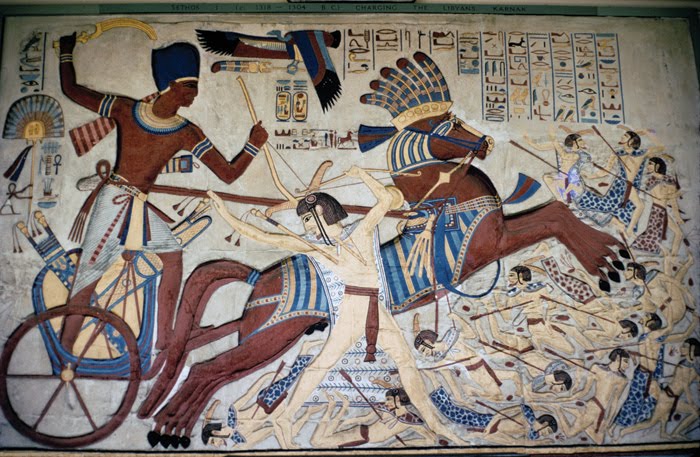
The Pharoah’s chariot army drowned in the Red Sea.

Do our ‘chariots’ impoverish us?
Does the flag condone murder?

By Rabbi Arthur Waskow / The Rag Blog / April 10, 2010

The end of Pesach is said to mark the anniversary of the moment when Pharaoh’s imperial horse-chariot army met disaster in the Red Sea. Just as the festival was ending this year, flashes of truth about our own imperial army appeared in the ways prophetic truth rises up in our day — unveiled videotape, unmuzzled journalism. One from the Iraq War, one from the Afghanistan War.

Is there more of a connection than this seeming accident of dates? Stay tuned, below.

In one of these flashes of truth, a U.S. airplane (July 2007) machine-guns two journalists — and even if you think the U.S. soldiers honestly mistook a camera for an assault rifle and mistook civilians casually strolling on the street for threats to the American occupation, that does not explain why they then killed two clearly unarmed men in a clearly unarmed van who came to help those wounded in the first attack. Nor does it explain why the military realized something had gone wrong, investigated, and then lied about what had happened.

In the other, U.S. “Special Forces” (February 2010) killed three Afghan women — two of them pregnant — and a local police chief and prosecutor, all on the way to a baby shower. Says The New York Times, “It was one of the latest examples of Special Operations forces’ killing civilians during raids, deaths that have infuriated Afghan officials and generated support for the Taliban despite efforts by American and NATO commanders to reduce civilian casualties.”

Then the Special Forces tampered with the evidence to hide what they had done, claiming that the three women had been murdered earlier, by their relatives, in an “honor killing.” (Everyone knows that’s what Muslim men do to their women. “Baby shower”? Only loving Western families do that.)

Once more, twice more, the official position will be that these are unfortunate byproducts of necessary wars.

They are not. If the killers were not waving U.S. flags, they would be called murderers. Terrorists. Terrorizing civilians to achieve political change.

These events, over and over and over, are not only the inevitable result of these specific wars, in which the Government of the United States went (in Iraq) and is still going (in Afghanistan) far beyond what is necessary to protect the United States itself. They are not only the inevitable causes of still more rage against America, not only the recruiting posters for new terrorists.

They are also the inevitable results of an American mindset that has sent U.S. troops and mercenaries and military bases throughout the world, and devoted between 880 billion dollars and 1.03 TRILLION dollars a year — as much as all other governments combined — to the U.S. military budget.

Details: For the 2010 fiscal year, the President’s base budget of the Department of Defense rose to $533.8 billion. Adding spending on “overseas contingency operations” brings the sum to $663.8 billion.

When the budget was signed into law on October 28, 2009, the final size of the Department of Defense’s budget was $680 billion, $16 billion more than the President had requested. Adm. Mike Mullen, the chairman of the Joint Chiefs of Staff, expected an additional supplemental spending bill, possibly in the range of $40-50 billion, by the Spring of 2010 in order to support the wars in Iraq and Afghanistan. Military-related expenditures outside of the Department of Defense constitute between $216 billion and $361 billion in additional spending, bringing the total for military spending to between $880 billion and $1.03 trillion in fiscal year 2010.

(These summaries, and a far more detailed analysis with detailed official sources come from here.)

While American schools rot, while our sewer mains crack, while our bridges fall, while our budgets for art, music, theater are slashed, while our autos speed and even our trains creak along burning oil and coal to send still more CO2 into the atmosphere to scorch our planet and give asthma to our children.

Deliberately, I do not use the words “defense budget.” This is not defense. It destroys others, and ourselves.

Increasingly, we hear talk about cutting the “entitlement” budget to reduce the monstrous deficits that allegedly may haunt our grandchildren. What are these “entitlements”?

  • Social Security. Medicare. The money that lets human beings live in dignity and find healing for their illnesses.
  • Unemployment insurance payments — which the Congress just shrugged and walked away from, while planning to actually increase the military budget and refusing to spend the money to make sure the millions of unemployed can find jobs so as not to need unemployment insurance.
  • And state pension funds.
  • Not to speak of salaries for teachers, cops, social workers, firefighters, who are being laid off because the biggest banks used cute tricks to make huge profits, then got the taxpayers to do what was indeed necessary to save the banks and the system, but made sure Congress did not meet these desperate needs of state and city governments that can’t govern sanely any more.

But the one “entitlement” we must not even mention cutting is the military.

Our own empire is eating us alive. It is a cancer, eating up the body that feeds it.

What does this have to do with religion, with spirituality, with Torah or Islam or mindful meditation or Easter or Pesach?

Murdering pregnant women and tampering with the truth are sins as well as crimes. Murdering civilians who are desperately trying to save the lives of wounded journalists is a sin as well as a crime.

Is it necessary to quote Dwight Eisenhower once again? “Every gun that is made, every warship launched, every rocket fired, signifies in the final sense a theft from those who hunger and are not fed, those who are cold and are not clothed.”

Is this a new idea? Not hardly. The Torah (Deut. 17:16) draws on the story of slavery in Mitzrayyim — geographically, Egypt; linguistically, the Tight/ Narrow Place — to teach that no Israelite king may “send the people back into Mitzrayyim” — forced labor, poverty, despair — “in order to pay for him to buy horses for his Army.”

Those thefts that Eisenhower and the Torah mention — not just the murders recorded in secret videotapes — are sins as well as crimes.

The Flag must not hide, condone, justify those sins, those crimes.

It is time for the American public, for sure including and ideally led by its religious communities, to subject these crimes, these sins, to what we used to call God’s judgment, and our own — and to strip away the mindset, and the decisions that make them happen.

The American people can be “defended” by a military budget far smaller than a trillion dollars a year. And our country can be made healthier, more productive, freer, happier, if we spend most of that money in other ways.

I usually end these letters by saying, “Blessings of shalom, salaam, shantih — peace.”

We will not deserve those blessings — and we will not in fact receive them! — unless we make them happen for others and ourselves. You cannot do it alone, and we at The Shalom Center cannot do it alone. We need your help, you need ours.

Arthur

[Rabbi Arthur Waskow, director, The Shalom Center; co-author, The Tent of Abraham; author of Godwrestling: Round 2, Down-to-Earth Judaism, and a dozen other books on Jewish thought and practice, as well as books on U.S. public policy. The Shalom Center voices a new prophetic agenda in Jewish, multireligious, and American life. To receive the weekly on-line Shalom Report, click here.]

The Rag Blog

Posted in Rag Bloggers | Tagged , , , | 3 Comments

SPORT / Earl From the Grave : Tiger and the Nike Ad

The Nike ad:
Tiger the Brand finally conquers Tiger the Man

By Dave Zirin / April 9, 2010

Why is the new Nike ad with a downcast yet proudly resilient Tiger Woods hearing the voice of his dead father making me so furious? It defies logic.

After all, we just came through a week during which we saw film footage of the U.S. military taking part in what is being called “collateral murder.” Death threats have been sent to Democratic members of Congress by right wing lunatics for the crime of passing a healthcare bill that could have been penned by Mitt Romney. And then take Pope Benedict and his Catholic defenders. Seriously. Please take them. I’d suggest somewhere hot.

In the context of our enduring global fever-dream, a tacky ad in which Nike and Tiger conspire to exploit the memory of Earl Woods is hardly that big a deal — particularly since if Earl Woods were alive, he would have supported this exercise in grave robbing 100 percent.

But the idea that Tiger and Nike would see the incredible turmoil that has engulfed Tiger’s life as an opportunity to rebrand Tiger and sell us more swoosh-laden crap is simply sickening. Every single member of the golf media and every fan who has felt sympathy for his self-destructive plight should feel like a grade-A sucker.

Every person impressed with his professed recommitment to the Buddhist faith and his family should be deeply offended that it was all just a springboard aimed at cashing in. And every golf fan and pro golfer should be furious that he’s shellacked another layer of controversy onto the most prestigious tournament on the tour, the Masters at Augusta.

There is a small part of me delighted that Tiger’s awful ad will further cloud an event whose history of segregation and exclusion would even give pause to our Confederate Governor of Virginia, “Robert E.” McDonnell.

But any joy at the discomfort of grown men with ten-figure bank accounts named Hootie and Billy is outpaced by the sheer cultural rock bottom that this ad represents, not to mention what it says about Woods himself.

I really believed that in the wake of his Odyssey of scandal and humiliation, there would be a showdown inside Tiger’s soul between the brand and the man. I couldn’t have been more wrong. There is no man, only brand.

If he wants to dehumanize himself on his own time then more power to him. But this ad dehumanizes all of us. One thing however is abundantly clear: If Tiger loses this weekend, Nike loses as well. Neither deserve to make the cut, on the course or otherwise. Tiger the brand has now wholly consumed Tiger the man.

[Dave Zirin is the author of the forthcoming Bad Sports: How Owners are Ruining the Games we Love (Scribner) Receive his column every week by emailing dave@edgeofsports.com. Contact him at edgeofsports@gmail.com.]

Source / The Nation

The Rag Blog

Posted in RagBlog | Tagged , , , , , | 2 Comments

New statistics show that an average of 950 veterans attempt suicide every month, and about 7% of those attempts are successful. Even those under VA care have an unacceptably high suicide rate. We are paying an awful price for the unnecessary wars in Afghanistan and Iraq.

Posted in RagBlog | Leave a comment

A critic at a diversity conference contends that the nature of Jensen’s criticism of societal hierarchies makes him part of the problem, not the solution. Professor Jensen responds with a call for personal accountability. “We cannot ignore the systems from which injustice emerges and expect injustice magically to disappear,” he tells us.

Posted in RagBlog | Leave a comment

The Rag Blog’s Sherman DeBrosse earlier wrote about “Protecting Wall Street from the People,” laying much of the problem at the feet of the Republicans. Dr. Steven Porter responds that the problem is less with the political parties, both of which he considers culpable, and more a product of a “culture of greed,” a phenomenon whose roots are in the child-rearing practices and sociological landscape of the society.”

Posted in RagBlog | Leave a comment

In the second of two, Sherm delves further into the Tea Bagger phenomenon — it’s anger, racism, and potential violence. He discusses indoctrination tactics and the nature of the true believer — and how the movement reflects a basic contempt for American democracy.

Posted in RagBlog | Leave a comment

Bill Ayers : Doublespeak at the University of Wyoming


Doublespeak at the University of Wyoming

“President Tom Buchanan’s self-satisfied bromides do nothing to disguise the fact that the principle of free and open intellectual exchange has suffered a defeat at the University of Wyoming. As the AAUP has argued since 1915, it is precisely prevailing public opinion that must not shape what views get heard on campus.” Cary Nelson, national president of the American Association of University Professors

By Bill Ayers / The Rag Blog / April 6, 2010

On March 30, 2010, officials at the University of Wyoming, citing “security threats” and “controversy,” canceled two talks I was invited to give in early April, one a public lecture entitled “Trudge Toward Freedom: Moral Commitment and Ethical Action,” and the other, a talk to faculty and graduate students called “Teaching and Research in the Public Interest: Solidarity and Identity.” I’d been invited in August 2009, but one week before I was to travel to Laramie, I was told I had been “disinvited.”

In February, as the University began to publicize my scheduled visit, a campaign to rescind the invitation was initiated on right-wing blogs, accelerating quickly to a wider space where a demonizing and dishonest narrative dominated all discussion. A wave of hateful messages and death threats hit the University, and was joined soon enough by a few political leaders and wealthy donors instructing officials in ominous tones to cancel my visit to the campus.

On March 28 an administrator wrote to tell me that the University was receiving vicious e-mails and threatening letters, as well as promises of physical disruption were I to show up. This is becoming drearily familiar to me, as I’ll explain.

A particularly despicable note from Frank Smith who lives in Cheyenne and is active in the Wyoming Patriot Alliance, said, “Maybe someone could take him out and show him the Matthew Sheppard (sic) Commerative (sic) Fence and he could bless it or something.” He was referring to Matthew Shepard, the young gay man who was tortured and murdered in 1998, left to die tied to a storm fence outside Laramie.

Republican candidate for Governor Ron Micheli released a letter he’d sent to all members of the University of Wyoming Board of Trustees asking them to rescind the invitation. Matt Mead, another gubernatorial candidate, said through a press release that while he is a self-described “fervent believer in free speech and the free exchange of ideas,” that still allowing me to speak would be “reprehensible.” He concluded that I should have “no place lecturing our students.”

I sympathized with the University, and told the folks I was in touch with how sorry I was that all of this was happening to them. I also said that I thought it was a bit of a tempest in a tea pot, and that it would surely pass. Certainly no matter what a couple of thugs threatened to do, I said, I thought that Wyoming law enforcement could get me to the podium, and I would handle myself from there, as I do elsewhere. I said I thought we should stand together and refuse to accede to these kinds of pressures to demonize someone and suppress students’ right to freely engage in open dialogue.

After all a public university is not the personal fiefdom or the political clubhouse of the governor, and donors are not permitted to call the shots when it comes to the content or conduct of academic matters. We should not allow ourselves to collapse in fear if a small mob gathers with torches at the gates.

I wouldn’t force myself on the University, of course, but I felt that canceling would be terribly unfair to the faculty and students who had invited me, and would send a big message that bullying works. It would be another step down the slippery slope of giving up on the precious ideal of a free university in a free society.
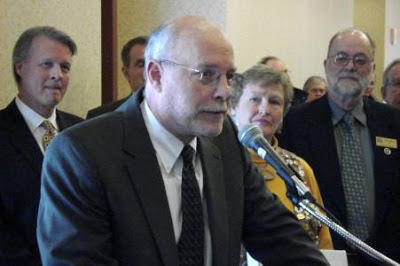
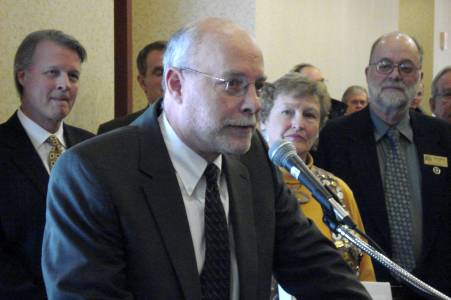
President Tom Buchanan, University of Wyoming.

No good. On March 30, 2010 the University posted an announcement of the cancellation of my visit with a long and rambling comment from President Tom Buchanan. He begins with the obligatory assertion that academic freedom is a core principle of the University, but quickly adds that “freedom requires a commensurate dose of responsibility.” We are charged to enact free speech and thought “in concert with mutual respect.”

Nothing that I did or said in this matter was disrespectful or irresponsible, and yet, in the absence of specific references, readers are led to imagine all kinds of offenses.

The announcement is punctuated with a deep defensiveness: anyone who thinks the University “caved in to external pressure,” Buchanan writes, would be “incorrect.” Anticipating what any casual observer would conclude, he builds a strained and somewhat desperate counter-narrative. Buchanan pleads that UW is “one of the few institutions remaining in today’s environment that garners the confidence of the public,” and that a speech by me would somehow undermine that confidence.

He concludes that “this episode illustrated an opportunity to hear and critically evaluate a variety of ideas thoughtfully, through open, reasoned, and civil debate, it also demonstrates that we must be mindful of the real consequences our actions and decisions have on others.”

That’s some sentence, and while it’s impossible to know definitively what he’s referring to as the “episode” (it might be the public lecture itself, but then it could be the cancellation of the lecture, or even the barbarians at the gates threatening to burn the place down, or withhold funds, that would provide the opportunity to critically evaluate matters).

It has an unmistakable Orwellian ring: we canceled that lecture as an expression of our support for lectures! And it’s eerily similar to the classics: we destroyed that village in order to save it! Work will make you free! War is peace!

One of the truly weird qualities of the Buchanan statement is a hole in its center, the deafening silence concerning why the campaign against me was organized in the first place. The reason is familiar to me as noted: in the 1960’s I was a leader of the militant anti-war group, Students for a Democratic Society, and then a founder of the Weather Underground, an organization that carried out dramatic symbolic attacks against several monuments to war and racism, crossed lines of legality, of propriety, and perhaps even of common sense.

And then during the 2008 presidential election I was unwittingly and unwillingly thrust upon the stage because I had known — like thousands of others — Barack Obama in Chicago. The infamous charge that the candidate was “pallin around with terrorists,” designed to injure Obama, also demonized me.

I’ve been an educator and professor for decades, but the hard right has accelerated the lunacy against thousands of folks — activists and artists, academics and theorists, outspoken radical thinkers — and wherever possible mounted campaigns exactly like the one in Wyoming.

Often university officials stand up on principle and resist the howling mob, as they did recently at St. Mary’s in California; sometimes — as at a student-run conference at the University of Pittsburgh in March — they compromise, restricting access to talks and surrounding a speaker with unwanted and unnecessary police protection; sometimes, as in this case, the university turns and runs. It’s a sad sight.

Of course I wasn’t invited to speak about any of this, and it’s unlikely any of it would have come up without the active campaigning and noisy thunder from the relatively tiny group that is the ultra-right.

I would have focused my talk on the unique characteristics of education in a democracy, an enterprise that rests on the twin pillars of enlightenment and liberation, knowledge and human freedom. Education engages dynamic questions of morality and ethics, identity and location, agency and action.

We want to know more, to see more, to experience more in order to do more — to be more competent and powerful and capable in our projects and our pursuits, to be more astute and aware and wide-awake, more fully engaged in the world that we inherit, the world we are simultaneously destined to change.

To deny students the right to question the circumstances of their lives, and to wonder how they might be otherwise, is to deny democracy itself.

It’s reasonable to assume that education in a democracy is distinct from education under a dictatorship or a monarchy; surely school leaders in fascist Germany or Albania or Saudi Arabia or apartheid South Africa all agreed, for example, that students should behave well, stay away from drugs and crime, do their homework, study hard, and master the subject matter; they also graduated fine scientists and musicians and athletes, so none of those things differentiate a democratic education from any other.

What makes education in a democracy, at least theoretically, distinct is a commitment to a particularly precious and fragile ideal: every human being is of infinite and incalculable value, each a unique intellectual, emotional, physical, spiritual, and creative force. Every human being is born free and equal in dignity and rights; each is endowed with reason and conscience, and deserves, then, a sense of solidarity, brotherhood and sisterhood, recognition and respect.

Democracy is geared toward participation and engagement, and that points to an educational system in which the fullest development of all is seen as the necessary condition for the full development of each, and conversely, that the fullest development of each is necessary for the full development of all.

In a vibrant and participatory democracy, we might conclude that whatever the wisest and most privileged parents want for their children is precisely the baseline and standard for what the wider community wants for all of its children. If children of privilege get to have small classes, abundant resources, and a curriculum based on opportunities to experiment and explore, ask questions and pursue answers to the furthest limit — if the Obama kids, for example, attend such a school, one where they also find a respected and unionized teacher corps — shouldn’t that be good enough for the kids in public schools everywhere?

Any other ideal for our schools, in John Dewey’s words, “is narrow and unlovely; acted upon it destroys our democracy.”

We want our students to be able to think for themselves, to make judgments based on evidence and argument, to develop minds of their own. We want them to ask fundamental questions — who in the world am I? How did I get here and where am I going? What in the world are my choices? How in the world shall I proceed? — and to pursue answers wherever they might take them. Our efforts focus not on the production of things so much as on the production of fully developed human beings who are capable of controlling and transforming their own lives, citizens who can participate fully in civic life.
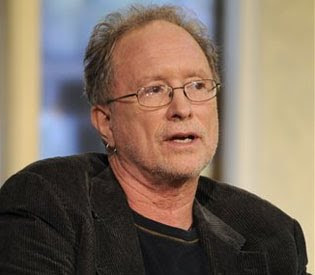
Professor William Ayers appears during an interview on ABC’s Good Morning America. Photo from AP.

Teaching in a democracy encourages students to develop initiative and imagination, the capacity to name the world, to identify the obstacles to their full humanity, and the courage to act upon whatever the known demands. Education in a democracy is always about opening doors and opening minds as students forge their own pathways into a wider world.

How do our schools at every level — K-16 — measure up to the democratic ideal?

Much of what we call schooling forecloses or shuts down or walls off meaningful choice-making. Much of it is based on obedience and conformity, the hallmarks of every authoritarian regime. Much of it banishes the unpopular, squirms in the presence of the unorthodox, hides the unpleasant. There’s no space for skepticism, irreverence, or even doubt.

While many long for an education that is transcendent and powerful, we find ourselves too-often locked in situations that reduce schooling to a kind of glorified clerking that passes along a curriculum of received wisdom and predigested and often false bits of information. This is a recipe for disaster in the long run.

Educators, students, and citizens must press for an education worthy of a democracy, including an end to sorting people into winners and losers through expensive standardized tests which act as pseudo-scientific forms of surveillance; an end to starving public schools — including public higher education — of needed resources and then blaming teachers for dismal outcomes; and an end to the rapidly accumulating “educational debt,” the resources due to communities historically segregated, under-funded and under-served.

All children and youth in a democracy, regardless of economic circumstance, deserve full access to richly-resourced classrooms led by caring, qualified, and generously compensated teachers.

We might try now to create open spaces in our schools and our various communities where we expect fresh and startling winds to blow, unaccustomed winds that are sure to electrify and confound and fascinate us. We begin by throwing open the windows. We declare that in this corner of this place — in this open space we are constructing together — people will begin to experience themselves as powerful authors of their own narratives, actors in their own dramas, the essential architects and creators of their own lives, participants in a dynamic and inter-connected community-in-the-making.

Here they will discover a zillion ways to articulate their own desires and demands and questions. Here everyone will live in search of rather than in accordance with or in accommodation to. Here we will join one another and our democratic futures can be born.

A primary job of teachers and scholars and journalists, and a responsibility of all engaged citizens, is to challenge orthodoxy, dogma, and mindless complacency, to be skeptical of all authoritative claims, to interrogate and trouble the given and the taken-for-granted. The growth of knowledge, insight, and understanding depends on that kind of effort, and the inevitable clash of ideas that follows must be nourished and not crushed.

As campuses contract and constrain, the main victims become truth, honesty, integrity, curiosity, imagination, freedom itself. When college campuses fall silent, other victims include the high school history teacher on the west side of Chicago or in Laramie or Cheyenne, the English literature teacher in Detroit, or the math teacher in an Oakland middle school. They and countless others immediately get the message: be careful what you say; stay close to the official story; stick to the authorized text; keep quiet with your head covered.

In Brecht’s play Galileo the great astronomer set forth into a world dominated by a mighty church and an authoritarian power: “The cities are narrow and so are the brains,” he declared recklessly.

Intoxicated with his own insights, Galileo found himself propelled toward revolution. Not only did his radical discoveries about the movement of the stars free them from the “crystal vault” that received truth insistently claimed fastened them to the sky, but his insights suggested something even more dangerous: that we, too, are embarked on a great voyage, that we are free and without the easy support that dogma provides.

Here Galileo raised the stakes and risked taking on the establishment in the realm of its own authority, and it struck back fiercely. Forced to renounce his life’s work under the exquisite pressure of the Inquisition, he denounced what he knew to be true, and was welcomed back into the church and the ranks of the faithful, but exiled from humanity — by his own word.

A former student confronted him in the street then: “Many on all sides followed you… believing that you stood, not only for a particular view of the movement of the stars, but even more for the liberty of teaching — in all fields. Not then for any particular thoughts, but for the right to think at all. Which is in dispute.”

This is surely in play today: the right to talk to whomever you please, the right to read and wonder, the right to pursue an argument into uncharted spaces, the right to challenge the state or the church and its orthodoxy in the public square. The right to think at all.

This is some of what I would have discussed in Wyoming, but that will not happen, at least not this week. Canceling this talk underlines the urgency of having multiple and far-ranging speeches, dialogue, and discussions at every level and throughout the public square.

[William Ayers is Distinguished Professor of Education and Senior University Scholar at the University of Illinois at Chicago.]

The Rag Blog

Posted in Rag Bloggers | Tagged , , , , , , , , | 13 Comments