Alan Pogue : My History With Violence

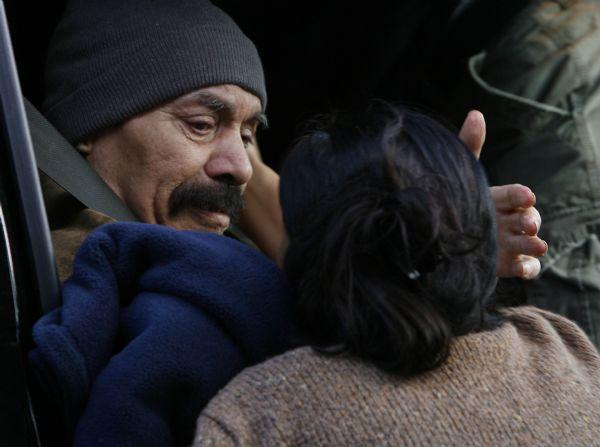
Alan Pogue and Tracey, the woman whose life he saved. The photo was taken by D’Ann Johnson on Nov. 4, 2008, during the trial of Willie McDade, Alan’s assailant.

“One late night in late April of this year, Alan Pogue was severely beaten when he tried to save a woman’s life on a street corner in east Austin. The woman. . . was being pounded by two others. Alan — the noted Austin photojournalist, social activist and frequent contributor to these pages — pulled the two women away from their victim but was sucker punched [by a man he hadn’t seen]. . .”

I wrote those words in The Rag Blog last November, introducing an article Alan Pogue wrote for us about that incident — where he risked his life to save another. Alan, was the staff photographer for The Rag in late Sixties Austin, and for a time lived in his darkroom there. [The Rag, our inspiration, was an underground newspaper, now something of a legend in these parts.]

Alan Pogue has written a remarkable article for The Texas Observer about that harrowing night at Chicon and Rosewood in east Austin. He also recounts his personal history with and his philosophy about the use of violence – from being beaten up as a kid and serving as a medic in Vietnam to a series of incidents in recent times where he has turned to his knowledge of self-defense to help himself and others.

That Observer article, My History of Violence, appears in full below, preceded by some further reflections Alan has written for The Rag Blog.

Thorne Dreyer / The Rag Blog / February 27, 2009

Remembering Kitty Genovese, and buying a gun.

In March of 1964 Winston Moseley stabbed Kitty Genovese on the street in Queens, New York… I vividly remember the article on this crime and that no one helped. I never want to be like those 38 people who would not help.

By Alan Pogue / The Rag Blog / February 27, 2009

The Texas Observer asked me to write a first person account about being jumped while helping a woman in distress at Chicon and Rosewood in Austin. Here is some background on my attacker. He was 25 years old and has been in and out of detention since he was 12. His aggravated assault on me was his third conviction. His father has four felony convictions. I’m told his family does not want him around. He had been out of prison only for a few months when he attacked me. He and his friends were using and selling crack. One may assume he has mental problems.

At the trial his lawyer did his best but there was little doubt about the facts of the case. My attacker showed no remorse or even that he cared at all about what was happening at the trial. Now he is in prison where I doubt anything good will be done for him. On the other hand he is a clear danger and needs to be off of the streets.

The drug bazaar at 12th and Chicon has been there since I came to Austin in 1968. The drug dealers there keep to themselves and their customers. There are some people there who clearly have mental problems. Also there are runaways. Some are prostituting themselves for drugs. Since this is all very obvious one wonders why no concerted effort is made to address the problems. There are plenty of churches nearby but they only do occasional and superficial forays to 12th and Chicon. Much of the action has moved east down 13th street. The drug dealers usually wear something red to indicate they are with the Bloods, or are Blood wannabes. There are other hot spots in north and southeast Austin. The Capitol is another story.

In March of 1964 Winston Moseley stabbed Kitty Genovese on the street in Queens, New York. Thirty eight people heard her screams but no one helped. Moseley went away but then came back and stabbed Genovese again, killing her. I vividly remember the article on this crime and that no one helped. I never want to be like those 38 people who would not help. Moseley is still in prison and he has shown no remorse. He escaped and committed a brutal rape before he was caught again.

But if you do stop to render aid you better be prepared for the worst. Besides not calling 911 before I got out of my car I failed to look around carefully for others who might be involved. Sometimes situations like this are set up to trap people who might help. Stopping to help with a flat tire could be a life threatening situation. That was not the case this time but the result was the same. In the past I have been able to handle attackers that I saw coming.

This time my attention was fixed in front of me, bad. Reflecting on what happened I now know that my attacker had another friend in his car. Had I overcome my attacker I might have had to deal with the other man and the two women. As it is I am fortunate not to have lost the sight in my right eye. As bad as I was hurt, at least I was not shot or stabbed.

But the ghost of Kitty Genovese is still with me. If I come upon another person who is in danger of being raped and/or killed I will help. Since my incident many people have stopped me to relate equally horrible stories about what happened to them. Just a month ago a couple was brutally beaten by four men at 4th and Colorado in Austin. Two people who stopped were also beaten.

So, thinking about all this, I did some research on pistols and came up with the Taurus “Judge” .45/.410. It is a five shot revolver that fires either .45 Colt bullets or .410 shotgun shells. The medium sized shot (like little BBs) .410 shell throws a very wide pattern, about 36″ at eight feet. This is a much wider circle than a regular shotgun throws. So with medium to small shot it would not be lethal unless the attacker insisted on getting very close. “00” buck shot is lethal, as well as are slugs and the regular .45 Colt bullet.

Of course one may not use any kind of gun unless actually under immediate threat of death or serious harm. As I was. But once you are out of your home or car you may not legally have a handgun unless you also have a license to carry a concealed handgun. I went to the considerable effort to obtain one. The backgound check took 120 days. I know they had a lot of files to go through in my case but there is no felony there so I got my permit. I had to take the 12 hours of instruction, pass the firing range and written tests, and pay for that course and the license. I got my senior citizen discount and paid $70 for the license and the full $120 for the course.

I suppose some people are horrified that I did this. I ask them to seriously consider what they would do if they came across someone who would be killed in a minute or so if they did nothing. Screaming does not count toward helping in the case I envision. The two women who were beating Tracey did not stop until I got very close to them. The fellow with the tire tool would not be deterred by verbal threats. He would not be deterred by pepper spray/mace. I did save Tracey’s life but it almost cost me mine. One of the doctors in the emergency room asked me if in the future I would stop again. I looked at her through my one good eye and promised that I would.

Don’t worry, I am not going all vigilante on you like Jody Foster in “The Brave One,” in which an NPRish woman gets beaten and then goes out of her way to shoot people. The drug dealers at 12th and Chicon have not bothered me and I am not going to bother them. As the Observer story relates I have been in some very dangerous confrontations and have not used any more force than was absolutely necessary.

Pacifism in the political arena is a valid method of social change.

Not stopping to help someone who is being beaten is not legally criminal negligence. Certainly there is no law that says one must risk life and limb for someone else. One may stop and render aid but that does not include taking a punch for someone.

Not responding to a murderous attack is suicide. Refusing to be ready is very ostrich like.

One of the two APD officers took this of me at the scene. They took five pics but the frontal one tells it all. I think seeing it helps people to understand the gravity of my injuries, how vicious the attack was. It was “Exhibit #1” — gruesome, but helpful to understanding my situation. Words can only explain so much and that is why I am a photographer.Alan Pogue

My History of Violence

By Alan Pogue / February 20, 2009

It was Tuesday night, and I was unable to sleep. I decided to go pick up a book—Can Humanity Change?—a dialogue between Indian philosopher J. Krishnamurti and Buddhist scholars, from my darkroom studio on East Martin Luther King Jr. Street in Austin.

I was driving there when I saw two women beating another woman in the street. I steered straight at them, thinking the attackers would back off as I approached, but they kept kicking and beating their victim, who was curled up into the smallest ball she could make of herself. They were hitting her so furiously that I didn’t feel I had time to call 9-1-1, so I jumped out of my car, intending to break up the fight.

The women finally looked up, angry at the interruption, and sprang at me, throwing wild punches. That gave me an opening to shove them away from the woman on the ground, who slowly got up and began dusting herself off. That’s when I was hit twice in the back of my head, shocking me and turning my reflexes to mush.

I managed to turn around and face my attacker, and saw an African-American man in his mid-20s wearing knee-length shorts. I could see his left hand coming up to hit me again, but I was unable to jump back or raise my arms to deflect the blow. He hit me across the right side of my face with a metal object, then for good measure hit me three more times, as though he were working a speed bag. The pain from the blows nauseated me, and I turned away. One of the women took my wallet.

Someone from the nearby apartments must have called the police, because the three suddenly disappeared, leaving me stunned but still standing. Their first victim was sitting on the curb. With my mind on autopilot, I got back into my car and continued to my darkroom, where I could see in the mirror there that my right eye was swollen nearly shut, there was an inch-long gash over my left eye, and two of my front teeth were cracked.

I picked up the book and my laptop and drove back down Chicon Street toward home. Police and emergency vehicles had gathered at Rosewood and Chicon, so I stopped to talk with the woman I’d tried to help. Her name was Tracey, and she thanked me. Plenty of cars had driven by, she said, and some of them honked, but no one else had stopped.

The EMTs took my vital signs, looked into my eyes, checked my reflexes and asked a series of simple questions to determine whether my mind was functioning properly. I explained that I lived only a few blocks away. They reluctantly let me go. Knowing how awful I looked, I called my wife to warn her.

When I got home she took me to St. David’s hospital, where the doctor who stitched me up told me about a man who’d been brought in the night before. He’d stopped to help a woman with a flat tire, only to be beaten and robbed.

The psychological fallout has been complex. For weeks I was edgy. At night I dreamt of being attacked. Realizing that I had failed to watch my back, I became hypervigilant. Driving down Chicon felt like walking trails in Vietnam in 1968. Instead of watching for tripwires and punji pits, I began peering down alleys and between parked cars. An old high-school buddy delivered a 12-gauge “home defense” shotgun to my bedside, and I admit it gave me some degree of comfort.

Still, the old saw that “a conservative is a liberal who’s been mugged” hasn’t turned out to be true in my case. Getting hit in the face with a tire tool simply highlights the necessity of being able to defend oneself in an occasionally savage environment. Bad air, worse water, rare jobs and inequitable health care are their own forms of social violence, but as threats go they don’t carry the immediacy of a knife at the throat, a gun barrel in the ribs, or an iron bar to the face. The political right often seems unable to address social pathology without resorting to quasi-fascism, and the left wing sometimes appears almost programmatically incapable of defending itself.

What’s a self-protecting person of humanitarian instincts to do? If I’m philosophically opposed to employing potentially lethal physical force in self-defense, then isn’t it hypocritical of me to ask the police to apply that force on my behalf? Physical violence may not be the best way to solve a problem, but if I’m confronted by someone who intends to kill me, loaning them my copy of Can Humanity Change? isn’t likely to be the most effective defense.

My personal history of violence began when I got punched in the nose in the first grade. My father asked me how it happened, explained that I’d be meeting other bullies at school, and taught me how to box so I’d be prepared to take care of myself. There’s usually a bully in every class, and I changed schools often. I took judo lessons at the YMCA.

There was no fighting at St. Edward’s High School in Austin, but W.B. Ray High School in Corpus Christi was rougher. Two upperclassmen there singled me out for harassment, but after I bested them in boxing matches, no one else bothered me.
Attending the University of St. Thomas, in Houston, I finally had a chance to study shotokan karate. My instructor, Sensei Richardson, introduced me to aikido techniques as well. In San Francisco I was able to use those aikido moves to save a man from a beating by deflecting, but not hurting, his attacker.

In 1966 I received my draft notice and said goodbye to California. We practiced hand-to-hand combat in basic training, but my first real fight for my life took place in the latrine at Fort Carson, Colo. A soldier with a knife had me cornered at the end of a long row of sinks. Fortunately, I was able to dodge his attempts to stab me. The military police took care of him after that. In all my previous fights, I’d never had to worry that my opponent might kill me if I faltered. My boyhood was over.

In Vietnam, at different times, I carried an M-14 rifle, an M-16 rifle, a .45-caliber machine-gun, and a .45-caliber pistol. I almost always carried hand grenades. My chaplain had me carry his weapons as well as my own so no newspaper photographer could snap a picture of the armed man of God. The machine gun and pistol were his, the big sissy. The M-16 rifle was mine, even though, as a medic, I never used it. I managed to give away all but one of my ammunition clips so I could carry more bandages. I knew we shouldn’t be there, and I harbored no fascination with fully automatic weapons.

I’d grown up in Corpus Christi, close to Kingsville and “uncle” Mike Gallagher, my fifth cousin. Uncle Mike, at 21, had been the youngest man ever to be made a foreman at the King Ranch, but he was in his late 50s when I first met him. He used a straight razor to shave. He trimmed his thick fingernails with a fine Italian switchblade and filed them with a heavy triangle file. He was very kind and very tough. He never married and had no children of his own, so he “adopted” me and two other boys, David and Ernesto, took us to roundups, bought us baseball gear, and taught us how to ride and rope.

He also taught me how to use guns, so my association with firearms is a positive one, and inextricably entwined with my memory of him.
Uncle Mike had me out shooting cans with a .22 when I was barely old enough to hold a rifle.

Uncle Mike gave me a .410-gauge shotgun for my 10th Christmas and took me deer hunting on the King Ranch that same year. He handed me a Winchester .30-.30, lever-action rifle that I had never fired and told me to hold the butt of the gun firmly to my shoulder because it kicked so hard. Don’t press your cheek to the stock when you’re sighting, or it will rub a burn on your face, he told me. Aim right behind the deer’s shoulder.

With that sage advice taken, I shot my first deer.

My father had given me a Remington repeating, bolt-action .22 rifle when I was 9, and he took me hunting for dove, duck and quail, but he didn’t care for deer hunting. Only years later did I understand his reasons: He was proud that I could shoot better with my little .410 than he could with his 16-gauge Browning with its gold trigger.

My father’s father drove train for the Southern Pacific and the Katy. When he died, I inherited his pocket watch and the pistol he carried to ward off train robbers: a nickel-plated, Colt .44/.40.

Those who grow up without any functional or familial relationship to guns may associate them solely with crime and war. They’re not likely to understand, never mind share, the passion that many people—even nonviolent people—have for gun ownership.

Back in the 1970s, I lived in a small, windowless room in the University YWCA on the drag in Austin. Late one night, someone tried to get into my room. I knew it was no one who belonged in the building since I was the only person who lived there. The incident bothered me enough that I purchased a small 9 mm pistol to keep on the bed in my little cul de sac. One day I got a call from a sweet reader of The Rag, a long-defunct alternative paper, saying that an aggressive heroin dealer was downstairs and would I please photograph him. I went down and took his picture. He charged at me with a small crowbar. I ran toward Les Amis Café, and when I got to the outside seating I picked up a metal chair and threatened to hit him with it. I asked the café patrons to call the police, but they all just sat there transfixed. The heroin dealer finally turned and ran off. I published his photo in The Rag and gave a copy to the police. I carried my pistol until he was arrested.

Another time, I was walking down West 22nd Street around 9 p.m. when I saw a man trying to rape a young woman. I got him off of her, but then he attacked me. My martial arts training allowed me to subdue him even though he was wild on drugs and seemed not to feel any pain. A friend walked by and called the police.

Back in the Y late one evening, I heard the sound of a hammer striking metal. I put my 9 mm in my back pocket and looked out into the hallway. A young man, maybe 15, was attacking a vending machine. He pulled a pistol and pointed it at me. I could have shot him, but I did not. The glance I got of his gun made me think it was only a starter pistol, not a lethal weapon. We had a standoff. In the end, I was not going to shoot anyone over robbing a Coke machine, so I let him pass. I called the police, and an officer came out and took my report. He spotted the 9 mm in my back pocket and berated me for not having shot “the little punk.” In the hallway I found a book with a girl’s name in it. She was a client at the Women’s Center, and from there we learned the name of her boyfriend, the Coke robber.

The “little punk” is still alive because he encountered me and not the police. They would argue that my kind of restraint would get them killed; I’d say they’re too ready to use maximum force.

That encounter at the Y made me realize I’d better augment my 9 mm with nonlethal pepper spray and handcuffs so I’d have more options. One afternoon I was chatting with friends inside Les Amis when a distraught young man burst through the front entrance with a beer bottle in his hand. He rushed onto the wait-stand, broke off the neck of the bottle, and started screaming at the waitresses and cooks, waving the broken beer bottle at them. I approached so he couldn’t see me and grabbed him, pinning his arms to his sides, and threw him to the floor. He dropped the bottle to catch himself and then bolted out the door. Everyone was surprised mild-mannered Alan had done this. Surprised but happy.

Time passed. I lost the handcuffs, and the pepper spray turned stale. The 9 mm stayed locked in a filing cabinet. There have been other incidents, but nothing on the order of what happened to me last April 29. After thinking about the fellow who hit me in the back of the head I’ve come to the conclusion that if I’m going to help people in distress, then I better get some more pepper spray and another type of pistol—one I’m willing to use on a human. There is a pistol on the market that fires .410 shotgun shells, as well as .45 caliber bullets of the same diameter.

I’m thinking about using the .410 shells. A small amount of birdshot would hardly be lethal, but it would be loud, it would generate a huge muzzle flash, and it would hurt. It would be a convincing deterrent.

Some would argue that this arrangement won’t have the stopping power a “real” bullet would exert on the worst-case scenario: a 300-pound homicidal maniac on drugs. Maybe so, but I’m more worried about being able to keep multiple attackers at bay—a situation in which a mere taser would be inadequate. Not killing anyone is as much a priority as not getting myself—or an innocent victim—killed. Until I have to deal with a sniper, a shot pistol will be good enough for me.

Paying attention to your surroundings is the first line of defense. Avoidance is best. Running is good. If I ever again have to save someone from being raped or beaten, I promise to call 911 first, use my pepper spray, and perhaps, as a last resort, deploy my .45/.410.

In addition to psychological trauma, I also now have $38,000 in medical bills to deal with. My present battle is with the insurance company. Tracey has left Austin and is receiving counseling. My attacker is in prison. Tracey’s attackers are at large.

A word of caution. Anyone who owns any kind of firearm must keep it under control. If it is at home, it must be locked up in such a way that no unauthorized persons can unlock it.

When I was a boy, I kept my .22 rifle and my .410 shotgun in my closet. Children were not shooting children in those days. I didn’t own a bicycle lock, either, because no one was stealing bicycles where I lived. No one worried about their children going “trick or treating.” Those days are gone. I wish we had them back. Until they return, I’m relying on more than wishes.

[Alan Pogue has photographed for social justice organizations since 1968. He studied martial arts intensively at John Blankenship’s Cha Yon Ryu and Jo Birdsong’s Aikido of Austin. He apologizes to them for his recent lapse in attention.]

Source / The Texas Observer

The Rag Blog

Posted in Rag Bloggers | Tagged , , , , | 6 Comments

Hot Damn! Marijuana in the News


Three news hits suggest that Marijuana Prohibition may be going up in smoke

By Thorne Dreyer / The Rag Blog / February 27, 2009

Yes friends and neighbors, who would have thunk it, but marijuana prohibition may just be entering its final days. Three items in the news:

First, AG Eric Holder tells us that the raids on medical marijuana are now history. This from GottaLaugh at The Political Carnival.

Now we have a definitive, undazed, unconfused statement:

In a little-noticed remark Wednesday, Obama Attorney General Eric Holder said that the Justice Department will no longer raid medical marijuana dispensaries established under state laws but technically prohibited by the federal government.

The decision marks a shift from the Bush Administration, which was more draconian in its approach to hunting those who sought to dispense marijuana for medical purposes.

Speaking at a press conference on Feb 25 with DEA Administrator Michele Leonhart [see Video above], and reiterating a position made by the White House following DEA raids in California on February 4, U.S. Attorney General Eric Holder told reporters that ending federal raids on medical marijuana dispensaries “is now American policy.” The Attorney General’s comments are the latest sign of a sea change in federal policy that prohibits the use of medical cannabis in the thirteen states that have enacted such laws.

Easing suffering: What a socialist, pinko commie, hippie, America-hating thing to do.

And, Andrew Sullivan in The Daily Dish chuckles about a CNBC graphic showing the pot by the numbers.

Time was: these were B-movie jokes. Now, they’re
serious economic measurements. As this depression leads to greater and greater questioning of this era’s Prohibition of a substance far less toxic and socially disruptive than alcohol, economists are beginning to assess the fiscal benefits of decriminalizing marijuana, especially for medical uses. And, to be frank, I’ve never seen anything so beautiful on CNBC.

And David Hamilton passes along the following about marijuana as economic savior:

Will Legalizing Pot Save California from its Cash Crunch?
By Bruce Mirken / February 27, 2009

California state Assemblyman Tom Ammiano (D-San Francisco) has announced the introduction of legislation to tax and regulate marijuana in a manner similar to alcoholic beverages. The bill, the first of its kind ever introduced in California, would create a regulatory structure similar to that used for beer, wine, and liquor, permitting taxed sales to adults while barring sales to or possession by those under 21.

Estimates based on federal government statistics have shown marijuana to be California’s top cash crop, valued at approximately $14 billion in 2006 — nearly twice the combined value of the state’s number two and three crops, vegetables ($5.7 billion) and grapes ($2.6 billion) — in spite of massive “eradication” efforts that wipe out an average of nearly 36,000 cultivation sites per year without making a dent in this underground industry.

Ammiano introduced the measure at a San Francisco press conference this morning, saying, “With the state in the midst of an historic economic crisis, the move towards regulating and taxing marijuana is simply common sense. This legislation would generate much needed revenue for the state, restrict access to only those over 21, end the environmental damage to our public lands from illicit crops, and improve public safety by redirecting law enforcement efforts to more serious crimes,” said Ammiano. “California has the opportunity to be the first state in the nation to enact a smart, responsible public policy for the control and regulation of marijuana.”

“It is simply nonsensical that California’s largest agricultural industry is completely unregulated and untaxed,” said Marijuana Policy Project California policy director Aaron Smith, who also spoke at the news conference. “With our state in an ongoing fiscal crisis — and no one believes the new budget is the end of California’s financial woes — it’s time to bring this major piece of our economy into the light of day.”

Independent experts from around the world, from President Nixon’s National Commission on Marijuana and Drug Abuse in 1972 to a Canadian Senate special committee in 2002, have long contended that criminalizing marijuana users makes little sense, given that marijuana is less addictive, much less toxic, and far less likely to induce aggression or violence than alcohol. For example, in an article in the December 2008 Canadian Journal of Psychiatry, Australian researcher Stephen Kisely noted that “penalties bear little relation to the actual harm associated with cannabis.”

[Bruce Mirken is communications director for the Marijuana Policy Project.]

Source / Marijuana Policy Project / AlterNet

The Rag Blog

Posted in Rag Bloggers | Tagged , , , , | 3 Comments

Larry Piltz : Intimate Resurrection

Intimate Resurrection

I rise from your grave looking for you
seven weeks after your passing
seven weeks after you were plucked
from your cold repose
swaddled in linen and longing
pressed tenderly to my cleft breast
carried slowly through the doors
of your life one last time
and tucked into the bed prepared

knowing I will find you someday
I rise and look for you
in the bright glow of clear radiance
suffusing the sunny creek
and in the merry shallows
for your traipse and splash

or are you along the trail
we threshed through thickets
where we navigated the fireflies
down to the open lagoon
with its teeming hospitality
and nonchalant prescience
onto our relic pontoon dock
over which time calls timeout

sitting on the bleached creviced planks
with their rounded edges and rusted nail heads
the breath of dusk carrying last warmth
I am confident tomorrow will be the day
our love will be renewed and am content for now
with surprisingly brazen clues of your whereabouts
and shy indelible tracings of your happy exuberance
when from around the bend of cypress trunks
low to the water and in purposeful arc
glides our great blue heron friend
seeking evening sanctuary of privacy
who wavers not and eases by just before us
wing tipping slightly in our direction
in generous gesture of trust and familiarity
and with a mild chuckled squawk
lands gently nearby

knowing I will find you someday
I rise and look for you
not knowing it would be today
and so intimate and thrilling
and hoping it’s not too soon

Larry Piltz / The Rag Blog

Indian Cove
Austin, Texas
February 23, 2009


The Rag Blog / Posted February 27, 2009

Posted in Rag Bloggers | Tagged , | 3 Comments

Bageant Goes Trippin’


Skinny Dipping in Reality: A coot’s account of the great hippie LSD enlightenment search party
By Joe Bageant / February 17, 2009

There’s nothing better that 250 mics of good acid to kick start the cosmic coonhunt for Enlightenment. It takes juice. After all sonny boy, you don’t knock down stars with a bee bee gun. — Mad Dog Howard, Hippie Doper/Philosopher

First LSD trip, 1965: Tumbling, tumbling, tumbling inward with eyes closed, I could hear the spider plant hanging in the basket overhead singing in its green subatomic plant language, a hymn to the sunlight charging my bedroom atmosphere. On the back of my eyelids spun a great wheel of existence, turning both ways simultaneously generating an unearthly mournful chant that seemed to be composed of every human voice on earth. It rose in some unknown universal tongue singing, “Wheel of life, wheel of death, Bangladesh, Bangladesh. Wheel of life, wheel of death, Bangaladesh, Bangaladesh.” Millions of starving faces, young men, girls, old men, babies, crones, materialized in uncountable swarms, each face transfigured by some unnamable mutual understanding that I could not share. Then they atomized, leaving the room filled with the scent of wood smoke, shit and citrus blossoms (an odor I would instantly recognize decades later in poverty stricken Central American villages.)

No words can describe an LSD trip, but let me say that at the end of this one, I sat down and cried. For happiness. My deepest hope and suspicion, the one to which I dared not cling, had been confirmed. Life could indeed be significant, piercing and meaningful.

I first took LSD in Winchester, Virginia, thanks to my gay friend George, who was being “treated” for his homosexuality with lysergic acid and enjoying every minute of treatment. Ever since reading about LSD in a Life magazine article a year before, both of us had wanted some of the stuff. Then one day George walked into my basement apartment and threw a cellophane packet onto the kitchen table. “There it is Bageant,” he said. Next day, after creating a small meditative space with plants, a Tibetan mandala, and classical music on the turntable, we took it. Five years later I was still taking it at least once a week, and to this day I consider LSD the promethean spark of whatever awakening I have managed to accomplish in the life.

Hard as it is to imagine today, LSD was perfectly legal at the time. Legal and apparently not dangerous. In fact, it never even interfered with my job at a microbiological laboratory in the local Shraft’s frozen food plant, but seemed to improve work. Often I arrived there still under the influence of the previous night’s psychotropics and still managed to impress the hell out of the lab boss, Ray Trotta, for my ability to note extremely subtle differences in cultured bacterial colonies. Of course, when we put our eye to the same lens of the dark field colony counter, we were by no means looking at the same colony, as I skimmed across and through the colorful landscapes and towers of teeming metropoli of bacterial civilizations.

For the first time in years, my life in that small town was very enjoyable. In fact Winchester soon spawned its own small psychedelic scene, one among thousands in heartland America at the time. We never hear about them today, the media having since trivialized the entire Sixties (which actually ran into the Seventies) into a handful of newsreel snippets of the Haight Ashbury, Kent State, long hair, Vietnam and the Beatles.

In Winchester, an assortment of perhaps fifty artists, gays, hillbilly hipsters, academics from a nearby college of music, passing beatniks, and psychedelic enthusiasts had accumulated around town, hanging out at a marvelous old “dinner and juke joint” in the poor section. Winchester’s good Southern burghers couldn’t help but notice all this “suspicious happiness,” as the mayor once called it. But because the sons and daughters of local doctors, lawyers and authorities, including the daughter of the town’s prosecuting attorney, were in the mix, and because the queer son of a state senator hung out there, a hands-off policy prevailed for the first couple of years. Finally, the good fundamentalist Christians and Republican business community just couldn’t take it any more.

Meanwhile, I’d gained a profile for myself through openly espousing consciousness expansion and by working to racially integrate the all white Shraft’s frozen food plant, which was later accomplished when the plant got a liberal New York manager named Hank. It was hairy for a while, but together we got it done.

As an aside, last year, some forty years later, I again saw the first Negro we hired (I use the non-PC word because it was the term of the day and feels right in this telling of the times), Ted, a religious man with a spark in his eye and built like a small tank. As we sat in his little house in Winchester’s still-black section, Ted, now completely white haired and with one of those post cancer bowel bags attached, recalled that “Them was the days of Jim Crow, but they wasn’t the worst thing to come along.” “How’s that?” I asked. “Crack,” he answered. “Crack be destroyin’ this generation. But if God took us through Jim Crow, he can take us through crack.” We clasped our hands and closed our eyes in a short prayer.

Given that I openly advocated LSD and psychedelics, my uh, notoriety, grew, resulting in becoming the town’s first pot bust. Tittilating as it was for the readers of The Winchester Star, the regular fare of which featured such things as potatoes that looked like Bob Hope and large unidentified bugs brought into its offices by local farmers, the trial itself was a dismal little thing, completely uninteresting in retrospect, even to the arrestee, despite that I was facing 15 years.

Anyway, several months later I was acquitted, partly for the fact that it was one of the few pot sales I didn’t make around town, but mostly because of a hard boozing old Southern attorney named Massey, who sported white linen suits and carried a load of buckshot in his ass acquired while climbing out the window after screwing some guy’s wife years before. Ever savvy, he selected blacks for the jury, people who for good reasons had no fondness for Winchester’s lily white judicial system and law enforcement. Massey personally did not have much use for “cullids,” and believed, as we were taught in schools then, that blacks were lazy and inferior because their culture evolved in a warm climate where fruit fell out of the trees and in the absence of the need for work, they just fucked all day. At the same time he understood that “the sight of cullids in the jury box is unnerving as hell for any prosecutor, the way they sit there blinkin’ so inscrutable and all. You never know what they are thinking, but you know it ain’t good for the prosecution. And besides, the commonwealth’s prosecuting attorney is gonna have his hands full just keeping his daughter’s name from coming up in your marijuana adventures. Nachully, you are gonna mention it every chance you get, and I’m gonna give you plenty. And we’re lucky as hell, boy, that he’s incompetent to boot.” This all turned out to be sheer prophecy.

The verdict was “not guilty.” Still, there was no living in Winchester after being all over the front pages of the paper. In fact, there was no living there during the long wait for the trial anyway because waiting for anything is boring as hell in an already boring place. So I moved to a tent in Resurrection City, the Poor People’s Campaign camp on Washington’s national mall, to wait for the trial.

After acquittal of the charge, I was gassed up, greased and ready to hit the road. I knew there was a big-time counter-culture out there somewhere, thanks to regular trips to D.C. to get publications such as Paul Krassner’s The Realist, and by damned my wife and infant child and I were going to join them for good. Several months later, after a stint in New Orleans’ French Quarter at the invitation of a junkie jazz man named Ed, who’d blown through Winchester earlier with his hooker wife, Kathy, after being released from Leavenworth. N’awlins was a scene in itself, given that we lived across the street from a hippie storefront church whose sole ritual was dropping acid.

Later, while headed for San Francisco, I found myself and my little family in Boulder, Colorado. Definitely this was a culture counter to the rest of America. Hell, they were hawking LSD out loud and openly on the streets! At least a dozen of them looked at us and asked, “Do you need a place to crash brother?” Or call out, “Brother and sister, come share food with us.” We wanted for very little as we worked toward buying the old psychedelic school bus, a 1947 Dodge, that became our home. Not that we lounged about in drugged out ecstasy (though there was some of that involved too). I was working at a car wash from the first week there. Also beginning a serious attempt at writing — at first for the small alternative weeklies, dealing a little dope now and then, but increasingly I got assignments from the larger slick magazines as years went by.

* * * * *

By 1970, the great hippie wave had years before broken on the West Coast, and the backwash had reached its high water mark, flooding the streets of Boulder and surrounding mountain canyons. There, thousands of similar minded young people sat up all night discussing metaphysics, the illusory nature of the “straight” world, and the coming revolution in American consciousness and politics we all felt was coming. Here in this self dubbed “Himalayas of the New World,” midnight oil burned in mountain cabins and attic apartments of the town below. From the ponderosa pine’s edge, mule deer pricked their ears and looked on at the noisy outdoor camps of America’s new culture gypsies –restless strange young nomads with psychotropically morphed street names and identities such as Cloud, Spaco Mike, Berkeley Betty, John The Baptist, Deputy Dawg, Chrisie the Shrimp Girl, STP John, Wabbit, Goldfinger, The Glass Man. They smoked homemades, screwed and read a lot, and diced up reality beyond recognition under the influence of bootleg insight. A weird electricity arched over everything, as blown away rap sessions drove into the starry night while sanity cowered in the back seat. Yup, this was paradise all right.

* * * * *

It’s a mortal sin for writers to paraphrase their betters in the craft, but I’d have to echo the late Hunter S. Thompson in his sentiment that, I wouldn’t recommend drugs and mayhem to anyone, but it’s always worked for me. For starters, LSD resolved, dissolved might be a better word, my bleak black/white, right/wrong judgmentalism forged in a fundamentalist childhood. But not the way one might think. As anyone who has used much of the stuff knows, acid can melt away painful lifelong imprints with a single blast of insight. But not usually. And it’s potential is never quite the same for any two people, and definitely different for a redneck kid who’d been raised on Christian fundamentalism. You start discovering from the space and life experience you already know. For me, LSD began to power deep meditations upon the meaning of Christian symbols, especially of the holy cross. Not motionless sitting meditations, but physically active ones, in this case woodcarving. As the product of generations who worked with their hands, to this day my hands must always be in motion, either playing guitar, tapping the keyboard — “talking with my hands.” So for hours, days and weeks I carved every sort of cross imaginable — plain ones, Coptic ones, Celtic ones, coarse ones and gold leafed ones, just sitting in our school bus home by dim lantern light carving, sometimes on peyote or acid.

And often the soft presence of a gentle and loving Christ would fill the air with a sense of transcendent peace. Despite my many personal conflicts with the Police Court Jehova of Christian fundamentalism, it was becoming clear that Christ was a guy whose actions were worth deep consideration, even if you considered yourself an atheist. Police Court Jehova be damned. Other times would come zappy symbolic glimpses of quasi cosmic order: Aha! The upright bar of the cross represents the onrushing spirit and mind of man through eternity, and the horizontal crossbar stands for undifferentiated matter. And where they meet one another all we know is made manifest — all pain, all ecstasy and everything in between. Pure existence. Years later I related this to one of the numerous Asian Buddhist masters who passed through Boulder. He crinkled up his face and laughed in recognition. This mysticism, if that’s what it is, was clearly not new.

LSD, by way of a discussion with Tim Leary, also delivered the question within a question: What is the question to which my life is the answer? Right away I knew I’d rather peel that metaphysical onion the rest of my life than grovel before a hollow religious institution which flails its cowering followers with the question WHY? Why does the world exist? Why does god take little children, or allow natural disasters? Why did god put so much fucking hair on my back?

So finally, I figured out that “Why?” was never the question. “Why?” was a bullshit ontological query Christianity forced upon its followers, so its priests could pretend they had the answer, and thus control the longing masses by withholding the answer. It’s sure as hell worked. People raised in Christian cultures are still asking it. And still not getting an answer because there is no answer to a non question. I was very lucky in that I never completely inherited the quest for that question, despite coming from a fundamentalist family loaded with preachers. But be damned if I wasn’t forced to go out and find some other unanswerable question anyway, because I did inherit their essential grim religiosity in approach to life — the dirty cultural/spiritual genetics of misery the loving Protestant European peasantry.

Of hundreds, I only had one bad LSD trip, one in which I felt I could not get my breath and was being smothered to death. It turned out that I actually couldn’t breathe, I’d always had bad lungs and I was experiencing the onset of COPD lung disease, which would later limit my life severely. If you’ve never experienced suffocation under the influence of a powerful mind altering substance, I’m telling you dear hearts, you can well grasp the horror of things like waterboarding and the kind of people who’d sanction such a thing. But even that experience taught me something, showed me once again the face of mortality. Eternity. Eternity without Joe Bageant in it. We may dance, make love and argue passionately, eat, shit and extrude children onto the floor of spinning speck of cosmic dust. But the universe yawns at the whole affair.

Nevertheless, once you’ve seen the face of eternity, you are left with the question of what to do about it. How to respond. “How will I live my life, in light of what I have seen?” I’m still wrestling with that question — but then that’s what I had wanted, wasn’t it? That Great Question which would lead to the Great Answer? LSD doesn’t give answers, just questions. But used with directed and sincere effort — to the degree that is even possible — it can make you ask the Great Questions, the only important ones. Such as “What are you going to do to eliminate human suffering? What are you going to do, Joe Bageant, now that you have seen the faces in the Great Wheel that turns both ways simultaneously? What will be your direct action?” If you really give a shit about the world, LSD will “serious your ass up real fast,” as we used to say.

Grave as such propositions appear, one must, to my mind at least, be both serious AND silly about exploring consciousness to get results, do it in the spirit of enlightened philosophical levity. Even after all these years, that spirit – when and if it happens to be available at the moment — still gets me through the day. It enables me to face the increasing sorrows that come with age. One of the nasty little truths about life is that it gets harder with age, not easier, and that there is no prize at the bottom of the box of crackerjacks. But the good news, as I see it, is that we are inherently capable of becoming stronger and more deeply resonant with the world in a way that swamps personal misery into insignificance. Denial ceases to be the first reaction to uncomfortable truths. There are billion dollar industries in this country based upon denial and our refusal to acknowledge mortal entropy. Even death is supposed to be more or less negotiable through fitness, medical science — and we are lied to that we are as young as well feel and act. There is no inherent virtue in being either young or old. We are young when we are young and old when we are old, and any attending virtue comes with whether or not we actualize truth

Enter Buddhism. It is damned near impossible for any literate person to launch off on a teleological trajectory without being sucked into the gravitational force of Buddhism. Especially if the launch is powered by LSD, which is the difference between a journey on foot and a ride in a rocket sled. By the way, there is no Buddhist commandment that says, “Do not take drugs,” though most Buddhists do not. Nor is there one that says, “Do not drink,” though it’s not the most recommendable thing to do. Buddhist leader Trungpa Rinpoche, founder of Boulder’s Naropa Institute, got drunk often, got laid too, and was very controversial for it. Our American Calvinism makes us equate morality and rightness with prohibition, especially of pleasure. The Christian church has always been about controlling its followers. Buddhism is not so much about prohibition, except for harming life. It’s not even about religion, but more about the ultimate order of the world and liberation.

There are many, many forms of Buddhism, but they all fall roughly into two types. If I may vastly over simplify — Mahayana and Theravada, “big boat” and little boat” Buddhism. Big boat aims at the enlightenment, over many incarnations, of all sentient beings through, among other things, selfless love. Little boat holds that you are alone responsible for your own enlightenment through your actions, and may possibly achieve liberation in a single lifetime — enlightenment being the liberation from the desires that create unhappiness and pain in mankind. As I said, I am vastly oversimplifying here, which is sure to put American trust fund babies in ashrams around the country and elderly Theravadan gurus into a snit, generating an onslaught of disputative email, but the essence is correct as far as I’m concerned.

There is a lineage of Buddhism which translates as “crazy wisdom.” It is the antithesis of what westerners usually think of in conjunction with religion, and it’s purposefully full of irreverence, goofiness, shifting perspectives and absurdity. Crazy Wisdom has been described as the unifying metaphysical force field of “poets, philosophers, artists and gurus and other crazy fools gushing with wisdom.” In one variant, the great Japanese poet monk Ikkyu found antidote to Zen formality in whorehouses and bars, i.e., “Her mouth played with my cock the way a cloud plays with the sky.” For whatever reasons, the “People of the Book,” Judaism, Christianity and Islam, opted out of the wine and blowjobs, which may partly explain the general crabbiness and vindictiveness that inspires them to enthusiastically kill other people who disagree with them, not to mention each other during such things as The Crusades, or more recently in Gaza.

By no means am I an adept at crazy wisdom, thus I am sure thousands of folks sitting zazen in Boulder and San Francisco are livid at my sloppy explanation and less than deeply dedicated application of its principles. “Using crazy wisdom as an excuse to escape the discipline of Buddhism,” is the usual charge. Which is much the same discipline ridden thinking as that of my Baptist-Pentecostal boyhood. Lawdy Miss Claudy, the American system instills a psycho-sexual love of discipline in all of us. No sex in the park bushes, no marijuana for Americans, but rather debt slavery and airport cavity searches by direct orders from the Christian police court Yaweh, whose face is now the Department of Homeland Security. It all comes down to just how much discipline is the right amount for an individual. A thirsty man needs but one drink of water to continue his journey, not the whole tank. Drinking the tank not only halts the journey, but in all likelihood kills the traveler. At any rate, as the years go by, what I take or mistake to be crazy wisdom continuously opens inner doors, even given my poor discipline (and small intermittent doses of it at that).

Crazy Wisdom was brought to Boulder in early 1971 by Chogyam Trungpa Rinpoche, a remarkable Chinese/Tibetan guru whose confrontational, unpredictable teaching style was smart, and controversial. Rinpoche (“The Rinp”) put away quarts of Johnnie Walker scotch, possessed an overwhelming charisma and humor, and turned your mind inside out, emptying it of its conditioned defenses. Rinpoche was both an enlightened teacher and an intentional charlatan, which if you think about it, is exactly in the spirit of crazy wisdom. He never doubted for a moment that all who came within his presence benefited from the experience. I remember an occasion when he arrived in town dead broke, though already with a couple of followers. “The Rinp” was invited to dinner at the Pygmy Farm, an early commune in Boulder. Upon leaving, Rinpoche gave the commune members a bill for his attendance. Which makes perfect sense when you consider that Crazy Wisdom forces change through confronting convention at every turn and by any means available. Another one of those things you either get or don’t get. Although it’s about the purest wordless kind of awareness, being literate does help you start to get it, which is why it attracts so many highly intelligent people.

* * * * *

By no means am I stretching things to say ours was a more literate generation. Most of the hippies I hung with in Boulder followed the contemporary literary scene, had read Hesse, Joyce and Mann, Hobbes, Faulkner, Freud, Jung, Huxley, and had a passing knowledge of such things as Zen and Sufism. Not to mention an expanded consciousness. So when Rinpoche explained how the “mind is emptiness, the true world is empty” and that “the emptiness is permanent and all else is merely passing mental display” they could get their heads around it. And have room to spare.

At the time however, I too often judged Rinpoche from my born-and-bred American perspective and background, so I missed a great learning opportunity, many in fact, regarding Rinpoche Trungpa. If nothing else, I owe Trungpa, for several things, some of them minor, such as coming to understand that the Tibetan Book of the Dead is a manual for living. And some of them major, such as that I’d lived most of my life in my head in an effort to avoid suffering.

All these years later I am beginning to understand the effect living for a decade or so in a genuinely free time and place had on my life. Thanks to an ongoing a ttempt to understanding human consciousness, everything has changed over time. Yet nothing has changed at all, except my attitude toward everything. And yes, LSD had everything to do with it. When it comes to rewiring one’s own neuro-circuitry toward ecstatic understanding and perception and playful wisdom, and real compassion, LSD and Buddhism can certainly jump start the awakening. Paradoxically, that awakening is to a dream. You come to see very clearly that the “It is the dream that is dreaming the dreamer.” Such liberating insights are big as stars. And like Mad Dog says, “You don’t knock down stars with a bee bee gun.”

* * * * *

But if I never get another look at the face of God on acid or pick up another splinter of insight for the rest of my life, it’ll be too goddamned soon for me! Life may be a shit sandwich all right, but brain damage ain’t ketchup either! — The Mad Dog in retrospection

Then that arc of electricity in the Himalayas of the New World snapped, and thus began what I call Enlightenment Fire Sale. For almost a decade change had come down like rain through the ozone (we still had some ozone left in those days) and Boulder found itself morphing into a metaphysical beachhead, a seething marketplace of salvation salesmen and exotic snake oil peddlers — hawkers of truth and burning skyfulls of revelation. The Ten Commandments played in the park, consciousness tramps did Sufi slapstick in the alleys, while more introverted souls curdled their brains as they saw fit, for about a buck a dose. In the throes of the new consumerism Boulder consumed every cosmic thing imaginable, short of a giant asteroid, even though it was surely contemplated during the comet Kahotek. But still no avatars. No ship of deliverance. No change in the price of bananas or sidewinder missiles.

Desire turned to demand, then exhaustion, disillusionment or plain boredom. Having lifted veil upon veil, mortality still grinned across the void, offering no new deals. The Cold War was thriving as much as ever. The murdering bastards in charge still had the upper hand.

The hippie generation represented a massive threat to Cold War America, already hell bent on Global Empire, but not acknowledging such. The harder you looked around at America, the more terrible the shock. Slow leaks in the bucket of our national destiny. Within that advanced core of the most optimistic, best educated and most visionary generation America ever produced, belief seeped away. Yet it nevertheless launched the ecological movement, the health food movement, and attempted to open up the closed darkness of American power politics, which made it avant-garde.

Avant-gardes are, by definition, small. Despite the claims of graybeard stock brokers and aging realtors at cocktail parties, the majority of the generation never took part in the movement. They were the same as they are today, concerned more with sports, pussy and bling. Oh, they smoked pot, talked the talk, but that’s about all. Thomas Frank documented this very well in The Marketing of Cool. Still, they were more open than the previous generation, and certainly more open than they are now.

Meanwhile, many, if not most, of those dedicated to the movement did not grow so fat and well-heeled as they aged. I can name many dozens who’ve remained true to their beliefs at great personal cost to their lives and families. A few still live on their humble organic back-to-the-land plots, or spent their lives teaching in school systems that keep on rotting despite their own best efforts, because the schools are themselves part of a degraded Empire of the type against which they fought. Or working in social services or the ecology and earth movement. (Speaking of which, I still hold the Rainbow Family and its gatherers to be among the highest order of men and women in America.) Many, if not most of the true blue hippies now suffer the gloom and depression of any intelligent and soulful person in this age. But they endure. Few of them as there are compared to the 300 million American other-minded souls around them, they endure.

Often at my speaking engagements or readings, I see one or more of them in the audience — long gray hair, loose fitting sensible well worn clothing, soft eyes, and perhaps an herbal amulet around the neck or in the hair. I look very directly at them from the podium, until that old electric flash of mutual recognition pops. Immediately after the reading or talk or whatever, I seek them out if at all possible (press agents sometimes screw this up). Always there is the big smile and the hug.

And we are again brothers and sisters,” as we used to sincerely address each other on the street. And again I have been granted the gift, that brief spark of unquestioned mutual love and goodwill in a darkening time.

* * * * *

For Cindy, who drove the getaway car, and Tim, who rode shotgun during the entire affair.

Source / Joe Bageant

The Rag Blog

Posted in RagBlog | Tagged , , | 2 Comments

Dr. Stephen R. Keister : Health Care Reform? Follow the Money

Sen. Ted Kennedy has been leadiing “quiet negotiations” on health care reform. Photo by J. Scott Applewhite / Pool / UPI.

Our nation invests twice as much as most nations in medical costs, 31% of which goes to insurance company salaries and advertising costs. Our prescription drugs cost at least twice what they cost in European nations.

By Dr. Stephen R. Keister / February 27, 2009

In this old curmudgeon’s opinion President Obama presented a first rate program in his speech to Congress. As a proud liberal it was satisfying that he articulated the economic program which he has planned in a way that most Americans can understand the content. Of course there are issues in his overall program, re civil rights, rendition, and lack of ardor in pursuing the last administration’s criminal conduct, that we can take exception to; however, on balance I must agree with Chris Matthews’ post address comments, that by and large he veered toward the left. Yet I am quite concerned regarding the conference about health care that is planned for next week at the White House.

A release from Physicians for a national Health Care Program on Feb. 24, tells us that the insurance and pharmaceutical industries are drowning Washington in money in opposition to universal, single payer health care. There are surely certainly multiple ominous signs:

1) Sen. Max Bauchus several weeks ago announced that universal single payer care was “off the table.” As I noted in an earlier submission to The RagBlog, Sen. Bauchus, according to OpenSecrets.org, has enjoyed outstanding campaign contributions from the insurance, pharmaceutical and health care industries.

2) Campaign For America’s Future in a recent publication — “Health Care – Kennedy-led workhorse group nears consensus on individual mandates:”

Led by Sen. Ted Kennedy (D-MA), a diverse group of senators, lobbyists for health insurance companies, pharmaceutical companies, small businesses, and doctors have been in quiet negotiations on a prospective universal health care plan since last fall. Although “not all industry groups are in complete agreement,” they are “embracing the idea that comprehensive health care legislation should include a requirement that every American carry insurance.”

When I read about “quiet negotiations,” why does Vice President Cheney’s secret negotiations with the oil companies in 2001 come to mind? As with Cheney — not including the nature preservationists, or opponents of global warming — there is no mention of Sen. Kennedy including Physicians for a National Health Program, the California Nurses Union, or any labor union or consumer organizations to his discussion. Further, the mandate that citizens must purchase health insurance is a concession to the insurance industry, in spite of the fact that certain constitutional scholars have raised the objection that an individual cannot be required by law to buy from a private industry. To do so is not taxation, but a very unique obligation.

3) Physicans For A National Health Care Program on Feb. 20, publicly requested Sen. Kennedy to provide universal coverage and keep costs low. It was once again pointed out that the Massachusetts model of health care is a failing plan and further pointed out that we are facing a health care crises in this country because private insurers are driving up costs with unnecessary overhead, bloated executive salaries and an unquenchable quest for profits — all at the expense of American consumers. “‘Massachusetts failed attempt at reform is little more than a repeat of experiments that haven’t worked in other states. To repeat that on a model would be nothing short of Einstein’s definition of insanity.”

With the release of the PNHP press statement was published an open letter signed by some 600 Massachusetts physicians, addressed to Sen. Kennedy, requesting that he consider single payer, universal health care. More on physician participation later save to note that PNHP incorporates 15,000 doctors, and their plan, incorporated in HR 676, is endorsed by the 150,000 member American College of Physicians. It should be noted that the American Medical association has never publicly endorsed universal single payer care; however, the AMA also opposed Medicare when it was enacted, and has always been cozy with the insurance and pharmaceutical industries. Further, less than 50% of physicians in this country are members of the AMA.

I would suggest that all readers familiarize themselves with HR 676 at: JohnConyers.com and further note the hundreds of endorsements of same here and here.

4.) To date we have heard nothing from the Republicans about a reasonable health care policy, but one can assume that their solution will be tax cuts for the wealthy, and undying support for the insurance and pharmaceutical industries with strict opposition to any program that will aid the working families, the poor, and the disabled!

I was interested to see the practicing physicians in Massachusetts sign an open letter. This is an unusual act these days, as I have seen little more than isolated activity in the medical community, to speak out for the betterment of our citizenry as a whole. Exceptions as I indicated are PNHP and the ACP. I have thought about this quite a bit and do not want to generalize; hence, my conclusions are non specific.

When I started practice in 1950, as the first rheumatologist in Northwestern Pennsylvania, the physician thought of himself as a PROFESSIONAL, answerable to no-one, driven by the challenge of healing the sick, and bound by the Hippocratic Oath. We expected to make a decent living but making money was not a driving force. We lived with a certain amount of idealism and a desire to care for the poor and underprivileged. Then, when the control of American medicine was ceded to the insurance industry some 30 years ago, the physician ceased to be his own person, became a paid tradesman rather than a professional.

With this came physician advertising in the yellow pages and in newspapers, and the commercialization of the practice of medicine. No longer was the physician a friend and confidant to his patient, he became, in insurance industry parlance, a “provider.” With the transformation of a profession into a trade, money became very important, as money is the basis of the insurance industry. We in the United States have undergone a complete cultural upheaval concerning what constitutes a medical practice, even seeing the advent of boutique (pre-paid ) medical care if one can afford it.

No longer does one enjoy an hour’s probing conversation, and physical examination with the physician at first meeting. Now one fills out a 4-6 page “medical history” and spends a considerable time with a nurse practitioner or PA. One assume that the poor overworked physician is on the telephone getting his daily approvals from an insurance company lackey. Herein lies the problem with getting wide spread physician support for universal health care. The doctor is too busy, or too frightened of losing his income if he riles his insurance company, or hospital, master. Yes, today many physicians who appear to be in private practice, are employees of a hospital, which dictates their hours, their fees and their practice methods. It probably accounts for hospitals’ advertising on TV or with full page newspaper ads.

Further, remember that we in the United States, under the stranglehold of the insurance/pharmaceutical cartels, rank #26 in the civilized world in quality and delivery of medical care. Our nation invests twice as much as most nations in medical costs, 31% of which goes to insurance company salaries and advertising costs. Our prescription drugs cost at least twice what they cost in European nations. Yet it seems in the present climate in the House and Senate that many of “the people’s representatives” will bow to the will of their paymasters.

The White House conference on “health care,” as I understand it, is scheduled for next week. Are all of the unions, municipal bodies, religious and charitable organizations that have signed on to support HR 676 going to be represented? It is time we make it loud and clear to our Representatives and Senators that it is the PEOPLE that they represent and not the special interests, Let us not allow health care to continue to be prostituted to big money and the corrupt industry that controls it now. The combined salaries of the CEOs of the insurance and pharmaceutical companies could provide health care for hundreds of thousands of individual citizens if it was invested in a non-profit single payer/universal system.

It should be noteed as well that NaturalNews.com on Feb. 20, reported that without any fanfare, pharmaceutical companies have been raising the prices of many of their drugs by 100% or more, according to researchers from the University of Minnesota.

Follow the money! And remember Will Rogers: “Ancient Rome declined because it had a Senate; now what’s going to happen to us with both a Senate and a House?”

[For previous Rag Blog articles on health care reform by Dr. Stephen R. Keister, go here.]

The Rag Blog

Posted in Rag Bloggers | Tagged , , , | 1 Comment

Afghanistan: Not Winning Hearts and Minds

Wounded Afghans recover after air strike bombings.

Losing the People: The Cost and Consequences of Civilian Suffering in Afghanistan
By Erica Gaston / February 26, 2009

For the last year, I have been living in Afghanistan interviewing civilians harmed in the conflict for the Campaign for Innocent Victims in Conflict (CIVIC). We spoke with 143 survivors of airstrikes, suicide bombings, IEDs, convoy shootings, and other incidents of war. What they told me, as well as what more than 80 military, governmental and humanitarian actors I spoke with said, became the basis for a new report we released last week:

Losing the People: The Cost and Consequences of Civilian Suffering in Afghanistan

The United Nations Assistance Mission in Afghanistan recently released figures estimating an almost 40% increase in the number of civilian deaths in 2008. CIVIC’s report builds on statistics like this by being the first report to look closely at civilian harm, efforts to provide help from the warring parties, how civilians feel and how these critical efforts can be improved.

While a troop surge for Afghanistan is being strategized, recent poll numbers indicate that the Afghan public’s support for the United States, and for more international troops in Afghanistan, is at an all time low. Having spoken to those families who directly bear the costs of the ongoing conflict, it’s no wonder why. Families repeatedly told me their grief at losing a loved one, at suffering a disability, at losing their homes, or being uprooted from their communities by conflict – and their anger that they saw no recognition or concern from those international troops whom they blamed for these losses. I spoke with one man who watched 47 of his neighbors and extended family killed in a US airstrike in July 2008. He was angered at the lack of basic respect demonstrated by the US military, who denied the loss of life. “In our culture if something happens to someone – they are killed, their property is destroyed – you come and apologize.”

From Kandahar to Herat, from refugee camp tents to bullet-pocked living rooms, affected families told me over and over how the incident shattered their lives, their communities, and not just in the immediate aftermath but for years to come. They needed help to get back on their feet, they wanted an apology, and they wanted it from those they held responsible – the international community.

Sadly, those that actually received compensation or other help were the minority. Far more often, civilians said they were only given promises of assistance, or that the assistance they received was too little, too late.

Providing compensation and basic respect and recognition to families who have lost a loved one, been injured, or lost a home, is only one piece of the challenge in Afghanistan of course. But in the eyes of the Afghan public it is at the core of their concerns. Billions are spent to win and rebuild Afghanistan particularly by the United States. But it only takes seeing one family ignored to turn the population against the United States and international forces. A 15-year old boy who lost his sister in the same July 2008 airstrike told me: “I feel bad and angry when I see international soldiers. I thought that they were coming to help and bring peace but they aren’t paying attention to civilians.”

To get it right in Afghanistan, we need to do a better job of listening to what Afghans say they need and want. Let’s start with being more responsive to one of their simplest requests: limit civilian harm, show basic respect and dignity where harm does occur, and help out those families who will pay the real, human costs of the newly proposed troop surge.

Source / Huffington Post

The Rag Blog

Posted in RagBlog | Tagged , , , | 2 Comments

Stimulus Denier Jindal Blows Rebuttal, Bails Out to Disneyland

Graphic by Larry Ray, The Rag Blog, with apologies to Mickey.

Even Rush Limbaugh had to scratch around in the back of his painful plaudit pantry to try to put some sort of positive face on Jindal’s threadbare recitation.

By Larry Ray / The Rag Blog / February 26, 2009

Louisiana Gov. Bobby Jindal has weakened Republican credibility even more after delivering his response to President Obama’s speech to Congress on Tuesday night. The Associated Press noted that Jindal’s speech, broadcast nationwide from the Louisiana Governor’s mansion, was, “Insane. Childish. Disaster. And those were some of the kinder comments from political pundits.”

Even Rush Limbaugh had to scratch around in the back of his painful plaudit pantry to try to put some sort of positive face on Jindal’s threadbare recitation. Blaming President Obama for being an inspirational orator, Rush grumbled, “We cannot shun politicians who speak for our beliefs just because we don’t like the way he says it.”

The choice of the 37 year old Jindal, a relative political newcomer, to be the one to deliver his party’s party line was certainly consistent with other recent lackluster GOP selections including Alaska Governor, Sarah Palin as their Vice Presidential candidate and recently elected National Republican Committee Chairman, Michael Steele whose most noticeable talent is divisive ranting right off the bat.

Sarah Palin, who is basically clueless, can at least connect with the dwindling rabid hard core Right Wing base when given a list of talking points. Jindal fell flat with Republicans as well as Democrats as he unconvincingly mumbled his way through tired ‘government is the problem’ sop. New York Times conservative columnist, David Brooks, minced no words about Jindal’s comments given the dire economic crisis the nation now faces, calling them,”insane” and tone-deaf.”

Jindal is the son of Indian immigrants, and, unlike Sarah Palin, is, indeed, a Rhodes Scholar. He has attracted the attention of the GOP because of his improbable political rise to power in Louisiana. Interestingly, Jindal and Palin have extreme religious experiences in common. Palin, a Pentacostal who speaks in tongues, had an African witch doctor on a visit to her church chant and pray to cast out any lingering demons that might be after her. The demon bashing ritual, held in Palin’s Alaska church, is still a YouTube favorite.

Jindal, a devout Catholic, detailed in an essay he wrote in 1994 for The Oxford Review how he took part in an exorcism to cast out a supernatural spirit that had possessed his friend. Jindal wrote that he believes her cancer was even cured by their ritual in addition to sending the demon packing. Palin and Jindal both scare the hell out of many Americans.

It may be telling that Governor Jindal, after delivering his Obama response, later went upstairs and helped his wife and children pack for a planned trip to Disney World. You can’t make up this stuff. They left today and I have to wonder if Bobby will make a visit to The Hall of Presidents in Liberty Square at Magic Kingdom Theme Park his first stop. It is a 23-minute stage show featuring every American president, past and present. Then, after that he could find a nice spot on the street outside to watch the ‘Disney Dreams Come True Parade.’ It passes right by the Hall of Presidents.

Jindal needs a nice vacation from work before he returns home to Louisiana to refuse tens of millions of dollars in federal emergency unemployment benefit stimulus assistance. He won’t accept the needed Federal money because that would mean Louisiana would finally have to expand access to unemployment insurance programs in his state to part time and other workers who now get nothing under ancient deep-South eligibility requirements.

Jindal makes it clear that he thinks that kind of use of federal dollars to help folks who need it most is just plain Goofy.

[Retired journalist Larry Ray is a Texas native and former Austin television news anchor. He also posts at The iHandbill.]

The Rag Blog

Posted in Rag Bloggers | Tagged , , , , | 2 Comments

Winter Soldier : GI’s Against the War Tell Their Stories


Winter Soldier: February 28, Austin, Texas

The Winter Soldier event provides an opportunity for peace activists and veterans to come together in common cause. These current wars, as with Vietnam, are waged in our name and funded by our tax dollars. Yet, the consequences to our citizen soldiers and the people of Iraq and Afghanistan have been expertly concealed.

By Alice Embree / The Rag Blog / February 25, 2009

Unlike the Vietnam war, the wars in Iraq and Afghanistan take place behind a curtain of national indifference. By and large, the media has relegated these wars to a remote soundtrack. The nation has turned its attention to an election and a failing economy.

In the 60s, the draft made Vietnam personal. The current wars are personal only to those serving in them, their families, and the people of Iraq and Afghanistan. That is why you should try to attend the Winter Soldier testimony this weekend in Austin, Texas. Modeled after the February 1971 testimony organized by Vietnam Veterans Against the War (VVAW), this testimony will come from those soldiers and marines for whom these occupations are intensely personal.

[For information about upcoming Winter Soldier events in other parts of the country and in Europe, go to the national Winter Soldier website.]

The Iraq Veterans Against the War (IVAW) invites the public to a Regional Winter Soldier event, 1-5 p.m., Saturday, February 28, 2009, at the Central Presbyterian Church, 200 East 8th Street (Brazos and 8th).

For more information on Winter Soldier, please go to the Austin Iraq Veterans Against the War website.

This regional Winter Soldier event will feature testimony from U.S. veterans from Texas and surrounding states. They have served in the occupations. They will give their accounts of what has really happened on the ground and of their transformations to antiwar activists. Brandon Neely of Houston, a former Guantanamo camp guard, will be among the veterans giving testimony. Neely was recently interviewed on the Rachel Maddow Show on MSNBC. [See Rag Blog story on Brandon Neely.]

Austin Iraq Veterans Against the War at the Texas State Capitol in Austin, on Veterans Day, 2008.

Despite the election of a new president with a promise to end the war in Iraq, we are ramping up deployments to yet another arena where military occupation is likely to be prolonged and bloody with no clear end in sight.

The Winter Soldier event provides an opportunity for peace activists and veterans to come together in common cause. These current wars, as with Vietnam, are waged in our name and funded by our tax dollars. Yet, the consequences to our citizen soldiers and the people of Iraq and Afghanistan have been expertly concealed.

The neo-con architects of these wars promised they would cost little and be over quickly. Those neo-cons learned a couple of lessons from the Vietnam era. One is to keep the consequences off television. Another is to avoid a draft. They know, particularly now, that they can rely on an economic draft. That is why military recruiters aggressively target working class schools and neighborhoods with their lures of bonuses and opportunities.

This Saturday, Feb. 28, honor the courage of those GI’s who resist. Come to Winter Soldier. Work with IVAW to end the wars in Iraq and Afghanistan and secure just treatment for military personnel.

The day following Austin’s Winter Soldier event, there will be a grand opening of a new GI coffeehouse in Killeen, Texas, near Fort Hood, called Under the Hood. In the tradition of the Oleo Strut of the 1960s, Under the Hood will provide a place for soldiers, military families and their friends to relax, find resources on GI rights and talk freely.

In the words of Ann Wright, U.S. Army Colonel (retired) and former U.S. State Department official, “The Under the Hood café offers an oasis for members of the military to gather and talk of issues of importance.”

For more information on the Sunday, March 1 opening, please visit the Under the Hood website .

The Rag Blog

Posted in Rag Bloggers | Tagged , , , | Leave a comment

David P. Hamilton: Socialized Medicine Works for Me

Universal Health Care Now stencil art recycled vinyl LP clock by artbymags / Margaret Coble

VA health care and Medicare are ‘good medicine’

In essence, health care should be a human right, not a commodity. It should not be restricted to those who can afford it and you shouldn’t have to risk your life in the military for it either. This principle is universally acknowledged, except here. The right to health care is the only position with any moral credibility.

By David P. Hamilton / The Rag Blog / February 25, 2009

Having turned 65 and being an army veteran, I am the recipient of two kinds of U.S. government run, single payer health care.

A comparison between the “socialist” care I get now and the much higher costs and relative inefficiency of health care previously provided to me through private insurance speaks strongly to our need for fundamental reform of the US health care system.

In 1964, as a privileged white boy with some college but poor mechanical skills, the army made me administrative personnel, initially as a clerk/typist and later as a “personnel management specialist.” Further fortuitous circumstances landed me at a division headquarters an hour south of Paris, where we very seldom suffered the privations of being “in the field.”

Having an 8 to 5 desk job allowed me to pursue other interests, like socialism and why I opposed the Vietnam War. My desk was lined with controversial books, from “The Communist Manifesto” to Bernard Fall. My commanding officer, reputedly educated as an economist at Abilene Christian College, took note and we debated. My pièce de résistance in this argument was my essay comparing US Army society with a Soviet-style communist society. They both had caste like hierarchical command structures that told you where to go and what to do – even to kill people – without recourse other than jail or desertion. They both supplied all essentials like food, clothing, housing, education, transportation, health care and political indoctrination. Everything else they made available at subsidized prices. There was no meaningful democracy and they both opened your mail with impunity (as happened to me).

Forty three years later, long after taking my last order, I’m still soaking up that army socialism. My primary health care option is the VA Clinic on Montopolis Blvd. in Austin.

There are some negatives about VA health care. The VA is underfunded. I shouldn’t have to go to Temple or San Antonio to get into a veteran’s hospital. They don’t have cutting edge gear. On average, their doctors are probably paid less than doctors are in private practice, hence, according to capitalist thinking, the market dictates second stringers. However, private doctors have told me that working for the VA is well compensated, has good working conditions and may also attract those less materially motivated.

There is also my existential discomfort being in a waiting room full of men, many broken physically and psychologically by their military experiences, who still revel in their military memories as if that had been their finest hour; a “Korea ‘52-‘53” bumper sticker on the back of a wheel chair. Often they have sales of memorabilia in the waiting room -– unit and campaign baseball caps (“Khe Sanh – ‘68”), decoration replicas of all types, but no “Vet for Peace” items. Another negative is the rent-a-cop at the front door who mechanically asks everyone entering if they’re carrying weapons. I always tell him, “Only my mind.” He shows no expression.

But the positives outweigh the negatives. First, VA health care is very cheap. Being relatively middle class, I pay a nominal amount on a sliding scale, but it is very little. Buying two medications regularly under my private health insurance used to cost me $50 a month at the pharmacy. At the VA, those medications cost me $15 for three months and they’re mailed to my house, over a 90% savings. I get bills from the VA for office visits and diagnostic procedures, but they are minuscule compared to what I paid for private health care.

Even better is the speed, integration and comprehensiveness of the care. I can walk in unannounced any day and go to the walk-in clinic. I’ll wait a while, but get to see a doctor about my complaint relatively quickly. I have a regular GP doctor there who calls me in every six months for another check up. They take the initiative to make the appointment and call me – and send me reminder letters – informing me of the time. The supportive lab work is done there too. Many specialists are in house. I now regularly see a rheumatologist there.

When any doctor or nurse working there needs to refer to my complete medical history, they just make a few key strokes and it appears on their computer screen. If they want me to have a blood test or an x-ray (or a sonagram or an EKG) they just hit a few more key strokes and send me down the hall for the procedure. Typically, I’m back in 30 minutes with the results already in their computer. If they want to order a medication, a few more key strokes and it’s ready for me down the hall at the pharmacy. They even have masseurs and nutrition counselors.

The VA is more proactive than my previous private system. Besides the regular physicals, both my doctors at the VA have called me at home after reviewing tests to have me come back in for immediate follow ups. They also honor patient driven care. I refused the first medication recommended by the rheumatologist and wanted guidance on holistic approaches. She acknowledged not having the requisite knowledge to provide that guidance, but loaned me her copy of the Arthritis Foundation’s book on alternative therapies. Then, without complaint, she provided pamphlets describing the various pharmaceuticals available to treat rheumatoid arthritis and let me choose those I was willing to take. If there is a specialist they don’t have in house, they refer you to one in private practice with the VA picking up the tab. In my experience, waiting time to see any of these specialists is less than it is to get such an appointment in private medicine.

There are occasions, however, where one wants cutting edge care or a diagnostic procedure (e.g., CT scan) more quickly or closer than the VA can provide. For that, Medicare, my other “socialist” plan, kicks in. It’s not so great, but beats the alternatives. I pay almost $100 a month for it, but there are no co-payments for office visits. This compares with $300 a month plus co-payments and deductibles under the retired teachers group plan I had previously. Although supplemental insurance from the teacher’s group covering what is not covered by Medicare costs me another $100 a month, my costs are still considerably less than what they were before I turned 65 for the same services.

“The United States continues to spend significantly more on health care than any country in the world. In 2005, Americans spent 53% per capita more than the next highest country, Switzerland, and 140% above the median industrialized country”, according to research from the Johns Hopkins Bloomberg School of Public Health. 47 million Americans, 15% of our population, have no health care coverage at all. As a direct result, the U.S. is 45th in life expectancy, behind Jordan and Bosnia, and 42nd in infant mortality, behind Cuba. These dismal figures are quite simply because we have capitalist, for profit, private health care and countries with lower costs and better outcomes have socialized public health care. The US health care system is a disgrace and should be exhibit A in how the private sector does a far worse job than government at providing essential public services.

Obama might have to spend hundreds of billions annually to establish a government run, single payer system, but it will quickly drive down prices, allow the American public to save hundreds of billions more on their health care costs and will produce better health care outcomes. The only losers would be the owners of the bloated and pampered private health insurance and pharmaceuticals industries. Health care remains one of the only remaining growth industries in the current economy and the factors driving that growth will continue in a public system.

In essence, health care should be a human right, not a commodity. It should not be restricted to those who can afford it and you shouldn’t have to risk your life in the military for it either. This principle is universally acknowledged, except here. The right to health care is the only position with any moral credibility. Some capitalists losing money as a result of the change to a public system is a small price to pay and has no moral equivalence. Our pragmatic president should see that publicly funded health care for all is not only the moral high ground, but also politically popular and the only system that is economically sustainable.

The Rag Blog

Posted in Rag Bloggers | Tagged , , , , | 4 Comments

‘Bank Holiday’ Coming? Obama and the Crippled Economy


The Bush near-depression spirals downward while President Obama’s powers to act seem circumscribed

. . .there are many interrelated parts of this deep economic crisis. Nothing improves until the banks are again stable and are lending money. The banks in turn, cannot be healthy until something is done with the mortgages. Economists are in agreement that unemployment will climb greatly this year. The stimulus was too small and it was weakened too much in order to get the votes for passage.

By Sherman DeBrosse / The Rag Blog / February 24, 2009

Last November, my retired banker friend told me the banking system was about to collapse and that another bank holiday would be necessary. Others who heard his comment registered utter surprise and disbelief. I remembered that four years before that, he told me that the housing bubble would soon collapse and would bring down with it the whole economy. He was right on target, but had actually underestimated the scale of the economic disaster we now face.

As we all know, there are many interrelated parts of this deep economic crisis. Nothing improves until the banks are again stable and are lending money. The banks in turn, cannot be healthy until something is done with the mortgages. Economists are in agreement that unemployment will climb greatly this year. The stimulus was too small and it was weakened too much in order to get the votes for passage. We are also facing the collapse of Chrysler and General Motors. If they are not rescued we are looking at a loss of up to two million lost jobs, a situation that could harm the South’s precious foreign car industry that depends on American parts firms that could go under.

When faced by a similar crisis, Franklin D. Roosevelt enjoyed considerable ability to experiment — trying one thing and then another. Obama has less of this freedom because major legislation now requires 60 Senate votes, because he was not given the traditional honeymoon, and because of other limitations, including available funds.

Our Desperately Sick Financial System

As it turned out, the banking system is so sick that a short bank holiday will not fix it. The situation is much worse than in 1933 because it is almost impossible to evaluate bad assets that did not even exist in 1929. A short bank holiday will not do the trick because so many big banks are insolvent — some say almost all of the top 50 — and their bad assets will take much effort to evaluate. Many of these assets did not exist in 1933, and we barely understand what they are or whether they really relate to the concrete, everyday economy. This writer has found no statutory power allowing the Treasury to make judgments about solvency based upon off-the-books holdings that would turn up on SEC forms 10-Q, and 8-K. But Treasury is free to refuse to assist banks with too many doubtful holdings.

With all this complexity and uncertainty, Secretary Tim Geithner has been on the receiving end of a lot of unfair criticism about his vagueness in describing Treasury’s approach. This is not 1933, when FDR could close the banks for a few days, do some simple math on assets everyone understood. And don’t forget that the Republicans, with the help of Bill Clinton and some other Democrats, gutted the legislation FDR left us to make regulation and possible bank reorganization simpler. Bill and those other Democratic Leadership Council Democrats were not against all regulation and did attempt to do some regulating, but they made a terrible mistake trying to be open to “new” ideas in an effort to appeal to a larger slice of America. But the situation is not as Time claimed, suggesting there were no chief culprits and absolving the GOP of the bulk of the blame. Senator Phil Gramm and the GOP deserve 70% of the blame.

Secretary of the Treasury Tim Geithner had no choice but to be vague about his rescue plan or how long it will take. Some decisions will be made when the “stress test” is over. By inclination, he and Larry Summers do not want to nationalize banks and have said that government is not good at running banks. Actually, the FDIC has done very well with short term management and the Resolution Trust Corporation did a very good job of remarketing distressed assets.

We do not know for certain how deep the hole is, but judging by the behavior of Wall Street, the situation is far, far worse than my banker friend thought. Indeed, financier George Soros says the financial crisis is now worse than that of the Great Depression and that it will soon be like the Russian meltdown that occurred some years ago, before that country was rescued by oil and gas revenues.

But to use the “N” word sets Wall Street into a tail spin. About two months ago, a close and very wealthy friend said his broker told him to sell everything because the market is ready to go into a real “panic” — meant both as the historical economic term and the word for intense irrational emotion — over the fate of the banks. Now the papers are quoting an expert who says the market could well fall to somewhere around 3,500 in the next six or nine months unless the street is satisfied with what the administration does.

This sounds a little bit as though Wall Street is holding hostage the value of all of our much diminished equity savings hostage unless it gets what it wants. It reminds one of the angry child who holds its breath until it gets what it wants. Come to think of it, that is how John Mc Cain actually performed as a child. Tell me about the rationality of the markets someday!

Wall Street’s Sense of Entitlement

Wall Street is worried that some of the bankers who made irresponsible decisions will be replaced and that the government will assume temporary control of some of the worst firms. There is also the grave concern that the common stock holders, who had greatly profited from the financial bubble, may have to pay the piper. President Barack Obama said some banks would not make it, but the Wall Street folks think government should use tax payer money to bail them all the bad banks.

Maybe we cannot really blame Wall Street for believing that it is entitled to limitless taxpayer dollars. From 1981 to about October, 2008, the government bailed out the banks to the tune of $7 trillion. Several hundred billion was in cash, but most was in guarantees. It began when Ronald Reagan issued Brady Bonds to rescue banks that had loaned too much to insolvent Latin American regimes. The amount ponied up from November until right now is in the trillions, with the amount of cash from TARP and the FED about 2.5 trillion. But that figure includes quite a lot issued on a short term to foreign banks. Bear Sterns experts say there is a trillion in bad sub-prime loans. That figure is deceptive because a great part of that might not be under water. Experts offer the conservative estimate that banks hold another seven trillion in bad assets. Again the question is how bad are they.

Limitations Facing the Obama Administration

President Franklin D. Roosevelt dealt with the last depression by experimentation. Barack Obama says he will do the same, but circumstances and some very adroit politicians together have arranged things so that this good man is boxed in, with little room to experiment or make honest mistakes.

The only cash the Obama administration has on hand to address the multiple economic crises is the balance of TARP money, about $350 billion. That money must be used to cover the $75 billion commitment to the mortgage restructuring program, the automobile industry bail out, and the restoration of liquidity to the banks. That is not really a great deal.

This writer has no idea what the limits are of U.S. borrowing power abroad. It was noted that the interest rate the Treasury pays for money advanced sharply in January. Can we ultimately live with as much as $18 to 22 trillion in guarantees without unleashing inflation, or even worse the stagflation we had in the late 1970s? Somewhere along the line we may pay the price for pouring gasoline on a fire.

The FED prints money by accepting others’ debt instruments and placing them on its books as assets. It must not exhaust its ability to print money in this manner. It needs to be able to strengthen the mortgage restructuring plan if that becomes necessary. The administration plan looks about right, but we are in unchartered waters. To preserve its options, it should resist simply giving vast amounts to the banks without getting a measure of control and taking away all the bad assets. It needs to be ready with money for some alternative liquidity plan if the new bailout again results in banks hoarding funds and not making loans.

Right now Obama faces the implicit threat that the Dow will go down when Wall Street thinks he is not doing what they want. The president cannot be expected to govern with one eye on the Dow! It will probably go down sharply because government simply cannot fulfill Wall Street’s wish list when it comes to rescuing the banks. If Obama does what must be done to quickly correct the financial system, there will be a sharp plunge in any event.

He needs to prepare people for this and remind them that the Dow will rise when the bank fix takes hold over time. It is likely that this jawboning will do little to arrest what seems to be a deepening panic. He might consider balancing the taking back of the tax cuts for the rich with drastic cuts in the long term capital gains tax. That might stimulate some investing. A second step to halt the downward spiral would be to place a moratorium of selling short.

Given the Senate minority’s ability to use the threat of a filibuster to veto legislation, Obama cannot look for more cash soon. It also mystifies this writer why people are talking about acting on universal health care. If considered separately, the GOP veto, which began with Bob Dole in 1993 and now is an institutionalized part of the way we do business, will prevail.

Yes, universal health care would cut costs at least 20 to 25% and would restore competitiveness to US industry. It would also trim Medicare and Medicaid and positively influence the COLA formula for Social Security, thus contributing to fixing Social Security. It could be a vital part of recovery, but politicians dependent upon donations from medical insurance and pharmaceuticals will certainly continue to put their cash cows above ordinary people. The leadership in Congress might consider making health reform part of the budget because a budget cannot be filibustered. But they would be inviting an enormous battle that still might not be won.

WE have to consider the possibility that the economy will not regain the strength to thrive as it once did or soar as it pursued bubbles such as the dot.com, tech, housing and financial bubbles. If that occurs, universal health care will be necessary to make bearable lives that will be far more difficult and affluent.

The public saw tens of billions go to banks that refused to lend. The same banks helped Americans escape taxes and they also sped up their gambling in derivatives, perhaps hoping to win enough in the casino to get out from under federal salary caps. Moreover, the big banks have been bringing in thousands of foreigners to put on their payrolls at wages less than Americans command. All their arrogance and damnable misbehavior has so angered all of us that it makes it much harder for the Obama administration to help them.

Even if some Republicans would decide to vote hundreds of billions more for their banker friends, it is likely that many Democrats could not now safely cast such votes. For this reason, we must get used to the idea that some banks will have to crash and burn, and in other cases common stockholder equity will have to be diluted or disappear. Obama, Geithner, and Summers cannot work magic.

Unnatural Restraints on Obama’s Ability to Address the Bush Near-Depression

There are political constraints. The GOP lost not one point in popularity refusing Obama a honeymoon and in trying to damage and obstruct the stimulus package. Indeed, their financial base seems to have been restored to where it was before November last. Moreover, Obama’s popularity among Republicans was driven down 25% in one month, and he has lost a few points in other quarters. Some of this was to be expected. As the GOP continues to talk down the economy by attacking Obama we can expect more damage to his ability to persuade and expend political capital.

Obama must privately put aside his daydreams about bipartisanship. WE and he cannot afford delusions. For the GOP, it is all about damaging his programs to get him out of office. He should read Newt Gingrich’s recent comments and those of Alabama’s Sessions. Gingrich is a sharp historian and certainly knows that the voters only once punished the GOP for unremitting obstructionism, and that was when it went way too far by shutting down government. The GOP will do absolutely anything to regainin power, even if “Taliban tactics” must be deployed and the Bush near-depression deepens.

Very few Republicans accept the old concept of “loyal opposition.” Even former Senator John Warner, once a leading Republican, has said this about his own party. In the long run, this approach can do massive damage to the republic we love. In the short run, it can substantially delay the recovery.

When FDR fought the Great Depression, the filibuster was a Senate institution, but it was not deployed on a regular basis. Now it is institutionalized and Obama needs 60 Senate votes to pass anything important. The Democrats must find the courage to take on the Dole Veto or forget implementing much of their program or being able to react quickly as this disaster deepens.

The pundits in the mainstream media are setting up Obama to take a fall. He took too many hits for the tax problems of his appointees. He could not have had all the information the IRS had about these people. Now, they say that Obama owns the economy. In my childhood, voters were sharp enough to know that FDR did not “own” depression that Herbert Hoover and the Republicans created. It just goes to show how far the science of opinion manipulation has advanced since then. Last Sunday, a CNN anchor spent two hours indirectly hammering the Obama mortgage restructuring plan. Not once did he or his subjects recall that McCain offered a much larger plan and that weeks ago the Congressional Republicans offered a still larger one, neither of the last two plans did much for the poor, prevented more flipping of mortgages or failed to help people who had exercised terrible judgment in the past.

Given the success of GOP/MSM criticism and just anger at the behavior of the auto executives and banks, President Obama may not even be able to find votes for another stimulus package next year, even though GOP columnist George Will now admits that the original stimulus was too small by two thirds.

Choices in Dealing with the Banks

The fastest and best solution would be to emulate Sweden in 1992 and buy all the bad assets of the banks, briefly nationalize them, repair damage under new leadership, and then sell them off to private investors. We cannot do this because out banks have a much greater proportion of very toxic assets. There simply is not enough money or borrowing power to do that. Second, we must avoid the poison word “nationalize,” it is politically lethal in right-center America.

The Republicans and even some Democrats like George Soros seem to want us to emulate the Japanese in the 1990s and continually pour good money to rescue bad debt and bad banks and leave the banks to manage their own affairs. It produced “zombie banks” like some we now have — soaking up more and more taxpayer money and was continually unable to make loans. Like the Japanese, Hank Paulson invested hundreds of billions of taxpayer money to rescue their share holders. These lavish gifts produced to the banks and shareholders produced nothing for ordinary Americans. That approach did not work, and we lack the funds to just throw money around again.

The Japanese did the same thing, time and again frittering away massive amounts in a doomed effort to rescue stockholders in banks that were already dead — the zombies.

That proved to be a disaster for the Japanese, and it even meant that a great deal of their multiple stimulus packages accomplished little more than easing pain because the economy could not restart without working banks. A long succession of bank bailouts might please the Republicans because they represent the banks and their shareholders and because it would doom Obama’s efforts to jump start the failed economy. The GOP might even expect the Democrats to provide most of the votes because that party has too large a dose of the idea it must take hits for the common good. Continual cash transfusions into “zombie” banks guarantees the economy will spiral down, down, down. Today’s code for following the Japanese road is references to the need for massive cash injections into the banks with few strings attached.

Why so many Americans think it is our sacred duty to make endless cash infusions without taking any equity or decision-making rights is a great puzzlement. It is all about an ideology that has been sold with near perfection to a huge chunk of Americans. Why so many ordinary folks do not share my fury at these people who are responsible for the loss of most of our paltry savings is a puzzlement.

The Japanese option is the great danger for us. Some of Obama’s advisors show some sympathy for this approach, and the Secretary has already signaled that cash will continue to be showered on institutions that have roles of international significance. One hopes that the Japanese approach ends there. Some of their suggestions resemble too much the Bush plans that lavish cash on banks and leave the taxpayer holding the bag. One such plan the Obama people floated was guaranteeing firms that bought bad debt. The firms are guaranteed big profits and the taxpayer will take any loss hits. If there were a limit to showering goodies on special interests, and if this approach guaranteed the cleansing of banks, one could hold his nose and once again let the banks play taxpayers for chumps. But it did not work that way here or in Japan.

If Obama lets them veer in that direction, we could lave a “lost decade” or more, as did Japan. We will also have many “zombie” banks, continually taking in federal largess but not functioning as lenders. The difference is it would be worse because Obama might not find votes for future stimulus plans that would somewhat mitigate the harm done. He has talked about the possibility of being a one term president; the Japanese option would guarantee it.

A modified Swedish approach must be tried fairly quickly and very decisively. A basic rule should be government directors and voting stock wherever government money goes. Another is to do as little as possible to help with exotic instruments. Shareholders must eat them. Some banks, that cannot pass the stress test, must be allowed to crash and burn. Their assets can go to something like the Resolution Trust Corporation or an aggregator bank that will try to market them and pay some of their debts.

In many cases the financial distress is so great that we must stop just short of nationalization. Rational economists are saying nationalize and be done with it. But this so challenges American folklore that it could depress confidence and the markets still more.

Banks that need short-term help can receive FED or FDIC short term “cushion funds” but they might have to accept new leadership and strong FDIC oversight.

Some of the weaker banks might have to be combined into new entities, with the common stockholders unfortunately taking a considerable hit. Some bad assets will simply be eaten by the stockholders, and other toxic assets purchased on a limited basis by the FED and put in an aggregator bank for reevaluation and remarketing.

The word “nationalization” must be avoided. Lessons can be learned from the Roosevelt Bank Holiday. After the stress tests are done, give the sound banks a resounding bill of good health. Right now the plan is to avoid such statements. This is what the American people long for so they can get on with business.

Whatever bad news there might be should be confined to the same few days of announcements. Announcing now, weeks before the stress tests are over, that CitiCorp asked and got the government to convert its senior preferred stock to common shares set off a round of needless and silly TV interviews from Wall Street insiders about the evils of nationalization and how wonderful the management of the banks has been up until now. This could only happen in a country addicted to bumper sticker slogans and adverse to careful thought about economics. Back as far as the 16th century, people were writing about how one gives out all the troubling news at once. Don’t dribble it out. Why help your opposition? What inept information management!!!

Right now CitiCorp’s assets are worth $30 billion and the government has given it $45 billion. Deep national ideological considerations prevent the government from simply nationalizing it, reforming it and selling it in two years, probably at a loss. That is the rational thing to do with this and other terribly sick banks. The best we can do is purge it of bad assets at the expense of stockholders, quickly reorganize it under some federal supervision and hope it improves enough to sell off federal shares in two years.

We also need to be careful about large subsidies to firms that deal in bad assets or purchasing bad assets on terms that are too generous. Critics will be watching these matters for ammunition to hurl at our new president and to talk down the efficacy of the plan.

The Auto Industry: No Ideal Choices

If the auto industry is not rescued, the industrial sector will remain a weak cell in the American economy. There are no easy choices here. We should remember that the industry has done some useful restructuring, that it is the victim of a worldwide near-depression, that foreign governments are subsidizing their automobile manufacturers, and that the southern states have subsidized their foreign firm at least to the tune of three billion. After digesting these facts, we should keep in mind that people will keep driving cars and that our auto stock is aging rapidly. That means we will retrieve the money we loan the two Detroit firms.

When we cut to the chase, most Republicans want to drive GM and Chrysler into bankruptcy. If it is Chapter Seven, it means a couple million jobs will be lost and the assets will be sold off. This seems to be what the Southern Republicans desire. Liquidation would so deepen unemployment that Obama would have no chance whatever of easing the situation in one term.

If it is Chapter Eleven, a bankruptcy controlled by creditors, many would still be working in the plants. The administrative costs would probably run $100 billion or more, but we would keep many people on the job and have jobs for others to eventually reclaim. The companies put that figure much higher, but that is for bargaining purposes. Chapter Eleven would do massage damage to future sales. The money to finance Chapter Eleven would have to come from the federal government. There is a remote possibility that Republicans would provide enough votes to come up with the $100 billion.

If you doubt my take on what is going on, consider the character of the people leading the attack on Detroit. Senator Richard Shelby now doubts that Obama was born in the U.S., thus questioning his right to be president. Senator Robert Corker ran an ugly racial advertisement against his African American opponent in Tennessee. It might be a good investment for them as they are so hell bent on crushing labor and helping their local foreign car firms. Eighty-five percent of Americans say they would not buy a car from a company in bankruptcy. There is no private money available for financing Chapter Eleven. That federal investment would essentially be an investment in the Republicans’ partisan agenda; it would yield us nothing.

Unfortunately, we probably cannot set aside enough TARP money to save jobs as well as the good wage and benefit packages. Some sort of government- sponsored arrangement that resembles pre-structured bankruptcy, but avoids that legal category, is our only choice to save jobs and the industry. It’s a terrible way to repay the UAW for all it did for all workers and it probably means that, in the future, few blue collar workers can expect good wages. In return for TARP money, the federal government would get common shares, votes on the boards, and changes in management. If more money is needed, the FED could pick up their commercial paper in return for warrants and seats on the boards. In time the FED and the Treasury would sell off its interests to private entities.

The Rag Blog

Posted in Rag Bloggers | Tagged , , , | Leave a comment

Bryan Burrough : Still Dissin’ Texas: The Fall From Power

Texas will rise again, of that I have no doubt. I don’t know when, and I don’t know who, but it will. Remember Santa Anna. He thought he’d stomped the Texans at the Alamo, yet it took barely two media cycles for Sam Houston to spring off the canvas and chase him back to Mexico.

Bryan Burrough, author of ‘The Big Rich: The Rise and Fall of the Greatest Texas Fortunes’

By Gator / January 23, 2009

See ‘Death and Texas,’ by Bryan Burrough, Below.

The Wrestler might have been shut out at [the] Academy Awards, but that didn’t stop one author from taking Texas to the proverbial woodshed.

Bryan Burrough, author of The Big Rich: The Rise and Fall of the Greatest Texas Fortunes, took a forearm shiver to the Lone Star State in an op-ed piece in [the Feb. 23, 2009] Washington Post. The crux of the screed is that the great days of Texas political power are OVER. Kaput.

But Burrough doesn’t just make his case, he belabors it.

“The twangy voices of political Texas, once so loud and proud, have been hushed. Molly Ivins is gone; great lady, sorely missed. Progressives such as Ronnie Dugger and Jim Hightower still soldier on, but not like before. The closest thing to a public intellectual Texas can now claim is Kinky Friedman, a Lone Star icon whose political pronouncements — you’ll recall he was a viable candidate for governor a while back — make Ron Paul look like Lincoln. Offhand, I can’t even name another Texas congressman. You?”

Yeah, unfortunately. But that doesn’t mean Texas should just give up and take a job stocking shelves at the local grocery store. Oh no, there is a silver lining for Burrough.

“Texas will rise again, of that I have no doubt. I don’t know when, and I don’t know who, but it will. Remember Santa Anna. He thought he’d stomped the Texans at the Alamo, yet it took barely two media cycles for Sam Houston to spring off the canvas and chase him back to Mexico. So smile if you want. I’m telling you, they’ll be back.”

Damn right. . . Give ’em hell, y’all.

Source / The Bayou / Washington Post blogs

Below is Burrough’s Op Ed from the Washington Post. But first, about the book — from the Houston Press:

The Vanity Fair writer gives us a cure for mogul envy

If one thing is comforting during these times of economic distress, it’s the occasional dose of schadenfreude. Not to say that we love hearing about financial ruin or anything, but when a very rich man has to publicly downgrade from, say, a new Bentley to a reconditioned Beemer, we secretly feel pretty good.

Get a fix with The Big Rich: The Rise and Fall of the Greatest Texas Oil Fortunes, the new book by Vanity Fair writer Bryan Burrough, which chronicles the ups and downs of erstwhile oil moguls Roy Cullen, H.L. Hunt, Clint Murchison and Sid Richardson. Money aside, there are plenty of salacious details: Cullen was an elementary school dropout, Hunt was a bigamist and Murchison did dirty deals with J. Edgar Hoover. . .

Texas oil man (and bigamist) H. L. Hunt. Bryan Burrough chronicles the fall of the Texas big rich.

Death and Texas

…now, barely a month into the Obama administration, even the proudest Texans must admit: The days of Lone Star Power are over. You may greet this news with tears or with relief, but there’s no denying it.

By Bryan Burrough / February 22, 2009

In 1845, the second-largest independent country in North America, the Republic of Texas, held its nose, took a deep breath and merged with its upstart eastern neighbor, the United States. (As a Texan myself, I understand the occasional regret that we took y’all’s name instead of the other way around.) For the next century, Texas didn’t give America much trouble. By and large, it was known for cattle with large horns, men with large hats and its citizenry’s penchant for orneriness, braggadocio and shooting one another.

All that began to change in the late 1940s, when America suddenly discovered that an awful lot of Texans had somehow become very, very rich — and very, very interested in national politics. The East Coast establishment’s dismay at this news was captured in a six-part series of front-page stories in this newspaper that began 55 years ago this month. Authored by the Pulitzer Prize-winning White House correspondent Edward T. Folliard, the package promised what an editor’s note called a first-ever look at “The Big Dealers, the fabulous money men of Texas who have been pouring part of their millions into American politics. . . . The unique thing about them is public ignorance of their motives, purposes and ideas.”

Thus began more than half a century of Texas political power that would see the first Texan, Lyndon B. Johnson, take a seat in the Oval Office; a second, George H.W. Bush, 25 years later; and in short order a third, George W. Bush. Along the way, the Texas “Big Dealers,” a class of rightwing oilmen more commonly known as the Big Rich, would thrust upon the nation a series of princelings, beginning with their in-house attorney, John Connally, and leading through men such as Tom DeLay, Dick Armey and Phil Gramm. Never let it be said that The Post doesn’t give you plenty of warning.

But now, barely a month into the Obama administration, even the proudest Texans must admit: The days of Lone Star Power are over. You may greet this news with tears or with relief, but there’s no denying it. Now that George W. Bush has hightailed it back to Dallas, there is no Texan of any real significance left on the national stage. Kay Bailey Hutchison is still hanging on, and Texas has that governor, Rick whatsisname, the guy with the haircut, but the most visible Texan in Washington right now is probably the Libertarian Ron Paul. I don’t think I need to say much more than that.

The twangy voices of political Texas, once so loud and proud, have been hushed. Molly Ivins is gone; great lady, sorely missed. Progressives such as Ronnie Dugger and Jim Hightower still soldier on, but not like before. The closest thing to a public intellectual Texas can now claim is Kinky Friedman, a Lone Star icon whose political pronouncements — you’ll recall he was a viable candidate for governor a while back — make Ron Paul look like Lincoln. Offhand, I can’t even name another Texas congressman. You?

It’s been a long time since Texas was irrelevant. Few remember it now, but before World War II it was regarded as little more than a supersize Mississippi, a backward, agrarian society whose ultraconservative businessmen were best known for the Texas Regulars, a third party they formed in 1944 to challenge Franklin D. Roosevelt. The party’s defining platform plank called for “restoration of the supremacy of the white race.” Those were the days of Gov. Pappy O’Daniel, a hillbilly singer and flour salesman who won the statehouse in 1938 on a simple platform: the Ten Commandments. The state’s most notable legislation during the 1940s made membership in the Communist Party punishable by death. And you thought Washington was a tough town.

Texas might have remained a marginalized curiosity, but oil changed everything — everything. Until the Great Depression, control of Texas oil remained largely in the hands of Yankee corporations. There were some wealthy Texans, but no Big Rich. During the Depression, however, the cash-strapped major oil companies all but stopped looking for oil, preferring to simply buy what they needed elsewhere. Into this vacuum charged hundreds of individual Texas oilmen, known as wildcatters, who between 1930 and 1935 proceeded to discover the largest oilfields ever found in the Lower 48, including the biggest, East Texas, and the runner-up, at Conroe, north of Houston.

Once the dust settled, four men had found the most: H.L. Hunt, a onetime Arkansas gambler and practicing bigamist who cut a deal to buy the heart of the East Texas field; his Dallas neighbor Clint Murchison, who made his fortune running illegal “hot oil” during the Depression; Murchison’s boyhood chum Sid Richardson, a Fort Worth wildcatter who hit it big in far West Texas; and a cantankerous Houston oilman named Hugh Roy Cullen, a fifth-grade dropout who doled out political advice to anyone who would listen — and to quite a few who wouldn’t. It was Cullen of whom Wendell Willkie was speaking when, during an exchange of pointed correspondence during his 1940 presidential run, he noted with a sigh: “You know the Good Lord put all this oil into the ground, then someone comes along who hasn’t been a success at anything else, and takes it out of the ground. The minute he does that he considers himself an expert on everything from politics to pettycoats.”

It was these four oilmen whose millions built the foundation of Texas political power. Murchison and Richardson used suitcases of illegal cash to help get LBJ elected to the Senate in 1948. Three years later Cullen bought a radio network with an eye toward making it a proto-Fox News. When it went belly up, he took to lobbing checks into political races around the country; Cullen was the largest single donor to American candidates in 1952 and again in 1954. Hunt went a step further, starting the first genuine conservative media network, Facts Forum, which launched scads of newsletters, radio and television programs. When he got religion in the late 1950s, Hunt started LIFELINE, one of the first media outfits to try mixing right-wing politics with sermonizing.

The Big Rich emerged at a key moment in the nation’s political history, a period that saw the birth pangs of modern conservatism. In the years before William F. Buckley founded the National Review in 1955, theirs were some of the loudest — and wealthiest — conservative voices in the land. “Virtually every Radical Right movement of the postwar era,” the Nation argued in 1962, “has been propped up by Texas oil millionaires.”

In the short run, the Big Rich squandered their political capital. After the press deduced how much money they had shoveled to Joe McCarthy — sometimes known as Texas’s third senator — his demise was theirs. In the long run, however, the Big Rich got Texas rolling down a path that by the 1960s would give birth to the modern Texas GOP, one of the first great Republican machines of the postwar South. It was Cullen whose money and organizational drives in the 1940s and ’50s helped transform the Texas Republicans from a cadre of nattering nobodies to a new home for thousands of newly minted conservatives. They got the conservative John Tower elected the state’s first GOP senator in 1961.

Ever since, Texas oil money has been a reliable backbone of the conservative movement. Not that all that cash easily translated into influence. After taking millions from ultraconservative oilmen over the years, Lyndon Johnson actually went and got all liberal: Before Murchison died in 1969, he wouldn’t even take LBJ’s calls. The first George Bush was never conservative enough for most oilmen, but then many considered him a Yankee carpetbagger to begin with, about as much a Texan as Winthrop Rockefeller was an Arkansan. The younger Bush, however, was the real deal, an actual Texan wildcatter who shared the Big Rich’s values and views pretty much across the board. Hunt and the others never knew George W., but they would have loved him.

And now, well, it’s over. The Bush administration’s bonfire of the inanities has made being a Texan something you don’t brag about. None of the East Coast Texans I know want to talk too much about their heritage these days — surely a first. Nationally, about the only Texas oilman who can still make waves is T. Boone Pickens, who captured a certain amount of national attention last year with all those commercials about alternative energy. Folks listened to Boone there for about five minutes when oil was at a million dollars a barrel, but now that the price has fallen back to earth, he has grumped his way back to Amarillo. I don’t know too many writers knocking on his door these days, but that could be just the fact that he lives in Amarillo.

I’ll miss all those Texans around Washington. The big boots, the big belt buckles, the big talk, the vaguely horrified look on the faces of network correspondents forced to do standups amid the cow pies and convenience stores ringing the Crawford White House. You think Joe Biden is gonna wake up one morning and shoot a load of buckshot into a Texan’s face anytime soon? Ah, good times.

Texas will rise again, of that I have no doubt. I don’t know when, and I don’t know who, but it will. Remember Santa Anna. He thought he’d stomped the Texans at the Alamo, yet it took barely two media cycles for Sam Houston to spring off the canvas and chase him back to Mexico. So smile if you want. I’m telling you, they’ll be back.

Source / Washington Post

Thanks to Jeff Jones / The Rag Blog

Posted in RagBlog | Tagged , , , | 1 Comment

Barack Obama Takes a Ride on the Pentagon Escalator

World’s Highest Escalator. Image from TechEBlog.

Will He be Able to Get Off?

President Obama has made a crucial mistake that could very well come back to haunt him, like the initial decision to escalate in Vietnam, made in 1965 against his better judgement, came back to haunt Lyndon Johnson.

By Franklin Spinney / February 23, 2009

MARMARIS, Turkey — Perhaps the greatest weakness in any foreign policy is the temptation to shape it according to the dictates of domestic politics. This seduction corrupts the synthesis of a sensible grand strategy as well as the formulation of sound military strategies. Although the temptation afflicts all nations, recent history has shown the United States to be dangerously prone to seeing and acting on the world through the disorienting lens of domestic politics. One need only recall Bush’s asinine grand-strategic assessment that the terrorists hate us, because they hate our way of life, to realize how dangerously misleading this kind of self referencing can become.

Bush’s inward focus was no anomaly, however. One of JFK’s most successful campaign tactics in presidential campaign of 1960, for example, was his phoney allegation of a missile gap between the Soviet Union and the United States, when in fact he knew the opposite was the case. JFK’s reckless campaign rhetoric unnecessarily intensified the cold war and reinforced militarists in both political parties. No doubt, his “bear any burden” rhetoric encouraged an atmosphere that helped to pave the way to Vietnam.

Ronald Reagon played the same game in 1980, with the same effects, using a phoney assertion of a “window of vulnerability,” together with equally spurious claim that the so-called hollow military of the Carter years was the product of budget cuts made by Democrats, when in fact the hollow military was a self-inflicted wound created by a perverse pattern of decision making within the Pentagon. The success of Reagan’s gambit intensified the Cold War in the early 1980s and launched an unprecedented “peacetime” spending spree that not only did not fix the Pentagon’s decision making pathologies, but put the US defense budget on a budget escalator that now can only be justified by continuing wars after the USSR had collapsed, much as George Kennan had predicted it would (i.e., due more to its internal contradictions than Reagan’s spending spree). That the continuing addiction to cold-war level defense budgets needs continuing war to justify the high spending levels can be seen clearly in the obsessive predilection toward bullying coercive diplomacy punctuated by the use of military force, especially bombing, exhibited by President Clinton and especially President George W. Bush.

Fast forward to 2008. During the last election, Candidate Barack Obama chose to attack President Bush’s catastrophically flawed grand strategy of belligerent warmongering (you are either with us or against us) by portraying Iraq, correctly in my opinion, as an unnecessary war that distracted attention away from Al Qaeda. But to shore up support from the “pro-military” parts of the democratic and independent electorates, Obama contrasted Iraq, the bad war, to Afghanistan, the good war. To that end, he pledged to draw down troops in Iraq and increase troops in Afghanistan, implicitly buying into Bush’s grand strategy of an open-ended, militarized, global war on terror — where al Qaeda remains forgotten but with the anti-Taliban war mutates into a far more dangerous anti-Pashtun war. Pointedly, Candidate Obama never called for reductions in the defense budget.

Candidate Obama’s domestic politicking is now coming back to haunt President Obama’s foreign policy and military strategy.

Specifically, Obama’s promise to focus on the “good war” is undermining his formulation of a sensible grand stategy as well as a sound military strategy, particularly with regard to the question of escalating our war in Afghanistan and intervening in Pakistan, which is clearly destabilizing Pakistan, the world’s only Muslim nation with atomic weapons.

To wit — Obama just approved an increase of 17,000 troops for Afghanistan, which is in line with his campaign promise, but far less than the 30,000 increase requested by the military. According to an unnamed source interviewed by Gareth Porter, the reason he reduced the military’s request is because the commander in Afghanistan, General McKiernan, could not tell Obama how the increased force would be used, and the Joint Chiefs of Staff could not tell him what the end-game in Afghanistan would be. In other words, the leaders of the military told Obama they have no strategy in Afghanistan, except doing more of the same, which everyone agrees is not working, and therefore, echoing the peculiar logic found in the Pentagon Papers, the military wants to redeem failure by escalating.

Rather than just saying no and telling the military to go back to the drawing board, Obama chose to make good on his campaign pledge by approving a smaller increase than requested (domestic politics), perhaps thinking he could keep his options open by buying himself a little time while he did a strategy study. However, in so doing, he bought into an admittedly strategy-free escalation decision (foreign policy), without understanding the future consequences of that decision. Straddling the fence may make sense in the context of day-to-day domestic politics, but Mr. Obama needs to understand Pentagon plays long-term bureaucratic politics, and over in Versailles on the Potomac, the stakes are high, because careers, budgets, and contracts are at stake.

Porter is right, President Obama has made a crucial mistake that could very well come back to haunt him, like the initial decision to escalate in Vietnam, made in 1965 against his better judgement, came back to haunt Lyndon Johnson. That is because, with his approval of a partial escalation in Afghanistan, Mr. Obama is now a vested party in General McKiernan’s strategy of mindlessness escalation. And Obama knows it is not good domestic politics to unring the bell. So, Mr. Obama will be under tremendous pressure and temptation to construct a strategy ex-post facto to justify his decision. Moreover, given his approval of an initial escalation, the priniciple of escalation is now an agreed-to option and he will soon learn that his credibility is at stake. You can be sure the milcrats understand this, because Front Loading decisions (i.e., getting politicos to commit to things before they understand the future consequences of their approval) has been raised a high art form in Versailles on the Potomac. It is now virtually certain the milcrats will try to use Obama’s initial escalation decision as the thin edge of the wedge to lever in a “new strategy” that will include sending even more troops into the Afghan/Paki meatgrinder.

So, is Obama repeating the mistakes of the Americans in Vietnam or the Russians in Afghanistan? General McKiernan apparently doesn’t think so, because the arrogantly dismissed analogies to the Russian experience in Afghanistan at a news conference on February 18 by saying, “There’s always an inclination to relate what we’re doing with previous nations … I think that’s a very unhealthy comparison.” Old timers, however, will remember, however, this is exactly how McKiernan’s predecessors blew off the warnings of Bernard Fall in the early 1960s, when they dismissed France’s experience in Indochina.

The sooner Obama realizes that studying and learning from past mistakes is a good idea, the easier it will be for him to jump off the Pentagon’s escalator, but he is just where the apparat wants him to be … alone. He has no George Ball in the Ms. Clinton’s State Department to act as the canary in the coal mine. And as for the dilletentes he appointed to sub-cabinet levels in Mr. Gate’s Pentagon, the milcrats know it will be far easier to roll over them that it was for their predecessors to successfully roll the best and the brightest in Mr. McNamara’s Pentagon.

[Franklin “Chuck” Spinney is a former military analyst for the Pentagon. He currently lives on a sailboat in the Mediterranean and can be reached at chuck_spinney@mac.com.]

Source / CounterPunch

Thanks to Tom Cleaver / The Rag Blog

Posted in RagBlog | Tagged , , | Leave a comment