The Media in the Recent War on Gaza

Paul Beckett is the newest addition to the growing family of Rag Bloggers. We are grateful he found us and wants to participate in the effort we have undertaken.

Richard Jehn / The Rag Blog

Journalists protesting against censorship outside the UN office in Gaza in September 2008. Photo: Mohammed Omer.

Creating Eyelessness in Gaza: Israel Controls the Old Media – But What About the New?
By Paul Beckett / The Rag Blog / February 12, 2009

Israel’s attack on Gaza was meticulously planned, over a six-months period. (Ilan Pappe and others have reported that a mock-up Gaza target city was constructed at a cost of millions in the Negev, and IDF soldiers practiced urban destruction for months before December 2008.)

Just as meticulous – and lasting just as long – was the planning for the media-control operation to accompany the military one.

When Israel invaded Lebanon in 2006 the spin had spun totally out of control as free-range journalists on the ground documented the killing, displacement and destruction (and the prolific use of weapons such as cluster bombs and bunker buster bombs against civilian targets). Very embarrassing for Israel (not to mention Condoleezza Rice!).

There must be a better way to suppress journalistic truth. Imbedding complaisant journalists with the IDF troops? Stricter filtering of applications for press passes (only the extremely safe need apply)? More effective censorship?

Ah! Then the wonderful idea came: how about no first-hand journalistic coverage at all! Genius!

Jon Snow’s U.K. Channel 4 show called “Unseen Gaza” (January 22, 2009) reports on his experience with the Israeli operation, first hand. With Israel’s attack (timed to begin in the American Christmas holiday week when nobody would be watching anyway), all the international media sent reporters. They were welcomed at the Press Accreditation Centre with a display of Hamas rocket debris. (That set the tone.) They were issued briefcase-loads of slick-paper reports and booklets laying out the “background story” for the journalists. Then, they were installed on a hill in southern Israel with a distant – really distant! – view of the edge of the Gaza Strip.

Visits to Sderot and the other Jewish towns that had taken Palestinian rocket fire (usually, but not always ineffectual) were furnished lavishly.

But not one journalist was permitted into the Gaza Strip.

Reporters or photographers who tried to jump the reservation were detained and sometimes had their discs erased.

The reporters watched and filmed white smoke and grey smoke and black smoke as, sporadically, it appeared over what they were told was Gaza City. They heard the dull thump of heavy bombs from time to time.

Sitting and standing there ineffectually, aware they were being used by Israel, reporters called it with sour humor, the “Hill of Shame.” Then “Hill of Same” because every day they wrote, called in, and photographed the same.

“Shame” is indeed appropriate. The reporters groused among themselves, but to my knowledge not one major Western news organization protested vigorously and left.

The media control operation was effective. On their hill, the reporters saw nothing they were not supposed to see. (Jon Snow remarks that often, as they called in their stories to London, the home office knew more than they.)

Now an interesting fact is that many of these organizations were in touch with Palestinian stringers in the Gaza Strip. They had access to the horrific reality of children blown apart, of white phosphorous wounds that burn and burn and burn in the flesh until they have burnt to the bone. They had access to shots of the hospitals where Palestinian doctors worked double and triple shifts trying to save some while others died at their feet. They had access to shots of the U.N. schools where hundreds of the homeless were pressed together to sleep on floors without water or electricity – and then (in several cases) were bombed and shelled by the Israeli forces (who had the precise coordinates of every rock and brick in Gaza, let alone the schools).

But of course, for the most part, the Western journalists on the Hill of Shame couldn’t use these, could they? After all, they had not seen these things “first-hand” with their own, highly-paid and officially-accredited, professional-journalist eyes.

Further, the gruesome pictures were much too strong (in their judgment) for their Western audiences, accustomed to infotainment. Snow permits us to listen to the self-justifications of several UK journalists or media managers (and these were not even the Americans!).

Was it a triumph for the Israeli Press Office? Well, certainly the media operation had gone exactly as planned.

Almost. What went wrong? Al Jazeera. Al Jazeera was there, and they stayed, and they were able to broadcast out. This best of the international news media ate the lunch of the Western big-name media organizations (as they’ve been doing now for years). They just told what they saw. And showed it. As much as would be humanly possible given the brutality of the attack, they even dutifully parroted Israeli official statements for balance. It was just good old-fashioned journalism in the midst of falling bombs, tank shells, and white phosphorous.

So half the world was seeing exactly what was going on. For Israel, it was not the important half. The all-important (for Israel) U.S. TV audience saw and heard only what they were supposed to.

But arguably the audience for Al Jazeera’s work was the most important part of the world. It included the entire Arab and Muslim world. And it included the younger generations everywhere, more internet-savvy, watching Al Jazeera live via Livestation, or trading clips via YouTube.

Israeli media-control failed to control the plain, good, fair, honest and old-fashioned television journalism of Al Jazeera. Meanwhile they firmly put themselves in the category (a Hall of Shame?) of regimes such as Burma or North Korea. Alas, this is not anything very new for contemporary Israel (and that’s a shame).

But there is still something else to this story, something unexpectedly heartening. There was another kind of media-control failure. This comes from the people themselves, and it is something (relatively) new in the world. This is ordinary Gazans filming blasts, wounds and killings with their cell-phones and sending out their stories. This is youthful Facebookers and bloggers who are telling the incredulous world what they’ve just been through.

This is what a new kind of media looks like, and what a new kind of democracy looks like. It’s difficult for authorities like the Israeli ones to control. Its devastating power is that people are just telling the truth, one to another. In this increasingly saddening world of ours, this is something to be excited about!

[Paul Beckett lives near a small lake in the university town of Madison, Wisconsin. In the past he lived in Nigeria and he co-authored books and wrote articles on Nigerian and African politics. Now he is active in a number of progressive causes and organizations including The Madison Institute, the Progressive Roundtable, and the Madison-Rafah Sister City Project. He is films librarian for the latter. Much of his reading and writing now focuses on the Israel-Palestine situation. He is on the lazy side with all too many recreational interests but might manage to do a book on Israel-Palestine next year. He can be reached at snkbeckett@yahoo.com.]

The Rag Blog

Posted in Rag Bloggers | Tagged , , , , , | 1 Comment

Wall Street Journal : Librarian Laments Research Shutdown

The following would just be a sad but passing story except for one thing. It is emblematic of what’s happening all over the country. Reporters are being “let go,” bureaus are being closed, broadcast news departments are suffering daily funding cutbacks and quality is suffering. And all that may just to be a stopgap measure to stave off what many consider the inevitable.

The news business is in big trouble and many a venerable journalistic institution is facing serious financial crisis and the very real possibility of going out of business.

— Thorne Dreyer / The Rag Blog / February 12, 2009

Librarian Leslie A. Norman says that the search softwear that reporters must now rely on cannot replace the ‘knowledge about how to research using all the tricks we’ve learned over the years.’

By Joe Strupp /February 11, 2009

NEW YORK — The librarian who operates The Wall Street Journal’s news research library — which is set to close with the elimination of her job and another staffer’s — said in a memo to other librarians that the shutdown is both a personal difficulty and a hit to news coverage.

“When I asked who will do research for the reporters, I was told, ‘No one,'” the memo from Leslie A. Norman, posted on a librarian list serve last week, stated. “The reporters will probably be using a Lexis product called Due Diligence Dashboard (you know how your moms told you ‘if you can’t say something nice…’)”

She later adds that it cannot replace the “knowledge about how to research using all the tricks we’ve learned over the years. We figure that the reporters will probably spend 10 times our compensation trying to do their own research.”

The library cutback is part of a 14-person newsroom job reduction announced last week by the Journal, which also includes news assistant Ed Ramos in the library. Norman and Ramos plan to remain on the job until at least March 23, the memo stated.

Asked to comment on the library closing and Norman’s memo, Journal Spokesman Robert Christie stated in an e-mail to E&P: “Yes, we are closing the library. It is regrettable. Our reporters do have access to multiple databases including Factiva and this migration to digital databases as you has been happening for many years.”

Officially an assistant librarian, Norman has been running the library since 2007 when the previous librarian left. She has been at the Journal since 2005, with four years’ prior experience at Bloomberg’s library. She declined comment, but confirmed the memo had been posted.

“I also love my job very much and I don’t see myself finding a news librarian job in the near future. Every day is different and a challenge. No offense but being a public librarian would drive me crazy,” she adds in the memo, which noted she may be able to remain in her post under a contract status without benefits, but has no confirmation yet. “I’m even worried about the microfilm. Between where the Proquest historical database leaves off and our PDF archives begins, there is about 10 years where the only physical form of the paper exists on microfilm.”

After that memo was posted on Feb. 5 at the NewsLib list serve, Norman received numerous notes and e-mails expressing sympathy through the list serve.

That prompted another memo on Tuesday that said, in part, “Your messages have been supportive and loving at a hard time. I got through half of them on Friday and I had to walk away from the computer because I was crying so much. I’ve printed them out so I can look at them when I feel bad.”

Both memos are posted below:

The announcement to her colleagues

Hi:

I regret to report that the WSJ Library will cease to exist on March 23, 2009.

Ed Ramos, the news assistant, and I were given our termination notices today. I have asked to continue on as a consultant with just pay, and not benefits. It’s in management’s hands now.

We will be put on a re-hire list and if the jobs open up in six months, we may be rehired.

When I asked who will do research for the reporters, I was told , “No one.” The reporters will probably be using a Lexis product called Due Diligence Dashboard (you know how your moms told you “if you can’t say something
nice…”)

But it cannot replace Ed’s and my knowledge about how to research using all the tricks we’ve learned over the years. We figure that the reporters will probably spend 10 times our compensation trying to do their own research.

I have many emotions, mostly fear. My husband was laid off by Dow Jones last fall. I also need medication for a chronic medical condition.

I also love my job very much and I don’t see myself finding a news librarian job in the near future. Every day is different and a challenge. No offense but being a public librarian would drive me crazy.

I’m even worried about the microfilm. Between where the Proquest historical database leaves off and our PDF archives begins, there is about 10 years where the only physical form of the paper exists on microfilm.

There are so many little things about what we do…how do I possibly explain them or even write them down?

We’ll be here in some form until March 23. Thanks.

Her gratitude for their support

Hi:

I can’t individually answer all the messages I’ve received in the past few days. So I’ll thank everyone with one big note.

Your messages have been supportive and loving at a hard time. I got through half of them on Friday and I had to walk away from the computer because I was crying so much. I’ve printed them out so I can look at them when I feel bad.

The reporters here have been supportive and compassionate also. Many have called wondering what they are supposed to do after the library closes. They told me how important my research was to their stories. I didn’t know I meant so much to them.

From the bottom of my heart, I thank you for your magnitude of caring and support.

Leslie A. Norman
Assistant Librarian
The Wall Street Journal

Source / Editor & Publisher

The Rag Blog

Posted in RagBlog | Tagged , , , | Leave a comment

Rabbi Arthur Waskow : Rebirthing the Freedom Seder

Freedom Seder graphic by Avi Katz.

Since the most profound issue facing the world today is the danger of climate catastrophe — ‘global scorching’ — and other forms of earth-wide environmental disaster, the Fortieth Anniversary Freedom Seders will especially address that challenge through the presence in the Passover story of the Ten Plagues.

By Rabbi Arthur Waskow / The Rag Blog / February 12, 2009

Forty years ago, the 2000-year-old form of the Passover Seder and Haggadah were turned into a seed for change, liberating new vision and creativity. The original Freedom Seder was held in Washington DC in 1969 on the first anniversary of the death of Dr. Martin Luther King. Every Haggadah before it had told the story of the liberation of the ancient Israelites from slavery under Pharaoh; the Freedom Seder intertwined that Jewish story with the struggles for freedom of Black America and other cultures, races, and religions. It won national attention and emulation, and in the decades since has sparked for many people the creation of many Seders and Haggadot devoted to various aspects of liberation.

Forty years – like the forty days of rain before the Flood, the forty days and nights that Moses and then Jesus fasted before their revelations, the forty years of travail in the wilderness, the forty weeks of human pregnancy — are the time for a pregnant pause toward a new birthing. What now most needs a birthing?

Since the most profound issue facing the world today is the danger of climate catastrophe — “global scorching” — and other forms of earth-wide environmental disaster, the Fortieth Anniversary Freedom Seders will especially address that challenge through the presence in the Passover story of the Ten Plagues.

Each of the plagues is an ecological disaster brought on by Pharaoh’s hard-heartedness, stubbornness, and addiction to his own power. Swarms of frogs and locusts, unprecedented hailstorms, rivers become undrinkable, three days of sandstorm darkness so thick it could be touched — these disasters for the earth were intertwined with economic disasters for the people: workers impoverished into slaves, foreigners turned into pariahs. What are the Ten Plagues being brought upon us by the institutional “pharaohs” of today? Who and what are thoee pharaohs?

The New Freedom Seder for the Earth will also address Ten Healings for the earth and human justice that we must bring about through our own action.

I wrote the original Freedom Seder, which was published by Ramparts magazine. The actual Seder was broadcast live on WBAI radio, and the Canadian Broadcasting Corporation carried an hour-long reprise on national television. Since I am now director of The Shalom Center, The Shalom Center has taken responsibility for creating the New Freedom Seder for the Earth.

A flagship 40th Anniversary Seder will be held in Washington, DC, at 5 pm on March 29, 2009, at Shiloh Baptist Church in Washington, D.C. Hundreds of participants representing many faiths and races are expected to attend the event, which will draw attention to global threats to the environment. The Seder will also focus on the central Passover themes of freedom and the ten Biblical plagues, most of which were ecological calamities.

Shiloh Baptist Church is one of the earliest and sturdiest of African-American churches in the nation’s capital. It was founded by slaves in 1852, in Fredericksburg, Virginia. When the Union Army offered safe passage to all blacks from Fredericksburg, north to Washington, many Shiloh members, now freed slaves, came meeting in a small shanty where they learned to read and write. They continued to worship together, growing to 750 members by 1861. In 1863, Shiloh was recognized as a true church and ordained its first pastor. In the 145 years since then, there have been only five other pastors. Sr. Pastor Dr. Wallace Charles Smith now leads the congregation.

March 29 is ten days before Passover, two weeks before Easter, and less than a week before the anniversary of Dr. Martin Luther King’s death. The Freedom Seder in Washington will infuse each of these events with new energy and depth. It will draw national attention to the many local Fortieth Anniversary Interfaith Freedom Seders that will be held simultaneously in communities around the U.S., uniting people of all faiths, cultures, and races in a common dedication to social and economic justice, peace, and the healing of our wounded earth.

The Fortieth Anniversary Freedom Seders will focus on how to move past the top-down pharaonic powers that today are blocking the path toward a promised land of justice and sustainable community, nourished by sustainable sources of energy. We intend for the Seders to be not a one-time-only event but part of a process of ongoing organizing to prevent climate disaster and work for a just and sustainable economy.

To attend the Seder in Washington, please register here.

To sponsor or take part in your Freedom Seder for the Earth in your own community, please write Awaskow@shalomctr.org and register your Seder here.

The Rag Blog

Posted in Rag Bloggers | Tagged , , , , | 1 Comment

David MacBryde in Berlin : A Look at the Ecomonic Sea Change

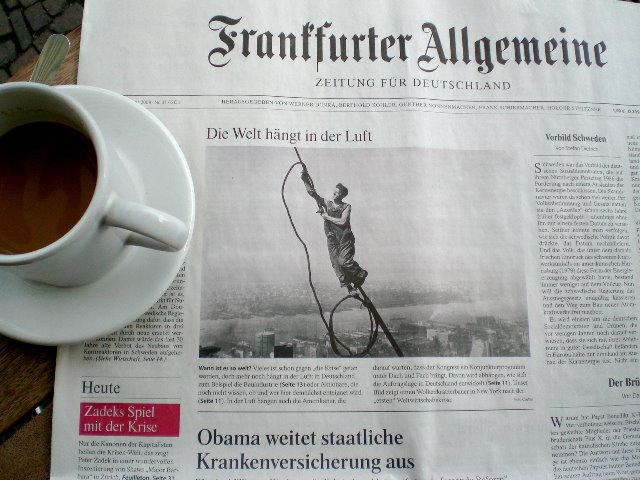
Allgemeine Zeitung: ‘The World Hanging in the Air.’ Photo by David MacBryde / The Rag Blog.

Seeing the Sea-Change in Germany and in the USA

What kind of “growth” is possible and desirable, what is impossible or dangerous on the thin surface of this planet? What do we want to “stimulate”, or “invest in” — and who makes, and in whose interest, “investment” decisions?

By David MacBryde / The Rag Blog / February 12, 2009

Beforehand:

BERLIN — In Germany on Friday, the sixth of November, 2009, the major conservative newspaper here, the Frankfurter Allgemeine Zeitung, ran a front page picture captioned “The World Hanging in the Air” just prior to, and while waiting for, the US response to the financial crisis and the economic stimulus package.

The paper reported, as a taste of what might come, that the US administration just extended public health coverage for children (SCHIP) “as a down payment on comprehensive reform.”

In the German news, local TV showed school districts in Berlin and around the country where people were working overtime gearing up to implement school building renovations as part of the German economic stimulus plans that had already been agreed upon.

One definite if relatively minor controversy was about accountability. Substantial public funds, borrowed in effect from the future, were being rapidly distributed to local school districts. How would the public school administrations handle the funds in an accountable way? That involves accounting in the bookkeeping sense (where German bookkeeping can be “stuffy” and rigid, not flexible and as fast as needed in the emergency.) The issue is also accountability in terms of appropriate use of public funds borrowed from the future. That sense of accountability, given the flood of funds, is getting lots of attention, including that of the school kids.

The main controversy in the German news came in debates about the crisis in the financial system. There are still many unknowns about conditions in some banks. There are still questions about possible huge hidden obligations, “innovative finance packages,” in the financial sector. And worse (since only relatively few banks here held many “innovative finance packages” bought from the USA — and there was no housing bubble or sub-prime mortgage problem here), the rapidly deepening recession meant that even “normal” bank assets were of unclear value, or were losing monetary value.

The German government is preparing legislation should it become necessary in the public interest to nationalize, expropriate, banks on a large scale. The government, the taxpayers, already de facto own a few banks on a case by case emergency basis. (And simply “nationalizing” the banks is not in itself here seen as adequate. One of the first banks to face failure here was the Bavarian State Bank, owned by the very conservative state of Bavaria and run by the local equivalent of very conservative Republicans. That is a topic for another blog.)

During:

On Tuesday the 10th of February there was news from the USA about the stimulus package being passed by the Senate. That process is being closely watched and generally greeted with some relief here.

Then the US administration presented the revised action plan about the financial crisis.

Lead by a hefty 10.2% decline in financial stocks, the stock market dropped 4.6%.

One thing is obvious: the announced action plan was NOT seen as making US banks wealthy.

To the contrary, bank stocks dropped.

Historians will have many details to look into. And more decisions will have to be made in order to get beyond the crisis in the financial system. But it is obvious that the plan as announced will NOT hand the banks a blank check from taxpayers as the original three page Bush-Paulson Republican bailout plan tried to do.

Into the future. Working towards April:

In Germany there has been much work on the crisis in the capital market system.

There was a meeting in Berlin about the financial crisis that was initiated by the German Ministry of International Economic Cooperation and that included non-governmental organizations and think tanks. The issue was the impact of the crisis in the financial system on weak states. The bottom line: the crisis, created in the richer countries, appears to be causing the unemployment of an additional 20 million people in poorer countries, with an increase in infant mortality. While over the years there had been some improvement in overcoming poverty and malnutrition, now that progress is being threatened and more kids are starving to death, all because of decisions that were made in banks. The German foreign policy position now includes (a) increasing direct foreign aid and (b) cutting those European and US agricultural subsidies that harm indigenous farming development in poorer countries. It was noted that Obama has explicitly urged the cut of those farm subsidies in the US, but that farm legislation in the US is also a domestic issue and depends on legislative work at the state level.

The German and European Union negotiating position on the financial crisis is being worked out with a view to the next international finance crisis meeting in April. That meeting will now include Brazil and China, and there is intense non-governmental work happening that concerns the inclusion of the interests of weaker states. This process will be one thing to watch.

For one aspect of the sea change that is happening, see the accompanying chart of current bank rankings as of Feb. 6, 2009 (Frankfurter Allgemeine Zeitun).

Chart of rankings of the largest banks as of Feb. 6, 2009. From Allgemeine Zeitung.

What will be happening in the USA regarding the financial system crisis?

There were congressional hearings with bankers on Wednesday, Feb. 11, 2009.

After the panicky punt by Paulson with his three page plan being defeated in Congress, Congress did pass a financial system plan that was supposed to be different — not a bailout but an investment — with oversight and accountability for us tax payers.

What has been happening to that? And what will happen next?

Personally, I have long appreciated the work of Elizabeth Warren. She wrote “the Coming Collapse of the Middle Class” and “The Two Income trap” concerning what has been happening economically to middle income families since the early 1970s, in “the mainstream.” She shows the sociological changes in the last 30 years and where we are “now” — BEFORE the current crisis — and how mainstream families ware but one accident away from bankruptcy BEFORE the current crisis started. Warren was previously at the University of Texas and now is at Harvard Law where she specializes in bankruptcy law.

If you have time, and cheep broadband access, she has a fine lecture on YouTube.

Warren was appointed chair of the Congressional Oversight Committee on the financial crisis. She is an expert in personal bankruptcy. She is certainly no fan of bankrupting average Americans in the interest of pumping money to bankers. She has heavily criticized both the Bush-Paulson plan and its implementation.

As the capital market crisis continues, she is one person to watch. There will be much controversy and more hearings in Congress.

On the stimulus package, Obama went on the road and encouraged local home meetings about the economy. And supposedly a government website is being set up for accountability, to follow implementation and to keep tabs on who does what with tax payer money for the stimulus.

There will be hearings in Washington on the financial system crisis. How will the controversies and decisions about the finance system crisis proceed?

Looking forward. From afar, one question:

Is there interest outside of Washington, D.C., in holding hearings on the financial crisis, on what happened and what is in the public interest? Might it be of interest, say in Austin, Texas, to encourage, say Congressman Lloyd Doggett with his staff, to set up a local hearing?

Maybe calling on Jim Hightower and perhaps faculty from Austin Community College, maybe Richard Croxdale, and UT journalism professor Robert Jensen, and James Galbraith of the UT Inequality Project, and others?

A start-up working paper to raise questions could be the Dec. 10, 2008, report from the Congressional Oversight Committee.

The focus for a hearing could be the Preamble to the Constitution, specifically one core purpose for the founding the United States, namely for “promoting the general welfare”. How do the efforts to solve the crisis in the financial system measure up to the purpose of “promoting the general welfare?”

That is a short term question. The longer term issue is what is meant by getting “beyond” the crises? Four cars in every garage is not the answer. I will write on that in a future blog. What kind of “growth” is possible and desirable, what is impossible or dangerous on the thin surface of this planet? What do we want to “stimulate”, or “invest in” — and who makes, and in whose interest, “investment” decisions?

The Rag Blog

Posted in Rag Bloggers | Tagged , , , | 2 Comments

Is Armageddon Closer Than Most Americans Think?

Frankly, I am not so concerned about doomsday and don’t believe it will come to that. But the thoughts that Hirschhorn expresses here are worthy of consideration, and the steep increase in firearms sales is rather disturbing.

Richard Jehn / The Rag Blog


Mesmerized by Melodic Rhetoric
By Joel S. Hirschhorn / February 11, 2009

Compared to rioting Europeans, Americans seem like docile, drugged out sheep herded towards the economic cliff, mesmerized by melodic rhetoric of political messiah Barack Obama. Too much hope can precipitate violence.

“I’ve been through Y2K and I’ve been through 9/11. I have never seen people so afraid as what we are seeing right now,” said gun shop owner Scott Moss recently. With more guns per capita easily 250 million privately owned ones and certainly more people in prisons than any other democracy, the intriguing question in this still worsening economic calamity is: If Americans found the courage for political rebellion now, would it preempt massive criminal violence, social havoc and armed rebellion later?

What we see President Obama and Congress doing and debating seem inadequate to restore financial health and security to the vast majority of Americans before millions more lives are devastated. Billions of tax dollars have gone to banks, corporations and others but have not stopped the hemorrhage of our financial lifeblood. More than half a million jobs continue to be lost a month; 3.5 million in the past year. Millions are losing their homes, health insurance and ability to buy food. Those with jobs are afraid to spend money.

As Nobel Prize winning and gloomy economist Paul Krugman said the other day after condemning what is going on in Washington, DC: “the economy is still in free fall” and we may be “falling into an economic abyss.” Harsh words for a harsh reality.

Recently, President Obama said: “A failure to act, and act now, will turn crisis into a catastrophe.” But what really matters is exactly what actions the government takes and whether they are what is needed. Besides, about the same time, his senior advisor David Axelrod said on television that “we have an economic catastrophe.” For most Americans, catastrophe seems more accurate.

Meanwhile, the elite Upper Class that stole the nation’s wealth in recent years with their greed and political clout, and destroyed the global economic system, are still sitting pretty in their McMansions, penthouses, private jets and yachts. They still enjoy their $50,000+ cars, still wine and dine in incredibly expensive restaurants, and still retain more wealth than ordinary people can imagine. Brioni men’s suits for $40,000+ are selling fast.

So what are ordinary Americans doing? Are there massive crowds of screaming, sign-carrying Americans in city streets from coast to coast? No. Or outside congressional buildings and the White House? No. Are there riots and looting by hoards of hungry and angry people who have lost a decent lifestyle? No. Do we see anything like the anti-Vietnam War protests? No. Do we see anything like the urban riots after the assassination of Martin Luther King, Jr.? No. Do we see anything like the rebellion against the British that created our nation? No

What do we see? Millions of people getting notices that they have lots their jobs, getting eviction notices, applying for bankruptcy, trying to get unemployment benefits, standing on long lines to get a shot at few jobs, filling crowded hospital emergency rooms to get medical help, taking their children out of child care they no longer can afford, and buying fewer and cheaper foods or seeking free food.

Compared to rioting Europeans, Americans seem like docile, drugged out sheep herded towards the economic cliff, mesmerized by melodic rhetoric of political messiah Barack Obama.

No wonder our politicians look like dithering, confused idiots arguing among themselves as we continue falling into economic hell. We simply are not demanding enough of those we elected.

It’s as if most Americans are patiently waiting to be rescued by winning the lottery. Is it hope or stupidity?

Meantime, President Obama has successfully stimulated one business sector. Since November, gun and ammunition sales have soared, as have requests for concealed carry permits. “Our sales are up 15 to 20 percent since October,” says the owner of Shooter’s Service in Livonia, Michigan. “It’s not the 40 percent other stores are reporting, but it’s good business.” Oakland County in Michigan issued 130 percent more concealed carry weapon permits in January than a year earlier. Such permits are up as much as 90 percent in some Western North Carolina counties. According to the FBI, background checks for gun sales in January jumped 29 percent over January 2008; this followed a 24 percent rise in December and a 42 percent increase in November. In many places gun sales have dropped because of shortages.

What awaits us when hope becomes futile and all confidence in the government is lost? Gun owner Chad Roberts in Tennessee said this recently: “With the economy like it is more people are going to be desperate wanting to steal from you.” So, perhaps we will see a contagious, rapid descent into mass criminal violence. As suffering, gun-toting Americans resort to looting, theft, robbery, burglary, assaults and other economically driven violent acts to get what is needed to survive, and other gun owners shoot to defend what they have. The fabric of civilized society ripped apart. Brutal police and military actions result, and for many no police protection. Constitutional freedoms suspended in a national emergency. Government threatened by armed rebellion as gun-toting citizens put their Second Amendment rights to the ultimate use.

This nightmare scenario may happen because free people waited too long, remained too hopeful, put too much faith in elections. Armageddon is closer than most Americans realize. Beyond catastrophe lies mob rule, a doomsday post-democracy, disintegration, collapse, chaos. Americans sucked into the economic abyss where violence replaces politics.

Hope will be a distant memory. One way to avoid the abyss is to give Americans what they have a constitutional right to have, something the Founders in their wisdom knew we would need. They provided an option in Article V of the Constitution that Congress has refused to honor, even though the one and only requirement has long been met. It is a convention of state delegates to consider proposals for constitutional amendments. This would provide a national forum for the public to seriously become involved with possible ways to reform and improve our government structure. Over 700 applications from state legislatures for an Article V convention have been submitted from all 50 states; they are being made available for the first time at foavc.org. Because the convention can only propose amendments that still must be ratified by three-quarters of the states there really is nothing to fear about harming our Constitution. There is now considerable interest in many states to push for a convention.

In these dismal times using what the Founders gave us makes more sense than ever before. Americans need more than two-party politics. They need a serious debate about structural reforms through constitutional amendments that can attack the deep rooted corruption and incompetence that plague the federal government and contributed to creating our current economic meltdown.

Rather than fear a convention, embrace it. It is far more rational to fear sticking with our status quo dysfunctional government or, worse, the degeneration into violent upheaval. Following the Constitution’s path to get reforms should be preferred.

[Joel S. Hirschhorn is a co-founder of Friends of the Article V Convention; contact him through delusionaldemocracy.com.]

Source / Nolan Chart

The Rag Blog

Posted in RagBlog | Tagged , , | Leave a comment

Britain: The Resurgence of the Student Occupation

Oxford students demand the university condemns Israel’s attack on Gaza. Photo: Rex.

Students are revolting: The spirit of ’68 is reawakening
By Emily Dugan

Campus sit-ins began as a response to the Gaza attacks, but unrest is already spilling over to other issues.

They are the iPod generation of students: politically apathetic, absorbed by selfish consumerism, dedicated to a few years of hedonism before they land a lucrative job in the City. Not any more. A seismic change is taking place in British universities.

Around the UK, thousands of students have occupied lecture theatres, offices and other buildings at more than 20 universities in sit-down protests. It seems that the spirit of 1968 has returned to the campus.

While it was the situation in Gaza that triggered this mass protest, the beginnings of political enthusiasm have already spread to other issues.

John Rose, one of the original London School of Economics (LSE) students to mount the barricades alongside Tariq Ali in 1968, spent last week giving lectures on the situation in Gaza at 12 of the occupations.

“This is something different to anything we’ve seen for a long time,” he said. “There is genuine fury at what Israel did.

“I think it’s highly likely that this year will see more student action. What’s interesting is the nervousness of vice chancellors and their willingness to concede demands; it indicates this is something that could well turn into [another] ’68.”

Beginning with a 24-hour occupation at the School of Oriental and African Studies (SOAS) on 13 January, the sit-ins spread across the country. Now occupations have been held at the LSE, Essex, King’s College London, Birmingham, Sussex, Warwick, Manchester Metropolitan, Oxford, Leeds, Cambridge, Sheffield Hallam, Bradford, Nottingham, Queen Mary, Manchester, Strathclyde, Newcastle, Kingston, Goldsmiths and Glasgow.

Among the demands of students are disinvestment in the arms trade; the promise to provide scholarships for Palestinian students; a pledge to send books and unused computers to Palestine; and to condemn Israeli attacks on Gaza.

Technology has set these actions apart from those of previous generations, allowing a national momentum to grow with incredible speed. Through the linking up of internet blogs, news of successes spread quickly and protests grew nationwide.

Just three weeks after the first sit-in at SOAS, students gathered yesterday at Birkbeck College to draw up a national strategy. The meeting featured speeches from leaders in the Stop the War movement, such as Tony Benn, George Galloway MP and Jeremy Corbyn MP. There has also been an Early Day Motion tabled in Parliament in support of campus activism.

At the end of the month students from across the country will gather for a national demonstration calling for the abolition of tuition fees, an event that organisers say has rocketed in size following the success of the occupations over Gaza.

Vice chancellors and principals have been brought to the negotiating table and – in the majority of universities – bowed to at least one of the demands. The students’ success means that now there is a new round of protests. On Wednesday two new occupations began at Strathclyde and Manchester universities, and on Friday night students at the University of Glasgow also launched a sit-in.

Emily Dreyfus, a 21-year-old political activist in her third year of reading classics at Oxford, was one of around 80 students to occupy the historic Bodleian library building in the city and demand that the university issue a statement condemning the Gaza attacks and disinvest from the arms trade. She said: “I found Oxford politically very dead when I arrived, but it’s completely different now. There seem to be more and more people talking about politics, which is so exciting. It’s really been aided by the communication tools we’ve got, things like Facebook.”

Wes Streeting, the president of the National Union of Students, said: “What we’ve seen over the Gaza issue is a resurgence of a particular type of protest: the occupation. It’s a long time since we’ve seen student occupations on such a scale. It’s about time we got the student movement going again and had an impact.”

Establishments that have not previously been known for their activism have also become involved. Fran Legg was one of several students to set up the first Stop the War Coalition at Queen Mary, a research-focused university in London, a month ago. Now they are inundated with interest.

“Action on this scale among students hasn’t been seen since the Sixties and Seventies,” she said.

“This is going to go down in history as a new round of student mobilisation and it will set a precedent. Gaza is the main issue at the moment, but we’re looking beyond the occupation; we’re viewing it as a springboard for other protests and to set up a committee to make sure the university only invests ethically.”

As the first generation of students to pay substantial direct fees to universities, their negotiating power has also been strengthened. Their concern over their college’s investments have been given new legitimacy because it is partly their money.

Ms Legg said: “For the first time, you’ve got students getting principals to the negotiation table, saying they don’t want their tuition fees funding war. Everybody wants to know where their money is going.”

The activist: ‘Students will see they can take action’

Katan Alder, 22, student leader speaking from the occupation at Manchester University

“We’ve been occupying the university since Wednesday. More than 500 people came to an emergency Students’ Union meeting and we took the vice chancellor’s administration block that afternoon. Israel’s assault on Gaza made people angry, and we heard about the occupations at other universities through blogs. This is the biggest student campaign we’ve had and it’s also the most wide-reaching. We’ll stay until the university lets us meet with the vice chancellor. I think students will see they can take action on more issues, such as the war in Iraq and Afghanistan and the education system; the Government’s refusal to stop the marketisation of education has provoked a lot of anger.”

The ’68 veteran: ‘It changed our lives’

John Rose, 63, former student organiser at the London School of Economics in 1968; now a lecturer and author on the Middle East

“I arrived at the LSE in ’66 as an extremely naive liberal student and I left in ’69 as a revolutionary socialist. It changed our lives. I was one of the student organisers with Tariq Ali and attended all the demonstrations and occupations. We did think a revolution was coming; we thought mass action of students might overthrow capitalism and bring genuine equality. It took us some time to realise that wasn’t going to happen.

“It wasn’t just about rioting and having fun, it was political argument that probed all the assumptions about the world. It was a highly intense period and the memory stays powerfully with anyone involved; it’s the memory of those times that has kept me going.

“It was a feeling of fantastic elation: we began to realise that mass action could change things. Once it started, we developed a taste for it and began to consider mass activity as a way of doing politics, which is what’s happening now. People are fed up with bankers, politicians and elite institutions. Hundreds of us thought the revolution was coming in ’69, but maybe the revolution is coming now.”

Source / The Independent / Posted on Feb. 8, 2009

The Rag Blog

Posted in RagBlog | Tagged , , | 1 Comment

The Republican Taliban Are in the Cat Bird Seat

Charge!: Republican Chairman Michael Steele calls forth the forces of reaction.

‘The price of determined obstructionism will be much higher for the nation, but the Republicans clearly care only about their own political fate.’

By Sherman DeBrosse / The Rag Blog / February 11, 2009

Representative Peter Sessions of Texas, head of the National Republican Congressional Committee, bragged that Senate Republicans had learned insurgency tactics from the Taliban. Republican columnist Jonah Goldberg has already registered his opinion that “The stimulus bill has failed. Barack Obama has failed.” Maybe he thought that his colleagues had successfully gutted it, but he limited his explanation of the failure to saying Barack Obama lost his opportunity to reduce the partisan climate, which was not a good idea in the first place in Goldberg’s view.

No one was surprised when Rush Limbaugh, the Republican ayatollah and enforcer of orthodoxy, said “I hope he [Obama] fails.” Limbaugh has spent two decades making racially “insensitive” remarks, and race was doubtless one important factor in the spinmeister’s motivation. It is difficult to say how many other conservatives have serious problems with President Obama’s race.

No Honeymoons for Clinton and Obama

Republicans refused to grant Bill Clinton a honeymoon in 1993, and now they have done the same to Barack Obama. Blocking Clinton programs paid off big time, and voters in 1994 restored Republicans to control of the House after decades in the wilderness. It looks like the GOP is looking to repeat this feat and profit handsomely in 2010. Willing to sacrifice the interests of the nation, the Republicans have put themselves in the cat bird seat. Heads they win; tails we the people lose.

But this time, the price of determined obstructionism will be much higher for the nation, but the Republicans clearly care only about their own political fate. Recently, a ranking international trade official predicted that this deep depression will lead to political instability in some countries. One of British Prime Minister Brown’s chief economic advisors is saying the world could be facing the worst economic crisis in 100 years.

Even Keynesian economists supporting the stimulus plan say things are bound to get much worse and that there will not be great improvement in 2010. Through delays, talking down the stimulus, and gutting important provisions, the Republicans have guaranteed that things will get much worse. Few doubt that the GOP base will hold firm, and there is a pattern of voters supporting the opposition in off years. Add to that impatient people who will want to punish Obama and the Democrats for not working economic miracles in less than two years, and there is the formula for huge GOP gains in 2010.

The Spin War is about a very difficult paradigm shift

So far, with the help of the corporate media, Republicans have run circles around Democrats in the spin war. All they are required to do is criticize and offer vague bumper sticker slogans. Most, like Party chairman Michael Steele, subscribe to Herbert Hoover economics, and want government to do nothing. Some back the three trillion tax cut plan offered in the Senate. Others are unhappy but have nothing to offer. It seems clear that they have greatly driven down public support for the stimulus and have reconverted many to the old, failed economic paradigm of tax breaks for the rich, deregulation, and opposition to spending to help the least advantaged.

Democrats mistakenly thought that the election results and illusory polls showed that there had been a paradigm shift away from the old model and toward modern economics. They should have read Thomas Kuhn, whose work shows that these shifts come slowly. Economic pain will get worse, and that will stimulate some to question the old assumptions. But there are no simple slogans and one minute soundbites to use in helping people understand our situation and seeing the merit of Keynesian solutions. In his first press conference, President Obama offered many good explanations. However, we must find ways to simplify them still more.

How the Democrats reeducate the public on economic matters is a problem. It is so much easier to sell people on misinformation. Correcting this propaganda requires two and three step reasoning. Congressional Democrats must harp on how Republican economics brought us this looming depression and they must harp on the inconsistency of Republican arguments.

There are many who insist that only tax cuts — especially for the rich — will do the job. They note that the Kennedy and Reagan cuts had some positive impact. But they do not tell us that studies of those two events show that we got far less than a dollar’s simulative value out of each dollar of tax cuts. Simple, untargeted spending yields $1.75 in stimulus for each dollar spent. It seems that the Bush tax cut went to fuel the financial services and housing bubbles, and the 2008 cash hand-out had no effect whatever.

The Gutted Stimulus Plan

The fact is that the world economy is going over the cliff. Keynesians know that this package is far too small and has the wrong ration between tax cuts and stimulus spending. If this first stimulus package prevents the bottom from completely falling out, it will have been a great success. We also know that the stimulus package was badly weakened in the Senate — all to pick up three votes. The child tax credit was changed to make certain that the very poorest children would be left out in the cold. Assistance to the states was sharply cut, assuring that many in state and municipal jobs will lose their jobs and be unable to spend at old levels. Medical assistance for the unemployed was practically left out. For no sensible reason, people who now own homes will get $39 billion in assistance so they can try to flip their houses at a profit. It is hard to see how all this damage can be repaired in conference committee as the votes of so-called centrists are needed to get it through the Senate.

After the conference bill passes, President Obama needs to lower expectations by pointing out all the damage that was done to the program. It will no longer produce four million jobs.

Let The Repugs Bring Buckets to the Senate

With the certainty of more obstruction down the road, Democrats have to either abandon large parts of their program or face up to doing something about the filibuster. It is unlikely that the rules can be changed, so they are left with letting the Republicans bring their buckets into the Senate chamber and start talking around the clock. The trick will be finding the right issue. It is probably health care, provided the Democrats submit a simple and clean bill that will not open the door for all sorts of outrageous claims about not being able to pick your own doctor, etc.

What NeoCons Want in 2013

If the Democrats cannot facilitate a paradigm shift, we could see gleeful NeoCons begin implementing Friedman’s Shock Doctrine in 2013, complete with a shredded safety net, all sorts of privatization, stripped away labor and environmental regulations, a return to casino capitalism, and a foreign policy designed to extend the power of Wall Street while alienating tens of millions abroad. Face it; if the American economy cannot generate great income for American investment capitalists, the Armed forces must do it abroad.

If things are bad enough, ordinary people might accept the kind of security state General Augusto Pinochet introduced to protect the Chicago School’s economic program in Chile. George W. Bush greatly improved upon the foundations laid by his father and Oliver North, and Barack Obama will not be able to dismantle all of that. Already, his administration has refused to back off Bush’s use of the state secret privilege.

The Rag Blog

Posted in Rag Bloggers | Tagged , , , | 2 Comments

The Press Doesn’t Cover Nonviolence : A Cautionary Tale

Creative nonviolence: street theater at the 2008 Republican Convention in St. Paul. Photo by Neal Reiter.

If you want nonviolence, report it

If newspaper editors are serious about wanting young people to choose nonviolence, then they must do more than pounce on stories about young people who use violence. They must report on the alternative.

By Susan Van Haitsma / The Rag Blog / February 11, 2009

An editorial published recently by the Austin American-Statesman admonished readers to view a trial in Minnesota as a “cautionary tale for activists.” Two men from Austin were charged with making explosives intended for use during the Republican National Convention last September

Cautionary tales are important, and it’s fortunate that the explosives were never used. I wholeheartedly agree with the editorial that using violence to effect change is counterproductive. But this story, focusing only on these two “activists” (and, later, their former colleague-turned FBI informant) has given a false impression of what activism actually looked like at both the Democratic and Republican National Conventions.

The case of the men from Austin was the only front-page news (Sept. 9, 10, 11, 25 and Jan. 9, 27, 28, 31) published in the Austin American-Statesman about any aspect of the demonstrations at either convention. The larger, unreported story was that an array of creative, nonviolent action was organized in Denver and St. Paul by committed people who had gathered there to exercise their First Amendment rights to assemble peacefully despite the restrictions placed on them. People whose message was essentially, “it’s counterproductive to use violence (invasion, occupation, torture, war) to effect change” were muffled by the police and the press.

I followed news about the demonstrations at both conventions mostly through independent media reports and eye-witness accounts from friends who were there. Events included parades, marches, permitted encampments, art displays, concerts, street theatre and public forums. In Denver, a group of hundreds of young people led by members of Iraq Veterans Against the War marched peacefully for several miles to deliver a statement to Obama campaign officials at the convention site. In St. Paul, a similar march was led by several hundred members of Veterans for Peace who had held their annual convention in St. Paul in order to coincide with the RNC. A group formed by Voices for Creative Nonviolence walked 450 miles from Chicago to St. Paul during the month ahead of the convention to speak in towns along the way about the ongoing occupation of Iraq. CodePink activists rode bicycles around the heavily barricaded convention sites to promote a “War is Not Green” message, and they used some spontaneous satire to dramatize corporate influence of politicians and to resist the provocative corralling of demonstrators by cordons of black-clad riot police and national guard troops.

If newspaper editors are serious about wanting young people to choose nonviolence, then they must do more than pounce on stories about young people who use violence. They must report on the alternative. Otherwise, part of the message young people get is that only violence warrants notice. Jurors have debated the influence of the FBI informant in the RNC case. Another discussion could reasonably ask whether the major media plays a role in “inducing” people to use violence by selling it so heavily in the news while downplaying or ignoring news about people who practice nonviolent resistance.

Martin Luther King, Jr. was rightly cited in the American-Statesman editorial as a powerful practitioner of nonviolence. His resistance was active, not “passive,” as the editorial termed it.

At Austin’s MLK Day celebration, and also in our public high schools this year, the Nonmilitary Options for Youth group that I work with has used a “peace wheel of fortune” that we made as a peace education tool. The wheel contains names and pictures of peacemakers past and present, including prominent figures like MLK and Gandhi, and others not as familiar. Students spin the wheel and, for a prize, are asked to tell us something about the person on the wheel where it stops. We are encouraged when we see how much students like the wheel, so we’re also saddened when we see how little they are being taught in school about even the most well-known nonviolent movements. If young people know only that MLK “had a dream,” but don’t know what he did to achieve it, and if they have never heard of Gandhi or Cesar Chavez, then they have little idea of what nonviolent resistance actually entails: the boycotts, labor strikes, fasts, sit-ins, teach-ins, mass marches, court cases, good faith negotiations and the long road made of many important steps. Tools and strategies evolve over time and adapt to different situations because nonviolence is a living history.

Don’t miss out on this history as it is being lived. Don’t cheat kids out of it. In this time of hopefulness and reform, I’d like to see the mainstream media commit to report more than the cautionary tales, and to tell the stories of the many creative ways that people are using nonviolent methods to defend our freedoms and bring about positive change. Do it because it will increase fairness and accuracy in reporting, and do it because it will save lives.

[Van Haitsma is active with Nonmilitary Options for Youth in Austin and writes as makingpeace on the Austin American-Statesman reader blogs.]

The Rag Blog

Posted in Rag Bloggers | Tagged , , , | 2 Comments

Police in Texas : Property Seizure called ‘Highway Piracy’

Beware all who enter here. Photo by MJW.

Highway robbery on the open roads of Texas

By Thorne Dreyer / The Rag Blog / February 11, 2009

See ‘Property seizure by police called “highway piracy,”‘ by Lisa Sandberg, Below.

According to the Mayor of Tenaha, Texas, population 1,000, “It’s always helpful to have any kind of income to expand your police force.” Even, apparently, when it’s literally highway robbery. Police are enriching local coffers by abusing an overly vague law permitting the taking of property by those accused of committing a crime. In many instances people are pressured to sign a waiver giving up their property in exchange for not being charged.

Most of those caught in this kind of trap are black and from out of state. And, according to the Houston Chronicle, “some affidavits filed by officers relied on the presence of seemingly innocuous property as the only evidence that a crime had occurred.”

Laws permitting the seizure by police of property from drivers suspected of committing a crime, including their car and anything in it, have been abused for years.

The Chronicle and the San Antonio Express-Times have published an expose about this form of criminal misuse of power, Attorney David Guillory is suing officials in Tenaha and Shelby County on behalf of a client, and Texas state Sen. John Whitmire, who has pressed a number of admirable causes over the years, is pushing for action against this highly questionable practice that is frequently based on racial profiling and designed to enrich the coffers of municipal pirates like the police force of Tenaha, Texas.

Property seizure by police called ‘highway piracy’

Attorney David Guillory calls the roadside stops and seizures in Tenaha ‘highway piracy,’ undertaken by a couple of law enforcement officers whose agencies get to keep most of what is seized.

By Lisa Sandberg / February 7, 2009

TENAHA — A two-decade-old state law that grants authorities the power to seize property used in a crime is wielded by some agencies against people who are never charged with, much less convicted, of a crime.

Law enforcement authorities in this East Texas town of 1,000 people seized property from at least 140 motorists between 2006 and 2008, and, to date, filed criminal charges against fewer than half, according to a San Antonio Express-News review of court documents.

Virtually anything of value was up for grabs: cash, cell phones, personal jewelry, a pair of sneakers, and often, the very car that was being driven through town. Some affidavits filed by officers relied on the presence of seemingly innocuous property as the only evidence that a crime had occurred.

Linda Dorman, a great-grandmother from Akron, Ohio, had $4,000 in cash taken from her by local authorities when she was stopped while driving through town after visiting Houston in April 2007. Court records make no mention that anything illegal was found in her van and show no criminal charges filed in the case. She is still waiting for the return of what she calls “her life savings.”

Dorman’s attorney, David Guillory, calls the roadside stops and seizures in Tenaha “highway piracy,” undertaken by a couple of law enforcement officers whose agencies get to keep most of what is seized.

Guillory is suing officials in Tenaha and Shelby County on behalf of Dorman and nine other clients who were stripped of their property. All were African-Americans driving either rentals or vehicles with out-of-state plates.

Lawsuit filed

Guillory alleges in the lawsuit that while his clients were detained, they were presented with an ultimatum: waive your rights to your property in exchange for a promise to be released and not be criminally charged. Guillory said most did as Dorman did, signing the waiver to avoid jail.

The state’s asset seizure law doesn’t require that law enforcement agencies file criminal charges in civil forfeiture cases.

It requires only a preponderance of evidence that the property was used in the commission of certain crimes, such as drug crimes, or bought with proceeds of those crimes. That’s a lesser burden than that required in a criminal case.

But Sen. John Whitmire, D-Houston, chair of the Senate Criminal Justice Committee, said the state’s asset forfeiture law is being abused by enough jurisdictions across the state that he wants to rewrite major sections of it this year.

“The idea that people lose their property but are never charged and never get it back, that’s theft as far as I’m concerned,” he said.

Supporters tout the state’s forfeiture law, when used right, as an essential law enforcement tool, allowing state and local departments the ability to go after criminals using the criminals’ money. Law enforcement agencies last year captured tens of millions of dollars from such seizures statewide, according to records from Whitmire’s office.

But in Tenaha, a town of chicken farms that hugs the Louisiana border, critics say being a black out-of-towner passing through with anything of value is almost evidence of a crime.

Town needs revenue

Tenaha Mayor George Bowers, 80, defended the seizures, saying they allowed a cash-poor city the means to add a second police car in a two-policeman town and help pay for a new police station. “It’s always helpful to have any kind of income to expand your police force,” Bowers said.

Local police, he said, must take aggressive action to stem the drug trade that flows through town via U.S. 59. “No doubt about it. (Highway 59) is a thoroughfare that a lot of no-good people travel on. They take the drugs and sell it and take the money and go right back into Mexico,” said Bowers, who has been Tenaha’s mayor for 54 years.

Bowers said he would defer questions about whether innocent people were being stripped of their property to Shelby County District Attorney Lynda Russell.

Russell could not be reached for comment, and her attorney declined comment. Randy Whatley, a local constable who himself deposited $115,000 into the county’s seizure account for fiscal year 2007 — state records show $45,000 was eventually returned to their owners — also could not be reached for comment. Russell, Whatley and Bowers are named in Guillory’s lawsuit.

Harris County District Attorney Patricia Lykos said the state’s forfeiture law, which last year put millions in the coffers of local law enforcement agencies, including hers, takes some of the profit out of crime. “These ill-gotten gains are used to further the aims of law enforcement and public safety,” she said. “It’s kind of poetic justice, isn’t it?”

Lykos praises law

Lykos believes the law, if followed, provides citizens with adequate safeguards. Local police and attorneys in her office, she said, are well-versed in what constitutes adequate evidence for seizures. Rarely, she said, do seizures take place locally without the filing of criminal charges.

In Shelby County, the district attorney made legal agreements with some individuals that her office would not file criminal charges so long as the property owner waived all rights to the valuables.

“In exchange for (respondent) signing the agreed order of forfeiture, the Shelby County District Attorney’s Office agrees to reject charges of money laundering pending at this time,” read one waiver, dated April 10, 2007.

The property owners named in the waiver had just signed over $7,342 in cash, their 1994 Chevrolet Suburban, a cell phone, a BlackBerry and a stone necklace.

The law, forbids a peace officer at the time of seizure to “request, require or in any manner induce any person . . . to execute a document purporting to waive the person’s interest in or rights to the property.”

Copyright 2009 Houston Chronicle Austin Bureau

Source / Houston Chronicle

The Rag Blog

Posted in Rag Bloggers | Tagged , , | 5 Comments

We Won’t Pay for Your Crisis !!

In December 2001 Argentina was caught by street protests when former President Fernando de la Rua froze bank accounts to pay off the country’s foreign debt. The continuing protests, street riots, and looting of shops caused De la Rua to resign as well as his successor Interim President Adolfo Rodriguez Saa. To end the country’s economic and political turmoil on New Year’s Day Argentina’s Legislative Assembly decided to appoint Eduardo Duhalde as Argentina’s new President until December 2003. Here Communistas throw rocks during a protest that turned into a riot between rival political parties. Photograph © 2002 Andrew Kaufman.

All of Them Must Go
By Naomi Klein / February 4, 2009

Watching the crowds in Iceland banging pots and pans until their government fell reminded me of a chant popular in anti-capitalist circles in 2002: “You are Enron. We are Argentina.”

Its message was simple enough. You–politicians and CEOs huddled at some trade summit–are like the reckless scamming execs at Enron (of course, we didn’t know the half of it). We–the rabble outside–are like the people of Argentina, who, in the midst of an economic crisis eerily similar to our own, took to the street banging pots and pans. They shouted, “¡Que se vayan todos!” (“All of them must go!”) and forced out a procession of four presidents in less than three weeks. What made Argentina’s 2001-02 uprising unique was that it wasn’t directed at a particular political party or even at corruption in the abstract. The target was the dominant economic model–this was the first national revolt against contemporary deregulated capitalism.

It’s taken a while, but from Iceland to Latvia, South Korea to Greece, the rest of the world is finally having its ¡Que se vayan todos! moment.

The stoic Icelandic matriarchs beating their pots flat even as their kids ransack the fridge for projectiles (eggs, sure, but yogurt?) echo the tactics made famous in Buenos Aires. So does the collective rage at elites who trashed a once thriving country and thought they could get away with it. As Gudrun Jonsdottir, a 36-year-old Icelandic office worker, put it: “I’ve just had enough of this whole thing. I don’t trust the government, I don’t trust the banks, I don’t trust the political parties and I don’t trust the IMF. We had a good country, and they ruined it.”

Another echo: in Reykjavik, the protesters clearly won’t be bought off by a mere change of face at the top (even if the new PM is a lesbian). They want aid for people, not just banks; criminal investigations into the debacle; and deep electoral reform.

Similar demands can be heard these days in Latvia, whose economy has contracted more sharply than any country in the EU, and where the government is teetering on the brink. For weeks the capital has been rocked by protests, including a full-blown, cobblestone-hurling riot on January 13. As in Iceland, Latvians are appalled by their leaders’ refusal to take any responsibility for the mess. Asked by Bloomberg TV what caused the crisis, Latvia’s finance minister shrugged: “Nothing special.”

But Latvia’s troubles are indeed special: the very policies that allowed the “Baltic Tiger” to grow at a rate of 12 percent in 2006 are also causing it to contract violently by a projected 10 percent this year: money, freed of all barriers, flows out as quickly as it flows in, with plenty being diverted to political pockets. (It is no coincidence that many of today’s basket cases are yesterday’s “miracles”: Ireland, Estonia, Iceland, Latvia.)

Something else Argentina-esque is in the air. In 2001 Argentina’s leaders responded to the crisis with a brutal International Monetary Fund-prescribed austerity package: $9 billion in spending cuts, much of it hitting health and education. This proved to be a fatal mistake. Unions staged a general strike, teachers moved their classes to the streets and the protests never stopped.

This same bottom-up refusal to bear the brunt of the crisis unites many of today’s protests. In Latvia, much of the popular rage has focused on government austerity measures–mass layoffs, reduced social services and slashed public sector salaries–all to qualify for an IMF emergency loan (no, nothing has changed). In Greece, December’s riots followed a police shooting of a 15-year-old. But what’s kept them going, with farmers taking the lead from students, is widespread rage at the government’s crisis response: banks got a $36 billion bailout while workers got their pensions cut and farmers received next to nothing. Despite the inconvenience caused by tractors blocking roads, 78 percent of Greeks say the farmers’ demands are reasonable. Similarly, in France the recent general strike–triggered in part by President Sarkozy’s plans to reduce the number of teachers dramatically–inspired the support of 70 percent of the population.

Perhaps the sturdiest thread connecting this global backlash is a rejection of the logic of “extraordinary politics”–the phrase coined by Polish politician Leszek Balcerowicz to describe how, in a crisis, politicians can ignore legislative rules and rush through unpopular “reforms.” That trick is getting tired, as South Korea’s government recently discovered. In December, the ruling party tried to use the crisis to ram through a highly controversial free trade agreement with the United States. Taking closed-door politics to new extremes, legislators locked themselves in the chamber so they could vote in private, barricading the door with desks, chairs and couches.

Opposition politicians were having none of it: with sledgehammers and an electric saw, they broke in and staged a twelve-day sit-in of Parliament. The vote was delayed, allowing for more debate–a victory for a new kind of “extraordinary politics.”

Here in Canada, politics is markedly less YouTube-friendly–but it has still been surprisingly eventful. In October the Conservative Party won national elections on an unambitious platform. Six weeks later, our Tory prime minister found his inner ideologue, presenting a budget bill that stripped public sector workers of the right to strike, canceled public funding for political parties and contained no economic stimulus. Opposition parties responded by forming a historic coalition that was only prevented from taking power by an abrupt suspension of Parliament. The Tories have just come back with a revised budget: the pet right-wing policies have disappeared, and it is packed with economic stimulus.

The pattern is clear: governments that respond to a crisis created by free-market ideology with an acceleration of that same discredited agenda will not survive to tell the tale. As Italy’s students have taken to shouting in the streets: “We won’t pay for your crisis!”

[Naomi Klein is an award-winning journalist and syndicated columnist and the author of the international and New York Times bestseller The Shock Doctrine: The Rise of Disaster Capitalism (September 2007); an earlier international best-seller, No Logo: Taking Aim at the Brand Bullies; and the collection Fences and Windows: Dispatches from the Front Lines of the Globalization Debate (2002).]

Source / The Nation (This article appeared in the February 23, 2009 edition of The Nation.)

The Rag Blog

Posted in RagBlog | Tagged , , | 1 Comment

James Howard Kunstler : ‘Economic Recovery’ and a Poverty of Imagination

James Howard Kunstler has a comprehensive and blistering view of the current crusade to stimulate the economy; he thinks it won’t work and that it’s based on obsolete and wrongheaded assumptions. He believes a basic change in attitude is required; and that we must swerve sharply from consumerism and “growth” in the direction of sustainability, genuine energy independence and a more manageable sense of scale.

Kunstler, however, fails to mention that among the dead is free market capitalism. Capitalism famously requires growth to survive. The future will require sustainability, not growth. That is inconsistent with capitalism. Hence, the objective conditions of the future will demand socialist organization. The alternative is societal disintegration and real class war.

David Hamilton / The Rag Blog / February 10, 2009

‘The big question before the nation is: do we try to re-start the whole smoking, creaking hopeless, futureless machine? Or do we start behaving differently?’

By James Howard Kunstler / February 9, 2009

Venturing out each day into this land of strip malls, freeways, office parks, and McHousing pods, one can’t help but be impressed at how America looks the same as it did a few years ago, while seemingly overnight we have become another country. All the old mechanisms that enabled our way of life are broken, especially endless revolving credit, at every level, from household to business to the banks to the US Treasury.

Peak energy has combined with the diminishing returns of over-investments in complexity to pull the “kill switch” on our vaunted “way of life” — the set of arrangements that we won’t apologize for or negotiate. So, the big question before the nation is: do we try to re-start the whole smoking, creaking hopeless, futureless machine? Or do we start behaving differently?

The attempted re-start of revolving debt consumerism is an exercise in futility. We’ve reached the limit of being able to create additional debt at any level without causing further damage, additional distortions, and new perversities of economy (and of society, too). We can’t raise credit card ceilings for people with no ability make monthly payments. We can’t promote more mortgages for people with no income. We can’t crank up a home-building industry with our massive inventory of unsold, and over-priced houses built in the wrong places. We can’t ramp back up the blue light special shopping fiesta. We can’t return to the heyday of Happy Motoring, no matter how many bridges we fix or how many additional ring highways we build around our already-overblown and over-sprawled metroplexes. Mostly, we can’t return to the now-complete “growth” cycle of “economic expansion.” We’re done with all that. History is done with our doing that, for now.

So far — after two weeks in office — the Obama team seems bent on a campaign to sustain the unsustainable at all costs, to attempt to do all the impossible things listed above. Mr. Obama is not the only one, of course, who is invoking the quest for renewed “growth.” This is a tragic error in collective thinking. What we really face is a comprehensive contraction in our activities, especially the scale of our activities, and the pressing need to readjust the systems of everyday life to a level of decreased complexity.

For instance, the myth that we can become “energy independent and yet remain car-dependent is absurd. In terms of liquid fuels, we’re simply trapped. We import two-thirds of the oil we use and there is absolutely no chance that drill-drill-drilling (or any other scheme) will change that. The public and our leaders can not face the reality of this. The great wish for “alternative” liquid fuels (bio fuels, algae excreta) will never be anything more than a wish at the scales required, and the parallel wish to keep all our cars running by other means — hydrogen fuel cells, electric motors — is equally idle and foolish. We cannot face the mandate of reality, which is to do everything possible to make our living places walkable, and connect them with public transit. The stimulus bills in congress clearly illustrate our failure to understand the situation.

The attempt to restart “consumerism” will be equally disappointing. It was a manifestation of the short peak energy decades of history, and now that we’re past peak energy, it’s over. That seventy percent of the economy is over, especially the part that allowed people to buy stuff with no money. From now on people will have to buy stuff with money they earn and save, and they will be buying a lot less stuff. For a while, a lot of stuff will circulate through the yard sales and Craigslist, and some resourceful people will get busy fixing broken stuff that still has value. But the other infrastructure of shopping is toast, especially the malls, the strip malls, the real estate investment trusts that own it all, many of the banks that lent money to the REITs, the chain-stores and chain eateries, of course, and, alas, the non-chain mom-and-pop boutiques in these highway-oriented venues.

Washington is evidently seized by panic right now. I don’t know anyone who works in the White House, but I must suppose that they have learned in two weeks that these systems are absolutely tanking, that the previous way of life that everybody was so set on not apologizing for has reached the end of the line. We seem to be learning a new and interesting lesson: that even a team that promises change is actually petrified of too much change, especially change that they can’t really control.

The argument about “change” during the election was sufficiently vague that no one was really challenged to articulate a future that wasn’t, materially, more-of-the-same. I suppose the Obama team may have thought they would only administer it differently than the Bush team — but basically life in the USA would continue being about all those trips to the mall, and the cubicle jobs to support that, and the family safaris to visit Grandma in Lansing, and the vacations at Sea World, and Skipper’s $20,000 college loan, and Dad’s yearly junket to Las Vegas, and refinancing the house, and rolling over this loan and that loan… and that has all led to a very dead end in a dark place.

If this nation wants to survive without an intense political convulsion, there’s a lot we can do, but none of it is being voiced in any corner of Washington at this time. We have to get off of petro-agriculture and grow our food locally, at a smaller scale, with more people working on it and fewer machines. This is an enormous project, which implies change in everything from property allocation to farming methods to new social relations. But if we don’t focus on it right away, a lot of Americans will end up starving, and rather soon. We have to rebuild the railroad system in the US, and electrify it, and make it every bit as good as the system we once had that was the envy of the world. If we don’t get started on this right away, we’re screwed. We will have tremendous trouble moving people and goods around this continent-sized nation. We have to reactivate our small towns and cities because the metroplexes are going to fail at their current scale of operation. We have to prepare for manufacturing at a much smaller (and local) scale than the scale represented by General Motors.

The political theater of the moment in Washington is not focused on any of this, but on the illusion that we can find new ways of keeping the old ways going. Many observers have noted lately how passive the American public is in the face of their dreadful accelerating losses. It’s a tragic mistake to tell them that they can have it all back again. We’ll see a striking illustration of “phase change” as the public mood goes from cow-like incomprehension to grizzly bear-like rage. Not only will they discover the impossibility of getting back to where they were, but they will see the panicked actions of Washington drive what remains of our capital resources down a rat hole.

A consensus is firming up on each side of the “stimulus” question, largely along party lines — simply those who are for it and those who are against it, mostly by degrees. Nobody in either party — including supposed independents such as Bernie Sanders or John McCain, not to mention President Obama — has a position for directing public resources and effort at any of the things I mentioned above: future food security, future travel-and-transport security, or the future security of livable, walkable dwelling places based on local networks of economic interdependency. This striking poverty of imagination may lead to change that will tear the nation to pieces.

Source / Kunstler.com

The Rag Blog

Posted in RagBlog | Tagged , , , , | Leave a comment

Obama Press Conference : What a Difference!

Graphic by Larry Ray / The Rag Blog.

After eight years of George Bush’s evasive, sophomoric and defensive prattle it was energizing to hear a president who clearly knows what he is talking about and who can communicate it in a clear and understandable way.

By Larry Ray / The Rag Blog / February 10, 2009

President Barack Obama’s first prime time press conference should be marked as another historic American moment. Because for the first time in decades we saw an American president patiently, intelligently and completely answer questions from the press.

He genuinely listened to questions from the assembled press corps. Unlike most other presidents since FDR, he took their loaded, presumptive questions and addressed them straight on, with no prepared notes, replying in great, logical detail. His manner was relaxed, persuasive and intelligent.

After eight years of George Bush’s evasive, sophomoric and defensive prattle it was energizing to hear a president who clearly knows what he is talking about and who can communicate it in a clear and understandable way. Never resorting to breezy slang, Obama reassuringly demonstrated his wide grasp of the issues and his ability to analyze them.

Again, it seems clear that the pundits and news guessers continue to underestimate Mr. Obama. Their cheap shots and shallow predictions are hollow. He is intellectually miles ahead of the prognosticators and nay sayers. In only 20 days in office he has shown impressive, thoughtful control after being thrown into in a maelstrom of inherited wars, the GOP’s massive budget deficit, and the prospect of an economic meltdown not seen since the 1930’s.

FDR reportedly had more than a thousand news conferences. Ike was skittish about doing live press conferences and had his recorded for later release. Reagan used his charm as an actor to create a halo effect with the press and public, but he all but stopped press conferences after the damaging heat he took from his Iran-Contra scandal. George Bush Senior became crankier and more confrontational with the press, the worse things got with his one term presidency. Bill Clinton was great with the press, dodging and weaving with long and passionate explanations, but alas, he too shut down his press contacts after the Monica tsunami washed over his desk.

And Little Bush was just a mess. He hated having to submit to actual unrehearsed questions from the press. With no teleprompter to read what someone else had written for him to say, he became twitchy and was likely to say any damned dumb thing. And he did. For eight long years.

That is why President Obama’s cool, sincere and informative responses to the press’s questions were reassuring at a time when America needs reassurance. Mr. Obama was clearly in control of his press conference. He referred to a carefully planned list of those upon whom he might choose to call. Even veteran White House correspondent, Helen Thomas, got a detailed answer to her rather rambling, whiny, loaded question, but she did not get to talk over Obama for a follow up. He nixed that with professional dignity and when it was over, it was over.

There was also an open offer from Obama to the wailing, recalcitrant conservative Republicans who still have not understood the clear message from the American people. His door remains open to talk when and if they ever come to their senses and start to pitch in with good ideas to correct the disaster their policies have largely caused our nation. They may be sorry they passed up the offer if Obama is forced to really play hard ball.

[Retired journalist Larry Ray is a Texas native and former Austin television news anchor. He also posts at The iHandbill.]

The Rag Blog

Posted in Rag Bloggers | Tagged , | 2 Comments