Obama and The Onion : Reflections on the Uses of Satire

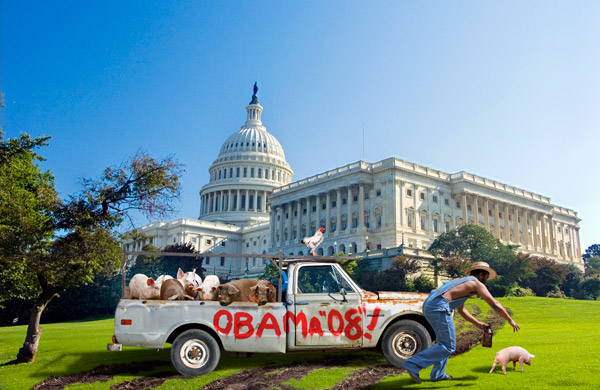
‘Cooter Obama’ chases pig on Capitol lawn. Photo from controversial satirical article in The Onion. Photo © Copyright 2008, Onion, Inc.

I recently chuckled at a satirical piece I found at The Onion’s website and reposted it here on The Rag Blog with barely a second thought. The story, “Obama’s Hillbilly Half-Brother Threatening To Derail Campaign,” stirred up a tempest. My co-editor Richard Jehn found it especially tasteless and pulled the story until we could discuss it. Though I’m a great fan of hard-hitting satire and consider no one above a bit of good-natured fun, I tended on reflection to agree with Richard and we left The Onion’s article off the blog. But I did pass it around for reaction.

Well, as often happens in our little corner of the internet, the whole affair inspired a discussion that has been fun and insightful. And best of all, Jim Retherford wrote the following rather eloquent reflection that is well worth a read!

Below Jim’s thoughtful take, I’ve included a bunch of posts from Rag Blog readers and friends – and I definitely urge you to read them. And by the way, here’s a link to The Onion’s satirical piece – which I just noticed is still number one on their “hit” list.

Thorne Dreyer / The Rag Blog / August 19, 2008

THE LIONS OF COMEDY
By James Retherford [convicted pie thrower] / The Rag Blog / August 19, 2008

Comedian Rich Scheidner used to perform frequently at Austin’s Comedy Workshop, and my spouse Cindy and I developed a warm friendship with him and his Austin-born wife. Early on I noticed that Rich’s comic schtick was unique; he did not make jokes about individuals or classes of people, except himself and the class he represented — i.e., clueless white guys. Yeah, he told wife and mother-in-law jokes, but he himself was the punchline of these routines. No off-color sexual jokes. No potty-mouth humor. No ethnic jokes. No vulgar class jokes. In short, none of the stuff I had grown accustomed to seeing on the Comedy Workshop stage. One night backstage as we tossed down a couple tequila shots after his show, I asked Rich about it. His reply was something like this:

“It doesn’t take talent to exploit other people in order to get a cheap laugh. I think it is lazy, and I also think it is wrong.”

Unlike Mike Klonsky’s and Carl Davidson’s thoughtful remarks, I simply dismissed the Onion piece as lazy and “not funny” and did not parse it further. As far as I’m concerned, “not funny” itself is the rimshot-punctuated death knell of satirical writing. It means whatever humor was intended, it missed the mark.

Badda-bing!

Why does the Onion piece miss the mark? As one with working-class redneck/hillbilly ancestral roots spread from Texas through the Smoky Mountains into rural Indiana, I find Appalachian culture and people a force to be celebrated, not mocked — especially not to be mocked by opportunistically “using” another historically marginalized and oppressed racial/cultural group such as African-Americans. Not funny. I have never watched a single episode of Beverly Hillbillies; it ain’t funny. There’s nothing funny about the brave men and women who stood up to the capitalists at Paint Creek, Cabin Creek, Matewan, Blair Mountain, “Bloody” Harlan and Bell County, Ludlow. They are heroes in my book. Nothing funny about what Peter Rowan calls that “high lonesome sound” of Jean Ritchey, the Stanley Brothers, the Monroe Brothers, Hazel Dickens, Jim Garland, Sarah Gunning, and Aunt Molly Jackson, the Carter Family, Flatt and Scruggs, Jim and Jesse, Charlie Poole, Doc Watson, Merle Travis, and many many many more. Nothing funny about the art of Grandma Moses either … or the near-anonymous master whittlers and quilters of the southland’s hills and hollers. There was plenty of funny about Minnie Pearl.

Cousin Minnie’s hillbilly humor brings us to a very important observation, to wit: Hillbillies — and African-Americans and Mexicans and Poles and Irish and women and men and gays and very tall people and very short people — have unlimited license to laugh at themselves. Black comics tell nigger jokes, gay comics tell faggot jokes, Rich Scheidner told “clueless white guy” jokes, and the members of their constituent groups ROTFL. Long-oppressed groups have risen up to reclaim the words that once were used to inflict pain and self-loathing, to turn the language of their oppressors upside down and inside out.

But in a world where oppression is a systemic disease, the language license is not transferable to any other class or group. Why not? Within these groups, rap, banter, trash talk, and humor is egalitarian. No one is “better” than anyone else. To riff on your friend’s po’ mamma is to riff on your own po’ mamma. But when humor is directed from one class at another, it is no longer egalitarian. It becomes hierarchical — and oppressive — as a performer representing the attitudes of a particular group or class invites the audience to join in the act of making fun of a “lesser” group or class. Moral, cultural, sexual, intellectual, racial, and/or class superiority emerges as the fundament of the routine, and targets of moral, cultural, sexual, intellectual, racial, and/or class inferiority are lined up by the enterprising jokester for the comic “kill.” Those words (like the n-word) reassume their denigrating meanings. I would further argue that derisive and demeaning “humor” directed at any marginalized or oppressed individual, group, or class can be — and is often — construed as a subtle form of violence, an attack on the very soul of culture, on the right of the individual, group, or class to be. As progressives, we should understand this by now.

Some may argue that “not funny” does not necessarily translate into “offensive,” but this is a false dichotomy and begs the basic question of class and power. I didn’t find characterizations of Jimmy Carter’s and Bill Clinton’s kinfolk funny either; I thought the revelations about Billy and Roger made the candidates more real. Rather I am reminded of the infamous recent New Yorker cover and of the white middle-class liberal intellectuals who, officiously incredulous by the uproar, declared, “If you don’t find this funny, something is wrong with you.”

So what IS wrong with me?

• First of all, I was born into poor white farming family and didn’t have running water (except the creek that ran through the woods behind the back pasture) or indoor “facilities” until I was in the eighth grade. My father was a tenant farmer who would disappear for days at a time on drinking and womanizing sprees and was abusive when he was at home. My father’s family — with a few exceptions — boasted of their lineage to ex-Confederates and horse thieves, and my father proved worthy of his bloodlines when one drunken night he came home with a loaded shotgun intent on killing my mom, my younger brother, and myself. He ended up in jail and then in a mental institution where he was given shock treatments.

My mother was an orphan who worked her way to a teaching degree at Indiana University. She taught in a small country school during the winter months and kept chickens, tended a very big garden, and worked in an aluminum factory in the summer to keep food on the table and clothes on our backs. As an orphan, however, she was not aware until late in her lifetime that her great-grandfather and great-great-grandfather were two of America’s finest abolitionist and women’s rights statesmen of the first half of the 19th century — one was a two-time vice-presidential candidate. (My grandson bears their names, Julian Giddings Retherford.)

• Second, for several months in 1974 I lived “underground” in the back of a holler in Calhoun County, WV, with my infant son Jesse James. While there I spent a lot of time down the crick visiting a retired coal miner and listening to hair-raising stories about the WV coal wars and the rise of the UMW. Every weekend a nearby community hosted a “sing,” a potluck-and-music event at which family musical groups from all over the nearby counties fiddled and sang from a makeshift stage. The spirit of communal sharing among the hill folk and the transplanted hippies was contagious and memorable, and I still get misty-eyed as I recall one lovely young local lass (aged 14 or 15) singing lilting tear-stained a cappella ballads plucked straight from the 15th-16th century Scottish highlands. Ah, that high lonesome sound.

• So what else is wrong with me? In August 1967 I had the remarkable opportunity to hear SNCC spokesperson James Forman tell a room full of white middle-class liberal intellectuals sporting “I Am Not Racist” buttons just how racist they (we) really were. The place was Chicago’s Palmer House ballroom at the infamous Conference on New Politics at a juncture when the emerging Black Power movement increasingly was at loggerheads with white paternalism in the civil rights struggle (and, I also should add, COINTELPRO was in full swing). Forman told the smug and testy white members of the audience [my paraphrase follows]:

“You say you aren’t racists. You say you have overcome your racism.

“You’re wrong. You ALL are racists! Each and every one of you is racist to the bone. …

“I’m not saying this to you in anger. I’m just stating fact. And the fact is that white people in America are racists. I also recognize that white people can’t help it. Your parents and your grandparents were born and raised in a racist society. You were born and raised in a racist society. You are schooled in racist schools. You get all of your news and information from racist media. You are bombarded by racist advertising images. So the question isn’t whether or not you are racist. The question is: When are you going to acknowledge your own racism? And then what are you going to do in order to understand and eliminate it?”

Forman further noted how white liberals, having declared themselves “beyond racism,” always seem to reserve for themselves the moral authority to arbitrate matters of racial acceptability. (To me, the Geraldine Ferraro flap was a classic example of what Forman was talking about). Challenging white liberals to cease such paternalistic practices, Forman asserted that only victims of race [or class or gender] oppression are qualified to judge whether an image or action directed against them is offensive and/or oppressive. His parting words challenged white middle-class liberal intellectuals to learn how to accept leadership from the victims of race and class oppression, the very people on whose behalf white liberals joined the movement, the very people suffering under the yoke of bigotry and intolerance.

(Forty-one years later, Forman’s admonishment continues to strike me as extraordinarily measured and reasonable. And forty-one years later, white middle-class liberals continue to claim the moral authority to stand in judgment over matters of race and class, to arbitrate over what is funny and what is not.)

So what IS wrong with me? My own life and work certainly has not been without yucks. How many people show up to testify at a federal grand jury probe of the Capitol bombing dressed like King Kong (hey, I heard they were looking for urban gorillas)? Or silence a world-class right-wing windbag who was trying to filibuster an SDS meeting by wrapping him up in an American flag and hauling him off the stage? Or get busted for pie-throwing?

Like Rich Scheidner, I too eschew the “easy” laugh, the lampoon of the socially marginalized and oppressed individual or class. On the other hand, I do NOT subscribe to the idea that humor cannot set its sights on any group or class. Instead I align with the free-for-all tradition of dada, the surrealists, the Keystone Kops (“pie-throwing as a fine, wish-fulfilling, universal idea,” Mack Sennett once said, “especially in the face of authority”), the Situationists, the Provos, the Motherfuckers, the Yippies, and the Daily Show. I see humor as a weapon to be wielded as scalpel or bludgeon — or lemon meringue pie — against oppressors, i.e., the ruling class and its oiligarchy. As Jay Jurie suggests, “Let’s lampoon the hell out of the rich and powerful.”

Meanwhile this discussion provides an excellent opportunity for each of us to take account of where we stand in regard to our lifelong struggles to understand and eliminate the vestiges of our own racism and classism (and, among us of the male gender, our sexism). Any open-minded, non-defensive survey of the U.S. cultural map in the first decade on the 21st century will, I think, show us that we still have a long long long way to go to meet Forman’s call of four decades ago and the many subsequent challenges that have followed.

The following are comments from other readers and friends of The Rag Blog.

I for one, am a big Onion fan, run their stuff on my blog all the time, and I love political satire aimed right or left (even at Obama). I also don’t flinch from comics like Chris Rock, who do race jokes. But this racist parody aimed at Obama and family, is too close to the racist norm, that is, to what’s appearing daily in the mainstream columns and media to be considered funny or good satire. The degradation of hillbillies only compounds the fracture. Every racist joke or cliche is not satire. The Rag can (should) do better.

Mike Klonsky

Really is in poor taste. Like some of the very worst of Mad magazine, but it really doesn’t belong on TRB. It is racist.

Richard Jehn

I thought is was awful – deleted it right away

. I just had a sick feeling when I saw it…

well, you didn’t put it on the front of the new yorker!!!! the rag folks are not shy about speaking up and it is the onion that should feel bad

Shelia CheaneyThorne. It seems every politician has a skeleton or brother in a closet somewhere. LBJ had his and Carter his. The news in Arkansas is that there is a clan of Obama relatives in the Ozarks of Arkansas. The Arkansans that I associate with were rather proud of that fact.

Terry DuBose

I thought it was very funny–and I’m a hillbilly of sorts.

But you notice that I didn’t repost it to P40 [Progressives for Obama].

My daughter Amy is a senior editor at the New Yorker, and visited here with my grandson last week–‘Dad, it was a horrible week, they actually PICKETED us! And I told them before it went into print that I didn’t think it was that funny, but I never expected this!’

Anyway, I’m with MikeK on this one. I think a good rule of thumb is not what we might think of it, but how it might go over among those who put the ‘N’ word in front of Obama’s name.

You have to be very careful with humor. Back at Penn State, in the early 1960s, I asked my Hegel-Marx professor once what he was working on. ‘A paper on how all humor has a touch of evil and violence,’ was the answer. I thought it bizarre at the time, but watch a few Roadrunner cartoons, and notice when you laugh!

Carl DavidsonI think your interpretation is probably correct, but unfortunately, racism is in the eyes of the beholder/perception is reality, so with such a figure and at such a particularly sensitive (politically/future-of-the-nation-wise) time, it was not wrong to pull it.

Earnest T. Bass

I thought it was funny,

and didn’t even have time to think about the implications. My mind went straight to Billy Carter and Roger Clinton. I mean, it was about a HILLBILLY fer cryin’ out loud-we all know there ain’t no such a thang as a black hillbilly.

Fontaine Maverick…I believe we would be the poorer without humor and jokes such as Cooter brings as comic relief. I will not even address the propriety or lack thereof of the stereotypes upon which the humor is based. The yardstick I would use to measure that is whether it is actually hurtful or merely crude. I hope we have all progressed beyond the point where Aggie and Polish jokes actually reflect any heartfelt prejudice against these oft abused communities.

Mike Hanks

…I tend to agree that the hillbilly thing was a stretch

because it didn’t have much of any basis in reality — few thought- provoking lessons to teach unlike Tom Tomorrow. Racial humor is like the third rail of politics.

Somebody probably told you to lighten up a bit so it doesn’t come across like Next Left Notes which is pretty heavy and probably takes itself too seriously and so isn’t very fun to read unless you think like Lenin. I think you want to make your blog a bit like the New Yorker.

But you are a hell of a good editor in general and its fine to focus on the lighter side of what a mess humans are making of trying to run the world.

As you notice I do a lot of that myself. You have to either laugh or cry about what happens when a bunch of tribal apes whose controlling instincts were honed by a million years of evolution living in small bands try to run vast civilizations. That mass society can ever function successfully at all is a miracle which takes the crutches of bullshit religions and legal bureaucracies to keep it functioning and from degenerating into constant war as the rule.

I hope this makes some sense.

Roger Baker…with all due respect to ya’lls sensitivity in general and Mr. Davidson’s sensitivity in particular, let me disagree with the idea that this story is racist or dangerous or anything else that might be offensive (with the possible exception of being mishillbillyistic:)

Some thoughts:

The story does not portray Obama and Michele as terrorists … or even the wet dreams of Sean Hannity’s misconstruction of Obamas as terrorists.

The story does not denigrate black people.

The story is not dependent on ‘elitist’ appreciation of irony or satire or cartoon parody

The story is like Billy Carter or Roger Clinton … but even more benign since it does not aim at an actual person

As my black wife said, “of course it isn’t racist … they couldn’t very well portray Obama’s fictitious brother as a white man.” Although one could, actually, and then have a whole set of additional concerns. (Now, that’s when some white people would sure enough scream, “Racist!”

My wife is not only black, but a hillbilly/hillsally (swampsally?) from the swamplands and sugar cane fields of southern Loosiana. She and her co-workers of color were hooting and laughing at the story.

The Rag is not the New Yorker.

Having said and so forth, it is hard to overemphasize the need for sensitivity and conversations on these matters, but we should remember that when no actual race or individual is meanly denigrated, and when something is funny, we should enjoy a hearty laugh whenever we can.

(When I asked my wife to read the story again in light of our concerns, she replied with simple dignity, “Shheeeeet, Cooter be funny!)

Jim Baldauf

I’ll just note I was about to the second paragraph

, thinking of Billy and Roger, and thinking that this was true (I mean I just got through being subjected to John Edwards stupidity and, then the announcement that Hillary was planning a little grandstanding at the convention to assuage her indignant supporters) in the world of ever-increasing weird politics, and how maybe it would undercut some of the harassment Obama’s getting when I noted the increasing classism and was then wondering what it was doing in the Rag. It is Onion stuff, but I don’t take them seriously enough to think much of their work, and this would be a prime example, not worth repeating. Furry Freak Brothers had their time, but we didn’t pay a lot of attention to them either, beyond a quick snort. I think you shouldn’t have bothered, mainly because it really has nothing to do with Obama or anything else for that matter.

In any case, satire is a hard row to hoe, so contemplate the medium, and take the risk again — it’s how we learn, and thank the goddess, it’s never too late. Meanwhile I hear there’s a new Jig/Jag on the candidates and i hope I can now hear it when it plays.

Pat CuneyThorne, Not only are you not “taking a beating on this,” it seems like most respondents disagreed with me and several liked or loved the Obama’s Hillbilly Half-brother Post and found it amusing to hilarious. I certainly wasn’t calling on you to take it down. I was just expressing my own distaste for it and my amazement that you published it in the first place. Once up, it sparked some good debate and discussion. I appreciate you considering readers opinions.

Mike Klonsky

I suppose it is debatable as to whether or not the article is funny

(I thought it was), but I certainly don’t see it as racist or as an attack on Obama. I think it’s important to take to heart what Molly [Ivins] repeatedly said, that if we can’t have fun doing what we think is important, we’re doing it wrong. Cheers!

David N. Smith This can’t be for real. Is this stuff really happening? If it is then it is choreographed by some one who is familiar with the “hillbilly” stereotype from “The Beverly Hillbillies”, “Dog Patch” and “Deliverence”. The concept of being a hillbilly is a stereotype about white, Southern hill people and never includes black people to my knowledge. I’d look to see who is laughing in the Republican National Committee.

Robert Pardun

…this one is way too open for misinterpretation,

and also to be taken and used by the people we wouldn’t want using it. For the next 80 days, I would recommend erring on the side of caution, just because “we ain’t seen nuthin’ yet, folks!” is about to hit the fan in 14 days.

Thomas CleaverI’d say leave it off. It’s not quite funny enough to overcome its negative aspects. If it made particularly relevant points, it would be OK, but it just plays on stereotypes for cheap laughs.

Nick Hopkins

Hi, I want to “weigh in” on this.

I love satire. I resent humorlessness (so prevalent in many “political” circles) and I crave any opportunity to laugh. I think when it comes to certain things, including race, we have to be very careful. I simply don’t like ethnic jokes. Chris Rock’s humor on racism (mentioned below) is coming from a black man, and that makes a big difference in how it is seen by blacks and whites. What the Rag/Onion did with the “hillbilly” thing is similar to the New Yorker cartoon cover depicting Obama as a Muslin and Michele Obama as a Pantheresque radical — clearly satirical stuff done by white people. Great satire for sure, but things are just too sensitive now and I think a good question to ask is, “Would black people have possibly created this particular satirical view?” And if the answer is no, then it’s not appropriate. Too much danger of misinterpretation, hurt feelings, perpetuating stereotypes, etc.

Analogy to consider — which influences my thinking, personally: Have you ever seen those “roasts” by comedians who frequently make reference to these straight male comedians having affairs with one another, including lots of ass-fucking jokes. So, men-loving-men and especially anal sex are big fucking jokes. No, not in my book, not when it is done in that way by straight (usually white) guys — guys who are probably so uptight they wouldn’t let a woman’s hand go near their behind.. Not when our culture is so burdened by homophobia (much of it sex-based).

Allen YoungI found the Onion’s satire on Obama humorless and boring. When I read it, I pictured a red neck type hillbilly, and imagined the half brother to look something like Bill Clinton’s problematic brother….then I saw the picture, and thought that was especially in bad taste. I wouldn’t waste the space on your blog with this one.

Kay Gaul

Right wing attacks on “political correctness”

are a not-so-subtle attack on the left as authoritarian and devoid of any sense of humor. They have the added value of legitimizing race hatred, gay-bashing, and other aspects of the right wing agenda, all under the guise of “free speech.” Like the classic “have you stopped beating your wife yet?” question, this is an excellent trap into which various liberals have fallen.

Those of us further to the left not only ought to be able to use humor as a weapon, or as a way to keep ourselves from going insane in the face of all the horror we encounter on a daily basis, but to laugh at the existential absurdity of the world and ourselves.

There are often fine lines between incisive humor and stereotypes intended to keep certain groups in their place.

Though I’m no fan of postmodernism, the idea of “deconstruction” does have some merit when applied to the social significance of current events.

In the instance of the Obama hillbilly cartoon, I’d say as a politician, and one who if elected would do his duty to represent the dominant corporate system, Obama is a legitimate target of humor. On the other hand, to link Obama to hillybilly stereotypes is not only a throwback to right wing smears against Jimmy Carter, it plays into fears exploited since the days of the “founding fathers,” of unpredictable “mob rule.” It was against this same sort of “mob” that Progressive Era “reformers” and nativists like Theodore Roosevelt responded, to suppress the urban machines and their immigrant and working class support base. It’s an old joke on fundamental social change, very time-worn.

As a rule of thumb, I’d say we should steer clear of humor based on race, ethnicity, age, gender, or sexual orientation.

When warranted we should point out the cruelty inherent in humor targeting the weak, powerless, infirm, disadvantaged, etc. For example, what I’ve read (I haven’t seen it) about the movie “Tropic Thunder” is that it disparages “retards.” I’m sure none of us wants to make fun at the expense of persons born with incapacitating conditions. It’s just not what the left is about.

Again, we should not take ourselves too seriously in so doing. There are plenty of other good targets for humor, let’s lampoon the hell out of the rich and powerful. When the right attacks affirmative action as political correctness, we should reply with how and why racism is wrong, and the best responses might involve skewering the right with humor.

J. JurieThe Rag Blog

Posted in Rag Bloggers | Tagged , , , , , , , , | 5 Comments

Predicting and Preparing for Economic Collapse


Closing the ‘Collapse Gap’: the USSR was better prepared for collapse than the US
by Dmitry Orlov

This article was originally published December 4, 2006.

Good evening, ladies and gentlemen. I am not an expert or a scholar or an activist. I am more of an eye-witness. I watched the Soviet Union collapse, and I have tried to put my observations into a concise message. I will leave it up to you to decide just how urgent a message it is.

My talk tonight is about the lack of collapse-preparedness here in the United States. I will compare it with the situation in the Soviet Union, prior to its collapse. The rhetorical device I am going to use is the “Collapse Gap” – to go along with the Nuclear Gap, and the Space Gap, and various other superpower gaps that were fashionable during the Cold War.

Slide [2] The subject of economic collapse is generally a sad one. But I am an optimistic, cheerful sort of person, and I believe that, with a bit of preparation, such events can be taken in stride. As you can probably surmise, I am actually rather keen on observing economic collapses. Perhaps when I am really old, all collapses will start looking the same to me, but I am not at that point yet.

And this next one certainly has me intrigued. From what I’ve seen and read, it seems that there is a fair chance that the U.S. economy will collapse sometime within the foreseeable future. It also would seem that we won’t be particularly well-prepared for it. As things stand, the U.S. economy is poised to perform something like a disappearing act. And so I am eager to put my observations of the Soviet collapse to good use.

Slide [3] I anticipate that some people will react rather badly to having their country compared to the USSR. I would like to assure you that the Soviet people would have reacted similarly, had the United States collapsed first. Feelings aside, here are two 20th century superpowers, who wanted more or less the same things – things like technological progress, economic growth, full employment, and world domination – but they disagreed about the methods. And they obtained similar results – each had a good run, intimidated the whole planet, and kept the other scared. Each eventually went bankrupt.

Slide [4] The USA and the USSR were evenly matched in many categories, but let me just mention four.

The Soviet manned space program is alive and well under Russian management, and now offers first-ever space charters. The Americans have been hitching rides on the Soyuz while their remaining spaceships sit in the shop.

The arms race has not produced a clear winner, and that is excellent news, because Mutual Assured Destruction remains in effect. Russia still has more nuclear warheads than the US, and has supersonic cruise missile technology that can penetrate any missile shield, especially a nonexistent one.

The Jails Race once showed the Soviets with a decisive lead, thanks to their innovative GULAG program. But they gradually fell behind, and in the end the Jails Race has been won by the Americans, with the highest percentage of people in jail ever.

The Hated Evil Empire Race is also finally being won by the Americans. It’s easy now that they don’t have anyone to compete against.

Slide [5] Continuing with our list of superpower similarities, many of the problems that sunk the Soviet Union are now endangering the United States as well. Such as a huge, well-equipped, very expensive military, with no clear mission, bogged down in fighting Muslim insurgents. Such as energy shortfalls linked to peaking oil production. Such as a persistently unfavorable trade balance, resulting in runaway foreign debt. Add to that a delusional self-image, an inflexible ideology, and an unresponsive political system.

Slide [6] An economic collapse is amazing to observe, and very interesting if described accurately and in detail. A general description tends to fall short of the mark, but let me try. An economic arrangement can continue for quite some time after it becomes untenable, through sheer inertia. But at some point a tide of broken promises and invalidated assumptions sweeps it all out to sea. One such untenable arrangement rests on the notion that it is possible to perpetually borrow more and more money from abroad, to pay for more and more energy imports, while the price of these imports continues to double every few years. Free money with which to buy energy equals free energy, and free energy does not occur in nature. This must therefore be a transient condition. When the flow of energy snaps back toward equilibrium, much of the US economy will be forced to shut down.

Slide [7] I’ve described what happened to Russia in some detail in one of my articles, which is available on SurvivingPeakOil.com. I don’t see why what happens to the United States should be entirely dissimilar, at least in general terms. The specifics will be different, and we will get to them in a moment. We should certainly expect shortages of fuel, food, medicine, and countless consumer items, outages of electricity, gas, and water, breakdowns in transportation systems and other infrastructure, hyperinflation, widespread shutdowns and mass layoffs, along with a lot of despair, confusion, violence, and lawlessness. We definitely should not expect any grand rescue plans, innovative technology programs, or miracles of social cohesion.

Slide [8] When faced with such developments, some people are quick to realize what it is they have to do to survive, and start doing these things, generally without anyone’s permission. A sort of economy emerges, completely informal, and often semi-criminal. It revolves around liquidating, and recycling, the remains of the old economy. It is based on direct access to resources, and the threat of force, rather than ownership or legal authority. People who have a problem with this way of doing things, quickly find themselves out of the game.

These are the generalities. Now let’s look at some specifics.

Slide [9] One important element of collapse-preparedness is making sure that you don’t need a functioning economy to keep a roof over your head. In the Soviet Union, all housing belonged to the government, which made it available directly to the people. Since all housing was also built by the government, it was only built in places that the government could service using public transportation. After the collapse, almost everyone managed to keep their place.

In the United States, very few people own their place of residence free and clear, and even they need an income to pay real estate taxes. People without an income face homelessness. When the economy collapses, very few people will continue to have an income, so homelessness will become rampant. Add to that the car-dependent nature of most suburbs, and what you will get is mass migrations of homeless people toward city centers.

Slide [10] Soviet public transportation was more or less all there was, but there was plenty of it. There were also a few private cars, but so few that gasoline rationing and shortages were mostly inconsequential. All of this public infrastructure was designed to be almost infinitely maintainable, and continued to run even as the rest of the economy collapsed.

The population of the United States is almost entirely car-dependent, and relies on markets that control oil import, refining, and distribution. They also rely on continuous public investment in road construction and repair. The cars themselves require a steady stream of imported parts, and are not designed to last very long. When these intricately interconnected systems stop functioning, much of the population will find itself stranded.

Slide [11] Economic collapse affects public sector employment almost as much as private sector employment, eventually. Because government bureaucracies tend to be slow to act, they collapse more slowly. Also, because state-owned enterprises tend to be inefficient, and stockpile inventory, there is plenty of it left over, for the employees to take home, and use in barter. Most Soviet employment was in the public sector, and this gave people some time to think of what to do next.

Private enterprises tend to be much more efficient at many things. Such laying off their people, shutting their doors, and liquidating their assets. Since most employment in the United States is in the private sector, we should expect the transition to permanent unemployment to be quite abrupt for most people.

Slide [12] When confronting hardship, people usually fall back on their families for support. The Soviet Union experienced chronic housing shortages, which often resulted in three generations living together under one roof. This didn’t make them happy, but at least they were used to each other. The usual expectation was that they would stick it out together, come what may.

In the United States, families tend to be atomized, spread out over several states. They sometimes have trouble tolerating each other when they come together for Thanksgiving, or Christmas, even during the best of times. They might find it difficult to get along, in bad times. There is already too much loneliness in this country, and I doubt that economic collapse will cure it.

Slide [13] To keep evil at bay, Americans require money. In an economic collapse, there is usually hyperinflation, which wipes out savings. There is also rampant unemployment, which wipes out incomes. The result is a population that is largely penniless.

In the Soviet Union, very little could be obtained for money. It was treated as tokens rather than as wealth, and was shared among friends. Many things – housing and transportation among them – were either free or almost free.

Slide [14] Soviet consumer products were always an object of derision – refrigerators that kept the house warm – and the food, and so on. You’d be lucky if you got one at all, and it would be up to you to make it work once you got it home. But once you got it to work, it would become a priceless family heirloom, handed down from generation to generation, sturdy, and almost infinitely maintainable.

In the United States, you often hear that something “is not worth fixing.” This is enough to make a Russian see red. I once heard of an elderly Russian who became irate when a hardware store in Boston wouldn’t sell him replacement bedsprings: “People are throwing away perfectly good mattresses, how am I supposed to fix them?”

Economic collapse tends to shut down both local production and imports, and so it is vitally important that anything you own wears out slowly, and that you can fix it yourself if it breaks. Soviet-made stuff generally wore incredibly hard. The Chinese-made stuff you can get around here – much less so.

Slide [15] The Soviet agricultural sector was notoriously inefficient. Many people grew and gathered their own food even in relatively prosperous times. There were food warehouses in every city, stocked according to a government allocation scheme. There were very few restaurants, and most families cooked and ate at home. Shopping was rather labor-intensive, and involved carrying heavy loads. Sometimes it resembled hunting – stalking that elusive piece of meat lurking behind some store counter. So the people were well-prepared for what came next.

In the United States, most people get their food from a supermarket, which is supplied from far away using refrigerated diesel trucks. Many people don’t even bother to shop and just eat fast food. When people do cook, they rarely cook from scratch. This is all very unhealthy, and the effect on the nation’s girth, is visible, clear across the parking lot. A lot of the people, who just waddle to and from their cars, seem unprepared for what comes next. If they suddenly had to start living like the Russians, they would blow out their knees.

Slide [16] The Soviet government threw resources at immunization programs, infectious disease control, and basic care. It directly operated a system of state-owned clinics, hospitals, and sanatoriums. People with fatal ailments or chronic conditions often had reason to complain, and had to pay for private care – if they had the money.

In the United States, medicine is for profit. People seems to think nothing of this fact. There are really very few fields of endeavor to which Americans would deny the profit motive. The problem is, once the economy is removed, so is the profit, along with the services it once helped to motivate.

Slide [17] The Soviet education system was generally quite excellent. It produced an overwhelmingly literate population and many great specialists. The education was free at all levels, but higher education sometimes paid a stipend, and often provided room and board. The educational system held together quite well after the economy collapsed. The problem was that the graduates had no jobs to look forward to upon graduation. Many of them lost their way.

The higher education system in the United States is good at many things – government and industrial research, team sports, vocational training… Primary and secondary education fails to achieve in 12 years what Soviet schools generally achieved in 8. The massive scale and expense of maintaining these institutions is likely to prove too much for the post-collapse environment. Illiteracy is already a problem in the United States, and we should expect it to get a lot worse.

Slide [18] The Soviet Union did not need to import energy. The production and distribution system faltered, but never collapsed. Price controls kept the lights on even as hyperinflation raged.

The term “market failure” seems to fit the energy situation in the United States. Free markets develop some pernicious characteristics when there are shortages of key commodities. During World War II, the United States government understood this, and successfully rationed many things, from gasoline to bicycle parts. But that was a long time ago. Since then, the inviolability of free markets has become an article of faith.

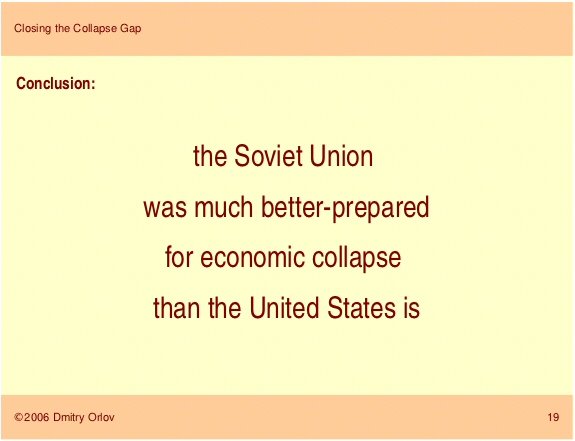
Slide [19] My conclusion is that the Soviet Union was much better-prepared for economic collapse than the United States is.
I have left out two important superpower asymmetries, because they don’t have anything to do with collapse-preparedness. Some countries are simply luckier than others. But I will mention them, for the sake of completeness.

In terms of racial and ethnic composition, the United States resembles Yugoslavia more than it resembles Russia, so we shouldn’t expect it to be as peaceful as Russia was, following the collapse. Ethnically mixed societies are fragile and have a tendency to explode.

In terms of religion, the Soviet Union was relatively free of apocalyptic doomsday cults. Very few people there wished for a planet-sized atomic fireball to herald the second coming of their savior. This was indeed a blessing.

Slide [20] One area in which I cannot discern any Collapse Gap is national politics. The ideologies may be different, but the blind adherence to them couldn’t be more similar.

It is certainly more fun to watch two Capitalist parties go at each other than just having the one Communist party to vote for. The things they fight over in public are generally symbolic little tokens of social policy, chosen for ease of public posturing. The Communist party offered just one bitter pill. The two Capitalist parties offer a choice of two placebos. The latest innovation is the photo finish election, where each party buys 50% of the vote, and the result is pulled out of statistical noise, like a rabbit out of a hat.

The American way of dealing with dissent and with protest is certainly more advanced: why imprison dissidents when you can just let them shout into the wind to their heart’s content?

The American approach to bookkeeping is more subtle and nuanced than the Soviet. Why make a state secret of some statistic, when you can just distort it, in obscure ways? Here’s a simple example: inflation is “controlled” by substituting hamburger for steak, in order to minimize increases to Social Security payments.

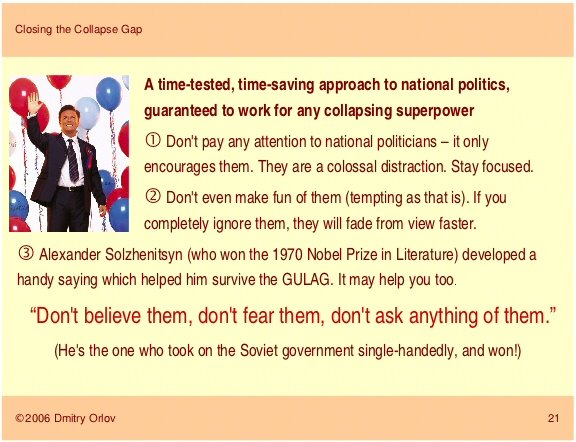
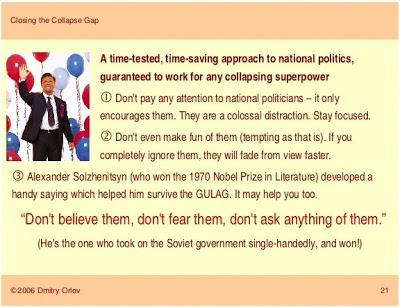
Slide [21] Many people expend a lot of energy protesting against their irresponsible, unresponsive government. It seems like a terrible waste of time, considering how ineffectual their protests are. Is it enough of a consolation for them to be able to read about their efforts in the foreign press? I think that they would feel better if they tuned out the politicians, the way the politicians tune them out. It’s as easy as turning off the television set. If they try it, they will probably observe that nothing about their lives has changed, nothing at all, except maybe their mood has improved. They might also find that they have more time and energy to devote to more important things.

Slide [22] I will now sketch out some approaches, realistic and otherwise, to closing the Collapse Gap. My little list of approaches might seem a bit glib, but keep in mind that this is a very difficult problem. In fact, it’s important to keep in mind that not all problems have solutions. I can promise you that we will not solve this problem tonight. What I will try to do is to shed some light on it from several angles.

Slide [23] Many people rail against the unresponsiveness and irresponsibility of the government. They often say things like “What is needed is…” plus the name of some big, successful government project from the glorious past – the Marshall Plan, the Manhattan Project, the Apollo program. But there is nothing in the history books about a government preparing for collapse. Gorbachev’s “Perestroika” is an example of a government trying to avert or delay collapse. It probably helped speed it along.

Slide [24] There are some things that I would like the government to take care of in preparation for collapse. I am particularly concerned about all the radioactive and toxic installations, stockpiles, and dumps. Future generations are unlikely to able to control them, especially if global warming puts them underwater. There is enough of this muck sitting around to kill off most of us. I am also worried about soldiers getting stranded overseas – abandoning one’s soldiers is among the most shameful things a country can do. Overseas military bases should be dismantled, and the troops repatriated. I’d like to see the huge prison population whittled away in a controlled manner, ahead of time, instead of in a chaotic general amnesty. Lastly, I think that this farce with debts that will never be repaid, has gone on long enough. Wiping the slate clean will give society time to readjust. So, you see, I am not asking for any miracles. Although, if any of these things do get done, I would consider it a miracle.

Slide [25] A private sector solution is not impossible; just very, very unlikely. Certain Soviet state enterprises were basically states within states. They controlled what amounted to an entire economic system, and could go on even without the larger economy. They kept to this arrangement even after they were privatized. They drove Western management consultants mad, with their endless kindergartens, retirement homes, laundries, and free clinics. These weren’t part of their core competency, you see. They needed to divest and to streamline their operations. The Western management gurus overlooked the most important thing: the core competency of these enterprises lay in their ability to survive economic collapse. Maybe the young geniuses at Google can wrap their heads around this one, but I doubt that their stockholders will.

Slide [26] It’s important to understand that the Soviet Union achieved collapse-preparedness inadvertently, and not because of the success of some crash program. Economic collapse has a way of turning economic negatives into positives. The last thing we want is a perfectly functioning, growing, prosperous economy that suddenly collapses one day, and leaves everybody in the lurch. It is not necessary for us to embrace the tenets of command economy and central planning to match the Soviet lackluster performance in this area. We have our own methods, that are working almost as well. I call them “boondoggles.” They are solutions to problems that cause more problems than they solve.

Just look around you, and you will see boondoggles sprouting up everywhere, in every field of endeavor: we have military boondoggles like Iraq, financial boondoggles like the doomed retirement system, medical boondoggles like private health insurance, legal boondoggles like the intellectual property system. The combined weight of all these boondoggles is slowly but surely pushing us all down. If it pushes us down far enough, then economic collapse, when it arrives, will be like falling out of a ground floor window. We just have to help this process along, or at least not interfere with it. So if somebody comes to you and says “I want to make a boondoggle that runs on hydrogen” – by all means encourage him! It’s not as good as a boondoggle that burns money directly, but it’s a step in the right direction.

Slide [27] Certain types of mainstream economic behavior are not prudent on a personal level, and are also counterproductive to bridging the Collapse Gap. Any behavior that might result in continued economic growth and prosperity is counterproductive: the higher you jump, the harder you land. It is traumatic to go from having a big retirement fund to having no retirement fund because of a market crash. It is also traumatic to go from a high income to little or no income. If, on top of that, you have kept yourself incredibly busy, and suddenly have nothing to do, then you will really be in rough shape.

Economic collapse is about the worst possible time for someone to suffer a nervous breakdown, yet this is what often happens. The people who are most at risk psychologically are successful middle-aged men. When their career is suddenly over, their savings are gone, and their property worthless, much of their sense of self-worth is gone as well. They tend to drink themselves to death and commit suicide in disproportionate numbers. Since they tend to be the most experienced and capable people, this is a staggering loss to society.

If the economy, and your place within it, is really important to you, you will be really hurt when it goes away. You can cultivate an attitude of studied indifference, but it has to be more than just a conceit. You have to develop the lifestyle and the habits and the physical stamina to back it up. It takes a lot of creativity and effort to put together a fulfilling existence on the margins of society. After the collapse, these margins may turn out to be some of the best places to live.

Slide [28] I hope that I didn’t make it sound as if the Soviet collapse was a walk in the park, because it was really quite awful in many ways. The point that I do want to stress is that when this economy collapses, it is bound to be much worse. Another point I would like to stress is that collapse here is likely to be permanent. The factors that allowed Russia and the other former Soviet republics to recover are not present here.

In spite of all this, I believe that in every age and circumstance, people can sometimes find not just a means and a reason to survive, but enlightenment, fulfillment, and freedom. If we can find them even after the economy collapses, then why not start looking for them now?

Thank you.

~~~~~~ Editorial Notes ~~~~~~

Energy Bulletin published an excerpt from this talk yesterday (Dec 3), and Dmitry reported that his small webserver was overwhelmed with requests. Although it’s good news that his writing has such a following, PLEASE don’t access the document on his web server (Club Orlov). The same content is here, on Energy Bulletin’s heavier duty webserver.

—————

Orlov has many penetrating insights, couched in his dark humor. Particularly striking is the strong case he makes that the peoples of the USSR were actually better prepared for a collapse because

* they had learned to be more self-reliant
* many crucial functions (like housing and transportation) were taken care of by the state sector which was more stable than a private sector would have been.

Orlov’s cynicism about the possibility of intelligent government action was probably justified in the case of the Soviet Union, but I think it would be a tragic mistake to abandon efforts to change the direction of the U.S. The Soviets had little chance to make democratic institutions work. We do have that chance.
-BA

UPDATE: Dmitri Orlov writes on March 4, 2007:
You wrote that “The Soviets had little chance to make democratic institutions work.” That’s not entirely true. Perestroika and Glasnost were all about democracy, and in my opinion it had the same chance of success as the hopelessly gerrymandered system that passes for democracy in the US, (although much less than any proper, modern democracy, in which the Bush regime would have been put out of power quite a while ago, after a simple parliamentary vote of no confidence and early elections). The problem is that, in a collapse scenario, democracy is the least effective system of government one can possibly think of (think Weimar, or the Russian Interim Government) – a topic I cover in Post-Soviet Lessons.

Lastly, I don’t think calling me a cynic is exactly accurate: I’ve been in the US a long time, watching the system become progressively more dysfunctional with each passing political season. It seems to me that it is not necessarily cynical to be able to spot a solid trend, but that it could be simply observant.

UPDATE (October 30, 2007):
We’ve noticed an influx of visitors to Dmitry Orlov’s article, since its mention on several websites. Dmitry writes that his new book, “Reinventing Collapse,” is due from New Society Publishers in the springtime.

Source, including all of the slides / Energy Bulletin

The Rag Blog

Posted in RagBlog | Tagged , , | Leave a comment

Afghanistan: So Long As It’s "Our Taliban"

Malalai Joya

Is Malalai Joya the Bravest Woman in Afghanistan? An Afghan Woman Who Stands Up to the Warlords
By Farooq Sulehria / August 18, 2008

Afghanistan lives in the fear of the US-sponsored war lords. These hated warlords are not scared by the Taliban-monster raising its head in the south. Ironically, they live in the fear of an unarmed girl in her late twenties: Malalai Joya. To silence Joya’s defiant voice, war lords dominating national parliament, suspended Joy’s membership for three years in 2007. Earlier, at almost every parliamentary session she attended, she had her hair pulled or physically attacked and called names (‘whore’). ‘They even threatened me in the parliament with rape’, she says. But she neither toned down her criticism of war lords (‘they must be tried’) nor US occupation (‘war on terror’ is a mockery). Understandably, she’s been declared the ‘bravest woman in Afghanistan’ and even compared with Aung Sun Suu Kyi.

A household name in Afghanistan (‘Most famous woman in Afghanistan’, according to BBC), Joya shot to fame back in 2003 at the Loya Jirga convened to ratify Afghanistan’s new constitution. Unlike US-sponsored clean-shaven fundamentalists, Joya was not nominated but elected by the people of Farah province to represent them. She stunned the Loya Jirga and journalists present on the occasion, when she unleashed a three-minute vitriolic speech exposing the crimes of warlords dominating that Loya Jirga. Grey-bearded Sibghatullah Mojadadi, chairing the Loya Jirga, called her an ‘infidel’ and a ‘communist’. Other beards present on the occasion also shouted at her. But before she was silenced by an angry mob of war lords around, she had electrified Afghanistan with her courageous speech.

During the course of these three fateful minutes, the course of Joya’s life was also changed. In her native province of Farah, locals wanted her to represent them in elections. It takes guns and dollars to contest an election in Afghan electoral-battlefields. Joya had none. But she could not turn down hundreds of supporters daily paying her visits, urging her to stand. She decided to run for Wolesi Jirga (lower house of national parliament). Danish film maker Eva Mulvad, immortalised Joya’s courageous election campaign and subsequent victory, in her ‘Enemies of Happiness’ .

I happened to meet Joya in January unexpectedly at a dinner when she reached Peshawar (Pakistan) on her way to Canada. Since her passport has been confiscated and she is on Exit Control List, she had travelled to Pakistan in disguise. Politely refusing my request for an interview on the plea that she got to catch a flight early next morning, she promised to catch up with me in Kabul later in March.

Three months later, we met again in Kabul. As an MP, Joya was entitled to rent a villa in a posh neighbourhood designated to MPs. However, plagued with life threats, Joya hardly visits it. Her comrades discreetly pointed to the villa when we were driving past this neighborhood on our way to an underground home Joya sometimes uses to meet visitors. In an interview, interspersed by a delicious Afghan dinner, and post-dinner chat, this brave woman shared her hopes and fears with Arbetaren. Here are the excerpts.

Have you gone to court against your suspension. Did you contact Karzai against your suspension?

Joya: Here in Afghanistan, we have a mafia running the system. It is the same war lords in the parliament who head the courts. These Northern Alliance warlords dispense justice. I was suspended because I termed Afghan parliament as a stable full of animals. Though I think animals are useful. The warlords want me to apologize for this comment. I refuse to apologize for telling the truth aloud. I don’t see a chance in a court dominated by warlords to do me justice. However, another reason was, for the fear of personal security, no advocate was ready to plead my case. Now a lawyer has agreed to plead my case and I would move the court. (She went to court in April). However, I would tell the court that not me but war lords be brought in the dock.

As far as Hamid Karzai is concerned, he has been shamelessly silent on my suspension by an undemocratic parliament. I never contacted him. He should have contacted me. On the other hand, there were demonstrations across Afghanistan against my suspension. Karzai’s police proved good only at breaking up these demonstrations. But also what Karzai could have done? He is ridiculed by the people of Afghanistan as mayor of Kabul since his control does not extend beyond Kabul.

How come than Karzai is in power and how come you keep declaring Afghan parliament as undemocratic when it has been elected in general elections?

Joya: Well, this is a parliament in which 80 per cent of the members are warlords or drug lords. They either snatched their places in parliament at gun point or bought these seats off with US dollars. In some cases, both guns and dollars played a role. Even Human Rights Watch has accused some leading members of this parliament of war crimes. But this parliament, in a unique move, granted warlords an amnesty against crimes committed during the war. Even Mulla Umar can benefit after this amnesty.

Karzai, who was voted in as a lesser evil, has been co-operating with these criminals all the time. Hence, no wonder if he is unpopular today. But he is sustained in the presidential palace by USA and all the warlords co-operate with the USA:

By the way, one hears more about Karzai’s brother in Kabul than Karzai himself. Every other posh real estate project or every second case of corruption is attributed to the younger Karzai. He is also named when it comes to drug peddling?

Joya: Corruption and drug trafficking have become a big issues. In my view, security is the biggest issue. After that it is corruption. The so-called international community which in fact is US government and its allies, has sent a lot of money. This amount was enough to build two instead of one Afghanistan. But even Karzai himself confesses that the money has ended up in the pockets of ministers, bureaucrats and member parliaments. On the other hand, one hears about a mother in Heart selling her daughter for ten dollars. And not merely the brother of Karzai is a drug lord, foreign troops have been allegedly involved.

Really? Any proof? Press reports?

Joya: Yes some press reports have pointed that out. For instance, Russian state TV has hinted at US troops involvement in drug trafficking. That was reported in the press here. But this is like an open secret. Karzai in one of his speeches last year said that it was not only Afghans who are involved in drug trafficking. He hinted at foreign connections. Though he did not name any country or troops but people in Afghanistan understood what he meant. Now Afghan drugs are finding their way to New York and European capitals. Hence, no wonder today Afghanistan is producing 90 per cent of world opium. This is taking its toll on women. Now we hear about ‘opium brides’. When harvests fail, peasants are not able to pay back loans to drug lords; they ‘marry’ their daughters off to warlords instead.

Why is the USA letting all this happen?

Joya: The USA wants the things as they are. The status quo. A bleeding, suffering Afghanistan is a good excuse to prolong its stay. Now they are even embracing the Taliban. Recently, in Musa Qila, a Taliban commander Mulla Salam was appointed as governor by Karzai. The USA has no problem with the Taliban so long as it’s ‘our Taliban’.

Not merely Karzai, but also all these war lords have been sustained in power by the USA. That is why, when there are demonstrations against war lords, there are also demonstrations against foreign troops. People here believe that the warlords are cushioned by the US troops. If the USA leaves, the warlords will loose power because they have no base among our people. The people of Afghanistan will deal with these warlords once US troops leave Afghanistan.

Don’t you think security situation will get even worse once troops pack off?

Joya: Maybe. But tell the people in Sweden that Swedish troops are helping implement US agenda in Afghanistan. The democracy-loving people of Sweden should rather support democratic forces in Afghanistan and instead of sending soldiers; Sweden should send doctors, nurses, teachers and build schools and hospitals.

Farooq Sulehria lives in Sweden and can be reached at mfsulehria@hotmail.com.

Source / CounterPunch

The Rag Blog

Posted in RagBlog | Tagged , , , | 1 Comment

Net Neutrality: Why You Should Give a Damn

Photo by Sean Nel.

‘Too much creative control is in the hands of too few people who aren’t creative’
By Michael Janover / August 16, 2008

OK, I’m old. I was around when Channel 2 went on the air in Denver in the early 50’s and brought us Blinky the Clown. It was exciting. Television. In Colorado!

In the mid-60s, cable TV and the dish staked their claims, and folks in the mountains could finally see Star Trek and Mary Tyler Moore. A whole new world was opening, no longer limited by four or five basic channels. Cable and satellite promised real choice. Hundreds of channels! Wow! You could see anything!

So what happened to all the choices?

Why is it that TV and the movies are always the same old, same old?

For one thing, the Federal Communications Commission (FCC) made it possible to merge control of the television and film industries into fewer and fewer networks. What started out as infinite possibilities gradually became three super networks. These entities gobbled up the studio system and the cable channels. Creative decisions were gradually assumed by corporate boards that prefer safe, tested and bland to innovative, daring and dramatic. It’s one of the reasons hard news became infotainment, and rich, life-changing drama is now “reality” programming.

Too much creative control is in the hands of too few people who aren’t creative.

The beginning of the 80s was the start of the Computer Age. I went out and bought a Kaypro, a clunky box, with black screen and glowing green text. It was great. Totally cutting edge.

Computers became more wonderful with color graphics and the mouse thingy, but the most amazing and subversive change was INTERNET. In a few short years, it turned the planet into one big neighborhood; and with broadband access, it also offered interactivity.

We are no longer simple couch potatoes in front of the living room TV. Today, we’re interactive potatoes and use computers to communicate, shop, or read and comment about everything from elections to Dancing With the Stars. We converse with people around the country and world as if they lived across the street. How quaint and microscopic those “hundreds of channels” seem now.

Blogs and YouTube are the new political language. They were vital in the Writer’s Guild’s recent successful struggle with management – the very people who own the mainstream media. Truth is, the Internet does more to democratize the world than any of the wars currently being waged. It truly offers an infinity of choices that TV can’t deliver, and freedom of interactivity that telephones only dream of.

Something this massive and good just begs for someone to control it, don’t you think?

Well, that group has surfaced. It’s not the Chinese government, not even your government. No, it’s the telecommunications companies. The same folks who offer you three-tiered packages of programming instead of just charging you for the shows you want to see; the same people who offer expensive long distance packages when you can do better for next to nothing over the Internet; and the same people who want immunity from prosecution for accidentally illegally wiretapping millions of our phone conversations.

Since the telecoms deliver the Internet to you, they think the government should grant them the power to control how you use it. They want to make more money and put limits on what you see and how you see it. In their world, websites should be charged for the privilege of being seen by their customers. And sites should pay extra for making it possible for consumers to download their material faster (– by removing the telecom’s artificial restraints). Failure to pay these tolls results in your site not being seen, or in ultra-lengthy download times that drive impatient users elsewhere.

Imagine going online to CNN or to download music or watch an old TV show, but the feed is so slow that it no longer works properly. The grass on your lawn is growing faster. Why? Because someone didn’t pay tacked-on fees to the local cable or phone company, and the feed was restricted.

The Telecoms are spending millions to convince Congressional candidates that giving them control makes for a less expensive, better Internet. As you read this, they’re donating money like there’s no tomorrow, because after this election, the new Congress will be forced to decide if Telecoms should be given this power.

“Net Neutrality” basically means “Leave the Internet alone,” and it’s the battle cry for those who think handing over management and control of information to a few mega-corporations is the worst possible idea.

Net Neutrality isn’t another “nutty left wing crusade.” Internet giants like Google and Microsoft, consumer advocates such as Consumer Reports, small businesses who might be relegated to the slow lane, and iPod users who might find it harder to download tunes — all want to maintain Net Neutrality.

“Maintain” is the magic word. Net Neutrality doesn’t ask for new regulations; it only wants to be sure that the freedom we already have is preserved. If you believe in a true open market and don’t want to give your freedom of choice to some corporate Big Brother, if you don’t want your Internet experience censored or restricted, if you enjoy watching YouTube or visiting Facebook without limitations – you probably support Net Neutrality without even realizing it.

It’s time for you to speak up and ask a few questions. Now is when you have the clout. Does your Senate candidate support maintaining freedom of the Internet – or increasing profits for the Telecoms? If you don’t know, find out.

For more detailed information on the fight to save the Internet, please check out www.freepress.net/files/nn_fact_v_fiction_final.pdf, a fact sheet put together by Free Press, the Consumers Union, and Consumer Federation of America.

[Michael Janover grew up in Denver and went to school and graduated from CU in Boulder in 1967. He’s been a WGA writer since 1978, worked for HAWAII 5-O, Wide World of Disney and wrote THE PHILADELPHIA EXPERIMENT while in Hollywood. He also helped start the Colorado Film School in Aurora.]

© Rocky Mountain News

Source / Rocky Mountain News

The Rag Blog

Posted in RagBlog | Tagged , , , , , | 1 Comment

Tom Hayden on Obama : Transformational President or Another Disappointment?

Screen print from Ray Noland’s (CRO) traveling Obama art show entitled Go Tell Mama!.

‘Whether he wins or loses, the vast movement inspired by Obama will become the next generation of American social activists’
By Tom Hayden

Barack Obama, it is true, is a transformational leader. But he needs a transformational movement to become a transformational president.

He is transformational not only by his charisma and brilliance, but by embodying the possibility of an African-American being chosen president in the generation following the civil-rights movement. Whether he wins or loses, the vast movement inspired by Obama will become the next generation of American social activists.

For many Americans, the possibility of Obama is a deeply personal one. I mean here the mythic Obama who exists in our imaginations, not the literal Obama whose centrist positions will disappoint many progressives.

My wife and I have an adopted eight-year old “biracial” boy whose roots are African-American. My adult son is married to an African-American woman with roots in Jamaica and Costa Rica. Our family is part of the globalized generation Obama represents. What is at stake for our kids’ future is real, palpable, not only political. Their future will very much be shaped by the outcome of this election. Millions of people in this country—and around the world—feel similarly affected.

Myths are all-important, as Obama writes in his Dreams from My Father. Fifty years ago, the mythic Obama existed only as an aspiration, an ideal, in a country where interracial love was taboo and interracial marriage was largely banned. In 1960, in my liberal community of Ann Arbor, Michigan, our student newspaper exposed the University of Michigan’s dean of women for secretly spying on white coeds seen having coffee with black men in the campus Union and notifying their parents. In those days, too, the vision of an African-American as president was preserved only in a dream state. As Obama himself declared on the night of the Iowa primary, “Some said this night would never come.”

The early civil-rights movement, the jazz musicians, and the Beat poets dreamed up this mythic Obama before the literal Obama could materialize. His African father and white countercultural mother dared to dream and love him into existence, incarnate him, at the creative moment of the historic march on Washington. Only the overthrow of Jim Crow segregation then opened space for the dream to rise politically.

This collapse was not an engineering feat, like a bridge falling, but the consequence of suffering and martyrdom along with countless invisible feats of organization in the American South.

If this sounds unscientific or, as some would say, cultish, think about it. None of the supposedly expert people in the political, media or intellectual establishments saw this day coming. I didn’t expect it myself, the news was carried to me by a new generation, including my own grown-up children. It was dreamed up and built “beyond the radar” or “outside the box” by experienced dreamers with long histories in community organizing, social movements, and not a few lost causes. They were sustained by the stones the builders left out, the movement, “calloused hand by calloused hand,” that Obama refers to.

In one of his best oratorical moments, Obama summons the spirit of social movements that were built from the bottom up, from the Revolutionary War to the abolitionist crusade to the women’s suffrage cause to the eight-hour day and the rights of labour, ending with the time of his birth when the walls came down in Selma and Montgomery, Alabama, and Delano, California.

As he repeats this mantra of movements thousands of times to millions of Americans, a new cultural understanding becomes possible. This is the foundation of a new American story that is badly needed, one that attributes whatever is great about this country to the ghosts of those who came before, in social movements from the margins.

Although Howard Zinn may not agree, Obama to a large degree has appropriated Zinn’s “people’s history” model of America as against the conservative narrative that glorifies wars against alien savages as necessary to forge a new democracy in the wilderness, the unbroken story of American exceptionalism, from the colonial forests to the Iraqi deserts, from Custer to McCain. Obama’s emerging narrative also includes but supercedes the other major explanation of American specialness, the narrative of the “melting pot,” by noting that whatever “melting” did occur was always in the face of massive and entrenched opposition from the privileged.

I have met John McCain, and I happen to like him as an earthy sort of guy. But I am constantly aware that he bombed Vietnam at least 25 times before being shot down in a war that never should have been fought, in a defeat that still cannot say its name. He wants to continue the unwinnable Iraq war, costing 10 billion dollars per month, until every suspect Iraqi is dead, wounded or detained, even though our military tactics keep causing more young Iraqis to hate us than ever before.

As if fighting the war on terrorism until the end of terrorism isn’t enough for him, McCain wants to reignite the Cold War until the Russians are forever broken and humiliated. The vanguard for the anti-Russian offensive has been Georgia, a stronghold of the neoconservative lobby and, incidentally, a cash cow for McCain’s own foreign-policy adviser Randy Scheunemann, who made hundreds of thousands of dollars working as a lobbyist for the country before joining McCain’s campaign team. By supporting Georgia’s impractical attempts to seize the breakaway areas of South Ossetia and Abkhazia, McCain has abetted another unnecessary war he cannot win.

This inability to limit the adventurist appetite for war is the most dangerous element of the McCain and Republican world view. It is paralleled, of course, by their inability to limit the corporate appetite for an unregulated market economy. In combination, the brew is an economy directed to the needs of the country-club rich, the oil companies, and military contractors.

A form of crony capitalism slouches forward in place of either competitive markets or state regulation. The McCain future will be one of circling the wagons around the five percent who own 40 percent of the planet’s resources against the 95 percent who live vulnerable lives under our web of empire. To nail down this future, McCain has pledged to nominate Supreme Court candidates approved by the far right.

And yet McCain has a good chance, the best chance among Republicans, of winning in November. He has Gen. Eisenhower’s war-hero persona. It is a dangerous world out there. He appeals to those whose idea of the future is more of the past, buying time against the inevitable. And McCain is running against Barack Obama, who threatens our institutions and culture simply by representing the unexpected and unauthorized future.

My prediction: If he continues on course, Obama will win the popular vote by a few percentage points in November, but is at serious risk in the Electoral College. The institution rooted in the original slavery compromise may be a barrier too great to overcome.

The priority for Obama supporters has to be mobilization of new, undecided, and independent voters in up-for-grabs states like Pennsylvania, Ohio, Michigan, while expanding the Electoral College delegates in places like New Mexico, Colorado, Nevada and possibly Virginia. Unlike the nadir of 2000, when Al Gore and the institutional Democrats seemed unable to mount a resistance, another Electoral College loss should trigger an unrelenting and forceful democracy movement against the Electoral College and other institutional chains on the right to know, vote, and participate.

There are many outside the Obama movement who assert that the candidate is “not progressive enough”, that Obama will be co-opted as a new face for American interventionism, that in any event real change cannot be achieved from the top down.

These criticisms are correct. But in the end, they miss the larger point.

The network www.progressivesforobama.blogspot.com/ is the site to visit for those who want to share and explore these concerns in depth, while still wanting to help the Obama movement win. Most of us want President Obama to withdraw troops from Iraq more rapidly than in 16 months. But it is important that Obama’s position is shared by Iraq’s prime minister and the vast majority of both our people. The Iraqi regime, pressured by its own people, has rejected the White House and McCain’s refusal to adopt a timetable.

The real problem with Obama’s position on Iraq is his adherence to the outmoded Baker-Hamilton proposal to leave thousands of American troops behind for training, advising and ill-defined “counterterrorism” operations. Obama should be pressured to reconsider this recipe for a low-visibility counterinsurgency quagmire.

On Iran, Obama has usefully emphasized diplomacy as the only path to manage the bilateral crisis and assure the possibility of orderly withdrawal from Iraq. He should be pressed to resist any escalation. On Afghanistan, Obama has proposed transferring 10,000 American combat troops from Iraq, which means out of the frying pan, into the fire. A July 28 Time magazine cover story by Rory Stewart rejects such thinking: “A troop increase is likely to inflame Afghan nationalism because Afghans are more anti-foreign than we acknowledge and the support for our presence in the insurgency areas is declining.” Obama should accept this advice.

Pakistan, and the possibility of a ground invasion by Afghan and U.S. troops, could be Obama’s Bay of Pigs, a debacle. On Israel-Palestine, he will pursue diplomacy more aggressively, but little more. Altogether, the counterinsurgencies in Iraq, Afghanistan, and Pakistan are likely to become a spreading global quagmire and a human-rights nightmare, nullifying the funding prospects for health-care reform or other domestic initiatives.

In Latin America, Obama supports the Colombian military, riddled with drug lords, against the Columbia guerrillas, with ties of their own to narco trafficking. Beyond that, he has been out of step and out of touch with the winds of democratic change sweeping Latin America. His commitment to fulfilling the United Nations anti-poverty goals, or to eradicating sweatshops through a global living wage, is underwhelming and—given his anti-terrorism wars—will be underfinanced.

And so on. The man will disappoint as well as inspire.

Once again, then, why support him by knocking on doors, sending money, monitoring polling places, getting our hopes up? There are three reasons that stand out in my mind. First, American progressives, radicals, and populists need to be part of the vast Obama coalition, not perceived as negative do-nothings in the minds of the young people and African-Americans at the center of the organized campaign. It is not a “lesser evil” for anyone of my generation’s background to send an African-American Democrat to the White House. Pressure from supporters of Obama is more effective than pressure from critics who don’t care much if he wins and won’t lift a finger to help him.

Second, his court appointments will keep us from a right-wing lock on social, economic and civil-liberties issues during our lifetime. Third, we all can chew gum and walk at the same time; that is, it should be no problem to vote for Obama and picket his White House when justified.

Obama himself says he has solid progressive roots but that he intends to campaign and govern from the centre. (He has said he is neither a “Scoop” Jackson Democrat nor a Tom Hayden Democrat.) That is a challenge to rise up, organize, and reshape the centre, and build a climate of public opinion so intense that it becomes necessary to redeploy from military quagmires, take on the unregulated corporations and uncontrolled global warming, and devote resources to domestic priorities like health care, the green economy, and inner-city jobs for youth.

What is missing in the current equation is not a capable and enlightened centrist but a progressive social movement on a scale like those of the past.

The refrain is familiar. Without the militant abolitionists, including the Underground Railroad and John Brown, there would have been no pressure on President Lincoln and no black troops for the South. Without the radicals of the 1930s, there would have been no pressure on President Franklin Roosevelt, no New Deal, no Wagner Act, no Social Security. Without the civil-rights and peace movements pressuring President John Kennedy, there would have been no march on Washington and no proposal to reverse the nuclear-arms race.

It is true that these radical reforms were limited and gradually weakened, but there is no evidence to suggest that if radicals had abstained from mainstream electoral politics that deeper reforms or revolution would have resulted.

The creative tension between large social movements and enlightened Machiavellian leaders is the historical model that has produced the most important reforms in the course of American history.

Mainstream political leaders will not move to the left of their own base. There are no shortcuts to radical change without a powerful and effective constituency organized from the bottom up. The next chapter in Obama’s new American story remains to be written, perhaps by the most visionary of his own supporters.

His own movement will have to pull him towards full withdrawal from Iraq, or the regulation of the great financial power centres, instead of waiting for him to lead. Already among his elite caste of fund-raisers, there is more interest in his position on the capital-gains tax than holding Halliburton accountable. And his “cast of 300” national security advisers, according to The New York Times, “fall well within centrist Democratic foreign policy thinking”.

Progressives need to unite for Barack Obama but also unite—organically at least, not in a top-down way—on issues like peace, the environment, the economy, media reform, campaign finance and equality like never before. The growing conflict today is between democracy and empire, and the battlefronts are many and often confusing. Even the Bush years have failed to unite American progressives as effectively as occurred during Vietnam. There is no reason to expect a President McCain to unify anything more than our manic depression.

But there is the improbable hope that the movement set ablaze by the Obama campaign will be enough to elect Obama and a more progressive Congress in November, creating an explosion of rising expectations for social movements—here and around the world—that President Obama will be compelled to meet in 2009.

That is a moment to live and fight for.

Tom Hayden is a lifelong peace and human-rights activist, former California legislator, professor, and author of more than 15 books. His latest are Voices of the Chicago Eight (City Lights), Writings for a Democratic Society: the Tom Hayden Reader (City Lights), and Ending the War in Iraq (Akashic).

Source / Straight.com.

The Rag Blog

Posted in RagBlog | Tagged , , , , | 1 Comment

Austin Police : Fear-Mongering About the Homeless

Mr. George, 6th & Congress, Austin, September 2007. Photo by Brian K. George.

‘Police Chief Art Acevedo spoke about the homeless, panhandlers and drug users being the cause of the ills of our society’
By Debbie Russell / The Rag Blog / August 18, 2008

Last Tuesday night I attended the South Central Commander’s forum where Austin Police Chief Art Acevedo spoke in fear-mongering tones about the homeless, panhandlers and drug users being the cause of the ills of our society and that Austin is a “magnet for the needy,” suggesting we should deplete, rather than increase services. Meanwhile, according to sources, across town at the Northwest Commander’s Forum, Command Sergeant Jim O’ Leary was parroting this meme.

The Commander, though, went a bit further in his assessment…after failing to correct a participant for touting that everyone should call 911 to report panhandlers (since the act of panhandling is not illegal), he dismissed a statistic offered by an audience member: that 25% of Austin’s homeless population are veterans. This has been documented,* and, in fact, Austin City Councilmember Lee Leffingwell noted such from the dais a few months ago during discussion of a panhandling survey. So is Cmdr. O’Leary calling the Councilmember a liar? He also spoke of former Councilmember Kim’s “flip-flopping” on the subject of an expanded solicitation ordinance, so it seems Cmdr. O’Leary is using his position to politic and lobby. As I recall…an officer’s duty, while in uniform, is to enforce the law, not seek to change it.

Who is this man? Cmdr. James O’ Leary, #854, former head of the Training Division, is known to many anti-war protesters as the vindictive initiator of the massive pepper-spraying of peaceful people on the sidewalk of the Congress Ave. bridge the night the war started,** and later introduced to the general public as the officer who was briefly suspended in 2006 for a drunk driving accident*** (he was sentenced a $1000 fine and 1 year probation/no time served).

So, is this APD’s official line? That we don’t need to concern ourselves with the homeless population (other than by generally outlawing homelessness) because they don’t believe that there are as many homeless veterans as studies say? And are we to only care about the homeless because of the percentage, whatever it is, of veterans within it? If not, then it sure seems the Chiefs need to realign their messaging on this point and properly address out-of-step Commanders who are already sullying APD with their past actions.

More to come on upside down police priorities and police-targeting of the most vulnerable and how that only perpetuates the problem.

Please see the following:

* O’Leary’s quote: “I don’t believe that; we all know how wrong those surveys are.” There are varying statistics, but 25% seems to be the accepted figure, and is the one the City has touted repeatedly:

Beside the Point: South by Solicitation / Austin Chronicle / March 14, 2008.

Homeless Veterans Facts / Community Partnership for the Homeless.

Stand Down Austin [Of 226 homeless people receiving services, 64 were vets.]

12,000 homeless vets in Austin and that’s 2006: Nonprofit calls for better housing for homeless veterans / Daily Texas online / Sept. 13, 2006.

640 homeless vets on any given day: CAN Community Council Meeting / Community Partnership for the homeless / March 2008.

**Point Austin: Not So Smart / Austin Chronicle / Feb. 17, 2006. [Video shows a wild-eyed O’Leary, without warning or provocation, launching his pump-gun sprayer at folks including 2 disabled people, who were merely waiting for instruction since APD had been giving conflicting information to that point.]

***Austin Police Department Memorandum / August 25, 2006.

The Rag Blog

Posted in Rag Bloggers | Tagged , , , , , | 3 Comments

A Video Series on World Agriculture: Monsanto, Part 7

The World According to Monsanto (Part 7 of 8)

Right now, there is probably no other company that is doing more to endanger the health of this planet, and it’s inhabitants, than Monsanto. With Nazi-like attitude, they are leading the world in shear destructive evil greed. First they were a drug company, and then they expanded to become a drugs and genetic engineering company, and now Monsanto is attempting to acquire water rights in countries with water shortages in a move to control the people’s basic means of survival, and production of the global food supply. Giant transnational corporations like Monsanto, in collusion with the World Bank and the World Trade Organization, seek to commodify and privatize the world’s water and put it on the open market for sale to the highest bidder. Millions of the world’s citizens are being deprived of this fundamental human right, and vast ecological damage is being wrought as massive industry claims water once used to sustain communities and replenish nature.

Click here for more information.

Thanks to Diane Stirling-Stevens / The Rag Blog

Posted in RagBlog | Tagged , | 1 Comment

The Siege of Gaza Must Be Broken


Can a handful of international activists and two boats break the siege of Gaza?
by Sharat G. Lin / August 18, 2008

The voyage to “break the siege of Gaza” was originally planned for the summer of 2007. But it did not materialize for lack of funds and because of logistical challenges in arranging for purchase and delivery of the boats. Many observers wondered whether the ambitious grassroots project without the backing of any major organization or agency would ever get off the ground.

But on August 10, 2008, two small Greek-flagged boats finally arrived from Greece to Chania, Cyprus. They were the 21-metre long SS Free Gaza (غزة الحرة) and the 18-metre SS Liberty, named in memory of the 34 American sailors who were killed when Israel attacked the USS Liberty in apparent error during the Six Day War in 1967. Before their arrival in Chania, the identity of the vessels had been a closely-guarded secret for genuine fear of Israeli sabotage. Once the vessels were renamed and presented at a press conference, activists remained on board both vessels 24 hours a day for security reasons.

After days of additional delays due to soaring prices for supplies and diesel fuel, a shortfall in funds, and turbulent weather, the vessels finally departed Crete en route to Cyprus, where they will take on the remaining half of the activists waiting apprehensively in Nicosia. Along the way, the activists have received tremendous support, including material assistance, from local residents in Crete and Cyprus.

Some forty peace and justice activists from 17 countries will be on board, including Israeli peace activist Jeff Halper, founder of the Israeli Committee Against House Demolitions (ICAHD) and nominee for the Nobel Peace Prize. Other notable individuals include 84-year-old Holocaust survivor Hedy Epstein of Saint Louis, Missouri; Lauren Booth, sister-in-law of former British Prime Minister Tony Blair; members of the European Parliament; a survivor of the Palestinian catastrophe (al-Nakbah); and Free Gaza Movement co-founders Paul Larudee and Greta Berlin. Including professional crewmembers and journalists, the number of people on the two boats could reach as high as sixty.

Threats

The Israeli government and Zionist organizations like the Anti-Defamation League have tried (unconvincingly) to link the Free Gaza Movement and its affiliations to the International Solidarity Movement to armed Palestinian resistance organizations that they have labelled as “terrorists.” In fact, the Free Gaza Movement and the Break the Siege campaign in particular have received no funding from any Palestinian organizations, armed or otherwise. The $200,000-300,000 raised for the voyage from Cyprus to Gaza has been entirely from small fundraising dinners in private homes and restaurants, individual contributions, and from the sale of fair-trade Palestinian olive oil rebottled in Berkeley, California by community volunteers. Donna and Darlene Wallach, twin sisters of Eastern European Jewish descent who have lived for many years in Israel and the Palestinian territories, were among those tireless volunteers and will be on the boats to Gaza.

More ominously, Lauren Booth reported on August 15, 2008 that a dozen threatening anonymous calls, text messages, and voice mails had been received by Free Gaza participants in Nicosia. This escalated to family members of activists. Booth reported that on August 14, an anonymous call to her husband in France threatened, “Your wife is in great danger. These ships will be blown up.” Who but a state intelligence agency like the Mossad could readily obtain private telephone and mobile numbers around the world?

Meanwhile, the Israeli daily newspaper Ha’aretz reported on August 17, 2008 that Israeli “defense officials favor forcefully blocking two boats which a group of U.S.-based activists plan to sail to Gaza to protest what they call ‘the Israeli siege on the Strip.’” The statement was based on a position paper by the legal department of the Israeli Foreign Ministry, arguing that Israel has the right to use force against the protesters under the Oslo Accords, which gives Israel responsibility for Gaza’s territorial waters.

Why Gaza?

When the Israeli government withdrew thousands of Israeli settlers and troops from Gaza at the end of 2005, it called the move “disengagement.” Many thought that the occupation of Gaza would come to an end. But on January 25, 2006, the day of Palestinian elections, Israel sealed off Gaza by closing the last open crossing at Erez owing to “security concerns” relating to the anticipated strong turnout for Hamas. Karni crossing had been closed since January 15, 2006, and three other checkpoints had been open only intermittently.

The final election results gave Hamas 74 seats out of 132 in the Palestinian Legislative Council, and an overwhelming majority in Gaza. After the elections, Israel proceeded to tighten control over the flow of goods and people into and out of Gaza in an attempt to destabilize popular support for Hamas and block Hamas’ participation in the Palestinian government headquartered in Ramallah in the West Bank.

Gaza is a strip of land approximately 40 kilometres long by 7 kilometres wide. It includes cities, towns, 8 major refugee camps and several minor ones, agricultural land, and uncultivable sand dunes and saline intrusion areas. With nearly 1.5 million people, Gaza has an overall population density twice that of a typical large U.S. city or roughly comparable to a European city. Gaza cannot possibly feed itself. It has no natural sources of energy — neither fossil fuels nor hydroelectric potential. It has no natural aquifers to provide a renewable source of fresh water. As a relatively unindustrialized territory, it is completely dependent on the outside for nearly all of its consumption needs and the majority of its viable employment.

After 1967, Gaza residents gained employment inside Israel and became dependent on the crossings for daily commutes to their jobs in Ashkelon, Tel Aviv, the Negev, and elsewhere. But that source of employment was largely cut off by Israel during the Second Intifada, and completely eliminated with the economic siege imposed on Hamas in Gaza in 2006. In reality, the drastic lack of employment, and the obstacles placed on the supply of food, drinking water, medicines, fuel, and electricity became a chronic collective punishment on all Gaza residents in full violation of international law.

Israeli “disengagement” from Gaza changed nothing with respect to the wall and fence that completely encircle Gaza from its northern boundary with Israel to its southern boundary with Egypt. Even the Rafah crossing between Gaza and Egypt is effectively controlled by Israel through European Union monitors who have acceded to Israeli demands to have veto power over any person or baggage moving through the Rafah crossing. The Kerem Shalom crossing for goods from and to Egypt is controlled directly by Israel because it operates on an intervening sliver of Israeli territory. The remaining checkpoints not only are opened by Israel very sparingly, but are each used by Israel for very restricted purposes. The Erez crossing in the north is the primary gateway for people, but not for goods. Nahal Oz crossing is exclusively for liquid fuels. Karni crossing is the primary entry point for food, medicines, and manufactured goods. Sufa crossing is mainly for bulk aggregates and building materials. Kissufim and Elie Sinai crossings are effectively closed.

Gaza has a commercial airport southeast of Rafah, but all Palestinian air traffic is banned by Israel. That leaves the sea. The Israeli Navy controls all waters around Gaza and does not allow any vessels in or out of Gaza’s fishing limits. There are over 700 boats, mostly fishing boats, registered in Gaza. The boats provide a livelihood for 3000 Palestinian fishermen according to a United Nations survey. Under the 1993 Oslo Agreement, the fishing limit for Gaza fishermen was set at 20 nautical miles from the shore. A “no fishing zone” 2 nautical miles wide was established as a security buffer from the Israeli sea boundary (as if fishermen were a threat to Israel’s security) within Gaza’s territorial waters and extending out from shore to the fishing limit. A similar “no fishing zone” one nautical mile wide was established on the sea border with Egypt. But in 2002 as a result of the comprehensive Israeli military assault on all the occupied Palestinian territories launched at the end of April, the Bertini Agreement restricted Gaza’s fishing limit to 12 nautical miles. Then, as part of the ever-tightening noose around Hamas-ruled Gaza, the Israeli Defense Forces began enforcing a 6-nautical-mile fishing limit from October 2006. Not only has Gaza effectively become the world’s largest open-air prison, but some of the walls of the prison have been progressively closing in on the inmate population.

So it is not surprising that perhaps hundreds of Gaza fishing boats may be preparing to greet the uncertain arrival of the SS Free Gaza and the SS Liberty. In Gaza Port alone, there are over 470 registered boats. If the Israeli siege is broken by sea, it will be a tremendous morale boost to Gaza fishermen whose operating territory has shrunken from the Eastern Mediterranean before 1967 to a mere sliver of coastal water under Israeli military control. Even in the years following the Israeli occupation, Gaza Port continued to be a bustling hub not only for fishing but for international shipping as well. I remember well in 1973 how ocean freighters used to wait in queue offshore for a berth in Gaza City’s cargo port. Few places on Earth have witnessed such a drastic and comprehensive economic decline under military occupation.

The SS Free Gaza and the SS Liberty either may pave the way for unrestricted international access to Gaza by symbolically breaking the Israeli naval blockade, or they will be stopped by the Israeli Navy which will prove that Israel still occupies Gaza despite its denials. The action places the Israeli government on the horns of dilemma, out of which neither outcome will work in its favor. It is only regrettable that no Arab government or organization has had the courage to challenge the Israeli blockade.

It is the responsibility of all activists for human rights and social justice worldwide to stand behind the courageous passengers of the SS Free Gaza and SS Liberty in the coming critical days as they prepare to depart from Cyprus. This is an act of nonviolent civil disobedience following in the footsteps of Mahatma Gandhi — unarmed ordinary people with an unshakable moral conviction facing down one of the most powerful military machines on Earth. Global awareness is key. The probability that they will be harmed is drastically reduced if the eyes of the world are focused on Gaza’s coastal waters. The siege of Gaza must be broken!

[Sharat G. Lin writes on migrant labor, global political economy, the Middle East, India, public health, and the environment.]

Source / Dissident Voice

The Rag Blog

Posted in RagBlog | Tagged , , , | Leave a comment

Alan Pogue and Steve Russell : Somalia and Big Oil

Oil exploration in Somalia. Chevron photo.

‘The point is that the oil is there and the U.S. energy companies, among others, want it.’

A Ragblogger dialogue with Alan Pogue and Steve Russell.

‘What would Obama do? Hillary? It was her husband who sent in the Marines in 1993 on an oil mission covered up as a humanitarian mission.’
By Alan Pogue
/ The Rag Blog / August 18, 2008

I continue to keep informed on Somalia. The BushCo U.S. encouraged North Korea (former axis of evil member) to sell weapons to Ethiopia so Ethiopia can be the proxy army for U.S. oil company interests in Somalia. We are not supposed to know about this. As in Haiti (soon in Sudan) the U.N. is the tool of U.S. foreign policy.

I don’t have any “action” ideas. What would Obama do? Hillary? It was her husband who sent in the Marines in 1993 on an oil mission covered up as a humanitarian mission. Bill Clinton and the Marines were embarrassed so rather than go through that again the Ethiopians get to do the dirty work for Chevron and all.

Please read Somalia: Troops killing people ‘like goats’ by slitting throats / amnesty.org.uk.

Response from Steve Russell:

And pray tell, Alan, how much oil have US companies taken out of Somalia?

How much oil has ANYBODY taken out of Somalia?

China sits on the spigot in Darfur to the extent there is a spigot.

I remember an article we ran in The Rag that attributed the Vietnam War to oil companies. I thought it was a crock, but if somebody said there was oil there….well, I didn’t know any better. Now that Vietnam is run by the Vietnamese I don’t see oil riches pouring in. Their economy seems pretty similar to other Indochinese nations, based on agriculture surplus (which had been destroyed by the war) plus a work ethic that draws manufacturing jobs.

And while we’re at it, how much oil have US companies taken though (not “out of”) Afghanistan?

How much oil have US companies taken out of Iraq? Now, that one has some legs since the occupation government redid all the leases. However, it does not appear to have had much impact on bottom lines yet. Not to say it won’t and anybody who thinks we invaded Iraq because Saddam was a naughty fellow needs a brain transplant, right after those who think we invaded Afghanistan to improve the conditions of Afghan women.

What would Obama do?

I expect a major push to get off the oil teat for transportation. If we manage that, we can actually meet our oil needs domestically for the first time in a long time. What Obama has not said and I would like to see happen is an end to our obligation to defend Saudi Arabia, which after all had more to do with the atmosphere that produced 9-11 than anything Iraq did. Since that agreement is not exactly public, I’m not sure what getting out of it will entail…but we sure as hell can’t get out of it while we depend on Saudi oil. Another thing Bush has bequeathed us is that Saudi Arabia is a big big big buyer of our T-bills that have enabled us to fight a war, increase domestic spending, and cut taxes all at once. This can be looked up, but my recollection is that it goes China, Japan, Saudi Arabia.

I also expect a major push to put together miliary interventions in Africa, although I don’t think he will go solo. I’m not sure there’s a lot of opportunity for Africa without military interventions to tamp down the ongoing legacies of colonialism. Can this be done without re-colonization? If it can minimize mass murder, who cares? But I think so because the international discourse on colonialism is so negative. Some protectorates are probably necessary. Is that bad? Well, Namibia has revived pretty well. All of the colonies the US stole off Spain in that “splendid little war” have prospered except Cuba and it has great potential if the bureaucracy can handle the post-Fidel transition. The former Portuguese colonies that were a major issue when we were undergraduates are moving right along toward the 20th century — unfortunately, the calendar reads 21st, but the violence has quieted and they are about the business of feeding themselves for a change.

Zimbabwe is a horrible mess that is suffering from black South Africa’s learning curve on how to govern, but, geez, that whole deal could have been so much worse. When South Africa withdraws support from Mugabe, he’s gone, and Zimbabwe may again export food instead of importing it. The SA government hestitates to cut the bastard loose because of the close ties during the apartheid years among the liberation movements. Therefore, I lay this one at the door of colonialism, too, albeit
indirectly.

I’ve always favored engagement economically and socially. Militarily only to save lives in an immediate sense. However….

As I’ve said before on this list, Bush’s inattention to Latin America has been a boon for democracy and economic progress. Latin America has done really well in the last eight years. Yes, there are nasty exceptions of meddling but there is no real focus down there like there was under Reagan. Brazil, Chile, Argentina–wow! Bolivia has great potential, for the first time in my life…no thanks to the US.

So I look at Latin America and wonder if Africa should just be left the hell alone by the developed countries?

The thing that makes that hard is sheer body count. Lots of people died during CIA adventures in Argentina, Chile, El Salvador, Nicaragua, Guatamala….but the body counts have been orders of magnitude greater in Africa. Also, Africa has the problem of recurring famine, which also kills more people in Africa than military misadventures have killed in Latin America.

When you see starving children with distended bellies….and you know that your country has plenty of chow…it’s really hard not to respond.

While Latin America recently might make a case for hands off in Africa, I think Obama is committed to hands on in Africa but his goals involve admitting black Africans (like his late father) to the human race, being as concerned about them as we are about white folks for a change.

Sure, capitalists will always try to profit from disasters. The bigger the emergency, the greater the chance to get a contract without bidding and the less likely anybody will track the money.

As much as I despise Bill Clinton, I don’t think oil had a damn thing to do with our ill-fated enterprise in Somalia. And the biggest capitalist reason for intervention in Somalia right now is not oil–it is suppressing piracy off the Horn of Africa. That capitalist goal, I suggest, dovetails perfectly with the interests of the people on land who are preyed upon by the pirates.

“Law and order” may have been a racist code that elected Richard Nixon, but just try living without it. That’s Somalia, and it benefits nobody to turn a blind eye to it.

Steve Russell

The point is that the oil is there and the U.S. energy companies, among others, want it. They have a long view. The oil runs from South Yemen under the Gulf of Aden and then under north Somalia. Below is “The Strategic Question,” part of a F.A.I.R. report. It contains a reference to Mark Fineman’s story on Somalia’s oil. One may Google “Mark Fineman” for the entire article plus a lot more. Unfortunately for us all Mark died of a heart attack in Baghdad. F.A.I.R. had Mark Fineman’s story in the L.A. Times as one of the ten most underreported stories of 1993. Google “North Korea Somalia Oil” for many reports on the U.S. backed North Korean arms sales to Ethiopia.

Go to USAID and type in Sudan Oil and you will get a map of the known deposits in Sudan and who controls them. China is big in south Sudan but so is Malaysia and a Swiss consortium. The French (TOTAL) have Chad’s oil. Darfur has oil but so far no one has the rights to it. The U.S. is fighting hard for those rights and has top State Department fellows there working on it. I have a file on them as well. Neither the U.S. State Department nor the Sudanese government wants peace , just yet, in Darfur. They have not killed as many of the indigenous political figures as they want to kill (rebels to us, soon to be referred to as “Al Qaeda” you can bet) that vie for the oil resources.

I have a friend whose father was an oil geologist and was looking for oil off the coast of Vietnam. He said they didn’t find out there was no oil to be had until 1968. If I can get the report I will.

My interests are not the same as the U.S. State Department’s so I do not use the word “we” when talking about U.S. foreign policy. If “we” are going to do anything good anywhere it will have to be along the lines of the Lincoln Brigade because the present military of the U.S. is up to no good. I am happy to say I am not part of the present team. Maybe Obama will call me.

The strategic question

“If the U.S. has not consistently acted in an altruistic manner toward starving people in Africa, why did it dispatch troops to Somalia at this point? There have been frequent media denials that geopolitical considerations might have entered in to the decision. The Washington Post reported (12/6/92) that “unlike previous large-scale operations, there is no U.S. strategic or economic interest in the Somalia deployments.”

“But The Nation (12/21/92) referred to Somalia as “one of the most strategically sensitive spots in the world today: astride the Horn of Africa, where oil, Islamic fundamentalism and Israeli, Iranian and Arab ambitions and arms are apt to crash and collide.” Given that the U.S. and U.S.S.R. jousted over the Horn of Africa for years, The Nation’s assessment may have been more realistic.

“There was also little discussion of the fact that northern Somalia (which has declared itself independent under the name Somaliland–Oakland Tribune, 12/21/92) contains mineral deposits and potential oil reserves. Considered geologically analogous to oil-rich Yemen across the Red Sea, it has been the site of oil exploration by such companies as Amoco, Chevron and Conoco. Not until six weeks into the operation (1/18/93) did a journalist for a major media outlet, Mark Fineman of the L.A. Times, report on the “close relationship between Conoco and the U.S. intervention force,” which used Conoco’s Mogadishu headquarters as a “de facto U.S. embassy.”

In Vietnam there was thought to be oil off the coast but finally in 1968 the various oil companies discovered there was not enough.”

Alan Pogue

Well Alan, I take it we could agree on the following:

As long as the US is dependent on oil, the position that “what’s good for Exxon Mobil is good for the USA” is arguable.

That position has been dominant in Washington.

Looking at the oil money in the Presidential race, we see the oil companies making “insurance bets” on Obama but the bulk of support going to McCain. I see two reasons for this from the oilman’s perspective.

First, McCain has supported the Repug position in Congress tying the reenactment of renewable tax benefits to continued favorable tax treatment for oil exploration. Obama not.

Second, McCain is fully committed to unilateral use of military force whenever our national interests are at stake. Obama is equivocal on the use of force and flat against using it unilaterally. As we move toward or past peak oil (depending on your point of view) dependence on oil will mean willingness to use force to get it.

Agree?

And one more thing. I’m getting impatient with cant in my old age.

When facing to the right, I’m determined to quit treating the anti-gay position as rational. It’s not. It’s bigotry, plain and simple.

When facing to the left, I’m not going to parse my language to avoid saying anything that might be construed as pro-American. It may be an old story to say that my personal story could not have happened in most other countries but that does not make it false. Ditto Obama’s story. American exceptionalism is way overblown.

However, America is exceptional in a number of ways and not all of them are negative. Leaving aside the truism that you can’t aspire to leadership by democratic means in a polity you despise except by lying.

Steve Russell / August 18, 2008

What is good for Exxon/Mobil is death for us all. Utter misery for many right now

The energy companies care only for their own profits and do not care (cannot care, cannot care) at all about the U.S.A. or any other nation state. G.E. is moving to Dubai. They have artificially constructed our dependence on them, their oil. They have successfully crushed mass transportation and any alternative to an oil based economy. Los Angeles is a prime example. The movie “Who Framed Roger Rabbit” was based on fact, on actual history. We may tinker on the edges with wind and solar power. (Today The New York Times has yet another article putting down wind power.) Individuals may make totally electric cars. A few cities may improve their public transportation systems against all odds.

If one thinks I exaggerate then please give this site a look and then get back to me:

McCain being the front man for Big Oil, Bechtel and the rest, will use the military to keep them in power. This is the exact opposite of any rational national, dare I say, human interest. Circular logic at its finest: we are dependent on oil so we must have it to maintain the dependence. Heroin, anyone? (A reality , not an analogy.) The military is nothing but the strong arm enforcers for the multinational pushers. Again, I suggest that you not use the pronouns “our” and “we” when you really mean “them.” Their interests are not our interests. “We,” as in you and I and regular folks, are being forced at gun point into a confrontation with peak oil that was purposefully made to happen by multinational energy companies that do not and cannot care if they destroy the planet in their ultimately narrow view of Profit as God. They really cannot entertain the smallest notion that there is any other good aside from amassing personal gain. Capitalism is a religious (non-rational) faith in itself which may not be questioned. So they want to privatize Social Security. There can be no exception to worshiping the God of Private Profit. They crushed tiny Haiti because there can be no exception to global capital.

They used force to make it happen and they will use force to keep it the way it is until we, the all inclusive “we,” are all dead. One recalls “Pinkerton,” “Rockefellor,” “Standard Oil,” “AT&T v. Allende,” the whole sordid attack on the labor movement both here and everywhere.

If all the oil disappeared tonight then we, all of us, would be in a world of hurt, for sure. But the point is that those who are in power and could make the transition very much less painful have no desire to do that.

Alan Pogue

The Rag Blog

Posted in Rag Bloggers | Tagged , , , , , , | 1 Comment

Perspectives on the Conflict in South Ossetia

And then there’s the near total silence about the strategic importance of Georgia in relation to the transport of oil and natural gas from the central Asian region. This is played out in US news as a clash between eastern and western ideologies, while it appears with little digging, to be considerably more pragmatic than that. Check the video below created by a young Russian student.

Richard Jehn / The Rag Blog

On August 8, Russian armored vehicles rolled into South Ossetia, a pro-Russian separatist region of Georgia. A week later, Russian troops are still in Georgia, a vital conduit of Caspian oil and natural gas to the West. Tensions between Moscow and Washington are rising. Here, Russian television shows a Georgian tank burning in Tskhinvali on the first day of clashes.

Washington’s hypocrisy
By Dmitry Rogozin / August 18, 2008

BRUSSELS — The U.S. administration is trying to stick the label of “bad guy” on Russia for exceeding the peacekeeping mandate and using “disproportionate force” in the peace-enforcement operation in Georgia.

Maybe our American friends have gone blind and deaf at the same time. Mikheil Saakashvili, the president of Georgia, is known as a tough nationalist who didn’t hide his intentions of forcing Ossetians and Abkhazians to live in his country.

We were hoping that the U.S. administration, which had displayed so much kindness and touching care for the Georgian leader, would be able to save him from the maniacal desire to deal with the small and disobedient peoples of the Caucasus.

But a terrible thing happened. The dog bit its master. Saakashvili gave an order to wipe Tskhinvali, the capital of South Ossetia, from the face of earth.

The Georgian air force and artillery struck the sleeping town at midnight. More than 1,500 civilians perished in the very first hours of the shelling. At the same time, Georgian special forces shot 10 Russian peacekeepers who didn’t expect such a betrayal from their Georgian colleagues.

The Kremlin attempted to reach Saakashvili, who was hiding, by phone. All this time the Russian Joint Staff forbid the surviving peacekeepers to open return fire. Finally our patience was exhausted. The Russian forces came to help Tskhinvali and its civilian population.

In reply to the insulting criticism by President Bush that Russia used “disproportionate force,” I’d like to cite some legal grounds for our response. Can shooting peacekeepers and the mass extermination of a civilian population – mainly Russian citizens – be regarded as hostile action against a state? Is it ground enough to use armed force in self-defense and to safeguard the security of these citizens?

Tbilisi concealed the scope of the humanitarian catastrophe in South Ossetia. Saakashvili’s constant lies about the true state of affairs in Georgia were attempts to lay the fault at somebody else’s door.

The Russian response is entirely justified and is consistent with both international law and the humanitarian goals of the peacekeeping operation conducted in South Ossetia. I will try to explain.

The Georgian aggression against South Ossetia, which came as a straightforward, wide-scale attack on the Russian peacekeeping contingent – Russian armed forces legally based on the territory of Georgia – should be classified as an armed attack on the Russian Federation, giving grounds to fulfill the right to self-defense – the right of every state according to Article 51 of the UN Charter.

As for the defense of our citizens outside the country, the use of force to defend one’s compatriots is traditionally regarded as a form of self-defense. Countries such as the United States, Britain, France and Israel have at numerous times resorted to the use of armed force to defend their citizens outside national borders.

Such incidents include the armed operation of Belgian paratroopers in 1965 to defend 2,000 foreigners in Zaire; the U.S. military intervention in Grenada in 1983 under the pretext of protecting thousands of American nationals, who found themselves in danger due to a coup d’êtat in this island state; the sending of American troops to Panama in 1989 to defend, among others, American nationals.

We also have to keep in mind the present-day military interventions by the U.S. and its allies in Yugoslavia, Iraq and Afghanistan. By the way, the last three cases are examples of tough American interventions when its own citizens did not need direct protection. But in spite of those countries’ massive civilian losses at the hands of American soldiers, no one blamed Washington for a “disproportionate use of force.”

Of course, the history of international relations is full of abuses committed under the pretext of defending citizens.

In order to draw a clear line between lawful and unlawful use of force, one can single out a number of objective criteria: first, the existence of a real threat to life or systematic and violations of human rights; second, the absence of other, peaceful means of resolving the conflict; third, a humanitarian aim for an armed operation; and four, proportionality – i.e., limitation on the time and means of rescue.

Russia’s actions were in full compliance with these criteria. In conducting its military action, Russian troops also strictly observed the requirements of international humanitarian law. The Russian military did not subject civil objects and civilians on the territory of Georgia to deliberate attacks.

It is hard to believe that in such a situation any other country would have remained idle. Let me quote two statements:

One: “We are against cruelty. We are against ethnic cleansing. A right to come back home should be guaranteed to the refugees. We all agree that murders, property destruction, annihilation of culture and religion are not to be tolerated. That is what we are fighting against. Bombardments of the aggressor will be mercilessly intensified.”

Two: “We appeal to all free countries to join us but our actions are not determined by others. I will defend the freedom and security of my citizens, whatever actions are needed for it. Our special forces have seized airports and bridges… air forces and missiles have struck essential targets.”

Who do you think is the author of these words? Medvedev? Putin? No. The first quote belongs to Bill Clinton, talking about NATO operation against Yugoslavia. The author of the second quote is the current resident of the White House, talking about the U.S. intervention in Iraq.

Does that mean that the United States and NATO can use brute force where they want to, and Russia has to abstain from it even if it has to look at thousands of its own citizens being shot? If it’s not hypocrisy, then what IS hypocrisy?

Dmitry Rogozin is Russia’s ambassador to NATO.

Source / International Herald Tribune

President Mikheil Saakashvili of Georgia. Photograph by: Vano Shlamov/AFP/Getty Images

New York Law to Russian Claw
by Kit R. Roane Aug 15 2008

The idealism and ambitions of Georgia’s embattled leader were shaped in Manhattan.

More than a decade before he became Georgia’s president, Mikheil Saakashvili was just another struggling law student with big plans tooling around Manhattan on his bicycle.

“He was ambitious, idealistic, and I think he had something of the American messianic sense that you could use law to change the world,” recalls professor Lori Damrosch, who taught Saakashvili in a Columbia law seminar entitled International Institutions in Transition.

“This was at a time of turmoil in the ex-Soviet republics, and he had a lot to say on those topics,” she adds, noting that students at the law school were “imbued with this idealistic spirit” and that Saakashvili “absorbed these values.”

With his country now bloodied after a clash with Russia and his leadership questioned, the overarching idealism of his New York student days would seem to have been finally shaken.

Critics have certainly come out of the woodwork, saying that the loss of Georgia’s breakaway regions, particularly that of South Ossetia, would foment protest to Saakashvili’s rule. Italy’s foreign minister, Franco Frattini, has said that the war brought on by Saakashvili’s futile and perhaps rash attempt to secure the areas “pushed Georgia further away not just from Europe, but also complicates the NATO council in December.” And Michael Evans, defense editor for the Times of London, noted that Saakashvili’s “military adventure had all the hallmarks of rushed planning and a finger-crossed strategy,” adding that the Georgian president gave Vladimir Putin “the opportunity he was waiting for to stamp his authority over Georgia and at the same time to cock a snoot at the West.”

So far, Saakashvili has not wavered. He continues to hammer out a drumbeat of statements aimed at presenting himself as the biblical David, Russia as the corrupt Goliath intent upon creating a new iron curtain, and Georgia as the thin edge of the wedge.

“Let us be frank: This conflict is about the future of freedom in Europe,” he wrote in the Wall Street Journal.

He has failed to persuade the West to send in reinforcements. With Russia still marching into new cities, the best news that Georgia could muster so far this week was word that its Olympic beach volleyball team had trounced the Russians in two out of three rounds.

Saakashvili would have likely modeled for a more robust response from the West. Well studied in the intricate dance among nations, he wrote a seminar paper on humanitarian intervention, which focused on ethnic conflicts in the former Soviet satellite states.

Unlike many other 1994 graduates of Columbia Law School, Saakashvili put his training to the test on the world stage.

By 1996, Saakashvili, who idolizes John F. Kennedy and leans politically toward John McCain, had already jettisoned a doctoral thesis at George Washington University Law School, quit the high-power law firm of Patterson Belknap and won a parliamentary seat in the Republic of Georgia (population 4.4 million).

This was the first of many leaps that would, in a short and bloodless coup, move Saakashvili into the presidency, an ascendancy that Saakashvili has said was helped along by the knowledge that he acquired while a law student in the United States.

“He clearly knew what he wanted when he was at Columbia, and he chose his courses very carefully and in a conscious way that didn’t follow the usual diet, which is corporate and securities law,” says professor George Bermann, who taught Saakashvili courses in European Union law, and transnational litigation and arbitration.

Despite Georgia’s setbacks, no one should count Saakashvili out just yet. He has spent the last decade and a half proving that idealism in the most adept hands can be a strong bulwark against even the strongest and most depressing reality.

The man known as Misha abandoned a life of Knicks games and opera nights to turn around the poor, corrupt, and complicated country from which he sprang. He also became a leading light among the wave of twentysomething rat-packers who had washed onto our shores hungry for American-style democracy, then eagerly trekked back home to plant this new-found seed in the dark soil left vacant following the Soviet Union’s collapse.

“He is a western person, and a very dedicated person, very dedicated to human rights,” notes professor Dinah Shelton, of George Washington University’s Law School, adding that when Saakashvili failed to finish his dissertation, his professors joked that his tackling Georgia’s weighty issues as its president was no excuse.

Little seemed to stop Saakashvili once back in Georgia. When his mentor, then-president Eduard Shevardnadze, balked at Saakashvili’s attempts to tackle official corruption, Saakashvili quit the government and went to work forming an opposition party.

After winning election to the head of the Tbilisi city council, he then used his populist appeal to claw his way back into power during the Rose Revolution of 2003. Again, he was unyielding, breaking with other opposition leaders who proposed talks with Sheverdnadze and sought a more measured approach. Instead Saakashvili and his supporters stormed the parliament chamber where Shevardnadze was holed up, then reportedly chased him from the building under the threat of flowers instead of guns.

Answering critics, Saakashvili told reporters at the time that his style was the type that “mobilizes people here,” noting later that “Georgia needs a new way” and that every moment Shevardnadze remained in power meant “losing time.”

Despite criticism of some of Saakashvili’s methods—and despite evidence that a frustrated Saakashvili turned to a more thuggish approach himself during crackdowns on demonstrators last fall—his many successes spring from the same tight-rope approach.

He has overhauled the police, brought about important economic reforms, increased average salaries, and improved the country’s power supply, notes Alexandra Stiglmayer, a senior Brussels-based policy analyst with the independent think tank European Stability Initiative.

“Saakashvili may be a complex personality and he has certainly made mistakes. But he has given the civil society breathing space,” she says. “Compared with its neighbors in the region, such as the Northern Caucasus region in Russia, but also Armenia, Azerbaijan, and eastern Turkey, Georgia is more liberal, more open, and more committed to the rule of law.”

The question now is whether he can stay in power. His old professors certainly hope their favored son will weather this latest storm.

Professor Damrosch recalls happening upon Saakashvili riding his bicycle when she was visiting Washington at the same time he was pursuing his doctoral studies there. She waved and Saakashvili sailed through several lanes of traffic just to chat.

“The image of Misha on a bicycle—whether in Washington, New York, or the more mountainous terrain of Georgia —conveys something of his energetic spirit,” says Damrosch. “I can’t think of anything that would slow him down.”

Source / Portfolio.com

The Rag Blog

Posted in RagBlog | Tagged , , , | Leave a comment

Ashamed and Disgusted at What is Happening

A Canadian Jew’s visit to the territory left him ashamed by what he saw

Gaza’s shocking devastation
By Harry Shannon / August 14, 2008

I had expected conditions in Gaza to be bad, but I was still shocked at the devastation when I went there in July.

Last month my companion and I entered Gaza at the Erez crossing through a modern building reminiscent of an airport terminal. After questioning by the Israeli border police, we left the building and had a kilometre walk to pick up transportation.

It was as if we had travelled to another planet. The sandy track is surrounded by the blown-up remnants of Gaza’s former industrial district. Rubble stretching for hundreds of metres lines the route.

Even on the main road through Gaza, driving is a slalom course around potholes. The air reeks of burnt oil and stale food from exhaust fumes (cars rely on used cooking oil for fuel.)

There are not many cars on the road, anyway. Donkey carts are common.

Despite the 35 C temperatures, drivers don’t use air conditioning in cars so they can save fuel.

Every so often, the smell of sewage fills the air. Lack of treatment facilities means that much of it is dumped raw into the Mediterranean.

We went first to a children’s hospital on the edge of Gaza City. The hospital director and doctors described the conditions. Of 100 beds, 40 were occupied by children with bacterial meningitis, an extremely serious disease.

There’s a shortage of basic medicines and supplies, even simple things such as alcohol swabs.

The hospital has three ventilators; only one is working. Israel won’t let in spare parts for the others.

The working machine is for a “hopeless case” who can’t be taken off. Meanwhile, patients who could benefit have no working machine.

There are many cases of malnutrition — for example, children nearly a year old weighing 3 kilograms (6.6 pounds). Their families can’t afford the special formula they need to improve.

Because of lack of equipment and qualified personnel, there is no radiotherapy and limited chemotherapy in Gaza.

Treatment for many conditions can only be obtained in Israel. Physicians for Human Rights — Israel reports that, despite the ceasefire in the last few weeks, emergency medical cases are still refused entry into Israel, where they could have life-saving treatment. PHR has documented many cases of people dying before they are treated.

Indeed the proportion of patients denied exit from Gaza for treatment has increased since last year.

PHR will soon release a report on “medical extortion.” Some sick Palestinians are interrogated at the Erez crossing and asked to become informants or collaborators as a condition of permission to leave Gaza for medical treatment.

After leaving the hospital, we travelled to the southern end of Gaza. We stopped at the Rafah crossing, the border with Egypt. It was closed, as it is most of the time.

A cluster of people were waiting, hoping against hope that they would be allowed to cross. Egypt is under pressure from both Israel and the U.S. not to open the border, and in any event, they do not want large numbers of refugees to flood in.

We drove into the city of Rafah, which has come under bombardment by the Israeli military. A huge number of buildings have been severely damaged or completely destroyed.

For street after street, barely any building is untouched. Makeshift shacks of corrugated metal and cloth sheets are now homes for those who have lost their housing.

We returned north along the coast road. The beauty of the sea view contrasted sharply with the rest of what we had seen.

After passing the Ash-Shati refugee camp, we went by modern hotels. They wait in vain for customers. The Gazan economy, devastated by Israel’s border controls, continues to languish.

My sister and her husband are Orthodox Jews living near Tel Aviv. They are outraged at Israel’s behaviour, especially the restrictions on sick patients needing to leave Gaza. My brother-in-law, a former chair of family medicine at Tel Aviv University and a specialist in medical ethics, has complained publicly about this.

As a Jew, I, too, am ashamed and disgusted at what is happening. Yes, Israel needs security. But what is happening goes far beyond security needs.Israel’s actions amount to collective punishment, forbidden under international law.

I am ashamed that the Harper government has tilted toward unconditional support for Israel against the Palestinians. The current policy is unconscionable, as anyone who visits Gaza can see only too well.

[Harry Shannon is a professor of clinical epidemiology and bio- statistics at McMaster University, and a member of Independent Jewish Voices. He lives in Dundas.]

Source / Hamilton Spectator

The Rag Blog

Posted in RagBlog | Tagged , , | Leave a comment

Much of Iraqi Oil Remains "Off-Line"

An oil refinery in Basra, Iraq. Oleg Nikishin / Getty

Why Iraq is Still Oil Poor
By Mark Kukis / August 15, 2008

BASRA — Roughly once a week a flotilla of half a dozen or so tankers heaves into the steamy southern Iraqi port of Khur al-Zubar, and the normally sleepy docks jump to life. Teams of workers scramble over ships arriving mainly from Dubai, Bahrain and other points around the Persian Gulf to connect hoses for the flow of diesel, kerosene and gasoline. Old-fashioned gas station tickers beside the ships clatter as thousands of liquid tons begin moving.

All that would seem business as usual at a harbor for a major oil producer, except that much of what’s flowing through Khur al-Zubar is coming into Iraq rather than heading out. These days, the facility, originally built more than 30 years ago for exporting oil, takes in roughly 66,460 metric tons of fuel a month, only slightly less than the amount of oil the area pumps for sale on the world market. (Iraq, as a whole, imports roughly a fifth of its oil.) “It’s a problem,” says port manager Hussein Hamid al-Maliki, who’s working on building another jetty to up the inflow still further. “Iraq bringing benzene and gasoline from outside? It’s a joke.”

Few are laughing. Frustration over the sluggish pace of Iraq’s oil production is rising in the country and abroad as global prices soar. (At the same time, current oil revenues account for 90% of the government’s substantial budget surplus of roughly $50 billion, unspent because of inefficient infrastructure and bureaucracy.) Much of Iraq starves for electricity and fuel as vast amounts of oil and gas sit untapped in the ground. Iraq’s oil industry needs a virtual overhaul to reach a level of production that could erase chronic fuel shortages in the country and rake in windfall profits to be had on the world market. The Iraqi government and more than two dozen oil companies are in the midst of drafting plans to begin the work. But the chances of success anytime soon are far from certain. Political pitfalls in Baghdad and ground realities in areas where resources rest could undo the long awaited bonanza before it begins.

In April, Iraq’s Ministry of Oil drew up an elite roster of companies ranging from Malaysia’s Petronas to Russia’s Gazprom. The list of 35 corporations, including six American giants, reads like a who’s who of global oil players, all of whom are invited to bid on eight major oil and gas projects Iraq wants to launch next year. The goal is to get Iraq, currently producing about 2 million barrels a day, pumping up to 3 million by the end of 2009. The eight oil projects on offer to outside companies chiefly involve refurbishing and developing various oil and gas fields in southern Iraq. American and Iraqi officials say the projects can go forward without passage of a long-delayed national oil law, as long as each contract individually is approved by the Iraqi government and endorsed by the parliament.

In the largely autonomous Kurdish territories of northern Iraq, the regional government is already moving ahead with oil deals of its own that the central government in Baghdad considers illegal. For the most part only small wildcatter firms have bypassed Baghdad for such deals, since their future legality remains uncertain in the absence of a national oil law. Most big players at present appear to be eyeing potential ventures in Iraq’s vast oil territory around Basra instead. Years of neglect have left many oil fields there looking like junkyards. Rusting vehicles, heaps of trash and pools of spilled oil litter a hazy expanse dotted with plumes of flames from gas flares. “We need equipment, we need instruments, we need a lot of technical help,” says Jabbar al-Ueaibi, the head of South Oil Company, an arm of Iraq’s Ministry of Oil.

Al-Ueaibi says South Oil Company is in the process of rehabilitating about 200 wells that could increase production by about a quarter million barrels a day by the end of the year. Perhaps as much as 2.5 million barrels a day could be flowing from Iraq within a year if South Oil Company can get some further outside help from companies in the coming months before any major deals are signed. Production levels beyond that, al-Ueaibi says, will depend on how much outside help Iraq can get.

But any oil company looking to get involved in Iraq faces some major disincentives. Without an oil law, which appears unlikely any time soon because of political bickering, companies wanting to start work in Iraq must essentially lobby both the Iraqi parliament and the government, which rarely find consensus. Two of the biggest projects, gas fields in the provinces of Anbar and Diyala, sit in territory plagued by violence and tribal politics. And none of the ventures are likely to allow companies to have a stake in any newly discovered oil reserves, the real moneymaking prize. “These deals themselves are not likely to be hugely lucrative,” says Charles Ries, the American embassy’s economic coordinator in Iraq.

That leaves much of the oil in the world’s third-largest reserves effectively off line for the time being and hopes for a sharp drop in prices at the pump in Iraq, the United States and around the world still distant. “This is a hope,” says al-Ueaibi of Iraq’s potential rise in oil production. “Let’s say hopeful wishing.”

Source / Time

The Rag Blog

Posted in RagBlog | Tagged , | Leave a comment