An Arrogrant Disregard For Humans Who May Be Different But Are No Less Worthy

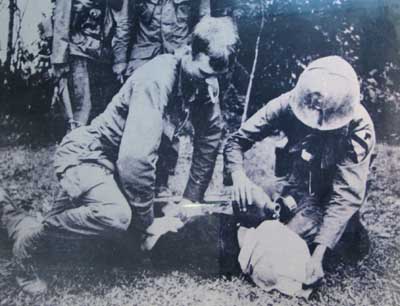
Water torture in Vietnam

John Buell: Torture’s political invisibility
By John Buell / August 19, 2008

That U.S. military personnel — and their superiors — supported the torture of enemy combatants elicits disturbingly little outrage among most voters. Human beings seldom torture those they regard as like themselves. Humans need and crave community, but throughout history narrow definitions of community and exaggerated claims on its behalf have occasioned grave injustices.

The most widely accepted defense of torture is a limited one: a nation possesses a sovereign right to torture a terrorist who purportedly knows the whereabouts of a ticking time bomb. If authorities had solid reason to know that an individual possessed such knowledge, it would present a serious moral dilemma.

Torture, however, has been employed well beyond those extreme parameters. Jane Mayer argues in her new book “The Dark Side” that after 9-11 the government emphasized “interrogation over due process to pre-empt future attacks” even before any ticking bombs were even being made.

In Portland Phoenix articles, Lance Tapley points out that about 35,000 U.S. citizens are held in solitary confinement at “Supermaxes” (including Maine’s). Many are subjected to torture in the form of beating, sleep deprivation and mental abuse that rival practices at Guantanamo, according to Tapley.

Torture’s political invisibility is remarkable given its counterproductive consequences. Tapley points out that the torture of Supermax prisoners, most of whom are mentally ill, leads to high rates of recidivism and poses great public risk.

Frank Rich, commenting on Mayer, suggests: “torture may well be enabling future attacks… false confessions and [an] avalanche of misinformation since 9-11… compromised prosecutions, allowed other culprits to escape and sent the American military on wild-goose chases.”

Some Americans do oppose torture, but even many who are opposed won’t acknowledge that “we” torture individuals not privy to secret bomb information. For example, prison authorities, major media and political leaders have not challenged Tapley’s specific factual assertions. Nonetheless, none have acted on his findings. Many national leaders even engage in tortuous redefinitions of torture.

These responses may have deep origins. Our world now presents shrinking employment options, rapid changes in neighborhoods and complex interdependence. Social turmoil leads many Americans, steeped in traditional notions of the U.S. as “a city upon a hill” in possession of unique truth, to embrace a problematic conviction: individuals whose differences in religion, lifestyle or ethnicity pose no direct threat really are dangerous.

The world is seen as irrevocably divided between a virtuous “us” and a dangerous “them.” We would never torture or would do so only for overwhelming reasons. When victims of our torture attack or murder us, their actions merely confirm our conviction that they are “basically evil.”

Greater equality and adequate security might blunt xenophobic responses to economic crisis. Nonetheless, especially in a world becoming ever more multicultural, achieving progressive reforms is unlikely without also challenging some prevalent forms of fundamentalism. These dogmatic and exclusionary creeds blind us to the limits of our own intelligence, deny opportunities for full self-development, and preclude social justice movements across racial and religious lines.

For the sake of others and ourselves, we need dialogues to explore sympathetically the deeper — and inherently contestable — assertions about God, truth and morality that underlie major religious, national and ethnic communities. Nations also must acknowledge that they can no longer manage all that goes on even within their own borders. “Multinational” corporations constrain national governments.

Nations should acknowledge the contributions that transnational labor and environmental activists can make by adding labor and environmental standards to the corporate protections in trade agreements. Our willingness to articulate, collectively revise and live by international civil liberties standards would also lead more of the world’s people to disclose terrorist criminal conspiracies.

What if, as James Der Derian, director of the Global Security Program at Brown University, has argued, ” border guards, concrete barriers and earthen levees not only prove inadequate but act as force multipliers, producing automated bungling that transform isolated events and singular attacks into global disasters.” We must, he argues, “ask if such mega-catastrophes are no longer an exception but part of densely networked systems that defy national management.”

Our support of torture and our desperate efforts to deny its prevalence — like defenses of slavery — bespeak an arrogant disregard of humans who may be different but are no less worthy. They also emanate from and intensify a false sense of security that poses increased risks to us all.

[John Buell is a political economist who lives in Southwest Harbor. Readers may contact him at jbuell@acadia.net. ]

Source / Bangor Daily News

The Rag Blog

Posted in RagBlog | Tagged , | Leave a comment

San Marcos : Dog Dies After Traffic Cop Ignores Owners’ Pleas

The law in San Marcos: Hays County Courthouse. Looks mighty pretty. Postcard courtesy of Phyllis C. Rummel.

“Who’s dying? Relax,” Stephens said as his cruiser’s dashboard camera captured the interaction.

“My dog,” Gonzalez said during the Aug. 5 traffic stop.

Source / ABC News. [See video below.]

Cop: ‘It’s a dog, it’s OK. You can get another one.’
August 17, 2008

SAN MARCOS, Texas — A police officer was accused of inappropriate behavior after his misconduct may have resulted in a dog’s death, ABC News reported.

Officer Paul Stephens pulled over Michael Gonzalez for speeding at 100 miles an hour down an interstate highway, prompting the driver to get out of the car, saying, “He’s dying.”

Gonzales and his girlfriend Krystal Hernandez explained that they were speeding to reach a veterinary clinic because their pet poodle Missy was choking.

The dashboard camera of the police car shows Officer Stephens yelling and criticizing the couple for putting other people’s lives at risk for a dog.

“You’re driving down the highway at 100 per hour,” he said. “It’s a dog, it’s OK. You can get another one. Relax.”

Stephens kept Gonzalez on the roadside for 15 minutes. The dog died as the couple waited for Stephens to issue a citation.

The couple tried to convince the officers several different ways to allow them to save their pet, KWTX Channel 10 News reported.

Gonzalez and Hernandez said they begged Stephens to let them go to the vet and turn themselves in for the speeding ticket later.

Gonzalez also offered to stay behind with the officer while Hernandez took the dog to the vet.

But Stephens ignored their pleas.

Police supervisors called the incident a “rookie mistake” and did not found Stephens guilty of any misconduct.

“This was not our finest hour,” said San Marcos Police Chief Howard Williams.

However, Williams did say that Stephens behavior was less than stellar.

“His world was collapsing. And what the officer says to him, basically, is, ‘I don’t care,'” Williams said.

Earlier this week, a police officer in Arizona was acquitted of charges of animal cruelty after leaving a police dog in a patrol car for 13 hours on a hot day last summer, the Associated Press reported.

Recent examples of police misconduct towards people are unfortunately no less appalling and usually include the use of tasers.

Police in South Carolina punched a teenage boy 13 times in the face before tasering him as he lay prone on the ground.

Police tasered an injured teen from Ozark, Missouri up to 19 times after he fell from a highway overpass in late July.

The 16-year-old had broken his back and heel when the officers began tasering him.

In yet another bizarre instance of police violence, a 66-year-old minister was tasered and beaten by hospital security guards for what he claims was a joke.

In that incident, hospital security cameras caught five officers kicking Rev. Al Poisson on the ground for at least five minutes.

Source / The Raw Story

Choking pet dies while owner waits for traffic ticket — ABC News

The Rag Blog

Posted in RagBlog | Tagged , , , , , | 17 Comments

The Most Trusted Man in America


You can’t be serious: How a comedian became the most influential voice in American politics
by Leonard Doyle / August 19, 2008

See video below.

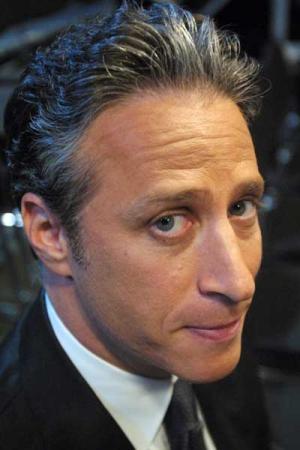
When Jon Stewart inaugurated his fake news anchor on The Daily Show eight years ago, his goal was to send up the hyperbolic and manufactured controversy of US Cable News and, if possible, be even more outrageous. Now, in a wonderful through-the-looking-glass moment, he has supplanted the subjects of his mockery in the country’s current affairs consciousness, and finds himself crowned the bemused voice of reason in an insane world.The underground comic has become such a cultural touchstone that The New York Times asked this week whether he has become “the most trusted man in America”.

For anyone who has missed the influential anchor, then his take on the way mainstream media peddles false rumours about Barack Obama is instructive. He calls it “Baracknophobia” and shows clips of blow-dried anchors and experts repeating widely-believed but baseless rumours – that the Democrat is actually a secret Muslim, a plagiarist, a misogynist etc. The purveyor of fake news lacerates the networks’ talking heads as they blame the internet for rumour mongering about Obama.

The highlight is a straight-faced Mr Stewart saying: “Oh, this is interesting. SomeguyI’veneverheardof.com is reporting presumptive Democratic nominee Barack Obama has lady parts. Obviously scurrilous and unfounded, we’ll examine it tonight in our special, ‘Barack Obama’s Vagina: The October Surprise In His Pants’.”

The latest sign of how far the show and its host have come from their edgy early days will come at the Democratic Convention in Denver, where he and his reporters are fully accredited.

When asked last year by the Pew Research Centre to name the journalist they most admired, Americans placed the fake news anchor Mr Stewart at number four on the list. He was tied with such luminaries as Tom Brokaw of NBC, Dan Rather, then of CBS, and Anderson Cooper of CNN.

The Daily Show and the equally funny and successful Colbert Report shows are broadcast more than 23 times a week, “from Comedy Central’s World News Headquarters in New York”. The side-street studio on Manhattan’s West Side is not only the undisputed locus of fake news, but it is increasingly the epicentre of real news – administered with a wrapping of college humour.

The whispered advice of a State Department spokesman to a foreign correspondent trying to make sense of American politics was very simple: tune into The Daily Show. “I watch the reruns every morning at 10.30,” she said, “it’s the only way to find out what’s really going on.”

The Conflict in Georgia

The Daily Show is also a top priority for ambitious politicians and was described by Newsweek as “the coolest pit stop on television” for presidential candidates, world leaders and ex-presidents. While mainstream news gave an even-handed report on the legacy of the Blair-Bush years after Tony Blair’s farewell visit to Washington last year, The Daily Show tore Mr Blair to ribbons.

One of the programme’s signature techniques – of using video montages showing politicians contradicting themselves – is now a staple technique of mainstream news shows.

Nor is The Daily Show afraid of tackling what it calls “super depressing” stories, such as President George Bush’s decision to approve the use of torture after the September 11 attacks and the unprecedented concentration of executive power by the White House. Interviews with serious authors such as Seymour Hersh have helped focus attention on potentially illegal acts by the Bush administration and win a wider audience for their work.

Mr Stewart’s frequent outbursts of “Are you insane?!” seems to capture the post-M*A*S*H, post-Catch-22 sensibilities of a country that waged a war in Iraq to find weapons of mass destruction that did not exist. Now, with the most promising candidate in generations running for president, Mr Stewart asks whether the country may be about to reject him at the ballot box because of rumours that he is Muslim.

The purpose of The Daily Show is to entertain, not inform, Mr Stewart insists, and he likens his job to “throwing spitballs” from the back of the room. But he and the high-powered writers who work with him like nothing better than tackling the big issues of the day – in ways that straight news programs cannot.

“Hopefully, the process is to spot things that would be grist for the funny mill,” Mr Stewart, 45, told The New York Times. “In some respects, the heavier subjects are the ones that are most loaded with opportunity because they have the most … potential energy, so to delve into that gives you the largest combustion, the most interest. I don’t mean for the audience. I mean for us.”

The Daily Show’s success comes from blending the informality and attitude of bloggers with the hard-nosed research and expertise of the best investigative reporters to reveal a new news medium. Like bloggers, a key to his show’s success is the authenticity that comes from in-depth reporting, combined with stating the blindingly obvious.

Every day begins with a morning meeting where material culled from 15 video recorders, as well as newspapers, magazines and websites, is pored over. The meeting, Mr Stewart says, “would be very unpleasant for most people to watch: it’s really a gathering of curmudgeons expressing frustration and upset, and the rest of the day is spent trying to … repress that through whatever creative devices we can find”. Josh Lieb, one of the executive producers of the show, describes the process as looking for stories that “make us angry in a whole new way”.

By 3pm a script has been prepared and Mr Stewart’s rehearsals begin. After an hour of rewrites, taping the show starts at 6pm.

The fake news anchor may be the antidote to fake news, which has a habit of showing up in American newspapers. After all, the US government had an initiative in 2005 to plant “positive news” in Iraqi newspapers to sway public opinion about the war. The Bush administration has worked closely with big business to keep it flowing.

According to Professor Robert Love, of Columbia Journalism School: “They have used fringe scientists and fake experts to muddy scientific debates on global warming, stem-cell research, evolution, and other matters.”

For all his fakery, Mr Stewart may be pointing the way to the future of news: bluntness and informality fused with ruthless editing and a funny bone which helps to ensure that stories he wants to cover are watched.

©independent.co.uk

Source, including a couple more videos / The Independent

The Rag Blog

Posted in RagBlog | Tagged , , , , , , | 1 Comment

The US Does Not Really Have a Foreign Policy


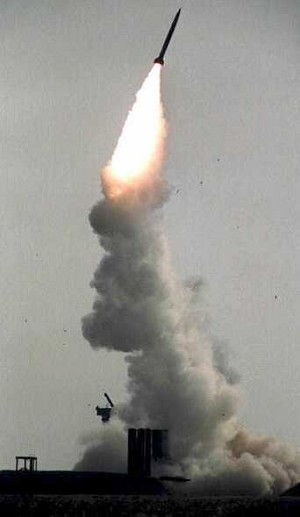
The US missile defence system is the magic pudding that will never run out
By George Monbiot / August 19, 2008

Poland is just the latest fall guy for an American foreign policy dictated by military industrial lobbyists in Washington

It’s a novel way to take your own life. Just as Russia demonstrates what happens to former minions that annoy it, Poland agrees to host a US missile defence base. The Russians, as Poland expected, respond to this proposal by offering to turn the country into a parking lot. This proves that the missile defence system is necessary after all: it will stop the missiles Russia will now aim at Poland, the Czech Republic and the UK in response to, er, their involvement in the missile defence system.

The American government insists that the interceptors, which will be stationed on the Baltic coast, have nothing to do with Russia: their purpose is to defend Europe and the US against the intercontinental ballistic missiles Iran and North Korea don’t possess. This is why they are being placed in Poland, which, as every geography student in Texas knows, shares a border with both rogue states.

They permit us to look forward to a glowing future, in which missile defence, according to the Pentagon, will “protect our homeland … and our friends and allies from ballistic missile attack”; as long as the Russians wait until it’s working before they nuke us. The good news is that, at the present rate of progress, reliable missile defence is only 50 years away. The bad news is that it has been 50 years away for the past six decades.

The system has been in development since 1946, and so far it has achieved a grand total of nothing. You wouldn’t know it if you read the press releases published by the Pentagon’s missile defence agency: the word “success” features more often than any other noun. It is true that the programme has managed to hit two out of the five missiles fired over the past five years during tests of its main component, the ground-based midcourse missile defence (GMD) system. But, sadly, these tests bear no relation to anything resembling a real nuclear strike.

All the trials run so far – successful or otherwise – have been rigged. The target, its type, trajectory and destination, are known before the test begins. Only one enemy missile is used, as the system doesn’t have a hope in hell of knocking down two or more. If decoy missiles are deployed, they bear no resemblance to the target and they are identified as decoys in advance. In order to try to enhance the appearance of success, recent flight tests have become even less realistic: the agency has now stopped using decoys altogether when testing its GMD system.

This points to one of the intractable weaknesses of missile defence: it is hard to see how the interceptors could ever outwit enemy attempts to confuse them. As Philip Coyle – formerly a senior official at the Pentagon with responsibility for missile defence – points out, there are endless means by which another state could fool the system. For every real missile it launched, it could dispatch a host of dummies with the same radar and infra-red signatures. Even balloons or bits of metal foil would render anything resembling the current system inoperable. You can reduce a missile’s susceptibility to laser penetration by 90% by painting it white. This sophisticated avoidance technology, available from your local hardware shop, makes another multibillion component of the programme obsolete. Or you could simply forget about ballistic missiles and attack using cruise missiles, against which the system is useless.

Missile defence is so expensive and the measures required to evade it so cheap that if the US government were serious about making the system work it would bankrupt the country, just as the arms race helped to bring the Soviet Union down. By spending a couple of billion dollars on decoy technologies, Russia would commit the US to trillions of dollars of countermeasures. The cost ratios are such that even Iran could outspend the US.

The US has spent between $120bn and $150bn on the programme since Ronald Reagan relaunched it in 1983. Under George Bush, the costs have accelerated. The Pentagon has requested $62bn for the next five-year tranche, which means that the total cost between 2003 and 2013 will be $110bn. Yet there are no clear criteria for success. As a recent paper in the journal Defense and Security Analysis shows, the Pentagon invented a new funding system in order to allow the missile defence programme to evade the government’s usual accounting standards. It’s called spiral development, which is quite appropriate, because it ensures that the costs spiral out of control.

Spiral development means, in the words of a Pentagon directive, that “the end-state requirements are not known at programme initiation”. Instead, the system is allowed to develop in whatever way officials think fit. The result is that no one has the faintest idea what the programme is supposed to achieve, or whether it has achieved it. There are no fixed dates, no fixed costs for any component of the programme, no penalties for slippage or failure, no standards of any kind against which the system can be judged. And this monstrous scheme is still incapable of achieving what a few hundred dollars’ worth of diplomacy could do in an afternoon.

So why commit endless billions to a programme that is bound to fail? I’ll give you a clue: the answer is in the question. It persists because it doesn’t work.

US politics, because of the failure by both Republicans and Democrats to deal with the problems of campaign finance, is rotten from head to toe. But under Bush, the corruption has acquired Nigerian qualities. Federal government is a vast corporate welfare programme, rewarding the industries that give millions of dollars in political donations with contracts worth billions. Missile defence is the biggest pork barrel of all, the magic pudding that won’t run out, however much you eat. The funds channelled to defence, aerospace and other manufacturing and service companies will never run dry because the system will never work.

To keep the pudding flowing, the administration must exaggerate the threats from nations that have no means of nuking it – and ignore the likely responses of those that do. Russia is not without its own corrupting influences. You could see the grim delight of the Russian generals and defence officials last week, who have found in this new deployment an excuse to enhance their power and demand bigger budgets. Poor old Poland, like the Czech Republic and the UK, gets strongarmed into becoming America’s groundbait.

If we seek to understand American foreign policy in terms of a rational engagement with international problems, or even as an effective means of projecting power, we are looking in the wrong place. The government’s interests have always been provincial. It seeks to appease lobbyists, shift public opinion at crucial stages of the political cycle, accommodate crazy Christian fantasies and pander to television companies run by eccentric billionaires. The US does not really have a foreign policy. It has a series of domestic policies which it projects beyond its borders. That they threaten the world with 57 varieties of destruction is of no concern to the current administration. The only question of interest is who gets paid and what the political kickbacks will be.

Source / The Guardian

The Rag Blog

Posted in RagBlog | Tagged , , , | Leave a comment

US Banking: The Shit Has Yet to Hit the Fan


Large U.S. Bank Collapse Seen Ahead
By Jan Dahinten / August 19, 2008

SINGAPORE — The worst of the global financial crisis is yet to come and a large U.S. bank will fail in the next few months as the world’s biggest economy hits further troubles, former IMF chief economist Kenneth Rogoff said on Tuesday.

“The U.S. is not out of the woods. I think the financial crisis is at the halfway point, perhaps. I would even go further to say ‘the worst is to come’,” he told a financial conference.

“We’re not just going to see mid-sized banks go under in the next few months, we’re going to see a whopper, we’re going to see a big one, one of the big investment banks or big banks,” said Rogoff, who is an economics professor at Harvard University and was the International Monetary Fund’s chief economist from 2001 to 2004.

“We have to see more consolidation in the financial sector before this is over,” he said, when asked for early signs of an end to the crisis.

“Probably Fannie Mae and Freddie Mac — despite what U.S. Treasury Secretary Hank Paulson said — these giant mortgage guarantee agencies are not going to exist in their present form in a few years.”

Rogoff’s comments come as investors dumped shares of the largest U.S. home funding companies Fannie Mae and Freddie Mac on Monday after a newspaper report said government officials may have no choice but to effectively nationalize the U.S. housing finance titans.

A government move to recapitalize the two companies by injecting funds could wipe out existing common stock holders, the weekend Barron’s story said. Preferred shareholders and even holders of the two government-sponsored entities’ $19 billion of subordinated debt would also suffer losses.

Rogoff said multi-billion dollar investments by sovereign wealth funds from Asia and the Middle East in western financial firms may not necessarily result in large profits because they had not taken into account the broader market conditions that the industry faces.

“There was this view early on in the crisis that sovereign wealth funds could save everybody. Investment banks did something stupid, they lost money in the sub-prime, they’re great buys, sovereign wealth funds come in and make a lot of money by buying them.

“That view neglects the point that the financial system has become very bloated in size and needed to shrink,” Rogoff told the conference in Singapore, whose wealth funds GIC and Temasek have invested billions in Merrill Lynch and Citigroup

In response to the sharp U.S. housing retrenchment and turmoil in credit markets, the U.S. Federal Reserve has reduced interest rates by a cumulative 3.25 percentage points to 2 percent since mid-September.

Rogoff said the U.S. Federal Reserve was wrong to cut interest rates as “dramatically” as it did.

“Cutting interest rates is going to lead to a lot of inflation in the next few years in the United States.”

© Thomson Reuters 2008

Source / Reuters

The Rag Blog

Posted in RagBlog | Tagged , , | Leave a comment

ECONOMY : Trickle Down from the Bailouts


‘The federal government is drowning in a sea of red ink’
By Roger Baker / The Rag Blog / August 19, 2008

Bernanke and his crew at the fed bailed out Bear Stearns at taxpayer expense because they feared not doing so would have caused a financial meltdown. There are many tens of trillions in financial derivatives that could quickly cause a panic and domino effect if they don’t keep throwing money at the banks to back up these tangles of derivatives which guarantee bonds and that the US financial system is sound.

The banks they need to bail out to prevent a spreading panic keep getting smaller and smaller. Bailing out Fannie and Freddie is only a matter of time now. The federal government is drowning in a sea of red ink.

But meanwhile all that bailout money is leaking into the broader economy and driving up “core inflation”, which in turn underestimates true inflation. When that happens, you lose money by holding bank deposits and treasury bonds and you have to raise interest rates, which then makes the derivative credibility problem worse. Things are unstable and could deteriorate pretty fast if the Chinese and Arabs and everyone start cashing in and dumping their dollars internationally. Get ready for more inflation, as Fisher of the fed is warning of now:

Fed’s Fisher Says U.S. May Face `Lingering Inflationary Fever’ / Bloomberg / August 19, 2008

Note from this last link that everything hinges on energy prices driving cost-push inflation moderating. If peak oil is real (which it is) then there is no way out; no amount of bailouts can paper over the reality all the trillions in derivatives that guarantee that the big corporations can repay their debts are as worthless as all the subprime loans that were involved in the first stage of the widening crisis.

See the following stories:

Bernanke Tries to Define What Institutions Fed Could Let Fail / Bloomberg / August 18, 2008

Large U.S. Banks May Fail Amid Recession, Rogoff Says / Bloomberg / August 19, 2008

The Rag Blog

Posted in Rag Bloggers | Tagged , , , , | 1 Comment

A Video Series on World Agriculture: Monsanto, Part 8

The World According to Monsanto (Part 8 of 8)

Right now, there is probably no other company that is doing more to endanger the health of this planet, and it’s inhabitants, than Monsanto. With Nazi-like attitude, they are leading the world in shear destructive evil greed. First they were a drug company, and then they expanded to become a drugs and genetic engineering company, and now Monsanto is attempting to acquire water rights in countries with water shortages in a move to control the people’s basic means of survival, and production of the global food supply. Giant transnational corporations like Monsanto, in collusion with the World Bank and the World Trade Organization, seek to commodify and privatize the world’s water and put it on the open market for sale to the highest bidder. Millions of the world’s citizens are being deprived of this fundamental human right, and vast ecological damage is being wrought as massive industry claims water once used to sustain communities and replenish nature.

Click here for more information.

Thanks to Diane Stirling-Stevens / The Rag Blog

Posted in RagBlog | Tagged , | 2 Comments

Iraq Report: Still Very Tense in Kirkuk

The aftermath of a suicide attack on Kurdish demonstrators three weeks ago.
Photo: Benjamin Lowy/VII Network

Kurdish Control of Kirkuk Creates a Powder Keg
By Richard A. Oppel Jr. / August 18, 2008

KIRKUK, Iraq — The phone rang, and it was answered by a Kurdish security commander, Hallo Najat, sitting in his office in this deeply divided city. On the line, he said, was a United Nations official wanting to know whether it was true that the Kurdish militia, the pesh merga, had left its bases in northern Iraq and was occupying Kirkuk.

No, Mr. Najat told the caller. But after hanging up, he wryly revealed the deeper truth about Kirkuk, combustible for its mix of ethnicities floating together on a sea of oil: the Kurds already control it.

“It’s true,” Mr. Najat said. “What is the need for the troops?”

Of all the political problems facing Iraq today, perhaps none is so intractable as the fate of Kirkuk, a city of 900,000 that Kurds, Arabs and Turkmens all claim as their own. The explosive quarrel over the city is one major barrier to creating stable political structures in the rest of Iraq.

Beyond that, it demonstrates that despite a recent decline in violence, Iraq’s unsettled ethnic and regional discord could still upend directives emanating from Baghdad and destabilize large swaths of the country — or even set off a civil war.

This month, legislation in the national Parliament to set the groundwork for crucial provincial elections collapsed in a bitter dispute over Kirkuk, as Arabs and Turkmens demanded that the Kurds be forced to cede some of their power here. But with the Kurds having already consolidated their authority in Kirkuk, there seemed little chance — short of a military intervention — of that happening.

Kurdish authority is visible everywhere in the city. In addition to the provincial government and command of the police, the Kurds control the Asaish, the feared undercover security service that works with the American military and, according to Asaish commanders, United States intelligence agencies.

Asaish officers are often the first to the scene of an attack and, other Kurdish officials concede, seem always to have the best intelligence. The leaders of the Asaish report only to the dominant Kurdish political parties, the Kurdistan Democratic Party and the Patriotic Union of Kurdistan.

“He’s my boss,” said Mr. Najat, the commander of the K.D.P. Asaish force in Kirkuk, glancing at a picture of Masrur Barzani, the head of intelligence for the K.D.P. and the son of the party’s leader, Massoud Barzani.

The Kurds’ control over the security forces — and their ability to use it for political purposes — was evident three weeks ago, rival groups say, after a suicide bomber attacked Kurdish demonstrators, igniting a riot that left dozens dead and hundreds wounded.

After the attack, a mob of Kurds set upon a Turkmen political headquarters, eventually firebombing the building. At some point, the Turkmen guards inside fired at the crowd. All in all, American officials say they believe, far more people were killed and wounded in the riot than in the bombing that touched it off.

Yet, while the police quickly arrested 13 Turkmens at the headquarters, charging them with firing on the crowd, they did not apprehend any of the Kurds who burned the building. One of the Turkmen guards wounded in the fighting was quickly interrogated at the hospital by the Asaish and the police. A video, in which the guard says he was ordered to fire on the crowd, soon appeared on Kurdish television.

Kurdish police commanders promise an impartial investigation of the bombing and its aftermath, overseen by officers from all of the city’s ethnic groups. But the senior Turkmen on the force, Maj. Gen. Turhan Abdul-Rahman Youssef, fears a whitewash.

“I don’t think we will have a result,” he said, describing the broadcast showing the wounded Turkmen guard as “illegal.”

The Kurds’ accumulation of power has stoked tensions with Arabs and Turkmens. “There is much fear,” said Mohammed Khalil, the leader of the Arab bloc on the provincial council. “The Asaish are saying they will annex Kirkuk by force, and that is terrifying people.” Arabs also say the Asaish carry out kidnappings, a charge Asaish officers deny.

But rival ethnic leaders also warn that the Kurds’ control of the security forces will not prevent chaos in the event of an outbreak of ethnic fighting. The city’s Arabs, Mr. Khalil said, “will not stay handcuffed by Kurdish actions.”

Under Saddam Hussein, tens of thousands of Kurdish families were ousted from Kirkuk, replaced by Arabs as part of his drive to obtain a firmer political grip on the enormous oil reserves here. But after the American-led invasion of Iraq in 2003, Kurdish militiamen reversed the process, driving out Arabs and bringing in Kurds. Arabs and Turkmens now make up about 40 percent of Kirkuk’s population, according to American military estimates.

The Kurds want to fold Kirkuk into the neighboring Kurdistan region. They also warn that any plan stripping them of power will be harshly contested.

“Its fate will be failure,” said Nejad Hassan, the senior Kurdistan Democratic Party official in Kirkuk.

After the suicide bombing, that conflict was evident in a dispute about whether to bring a substantial number of Iraqi troops into the city, in a direct challenge to Kurdish supremacy.

In a series of sweeps conducted with the Americans, the Iraqi Army has helped establish stability this year in other volatile parts of Iraq. But Iraqi troops have largely stayed out of Kirkuk.

After the July 28 attacks, however, Prime Minister Nuri Kamal al-Maliki ordered in a battalion from a nearby base. The troops took up positions in the city.

Aware that part of the proposal being debated in Baghdad was to send a far larger force from central and southern Iraq to administer security — which would mean a mostly Arab force, loyal to the Baghdad government, set against Kurdish-controlled forces — the Kurds objected strenuously.

Kurds were not the only ones opposing the deployment of a major Arab security force after the violence. The American military commander here, Col. David Paschal, said he feared that if Baghdad sent in additional troops, Kurdish leaders would retaliate by sending in their own militia from northern Iraq, creating a potentially disastrous confrontation.

“I just saw this continued escalation of force happening,” he said. Baghdad is expected to withdraw the troops, according to American commanders.

Colonel Paschal blames all the political parties for inflaming tensions to serve their interests. But he said it was difficult to comprehend the level of mistrust.

“Negotiations here are, ‘You give me everything I want, and I will walk away happy,’ ” he said. “It is hard for us to appreciate the level of ethnic hatred.”

The severity of those tensions became indisputably clear three weeks ago when thousands of Kurds poured into central Kirkuk to protest the power-sharing proposal in Baghdad.

In a video that American commanders say they believe to be authentic, a young man who the Americans say appears to be the bomber, not a woman as Kurdish officials initially said, can be seen standing in a sea of demonstrators. He ritualistically raises his hands, palms up, toward his face, then lowers them to his side. An instant later the explosion engulfs him and everyone around him.

It took only a few moments for the demonstrators to turn their fury on the Turkmens, whom they instantly blamed. One mistook a well-known Kurdish journalist, Yahya Barzanji, for a Turkmen correspondent, shouting, “He’s working for the Turkmens,” Mr. Barzanji recalled. A video captured the crowd furiously beating Mr. Barzanji, chanting: “Kill him! Kill him!”

Within minutes the mob was in front of the Turkmen party headquarters. While American and Kurdish officials agree that the Turkmen guards fired into the crowd, Colonel Paschal — who watched the skirmish unfold in a video feed from a remotely piloted aerial drone — said that the Turkmens did not appear to fire wantonly, and that they instead gradually escalated until they were firing directly into a large and growing mob that posed a threat.

All told, at least 28 people died and 213 were wounded in the suicide attack and the ensuing riot, according to the Asaish commander at the main hospital. Kurdish authorities have sought to play down the intensity of the fight between the Kurds and the Turkmens, but Colonel Paschal said most of the casualties were sustained during the riot.

Despite this outbreak, Colonel Paschal said attacks in Kirkuk had dropped by two-thirds since last summer. Kurds attribute some of that improvement to the Asaish.

“They are in direct contact with the people,” said Hemin Shafiq, a 24-year-old policeman. “They are more rapid. That is why they are much more active than the police.”

Rifat Abdullah, the leader of the Patriotic Union of Kurdistan here, said: “The Asaish have lots of sources, and that’s why the Americans depend on them and the police depend on them. That might explain why they have more power.”

General Turhan admitted that the Asaish officers were, at times, more powerful than the police, and he said there were thousands of Asaish in the city, though Kurdish officials say there are no more than 1,000. “They have a major role combating terrorism, but the problem is they are loyal to the political parties,” he said.

In an interview, the provincial police chief, Maj. Gen. Jamal Taher, a Kurd, did not answer a question about whether he had the power to control the activities of the Asaish. But he praised their ability to ferret out information.

“Maybe they have better sources than me,” he said.

Riyadh Muhammed contributed reporting.

Source / New York Times

The Rag Blog

Posted in RagBlog | Tagged , | Leave a comment

Democracy in Pakistan Still Has a Fighting Chance

Pakistani President Pervez Musharraf inspects guard of honor before leaving the presidential house after his resignation in Islamabad Aug. 18, 2008.
Photo: Reuters/Mian Khursheed

The fall of Bush’s man in Pakistan
By Juan Cole / August 19, 2008

Despite Pervez Musharraf’s despotism and double-dealing with U.S. enemies, George W. Bush, John McCain and the GOP embraced him to the bitter end.

It is a measure of the Bush administration’s broken foreign policy that the departure of Pervez Musharraf, the corrupt, longtime military dictator of Pakistan, is provoking fears in Washington of “instability.” Despite Bush’s warm embrace, Musharraf gutted the rule of law in Pakistan over the previous year and a half, including sacking its Supreme Court. He attempted to do away with press freedom, failed to provide security for campaigning politicians and strove to postpone elections indefinitely.

The Bush administration has made a regular practice of undermining democracy in places where local politics don’t play out to its liking, and in that, at least, Musharraf was a true partner. But stability derives not from a tyrannical brake on popular aspirations; it derives from the free play of the political process. Musharraf’s resignation from office, in fact, marks Pakistan’s first chance for a decent political future since 1977.

Musharraf as a general had been known in the 1990s as a hawk, foolhardy in his provocation of India and deeply wedded to supporting the Taliban (and implicitly al-Qaida) in Afghanistan. Unlike some of his colleagues, there was nothing ideological about his belligerence. Brought up in part in secular Turkey as the son of a diplomat, he displayed no interest in fundamentalist Islam. His was the belligerence of opportunism and ambition.

Musharraf deposed then Prime Minister Nawaz Sharif in October of 1999. As army chief of staff, he had earlier that year launched the disastrous Kargil War against India in the Himalayan area of Kashmir, and been forced to withdraw. The encroachment on Indian-held territory had not been cleared with the prime minister, who was all too happy to yield to American entreaties to withdraw. Musharraf might well have been brought up on charges over the catastrophe, but he decided to overthrow the civilian government instead.

George W. Bush has been a staunch supporter of Musharraf. When campaigning for president in the fall of 1999, Bush praised Musharraf’s coup as promising stability for Pakistan. Sen. John McCain also supported the coup, and has recently dismissed the civilian government of the 1990s as a “failed state.” It is true that Sharif had begun exhibiting dictatorial tendencies before his ouster, but that is not a failed state, it is tyranny. How civilian authoritarianism could have been cured by military dictatorship remains unclear.

Pakistan was founded in 1947 by Muhammad Ali Jinnah and other leaders of the Muslim League as a refuge for the Muslims of British India. Jinnah fulminated against theocracy and fully expected Hindus and Sikhs to constitute a plurality of the new state’s population. He thought of it as a state for Muslims, not as an Islamic state, and simply wanted to save South Asian Muslims from laboring under a Hindu majority in India.

But Pakistan did not become the enlightened, parliamentary democracy with guaranteed constitutional rights that its founder, a Shiite trained in British law in London, had envisaged. It constituted the most rural and least industrialized parts of British India. It never implemented proper land reform, ensuring the survival of a corrupt and imperious class of large landlords who are not exactly clamoring for their peasants to become literate and politically aware. Its social indicators, whether literacy, health or urbanization, remained disappointing. A small fundamentalist movement, the Jama’at-i Islami, came to have influence all out of proportion to its membership, despite its general inability to garner more than 3 percent of the vote in most elections.

The military was the most ambitious bureaucracy inherited from British India, and it made its first coup in 1958. After a return to civilian rule in 1971, the military under Gen. Zia ul-Haq struck again in 1977, hanging Prime Minister Zulfikar Ali Bhutto in 1979. Gen. Zia was viewed by the Reagan administration as indispensable to its covert war against the Soviet occupation of Afghanistan. Zia, isolated and without popular support inside Pakistan, made an alliance with the fundamentalist Jama’at-i Islami and began the “Islamization” of Pakistani law, which had earlier been a mixture of British legal principles with precedents derived from Muslim customary practice.

Zia’s Inter-Services Intelligence, the feared military intelligence branch, received some $5 billion from Reagan and a matching sum from King Fahd in Saudi Arabia to fight the Soviets, and the ISI funneled much of that money to the most hard-line fundamentalist guerrillas among the Afghans. The Reagan-backed jihad against Moscow attracted the enthusiasms of Osama bin Laden, Ayman al-Zawahiri and thousands of other Arab volunteers, leading to the creation of al-Qaida.

Zia died in a mysterious plane crash in 1988, allowing a partial return to civilian rule. Bhutto’s daughter, Benazir, won the elections to become the country’s first female prime minister. But the military only let her take office after she pledged to cede Afghanistan policy to them, so that entire policy sectors remained under military control.

Gen. Zia had extensively and arbitrarily amended the constitution, giving the president enormous powers, including the authority to dismiss the prime minister. His successor dismissed Bhutto in 1990, allowing her rival, Nawaz Sharif, to come to power. In 1993, she swept back to power in that year’s parliamentary elections, but she was dismissed once more in 1996, again succeeded by Sharif, who was overthrown by the military in 1999. The military’s continued control of much of government policy during that decade and the repeated intervention of the president or the chief of staff to overturn the results of popular elections stunted the growth of political parties and institutions such as the courts. Contrary to McCain’s assertion, it was not the civilian parties that created a failed state but the generals who did it.

Musharraf ostensibly turned his back on his allies, the Taliban and their al-Qaida colleagues, after 9/11, acquiescing in Bush’s demand that he join Washington in a global war on terror. Musharraf, who had long backed not only the Taliban but also jihadi groups inside Pakistan that the Pakistani military sent to hit Indian Kashmir, was the least likely poster child for counterterrorism imaginable. But Bush’s propaganda machine painted him and the Pakistani military as anchors of stability — after they had spent decades destabilizing Pakistan and Afghanistan and cynically deploying the most virulent forms of Muslim fundamentalism to fight India and Indian influence.

Musharraf was an embarrassment to the Bush administration once Bush began using a rhetoric of democratization. So Musharraf conveniently turned himself from mere military dictator into a “president” by the expediency of a referendum on April 30, 2002.

For a dictator, a referendum has the advantages that it does not require one to run against a rival candidate, and virtually any vote tally can be declared a victory. Musharraf held crooked parliamentary elections in fall 2002, interfering in the free campaigning of the left-of-center, secular-leaning Pakistan People’s Party and the right-of-center, big landlord-dominated Muslim League (N), which had been led by Nawaz Sharif (hence the “N”). The party that did best was a pro-Musharraf, breakaway faction of the Muslim League, called “Q” for the “Great Leader,” Qa’id-i A’zam, the honorific of Muhammad Ali Jinnah, the country’s founder. It was essentially what it would be like if an American general led a coup, suppressing the Democrats and Republicans, and ruling through something he called the “George Washington Party.”

After Musharraf rigged the elections against the popular parties, a coalition of fundamentalist parties saw unprecedented success, getting 17 percent of seats in the federal parliament and taking over two major provinces, the North-West Frontier Province and Baluchistan. Those provinces were preciscely where the remnants of the Taliban and al-Qaida who fled to Pakistan were hiding out. The Jama’at-i Islami and its partners in the Islamic Action Council (MMA) promptly denied that there was any such thing as al-Qaida. But some of the MMA leaders had trained, or even been Taliban.

So the man Bush had so eagerly enlisted for the war on terror, by his dictatorial tinkering with the electoral process, helped put pro-bin Laden Muslim fundamentalists in control of the very provinces where the fight against militancy and terrorism was most important. And in reality, Musharraf needed the jihadi militants too much for his struggle with India over Kashmir to thoroughly root them out.

Although the Pakistani security forces did capture more than 600 Arab al-Qaida fugitives in Pakistan, and did engage in sometimes hard fighting against tribal forces in the northwest allied to the Taliban or neo-Taliban groups, Washington’s depiction of Musharraf as a critical ally in the war on terror was blatant propaganda. Elements of the ISI even went on cultivating and using Taliban elements based in Pakistan to assert control of southern Pakistan, a policy that had, in part, led to 9/11 in the first place. Musharraf either was unable to purge ISI of fundamentalist elements, or cynically continued to use them in his rivalry with Afghanistan President Hamid Karzai, who deeply dislikes and distrusts the general.

Musharraf’s unwillingness or inability to root out fundamentalist extremism brought him into disrepute with middle-class Pakistanis, especially educated women, who feared the Talibanization of their own society. Musharraf’s economic policies helped grow a large, literate, urban middle class that grew attached to free access to independent and foreign media, and depended for business and professional purposes on a rule of law.

When Musharraf came into conflict with Supreme Court Chief Justice Iftikhar Muhammad Chaudhry in spring of 2007, he highhandedly dismissed him. Pakistan’s middle classes, attorneys and other legal professionals staged continual protests and rallies. Musharraf was forced to reinstate Chaudhry in summer of 2007. But when he attempted to become an elected president that fall without resigning first as military chief of staff, the Supreme Court was set to rule against him. He therefore sacked the whole Supreme Court and packed it with yes men who allowed him to call himself president. He also imposed strict press censorship and excluded some independent channels from broadcasting over cable in Pakistan. This series of dictatorial actions, including interfering with free access to the media, caused Musharraf’s popularity to plummet.

Musharraf’s grip on power had clearly become too feeble for his main external backers, the Bush administration and the Saudi royal family, to trust him to continue to ride the tiger of popular discontent. He had to resign his military commission to remain believable as a civilian president. After Benazir Bhutto was assassinated on Dec. 27, 2007, while campaigning for prime minister, he was forced to hold credible parliamentary elections. The Pakistani public dealt a crushing rebuff to Musharraf last February, turning the country over to Benazir’s PPP and to Sharif’s Muslim League. The two major, long-standing parties made a political alliance and began planning for Musharraf’s impeachment, spurred on by the lawyers and popular activists. It was over for Musharraf by last February.

Pakistan’s middle classes have spoken. They want a return to civilian rule and a reestablishment of the rule of law. They are skeptical that the corrupt and imperious establishment political parties can deliver to them the better life to which they aspire for themselves and their children. Given the chance, they gave the biggest number of seats in parliament to a left of center, secular-tinged party, the PPP. The Pakistani people have given the lie to the stereotype often visited upon them, that a majority are religious fanatics and are incapable of participating in an open democracy.

The Pakistani military and its tacit alliance with militant fundamentalists has in fact caused most of the country’s problems. If the U.S. and Europe are wise, they will give the elected prime minister their full support and pump in aid to help ensure that democracy in Pakistan, still an embryo, actually has a fighting chance.

Source / Salon

The Rag Blog

Posted in RagBlog | Tagged , , | Leave a comment

Texas Horror Movies : The Top Five


A Handful of Non-Chainsaw Horrors
By Hair Balls / August 18, 2008

We Texans live with our share of horrors: fire ants, Rick Perry, residents of Plano, but this entry was still something of a challenge. After all, coming up with Texas horror movies without invoking the one that actually has the name of our state in the title is harder than successfully suing local religious figures. Still, a few intrepid filmmakers have found some scares of the non-chainsaw variety in the Lone Star State.

5. Manos: The Hands of Fate (1966)

Torgo and company were rightly consigned to the chemical toilet of Hollywood history until MST3K resurrected them. Repeat viewings of Harold P. Warren’s sole foray into cinema don’t convey any greater insight (believe me, I’ve tried), just heightened annoyance. Set in Warren’s hometown of El Paso, it’s allegedly Quentin Tarantino’s favorite comedy, which isn’t exactly a ringing endorsement.

4. Future-Kill (1985)

This is a bit of a cheat, seeing as it stars Chain Saw Massacre alumni Edwin Neal and Marilyn Burns. Then again, my friends and I were among the few people who were actually suckered in by H.R. Giger artwork’s (which director Ronald W. Moore tearfully begged the artist to supply for the poster) enough to see the movie in theatrical release. There’s very little “future” in this Austin-filmed horror flick about frat boys tasked with abducting a “Mutant” (a nuclear protester with a penchant for lipstick and mascara) and running afoul of “Splatter” (Neal), an actual mutant with a mean streak.

I’m genuinely heartbroken I couldn’t find the scene where a dude kills a stray cat with an Uzi. You’ll have to make do with this dubbed clip:

3. Silent Rage (1982)

How do you stop a killer who can’t die? Ordinarily I’d recommend you track down some member of the Van Helsing clan, but the only hope for the residents of this small Texas town is Sheriff Chuck Norris, who engages in an increasingly futile series of hand-to-hand battles with a resurrected maniac before doing the sensible thing and dropping the guy down a well.

Fine, I just wanted to talk about Chuck some more. But what about that ending? It leaves things open for a sequel!

2. Bubba Ho-Tep (2002)

Perhaps only the great Joe R. Lansdale could come up with a story in which a long-forgotten Elvis and a surgically altered JFK (darkened, Tropic Thunder style, to throw his enemies off track) do battle with an ancient mummy. Set in an East Texas rest home, the film was hampered from the start by Campbell’s insistence on referring to the flick as a B-movie, to director Don Phantasm Coscarelli’s chagrin.

My friend and I saw the River Oaks premiere of this, with Campbell and Coscarelli in attendance, sneaking into the theater while a German romantic comedy (they exist) was screening. We ended up sitting next to the entire Lansdale clan, who’d trekked down from Nacogdoches for the trip. Good people. And they didn’t rat us out

1. Man of the House (2005)

Oh, boo yourself. Did any of you actually watch this? Academy Award winner Tommy Lee Jones and Academy Award watcher Cedric the Entertainer join forces to make the University of Texas a laughing stock to everyone in the country who didn’t attend A&M. I understand it’s not
technically horror, but you try sitting through it without getting the shakes. Fear or nausea…makes no difference.

To give you an idea how bowel-clenchingly awful it is, the Offspring song accompanying this clip is actually better than the actual dialogue.

Go here for more video clips: Source / Houston Press

The Rag Blog

Posted in RagBlog | Tagged , , , , | 1 Comment

Riding the New Media : How Obama Really Did It

Cake and eat it too. From a party organized through Obama social-networking site. Photo by Porter Gifford / Technology Review.

The social-networking strategy that took an obscure senator to the doors of the White House.
By David Talbot

This article appears in full in the September/October 2008 issue of Technology Review.

Joe Trippi, Howard Dean’s 2004 presidential campaign manager and Internet impresario, describes Super Tuesday II–the March 4 primaries in Texas, Ohio, Vermont, and Rhode Island–as the moment Barack Obama used social tech­nology to decisive effect. The day’s largest hoard of dele­gates would be contested in Texas, where a strong showing would require exceptional discipline and voter-education efforts. In Texas, Democrats vote first at the polls and then, if they choose, again at caucuses after the polls close. The caucuses award one-third of the Democratic delegates.

Hillary Clinton’s camp had about 20,000 volunteers at work in Texas. But in an e-mail, Trippi learned that 104,000 Texans had joined Obama’s social-­networking site, www.my.barackobama.com, known as MyBO. MyBO and the main Obama site had already logged their share of achievements, particularly in helping rake in cash. The month before, the freshman senator from Illinois had set a record in American politics by garnering $55 million in donations in a single month. In Texas, MyBO also gave the Obama team the instant capacity to wage fully networked campaign warfare. After seeing the volunteer numbers, Trippi says, “I remember saying, ‘Game, match–it’s over.'”

The Obama campaign could get marching orders to the Texans registered with MyBO with minimal effort. The MyBO databases could slice and dice lists of volunteers by geographic micro­region and pair people with appropriate tasks, including prepping nearby voters on caucus procedure. “You could go online and download the names, addresses, and phone numbers of 100 people in your neighborhood to get out and vote–or the 40 people on your block who were undecided,” Trippi says. “‘Here is the leaflet: print it out and get it to them.’ It was you, at your computer, in your house, printing and downloading. They did it all very well.” Clinton won the Texas primary vote 51 to 47 percent. But Obama’s ­people, following their MyBO playbook, so overwhelmed the chaotic, crowded caucuses that he scored an overall victory in the Texas delegate count, 99 to 94. His showing nearly canceled out ­Clinton’s win that day in Ohio. Clinton lost her last major opportunity to stop the Obama juggernaut. “In 1992, Carville said, ‘It’s the economy, stupid,'” Trippi says, recalling the exhortation of Bill Clinton’s campaign manager, James Carville. “This year, it was the network, stupid!”

Throughout the political season, the Obama campaign has domi­nated new media, capitalizing on a confluence of trends. Americans are more able to access media-rich content online; 55 percent have broadband Internet connections at home, double the figure for spring 2004. Social-networking technologies have matured, and more Americans are comfortable with them. Although the 2004 Dean campaign broke ground with its online meeting technologies and blogging, “people didn’t quite have the facility,” says ­Lawrence Lessig, a Stanford law professor who has given the Obama campaign Internet policy advice (Lessig wrote The People Own Ideas! in our May/June 2005 issue). “The world has now caught up with the technology.” The Obama campaign, he adds, recognized this early: “The key networking advance in the Obama field operation was really deploying community­-building tools in a smart way from the very beginning.”

Of course, many of the 2008 candidates had websites, click-to-donate tools, and social-networking features–even John McCain, who does not personally use e-mail. But the Obama team put such technologies at the center of its campaign–among other things, recruiting 24-year-old Chris Hughes, cofounder of Facebook, to help develop them. And it managed those tools well. Supporters had considerable discretion to use MyBO to organize on their own; the campaign did not micromanage but struck a balance between top-down control and anarchy. In short, Obama, the former Chicago community organizer, created the ultimate online political machine.

The Obama campaign did not provide access or interviews for this story; it only confirmed some details of our reporting and offered written comments. This story is based on interviews with third parties involved in developing Obama’s social-networking strategy or who were familiar with it, and on public records.

An Online Nervous System

A row of elegant, renovated 19th-century industrial buildings lines Boston’s Congress Street east of Fort Point Channel. On any given day, behind a plain wooden door on the third floor of 374 Congress, 15 to 20 casually clad programmers tap away at computers. On the day I visited, the strains of Creedence Clearwater Revival filled the room; a Ping-Pong table dominated the small kitchen. This is the technology center for Blue State Digital, which means that it is also the nervous system for its two largest clients, the Barack Obama campaign and the Democratic National Committee. Founded by alumni of the Dean campaign, Blue State Digital added interactive elements to Obama’s website–including MyBO–and now tends to its daily care and feeding. The site’s servers hum away in a Boston suburb and are backed up in the Chicago area.

Jascha Franklin-Hodge, 29, greeted me with a friendly handshake and a gap-toothed grin. He has a deep voice and a hearty laugh; his face is ringed by a narrow beard. Franklin-Hodge dropped out of MIT after his freshman year and spent a few years in online music startups before running the Internet infrastructure for the Dean campaign, which received a then-­unprecedented $27 million in online donations. “When the campaign ended, we thought, ‘Howard Dean was not destined to be president, but what we are doing online–this is too big to let go away,'” he says. He and three others cofounded Blue State Digital, where he is chief technology officer. (Another cofounder, Joe Rospars, is now on leave with the Obama campaign as its new-media director.)

The MyBO tools are, in essence, rebuilt and consolidated versions of those created for the Dean campaign. Dean’s website allowed supporters to donate money, organize meetings, and distribute media, says Zephyr Teachout, who was Dean’s Internet director and is now a visiting law professor at Duke University. “We developed all the tools the Obama campaign is using: SMS [text messaging], phone tools, Web capacity,” Teachout recalls. “They [Blue State Digital] did a lot of nice work in taking this crude set of unrelated applications and making a complete suite.”

Blue State Digital had nine days to add its tools to Obama’s site before the senator announced his candidacy on February 10, 2007, in Springfield, IL. Among other preparations, the team braced for heavy traffic. “We made some projections of traffic levels, contribution amounts, and e-mail levels based on estimates from folks who worked with [John] Kerry and Dean in 2004,” recalls Franklin­-Hodge. As Obama’s Springfield speech progressed, “we were watching the traffic go up and up, surpassing all our previous records.” (He would not provide specific numbers.) It was clear that early assumptions were low. “We blew through all of those [estimates] in February,” he says. “So we had to do a lot of work to make sure we kept up with the demand his online success had placed on the system.” By July 2008, the campaign had raised more than $200 million from more than a million online donors (Obama had raised $340 million from all sources by the end of June), and MyBO had logged more than a million user accounts and facilitated 75,000 local events, according to Blue State Digital.

MyBO and the main campaign site made it easy to give money–the fuel for any campaign, because it pays for advertising and staff. Visitors could use credit cards to make one-time donations or to sign up for recurring monthly contributions. MyBO also made giving money a social event: supporters could set personal targets, run their own fund-raising efforts, and watch personal fund-­raising thermometers rise. To bring people to the site in the first place, the campaign sought to make Obama a ubiquitous presence on as many new-media platforms as possible.

The viral Internet offered myriad ways to propagate unfiltered Obama messages. The campaign posted the candidate’s speeches and linked to multimedia material generated by supporters. A music video set to an Obama speech–“Yes We Can,” by the hip-hop artist Will.i.am–has been posted repeatedly on YouTube, but the top two postings alone have been viewed 10 million times. A single YouTube posting of Obama’s March 18 speech on race has been viewed more than four million times. Similarly, the campaign regularly sent out text messages (at Obama rallies, speakers frequently asked attendees to text their contact information to his campaign) and made sure that Obama was prominent on other social-networking sites, such as Facebook and MySpace (see “New-Media King” chart above). The campaign even used the micro­blogging service Twitter, garnering about 50,000 Obama “followers” who track his short posts. “The campaign, consciously or unconsciously, became much more of a media operation than simply a presidential campaign, because they recognized that by putting their message out onto these various platforms, their supporters would spread it for them,” says Andrew Rasiej, founder of the Personal Democracy Forum, a website covering the intersection of politics and technology (and another Dean alumnus). “We are going from the era of the sound bite to the sound blast.”

Money flowed in, augmenting the haul from big-ticket fund-raisers. By the time of the Iowa caucuses on January 3, 2008, the Obama campaign had more than $35 million on hand and was able to use MyBO to organize and instruct caucus-goers. “They have done a great job in being precise in the use of the tools,” Teachout says. “In Iowa it was house parties, looking for a highly committed local network. In South Carolina, it was a massive get-out-the-vote effort.” MyBO was critical both in the early caucus states, where campaign staff was in place, and in later-­voting states like Texas, Colorado, and Wisconsin, where “we provided the tools, remote training, and opportunity for supporters to build the campaign on their own,” the Obama campaign told Technology Review in a written statement. “When the campaign eventually did deploy staff to these states, they supplemented an already-built infrastructure and volunteer network.”

Using the Web, the Obama camp turbocharged age-old campaign tools. Take phone banks: through MyBO, the campaign chopped up the task of making calls into thousands of chunks small enough for a supporter to handle in an hour or two. “Millions of phone calls were made to early primary states by people who used the website to reach out and connect with them,” Franklin-Hodge says. “On every metric, this campaign has operated on a scale that has exceeded what has been done before. We facilitate actions of every sort: sending e-mails out to millions and millions of people, organizing tens of thousands of events.” The key, he says, is tightly integrating online activity with tasks people can perform in the real world. “Yes, there are blogs and Listservs,” Franklin-Hodge says. “But the point of the campaign is to get someone to donate money, make calls, write letters, organize a house party. The core of the software is having those links to taking action–to doing something.”

Read all of this article here / Technology Review

Thanks to Carlos Lowry / The Rag Blog

Posted in RagBlog | Tagged , , , , , | Leave a comment

Six Questions about the Anthrax Case

A hazardous materials unit worker is hosed down on Capitol Hill on Tuesday, where worked continued inspecting buildings and offices for anthrax contamination. Photo by Ron Thomas / AP.

Double Standards in the Global War on Terror, Anthrax Department
By Tom Engelhardt / August 18, 2008

Oh, the spectacle of it all — and don’t think I’m referring to those opening ceremonies in Beijing, where North Korean-style synchronization seemed to fuse with smiley-faced Walt Disney, or Michael Phelp’s thrilling hunt for eight gold medals and Speedo’s one million dollar “bonus,” a modernized tribute to the ancient Greek tradition of amateurism in action. No, I’m thinking of the blitz of media coverage after Dr. Bruce Ivins, who worked at the U.S. Army Medical Research Institute of Infectious Diseases at Fort Detrick, Maryland, committed suicide by Tylenol on July 29th and the FBI promptly accused him of the anthrax attacks of September and October 2001.

You remember them: the powder that, innocuously enough, arrived by envelope — giving going postal a new meaning — accompanied by hair-raising letters ominously dated “09-11-01” that said, “Death to America. Death to Israel. Allah is great.” Five Americans would die from anthrax inhalation and 17 would be injured. The Hart Senate Office Building, along with various postal facilities, would be shut down for months of clean-up, while media companies that received the envelopes were thrown into chaos.

For a nation already terrified by the attacks of September 11, 2001, the thought that a brutal dictator with weapons of mass destruction (who might even have turned the anthrax over to the terrorists) was ready to do us greater harm undoubtedly helped pave the way for an invasion of Iraq. The President would even claim that Saddam Hussein had the ability to send unmanned aerial vehicles to spray biological or chemical weapons over the east coast of the United States (drones that, like Saddam’s nuclear program, would turn out not to exist).

Today, it’s hard even to recall just how terrifying those anthrax attacks were. According to a LexisNexis search, between Oct. 4 and Dec. 4, 2001, 389 stories appeared in the New York Times with “anthrax” in the headline. In that same period, 238 such stories appeared in the Washington Post. That’s the news equivalent of an unending, high-pitched scream of horror — and from those attacks would emerge an American world of hysteria involving orange alerts and duct tape, smallpox vaccinations, and finally a war, lest any of this stuff, or anything faintly like it, fall into the hands of terrorists.

And yet, by the end of 2001, it had become clear that, despite the accompanying letters, the anthrax in those envelopes was from a domestically produced strain. It was neither from the backlands of Afghanistan nor from Baghdad, but — almost certainly — from our own military bio-weapons labs. At that point, the anthrax killings essentially vanished… Poof!… while 9/11 only gained traction as the singular event of our times.

Those deaths-by-anthrax ceased to be part of the administration’s developing Global War on Terror narrative, which was, of course, aimed at Islamist fanatics (and scads of countries that were said to provide them with “safe haven”), but certainly not military scientists here at home. No less quickly did those attacks drop from the front pages — in fact, simply from the pages — of the nation’s newspapers and off TV screens.

Unlike with 9/11, there would be no ritualistic reminders of the anniversaries of those attacks in years to come. No victims, or survivors, or relatives of victims would step to podiums and ring bells, or read names, or offer encomiums. There would be no billion-dollar (or even million-dollar) memorial to the anthrax dead for the survivors to argue over. There would be little but silence, while the FBI fumbled its misbegotten way through an investigative process largely focused on one U.S. bio-weapons scientist, Steven J. Hatfill, who also worked at Fort Detrick and just happened to be the wrong man. (Bruce Ivins, eerily enough, would work closely with, and aid, the FBI’s investigation for years until the spotlight of suspicion came to be directed at him.)

This essentially remained the state of the case until, as July ended, Ivins committed suicide. Then, what a field day! The details, the questions, the doubts, the disputed scientific evidence, the lists of kinds of drugs he was prescribed, the lurid quotes, the “rat’s nest” of an anthrax-contaminated lab he worked in, the strange emails and letters! (“I wish I could control the thoughts in my mind… I get incredible paranoid, delusional thoughts at times, and there’s nothing I can do until they go away, either by themselves or with drugs.”) Case solved! Or not… The “mad scientist” from the Army’s Fort Detrick bio-wars labs finally nabbed! Or not…

It was a dream of a story. And the mainstream media ran with it, knowledgeably, authoritatively, as if they had never let it go. Now, as the coverage fades and the story once again threatens to head for obscurity (despite doubts about Ivins’s role in the attacks), I thought it might be worth mentioning a few questions that came to my mind as I read through recent coverage — not on Ivins’s guilt or innocence, but on matters that are so much a part of our American landscape that normally no one even thinks to ask about them.

Here are my top six questions about the case:

1. Why wasn’t the Bush administration’s War on Terror modus operandi applied to the anthrax case?

On August 10th, William J. Broad and Scott Shane reported on some of the human costs of the FBI anthrax investigation in a front-page New York Times piece headlined, “For Suspects, Anthrax Case Had Big Costs, Scores of the Innocent in a Wide F.B.I. Net.” They did a fine job of establishing that those who serially came under suspicion had a tough time of it: “lost jobs, canceled visas, broken marriages, frayed friendships.” According to the Times (and others), under the pressure of FBI surveillance, several had their careers wrecked; most were interviewed and re-interviewed numerous times in a “heavy-handed” manner, as well as polygraphed; some were tailed and trailed, their homes searched, and their workplaces ransacked.

Under the pressure of FBI “interest,” anthrax specialist and “biodefense insider” Perry Mikesell evidently turned into an alcoholic and drank himself to death. Steven Hatfill, while his life was being turned inside out, had an agent trailing him in a car run over his foot, for which, Broad and Shane add, he, not the agent, was issued a ticket. And finally, of course, Dr. Ivins, growing ever more distressed and evidently ever less balanced, committed suicide on the day his lawyer was meeting with the FBI about a possible plea bargain that could have left him in jail for life, but would have taken the death penalty off the table.

Still, tough as life was for Mikesell, Hatfill, Ivins, and scores of others, here’s an observation that you’ll see nowhere else in a media that’s had a two-week romp through the case: In search of a confession, none of the suspects of these last years, including Ivins, ever had a lighted cigarette inserted in his ear; none of them were hit, spit on, kicked, and paraded naked; none were beaten to death while imprisoned but uncharged with a crime; none were doused with cold water and left naked in a cell on a freezing night; none were given electric shocks, hooded, shackled in painful “stress positions,” or sodomized; none were subjected to loud music, flashing lights, and denied sleep for days on end; none were smothered to death, or made to crawl naked across a jail floor in a dog collar, or menaced by guard dogs. None were ever waterboarded.

Whatever the pressure on Ivins or Hatfill, neither was kidnapped off a street near his house, stripped of his clothes, diapered, blindfolded, shackled, drugged, and “rendered” to the prisons of another country, possibly to be subjected to electric shocks or cut by scalpel by the torturers of a foreign regime. Even though each of the suspects in the anthrax murders was, at some point, believed to have been a terrorist who had committed a heinous crime with a weapon of mass destruction, none were ever declared “enemy combatants.” None were ever imprisoned without charges, or much hope of trial or release, in off-shore, secret, CIA-run “black sites.”

Why not?

2. Why wasn’t the U.S. military sent in?

Part of the reigning paradigm of the Bush years was this: police work was not enough when the homeland was threatened. The tracking down of terrorists who had killed or might someday kill Americans was a matter of “war.” Those who had attacked the American homeland and murdered U.S. citizens would, as our President put it, be “hunted down” by special ops forces and CIA agents who had been granted the right to assassinate and brought in “dead or alive.”

Why then, when acts of murderous bio-terror had been committed on American soil, was the military not called in? Why were no CIA “death squads” — the tellingly descriptive phrase used by Jane Mayer in her remarkable new book, The Dark Side — dispatched to assassinate likely suspects? Why were no Predator unmanned drones, armed with Hellfire missiles, launched to cruise the skies of Maryland and take out Ivins or other suspects “precisely” and “surgically” in their homes (whatever the “collateral damage”)? Why, in fact, weren’t their homes simply obliterated in the manner regularly employed in Afghanistan, Pakistan, Somalia, and elsewhere? (In fact, it seems to have taken the FBI two years after their first suspicions of Ivins simply to search his house and even longer finally to take away his high-level security clearance.)

Once U.S. weapons labs were identified as the sources of the anthrax, why were no special ops teams sent in to occupy the facilities, shut them down, and fly those found there, shackled and blindfolded, to Guantanamo or other more secret sites?

Why, when the administration went to great lengths to squeeze off funding for terrorists elsewhere, was funding for those labs significantly increased?

Why, when those swept up or simply kidnapped by the Bush administration and then discovered to be innocent, were — after secret imprisonment, abuse, and torture — regularly released without apology or reimbursement (if released at all), did the U.S. government pay Hatfill $4.6 million to settle a lawsuit he filed in response to his ordeal?

Why when, according to the Vice President’s “one percent doctrine,” no response was too extreme if even a minuscule chance of a catastrophic attack against the U.S. “homeland” existed, were no extreme acts taken with a WMD killer (or killers) on the loose, possibly in Maryland’s suburbs?

3. Once the anthrax threat was identified as coming from U.S. military labs, why did the administration, the FBI, and the media assume that only a single individual was responsible?

Read as much of the coverage of the anthrax killings as you want and you’ll discover that the FBI has long taken for blanket fact that a single “mad scientist” was the culprit — and, no less important, that that theory has been accepted as bedrock fact by the media as well. No alternative possibilities have been seriously considered for years.

For instance, it is known that a set of the anthrax letters was sent from a mailbox in Princeton, New Jersey, some hours from Ivins’s home and the Fort Detrick lab in Frederick, Maryland. The question the FBI puzzled over — and the media took up vigorously — was whether, on the day in question, Ivins had time to make it to Princeton and back, given what’s known of his schedule. The FBI suggests that he did; critics suggest otherwise. No one, however, seems to consider the possibility that the lone terrorist of the anthrax killings might have had one or more accomplices, which would have made the “problem” of mailing those letters into a piece of cake.

Is it that Americans, as opposed to foreigners bent on terrorism, are assumed to be unstoppable individualists, loners canny enough to carry out plots by themselves? Does no one recall that the last great act of American terrorism in the United States, the bombing of the Alfred P. Murrah Federal Building in Oklahoma City in 1995, was a crime committed by at least two American “loners”? (The earliest reports in that case, too, blamed Arab terrorists — plural.)

There seem to have been no serious al-Qaeda “sleeper cells” in this country, but how do we know that there isn’t a “sleeper cell” of American bio-killers lurking somewhere in the U.S. military lab community?

4. What of those military labs? Why does their history continue to play little or no part in the story of the anthrax attacks?

In reading through reams of coverage of Ivins’s suicide and the FBI case against him, I found only a single reference to the work his lab at Fort Detrick had been dedicated to throughout most of the Cold War era. Here is that sentence from the Washington Post: “As home to the Army Biological Warfare Laboratories, the facility ran a top-secret program producing offensive biological weapons from 1943 until 1969.” And yet, if you don’t grasp this fact, the real significance of the anthrax case remains in the shadows.

As with the continuing story of nuclear dangers on our planet, the terrors of our age are almost invariably portrayed as emerging from bands of fanatics, or lands like Iran said to be ruled by the same, in the backlands of our planet (some of which also just happen to be in the energy heartlands of the same planet). And yet, if we are terrified enough of loose or proliferating weapons of mass destruction to threaten or start wars over them, it’s important to understand that, from 1945 on, these dangers — and they are grim dangers — emerged from the heartland of the military-industrial machines of the two Cold War superpowers, the U.S. and the USSR.

Put another way, the most conceptually frightening attacks of 2001 came directly from the Cold War urge to develop offensive biological weapons. Until 1969, the Army’s biological-warfare laboratories at Fort Detrick were focused, in part, on that task. Plain and simple. After President Richard Nixon shut down the offensive bio-war program in 1969, the Army’s scientists switched to work on “defenses” against the same. As with defenses against nuclear attack, however, such work, by its nature, is often hard to separate from offensive work on such weaponry. In other words, looked at a certain way, one focus of the Fort Detrick lab, which fell under suspicion in the anthrax attacks by the winter of 2001, has long been putting bio-war on the global menu. In that, it was evidently successful in the end.

There is irony here, of course. In the post-Cold War era, our worries focused almost solely on the deteriorating, sometimes ill-guarded Russian Cold War labs and storehouses for biological, chemical, and nuclear war. It was long feared that, from them, such nightmares would drop into our world. But in this we were, it seems, wrong. The labs with the holes were ours and — what’s more terrifying — the possibilities for leakage and misuse are still expanding exponentially.

5. Were the anthrax attacks the less important ones of 2001?

If you compare the two sets of 2001 attacks in terms of death and destruction, 9/11 obviously leaves the anthrax attacks in the dust. Thought about a certain way, however, the attacks of 9/11, while bold, murderous, televisually spectacular, and apocalyptic looking, were conceptually old hat. It was the anthrax attacks that pointed the way to a new and frightening future.

After all, the World Trade Center had already been attacked, and one of its towers nearly toppled, by a rental-van bomb driven into an underground garage by Islamists back in 1993. The planes in the 2001 assaults were, as Mike Davis has written, simply car bombs with wings, and car bombs have a painfully long history. Even though in their targeting — the symbolic mega-buildings of an imperial power whose citizens previously preferred to believe themselves invulnerable — the 9/11 hijackers offered a new psychological reality to Americans, their most striking and unsettling feature was perhaps themselves. Those 19 men had pledged to commit suicide not for their country, as had thousands of Japanese kamikaze pilots at the end of World War II, or even for a potential country like hundreds of Tamil suicide bombers in Sri Lanka, but for a religious fantasy (behind which lay non-religious grievances). On the other hand, the 9/11 attacks were but a larger, more ambitious version of, for instance, the suicide-by-boat attack on the U.S.S. Cole in a Yemeni port in 2000.

On the other hand, the anthrax mailings represented something new. (The Japanese Aum Shinrikyo cult had attempted to make and use bio-weapons, including anthrax, back in 1990s, but failed.) If the al-Qaeda strike on 9/11 had only simulated a weapon-of-mass-destruction attack, with the anthrax killer, no imagination was necessary. An actual weapon of mass destruction — highly refined anthrax — had been used successfully, then used again, and the killer(s) remained at large, not in the Afghan backlands but somewhere in our midst, with no evidence that the supply of anthrax had been used up.

And yet, even as the Bush administration, the two presidential candidates, all of Washington, and the media remain focused on terrorism in the Afghan-Pakistani border regions, few give serious thought — except when it comes to individual culpability — to the terror that emerged from the depths of the military-industrial complex, from our own Cold War weapons labs. To that, no aspect of the Global War on Terror seems to apply.

6. Who is winning the Global War on Terror?

The answer, obviously, is the terrorists. Just last week, Mike McConnell, the director of national intelligence, made this crystal clear when it came to al-Qaeda. He testified before Congress that the organization “is gaining in strength from its refuge in Pakistan and is steadily improving its ability to recruit, train and position operatives capable of carrying out attacks inside the United States.” In fact, it’s been clear enough for quite a while that the Bush administration’s Global War on Terror has mainly succeeded in creating ever more terrorists in ever more places. And yet, arguably, the anthrax killer or killers have, to date, gained far more than al-Qaeda. Looked at a certain way, whatever the role of Bruce Ivins, the anthrax killings proved to be a full-scale triumph of terrorism.

One theory has long been that whoever committed the anthrax outrages was intent on drawing attention (and probably funding) to further research and development of U.S. bio-war “defenses.” If so, then, what a remarkable success! In the years since the attacks occurred, funding has flooded into such labs, whose numbers have grown strikingly. On September 11, 2001, reports the Washington Post, “there were only five ‘biosafety level 4′ labs — places equipped to study highly lethal agents such as Ebola that have no human vaccine or treatment — a Government Accountability Office report stated last fall. Fifteen are in operation or under construction now, according to the report. There are hundreds more biosafety level 3 labs, which handle agents such as Bacillus anthracis, which does have a human vaccine.”

The few hundred people at work in the U.S. bio-defense program before 9/11 have swelled to perhaps 14,000 scientists who have “clearances to work with ‘select biological agents’ such as Bacillus anthracis — many of them civilians working at private universities” where, according to experts, “security regulations are remarkably lax.” And don’t forget the Army’s own billion-dollar plan to “build a larger laboratory complex as part of a proposed interagency biodefense campus at Fort Detrick.” We’re talking about the place where, as Ivins’s crew was evidently nicknamed, “Team Anthrax” worked and whose labs are reputedly “renowned for losing anthrax.” In these same years, according to the New York Times, “almost $50 billion in federal money has been spent to build new laboratories, develop vaccines and stockpile drugs.” Some of this money was pulled out of basic public health funds which once ensured that large numbers of people wouldn’t die of treatable diseases like tuberculosis and redirected into work on the Ebola virus, anthrax, and other exotic pathogens.

In these years, not to put too fine a point on it, the Bush administration has exponentially expanded our bio-war labs, increasing significantly the likelihood that a new “mad scientist” will have far more opportunity and far more deadly material available to work with. It has, in other words, increased the likelihood not just that terror will come to “the homeland,” but that it will come from the homeland. Thanks to this administration, the terrorists won this round and future terrorists can reap the fruits of that victory.

Bruce Ivins, whatever you did, or whatever was done to you, R.I.P. Your lab is in good hands. And the likelihood is that, almost seven years after the first anthrax envelope arrived, the world is more of a terror machine than ever.

[Tom Engelhardt, co-founder of the American Empire Project, runs the Nation Institute’s TomDispatch.com. He is the author of The End of Victory Culture, a history of the American Age of Denial. The World According to TomDispatch: America in the New Age of Empire (Verso, 2008), a collection of some of the best pieces from his site, has just been published. Focusing on what the mainstream media hasn’t covered, it is an alternative history of the mad Bush years.]

Note on readings: Oddly enough, back in December 2002, as this site was going public, the very first TomDispatch guest writer, public health expert David Rosner, took up the issue of smallpox hysteria, pointing out that the disease was saved from total eradication on the planet by a U.S./USSR agreement “to make sure that the virus that causes smallpox would remain in storage awaiting a new opportunity to terrorize the world. For decades, both countries stored it, distributed it to various research labs and otherwise ensured that this public health victory would be turned into a potential human tragedy.” He added: “Fear of smallpox has played nicely into the overall strategy of the Bush administration to militarize public health.” It’s a piece worth revisiting, as perhaps is “It Should Have Been Unforgettable,” a post I wrote back in 2005 when the anthrax case had long fallen off the American radar screen.

More recently, Glenn Greenwald of Salon.com has done superb work on the anthrax story. In 2007, he wrote a striking column, “The unresolved story of ABC News’ false Saddam-anthrax reports,” on some crucially bad reporting by Brian Ross and ABC, and he followed up after Ivins’s suicide with a piece, (“Journalists, their lying sources, and the anthrax investigation,”) that has more unsettling questions about the anthrax case than any other 16 pieces I’ve seen. It’s a must read. Jay Rosen, at his always interesting PressThink blog, took up Greenwald’s challenge to Brian Ross and ABC on its reporting and pressed the point home in two recent posts, here and here.

Finally, Elisa D. Harris, a senior research scholar at the Center for International and Security Studies at the University of Maryland, had a fine, thoughtful op-ed last week in the New York Times, “The Killers in the Lab” (“Our efforts to fight biological weapons are making us less safe”), which laid out in an impressive way the expansion of U.S. bio-weapons research since 2001.

Copyright 2008 Tom Engelhardt

Source / TomDispatch

The Rag Blog

Posted in RagBlog | Tagged , , , , | Leave a comment