In Abrupt and Catastrophic Ways

Severe food shortages, price spikes threaten world population
By Naomi Spencer, Dec 22, 2007, 02:52

Worldwide food prices have risen sharply and supplies have dropped this year, according to the latest food outlook of the United Nations Food and Agriculture Organization. The agency warned December 17 that the changes represent an “unforeseen and unprecedented” shift in the global food system, threatening billions with hunger and decreased access to food.

The FAO’s food price index rose by 40 percent this year, on top of the already high 9 percent increase the year before, and the poorest countries spent 25 percent more this year on imported food. The prices for staple crops, including wheat, rice, corn and soybeans, all rose drastically in 2007, pushing up prices for grain-fed meat, eggs and dairy products and spurring inflation throughout the consumer food market.

Driving these increases are a complex range of developments, including rapid urbanization of populations and growing demand for food stuffs in key developing countries such as China and India, speculation in the commodities markets, increased diversion of feedstock crops into the production of biofuels, and extreme weather conditions and other natural disasters associated with climate change.

Because of the long-term and compounding nature of all of these factors, the problems of rising prices and decreasing supplies in the food system are not temporary or one-time occurrences, and cannot be understood as cyclical fluctuations in supply and demand.

The world reserves of cereals are dwindling. In the past year, wheat stores declined 11 percent. The FAO notes that this is the lowest level since the UN began keeping records in 1980, while the US Department of Agriculture (USDA) has reported that world wheat stocks may have fallen to 47-year lows. By FAO figures, the falloff in wheat stores equals about 12 weeks worth of global consumption.

The USDA has cautioned that wheat exporters in the US have already sold more than 90 percent of what the department had expected to be exported during the fiscal year ending June 2008. This has dire consequences for the world’s poor, whose diets consist largely of cereal grains imported from the United States and other major producers.

More than 850 million people around the world suffer from chronic hunger and other associated miseries of extreme poverty. According to the FAO, 37 countries—20 in Africa, 9 in Asia, 6 in Latin America, and 2 in Eastern Europe—currently face exceptional shortfalls in food production and supplies.

Those most affected live in countries dependent on imports. The poorest people, whose diets consist heavily of cereal grains, are most vulnerable. Already the poor spend the majority of their income on staple foods—up to 80 percent in some regions, according to the FAO. Ever-rising prices will lead to a distinct deterioration in the diets of these sections of the population.

The food crisis is intensifying social discontent and raising the likelihood of social upheavals. The FAO notes that political unrest “directly linked to food markets” has developed in Morocco, Uzbekistan, Yemen, Guinea, Mauritania and Senegal. In the past year, cereal prices have triggered riots in several other countries, including Mexico, where tortilla prices were pushed up 60 percent. In Italy, the rising cost of pasta prompted nationwide protests. Unrest in China has also been linked to cooking oil shortages.

In addition to the cost of imports, war and civil strife, multiple years of drought and other disasters, and the impact of HIV/AIDS have crippled countries’ food supply mechanisms.

Iraq and Afghanistan both suffer severe shortfalls because of the US invasion and ongoing occupation. North African countries are hard hit by the soaring wheat prices because many staple foods require imported wheat.

Countries of the former Soviet Union are facing wheat shortages. People there spend upwards of 70 percent of their incomes on food; the price of bread in Kyrgyzstan has risen by 50 percent this year and the government released emergency reserves of wheat in the poorest areas to temporarily ease the crisis.

In Bangladesh, food prices have spiraled up 11 percent every month since July; rice prices have risen by nearly 50 percent in the past year.

Central American countries saw a 50 percent increase in the price of that region’s staple grain, corn. Several countries in South America have also been impacted by the high international wheat prices, compelling national governments to dispense with import taxes. The government in Bolivia, for example, has dispatched the military to operate industrial-scale bread bakeries.

All national governments are keenly aware of the possibility of civil unrest in the event of severe food shortages or famine, and many have taken minimal steps to ease the crisis in the short term, such as reducing import tariffs and erecting export restrictions. On December 20, China did away with food export rebates in an effort to stave off domestic shortfalls. Russia, Kazakhstan, and Argentina have also implemented export controls.

But such policies cannot adequately cope with the crisis in the food system because they do not address the causes, only the immediate symptoms. Behind the inflation are the complex inter-linkages of global markets and the fundamental incompatibility of the capitalist system with the needs of billions of poor and working people.

The volatility of the financial markets, driven by speculation and trading in equity and debt, intersects with the futures and options markets that have a direct bearing on agricultural commodity markets. As the housing market in the United States collapsed, compounding problems in the credit market and threatening recession, speculation shifted to the commodities markets, exacerbating inflation in basic goods and materials. The international food market is particularly prone to volatility because current prices are greatly influenced by speculation over future commodity prices. This speculation can then trigger more volatility, encouraging more speculation.

Future grain prices are a striking example of this disastrous cycle. On December 17, speculation on wheat and rice for delivery in March 2008 forced prices to historic highs on the Chicago Board of Trade. Wheat jumped to more than $10 a bushel on projections of worsening shortages and inflation. This level is double the $5-a-bushel price of wheat at the beginning of 2007.

Japan, the largest wheat importer in Asia, announced December 19 that it may raise wheat prices by 30 percent. The same day, Indian government officials warned of impending food security problems. These were due, according to Prime Minister Manmohan Singh, to “clouds on global financial markets following the sub-prime lending crisis.”

Soybean and corn prices have also been pushed up to 34-year and 11-year highs, respectively, on the projected shortages and demand for biofuel. These new trading levels become the agricultural benchmarks for subsequent trading, and, as the Financial Times put it December 17, have the consequence of “raising inflationary pressure and constraining the ability of central banks to mitigate economic slowdown.”

Higher fuel costs ultimately lead to higher food prices, via higher shipping charges, particularly for nations that import a large proportion of their staple foods. Shipping costs for bulk commodities have increased by more than 80 percent in the past year and 57 percent since June, according to the Baltic Exchange Dry Index.

The FAO report noted that the enormous increase in freight costs has had the effect of dis-integrating the world market in certain regions because many import-heavy countries have opted to purchase from closer suppliers, resulting in “prices at regional or localized levels falling out of line with world levels.”

The rising oil price not only affects the costs of transportation and importation. It also has a direct impact on the costs of farm operation in the working of agricultural and industrial processing machinery. Moreover, fertilizer, which takes its key component, nitrogen, from natural gas, is also spiking in price because of the impact of rising oil prices on the demand and costs of other fuels. By the same token, as oil prices rise, the demand for biofuel sources such as corn, sugarcane, and soybeans also rises, resulting in more and more feedstock crops being devoted to fuel and additives production.

In the US, the use of corn for ethanol production has doubled since 2003, and is projected by the FAO to increase from 55 million metric tons to 110 million metric tons by 2016. The US government is more ambitious. On December 19, President Bush signed a new energy bill into law which contains a mandate for expanding domestic biofuel production five-fold over the next 15 years, to more than 36 billion gallons a year. Already a third of the US corn harvest is devoted to ethanol production, surpassing the amount of corn bound for the world food markets.

As more US cropland is devoted to ethanol-bound corn, other major agricultural regions are struggling with weather disasters associated with climate change. Australia and the Ukraine, both significant exporters of wheat, have suffered extreme weather that damaged crops. A prolonged drought in southern Australia has curtailed farming to such a degree that many farmers have sold their land.

Current research suggests that as temperatures rise over the next fifty years by 1 to 2 degrees Celsius, poor countries may lose 135 million hectares (334 million acres) of arable land because of lost rainfall. In new studies published earlier this month in the Proceedings of the National Academy of Sciences, researchers have cautioned that this estimate may be conservative, and that the impact of climate change on food production has been over-simplified.

According to NASA/Goddard Institute of Space Studies researcher Francesco Tubiello, complications of climate change on the world food supply may be far worse than previously predicted: “The projections show a smooth curve, but a smooth curve has never happened in history. Things happen suddenly, and then you can’t respond to them.”

Tubiello’s research focuses on extreme weather events that have devastated entire crops when they coincided with germination and blossoming periods, as was the case with Italy’s corn crop in 2003. Tubiello noted that corn yield in the Po valley growing region fell to 36 percent following a heat wave that raised Italy’s temperatures 6 degrees over the long-term average.

In addition to the survival thresholds of plants, researchers have begun studying the effects of higher temperatures on the physiology and diseases of livestock, as well as the spread of pests, molds and viruses native to tropical zones. Goddard Institute research has suggested that bluetongue, a viral disease of cattle and sheep, will move outward from the tropics into regions including southern Australia. According to the Earth Institute at Columbia University, higher temperatures will lead to higher infertility in livestock and lower dairy yields.

The implications of these studies are that farming adaptations such as hardier crops and shifts in planting times may initially mitigate anticipated global warming. Yet over the coming decades, the stress of climate change on the food supply will also intensify in abrupt and catastrophic ways for which the capitalist system and its ruling elites are entirely unprepared and which they are unable to prevent.

Source

Posted in RagBlog | Leave a comment

The Poverty of NATO (and US) Military Strategy

Revealed: the secret US air war
By James Tweedie, Dec 22, 2007, 07:56

Peace campaigners expressed shock yesterday at revelations of a massive escalation in US air attacks in Afghanistan and Iraq.

A report by Anthony H Cordesman of the Centre for Strategic and International Studies found a massive increase in the number of air attacks on the two countries from 2006 to 2007.

The centre was founded by veteran US warmonger Zbigniew Brzezinski, the mastermind of the US-funded 1979-1989 Afghan war.

Mr Cordesman’s report found 1,119 “close air support/precision” (CAS) bombing raids in Iraq in 2007, an incredible fivefold increase on 2006.

In Afghanistan, the number of CAS raids rose from an already massive 1,770 in 2006 to 2,926 this year, a 65 per cent increase over the year and 34 times as many as in 2004.

Mr Cordesman attributed the rising use of air power in Iraq and Afghanistan to the “surge” or escalation in Iraq and to an increase in “Taliban activity,” coupled with a lack of NATO and Afghan army forces, in Afghanistan.

He pointed out that most aircraft sorties do not result in the dropping of bombs but he admitted: “This does not mean that there were not civilian casualties or collateral damage to civil facilities.”

A Stop the War Coalition spokesman said that the increasing reliance of NATO on air strikes demonstrates “the poverty of its military strategy and only results in large numbers of civilian deaths.”

More than 6,000 Afghan civilians have been killed in the fighting this year alone, almost twice as many as died during the US-led invasion in 2001.

However, the figures in the report do not paint the whole picture, as they exclude attacks where only machine guns, 20mm and 30mm cannon or rockets were used.

This would exclude most attacks by helicopter gunships and the A-10 close air support aircraft.

It is unclear whether high-level raids by heavy bombers are included and no mention is made of ground-based artillery bombardments.

In addition, the figures for Afghanistan only include air forces attached to the US so-called Operation Enduring Freedom mission and not the NATO International Security Assistance Force.

The figures also show that the quantity of supplies air-dropped to troops has almost doubled, as it has become too dangerous to deliver by road in Afghanistan.

Media Workers Against the War spokesman David Crouch said: “Andrew Gilligan was right when he said that Iraq is underreported.

“As a result, we have a very limited understanding of the surge and what it means for Iraqis on the ground.

“Afghanistan really is Britain’s forgotten war,” said Mr Crouch.

“Almost all we read about it in the newspapers are Ministry of Defence press releases.

“It’s hardly surprising, then, that shocking figures like these come seemingly out of the blue.”

Labour MP John McDonnell added: “These figures give the lie to the image portrayed by the government that Iraq is being pacified and demonstrate the intensity of the conflict in both Iraq and Afghanistan.

“The reality is that the coalition forces have been defeated.

“They’re using air strikes rather than risk troops on the ground,” said the MP.

A Ministry of Defence spokesman refused to discuss US tactics.

But he claimed: “UK air power is used with great restraint and only when necessary.”

Source

Posted in RagBlog | Leave a comment

Is Junior’s House of Cards Finally Collapsing?

CIA chief to drag White House into torture cover-up storm
Sarah Baxter, December 23, 2007

THE CIA chief who ordered the destruction of secret videotapes recording the harsh interrogation of two top Al-Qaeda suspects has indicated he may seek immunity from prosecution in exchange for testifying before the House intelligence committee.

Jose Rodriguez, former head of the CIA’s clandestine service, is determined not to become the fall guy in the controversy over the CIA’s use of torture, according to intelligence sources.

It has emerged that at least four White House staff were approached for advice about the tapes, including David Addington, a senior aide to Dick Cheney, the vice-president, but none has admitted to recommending their destruction.

Vincent Cannistraro, former head of counterterrorism at the CIA, said it was impossible for Rodriguez to have acted on his own: “If everybody was against the decision, why in the world would Jose Rodriguez – one of the most cautious men I have ever met – have gone ahead and destroyed them?”

The tapes recorded the interrogations of Abu Zubaydah and Abd al-Rahim al-Nashiri, two suspected Al-Qaeda leaders, over hundreds of hours while they were held in secret “ghost” prisons. According to testimony from a former CIA officer, Zubaydah was subjected to waterboarding, a form of torture that simulates drowning, and “broke” after 35 seconds. He is believed to have been interrogated in Thailand. The tapes were destroyed in 2005. Both men are now held in Guantanamo Bay.

The House intelligence committee has subpoenaed Rodriguez to appear for a hearing on January 16. Last week the CIA began opening its files to congressional investigators. Silvestre Reyes, a Democrat who is chairing the committee, has said he was “not looking for scapegoats” – a hint to Rodriguez that he would like him to talk.

Larry Johnson, a former CIA officer, believes the scandal could reach deep into the White House. “The CIA and Jose Rodriguez look bad, but he’s probably the least culpable person in the process. He didn’t wake up one day and decide, ‘I’m going to destroy these tapes.’ He checked with a lot of people and eventually he is going to get his say.”

Johnson says Rodriguez got his fingers burnt during the Iran-contra scandal while working for the CIA in Latin America in the 1980s. Even then he sought authorisation from senior officials. But when summoned to the FBI for questioning, he was told Iran-contra was “political – get your own lawyer”.

He learnt his lesson and recently appointed Robert Bennett, one of Washington’s most skilled lawyers, to handle the case of the destroyed interrogation tapes. “He has been starting to get his story out and was smart to get Bennett,” said Johnson.

The Justice Department has launched its own inquiry into the destruction of the tapes. It emerged yesterday that the CIA had misled members of the 9-11 Commission by not disclosing the existence of the tapes, in potential violation of the law. President George W Bush said last week he could not recall learning about the tapes before being briefed about them on December 6 by Michael Hayden, the CIA director.

“It looks increasingly as though the decision was made by the White House,” said Johnson. He believes it is “highly likely” that Bush saw one of the videos, as he was interested in Zubaydah’s case and received frequent updates on his interrogation from George Tenet, the CIA director at the time.

It has emerged that the CIA did preserve two videotapes and an audiotape of detainee interrogations conducted by a foreign government, which may have been relevant to the trial of Zacarias Moussaoui, the Al-Qaeda conspirator.

The CIA told a federal judge in 2003 that no such recordings existed but has now retracted that testimony. One of the tapes could show the interrogation of Ramzi Binalshibh, a September 11 conspirator, who was allegedly handed to Jordan for questioning.

Source

Posted in RagBlog | Leave a comment

What Fool Ever Argued the US Is Fucking Moral?

Where is Our Tacitus? Nothing Can Morally Justify the Invasion of Iraq
By JACOB G. HORNBERGER

Neo-con supporters of the U.S. government’s war of aggression against Iraq are undoubtedly holding their collective breath in the hope that U.S. military forces have finally smashed any further violent opposition to their conquest of Iraq. The attitude would then be, “You see, this shows that we were right after all to invade and occupy Iraq and kill and maim hundreds of thousands of Iraqi people.”

Meanwhile, the Associated Press is reporting that U.S. soldiers have found mass graves next to a torture center north of Baghdad. In the torture center, chains were attached to blood-spattered walls while a metal bed was attached to an electrical shock system.

Hey, who knows? Maybe the torture center prevented a ticking time bomb from going off? And who’s to say that chains, blood-spattered walls, metal beds, and an electrical shock system really constitute torture? Doesn’t torture depend on each person’s subjective determination of the term?

By the way, wasn’t there torture in Iraq under Saddam Hussein? I wonder if his justifications for torture were different from those employed by those torturing in Iraq today. I wonder if they were different than those employed by current U.S. torturers.

As Rosa Brooks writes in the Los Angeles Times today, Baghdad has now been divided into “cleansed” neighborhoods, in which Sunnis occupy some areas and Shiites occupy others. The U.S. military is helping to keep the neighborhoods free of violence by constructing walls that separate the respective neighborhoods. What an interesting way for the Pentagon to rebuild a peaceful society that it has destroyed with its invasion.

Meanwhile, hundreds of thousands of Iraqis have fled the country, mostly to neighboring countries given that the U.S. government refuses to let them emigrate to the United States, despite one of the U.S. government’s claims (in addition to the WMD one) that it invaded Iraq out of love for the Iraqi people. Hey, what better way to reduce the death toll than by reducing the country’s population?

And if things weren’t crazy enough, we now learn that the U.S. government is helping Turkey to attack Iraqi Kurds in the northern part of the country. Can’t you just hear U.S. officials exclaim when some Iraqi survivor of those attacks retaliates with a terrorist attack against the U.S.: “We’re innocent! We’re innocent! We haven’t done anything to provoke this! They hate us for our freedom and values! God bless America!”

No rational person can deny that Iraq never had any connection whatsoever to the 9/11 attacks, especially given that none of the 9/11 attackers were even from Iraq. Yet, countless Iraqi people are now dead or maimed and their entire country is destroyed. One might easily say that Iraq is the federal massacre of Waco magnified a million-fold. The whole situation in Iraq brings to mind the famous dictum of Tacitus: “They made a desert and called it peace.”

Nothing, not even “peace” in Iraq, will ever be able to morally justify a war of aggression against a nation whose people were totally innocent of the 9/11 attacks. Nothing, not even some warped definition of “terrorist,” will ever be able to morally justify killing Iraqis who were doing nothing more than trying to oust their country of an illegal invader who had invaded with a thirst for vengeance and regime change relying on fake and false rationales for its invasion. Nothing will ever be able to morally justify the killing of even one single Iraqi, much less hundreds of thousands of them, given that neither the Iraqi people nor their government ever attacked the United States.

Jacob Hornberger is founder and president of The Future of Freedom Foundation.

Source

Posted in RagBlog | Leave a comment

More Evidence of Failed US Detainee Policy

The Guantánamo Britons and Spain’s dubious extradition request
by Andy Worthington, December 23, 2007

Celebrations by the families, friends and supporters of the three British men who returned from Guantánamo on Wednesday – Omar Deghayes, Jamil El-Banna and Abdulnour Sameur – were abruptly cut short when the Spanish government immediately requested the extradition of El-Banna and Deghayes for alleged ties with terrorists, even though the supposed evidence in Deghayes’ case was comprehensively demolished nearly three years ago, and, in El-Banna’s case, is strenuously denied by his lawyers. In March 2005, image recognition experts, commissioned by the BBC’s Newsnight, concluded that the figure in a grainy video of a Chechen training camp, which was supposed to be Deghayes, was in fact a militant named Abu Walid, who had later been killed.

As the men landed on British soil, there was no reason to suspect that their return would involve anything more than a cursory police investigation. El-Banna had been cleared for release from Guantánamo by a military review board in May this year – as close to an admission of innocence as the notoriously unapologetic US administration ever gets – and the US authorities had also agreed to the return of Deghayes and Sameur, as requested by the British government in August, while refusing to release another British resident, Binyam Mohamed.

Lawyer Clive Stafford Smith, who represented the men and met with them at Guantánamo during their long imprisonment without charge or trial, pointed out that they had all agreed to unspecified voluntary security arrangements required by the UK authorities, and, on arrival, as Sean O’Neill described it in the Times, El-Banna “was detained under port and border controls – a signal that Britain does not regard him as posing any serious security threat.” Deghayes and Sameur, meanwhile, were arrested under the Terrorism Act 2000 and were held for questioning at Paddington Green police station in west London, a move that served only to indicate that Scotland Yard’s Counter-Terrorist commanders wanted to be certain that they posed no threat to Britain before releasing them. O’Neill added, “Most of the previous returnees from Camp Delta have been through the same process and none have been involved in any trouble since they came back.”

Even more significant were comments made by William Nye, director of counter-terrorism and intelligence at the Home Office, following discussions with the US government about the return of the British residents, which had first taken place in June 2006, and which were revealed in the Guardian last October. At the time, the British government, which, until that point, had refused to press for the release of any of the British residents, was reluctantly discussing the return of just one of the British residents, Bisher al-Rawi (who was released in March this year). Both al-Rawi and El-Banna had been kidnapped by CIA agents in the Gambia, where they had travelled to set up a mobile peanut-processing plant, after an inexplicable tip-off from MI5, and had been transferred to Guantánamo via a secret CIA-run prison. Scandalously, the discussions about the repatriation of al-Rawi – but not of El-Banna – were based solely on the fact that al-Rawi’s lawyers had embarrassed the government by pointing out that he had actually been working for MI5, keeping tabs on the radical cleric Abu Qatada.

Describing what had happened during the meeting with Americans, William Nye explained that the Americans had requested that the British take back all the residents – not just al-Rawi – but that the British representatives had balked at the conditions that the US government had attempted to impose, which included an insistence that they “cannot legally leave the UK, engage with known extremists or engage in, support, promote, plan or advocate extremist or violent activity,” and that the British government would put surveillance in place “to know immediately of any attempt to engage in any such activity.” Nye declared, “I am not satisfied it would be proportionate to impose … the kind of obligations which might be necessary to satisfy the US administration,” explaining that the measures demanded by the Americans would have to be enforced by MI5 and would divert vital resources away from countering more dangerous terrorist suspects. “The use of such resources … could not be justified and would damage the protection of the UK’s national security,” he wrote, adding, in the most crucial passage, that the detainees “do not pose a sufficient threat to justify the devotion of the high level of resources” the US would require.

It was genuinely shocking, therefore, when the Spanish government lodged its extradition request on the men’s return. As Sean O’Neill described it, the Spanish alleged that El-Banna had links with a Madrid al-Qaeda cell, which was purportedly responsible for recruiting young men and sending them for jihad training, and which was also “said to have had ties to the German-based al-Qaeda unit that plotted the September 11 atrocities.” He added, “What has motivated Spain to act now is something of a mystery. America has had Mr. El-Banna in custody for five years and interrogated him repeatedly in brutal conditions. It laid no charges against him and deemed him fit to be freed. Spain made no attempt to extradite him from or question him while he was in US custody.” He concluded that the Spanish government’s action “seems inhumane and its evidence rather thin.”

Clive Stafford Smith added more detail, explaining that he had tried to encourage a Spanish extradition request as a means of getting the men out of Guantánamo, but that the authorities in Madrid had never showed any interest. “It is very dismaying,” he told the BBC’s Newsnight. “For quite a long time, we tried to get the Spanish to demand their release because we thought it was an elegant way to get them out of Guantánamo. The Spanish weren’t interested … The idea now that they want to use this evidence we have proved to be false to take them for further detention is very worrying.”

Under the terms of the European Arrest Warrant, an EU-wide agreement introduced in 2004 and intended to simplify extradition procedures between member states by removing potential political interference and ensuring “faster and simpler surrender procedures,” the British government had no choice but to comply with the Spanish request, even though William Nye had made it clear that none of the men were regarded as a “sufficient threat” to warrant 24/7 surveillance, and, as Sean O’Neill pointed out, the British “had no intention of putting [El-Banna] on trial as a terrorist when he returned here.”

On the morning of December 20, while the Metropolitan Police were preparing to release Abdulnour Sameur without charge, Jamil El-Banna and Omar Deghayes were duly transported to Westminster Magistrates’ Court – just a few hundred yards from Parliament – where Melanie Cumberland, representing the Spanish government, resurrected the claims against the men, first formulated by the Spanish judge Baltasar Garzón in December 2003, when he also requested the extradition of two other Guantánamo detainees, a Moroccan and a Spaniard – that El-Banna had been a member of a Madrid-based organization known as the Islamic Alliance, and that he was an associate of Imad Yarkas, who is serving 12 years in a Spanish prison for terrorism offences. Cumberland relayed the Spanish authorities’ claim that both El-Banna and Deghayes belonged to a cell that provided recruits for military training in Afghanistan and Indonesia, which was also alleged to have raised funds for terrorism and to have spread al-Qaeda propaganda.

In response, Ed Fitzgerald QC, who represented both men, cited the discredited video as “the centrepiece” of the Spanish allegations, and accused the prosecutor of making wild accusations “for which there was no evidence,” adding that there was, instead, solid evidence that neither the US nor UK authorities considered the men to pose a significant danger.

Granting bail to both men – set at £50,000 (much of which was paid by actress and human rights campaigner Vanessa Redgrave) – the judge, Timothy Workman, dismissed prosecution claims that they would flee abroad or engage in terrorist acts, and declared, in El-Banna’s case, “The prosecution concerns about offences being committed are outweighed by the detailed review being carried out in the US.” He did, however, insist on tough bail conditions, including the imposition of a curfew, the use of electronic tagging and a prohibition on travelling abroad.

Outside the court, El-Banna, who appeared to have aged considerably during the five years of his imprisonment, made only a brief statement. “Thank you very much everybody, my solicitor, the British people, the British government for your help,” he said, adding, “I am tired, I want to go home and see my children,” before leaving in a car to be reunited with his wife and his five children. He has never seen his youngest child, who was born after his capture. His MP, Sarah Teather, who has campaigned assiduously for his release, said that “immense cruelty” had been inflicted on the family, who were only told at 8.30pm on Wednesday that he had been arrested and would not be coming home. “The children could not understand why he was not back and Sabah [his wife] was devastated,” she added. After meeting Mrs. El-Banna briefly outside the courtroom on Thursday morning, I can confirm that this was indeed the case.

Several hours later, Omar Deghayes also emerged from the court to be reunited with his family. Speaking later from his home in Brighton, he said, “I am very, very happy to be home. I am very grateful to everybody who has helped me. I would have been happier if everybody in Guantánamo were released and that ugly, bad place was closed down if not demolished.” He added, “I need some rest but I will be very happy to speak to everybody in the media to help other people to be released.”

Missing from the extradition discussions – in the media, if not amongst the lawyers – was the demonstrable weakness of the intelligence relating to the two other Guantánamo detainees whose extradition was requested by Judge Garzón in December 2003. Garzón’s motives were not in doubt. In an interview for Mother Jones in 2004, he explained to Tim Golden why he was opposed to the Americans’ approach to the “War on Terror,” and why he favoured “a multinational, legal approach over what he describe[d] as a ‘militaristic’ strategy of intelligence gathering, extrajudicial arrests, and military detention.” “What frightens me is when people start going beyond the limits of the law,” he said. “Taking the right to a defense away from those who are detained at Guantánamo. Establishing a license to kill terrorists. In this country, we know what it means to use this heavy hand. We know that when the fight against terrorism moves outside the law, it becomes very dangerous.”

As an example of Garzón’s legal approach to the post-9/11 world, Tim Golden observed that an indictment of Osama bin Laden that was issued by Garzón in autumn 2003, which was the first such document to charge bin Laden in connection with the 9/11 attack, “echoed his insistence that even the most terrible criminals on earth should be dealt with in courts of law.” Garzón also defended his extradition request for the four Guantánamo detainees – Jamil El-Banna, Omar Deghayes, Moroccan-born Lahcen Ikassrien, and Hamed Abderrahman Ahmed, from the Spanish enclave of Ceuta, in north Africa – “arguing pointedly that the only standing charges against them were those he had filed in Spain.”

Despite Garzón’s enthusiasm for the law, however, when Lahcen Ikassrien and Hamed Ahmed were extradited from Guantánamo to Spain, at his request, the cases against them collapsed.

Ahmed, transferred in February 2004, had the dubious distinction of being the first Guantánamo detainee to be handed over to a foreign country for prosecution. Released on bail in July 2004, he was later put on trial and was sentenced to six years in prison in October 2005, although Garzón’s claims did not even figure in his trial. Instead, he was convicted based on allegations by the prosecution that he had travelled to Afghanistan in August 2001 to fight for the Taliban government, and had received religious and military training. However, in a momentous decision by the Spanish Supreme Court in July 2006, his sentence was dismissed. The Supreme Court ordered his immediate release, and said that the High Court had not considered him “innocent until proven guilty,” and had used evidence collected at Guantánamo that “should be declared totally void and, as such, non-existent,” adding that the High Court was “entirely remiss in its role of providing evidence.”

Ikassrien, transferred in July 2005, was released on his return, but was ordered to report daily to the police, and was prohibited from leaving the country without permission. When his trial came around, he, like Hamed Ahmed, had his case dismissed by the Supreme Court, which concluded, in October 2006, that there was no evidence to back up charges he was a member of al-Qaeda, stating, “It has not been proved that the accused Lahcen Ikassrien was part of a terrorist organization of Islamic fundamentalist nature, and more specifically, the al-Qaeda network created by [Osama] bin Laden.” Significantly, the Supreme Court’s judgment followed another momentous decision, four months before, to quash the conviction of Imad Yarkas, the lynchpin of the whole case against Hamed Ahmed, Lahcen Ikassrien, Jamil El-Banna and Omar Deghayes, for conspiracy to commit murder in the 9/11 attacks, although his conviction for belonging to a terrorist organization was upheld.

With only these examples of failed prosecutions to draw upon, the position taken by the Spanish government is, frankly, incomprehensible. As Jamil El-Banna and Omar Deghayes attempt to rebuild their shattered lives in the bosom of their families, it is to be hoped that their lawyers can draw compelling arguments from these cases – and from other examples of Spanish intelligence failures – before the extradition hearings begin on January 9, 2008.

Andy is the author of The Guantánamo Files: The Stories of the 774 Detainees in America’s Illegal Prison. Contact him through his website here.

Source

Posted in RagBlog | Leave a comment

Rampant Racism Strikes Again

To be blunt, this guy is either blind or stupid. Amerikkka is blatantly racist – always has been, always will be.

This is America, please order in English
by Abha Malpani Dec 18th 2007 @ 4:30PM

Since 2005, a Philadelphia based cheese-steak bistro owner has been defending a signpost in his shop that said: “This is America, please order in English.” Not surprisingly, he was taken to court on grounds of discrimination, equating it to derogatory signs like “Whites Only”. No ruling has been given yet.

I wrote a post earlier about how surprising I found it that people barely speak English in a big, cosmopolitan capital city like Madrid. It triggered a debate over whether it’s necessary for big cities (where English isn’t the first language) to have basic knowledge of English, or not.

I think it is relative. In non-English speaking metropolises, as long as the tourists put in some effort, lack of basic English may not be an important day-to-day communication hindrance, but it is definitely a disadvantage in the larger scope of things. For example: Madrid is bidding to host the 2016 Olympics — surely the knowledge of English would play an important role there. How is China tackling that issue for next year’s games? Anyway, I digress.

What do you do in an English-speaking country when your customers don’t speak English? Do you put up a sign like our friend did? Hmmm, I don’t think so — it’s quite an insult. The sign reminded me of when the English ruled India and the “No Indians or Dogs” sign was not uncommon. Couldn’t they just be offered picture menus where they could point out what they wanted? Or what about bilingual menus?

There is an online poll on the article asking whether people approve this sign post. At this moment, of the 115,732 people who voted, 92% of them approve. Call me overly sensitive but I’m kinda shocked to see the response.

Source

Posted in RagBlog | Leave a comment

Remembering the Good Things of 2007

Progressive Good Tidings of 2007
by Mark Engler, December 22, 2007

Along with political challenges, the past year offered some hopeful advances– many of which came just in last few weeks.

Understanding what is wrong in our society; speaking out against injustice; denouncing abuses by the powerful. All of these are crucial tasks. Many of us devote a large part of the year to them, and they are certainly necessary if we are to create a better world.

At the same time, it is highly doubtful that these acts are sufficient. Creating positive social change takes more. It takes the knowledge that people can organize to win justice and an awareness that, even in inhospitable times, some things can go right. The holiday season provides an important moment to reflect on a few of those advances that offered hope in 2007-many of which came about just in the past few weeks.

In early December the 16 U.S. intelligence agencies, including the CIA and the NSA, released a new National Intelligence Estimate on Iran. The document may have single-handedly undermined the White House’s push to start yet another war in the Middle East. The report declared that Iran dropped its clandestine nuclear weapons program in 2003 and has not renewed it since. The NIE has greatly strengthened the hand of those in Washington-including many high-ranking military officials-who believe that a preemptive attack on Iran would be both unnecessary and disastrous. The NIE also solidified public opinion against military escalation and spawned a wide range of commentary denouncing the most recent round of Bush-Cheney war-mongering. The Washington Post, for one, editorialized that the report “strengthens the view, which we have previously endorsed, that this administration should not have to resort to military action to destroy Iranian nuclear facilities.”

Of course, efforts to stop a new war must continue. The NIE notwithstanding, U.S. relations with Iran remain tense, and the neoconservatives have recently been trying to regroup and articulate reasons why an attack would still be warranted. But their opponents can proceed from a much better position than before. So distraught are the far-right militarists that some have resorted to conspiracy theory: Neocon godfather and Giuliani advisor Norman Podhoretz recently voiced “dark suspicions” that the intelligence community was “leaking information calculated to undermine” President Bush.

Beyond Iran, 2007 witnessed a number of other critical shifts in policy debate. Whereas just a few years ago many public officials denied that global warming was even taking place, climate change is now almost universally regarded as one of humanity’s gravest challenges. The Nobel Committee trained a spotlight on this idea by awarding the Peace Prize to Al Gore and the UN’s Intergovernmental Panel on Climate Change. Upon formally receiving the award on December 10, Gore passionately decried global warming as a “threat to the survival of our civilization that is gathering ominous and destructive potential.” Just a week later, at the United Nations Climate Change Conference in Bali, he went further by explicitly charging that “My own country, the United States, is principally responsible for obstructing progress” on climate policy–an unusually blunt acknowledgement which the conference attendees applauded energetically.

In their most serious drive in at least a decade to address this crisis and end U.S. dependency on foreign oil, Democrats have pushed a promising energy bill in Congress. The bill, which passed through the House on December 6, included what the New York Times calls “the first meaningful increase in fuel efficiency standards in three decades,” mandating that auto makers move from a standard of 25 miles per gallon (mpg) to 35 mpg by 2020. Due to a shameful filibuster by Senate Republicans and a threatened veto from the White House, two provisions from the original bill were removed from later versions: one would have required that at least 15 percent of the country’s electricity come from renewable alternative energy sources by 2020, while the other would have paid for this initiative by eliminating tax subsidies for oil companies. Despite these changes, the legislation marks a significant defeat for the big oil corporations and for the auto lobby. The rising public demand for action on clean energy suggests that this may be the first of many.

In another overdue but nevertheless important move, Congress passed a bill in May mandating a graduated increase in the federal minimum wage, raising it from $5.15 to $7.25–the first increase in 10 years. There were also some victories for working people on the grassroots level this year. In April, building on their 2005 victory against Taco Bell, the Coalition of Immokalee Workers won a campaign calling for McDonalds to demand that tomato growers it buys from increase wages for their farm workers. This increase will almost double wages for the workers, raising their pay from 40 cents to 72 cents per bucket of tomatoes picked. The agreement will also create a new code of conduct for labor relations and safeguard workers’ rights in future disputes. With their series of wins the Coalition of Immokalee Workers – made up of immigrant laborers who are traditionally among the most exploited in America – have provided some brilliant examples of the power of collective action.

There has also been a notable shift this year in the debate over the death penalty. On the national level, the movement to restrict capital punishment has been reinforced by actions at the Supreme Court. The Court has implemented a de facto moratorium since late September, ordering the halt of five scheduled executions while it deliberates on a case that will determine whether lethal injection constitutes a form of cruel and unusual punishment. Subsequently, on December 13, the New Jersey State legislature passed a bill outlawing capital punishment in the state, which Governor Jon Corzine signed into law the following week. New Jersey thus became the first state to abolish the death penalty since Iowa and West Virginia did so in 1965. David Fathi of Human Rights Watch argued that the move is “a very significant event for a state that has had the death penalty on its books for decades. It’s one more indication that the death penalty is on its way out in the United States.”

Advances in the global South also bode well. The rebellion in Latin America against the economics of corporate globalization continued in 2007, with governments in Bolivia, Ecuador, and Venezuela leading the march toward more progressive policies. In what ended up being a very positive development, Venezuela’s president Hugo Chávez lost a public referendum on December 3 in a narrow 51-to-49 percent vote. Among other things, the constitutional amendments at issue would have abolished presidential term limits and centralized state power. Chávez graciously admitted defeat. Contrary to the hysterical voices in the mainstream press asserting that Venezuela had become a dictatorship, the referendum showed that the country’s democracy is robust and its public debate vigorous. From a progressive perspective, the referendum’s failure will encourage Chávez to broaden the leadership of his “Bolivarian revolution” and potentially pave the way for a new generation of activists to succeed him.

For Latin America as a whole, one of the most significant gains of the year was the creation of the Bank of the South. On December 6 representatives from Argentina, Brazil, Bolivia, Ecuador, Paraguay, Uruguay, and Venezuela met in Buenos Aires to inaugurate the new bank, which will compete directly with Washington-controlled institutions such as the International Monetary Fund and the World Bank. In the past, these institutions were leaders in enforcing a fundamentalist brand of “free trade” neoliberalism-an economic model that has had terrible results in the region. Not only will the Bank of the South represent a critical step in the battle for regional self-determination, it will be free to support approaches to development that can effectively combat inequality and address the needs of the poor.

For those who have grown disheartened living under the reign of George W. Bush, such victories abroad are genuine markers of hope. We can cheer them just as heartily as we celebrate the signs of progress within the United States-and resolve to work for even greater gains in the New Year.

Mark Engler, an analyst with Foreign Policy In Focus, is author of How to Rule the World: The Coming Battle Over the Global Economy (Nation Books, April 2008). He can be reached via the web site www.DemocracyUprising.com. Research assistance provided by Sean Nortz.

Source

Posted in RagBlog | Leave a comment

Condemned to the Unexamined Life

Surely, If We Believed Life Was Worth Living …
by E.R. Bills / December 22nd, 2007

French-Algerian writer, philosopher and 1957 Nobel Prize Laureate Albert Camus once suggested that the most important question philosophy had to answer is whether or not we should kill ourselves.

It’s a stupendous claim that’s easy to dismiss, especially without careful consideration.

It’s controversial. It’s spiritually and biologically blasphemous. It cuts to the metaphysical quick.

It’s such an abrupt statement that it seems like an attack; but it’s not. It’s simply the ultimate reality check.

In the grand scheme of things, we may be specks of dust gravitationally attached to a spinning pebble that’s flying thru the universe at approximately 16,000 mph, surrounded by billions of other speeding, spinning pebbles powdered with trillions of other specks of space dust. Cosmically speaking, everything we do may be futile.

Making matters worse, our smallish, brief existences are regimented by petty, slavish vocational requirements, ludicrous societal expectations and frivolous material wants. Instead of living, we are preoccupied with “making” a living. Instead of making sure we have what we need, we obsess over getting what we want. Instead of being ourselves, we resign ourselves to being who we’re expected to be.

Clearly, ours is what Socrates condemned as the unexamined life — and our political, religious and economic institutions are ill-fatedly designed to ensure that things stay that way. Camus simply pointed out the obvious.

Much of our existence is absurd. Too much of it runs contrariwise to our own innate wisdom and natural integrity. We are asked to accept and resign ourselves to travesties and incongruities that every cell of our being cries out against, but we ignore our internal unrest and assume our ignorance is simply a fundamental step towards growing up, gaining maturity and mustering prudence. The utter inanity of our surrender is what makes things absurd, and this absurdity is what begs Camus’ heretical question. It doesn’t matter if we despise his claim or resent the resultant query. Once the proposition of life or death is boiled down to a simple value judgment, we are compelled to weigh in.

Obviously, most of us weigh in affirmatively, quickly finding ways to justify our lives. Many rationales may be shallow or contrived, but they’re safe and sustainable, and they allow us to function as conventionally productive individuals.

On an individual level then, our answer to Camus’ question is a resounding “Yes.” Life is worth living. We teach it, we preach it and we cling to it. We live our lives as if there’s more to us than meets the eye, as if there’s a reason we’re here, as if we have something to contribute. We affirm our lives every day, from the minute we get out of bed to the moment we fall asleep.

Unfortunately, even as we individually clamor to proclaim that life is worth living, we collectively indicate the opposite.

Collectively, we live self-destructively as if life is not worth living, much less preserving. We poison and pollute our natural habitat for the sake of mass production and steeper profit margins. We squander our natural resources to maintain cultures of indulgence and material extravagance. We base our politics on greed and brutishness. We base our economics on carbon-based fuels and war-mongering. We mortgage our future well-being for instant gratifications, short-term gains, and perpetual modes of entertainment, leisure and general escapism.

Surely, if we collectively believed life was worth living, we’d be interested in conserving and protecting our natural resources for future generations. Surely, if we collectively believed life was worth living, we wouldn’t allow our political representatives to obstruct progress on climate talks, emissions reductions and renewable energy. Surely, if we collectively believed life was worth living, we’d be more committed to getting to the bottom of extraordinary renditions, outed CIA agents, destroyed interrogation tapes, nonexistent WMDs, Abu Ghraib, Guantanamo, Blackwater, etc.

Surely, if we collectively believed life was worth living, the ruling economic elite wouldn’t be permitted to reduce the middle and lower classes to Capitalist-sanctioned wage slaves. Surely, if we collectively believed life was worth living, we wouldn’t have a healthcare system based on exclusion instead of inclusion. Surely, if we believed life was worth living, purchasing power wouldn’t be prized over conscience and the dollar wouldn’t be mightier than the pen. Surely, if we collectively believed life was worth living, we wouldn’t live as though we were specks of dust with no hope of making a difference.

Surely, if we believed life was worth living, we’d live more deliberately, more accountably, more responsibly.

Surely, if we believed life was worth living, we’d live more worthwhilely instead of selfishly, cynically and fatalistically.

E. Bills is a writer from Ft. Worth, Texas. His work appears regularly in The Paper of South Texas, Fort Worth Weekly, etc. He can be reached at: accentelect@yahoo.com.

Source

Posted in RagBlog | Leave a comment

And Maybe Even Save the World

From Kant to John Lennon: a Christmas Story
War is Over! (If Only We Really Wanted It)

By TIMOTHY J. FREEMAN


It was thirty eight years ago today,
that John and Yoko gave us all something to play,
a message that’s never really been in style,
though its guaranteed to raise a smile. . . .

. . . and maybe even save the world, if only we really listened. . .OK, sorry about that (Oh, and I know its not even a Lennon song).
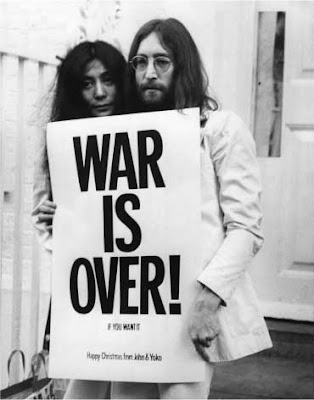
Thanks to a recent viewing of the film, The U.S. vs John Lennon, the simple message in John Lennon and Yoko Ono’s campaign for peace at Christmas 1969-later turned into the song Happy Xmas (War is Over)-keeps playing over and over again in my mind. At Christmas in 1969 over 47,000 American soldiers had already perished in Vietnam, and over 10,000 more would die before the war was really over. Yet in seven different languages in eleven different cities around the world, Lennon and Ono had posted on giant billboards the bold declaration: “WAR IS OVER!” along with, of course, the whispered proviso in small print: “If you want it.”

Now thirty eight years later, with the U.S. mired in a “war on terrorism” in Afghanistan and Iraq which seems to have no end in sight, and which-despite the recent National Intelligence Estimate refuting Iran’s purported nuclear threat-still could escalate into a wider and far more dangerous war, the plaintive plea in Lennon and Ono’s message might seem to raise only a painful smile. With conflict over shrinking resources-oil and water especially-surely inevitable in the century ahead, and with the current direction of U.S. power almost certainly bound to lead to confrontation with China and Russia in the future, the thought that war really could be over if only we really wanted it to be seems hopelessly naive, at best a quaint idealism completely out of step with the demands of the real world. “Sure, a nice thought,” most Americans probably think, “war could be over, but only if they wanted it-those terrorists, Islamo-fascists, communists, and whatever other “ists” who haven’t recognized the value of freedom and the God-appointed destiny of the American way.” War is a part of human nature anyway, its been a part of human history from the beginning and that isn’t likely to change. Its just a pie in the sky to think that war really ever could be over.1

So maybe I, too, am hopelessly naive; but I can’t get John and Yoko’s words out of my head-especially as sung in the chorus by the children of the Harlem community choir in Happy Xmas (War is Over)-and thus I am led to this further reflection. Could war really be over if only we really wanted it to be? Is it really possible to “give peace a chance”?

Give Peace a Chance?

This question leads me to reflect on the essay Toward Perpetual Peace written by Immanuel Kant at the end of the 18th century.2 Kant’s philosophy is something like a watershed in the history of Western thought, marking a turning point which influences all subsequent philosophy. Kant has been described as both “the paradigmatic and culminating figure of the European Enlightenment,” which, of course, is that intellectual movement noted for its optimistic faith in human reason, and which gave us, among other things, our faith in democracy.3 Kant is a paradigmatic figure of the enlightenment both for his defense of reason against the skepticism of Hume, which required a theory of knowledge which revolutionized the understanding of the human mind, and for his ethics, which is founded on the conviction that the freedom of choice and action in accordance with the dictates of reason is our highest value, that which Kant holds to be even the very definition of humanity. He is also the culminating figure of the Enlightenment in drawing the limits to human reason, both in his theory of knowledge and his ethics. For Kant, the freedom to choose implies the freedom to do evil as well as good, and thus there are no laws of nature or dialectic of history which can guarantee that good will triumph. That hope will always depend upon human choice.

Both of these paradigmatic and culminating Enlightenment convictions surface in Toward Perpetual Peace. Kant actually begins the essay with something of a little joke, telling us about a Dutch Innkeeper’s sign which had the inscription ‘The Perpetual Peace’ next to a picture of a graveyard. Kant is clear that there is certainly no guarantee that humanity will be able to avoid the perpetual peace of the graveyard, but the gist of his essay is that if humanity really wants a lasting peace in this world-if humanity really wants to give peace a chance-this is what the nations of the world ought to do.

Now maybe in our post-Enlightenment, postmodern times it might be easy to dismiss Toward Perpetual Peace as it betrays as much of the Enlightenment’s naivete as well as hope. It would at least be interesting, however, to reflect on the merit of the ideas Kant puts forward, and then to consider what it is that stands in the way of giving them a chance.

Kant presents what he considers to be the necessary conditions of a perpetual peace as if it were a peace treaty among the nations of the world. The treaty is divided into two sections. The first part, consisting of six “preliminary articles of a perpetual peace among states,” are to be considered as prohibitive laws which aim to reduce the probability of warfare . The second part contains the “definitive articles” which aim, not just at eliminating potential provocations to war, but at establishing a permanent federation of states, thus providing a foundation for international law. It is here, of course, where Kant’s essay has proved most influential, as we find the first articulation of the idea which came to fruition with the establishment of the United Nations.

The Preliminary Articles of a Perpetual Peace

Three of the preliminary articles Kant specifies should be treated as strictly prohibitive laws and thus the abuses which are prohibited should be abolished immediately if the nations of the world really wanted peace. The first article prohibits any peace treaties made with “secret reservation of the material for a future war.” It’s easy to understand Kant’s reasoning here as any peace agreement is not likely to last if the parties involved were secretly preparing for another war of aggression. We know, of course, what a threat to world peace Saddam’s secret stockpiles of WMDs were, as well as the secret nuclear ambitions of the Iranian mullahs are today. Oh, that’s right, they weren’t and aren’t-but at least Americans do understand what a threat to world peace secret preparations for wars of aggression can be. I guess peace might really have a chance if all those other nations stopped making secret preparations for war. Of course, ours is a just nation and our leaders would never think of doing such a thing. Oh, that’s right, I’d forgot about all those secret preparations for the invasion of Iraq before the Bush Administration even took office. I guess it was just naive of Kant to include this article in his world peace treaty. Actually, it’s interesting that Kant acknowledges that the prohibition of secret preparations for war “will certainly appear academic and pedantic” if “in accordance with ‘enlightened’ notions of political expediency, we believe that the true glory of a state consists in the constant increase of its power by any means whatsoever.”

The next thing that Kant recommends should be abolished immediately is any forcible interference by one state in the “constitution and government of another state” (article 5). Well this one is certainly not hard to understand either, as Americans surely wouldn’t stand for any external interference in our constitution and government. I guess it’s easy to see that peace really could have a chance if the nations of the world could agree to this article; but, of course, this doesn’t seem possible in our world, and for reasons of ‘enlightened’ political expediency, the U.S. in the last century has certainly mastered the art of such interference. Well, at least we can say that the U.S. has had plenty of experience in this regard, from San Juan Hill and the numerous more recent interventions in Latin America and Southeast Asia to the current interventions in Afghanistan and Iraq. Unfortunately, few Americans have really understood what the political expediency really amounts to.

The last of the strictly prohibitive laws in Kant’s treaty forbids any “acts of hostility as would make mutual confidence impossible during a future time of peace” (article 6). Here Kant refers explicitly to things like the employment of assassins and poisoners, the breaking of treaties and the instigation of treason within another state; but we can extrapolate from what Kant says to understand that he has in mind any acts of hostility that would make mutual trust impossible. Once again, the idea is certainly not hard to understand, though, once again, for reasons of political expediency, the U.S. has certainly had a lot of experience in assassinations and attempted assassinations, the abrogations of treaties, and other such acts of hostility. I wonder if the Iraqi people will ever trust the U.S. again after the obliteration of much of their cultural heritage in the aftermath of the fall of Baghdad, after the torture palace of Abu Ghraib, after the wholesale slaughter of civil war that has ensued in the wake of our ‘liberation’ of Iraq.

The other preliminary articles of a perpetual peace, Kant states, “allow some subjective latitude according to the circumstances” and though they “need not necessarily be executed at once,” their execution should “not be put-off to a non-existent date.” The first of these articles prohibits the acquisition of independently existing states as if they were private property (article 2). I suppose Kant found it impractical to call for the immediate prohibition of such acquisitions as it was such a commonplace practice in the Europe of his day for states to be acquired through marriage and other family alliances among the ruling class. Of course, if such a prohibition were to be a part of any global peace treaty today, considerable latitude would have to be allowed to the U.S. as it is essentially the product of the acquisition of territory as private property, and, at least in the case of Hawaii, of the acquisition of an independently existing state. But at least we might be able to say that this is a problem of the past, as political expediency no longer calls for the acquisition of independently existing states-especially as the forcible interference in the constitution or government of other states can meet that expediency.

The last two of Kant’s preliminary articles of peace are very much relevant today; however, and due to political expediency, it is still very difficult to imagine how they could be executed at once, or even at some future date. Here Kant suggests that if the nations of the world really want peace then standing armies should be gradually abolished (article 3) along with the accumulation of national debt “in connection with the external affairs of the state” (article 4). Regarding the former, Kant foresees an arms race in which states seek “to outdo one another in arming unlimited numbers of soldiers, and since the resultant costs eventually make peace more oppressive than a short war, the armies are themselves the cause of wars of aggression.” Kant even warns that such an arms race might compel states “to mount preventative attacks.” Some hundred and fifty years before Eisenhower, Kant seems to have seen the danger of the Industrial Military complex: “for of the three powers within a state-the power of the army, the power of alliance and the power of money-the third is probably the most reliable instrument of war.”

Kant’s prohibition against the incurrence of national debt for foreign military adventures seems perhaps even more prescient. The neo-con adventure in Iraq would, of course, be completely inconceivable without the tremendous debt which has been accumulated.4 Kant’s explanation for this article of peace seems as if he had in mind precisely the case with the U.S. today:

There is no cause for suspicion if help for the national economy is sought inside or outside the state (e.g. for improvements to roads, new settlements, storage of foodstuffs for years of famine, etc.). But a credit system, if used by the powers as an instrument of aggression against one another, shows the power of money in its most dangerous form. For while the debts thereby incurred are always secure against present demands (because not all the creditors will demand payment at the same time), these debts go on growing indefinitely. This ingenious system, invented by a commercial people in the present century, provides a military fund which may exceed the resources of all the other states put together. It can only be exhausted by an eventual tax-deficit, which may be postponed for a considerable time by the commercial stimulus which industry and trade receive through the credit system. This ease in making war, coupled with the warlike inclination of those in power (which seems to be an integral feature of human nature), is thus a great obstacle in the way of perpetual peace. Foreign debts must therefore be prohibited by a preliminary article of such a peace, otherwise national bankruptcy, inevitable in the long run, would necessarily involve various other states in the resultant loss without their having deserved it, thus inflicting upon them public injury. Other states are therefore justified in allying themselves against such a state and its pretentions.

The Definitive Articles of a Perpetual Peace

While the preliminary articles in Kant’s treaty certainly provide much food for thought in considering whether it is possible to give peace a chance, it is with the definitive articles that we come, I think, to the real crux of the challenge of peace in our time. What Kant says here is, on the one hand, quite influential, while on the other hand, very problematic. The influential part is the second article in which Kant lays out his idea for a league or federation of nations.

Kant is clearly influenced here by the political theory of the early Modern philosopher Thomas Hobbes, to whom we owe the idea of government as a social contract. In order to provide a justification for the social contract, Hobbes conceived of a hypothetical “state of nature” which would be what human society would be like without government. As Hobbes had a basically pessimistic understanding of human nature, human beings being hard-wired, so to speak, to seek only their own self-interest, the state of nature, as he conceived it, is a state of war. Everyone would have an unlimited right to get away with anything, and thus everyone would live in constant fear and danger of violent death. The life of man in the state of nature, as Hobbes famously put it, is thus “solitary, poor, nasty, brutish, and short.”5 It is thus to get out of this state of nature that human beings would rationally choose to surrender this unlimited right, and to form a government by social contract.

The early modern political theorists such as Hobbes and John Locke were concerned only with the formation of the nation-state and did not extend their reflection to the international arena. Kant’s essay extends social contract political theory to the relations between states. Kant begins the second section of his essay introducing the idea of an international social contract:

A state of peace among men living together is not the same as the state of nature, which is rather a state of war. For even if it does not involve active hostilities, it involves a constant threat of their breaking out. Thus the state of peace must be formally instituted, for a suspension of hostilities is not in itself a guarantee of peace.

Kant follows Hobbes here more than Locke in conceiving the state of nature as a state of war (Locke conceived the state of nature as bound by natural law, and thus it is not necessarily a state of war, though it is still inconvenient enough to require a social contract to get out of the state of nature). Kant argues that if the people of the world want to get out of the constant state of war among nations, then the nations of the world ought to form a federation of nations:

Each nation, for the sake of its own security, can and ought to demand of the others that they should enter along with it into a constitution, similar to the civil one, within which the rights of each could be secured. This would mean establishing a federation of peoples.

Kant is clear that he is not thinking of an “international state” or one world government. Each state retains its sovereignty in the same way that individuals retain their rights in entering the social contract (Kant follows Locke here more than Hobbes in arguing that states and individuals have rights that cannot be given up). Kant argues that the only way of giving a perpetual peace a chance is through such an agreement between nations:

But peace can neither be inaugurated nor secured without a general agreement between the nations; thus a particular kind of league, which we might call pacific federation, is required. It would differ from a peace treaty in that the latter terminates one war, whereas the former would seek to end all wars for good. This federation does not aim to acquire any power like that of a state, but merely to preserve and secure the freedom of each state in itself, along with that of the other confederated states, although this does not mean that they need to submit to public laws and to a coercive power which enforces them, as do men in a state of nature. It can be shown that this idea of federalism, extending gradually to encompass all states and thus leading to perpetual peace, is practicable and has objective reality.

Kant’s idea of a particular kind of league of nations which would seek to end all wars for good was, of course, first proposed as the League of Nations at the end of the first world war. The U.S., of course, didn’t participate in the League of Nations because the Senate, controlled by Republicans after the election of 1918, voted against the ratification of the Treaty of Versailles. The League of Nations came to an end with the onset of the second world war, but was resurrected in its aftermath as the United Nations.

The problem with the League of Nations, as well as its successor, is that there is no coercive power to enforce international law. The success of the federation, as Kant makes clear, depends upon the mutual agreement of the member nations. The main weakness of the United Nations today is that the most powerful nation in the world, led by the neo-cons in the Bush Administration, has shown utter contempt for the United Nations and clearly operates as if the international arena were a Hobbesian state of nature.

Hobbes was quite explicit that in the state of nature the question of justice and injustice cannot even arise: “To this war of every man against every man, this is also consequent; that nothing can be unjust. The notions of right and wrong, justice and injustice have there no place. Where there is no common power, there is no law: where there is no law, no injustice.”6 Although the Bush Administration has tried to justify its wars of aggression to the American public, it’s clear from everything they did in the run-up to the war in Iraq-when instead of doing everything in their power to avoid war and find a peaceful solution, they, in fact, did everything in their power to avoid a peaceful solution and find a reason for war-as well as their disregard of the Geneva Conventions concerning the treatment of prisoners during the occupation of Iraq, that their real position is that they need not be concerned with the question of justice and injustice and the restrictions of international law.7 Kant had this to say about people like these architects of the Iraq war who have chosen to reject international law and the federation of nations and instead plunge the nations of the world into a state of nature in which the future of humankind seems likely to be nasty, brutish, and short:

We look with profound contempt upon the way in which savages cling to their lawless freedom. They would rather engage in incessant strife than submit to a legal constraint which they might impose upon themselves, for they prefer the freedom of folly to the freedom of reason. We regard this as barbarism, coarseness, and brutish debasement of humanity. We might thus expect that civilized peoples, each united within itself as a state, would hasten to abandon so degrading a condition as soon as possible. But instead of doing so, each state sees its own majesty (for it would be absurd to speak of the majesty of a people) precisely in not having to submit to any external legal constraint, and the glory of its ruler consists in his power to order thousands of people to immolate themselves for a cause which does not truly concern them, while he need not himself incur any danger whatsoever. . . .

There remains one further aspect of Kant’s essay which is necessary to discuss and that is the problematic first definitive article of a perpetual peace. Kant argues that for this federation of nations to be possible it is first necessary that the constitution of every state be a republic. Fortunately, it proved not to be necessary to wait for this to come to pass for the establishment of the United Nations. Unfortunately, this requirement can be construed as a reason not to take the United Nations seriously, and even more perniciously, as a justification for wars of aggression in the name of democracy. However, Kant’s argument is not based on the intrinsic superiority of a republic in itself (he argues for a republic over a pure democracy for the essentially the same reason Madison did, and the reason why the U.S. Constitution is a republic-and that is the danger of the tyranny of the majority, which could not be avoided if a simple majority vote of the people decided every issue and the executive and legislative powers were not separated). Kant’s argument is rather that war would be less likely if the government were accountable to the people as in a republic:

If, as is inevitably the case under this constitution, the consent of the citizens is required to decide whether or not war is to be declared, it is very natural that they will have great hesitation in embarking on so dangerous an enterprise. For this would mean calling down on themselves all the miseries of war, such as doing the fighting themselves, supplying the costs of the war from their own resources, painfully making good the ensuing devastation, and, as the crowning evil, having to take upon themselves a burden of debt which will embitter peace itself and which can never be paid off on account of the constant threat of new wars. But under a constitution where the subject is not a citizen, and which is therefore not republican, it is the simplest thing in the world to go to war. For the head of state is not a fellow citizen, but the owner of the state, and a war will not force him to make the slightest sacrifice so far as his banquets, hunts, pleasure palaces and court festivals are concerned. He can thus decide on war, without any significant reason, as a kind of amusement, and unconcernedly leave it to the diplomatic corps (who are always ready for such purposes) to justify the war for the sake of propriety.

Not surprisingly there has been much discussion of this point, and sometimes it has been argued that Kant’s whole scheme has been undermined by the unfolding of history since Kant’s day with numerous examples of republics making war upon one another. Two replies to this objection, however, have been offered. The first is that it is not so clear that there has been war between states that “really do satisfy Kant’s own highly stringent definition of a republic” and secondly, “it must always be remembered that Kant never argues that even a worldwide federation of republics makes permanent peace necessary; his view is rather that only such a federation makes permanent peace even possible. Kant’s final word, after all, is that human beings have free will, and no matter what remain free to choose to do what is right, but equally free, alas, to choose evil over good.”8

The example set by the U.S., in the last half-century at least, does not necessarily refute this last point; however, it does raise the question of whether a republican form of government is enough to protect a democracy against the problem of the tyranny of the majority. I don’t imagine that Kant ever foresaw a republic such as ours, where the people could be so oblivious to the real costs and miseries of war. What Kant says above about the despotic owner of a state applies just as easily to our leaders in Washington today. What value is there in a republic today, as far as avoiding unnecessary wars, if the people can be so insulated from the devastating effects of war?

One of the principle reasons the U.S. is in Iraq today is that the American people never really learned the lesson from the Vietnam War. As soon as the troops came home and the protests ended, the corporate controlled media began a reactionary counter-movement which pretty much successfully obliterated the memory of what happened in Vietnam. This came home to me most powerfully in one of my Introduction to Western Philosophy courses last year. During our review of the issue of the ethics of war and peace, I had the students watch the film The Fog of War. Before watching the film, I said that most Americans probably know about how many Americans died in the war, but probably don’t know how many Southeast Asians perished. So I asked them. There was a few minutes of silence, and then one young woman raised her hand and hesitatingly responded: “10,000?” That about sums up the problem for me. How many Americans really understand that millions died, and-as Robert McNamara seems to acknowledge in The Fog of War-for really no good reason.9 What was the reason? Oh, that’s right, all those millions died so that we could stop the dominoes from falling and halt the spread of communism. McNamara admits that the U.S. just simply never understood that the Vietnamese saw it as a war of independence. The U.S. has still never come to terms with the terrible moral failure that was the war in Vietnam.

Our corporate controlled “free press” tells us that the “surge” in Iraq is going great. They won’t tell us; however, what is really going on in Iraq. The majority of Americans may be tiring of the war, like they tire of yesterday’s news; yet they still don’t really understand what a moral failure it is once again that U.S. troops are engaged in a war for no good reason. The fear of communism was replaced by the fear of terrorism in leading the American people to support another unnecessary war. It certainly doesn’t help put out the fires of terrorism by participating in terrorism. When it is understood that over a million Iraqis have already perished, supposedly as a response to the threat of terrorism and in retaliation for the 3000 that died in New York on 9/11, when it turned out that Iraq was never really a threat and certainly had nothing to do with the atrocity of 9/11, then it must be recognized that the invasion and occupation of Iraq has been, itself, an act of terrorism that dwarfs what happened on 9/11. Americans are simply as oblivious to the real causes of the problem of terrorism as they are to the real costs and miseries of war.

The majority of Americans may want to bring the troops home, but what value is there in our republic if the only candidates who have a chance of being elected President next fall are not going to bring the troops home, and are committed to continuing the general direction of U.S. foreign policy? What value is there in our republic if a candidate like Dennis Kucinich, the only candidate who is committed to giving peace a chance, and understands what it would take to do so, is excluded from even participating in the debate?

How many Americans have the slightest inkling of what political expediency really drives the U.S. war machine? It certainly isn’t a defense of democracy, as our leaders have been more than willing to overthrow democratically elected leaders if it suits that political expediency-as the assassination of Allende in Chile ought to have made clear. It certainly isn’t a defense of our freedom-as the Vietnam War and now the war in Iraq should make abundantly clear. That political expediency which has made the U.S. the greatest obstacle to peace in the world today is simply the preservation and dissemination of an economic system which seeks, above all, to maximize wealth in the hands of the very few. The $400 million retirement package doled out to the former CEO of Exxon Corporation in 2005 perhaps stands as the best illustration of what our troops are really dying and killing for.10 In the century ahead, with unparalleled crises facing humanity, that expediency is beyond abominable. John Lennon hit the nail on the head when he said, as recorded in The U.S. vs John Lennon, “our society is run by insane people for insane objectives.”

What is really absurd is that this Christmas, like every Christmas, churches all across America will be filled with those who most believe that America is a just nation-those who most stridently think of themselves as followers of the “prince of peace”-and yet they will elect more insane people for these same insane objectives and thus peace will never have a chance.

The problem with the U.S. is that Americans have never really understood what the key to democracy is. If one were to take a poll across America and ask everyone what is more important, faith or the love of wisdom-the capacity to question and to critically think about the important issues of the day, there isn’t much doubt about what the result would be. Such a poll would reveal the contradiction within the heart of America. The first colonists were mostly religious fundamentalists who certainly had no idea of founding a democracy. That idea came more than a century later, during the height of the Enlightenment. Perhaps this was the Enlightenment and Kant’s greatest naivete. The Enlightenment hope in democracy, and Kant’s conviction that a republican form of government would be the best hope of giving peace a chance, both are founded on the assumption that the people are capable of the love of wisdom -and have thus, not just the freedom to choose good over evil, but the courage and strength to take up the burden of conscience in thinking through the problem of good and evil. All those Christians who think that faith is the key to democracy should read Dostoevsky’s short story “The Grand Inquisitor” from The Brothers Karamazov. Then maybe they would understand how, if faith is blind, one can have faith in the precisely the opposite of what one thinks one has faith in.

Given the state of affairs in the world today it certainly seems naive to think that a perpetual peace can ever be achieved. There is certainly no hope for Kant’s plan for a perpetual peace if the most powerful nation in the world cannot come to its senses and set a better example for the nations of the world to follow in living up to the requirements of international law. Maybe, just maybe, war could be over-if we just wanted it. Imagine that.

Timothy J. Freeman teaches philosophy at the University of Hawaii at Hilo. He can be reached at freeman@hawaii.edu.

Notes

1. The origin of the phrase “pie in the sky” comes from Joe Hill’s radical song Preacher and the Slave from 1911 .

2. Immanuel Kant, “Toward Perpetual Peace,” in Kant: Political Writings, 2nd. ed., H Reiss, ed. (Cambridge University Press, 1991).

3. Paul Guyer, “Immanuel Kant: Introduction,” in Political Philosophy: The Essential Texts. Steven M. Cahn, ed. (Oxford: Oxford University Press, 2005), p. 376. My summary here is indebted to Guyer’s introduction to Kant’s essay.

4. See the costs of the Iraq war at the National Priorities Project.

5. Thomas Hobbes, Leviathan, ed. Michael Oakeshott (New York: Macmillan, 1946), ch. 13, p. 82.

6. Leviathan, ch. 13, p. 83.

7. See my previous essays which have elaborated on this point: Timothy J. Freeman, “The Terrible Truth about Iraq,” CounterPunch, September 17, 2003. Timothy J. Freeman, “The Price of Freedom,” CounterPunch, November 26/27, 2005.

8. Paul Guyer, “Immanuel Kant: Introduction” in Political Philosophy: The Essential Texts, pp. 378-379.

9. Documents declassified by the Vietnamese government in 1995 put the total casualties at 5.1 million.

10. http://abcnews.go.com/GMA/story?id=1841989

Source

Posted in RagBlog | Leave a comment

The Protected and the Damned

The Shock Doctrine in Action in New Orleans
by Naomi Klein

Readers of The Shock Doctrine know that one of the most shameless examples of disaster capitalism has been the attempt to exploit the disastrous flooding of New Orleans to close down that city’s public housing projects, some of the only affordable units in the city. Most of the buildings sustained minimal flood damage, but they happen to occupy valuable land that make for perfect condo developments and hotels.

The final showdown over New Orleans public housing is playing out in dramatic fashion right now. The conflict is a classic example of the “triple shock” formula at the core of the doctrine.

* First came the shock of the original disaster: the flood and the traumatic evacuation.

* Next came the “economic shock therapy”: using the window of opportunity opened up by the first shock to push through a rapid-fire attack on the city’s public services and spaces, most notably it’s homes, schools and hospitals.

* Now we see that as residents of New Orleans try to resist these attacks, they are being met with a third shock: the shock of the police baton and the Taser gun, used on the bodies of protestors outside New Orleans City Hall yesterday.

Democracy Now! has been covering this fight all week, with amazing reports from filmmakers Jacquie Soohen and Rick Rowley (Rick was arrested in the crackdown). Watch residents react to the bulldozing of their homes here.

And footage from yesterday’s police crackdown and Tasering of protestors inside and outside city hall here.

That last segment contains a terrific interview with Kali Akuno, executive director of the People’s Hurricane Relief Fund. Akuno puts the demolitions in the big picture, telling Amy Goodman:

This is just one particular piece of this whole program. Public hospitals are also being shut down and set to be demolished and destroyed in New Orleans. And they’ve systematically dismantled the public education system and beginning demolition on many of the schools in New Orleans–that’s on the agenda right now–and trying to totally turn that system over to a charter and a voucher system, to privatize and just really go forward with a major experiment, which was initially laid out by the Heritage Foundation and other neoconservative think tanks shortly after the storm. So this is just really the fulfillment of this program.

Akuno is referring to the Heritage Foundation’s infamous post-Katrina meeting with the Republican Study Group in which participants laid out their plans to turn New Orleans into a Petri dish for every policy they can’t ram through without a disaster. Read the minutes on my website.

For more context, here are couple of related excerpts from The Shock Doctrine: The Rise of Disaster Capitalism:

The news racing around the shelter [in Baton Rouge] that day was that Richard Baker, a prominent Republican Congressman from this city, had told a group of lobbyists, “We finally cleaned up public housing in New Orleans. We couldn’t do it, but God did.” Joseph Canizaro, one of New Orleans’ wealthiest developers, had just expressed a similar sentiment: “I think we have a clean sheet to start again. And with that clean sheet we have some very big opportunities.” All that week the Louisiana State Legislature in Baton Rouge had been crawling with corporate lobbyists helping to lock in those big opportunities: lower taxes, fewer regulations, cheaper workers and a “smaller, safer city”–which in practice meant plans to level the public housing projects and replace them with condos. Hearing all the talk of “fresh starts” and “clean sheets,” you could almost forget the toxic stew of rubble, chemical outflows and human remains just a few miles down the highway.

Over at the shelter, Jamar Perry, a young resident of New Orleans, could think of nothing else. “I really don’t see it as cleaning up the city. What I see is that a lot of people got killed uptown. People who shouldn’t have died.” He was speaking quietly, but an older man in line in front of us in the food line overheard and whipped around. “What is wrong with these people in Baton Rouge? This isn’t an opportunity. It’s a goddamned tragedy. Are they blind?”

A mother with two kids chimed in. “No, they’re not blind, they’re evil. They see just fine.”

At first I thought the Green Zone phenomenon was unique to the war in Iraq. Now, after years spent in other disaster zones, I realize that the Green Zone emerges everywhere that the disaster capitalism complex descends, with the same stark partitions between the included and the excluded, the protected and the damned.

It happened in New Orleans. After the flood, an already divided city turned into a battleground between gated green zones and raging red zones–the result not of water damage but of the “free-market solutions” embraced by the president. The Bush administration refused to allow emergency funds to pay public sector salaries, and the City of New Orleans, which lost its tax base, had to fire three thousand workers in the months after Katrina. Among them were sixteen of the city’s planning staff–with shades of “de Baathification,” laid off at the precise moment when New Orleans was in desperate need of planners. Instead, millions of public dollars went to outside consultants, many of whom were powerful real estate developers. And of course thousands of teachers were also fired, paving the way for the conversion of dozens of public schools into charter schools, just as Friedman had called for.

Almost two years after the storm, Charity Hospital was still closed. The court system was barely functioning, and the privatized electricity company, Entergy, had failed to get the whole city back online. After threatening to raise rates dramatically, the company managed to extract a controversial $200 million bailout from the federal government. The public transit system was gutted and lost almost half its workers. The vast majority of publicly owned housing projects stood boarded up and empty, with five thousand units slotted for demolition by the federal housing authority. Much as the tourism lobby in Asia had longed to be rid of the beachfront fishing villages, New Orleans’ powerful tourism lobby had been eyeing the housing projects, several of them on prime land close to the French Quarter, the city’s tourism magnet.

Endesha Juakali helped set up a protest camp outside one of the boarded-up projects, St. Bernard Public Housing, explaining that “they’ve had an agenda for St. Bernard a long time, but as long as people lived here, they couldn’t do it. So they used the disaster as a way of cleansing the neighbourhood when the neighbourhood is weakest. … This is a great location for bigger houses and condos. The only problem is you got all these poor black people sitting on it!”

Amid the schools, the homes, the hospitals, the transit system and the lack of clean water in many parts of town, New Orleans’ public sphere was not being rebuilt, it was being erased, with the storm used as the excuse. At an earlier stage of capitalist “creative destruction,” large swaths of the United States lost their manufacturing bases and degenerated into rust belts of shuttered factories and neglected neighbourhoods. Post-Katrina New Orleans may be providing the first Western-world image of a new kind of wasted urban landscape: the mould belt, destroyed by the deadly combination of weathered public infrastructure and extreme weather.

Since the publication of The Shock Doctrine, my research team has been putting dozens of original source documents online for readers to explore subjects in greater depth. The resource page on New Orleans has some real gems.

Naomi Klein is the author of many books, including her most recent, The Shock Doctrine: The Rise of Disaster Capitalism, which will be published in September.Visit Naomi’s website at www.naomiklein.org, or to learn more about her new book, visit www.shockdoctrine.com.

© 2007 Huffington Post

Source

Posted in RagBlog | Leave a comment

And Some Will Rob You with a Fountain Pen

Bush’s Class Warfare
by Peter Dreier

Just a week before Christmas, President Bush gave corporate America two big presents. On Tuesday, his Federal Communications Commission changed the rules to allow the nation’s giant conglomerates to further consolidate their grip on the media by permitting them to purchase TV and radio stations in the same local markets where they already own daily newspapers. As a gift to the country’s automobile industry, Bush’s Environmental Protection Agency ruled Wednesday, over the objections of the agency’s staff, that California, the nation’s largest and most polluted state, and 16 other states, can’t impose regulations to limit greenhouse gases from cars and trucks that are stronger than the federal government’s own weak standards.

So far, no major politicians or editorial writers have labeled these actions “class warfare,” although this is precisely what Bush is engaged in — helping the already rich and powerful at the expense of everyone else. Class warfare is, in fact, the very essence of Bush’s tenure in the White House. In thousands of ways, big and small, Bush has promoted the interests of the very rich and the largest corporations. Corporate lobbyists have the run of the White House. Their agenda – tax cuts for the rich and big business, attacks on labor unions, and the weakening of laws protecting consumers, workers and the environment from corporate abuse – is Bush’s agenda.

For example, Bush has handed the pharmaceutical industry windfall profits by restricting Medicare’s ability to negotiate for lower prices for medicine. He targeted huge no-bid federal contracts to crony companies like Haliburton to supply emergency relief, reconstruction services and materials to rebuild Katrina while attempting to slash federal wage laws for reconstruction workers. He repealed Clinton-era “ergonomics” standards, affecting more than 100 million workers, that would have forced companies to alter their work stations, redesign their facilities or change their tools and equipment if employees suffered serious work-related injuries from repetitive motions. He opposed stiffer health and safety regulations to protect mine workers and cut the budget for federal agencies that enforce mine safety laws. Not surprisingly, under Bush, we’ve seen the largest number of mine accidents and deaths in years. Bush’s Food and Drug Administration lowered product-labeling standards, allowing food makers to list health claims on labels before they have been scientifically proven. His FDA chief announced that the agency would no longer require claims to be based on “significant scientific agreement,” a change that the National Food Processors Association, the trade association of the $500 billion food processing industry, had lobbied for. Bush resisted efforts to raise the minimum wage (which had been stuck at $5.15 an hour for nine years) until the Democrats took back the Congress earlier this year.

Virtually every week since he took office, the Bush administration has made or proposed changes in our laws designed to help the rich and powerful while harming the most vulnerable people in society and putting the middle class at greater economic risk. The list of horrors can be so numbing that one can lose sight of the cumulative impact of these actions. Taken together, they add up to the most direct assault on working people, the environment and the poor that the country has seen since the presidency of William McKinley over a century ago.

Bush has been a persistent practitioner of top-down class warfare , but the media rarely characterize his actions that way. In contrast, when progressive activists, unions, environmental groups, community organizations and politicians support legislation and rules to redress the balance of power and wealth, they are inevitably described as engaging in c lass warfare . Top-down class warfare seems to be OK, but bottom-up class warfare is apparently a no-no.

The class warfare rap is now being used against John Edwards, when he talks about challenging the power of the insurance and drug corporations. In a recent speech, Edwards said that his campaign was about challenging “the powerful, the well-connected and the very wealthy.” But wary of being criticized for fueling class resentments, even Edwards felt it necessary to say “This is not class warfare. This is the truth.”

Yes, the truth is that the rich have been at war with the rest of the country. It isn’t a question of “”rich against the poor,” which is often how leftists describe things. That leaves out most Americans. Its the very rich versus everyone else.

As Robert Kuttner observes in his new book, The Squandering of America, from 1966 to 2001, the wealthiest one-tenth of all Americans captured the lion’s share of society’s productivity growth. But it was the top one tenth of 1 percent that gained the very most. Those between the 80th and 90th percentiles about held their own. Those between the 95th and 99th percentiles gained 29 percent, while those between the top 99 and 99.9 percentile, gained 73 percent.

“But,” Kuttner writes, “it was those at the very pinnacle –the top one tenth of 1 percent of the population – one American in a thousand – who gained a staggering 291 percent.”

Wealth has become even more concentrated during the Bush years. Today, the richest one percent of Americans has 22 percent of all income and about 40 percent of all wealth. This is the biggest concentration of income and wealth since 1928. In 2005, average CEO pay was 369 times that of the average worker, compared with 131 times in 1993 and 36 times in 1976. At the pinnacle of America’s economic pyramid, the nation’s 400 billionaires own 1.25 trillion dollars in total net worth – the same amount as the 56 million American families at the bottom half of wealth distribution.

Meanwhile, despite improvements in productivity, the earnings of most workers have been stagnant, while the cost of health care, housing, and other necessities has risen. The basics of the American Dream – the ability to buy a home, pay for college tuition and health insurance, take a yearly vacation, and save for retirement – have become increasingly slippery. And for the 37 million Americans living below the official poverty line – $17,170 a year for a family of three – the dream has become a nightmare.

In many ways, America today resembles the conditions in the late 1800s that was called the Gilded Age. It was an era of rampant, unregulated capitalism. It was a period of merger mania, increasing concentrations of wealth among the privileged few, and growing political influence by corporate power brokers called the Robber Barons. During the Gilded Age, new technologies made possible new industries, which generated great riches for the fortunate few, but at the expense of workers, consumers, and the environment. The gap between the rich and other Americans widened dramatically.

It was also an era of massive immigration to the US from people fleeing political persecution and economic hardship. In the growing cities of the early 20th century, there were terrible poverty, child labor, sweatshops, slums, and serious public health crises, including major epidemics of contagious diseases.

But out of that turmoil, activists created a “Progressive” movement, forging a coalition of immigrants, unionists, middle-class reformers, settlement house workers, muckraking journalists, clergy, and upper-class philanthropists. They fought for, and won, better working conditions, better housing, better schools, and better public services like sanitation and public health laws. Those reforms began at the local and state levels, but eventually laid the foundation for a wave of reform at the federal level – the New Deal.

In 1939, in the midst of the Great Depression, the balladeer Woody Guthrie wrote a song about bank robbers and outlaws. “Yes, as through this world I’ve wandered, I’ve seen lots of funny men,” Guthrie wrote, “Some will rob you with a six-gun, and some with a fountain pen.”

Throughout his Presidency, Bush has used his pen to sign regulations and laws that make the rich richer, allow big business to pollute the environment, reduce wages, and rip-off borrowers and consumers.

But Americans finally seem to have caught on. Iraq, Katrina, Enron, the current wave of foreclosures, and other events have helped wake them up to the reality that Bush’s top-down class warfare has done great damage to our country. We now may be on the brink of another progressive era. Bubbling below the surface is a new wave of social activism.

Today’s progressive movement is almost invisible to the mainstream media, but it is obvious to anyone involved in the struggle for social justice. It has many of the same elements as 100 years ago. There is a new wave of activism across America among labor unions, community organizations, environmental groups, immigrant rights activists, and grassroots housing and health care reformers. In the last decade, for example, more than 150 cities, dozens of counties, and now one state (Maryland) have adopted “living wage” laws to lift low-wage workers out of poverty, the result of solid organizing efforts by networks of unions, religious congregations, and community groups like ACORN and the Los Angeles Alliance for a New Economy. Environmentalists and unions – who were barely on speaking terms for many years – are now forging alliances to push for “green” jobs and waging joint campaigns, such as the coalition of Teamsters and environmental activists working together to clean up the Los Angeles/Long Beach port, the nation’s largest port and also its most polluted, and unionize the immigrant truck drivers.

Like the Progressive and New Deal eras, there is now a growing number of politicians at the local, state and national level who help give voice to this burgeoning movement. When they do, they are accused of engaging in “class warfare.” They should wear it as a badge of honor.

Peter Dreier is E.P. Clapp Distinguished Professor of Politics, and director of the Urban and Environmental Policy program, at Occidental College in Los Angeles.

Source

Posted in RagBlog | 1 Comment

Shut Up ! We Told You This Would Happen !

Global Warming Will Save America from the Right … Eventually
by Dave Lindorff

Say what you will about the looming catastrophe facing the world as the pace of global heating and polar melting accelerates. There is a silver lining.

Look at a map of the US.

The area that will by completely inundated by the rising ocean – and not in a century but in the lifetime of my two cats – are the American southeast, including the most populated area of Texas, almost all of Florida, most of Louisiana, and half of Alabama and Mississippi, as well as goodly portions of eastern Georgia, South Carolina and North Carolina. While the northeast will also see some coastal flooding, its geography is such that that aside from a few projecting sandbars like Long Island and Cape Cod, the land rises fairly quickly to well above sea level. Sure, Boston, New York and Philadelphia will be threatened, but these are geographically confined areas that could lend themselves to protection by Dutch-style dikes. The West Coast too tends to rise rapidly to well above sea level in most places. Only down in Southern California towards the San Diego area is the ground closer to sea level.

So what we see is that huge swaths of conservative America are set to face a biblical deluge in a few more presidential cycles.

Then there’s the matter of the Midwest, which climate experts say is likely to face a permanent condition of unprecedented drought, making the place largely unlivable, and certainly unfarmable. The agribusinesses and conservative farmers that have been growing corn and wheat may be able to stretch out this doomsday scenario by deep well drilling, but west of the Mississippi, the vast Ogallala Aquifer that has allowed for such irrigation is already being tapped out. It will not be replaced.

So again, we will see the decline and depopulation of the nation’s vast midsection-noted for its consistent conservatism. Only in the northernmost area, around the Great Lakes (which will be not so great anymore), and along the Canadian border, will there still be enough rain for farming and continued large population concentrations, but those regions, like Minnesota, Wisconsin and Illinois, are also more liberal in their politics.

Finally, in the Southwest, already parched and stiflingly hot, the rise in energy costs and the soaring temperatures will put an end to right-wing retirement communities like Phoenix, Tucson and Palm Springs. Already the Salton Sea is fading away and putting Palm Springs on notice that the good times are coming to an end. Another right-wing haven soon to be gone.

So the future political map of America is likely to look as different as the much shrunken geographical map, with much of the so-called “red” state region either gone or depopulated.

There is a poetic justice to this of course. It is conservatives who are giving us the candidates who steadfastly refuse to have the nation take steps that could slow the pace of climate change, so it is appropriate that they should bear the brunt of its impact.

The important thing is that we, on the higher ground both actually and figuratively, need to remember that, when they begin their historic migration from their doomed regions, we not give them the keys to the city. They certainly should be offered assistance in their time of need, but we need to keep a firm grip on our political systems, making sure that these guilty throngs who allowed the world to go to hell are gerrymandered into political impotence in their new homes.

There will be much work to be done to help the earth and its residents-human and non-human-survive this man-made catastrophe, and we can’t have these future refugee troglodytes, should their personal disasters still fail to make them recognize reality, mucking things up again.

It should be considered acceptable, in this stifling new world, to say, “Shut up. We told you this would happen.”

Dave Lindorff is an investigative journalist and columnist. His latest book, co-authored by Barbara Olshansky, is “The Case for Impeachment” (St. Martin’s Press, 2006 and now available in paperback, suitable for a last-minute Christmas gift). His work is available at www.thiscantbehappening.net.

Source

Posted in RagBlog | Leave a comment


