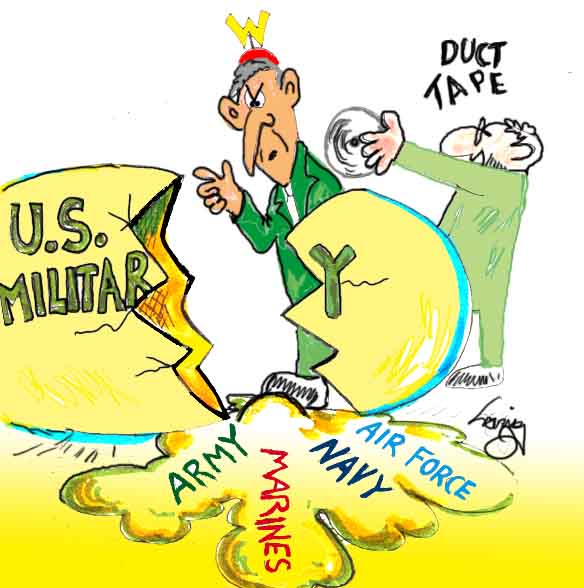
CleanNuke on TT* – C. Loving

Thank you, Charlie.


* Note: TT = (car)Toon Tuesday

Posted in RagBlog | Leave a comment

Further Exposing the Mealy State Mouthpiece

Media Ignores Black, Latino Views on Iraq
by Randy Shaw‚ Jan. 12‚ 2007

Forty years after Dr. Martin Luther King, Jr’s murder, America’s media still deems African-Americans, Latinos and other people of color unqualified to express views on the nation’s most riveting issue—the Iraq War. CNN’s wall-to-wall coverage of the lead-up to Bush’s Wednesday night speech had anchorperson Wolf Blitzer surrounded by several other pundits/reporters, all of whom were white. And those selected to give their insights were not generals or ex-military leaders, but political hacks like Paul Begala and Bay Buchanan, neither of whom have any basis for providing special insights on Iraq. The media refuses to acknowledge the war’s racial component, and representatives of the African-American and Latino communities whose members are dying for George Bush’s fantasies are deemed unfit to comment upon it.

I do not watch television news at home, but get more than my fill from the bank of televisions where I work out. CNN, MSNBC, various local and national news shows and even Jon Stewart and Stephen Colbert are on display, so I get a cross-section of who is being asked to comment on national and international events.

In the hour before Bush’s Wednesday night speech, CNN’s Wolf Blitzer and his staff interviewed what was designed to represent a broad cross-section of opinion on the “surge” strategy. To my surprise, the leading alternative to the right-wing FOX News did not feel obligated to include even a token African-American, not even the Juan Williams-type moderate who can be trusted to parrot the mainstream line.

No, CNN’s reporters and interviewees were as white as major league baseball teams before Jackie Robinson joined the Dodgers sixty years ago. In fact, the scene was right out of the South of the 1950’s: a whites-only setting where folks discuss decisions that disproportionately affect blacks, Latinos and people of color.

Read the rest here.

Posted in RagBlog | Leave a comment

Way Too Freaky !!!!

This was written for the Onion six years ago. Read it, and think about it …

Bush: ‘Our Long National Nightmare Of Peace And Prosperity Is Finally Over’
January 17, 2001 | Issue 37•01

WASHINGTON, DC–Mere days from assuming the presidency and closing the door on eight years of Bill Clinton, president-elect George W. Bush assured the nation in a televised address Tuesday that “our long national nightmare of peace and prosperity is finally over.”

President-elect Bush vows that “together, we can put the triumphs of the recent past behind us.”

“My fellow Americans,” Bush said, “at long last, we have reached the end of the dark period in American history that will come to be known as the Clinton Era, eight long years characterized by unprecedented economic expansion, a sharp decrease in crime, and sustained peace overseas. The time has come to put all of that behind us.”

Bush swore to do “everything in [his] power” to undo the damage wrought by Clinton’s two terms in office, including selling off the national parks to developers, going into massive debt to develop expensive and impractical weapons technologies, and passing sweeping budget cuts that drive the mentally ill out of hospitals and onto the street.

During the 40-minute speech, Bush also promised to bring an end to the severe war drought that plagued the nation under Clinton, assuring citizens that the U.S. will engage in at least one Gulf War-level armed conflict in the next four years.

“You better believe we’re going to mix it up with somebody at some point during my administration,” said Bush, who plans a 250 percent boost in military spending. “Unlike my predecessor, I am fully committed to putting soldiers in battle situations. Otherwise, what is the point of even having a military?”

On the economic side, Bush vowed to bring back economic stagnation by implementing substantial tax cuts, which would lead to a recession, which would necessitate a tax hike, which would lead to a drop in consumer spending, which would lead to layoffs, which would deepen the recession even further.

If you dare to read all of it, which is frighteningly accurate in its predictions of what was to come, click here.

Posted in RagBlog | Leave a comment

Serotonin Serenade – A Book Review

Jim Simons’ Molly Chronicles: Serotonin Serenade (Plain View Press, Austin, 2006) may be the sweetest memoir yet to come out of the radical movements of the 1960s and beyond. Spanning Simons’ 40 years as a self-created Movement lawyer, and written with the help of his poodle, Molly, the book touches lightly on events that made headlines, coaxing the reader’s memories to join Jim’s. From civil rights, anti-draft and anti-war demonstrations to defending the American Indian Movement at Wounded Knee, Simons stood with the people and defended them. Grinding no axes, he doesn’t try to set history straight, nor justify or condemn anybody’s politics.

Instead he recounts the path of a directionless, unmotivated lad who hated Law School, through perilous times, sexual revolution, recurring depression and “ethanol”, to a state of grace as grandfather and husband, and how it came to be well-deserved after all. There’s no white-washing of his own sins, committed or omitted; in fact some may say Jim shares too much of his romantic wanderings, but I for one am glad to know others still recall a unique time when love was easily expressed in the universal currency of kisses, and, in fact, all we needed was love — and a good lawyer. Bittersweet poignancy alternates with laughter and people’s victories here; recommended.

– Mariann Wizard

Posted in RagBlog | Leave a comment

Killing the Enthusiasm of the Faithful

Despite despising George Bush beyond any other president in Amerikan history, we can be vaguely grateful for one thing: he turned so many conservatives against the Republican party that it may never have the strength it once did.

Rod Dreher: “Hadn’t the hippies tried to tell my generation this”?

Rod Dreher is as conservative as it gets — a contributor to National Review and the Corner, a current columnist for The Dallas Morning News, a self-described “practicing Christian and political conservative.”

Today, Dreher has an extraordinary (oral) essay at NPR in which he recounts how the conduct of President Bush (for whom he voted twice) in the Iraq War (which he supported) is causing him to question, really to abandon, the core political beliefs he has held since childhood.

Dreher, 40, recounts that his “first real political memory” was the 1979 failed rescue effort of the U.S. hostages in Iran. He says he “hated” Jimmy Carter for “shaming America before our enemies with weakness and incompetence.” When Reagan was elected, he believed “America was saved.” Reagan was “strong and confident.” Democrats were “weak and depressed.”

In particular, Dreher recounts how much, during the 1980s, he “disliked hippies – the blame America first liberals who were so hung up on Vietnam, who surrendered to Communists back then just like they want to do now.” In short, Republicans were “winners.” Democrats were “defeatists.”

On 9/11, Dreher’s first thought was : “Thank God we have a Republican in the White House.” The rest of his essay:

As President Bush marched the country to war with Iraq, even some voices on the Right warned that this was a fool’s errand. I dismissed them angrily. I thought them unpatriotic.

But almost four years later, I see that I was the fool.

In Iraq, this Republican President for whom I voted twice has shamed our country with weakness and incompetence, and the consequences of his failure will be far, far worse than anything Carter did.

The fraud, the mendacity, the utter haplessness of our government’s conduct of the Iraq war have been shattering to me.

It wasn’t supposed to turn out like this. Not under a Republican President.

I turn 40 next month — middle aged at last — a time of discovering limits, finitude. I expected that. But what I did not expect was to see the limits of finitude of American power revealed so painfully.

I did not expect Vietnam.

As I sat in my office last night watching President Bush deliver his big speech, I seethed over the waste, the folly, the stupidity of this war.

I had a heretical thought for a conservative – that I have got to teach my kids that they must never, ever take Presidents and Generals at their word – that their government will send them to kill and die for noble-sounding rot – that they have to question authority.

On the walk to the parking garage, it hit me. Hadn’t the hippies tried to tell my generation that? Why had we scorned them so blithely?

Will my children, too small now to understand Iraq, take me seriously when I tell them one day what powerful men, whom their father once believed in, did to this country? Heavy thoughts for someone who is still a conservative despite it all. It was a long drive home.

Dreher’s essay is extreme and intense but also increasingly commonplace and illustrative. The disaster of unparalleled magnitude that President Bush and his integrity-free and bloodthirsty administration and followers wrought on this country will have a profound impact not only on American strength and credibility for a long, long time to come, but also on the views of Americans towards their political leaders and, almost certainly, towards the Republican Party.

Read all of it here.

Posted in RagBlog | Leave a comment

Noam on Iraq

Iraq: Yesterday, Today, and Tomorrow: Noam Chomsky interviewed by Michael Albert
December 27, 2006

1. Why did the U.S. invade Iraq? (And why did important sectors of the political elite, like Scowcroft, oppose doing so?) What are the U.S.motives for staying?

The official reason was what Bush, Powell, and others called “the single question”: will Saddam end his development of Weapons of Mass Destruction? The official Presidential Directive states the primary goal as to: “Free Iraq in order to eliminate Iraqi weapons of mass destruction, their means of delivery and associated programs, to prevent Iraq from breaking out of containment and becoming a more dangerous threat to the region and beyond.” That was the basis for congressional support for the invasion. The Directive goes on with the goal of cutting “Iraqi links to and sponsorship of international terrorism,” etc. A few phrases are thrown in from the standard boilerplate about freedom that accompanies every action, and is close to a historical universal, hence dismissed as meaningless by reasonable people, but there to be dredged up by the doctrinal system when needed.

When the “single question” was answered the wrong way, and the claims about internationational terrorism became too much of an embarrassment to repeat (though not for Cheney and a few others), the goal was changed to “democracy promotion.” The media and journals, along with almost all scholarship, quickly jumped on that bandwagon, relieved to discover that this is the most “noble war” in history, pursuing Bush’s “messianic mission” to bring freedom and democracy to the world. Some Iraqis agreed: 1% in a poll in Baghdad just as the noble vision was declared in Washington. In the West, in contrast, it doesn’t matter that there is a mountain of evidence refuting the claim, and even apart from the timing — which should elicit ridicule — the evidence for the “mission” is that our Dear Leader so declared. I’ve reviewed the disgraceful record in print. It continues with scarcely a break to the present, so consistently that I’ve stopped collecting the absurd repetitions of the dogma.

The real reason for the invasion, surely, is that Iraq has the second largest oil reserves in the world, very cheap to exploit, and lies right at the heart of the world’s major hydrocarbon resources, what the State Department 60 years ago described as “a stupendous source of strategic power.” The issue is not access, but rather control (and for the energy corporations, profit). Control over these resources gives the US “critical leverage” over industrial rivals, to borrow Zbigniew Brezinski’s phrase, echoing George Kennan when he was a leading planner and recognized that such control would give the US “veto power” over others. Dick Cheney observed that control over energy resources provides “tools of intimidation or blackmail” — when in the hands of others, that is. We are too pure and noble for those considerations to apply to us, so true believers declare — or more accurately, just presuppose, taking the point to be too obvious to articulate.

There was unprecedented elite condemnation of the plans to invade Iraq, even articles in the major foreign policy journals, a publication of the American Academy of Arts and Sciences, and others. Sensible analysts were able to perceive that the enterprise carried significant risks for US interests, however conceived. Global opposition was utterly overwhelming, and the likely costs to the US were apparent, though the catastrophe created by the invasion went far beyond anyone’s worst expectations. It’s amusing to watch the lying as the strongest supporters of the war try to deny what they very clearly said. There is a good review of the “mendacity” of neocon intellectuals (Ledeen, Krauthammer, and others) in The American Conservative, Jan. 07. But they are not alone.

On the US motives for staying, I can only repeat what I’ve been writing for years. A sovereign Iraq, partially democratic, could well be a disaster for US planners. With a Shi’ite majority, it is likely to continue improving relations with Iran. There is a Shi’ite population right across the border in Saudi Arabia, bitterly oppressed by the US-backed tyranny. Any step towards sovereignty in Iraq encourages activism there for human rights and a degree of autonomy — and that happens to be where most of Saudi oil is. Sovereignty in Iraq might well lead to a loose Shi’ite alliance controlling most of the world’s hydrocarbon resources and independent of the US, undermining a primary goal of US foreign policy since it became the world-dominant power after World War II. Worse yet, though the US can intimidate Europe, it cannot intimidate China, which blithely goes its own way, even in Saudi Arabia, the jewel in the crown — the primary reason why China is considered a leading threat. An independent energy bloc in the Gulf area is likely to link up with the China-based Asian Energy Security Grid and Shanghai Cooperation Council, with Russia (which has its own huge resources) as an integral part, along with the Central Asian states (already members), possibly India. Iran is already associated with them, and a Shi’ite dominated bloc in the Arab states might well go along. All of that would be a nightmare for US planners, and its Western allies.

There are, then, very powerful reasons why the US-UK are likely to try in every possible way to maintain effective control over Iraq. The US is not constructing a palatial Embassy, by far the largest in the world and virtually a separate city within Baghdad, and pouring money into military bases, with the intention of leaving Iraq to Iraqis. All of this is quite separate from the expectations that matters can be arranged so that US corporations profit from the vast riches of Iraq.

These topics, though surely high on the agenda of planners, are not within the realm of discussion, as can easily be determined. That is only to be expected. These considerations violate the fundamental doctrine that state power has noble objectives, and while it may make terrible blunders, it can have no crass motives and is not influenced by domestic concentrations of private power. Any questioning of these Higher Truths is either ignored or bitterly denounced, also for good reasons: allowing them to be discussed could undermine power and privilege. I don’t, incidentally, suggest that commentators have much awareness of this. In our society, intellectual elites are deeply indoctrinated, a point that Orwell noted in his (unpublished) introduction to Animal Farm on how self-censorship works in free societies. A large part of the reason, he plausibly concluded, is a good education, which instills the understanding that there are certain things “it wouldn’t do to say” — or more accurately, even to think.

Read all of the interview here.

Posted in RagBlog | Leave a comment

The Monday Movie – Money Masters, Part II

If you missed part one, it’s here.

The Money Masters – Part II

Posted in RagBlog | Leave a comment

Badger Comments on "The Plan"

From Missing Links

Sunday editorial

In reading about Iraq, you need to keep two things separate. One is to understand the writer’s preferred configuration for a resulting Iraqi government, and to make the necessary adjustments in what he has to say. Saudi writers, generally speaking, think of any Shiite-dominated government as pro-Iranian and therefore as to some degree an enemy. By contrast, to take one example, Juan Cole thinks a SCIRI/Kurd government is the natural result, and consequently he has had the tendency to associate the Iraqi Sunni population with terrorists and Baathists (adding lately some concessions to the Sunnis). These are natural human attitudes (for those who take a sectarian approach, that is), but when reading what these people have to say, it is important to see what other points or attitudes they are giving voice to, apart from advocacy for one side or the other.

This is particularly important now, because with the new Bush plan, there is starting to be a shift in Arab perceptions of what the United States is up to in Iraq, and this shift has nothing to do with which side you are on. It has to do with the nature of the American aims and objectives in and of themselves. Up to now, one of the prevailing views has been that America has been manipulating the sectarian forces in Iraq to weaken the Iraqi state and keep all sides off balance, against the backdrop of the US military presence. All-out attacks on Falluja and other places were seen as strategic anomalies in what was essentially a divide-and-conquer political strategy. This is where the new Bush plan comes in.

Under the new Bush plan, the dominant picture for some Arab commentators is no longer to see the US as essentially involved in a divide-and-conquer political scheme. Rather, the picture is now of a US plan is military domination of an entire population plain and simple, without regard to local politics. It is a horse of a different color, and people in all of the otherwise-competing camps are coming to see it that way.

Read the rest of it here.

Posted in RagBlog | Leave a comment

The Real Front in the Middle East

A much more clear and detailed article (than ours) about the impending conflagration with Iran. Certainly, we found the overt mention of Patriot missile deployment the most telling sign of an impending action.

Bush’s Iraq Plan – Goading Iran into War
by Dr. Trita Parsi
Global Research, January 15, 2007
National Iranian American Council (NIAC)

President George W. Bush’s address on Iraq Wednesday night was less about Iraq than about its eastern neighbor, Iran. There was little new about the US’s strategy in Iraq, but on Iran, the President spelled out a plan that appears to be aimed at goading Iran into war with the US. While Washington speculated whether the president would accept or reject the Iraq Study Group’s recommendations, few predicted that he would do the opposite of what James Baker and Lee Hamilton advised. Rather than withdrawing troops from Iraq, Bush ordered an augmentation of troop levels. Rather than talking to Iran and Syria, Bush virtually declared war on these states. And rather than pressuring Israel to resolve the Israeli-Palestinian conflict, the administration is fuelling the factional war in Gaza by arming and training Fatah against Hamas.

Several recent developments and statements indicate that the administration is ever more seriously eyeing war with Iran. On Wednesday, Bush made the starkest accusations yet against the rulers in Tehran, alleging that the clerics were “providing material support for attacks on American troops.”

While promising to “disrupt the attacks on our forces” and “seek out and destroy the networks providing advanced weaponry and training to our enemies in Iraq,” he made no mention of the flow of arms and funds to Sunni insurgents and al Qaeda from Jordan and Saudi Arabia.

Instead, he revealed the deployment of an additional carrier strike group to the Persian Gulf and of the Patriot anti-missile defence system to Gulf Cooperation Council (GCC) states to protect U.S. allies. The usefulness of this step for resolving the violence in Iraq remains a mystery. Neither the Sunni insurgents nor the Shia militias possess ballistic missiles. And if they did, nothing indicates that they would target the GCC states — Bahrain, Kuwait, Oman, Qatar, Saudi Arabia and the United Arab Emirates.

The deployment of the Patriot missiles can be explained, however, in light of a U.S. plan to attack Iran. Last year, Tehran signalled the GCC states in unusually blunt language that it would retaliate against the Arab sheikhdoms if the U.S. attacked Iran using bases in the GCC countries. Mindful of the weakness of Iran’s air force, Tehran’s most likely weapon would be ballistic missiles — the very same weapon that the Patriots are designed to provide a shield against. A first step towards going to war with Iran would be to provide the GCC states with protection against potential Iranian retaliation.

Perhaps the starkest indication of an impending war with Iran is Washington’s recent arrest of Iranian diplomats in Iraq. Around the time of President Bush’s speech, U.S. Special Forces — in blatant violation of diplomatic regulations reminiscent of the hostage taking of U.S. diplomats in Tehran by Iranian students in 1979 — stormed the Iranian consulate in Arbil in northern Iraq, arresting five diplomats. Later that day, U.S. forces almost clashed with Kurdish peshmerga militia forces when seeking to arrest more Iranians at Arbil’s airport.

These operations incensed the Iraqi government, including its Kurdish components that otherwise are staunchly pro-Washington. “What happened… was very annoying because there has been an Iranian liaison office there for years and it provides services to the citizens,” Iraq’s Minister of Foreign Affairs Hoshiyar Zebari, who is himself a Kurd, told Al-Arabiya television.

Read the rest of it here.

Posted in RagBlog | Leave a comment

Nazi Amerika

From Xymphora

Is the United States a military dictatorship?

Is the United States a military dictatorship? Three stories all from January 14, 2007:

  1. The Pentagon and the Central Intelligence Agency are using ‘noncompulsory’ ‘national security letters’ to compel disclosure of private financial information about Americans. Congress has rejected attempts by the Pentagon and CIA to be able to use mandatory versions of the letters, but the distinction is irrelevant as who is going to deny the Pentagon or the CIA?
  2. The Army has decided that it no longer has to worry about the Foreign Intelligence Surveillance Act in obtaining a wiretap.
  3. Charles ‘Cully’ Stimson, the deputy assistant secretary of defense for detainee affairs, called for a corporate boycott of law firms who dared to represent victims of Guantanamo. Although later rejected by the Pentagon as official Pentagon policy, the damage is already done. Anyone representing a Guantanamo detainee has to kiss his or her future livelihood goodbye.

The United States has been a military dictatorship since November 22, 1963, but a lot of the niceties hiding this fact are falling away all of a sudden. Of course, the ‘rights’ of the victims of Guantanamo will be a model for the ‘rights’ afforded all Americans once the domestic detention camps are functioning.

Source

Posted in RagBlog | Leave a comment

Gratitude – There’s Never Enough of It

The depth of cynicism of this man is overwhelming.

Bush Says Iraqis Not Grateful Enough

That’s what he just said on 60 Minutes.

SCOTT PELLEY: Do you think you owe the Iraqi people an apology for not doing a better job?

BUSH: That we didn’t do a better job or they didn’t do a better job?

PELLEY: Well, that the United States did not do a better job in providing security after the invasion.

BUSH: Not at all. I am proud of the efforts we did. We liberated that country from a tyrant. I think the Iraqi people owe the American people a huge debt of gratitude, and I believe most Iraqis express that. I mean, the people understand that we’ve endured great sacrifice to help them. That’s the problem here in America. They wonder whether or not there is a gratitude level that’s significant enough in Iraq.

PELLEY: Americans wonder whether . . .

BUSH: Yeah, they wonder whether or not the Iraqis are willing to do hard work.

Here’s a question for Emily Post: What level of gratitude is appropriate when your country has been invaded under false pretenses, tens of thousands of your fellow citizens have been killed, and hundreds of thousands have fled the country due to the very real fear of assasination? Will a muffin basket do it?

Read all of it (and more) here.

Posted in RagBlog | Leave a comment

Played Like a Pawn …

Although the Amerikan perception is that the Iraqis are duping them, the facts probably do not support such a conclusion. We would look for insurmountable cultural differences, Amerikan arrogance, unrealistic Amerikan expectations, and initial piss-poor Amerikan planning. But that doesn’t square with the Yank plan, does it? That plan would be the one that blames the Iraqis because they couldn’t handle standing up as the Yanks stood down. Yeh, right ….

U.S. and Iraqis Are Wrangling Over War Plans
By JOHN F. BURNS
Published: January 15, 2007

BAGHDAD, Jan. 14 — Just days after President Bush unveiled a new war plan calling for more than 20,000 additional American troops in Iraq, the heart of the effort — a major push to secure the capital — faces some of its fiercest resistance from the very people it depends on for success: Iraqi government officials.

American military officials have spent days huddled in meetings with Iraqi officers in a race to turn blueprints drawn up in Washington into a plan that will work on the ground in Baghdad. With the first American and Iraqi units dedicated to the plan due to be in place within weeks, time is short for setting details of what American officers view as the decisive battle of the war.

But the signs so far have unnerved some Americans working on the plan, who have described a web of problems — ranging from a contested chain of command to how to protect American troops deployed in some of Baghdad’s most dangerous districts — that some fear could hobble the effort before it begins.

First among the American concerns is a Shiite-led government that has been so dogmatic in its attitude that the Americans worry that they will be frustrated in their aim of cracking down equally on Shiite and Sunni extremists, a strategy President Bush has declared central to the plan.

“We are implementing a strategy to embolden a government that is actually part of the problem,” said an American military official in Baghdad involved in talks over the plan. “We are being played like a pawn.”

Read all of it here.

Posted in RagBlog | Leave a comment