
With primary elections ongoing, and the mid-term coming up ….

With primary elections ongoing, and the mid-term coming up ….
A couple of offerings for *(car)Toon Tuesday. Since it’s new news, the first toon needed to get posted today. Many thanks, Charlie. rdj


This is continuation of a conversation that started with this post. Updated 12 September at 7:15 PDT. rdj
Oversimply, most political leaders there (as well as their associates in Dublin and London) are trying to settle. Hardliners across communities are of course skeptical and see the settlement effort as naivite at best and betrayal at worst. The question is whether the non-hardliners (can’t bring myself to call them moderates) can sufficiently build confidence in the settlement among constituents across communities. It’s unclear how one can readily build confidence in political contexts in which each side has demonized the other for generations, or, as in this case, for centuries.
Gavan Duffy
Well, ok, but what exactly is being done to “retract solidary”?? please be specific
If I am understanding this even vaguely, you are describing a [very slow and tentative] process, in Ireland, of reducing expectations, and especially guarantees, of special treatment or privilege based on one’s commitment to a [respective] faith — one example (and perhaps not a very apt one) might be in assuring equal access to housing, in any neighborhood; in the US there used to be deed restrictions that prevented the sale of homes in white neighborhoods to “coloreds” and although I don’t know if there are similar arrangements in Ireland, it seems plausible — and one can make that illegal, but that doesn’t necessarily end the practice or the expectation.
So, on that kind of level, please, what is being tried now that you know of? Or am I totally and completely not getting this one?
Mariann Wizard
Well, Marian, when you ask “what exactly is being done to retract solidary” incentives, you re-ask my question. I don’t know, exactly, how to retract them. Once you’ve demonized an enemy to mobilize constituents, how do you de-demonize that enemy when you want to settle?
The deed restriction example isn’t apt. Material incentives are easy to retract, by (in this instance) making deed restrictions illegal or (more typically) withholding pay (or threatening incarceration) for non-obedience to leaders’ orders. Solidary incentives, however, aren’t readily retractable.
Generally, we hear about vague “confidence-building” measures, but these tend not to bear fruit for at least a generation, if then. I suspect the underlying causal mechanism is “cohort replacement.” Political animosities fade as the hardliners slowly pass away.
Something faster would be helpful. There are of course the truth and reconciliation commissions. These tend to be employed where there were massive human rights abuses, but they could be useful in divided communities where human rights abuses have been relatively less severe. I haven’t heard of their use in Northern Ireland, though.
Apart from that, the only concrete proposal I can come up with is to educate prospective political leaders of the dangers of mobilizing in this way. Of course, revolutionary insurgencies typically have no alternative, as they tend to have limited access to material resources. This makes the proposal less than satisfying as a general solution.
Gavan
After WWII the US and other Allies mounted large campaigns to rebuild Germany and Japan. (Rebuilding them–more or less–in the Allies’ images) Thus the Axis powers became more like the Allies, and are now in most ways Us not Them.
On a grassroots level, the process allowed people to see each others’ humanity by, on one side, helping the other, and, on the other side, receiving help from a former enemy.
Similarly, as China’s economic model has allowed more profit taking there, China has been de-demonized by the leaders of commerce. It is seen as more like us.
I believe that most of us on this list would have doubts about trying to make any of the targets of US demonizing more like us. But we can reach for common humanity in small ways. (That is why I worry when we repeat the demonizing of Islamic Fundamentalism.)
I hear Conservative complaints about how the media don’t publicize the “good things” the US is doing in Iraq–building schools etc. I would guess if the US were to focus more on rebuilding rather than attempting to attack insurgents then the humanizing would go both ways.
I agree that at the level of leaders, we need to do all we can to decrease the tendency to demonize whichever people is the target of the leader’s hate. But I think that maybe at the grassroots level, we need more helpful ways to make contacts between the Us’s and the Them’s.
One note–I wonder if peacemakers’ attempts to communicate the terrible suffering that the US are inflicting on the Iraqis is effectively helping grassroots contacts. American culture is so focused on solving problems, and in denying painful truths, that there’s extremely limited attention for massive sad stories–a sympathy glut. I think many folks connect better with individual stories, and ones with some ray of hopefulness, some vision of remedy, such as Ruqayya’s.
It is counter cultural to appeal to altruism rather than the profit motive. To incite feelings of love (or at least respect) rather than hate. But that’s the only way to re-draw the circle of Us’s to include the Them’s.
But we were the countercultural folks 30 years ago. Can we do that now?
Paz–Val Liveoak
Well, Val, I guess it depends on whether you think there are demons.
Demons, to me, are fundamentalists of any stripe: Islamic, Christian, Marxist, whatever.
People willing to sacrifice the human beings in front of them for some abstract good with which the people in front of them may not agree.
I don’t respect fundamentalists, except in the sense that I respect their right to be crazy.
But not their right to make the world crazy, which is their primary goal. Therein comes the conflict.
Steve Russell
The postwar rehabilitation of the Germans and Japanese certainly exemplifies the retraction of solidary incentives, but it took a generation at least — especially for the Japanese, whose ethnic difference from (most of) us slowed the transition (if it’s even completed). It’d be real nice to find a more efficient approach.
Grassroots encounters and other efforts to reach for common humanity are salutary, but typically ineffective. The underlying presumption is the “contact hypothesis,” the idea that positive interactions between persons in mutally disaffected communities will motivate them to drop their negative stereotypes of the other’s group. Unfortunately, the evidence runs counter to the contact hypothesis. People tend to explain away their positive experiences as ceteris paribus conditions, or exceptions to the rule, while retaining the stereotype. “Well, Ahmed is a really nice person, not like the rest of those damn Arabs.”
See Miles Hewstone’s discussion of the contact hypothesis in his book on causal attribution. Sorry, don’t have the full reference handy, but I recall the book’s title as Causal Attribution.
Gavan
I don’t have to BELIEVE in evil actions since I can see them. And I agree they are often done by fundamentalists. But to consider fundamentalists of any sort as demons makes it impossible to consider that they might be able some day to grow and change. It ignores the good motives they might have for every single one of their activities or beliefs–even ones we might otherwise find in common with our own. Can a “demon” ever do good?
Sister Helen Prejean says of people on death row, “What would you or I be if we were only known by the worst thing we ever did?”
That said we can and should find ways to stop evil actions. But calling people demons doesn’t help IMHO.
Paz–Val
I am not an academic. I don’t know if the Hewstone study includes work specifically aimed at rebuilding communities shattered by violence.
The group with which I work, Friends Peace Teams, has a very impressive project of community reconciliation in Burundi and Rwanda. Check it out here. Look for the African Great Lakes Initiative.
Paz–Val
I will. I’ll also share it with a Kenyan doctoral student who’s worked on the ground in both Burundi and Rwanda and is writing a dissertation in this substantive area. I’m sure she’ll be interested.
Hewstone’s study is relevant, whether you are an academic or not. It would be an advance, for both theory and practice, to show that reconciliation efforts in any context produced significantly positive results, contrary to Hewstone’s conclusion. If they don’t, that would be important to know too.
Anyway, I’ll visit the website. I’m interested in cataloging the efforts that people make to retract or otherwise undo solidary incentives, successful or not, naively idealistic or not.
Gavan
I agree that demonizing individuals does not advance the ball and I try not to do so.
Some individuals do manage to demonize themselves, and I don’t find it productive to spend time pointing out that Hitler loved his dog and had a horrible upbringing, both of which are apparently true.
But demonizing IDEAS is not the same thing.
The idea that it is morally correct to kill somebody over a theological difference or a political difference is repugnant.
You argue theology if you think it’s worth arguing and ditto politics but when it’s part of your argument that those who disagree must die you forfeit any claim to respect.
The “lawful” use of force on the international level is at this time limited to purely defensive wars and actions sanctioned by the UN Security Council. Bush, I suppose, didn’t get the memo.
The lawful use of force on the individual level is limited to self-defense and defense of another from imminent threat.
Is a rule of law a good thing? Some people say that governments, having monopolies on lawful force, may by definition only be toppled by unlawful force in an undemocratic situation. History does not generally support that hypothesis, but it dovetails nicely with the impulse to do violence that comes from injustice.
Had the Palestinians the discipline for a Satyagraha, there would have been a Palestinian state a long time ago and a lot fewer people would be dead on both sides. But Gandhi was right that the hard part is not dealing with your adversary but rather preparing yourself.
And you are right that you don’t prepare yourself by speaking in terms of demons.
I have come in my old age to just put some things outside what I consider to be rational discourse. Maybe I’m a curmudgeon. That’s what my little explosion about gay marriage was about at the Rag reunion. The other place my curmudgeonly persona comes forward is in excusing violence by people I believe to be oppressed when that violence is directed at the innocent. I guess now that I make a living in the world of ideas I have come to take seriously the idea that not everything is within the realm of rational discourse. Outside that realm there be demons.
Steve
National days of protest demand ‘U.S. out of the Middle East
It is a solemn day today. That’s why we’re protesting. Mabel, I think we need a couple of megaphones, and water, and two bandanas, some snacks, and good walking shoes. We’ll be busy today, saying something about illegal wars and hegemony. Please join us.
It is a pleasure to introduce you to Django’s Moustache if you haven’t yet met them. They’re an Austin band and play around town from time to time. I’d hoped that Tony Airoldi would write something for me to go with this tune, but he’s a busy boy. If he does get something to me, I’ll post it. They did grant permission for us to post one of their songs, and that counts for a great deal.
I’ve known Tony for almost 40 years, and we seem to reconnect periodically, despite the turns our lives have taken. I remember first hearing him when he played with the Zig Zag String Quartet in the 1960’s. His guitar playing now is absolutely awesome. Enjoy this beautiful tune he’s written. rdj
A morbid, cynical tragic public service message.
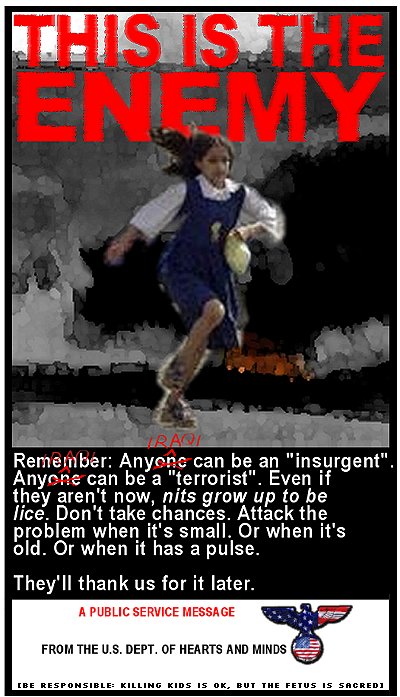
This post was originally on 6 August 2006, but now as September 11 approaches, it’s time to get it where it belongs in time. Charles Bishop’s letter was posted in August because the Austin American Statesman scooped us. They also published Steve Russell’s letter, but not until about the 25th of August. They did not publish either of the other two letters, so they are appearing for the first time in print.
Here is Mariann’s original challenge to the membership:
… announces the beginning of the Statesman’s “anniversary coverage” of 9/11 and invites YOU THE READER to submit 200 words or less to sept11@… disclosing your thoughts on the deadly event, and whether America is now a kinder, gentler, place, with more fearful but safer people etc. und zo forth. I have written my 200, my dears, as an exercise in political discourse and rhetoric, and urge and plea with you to do the same, muy pronto, and to send it off inmedianmente! It would be shame if this special coverage did not include a few rants about the utter ridiculous stupid gravity of it all, and were to be dominated by flag-waving effluvia!!
Nine-11 accelerated ongoing processes of profound change. America’s vision of itself shattered with the physical wreckage, replaced by a distorting mirror of fear.
I am more afraid of my government; less proud of my country. Invasive “security procedures” mock Liberty but don’t stop terrorism, just as gun laws don’t stop crime. Nine-11 wasn’t an “inside job”, but the Bush administration was too ready with regressive domestic legislation and a profitable war abroad.
Public displays of allegiance chill uniquely American freedoms: to be silent, to differ, to criticize the powers-that-be. Years of substandard education have made us sheep, mesmerized by silver-paper “stars” and disinclined to critical thinking. The juggernaut of “emergency” activity following 9/11 crushed attempts to slow the New World agenda, and despite robust Internet dissent, Bush & Co. may well feel smug.
Meanwhile, our small towns languish unless overrun by “development”; meaningful jobs evaporate; and, for late-arriving immigrants, the Promised Land has left the building. Multinational profiteers will soon pave a broad swath of Texas, ripping a limited access trade corridor through America’s heart. Poets and prophets say, “The world is a ghetto,” and the U.S.A. is another bad neighborhood.
Mariann Garner-Wizard
It is absurd to believe that the United States has become a safer place since 11 September 2001. It is more difficult to smuggle a box cutter onto a commercial aircraft, but it is just as simple to sabotage a water supply, a large chemical plant or oil refinery, or a majour port now as it was in 2001.
The war in Iraq is generating USA-haters at the rate of almost 4 per hour, by my rather conservative estimate (based on 30 Iraqi civilian deaths per day each of whom had just three grief-stricken relatives). Having followed Iraqi bloggers closely for three years, it is clear that they (and their local readership) are becoming less sympathetic to the “war on terror.”
After all, how can one fight terror? It is as ridiculous as fighting altruism or faith. It seems foolish to repeat the obvious, but if the effort had focused on al Qaeda until that task was better in hand, perhaps there could have been a measure of success. As it is, we lied our way into a war in Iraq at the potential expense of the nation (via an impending national bankruptcy). Frankly, if true, it will be no loss.
Richard Jehn
Port Angeles, Washington
The events of 9-11-01 were horrible crimes, but we are not at war with terrorism. If Mohammad Atta had been caught rather than consumed in flames, he would not be a prisoner of war. A terrorist is not a soldier but a criminal. The laws to deal with terrorism have been in place since the Barbary pirates, and any nation can punish the crime or declare war on a state harboring terrorists. This is not new and there are legal tools to deal with it.
The President said, by way of explanation, “they hate our freedom.” His solution domestically has been to take away our freedom so they will no longer hate us. Logical as that is, our safety is not increased by diluting the Bill of Rights that is supposed to separate us from our adversaries. It’s easier to cede our power to the government than it will be to get it back.
The invasion of Afghanistan was a legal and justified act of self-defense, although bungled in execution. There is a legal war against Afghanistan, which harbored terrorists, and an illegal war against Iraq, which did not attack us. But there is no war on terrorism.
Steve Russell
My Thoughts about a Post-9/11 America & World
The attack on 9/11 produced a “pissin’ contest” between two political parties to see who could be “more” patriotic than the other. This would have been humorous had it not led to the “Patriot Act” and an abused “War Powers” resolution to initiate an unprecedented preemptive attack on a sovereign nation, resulting in an “out-of-control” civil war in Iraq!!
I do not believe we are a safer nation, and most assuredly not a safer world since the events of 9/11.
The inept, misguided lurch into the Iraqi War has created MORE terrorists, MORE attacks and MORE killings, yet the most expensive military force in the world cannot conquer this “third-rate” enemy!
Our once Great Nation is now a wholly owned subsidiary of multi-national corporations who could care less about protecting our borders or insuring our American workers have decent incomes! They would rather “outsource” American jobs to third-world countries so “their” shareholders can earn a dividend!
The result is an uncontrolled inflationary spiral that has placed a great many financial hardships on the American people.
The tragic events of 9/11 “stopped the world” for a day — its aftermath will continue to change the world for generations to come.
Charles E. Bishop
Burleson, Texas
PDS – Basic analysis:
The citizens of the USA comprise roughly 4% of the world’s total population, but we currently consume 25% of the world’s resources and products. This disparity is untenable in the long term and unjust, regardless.
The USA became the dominant economic power in the world by virtue of the 20th century wars that decimated its potential imperial rivals. Our chief global economic rival, Europe, embraced a culture that rejected war as a means of conflict resolution, as a result of these wars. The USA then consolidated its dominion by becoming the world’s leading military power due to the fact that it outlasted its main military rival in the Cold War.
The US projects power though a system of post-colonial neo-imperialism (i.e., economic colonies under the management of compliant, local bourgeoisie without the administrative costs of true colonies). US society has largely become a warfare state, an economy dependent on the catalyst of government military spending. In the recent past the more insightful American political leaders have indulged the domestic working class in the spoils of imperial conquest just enough to tie them to the nationalist crusade.
Outside its residual dominance in military technology, all the factors that led to American dominance are diminishing. Other countries and regional blocs are becoming comparable economic powers, and none are friendly to continued US supremacy. Collectively, they point toward the return to a multi-polar world. This is incompatible with a US ruling class that clings to its role as the “last superpower”, able to enforce its will unilaterally and with impunity.
The US manufacturing base has largely been sent overseas in pursuit of cheaper labor. Financially, the US wallows in debt, most of it owed to potential rivals. The military now finds itself eroded, with plenty of guns, but few who volunteer out of principle to carry them. As only youth with limited prospects can be induced by ever-growing financial rewards to put on the uniform, it becomes an army of mercenaries in search of justification.
Another major byproduct of our unrestrained capitalism and its venal leadership is environmental destruction. The recent flooding of New Orleans, triggered by government-denied global warming and created by a careless incompetence is a case-in-point. Environmental degradation is also a crucial ingredient in societal collapse, because the effects lead to hunger, disease, and territorial aggression.
The twilight of the era of American dominion has begun. The future will be one of reduced US power and wealth relative to the rest of the world. Doubtless, however, those in the most privileged positions of American society and their deluded minions will defend privilege with all their resources. A militaristic reaction is a typical response to the decline of empire. This reaction is already evident in the Bush administration and among those who support it.
As citizens of the world living in the heart of danger, how can we react in order to advance our values of peace, justice, and equality? An essential element of this effort must be that it is international. The struggle solely within the national context of home-country of an empire in decline cannot succeed. However, this domestic struggle is crucial to the future of humanity.
Unless the empire can reform so as to be a better global citizen, the potential for catastrophe is high, if not inevitable.
People for a Democratic Society 15 Point Program
David Hamilton and Paul Spencer
Richard’s Rich Tortilla Soup (2 January 2001)
This soup was not what I expected – I have had many versions of tortilla soup, but this one takes the prize! I believe the squash is the secret.
I have a funny story to go with this recipe. A long-time Texan friend (known him for more than 35 years), who contributed several things to this book and whose Mom of Mexican background did all the childhood cooking, asked me for a recipe for tortilla soup.
I had already come up with this one, so I sent it to him. He lives in Austin now, so easily would have found all the chiles and other ingredients. The night he was making the soup, he phoned in a bit of a panic. He asked me why his soup was “glow-in-the-dark” green.
To make a long story short, he had used fresh green poblano chiles instead of the correct dried New Mexico and dried ancho chiles. He’s made me give thought to how I write recipes, but so many other people have praised the effort and the dishes they have prepared using the first book that I think I should not be too concerned.
Sorry for emphasizing the dried thing below. Vic tells me, “You must write with clarity.” This recipe completely takes away Vic’s breath. By the way, anchos and pullas do not exist other than dried. It’s kinda like the matter of Inuit words for snow, all 40-something of them. Whatever ….
The recipe also appears in KCTS Cooks Favorite Recipes.
3 or 4 dried ancho (or NM) chiles, stems and seeds removed
2 dried pulla chile, stem and seeds removed
Bring about a cup of water to almost boiling, then pour it over the chiles that have been placed into a small bowl. Soak the chiles until the squash is baked.
1 small yellow-meated, Winter squash, halved, cleaned of seeds and strings, and lightly coated with olive oil (butternut, acorn or delicata squash are all great)
Bake the squash at 350° F. for about 45 or 50 minutes, until tender. Scrape the meat from the squash into a food processor or blender. Also add the chiles and about 1/2 cup of the chile soaking liquid. Process until a smooth liquid.
2 small Spanish onions, diced
3 Italian garlic cloves, minced
2 tablespoons grapeseed oil
8 Roma tomatoes, chopped (or a 14-ounce can diced tomato)
1 tablespoon epazote (optional, but important)
2 tablespoons cumin
1 teaspoon fresh-ground pepper
1 teaspoon salt
2 cups low-fat chicken stock (or vegetable stock)
In a 4-quart pot, heat the oil, then add the onions and garlic. When transparent, add the remaining ingredients, stirring well. Also add the squash and chile purée. Simmer slowly until the tomatoes are broken down, about 1-1/2 to 2 hours.
I also sautéed some button mushrooms, as follows:
12 large button mushrooms, cleaned and sliced
2 tablespoons unsalted butter
Salt and pepper to taste
Heat the butter in a little frying pan, then add the mushrooms and salt and pepper. Don’t touch the mushrooms, until they are a bit dry and caramelizing. Add them to the soup about 10 or 15 minutes before you expect to eat, stirring them into the broth.
In the meanwhile, prepare the following condiments:
6 yellow corn tortillas, sliced into 1/4-inch wide strips
1/4 cup vegetable or peanut oil
Salt to taste
Heat the oil to almost smoking in a large frying pan. Fry the tortilla strips in batches until crispy, turning as required. Drain on paper towels, salting to taste.
1/4 cup sharp cheddar cheese, coarsely grated
1 avocado, sliced into bite-sized pieces
1 lime, sliced into 8 wedges
You can grate the cheese a little time ahead of when your soup is done, but wait until the last minute for the avocado and lime.
In two large bowls, place a few tortilla strips, then ladle hot soup over them. Garnish with cheese and avocado and serve a lime wedge or two on the side.
The soup freezes very well, but prepare the condiments (i.e., avocado, cheese, lime, and tortilla strips) fresh each time.
* FF = Foodie Friday
I am an environmentalist. I am a tree-hugger. I wish all the cars would stop and only trains, buses, and other such mass-transportation vehicles would work. And I love all creatures (although I have a hell of a hard time with what humans do some of the time). Here is a tiny creature that spent a lot of time in the camellia bush outside the front door in Shelton when I lived there. He kindly sat still for a few moments to let me take this. The photo was taken in March 2004. Oh, he is a rufous hummingbird, one of the more aggressive of the clan, although it’s a hard term to reconcile with the notion (and physical presence) of hummingbirds. They are particularly protective of nesting sites and afraid of nothing that moves …

RIchard Jehn
Alan titled his post, “Druids and Animists, oh! my!” I don’t know which is more appropriate – they both work. rdj
Gavan,
I almost never look at the web site because I have no idea about i.d.s and codes and such but I intuited your message.
Most of the Vietnamese were animists with a spot of ancestor worship, kinda Shinto but they wouldn’t use that term. A Vietnamese Catholic priest who was completely honest explained Vietnamese religious demographics to me. I was a Catholic chaplain’s assistant at the time. We were in a bombed out church with nothing much to do and shared an interest in comparative theology. I met a Vietnamese soldier who loved Dylan Thomas but that is another story.
I use the word “meaningless” in an exact sense. Words refer to something in order to have meaning. There is Lewis Carroll. The word “god” has no content, no attributes, no predicates , no nothing. Most mystics will agree but some keep on insisting that there is some other plane of existence they have a line on. Well, dial it for me so I can listen in. Maybe if I give them a few bucks they will call in my request. We humans like to anthropomorphize. We can attribute motives to inanimate objects or the weather. We have always wanted to be the center of something or the end product of the unfolding of something, anything to make us feel special, cosmically loved. Vague category words like “love” and “beauty” are hard to define, by definition, but one can pen down what one is referring to in particular. There is/are someone(s) one loves and there is/are something(s) that is/are thought to be beautiful and they have these attributes but if one says they love God then we are back to nothing again. Falling in love with love is falling for make believe et cetera. There has to be some there there. Go Gertrude.
Huge numbers of people can believe total bullshit. We see that all the time. Pass me a People magazine and a Diet Coke. Sociological meaning is another animal. Karl Rove can manipulate the nothings we believe are important. Strong emotional belief has a lot of sociological meaning. Let us all salute the flag, amen.
I like Zen/Chan Buddhism for the same reason I like existential phenomenology. They talk about our perception of reality in a way that helps scrape off all the nonsense. Unfortunately there are many wishy-washy people calling themselves Buddhists who reek of god nostalgia. Theism is like heroin or nicotine or Teddy Bear or nationalism.
Positivism and linguistic analysis aren’t all of philosophy but they are helpful. If someone wants to assert the existence of something then where is it. If it is, by definition, unknowable then how do they know about it? Got some old stone tablets or gold plates with cuneiform on them? And then, God or no God what difference does it make if it doesn’t make any difference? Shall we pray for rain? A straight flush? A cure for cancer? A parking space? Intuition of the correct path?
I believe in the essential goodness of human consciousness. Might as well since that is all we have, while the light lasts.
I believe in justification by works, not faith (identification of oneself with a magic totem). Many are those that cry Gaea, Gaea but do not do the will of the Mother/ Father/ General Good.
Alan, the a-Druid, a-Pagan and a-theist, altarless boy
Alan and Gavan,
I think you both underestimate what can be accomplished by the manipulation of the meaningless, although I agree with you both on the bottom line of “factual” meaninglessness.
It’s kind of like “There is no such thing as race.” A true statement in the scientific sense, but in the social sense we ignore race at our peril.
Steve “Pagan” Russell
Emile Durkheim, the “Father of Sociology” and an influential 19th century analyst of things social, argued that human behavior is constrained by three kinds of reality: physical reality (you can’t fly because we don’t have wings), psychological reality (we are limited in our ability to understand), and social reality (Durkheim’s example: he had to speak French not because he was incapable of speaking some other language physically or mentally, but because he lived in a French-speaking society). Social realities are just as “real” as the other two when it comes to affecting people’s behavior. Concepts like “race” may not be empirically valid, but they sure are socially valid. “Socially-constructed realities” are still real, even if they are just social constructs.
Incidentally, Durkheim also argued that in order to change a “social fact,” you had to change its causes, e.g., if you want to lower the crime rate, locking up criminals won’t do it, you have to attack the base causes of crime.
My two cents.
Nick Hopkins (a great fan of pagans)
Well, I agree with both Alan and Steve.
My point was simply that religion, although not at all the main cause of the Troubles in Northern Ireland, is not irrelevant in (and thus not meaningless to) any explanation or understanding of political events there. Although in the final analysis religion is meaningless for all the reasons Alan articulates, it nevertheless and unfortunately motivates the actions of a great many people. Political leaders in Northern Ireland (and elsewhere) know this and exploit it to mobilize mass political constituencies cheaply (without having to expend material resources).
So, the political leaders in Northern Ireland across communities, are motivated by an interest in security. But they find it convenient (and cheap) to mobilize mass constituents by “distributing solidary incentives” or, in this case, by glorifying their group and demonizing their opponent’s group along confessional lines.
Although distributing solidary incentives is cheap, leaders discover when they want to settle with their opponents that — even if they attain their actual goal (security in this case) — they cannot settle without risking loss of their incumbency or loss of their lives to hardliner assassins within their own constituency. If you don’t believe me, ask Anwar Sadat or Yitzhak Rabin.
The Good Friday agreement delivers the security every party wants, and nominally solves the Irish problem. However, its implementation is delayed (hopefully not prevented) because of difficulties in retracting solidary incentives in both the nationalist and unionist communities. Retraction of these incentives is particularly difficult in this case, as political leaders been distributing them for half a millennium or so.
I contend that the solidary incentive retraction problem is a prime obstacle to peace and not just in Northern Ireland. If anyone has any ideas about how to foster their retraction, I’d like to hear them.
Gavan, the devout agnostic, Duffy
When writing about solidary incentives, I stand on many shoulders. One set belongs to John Turner, who writes about stereotyping and social categorization. He was standing on the shoulders of Henri Tajfel, who conducted the famous “minimal groups” experiments (which showed the people’s evaluative judgments of others are affected by their group affiliations, even when those affiliations have no real meaning). Tajfel in turn was standing on the shoulders of Emile Durkheim and his work on socially constructed realities in The Elementary Forms of the Religious Life.
It’s in just this sense that religion is not meaningless, even if Alan and I choose to construct it that way.
Gavan Duffy
Steve Russell and Gavan Duffy wrote:
“As to Ireland, you think it’s political (and it is) and I think it’s religious (and it is) and Mar says it’s the same think but I don’t think so. I think the politics of it could be worked out but the religious part of it is the tougher problem. Religion is relevant, of course, but the main issue in Ireland is and always has been security.”
Walking around in neighborhoods in north Ireland I kept seeing white shields with a red hand* in the middle, attached to lamp posts, sort of like the ones on crosswalk lights but always on “stop”. I spotted a fellow who had a red hand tattooed on his upper arm and asked what the hand symbolized. He was happy to explain that the British Crown had given Northern Ireland to some Scots [without consulting the relevant history books I’ll assume they were the sellout Scots, like the Campbells]. The first Scot to touch the shore would have his pick of the best land. One enterprising Scot cut off his left hand and at the right moment threw it on to the shore so he would get the first pick of the acreage. The fellow with the tattoo was a member of the Red Hand Commandos. Their self appointed task, with help from the Crown, was to keep Irish nationalists out of their neighborhoods, among other activities. Having taken the Indigenous People’s land they have to keep up a constant guard.

In north Ireland the “police stations” were fortresses for British troops. I saw plenty of British helicopters flying about. The situation was not as oppressive as the West Bank but the similarities were easy to see. It was tense. I’m sure a casual tourist who only wanted to drink, shop and go from castle to castle might not notice.
In Vietnam the French colonialists were Catholic. Enterprising Vietnamese would become Catholics so they could rise in the French colonial bureaucracy. They became French Loyalists. Get it? In Ireland the colonizing power is Protestant so the Loyalists are Protestant.
Religion, in itself, is meaningless.
Alan , the druid pagan, Pogue
Alan, the druid pagan, Pogue wrote: “Religion, in itself, is meaningless.”
I think you overstate the case, but I would agree that any religious issues obscure the real ones.
Gavan, the animist, Duffy
* Note: For more information about the ‘red hand,’ click here or here.
Thorne Webb Dreyer, Editor





