Roger Baker : Converging Global Crises and Why We Deny Them

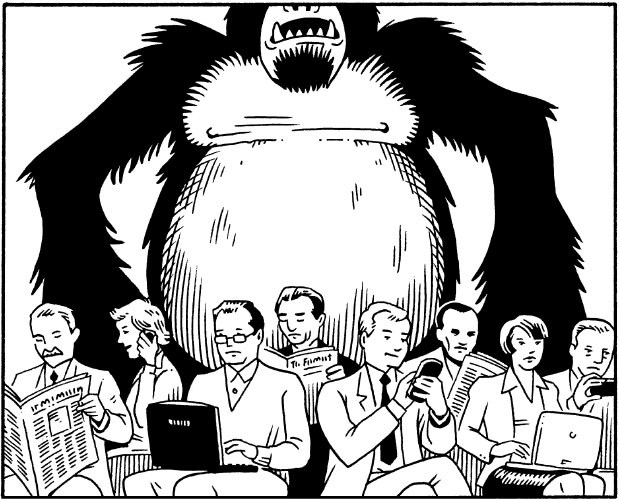
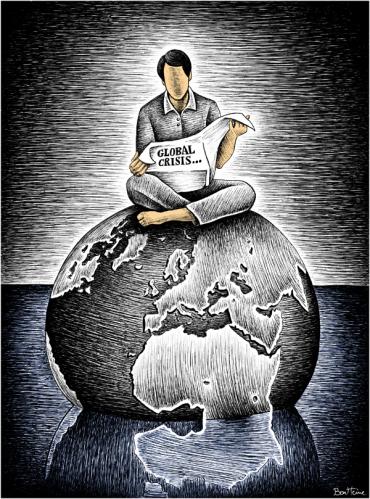
Cartoon from Belonging Las Vegas.

Converging global crises
and why we deny them

It is the system itself that is unsustainable, but the public tends to interpret the problem as being a function of bad leadership.

By Roger Baker | The Rag Blog | August 23, 2012

[First of a series.]

Why crises are converging

The evidence has become quite persuasive that humans are bumping into interrelated natural limits to growth that spell big trouble no matter what we do. We appear to be in the grip of multiple interrelated crises that are converging into an overall crisis.

What do I mean by converging crises? The situation we now see ourselves in is one where the problems posed by the natural global limits on growth are so intertwined that, if we try to deal with any one problem individually, it tends to make the other problems worse.

For example, global warming is merging with peak oil as a major threat. This is because it will necessarily take a lot of oil to deal with either global warming, or a growing shortage of cheap oil itself. The growing list of simultaneous crises we face involves peak fossil fuel, peak food production, water shortages, a stalled global economy, species extinction, and a rising global population.

Compare the situation now with 50 years ago, when none of the five crises listed below seemed too hard to deal with. A steadily rising population and its per capita impact are at the heart of our problems. The 1972 book, The Limits to Growth, used models that tried to project trends to roughly quantify global growth limits.

Richard Heinberg’s recent book, The End of Growth, is centered on fossil fuel energy limits that mean that our main policy option going forward will be using our current economic output differently, and hopefully more wisely. The various emerging and interacting limits to growth mean that we will need to learn to be happier with less, to abandon consumerism, and to make a major transition toward working together in the current decade.

The list of converging, interacting crises that we face will certainly have to deal with global warming as a central problem. The nature of the problems we face and their interactions have become like a contracting net that surrounds us. The situation is deceptive and conducive to denial because, like a net, it seems to offer a little room to maneuver in any given direction.

What the public sees on TV and reads in the newspaper is largely comprised of descriptions of the symptoms of problems, frequently calling for more spending as the best solution. In this way, whether or not we want to solve our problems is made into a political choice. Dealing honestly and straightforwardly with the deeper causes of a cluster of interacting problems is much more difficult and disturbing.

Global warming or peak oil by itself would require a unified consensus and focused national effort, similar to winning WWII, to deal with adequately. From the standpoint of global warming, based on the climate science, the future looks either bleak, very bleak, or somewhere in between. Adding a list of other serious problems can hardly improve this situation.

It is the system itself that is unsustainable, but the public tends to interpret the problem as being a function of bad leadership. The polls leave no doubt that our polarized and dysfunctional federal government is unpopular; Congress is now ranked as less popular than the United States going Communist.

There is little public agreement on what to do. Many believe that we have lost our way as a nation, and they see things getting worse. A prevailing hope is that some politicians will know how to create jobs (didn’t FDR get us out of the Great Depression?). By electing the right politician, the economy might recover, and that could give us enough money to solve our other problems.

Now let us switch over to what science is telling us. The long-term problems we now face are said to be serious enough to threaten global human survival. It has now been a full 20 years since a majority of the world’s Nobel Prize winning scientists cosigned the “World Scientists’ Warning to Humanity.”

More recently, top scientists have become even more urgent in their warnings that the limits of nature are taking us to a tipping point — a point at which the limits we face will lead to a rapid deterioration of our situation regardless of our policies. Here is an Ecoshock Radio link to the situation, introduced by Prince Charles.

A prestigious group of scientists from around the world is warning that population growth, widespread destruction of natural ecosystems, and climate change may be driving Earth toward an irreversible change in the biosphere, a planet-wide tipping point that would have destructive consequences absent adequate preparation and mitigation. UC Berkeley professor Tony Barnosky explains how an increasing human population, coupled with climate change, could irreversibly alter Earth’s ecosystem.

If you a prefer a scary but still science-based energy limits and global warming scenario, this video clip is worth pondering. There is a chance that we have already reached a global warming tipping point where positive feedback effects like polar methane release take over.

This interview with a long time futurist, Jorgen Randers, suggests that we might possibly have 40 years of something resembling a normal life yet to come. He is still pessimistic about what will happen beyond then, primarily because of global warming.

The two main barriers he sees are the relentlessly expansionist nature of capitalism, and democracy itself, with its preference to favor short-run policies.

James Howard Kunstler is an excellent writer with an uncommon grasp of energy economics, and a good sense for how the end of growth is likely to interact with U.S. culture and politics. His 2005 book, The Long Emergency, described converging natural limits centered on peaking oil. His new book, Too Much Magic, is an update written to debunk the seductive dream that some kind of new technology will save us, and allow economic growth to continue as it always has in the past.

Kunstler describes the delusional thinking surrounding the slow unraveling of American life, since our energy problems argue that we face a long and unwelcome future of economic contraction.

Al Gore was warning the nation of global warming in his 2000 election, but he was defeated by a president stubbornly in denial of natural limits to continuing growth. Since then, as a nation, we have led the world in global warming denial. A well-established and well-funded right wing media effort has been organized to deny that there are any limits to growth, and to oppose environmentalist concerns that are deemed to be harmful to profits.

Let us look briefly at five converging and interacting factors that I see as the most threatening. Each has its own timing and economics and dynamics.

  1. Scientific denial as a well-funded, primarily Republican political war serves mainly to prevent public opinion from being mobilized into policy change to rationally deal with the other crises. Policy change to deal with global warming was seen as a big threat to many existing oil-addictive industries. The current investments have been highly profitable, at least for a few.

    Global warming denial propaganda has worked well for the past decade, but especially in the last year things have been changing. Climate change is causing heat waves, forest fires, and droughts to an alarming degree, developments that have strongly shifted public opinion toward acceptance. However the denial efforts continue at a high level and have been broadened to include peak oil.

  2. Global population growth is slow at about 1.1% globally, but it tends to drive all the other crisis factors by steadily increasing food requirements. We are almost certainly at peak per capita food already. Food shortages play out as food cost increases. These are a powerful cause of riots and political turmoil and instability in the countries that cannot afford to buy food.
  3. Global warming and climate change are part of a slowly developing crisis that has taken many decades to develop. It comes with a built in latency factor that is expected to about double the apparent effects, but these effects have now gotten to the point of causing catastrophic droughts, floods, and food failures.
  4. Peak oil is another slowly developing crisis, which will probably end soon with a rude awakening. The cheap conventional oil already peaked in 2005.The addition of much more expensive non-conventional oil has kept the world on a plateau, but the price is still high enough to trigger a global economic crisis and prevent recovery. The “cornucopian” denial-of-any-limits lobby has discovered peak oil and is busily denying it.
  5. An impossible debt burden is a predictable consequence of an expansionist economic system, unable to expand any further in a finite world. If finance capital is unregulated it will try to extend more credit than can possibly be repaid. Capitalism has always been prone to periodic credit crises — termed the capitalist business cycle — which, in an era of expansion, can be relieved by using Keynesian stimulus.

    Since continuing growth is impossible without cheap oil, the global economy is headed toward the mother of all global economic crises. Even the best political and economic policy can only delay the crash.

Next time we’ll take a closer look at this short list of converging crises.

[Roger Baker is a long time transportation-oriented environmental activist, an amateur energy-oriented economist, an amateur scientist and science writer, and a founding member of and an advisor to the Association for the Study of Peak Oil-USA. He is active in the Green Party and the ACLU, and is a director of the Save Our Springs Association and the Save Barton Creek Association in Austin. Mostly he enjoys being an irreverent policy wonk and writing irreverent wonkish articles for The Rag Blog. Read more articles by Roger Baker on The Rag Blog.]

The Rag Blog

Posted in Rag Bloggers | Tagged , , , , , , | 7 Comments

Devon G. Peña : The Commodity Form Goes Molecular

Cyborg. Artist unknown. Image (and inset images below) from Environmental and Food Justice.

Capitalism and synthetic biology:
The commodity form goes molecular

By Devon G. Peña | The Rag Blog | August 22, 2012

“We’re moving from reading the genetic code to writing it.” — J. Craig Venter, JCV

“Designing genomes will be a personal thing, a new art form as creative as painting or sculpture. Few of the new creations will be masterpieces, but a great many will bring joy to their creators and variety to our fauna and flora.” — Freeman Dyson, Theoretical physicist

“Scientists are making strands of DNA that have never existed, so there is nothing to compare them to. There are no agreed mechanisms for safety, no policies.” — Jim Thomas, ETC Group

[Part 1 of 4.]

While many of us continue to worry about the effects of genetically-engineered organisms (GEOs) in our foods, there is another looming threat on the horizon that has not yet received the attention it deserves. The advent of commercialized synthetic biology (SB) poses new social, legal, economic, and ecological dilemmas the likes of which we have never really had to confront, even with the bewildering array of problems associated with agricultural transgenics.

What is synthetic biology? In a word: God. Or, humans playing at God, anyway. By inventing new life forms, manufacturing artificial biological organisms, synthetic biologists are really acting as Creators of life; or so they think.

The definition of synthetic biology is itself hotly debated, but a 2009 article in The New Yorker by Michael Specter provides a richly textured one that I believe captures the most significant qualities of this new interdisciplinary applied engineering field. According to Specter, synthetic biology combines the elements of engineering, chemistry, computer science, and molecular biology in order to “assemble the biological tools necessary to redesign the living world” in accordance with human needs.

This is not rocket science.

The principles are really as simple as ABC; well, actually the technology is a matter of rearranging ACGT — the four nucleic acid bases that make up DNA. The “A” stands for Adenine and pairs with the “T” which stands for Thymine. The “C” stands for Cytosine and pairs with the “G,” Guanine. These four nucleic acids are bound together in a nearly infinite double helix set of reiterations that constitute the genetic code, or DNA, of living organisms.

While not complicated in principle, synthetic biology is exceptionally tedious and very time consuming. So, it requires an inordinate amount of super-computing capacity to crunch the possible reiterations in the genome sequences of a living creature.

The approach championed by J. Craig Venter and his colleagues is basically a type of “subtraction” of genes. A June 2005 report in The Wall Street Journal summed it up this way:

The project to create an artificial cell dates back to 1995, when Dr. Venter led the first team to sequence all the DNA of a living organism, Haemophilus influenzae. The decoded germ had 1,800 genes, yet M[ycolplasma] genitalium, the second bacterium studied by Dr. Venter’s research group, proved to have fewer than one-third as many. “That started the whole thinking of, ‘How small can it be? What is the minimal definition of life?’” says Dr. Venter. “If we can’t answer that question, we can’t pretend to understand what life is.”…

For practical applications as well, a minimalist genome would be a helpful starting point because the bacteria wouldn’t have any unneeded parts, saving their energy for whatever process they’re being used for… Dr. Venter and a collaborator, Clyde Hutchison, began systematically disabling M. genitalium’s DNA a piece at a time, looking for colonies that could still grow despite the missing parts. From 517 genes, they pared the genome down to a must-have list of between 265 and 350… Drs. Venter and Smith concluded the only way to test the viability of a minimal genetic life form would be to build one. [Brackets added]

According to Specter’s New Yorker article, Venter and his team had by the end of 2008 “pieced together thousands of chemically synthesized fragments of DNA and assembled a new version of the organism.” Specter continues to elaborate how Venter and his team produced the entire genome of Mycoplasma genitalium, the results of which were published in the journal Science in May 2010.

In his interview with Specter, Venter waxed poetic about how “It should be possible to assemble any combination of synthetic and natural DNA segments in any desired order.” It is this type of arrogant explication that has so many ethcists concerned.

Regardless, Venter recently succeeded in transplanting the artificial chromosome into the walls of a undifferentiated cell and then “rebooted” the resulting structure in a sort of Frankenstein-style reanimation. The organism was then able to replicate its own DNA — becoming the first truly artificial organism. The organism has been dubbed “Synthia.”

This is a strange turn because until now most systems biologists have thought that what makes a given set of chemical associations a living system is the principle of self-organization or what the Greeks called autopoiesis. Here, the principle is turned on its head with the scientist organizing the chemical associations and determining the conditions and processes under which the synthetic organism will replicate itself and therefore at least mimic autopoietic processes.

The promise Venter is making is nothing short of saving the world by repackaging these artifical life forms depending on customer needs or commercial uses. His corporation, Synthetic Genomics, Inc. (SGI) is proposing that it might produce specific cancer-fighting drugs or perhaps an airborne bacterium reprogrammed to digest carbon in the atmosphere. See? Venter only wants to save the planet!

These promises to save the world are front and center on the company website that asks us to celebrate the coming synthetic utopia in which bioengineered organisms will replace coal with clean bioenergy and even allow us to convert greenhouse gases into life-saving vaccines. In the words of the company itself:

J. Craig Venter and his teams have discovered more than 20 million genes to date and view these as the design components of the future. SGI is designing, synthesizing and assembling genes, synthetic chromosomes and even whole genomes to produce clean energy, bio-chemicals and other high value products directly from carbon dioxide, plant biomass and coal.

Image from Synthetic Genomics

Synth-Ethics, or Synthia you ain’t the finest thing…

One might wonder why this story also ended up on the pages of the WSJ instead of just the scientific journals. The answer is as simple as “C,” as in Capitalism. Public sector scientists have long viewed Venter as an opportunist who takes technologies developed by investments of the public sector to serve the aims of a for-profit corporate agenda; this happened with sequencing of the human genome and is now happening with the development of synthetic organisms.

Be that as it may, the current corporate development of synthetic life forms by Venter and his investors is entirely a for-profit venture, albeit with the inevitable “Trust us, we are going to save the planet” type of hubris that we have heard from every single previous capitalist-inspired panacea of the past 50 years: From numerical control and computers to robotics; and from biotechnology to nanotechnology and now synthetic biology.

None of these saved the world, ended hunger, or resolved the climate crisis; none ended disease, poverty, or war; none made agriculture more sustainable or equitable. These technologies did make a few investors very wealthy indeed and extended the life of capitalism beyond its moribund Fordist organizational forms of the 1950s.

This has not stopped Venter from trying to peddle a new panacea, based on the cheap promises of his first synthetic life form, with has the way too cute name of “Synthia.” Remember the lyrics from a Bruce Springsteen song called “Cynthia?” With apologies to The Boss, I have to rewrite these:

Synthia, when you come creeping out
You’re an inspirin’ sight
Synthia, under the electron microscope
You don’t smile, but that’s alright

Well now you ain’t the finest thing I’ll never have
Well, baby, it ain’t so bad,
Yeah, there ain’t a banker in this whole town
Who’ll say you ain’t fine
Well you make us rich, honey, when we sell you
To see sump’n’so good, in a world gone bad
There’s still Synthia, oh yeah.

The objections to synthetic biology are more serious than these justifiable complaints about the opportunistic exploitation of social sector investments to advance a private neoliberal agenda and profit making.

Serious analysts and ethicists have launched wide-ranging criticisms of synthetic biology that merit lengthy discussion. In the coming weeks, I will be addressing a selection of the nine most pressing issues of current concern to ethicists, environmental scientists, indigenous communities, and advocates of sustainability, social justice, and equity. These include:

  1. Environmental implications and risks
  2. Food regulation
  3. Biomedical applications
  4. Cosmetics regulations
  5. Intellectual property
  6. Bio-informatics
  7. Occupational health
  8. Implications for human and ecosystem rights guarantees
  9. Trade and global justice.

Suffice it for now, as a matter of introducing this topic to my readers and followers, that there is (1) an excess of hubris by scientists who are also entrepreneurs with a lot to lose if their inventions and investments fail to pan out as imagined; (2) there is also a great deal of arrogance on the part of synthetic biologists who think they can just start snipping and snapping the pieces of the biological puzzle together without truly understanding gene-protein and gene-environment relationships and interactions; and (3) there is no predictive ecology or risk model for the assessment of the risks associated with SB.

The failure to abide by the Precautionary Principle in the past gave us the still-unfolding wreckage of social, economic, ecological, and health problems of commercial agricultural biotechnology and especially transgenic substances in our food supplies. We have an opportunity to prevent a repetition of this mistake and must act now to apply the precautionary principle to the entire domain of synthetic biology.

There should be no commercialization or environmental release of SB organisms until all the scientific evidence on risks has been gathered and evaluated. If the risks are determined to be too great, then the commercial release of synthetic organisms must be completely banned.

This is not a radical proposal. What is radical is the arrogant idea that scientists-cum-capitalists can pretend to have invented masterpieces, like so many colorful gems of genetic art, that they can just release on the rest of us without our consent.

Freeman Dyson is completely wrong when he imagines that “Designing genomes will be a personal thing, a new art form as creative as painting or sculpture.” But he is right about one thing: Many of these will not be masterpieces. No, they will be monstrosities, and once released there is no way to call them back into the confined spaces of the lab or to erase the biological damage and evolutionary havoc they will have unleashed.

It is not a personal thing, like some fashion trend, to unleash a synthetic bacterium on the entire planet, affecting all organisms, whether they wish to be affected or not. That is not personal freedom; it is biological totalitarianism. It is the worst sort of panacea since it carries within it the poison core of a biological Chernobyl while pretending to be our planetary savior served-up by an elitist and avarice-driven few over a powerless, non-consenting multitude.

[A lifelong activist in the environmental justice and resilient agriculture movements, Devon G. Peña is a Professor of American Ethnic Studies, Anthropology, and Environmental Studies at the University of Washington in Seattle. He blogs at Environmental and Food Justice.]

The Rag Blog

Posted in RagBlog | Tagged , , , , | 1 Comment

VERSE / Larry Piltz : Hasan’s Beard

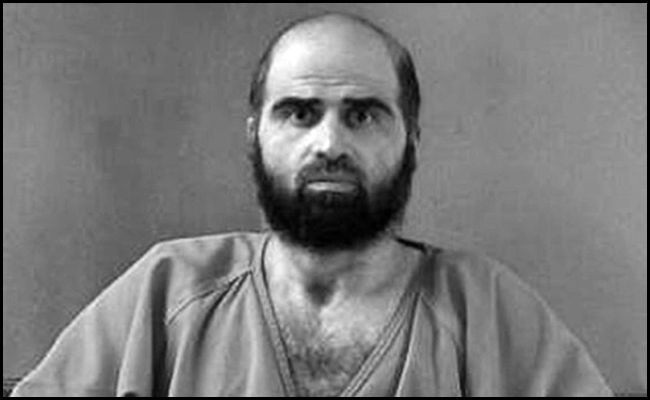
Hasan’s Beard

Not one to turn the other cheek
Hasan’s Beard bristled at the charges.
Not guilty by reason of inanity!
Not even accessory after the fact.
Yet military justice had Hasan’s Beard by the short ones
and Hasan’s Beard would ultimately take it on the chin
in this enigmatic full-grown brush with the law
with the verdict-to-be not even a close shave
nor by a whisker but a shadow of a pretext.

This is a rash prosecution of ingrown justice
wrong in so many ways even on a follicular level
the trial more of a clip joint than a court of law.

They have not seen the last of Hasan’s Beard
a growing problem
even after death.

Larry Piltz / The Rag Blog
August 22, 2012
Indian Cove
Austin

http://www.statesman.com/news/local/judge-orders-hasans-beard-shaved-before-court-martial-2422326.html

[Larry Piltz is an Austin-based writer, poet, and musician. Find more articles and poetry by Larry Piltz on The Rag Blog.]

The Rag Blog

Posted in Rag Bloggers | Tagged , , , | 1 Comment

Marilyn Katz : The Ties That Bind Paul Ryan and Todd Akin

Graphic from Eclectablog.

Paul Ryan and Todd Akin:  
The ties that bind

Rape-denier Todd Akin is right in line with the GOP’s staunchly anti-abortion platform. And so is Ryan.

By Marilyn Katz | The Rag Blog | August 22, 2012

Republicans, heeding their media strategists, are trying to distance themselves from Todd Akin’s absurd comment that women cannot get pregnant from “legitimate rape.” But we shouldn’t let them get away with it. Rather than making him an outlier, Akin’s comments are consistent with the words and actions of the Republican Party — including its latest darling, presumptive vice-presidential candidate Paul Ryan.

Ryan is being touted as an economic expert, but his legislative focus on economics is relatively new, whereas his anti-choice record is pages long and more than decade old. Of the 81 bills Ryan has sponsored or cosponsored in this congressional session, only three have dealt with the economy. The greatest number of bills he has backed on a single topic — 10 — have to do not with controlling the economy but controlling women’s bodies and what we can and cannot do with them.

And that’s not new. Over the 13 years he’s been in Congress, Ryan has voted 59 times — every time possible — to deny women access to abortion and even to forms of contraception. The 59 pieces of legislation range from declaring a fetus a human being with full legal rights to allowing hospitals to refuse treatment to a woman who needs post-abortion care — even if she is at death’s door.

Nor are Ryan and Akin anomalies or renegades. Republicans have introduced more than 1,000 anti-choice and anti-contraception bills in state legislatures in the past two years, many of which passed, especially in the 27 state legislatures under GOP control. And yesterday the national party approved a platform plank declaring abortion unconstitutional and calling for a wholesale ban without any exception for rape or incest.

Not all Republicans are as careless in their speech as are Todd Akin or Illinois’s Joe Walsh, but they all share the position that they have the right to impose their controls on women’s lives and bodies.

The record is clear: pro-gun and anti-choice, Akin, Ryan, and their Grand Old Party are a danger to women and other living things.

[An anti-war and civil rights organizer during the Vietnam War, Marilyn Katz helped organize security during the August 1968 protests at the Democratic National Convention. Katz has founded and led groups like the Chicago Women’s Union, Reproductive Rights National Network, and Chicago Women Organized for Reproductive Choice in the 1960s and 1970s, and Chicagoans Against War in Iraq in 2002. The founder and president of Chicago-based MK Communications, Katz can be contacted at mkatz@mkcpr.com. This article was also published at In These Times. Read more articles by Marilyn Katz on The Rag Blog.]

The Rag Blog

Posted in Rag Bloggers | Tagged , , , , , , | Leave a comment

Bill Fletcher, Jr. and Carl Davidson : What Should Progressives Do in November?

Dynamic duo. Graphic by DonkeyHotey.

What to do in November, and beyond

The 2012 election will be one of the most polarized and critical elections in recent history. And it will have little to do with Obama’s record… which is why we are voting for him.

By Bill Fletcher, Jr. and Carl Davidson / AlterNet / August 21, 2012

[There has been substantial discussion on the Left of late about the proper role of progressives in the upcoming presidential elections — and whether it’s appropriate, or politically correct, to support a “lesser evil” Barack Obama. The Rag Blog‘s email discussion group has been abuzz with this debate. Many believe, for a number of reasons, that the elections should be boycotted or even actively opposed. Bill Flether, Jr. and Carl Davidson address these issues here. It’s a long piece, but highly relevant and well worth the read. — Thorne Dreyer / The Rag Blog.]

Let’s cut to the chase. The November 2012 elections will be unlike anything that any of us can remember. It is not just that this will be a close election. It is also not just that the direction of Congress hangs in the balance. Rather, this will be one of the most polarized and critical elections in recent history.

Unfortunately what too few leftists and progressives have been prepared to accept is that the polarization is to a great extent centered on a revenge-seeking white supremacy; on race and the racial implications of the moves to the right in the U.S. political system.

It is also focused on a re-subjugation of women, harsh burdens on youth and the elderly, increased war dangers, and reaction all along the line for labor and the working class. No one on the Left with any good sense should remain indifferent or stand idly by in the critical need to defeat Republicans this year.

U.S. Presidential elections are not what progressives want them to be.

A large segment of what we will call the “progressive forces” in U.S. politics approach U.S.elections generally, and presidential elections in particular, as if:

  1. we have more power on the ground than we actually possess, and
  2. the elections are about expressing our political outrage at the system. Both get us off on the wrong foot.

The U.S. electoral system is among the most undemocratic on the planet. Constructed in a manner so as to guarantee an ongoing dominance of a two-party duopoly, the U.S. electoral universe largely aims at reducing so-called legitimate discussion to certain restricted parameters acceptable to the ruling circles of the country.

Almost all progressive measures, such as Medicare for All or Full Employment, are simply declared “off the table.”  In that sense there is no surprise that the Democratic and Republican parties are both parties of the ruling circles, even though they are quite distinct within that sphere.

The nature of the U.S. electoral system — and specifically the ballot restrictions and “winner-take-all” rules within it — encourages or pressures various class fractions and demographic constituency groups to establish elite-dominated electoral coalitions. The Democratic and Republican parties are, in effect, electoral coalitions or party-blocs of this sort, unrecognizable in most of the known universe as political parties united around a program and a degree of discipline to be accountable to it.

We may want and fight for another kind of system, but it would be foolish to develop strategy and tactics not based on the one we actually have.

The winner-take-all nature of the system discourages independent political parties and candidacies on both the right and the left. For this reason the extreme right made a strategic decision in the aftermath of the 1964 Goldwater defeat to move into the Republican Party with a long-term objective of taking it over.

This was approached at the level of both mass movement building, e.g., anti-busing, anti-abortion, as well as electoral candidacies. The GOP right’s “Southern Strategy” beginning in 1968 largely succeeded in chasing out most of the pro-New Deal Republicans from the party itself, as well as drawing in segregationist Democratic voters in the formerly “Solid South.”

Efforts by progressives to realign or shift the Democratic Party, on the other hand, were blunted by the defeat of the Mississippi Freedom Democratic Party in 1964, and later the defeat of the McGovern candidacy in 1972, during which time key elements of the party’s upper echelons were prepared to lose the election rather than witness a McGovern victory.

In the 1980s a very different strategy was advanced by Rev. Jesse Jackson and the Rainbow insurgencies that aimed at building — at least initially — an independent, progressive organization capable of fielding candidates within the Democratic primaries. This approach — albeit independent of Jackson himself — had an important local victory with the election of Mayor Harold Washington in Chicago. At the national level, however, it ran into a different set of challenges by 1989.

In the absence of a comprehensive electoral strategy, progressive forces fall into one of three cul-de-sacs:

  1. ad hoc electoralism, i.e., participating in the election cycle but with no long-term plan other than tailing the Democrats;
  2. abandoning electoral politics altogether in favor of modern-day anarcho-syndicalist “pressure politics from below”; or
  3. satisfying ourselves with far more limited notions that we can best use the election period in order to “expose” the true nature of the capitalist system in a massive way by attacking all of the mainstream candidates.

We think all of these miss the key point.

Our elections are about money and the balance of power.

Money is obvious, particularly in light of the Citizens United Supreme Court decision. The balance of power is primarily at the level of the balance within the ruling circles, as well as the level of grassroots power of the various mass movements. The party that wins will succeed on the basis of the sort of electoral coalition that they are able to assemble, co-opt, or be pressured by, including but not limited to the policy and interest conflicts playing out within its own ranks.

The weakness of left and progressive forces means we have been largely unable to participate, in our own name and independent of the two party upper crust, in most national-level elections with any hope of success. In that sense most left and progressive interventions in the electoral arena at the national level, especially at the presidential level, are ineffective acts of symbolic opposition or simply propaganda work aimed at uniting and recruiting far smaller circles of militants.

They are not aimed at a serious challenge for power but rather aim to demonstrate a point of view, or to put it more crassly, to “fly the flag.” The electoral arena is frequently not viewed as an effective site for structural reforms or a more fundamental changing of direction.

Our politics, in this sense, can be placed in two broad groupings — politics as self-expression and politics as strategy. In an overall sense, the left needs both of these — the audacity and energy of the former and the ability to unite all who can be united of the latter. But it is also important to know the difference between the two, and which to emphasize and when in any given set of battles.

Consider, for a moment, the reform struggles with which many of us are familiar. Let’s say that a community is being organized to address a demand for jobs on a construction site. If the community is not entirely successful in this struggle, it does not mean that the struggle was wrong or inappropriate. It means that the progressives were too weak organizationally and the struggle must continue.

The same is true in the electoral arena. The fact that it is generally difficult, in this period, to get progressives elected or that liberal and progressive candidates may back down on a commitment once elected, does not condemn the arena of the struggle. It does, however, say something about how we might need to organize ourselves better in order to win and enforce accountability.

In part due to justified suspicion of the electoral system and a positive impulse for self-expression and making our values explicit, too many progressives view the electoral realm as simply a canvass upon which various pictures of the ideal future are painted. Instead of constructing a strategy for power that involves a combination of electoral and non-electoral activity, uniting both a militant minority and a progressive majority, there is an impulsive tendency to treat the electoral realm as an idea bazaar rather than as one of the key sites on which the struggle for progressive power unfolds.

The shifts within the Right and the rise of irrationalism

Contrary to various myths, there was no “golden age” in our country where politicians of both parties got along and politics was clean. U.S. politics has always been dirty. One can look at any number of elections in the 19th century, for instance, with the Hayes-Tilden election of 1876 being among the more notorious, to see examples of electoral chicanery. Elections have been bought and sold and there has been widespread voter disenfranchisement.

In the late 19th century and early 20th century massive voter disenfranchisement unfolded as part of the rise of Jim Crow segregation. Due to gains by both the populist and socialists is this era, by the 1920s our election laws were “reformed” — in all but a handful of states — to do away with “fusion ballots” and other measures previously helpful to new insurgent forces forming independent parties and alliances.

What is significant about the current era has been the steady move of the Republican Party toward the right, not simply at the realm of neoliberal economics (which has also been true of much of the Democratic Party establishment) but also in other features of the “ideology” and program of the Republicans.

For this reason we find it useful to distinguish between conservatives and right-wing populists (and within right-wing populism, to put a spotlight on irrationalism). Right-wing populism is actually a radical critique of the existing system, but from the political right with all that that entails. Uniting with irrationalism, it seeks to build program and direction based largely upon myths, fears and prejudices.

Right-wing populism exists as the equivalent of the herpes virus within the capitalist system. It is always there — sometimes latent, at other times active — and it does not go away. In periods of system distress, evidence of right-wing populism erupts with more force. Of particular importance in understanding right-wing populism is the complex intersection of race, anti-immigrant settler-ism, “producerism,” homophobia, and empire.

In the U.S., right-wing populism stands as the grassroots defender of white racial supremacy. It intertwines with the traditional myths associated with the “American Dream” and suggests that the U.S. was always to be a white republic and that no one, no people, and no organization should stand in the way of such an understanding. It seeks enemies, and normally enemies based on demographics of “The Other.”

After all, right-wing populism sees itself in the legacy of the likes of Andrew Jackson and other proponents of Manifest Destiny, a view that saw no inconsistency between the notion of a white democratic republic, ethnic cleansing, slavery, and a continental (and later global) empire. “Jacksonian Democracy” was primarily the complete codification and nationalization of white supremacy in our country’s political life.

Irrationalism is rising as an endemic virus in our political landscape.

Largely in times of crisis and uncertainty, virulent forms of irrationalism make an appearance. The threat to white racial supremacy that emerged in the 1960s, for instance, brought forward a backlash that included an irrationalist view of history, e.g., that the great early civilizations on earth couldn’t have arisen from peoples with darker skins, but instead were founded by creatures from other planets. 

Irrationalism, moreover, was not limited to the racial realm. Challenges to scientific theories such as evolution and climate change are currently on the rise. Irrationalism cries for a return to the past, and within that a mythical past. A component of various right-wing ideologies, especially fascism, irrationalism exists as a form of sophistry, and even worse. It often does not even pretend to hold to any degree of logic, but rather simply requires the acceptance of a series of non sequitur assertions.

Right-wing populism and irrationalism have received nationwide reach anchored in institutions such as the Fox network, but also right-wing religious institutions. Along with right-wing talk radio and websites, a virtual community of millions of voters has been founded whose views refuse critique from within. Worse, well-financed and well-endowed walls are established to ensure that the views are not challenged from without.

In the 2008 campaign and its immediate aftermath, we witnessed segments of this community in the rise of the “birther” movement and its backing by the likes of Donald Trump. Like many other cults there were no facts that adherents of the “birthers” would accept except those “facts” which they, themselves, had established. Information contrary to their assertions was swept away. It didn’t matter that we could prove Obama was born in the U.S., because their real point, that he was a Black man, was true.

The 2012 Republican primaries demonstrated the extent to which irrationalism and right-wing populism, in various incarnations, have captured the Republican Party. That approximately 60% of self-identified Republicans would continue to believe that President Obama is not a legitimate citizen of the USA points to the magnitude of self-delusion.


The Obama campaign of 2008 at the grassroots was nothing short of a mass revolt.

The energy for the Obama campaign was aimed against eight years of Bush, long wars, neoliberal austerity and collapse, and Republican domination of the U.S. government. It took the form of a movement-like embrace of the candidacy of Barack Obama. The nature of this embrace, however, set the stage for a series of both strategic and tactical problems that have befallen progressive forces since Election Day 2008.

The mis-analysis of Obama in 2007 and 2008 by so many people led to an overwhelming tendency to misread his candidacy. In that period, we — the authors of this essay — offered critical support and urged independent organization for the Obama candidacy in 2008 through the independent “Progressives for Obama” project. We were frequently chastised by some allies at the time for being too critical, too idealistic, too “left,” and not willing to give Obama a chance to succeed.

Yet our measured skepticism, and call for independence and initiative in a broader front, was not based on some naïve impatience. Instead, it was based on an assessment of who Obama was and the nature of his campaign for the presidency.


Obama was and is a corporate liberal.

Obama is an eloquent speaker who rose to the heights of U.S. politics after a very difficult upbringing and some success in Chicago politics. But as a national figure, he always positioned himself not so much as a fighter for the disenfranchised but more as a mediator of conflict, as someone pained by the growth of irrationalism in the USA and the grotesque image of the USA that much of the world had come to see.

To say that he was a reformer does not adequately describe either his character or his objectives. He was cast as the representative, wittingly or not, of the ill-conceived “post-Black politics era” at a moment when much of white America wanted to believe that we had become “post-racial.” He was a political leader and candidate trying to speak to the center, in search of a safe harbor. He was the person to save U.S. capitalism at a point where everything appeared to be imploding.

For millions, who Obama actually was came to be secondary to what he represented for them. This was the result of a combination of wishful thinking, on the one hand, and strongly held progressive aspirations, on the other. In other words, masses of people wanted change that they could believe in. They saw in Obama the representative of that change and rallied to him.

While it is quite likely that Hillary Clinton, had she received the nomination, would also have defeated McCain/Palin, it was the Obama ticket and campaign that actually inspired so many to believe that not only could there be an historical breakthrough at the level of racial symbolism — a Black person in the White House — but that other progressive changes could also unfold.

With these aspirations, masses of people, including countless numbers of left and progressive activists, were prepared to ignore uncomfortable realities about candidate Obama and later President Obama.

There are two examples that are worth mentioning here. One, the matter of race. Two, the matter of war. With regard to race, Obama never pretended that he was anything other than Black. Ironically, in the early stages of his campaign many African Americans were far from certain how “Black” he actually was. Yet the matter of race was less about who Obama was — except for the white supremacists — and more about race and racism in U.S. history and current reality.

Nothing exemplified this better than the controversy surrounding Rev. Jeremiah Wright, followed by Obama’s historic speech on race in Philadelphia. Wright, a liberation theologian and progressive activist, became a target for the political right as a way of “smearing” Obama.

Obama chose to distance himself from Wright, but in a very interesting way. He upheld much of Wright’s basic views of U.S. history while at the same time acting as if racist oppression was largely a matter of the past. In that sense he suggested that Wright’s critique was outdated.

Wright’s critique was far from being outdated. Yet in his famous speech on race, Obama said much more of substance than few mainstream politicians had ever done. In so doing, he opened the door to the perception that something quite new and innovative might appear in the White House. He made no promises, though, which is precisely why suggestions of betrayal are misplaced. There was no such commitment in the first place.

With regard to war, there was something similar. Obama came out against the Iraq War early, before it started. He opposed it at another rally after it was underway. To his credit, U.S. troops have been withdrawn from Iraq. He never, however, came out against war in general, or certainly against imperialist war. In fact, he made it clear that there were wars that he supported, including but not limited to the Afghanistan war. Further, he suggested that if need be he would carry out bombings in Pakistan.

Despite this, much of the antiwar movement and many other supporters assumed that Obama was the antiwar candidate in a wider sense than his opposition to the war in Iraq. Perhaps “assumed” is not quite correct; they wanted him to be the antiwar candidate who was more in tune with their own views.

With Obama’s election, the wishful thinking played itself out, to some degree, in the form of inaction and demobilization. Contrary to the complaints of some on the Left, Obama and his administration cannot actually be blamed for this.

There were decisions made in important social movements and constituencies to

  1. assume that Obama would do the ‘right thing,’ and,
  2. provide Obama ‘space’ rather than place pressure on him and his administration.

This was a strategic mistake. And when combined with a relative lack of consolidating grassroots campaign work into ongoing independent organization at the grassroots, with the exception of a few groups, such as the Progressive Democrats of America, it was an important opportunity largely lost.

There is one other point that is worth adding here. Many people failed to understand that the Obama administration was not and is not the same as Obama the individual, and occupying the Oval Office is not the same as an unrestricted ability to wield state power. “Team Obama” is certainly chaired by Obama, but it remains a grouping of establishment forces that share a common framework — and common restrictive boundaries. It operates under different pressures and is responsive — or not — to various specific constituencies.

For instance, in 2009, when President Zelaya of Honduras was overthrown in a coup, President Obama responded — initially — with a criticism of the coup. At the end of the day, however, the Obama administration did nothing to overturn the coup and to ensure that Honduras regained democracy. Instead the administration supported the “coup people.”

Did this mean that President Obama supported the coup? It does not really matter. What matters is that his administration backtracked on its alleged opposition to the coup and then did everything in its power to ensure that President Zelaya could not return. This is why the focus on Obama the personality is misleading and unhelpful.

Image from Toonari Post.

No struggle, no progress

President Obama turned out not to be the progressive reformer that many people had hoped he would be. At the same time, however, he touched off enough sore points for the political Right that he became a lightning rod for everything that they hated and feared. This is what helps us understand the circumstances under which the November 2012 election is taking place.

As a corporate liberal, Obama’s strategy was quite rational in those terms. First, stabilize the economy. Second, move on health insurance. Third, move on jobs. Fourth, attempt a foreign policy breakthrough. Contrary to the hopes of much of his base, Obama proceeded to tackle each of these narrowly as a corporate “bipartisan” reformer rather than as a wider progressive champion of the underdog. That does not mean that grassroots people gained nothing. Certainly preserving General Motors was to the benefit of countless auto workers and workers in related industries.

Yet Obama’s approach in each case was to make his determinations by first reading Wall Street and the corporate world and then extending the olive branch of bipartisanship to his adversaries on the right. This, of course, led to endless and largely useless compromises, thereby demoralizing his base in the progressive grassroots.


While Obama’s base was becoming demoralized, the political right was becoming energized.

It did not matter that Obama was working to preserve capitalism. As far as the Right was concerned, there were two sins under which he was operating: some small degree of economic redistribution and the fact that Obama was Black. The combination of both made Obama a demon, as far as the right was concerned, who personified Black power, anti-colonialism and socialism, all at the same time.

The upset Right and November 2012

We stress the need to understand that Obama represents an irrational symbol for the political Right, and a potent symbol that goes way beyond what Obama actually stands for and practices. The Right, while taking aim at Obama, also seeks, quite methodically and rationally, to use him to turn back the clock. They have created a common front based on white revanchism (a little used but accurate term for an ideology of revenge), on political misogynism, on anti-“freeloader” themes aimed at youth, people of color, and immigrants, and a partial defense of the so-called 1%.

Right-wing populism asserts a “producer” vs. “parasites” outlook aimed at the unemployed and immigrants below them and “Jewish bankers and Jewish media elite” above them. Let us emphasize that this is a front rather than one coherent organization or platform. It is an amalgam, but an amalgam of ingredients that produces a particularly nasty U.S.-flavored stew of right-wing populism.

Reports of declining Obama support among white workers is a good jumping off point in terms of understanding white revanchism. Obama never had a majority among them as a whole, although he did win a majority among younger white workers.

White workers have been economically declining since the mid-1970s. This segment of a larger multinational and multiracial working class is in search of potential allies, but largely due to a combination of race and low unionization rates finds itself being swayed by right-wing populism. Along with other workers it is insecure and deeply distressed economically, but also finds itself in fear — psychologically — for its own existence as the demographics of the USA undergoes significant changes.

They take note of projections that the U.S., by 2050, will be a majority of minorities of people of color. They perceive that they have gotten little from Obama, but more importantly they are deeply suspicious as to whether a Black leader can deliver anything at all to anyone.

Political misogynism — currently dubbed “the war on women” — has been on the rise in the U.S. for some time. The ‘New Right’ in the 1970s built its base in right-wing churches around the issue in the battles over abortion and reproduction rights, setting the stage for Reagan’s victory. In the case of 2012, the attacks on Planned Parenthood along with the elitist dismissal of working mothers have been representative of the assertion of male supremacy, even when articulated by women.

This in turn is part of a global assault on women based in various religious fundamentalisms that have become a refuge for economically displaced men and for gender-uncomfortable people across the board.

The attack on “slacker,” “criminal,” and “over-privileged” youth, especially among minorities, is actually part of what started to unfold in the anti-healthcare antics of the Tea Party. Studies of the Tea Party movement have indicated that they have a conceptualization based on the “deserving” and “undeserving” populations.

They and many others on the right are deeply suspicious, if not in outright opposition, to anything that they see as distributing away from them any of their hard-won gains. They believe that they earned and deserve what they have and that there is an undeserving population, to a great extent youth (but also including other groups), who are looking for handouts.

This helps us understand that much of the right-wing populist movement is a generational movement of white baby-boomers and older who see the ship of empire foundering and wish to ensure that they have life preservers, if not life-boats.

The defenders of the 1% are an odd breed. Obviously that includes the upper crust, but it also includes a social base that believes that the upper crust earned their standing. Further, this social base believes or wishes to believe that they, too, will end up in that echelon.

 Adhering to variations of Reaganism, “bootstrapping,” or other such ideologies, they wish to believe that so-called free market capitalism is the eternal solution to all economic problems. Despite the fact that the Republican economic program is nothing more or less than a retreading of George W. Bush’s failed approach, they believe that it can be done differently.

Empire, balance of forces and the lesser of two evils

The choice in November 2012 does not come down to empire vs. no-empire. While anyone can choose to vote for the Greens or other non-traditional political parties, the critical choice and battleground continues to exist in the context of a two-party system within the declining U.S. empire. The balance of forces in 2012 is such that those who are arrayed against the empire are in no position to mount a significant electoral challenge on an anti-imperialist platform.

To assume that the November elections are a moment to display our antipathy toward empire, moreover, misses entirely what is unfolding. This is not a referendum on the “America of Empire”: it is a referendum pitting the “America of Popular Democracy” — the progressive majority representing the changing demographics of the U.S. and the increasing demands for broad equality and economic relief, especially the unemployed and the elderly — against the forces of unfettered neoliberalism and far right irrationalism.

Obama is the face on the political right’s bullseye, and stands as the key immediate obstacle to their deeper ambitions. We, on the left side of the aisle, recognize that he is not our advocate for the 99%. Yet and quite paradoxically, he is the face that the right is using to mobilize its base behind irrationalism and regression.

That’s why we argue that Obama’s record is really not what is at stake in this election.

Had the progressive social movements mobilized to push Obama for major changes we could celebrate; had there been progressive electoral challenges in the 2010 mid-term elections and even in the lead-up to 2012 (such as Norman Solomon’s congressional challenge in California, which lost very narrowly), there might be something very different at stake this year.

Instead, what we have is the face of open reaction vs. the face of corporate liberalism, of “austerity and war on steroids” vs. “austerity and war in slow motion.”

This raises an interesting question about the matter of the “lesser of two evils,” something which has become, over the years, a major concern for many progressives. Regularly in election cycles some progressives will dismiss supporting any Democratic Party candidate because of a perceived need to reject “lesser evil-ism,” meaning that Democrats will always strike a pose as somewhat better than the GOP, but remain no different in substance.

In using the anti-‘lesser evil-ism’ phraseology, the suggestion is that it really does not matter who wins because they are both bad. Eugene Debs is often quoted — better to vote for what you want and not get it, than to vote for what you oppose and get it. While this may make for strong and compelling rhetoric and assertions, it makes for a bad argument and bad politics.

In elections progressives need to be looking very coldly at a few questions:

Are progressive social movements strong enough to supersede or bypass the electoral arena altogether? Is there a progressive candidate who can outshine both a reactionary and a mundane liberal, and win? What would we seek to do in achieving victory? What is at stake in that particular election?

In thinking through these questions, we think the matter of a lesser of two evils is a tactical question of simply voting for one candidate to defeat another, rather than a matter of principle. Politics is frequently about the lesser of two evils. World War II for the USA, Britain and the USSR was all about the lesser of two evils.

Britain and the USA certainly viewed the USSR as a lesser evil compared with Nazi Germany, and the USSR came to view the USA and Britain as the lesser evils. Neither side trusted the other, yet they found common cause against a particular enemy. There are many less dramatic examples, but the point is that it happens all the time. It’s part of “politics as strategy” mentioned earlier.

It is for these reasons that upholding the dismissal of the “lesser evil-ism” is unhelpful. Yes, in this case, Obama is aptly described as the lesser of two evils. He certainly represents a contending faction of empire. He has continued the drone attacks in Afghanistan and Pakistan. His healthcare plan is nowhere near as helpful as would be Medicare for All. He has sidelined the Employee Free Choice Act that would promote unionization. What this tells us is that Obama is not a progressive. What it does not tell us is how to approach the elections.


Approaching November

The political Right, more than anything, wishes to turn November 2012 into a repudiation of the changing demographics of the U.S. and an opportunity to reaffirm not only the empire, but also white racial supremacy.

In addition to focusing on Obama they have been making what are now well-publicized moves toward voter suppression, with a special emphasis on denying the ballot to minority, young, formerly incarcerated, and elderly voters. This latter fact is what makes ridiculous the suggestion by some progressives that they will stay home and not vote at all.

The political right seeks an electoral turnaround reminiscent of the elections at the end of the 19th century in the South that disenfranchised African Americans and many poor whites. This will be their way of holding back the demographic and political clocks. And, much like the disenfranchisement efforts at the end of the 19th century, the efforts in 2012 are playing on racial fears among whites, including the paranoid notion that there has been significant voter fraud carried out by the poor and people of color (despite all of the research that demonstrates the contrary!).

Furthermore, this is part of a larger move toward greater repression, a move that began prior to Obama and has continued under him. It is a move away from democracy as neoliberal capitalism faces greater resistance and the privileges of the “1%” are threatened. Specifically, the objective is to narrow the franchise in very practical terms. The political Right wishes to eliminate from voting whole segments of the population, including the poor. Some right-wingers have even been so bold as to suggest that the poor should not be entitled to vote.

November 2012 becomes not a statement about the Obama presidency, but a defensive move by progressive forces to hold back the “Caligulas’ on the political Right. It is about creating space and using mass campaigning to build new grassroots organization of our own. It is not about endorsing the Obama presidency or defending the official Democratic platform.

But it is about resisting white revanchism and political misogynism by defeating Republicans and pressing Democrats with a grassroots insurgency, while advancing a platform of our own, one based on the “People’s Budget” and anti-war measures of the Congressional Progressive Caucus. In short, we need to do a little “triangulating” of our own.


Why do we keep getting ourselves into this hole?

Our answer to this question is fairly straight forward. In the absence of a long-term progressive electoral strategy that is focused on winning power, we will find ourselves in this “Groundhog Day” scenario again and again. Such a strategy cannot be limited to the running of symbolic candidates time and again as a way of rallying the troops. Such an approach may feel good or help build socialist recruitment, but it does not win power. Nor can we simply tail the Democrats.

The central lesson we draw from the last four years has less to do with the Obama administration and more to do with the degree of effective organization of social movements and their relationship to the White House, Congress, and other centers of power.

The failure to put significant pressure on the Obama administration — combined with the lack of attention to the development of an independent progressive strategy, program and organizational base — has created a situation whereby frustration with a neoliberal Democratic president could lead to a major demobilization. At bottom this means further rightward drift and the entry into power of the forces of irrationalism.

Crying over this situation or expressing our frustration with Obama is of little help at this point. While we will continue to push for more class struggle approaches in the campaign’s messages, the choice that we actually face in the immediate battle revolves around who would we rather fight after November 2012: Obama or Romney? Under what administration are progressives more likely to have more room to operate? Under what administration is there a better chance of winning improvements in the conditions of the progressive majority of this country?

These are the questions that we need to ask. Making a list of all of the things that Obama has not done and the fact that he was not a champion of the progressive movement misses a significant point: he was never the progressive champion. He became, however, the demon for the political right and the way in which they could focus their intense hatred of the reality of a changing U.S., and, indeed, a changing world.

We urge all progressives to deal with the reality of this political moment rather than the moment we wish that we were experiencing. In order to engage in politics, we need the organizations to do politics with, organizations that belong to us at the grassroots. That ball is in our court, not Obama’s.

In 2008 and its aftermath, too many of us let that ball slip out of our hands, reducing us to sideline critics, reducing our politics to so much café chatter rather than real clout. Let’s not make that mistake again.

[Bill Fletcher, Jr. is a racial justice, labor, and international writer and activist. He is a Senior Scholar with the Institute for Policy Studies, the immediate past president of TransAfrica Forum, an editorial board member of BlackCommentator.com, the co-author of Solidarity Divided, and the author of the forthcoming “They’re Bankrupting Us”: And Twenty other Myths about Unions. He can be reached at billfletcherjr@gmail.com

[Carl Davidson is a political organizer, writer and public speaker. He is currently co-chair of Committees of Correspondence for Democracy and Socialism, a board member of the U.S. Solidarity Economy Network, and a member of Steelworker Associates in Western Pennsylvania. His most recent book is New Paths to Socialism: Essays on the Mondragon Cooperatives, Workplace Democracy and the Politics of Transition. He can be reached at carld717@gmail.com.]

Read more articles by and about Bill Fletcher, Jr., and Carl Davidson on The Rag Blog.

The Rag Blog

Posted in RagBlog | Tagged , , , , , , , | 3 Comments

The Rag Blog : Peace and Justice Activist Tom Hayden in Austin

Progressive activist and New Left pioneer:
Tom Hayden in Austin Saturday

The Rag Blog and Rag Radio are presenting progressive activist and New Left icon Tom Hayden at the 5604 Manor Community Center, 5604 Manor Rd. in Austin, on Saturday, August 25, at 5 p.m. Hayden will speak on “The Drug War, the Peace Movement, and the Legacy of Port Huron.” There is a suggested donation of $5 which will benefit the New Journalism Project, publisher of The Rag Blog.

Hayden will be in Austin in conjunction with Mexican poet Javier Sicilia’s Caravan for Peace which is aimed at ending the U.S.-sponsored Drug War and which will rally on the steps of the Texas State Capitol from noon-3 p.m., Saturday, Aug. 25, 2012.

Tom Hayden was a founder of SDS and the primary author of the Port Huron Statement, the defining document of the New Left, which is celebrating its 50th Anniversary this year with major observances around the country.

He was a Freedom Rider in the Deep South, a community organizer in Newark, N.J., and one of the most visible and articulate opponents of the War in Vietnam. He was one of the Chicago Seven, arrested during demonstrations at the 1968 Chicago Democratic Convention.

He later organized the grassroots Campaign for Economic Democracy in California and then spent 16 years in the California legislature — where the Sacramento Bee called him the “conscience of the Senate” — and is now an author, a teacher, and one of the country’s most eloquent advocates for peace and justice.

Tom has recently taught at Scripps College and Pitzer College, Occidental College, and Harvard University’s Institute of Politics; and is currently teaching a class at UCLA on protest movements from Port Huron to the present.

Hayden, who is the author or editor of 19 books and serves on the editorial board of The Nation, is a leading progressive activist and an outspoken critic of the Pentagon’s “Long War.” He was an initiator of Progressives for Obama, a group that offered critical support for Barack Obama during his initial campaign for the presidency.

Hayden is director of the Peace and Justice Resource Center in Culver City, California, edits the Peace Exchange Bulletin, and organizes anti-war activities for the Progressive Democrats of America (PDA).

Nicholas Lemann wrote in The Atlantic that “Tom Hayden changed America.” Historian James Miller called the Port Huron Statement “one of the pivotal documents in post-war American history.” Historian Michael Kazin called Port Huron “the most eloquent manifesto in the history of the American Left.” Richard Goodwin, advisor to Kennedy and Johnson, said that Hayden “created the blueprint for the Great Society programs.”

Tom Hayden told Thorne Dreyer on Rag Radio: “It’s a little uncanny how the words of the Port Huron Statement echo today…”

Read “As Port Huron turns 50: An Interview with Peace and Justice Activist Tom Hayden,” by Thorne Dreyer at The Rag Blog, and listen to Dreyer’s two hour-long Rag Radio interviews with Hayden.

Read articles by Tom Hayden on The Rag Blog.

The Rag Blog

Posted in RagBlog | Tagged , , , , , , , , , , | Leave a comment

Harry Targ : The Campaign Against Social Security

Rep. Paul Ryan talks to media April 1, 2008, about his budget plan. Ryan wants to privatize Social Security. Photo by AP.

The media relaunches the
campaign against social security

The addition of Congressman Paul Ryan to the Romney ticket is cause for the rekindling of the far-right agenda to privatize social security

By Harry Targ | The Rag Blog | August 20, 2012

The Lafayette, Indiana, Journal and Courier, a Gannett Newspaper, printed an Associated Press story, Monday, August 13, on the front page above the fold, entitled “Little Security for Program’s Payouts.” It warned that Social Security would be in financial crisis by 2033.

The $2.7 trillion surplus in the fund, the story suggested “is starting to look small.”

The story did admit that for 30 years the social security fund received more in taxes than it paid out to eligible recipients. But it raised the fear that the balance sheet would undoubtedly change in the future. In addition, the story indirectly blamed Social Security for federal deficits by suggesting that “surpluses also helped mask the size of the budget deficit being generated by the rest of the federal government.”

The story reported projections of Social Security shortfalls of $7 trillion by 2086. And if 75 years of shortfalls are added up, adjusted for inflation, that would amount to $30.5 trillion dollars. By my calculation in today’s dollars that would reduce the feasibility of engaging in 10 Iraq magnitude wars!

Before readers, particularly the young, freak out after reading this story, they should access on the web a report entitled “A Young Person’s Guide to Social Security” from the Economic Policy Institute study prepared in collaboration with the National Academy of Social Insurance. The report summarizes the history of Social Security, its goals, its payment structure, and the long-term projections of its economic stability.

Among the prominent generalizations that are derived from the report are the following

  • The Social Security program has been the most cost-effective program ever developed by the United States government. Less than one percent of payments into the program are used for its administration.
  • The Social Security program is an insurance program paid for through payroll taxes workers and their employers pay in equal proportions.
  • The Social Security program provides benefits to participants who have paid into the program for at least 10 years. Those entitled to benefits are retirees over 62 years of age, persons with sustained disabilities, and orphans and widows of insured workers.
  • Social Security has been the most effective program the United States government ever adopted for lifting workers out of poverty. “In 2010 it lifted 20.3 million Americans out of poverty, 14 million of whom were seniors.”
  • Without Social Security half of America’s senior citizens would live in poverty as opposed to the one in 10 who are in poverty today. From 1959 to the present the percentage of the elderly who lived in poverty dropped from over 35 percent to nine percent.
  • Even though the U.S. economy has experienced multiple economic crises since the foundation of Social Security, payments to eligible recipients have never been postponed or arrived late.
  • Social Security is funded by “dedicated revenue sources” — that is, payroll taxes, interest on the trust fund, and taxes on high income earners who are also social security recipients.
  • Current Social Security payroll taxes are regressive in the sense that the “tax cap” currently is $110,000. No payroll taxes in excess of that figure are assessed. (The report compares the 2012 salary of a police official in Miami Beach [$175,000] with NBA star LeBron James [$16 million]. Both pay the same dollar amount of Social Security payroll tax.)

The EPI/NASI report lists possible policy changes that could address the temporary shortfalls in Social Security receipts that may occur at various times between 2033 and 2070.

These include raising the payroll tax rate, raising the “tax cap” so James pays more on his $16 million salary than those earning a tenth of his salary, or extending the pool of workers — such as some state and local government employees — who would be eligible and thus contributors to the program.

In addition, social security statisticians point out that the spike in upcoming social security recipients, the so-called “baby boomers,” will flatten out with declining birth rates.

The addition of Congressman Paul Ryan to the Romney ticket is cause for the rekindling of the far-right agenda to privatize social security, which, given the recent economic crisis, would have been a disaster for millions of senior citizens. Former President Bush had proposed the privatization of Social Security in 2005 but withdrew his proposal because of massive public resistance.

Media conglomerates including Gannett, the Associated Press, and their home town affiliates, have been ready and waiting to scare the American people again. And, like Iraq’s alleged “weapons of mass destruction,” this new campaign is designed to overcome the overwhelming resistance of the American people to changing the most successful U.S. government program in history.

And the targeted population is young people who the Right wishes to set in conflict with their elders. Of course, the fear merchants will not raise the specter of young people, jobless and poor, having to support their elders who may slip into poverty because their loved ones no longer have insured retirement benefits.

It is a scary prospect for young and old alike. All the more reason for building a progressive coalition to fight the right-wing assault on Social Security, Medicare, Medicaid, and all the other programs that help everyone but the one percent.

[Harry Targ is a professor of political science at Purdue University who lives in West Lafayette, Indiana. He blogs at Diary of a Heartland Radical — and that’s also the name of his new book which can be found at Lulu.com. Read more of Harry Targ’s articles on The Rag Blog.]

The Rag Blog

Posted in Rag Bloggers | Tagged , , , , | Leave a comment

BOOKS / Ron Jacobs : In a World Without Reason

Paranoia, hedonism, and resistance:
In a world without reason

By Ron Jacobs | The Rag Blog | August 20, 2012

[Drop City by T.C. Boyle (2003: Viking); Hardback; 464 pp.; $25.95. King of the City by Michael Moorcock (2001: William Morrow); Hardback; 432 pp; $26. Walking With the Comrades by Arundhati Roy (2011: Penguin); Trade Paperback; 144 pp.; $16.99.]

I had a summer job once that involved watering pot plants twice a day. One of a few different positions I held in the industry during the 1980s, it paid the least and smelled the best.

The grow area was in the woods of the Pacific Northwest and our operation was but one of many. Despite the fact that I smoked a fair amount of weed back then, I was rarely paranoid when going about my job. Planes flying above me maybe taking pictures? No problem. Cops on the road three miles from the patch? Still no problem. Plants missing stalks where the day before there had been buds the length of my hand. Must be deer.

No matter what, my mindset at the time did not allow for paranoia. Perhaps this was related to my recent move from the streets of Berkeley, California where my street politics and small-time dealing combined with an in-your-face attitude towards authority figures (especially the cops that walked the Telegraph Ave. beat) made me a pretty paranoid cat.

Getting stopped and frisked a few times a week by big cops with guns and fairly menacing mugs will do that to a person; just ask the thousands of Blacks and Latinos in New York City (or any other urban area in North America).

Anyhow, the contrast between the streets of Berkeley and Oakland and the benevolence of the Olympic coniferous realms on the waters of the lake made me considerably less paranoid.

T.C. Boyle is a writer with whom I have a mixed relationship. A fan of his back cover dandyish author photos, I have found only a couple of his books to be up my alley. Both of them have something to do with the wake of the Sixties counterculture.

Drop City does a wonderful job chronicling the life of a group of misfit adventurers in their attempt to homestead in Alaska. Budding Prospects, the book I am recommending here, is a rollicking, paranoid and delightful horticultural adventure. The story takes place in the 1980s and involves a get-rich-quick scheme launched by four men with varying levels of commitment and a number of attributes that prevent most of them from working at any regular job for very long.

At turns hilarious as a Bugs Bunny cartoon seems when one is stoned on really good weed and at other times a tale of paranoia gone wild (also similar to an experience one might have when stoned on really good herb), the book is an entertaining look at the early days of marijuana growing in California.

When I lived in California, the woods a couple hours north of San Francisco were beginning to produce some mighty fine weed. The locals watched hippies and others move into the area. Within a year, many of those hippies had some nice new pickups, so the locals got into the growing business, too. When I would drive up with friends going to make a purchase for the city folks I would get left at a bar in town. Money flowed freely and every hardware store had a variety of scissors and other implements used primarily by growers and their helpers.

I have no idea what it is like in the area now, but the last year I was there in the 1980s people were fearful of the DEA helicopters, which had begun flying regular missions over the area. Budding Prospects captures this fear while simultaneously making light of it in a way many a pot smoker would understand.

Something not quite as light, but from around the same time period, is Michael Moorcock’s King of the City. Moorcock, a very prolific British writer probably best known for his numerous science fiction and fantasy novels, is also something of an anti-capitalist and anarchist. Although I have read some of his sci-fi (mostly when I was in junior high), I do not recall much of it.

King of the City, on the other hand, is unforgettable. The story of a group of friends from the London slums, this novel is really about the commodification of everything. Rock and roll to social services; London’s bridges to NGOs; public housing and politicians.

One of the friends is a photographer who began as the photographer equivalent of an investigative journalist and ends up working for a tabloid. Another is a billionaire businessman who owns politicians, journalists, and half of London, not to mention several other parts of the world. Another friend is a woman who is also the photographer’s cousin. She has loved, lost and made a name for herself as a superstar, society woma,n and goddess of goodwill to the world’s poor. The final friend is a former rock musician whose paranoia overwhelms him.

The beginnings of this quartet’s connections were in the public housing projects known as the Huguenots in the novel. Their bonds increased while they played in a successful rock band known as Deep Fix based somewhat on Moorcock’s flings with the bands Hawkwind and Blue Oyster Cult, not to mention his own outfit known as Deep Fix (the name of the group in the novel). Their story ends in a mind-altering spectacle on a bridge over the Thames.

Like David Peace in his masterwork GB84, Moorcock portrays the Thatcher years and the reign of brutal capitalism they ushered in. Also like Peace, the message is clear, when everything is for sale; anything of worth no longer has any value. Escape seems a very viable response.

This point is brought home quite vividly by Arundhati Roy in her 2011 release titled Walking With the Comrades. This journalistic essay describing Roy’s stay with some members of the elusive, yet powerful Communist Party of India (Maoist) or the Naxalites as they are commonly known, is an indictment of an India where corporate money has usurped even the illusion of democracy.

In a prose that is simultaneously gentle and harsh, Roy describes the situation of India’s vast millions vis a vis the ruling classes and their corporate masters. She tells the story of the forgotten tribal peoples whose lands are being illegally taken away and turned over to mining conglomerates intent on profits and their accompanying destruction.

Of course, nothing is what it is called. Schools attacked by the guerrillas are really barracks for the special security police whose mission is to destroy any opposition to corporate capital. Human rights commissions are agencies whose primary mission is to call massacres by right wing paramilitaries resettlements. The Maoists are called the greatest threat to democracy when it is the corporations that have rendered it obsolete.

Not only is Mother India revealed as the near epitome of neoliberal exploitation, but also as an unabashed manipulator of colonialist language. George Orwell would certainly be proud.

These three books explore a world where the powerful are in control and the hold of the wealthy on the economy renders millions redundant in that economy. More people than ever truly have nothing left to lose, except for their freedom (and conversely, their chains, as the saying goes).

This reality is what fuels the paranoia of the dope growers, the hedonism of Moorcock’s rockers, and the resistance of the Maoists. In the world of corporate fascism, each response is as reasonable as the other.

[Rag Blog contributor Ron Jacobs is the author of The Way The Wind Blew: A History of the Weather Underground. He recently released a collection of essays and musings titled Tripping Through the American Night. His latest novel, The Co-Conspirator’s Tale, is published by Fomite. His first novel, Short Order Frame Up, is published by Mainstay Press. Ron Jacobs can be reached at ronj1955@gmail.com. Find more articles by Ron Jacobs on The Rag Blog.]

The Rag Blog

Posted in Rag Bloggers | Tagged , , , , | Leave a comment

Type your summary here

Type rest of the post here

Source /

The Rag Blog

Posted in RagBlog | Leave a comment

Lamar W. Hankins : German Freethinkers and the Massacre at the Nueces

A number of German Freethinking Unionists were hung after the massacre at the Nueces River in the Texas Hill Country. Graphic from Thoughts, Essays, and Musings on the Civil War. Inset image below: Treu der Union monument at Comfort, Texas.

A tale of Civil War Texas:
The battle and massacre at the Nueces River

The German Freethinkers in the Hill Country stood up for their beliefs in the face of hostile, organized, and armed opposition.

By Lamar W. Hankins | The Rag Blog | August 15, 2012

Among Civil War battles, the fight that has come to be known to many as “The Battle of the Nueces” was not very important, but it may be one of the most controversial battles, because of its characterization by Civil War historians and aficionados — Was it a battle or a massacre? From my research, it appears to have been a massacre within a battle.

It occurred 150 years ago on August 10, 1862. But the story begins around 1848, when about 1,000 freethinking Germans immigrated to the Texas Hill Country, mostly to the area between and west of San Antonio, New Braunfels, and Fredericksburg.

About 20,000 German Freethinkers (Freidunker in German) immigrated to the U.S. around 1848 to escape political and religious persecution in Germany. They included prominent doctors, writers, newspaper publishers and reporters, philosophers, scientists, engineers, and inventors. While many consider the Freethinkers atheists or agnostics, a more apt characterization is that they viewed the idea of a diety as irrelevant to their lives.

Ed Scharf’s research on Hill Country Freethinkers found that they took political and social positions that could be considered anti-authoritarian, democratic, and communitarian by today’s standards. These Freethinkers were products of the Enlightenment. They revered science and intellectual pursuits, and they opposed superstition. They were intolerant of abuses by both the church and the state.

Scharf reports that in San Antonio, at an 1854 Saengerfest, a singing convention which the German Freethinkers held annually, they adopted resolutions which, among other things, demanded

  • laws to be enacted, so simple and intelligible, that there should be no need of lawyers
  • the abolition of the grand jury
  • the abolition of capital punishment
  • the abolition of all temperance laws
  • taxation based on level of income — the greater the income, the greater the tax
  • the elimination of religious instruction in schools and preachers as school teachers
  • the abolition of laws respecting Sunday or days of prayer
  • the abolition of a religious oath
  • an end to opening Congress with prayer

The Freethinkers also opposed slavery and stood on the side of the Union, as did Sam Houston, the first president of the Republic of Texas. After Texas was annexed by the United States in 1845, Houston became a U.S. Senator. During a debate in the Senate over several bills known as the Compromise of 1850, Houston said, “A nation divided against itself cannot stand,” a sentiment echoed eight years later by President Abraham Lincoln. However, most German immigrants to the southern U.S. did not follow Houston’s and the Freethinkers’ lead — they supported the Confederacy.

German Freethinkers were prominent in the Hill Country and beyond. They could be found in the Texas counties of Kendall (Comfort, Sisterdale, and Tusculum), Llano (Castell), Colorado (Frelsburg), Washington (Latium), DeWitt (Meyersville and Ratcliffe), and Austin (Millheim and Shelby). A German Freethinker, Dr. Carl Adolph Douai, published the San Antonio Zeitung, a newspaper dedicated to social progress and fiercely opposed to slavery and secession. In 1855, the newspaper offices were destroyed by people opposed to the views regularly expressed in the newspaper.

In 1861, German Freethinkers in the Texas Hill Country around Comfort and Fredericksburg organized the Union Loyal League to oppose secession, provide protection from Confederate soldiers who patrolled the area between their encampment near Fredericksburg and San Antonio, and to protect settlers against outlaws and hostile Indians (though many Indians interacted with the settlers peaceably).

Some members of the League were strong supporters of the Union and celebrated Union victories that they learned about. By mid-1862, the League had an estimated 500 members who were armed with conventional weapons of the time — pistols, shotguns, and rifles.

The League clearly hoped to restore Federal power to the region when the Civil War ended, and they wanted “to prevent the forced enrollment of Unionists in the Confederate Army.” Some in the League threatened people who sided with the Confederacy. League members shared information through “an underground communication system” and encouraged the Union to invade Texas.

If an invasion did occur, the League planned to help Union forces, including freeing Union sympathizers who had been imprisoned and fighting Confederate units. Because of these threats, the Confederate government located in Austin organized a detachment of state militia forces and Confederate cavalry forces to patrol the Texas Hill Country.

These patrols were given the task to locate and capture any men in arms against the Confederacy and to keep order among those who resisted the recently enacted Confederate Conscription Act, which required all men between the ages of 18 and 35 to pledge allegiance to the Confederacy and serve in the Confederate Army. The detachment, under the control of Captain James Duff, was bivouacked near Fredericksburg.

Duff had been a member of the state militia before receiving a commission as captain in the Confederate army. His unit left the Fredericksburg area in June, but in July Duff was given command of four companies to return to the area to put down what was believed to be open insurrection by Hill Country Unionists. Duff was appointed as provost marshal for the area. In late July, Duff proclaimed martial law in Gillespie County and in portions of other adjacent counties.

Even many of Duff’s men considered him ruthless in his harassment of Unionists in Gillespie, Kerr, Kendall, Edwards, and Kimball Counties. Consequently, many League members decided to flee the state because of their political views, to avoid conscription into the Confederate Army, and for personal safety.

One of their leaders, Frederick Tegener, an organizer of the Union Loyal League, reported that he had read a proclamation stating that Texas Governor Francis Lubbock had ordered that those men who could not follow the requirements of the Confederate Conscription Act would be given 30 days to leave the state, though no documentary evidence of such an order has been found.

On August 1, 1862, 80 German men met at Turtle Creek, 18 miles west of Kerrville. Sixty-one decided to flee to Mexico. From there some of the men thought that they could make their way to New Orleans, which had been taken by Union forces on May 1, 1862, to join up with the Union army.

During the next two days, the men left their homes to head toward Mexico by way of Devil’s River, led by Frederick Tegener and accompanied by a non-German, John W. Sansom. Probably two spies in their midst reported the departures and plans to Duff, who dispatched 96 men under the leadership of Colin D. McRae to pursue them. Leaving on August 3, they tracked the fleeing Unionists from the Pedernales River, down the Guadalupe.

At some point, another five men (four Anglos and one Mexican) joined the Unionists in their trek to Mexico. The men continued down the Medina and Frio Rivers until they reached a bend in the Nueces River. There they decided to camp on the night of August 9.

The pace for the trip had been leisurely, with reports of target practice and wood carving by some of the men as they made their way toward Mexico, which was only one day’s ride from their campsite on the Nueces.

Hunting parties sent out by the Unionists from their Nueces camp reported seeing unidentified riders on the Unionists’ backtrail, but neither Tegener nor any of the other Unionists seemed concerned, apparently not realizing that they were being hunted down by Duff’s troops. The Unionists were so unconcerned with safety that they did not even post sentries for the night.

When the Texas Confederate forces neared the Unionists’ encampment, they prepared for an assault on foot and split into two groups to attack the Unionists from two sides. They planned to attack during the night and were in place by 1 a.m. A gun shot was to be the signal to begin the assault.

Two of the Unionists wandering from the encampment during the night, stumbled upon one of the groups of Confederate forces around 3 a.m. and killed one of the men. That shot was thought by the Confederates to be the signal to attack, and the battle began with sporadic fighting and re-positioning of forces by the Confederates during the night.

Before dawn, 23 Unionists escaped the encampment through McRae’s scattered forces to return to their homes. That increased the Confederates’ advantage considerably. At dawn the Confederates slowly made their way toward the Unionists who remained.

During this initial battle, two Confederates were killed and 19 more wounded. McRae was wounded with two shots. Twice the Confederates were made to fall back by the determined fighting of the Unionists, but a final charge by the Confederate forces killed, wounded, or scattered the remaining Unionists.

When the fighting subsided early in the morning, some of the Confederates attended to their own wounded and to wounded Unionists. Some of the men cooked breakfast. Immediately after the fighting ended, according to the eyewitness account by Confederate fighter R. H. Williams, “a couple of boys were sent off, post haste, to Fort Clark,” about 30 miles away, to get medical help for the wounded.

In the late afternoon, after tending to the needs of some of the wounded Confederates, Williams decided to check back on the wounded Freethinkers, but found they had been moved. A group of Confederates, taking directions from Lt. Edwin Lilly (whose name has also been reported as Luck) moved nine to 11 of the wounded Unionists into a cedar thicket under the excuse that they needed to be in the shade.

Williams started to go see to them when he heard a number of shots fired. Lt. Lilly had had all of them summarily executed with shots to their heads. Williams wrote that he considered it a cowardly and despicable act, and that the Lieutenant was a “remorseless, treacherous villain,” which he told him to his face.

The Confederates buried their dead in a long trench, but left the bodies of the dead Unionists to the vultures, coyotes, and wolves. Nine other Unionists were pursued by various units of Confederates and state troops and shot or hanged within two weeks of the Battle at the Nueces, but it is unclear from the historical record how many of them had been at the Nueces battle.

In 1865, a group of family and friends of the dead Unionists made their way to the battle site and recovered the remains of the Unionists. The remains of 36 Freethinking Unionists were buried at Monument Hill in Comfort, Texas, where a memorial — called the “Treue der Union” (loyalty to the Union) — was erected in their memory.

Harper’s Weekly, in 1866, described the burial ceremony as including a military honor salute “without any religious fanfare.” After the Civil War ended, German Freethinkers scattered throughout Texas, many moving to urban areas and continuing to make significant cultural, social, and political contributions to the state.

The German Freethinkers in the Hill Country stood up for their beliefs in the face of hostile, organized, and armed opposition. They adopted the same tactics against the Confederacy, a course they believed was their only hope for survival. Even in their efforts to leave Texas and avoid conscription into the Confederate Army, nearly 70 of the Freethinking men were tracked down and most were killed by Confederate forces.

When all the facts are known, it seems clear that the Battle at the Nueces River was not unlike many Civil War battles, with one difference: it included a massacre of wounded men that was unnecessary and considered vicious retribution by many. In 1929, the Dallas Morning News referred to the massacre within the Nueces battle as “The Blackest Crime in Texas Warfare.”

[Lamar W. Hankins, a former San Marcos, Texas, city attorney, is also a columnist for the San Marcos Mercury. This article © Freethought San Marcos, Lamar W. Hankins. Read more articles by Lamar W. Hankins on The Rag Blog.]

[SOURCES: Paul Burrier, an independent historian of the Battle at the Nueces, of Leakey, Texas — interviewed February 29, 2012; Edwin E. Scharf, ” ‘Freethinkers’ of the Early Texas Hill Country,” published in Freethought Today, April 1998; Stanley S. McGowen, “Battle or Massacre?: The Incident on the Nueces, August 10, 1862,” published in The Southwestern Historical Quarterly, Vol. 104, July 2000-April 2001; Robert W. Shook, “The Battle of the Nueces, August 10, 1862,” published in The Southwestern Historical Quarterly, Vol. 66, July 1962-April 1963; Dominque De Cleer (translated into English by Gerald Hawkins), a tract titled “Victory Without Heroes on the Nueces” published by the Confederate Historical Association of Belgium; Joe Baulch, “The Dogs of War Unleashed: The Devil Concealed in Men Unchained,” published by the West Texas Historical Association; Egon Richard Tausch, “Letter From Texas: Gott Mit Uns,” published in Chronicles: A Magazine of American Culture, August 2007; Irene Van Winkle, “Myth, fate clash around Tegener’s role in Unionist movement, published by the West Texas Current, March 10, 2012; R. H. Williams (who fought in the battle on the Confederate side) and John W. Sansom (who fought with the Freethinkers but escaped before the battle ended and later was a Texas Ranger), “The Massacre on the Nueces River: The Story of a Civil War Tragedy,” published by the Frontier Times Publishing House]

The Rag Blog

Posted in RagBlog | Tagged , , , , , | Leave a comment

Tom Hayden : Javier Sicilia’s Caravan for Peace Takes on the Drug War

Mexican poet Javier Sicilia and members of his Caravan for Peace protest the drug war earlier this summer in Cuernavaca, Mexico. Photo by Henry Romero / Reuters.

Can the Caravan for Peace
end the War on Drugs?

“The powers that be were trying to tell us that all those who were dying were just criminals, just cockroaches. We had to change the mindset, and put names to the victims for a change.” — Mexican Poet Javier Sicilia

By Tom Hayden | The Rag Blog | August 9, 2012

The Rag Blog and Rag Radio will present writer and progressive activist Tom Hayden, Saturday, August 25, 2012, at 5 p.m., at the 5604 Manor Community Center in Austin. Tom — who was a founder of SDS and primary author of the Port Huron Statement — and later a California State Senator — will speak on “The Drug War, the Peace Movement, and the Legacy of Port Huron.” There will be a suggested $5 donation to the New Journalism Project, publisher of The Rag Blog.

A new peace movement to end the U.S.-sponsored drug war begins with buses rolling and feet marching from the Tijuana–San Diego border on August 12 through 25 U.S. cities to Washington, DC, in September.

Named the Caravan for Peace, the trek is intended to put human faces and names on the estimated 60,000 dead, 10,000 disappeared, and 160,000 displaced people in Mexico since 2006, when the U.S. Drug Enforcement Agency, Pentagon, and the CIA supported the escalation of the Mexican armed forces.

[The Caravan for Peace will be in Austin, Saturday, August 25, with a public rally on the south steps of the State Capitol from 12 noon-3 p.m. Other Texas stops include El Paso, Laredo, Harlingen, Brownsville, McAllen, San Antonio (August 24), and Houston (August 26).]

The caravan, which has staged mass marches across Mexico since 2011, is led by well-known Catholic poet Javier Sicilia, 56, whose son Juan Francisco, then 24, was killed in crossfire in Cuernavaca in March 2011. After his son’s death, Sicilia, vowing not to write poetry any longer, formed a Movement for Peace with Justice and Dignity (MPJD) and penned an anguished grito, or cry, titled “Estamos Hasta La Madre!” The English equivalent might be “Fed Up!,” but the Spanish slang also means that the authorities “insulted our mother protector, they’ve committed a sacrilege,” Sicilia says.

About 70 Mexican activists, many of whom are relatives of victims, and about 30 Americans will accompany Sicilia on the caravan along the U.S.-Mexico border, north from New Orleans through Mississippi and Alabama, to Chicago, Cleveland, New York City, Baltimore and Washington, DC. The U.S.-based Global Exchange is charged with coordination and logistics.

More than 100 U.S. immigrant rights and peace groups are actively involved, including the Drug Policy Alliance, the NAACP, the Washington Office on Latin America, the Center for International Policy’s Americas Program, the Law Enforcement Against Prohibition, the National Latino Congreso, Presente.org and Veterans for Peace. Fifty grassroots groups are involved from California alone.

The caravan may force a response from President Obama, who at the Summit of the Americans this past April stated “it is entirely legitimate to have a conversation about whether the laws in place are ones that are doing more harm than good in certain places.”

At this point, the caravan has not reached a decision on whether to seek a meeting with the White House, according to caravan spokesman Daniel Robelo of the Drug Policy Alliance. But it will hold briefings on Capitol Hill and intends to reach out to administration officials, Robelo says.

After the caravan massed 100,000 in Mexico City’s Zócalo (main plaza) last spring, Sicilia took part in direct dialogue with Mexican president Felipe Calderón last June in historic Chapúltepec Castle. On a large table before the president lay photos of Mexicans slain in the conflict, often depicting them as smiling, hopeful human beings before the horror that claimed their lives.

Sicilia said, “The powers that be were trying to tell us that all those who were dying were just criminals, just cockroaches. We had to change the mindset, and put names to the victims for a change.”

The response to Sicilia’s call was spontaneous and widespread. Overnight he became a revered figure in Mexico. Soon he was one of the protesters featured in Time magazine’s 2011 “Person of the Year” issue.

Assuming favorable local and national coverage as the caravan crosses the United States, Sicilia’s voice will soon be heard by millions of Americans.

And an unusual voice it is. Authentic: the voice of a grieving father. Nonpolitical: “I had never thought of starting a movement or being a spokesman for anything.” Religious: he is a theologian trained in liberation theology, and believes “the life of the soul can be powerful too.”

Sicilia’s movement has not pleased everyone on the Mexican left. Though a man of the left, Sicilia did not support Andrés Manuel López Obrador, the presidential candidate of the Partido de la Revolución Democrática (PRD). In the view of some, his strategy of dialogue only made Calderón and conservative political parties seem more reasonable.

In a Time interview, Sicilia denounced left-wing groups in Juárez for trying to “highjack the movement” by insisting that Calderón withdraw all Mexican troops from the streets. Sicilia’s intuition was that immediate and total withdrawal of the army was an unrealistic demand that would weaken public support. “It threatened to drain the force of the movement,” he said. “It showed me that a protest can’t be overly ideological if it’s going to be successful.”

An eyewitness journalist I spoke to, however, said the Juárez dispute also concerned the centralizing of too much decision-making power in Sicilia alone. The journalist acknowledged that many differences exist about the role, if any, of troops on the streets.

Perhaps the main achievement of Sicilia’s campaign so far is a change in narrative about the drug war taking place across Mexico. For years the central narrative has been about escalating prohibition and repression through a “mano dura” (“strong hand”) policy by the state and security forces. Victims’ voices have been enlisted to promote revenge. Questioners were marginalized as soft on crime and drugs.

While many are still enraged about traffickers and assassins, the rising narrative is about the failure of the drug war itself — including Mexican institutions like corrupt courts, law enforcement, and elected bodies — and a thoroughgoing “cluelessness” that Sicilia sees among Mexico’s governing elites.

Elites in the U.S. also will be threatened by parts of the platform the MPJD is carrying north. The document was cobbled together over a mid-June weekend with input from the Center for International Policy’s Americas Program, the Drug Policy Alliance, Washington Office Online America and Witness for Peace, among others.

The platform attempts to re-balance the drug policy debate from the two poles of Prohibition and Legalization towards a dialogue about alternative policies to militarization. It calls for:

  • “suspension of US assistance to Mexico’s armed forces,” and a shift from the war focus to human security and development;
  • effective policies to halt arms smuggling in border regions, especially Texas and Arizona;
  • an increased federal crackdown on money-laundering;
  • protections of immigrants who have been “displaced by violence who are fleeing to the U.S. seeking save haven and a better life.”

The DPA’s Daniel Robelo says the main purpose of the caravan is to “make Mexico’s national emergency tangible in the U.S.” and create a binational platform to affect public opinion.

Laura Carlsen, of the Americas Program in Mexico City, who worked on the platform’s security issues, says that the caravan

has this very sort of moral purpose more than political right now. It’s outrageous that our governments continue with a strategy that is demonstrably ineffective and costly in terms of death and destruction of families. By hearing the stories of Mexican victims alongside families of U.S. youth incarcerated for simple possession and lives lost to the violence and corruption of the illegal drug trade, citizens can get a real picture of how deeply wrong prohibition and the drug war are and begin to look at realistic and humane alternatives.

If the caravan’s call to “end the violence” diminishes public support for the militarized approach, it could force an open dialogue about alternatives like drug legalization, until very recently considered a fatal third rail.

Sicilia and the caravan have been careful not to call explicitly for legalization, because their starting point is the suffering caused by the failed drug war. In addition, they acknowledge that the alternatives are complex. They have an informal consensus, though not a demand, on somehow regulating marijuana more safely, and promoting research and analysis on approaches other drugs like cocaine and methamphetamine — humanizing, so to speak, instead of militarizing, the problem.

The caravan arrives at a turning point in the hemispheric drug policy debate. Obama’s endorsement of a new “conversation” was forced by unprecedented criticism of U.S. drug war policies by the presidents of Guatemala, Colombia, Costa Rica, Argentina, Brazil, and Ecuador at a regional summit in February. Belize has followed suit, and Uruguay’s president José Mujica on June 20 proposed that his country become the first to legalize marijuana under state management.

A recent front-page New York Times account titled “South America Sees Drug Path to Legalization” mocked Mr. Mujica as “famously rebellious,” a “former guerrilla who drives a 1981 Volkswagen beetle.” Mujica, the Times seemed to chuckle, would turn Uruguay into the world’s first “marijuana republic.”

But the regional upheaval against the drug war paradigm is real, and Obama knows it. The U.S. government’s increasing isolation from Latin America will require more than “a conversation,” but it could usefully begin with one. The drug war status quo is collapsing. More than ever, voices of protest are backed by the power of hemispheric leaders too numerous to ignore.

[Tom Hayden is a former California state senator and leader of Sixties peace, justice, and environmental movements. He currently teaches at Pitzer College in Los Angeles. His latest book is The Long Sixties. This article was first published at The Nation. Read more of Tom Hayden’s writing on The Rag Blog.]

The Rag Blog

Posted in Rag Bloggers | Tagged , , , , , , | 1 Comment

Gregg Barrios : An Appreciation of Judith Crist

Judith Crist passed away at the age of 90 in Manhattan on Aug. 7, 2012. Photo by Gabe Palacio / Getty Images. Inset below: Crist in 1967. Photo from AP.

An appreciation:
Pioneering film critic
Judith Crist (1922-2012)

By Gregg Barrios | The Rag Blog | August 9, 2012

“To be a critic, you have to have maybe three percent education, five percent intelligence, two percent style, and 90 percent gall and egomania…” — Judith Crist

She was from another era.

It was an age before cable, Sundance, video stores, and the Internet. For those of us coming of age, it was a heady time. Films were an international language of expression — the rise of the French new wave, post-neorealism, the underground film and independent film. Movies were considered the lively, seventh art.

The new generation of filmmakers brought brave, new, and vital work to the screen. Universities had film clubs and a nearby art film house. One could see X-rated porn in a legit movie theater. It was the time before Hollywood lost the will and the courage to make movies that really mattered. It was also a time when inquiring minds read film reviews and criticism and took it seriously.

It wasn’t the phalanx of male film critics that fueled the rise of the new American film criticism — it was Judith Crist who paved the way.

Crist, who died August 7, was the first woman film critic for a daily newspaper and, almost at the same time, the film reviewer for TV’s Today program on NBC. Soon after, she was writing for TV Guide and New York magazine. Each week her reviews were either the kiss of death for exhibitors or a boost in that week’s box office. And while one doesn’t want to overestimate her power, at one point she was reaching over two million readers and scores more of TV viewers on a weekly basis. It drove the suits at the studios into apoplexy.

Critic Roger Ebert has credited Crist for making film criticism both lively and serious — and by extension, film buffs sought out other critics like Pauline Kael at The New Yorker, Andrew Sarris at the Village Voice and Dwight MacDonald in Esquire. The new era of film reviewing brought readers to consult these critics before and after a night at the movies. Film posters often carried their quotes above the film title.

Crist knew how to pinpoint a film’s strengths and weaknesses, whether she was writing a 500-word or a 25-word or less review. My favorite example of this: Crist’s review of Tora! Tora! Tora! She succinctly wrote: “Bora! Bora! Bora!” When she reviewed The Sound of Music, the first sentence of her review said it all: “If you have diabetes, stay away from this movie.”

After decimating the Liz Taylor-Richard Burton version of Cleopatra, she became the scourge of Hollywood, which banned her from advance screenings and tried to remove film advertising from the Herald Tribune. Director Otto Preminger called her, “Judas Crist.”

Crist was flexible and generous enough to change her mind about a film after initially giving a negative review or reviewing a genre film that wasn’t likely to play well in Middle America.

After she panned 1967′s Casino Royale, the film’s screenwriter Woody Allen sent her his original script. She saw that it had been ripped to shreds and little remained of what he had written. She told him he was right. They became friends over the years, with Allen asking Crist to play a part in his film Stardust Memories.

She initially didn’t review the Beatles’ A Hard Day’s Night since her TV audience wouldn’t consider a teen film. However, after her young son raved about it, Crist attended an afternoon showing and loved it. She told her editor she was leading her segment with a review of the Beatles film.

Not one to shy from controversy, Crist reviewed the 1973 pornographic film Devil in Miss Jones for the Herald Tribune. She wrote that the star Georgina Spelvin “touched the emotions,” adding “for those whose taste it is, I say leave it lay.” Devil went on to earn $15 million in box office gross, making it one of the most successful films of 1973 right behind Paper Moon and Live and Let Die.

When she interviewed Federico Fellini, he invited her for coffee. She asked what made his brand of filmmaking different than Michelangelo Antonioni, the other celebrated Italian director. She later related that Fellini took a quarter on the table and said that Antonioni would look at the quarter and continue to gaze at it, and try to imagine what was on the other side.

Fellini then took the quarter in his hand, flipped it, looked at both sides, and bit it to see if it was real. He then added, “That is how I approach filmmaking.” Crist used that story over the years with her creative writing classes at Columbia University, where she continued to teach until February of this year.

I met Crist twice. The first was at the University of Texas in Austin in 1966. I headed the student film society Cinema 40. By then Crist had already cemented her reputation as the first woman film critic at a daily newspaper and the first film woman reviewer on television.

She told us some wonderful stories of her experiences in doing TV and print film criticism. She asked us why we in Central Texas were so knowledgeable to the new burgeoning art and independent film explosion. We responded that we invited a number of filmmakers, films, and critics because there was an enthusiasm for it. She applauded the idea.

Some 30 years later, I attended one of Crist’s film festival weekends at Tarrytown, New York. I felt transported back to my college days when we felt so passionate about films. She had over the years brought almost every major or rising filmmaker to her film seminars to discuss, debate, sleep, and party films. (Allen used her events as a template for his Stardust Memories.)

When asked how she would like to be remembered, she acknowledged that her validation by Dorothy Parker, her lifelong writing role model, was as rewarding as anything she hoped to achieve. Then, speaking in the third person about herself, she said: “She was a very good journalistic critic in her time. And by the way, she was the first woman on network television to review movies.”

Modesty aside, Judith, you did much more. You raised the bar several notches. Film studies and criticism are flourishing in no small part due to your pioneering spirit. Your critical eye tempered with an ability to cut through the hype and approach film criticism on its entertainment and artistic value for the movie-going public is sorely absent in the writing of many of today’s wannabe film critics. We salute you and owe you a debt of gratitude. You were an American original.

[Gregg Barrios is a journalist, playwright, and poet living in San Antonio. Gregg, who wrote for The Rag in Sixties Austin, is on the board of directors of the National Book Critics Circle. This article was first published at the San Antonio Current. Contact Gregg at gregg.barrios@gmail.com. Read more articles by Gregg Barrios on The Rag Blog.]

The Rag Blog

Posted in Rag Bloggers | Tagged , , , , | Leave a comment