Type your summary here
Type rest of the post here
Source /
The Guru’s utopian vision somehow took a turn in the wrong direction.
By Ivan Koop Kuper / The Rag Blog / May 2, 2012
HOUSTON — The 1970s were a time in Houston’s history when the population began to boom and employment opportunities in the petrochemical arena saw no limits as a result of the Arab Oil Embargo.
To accommodate this influx of mostly northerners to the “Bayou City,” developers borrowed large sums of venture capital from lending institutions hoping to cash in on the new-found prosperity, and new construction could be seen rising from the barren landscape from the suburbs to the inner city. In addition, several mid-rise hotels were erected in the immediate downtown area.
By the mid-1980s, as oil prices fell, Houston experienced its first major recession which put a halt to job growth and adversely affected the city’s real estate market. It was a time when businesses closed and a significant portion of the population left town in mass for job opportunities elsewhere. It was also a time when investors simply walked away from their mortgage commitments and their real property holdings.
Heaven on Earth
An abandoned hotel on the southern fringe of downtown Houston with the physical address of 801 St. Joseph Parkway began its life as a Holiday Inn in 1971. By 1984 the Holiday Inn was sold to the Days Inn, a hotel chain created by eccentric real estate mogul and Christian philanthropist, Cecil B. Day. It was sold again 1992 to the Maharishi Global Development Fund for a price tag of $2 million and reincarnated into the Heaven on Earth Inn.
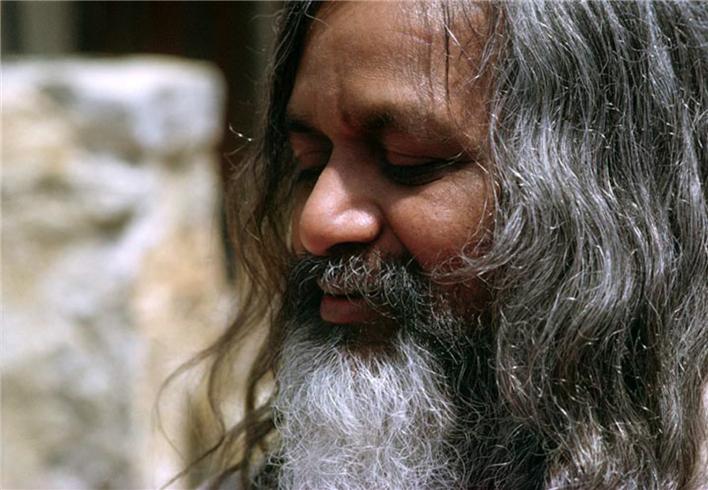
The Maharishi Global Development Fund is a nonprofit, 501(c)(3) organization owned by the 1960s Indian mystic and former spiritual guide to the Beatles, the Guru Maharishi Mahesh Yogi. The 600-room hotel was purchased with the intent of having a spiritual sanctuary and a learning center for members of the Transcendental Meditation movement, complete with an upscale vegetarian restaurant, in downtown Houston.
The Guru’s utopian vision somehow took a turn in the wrong direction over the next three years, and by 1995, and in need of extensive renovation, the HOE evolved into an extended-stay residential shelter for Houston’s homeless and the underemployed. It also became a magnet for individuals with backgrounds in petty crime and drug abuse.
By 1998, the city of Houston forced the hotel to close its doors for safety reasons and building code violations. The hotel has been vacant and for sale for the 14 years since it ceased operating. Due to the need for extensive renovation, including asbestos abatement, the sale of this 33-story mid-rise edifice has become cost prohibitive and the building remains an eyesore on Houston’s skyline.
Beirut Hilton
Timothy Bleakie, a former resident of the Heaven on Earth in the mid-1990s, remembers what life was like living in this unusual extended-stay hotel where the elevators seldom worked and room break-ins were a frequent occurrence.
“Seven to eight of us bicycle messengers occupied the entire 14th floor back in 1995,” said the former HOE resident and well-known downtown Houston bicycle courier. “We paid $275 per month with double occupancy and our utilities were included. We mainly kept to ourselves because, believe it or not, there was a lot of crack and heroin use among the tenants back then and there was a lot of crime as a result.”
“The owners thought they would attract a higher caliber of resident by offering on-site lessons in Transcendental Meditation, but that wasn’t the case. Very few of the tenants took them up on the offer. It was an ill-conceived business project. The average stay was about one month but I ended up living there for six. I became a model tenant and I even ended up maintaining the swimming pool on the 7th floor.”
The Heaven on Earth was one of several investment properties purchased by the MGDF throughout the United States in the 1990s that included other vacant hotels in Chicago, Tulsa, Detroit, Hartford, and Avon Lake, Ohio. Like the one in Houston, these spiritual sanctuaries and learning centers were christened “peace palaces” whose mission was to “improve humanities’ global consciousness” as well as realize a substantial profit.
Ironically, near the end of its demise, the HOE became known as the “Beirut Hilton” by its residents and downtown neighbors because of its rundown appearance and its resemblance to the infamous, bullet-riddled hotel in war-torn Lebanon. According to Houston Police Department records, by 1998, the HOE had been the scene of multiple drug busts, assaults, and one homicide.
“It got rougher toward the end of my six month stay,” Bleakie said. “Most of the tenants didn’t have any money and were substance abusers. By the time I moved in, the vegan restaurant had already closed. They were still offering classes in TM on the top floor but very few tenants took them up on the offer.”
“There was a lot of paranoia among the residents regarding break-ins. The room keys were very easy to duplicate and you could easily enter a room with a credit card or driver’s license. There was a man who lived there with his daughter and he was a junkie. The man used to trick out his daughter just to pay the rent.”
Because of the Maharishi’s strict eastern religious beliefs and the fact that he subscribed to the principles of Vedic architecture, the residents were not allowed to use the actual entrance to the building. These architectural principles govern the orientation of a building and designate from what direction one may enter. “The residents were forbidden from using the main entrance on the building’s south side,” Bleakie explained, “so we used a small service entrance facing west on Milam Street instead.”
“My biggest fear was that one day there would be a fire and we wouldn’t be able to get out. I remember that all the elevators quit working for two weeks one time and there weren’t any phones in the rooms, only in the lobby. There was also a woman in a wheel chair that lived on the 25th floor. She had to have her food brought to her until they were fixed. I remember that the cops and the fire department were there quite often.”
Spiritual default
In 2004, the Houston Business Journal reported that the hotel was sold to LandCo Investments, LLC, for $8.5 million. However, by 2005, the Colorado-based investment group defaulted on its promissory note to the MGDF, thereby reverting ownership of the hotel back to the Maharishi.
On February 5, 2008 the Guru Maharishi Mahesh Yogi died leaving his investments and his spiritual movement in the hands of his multiple family members and business associates. The Maharishi Global Development Fund reported that at the time of his death, the Guru’s United States real estate assets alone were valued at more that $300 million.
According to the Harris County Appraisal District, effective October 4, 2011, the Heaven on Earth Inn changed hands once again, and has been renamed the Beanmont Medical Center Hotel, LLC. It is still vacant and in need of extensive renovation.
[Ivan Koop Kuper is a real estate broker and a graduate student at the University of St. Thomas in Houston, and maintains a healthy diet of music, media, and popular culture. He can be reached at kuperi@stthom.edu. Find more articles by Ivan Koop Kuper on The Rag Blog.]
By Rag Radio / The Rag Blog / May 2, 2012
Theologian and Social Ethicist Gary Dorrien, an Episcopal priest and professor at Union Theological Seminary and Columbia University, was Thorne Dreyer’s guest on Rag Radio, Friday, April 27, 2012, on Austin community radio station KOOP 91.7-FM, and streamed live on the Internet.
Gary Dorrien has been described by Cornel West as “the preeminent social ethicist in North America today.” On Rag Radio Dorrien discussed liberal Christian theology and the social gospel in relation to contemporary politics and progressive political movements and issues of social and economic justice.
You can listen to the show here.
Dorrien was in Austin to speak on “Breaking the Oligarchy,” at University United Methodist Church in Austin, keynoting a weekend gathering on economic justice and faith, April 27-29, 2012.
Rag Radio, which has aired since September 2009 on KOOP 91.7-FM, a cooperatively-run all-volunteer community radio station in Austin, Texas, features hour-long in-depth interviews and discussion about issues of progressive politics, culture, and history.
Hosted and produced by Rag Blog editor and long-time alternative journalist Thorne Dreyer, a pioneer of the Sixties underground press movement, Rag Radio is broadcast every Friday from 2-3 p.m. (CST) on KOOP and streamed live on the web. Rag Radio is also rebroadcast on Sundays at 10 a.m. (EST) on WFTE, 90.3-FM in Mt. Cobb, PA, and 105.7-FM in Scranton, PA.
Rag Radio is produced in the KOOP studios, in association with The Rag Blog, a progressive internet newsmagazine, and the New Journalism Project, a Texas 501(c)(3) nonprofit corporation. Tracey Schulz is the show’s engineer and co-producer.
After broadcast, all episodes are posted as podcasts and can be downloaded at the Internet Archive.
THIS FRIDAY, May 4, 2012 on Rag Radio: Chris Mooney, author of The Republican Brain: The Science of Why They Deny Science, and Reality.
WE’RE TAKING A BREAK: Rag Radio will be on hiatus May 11 and May 18.
By Danny Schechter / The Rag Blog / May 2, 2012
NEW YORK CITY — It’s easy to understand why presidents, politicians, and the military love robots. They don’t talk back. They follow orders. You press a button and they do what they are told. They are considered so efficient, and so lethal.
These modern killing machines represent science fiction reborn as science “faction.”
Robots and drones don’t burn Korans or pose with the heads of their captives on the battlefield. (Robots also don’t protest wars.) Lose the human factor and you get silent-but-deadly total destruction.
And that’s why drone warfare has become such a weapon of choice. You have video game jockeys sitting on their asses in front of consoles of digital displays at an Air Force base outside Las Vegas, targeting suspected terrorists in Afghanistan. After a couple of quick kills, they take the rest of the day off.
It’s only later, that we get the reports of civilians decimated as collateral damage.
Oops!
These new lethal toys are used both for surveillance and targeted assassinations.
In Congress, according to Code Pink’s Medea Benjamin, there’s even a bipartisan caucus to encourage more building of drones cheered on by the military industrial complex. She has just written a book about it. She told me, “instead of having a caucus to feed preschool children, they decided it was more important to have a Drone Caucus and that’s because all the manufacturers in their districts are funding them.”
I asked Medea if this is more evidence that President Eisenhower was right when he warned of a growing military-industrial complex?
“Eisenhower was so right,” she replied,
and he was so right when he said it steals money, it robs us of food for our children, of healthcare for our parents, he was so right. And it’s just worse and worse. And you get the little puppets in Congress, and I’m in Washington now, so I see these little puppets, and wish that they were like the NASCAR drivers that got to have their corporations on their suits, but they don’t rule America. The corporations obviously rule America.
And when it comes to war and peace, those corporations are so powerful that they’ve kept us for the last decade and more and if we don’t do something about it, they will keep us more for the next decade.
Anti-war activist and author David Swanson has been tracking this phenomenon too, telling me that
members of Congress have created a caucus for drones, where they openly promote the use and sale of drones at home and abroad. They have now authorized the flight of up to 30,000 drones in U.S. skies for whatever purpose — this is in contrast to the lack of any caucus for senior citizens, for children, for health coverage, for green energy, for human beings — there’s a caucus for robots.
Soon we will have an arms race in drones of all kinds. The crash of a U.S. drone in Iran has allowed that country to reverse-engineer one, probably leading to Iran soon making their own.
The Russians and Chinese, even the North Koreans, can’t be far behind.
More worrying to Americans should be a report saying that there are already 63 drone bases inside the United States.
Big things can happen in Congress — as long as no one is watching.
Lobbying records released last week show that there wasn’t much opposition this winter when Congress quietly opened up U.S. airspace to aerial drones, which some advocates for civil liberties say raise a host of concerns about privacy.
Drone technology, advanced by the military for surveillance and elimination of terrorists in war zones, is set to come back to the home front in a big way in coming years, with possible uses for law enforcement, first responders, and agriculture and environmental monitoring.
Select companies and ask local governments around the country already have permission to test drones, which can sometimes stay aloft for days at a time at a fraction of the cost of helicopters and airplanes.
What assisted all of this drone fever?
Remember the NDAA bill passed last year that was signed quietly into law on New Year’s Eve by President Obama?
The Administration assured one and all that it would not apply to military operations on U.S. soil or against American citizens.
It now turns out that the NDAA is being interpreted as authorization to deploy military drones (unmanned aerial vehicles or UAVs) into domestic airspace. A major overhaul of the Federal Aviation Administration’s control system is permitting the deployment of drones
Recently, Alexander Higgins.com reported:
A lawsuit has forced the FAA to reveal the location of 63 Secret Drone bases located inside the United States some of which will be the starting point for more drone warfare.
While the information released shows an alarming number of bases being used for military and local law enforcement drones, perhaps the most startling revelation is that the United States is allowing Canadian Border Patrol drones to operate across the Canadian border.
Odds are that there are many more drone bases inside the United States whose locations have been kept secret for various national security reasons and the lawsuit only forced the government to release the names and locations of permitted U.S. drone operators.
That means that the type of drones — be they for targeted killing, guiding missiles, or general surveillance — and the number of drones at each location still remains a secret although the FAA says they plan on releasing such information at a later date.
England’s Daily Mail has more information:
Most of the active drones are deployed from military installations, enforcement agencies and border patrol teams, according to the Federal Aviation Authority.
But, astonishingly, 19 universities and colleges are also registered as owners of what are officially known as unmanned aerial vehicles.
It is thought that many of institutions, which include Cornell, the University of Colorado, Georgia Tech, and Eastern Gateway Community College, are developing drone technology.
There are also 21 mainstream manufacturers, such as General Atomics, who are registered to use drones domestically.
As well as active locations, the FAA also revealed 16 sites where licenses to use spy planes have expired and four where authorizations have been disapproved, such as Otter Tail County, Minnesota.
However, the FAA is yet to reveal what kinds of drones might be based at any of these locations. The agency says it will release this data later.
Robot technology has other uses too, says financial journalist Max Keiser, who told me in a recent appearance on my Progressive Radio Network show that algorithm based technology is now actually writing stories, perhaps even like this one.
He explained,
Forbes Magazine wrote a story a couple of weeks ago about computers that are able with narrative software to take prices from the exchange and create stories in any of the ways that they want in their magazine. So it can be like, okay, write a story about the prices that — the closing prices in the technology sector in the voice of Danny Schechter. And they’ll create a story and it’ll appear in the magazine.
So it’s a computer that’s writing the stories, but the computers are also reading the stories.
Oops, Delete!
[News Dissector Danny Schechter blogs at Newsdissector.net. His recent books are Occupy: Dissecting Occupy Wall Street and Blogothon (Cosimo Books). He hosts News Dissector Radio on PRN.fm. His latest film is Plunder: The Crime of Our Time. Email Danny at dissector@mediachannel.org. Read more articles by Danny Schechter on The Rag Blog.]
Occupy 1914?
‘More Powerful Than Dynamite’
By Ron Jacobs | The Rag Blog | May 2, 2012
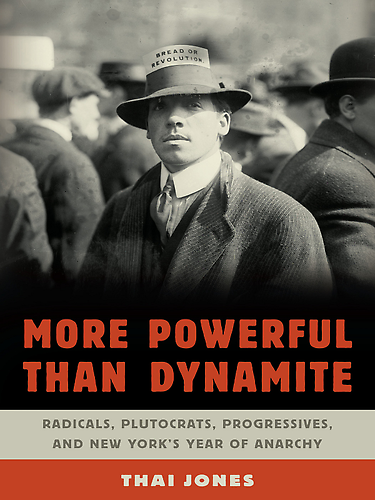
[More Powerful Than Dynamite: Radicals, Plutocrats, Progressives and New York’s Year of Anarchy by Thai Jones (2012: Walker and Company); Hardcover; 416 pp.; $28.]
Anti-capitalist protests in Union Square brutally attacked by police. Economic hardship among the workers. Ostentatious expenditure by the wealthy. This scenario sounds like the news headlines of the past couple of years, yet the period referred to is the year 1914 and the story is the one told in More Powerful Than Dynamite: Radicals, Plutocrats, Progressives and New York’s Year of Anarchy.
This book is a history that includes some of history’s most famous anarchists and a progressive president determined to use government for good but indebted to the finance house of Wall Street. That indebtedness leads him into war and repression.
There’s also a progressive mayor of the world’s largest city whose plans include using government to lift people from poverty and despair. His social engineering ends up making very few people happy: not the wealthy and not the poor.
The city was New York. The year was 1914. The anarchists included Alexander Berkman and Emma Goldman. The mayor was John Mitchel and the president was Woodrow Wilson.
Despite the best-laid plans, it was as if the weather itself conspired with the plutocrats in a relentless effort to prevent Mitchel from ending the corrupt tradition of politics in Manhattan known colloquially as Tammany Hall. The economy that had already shrunk the employment rolls worsened in the wake of a series of snowstorms and bitterly cold weather that forced thousands into the streets without work, shelter or income.
When a city agency decided to use the unemployed to shovel snow out of the streets and sidewalks, not only did the task turn out to be beyond the capabilities of those involved, the measly pay offered became one more cause for radicals to organize around. The popularity of the cause proved the rationale of the organizers.
There was no communist party in the United States in 1914. The lead in the protests was taken by the anarchists. Their success at engaging the urban unemployed while enraging the wealthy and middle class encouraged the leadership to take increasingly provocative actions. This in turn intensified the wrath of the wealthy and their guardians, the police.
After it was determined that the aggressive and violent tactics of the police only served to increase the popularity of the protests, a new chief was appointed who changed tactics. He allowed protests while simultaneously building an intelligence network among the radicals.
This network involved the recruiting of spies, provocateurs and, ultimately, the use of those provocateurs to instigate actual crimes designed to incriminate individual radicals, thereby painting the entire movement as criminal. In short, anarchists were the “terrorists” of the period and the tactics used by the authorities against them were the same as those being used against today’s “terrorists” and radicals.
Jones, whose previous work includes a memoir (A Radical Line) that is partially about his childhood growing up underground with his Weather Underground parents, provides the reader with an incredibly detailed, impeccably researched look at this period in New York’s history.
Not only do the characters come alive in Jones’ telling, so do the issues. Of course, this is in part due to the fact that the issues continue to be relevant in today’s climate of corporate domination and willful destruction of the dreams of working people.
For many people, reading history can be a chore. A good history text must either tell a story so good that one puts up with the dryness of the text or it must be told in a way that keeps the reader’s interest. In More Powerful Than Dynamite, Thai Jones provides both, thereby creating a compellingly written tale of an incredibly interesting time.
[Rag Blog contributor Ron Jacobs is the author of The Way The Wind Blew: A History of the Weather Underground. He recently released a collection of essays and musings titled Tripping Through the American Night. His latest novel, The Co-Conspirator’s Tale, is published by Fomite. His first novel, Short Order Frame Up, is published by Mainstay Press. Ron Jacobs can be reached at ronj1955@gmail.com. Find more articles by Ron Jacobs on The Rag Blog.]
By Lamar W. Hankins | The Rag Blog | May 2, 2012
“The GOP has become an insurgent outlier in American politics. It is ideologically extreme; scornful of compromise; unmoved by conventional understanding of facts, evidence and science; and dismissive of the legitimacy of its political opposition.” — Thomas E. Mann and Norman J. Ornstein, The Washington Post
It would be hard to pick the most “ideologically extreme” Republican today, but one of the top five would surely be John Raese, a Republican candidate for the U.S. Senate in West Virginia. Raese thinks that a requirement to place a sign on his building that declares it a smoke-free environment is an atrocity.
That’s a fine sentiment, but you may be shocked at what he believes is the sign’s equivalent: “Remember Hitler used to put Star of David on everybody’s lapel, remember that? Same thing.” Not only is Raese’s statement historically inaccurate, but the building sign is not an equivalency to a precursor of Nazi genocide against Jews, gypsies, and homosexuals. Raese’s mind is clearly going to waste.
Recently, Republicans on the Senate Judiciary Committee have unanimously opposed the historically bipartisan Violence Against Women Act.
Both of Texas’ Republican senators dislike provisions of the bill that would allow tribal courts to adjudicate domestic violence cases that occur on reservations and involve non-Indian suspects. Further, they oppose a provision that would allow more temporary visas to be issued for undocumented immigrant victims of domestic violence. And they don’t want the Violence Against Women Act to be expanded to protect gay, bisexual, or transgender victims of domestic abuse.
While good arguments against these provisions may exist, the two senators from Texas didn’t make them. Although a few Republican senators did vote in favor of the Senate version of the bill, there is little chance that there will be bipartisan support for the bill in the House.
It is increasingly difficult to believe that the Republican Party is the party of “law and order,” as it used to tout itself. Even law and order is too mundane for today’s Republican extremists.
The powerful Republican Chairman of the House Budget Committee, Paul Ryan, decided that he had a winning argument in support of his budget proposal by claiming that it was based on his Catholic heritage: “Our budget offers a better path, consistent with the timeless principles of our nation’s founding and, frankly, consistent with how I understand my Catholic faith.”
He spoke about this recently at the Catholic-run Georgetown University, where almost 90 faculty members and administrators challenged Ryan’s view of Catholic doctrine.
In a press release, Father Thomas Reese, a fellow at the Woodstock Theological Center at Georgetown, is quoted as saying, “I am afraid that Chairman Ryan’s budget reflects the values of his favorite philosopher Ayn Rand rather than the gospel of Jesus Christ. Survival of the fittest may be okay for Social Darwinists but not for followers of the gospel of compassion and love.”
Ryan tried to distance himself from Ayn Rand, claiming his embracing her was a youthful obsession. Yet, it’s hard to forget his earlier pronouncements about Rand:
Ryan’s budget pronouncements have been opposed not only by Catholics at Georgetown, but by the U.S. Conference of Catholic Bishops and many groups of nuns and Catholic lay workers who have given their lives to helping people most vulnerable to Ryan’s budget cuts — those who use Catholic-run soup kitchens, homeless shelters, and other social service charities.
Ryan’s budget follows the welfare reforms supported by the neoliberal ideas of President Bill Clinton and warmly embraced by almost all Republicans, as well as most Democrats, in the mid-1990s. Those reforms led to greater child poverty rates, but Ryan insists, against the evidence, that the so-called reforms brought down poverty rates.
Such claims, made against verified, non-partisan data, are characteristic of the failure to think logically, and honestly. During the first decade of this century, child poverty rates in the U.S. rose from about 17% to about 22%. This rise occurred after the mid-90s’ welfare reforms took hold — evidence that welfare reform contributed to, not reduced, child poverty.
Ryan’s budget continues the earlier welfare reforms and makes them worse by scaling back food stamps and drastically reducing Medicaid, the primary health care program for the poor. It seems fair to say that Ryan’s Republican mind is as dishonest and wasted as they come.
Another wasted Republican mind is that embodied in Senator Marco Rubio, the up and coming Republican senator from Florida. He is trying to find a way to convince other Republicans that he can put together a DREAM (Development, Relief, and Education for Alien Minors) Act that will satisfy modern Republican goals and still appear to be significant reform.
The original DREAM Act was intended to reform immigration law by providing a path to citizenship and was a Republican idea, first introduced by Republican Senator Orin Hatch of Utah 11 years ago, along with Sen. Dick Durbin (D-IL). Now, Rubio is working on a plan that will create permanent second-class citizens of immigrants to whom it will apply by denying them a path to citizenship, but allowing them to live and work in the U.S. He has yet to explain the details.
The original DREAM Act was from the Republicans of old, who were willing to work with Democrats to make government work for the people. Today’s Republicans mostly like to castigate immigrants who came to this country without an approved, legal status, no matter why they came here.
These Republicans don’t care that a high percentage of these immigrants are children and had no choice but to follow their parents, as children everywhere usually do. After a short while, such children become Americans culturally, if not legally.
Today’s Republicans are focused more on border security than they are on helping mostly Latino immigrants live here legally by allowing them to prove their value to this society before being granted a path to citizenship.
But even today’s Republicans make exceptions. If you are Cuban and can manage to set foot on American soil, you can stay here in most cases without worrying about being snatched away by ICE (Immigration and Customs Enforcement), an apt acronym for the cold-hearted politicians who would deny to other Latinos what they willingly give to Cubans.
And then there is Republican Representative Virginia Foxx of North Carolina, the chair of the House Subcommittee for Higher Education, who believes that today’s students should be able to do what she did 40 years ago and work their way through college without any help with loans. Never mind that tuition and fees (adjusted for inflation) are three to eight times what they were four decades ago.
Mitt Romney suggests that students just borrow the money needed for college from their parents. Either his mind is wasted or he is out of touch with the fact that few parents have his resources. Neither of these representative Republicans has sympathy for or understanding of the financial needs of today’s students. Doesn’t Romney know that most parents, if they had the money, would pay for their children’s education themselves? They’d give them the money, not lend it to them.
Foxx’s views are important because on July 1, the interest rates on student loans will double, adding about $1,000 per year on average to the cost of a student loan. When the House passed Ryan’s budget last year (it didn’t make it past the Senate), it included the increase in interest rates on student loans. No Democrat voted for it, but 97% of Republicans did, indicating their near-unanimous support for permanently increasing the interest rate on student loans.
In spite of House Speaker John Boehner’s recent histrionic claims that the Republicans have no problem with keeping the interest rates as they are now, Foxx and most Republicans will put up as many roadblocks as possible to the proposal to keep current student loan interest rates.
It is already clear that Republicans want to reduce federal outlays for women’s health and childhood immunizations to compensate for keeping the interest rates low; Democrats want to compensate by eliminating oil and gas subsidies for some of the most profitable corporations in America — subsidies that they don’t need to stay productive. That’s a difference worth contemplating.
At a time when federal banks can borrow money at almost no interest, it is difficult to understand why student loans should double from 3.4% to to 6.8%. But it makes sense if you conclude that Republicans don’t believe in a government that works for the benefit of the public good, rather than the benefit of the 1%, and if you believe that higher education is a public good.
Until the 1970s, tuition was prohibited for higher education in California, but no one ever talks about the benefit to society of universal higher education, so instead we are debating issues like interest rates.
But the most wasted Republican mind of late seems to be that of Rep. Allen West of Florida. He claimed recently that there are “78 to 81” Democrats in Congress who are members of the Communist Party. The late, infamous Sen. Joe McCarthy would have been proud. If his rotten corpse could smile, we’d all be able to see his Cheshire Cat grin.
So far, however, I’ve not heard any Republican condemn this ridiculous false assertion, which is some evidence that all their minds are a wasteland.
Science writer Chris Mooney tries to explain “The Republican Brain” in his new book by that title. Mooney’s research suggests that Republicans tend to be conservative because they are authoritarian (they tend to see things in black and white, without the ambiguities and complexities that non-conservatives wrestle with), lack openness to experience, and have a high need for closure.
As it turns out, Republicans aren’t even interested in learning more about themselves — most Republicans who have critiqued it have panned Mooney’s book without even reading it. But what they really distrust is science.
Science provides a way — arguably the best way — to investigate things we can observe, to acquire new knowledge, and to correct or better understand previously acquired knowledge. Scientific knowledge can be tested repeatedly to determine its truth.
The opinions expressed in this article are not science, but they are based on observable phenomena. I don’t pretend that they are objective, but there is evidence to support my views, if the reader is willing to consider that evidence.
Republican minds were not always the wasteland they are today. I gave up on Republicans as honest brokers of the truth long before I gave up on the Democrats, which happened 20 years ago. So this is an essay on the failure of our political system to produce people who value truth. A scattering of people throughout the political spectrum value truth, but they are few.
I’ve gone easy on the Democrats this time largely because a few more of them favor the people over the corporations. While I will vote in the Republican primary again this year, it won’t be because Republicans are more wedded to the truth. I’d like to help them get over their disdain for science, but I’m not holding my breath.
[Lamar W. Hankins, a former San Marcos, Texas, city attorney, is also a columnist for the San Marcos Mercury. This article © Freethought San Marcos, Lamar W. Hankins. Read more articles by Lamar W. Hankins on The Rag Blog.]
By Greg Moses / The Rag Blog / May 1, 20112
Counting in reverse through the great Theses on Feuerbach, we pass by the iconic eleventh, which demands that we quit describing the world and start changing it, in order to re-visit the lesser-known tenth.
“The standpoint of the old materialism is civil society;” says the Smith-Cuckson translation of the tenth thesis, “the standpoint of the new is human society or social humanity.” In plain English we recognize the warning already sounded in 1845 that normalized uses of “civil society” bring with them bureaucratic retinues, orders of articulation, credentials, and border-sweeping technologies of lethal effect.
In the author’s German original, the term for the old society is not “civil” but “burgerliche,” which is usually translated into “English” as bourgeoise. Therefore on this May Day 2012 we ask how far from a bourgeoise society have we traveled and what are the prospects of ever realizing our “social humanity” (oder die gesellschaftliche Menschheit)?
This May Day question is born from the robust and passionate vision expressed by the twenty-something German author when he dashed off the tenth thesis as a prelude to his life’s work. It reminds me of a slightly older Thoreau, who wrote in his great “Civil Disobedience” of 1849 that “when men (sic) are prepared for it” they will be governed by no government at all.
Together these authors sing lyrical sentiments worthy of May Day, a calendar occasion for marking human celebrations of life, labor, and liberty.
As Rosa Luxembourg tells the modern history of May Day, it was born in Australia by workers — the stonemasons of Melbourne University, says Wikipedia — who in 1856 won their struggle for an eight-hour work-day. In the radical Republican aftermath of the U.S. Civil War, the eight-hour day was adopted for federal employees and proclaimed as a presidential principle by Ulysses S. Grant.
Deploying the eight-hour policy into “private” employment became a bloody struggle for several decades more, validating the sorts of things that Marx liked to write about revolution, and solidifying the modern association between May Day and labor struggle.
And still, the story of May Day goes back into archaic traditions of human responses to springtime. Dancing around maypoles, people enact a sense of participation in the joys of natural renewal and growth won back from winter’s death. Even in the “Official Eight Hour Song,” we hear a human demand to experience the things of spring. “We want to feel the sunshine, and we want to smell the flowers, for surely God has willed it and we mean to have it ours.”
In the accumulated history of factory work, the cruelty of long hours would become ever more unbearable in proportion to April’s lengthening light.
“Why should not we also enjoy an original relation to the universe?” asked Emerson, anonymously, in his essay “Nature” of 1836. “Our hands and hearts are weary and our homes are heavy with dole,” rejoined the singers of the eight-hour song, “if our lives are filled with drudgery, what need of a human soul?”
In some parts of Texas especially this year spring has gushed from the soil like a trillion geysers of greening promises. Landscapes that last year groaned under dehydrations the color of burnt toast this year have sprung into unbelievable thickness of life. Just add water, and up from underground it comes dressed for dancing in the sun.
“All social life is practical,” declares thesis number eight, as our countdown continues. “All mysteries which lead theory to mysticism find their rational solution in human practice and in the comprehension of this practice.”
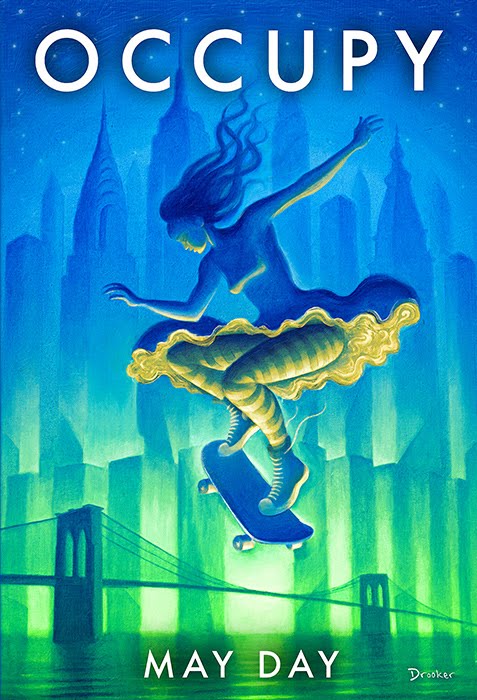
May Day 2012 promises to revive the greening energies of general strike, when people declare for themselves a day to stand apart from everything they do in the name of “civil society” and posit the experience of a more social humanity.
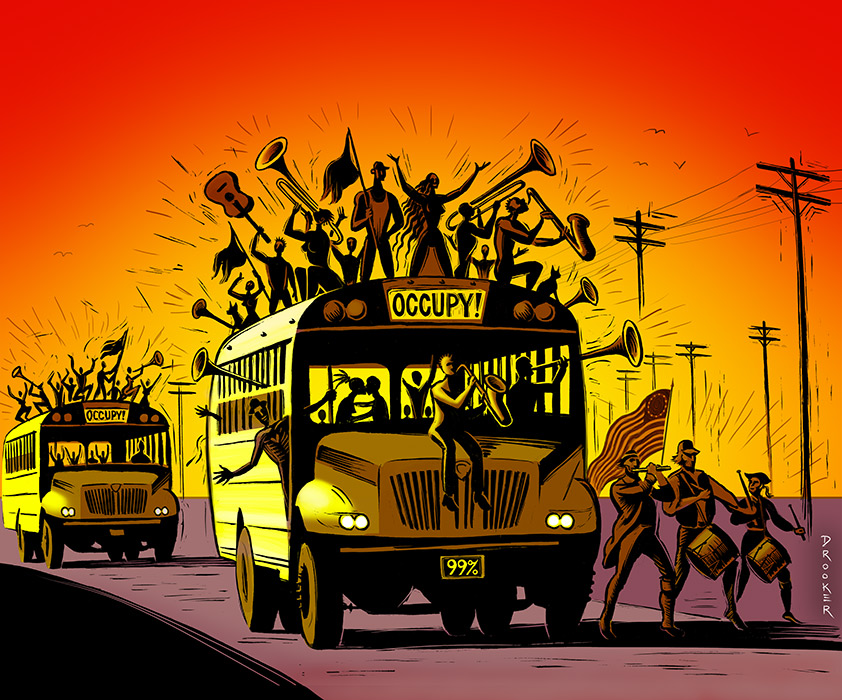
The global Occupy movement inspired by Tahrir Square is this spring beginning to makeover vacant lots and abandoned bookstores into gardens and museums. People are seeking new ways to practice their social humanity. Dead spaces, dehydrated by a “capital strike” are being renewed through social labor, which is the only source that capital can come from in the first place. People are exploring human practices and comprehending possibilities in the best ways they know how.
“There is no doubt,” wrote the wise Jane Addams, “that the great difficulty we experience in reducing to action our imperfect code of social ethics arises from the fact that we have not yet learned to act together, and find it far from easy even to fuse our principles and aims into a satisfactory statement.”
There is no royal road to the new, but that has never stopped life from moving forward. We don’t have to live out other people’s gridlock as our own.
So when I hear that San Francisco activists have ploughed under idle land the better to grow their own food, or that people in East Lansing have transformed an abandoned book store into a museum, I think of Henry George scanning his beloved bay area and recognizing the absurd contradiction of a system that would enforce monopoly over idle property even as it grinds out longer lines of joblessness and poverty.
Throw property open to anyone weary of idle hands, and you practically eliminate idleness altogether. “It is not the relations of capital and labor,” said George, “not the pressure of population against subsistence, that explains the unequal development of society.” No. “The great cause of inequality in the distribution of wealth is inequality in the ownership of land.”
We don’t know if Henry George was right. In the end it will be a practical question answered in practice, not theory alone. But we do have some acquaintance with the practical absurdity of “civil society” reacting with brutality to the social, human occupations of idle spaces. Pardon us please if we are well reminded of Hawthorne’s immortal account of what happened to Thomas Morton.
A general strike would at least emphasize an insight that unifies both ancient and modern histories of May Day. It is through our sheer participation in life itself that we find any shred of value whatsoever. By dedicating a day each year to the dancing practices of our social humanity and their comprehensions, we remind ourselves of a proper standard for evaluating everything in between.
[Greg Moses is editor of the Texas Civil Rights Review and author of Revolution of Conscience: Martin Luther King, Jr. and the Philosophy of Nonviolence. His entries on King and Racism appear in the Encyclopedia of Global Justice. He can be reached at gmosesx@gmail.com. Read more articles by Greg Moses on The Rag Blog.]
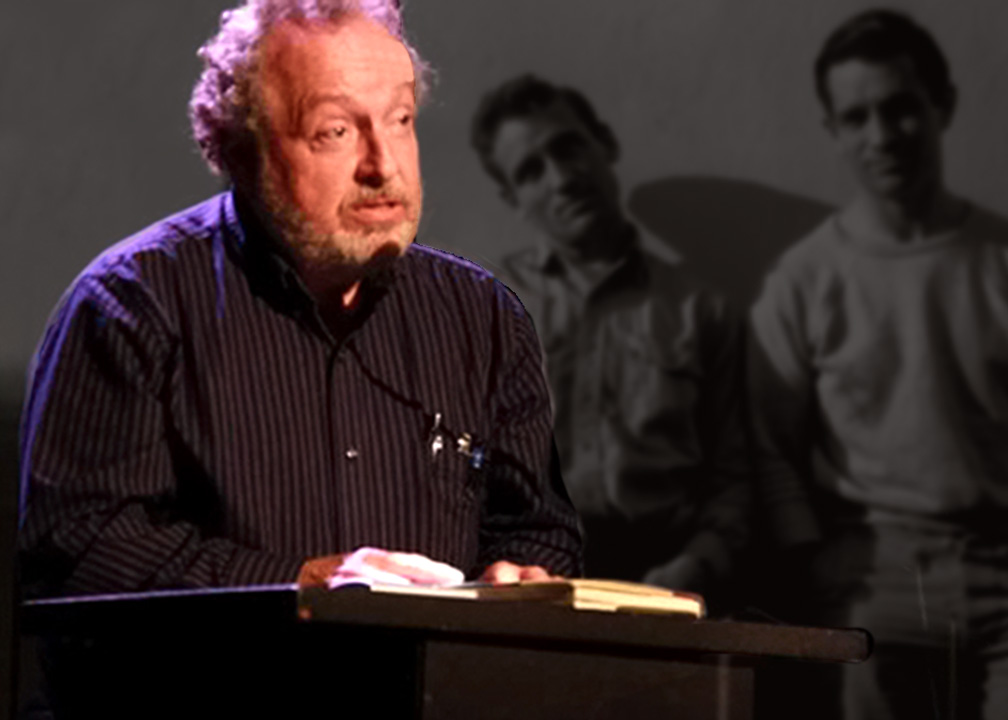
The Beats are back! Allen Ginsberg biographer and former Yippie activist Jonah Raskin profiles and interviews Jack Kerouac scholar Gerald Nicosia as three new Beat movement-inspired movies are in the works, including Walter Salles’ version of Jack Kerouac’s “On the Road.” Raskin and Nicosia talk about “Kerouac, Ginsberg, Burroughs, and their friends and lovers.”
By Jonah Raskin | The Rag Blog | April 16, 2012
For decades, the Illinois-born writer, Gerald Nicosia, has made it his business to follow the fortunes and misfortunes of the spunky writers of the Beat Generation. This year with three new Beat movies — Kill Your Darlings, Big Sur, and On the Road — he’s as vigilant and as outspoken as ever.
He’s also waiting impatiently for the films to arrive at his neighborhood theater. Daniel Radcliffe of Harry Potter fame stars as Allen Ginsberg in Kill Your Darlings. Walter Salles, the director of The Motorcycle Diaries, directs the movie version of Kerouac’s novel, On the Road. An adviser on Salles’s film, Nicosia played a big behind-the-scenes role, and he’s betting that it will help spread the rebellious spirit of the Beats.
The author of a hefty biography of Jack Kerouac entitled Memory Babe, and a poet in his own right, Nicosia carries on the cultural and spiritual legacy of his literary heroes. For him, American literature is the literature of protest and rebellion that goes back to Henry David Thoreau and that includes Jack London, the socialist adventurer, and the tribe of Chicago writers such as Nelson Algren, author of A Walk on the Wild Side.
Though he lives in bucolic Marin County, California, he walks and talks with the gusto of Chicago and its rough-and-tumble novelists and poets. I’ve known Nicosia for 30 years; we first met after a poetry reading that Allen Ginsberg gave at College of Marin.
In 2005, we launched a 50th anniversary celebration for Howl at the San Francisco Public Library with crowds standing in the aisles and at the back of the theater. In 2007, we produced a 50th anniversary celebration for On the Road at the Jewish Community Center in San Francisco, with more than 600 people in the audience.
When I heard that three new movies about the Beats were on the way to movie screens around the world I thought it was time to talk to Nicosia again and find out what he was thinking about Kerouac, Ginsberg, Burroughs, and their friends and lovers.
Gerald Nicosia: That they were responding to an urgency in America, a wrong direction taken, a loss of community, a loss of brotherly love, a loss of a moral center.
You worked as an adviser to the film version of On the Road. What suggestions did you make to the actors and the director?
I told the actors not to worry about getting the exact details of the lives they were portraying. I told them that what was important was to give people a taste of what the love of these people was all about. With the director, Walter Salles, I got into things more deeply. He wanted to talk about the main characters’ search for identity and for the father.
I told him I thought the brother relationship between Neal Cassady and Jack Kerouac was at the heart of the novel — these two outcasts, misfits, learning to care about and take care of each other, breaking down the walls of isolation that were being so rapidly erected in postwar World War II America.
Why do you think there are three Beats movies coming out now? Is 2012 like the 1950s when their books were first published?
The cash-in on the Beats began several years ago. Now, you have three estates, those of Kerouac, Ginsberg, and Burroughs, discovering that there is unlimited money to be made in marketing these properties in electronic media and film.
Will any of the new movies do justice to the Beats?
I have the highest hopes for the movie of On The Road, because it was made outside the Hollywood system, financed by a small European company, MK2, and made by people who genuinely care about Jack’s message, beginning with the director Walter Salles. I don’t think he was put under the same pressure to make a “hit” that American moviemakers are under.
When and where and how did you first become interested in Kerouac?
I was at the University of Illinois in Chicago, getting my master’s. My officemate was a hip kid from Harvard who kept dropping Kerouac’s name because he knew I hadn’t read him. This was 1972 — three years after Jack died. The Dharma Bums and On The Road were the only two Kerouac books in print. I was blown away by Kerouac’s compassion for the down-and-out, the working class, those on the wrong side of American capitalism.
On what side of capitalism were you raised?
My family was working class — my dad a mailman, his father a construction worker and chimney sweep; my mom’s father a barrel maker, my mom’s mom ran a grocery store, my mom a secretary all her life.
How do you explain the Beats? Kerouac came from a Catholic working class family. Ginsberg was from a Jewish left-wing family and William Burroughs was white Anglo Saxon protestant. What did they have in common?
Amiri Baraka says they all came from minorities not yet fully assimilated into the American capitalist dream. I would say they were individuals who, by birth, temperament, political persuasion, and economic status, did not fit in with materialistic, chauvinistic, and belligerent American society. They were trying to find a way they felt had existed during the Great Depression of the 1930s.
You spent years doing research about Jack Kerouac. What would you say was the biggest surprise?
Kerouac’s books portray a hero and narrator free and easy, confident, sure of his rebellion against the American system. In reality, Jack was torn between Catholicism, Buddhism, and his own demon-driven pursuit of kicks, between spirit and flesh, between mom’s house and the Beat coffeehouse, patriotism and subversion, men and women, society and solitude, carousing and meditation, sacred and profane, secular and divine. It’s a miracle he survived as long as he did.
For years the Sampas family controlled the Kerouac estate? For those who don’t know, who are they and what damage did they do?
Sam Sampas was Jack’s first friend who gave him the courage to be a poet despite the jeers of his working class community. Late in life, when Jack’s mom had a stroke and refused to go into a nursing home he married Stella Sampas, Sam’s older sister, to take care of his mother. The marriage was a disaster, and Jack was about to divorce her when he died of liver disease from drinking at 47.
What happened with the will of Jack’s mother?
Stella forged Gabrielle Kerouac’s signature, thus stealing the estate from her grandchildren: Jack’s daughter, Jan Kerouac, and Jack’s nephew, Paul Blake, Jr. The damage they did was to sell Kerouac’s archive into private hands. Not one of the 9 or 10 manuscripts Jack wrote on long rolls of paper is now in a library where it can be studied.
I’ve heard it said that if it weren’t for Ginsberg and his savvy with promotion and public relations there would be no Beat Generation. How important was he in the marketing of his friends and their books?
He was very important — both in terms of things he wrote, and in schmoozing people in positions of power who could help the Beats get recognized. His thousands of readings carried the Beat message to millions of people.
Ginsberg, Kerouac, Burroughs, and Cassady knew one another from New York in the 1940s. How was that time and place significant for their development?
I think for all of them the key was to break out of the conformity, narrow-mindedness, and materialism that New York represented. Neal Cassady with his visions of Western individualism provided a way out for Ginsberg and Kerouac; for Burroughs the way out was through Tangier, Paris, and London, and finding more freedom in older cultures.
Kerouac would be writing. Cassady would be taking Viagra and chasing women. Ginsberg would be teaching. Burroughs would be taking his daily Methadone and plotting his next novel. They were driven people, on a mission, and only death could stop them.
We know now that there were women of the Beat Generation and that they wrote books. What do their books add to those written by their lovers, husbands, and boyfriends?
There was a heavy price to be paid for that male-led revolution. Somebody had to support it by hard work and carrying the daily load, the family load, that those male revolutionaries didn’t have time or inclination for.
In what ways do you think the Beats led to the rebellion and the protests of the 1960s?
They absolutely made the crack in Fifties consciousness, through which the counterculture of the Sixties poured. It couldn’t have entered without that wedge driven into the concrete wall of Eisenhower-McCarthy-Billy Graham America.
The Beats became a global phenomenon. What is it about them that appealed to citizens of the world?
They are citizens of the world; they speak as citizens of the world. It was a rare American ecumenical movement — even more so than the Transcendentalists, who were also reading Asian and Indian texts. The Beats actually went to those places, mingled with people, shared their writings, and learned from other cultures. I think people in other countries see this as a rare phenomenon among Americans.
The Beats didn’t do anything in moderation. If you knew them back in the day would you have cautioned them not to be as intense as they were?
No, you can’t slow down intense people. They have to burn at their own rate. People on a mission are unstoppable. God bless them for it. It would be a poorer, more miserable world without them.
For someone nineteenth or twenty years old now what Beat books would you recommend they read?
On the Road, The Dharma Bums, Desolation Angels by Kerouac. Howl, Kaddish, and The Fall of America by Ginsberg. Most of Burroughs is going to go over their heads, unless they’re lit majors. Gregory Corso’s poems, “Marriage” and “Bomb.” Diane Di Prima’s Revolutionary Letters, Ted Joans’s Teducation, Bob Kaufman’s Cranial Guitar, Jack Micheline’s River of Red Wine, and Ray Bremser’s Poems of Madness and Cherub.
[Jonah Raskin is the author of American Scream: Allen Ginsberg’s “Howl” and the Making of the Beat Generation and a regular contributor to The Rag Blog. Read more articles by Jonah Raskin on The Rag Blog.]
The new NATO is a secretive and costly instrument of war and aggression. It makes its own rules and confirms its own authority.
By Bernardine Dohrn and Bill Ayers | The Rag Blog | April 26, 2012
The day after the 9/11 attacks the Bush administration took dozens of extreme, transformative actions, including invoking Article 5, the right to collective self defense, of NATO’s founding charter — a first in NATO’s 50-year history.
This marked the fateful expansion of NATO’s mission into new geographical regions (such as Afghanistan) and novel functions, such as the initiation and rationalization of the use of preemptive attacks on sovereign states.
All of this was codified and consolidated over the next months in support of the U.S. “war on terror,” crimes committed by non-nation state actors were reframed as “acts of war,” and NATO nations were now expected to join together and respond in kind, opening a door onto war without end, worldwide conflict, and the “long war.”
This is why groups of citizens in virtually every NATO nation have come together to press their governments to leave this deadly enterprise.
NATO has become part of the background noise that over time and with repetition we simply take for granted, an unexamined but passively accepted part of the given world: “NATO forces…” “NATO bombings…” “NATO casualties…” NATO becomes a familiar and entirely opaque presence in our lives. In reality NATO is anything but benign, and exposing the reality behind the mask is an urgent responsibility.
NATO is not a mutual self-defense organization; it is now plainly a global military alliance designed to engage in aggressive invasions and preemptive wars. A 2004 communiqué declared that “Defense against terrorism may include activities by NATO’s military forces, based on decisions by the North Atlantic Council [not the UN Security Council] to deter, disrupt, defend and protect against terrorist attacks, or threat of attacks, directed from abroad, against populations, territory, infrastructure and forces of any member state, including by acting against these terrorists and those who harbour them.”
NATO has collaborated with the U.S. CIA in a wide range of illegal activities, including detainee transfer operations called “renditions,” blanket over-flight clearances, and access to airfields for CIA operations — in effect acting as partners in torture, abduction, and indefinite detention. Under cover of NATO, the U.S. has created an entirely unaccountable framework that enables it to evade both national and international law.
NATO has refused to address civilian casualties resulting from NATO bombings and drone attacks in Afghanistan, Pakistan, and Libya. The U.S. continues to dominate NATO military strategy and weaponry, accounting for virtually all of the 7,700 bombs and missiles dropped or fired on Libya.
The Nuclear Non-Proliferation Treaty (NPT) of 1968 prohibits nuclear weapon states from transferring nuclear weapons to non-nuclear states, and conversely prohibits non-nuclear states from receiving nuclear weapons from nuclear states. All NATO members are parties to the NPT. The five non-nuclear countries (Belgium, Germany, Italy, the Netherlands, and Turkey) that maintain U.S. nuclear weapons on their territory, and the U.S. itself, are all in violation of the NPT.
The new NATO is a secretive and costly instrument of war and aggression. It makes its own rules and confirms its own authority. As a tool of global intervention NATO undermines democracy and constricts citizen participation on issues of war and peace. It has no place in a democracy, and an authentic democracy should have no business with NATO.
[William Ayers is Distinguished Professor of Education and Senior University Scholar at the University of Illinois at Chicago. Bernardine Dohrn is Clinical Associate Professor of Law and Director and founder of the Children and Family Justice Center at Northwestern University. Both Ayers and Dohrn were leaders in SDS and the New Left, and were founders of Weatherman and the Weather Underground. Find more articles by and about Bill Ayers and Bernardine Dohrn on The Rag Blog.]