Bob Feldman : Texas Oil Industry Emerges; O. Henry Publishes, 1890-1920

William Sydney Porter (later to be known as O. Henry) in Austin, circa 1880’s. Image from Austin History Center, Austin Public Library / Wikimedia Commons.

The hidden history of Texas

Part IX: 1890-1920/4 — Oil business emerges; O. Henry publishes

By Bob Feldman / The Rag Blog / February 28, 2012

[This is the fourth section of Part 9 of Bob Feldman’s Rag Blog series on the hidden history of Texas.]

It was during the 1890-1920 historical period that an oil industry first began to develop in Texas. As Randolph Campbell recalled in his book, Gone To Texas, “significant commercial production [in Texas] did not begin until 1894, when well drillers seeking water near Corsicana struck oil instead,” and “production in the Spindletop field [near Beaumont], which reached 17,500,000 barrels in 1902, created the state’s first great oil boom.”

Yet, “in spite of the major discoveries, Texas [still] stood only sixth in the nation in oil production in 1909,” according to the same book. And most people who lived in Texas did not benefit from the development of its oil industry between 1894 and 1920. As Vanity Fair magazine correspondent Bryan Burrough observed in his 2009 book, The Big Rich: The Rise and Fall of the Greatest Texas Oil Fortunes:

If Spindletop created an oil industry for Texas, little of it ended up controlled by Texans. The big money of Spindletop was initially split between groups of powerful Texas businessmen and seasoned oilmen from back east. One Texas faction was an alliance of Austin politicians and Gulf Coast attorneys led by the former governor Jim Hogg, who acquired a valuable lease on Spindletop hill for the bargain price of $180,000 in July 1901, six months after the first gush…

The strange new infrastructure of Texas oil — the storage tanks, the pipelines, the refineries — was controlled by eastern interests… By 1920, two decades after Spindletop, the discovery of oil hadn’t changed Texas much… What oil was pumped from Texas fields was still largely controlled by eastern interests…

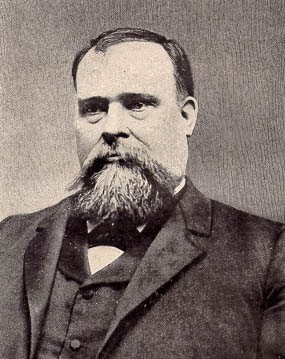
Between 1891 to 1895 Democratic Governor Jim “Boss” Hogg rhetorically “fought against the use of corporate funds in politics, for equalities of taxation, and for the suppression of organized lobbying,” and “demanded steps to make `corporate control of Texas’ impossible,” according to Antonia Juhasz’s 2008 book The Tyranny of Oil.

In the same book Juhasz also recalled that when Hogg was the attorney general of Texas he had written “the nation’s second antitrust law and put it to work against Standard Oil,” and “while governor, he tried to extradite [John D.] Rockefeller from New York to stand trial in Texas.” As a result, “the largely `Standard-free-zone’ established in Texas allowed for independent oil companies, such as Gulf and Texaco, to develop outside of Standard Oil’s grip in what would emerge as the most oil-rich state in the nation.”


Jim Hogg, the 20th governor of Texas. Image courtesy of the Texas State Library and Archives Commission / Wikimedia Commons.

According to The Tyranny of Oil, the financing for the drilling in the Spindletop field where oil first gushed out on January 10, 1901, “came from Pittsburgh’s Andrew and Richard Mellon,” and “the Mellon family ultimately forced everyone else out,” before merging the 1901-founded Guffey Petroleum and Gulf Refining oil firms into the Gulf Oil Corporation in 1901.

Financing for the drilling by the Texas Fuel Company (that was founded in 1901 and later changed its name to Texaco) “came from Lewis Lapham of New York, who owned U.S. Leather, the centerpiece of the leather trust, and John Gates, a Chicago financier,” as well as from a New York investment banker named Arnold Schlaet.

It was also during the 1890s that an Austin writer named William Sydney Porter — who later, under the pen name of O. Henry, became famous in New York City as a writer of short stories with surprise endings — briefly published a weekly newspaper in Austin called The Rolling Stone — over 70 years before Jann Wenner started to publish his Rolling Stone magazine in the Bay Area in the late 1960s.

As University of Auburn Professor Emeritus for American Literature Eugene Current-Garcia noted in his 1993 book O.Henry: A Study of the Short Fiction:

O. Henry and his partner… renamed their paper The Rolling Stone… It was never a commercial success, surviving only a single year with an alleged circulation peak of 1,500, but the fact that O. Henry managed to keep it going at all at times virtually single-handedly — was a remarkable feat in itself. Each week he filled its eight pages with humorous squibs and satirical barbs on persons and events of local interest…

The portable humor sheet quietly rolled off its last issue on Mar. 30 1895, and was soon forgotten until its creator’s worldwide fame a few decades later made of it a collector’s item… For in his… little news-sheet — O. Henry’s first published body of work — lay the foundation stones of his unique short fiction edifice: his themes, plots, methods and style.

[Bob Feldman is an East Coast-based writer-activist and a former member of the Columbia SDS Steering Committee of the late 1960s. Read more articles by Bob Feldman on The Rag Blog.]

The Rag Blog

Posted in Rag Bloggers | Tagged , , , , | Leave a comment

Brendan Smith and Jeremy Brecher : Labor’s Keystone Dilemma

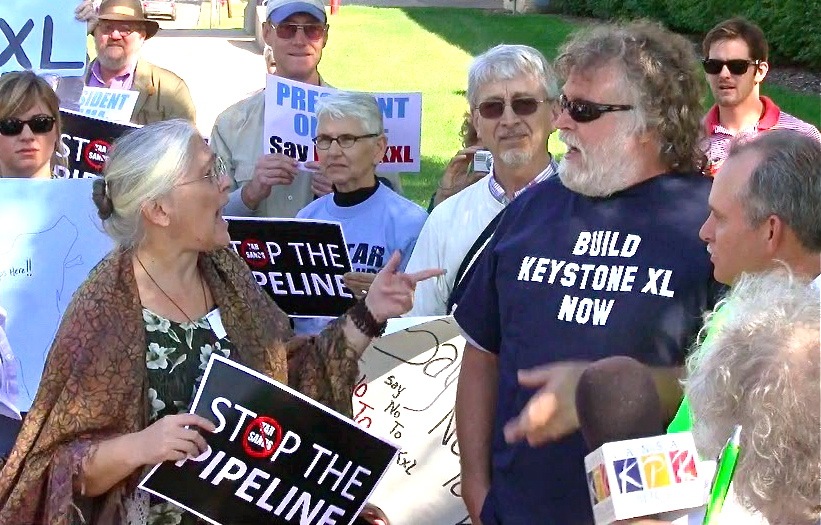
Unions and the Keystone dilemma. Image from Kansas Watchdog.

Dirty vs. green jobs:
Labor’s Keystone dilemma

Outside of Washington, the very same unions that support the pipeline are down in the trenches fighting for a transition to a green economy.

By Brendan Smith and Jeremy Brecher / Portside / March 13, 2012

These are tough times to be a construction worker in America. While other sectors of the economy are showing signs of life, the unemployment rate in the construction industry is getting worse, not better — rising from 16 percent to 17 percent in January.

It is against this backdrop that the titanic struggle over the Keystone XL pipeline is being waged. On one side are unions such as the Laborers International Union of North America and the United Association of Plumbers and Pipefitters, who support the pipeline because they believe that it will create thousands of high-wage jobs for their members. On the other side are environmentalists and others who believe the pipeline will hasten the climate crisis, threaten our water supplies, and increase oil prices.

The fallout from the conflict has been significant. When six labor unions joined the Sierra Club and other environmental groups in support of President Obama’s decision to oppose the permit last month, LIUNA President Terry O’Sullivan accused the coalition as being “job killers,” and withdrew his union from the BlueGreen Alliance.

Inside Washington, this divide over Keystone appears insurmountable — especially since the “jobs vs. environment” debate has been played out repeatedly for decades. But outside of Washington, the very same unions that support the pipeline are down in the trenches fighting for a transition to a green economy.

LIUNA, for example, has created OptiHome, an alliance of skilled workers and certified contractors working in the energy efficiency sector. The program includes training and job placement, and has been effective at bringing a new generation of workers into the green economy.

One of these workers is Tahlia Williams, a 30-year-old single mom who had been interested in construction work for a long time but saw it as “man’s work” and was unsure how to break into the industry. But after Tahlia completed LIUNA’s weatherization training program she was quickly hired as an energy efficiency mechanic by the Community Environmental Center — the largest residential weatherization contractor in New York City.

According to Tahlia, she is “proud to be working to protect our environment, while at the same time helping fellow residents save money on their energy bills and enjoy a more comfortable home. This is about a better future for my family, for New York homeowners, and for everyone!”

LIUNA’s green jobs agenda has also helped grow the union. They negotiated a card check agreement with Conservation Services Group, a company which conducts nearly a half million home energy assessments annually for utilities and energy efficiency organizations nationwide, reaching more than 2 million homes in the last 25 years.

And LIUNA recently chartered a green local designed for workers specializing in weatherization and other green jobs. Green Jobs Local 58’s first round of recruits graduated from LIUNA’s training center this month and are earning $14 an hour with benefits. To fund the program, LIUNA joined forces with local environmentalists to pass the New York Green Jobs Financing Law that provides funding for residential weatherization work.

Another building trades union that is riding the green wave is the United Association of Plumbers and Pipefitters. UA created the nation’s first union “sustainability office” in the country, which is developing three new “green” craft-specific certifications: Green Plumbing/Pipefitting, Green Sprinkler Fitting, and Green Heating, Ventilation, Air Conditioning and Refrigeration (HVACR).

UA has also been driving a “Green Systems Training Trailer” around the country to educate members and the general public about the importance of energy efficiency.

So despite their support for the Keystone pipeline, on the ground in cities and towns around the country building trades unions are at the cutting edge of green economic development. These green success stories show that the green jobs path for LIUNA and other construction unions is not a “pie-in-the-sky” promise — these jobs are shovel-ready and offer a secure future for their members.

It is also significant that some of these unions have stepped out in front at the international level by joining environmentalists around the globe fighting to reduce greenhouse gas emissions. LIUNA, for example, was one of three unions in the U.S. to support science-based targets and timelines for carbon reduction at the 2009 climate summit in Copenhagen.

But here is the problem: For environmentalists, the Keystone battle has called into question unions’ commitment to addressing climate change, which is the primary rationale for green jobs and energy efficiency programs. Some unions are trying to play both sides of the fence: siding with fossil fuel companies and Republicans for new coal plants, pipelines, and refineries, while simultaneously teaming up with environmentalists for green jobs programs. Keystone has laid bare this contradiction.

The Keystone campaign has also put a strain on labor’s relationship with Occupy — a movement seen by unions as a powerful new ally. Indeed, LIUNA’s own homepage features a statement that “LIUNA Backs Occupy Wall Street Movement.” In November the Building Trades launched the Jobsforthe99.com website and began running ads in newspapers and radio along the pipeline route, using the rhetoric of Occupy and the 99 percent to push for construction of the Keystone XL pipeline.

In response, the main governing body of Occupy in New York issued a statement of disavowal: “The leadership of the unions behind this campaign have made a public alliance with the oil industry and Tea Party funders… We must dissociate from this attempt at co-optation by the 1% to preserve our movement as the 99%.”

The last decades have shown that partnering with the right wing and corporations has been a devil’s bargain for workers, whereby companies use unions to push for environmental deregulation and subsidies for carbon-intensive projects, while simultaneously funding “right-to-work” and other anti-union campaigns. This unholy alliance has crippled unions’ ability to organize workers and laid the foundation for a private sector unionization rate of less than seven percent.

Unions and environmentalists agree on most issues — ranging from living wages and health care to corporate greed and green job creation — and there is consensus that defeating the right wing agenda requires solidarity of the 99%.

With this in mind, it’s time for labor and environmentalists to sit down and hammer out plans for putting union members to work rebuilding our country and protecting the planet. None of us can build a sustainable future alone.

[Brendan Smith is co-founder of the Labor Network for Sustainability and Voices for a Sustainable Future and senior fellow at the Progressive Technology Project. His commentary has appeared in The Atlantic, The Los Angeles Times, The Guardian, and The Nation. Contact him at www.bsmith.org. Jeremy Brecher‘s new book, Save the Humans? Common Preservation in Action addresses how social movements make social change. Brecher is the author of more than a dozen books on labor and social movements, including Strike! and Global Village or Global Pillage, and the winner of five regional Emmy awards for his documentary movie work. He currently works with the Labor Network for Sustainability. This article was distributed by Portside.]

The Rag Blog

Posted in RagBlog | Tagged , , , | 2 Comments

Lamar W. Hankins : Religion and Secularism in the Public Square

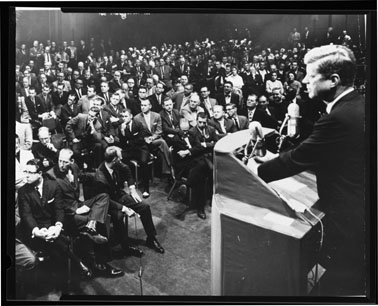
Sen. John F. Kennedy speaks attempts to allay fears about his Caltholicism before the Greater Houston Ministerial Association on Sept. 12, 1960. Photo from Houston Chronicle / AP.

Religion and secularism in the public square

Opposing the promotion of religion and religious practices by government is not the same as opposing religious expression…

By Lamar W. Hankins / The Rag Blog / March 13, 2012

Whenever he speaks, it has become common for Republican presidential aspirant Rick Santorum to state that because of the beliefs or actions of various public figures or the society at large, people of faith no longer have a role in the public square.

Santorum has claimed at various times that this was the position of John F. Kennedy, and is the position of President Obama. And he seems to believe that there are others, many others, who want to prevent religious people from having their say about public policy.

A fair and complete reading of what John F. Kennedy said in 1960 cannot possibly lead to such a conclusion. If anything, Barack Obama sometimes has seemed to agree with Santorum on this issue.

With this repeated assertion, Santorum makes what is often called a “straw man” argument. He has set up a false premise so that he can easily knock it down. But this straw man argument has a purpose beyond mere deception: to galvanize the evangelical vote in his favor. And many evangelicals claim that if the government doesn’t promote their brand of Christianity, then they are being denied access to the public square.

To understand the deceit inherent in this argument, we need to understand what is meant by the “public square.” Generally, and quite literally, the public square is an open public space found near the center of a community and used for public gatherings. It may refer also to all areas of public property which may be used for a variety of events, either with or without permission of the government that controls the property — reference the Occupy Movement in the last half year.

In another sense, public square refers to the use of public places for exercising our rights to free speech. Some communities have areas where people hold forth on whatever topic may interest them and the passers-by who linger to listen to what they say.

This activity was likely more prevalent in the days before the media took information to the masses through newspapers, magazines, radio, and television; and now individuals do so by email, Facebook, and tweets. Of course, we have had mail service since the founding of the country, but that was not a way to reach the masses about public policy concerns until the advent of direct-mail political campaigns, which started about 30 years ago.

In some cases, public buildings have been open for public expression, much like the open areas owned in common by the people. But normally, public expression has taken place in these venues only when the governmental authority responsible for their maintenance has allowed them to be used in this way. Otherwise, the buildings are designated for particular uses, rather than any use a member of the public desires.

For instance, a high school gymnasium or a meeting room at a city activity center is not a public forum unless a group or individual pays a fee to use the facility for such a purpose, or the government opens the facility at a specific time for the purpose of having a public forum.

When an area becomes a public place for free speech, the government may not limit what views are expressed there. All views, including religious views, may be expressed, which gets us to the claim that religion is being driven from the public square. Presidential candidate Rick Santorum recently declared that the First Amendment’s guarantee of the free exercise of religion by all Americans “means bringing everybody, people of faith and no faith, into the public square.”

On this I agree completely.

But Santorum went on to claim that presidential candidate and later President John F. Kennedy said that “faith is not allowed in the public square.” I have quoted Kennedy’s 1960 Houston speech in which he discussed this matter in previous columns and have read it many times. Nowhere in that speech did Kennedy say that faith is not allowed in the public square, but in Santorum’s mind, Kennedy’s views would “create a purely secular public square cleansed of all religious wisdom and the voice of religious people of all faiths.”

Santorum’s thoughts on this issue are so ridiculous that I address them only to suggest that Santorum has it wrong. Kennedy was not trying to drive religion or religious values from the public square with his 1960 speech to a group of Protestant ministers. He was trying to allay fears among Protestants that, as a Catholic, he would perform presidential duties under orders from the Pope.

Of course, considering Santorum’s membership in Opus Dei, which strictly follows traditional Catholic doctrine, he might seek the Pope’s advice on U.S. policy were he to become President.

But this is not the first time a political figure has distorted the views of Americans to deal with a fictitious issue. In 2006, Barack Obama spoke about religion in public life in a speech at a religious conference in which he accused secularists of asking “believers to leave their religion at the door before entering the public square.” He also equated secularism with a lack of moral values, as though moral values come only from religion.

While I know more religious people than secularists, I have never read or heard a secularist (a non-religious person) who claims that religion and religious ideas are forbidden in the public square. What I have often thought, however, is that if your only argument on a matter of public importance is that God has a position on the issue, you might not have a winning argument.

God’s views are hard to document — something I learned as a pre-ministerial student at a Methodist-related university. Even the “holy texts” leave much room for interpretation and differences of opinion about meaning.

In 2002, a San Marcos city council member explained his vote in favor of a resolution supporting the War in Iraq by quoting Ecclesiastes — “there’s a time for war.” I thought then that the remark was less than shallow and a poor excuse for actual thinking about the matter. Of course, people use “holy texts” frequently to bolster some position or other — against homosexuals, against prostitutes, against money-lending, against slavery; or in favor of slavery, child-beating, war, adulterer-stoning, capital punishment, mass murder, etc.

As to the origin of moral values, perhaps the most universal moral precept is what we usually term The Golden Rule: do unto others as you would have them do unto you. It has ancient origins that have been traced back nearly four millennia to the birth of writing in Egypt (though writing may have begun about the same time in Mesopotamia). But even the Golden Rule has its drawbacks. I certainly would not want a delusional or masochistic person treating me the way she might want to be treated.

What is important to me is that moral values do not depend on religion. Moral values have risen wherever there are people capable of thinking about themselves as distinct entities related to others. In fact, self-reflection may be what distinguishes humans from other species.

In America’s public square, broadly conceived, all people can be participants in the discussion. Perhaps the most inclusive definition of the public square is found in David E. Guinn’s paper written for The Encyclopedia of American Civil Liberties:

[The public square is] that forum in which the people discuss, debate, and evaluate public activities with the idea of persuading their compatriots and influencing the state in the development, enactment and enforcement of public policy. It is a forum, by definition, available to all…

The public square is not necessarily a place or a building. Today, forums are developed anywhere ideas can be discussed. In the on-line world, anyone wanting to make a comment can participate in that discussion.

As anyone who has read the Constitution knows, religion is mentioned three times — to guarantee religious freedom, to prohibit government establishment of religion, and to assure that there be no religious test for holding public office. God does not appear in the document except in relation to the date given at the end.

This should not prevent God and religion from entering public discussions, but it does suggest that the government should neither dominate religion, nor religion government. Opposing the promotion of religion and religious practices by government is not the same as opposing religious expression in the public square. Those who equate the two are not being intellectually honest.

According to a 2011 study by the nonprofit, nonpartisan research and education organization Public Religion Research Institute, “Nearly two-thirds (66 percent) of Americans agree that we must maintain a strict separation of church and state.” And 88% of Americans “strongly affirm the principles of religious freedom, religious tolerance, and separation of church and state.” Religious freedom is for everyone.

Contrary to the assertions of people like Rick Santorum and those who use fear to promote their theocratic views, the public square in America is doing fine, open to all ideas, religious as well as secular. And the public square can be used to promote moral values by everyone who has moral values, be they religious or secular.

It is possible to be good without God, even if some people claim otherwise. If you don’t agree, just listen to the values being expressed in the public square and observe the public behaviors represented there. Morality is not exclusive to our religious brethren, nor does being religious assure moral behavior.

[Lamar W. Hankins, a former San Marcos, Texas, city attorney, is also a columnist for the San Marcos Mercury. This article © Freethought San Marcos, Lamar W. Hankins. Read more articles by Lamar W. Hankins on The Rag Blog.]

The Rag Blog

Posted in Rag Bloggers | Tagged , , , , , , , , | Leave a comment

Alice Embree reports from San Antonio on that city’s 22nd annual Women’s Day celebration, organized by a coalition of “fierce ‘mujeres'” from community and social justice organizations, including union organizers and advocates for reproductive choice and LGBTQ rights. The event, which “crossed boundaries of race, age, class, national origin, and sexual orientation,” included a lively dose of political theater provided by CodePink and others. Includes a great gallery of photos from the event.

Posted in RagBlog | Leave a comment

Bernardine Dohrn and Bill Ayers : Come to Chicago!

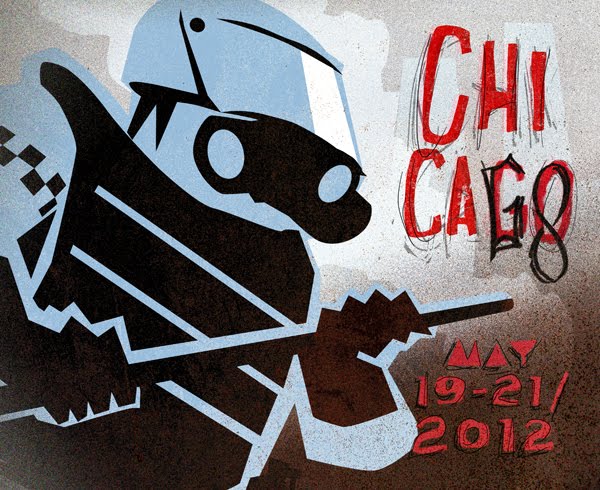
Graphic by Dave Wittekind / The Rag Blog.

UPDATE: In a major development, the G8 summit has been moved from Chicago to Camp David by President Obama, who apparently gave Chicago Mayor Rahm Emanuel only an hour’s advance notice of the move. The NATO gathering will still be held in Chicago.

There is speculation about a widening rift between Obama and Emanuel.

From the Chicago Tribune:

Mayor Rahm Emanuel today wouldn’t get into the particulars of why Chicago lost the G-8 summit in May, deferring to President Barack Obama.

The mayor was touting the importance of Chicago hosting the back-to-back G-8 and NATO gatherings of world leaders as late as Monday morning. Hours later, the Obama administration announced it was yanking the G-8 summit out of Chicago in favor of Camp David.

From the Chicago Sun-Times:

The mayor said he saw no slight or embarrassment for Chicago in President Barack Obama’s move. Emanuel, a former White House chief of staff, said he “takes at face value” Obama’s explanation that Camp David would be a more relaxed setting in which the world’s leaders could connect.

Organizers of Occupy Wall Street said:

The Group of 8 Summit, a meeting of the governments of the world’s eight largest economies, was supposed to convene in Chicago this May. For months, Occupy Chicago, international anti-war groups, Anonymous, and hundreds of allies have publicly planned to shut it down.

Now, only two months before the meeting is scheduled to begin, U.S. President Barack Obama is moving the assembly of over 7,000 leaders from the world’s wealthiest governments to the Camp David presidential compound, located in rural Maryland near Washington, DC, one of the most secure facilities in the world. The Chicago Tribune reports that summit organizers are “stunned” by the news.

In an article distributed by Truthout, the Occupied Chicago Tribune said:

The prospect of such a response [from massive demonstrations], and the political context in which it will take place, was enough to force the Obama administration to reconsider bringing the G8 summit to the president’s hometown and the site of his re-election campaign headquarters.

According to the Uprising Radio website, demonstrations will still take place in Chicago:

Chicago activist Andy Thayer, who is working with a coalition of groups in preparation for the May summits told the Associated Press on Tuesday, “Guess what? The protests are going to happen anyway.” There is also a possibility that activists will follow the G8 to Maryland.

An open invitation:
Come to Chicago

Occupy this/Occupy that!
NATO/G8: May 18-21, 2012

By Bernardine Dohrn and Bill Ayers | The Rag Blog | March 8, 2012

The tiny fraternity of concentrated wealth and power that calls itself the Group of Eight (G8) is meeting in Chicago in mid-May, overlapping with representatives of history’s largest global military cohort, NATO (North Atlantic Treaty Organization), the gently self-named military behemoth dominated by the U.S.

Heads of state, spooks, foreign ministers and generals, cabinet members and secret operatives, advisors and bureaucrats — the 1% of the 1% — plan to gather in barricaded opulent surroundings while coordinating and conspiring to extend and defend their obscene wealth, to exploit the remaining fossil fuels, natural resources, human labor, and the living planet, to the last drop, and to dominate the people of the global majority.

A 1984-style national security dragnet is descending on the city to attempt to lock Chicago down. Chicago’s Mayor is concocting a culture of fear, suggesting that it is the human resistance to NATO/G8 that represents danger, outside agitators, violence and invasion.

Universities and schools are being urged to close early in May; communities of color are told that this is not their concern; merchants are preparing for assault. In reality, NATO/G8 represents the masters of war; it is they who are the greatest purveyors of violence on this earth.

NATO/G8 will not be alone in Chicago: Occupy’s 99% will gather in a festival of life and peace, joy and justice. Two permitted, family-friendly rallies at the Daley Center and marches for justice, jobs, and peace are scheduled on May 18 and 19 (and perhaps another on May 21). Music, dance, teach-ins, and peoples’ tribunals will overflow the parks and theaters.

Image from Occupy All Streets

We will all be there to open Chicago back up. In the spirit of the Arab Spring and Occupy, the Madison labor struggle, the Pelican Bay hunger strikers, teachers and nurses, the Dream youth, returning veterans against the wars, women insisting on reproductive dignity, foreclosure resistance, LGBTQ equality and, many more, Adbusters, CanG8, CodePink, Portoluz, and others have called for people to come from near and far, armed with their spirit and their creativity, pitching their tents and staking their claims.

We’re excited and you’re invited: Come to Chicago, May 18-May 21. Bring a sleeping bag, and if we have room, you can stay with us on the Southside.

Mayor Rahm Emanuel has made it entirely clear that he alone will happily host NATO/G8, but that the 99% are decidedly not welcome. He has funding to further arm and mobilize the police and militarize the city; he has announced plans to contain and suppress demonstrators; he has pushed through legislation that restricts and criminalizes free speech and assembly, and requires insurance for public demonstrations; he is issuing a steady stream of pronouncements about Chicago-under-siege from ominous and dangerous outside forces.

But Chicago is big enough for all — it is after all a nuclear-free and cease-fire city, cradle of the Haymarket martyrs and the eight-hour day, labor and peace actions, vast civil rights and immigration rights manifestations, home of Ida B. Wells Barnett, Jane Addams, Richard Wright, Gwendolyn Brooks, and Studs Terkel.

The rich and the powerful do gather here, but Chicago is a public space with historic parks, monuments, neighborhoods, and streets for popular mobilizations as well — Chicago belongs to all of us.

We underline the right — the moral duty — to dissent and demonstrate, to resist and to be heard, to participatory (not billionaire-paid-for) democracy. Mayor Emanuel can still change course, and he should; so far he has obstinately and foolishly chosen to frame mid-May solely in military and security terms.

The mayor, not the popular resistance, is creating conditions — once again — for a police riot in Chicago against people who have every intention and every right to assemble peacefully deploying humor and music, art and play, civil disobedience and imagination, to forcefully express rejection of imperial and permanent wars, to challenge racial/ethnic/gender discrimination and hate, to demand justice, education, health care, and peace, women- and gender-dignity, the opportunity for meaningful work and reversing epic income disparities, an end to mass incarceration, and the urgent need to shift course and live differently for the sake of the planet and future generations.

Join us in Chicago in May (or, if you can’t come, act in solidarity — Occupy the suburbs, cities, and communities across the land): stand up for civil and human rights, exercise your voice and be a witness, act up and speak out. Be part of a wave of people power, creative direct non-violent action, and the most vast, determined resistance in memory.

History calls!

Occupy the future!

Another world is possible!

[William Ayers is Distinguished Professor of Education and Senior University Scholar at the University of Illinois at Chicago. Bernardine Dohrn is Clinical Associate Professor of Law and Director and founder of the Children and Family Justice Center at Northwestern University. Both Ayers and Dohrn were leaders in SDS and the New Left, and were founders of Weatherman and the Weather Underground. This article was also posted at Bill Ayers. Find more articles by and about Bill Ayers and Bernardine Dohrn on The Rag Blog.]

The Rag Blog

Posted in Rag Bloggers | Tagged , , , , , , | 2 Comments

Richard Raznikov : Battlefield America

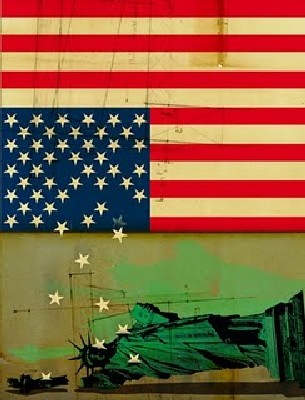
“Dissent is terrorism.” Art by Anthony Freda / Activist Post.

Battlefield America:
‘We had to make some sacrifices…’

There are no more legal barriers to arrest without warrants, prison without lawyers, condemnation and even execution without trial.

By Richard Raznikov | The Rag Blog | March 8, 2012

There was a declaration in the Congress during the passage of the National Defense Authorization Act, to the effect that in the “war on terror” the United States was a part of the field of battle.

This statement was made by Senator Lindsey Graham, among others. It was consequent to the continuing fantasy that we now live in a “post-9-11 world” which, presumptively, means that the laws which have protected Americans from their government for 200 years no longer apply.

Sorry about your freedom, but we had to make some sacrifices to keep you free.

Because of 9-11, we were told, we needed the grotesquely-named “Patriot Act” which took large pieces out of the Bill of Rights. In order to be safe from the “enemy” we had to give up the Constitution. The Patriot Act was passed as emergency legislation with no debate. The senators and representatives who voted for it did not read it. For that alone, they deserve impeachment and removal from office.

But betraying the country is no longer a crime when it’s done by the government.

It seemed at the time like an odd construction, the insistence that America’s own turf was now a part of the battlefield, but that’s what Graham and others insisted.

There were reasons for this.

For one thing, as the NDAA legislation makes clear, the protection afforded Americans from the use of the army against us, the so-called Posse Comitatus Act, has effectively been nullified. Last month, the army conducted “exercises” with Homeland Security operatives and the L.A. police force in a section of downtown Los Angeles.

For another, by calling the United States part of the battlefield, the president, any president, can direct the army to arrest and detain without trial any citizen “suspected” of actions in “support” of an “enemy.” The person imprisoned with no rights, in violation of the most fundamental clauses of the Constitution, can’t get judicial review and may never be released because the “war” against “terror” is a war which will by definition never end.

Pretty neat trick, huh?

Last time I looked, only fascist countries and totalitarian regimes did these sort of things. I must’ve been mistaken.

A week ago, in testimony before the Senate Judiciary Committee, Steven G. Bradbury, former acting assistant Attorney General, principal deputy for the Office of Legal Counsel, and one of the authors of the infamous Bush “torture memos,” told Senators that an amendment to the NDAA which would exempt American citizens from indefinite detention without charge or trial would be a mistake.

…the evident purpose of the legislation is to prevent the President from detaining as an enemy combatant under the laws of war, without criminal charge, any American citizen or lawful permanent resident of the United States who is apprehended in this country, even if the person is captured while acting as part of a foreign enemy force engaged in acts of war against the United States, such as a U.S.-based terrorist recruit of al Qaeda acting to carry out an armed attack within our borders…

Bradbury believes such a limit would hamper the President in waging the war against terror. America’s a battlefield, he believes, echoing the words of Graham and Chuck Grassley, the senator who brought him in to testify, and that means that anyone on the side of the “enemy” should not be able to count on the protection of the Bill of Rights.

According to an article on the hearing by Kevin Gosztola in Firedoglake, Graham, who was present, “contended the ‘homeland’ was part of the battlefield and reading Miranda rights is not the best way to collect intelligence. He firmly asserted that homegrown terrorism could be a problem and he wanted the legal system to recognize ‘the difference between fighting a crime and fighting a war.'”

No, reading a suspect ‘Miranda rights’ was never the best way to get a confession, either. A rubber hose or simple, repetitive beatings, or simulated drownings, for that matter, could get people to confess to anything just to make it stop. The use of torture, which Obama claimed to oppose but which his administration continues to authorize, is good only for the purpose of satisfying the perverse, sadistic interests of the torturers; nobody in law enforcement thinks it extracts much truth.

Bradbury testified that since President Obama believes he has the authority to order the killing of American citizens in other countries — such as the victims of U.S. targeted drones in Yemen — it doesn’t make sense that such a target could become entitled to constitutional rights simply by “making it to the homeland.”

See where this is going?

If the “war” against “terror” is fought everywhere on earth, and if Americans can be legally killed by order of the President on foreign soil, then the President can order the killing of American citizens anywhere, including the United States.

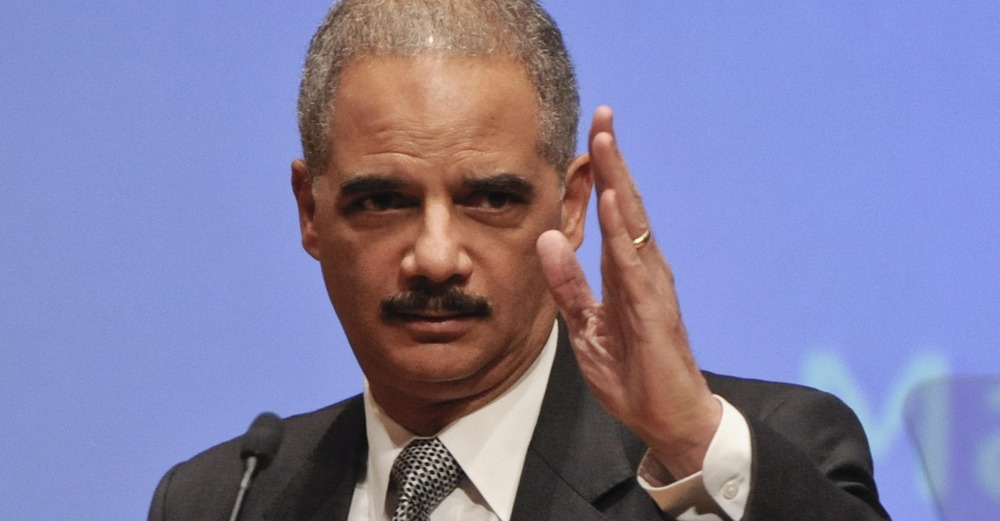
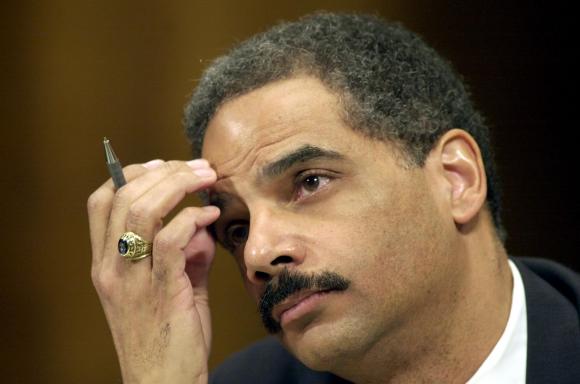
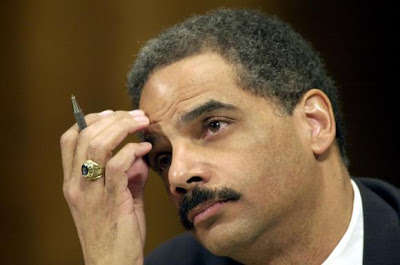
Attorney General Eric Holder. Image from MSNBC.

That was the point of Lindsey Graham’s continued harping on the “battlefield” terms; that was the point of the NDAA and its lightning-swift passage through a somnolent and hopelessly corrupt Congress which barely raised any questions. If America is part of the battlefield, whatever may be legally done on a battlefield may be done here, right here, maybe in L.A. or Oakland, or wherever you live.

True, the use of drone attacks might have to be minimized; too much political fallout from killing a bunch of neighbors along with the “enemy” suspect.

A year ago, the idea that the President had initiated use of death lists, lists of people who were to be killed by the CIA, was considered fanciful or paranoid. Such a claim in the New Yorker by Pulitzer Prize winner Sy Hersh, drew little public response and no Congressional outcry. Now, it’s a conceded fact. And still very few object.

Now, Attorney General Holder, obviously speaking for Obama, tells Congress that the President has the right to order the assassination of whomever he wants. And if America’s now in a permanent state of war, and if that war is taking place right here, in the Fatherland, then there is nothing to prevent Obama — or any future president — from killing people, or simply letting the army do it.

That is the situation. It’s not exaggerated. Right now, the U.S. uses death lists. Right now, people are targeted for assassination not because of what anyone’s proven them to do but because of what they are said to have done, or even are said to be thinking of doing.

Obama and Holder are telling us that in plain English. Right now, with the Patriot Act and NDAA, the U.S. is considered part of the “battlefield,” which means that the army may do to anyone suspected of wrongful behavior, or of planning such behavior, whatever it wishes. That gives the formerly proscribed act known as prior restraint a whole new meaning.

There are no more legal barriers to arrest without warrants, prison without lawyers, condemnation and even execution without trial. It is a situation so antithetical to what America has by law always been that it is beyond belief. Yet it is so.

Here’s Holder again:

Now, let me be clear. An operation using lethal force in a foreign country targeted against a U.S. citizen who is a senior operational leader of al-Qaeda or associated forces and who is actively engaged in planning to kill Americans would be lawful at least in the following circumstances: first, the U.S. government has determined after a thorough and careful review that the individual poses an imminent threat of violent attack against the United States; second, capture is not feasible; and third, the operation would be conducted in a manner consistent with applicable law of war principles.

The government “has determined.” “Careful review.” “Capture is not feasible.”

And this:

Some have argued that the president is required to get permission from a federal court before taking action against a United States citizen who is a senior operational leader of al-Qaeda or associated forces. This is simply not accurate. Due process and judicial process are not one and the same, particularly when it comes to national security. The Constitution guarantees due process. It does not guarantee judicial process.

If due process under the American system, under the Bill of Rights, does not consist of judicial process, of what does it consist? For Holder and Obama, it consists of their own judgment. Don’t worry. Your government will not mistreat you.

Holder:

Some have called such operations “assassinations.” They are not. And the use of that loaded term is misplaced. Assassinations are unlawful killings. Here, for the reasons that I have given, the U.S. government’s use of lethal force in self-defense against a leader of al-Qaeda or an associated force who presents an imminent threat of violent attack would not be unlawful, and therefore would not violate the executive order banning assassination or criminal statutes.

“Self-defense” against someone who has yet done nothing but who “presents an imminent threat” as determined by, well, by the government.

And Barack Obama, on the heels of drone attacks which have specifically targeted not only individuals, such as the 16-year-old son of Anwar al-Awlaki, but funeral processions and first responders, such as medical teams, had this to say:

I want to make sure that people understand, actually, drones have not caused a huge number of civilian casualties. For the most part, they have been very precise precision strikes against al-Qaeda and their affiliates. And we are very careful in terms of how it’s been applied.

So, I think that there’s this perception somehow that we’re just sending in a whole bunch of strikes willy-nilly. This is a targeted, focused effort at people who are on a list of active terrorists who are trying to go in and harm Americans, hit American facilities, American bases, and so on. It is important for everybody to understand that this thing is kept on a very tight leash.

People who have not attacked America but who “are trying to go in and harm Americans” based on the secret information that we have. The President wants people to understand.

I understand, all right. Here’s Hina Shamsi, an ACLU lawyer, on Democracy Now!:

President Obama has used more targeted killings than the Bush administration ever did. And we do not have the memos, the Office of Legal Counsel memos, that justify the targeted killing policy. And so, very disappointingly, we see the administration claiming a broad and dangerous authority without adequate public transparency, disclosure, and refusing to defend its authority in the courts.

We do not get to see the memos, the memos that “justify” murdering, that is using “lethal force” against Americans, drafted by a government agency. Thanks for the transparency, Mr. President, that you promised. But don’t worry, we trust you. You would never lie to us. You would never violate the constitution. You want to make sure that people understand.

I understand, all right, and so do plenty of other people. This Constitution means something to us, brother, and we’re not giving it up just yet.

[Rag Blog contributor Richard Raznikov is an attorney practicing in San Rafael, California. He blogs at News from a Parallel World. Find more articles by Richard Raznikov on The Rag Blog.]

The Rag Blog

Posted in Rag Bloggers | Tagged , , , , , , , | 1 Comment

Ron Jacobs : Women’s Rights are Human Rights

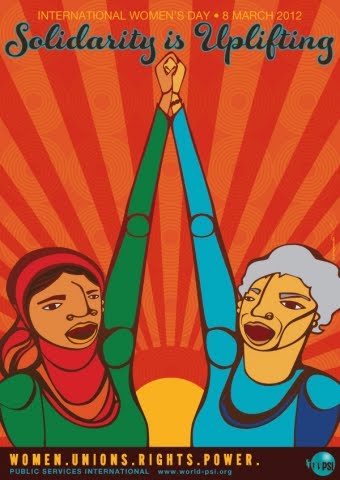
International Women’s Day 2012 poster from Public Services International, a global trade union federation.

Women’s rights are human rights

Besides the fact that it celebrates women in a society primarily controlled by men, it is the socialist roots of International Women’s Day that have discouraged its celebration in the United States.

By Ron Jacobs | The Rag Blog | March 7, 2012

On March 8, 1997, workers at the University of Vermont were at the beginning of a struggle to unionize. The units of the workforce that were prime for unionization (and most likely to vote in a union) were those units that maintained the buildings and grounds of the university. These units were composed of a large number of new immigrants and women.

The union we were working with was the United Electrical, Radio and Machine Workers of America or UE. This union is one of the few U.S. unions that refused to kick leftists out of the union in 1948 and is therefore not part of the AFL-CIO. We held a rally that day at the university. We chose March 8 because of its importance as International Women’s Day. It was the first that many of the workers had ever heard of this day.

Unknown to most U.S. residents, International Women’s Day has its roots in a strike by female garment workers in New York City. On March 8, 1857, these textile workers marched and picketed to demand improved working conditions, a 10-hour day, and equal rights for women. The police attacked the march.

On March 8, 1908, women textile workers marched again, recalling the 1857 march and demanding the vote, and an end to sweatshops and child labor. The police attacked this march, also.

Two years later, revolutionary Clara Zetkin urged the international socialist Second International to adopt March 8th as a holiday honoring the struggle for women’s rights. The motion passed.

Besides the fact that it celebrates women in a society primarily controlled by men, it is the socialist roots of International Women’s Day that have discouraged its celebration in the United States. After all, this is a nation that created Labor Day to prevent workers from celebrating May Day, even though that workers’ holiday was established in the United States in the late nineteenth century.

The insistent capitalism of America’s ruling classes will not so much as even acknowledge a holiday determined by the workers that celebrates something besides the domination of Wall Street and Washington. Nonetheless, both holidays continue to be celebrated in the United States, albeit not on the same scale as elsewhere.

The first that many U.S. residents alive today became aware of International Women’s Day was in the late 1960s and 1970s. Thanks to the leftist foundations of the feminist movement that developed in those years, International Women’s Day was retrieved from the dustbin of history where it had been tossed. Since those days, it has been consistently celebrated by most women’s groups, much of organized labor, and even given a mention by some elected officials.

However, like so many other movements with their current roots in the struggles of the 1960s, the women’s rights movement is much more than a single holiday. Just like people did not protest, go to jail, fight the police, and even die so that school children can celebrate Martin Luther King, Jr.’s birthday every January, neither have women and their allies fought merely to wear a ribbon or attend a celebration of International Women’s Day every March 8.

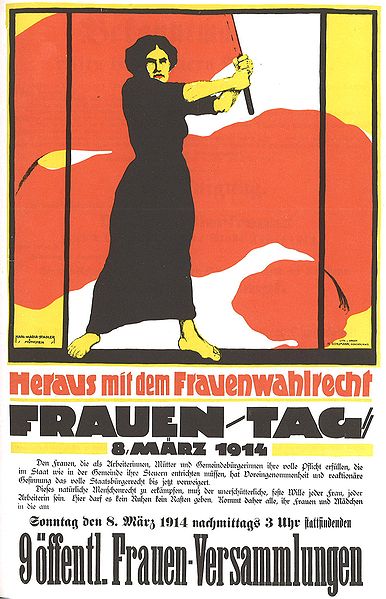
German poster for International Women’s Day, March 8, 1914. Image from Wikimedia Commons.

Women’s rights have always been human rights. The very fact that this day has its roots in a labor struggle proves that. Women and girls comprise much of the workforce, the student population and, in some nations, the military.

In today’s world, where the wars and economic policies of neoliberalism force millions of people to leave their homes and countries, it is the women that make up the bulk of those refugees. Given that females continue to be the primary caregivers of the human species, it becomes even clearer that their struggle is synonymous with the struggle for human rights. Yet, every day the news is full of attacks on those rights.

In the United States, the right wing and many Christian churches are conspiring to deny easy and affordable access to an essential element of health care — birth control. At the same time, budget cuts on both state and federal levels are targeting low-income children and women, leaving many of them without essential needs like food, shelter, and health care. These budget cuts are the direct result of polices that cut taxes for the rich, fund the war industry at ever greater cost, and attach more and more riders on the tax burdens of working people.

Meanwhile, unemployment maintains a relatively constant level of several million capable workers and real wages continue to sink. In other countries in the western neoliberal zone, like Greece, Spain, and Portugal, the situation is even direr.

Meanwhile, most women in countries that are part of what economists call the developing world are in even worse straits. Many of them have never lived in anything other than a refugee camp. Education is something not even considered for their male children much less for themselves or the girls in their families.

Tribal and ethnic wars that are exacerbated by the neoliberal economic crisis bring death and illness without warning. Other wars brought on by Washington and Wall Street’s perceived need for hegemony create their own havoc and death. Religious fanatics whose similarities with their kinsmen in the United States and the Vatican outweigh their differences do their best to insure women remain subjugated to their medieval belief systems.

The list continues. It is apparent that the need for a women’s movement as represented by those textile workers who took to the streets of Manhattan over a hundred years ago exists as much as it ever did. From Manhattan to Mumbai, from Beijing to Bagdad, the struggle for women’s rights and lives is the struggle for human rights and lives.

[Rag Blog contributor Ron Jacobs is the author of The Way The Wind Blew: A History of the Weather Underground. He recently released a collection of essays and musings titled Tripping Through the American Night. His latest novel, The Co-Conspirator’s Tale, is published by Fomite. His first novel, Short Order Frame Up, is published by Mainstay Press. Ron Jacobs can be reached at ronj1955@gmail.com. Find more articles by Ron Jacobs on The Rag Blog.]

Also see “Fierce Women March in San Antonio,” by Alice Embree / The Rag Blog / March 5, 2012

The Rag Blog

Posted in Rag Bloggers | Tagged , , , , | 1 Comment

RAG RADIO / Thorne Dreyer : Rock Journalist Margaret Moser and Film Actor Sonny Carl Davis

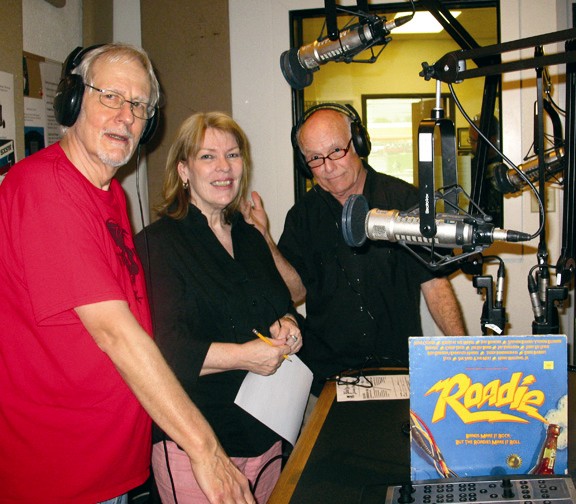
Margaret Moser and Sonny Carl Davis with Rag Radio host Thorne Dreyer, left, at the studios of KOOP-FM in Austin, Friday, March 2, 2012. Photo by Tracey Schulz / Rag Radio.

Rag Radio:
Margaret Moser and Sonny Carl Davis discuss
the film, Roadie, and the Austin cultural scene

By Rag Radio | The Rag Blog | March 7, 2012

Rock journalist Margaret Moser and film actor Sonny Carl Davis were Thorne Dreyer’s guests on Rag Radio, Friday, March 2, 2012, on Austin community radio station KOOP-FM.

They discussed the making of the classic 1980 Alan Rudolph movie Roadie, which was partly filmed in Austin and which starred Meat Loaf, who is a 2012 inductee into the Texas Music Hall of Fame. They also talked about the upcoming Austin Music Awards, which Moser directs; the 2012 South by Southwest music, film, and interactive festival; and the thriving Austin music and film scenes.

You can listen to the show here.

Music Writer Margaret Moser and Film Actor Sonny Carl Davis
on Rag Radio with Thorne Dreyer, March 2, 2012


An “unabashed former groupie,” award-winning rock journalist Margaret Moser is a senior editor and staff writer for the Austin Chronicle, and is also the author of three books including The Edge Guide to Austin and Rock Stars Do the Dumbest Things.

Moser has been a commentator for NPR and has written for Sony Records and MOJO magazine. She has served on the Austin Music Commission, is currently on the Board of the Texas Music Hall of Fame, founded the South Texas Popular Culture Center in San Antonio, and directs the Chronicle’s annual Austin Music Awards show during South by Southwest.

Sonny Carl Davis is a film actor, a musician, and a screenwriter. He played a redneck entrepreneur in Texas filmmaker Eagle Pennell’s The Whole Shootin’ Match and played memorable roles in Last Night at the Alamo and Fast Times at Ridgemont High. He also had featured parts in Thelma and Louise, Melvin and Howard, and Roadie, and a supporting role in Red Headed Stranger with Willie Nelson. Sonny was also a founding member in 1968 of Austin’s legendary Uranium Savages, a theatrical rock group that played Austin’s venerable 60s-70s rock venues.

Both Sonny Davis and Margaret Moser were involved in the production of Roadie, which was written by Austinites Big Boy Medlin and Michael Ventura, with Davis playing a featured role in the film. Roadie, which was filmed in Austin, Los Angeles, and New York, starred Meat Loaf and featured Art Carney, as well as musicians like Blondie, Alice Cooper, Hank Williams, Jr., Roy Orbison, Alvin Crow, Asleep at the Wheel, and the late Soul Train host, Don Cornelius.

Davis and Moser hosted a special screening of the film on March 5 at Austin’s Alamo Drafthouse on South Lamar. Meat Loaf is being inducted into the Texas Film Hall of Fame on March 8 at ACL Live at the Moody Theater in Austin.

South by Southwest, with keynote speaker Bruce Springsteen, takes place in Austin, March 9-March 18; and the Austin Music Awards, featuring performances by Tex-Mex great Joe King Carrasco and the Crowns, blues musicians Carolyn Wonderland and Ruthie Foster, and a special Christopher Cross reunion, is on March 14 at the Austin Music Hall.

This episode of Rag Radio was produced during KOOP’s spring membership drive; fundraising pitches, underwriting announcements, and recorded music have not been edited out of the podcast.

Rag Radio, which has aired since September 2009 on KOOP 91.7-FM, a cooperatively-run all-volunteer community radio station in Austin, Texas, features hour-long in-depth interviews and discussion about issues of progressive politics, culture, and history.

Hosted and produced by Rag Blog editor and long-time alternative journalist Thorne Dreyer, a pioneer of the Sixties underground press movement, Rag Radio is broadcast every Friday from 2-3 p.m. (CST) on KOOP and streamed live on the web. After broadcast, all episodes are posted as podcasts and can be downloaded at the Internet Archive.

Rag Radio is also rebroadcast on Sundays at 10 a.m. (EST) on WFTE, 90.3-FM in Mt. Cobb, PA, and 105.7-FM in Scranton, PA. Rag Radio is produced in the KOOP studios, in association with The Rag Blog, a progressive internet newsmagazine, and the New Journalism Project, a Texas 501(c)(3) nonprofit corporation.

Tracey Schulz is the show’s engineer and co-producer.

Coming up on Rag Radio:

March 9, 2012: Singer-songwriter & author Bobby Bridger on the lasting impact of Native-American culture on American society.
March 16, 2012: Journalist and labor activist David Bacon on how U.S. policies fueled Mexico’s great migration.

The Rag Blog

Posted in RagBlog | Tagged , , , , , , , , , | Leave a comment

Lamar W. Hankins : Gasoline Prices and Political Nonsense

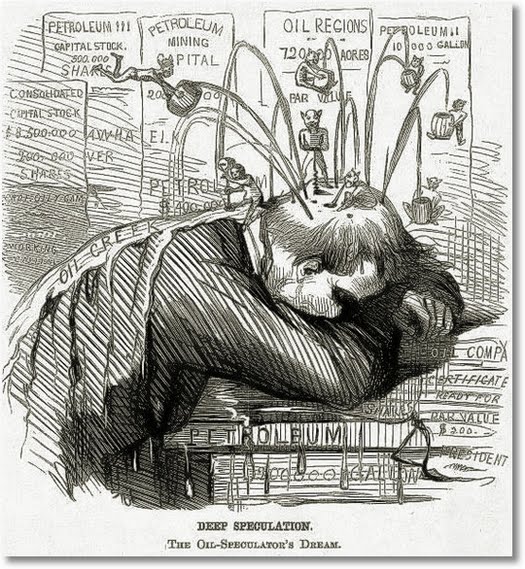
Yesterday, today, and tomorrow: The oil speculators’ dream, from Harper’s Weekly, 1965. Image from cw-chronicles.com / heatingoil.com.

Gasoline prices, the XL Pipeline,
oil speculators, and political nonsense

The giddy, knee-jerk response to higher gasoline prices is the thoughtless mantra ‘drill, baby, drill.’

By Lamar W. Hankins | The Rag Blog | March 7, 2012

None of us likes paying higher prices for gasoline. Some of us can’t afford the price increases we have seen the last few weeks and months to get to work and wherever else we need (or want) to go, leaving us less to spend on other products. But what most politicians have to say on the subject is nonsense. They want to score political points, rather than find a way out of this mess, or at least a way to improve it.

The giddy, knee-jerk response to higher gasoline prices is the thoughtless mantra “drill, baby, drill.” But our problem is not a lack of domestic oil production. We are producing about all we can, with thousands of leases still not developed. And domestic demand is lower than it was 14 years ago.

According to a report in Bloomberg Businessweek, the U.S. demand for crude oil in 2011 was less than it was in April 1997. In spite of our gargantuan appetite for oil, as a share of our total use, domestic oil consumption was 15 points lower in 2005 than it was in 1995. Today’s figures are about the same, according to a petroleum report in the Financial Times of London.

The largest single source of oil for the U.S. is Canada, at 25%. The OPEC countries together account for 47% of U.S. imports. Demand for oil in the U.S. dropped 2% in 2011, while U.S. oil production has increased. The rise in gasoline prices is not because we don’t have enough oil. Two reasons for the higher prices are the rising cost of oil on the world market because of higher demand in China and India, and the actions of crude oil commodity speculators.

U.S. oil companies export more oil products, such as gasoline and diesel, than they import. The top 10 countries we export to are Mexico, Netherlands, Chile, Canada, Spain, Brazil, Guatemala, Turkey, Argentina, and France. In fact, most of the XL Pipeline tar sands oil that could come from Canada is slated to be turned into diesel and exported, according to the refineries that will process that oil if it ever comes into the U.S.

The main reason for the increased U.S. exports of petroleum products is that the refineries make more money exporting oil than selling it domestically. Further, the refineries in the Port Arthur area are in a Foreign Trade Zone that rewards them with tax breaks for exporting oil products.

The thousands of new jobs that some politicians and business interests claim will be created by the XL Pipeline are nothing but Chamber of Commerce-type hype. The pipeline construction may result in 2,500 temporary jobs, not tens of thousands of permanent jobs.

A leading expert on gas prices, James Hamilton of The University of California-San Diego, says that generally a $1 increase in the price of crude oil produces a 2.5-cent increase in the price of gasoline, which is exactly what has been happening in recent weeks.

While the gasoline price increases are not yet higher than they were in 2008, we did not hear President Bush being blamed for those increases then. But those opposed to President Obama have been yelling to anyone within earshot that the current responsibility for gasoline price increases are his.

This is partisan and political nonsense, unsupported by the economic reality that about 97% of the price of gasoline is determined by the price of crude oil, according to Stuart Staniford, a scientist in the technology industry who studies oil-related data.

Around 2004, oil production stopped increasing world-wide. The producing countries have only so many pumps, oil pipelines, tankers, and other methods of getting the crude oil to refineries. As a result, the increasing demand from Asia and the rest of the rapidly-developing countries has created new competition for the oil production that is available, driving prices up.

Decreasing demand for oil products caused by more energy-efficient vehicles makes a small difference in the price of gasoline, as do marginal increases or decreases in the price charged by retailers.

Oil commodity speculators also drive up the price of crude oil. According to some estimates, such speculators control 80% of the commodity futures market in crude oil. Such speculators don’t produce oil, refine it, or use it, except as a way to make money by arranging to buy it at one price and sell it at a higher price. Sen. Bernie Sanders (I-Vermont) wrote recently for CNN Opinion:

I’ve seen the raw documents that prove the role of speculators. Commodity Futures Trading Commission records showed that in the summer of 2008, when gas prices spiked to more than $4 a gallon, speculators overwhelmingly controlled the crude oil futures market.

The commission, which supposedly represents the interests of the American people, had kept the information hidden from the public for nearly three years. That alone is an outrage. The American people had a right to know exactly who caused gas prices to skyrocket in 2008 and who is causing them to spike today.

Even those inside the oil industry have admitted that speculation is driving up the price of gasoline. The CEO of Exxon-Mobil, Rex Tillerson, told a Senate hearing last year that speculation was driving up the price of a barrel of oil by as much as 40%. The general counsel of Delta Airlines, Ben Hirst, and the experts at Goldman Sachs also said excessive speculation is causing oil prices to spike by up to 40%.

Even Saudi Arabia, the largest exporter of oil in the world, told the Bush administration back in 2008, during the last major spike in oil prices, that speculation was responsible for about $40 of a barrel of oil.

Confirming Sen. Sanders’s statements are comments from Bart Chilton, a commissioner on the five-member Commodity Futures Trading Commission, which regulates the trading of contracts for future deliveries of oil, as well as other commodities:

There is currently ample supply and limited demand, which should not push prices to the places they are today. Financial regulators are not price setters, but we are supposed to ensure prices are fair, and I am concerned that today they are not. There is a speculative premium being paid by consumers and businesses alike.

New shale oil production in North Dakota and West Texas, new off-shore production, and recovering oil from the Arctic might increase global supplies a bit if the oil can be shipped to refineries, and if the refineries can increase their capacity to produce more oil products. But given the increasing demand for oil in China and other countries with newly-growing economies, it is unlikely that the price of crude oil will be permanently reduced by those small increases in production.

With speculators influencing the price of crude oil for their economic benefit, the price will continue to be significantly higher than it would be in a non-speculative market. Such speculators are rightly seen as social and economic parasites who would rather manipulate oil prices than do any productive work.

But the bottom line is that everyone in the world will pay whatever they must to get the oil they need no matter what causes price increases. And the U.S. will not be exempt from these forces. The chances that this Congress will do something about the crude oil speculation seems not very good to me, so we will continue to pay higher prices than we need to pay at the pump.

Realistically (meaning we will get no help from Congress), the best we can hope to do to lessen the impact of high oil prices is to drive more economical vehicles, switch to electric and hydrogen-powered vehicles (when they become available), or find other technologies to meet our transportation needs that don’t rely so directly on oil products.

[Lamar W. Hankins, a former San Marcos, Texas, city attorney, is also a columnist for the San Marcos Mercury. This article © Freethought San Marcos, Lamar W. Hankins. Read more articles by Lamar W. Hankins on The Rag Blog.]

The Rag Blog

Posted in Rag Bloggers | Tagged , , , , | 2 Comments

Bernardine Dohrn and Bill Ayers : Come to Chicago!

Graphic by Dave Wittekind / Dave’s Ink / The Rag Blog.

An open invitation:
Come to Chicago

Occupy this/Occupy that!
NATO/G8: May 18-21, 2012

By Bernardine Dohrn and Bill Ayers | The Rag Blog | March 8, 2012

The tiny fraternity of concentrated wealth and power that calls itself the Group of Eight (G8) is meeting in Chicago in mid-May, overlapping with representatives of history’s largest global military cohort, NATO (North Atlantic Treaty Organization), the gently self-named military behemoth dominated by the U.S.

Heads of state, spooks, foreign ministers and generals, cabinet members and secret operatives, advisors and bureaucrats — the 1% of the 1% — plan to gather in barricaded opulent surroundings while coordinating and conspiring to extend and defend their obscene wealth, to exploit the remaining fossil fuels, natural resources, human labor, and the living planet, to the last drop, and to dominate the people of the global majority.

A 1984-style national security dragnet is descending on the city to attempt to lock Chicago down. Chicago’s Mayor is concocting a culture of fear, suggesting that it is the human resistance to NATO/G8 that represents danger, outside agitators, violence and invasion.

Universities and schools are being urged to close early in May; communities of color are told that this is not their concern; merchants are preparing for assault. In reality, NATO/G8 represents the masters of war; it is they who are the greatest purveyors of violence on this earth.

NATO/G8 will not be alone in Chicago: Occupy’s 99% will gather in a festival of life and peace, joy and justice. Two permitted, family-friendly rallies at the Daley Center and marches for justice, jobs, and peace are scheduled on May 18 and 19 (and perhaps another on May 21). Music, dance, teach-ins, and peoples’ tribunals will overflow the parks and theaters.

Image from Occupy All Streets

We will all be there to open Chicago back up. In the spirit of the Arab Spring and Occupy, the Madison labor struggle, the Pelican Bay hunger strikers, teachers and nurses, the Dream youth, returning veterans against the wars, women insisting on reproductive dignity, foreclosure resistance, LGBTQ equality and, many more, Adbusters, CanG8, CodePink, Portoluz, and others have called for people to come from near and far, armed with their spirit and their creativity, pitching their tents and staking their claims.

We’re excited and you’re invited: Come to Chicago, May 18-May 21. Bring a sleeping bag, and if we have room, you can stay with us on the Southside.

Mayor Rahm Emanuel has made it entirely clear that he alone will happily host NATO/G8, but that the 99% are decidedly not welcome. He has funding to further arm and mobilize the police and militarize the city; he has announced plans to contain and suppress demonstrators; he has pushed through legislation that restricts and criminalizes free speech and assembly, and requires insurance for public demonstrations; he is issuing a steady stream of pronouncements about Chicago-under-siege from ominous and dangerous outside forces.

But Chicago is big enough for all — it is after all a nuclear-free and cease-fire city, cradle of the Haymarket martyrs and the eight-hour day, labor and peace actions, vast civil rights and immigration rights manifestations, home of Ida B. Wells Barnett, Jane Addams, Richard Wright, Gwendolyn Brooks, and Studs Terkel.

The rich and the powerful do gather here, but Chicago is a public space with historic parks, monuments, neighborhoods, and streets for popular mobilizations as well — Chicago belongs to all of us.

We underline the right — the moral duty — to dissent and demonstrate, to resist and to be heard, to participatory (not billionaire-paid-for) democracy. Mayor Emanuel can still change course, and he should; so far he has obstinately and foolishly chosen to frame mid-May solely in military and security terms.

The mayor, not the popular resistance, is creating conditions — once again — for a police riot in Chicago against people who have every intention and every right to assemble peacefully deploying humor and music, art and play, civil disobedience and imagination, to forcefully express rejection of imperial and permanent wars, to challenge racial/ethnic/gender discrimination and hate, to demand justice, education, health care, and peace, women- and gender-dignity, the opportunity for meaningful work and reversing epic income disparities, an end to mass incarceration, and the urgent need to shift course and live differently for the sake of the planet and future generations.

Join us in Chicago in May (or, if you can’t come, act in solidarity — Occupy the suburbs, cities, and communities across the land): stand up for civil and human rights, exercise your voice and be a witness, act up and speak out. Be part of a wave of people power, creative direct non-violent action, and the most vast, determined resistance in memory.

History calls!

Occupy the future!

Another world is possible!

[William Ayers is Distinguished Professor of Education and Senior University Scholar at the University of Illinois at Chicago. Bernardine Dohrn is Clinical Associate Professor of Law and Director and founder of the Children and Family Justice Center at Northwestern University. Both Ayers and Dohrn were leaders in SDS and the New Left, and were founders of Weatherman and the Weather Underground. This article was also posted at Bill Ayers. Find more articles by and about Bill Ayers and Bernardine Dohrn on The Rag Blog.]

The Rag Blog

Posted in Rag Bloggers | Tagged , , , , , , | Leave a comment

Richard Raznikov : Battlefield America


Frontpagemag

Battlefield America:
‘We had to make some sacrifices…’

There are no more legal barriers to arrest without warrants, prison without lawyers, condemnation and even execution without trial. It is a situation so antithetical to what America has by law always been that it is beyond belief.

By Richard Raznikov | The Rag Blog | March 8, 2012

There was a declaration in the Congress during the passage of the National Defense Authorization Act, to the effect that in the “war on terror” the United States was a part of the field of battle.

This statement was made by Senator Lindsey Graham, among others. It was consequent to the continuing fantasy that we now live in a “post-9-11 world” which, presumptively, means that the laws which have protected Americans from their government for 200 years no longer apply.

Sorry about your freedom, but we had to make some sacrifices to keep you free.

Because of 9-11, we were told, we needed the grotesquely-named “Patriot Act” which took large pieces out of the Bill of Rights. In order to be safe from the “enemy” we had to give up the Constitution. The Patriot Act was passed as emergency legislation with no debate. The senators and representatives who voted for it did not read it. For that alone, they deserve impeachment and removal from office.

But betraying the country is no longer a crime when it’s done by the government.

It seemed at the time like an odd construction, the insistence that America’s own turf was now a part of the battlefield, but that’s what Graham and others insisted.

There were reasons for this.

For one thing, as the NDAA legislation makes clear, the protection afforded Americans from the use of the army against us, the so-called Posse Comitatus Act, has effectively been nullified. Last month, the army conducted “exercises” with Homeland Security operatives and the L.A. police force in a section of downtown Los Angeles.

For another, by calling the United States part of the battlefield, the president, any president, can direct the army to arrest and detain without trial any citizen “suspected” of actions in “support” of an “enemy.” The person imprisoned with no rights, in violation of the most fundamental clauses of the Constitution, can’t get judicial review and may never be released because the “war” against “terror” is a war which will by definition never end.

Pretty neat trick, huh?

Last time I looked, only fascist countries and totalitarian regimes did these sort of things. I must’ve been mistaken.

A week ago, in testimony before the Senate Judiciary Committee, Steven G. Bradbury, former acting assistant Attorney General, principal deputy for the Office of Legal Counsel, and one of the authors of the infamous Bush “torture memos,” told Senators that an amendment to the NDAA which would exempt American citizens from indefinite detention without charge or trial would be a mistake.

…the evident purpose of the legislation is to prevent the President from detaining as an enemy combatant under the laws of war, without criminal charge, any American citizen or lawful permanent resident of the United States who is apprehended in this country, even if the person is captured while acting as part of a foreign enemy force engaged in acts of war against the United States, such as a U.S.-based terrorist recruit of al Qaeda acting to carry out an armed attack within our borders…

Bradbury believes such a limit would hamper the President in waging the war against terror. America’s a battlefield, he believes, echoing the words of Graham and Chuck Grassley, the senator who brought him in to testify, and that means that anyone on the side of the “enemy” should not be able to count on the protection of the Bill of Rights.

According to an article on the hearing by Kevin Gosztola in Firedoglake, Graham, who was present, “contended the ‘homeland’ was part of the battlefield and reading Miranda rights is not the best way to collect intelligence. He firmly asserted that homegrown terrorism could be a problem and he wanted the legal system to recognize ‘the difference between fighting a crime and fighting a war.'”

No, reading a suspect ‘Miranda rights’ was never the best way to get a confession, either. A rubber hose or simple, repetitive beatings, or simulated drownings, for that matter, could get people to confess to anything just to make it stop. The use of torture, which Obama claimed to oppose but which his administration continues to authorize, is good only for the purpose of satisfying the perverse, sadistic interests of the torturers; nobody in law enforcement thinks it extracts much truth.

Bradbury testified that since President Obama believes he has the authority to order the killing of American citizens in other countries — such as the victims of U.S. targeted drones in Yemen — it doesn’t make sense that such a target could become entitled to constitutional rights simply by “making it to the homeland.”

See where this is going?

If the “war” against “terror” is fought everywhere on earth, and if Americans can be legally killed by order of the President on foreign soil, then the President can order the killing of American citizens anywhere, including the United States.

That was the point of Lindsey Graham’s continued harping on the “battlefield” terms; that was the point of the NDAA and its lightning-swift passage through a somnolent and hopelessly corrupt Congress which barely raised any questions. If America is part of the battlefield, whatever may be legally done on a battlefield may be done here, right here, maybe in L.A. or Oakland, or wherever you live.

True, the use of drone attacks might have to be minimized; too much political fallout from killing a bunch of neighbors along with the “enemy” suspect.

A year ago, the idea that the President had initiated use of death lists, lists of people who were to be killed by the CIA, was considered fanciful or paranoid. Such a claim in the New Yorker by Pulitzer Prize winner Sy Hersh, drew little public response and no Congressional outcry. Now, it’s a conceded fact. And still very few object.

Now, Attorney General Holder, obviously speaking for Obama, tells Congress that the President has the right to order the assassination of whomever he wants. And if America’s now in a permanent state of war, and if that war is taking place right here, in the Fatherland, then there is nothing to prevent Obama — or any future president — from killing people, or simply letting the army do it.

That is the situation. It’s not exaggerated. Right now, the U.S. uses death lists. Right now, people are targeted for assassination not because of what anyone’s proven them to do but because of what they are said to have done, or even are said to be thinking of doing.

Obama and Holder are telling us that in plain English. Right now, with the Patriot Act and NDAA, the U.S. is considered part of the “battlefield,” which means that the army may do to anyone suspected of wrongful behavior, or of planning such behavior, whatever it wishes. That gives the formerly proscribed act known as prior restraint a whole new meaning.

There are no more legal barriers to arrest without warrants, prison without lawyers, condemnation and even execution without trial. It is a situation so antithetical to what America has by law always been that it is beyond belief. Yet it is so.

Here’s Holder again:

Now, let me be clear. An operation using lethal force in a foreign country targeted against a U.S. citizen who is a senior operational leader of al-Qaeda or associated forces and who is actively engaged in planning to kill Americans would be lawful at least in the following circumstances: first, the U.S. government has determined after a thorough and careful review that the individual poses an imminent threat of violent attack against the United States; second, capture is not feasible; and third, the operation would be conducted in a manner consistent with applicable law of war principles.

The government “has determined.” “Careful review.” “Capture is not feasible.”

And this:

Some have argued that the president is required to get permission from a federal court before taking action against a United States citizen who is a senior operational leader of al-Qaeda or associated forces. This is simply not accurate. Due process and judicial process are not one and the same, particularly when it comes to national security. The Constitution guarantees due process. It does not guarantee judicial process.

If due process under the American system, under the Bill of Rights, does not consist of judicial process, of what does it consist? For Holder and Obama, it consists of their own judgment. Don’t worry. Your government will not mistreat you.

Holder:

Some have called such operations “assassinations.” They are not. And the use of that loaded term is misplaced. Assassinations are unlawful killings. Here, for the reasons that I have given, the U.S. government’s use of lethal force in self-defense against a leader of al-Qaeda or an associated force who presents an imminent threat of violent attack would not be unlawful, and therefore would not violate the executive order banning assassination or criminal statutes.

“Self-defense” against someone who has yet done nothing but who “presents an imminent threat” as determined by, well, by the government.

And Barack Obama, on the heels of drone attacks which have specifically targeted not only individuals, such as the 16-year-old son of Anwar al-Awlaki, but funeral processions and first responders, such as medical teams, had this to say:

I want to make sure that people understand, actually, drones have not caused a huge number of civilian casualties. For the most part, they have been very precise precision strikes against al-Qaeda and their affiliates. And we are very careful in terms of how it’s been applied.

So, I think that there’s this perception somehow that we’re just sending in a whole bunch of strikes willy-nilly. This is a targeted, focused effort at people who are on a list of active terrorists who are trying to go in and harm Americans, hit American facilities, American bases, and so on. It is important for everybody to understand that this thing is kept on a very tight leash.

People who have not attacked America but who “are trying to go in and harm Americans” based on the secret information that we have. The President wants people to understand.

I understand, all right. Here’s Hina Shamsi, an ACLU lawyer, on Democracy Now!:

President Obama has used more targeted killings than the Bush administration ever did. And we do not have the memos, the Office of Legal Counsel memos, that justify the targeted killing policy. And so, very disappointingly, we see the administration claiming a broad and dangerous authority without adequate public transparency, disclosure, and refusing to defend its authority in the courts.

We do not get to see the memos, the memos that “justify” murdering, that is using “lethal force” against Americans, drafted by a government agency. Thanks for the transparency, Mr. President, that you promised. But don’t worry, we trust you. You would never lie to us. You would never violate the constitution. You want to make sure that people understand.

I understand, all right, and so do plenty of other people. This Constitution means something to us, brother, and we’re not giving it up just yet.

[Rag Blog contributor Richard Raznikov is an attorney practicing in San Rafael, California. He blogs at News from a Parallel World. Find more articles by Richard Raznikov on The Rag Blog.]

The Rag Blog
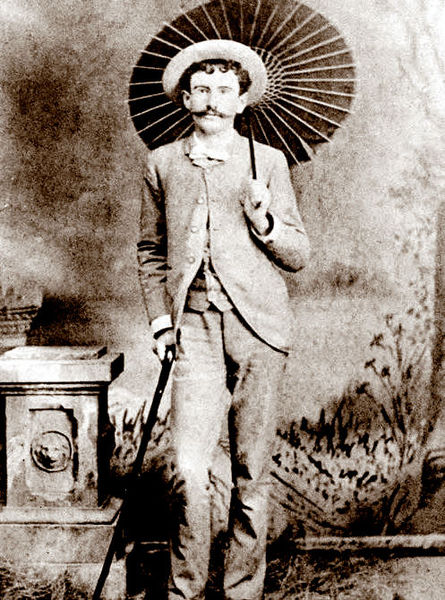
Posted in RagBlog | Leave a comment

Gasoline prices, the XL Pipeline, political nonsense, and oil speculators

None of us like paying higher prices for gasoline. Some of us can’t afford the price increases we have seen the last few weeks and months to get to work and wherever else we need (or want) to go, leaving us less to spend on other products. But what most politicians have to say on the subject is nonsense. They want to score political points, rather than find a way out of this mess, or at least a way to improve it.

The giddy, knee-jerk response to higher gasoline prices is the thoughtless mantra “drill, baby, drill.” But our problem is not a lack of domestic oil production. We are producing about all we can, with thousands of leases still not developed. And domestic demand is lower than it was 14 years ago. According to a report in Bloomberg Businessweek Magazine, the US demand for crude oil in 2011 was less than it was in April 1997. In spite of our gargantuan appetite for oil, as a share of our total use, domestic oil consumption was 15 points lower in 2005 than it was in 1995. Today’s figures are about the same, according to a petroleum report in the Financial Times of London.

The largest single source of oil for the US is Canada, at 25%. The OPEC countries together account for 47% of US imports. Demand for oil in the US dropped 2% in 2011, while US oil production has increased. The rise in gasoline prices is not because we don’t have enough oil. Two reasons for the higher prices are the rising cost of oil on the world market because of higher demand in China and India, and the actions of crude oil commodity speculators.

US oil companies export more oil products, such as gasoline and diesel, than they import. The top ten countries we export to are Mexico, Netherlands, Chile, Canada, Spain, Brazil, Guatemala, Turkey, Argentina, and France. In fact, most of the XL Pipeline tar sands oil that could come from Canada is slated to be turned into diesel and exported, according to the refineries that will process that oil if it ever comes into the US. The main reason for the increased US exports of petroleum products is that the refineries make more money exporting it than selling it domestically. Further, the refineries in the Port Arthur area are in a Foreign Trade Zone that rewards them with tax breaks for exporting oil products.

The thousands of new jobs that some politicians and business interests claim will be created by the XL Pipeline are nothing but Chamber of Commerce-type hype. The pipeline construction may result in 2500 temporary jobs, not tens of thousands of permanent jobs.

A leading expert on gas prices, James Hamilton of The University of California-San Diego, says that generally a $1 increase in the price of crude oil produces a 2.5-cent increase in the price of gasoline, which is exactly what has been happening in recent weeks.

While the gasoline price increases are not yet higher than they were in 2008, we did not hear President Bush being blamed for those increases then. But those opposed to President Obama have been yelling to anyone within earshot that the current responsibility for gasoline price increases are his. This is partisan and political nonsense, unsupported by the economic reality that about 97% of the price of gasoline is determined by the price of crude oil, according to Stuart Staniford, a scientist in the technology industry who studies oil-related data.

Around 2004, oil production stopped increasing world-wide. The producing countries have only so many pumps, oil pipelines, tankers, and other methods of getting the crude oil to refineries. As a result, the increasing demand from Asia and the rest of the rapidly-developing countries has created new competition for the oil production that is available, driving prices up. Decreasing demand for oil products caused by more energy-efficient vehicles makes a small difference in the price of gasoline, as do marginal increases or decreases in the price charged by retailers.

Oil commodity speculators also drive up the price of crude oil. According to some estimates, such speculators control 80% of the commodity futures market in crude oil. Such speculators don’t produce oil, refine it, or use it, except as a way to make money by arranging to buy it at one price and sell it at a higher price. Sen. Bernie Sanders (I-Vermont) wrote recently for CNN Opinion:

“I’ve seen the raw documents that prove the role of speculators. Commodity Futures Trading Commission records showed that in the summer of 2008, when gas prices spiked to more than $4 a gallon, speculators overwhelmingly controlled the crude oil futures market. The commission, which supposedly represents the interests of the American people, had kept the information hidden from the public for nearly three years. That alone is an outrage. The American people had a right to know exactly who caused gas prices to skyrocket in 2008 and who is causing them to spike today.

“Even those inside the oil industry have admitted that speculation is driving up the price of gasoline. The CEO of Exxon-Mobil, Rex Tillerson, told a Senate hearing last year that speculation was driving up the price of a barrel of oil by as much as 40%. The general counsel of Delta Airlines, Ben Hirst, and the experts at Goldman Sachs also said excessive speculation is causing oil prices to spike by up to 40%. Even Saudi Arabia, the largest exporter of oil in the world, told the Bush administration back in 2008, during the last major spike in oil prices, that speculation was responsible for about $40 of a barrel of oil.”

Confirming Sen. Sanders’s statements are comments from Bart Chilton, a commissioner on the five-member Commodity Futures Trading Commission, which regulates the trading of contracts for future deliveries of oil, as well as other commodities: “There is currently ample supply and limited demand, which should not push prices to the places they are today. Financial regulators are not price setters, but we are supposed to ensure prices are fair, and I am concerned that today they are not. There is a speculative premium being paid by consumers and businesses alike.”

New shale oil production in North Dakota and West Texas, new off-shore production, and recovering oil from the Arctic might increase global supplies a bit if the oil can be shipped to refineries, and if the refineries can increase their capacity to produce more oil products. But given the increasing demand for oil in China and other countries with newly-growing economies, it is unlikely that the price of crude oil will be permanently reduced by those small increases in production. With speculators influencing the price of crude oil for their economic benefit, the price will continue to be significantly higher than it would be in a non-speculative market. Such speculators are rightly seen as social and economic parasites who would rather manipulate oil prices than do any productive work.

But the bottom line is that everyone in the world will pay whatever they must to get the oil they need no matter what causes price increases. And the US will not be exempt from these forces. The chances that this Congress will do something about the crude oil speculation seems not very good to me, so we will continue to pay higher prices than we need to pay at the pump.

Realistically (meaning we will get no help from Congress), the best we can hope to do to lessen the impact of high oil prices is to drive more economical vehicles, switch to electric and hydrogen-powered vehicles (when they become available), or find other technologies to meet our transportation needs that don’t rely so directly on oil products.

© Lamar W. Hankins, Freethought San Marcos


Type rest of the post here

Source /

The Rag Blog

Posted in RagBlog | Leave a comment