Ted McLaughlin : Recovery is a Myth For Most Americans

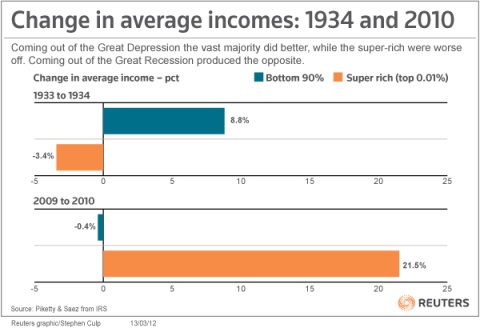
Chart from Reuters / ThinkProgress.

For most Americans:
The recovery is a myth

By Ted McLaughlin / The Rag Blog / March 20, 2012

The Great Depression of the 1930’s has a lot in common with the current Great Recession, which poses the question of why the economy is not recovering today the same way it did from the Great Depression.

As the chart above shows, the period from 1933 through 1934 showed an 8.8% income growth that was enjoyed by the bottom 90% of Americans. But in the “recovery” of 2009 through 2010, the bottom 90% of Americans actually dropped another 0.4% in income while the top 0.01% (the richest Americans) gained 21.5%. Why is the current recovery benefiting only the super-rich?

It all boils down to how the government has acted in response to it. In 1932, the country elected a huge majority of Democrats to Congress and put Democrat Franklin Roosevelt in the White House. The Democrats then went to work creating jobs. They created many jobs through government programs like the Works Project Administration (WPA) and the Civilian Conservation Corp (CCC), and taxed the rich to pay for it. These organizations went to work building America up, and we still enjoy many of the projects they completed.

But this also did something else besides putting some people in government jobs. It also increased the money flowing through the economy (because the people with those jobs now had money to spend). And all that new spending boosted the small businesses around the country, and as their business improved they also began to hire workers. The actions by those Democrats resulted in a rising economic tide that helped most Americans.

But Americans are not good at learning from history, so when the Great Recession struck in 2008 the country’s leaders did exactly the opposite of what the government had done to cure the Great Depression. They did this because the Democrats did not have a big enough majority to override Republican obstructionism. In 2009 and 2010, the Republicans in the Senate misused the filibuster rule to block any efforts the Democrats made to create large numbers of jobs.

The Republicans then shrunk the economy by laying off massive amounts of government workers (on both the state and federal level), cutting social programs severely, encouraging the export of American jobs, and extending the Bush tax cuts for the rich. And to their great shame, too many Democrats went along with this. This shrinking of the amount of money flowing through the economy also had the effect of hurting small businesses, so they also laid off workers.

After the 2010 elections, the Republicans had control of the House of Representatives so the obstructionism shifted from the Senate to the House. But the Republican policies (to block help for ordinary Americans while giving more to the rich) are still having the same effect they did in 2009 and 2010 — to keep the recession going for most Americans while only the richest Americans enjoy a “recovery.”

There is a solution — vote as many Republicans out of office as possible, and replace them with progressives. The Republicans know they have no solutions for the economic recovery of most Americans — they just don’t care as long as they can keep the money flowing to their rich Wall Street and corporate buddies.

That’s why they are trying to change the political focus from the economy to social issues (like abortion, contraception, immigration, race, same-sex marriage, etc.). If the Republicans are successful in changing the political agenda, then we can expect the economic pain to last many years longer for most Americans.

[Ted McLaughlin also posts at jobsanger. Read more articles by Ted McLaughlin on The Rag Blog.]

The Rag Blog

Posted in Rag Bloggers | Tagged , , , | Leave a comment

Walking While Black: Trayvon Martin’s Fatal Short-cut

By Jay D. Jurie / The Rag Blog /

SANFORD, Florida — Walking from a nearby 7-11 on February 26, 17-year-old Trayvon Martin took a short cut to the gated community home where he was staying with his father’s fiance. Shortly after 7 p.m., 28-year-old self-appointed neighborhood watch captain George Zimmerman called the Sanford Police Department on a non-emergency line to report a “suspicious person” who “looked like he was up to no good” in the neighborhood.

Shortly thereafter, several residents called 911 to report a disturbance and gunfire. After police were dispatched at 7:17 p.m., they arrived to find Martin face-down on the ground, with a gunshot wound to the chest, and apart from a pack of Skittles candy and a can of Arizona ice tea he’d purchased at the convenience store, he was unarmed. Martin was pronounced dead at 7:30 p.m.

That he was African-American, wearing a hoodie, and walking after dark in a neighborhood where he had every right to be constitutes the only evidence Martin was a “suspicious person.” A junior in high school, math was his favorite subject, and he earned A’s and B’s. He was studying to be an engineer, was interested in flying, and attended flying school part time. Martin had no criminal record nor any history of violence.

Police found Zimmerman standing nearby with a 9mm handgun in his waistband, a bloody nose, blood on the back of his head, and grass on the back of his shirt. Zimmerman admitted at the scene that he had shot Martin. What else has been established is that Zimmerman, a Hispanic of medium to stocky build, had expressed a desire to become a police officer, even though he had a 2005 arrest that included assault on a police officer.

He possessed a concealed weapons permit and was “patrolling” the neighborhood in an SUV when he spotted Martin.

According to the National Neighborhood Watch Manual (2010), “[Neighborhood] patrol members should be trained by law enforcement. It should be emphasized to members that they do not possess police powers and they shall not carry weapons… Members should never confront suspicious persons who could be armed and dangerous.”

There is no evidence that Zimmerman had ever received any training that might qualify him to serve as an effective neighborhood watch volunteer and he explicitly disregarded the imperatives not to carry a weapon and not to confront persons.

Several news outlets have reported that Zimmerman had contacted Sanford Police 46 times within the past 15 months. In a previous encounter, Zimmerman alleged that someone had spat at him. After he called police on February 26 and disclosed that he was following Martin, the tape reveals the dispatcher told him “you don’t need to be doing that.” Zimmerman is also clearly heard on that tape saying “these assholes, they always get away.”

Zimmerman disregarded the dispatcher’s admonition and continued following Martin. At some point Zimmerman exited his SUV; why he did so is unknown. Then occurred what a police spokesperson described as an “altercation.” Other details of what transpired remain sketchy and in dispute.

According to an Orlando Sentinel report, one partial eyewitness, 13-year-old Austin McLendon who was walking his dog, heard screaming and cries of “help me.” He saw one man wearing a red shirt, later identified as Zimmerman, on the ground. When the boy’s dog escaped, he turned to catch it and didn’t see what happened next, but heard a gunshot. McLendon was quoted as saying he heard no more screaming after the shot.

Another witness, Mary Cutcher, initially related that there was no punching, hitting, or wrestling, and the shooting was not self-defense, as Zimmerman insisted. She contended that police ignored her statement. After it aired on WFTV, the local ABC affiliate, police challenged the coverage and twice tried to contact her. On their third contact, it was reported that she changed what she had said and signed a sworn statement that corroborated Zimmerman’s version of events.

According to a story filed on the blog of Orlando Sentinel TV critic Hal Boedecker, Cutcher told a CNN interviewer “I don’t know this family [the Martins], I’m only trying to help, and I think that they [the Sanford Police Department] are trying to cover up something — that they made a mistake — and honestly, I feel like they’re taking the light off of them and trying to discredit my statements.”

According to Sela Mora Lamilla, a second witness quoted in the Boedecker story, “we were just telling the truth.”

Others in the surrounding area heard the altercation and called police. Screaming and the calls for help can be heard on the audio tapes. On one tape the sound of the gunshot is heard, after which the calls for help and screaming immediately stop. A key issue that remains in dispute is who was screaming; Zimmerman has claimed it was him.

Under mounting public pressure, police released the tapes more than two weeks after the shooting. After listening to the tapes, Martin’s parents, Tracy Martin and Sybrina Fulton, claimed it was their son, not Zimmerman, who was screaming and calling for help.

When police arrived on the scene, Zimmerman was initially handcuffed, but then released after he told police he’d acted in self-defense. Contrary to standard police homicide investigation procedure, Zimmerman was not alcohol- or drug-tested. More than three weeks after this incident, Zimmerman had still not been arrested or charged with any crime.

Sanford Police claimed there was “no probable cause” to make an arrest. Martin’s parents secured the services of attorneys Benjamin Crump and Natalie Jackson to seek recourse for their son’s death. As questions surrounding the police investigation and their decision not to arrest Zimmerman began to grow, the Police Department referred the case to the State Attorney’s Office.

Shortly after the Orlando Sentinel editorialized that the Florida Department of Law Enforcement (FDLE) needed to be brought in to investigate the situation, Sanford Police Chief Bill Lee, Jr., issued an invitation to the FDLE. He issued a similar invitation to the U.S. Department of Justice. U.S. Rep. Corrine Brown (D-FL) met with Sanford city officials and also solicited Justice Department involvement.

Darryl E. Owens of the Orlando Sentinel, in his column of March 17, observed that Florida has a long history of racism, including a 1920 white riot against blacks that culminated in a lynching, and the 1923 burning of the black town of Rosewood.

He alluded to the 1955 lynching of 14-year-old Emmett Till in Mississippi as a reason that African-Americans today remain mistrustful, and noted that “…another young black kid’s death has revived the suspicion that a black life doesn’t have all that much value…” and that “black folk… all too well know the deep, abiding sense that, in a country where segregation, Jim Crow, and prejudice have created unequal footing, African-Americans also too often endure separate but unequal justice.”

Like Florida, Sanford has a long history of racism, and not all of it in the distant past. A city of approximately 50,000, Sanford has roots as an agricultural community. At one time it was referred to as the “Celery City.” When agriculture began to decline in the post-World War II era, former agricultural workers were left stranded with little in the way of employment, resources, and educational opportunities. Pockets of African-American poverty spanning several generations remained — within and in close proximity to Sanford.

On Christmas Day, 1951, a bomb planted by the Ku Klux Klan blew up the home of African-American civil rights pioneers Harry T. and Harriette V. Moore. Harry Moore died on the way to the hospital in Sanford and Harriette Moore died there nine days later. Following the passage of the 1964 Civil Rights Act, the City filled in the swimming pool in Sanford’s downtown park, rather than integrate it.

More recently, in 2005, another young African-American man, Traveres McGill, was shot and killed by two white security guards in an apartment complex parking lot. One guard was a volunteer Sanford Police officer, and the other was the son of a former officer.

They claimed McGill was attempting to run them down with his car, and argued they shot him in the back in self-defense. Though one was initially charged with manslaughter and the other with firing into an occupied vehicle, a judge later dismissed both charges for lack of evidence.

In January 2011 homeless African-American Sherman Ware was standing outside a Sanford bar when for no apparent reason he was cold-cocked and knocked unconscious by Justin Collison, a white 21-year old. Collison, the son of a Sanford Police lieutenant, was not arrested until nearly two months later, after the incident was publicized on YouTube. He was eventually convicted of battery and placed on probation.

Then-Sanford Police Chief Brian Tooley, on the verge of retirement, was forced out of office early due to this case. Present Sanford Police Chief Bill Lee, Jr., was hired with a commitment to restore damaged race relations. Upon acceptance of the job, his pronouncements to that effect were encouraging.

However, this perception has now soured. On March 14, the Sanford Herald ran a banner headline that read: “Chief Lee: Arrest of Martin’s Shooter Would be Violation of Civil Rights.” The civil rights that Lee was concerned about were those of the shooter, George Zimmerman, not those of the deceased shooting victim, Trayvon Martin.

Lee based his statement, and his department’s decision not to arrest Zimmerman, largely on Florida Statutes Chapter 776.012, also known as the “stand your ground” law. This statute authorizes any person, virtually anywhere, any time, to engage in “the use of deadly force” if the person “reasonably believes… such force is necessary to prevent imminent death or great bodily harm to himself or herself…”

This statute further states that if deadly force is “justified,” then the person using it “does not have a duty to retreat.”

Florida is among 15 states, mostly in the South and West, that have the National Rifle Association-inspired “stand your ground” law on the books. When it was briefly part of the public debate before enactment in 2005, some expressed concern that it would produce unnecessary deadly consequences, such as “road rage” encounters escalating into killings. Those concerns have proven prophetic. While there have been other examples of what has gone wrong with this law, unfortunately, Trayvon Martin’s death is among the most tragic.

Adding further injury to the loss suffered by Martin’s family, Florida’s “stand your ground” statute provides not only immunity from criminal prosecution for a person using deadly force, but from civil liability as well. In other words, if the protective cover that has been afforded Zimmerman continues to be upheld, Martin’s parents cannot file a wrongful death lawsuit against him for killing their son.

When asked why Zimmerman was not arrested — since the police dispatcher had told him to quit following Martin — Lee replied that it was only advisory, not a police order. In combination with “stand your ground,” and Zimmerman’s concealed weapons permit, these appear to be the major factors upon which the Sanford Police “no probable cause” to arrest decision was based.

Lee has also asserted that there are additional factors that weigh in favor of Zimmerman’s claim of self-defense. Initially, these additional factors included the now-released tapes, which though inconclusive, do not appear to support Zimmerman.

At a March 19 protest rally at the Seminole County Courthouse, organized by law students from around the state and the Florida Civil Rights Association, representatives of the Florida Agricultural & Mechanical University (FAMU) Black Law Student Association (BLSA) related that they had met with a representative of the State Attorney’s office to insist upon transparency and demanded the immediate release of all other information pertaining to the case.

The BLSA representatives stated that such transparency was the only way to dispel the impression that the Sanford Police Department and the investigative process were functioning as George Zimmerman’s defense counsel. The students were informed that the tapes will be voice-tested to determine who was screaming and calling for help.

Given what is known to date, aside from the testimony of the sole survivor of the encounter between Trayvon Martin and George Zimmerman, it cannot be said with any certainty that it was Zimmerman who stood his ground.

Martin may have entered the neighborhood where he was staying, with his candy and tea, and noticed a “suspicious person” following him slowly in an SUV. He might have seen this person get out of this car and approach him. Not knowing this person, or his intentions, he might either have sought to “retreat,” or — as he would have every right to do under Florida law — stood his ground. Maybe Martin was killed trying either to get away from or to defend himself against Zimmerman.

Unless further information paints a more complete and accurate picture of what occurred, we’ll never know. What we do know for sure is that Zimmerman had a chip on his shoulder against “assholes,” whoever he imagined those “assholes” might be; that contrary to neighborhood watch instructions he was carrying a weapon; that he continued to pursue Martin after he was dissuaded

from doing so; and that for reasons known only to him, he got out of his SUV, apparently to confront Martin on foot. All this strongly suggests that, if not overtly racist, Zimmerman was an overzealous “wannabe” on a power trip. Or, as a participant at the March 19 rally put it, a “bully.” These factors alone may make whatever other information the police and prosecutors might have, and selectively release, difficult to overcome.

Meanwhile, protests about the circumstances surrounding the death of Trayvon Martin continue. Yesterday hundreds marched in Titusville, the County Seat of Brevard County, that shares the same judicial circuit as Seminole County. Two more mass meetings and a demonstration are scheduled in Sanford before the end of the month. Rev. Al Sharpton is scheduled to appear at a mass meeting on March 21st.

It has been reported there will be a demonstration in Tallahassee, the state capital. An online petition calling for “Justice for Trayvon” has reportedly received more than 285,000 signatures.

Members of the New Black Panther Party have already demonstrated outside Sanford Police Headquarters and said they may return. Members of the New Black Liberation Militia have threatened to make a citizens arrest of Zimmerman.

Beyond these immediate steps, a fresh look needs to be taken at Florida’s concealed weapons permitting process. Like the shooting of Rep. Gabrielle Giffords in Arizona showed, this process may too easily put guns into the wrong hands.

Sanford City Commissioner Velma Williams has already proposed a “Trayvon Martin Law” that would amend or curtail Florida’s “stand your ground” law.

During the 1960s the U.S. Justice Department was compelled to act in the Deep South when local law enforcement and the justice system failed to adequately and equally protect all citizens. That sort of intervention is necessitated in Sanford today. It may well turn out that possible violation of Trayvon Martin’s civil rights will have to be adjudicated under federal law.

Given its inability to reform itself, the Sanford Police Department may need to be placed in some form of federal receivership, as when the Sanford Housing Authority was placed in receivership under the U.S. Department of Housing and Urban Development due to extreme fiscal and other mismanagement.

Above all, Sanford’s residents need to stay involved, and continue to demand greater responsibility, accountability, openness, and transparency over the long haul.

For one example of citizen involvement, go to Matt Diaz, Sr., calls the State Attorney’s office:

www.youtube.com/watch?v=nVylGQF1o04&feature=youtu.be

[Jay D. Jurie, a veteran of SDS at the University of Colorado at Boulder, now teaches public administration and urban planning and lives near Orlando, Florida. Read more articles by Jay D. Jurie on The Rag Blog.]

References:

Audio of Trayvon Martin Shooting 911 Tape Calls: http://www.wftv.com/videos/news/teen-shooting-911-calls-1-3/vGZnj/

Boedecker, Hal, “Trayvon Martin: Thank God for the Media, ” Orlando Sentinel Entertainment Blog, March 16, 2012.
http://blogs.orlandosentinel.com/entertainment_tv_tvblog/2012/03/trayvon-martin-thank-god-for-the-media.html

Delinski, Rachel, “Chief Lee: Arrest of Martin’s Shooter Would be a Violation of Civil Rights,” Sanford Herald, March 14, 2012. www.mysanfordherald.com

Herald Staff, “Chief Bill Lee Answers Questions about Investigation Into Shooting of 17-year-old Trayvon Martin, Sanford Herald, March 17, 2012. http://mysanfordherald.com/view/full_story/17920337/article-Chief-Bill-Lee-answers-questions-about-investigation-into-shooting-of-17-year-old-Trayvon-Martin?instance=home_news_2nd_left

Lee, Trymaine, “Trayvon Martin Case Salts Old Wounds and Racial Tension,” Huffington Post, March, 14, 2012. http://www.huffingtonpost.com/2012/03/14/trayvon-martin-sanford-florida_n_1345868.html?flv=1#s766198

Lee, Trymaine, “Trayvon Martin Case Recasts Century-old Battle Lines for Local Activist,” Huffington Post, March 18, 2012. http://www.huffingtonpost.com/2012/03/16/trayvon-martin-george-zimmerman_n_1352874.html?ref=topbar

Owens, Darryl, E., “Here’s Why People Are So Angry Over Trayvon’s Death,” Orlando Sentinel, March 17, 2012. http://www.orlandosentinel.com/news/local/seminole/os-trayvon-martin-shooting-darryl-owens-031712-20120316,0,3856677.column

Robles, Frances, “Shooter of Trayvon Martin a Habitual Caller to Cops,” Miami Herald, March 17, 2012.
http://www.miamiherald.com/2012/03/17/2700249/shooter-of-trayvon-martin-a-habitual.html

Stutzman, Rene, “George Zimmerman’s Father: My Son Is Not a Racist,” Orlando Sentinel, March 15, 2012. http://www.orlandosentinel.com/news/local/os-trayvon-martin-shooting-zimmerman-letter-20120315,0,1716605.story

Stutzman, Rene, “Shooter’s Father: Son Didn’t Start Encounter,” Orlando Sentinel, March 16, 2012.
http://www.orlandosentinel.com/news/local/os-trayvon-martin-shooting-zimmerman-letter-20120315,0,1716605.story

Stutzman, Rene, and Prieto, Bianca, “Trayvon Martin Shooting: Police to Release 911 Calls,” Orlando Sentinel, March 16, 2012. http://articles.orlandosentinel.com/2012-03-16/news/os-trayvon-martin-shooting-911-call-20120316_1_shooting-police-department-investigator-chris-serino,

Type rest of the post here

Source /

The Rag Blog

Posted in RagBlog | Leave a comment

Bill Freeland : Republican Roulette

Graphic by Bill Freeland / The Rag Blog.

Republican roulette:
Romney vs. the rebels

By Bill Freeland | The Rag Blog | March 20, 2012

As the Republican nominating process enters its whirlwind phase — with nearly a primary a week scheduled over the next three months — it’s not just delegates that will be up for grabs. More fundamentally, it will also be the identity of the party itself.

On the surface, of course, it’s been between Romney and “Anybody But” — a revolving cast of challengers dating back to Donald Trump. But now, as we enter the crucial home stretch, the pitchfork is firmly in the grasp of challenger Rick Santorum.

Yet as the bitterness of the contest has revealed, the nominating process has actually devolved into a rancorous sibling rivalry between two symbolic poles: an entitled Establishment and a diverse rebel insurgency.

So what began merely as a political contest between personalities has become something entirely different: a fight between two radically different paradigms.

But here’s the twist: This could be the year that the losers in the GOP primary process could ultimately have as lasting an influence as the winners on the party’s future as they plot their return.

Say, for example, the party elites get their way — and their man — and Romney is nominated but loses to President Obama.

The elites, who are bitterly opposed by the rebels, will be disgraced and the insurgents vindicated. It will be 1976 all over again, when the party mainstream mistakenly stuck with Ford over Reagan — and lost to Carter. They corrected that mistake four years later, signing on with the Gipper and his purer vision of movement conservatism.

Next time today’s agitators will likely look early on to reincarnate a symbolic Reagan and move still further to the right to win in 2016.

Now compare that to a victory in Tampa by the “Anybody But Romney” wing of the GOP. It would be a stunning victory — but what if they lose to Obama?

In that case, welcome to 1964. That year Goldwater proclaimed extremism was no vice — but learned to his regret that moderation in pursuit of the presidency was a virtue — as he lost to LBJ in a landslide.

What his party learned was the virtue of moderation — and succeeded with Nixon four years later. A loss in 2012 will likely mean the party next time will avoid the mistakes of 1964 and seek a win with a similarly moderate candidate in 2016.

Now what about the Democrats? A parallel scenario could also emerge.

Recent polls, reflecting both better economic trends and perhaps a contrast with the bitter GOP primary battles, give the incumbent Obama a slight advantage over his challengers. But worsening job numbers and high gas prices could still put the outcome in doubt.

Should he lose, the signature policy of his administration, bipartisanship in the face of GOP obstructionism (which has driven many Democrats to distraction), would likely be repudiated — resulting in a more assertive nominee next time. The likely outcome: a more aggressive party and an even more polarized political process.

The lesson in all this: hopes for the future are often haunted by the failures of the past — and sometimes even defined by them. Thus it can be argued that instead of imagining the future, we sometimes settle merely for avoiding the mistakes of the past.

If that is the lesson the losers of 2012 take as a guide for the future, then their party and our nation will be the poorer for it.

[In the Sixties, Bill Freeland was a contributor to The Rag in Austin and Liberation News Service in New York. Read more articles by Bill Freeland on The Rag Blog.]

The Rag Blog

Posted in Rag Bloggers | Tagged , , , | Leave a comment

Harry Targ : Military Spending and our National Priorities

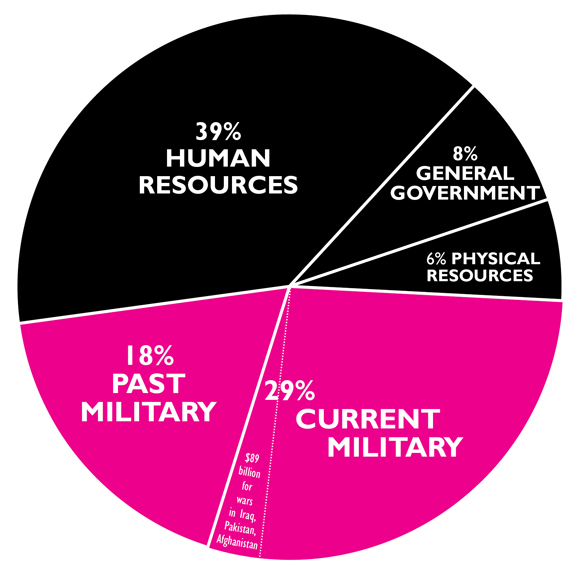
Breakdown of projected government spending for fiscal yer 2013. To see how these figures were determined, go here.

Poor are paying the price:
Military spending and
our natioal priorities

By Harry Targ
/ The Rag Blog / March 18, 2012

“From Forrestal’s day to the present, semi-warriors have viewed democratic politics as problematic. Debate means delay. To engage in give-and-take or compromise is to forfeit clarity and suggests a lack of conviction. The effective management of national security requires specialized knowledge, a capacity for clear-eyed analysis and above all an unflinching willingness to make decisions, whatever the cost.

With the advent of the semi-war, therefore, national security policy became the preserve of experts, few in number, almost always unelected, habitually operating in secret, persuading themselves that to exclude the public from such matters was to serve the public interest. After all, the people had no demonstrable ‘need to know.’ In a time of perpetual crisis, the anointed role of the citizen was to be pliant, deferential and afraid.” — Andrew Bacevich, reviewing a biography of James Forrestal, the first Secretary of Defense, in The Nation.

Andrew Bacevich reminds us that a permanent war economy has been part of the political and economic landscape of the United States at least since the end of World War II.

The War Resisters League pie chart of total government spending for fiscal year 2013 indicates that 47 percent of all government spending deals with current and past military costs. Despite lower government estimates that mask true military spending, by adding the Social Security Trust Fund to total spending and regarding past military spending — particularly veteran’s benefits — as non-military, it is clear that roughly 50 cents of every dollar goes to war, war preparation, covert operations, and military contractors.

In addition, “war support” contractors such as KBR have made billions of dollars in the twenty-first century from military spending. Top producers of military hardware Lockheed Martin, Northrop Grumman, and Boeing earned 11, 8, and 5 billion dollars in contracts in 2010 alone. Ostensibly non-military corporations such as BP, FedEx, Dell, Kraft, and Pepsi received hundreds of millions of dollars in defense contracts in 2010.

Virtually every big corporation is to some degree on the Department of Defense payroll.

A recent data-based report, “Don’t Bank on the Bomb,” prepared by the International Campaign to Abolish Nuclear Weapons (ICAN), identified “more than 300 banks, insurance companies, pension funds and asset managers from 30 countries that invest significantly in 20 major nuclear weapons producers.”

The report examined in detail financial connections to 20 major nuclear weapons companies. These 20 included U.S. producers of nuclear weapons components such as Bechtel, Boeing, GenCorp, General Dynamics, Honeywell, and Northrop Grumman.

U.S. financial institutions investing in the nuclear weapons producers included Abrams Bison Investments, AIG, American National Insurance Company, Fidelity, Franklin Templeton, JP Morgan Chase, New York Life, and Prudential Financial.

Because of the economic crisis which began in 2007, debate about military spending has increased. In 2010 Congressmen Barney Frank and Ron Paul initiated a study addressing needed cuts. The report prepared for them in 2010, “Debt, Deficits, and Defense,” called for across the board reductions in spending-procurement, research and development, personnel, operations and maintenance, and infrastructure — of $960 billion over the next decade. The report noted that over the last decade 65 percent of federal discretionary spending went to the military.

President Obama last January proposed more modest spending cuts of $480 billion over the next decade (reductions in projected increases, not existing funding). He coupled the announcement about future spending with a firm statement that the world must realize that the United States remains committed to maintaining its military superiority.

The President indicated that spending reductions in the future will be tied to greater use of “special operations,” drones, and shifting existent forces from Europe to Asia.

The magnitude of military spending represents what Bacevich referred to as the permanent war economy articulated and defended by the “semi-warriors” dominating U.S. foreign policy in each administration since World War II.

These semi-warriors gained influence after the Truman Administration accepted recommendations in National Security Document Number 68 (1950), which recommended that defense spending should always have priority over all other government spending. NSC 5412, approved by President Eisenhower, gave legitimacy to covert operations around the world allowing any president to “plausibly deny” any connections with such operations.

Subsequently virtually each president proclaimed a doctrine — Eisenhower for the Middle East, Carter for the Persian Gulf, Reagan to rollback “the evil empire,” Clinton for “humanitarian interventions” and Bush for “preemptory attacks” — justifying more and more military spending.

The Obama administration, through speeches and actions, has constructed what might be called “the Obama Doctrine.”

First, as the last remaining superpower and the beacon of hope for the world, the United States once again reserves the right and responsibility to intervene militarily to enhance human rights around the world.

Second, U.S. humanitarian military interventions will be carried out from time to time with our friends.

Third, new technologies such as drones will allow these interventions to occur without “boots on the ground.” They will be cheaper in financial and human cost (mostly for American troops).

Finally, assassinations and covert killings have made it clear that the Obama Doctrine overrides recognized judicial proceedings and the sanctity of human life.

Since the establishment of the permanent war economy in the 1940s millions of proclaimed “enemies” have been killed and seriously injured, mostly in the Global South. Permanent physical and psychological damage has been done to U.S soldiers, predominantly poor and minorities as they too are victims of war.

In addition, military spending has distorted national priorities and invested U.S. financial resources in expenditures that do not create as many jobs as investments in construction, education, or healthcare. And the permanent war economy has created a culture that celebrates violence, objectifies killing, dehumanizes enemies, and exalts super-patriotism through television, music, video games, and educational institutions.

These issues need to be more vigorously related to those raised by the grassroots campaigns that have sprung up to defend worker’s and women’s rights, oppose growing income and wealth inequality, and defend working people’s homes from foreclosures.

A long time ago — in reference to the massive U.S. war in Southeast Asia and desperate needs of workers at home — Dr. Martin Luther King described the fundamental connections that peace activists and all progressives must pursue: “I speak of the poor of America who are paying the double price of smashed hopes at home, and death and corruption in Vietnam.”

[Harry Targ is a professor of political science at Purdue University who lives in West Lafayette, Indiana. He blogs at Diary of a Heartland Radical — and that’s also the name of his new book which can be found at Lulu.com. Read more of Harry Targ’s articles on The Rag Blog.]

The Rag Blog

Posted in Rag Bloggers | Tagged , , , | Leave a comment

VERSE / Mariann G. Wizard : Hiatus

Image from Dzinepress.

Hiatus

The plazas are empty, swept clean of debris,
smug analyses already written.
Elections are coming, everyone run to see:
is it Newton? or El Ron? or Mittens?

But out of the glare of the media stare,
the knowledge unerringly spreads:
the old ways are broken, the people have spoken,
and a new generation now treads
lightly as snowflakes, deeper than earthquakes,
firmly they step to the fore;
unafraid of each other, knowing Earth as their mother,
occupying tomorrow’s far shore.

As spring comes around, let us welcome the sound
of our children all rising as one!
Step away from the past! Find a way that can last!
Our survival demands that we yearn
not for privileged wealth, but for happiness, health,
and a sense of creation and worth.
If no one is greedy, no one must be needy —
let a new age bring forth peace on earth!

The plazas are empty, swept clean of debris,
but the rising continues to roll.
When the people come out, and again raise a shout,
trust your kids, not some fake Fox News poll!

Mariann G. Wizard / The Rag Blog
February 14, 2012

[Mariann G. Wizard, a Sixties radical activist and contributor to The Rag, Austin’s underground newspaper from the 60s and 70s, is a poet, a professional science writer specializing in natural health therapies, and a regular contributor to The Rag Blog. Read more poetry and articles by Mariann G. Wizard on The Rag Blog.]

The Rag Blog

Posted in Rag Bloggers | Tagged , , , | 2 Comments

David Bacon : How U.S. Policies Fueled the Great Mexican Migration

So many migrants from Veracruz have settled in North Carolina and the South that they name markets for their home state. Because of ferocious anti-immigrant laws, however, many businesses have lost customers as immigrants flee the state. Photo © David Bacon.

How U.S. policies fueled
Mexico’s great migration

By David Bacon | The Rag Blog | March 15, 2012

David Bacon will discuss the issues raised in this article on Rag Radio with Thorne Dreyer, on KOOP 91.7-FM in Austin on Friday, March 16, 2012, from 2-3 p.m. (CDT). The show will be streamed live here. Rag Radio is rebroadcast — and streamed live — every Sunday at 10 a.m. (EDT) on WFTE-FM in Mt. Cobb and Scranton, PA. After broadcast, all shows are posted as podcasts at the Internet Archive and can be listened to here.

[This article was reported in partnership with The Investigative Fund at The Nation Institute and the Puffin Foundation. It was originally published by The Nation on January 23, 2012. Some names of the people profiled in this article have been changed.]

Roberto Ortega tried to make a living slaughtering pigs in Veracruz, Mexico. “In my town, Las Choapas, after I killed a pig, I would cut it up to sell the meat,” he recalls.

But in the late 1990s, after the North American Free Trade Agreement (NAFTA) opened up Mexican markets to massive pork imports from U.S. companies like Smithfield Foods, Ortega and other small-scale butchers in Mexico were devastated by the drop in prices. “Whatever I could do to make money, I did,” Ortega explains. “But I could never make enough for us to survive.”

In 1999 he came to the United States, where he again slaughtered pigs for a living. This time, though, he did it as a worker in the world’s largest pork slaughterhouse, in Tar Heel, North Carolina.

His new employer? Smithfield — the same company whose imports helped to drive small butchers like him out of business in Mexico.

David Ceja, another immigrant from Veracruz who wound up in Tar Heel, recalls, “Sometimes the price of a pig was enough to buy what we needed, but then it wasn’t. Farm prices were always going down. We couldn’t pay for electricity, so we’d just use candles. Everyone was hurting almost all the time.”

Ceja remembers that his family had 10 cows, as well as pigs and chickens, when he was growing up. Even then, he still had to work, and they sometimes went hungry. “But we could give milk to people who came asking for it. There were people even worse off than us,” he recalls.

In 1999, when Ceja was 18, he left his family’s farm in Martinez de la Torre, in northern Veracruz. His parents sold four cows and two hectares of land, and came up with enough money to get him to the border. There he found a coyote who took him across for $1,200. “I didn’t really want to leave, but I felt I had to,” he remembers. “I was afraid, but our need was so great.”

He arrived in Texas, still owing for the passage. “I couldn’t find work for three months. I was desperate,” he says. He feared the consequences if he couldn’t pay, and took whatever work he could find until he finally reached North Carolina. There friends helped him get a real job at Smithfield’s Tar Heel packinghouse. “The boys I played with as a kid are all in the U.S.,” he says. “I’d see many of them working in the plant.”

North Carolina became the number-one U.S. destination for Veracruz’s displaced farmers. Many got jobs at Smithfield, and some, like Ortega and Ceja, helped lead the 16-year fight that finally brought in a union there. But they paid a high price. Asserting their rights also made them the targets of harsh immigration enforcement and a growing wave of hostility toward Mexicans in the American South.

The experience of Veracruz migrants reveals a close connection between U.S. investment and trade deals in Mexico and the displacement and migration of its people. For nearly two decades, Smithfield has used NAFTA and the forces it unleashed to become the world’s largest packer and processor of hogs and pork. But the conditions in Veracruz that helped Smithfield make high profits plunged thousands of rural residents into poverty. Tens of thousands left Mexico, many eventually helping Smithfield’s bottom line once again by working for low wages on its U.S. meatpacking lines. “The free trade agreement was the cause of our problems,” Ceja says.

Smithfield goes to Mexico — and migrants come here

In 1993 Carroll Foods, a giant hog-raising corporation, partnered with a Mexican agribusiness enterprise to set up a huge pig farm known as Granjas Carroll de Mexico (GCM) in Veracruz’s Perote Valley. Smithfield, which had a longtime partnership with Carroll Foods, bought the company out in 1999.

By 2008 the Perote operation was sending close to a million pigs to slaughter every year — 85 percent to Mexico City and the rest to surrounding Mexican states. Because of its location in the mountains above the city of Veracruz, Mexico’s largest port, the operation could easily receive imported corn for feed, which makes up two-thirds of the cost of raising hogs.

NAFTA lifted the barriers on Smithfield’s ability to import feed. This gave it an enormous advantage over Mexican producers, as U.S. corn, heavily subsidized by U.S. farm bills, was much cheaper. “After NAFTA,” says Timothy Wise, of the Global Development and Environment Institute at Tufts University, U.S. corn “was priced 19 percent below the cost of production.”

But Smithfield didn’t just import feed into Mexico. NAFTA allowed it to import pork as well.

According to Alejandro Ramírez, general director of the Confederation of Mexican Pork Producers, Mexico imported 30,000 tons of pork in 1995, the year after NAFTA took effect. By 2010 pork imports, almost all from the United States, had grown more than 25 times, to 811,000 tons. As a result, pork prices received by Mexican producers dropped 56 percent. U.S. pork exports are dominated by the largest companies. Wise estimates that Smithfield’s share of this export market is significantly greater than its 27 percent share of U.S. production.

Imported pork had a dramatic effect on Mexican jobs. “We lost 4,000 pig farms,” Ramírez estimates, based on reports received by the confederation from its members. “On Mexican farms, each 100 animals produce five jobs, so we lost 20,000 farm jobs directly from imports. Counting the five indirect jobs dependent on each direct job, we lost over 120,000 jobs in total.”

“That produces migration to the U.S. or to Mexican cities,” Ramírez charges.

Corn imports also rose, from 2 million to 10.3 million tons from 1992 to 2008. “Small Mexican farmers got hit with a double whammy,” Wise explains. “On the one hand, competitors were importing pork. On the other, they were producing cheaper hogs.” Smithfield was both producer and importer. Wise estimates that this one company supplies 25 percent of all the pork sold in Mexico.

The increases in pork and corn imports were among many economic changes brought about by NAFTA and concurrent neoliberal reforms to the Mexican economy, such as ending land reform. Companies like Smithfield benefited from these changes, but poverty increased also, especially in the countryside.

In a 2005 study for the Mexican government, the World Bank found that the extreme rural poverty rate of 35 percent in 1992-94, before NAFTA, jumped to 55 percent in 1996-98, after NAFTA took effect — the years when Ortega and Ceja left Mexico. This could be explained, the report said, “mainly by the 1995 economic crisis, the sluggish performance of agriculture, stagnant rural wages, and falling real agricultural prices.”

By 2010, according to the Monterrey Institute of Technology, 53 million Mexicans were living in poverty — half the country’s population. About 20 percent live in extreme poverty, almost all in rural areas.

The growth of poverty, in turn, fueled migration. In 1990, 4.5 million Mexican-born people lived in the United States. A decade later, that population had more than doubled to 9.75 million, and in 2008 it peaked at 12.67 million. About 5.7 million were able to get some kind of visa; another 7 million couldn’t but came nevertheless.

As an agricultural state, Veracruz suffered from Mexico’s abandonment of two important policies, which also helped fuel migration. First, neoliberal reforms did away with Tabamex, a national marketing program for small tobacco farmers. A similar program for coffee growers ended just as world coffee prices plunged to record lows. Second, Carlos Salinas de Gortari, the country’s corrupt president, pushed through changes to Article 27 of the Constitution in 1992, dismantling land reform and allowing the sale of ejidos, or common lands, as private property.

Fausto Limon looks at his bean plants, knowing they need more fertilizer, but lacking the money to buy it. Photo © David Bacon.

Waves of tobacco and coffee farmers sold their land because they could no longer make a living on it. Many became migrants. But allowing the sale of ejidos to foreigners made it possible for Carroll Foods to buy land for its swine sheds. Displaced farmers then went to work in those sheds at low wages.

Simultaneous changes in the United States also accelerated migration. The Immigration Reform and Control Act, passed by Congress in 1986, expanded the existing H2-A visa program, creating the current H2-A program, which allows U.S. agricultural employers to bring in workers from Mexico and other countries, giving them temporary visas tied to employment contracts.

Growers in North Carolina became large users of the program, especially through the North Carolina Growers Association. Landless tobacco farmers from Veracruz became migrant tobacco workers in the Carolinas.

“Many Veracruzanos came because we were offered work in the tobacco fields, where we had experience,” remembers Miguel Huerta. “Then people who’d been contracted just stayed, because they didn’t have anything in Mexico to go back to. After the tobacco harvest, workers spread out to other industries.”

From Huerta’s perspective, “these companies are very powerful. They can go to Mexico and bring as many employees as they want and replace them when they want.” Poverty, though, was the real recruiter. It created, as Ceja says, the need. “We all had to leave Veracruz because of it,” he emphasizes. “Otherwise, we wouldn’t do something so hard.”

Exporting the hazards of corporate hog raising

Hog raising is a dirty business — and the environmental damage it creates has provoked rising opposition to Smithfield’s operations within U.S. borders. In Virginia in 1997, federal judge Rebecca Smith imposed the largest federal pollution fine to that date — 
$12.6 million — on the company for dumping pig excrement into the Pagan River, which runs into Chesapeake Bay. That year the state of North Carolina went further, passing a moratorium on the creation of any new open-air hog waste lagoons and a cap on production at its Tar Heel plant.

In 2000, then-State Attorney General Mike Easley forced Smithfield to fund research by North Carolina State University to develop treatment methods for hog waste that are more effective than open lagoons. Despite North Carolina’s well-known hostility to regulating business, in 2007 Easley (by then governor) made the moratorium permanent. In the face of public outcry over stench and flies, even the anti-regulation industry association, the North Carolina Pork Council, supported it.

In Mexico’s Perote Valley, however — a high, arid, volcano-rimmed basin straddling the states of Veracruz and Puebla — Smithfield could operate unburdened by the environmental restrictions that increasingly hampered its expansion in the United States.

Mexico has environmental standards, and NAFTA supposedly has a procedure for requiring their enforcement, but no complaint was ever filed against GCM or Smithfield under NAFTA’s environmental side agreement. Carolina Ramirez, who heads the women’s department of the Veracruz Human Rights Commission, concluded bitterly that “the company can do here what it can’t do at home.”

For local farmers like Fausto Limon, the hog operation was devastating. On some warm nights his children would wake up and vomit from the smell. He’d put his wife, two sons, and daughter into his beat-up pickup, and they’d drive away from his farm until they could breathe without getting sick. Then he’d park, and they’d sleep in the truck for the rest of the night.

Limon and his family all had painful kidney ailments for three years. He says they kept taking medicine until finally a doctor told them to stop drinking water from the farm’s well. Last May they began hauling in bottled water. Once they stopped drinking from the well, the infections stopped.

Less than half a mile from his house is one of the many pig farms built by Smithfield’s Mexican hog-raising subsidiary, GCM. “Before the pig farms came, they said they would bring jobs,” Limon remembers. “But then we found out the reality. Yes, there were jobs, but they also brought a lot of contamination.”

David Torres, a Perote native who spent eight years in the operation’s maternity section, estimates that GCM has 80 complexes, each with as many as 20,000 hogs. The sheds look clean and modern. “When I went to work there, I could see the company was completely mechanized,” he says. The Mexican News online business journal explains that “production cost is very low because of the high ratio of pigs to workers… The preparation of food and feeding of the pigs is completely automated, along with temperature control and the elimination of excrement.”

Workers aren’t employed directly by Granjas Carroll, however, according to Torres. “Since we work for a contractor, we’re not entitled to profit-sharing or company benefits,” he says. “Granjas Carroll made millions of dollars in profits, but never distributed a part of them to the workers,” as required under Mexico’s federal labor law. Torres was paid 1,250 pesos ($90) every 15 days; he says the company picked him up at 6:00 every morning and returned him home at 5:30 each evening, often six days a week.

In back of each complex is a large oxidation pond for the hogs’ urine and excrement. A recent drive through the valley revealed that only one of several dozen was covered. “Granjas Carroll doesn’t use concrete or membranes under their ponds,” Torres charges, “so the water table is getting contaminated. People here get their water from wells, which are surrounded by pig farms and oxidation ponds.”

Ruben Lopez, a land commissioner in Chichicuautla, a valley town surrounded by hog farms, also says there is no membrane beneath the pools.

In response to an article published in August in Imagen de Veracruz, a Veracruz newspaper, GCM public relations director Tito Tablada Cortés declared, “Granjas Carroll does not pollute.” And Smithfield spokeswoman Amy Richards says, “Our environmental treatment systems in Mexico strictly comply with local and federal regulations… Mexico encourages, and requires, anaerobic digesters and evaporation ponds.”

Yet despite the 1,200 jobs the pig farms created in a valley where employment is scarce, Limon estimates that a third of the young people have left. “They don’t see a future, and every year it’s harder to live here,” he says.

In 2004 a coalition of local farmers called Pueblos Unidos (United Towns) started collecting signatures for a petition to protest the expansion of the swine sheds. According to teacher Veronica Hernandez, students told her that going to school on the bus was like riding in a toilet. “Some of them fainted or got headaches,” she charges.

When expansion plans moved forward nonetheless, on April 26, 2005, hundreds of people blocked the main highway. That November a construction crew about to build another shed and oxidation pond was met by 1,000 angry farmers. Police had to rescue the crew.

Finally, in 2007 GCM’s Tablada Cortés signed an agreement with local towns blocking any new expansion. That year, however, the company filed criminal complaints against Hernandez and thirteen other leaders, charging them with “defaming” the company. Although the charges were eventually dropped, the farmers were intimidated and the protest movement diminished.
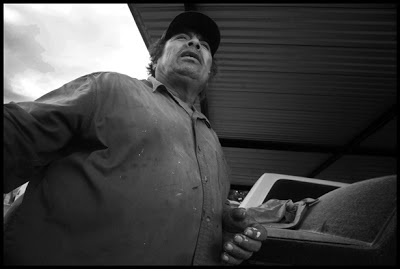
A local farmer declares that the people of the Perote Valley want the hog farms removed to protect the environment and health of the communities there. Photo © David Bacon.

Then, in early 2009, the first confirmed case of swine flu, the AH1N1 virus, was found in a five-year-old boy, Édgar Hernández from La Gloria. Pickup trucks from the local health department began spraying pesticide in the streets to kill the omnipresent flies. Nevertheless, the virus spread to Mexico City. By May, 45 people in Mexico had died. Schools closed, and public events were canceled.

Smithfield denied that the virus came from its Veracruz hogs, and Mexican officials were quick to agree. Tablada’s note to Imagen de Veracruz asserted, “Our company has been totally cleared of any links with the AH1N1 virus,” and “the official position of the Secretary of Health and the World Health Organization leaves no room for doubt.”

By one estimate, fear of the virus had led to losses of $8.4 million per day for the U.S. pork industry for the first two weeks of the global scare. So meatpacking companies breathed a sigh of relief at Smithfield’s exoneration. In the valley, though, “no one believed it,” Limon recalls.

This past August, GCM representatives received a permit from the municipal president of Guadalupe Victoria, the county next to Perote, for building new hog farms. Representatives of 18 town councils have denounced the expansion plans and accuse state authorities of “threatening to use public force (the granaderos) so that the company can continue to expand, against our will.”

“It doesn’t do any good to threaten to kill us,” responds one farmer. “We’re not going to let them build any more sheds. We want GCM to leave the valley.”

Veracruzanos fight for the union in Tar Heel

As unrest grew in Veracruz, it was also growing among the company’s workers in North Carolina. When the Tar Heel slaughterhouse opened in 1992, its labor force was made up mostly of African-Americans and local Lumbee Native Americans. Many objected to the high line speed and the injuries that proliferated as a result.

The plant kills and dismembers 32,000 hogs every day. People stand very close together as animal carcasses speed by. They wield extremely sharp knives, slicing through sinews and bone in the same motion, hundreds of times each hour. Repetitive stress and other injuries are endemic to meatpacking, and the faster the line runs, the more injuries there are.

The workers’ frustration with the low wages and brutal working conditions produced one of the longest and bitterest fights to organize a union in modern U.S. labor history. In 1994 and 1997 the United Food and Commercial Workers (UFCW) lost two union representation elections. The 1997 election was thrown out by the labor board, but an administrative law judge ruled that in both, Smithfield “engaged in egregious and pervasive unfair labor practices and objectionable conduct.”

In 1997 police in riot gear lined the walkway into the plant, and workers had to file past them to cast their ballots. At the end of the vote count, union organizer Ray Shawn was beaten up. Security chief Danny Priest and the other guards were later deputized, and Smithfield maintained a holding cell in a trailer on the property, which workers called the company jail.

Even by standards in North Carolina, where union membership and wages are low, Smithfield’s pay scale and reputation for injuries made it hard for the company to attract local workers. In the mid-’90s, Mexicans pushed by the effects of NAFTA to leave the Veracruz countryside began arriving in North Carolina and going to work at the Tar Heel slaughterhouse. All over Veracruz, meatpacking companies were recruiting them, according to Carolina Ramirez.

“There were recruiters in many Veracruz towns,” she remembers. “There were even vans stationed in different places, and a whole system in which people were promised jobs in the packing plants. It was an open secret.”

Richards, the Smithfield spokeswoman, denied that the company recruited workers in Mexico. “With one exception [a management trainee program], Smithfield Foods does not travel to, nor advertise in, other countries or outside of our local communities to actively recruit employees for our various facilities around the country,” she said.

Roberto Ortega remembers that there were hundreds of people from Veracruz in the Tar Heel plant when he worked there in the late ’90s and early 2000s. They’d have community get-togethers, eat seafood and play their state’s famous jarocho music on wooden harps and guitars. “Almost the whole town [of Las Choapas] is here,” he says. “Some are supervisors and mayordomos, and they bring people from the town.”

Keith Ludlum is president of UFCW Local 1208. Photo © David Bacon.

As new migrants, the Veracruzanos were desperate and hungry. Most were undocumented. According to Keith Ludlum, one of the plant’s few white workers, “After Smithfield ran through the workforce around here, you started seeing a lot more immigrants working in the plant. The company thought the undocumented would work cheap, work hard, and they wouldn’t complain.”

Ramirez describes the Veracruz immigrants as “docile at first, because they didn’t have the experience.” For employers, she explains, “these people were a safe workforce. They didn’t understand their rights, but they got the message — don’t organize. They would work fast for fear of losing their jobs, because there was no alternative.”

“They pressured you so you’d work faster and produce more,” Ortega recalls. “You felt like knifing the foreman. Many wanted to throw their knives at his feet and just leave. But if you are the support of your family, you put up with it. I am not going to leave my work, you’d say to yourself — who will pay me then?”

Eventually, however, like the locals, the immigrants didn’t put up with it either.

In the early 2000s the UFCW sent in a new group of organizers, who began helping workers find tactics to slow down the lines. They set up a workers’ center in Red Springs, offering English classes after work. In 2003 the night cleaning crew refused to work, keeping the lines from starting the following morning. David Ceja helped organize another work stoppage a year later.

Ortega was fired in 2005. “Perhaps they saw us talking about this [the union] on our meal breaks, and they started to notice there is something going on with these people,” he says. “They never told me and I never knew why I was fired. They just said, As of today there is no more work for you.” He then began making visits to other workers.

By 2006 Mexicans made up about 60 percent of the plant’s 5,000 employees. In April of that year, protests and demonstrations for immigrants’ rights were spreading across the country, culminating in massive May Day rallies in dozens of cities. Hundreds left the Tar Heel plant and marched through the streets of Wilmington. On May Day only a skeleton crew showed up for work.

Abel Cervantes, a worker at the Smithfield pork plant in Tar Heel, was cut by a knife at work. At 20 years old, he can no longer use his hand or work. Photo © David Bacon.

That spring, Smithfield enrolled in the Department of Homeland Security’s IMAGE program, in which the government identifies undocumented workers and employers agree to fire them. The program enforces a provision of the 1986 Immigration Reform and Control Act called employer sanctions, which prohibits employers from hiring undocumented workers. Smithfield spokeswoman Richards says, “We do all that the law requires, and more, in assuring that our workforce is authorized to work in the U.S.”

In October 2006 the company announced that it intended to fire hundreds of workers suspected of being undocumented because they had bad Social Security numbers. When terminations started, 300 workers walked out and stopped production, temporarily forcing the company to rescind the firings.

Ludlum, who had just been rehired after a 12-year legal battle, says, “It was really empowering to see all those workers stand up together — probably one of the best experiences of my life.” It had an effect on African-American workers too. They collected 4,000 signatures, asking the company for the day off on Martin Luther King Jr.’s birthday. When managers refused, 400 black workers on the kill line didn’t come in. With no hogs on the hooks at the beginning of the lines, no one else could work either. The plant shut down again.

Nine days later, agents of Immigration and Customs Enforcement (ICE) detained 21 Smithfield workers for deportation, questioning hundreds more in the lunchroom. Fear was so intense that most immigrants didn’t show up for work the following day. A few months later, another raid took place. Some of the detained workers were later charged with federal felonies for using bad Social Security numbers.

Meanwhile, ICE agents swept through Mexican communities, detaining people at home and in the street. Ludlum and union organizer Eduardo Peña followed the ICE agents with video cameras but couldn’t stop the raids. Ludlum, Peña and other union activists believed the company had cooperated in the immigration enforcement because the Veracruzanos were no longer useful. “The workforce that was in the shadows was expecting rights, expecting to be part of the community,” Ludlum says. “That’s not what the company wanted.”

Eventually, the crackdown took its toll, and the immigrant workforce shrank by half, as people left. Union organizing stalled. But then, in 2006, led by activist Terry Slaughter, African-American workers stopped the plant again by sitting all day in the middle of the kill floor. They put union stickers on their hard hats and began collecting signatures demanding union recognition.

Spurred by widespread community support and the threat of lawsuits, the company agreed to an election without its old bare-knuckle tactics. When the ballots were finally counted on December 11 that year, the union had won. Today Ludlum is president of UFCW Local 1208, and Slaughter is secretary-treasurer.
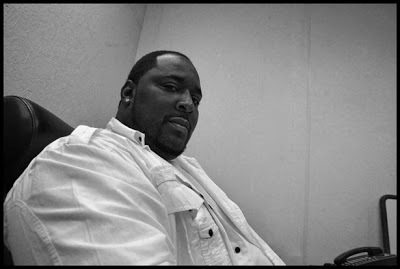
Terry Slaughter is secretary-treasurer of UFCW Local 1208. Photo © David Bacon.

A Veracruzana, Carmen Izquierdo, sits on the union executive board. “In the union it doesn’t matter if you’re undocumented, if you have papers or not,” she says. “All the workers here, whether or not we have papers, have rights.”

Ludlum and Slaughter say line speed is slower now, and workers can rotate from one job to another, reducing injuries. Ceja feels that the union gave workers a tool to change conditions. “I’m glad it came in. We worked hard to get it,” he says. But he was not there to enjoy the union’s victory; he left after he was made a supervisor at the time of the raids.

“They wanted me to send workers to the office, where I was afraid the immigration agents would be waiting for them,” he explains. “I thought it was better for me to leave, so I wouldn’t have to turn in my compañeros.”

Others left because of fear, especially in the intensifying anti-immigrant climate in North Carolina. Roberto Ortega and his wife, Maria, left the state when the hostility got worse and they couldn’t find work. Juvencio Rocha, head of the Network of Veracruzanos in North Carolina, says bitterly that “after we contributed to the economy, they didn’t want us here anymore. They even took our driver’s licenses away.”

Resisting the system on both sides of the border

Smithfield didn’t invent the system of displacement and migration. It took advantage of U.S. trade and immigration policies, and of economic reforms in Mexico. In both countries, however, the company was forced to bend at least slightly in the face of popular resistance.

Farmers in Perote Valley have been able to stop swine shed expansion, at least for a while. Migrant Veracruzanos helped organize a union in Tar Heel. Yet these were defensive battles against a system that needs the land and labor of workers but does its best to keep them powerless.

“From the beginning NAFTA was an instrument of displacement,” says Juan Manuel Sandoval, co-founder of the Mexican Action Network Against Free Trade. “The penetration of capital led to the destruction of the traditional economy, especially in agriculture. People had no alternative but to migrate.”

Sandoval notes that many U.S. industries are dependent on this army of available labor. “Meatpacking especially depends on a constant flow of workers,” he says. “Mexico has become its labor reserve.”

Raul Delgado Wise, a professor at the University of Zacatecas, charges that “rather than a free-trade agreement, NAFTA can be described as… a mechanism for the provision of cheap labor. Since NAFTA came into force, the migrant factory has exported [millions of] Mexicans to the United States.”

About 11 percent of Mexico’s population lives in the United States, according to the Pew Hispanic Center. Their remittances, which were less than $4 billion in 1994 when NAFTA took effect, rose to $10 billion in 2002, and then 
$20 billion three years later, according to the Bank of Mexico.

Even in the recession, Mexicans sent home $21.13 billion in 2010. Remittances total 3 percent of Mexico’s gross domestic product, according to Frank Holmes, investment analyst and CEO of U.S. Global Investors. They are now Mexico’s second-largest source of national income, behind oil.

However, Mexico’s debt payments, mostly to U.S. banks, consume the same percentage of the GDP as remittances. Those remittances, therefore, support families and provide services that were formerly the obligation of the Mexican government. This alone gives the government a vested interest in the continuing labor flow.

For Fausto Limon, the situation is stark: his family’s right to stay in Mexico, on his ranch in the Perote Valley, depends on ending the problems caused by the operation of Granjas Carroll. But he has no money for planting, and he shares the poverty created by meat and corn dumping with farmers throughout Mexico. The trade system that allows this situation to continue will inevitably produce more migrants — if not Limon, then probably his children. The fabric of sustainable rural life at his Rancho del Riego is being pulled apart.
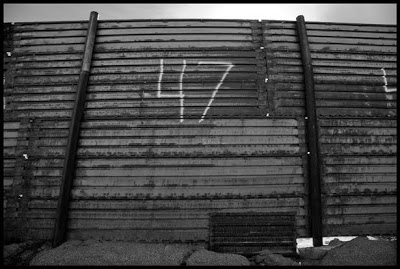
The border wall in the mountains west of Mexicali. Photo © David Bacon.

In both the United States and Mexico, many migrant rights networks believe that rational immigration reform must address issues far beyond immigration law enforcement in the United States: real reform must change the U.S. trade policies that contribute to displacing people.

Gaspar Rivera-Salgado, a professor at UCLA and former head of the Binational Front of Indigenous Organizations, a group of indigenous Oaxacans living in Mexico and the United States, believes that in the United States “migrants need the right to work, but with labor rights and benefits.” In Mexico, “we need development that makes migration a choice rather than a necessity — the right to not migrate. Both rights are part of the same solution.”

There are some constructive proposals on the table. The TRADE Act, proposed in the 110th Congress by Maine Democratic Representative Mike Michaud, received support from many migrant rights groups because it would hold hearings to re-examine the impact of NAFTA, including provisions like the environmental side agreement that did nothing to restrict the impact of Granjas Carroll on Perote Valley.

Another immigration reform proposal, called the Dignity Campaign, goes one step further. It would ban agreements that lead to displacement, like that caused by pork imports or the cross-border investments that created the Perote pig farms. It would also repeal employer sanctions, the immigration law that led to the firing of so many Veracruz migrants at the Tar Heel plant.

“Employer sanctions have little effect on migration,” says Bill Ong Hing, a law professor at the University of San Francisco, “but they have made workers more vulnerable to employer pressure. The rationale has always been that this kind of enforcement will dry up jobs for the undocumented and discourage them from coming. However, they actually become more desperate and take jobs at lower wages — in effect, a subsidy to employers.”

“When you make someone’s status even more illegal,” Carolina Ramirez adds, “you just make their living and working conditions worse. Jobs become like slavery. And if there are no remittances, kids in Veracruz can’t go to school or to the doctor. All the social problems we already have get worse. And all this just provokes more migration.”

The Dignity Campaign and similar proposals are not viable in a Congress dominated by Tea Party nativists and corporations seeking guest-worker programs. But as it took a civil rights movement to pass the Voting Rights Act, any basic change to establish the rights of immigrants will also require a social upheaval and a fundamental realignment of power.

The walkouts in Smithfield and the marches in the streets in 2006 show a deep desire among migrants for basic changes in their conditions and rights. In Perote Valley, farmers are equally determined to prevent the expansion of pig farms and the destruction of their environment. These organizing efforts are linked not just because they’re carried on by people from the same state, facing the same transnational corporation. They’re trying to change the same system.

“We are fighting because we are being destroyed,” says Roberto Ortega. “That is the reason for the daily fight, to try to change this.”

[David Bacon is a California-based writer and photographer. His latest book, Illegal People: How Globalization Creates Migration and Criminalizes Immigrants, was published by Beacon Press. His photographs and stories can be found at dbacon.igc.org. This article was published at Truthout and was crossposted to The Rag Blog. Read more of David Bacon’s articles on The Rag Blog.]

The Rag Blog

Posted in Rag Bloggers | Tagged , , , , | 1 Comment

BOOKS / Ron Jacobs : Sparks and Wildfires


Sparks and wildfires:
Wisconsin and the global revolutions:

By Ron Jacobs | The Rag Blog | March 15, 2012

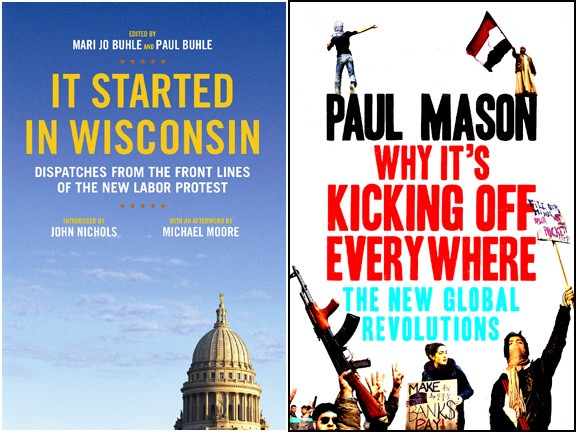
It Started In Wisconsin: Dispatches from the Front Lines of the New Labor Protest, by Mari Jo Buhle and Paul Buhle (Verso: 2012); Paperback, 192 pp., $14.95.
Why It’s Kicking Off Everywhere: The New Global Revolutions, by Paul Mason (Verso: 2012); Paperback, 244 pp., $19.95.

It was about a year ago that the protests against the anti-worker legislation in Wisconsin were reaching their zenith. What had begun as a concerted effort by the Teaching Assistants Association at University of Wisconsin, their supporters, and some other activists grew into the largest pro-union/pro-worker movement in decades.

The use of tactics not seen since the 1960s, including building occupations, was essential to its organizational success. Unfortunately, the right-wing majority in the state government was equally determined to end collective bargaining rights for public workers and on March 9, 2011, passed the legislation in the dark of night.

However, the spark was lit. The eruption of popular protest against the neoliberal corporate agenda that most of the world had already experienced by the winter of 2011 had finally reached the nation most responsible for that agenda — the United States.

The rest of the year would see the expansion of that protest across the United States grow in dimension and breadth. From further State Capitol occupations to the occupations of city parks, the masterminds and profiteers of the neoliberal economy were put on notice.

Meanwhile, protest from like-minded citizens of the rest of the world also continued to spread. Politicians scrambled as they figured out how to respond to what was clearly a left-oriented popular movement against those who had bought and sold them long ago.

Naturally, there have been millions of words written and published about this wave of people power. A very recent collection of some of those words edited by Wisconsinites Paul and Mari Jo Buhle, is titled It Started In Wisconsin.

Essentially a collection of essays written by various participants and organizers of the Wisconsin protests, It Started In Wisconsin provides a reasonable and objective look at the movement. By discussing its structures and organizational strategies, the politics of the movement are also examined. Like the Wisconsin movement itself, the parameters of the discussion tend to remain limited to the parameters of the liberal-progressive spectrum.

The book begins with the first essayist attempting to place the protests firmly in the tradition of the great Progressive Robert LaFollette. However, the very fact that the movement ended up being confined to the traditional Democrat-Republican contest made even the more left elements of the Progressive philosophy irrelevant in the final outcome.

It Started In Wisconsin tends to examine the uprising and its politics from a generally anti-corporate perspective but, like the movement itself, never truly challenges capitalism at its roots as an essentially unequal system that by its nature requires growing levels of inequality.

There is one essay that stands out from the rest of those that analyze the movement in that it does look beyond the façade of neoliberalism. That essay, titled “The Role of Corporations” by Roger Bybee, is the most radical in the book. Radical, that is, in the fundamental definition of the word: “of or going to the root or origin.”

The essay is a clear and straightforward description of how neoliberal capitalism works, who it benefits and, to put it bluntly, who it screws. No other analytical piece between these covers quite approaches the clarity and depth of analysis like Bybee’s.

Yet, this book is not really about analysis. It is a collection of stories from those that participated in one of the most inspiring movements to erupt in the U.S. heartland in decades. Those stories provide the observer from afar with a fairly universal and nuanced look at the daily lives of those involved in organizing, occupying, reporting and otherwise participating in those weeks of popular democracy.

Interspersed between the tales of the workers, students, farmers and other protesters are a number of photographs and comics. The inclusion of these graphics truly enhances the overall effect.

One of the last two essays in It Started In Wisconsin discusses the position of the Wisconsin uprising in the global insurrections of the past 18 months. The authors of this short essay, Ashok Kumar and Simon Hardy, briefly discuss the possibilities and take a quick look at the lessons they see to be learned.

In addition, and most importantly, they broach the subject of the differences between the radical grassroots and the more conservative entrenched union and political leadership. It is here, they hint, that the real direction of this global movement will be determined.

In Wisconsin that outcome has already taken one turn with the shifting of the uprising’s momentum into the recall efforts against Governor Scott Walker. The outcome of this turn to electoral politics is still being hotly debated by many of the uprising’s organizers, with some of them refusing to endorse the Democratic candidate opposing Walker because they see him as just more of the same.

Moving from the local to the global, let us consider another recently published text that takes a look at the international manifestations of this movement.

This book, titled Why It’s Kicking Off Everywhere: The New Global Revolutions is authored by journalist Paul Mason. Like the Buhle’s effort, Mason’s book describes the movements against neoliberal intolerance and authoritarianism that have become part of the collective imagination this past year. Likewise, Mason’s text examines the politics of the movement from what can only be termed a New Left viewpoint.

What this means is that he places the emphasis on the cry for freedom implicit in these protests while underemphasizing the economic nature of the oppression the protesters are rebelling against.

Given the broader scope of Mason’s text, there is also a broader discussion. Several different manifestations of the movement — from Greece to London to Cairo to Spain and other points in between — are reported on. These reports are good journalism. One feels as if they are present at the rallies, occupations and riots that Mason describes.

The anecdotal tales he provides should remind anyone who participated in any kind of popular resistance in the past decades of the energy and hope one finds and feels at such events. These are the stuff that makes one join such movements.

When it comes to analysis, Mason’s text provides some interesting possibilities. He spends a fair number of words discussing the desire for freedom this global movement represents. The Egyptian opposed to the harshness of the Mubarak authoritarian regime and the British student fearing the limitations a life without affordable education will create are examined through what Mason calls the social laboratory of the self.

He emphasizes the role of social networking and the existence of a new dimension in organizing directly related to the existence of networking technology. He rightly questions the validity of the Left, but does not really examine what he means by the Left, choosing instead to adopt the mainstream media’s definition that the Left is composed of political parties like Labour In Britain, various elements of the Democratic Party in the United States, and numerous sects espousing various versions of Leninism.

By dismissing the Left, even in its current splintered formation, Mason is also dismissing a more radical analysis of the true culprit in the global economic catastrophe.

It is true, as Mason makes clear, that neoliberal policies are responsible for the numerous maladies the global uprising sprang from. However, what is unexplored in Why It’s Kicking Off Everywhere is why neoliberal capitalism is the dominant economic regime on the planet. That explanation can only come from an understanding of the economic works of Marx and his theoretical successors like Nikolai Bukharin, Rosa Luxembourg, and even Lenin. It was these thinkers and revolutionaries, after all, that studied and explained the stages of capitalism in the industrial world and how they would come about. So far, they have been pretty damn accurate.

Mason has it right when he places the search for freedom and against the authoritarianism of a Mubarak or of neoliberalism in the context of Marx’s discussion of the alienation of the human spirit under capitalism. However, by not taking a similar look at the analysis Marxist economics provides regarding the trajectory of capitalism, the analysis he provides falls short. It would be useful for Mason and the protesters he writes about if they knew that a Marxist anti-imperialist analysis does not mean that a Leninist solution is the necessary result.

Yet, Mason is not much different from the movements he describes. Rightly opposed to the excesses of neoliberal capitalism (which is merely another phase of monopoly capitalism as described by Luxembourg, et al.), the current movement runs the risk of merely removing the worst of those excesses.

If this is the result, it will only be a few decades before an even harsher manifestation of capitalist greed subordinates the world. Unless, that is, the current movement undertakes a truly radical analysis that places the existence of capitalism itself at the core of the problem.

I don’t expect that capitalism will be removed from the planet. However, without an understanding that it is capitalism that is the root of the problems of inequality and sustainability we are currently facing, there can be no substantive change in the future we face. Then again, the very fact that many elements of the movement don’t seem too concerned about the Left’s role is a call to those on the Left to get active and make it clear that what passes for the Left in today’s world is for the most part nothing of the sort. Indeed, it is a rejection of the Left’s important and earth-changing history.

Despite the aforementioned shortcomings, these two publications are worthwhile and provocative reads. The authors and editors present the primary actors in the global uprising — students, workers, and the marginalized — and describe their passion, joy, and fears. They also begin to explain where the global movement against neoliberalism came from and where it is now. Reading them in this context will certainly help guide us through that movement’s next metamorphosis.

[Rag Blog contributor Ron Jacobs is the author of The Way The Wind Blew: A History of the Weather Underground. He recently released a collection of essays and musings titled Tripping Through the American Night. His latest novel, The Co-Conspirator’s Tale, is published by Fomite. His first novel, Short Order Frame Up, is published by Mainstay Press. Ron Jacobs can be reached at ronj1955@gmail.com. Find more articles by Ron Jacobs on The Rag Blog.]

The Rag Blog
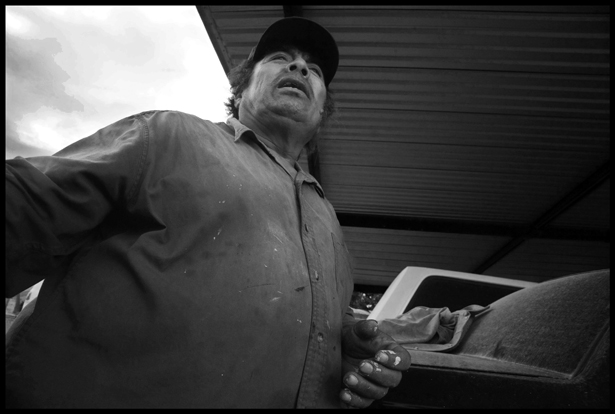
Posted in Rag Bloggers | Tagged , , , , | Leave a comment

RAG RADIO / Thorne Dreyer : Bobby Bridger on the Lasting Impact of Native American Culture

Singer/songwriter and author Bobby Bridger at the KOOP studios in Austin, March 9, 2012. Photo by Ken McKenzie-Grant / The Rag Blog.

Rag Radio:
Bobby Bridger discusses the lasting impact
of Native American culture on our society

By Rag Radio / The Rag Blog / March 15, 2012

Author, historian, singer/songwriter, playwright, artist, actor, and theatrical producer Bobby Bridger was Thorne Dreyer’s guest on Rag Radio, Friday, March 9, 2012, on Austin community radio station KOOP-FM.

You can listen to the show here.

Bobby Bridger Discusses the Lasting Impact of Native American
Culture on Rag Radio with Thorne Dreyer, Friday, March 9, 2012


On the show, Bridger discusses the issues raised in his most recent book, Where the Tall Grass Grows: Becoming Indigenous and the Mythological Legacy of the American West, which “explores the impact of Native American culture on the American psyche… and examines the impact of indigenous American mythology on contemporary identity and the development of modern popular entertainment, particularly the Hollywood film industry.”

On the show, Bridger contrasts the roles played by iconic figures like Sitting Bull and John Wayne in depicting Indian culture, and the impact of Lakota holy man Black Elk and his book, “Black Elk Speaks.” Ken McKenzie-Grant participated in this interview and the show includes live performance by Bridger.

This is our second Rag Radio interview with Bobby Bridger; the first occurred on Nov. 18, 2011, and you can listen to it here.

Bobby Bridger, who lives in Houston, is also the author of A Ballad of the West, and other books about native American culture and the American West. A descendant of legendary “mountain man” Jim Bridger, Bobby was featured in an entire chapter of Jan Reid’s classic book, The Improbable Rise of Redneck Rock.

Bridger, who is also a trained sculptor, painter, and art educator, has appeared twice on PBS’ Austin City Limits, on PBS’s American Experience, and on Good Morning America and other major national media. He is the composer of the anthem of the Kerrville Folk Festival, “Heal in the Wisdom,” and London-based Qube Pictures released a boxed set DVD collection of his highly-acclaimed epic theatrical trilogy, A Ballad of the West.

Rag Radio, which has aired since September 2009 on KOOP 91.7-FM, a cooperatively-run all-volunteer community radio station in Austin, Texas, features hour-long in-depth interviews and discussion about issues of progressive politics, culture, and history.

Hosted and produced by Rag Blog editor and long-time alternative journalist Thorne Dreyer, a pioneer of the Sixties underground press movement, Rag Radio is broadcast every Friday from 2-3 p.m. (CST) on KOOP and streamed live on the web. After broadcast, all episodes are posted as podcasts and can be downloaded at the Internet Archive.

Rag Radio is also rebroadcast on Sundays at 10 a.m. (EST) on WFTE, 90.3-FM in Mt. Cobb, PA, and 105.7-FM in Scranton, PA. Rag Radio is produced in the KOOP studios, in association with The Rag Blog, a progressive internet newsmagazine, and the New Journalism Project, a Texas 501(c)(3) nonprofit corporation.

Tracey Schulz is the show’s engineer and co-producer.

Coming up on Rag Radio:

THIS FRIDAY, March 16, 2012: Journalist and labor activist David Bacon on how U.S. policies fueled Mexico’s great migration.

The Rag Blog

Posted in RagBlog | Tagged , , , , , , | Leave a comment

BOOKS / Mariann G. Wizard : Jonah Raskin’s ‘Rock ‘n’ Roll Women’


Portraits of a Generation:
Jonah Raskin’s Rock ‘n Roll Women

By Mariann G. Wizard | The Rag Blog | March 14, 2012

[Rock ‘n’ Roll Women: Portraits of a Generation, by Jonah Raskin (Santa Rosa, CA: McCaa Books, 2012); Paperback, 40 pp.]

Jonah Raskin’s new poetry chapbook, Rock’ n ‘Roll Women: Portraits of a Generation, celebrates both rock and women equally and with great good will. Its 25 brief poems follow a simple formula like the guitar, bass, and drums of a rock trio: a woman (well, 24 women and one man), a rock artist from any era, and a moment in time defined by its soundtrack.

The poems were written for performance, accompanied by drums and/or stand-up bass, and reading them might seem a bit like reading CD liner notes, but they stand on their own nicely.

Of course Raskin isn’t alone in being influenced, personally and artistically, by the musical revolution that rocked the world in the late 1950s and continues to roll across the galaxy today.

If you weren’t alive before then, forgive me, but you just can’t know how bloody bleak it was. Don’t get me wrong, I still love a lot of Big Band-era music, classical stuff, C&W. But the thing is, every single bit of it was square, and we feared for a while that was all there was.

Yes, there was some jazz and some blues if you knew where to look, but you had to be some kind of egghead-kook to even look, and frankly, both genres can be awfully depressing, reflecting bittersweet, lost worlds of heroin and gin joints.

Folk music was a breath of fresh air in some ways from the pop pap of the post-World War II 40s and 50s, but at most a breath relived from second grade, before Sputnik went up and the system started shoving math and science down our throats while still jiving the campy campfire sounds of “Mairzy Doats.”

Rock music is first, foremost, and always good time music, good times even in bad times, dancing to defy bad times, and power to the people always. The rise of rock coincided with, helped fuel, and was in turn fueled by the rise of a generation that couldn’t stomach plastic-fantastic lies any longer, emphatically including young women who didn’t really dig Doris Day or see themselves being Donna Reed.

(Women’s) liberation is implicit in rock’s hip-swinging beat. “Ladies,” by definition, do not shake their booties or groove thangs, twist the night away, or get down or funky.

That Jonah celebrates just 24 rock ‘n’ roll women in this book is surely a testament to discretion; just as the 29 choice CDs he names — admitting there are too many of the latter to list them all — are only the tip of an iceberg of life-affirming music. Every woman who came of age when Beethoven was rolled over has her own internal rock soundtrack.

The one guy included, in “Mr Tommy & Mick Jagger,” may not be the greatest example of American manhood, but I swear, I’d know this dude in any dancehall in the country, and Raskin is right, it “coulda been worse.”

I have to give an appreciative nod to Jonah’s restraint in not quoting from the rock lyrics that inspire and energize his verses; a constant temptation to me and one I seldom resist. At most, he uses a word or phrase ineluctably linked to a band or performer — “boogie” and Creedence Clearwater; a piece of heart and Janis; Otis Redding and the end of a dock — but mostly summons more subtle connections, the telling details of experience that make true songs:

Margaret & Pink Floyd

You, Margaret, cooked winter stew,
grew tarragon and didn’t rue,
made tapes of Pink Floyd,
broke down dad’s resistance,
reluctance to love, cut alternating
currents that drove him to extremes,
wild dreams,
acted out on crazy stage
your mother so kindly crafted,
Rock ‘n’ Roll woman.

Jonah has written six other books of poetry; American Scream, about Allen Ginsberg’s epic poem “Howl”; and several other books, including Marijuanaland — and is a regular contributor to The Rag Blog. Rock ‘n’ Roll Women‘s cover was designed by The Rag Blog‘s James Retherford.

[Mariann G. Wizard, a Sixties radical activist and contributor to The Rag, Austin’s underground newspaper from the 60s and 70s, is a poet, a professional science writer specializing in natural health therapies, and a contributing editor to The Rag Blog. Read more articles and poetry by Mariann G. Wizard at The Rag Blog.]

The Rag Blog

Posted in Rag Bloggers | Tagged , , , | Leave a comment

Robert Jensen : Holding Onto the Joy in Teaching

Pompous professor. Image from Canadian Mysteries.

Holding onto the joy in teaching

We are the best teachers when we aren’t afraid of the dark.

By Robert Jensen | The Rag Blog | March 13, 2012

I am a tenured professor in a relatively stable university, which is quite possibly the best job in the world. I get paid well to read, think, talk, and write, and I have more job security than almost anyone I know.

Like many professors, I am critical of the increasingly corporate nature of universities. The conservative/neoliberal project of turning public schools into educational factories is also gathering steam in higher education, and there is much organizing work necessary just to protect what little space for critical thinking still exists.

But the longer I teach, the more I appreciate the privileges that come with the job, and the more fun I have. So, when I recently had to write a “statement of teaching philosophy,” I tried to reflect that gratitude and pleasure.


Statement of Teaching Philosophy:

Pay attention, be astonished, tell about it

After years of research, I have developed a three-stage teaching method that breaks new ground in pedagogical theory: Stage 1: Pay attention. Stage 2: Be astonished. Stage 3: Tell about it.

The first thing to say about this sophisticated advance in our understanding of university teaching is that I stole it, from Mary Oliver’s poem “Sometimes.”

If it appears I’m trying to poke fun at university professors’ self-indulgent tendency toward pomposity, I am. Since I am a university professor who occasionally can be self-indulgent and pompous, I have standing to poke fun. Frankly, we don’t poke fun at ourselves enough. That’s part of my teaching philosophy: Poke fun at myself, as often as possible, especially in front of students.

In this regard, poets perform an important service for professors. If we professors are ever tempted to claim that we have had an original insight into the human condition, we should pause and remember this: There’s at least one poet, and likely dozens, who had the insight long before we did and who expressed it far more eloquently than we could ever hope.

I don’t teach poetry, but I often read poetry to my class. That’s part of my teaching philosophy, to remind students that whatever the subject, poets have something important to say to us. I read to my students even though I have had no voice training and am not particularly good at reciting poetry.

That’s part of my teaching philosophy, too. I think it’s healthy for students to see professors stumble. When every word we utter in class is precise and polished, it can create distance between professor and student. Students are too easily impressed by us, and they can come to believe we are our performances.

Better that they see we are human beings, struggling and stumbling, so that intellectual work doesn’t appear to be something only specialists can do. Our job isn’t to be smart but to help students understand that they can be smart, too.

So, I read to my class, from Mary Oliver and Wendell Berry, from Marge Piercy and Faiz Ahmed Faiz. I play songs, too, though I’m sensible enough not to sing in class.

Back to Oliver. Those three recommendations comprise her “instructions for living a life.” They also are serviceable instructions for teaching. I try to pay attention, not only to the scholarship in my field but to the world around me, which means I try to get out in the world beyond the university as often as possible.

I am constantly astonished by the human capacity for both depravity and love, and I spend considerable time trying to figure out these paradoxes. I tell about it as often as possible, as a teacher, public speaker, and writer.

After 20 years of teaching at the University of Texas at Austin, I have written numerous statements about my teaching philosophy. Each exercise is an opportunity for me to challenge myself. The somewhat unorthodox style of this essay comes not from a lack of respect for the assignment but a desire to challenge myself in a new way. This might be because, after 20 years, I have a sense that I’m a better teacher than ever, but at the same time I’m less sure why that might be the case.

Here’s one plausible answer to the question of why my teaching might be better today: I’m more comfortable with ambiguity than when I was younger. As we age, we have a choice. We can conclude that we’re right in our assertions about the world and proceed based on that assumption. Or, we can conclude that we’re right and proceed based on the assumption that we’re missing something.

I have spent considerable time studying the role of news media in our culture, politics, and economy. I am confident that the assertions I make about that institution and those systems are compelling. I’m pretty sure that I’m right, and I argue strenuously that those assertions are the best way to understand journalism and society. And I also wonder about that.

Time for another poet. Faiz Ahmed Faiz concludes his poem “The City from Here”:

There are flames dancing in the farthest corners,
throwing their shadows on a group of mourners.
Or are they lighting up a feast of poetry and wine?
From here you cannot tell, as you cannot tell
whether the color clinging to those distant doors and walls
is that of roses or of blood.

I read that poem to my journalism students as a reminder that when we look, we look from one perspective. “When you look at the city from here,” from any one place, it can be easy to confuse roses and blood. Since we are always looking from somewhere, caution and humility are important. I read that poem to remind students that their point of view is a point of view. I read that poem to remind myself as well.

With that winding introduction, here’s a concise statement of my teaching philosophy: I have the best job in the world. I get paid a salary that allows me to live comfortably and give back to the community. To earn this salary, I am asked to spend my time thinking, reading, writing, and talking, all things I enjoy doing even when not being paid.

On occasion, I have to go to a boring meeting or file a stupid report, which can at times be annoying. But, all in all, this is a really good gig. The least I can do is pay attention, be astonished, and tell about it with as much joy and passion as possible. When I do that, I think I’m a pretty good teacher, and I think I do that most every day I walk into the classroom.

But I’m not 100 percent sure I’m as good as I think. When I look out at my students and see roses, maybe that’s just how the city looks from the lectern. Perhaps I simply don’t see the blood.

Time for a closing metaphor, this time borrowed from Wendell Berry’s poem, “To Know the Dark”:

To go in the dark with a light is to know the light.
To know the dark, go dark. Go without sight,
and find that the dark, too, blooms and sings,
and is traveled by dark feet and dark wings.

We are the best teachers when we aren’t afraid of the dark. When I began teaching, I went into the dark with the biggest flashlight I could find. That light allowed me to see many things, but the intensity of the beam obscured other things, in the shadows. That light allowed me to feel smart, but these days I am less reassured by being smart. The older I get, the more I realize that being smart isn’t going to get us all the way home.

So, these days I carry a smaller flashlight, and I turn it off as often as I can muster the courage. My best teaching is when I go dark.

[Robert Jensen is a journalism professor at the University of Texas at Austin, where he teaches courses in media law, ethics, and politics — and a board member of the Third Coast Activist Resource Center in Austin. His books include All My Bones Shake: Seeking a Progressive Path to the Prophetic Voice, and Getting Off: Pornography and the End of Masculinity. His writing is published extensively in mainstream and alternative media. This article was first published at Truthout. Robert Jensen can be reached at rjensen@uts.cc.utexas.edu. Read more articles by Robert Jensen on The Rag Blog.]

The Rag Blog

Posted in Rag Bloggers | Tagged , , , | Leave a comment

Republican Roulette: Romney vs. The Rebels

By Bill Freeland

Super Tuesday has come and gone but Republicans are hardly any closer to selecting a nominee.

Mitt Romney pulled out wins in three more states where he competed with his current rival Rick Santorum, but in the contest that mattered most, Ohio, his margin was disappointingly thin despite out-spending him 12 to 1.

What’s more, much of that outcome would likely have been reversed had the religious vote not been split between Santorum and Newt Gingrich.

This dynamic means the race will continue for weeks more, but with the focus now shifting to some southern states where Santorum holds an advantage with Christian evangelicals. The result: no one will likely claim victory for weeks to come.

But as the bitterness of the contest has revealed, the struggle within the party extends beyond this year’s election. The nominating process has devolved into a rancorous sibling rivalry between an entitled dstablishment and a diverse rebel insurgency. At stake: not just the choice of a nominee but a broader ideological fight between these two camps with the future of the Republican brand hanging in the balance.

In the choice between these two political paradigms, the focus is predictably on who wins. Yet there is a counterintuitive case to be made, depending on what happens later in the general election.

This could be the year that the losers in the GOP primary process ultimately have as lasting an influence as the winners on its future as they plot their return.

Say, for example, the party elites get their way — and their man — and Romney is nominated and goes on to win the general election. The “regulars” will be proven right, and the insurgents will return to irrelevance as the establishment types get to keep their preferred seating at the 2016 convention.

But what if Romney loses to Obama? The elites, bitterly opposed by the rebels, will finally be disgraced and the insurgents vindicated. It will be 1976 all over again, when the party mainstream mistakenly stuck with Ford over Reagan — and lost to Carter. They corrected that mistake four years later, signing on with the Gipper and his purer vision of movement conservatism. Next time today’s agitators will likely look early on to reincarnate a symbolic Reagan and move still further to the right to win in 2016.

Compare that to a victory in Tampa by the Anybody But Romney wing of the GOP. Should its nominee win the election in the fall, the party rebels will rightly claim a stunning victory and what’s left of the Republican establishment will be further diminished.

But what if the rebel candidate wins at the convention but loses to Obama? In that case, welcome to 1964. That year Goldwater proclaimed extremism was no vice — but learned to his regret that moderation in pursuit of the presidency was a virtue — as he lost to LBJ in a landslide.

What his party learned was the virtue of moderation — and succeeded with Nixon four years later. A loss in 2012 will likely mean the party next time will avoid the mistakes of 1964 and seek a win with a similarly moderate candidate in 2016.

Now what about the Democrats? A parallel scenario could also emerge.

Recent polls, reflecting both better economic trends and perhaps a contrast with the bitter GOP primary battles, give the incumbent Obama a slight advantage over his challengers. But worsening job numbers and gas prices could still put the outcome in doubt.

If he wins reelection, his overriding bipartisan stance in the face of Republican obstruction (which has driven many Democrats to distraction) would be convincingly vindicated.

Should he lose, however, the signature policy of his administration would likely be repudiated resulting in a more assertive nominee next time. The likely outcome: a more aggressive party and an even more polarized political process.

The lesson in all this: hopes for the future are often haunted by the failures of the past–and sometimes even defined by them. Thus it can be argued that instead of imagining the future, we sometimes settle merely for avoiding the mistakes of the past.

If that is the lesson the losers of 2012 take as a guide for the future, then their party and our nation will be the poorer for it.

[In the Sixties, Bill Freeland was a contributor to The Rag in Austin and Liberation News Service in New York. Read more articles by Bill Freeland on The Rag Blog.]


Type rest of the post here

Source /

The Rag Blog

Posted in RagBlog | Leave a comment

Rag Blog : ‘Feed Your Head’ on April Fool’s Day!

Art by Jim Franklin; poster by James Retherford / The Rag Blog.

‘Feed Your Head’ on April Fool’s Day:
Legendary Austin Bands at Rag Blog Bash

Go to the Facebook “Feed Your Head!” event page.

“Old Skool” will be in session on April Fool’s Day at Jovita’s in Austin, when The Rag Blog and Rag Radio invite you to “Feed Your Head.” A big slice of Austin music history will be on display at the event, which will feature performances by Shiva’s Headband, Greezy Wheels, and Jesse Sublett.

The event, scheduled for 6-9 p.m., April 1, at Jovita’s, 1619 S. First St. in Austin, will benefit The Rag Blog, an Austin-based progressive Internet news magazine, and Rag Radio, a weekly public affairs program broadcast on Austin’s KOOP 91.7-FM and hosted by Rag Blog editor Thorne Dreyer. The Rag Blog and Rag Radio trace their roots to Austin’s legendary underground newspaper, The Rag, which was published from 1966-1977 with Dreyer as its original editor.

Psychedelic rockers Shiva’s Headband, founded in 1967 by Spencer Perskin, a classically trained violinist, was the house band at Austin’s Vulcan Gas Company, and was the first group to perform at Austin’s iconic Armadillo World Headquarters. Their album, Take Me to the Mountains, was the first nationally released album by an Austin rock band.

Pioneers of the “progressive country” movement in the 1970s, Greezy Wheels was for years the unofficial house band at the Armadillo. Guitarist and writer Cleve Hattersley and “fiddler extraordinaire” Mary Hattersley, led the group that, according to the Austin Chronicle’s Margaret Moser, “owned Austin” in the mid-70s.

Bassist Jesse Sublett -– also a mystery writer and artist — founded Austin’s legendary alt-punk band, The Skunks, which debuted at Austin’s Raul’s in 1978, and Sublett continued to be a mainstay on the Austin music scene.

A poster for the event, designed by James Retherford, features original art by Austin surrealist artist Jim Franklin, who, as house artist at the Armadillo World Headquarters, helped turn the lowly armadillo into an internationally recognized symbol for the Texas counterculture and whose artwork graced the landmark Shiva’s album, Take Me to the Mountains.

Proceeds from the event benefit the New Journalism Project, a Texas 501(c)(3) nonprofit corporation that publishes The Rag Blog and produces Rag Radio. Suggested donation is $10. Limited edition Jim Franklin posters and special Rag Blog t-shirts will be available. Jovita’s has a full bar and food menu.

The Rag Blog, founded in 2006 after a reunion of staffers from the original Rag, has become a force in the progressive blogosphere and receives 50,000 unique visits a month. Rag Radio features hour-long in-depth interviews with newsmakers, artists, and leading thinkers. Broadcast Fridays from 2-3 p.m. (CDT) on KOOP 91.7-FM in Austin, it is also rebroadcast on Sundays at 10 a.m. (Eastern) by WFTE-FM in Mt. Cobb and Scranton, PA, and also streams live, with a widespread internet audience.

The Rag Blog

Posted in RagBlog | Tagged , , , , , , , , , , , | Leave a comment