Jim Rigby : The Flag by the Pulpit

Image from encountering love.

The flag by the pulpit

What does it mean when we tell preachers not to be political, but place a flag by the pulpit as though the flag were not itself a political statement?

By Jim Rigby | The Rag Blog | March 7, 2012

When I first graduated from seminary and began to preach, I barely noticed the flag that stands by most pulpits in the U.S. If we see a flag on a ship at sea, or on the car of a diplomat, we understand those vehicles are set aside to represent the United States. It did not occur to me that the flag by the pulpit bore the same meaning.

If a Roman emperor required a statue of himself to be placed in an early church, everyone would understand what that statue really meant. The statue would be a reminder that people could worship however they wished, so long as their first loyalty was to the empire.

The flag can also stand as a boundary that American preachers are not to cross. We may pray for our troops, but not for our enemy’s. We may pray for healing, but not for health care. We may pray for the poor, but we must never question the capitalist system that makes them poor.

What does it mean when we tell preachers not to be political, but place a flag by the pulpit as though the flag were not itself a political statement? Is the flag not a warning? Does the flag not bear a command? “You shall not speak of any other politics than that of the American Empire. You are not to worship a God who is bigger than your nation. You shall not hold the actions of your nation to a universal standard.”

The flag by the pulpit reminds us that the American Empire and the capitalism for which it now stands, lies in the background of everything the church can do, or even think, so long as nationalism is the context from within which we try to be ethical.

Knowing this, who would not take the flag down? We should take down the very cross itself, if it ever prevented us from showing the love of Christ to those who are not Christian. There is one universal love to which every other lesser loyalty must submit. We do not love America less, for loving humankind more.

[Rev. Jim Rigby, a human rights activist, is pastor of St. Andrew’s Presbyterian Church in Austin, Texas. Jim Rigby blogs at jimrigby.org. He can be reached at jrigby0000@aol.com., and videos of his sermons are available online here. Read more articles by Jim Rigby on The Rag Blog.]

The Rag Blog

Posted in Rag Bloggers | Tagged , , , , | 1 Comment

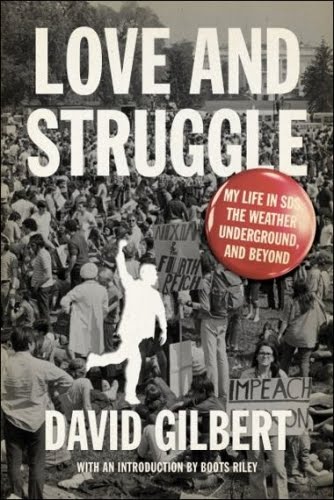
BOOKS / Rick Ayers : Gilbert’s Memoir Helps Us Understand Our History


Love and Struggle:
David Gilbert’s memoir helps us
understand our history and the world today

By Rick Ayers / The Rag Blog / March 7, 2012

[Love and Struggle: My Life with SDS, the Weather Underground and Beyond, by David Gilbert. (Oakland, CA: PM Press, December 2011); Paperback, 384 pp, $22.]

This is the third review of David Gilbert’s Love and Struggle published on The Rag Blog. We have run multiple reviews of the same book in the past, when the articles have covered different territory and when we have considered the material to be of special interest to our readers. And we consider this to be a very important book. Also see the Rag Blog reviews of Love and Struggle by Ron Jacobs and Mumia Abu-Jamal.

As I write this, four presidents in Latin America are veterans of revolutionary guerrilla struggles of the 1960’s. Pepe Mujica of Uruguay was a member of the Tupamaros and among those political prisoners who escaped from Punta Carretas Prison in 1971; Mauricio Funes of El Salvador is a member of the Farabundo Marti Liberation Front (FMLN) and his brother was killed fighting in the Salvadoran civil war; Daniel Ortega was a leader of the Sandinista National Liberation Front which fought an 18-year guerrilla war; and Dilma Rousseff of Brazil was a member of the urban guerrilla group National Liberation Command (COLINA) which carried out armed attacks and bank robberies in the late 60’s.

David Gilbert, who is of the same aspirational generation, is living a dramatically contrasting life — presently doing life in a New York prison. His recently released memoir, Love and Struggle, My life in SDS, the Weather Underground and Beyond, opens the door onto a world that mostly exists as some distorted corner of the political imagination of the U.S. in 2012.

But it’s a world and a story that is vivid and compelling — and one worth paying attention to at precisely this moment as a young generation of activists is generating its own stories on Wall Street and beyond.

Like Mujica, Funes, and Rousseff, Gilbert was a militant fighter in the 60s and 70s — but he found himself at war from within what Che Guevara called the “belly of the beast.”

The actor and activist Peter Coyote had this to say about the memoir: “Like many of his contemporaries, David Gilbert gambled his life on a vision of a more just and generous world. His particular bet cost him the last three decades in prison and, whether or not you agree with his youthful decision, you can be the beneficiary of his years of deep thought, reflection, and analysis on the reality we all share. I urge you to read it.”

Written under the appalling conditions of imprisonment in the massive U.S. prison-industrial complex — under the endless dangers, harassments, and frustrations of life in various New York prisons — the existence of this volume is itself an amazing accomplishment.

Gilbert explores crucial issues of the 60’s and today: racism, imperialism, the oppression of women, and the crisis of capitalism. The fact that it is self-critical without being maudlin or self-pitying, the fact that he has crafted a reflective, modest, and ultimately hopeful picture of his life and times, makes Love and Struggle particularly welcome.

We were, as a generation, born into war. After the “good war” to defeat fascism in the 1940’s, the U.S. continued a series of military engagements designed to defeat liberation movements and assure its economic dominance in the world. While most everyone today agrees that the war on Vietnam was at best a mistake and more accurately a genocidal horror, it is curious how the American narrative has twisted even that memory.

Those who seek to draw the U.S. into more military adventures cynically extol the veterans of the war as heroes while leaving a record number of homeless vets to fend for themselves on the streets or to populate the prisons. At the same time, they denigrate the veterans of the resistance. Those who were right, in other words, are never honored in the corporate media — they are erased and disappeared

While David Gilbert represents an extreme of the resistance movement, and while the Brinks robbery which landed him in prison was thoughtless and harmful, Gilbert reminds us that it is essential to confront the many war crimes the U.S. committed in Vietnam — and continues to commit here and around the world — with no consequences.

David’s life sentence does not square with Lt. William Calley’s sentence of three years house arrest for the massacre of 104 Vietnamese civilians at My Lai in 1971 or John McCain’s record of bombing civilians from the air, wanton crimes against humanity; and it does not make sense against the other My Lai’s that occurred on a weekly basis.

Beyond the actions of troops on the ground, a just society would have prepared war crimes trials for top military and political leaders who ordered carpet bombing of civilian areas, the vast deployment of napalm and Agent Orange, the CIA’s “Operation Phoenix” assassination program, the decade-long, “secret” aerial bombardment of Laos, as well as the Cointelpro attacks against African American and Native American activists in the U.S. that resulted in hundreds being killed and imprisoned.

David Gilbert does not ask us to forget the costly human consequences of the 1981 Brinks robbery in which three people were killed and which landed him in prison. But his memoir forces us to encounter and understand much more about the struggles of the 60s and 70s.

Since the release of Sam Greene and Bill Siegel’s film Weather Underground in 2002, there has been a resurgence of interest in those in the U.S. who went from protest to resistance and from resistance to clandestine actions. Five or six “Weather” memoirs have come out in the past decade — each with a different approach or take on the history.

Two excerpts will perhaps capture some of the intensity of his insight and analysis. In discussing the work of the Weather Underground to build a clandestine movement against U.S. international wars, he reminds us of the example of Portugal:

“1974 brought an unanticipated but exhilarating boost to the politics of revolutionary anti-imperialism. On April 25, the dictatorship that had ruled Portugal with an iron hand since 1932 was overthrown. Popular discontent had been central and radicals, including socialists and communists, were major forces in the new constellation of power. The new government soon ceded independence to all of Portugal’s remaining colonies. The series of colonial wars in Africa had drained Portugal’s resources and economy, and that created the conditions for radical internal changes.

We saw the relatively poor imperial nation of Portugal as a possible small-scale model of what could happen to the far more powerful U.S. after a protracted period of economic losses and strains brought on by “two, three, many Vietnams.” The costs of a series of imperial wars could crack open the potential of radical change within the home country.”

And he often counters narrow and stupid characterizations of the 60s and 70s, reminding us of the human faces behind the mythology of the radical movements.

In discussing the death of Teddy Gold, his old friend from Columbia University, he seeks to set the record straight:

“When Teddy and two other comrades were killed in the tragic townhouse explosion, J. Kirkpatrick Sale immediately published a piece in The Nation defining Teddy as the epitome of “guilt politics.” I don’t think Sale ever met Teddy; he certainly didn’t know him. Sale’s rush to judgment probably came from his urgency to discredit any political push toward armed struggle. The “guilt politics” mantra just didn’t fit the deep level of identification we felt with Third World people; and far from feeling guilt, with its condescending sense that we are so much better off than they are, we were responding to their leadership.

The national liberation movements were providing the tangible hope that a better world was possible. Those who caricatured him never saw Teddy on his return from Cuba — the very picture of inspiration, energy, and hope. The word that captures Teddy’s psyche as he built the New York collective was not guilt but exuberance.”

Whether you agree with much that David says or very little, Love and Struggle is a book you won’t soon forget.

[Rick Ayers was co-founder of and lead teacher at the Communication Arts and Sciences small school at Berkeley High School, and is currently Adjunct Professor in Teacher Education at the University of San Francisco. He is author, with his brother William Ayers, of Teaching the Taboo: Courage and Imagination in the Classroom, published by Teachers College Press. He can be reached at rayers@berkeley.edu. Read more articles by Rick Ayers on The Rag Blog.]

The Rag Blog

Posted in Rag Bloggers | Tagged , , , , , , , , , , | 6 Comments

Harry Targ : Political News as Commodity

Screenshot of Rachel Maddow reporting on the phony ACORN media sting during her MSNBC show. Image from Democurmudgeon.

What sells is legitimate:
Political news is a commodity

By Harry Targ | The Rag Blog | March 6, 2012

“The public version of Andrew was not the version I knew. I won’t miss the public version of Andrew. But the next time I’m walking down the street in New Hampshire, I will think of him, and I will wish I could run into the Andrew Breitbart who I knew.” — Lawrence O’Donnell, The Last Word, MSNBC, March 2, 2012.

Andrew Breitbart, the despicable electronic journalist of the Right, died on March 2 at the age of 43. Breitbart gained fame for producing short “documentaries” which distorted the image and activities of ACORN, a national organization of community activists. The slander of this grassroots organization led ultimately to its defunding by Congress.

Breitbart prepared and disseminated distorted footage of a speech by Georgia Rural Development Director for the Department of Agriculture Shirley Sherrod leading to her dismissal by the Obama Administration. He constructed a clumsily doctored documentary from a Labor Studies class at the University of Missouri to make it look like the instructors, one of whom was a trade union staffer, were advocating working class revolution.

Breitbart produced vicious lies about people and organizations. The harm he did to the real lives of poor and powerless people in our society in these and other instances is incalculable.

And not only did Breitbart produce venomous news accounts, he became a role model for other so-called journalists who have produced like-minded distorted reportage on venues such as Fox News.

In addition, it is important to recognize that the distorted journalism that pervades Fox News can be found in the work of almost every other major media purveyor, electronic and print, in the United States. And Breitbart was a producer of this distorted journalism and an inspiration for the expansion of it throughout the profession.

So why did Lawrence O’Donnell, who generally is a principled journalist and voice of those victimized by powerful economic and political elites, memorialize Breitbart in such touching ways?

And O’Donnell was not alone. Arianna Huffington and many others took the view that Breitbart, although he presented distorted information that impinged on progressive movements and policies, was passionate about his craft. Several media pundits suggested that Breitbart’s slanderous advocacy journalism, even if misplaced, was a contribution to a new journalism.

Why is it that journalists laud those who produce and disseminate news that destroys organizations and people who do good works? Why are journalists — who produce news that exacerbates anti-worker, racist, and sexist attitudes and values, or more generally produces pain and suffering — celebrated by their peers?

Perhaps part of the answer can be found in an analysis of news in modern society. We know that products that people produce and consume have “use value,” that is they provide some concrete and practical purpose which explains why we value them. Food is produced and consumed because we need food to survive. Beyond food, we consume many products because they provide us with comfort and pleasure.

Before the rise of capitalism, workers and peasants produced goods and services for their own use. With the rise of capitalism workers increasingly participated in the production of goods and services for sale in the marketplace. Workers produced not for use but for sale. Virtually every product became a commodity for sale.

In a system of commodity production the sales effort becomes more important than the basic value the goods hold for their producers. As capitalism unfolded over the last 200 years, the production of goods and services became more concentrated in fewer and fewer corporations and financial institutions.

Huge conglomerates organized the production and distribution of goods and increasingly engaged in the process of generating demands for the wants people have in a modern society. In short, ours is a society of mass production and mass consumption. And consumers are vital to its survival and growth.

What does this analysis of the rise of our modern economy mean for journalism? It suggests that at some time in the past, images of our world and knowledge about it were produced and consumed by families and communities for their immediate needs. Over time, large media corporations were created to produce news and knowledge for dissemination among larger and larger populations. News became a commodity.

Media corporations increasingly saw the need to produce news, a commodity, which would be broadly consumed by the people. In other words news, in a world in which 10 media monopolies dominate, required the selling of their product. As the media monopolies competed for customers for their commodities, appeals increased to the base desires, values, and beliefs of a population that already were shaped by racism, sexism, and animosity toward workers and the poor.

Here is where skilled journalist/viral ideologues enter the picture. They applied their skills to the production of news that would entice and increase the appetite for more of the news that privileged scandal, racism, and sexism.

But what about the more rigorous, informed, and “professional” journalists who waxed eloquently about Breitbart’s professionalism despite some of his odious practices? Well, sad to say, virtually all media workers are engaged in the business of producing commodities for sale in the media market. So for them, the Breitbarts of the world are to be admired for their craft, if not their message and impacts on people’s lives.

In the end, the intellectual and moral bankruptcy of the media, the 10 media conglomerates that produce one-half of all we read, listen to, and view in news and culture, is a direct result of the fact that our economic system requires the commodification of everything, including news and culture. Andrew Breitbart was an inevitable product of this system.

[Harry Targ is a professor of political science at Purdue University who lives in West Lafayette, Indiana. He blogs at Diary of a Heartland Radical — and that’s also the name of his new book which can be found at Lulu.com. Read more of Harry Targ’s articles on The Rag Blog.]

The Rag Blog

Posted in Rag Bloggers | Tagged , , , , , , | Leave a comment

Danny Schechter : Exit Snow and Breitbart: End of an Era?


Is it the end of an era?
Exit Olympia Snow and Andrew Breibart

By Danny Schechter / The Rag Blog / March 6, 2012

There was an eerie synchronicity in the pending resignation of veteran Maine Senator Olympia Snowe, a Republican who had more than she could take of hyper-partisan “conservative” correct-lineism in Congress, and the death of Andrew Breitbart, the right-wing provocateur who did his very best to create the dynamic that Snowe was rejecting.

She would never use the language of her Party-mate Rick Santorum who confessed that some policies he disagreed with made him want to throw up, but if we lived in the age when all roads led to Rome, Congress would surely have its own vomitorium in the basement and it would be well-attended.

Breibart’s unexpected passing of “natural causes” might foreshadow the death of his political brand just as Snowe’s retreat to the state lobsters made famous may mark the end of the center in the GOP.

There was nothing natural about Andrew’s angst and activism as he smeared and bullied political opponents with the full support of the extremist echo chamber that helped him build his career.

There was no tactic that was too unethical in his aggressive arsenal that relished embarrassing and exposing enemies with videos and bombast.

After he died, the likes of Matt Drudge and Michelle Malkin were there with teary condolences as were his adoring staff members who posted this testimonial: “Andrew lived boldly, so that we more timid souls would dare to live freely and fully, and fight for the fragile liberty he showed us how to love.”

What he did love was to retweet every criticism he received as badges of honor in what seemed like an endless self-promoting crusade. No wonder, the right wing blogosphere is in mourning, echoing each other’s laments.

Brinart’s spirit was animated by a large dose of Stalin.

Conservative Ron Deher wrote,

I couldn’t stand some of what Breitbart did, and criticized certain of his stunts on this blog. But Lord have mercy, a 43-year-old man dropped dead and left a widow and four fatherless children. He was a provocateur, not a criminal. The thing Breitbart suffered from is the same thing… too many of us suffer from: making ideology more important than basic human decency.

David Frum, the man who coined the phrase “axis of evil,” was honest enough to admit

that to speak only “good” of Breitbart would be to misunderstand the man. The good was there. Breitbart was by all accounts generous with time and advice, a loving husband and father, and a loyal friend.

Yet perhaps Breitbart’s most consequential innovation was his invention of a new kind of culture war, and it’s difficult to assess his impact on American media and politics if you withhold an objective evaluation of his career — a career that was so representative of his times.

It was that “culture war” that offended a cultured senator like Olympia Snowe who said she was through with the spirit of confrontation and polarization that drives politics, fed up with an environment which has no room for individual conscience or dissent.

NPR reported, from a story in The Nation:

Politico’s Jonathan Allen published a piece that epitomizes this genre today. The article, “The center crumbles,” laments that “Congress can’t find the middle ground because no one’s willing and able to stand there anymore.”

For some like Snowe, the question is, why bother? The prospect of running hard to win another term — particularly a six-year Senate term — is less and less attractive for folks who came to Washington to make things happen only to find out there’s no common ground to get things done, only partisan point-scoring that leads to paralyzed politics.

Some years ago when I was making the film In Debt We Trust, I spent a long night in Congress waiting to interview Texas Congresswoman Sheila Jackson Lee who was then speaking on the floor against Republican demands that the United States seal both our Southern and Northern borders with a fence or East Berlin-like high wall to stop illegal immigrants.

She very calmly challenged the idea with facts and figures that seemed very rational and to the point.

But when the vote came, all of the Republicans were looking down at their blackberries where they were being instructed on how to vote by their leadership.

Despite agreeing with some of the points she made in the debate, the GOP voted as a block, no deviations! That was before the Tea Party fanatics moved in and frequently rejected the advice of their whips because it was not obstructionist enough.

Those were Breibart’s ideas in action. The Los Angeles Times praised him for turning media manipulation into an art:

Breitbart was a revolutionary eager to overthrow a media establishment that he viewed as a front for left-wing social causes. Always brimming with righteous indignation — before he died, his final tweet offered an explanation for why he’d called an adversary a “putz” — he had contempt for anything that smacked of liberal do-gooderism or hypocrisy.

In his last known conversation in an LA bar he blamed liberals for forcing the GOP to debate social issues so they could challenge them. To him, like generations of anti-communists before him, there was always a liberal (his version of communist) under every bed.

Noted writer Patrick Goldstein said,

Breitbart would’ve been a marginal figure if he had simply been a media gadfly. His genius was rooted in the realization that in the new media universe, being outrageous often gets far more attention than being authoritative. After Ted Kennedy died in 2009, when everyone else was lionizing the great liberal crusader, Breitbart ripped him as a “duplicitous bastard.” He also called him a “prick” and “a special pile of human excrement.”

Personally, he went from a liberal family to join a reactionary community. He helped found Huffington Post. Appearances on Bill Maher’s shows and Fox News programs helped build his national celebrity even as he co-wrote a book criticizing the celebrity culture that propelled him into national visibility.

Many on the left lacked his sophistication and were unprepared to respond to his attacks. Organizations like ACORN, known for grassroots organizing and voter registration, were destroyed by Breibart’s calculated shock tactics, partly because his undercover gang with video cameras understood its vulnerabilities and played on its naiveté. Rather than defending them, many Democrats rushed to distance themselves and in the process helped defund an important organizing force.

He was less effective in his campaign against Occupy Wall Street but what he lacked in invective, local police forces more than made up for with spying, surveillance, and physical attacks on Occupy. He was a cheerleader for this repressive response.

He did seem to have some loose screws, though. According to Wikipedia,

At the Conservative Political Action Conference convention in Washington, D.C., on February 10, 2012, a belligerent Breitbart was captured walking with a glass of wine, screaming a diatribe at protesters, including repeatedly calling them “filthy freaks” and “murderers,” demanding that they “stop raping the people.” He was restrained by convention hotel security, resisting as they physically pushed him away from the demonstration.

He wanted his enemies to hate him, and, no surprise, many reciprocated in kind.

Wikipedia also noted that

Breitbart often appeared as a speaker at Tea Party movement events across the U.S. For example, Breitbart was a keynote speaker at the first National Tea Party Convention at Gaylord Opryland Hotel in Nashville on February 6, 2010.

What’s the lesson for the left?

No one would suggest emulating Breitbart’s deliberately deceptive methods, but perhaps his example argues that the activists he sought to destroy need more audacity, more discipline, and more cleverness in exposing right-wing media with better alliances and collaborations. They need to create mutually supportive echo chambers that go on the offensive as opposed to just reacting to attack.

They also need to try to seize the national stage, not shrink from it for fear of being co-opted.

Olympia Snow deserves our respect for taking the stand she did. Andrew Breibart didn’t deserve to die at age 43, but — who besides acolytes and his own ditto-heads, including many haters — will really honor his legacy?

[News Dissector Danny Schechter writes the News Dissector blog and edits the new Mediachannel1.org. His new book is Occupy: Dissecting Occupy Wall Street (ColdType.net). Email Danny at dissector@mediachannel.org. Read more by Danny Schechter on The Rag Blog.]

The Rag Blog

Posted in Rag Bloggers | Tagged , , , , , , , , | Leave a comment

Alice Embree : ‘Fierce Women’ March in San Antonio

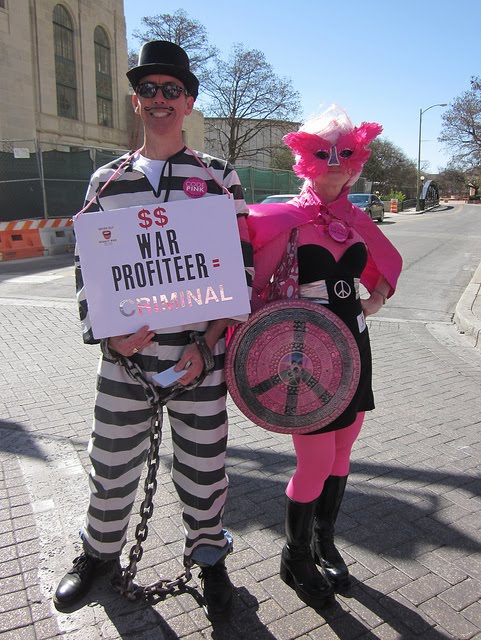
Photo by Carlos Lowry / The Rag Blog.

International Women’s Day:
‘Fierce women’ keeping the faith

By Alice Embree | The Rag Blog | March 5, 2012

See gallery of photos by Carlos Lowry and Susan Van Haitsma, Below.

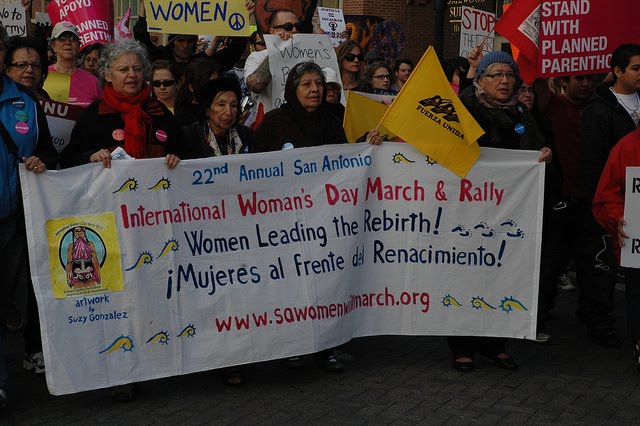
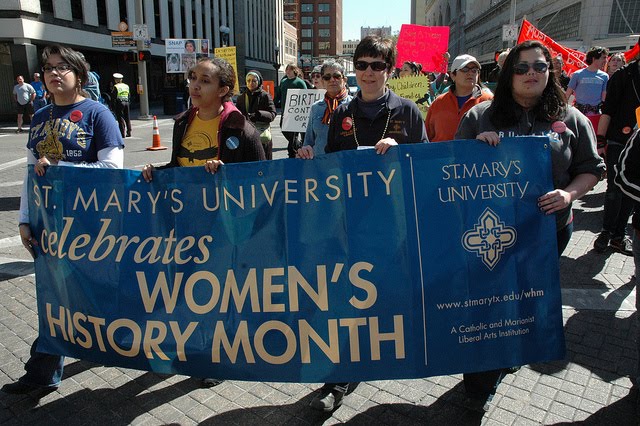
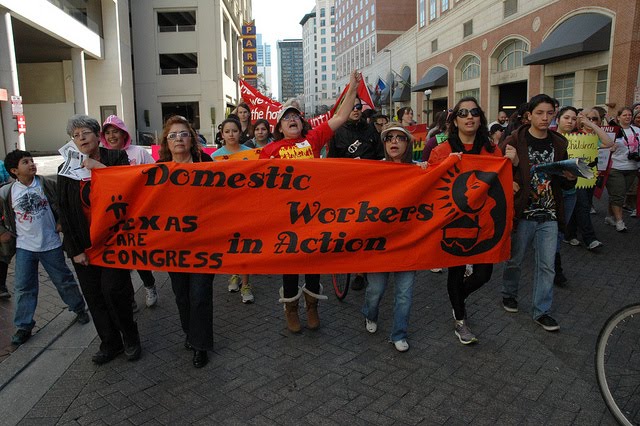
SAN ANTONIO — For the third year I traveled south from Austin to San Antonio to take part in their International Women’s Day march with others from CodePink Austin. It was the twenty-second annual Women’s Day celebration in that city, which has kept the faith better than any city I know of.

The march did not disappoint. A blustery wind whipped against our banner, “Women Say No to War,” when we left from the Grand Hyatt on Saturday, March 3. But the wind died down as we made the now familiar trek to Milam Park and the Plaza del Zacate. CodePink Austin invoked various “Supershero powers” as the contingent marched in costumes, adorned with capes and crowns, and accompanied by a prison-garbed and shackled “war criminal.”

The International Women’s Day celebration was organized by a coalition of “fierce mujeres” from community and social justice organizations — union organizers for nurses, hotel workers, and domestic workers, advocates for reproductive choice and LGBTQ rights.

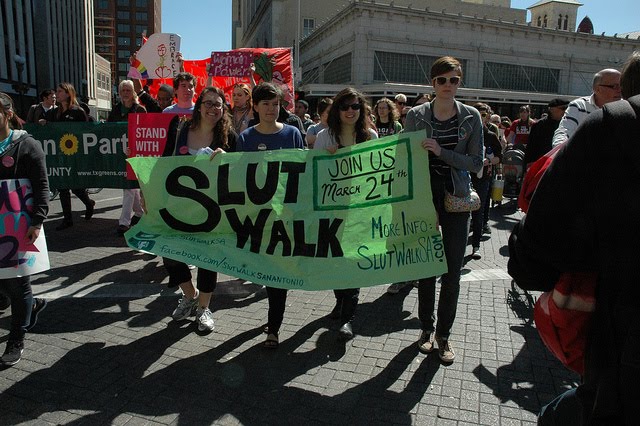
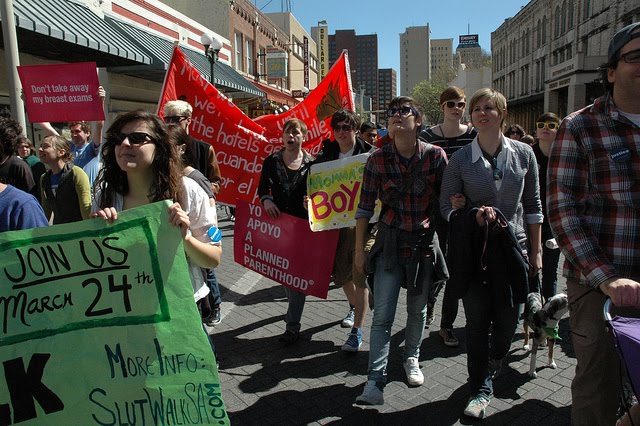
Graciela Sanchez of the Esperanza Peace and Justice Center, her mother, Isabel Sanchez, two women from Fuerza Unida, and a former councilwoman carried the leadoff banner for the march. Other banners and signs displayed the diversity of causes and issues, calling for an end to NAFTA and to war, defending immigrant rights and decrying the border wall.

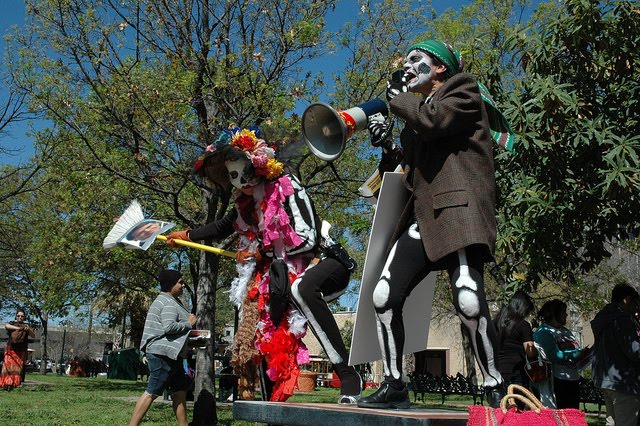
Photo by Carlos Lowry / The Rag Blog.

The generations ranged from Girl Scout participants and the youth of the Martinez Street Women’s Center to the elders like Graciela Sanchez who have kept this tradition alive for more than two decades. Indigenous dancers and a calavera (skeleton) -clad duo were reminders of the Native American and Mexican ancestry of South Texas.

San Antonio displayed once again its ease with crossing boundaries of race, age, class, national origin, and sexual orientation. The call for the march proclaimed:

We, like women and girls all over the world, are the voices of conscience, the roots of change, and the leaders of local and global movements. We seek healthcare, housing, education, environmental justice, and fair wages, not just as women, but also as people of color, as youth and elders, as immigrants and indigenous people, as lesbian, bisexual, intersex, two-spirit, transgender, and queer women, and as poor and working class people.

We oppose all forms of violence. We advocate for reproductive choice. We call for an end to war, genocide, and occupation. We claim our own voices and come together to share them in public space. We march in solidarity with women and social justice movements around the world.

I hope that we in Austin will again see such a diverse coalition of fierce women. As the Republican primary candidates attempt to dial us back to the 50s, as women’s basic healthcare comes under attack, as women are advised to “hold an aspirin between their knees” as cheap birth control, as Rush Limbaugh hurls accusations of “slut” and “prostitute” at a college student defending access to birth control, the need for outrage and ferocity grows.

Austin musician Marcia Ball is “seeing red” and calling for women (and men) to join her wearing red on the Capitol steps each of the next three Tuesdays — March 6, 13, and 20 — from noon until 2 p.m. On March 9 at 7 p.m., a presentation at Austin’s feminist bookstore, BookWoman, will remind us of the beginnings of the women’s movement, with clips from an upcoming movie, She’s Beautiful When She’s Angry.

Time to let the rage out of the bottle, sisters. I guess it’s the only thing Rush and the two Ricks can understand.

[Alice Embree is a long-time Austin activist, organizer, and member of the Texas State Employees Union. A former staff member of underground papers, The Rag in Austin and RAT in New York, and a veteran of SDS and the women’s liberation movement, she is now active with CodePink Austin and Under the Hood Café. Embree is a contributing editor to The Rag Blog and is treasurer of the New Journalism Project. Read more articles by Alice Embree on The Rag Blog.]

Also see: “San Antonio: Thousands Rally for International Women’s Day,” by Alice Embree / The Rag Blog / March 8, 2010

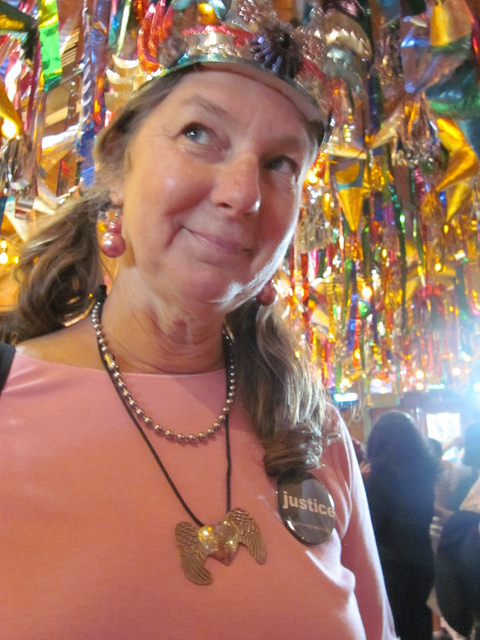
Photo by Susan Van Haitsma / The Rag Blog.

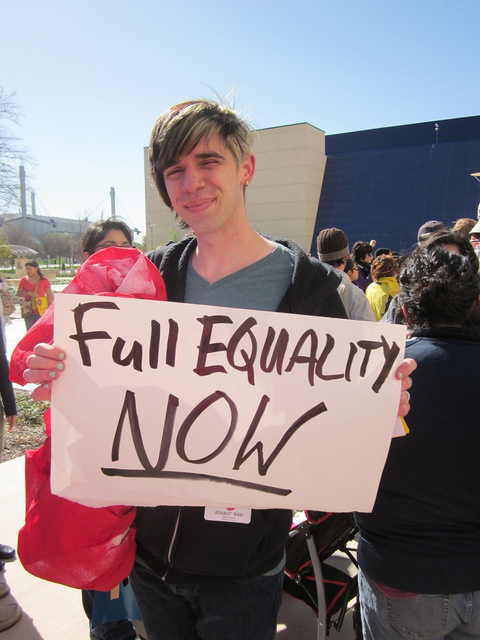
Photo by Carlos Lowry / The Rag Blog.

Photo by Susan Van Haitsma / The Rag Blog.

Photo by Susan Van Haitsma / The Rag Blog.

Photo by Carlos Lowry / The Rag Blog.

Photo by Susan Van Haitsma / The Rag Blog.

Photo by Susan Van Haitsma / The Rag Blog.

Photo by Susan Van Haitsma / The Rag Blog.

Photo by Susan Van Haitsma / The Rag Blog.

Photo by Carlos Lowry / The Rag Blog.

Photo by Carlos Lowry / The Rag Blog.

Photo by Carlos Lowry / The Rag Blog.

Photo by Carlos Lowry / The Rag Blog.

Photo by Carlos Lowry / The Rag Blog.

Photo by Carlos Lowry / The Rag Blog.

Photo by Carlos Lowry / The Rag Blog.

Photo by Carlos Lowry / The Rag Blog.

Photo by Carlos Lowry / The Rag Blog.

Photo by Carlos Lowry / The Rag Blog.

The Rag Blog

Posted in Rag Bloggers | Tagged , , , , , , | 4 Comments

International Women’s Day

By Alice Embree / The Rag Blog / March 5, 2012

SAN ANTONIO — For the third year I traveled south from Austin to San Antonio to take part in their International Women’s Day march with others from CodePink Austin. It was the twenty-second annual Women’s Day celebration in that city, which has kept the faith better than any city I know of.

The march did not disappoint. A blustery wind whipped against our banner, “Women say no to war,” when we left from the Grand Hyatt on Saturday, March 3. But the wind died down as we made the now familiar trek to Milam Park and the Plaza del Zacate. CodePink Austin invoked various “Supershero powers” as the contingent marched in costumes, adorned with capes and crowns, and accompanied by a prison-garbed and shackled “war criminal.”

The celebration was organized by a coalition of “fierce mujeres” from community and social justice organizations — union organizers for nurses, hotel workers, and domestic workers, advocates for reproductive choice and LBGTQ rights.

Graciela Sanchez of the Esperanza Peace and Justice Center, her mother, Isabel Sanchez, two women from Fuerza Unida, and a former councilwoman carried the leadoff banner for the march. Other banners and signs displayed the diversity of causes and issues, calling for and end to NAFTA and to war, defending immigrant rights and decrying the border wall.

The generations ranged from Girl Scout participants and the youth of the Martinez Street Women’s Center to the elders like Graciela Sanchez who have kept this tradition alive for more than two decades. Indigenous dancers and a calavera (skeleton) -clad duo were reminders of the Native American and Mexican ancestry of south Texas.

San Antonio displayed once again its ease with crossing boundaries of race, age, class, national origin, and sexual orientation. The call for the march proclaimed:

We, like women and girls all over the world, are the voices of conscience, the roots of change, and the leaders of local and global movements. We seek healthcare, housing, education, environmental justice and fair wages, not just as women, but also as people of color, as youth and elders, as immigrants and indigenous people, as lesbian, bisexual, intersex, two-spirit, transgender, and queer women, and as poor and working class people.

We oppose all forms of violence. We advocate for reproductive choice. We call for an end to war, genocide, and occupation. We claim our own voices and come together to share them in public space. We march in solidarity with women and social justice movements around the world.

I hope that we in Austin will again see such a diverse coalition of fierce women. As the Republican primary candidates attempt to dial us back to the 50s, as women’s basic healthcare comes under attack, as women are advised to “hold an aspirin between their knees” as cheap birth control, as Rush Limbaugh hurls accusations of “slut” and “prostitute” at a college student defending access to birth control, the need for outrage and ferocity grows.

Austin musician Marcia Ball is “seeing red” and calling for women (and men) to join her wearing red on the Capitol steps each of the next three Tuesdays, March 6, 13, and 20, from noon until 2 p.m. On March 9 at 7 p.m., a presentation at Austin’s feminist bookstore, BookWoman, will remind us of the beginnings of the women’s movement, with clips from an upcoming movie, She’s Beautiful When She’s Angry.

Time to let the rage out of the bottle, sisters. I guess it’s the only thing Rush and the two Ricks can understand.

[Alice Embree is a long-time Austin activist, organizer, and member of the Texas State Employees Union. A former staff member of underground papers, The Rag in Austin and RAT in New York, and a veteran of SDS and the women’s liberation movement, she is now active with CodePink Austin and Under the Hood Café. Embree is a contributing editor to The Rag Blog and is treasurer of the New Journalism Project. Read more articles by Alice Embree on The Rag Blog.]

Also see “San Antonio: Thousands Rally for International Women’s Day,” by Alice Embree / The Rag Blog / March 8, 2010

Photos by Carlos Lowry:
http://www.flickr.com/photos/carlos/sets/72157629141475946/with/6950632055/


Type rest of the post here

Source /

The Rag Blog

Posted in RagBlog | Leave a comment

Olympia Snow and Andrew Breibart:
Is it the end of an era?

By Danny Schechter | The Rag Blog | March 5, 2012

There was an eerie synchronicity in the pending resignation of veteran Maine Senator Olympia Snowe, a Republican who had more than she could take of hyper-partisan “conservative” correct-lineism in Congress, and the death of Andrew Breitbart, the right-wing provocateur who did his very best to create the dynamic that Snowe was rejecting.

She would never use the language of her Party-mate Rick Santorum who confessed that some policies he disagreed with made him want to throw up, but if we lived in the age when all roads led to Rome, Congress would surely have its own vomitorium in the basement and it would be well-attended.

Breibart’s unexpected passing of “natural causes” might foreshadow the death of his political brand just as Snowe’s retreat to the state lobsters made famous may mark the end of the center in the GOP.

There was nothing natural about Andrew’s angst and activism as he smeared and bullied political opponents with the full support of the extremist echo chamber that helped him build his career.

There was no tactic that was too unethical in his aggressive arsenal that relished embarrassing and exposing enemies with videos and bombast,

After he died, the likes of Matt Drudge and Michelle Malkin were there with teary condolences as were his adoring staff members who posted this testimonial: “Andrew lived boldly, so that we more timid souls would dare to live freely and fully, and fight for the fragile liberty he showed us how to love.”

What he did love was to retweet every criticism he received as badges of honor in what seemed like an endless self-promoting crusade. No wonder, the right wing blogosphere is in mourning, echoing each other’s laments.

Brinart’s spirit was animated by a large dose of Stalin.

Conservative Ron Deher wrote,

I couldn’t stand some of what Breitbart did, and criticized certain of his stunts on this blog. But Lord have mercy, a 43-year-old man dropped dead and left a widow and four fatherless children. He was a provocateur, not a criminal. The thing Breitbart suffered from is the same thing… too many of us suffer from: making ideology more important than basic human decency.

David Frum, the man who coined the phrase “axis of evil,” was honest enough to admit

that to speak only “good” of Breitbart would be to misunderstand the man. The good was there. Breitbart was by all accounts generous with time and advice, a loving husband and father, and a loyal friend.

Yet perhaps Breitbart’s most consequential innovation was his invention of a new kind of culture war, and it’s difficult to assess his impact on American media and politics if you withhold an objective evaluation of his career — a career that was so representative of his times.

It was that “culture war” that offended a cultured senator like Olympia Snowe who said she was through with the spirit of confrontation and polarization that drives politics, fed up with an environment which has no room for individual conscience or dissent.

NPR reported,

Politico’s Jonathan Allen published a piece that epitomizes this genre today. The article, “The center crumbles,” laments that “Congress can’t find the middle ground because no one’s willing and able to stand there anymore.”

For some like Snowe, the question is, why bother? The prospect of running hard to win another term — particularly a six-year Senate term — is less and less attractive for folks who came to Washington to make things happen only to find out there’s no common ground to get things done, only partisan point-scoring that leads to paralyzed politics.

Some years ago when I was making the film In Debt We Trust, I spent a long night in Congress waiting to interview Texas Congresswoman Sheila Jackson Lee who was then speaking on the floor against Republican demands that the United States seal both our Southern and Northern borders with a fence or East Berlin-like high wall to stop illegal immigrants.

She very calmly challenged the idea with facts and figures that seemed very rational and to the point.

But when the vote came, all of the Republicans were looking down at their blackberries where they were being instructed on how to vote by their leadership.

Despite agreeing with some of the points she made in the debate, the GOP voted as a block, no deviations! That was before the Tea Party fanatics moved in and frequently rejected the advice of their whips because it was not obstructionist enough.

Those were Breibart’s ideas in action. The Los Angeles Times praised him for turning media manipulation into an art:

Breitbart was a revolutionary eager to overthrow a media establishment that he viewed as a front for left-wing social causes. Always brimming with righteous indignation — before he died, his final tweet offered an explanation for why he’d called an adversary a “putz” — he had contempt for anything that smacked of liberal do-gooderism or hypocrisy.

In his last known conversation in an LA bar he blamed liberals for forcing the GOP to debate social issues so they could challenge them. To him, like generations of anti-communists before him, there was always a liberal (his version of communist) under every bed.

Noted writer Patrick Goldstein said,

Breitbart would’ve been a marginal figure if he had simply been a media gadfly. His genius was rooted in the realization that in the new media universe, being outrageous often gets far more attention than being authoritative. After Ted Kennedy died in 2009, when everyone else was lionizing the great liberal crusader, Breitbart ripped him as a “duplicitous bastard” He also called him a “prick” and “a special pile of human excrement.”

Personally, he went from a liberal family to join a reactionary community. He helped found Huffington Post. Appearances on Bill Maher’s shows and Fox News programs helped build his national celebrity even as he co-wrote a book criticizing the celebrity culture that propelled him into national visibility.

Many on the left lacked his sophistication and were unprepared to respond to his attacks. Organizations like ACORN, known for grassroots organizing and voter registration, were destroyed by Breibart’s calculated shock tactics, partly because his undercover gang with video cameras understood its vulnerabilities and played on its naiveté. Rather than defending them, many Democrats rushed to distance themselves and in the process helped defund an important organizing force.

He was less effective in his campaign against Occupy Wall Street but what he lacked in invective, local police forces more than made up for with spying, surveillance, and physical attacks on Occupy. He was a cheerleader for this repressive response.

He did seem to have some loose screws, though. According to Wikipedia,

At the Conservative Political Action Conference convention in Washington, D.C., on February 10, 2012, a belligerent Breitbart was captured walking with a glass of wine, screaming a diatribe at protesters, including repeatedly calling them “filthy freaks” and “murderers,” demanding that they “stop raping the people.” He was restrained by convention hotel security, resisting as they physically pushed him away from the demonstration.

He wanted his enemies to hate him, and, no surprise, many reciprocated in kind.

Wikipedia also noted that

Breitbart often appeared as a speaker at Tea Party movement events across the U.S. For example, Breitbart was a keynote speaker at the first National Tea Party Convention at Gaylord Opryland Hotel in Nashville on February 6, 2010.

Whats the lesson for the left?

No one would suggest emulating Breitbart’s deliberately deceptive methods, but perhaps his example argues that the activists he sought to destroy need more audacity, more discipline, and more cleverness in exposing right-wing media with better alliances and collaborations. They need to create mutually supportive echo chambers that go on the offensive as opposed to just reacting to attack.

They also need to try to seize the national stage, not shrink from it for fear of being co-opted.

Olympia Snow deserves our respect for taking the stand she did. Andrew Breibart didn’t deserve to die at age 43, but — who besides acolytes and his own ditto-heads, including many haters — will really honor his legacy?

[News Dissector Danny Schechter writes the News Dissector blog and edits the new Mediachannel1.org. His new book is Occupy: Dissecting Occupy Wall Street. (ColdType.net). Email Danny at dissector@mediachannel.org. Read more by Danny Schechter on The Rag Blog.]

The Rag Blog

Posted in RagBlog | Leave a comment

Jim Hightower : The Keystone XL Flim-Flam

Valero refinery in Port Arthur, Texas. Image from Nation of Change.

The Keystone XL flim-flam

The dirty little secret that those pushing so urgently for building Keystone XL don’t want you to know is that the tar sands oil producers are in cahoots with Texas refineries to move the product onto the lucrative global export market…

By Jim Hightower / Reader Supported News / March 4, 2012

For Rep. Allen West, the skyrocketing price of gasoline is not just a policy matter, it’s a personal pocketbook issue. The Florida tea-party Republican (who, of course, blames President Obama for the increase) recently posted a message on Facebook wailing that it’s now costing him $70 to fill his Hummer H3.

It’s hard to feel the pain of a whining, $174,000-a-year Congress-critter, but millions of regular Americans really are feeling pain at the pump — especially truck drivers, cabbies, farmers, commuters,and others whose livelihoods are tethered to the whims of Big Oil.

It’s an especially cynical political stunt, then, for congressional Republicans, GOP presidential wannabes, and a chorus of right-wing mouthpieces to use gas price pain as a whip for lashing out at Obama’s January decision to reject the infamous Keystone XL pipeline.

This friendly Canadian corporation, they cried, would send 700,000 barrels of “tar sands crude” oil per day through the 2,000-mile-long pipeline that it would build from Alberta, Canada, to Texas refineries on the Gulf Coast. “Less dependence on OPEC,” they chant like a mantra, “more gasoline for America, lower prices for consumers.”

What’s not to like?

Well, aside from inevitable environmental damage from pipeline leaks, and the fact that this foreign-owned corporation would use the autocratic power of eminent domain to take land from unwilling sellers along the 2,000 mile route, here’s something not to like: The gasoline and diesel that would be made from this Canadian crude would not go to American gas pumps, but to foreign markets.

The dirty little secret that those pushing so urgently for building Keystone XL don’t want you to know is that the tar sands oil producers are in cahoots with Texas refineries to move the product onto the lucrative global export market, selling it to buyers in Europe, Latin America and China — not to you and me.

The pipeline and the toxic crude it would carry across six states would do absolutely nothing to shave even a penny off of the price we pay at the pump.

Already, U.S. refineries are exporting record amounts of the gasoline they make. For the first time in 62 years, America is now a net petroleum exporter. Valero Energy Corp., the largest U.S. exporter of refined petroleum products, is a major lobbyist for Keystone XL.

Along with Motiva (an oil refiner jointly owned by Shell and Saudi Aramco) and Total (a French refinery), Valero has signed secret, long-term contracts with Keystone’s owner (TransCanada Corp.) and several tar sands oil producers to bring this crude to Port Arthur, Texas. All three have upgraded their refineries there to process diesel for export.

Adding to Big Oil’s enjoyment is the fact that the Port Arthur refineries of Valero, Motiva, and Total are within a Foreign Trade Zone, giving them special tax breaks for shipping gasoline and diesel out of our country.

And adding to the dismay of some U.S. consumers, TransCanada has quietly boasted that Keystone XL would cut gasoline supplies in our Midwestern states, thus raising prices at the pump and siphoning more billions of dollars a year from consumers pockets into the vaults of multinational oil interests.

So, lets tally the score in this Keystone pipeline deal: The American people’s environment would be put at risk, foreign nations would get the fuel, pipeline and oil investors would get the tax-subsidized profits, and we’d all stay hooked on deadly polluting oil.

Meanwhile, the financial speculators and supply manipulators who are artificially causing our gasoline prices to rise escape scrutiny, while self-serving politicians (tanked up on Big Oil’s and Wall Street’s campaign cash) divert attention to the bugaboo of Obama’s pipeline decision.

And, yet again, our nation has an excuse to postpone the necessary investments in conservation, alternative fuels, and mass transit that would actually solve the gas-gouging problem.

What’s not to like?

[Jim Hightower, a radio commentator, writer, public speaker, and former Texas Agriculture Commissioner, edits the populist newsletter, The Hightower Lowdown. This article was published by Creators Syndicate and distributed by Reader Supported News. Read more articles by and about Jim Hightower on The Rag Blog.]

The Rag Blog

Posted in RagBlog | Tagged , , , , , | Leave a comment

Richard Raznikov tells us that “all across the western world, there is enormous pressure… to ‘privatize’ everything.” Severing the connection between the public and the “management of and control over public resources and operations” is dangerous, he says. For instance, “Does anyone have to ask what happens to law enforcement and the judicial system once the state agrees to keep private prisons at 90% of capacity?”

Posted in RagBlog | Leave a comment

David P. Hamilton : Guatemala’s Perez Molina Wants to Legalize all Drugs

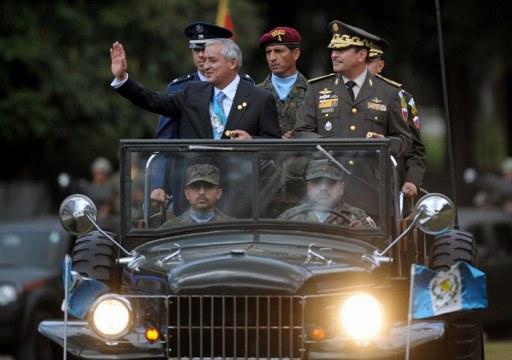
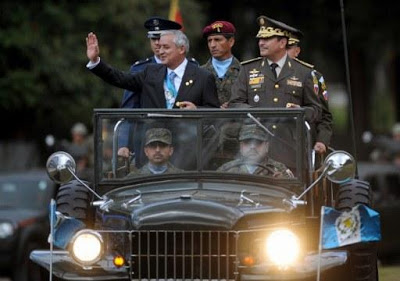
Guatemalan President Otto Pérez Molina, left, with his Defense Minister Ulises Ansueto Giron, during a ceremony in Guatemala City in January. Photo from AFP / Tico Times.

Otto Perez Molina and the Drug War

Perez Molina surprised everyone by announcing that he was going to propose to his fellow Latin American leaders the complete legalization of drugs throughout Central America, Mexico, and Colombia.

By David P. Hamilton / The Rag Blog / March 1, 2012

GUATEMALA CITY — On January 14, 2012, Otto Perez Molina was inaugurated as the new president of Guatemala. This justly inspired an outcry of anguish among leftists everywhere.

Perez Molina has a seriously marred resume. He is an ex-Guatemalan army general who specialized in intelligence and who was present in the Quiche Department during the massacres of the Ixil-speaking Maya. Survivors have identified him as having personally tortured them. He served in the notoriously brutal special forces known as the Kaibles as their director of intelligence. He is a graduate of the Guatemalan National Military Academy and the School of the Americas at Ft. Benning, Georgia.

In 1992, Perez Molina was the Director of Military Intelligence when guerrilla leader Efrain Bámaca Velásquez disappeared. Bámaca’s wife, American lawyer Jennifer Harbury, claims that Perez Molina gave the orders to torture and kill her husband.

There are also allegations that Perez Molina participated in the 1998 murder of Juan José Gerardi, the Roman Catholic bishop of Guatemala and a prominent human rights advocate.

How could such a ghastly individual be elected president of Guatemala, a country whose population is half Maya, in the midst of the leftist ascendancy in Latin America? To understand the answer to that question, one must consider other aspects of Perez Molina that appealed to voters and understand the current political climate of Guatemala.

To his credit, in 1983 Perez Molina participated in the coup that overthrew Efrian Rios Montt, the most egregious of all the Guatemalan military dictators during the civil war. That coup brought to power General Oscar Mejia Victorias. Both Rios Montt and Mejia Vitorias are still alive and both have been charged with genocide by Spanish courts. Rios Montt is currently on trial for the same offense in Guatemalan courts.

There are those in the human rights community who say that the only difference between Rios Montt and Mejia Victorias was that the former was a militant evangelical, whereas the latter was a nominal Catholic; that they followed the same counter-insurgency strategy. Others contend that there was a split in the Guatemalan army between the “dinosaurs” such as Rios Montt who wanted to “dry up the sea” in which the guerrillas swam by killing the Maya or relocating them to concentration camps, and the “constitutionalistas” who recognized the need for a political component in order to end the war.

Despite presiding over the killing of thousands more Maya after taking power, Mejia Victorias got rid of Rios Montt, reduced the level of violence, handed over power to the first elected civilian government in decades (albeit under a military thumb) and set in motion the process that eventually resulted in a peace treaty to end the civil war. As is typical in U.S. politics, at least he was better than the other guy.

This faction fight in the military remains a blood feud 30 years later. When Rios Montt’s protégé, Alfonso Portillo, became president in 2000, Mejia Victorias fled into exile in Spain and Perez Molina resigned from the military. Now Perez Molina shows no sign of interfering with the trial of Rios Montt who is under house arrest and being prosecuted by a militant woman attorney general. Meanwhile, his 81-year old mentor, Mejia Victorias, hangs out with old friends in Antigua’s delightful central park.

While serving as chief of military intelligence in 1993, Perez Molina “was instrumental” in stopping then President Jorge Serrano, who had tried to dissolve the legislature and reappoint a new supreme court so he could rule by fiat. Serrano was quickly forced to flee the country along with his vice-president.

His successor, selected by the Congress from a short list reputedly provided by Bill Clinton, was Ramiro de Leon Carpio, who had previously been Guatemala’s human rights ombudsman and had defended Rigoberta Menchu. Perez Molina became de Leon Carpio’s chief of staff and represented the Guatemalan military in the negotiations that eventually led to the 1996 Peace Accords.

Another facet of Perez Molina is his personal experience as a victim of political violence. In early 2000, he retired from the military in order to found a new political party to challenge the Rios Montt faction that held the presidency and had the largest party in the Congress.

In November of that year, Perez Molina’s son was attacked by gunmen while driving with his wife and infant daughter. Three months later, on the eve of Perez Molina’s announcing his new party’s formation, his daughter was wounded by gunmen on the same day that a woman was gunned down immediately after having left a meeting with Perez’s wife.

During his 2007 campaign for president, several members of Perez’s political party were murdered, including a 33-year-old Maya woman who was one of his principal aides.
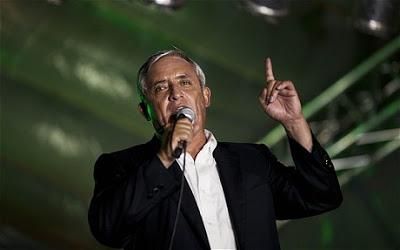
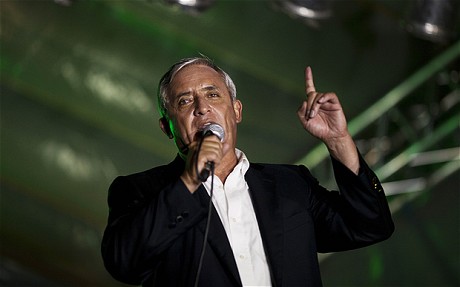
Guatamelan president Otto Perez Molina. Photo from AP / The Telegraph.

Perez Molina’s predecessor as president, Alvaro Colom, had defeated him in 2007. Colom came into office as a moderate leftist, but he was a disappointment, considered weak and suspected of corruption. Because Guatemala’s constitution bars a president from running again, Colom tried to have his wife run instead. It was widely reported that she ran the government already.

In order to advance this ploy, they got a divorce. But the Guatemalan Supreme Court wouldn’t buy it and she wasn’t allowed to run. No other left-leaning candidate was successful in getting into the second round run off.

Perez Molina ran the most expensive campaign in the history of Guatemala. His opponent was Manuel Baldizon, described as a multimillionaire Christian populist and proponent of the death penalty who wants to fight crime by televising executions. Both ran with women as their vice-presidents.

Baldizon is a very rich man from the part of the country where the drug gangs are the strongest. Because the drug cartels are so rich and powerful in Guatemala, it is widely assumed that both candidates in the run-off were supported by drug money.

Perez Molina ran for president pledging a mano duro” against crime. This term has rather sinister connotations in the context of Guatemala. It can be interpreted as somewhere between firm hand and iron fist. Presidents during the civil war used the same term to describe their approach to the insurgency.

Crime is overwhelmingly the consensus number one issue in Guatemala and everyone wants a government that will somehow reduce it. Guatemala’s largest industry is tourism, which has been severely hurt by the country’s reputation for violence. The U.S. Embassy reports that “Guatemala has one of the highest violent crime rates in Latin America.” Currently Guatemala has the seventh highest homicide rate in the world and the successful prosecution rate is negligible.

The bordering countries of Belize (6th), El Salvador (2nd) and Honduras (1st) are worse. In the first seven months of 2011, approximately 42 murders a week were reported in Guatemala City, a city of 2.5 million. Illegal drug money fuels this violence. Perez Molina won the presidency primarily because he was the only candidate who ran convincingly on this issue.

At the time of Perez Molina’s inauguration, critics were warning of the carnage to come. Indeed, his first move was to employ the army to back up the police. Then, a month into office, he surprised everyone by announcing that he was going to propose to his fellow Latin American leaders the complete legalization of drugs throughout Central America, Mexico, and Colombia.

We’re not talking here about the legalization of an ounce of pot for personal use or some other minimal measure. He’s talking about complete legalization — possession, transportation, production, et al, of all illegal drugs. He has said that the evidence clearly shows that the long-standing effort to repress illegal drug use has failed and that different approaches must be considered — such as employing market forces instead of military forces.

He says he will put this proposal on the agenda at the next meeting of regional leaders. However you might decide to interpret this, it was a very radical move, way outside the boundaries of previous discourse. Suddenly, the terms of debate are entirely different. Is he proposing to reduce crime by the simple procedure of making fewer things illegal?

This move has led to considerable speculation as to his motives, everyone having the idea that he’s actually angling for something else. In the The Atlantic magazine, Natalie Kitroeff, a research associate in the Latin America program of the Council on Foreign Relations, says he’s doing it to pressure the U.S. to lift the embargo on selling arms to Guatemala that has been in place since 1978.

But the logic of her argument is that Perez Molina is very publicly calling into question the whole rationale of the Drug War in order to extort the U.S. to give him more money and arms to fight the Drug War. In other words, its open season for speculation and no one really knows what this guy is up to, but everyone assumes that there is a separate agenda lurking somewhere.

Drug war violence in Central America. Image from Foreign Policy.

It might be appropriate here to consider the contrast between the neighboring cities of Ciudad Juarez in Mexico and El Paso, Texas, USA. The former has one of the highest homicide rates in the world. The latter, just across the dribble known on its north bank as the Rio Grande, has the lowest murder rate of any American city.

However you might choose to explain this phenomenon, some facts are obvious. The drug cartels exist inside the U.S. in large numbers, but they don’t fight there, clear evidence of an agreement to a truce among them. When was the last time you heard of Mexican cartels shooting it out in the streets of LA, a city with several million Mexicans and Mexican-Americans?

They also don’t fight in Mexico City, which has one-third the murder rate of Washington, DC. The heavy price for the Drug War is being paid in blood that flows almost entirely south of the border along the drug transit lanes — the coasts of Mexico and Central America and the U.S.-Mexico border region.

In addition, the illegal drug industry is corrupting the political processes and judicial systems in the whole region. The resulting mayhem is ruining tourism and besmirching their reputations in general. This becomes very much a national security issue for a country like Guatemala and Perez Molina named his political party the Patriot Party.

On the other side of the border in the U.S., the Drug War remains useful to the power elite by providing an excuse to throw thousands of young, mostly-nonwhite men in prison, but generally folks up there are just gettin’ high and ignoring the carnage down south. The U.S. marijuana laws are in an advanced state of decay, the dam having been broken in numerous localities by the medical marijuana movement, most notably California.

Domestic production and consumption of pot in the U.S. have never been higher and there is no shortage. Principled potheads shun “cartel pot.” Although the U.S. remains the world’s largest consumer of cocaine, that market isn’t growing and the street price continues to decline due to oversupply. The market metrics point to declining profits.

Forces supporting legalization of now illegal drugs are gaining momentum throughout Latin America and beyond. Former presidents Vicente Fox and Ernesto Zedillo of Mexico, Fernando Henrique Cardoso of Brazil, and Cesar Gaviria of Colombia, have signed statements and written articles calling for the legalization or decriminalization of drugs. The current presidents of Mexico and Colombia say they are open to discussing the issue.

A recent report from The Global Commission on Drug Policy, backed by high-profile political figures (including former presidents of Brazil, Mexico, Colombia, and Switzerland, the incumbent Prime Minister of Greece, the former UN Secretary General Kofi Annan, the former U.S. Secretary of State George Shultz, the former European Union High Commissioner Javier Solana, and the British billionaire Richard Branson, among others) argues for a move away from the “zero tolerance” approach.

A conference of Latin American leaders last December in Mexico made “an unambiguous call” to legalize and regulate drugs. That conference was attended by the presidents of Mexico, Guatemala, Honduras, Nicaragua, and Panama, the vice-president of Costa Rica, and the foreign ministers of El Salvador, Belize, and Colombia. Their closing statement was a clear acknowledgement that the war on drugs is fueling much of the violence and chaos in their countries.

Exacerbating their dissatisfaction with the U.S.’s lack of success at reducing consumption, the Obama administration is planning to reduce anti-drug trafficking funds to Latin America next year by 16%, including a 60% reduction in such aid to Guatemala. Latin Americans ask themselves, why should we put up our money to fight the U.S.’s drug war when they won’t pay their share or reduce consumption?

Supporters of legalization talk about the effects of allowing market forces to come into play. If currently illegal drugs were legalized in Latin America, they could be shipped north via normal means. The shippers wouldn’t need expensive private airplanes and submarines when DHL will take it as far as Nuevo Laredo. They also wouldn’t need a private army to protect it all along the way. Legitimate business people would become involved and the cartels would be forced to compete and move their money into other areas as the price for their product dropped and their profit margins shrunk.

As the Rand Corporation predicted relative to the possible legalization of marijuana in California in 2010, the price of the drugs on the street would collapse. Only illegality makes the product expensive. Removing much of the money from the industry is the heaviest blow that can be dealt to the drug lords.

As the history of the prohibition of alcohol in the U.S. might suggest, more and more Latin American leaders are thinking that the only way to reduce the violence that plagues their countries is drug legalization. This puts them on a collision course with the U.S. government, regardless of which party is in power.

If Perez Molina and other Latin American leaders do indeed take money from the cartels, Perez Molina’s recent moves would indicate that at least some cartel owners are willing to sacrifice their current mega-profits for peace and legitimacy. It was recently reported that Zetas were living in campers so that their mobility would impede their arrest. They might prefer a house instead.

In this context, the idea of dumping the whole problem in Washington’s lap has considerable appeal to Latin American leaders located between the sources in the south and the big consumer up north. They could free resources to repress violence instead of bothering about the drugs.

Much of the rationale for the violence disappears and much of the money is taken out of the market when these products are no longer illegal. And the inherent anti-Americanism of legalization might be an issue that unites Latin American leaders across the political spectrum. Indeed, the more conservative leaders are taking the lead on this, although ex-coca grower Evo Morales is doubtless on board.

Now Perez Molina has thrown the fat on the fire in a highly public manner. If he puts it at the top of the agenda of the next meeting of regional leaders in March, expect a major freakout in Washington. The U.S. news media, almost totally fixated on the machinations of a pack of Republican losers and the corrupt U.S. presidential race, has so far ignored these loud knocking sounds on our southern door.

It is not unlikely that the U.S. will soon find itself without allies in the war on drugs and thus be compelled to adopt a wholly new approach.

[Rag Blog contributor David P. Hamilton has been a political activist in Austin since the late 1960s when he worked with SDS and wrote for The Rag, Austin’s underground newspaper. Read more articles by David P. Hamilton on The Rag Blog.]

The Rag Blog

Posted in Rag Bloggers | Tagged , , , , , , , | 3 Comments

Richard Raznikov : The Privatization of Everything

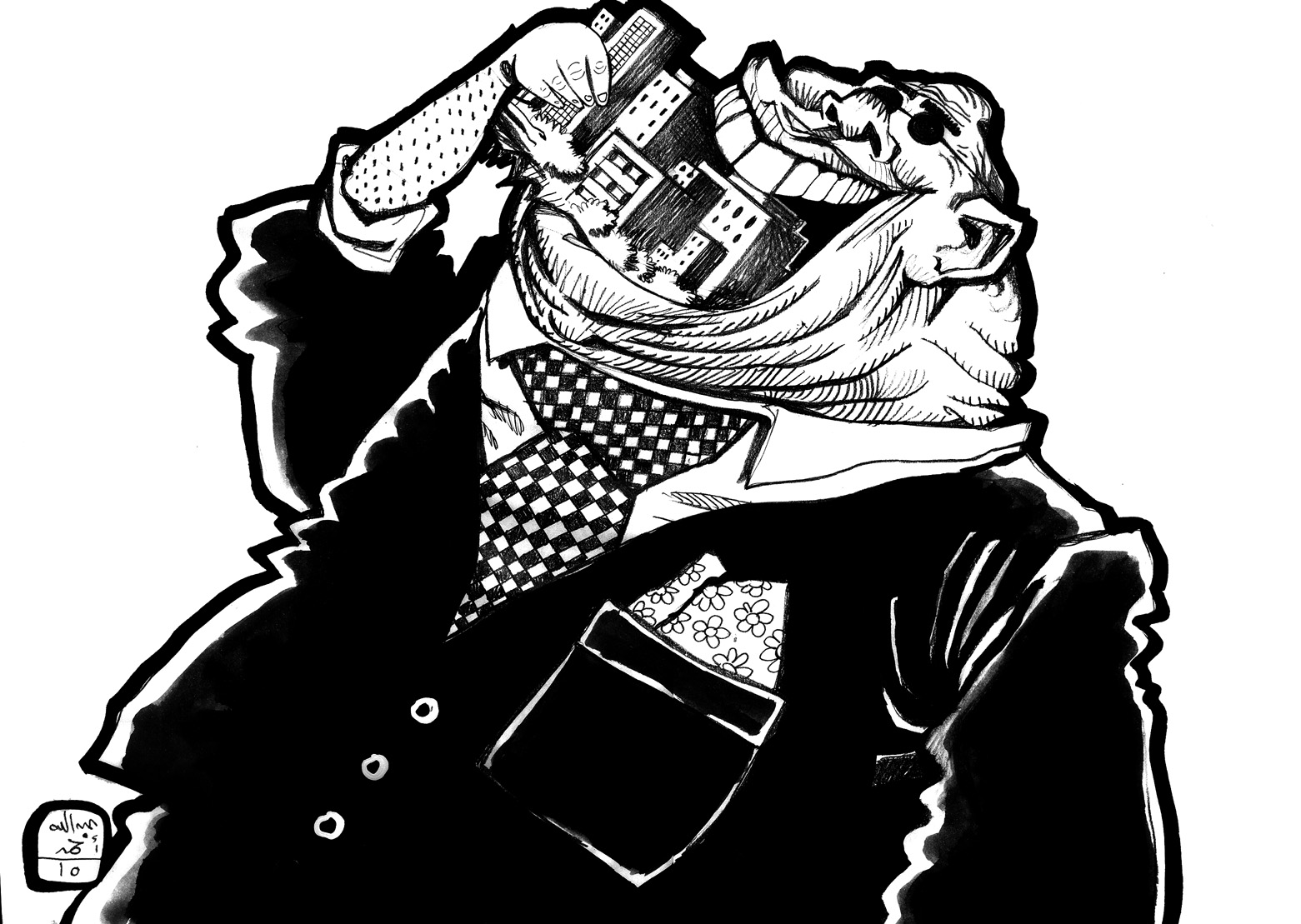
Gobbling up the Commons. Cartoon by Ahmed Abdallah / 3arabawy.

On the verge:
The privatization of everything

Does anyone have to ask what happens to law enforcement and the judicial system once the state agrees to keep private prisons at 90% of capacity?

By Richard Raznikov | The Rag Blog | March 1, 2012

No society can aspire to democracy unless it maintains an unbreakable connection between its politics and its police powers.

Once the populace has no political access to policy and enforcement, once those with coercive power over others are not directly accountable to the people’s representatives, you can kiss your ass goodbye.

We’re on the verge of it in America, 2012.

As David Foster Wallace remarked, the truth will set you free but not until it’s finished with you.

All across the western world, there is enormous pressure being brought to “privatize” everything. Where does this pressure come from? On whose behalf? What does it mean? What is the connection between the demands for “privatization” in Greece, as part of an “austerity package” initiated by the International Monetary Fund, with the “privatization” of prisons in Florida and other states of the U.S.? Is there one?

Let’s begin with this thought: as human cultures have evolved, there has been a general agreement that some things on the planet, such as water and air, belong to everyone. Democratization has extended these rights to include access to natural beauty and to the oceans.

With various forms of democracy, even including communism and socialism, have come the acceptance that matters of common concern, however approached or regulated, are integrally connected to the political system. That is a fundamental good, since without it there is no way for the people to exercise any real power over their political environment.

If one subscribes, therefore, to democracy, one also must take with it an inviolable connection between, for example, the building of roads, and politics. Otherwise, should roads be privately built, no one could pass without paying extortionate fees. Farmers could not get their crops to market. People could not travel or visit one another. And so forth.

Severing the connection between the public and the management of and control over public resources and operations thought to be of the commons, is dangerous. It would be hard to exaggerate just how dangerous.

The issue of privatization is maybe the most important public issue we’re facing in the U.S., and it’s causing terrible dislocation and political chaos in Europe, as well. You’re not going to see it on the news (sic). As with many things in America now, this is a story we’ll have to piece together on our own.

The Corrections Corporation of America, largest company operating private prisons, has written to 48 states offering to take over the running of prisons, provided that the states guarantee a 90 percent occupancy.

The systemic corruption this invites is breathtaking.

The care of inmates is of course a responsibility of the prison systems in the states and in the country as a whole for federal institutions. How we treat inmates, provision for their food and clothing, their recreation, their activities, their health, this is a matter of public policy. The state arrests, tries, and attains convictions; inmates have been sentenced to prison. The duration of the sentence is often impacted by the behavior of the prisoner.

It should be obvious that prison conditions are subject to politics; it is politics which passes the laws and operates the judicial system. How prisons are run is our public responsibility, and this is subject to our laws.

Prisons are not meant to be, nor should they be, profit-making enterprises. They have functions to fulfill. That’s not to say that budget matters are unimportant, only that they cannot be the sole criterion for proper operation.

Otherwise, inmates would be given no services at all. Rice is cheap; rancid meat is really cheap. There would be no point worrying about rehabilitation, which can be expensive. Nobody cares what happens when they get out. Gulags give you a profit margin that would impress even Wall Street.

Government is not supposed to be a profit-making enterprise. But any governmental function, once privatized, becomes exactly that. Does anyone have to ask what happens to law enforcement and the judicial system once the state agrees to keep private prisons at 90% of capacity?

How will the national parks be run when we privatize them, as some idiot politicians are advocating? What will the nation’s coastlines be like? Years ago, California voters approved the Coastal Initiative which protected it and secured public access; if and when that promise is broken, how long before only the wealthy can enjoy the beach?

On a lighter note, how about privatizing the military? It’s being done, you know. When Obama announced the “withdrawal” of U.S. troops from Iraq he’d promised only three years before, he didn’t bother to mention that remaining behind are an estimated 50,000 private troops, a private army serving the needs of the corporate mobsters who are figuring to loot what’s left.

Xe, nee Blackwater, is a private army the government contracts with to perform certain tasks, often unspecified, which it feels the regular army cannot perform. Its soldiers are paid much more than GIs, and the casualty rate is much higher. Xe works for the U.S. or for Halliburton or Bechtel or whomever hires it. It is, as we discovered when Blackwater mercenaries murdered Iraqi civilians for pure sport, exempt from U.S. law and the control of the American government which hired it.

When private armies can operate outside the political control of a country, there is no democracy, even in form. We all know what it is, don’t we?

Privatization of water, which I wrote about recently (“As Benign as Lucifer“), has enabled major corporations to destroy wide swaths of agriculture in India and elsewhere, causing widespread suicide as farmers by the tens of thousands have lost their land. Privatization of public services, public properties, public responsibilities, is a one-way ticket to hell.

The riots in Greece are about privatization. That is the agenda of the International Monetary Fund, the consortium of bankers who run a large part of the world and want more. Through the mechanism of manufactured debt, the bankers are able to extort whatever “austerity” measures they want. These involve a reduction in the wages of public employees, a reduction in social services for the poor, and the privatization of what is publicly owned.

If you think we’re not headed in that direction in the United States, you’re dreaming. That’s what the budget arguments are about now, and the talk of America’s “debt.” To whom is that “debt” owed? Why, to the bankers, of course, the same people whose looting of the Treasury caused this crisis in the first place. Pretty neat, huh?

Having taken everything else, they are going after what’s left, and what’s left are the treasures of a nation, the wealth owned in common by its people.

We simply can’t let them get it.

[Rag Blog contributor Richard Raznikov is an attorney practicing in San Rafael, California. He blogs at News from a Parallel World. Find more articles by Richard Raznikov on The Rag Blog.]

The Rag Blog

Posted in Rag Bloggers | Tagged , , , , , | 4 Comments

Jack A. Smith : Will Israel Bomb Iran?

Will Israel strike? Image from Gestetner Updates.

Bombing Iran:
Will they or won’t they?

Iran insists it is not producing or about to produce nuclear weapons… Israel is known to possess at least 200 nuclear weapons and delivery systems.

By Jack A. Smith | The Rag Blog | March 1, 2012

What’s the Obama Administration’s latest position on the possibility of an attack on Iran? It seems to be in flux but the White House is reported to be urging Israel not to start a war before the November elections.

Defense Secretary Leon Panetta says there is a “strong possibility” that Israel will attack Iran in either April, May, or June. The purpose would be to destroy Iran’s alleged building of a nuclear weapon, an assertion Tehran rejects, pointing to strong support for its position from authoritative American sources.

Commenting on Panetta’s report, a February 25 Associated Press dispatch declared: “An Israeli pre-emptive attack on Iran’s nuclear sites could draw the U.S. into a new Middle East conflict, a prospect dreaded by a war-weary Pentagon wary of new entanglements… with unpredictable outcomes.”

Foreign policy theorist Zbigniew Brzezinski, a former National Security Advisor to President Jimmy Carter with links to the Obama White House, told CNN Feb. 24 that if Israel attacks Iraq, “it will be disastrous for us in Afghanistan, in Iraq, in the terms of oil, but also in the Middle East more generally.”

On February 28, the AP reported that “Israeli officials say they won’t warn the U.S. if they decide to launch a pre-emptive strike against Iranian nuclear facilities.”

The U.S. is in daily communication with Israel about the matter. President Barack Obama is scheduled to hold discussions with warhawk Israeli Prime Minister Benjamin Netanyahu at the White House on March 5.

In the midst of this gathering war talk there are indications Washington does not want Israel to start a war at this juncture for several reasons:

  • The Obama Administration believes bombing Iran’s nuclear facilities will cause far more problems than it solves, and that the more effective policy is composed of sanctions, spying, and subversion, leading to regime change if possible.
  • Washington is hesitant to get any deeper into a potential Iran quagmire at a time when Afghanistan is blowing up in its face, and while the U.S. is involved behind the scenes in ousting the Bashar al-Assad regime in Damascus.
  • The White House does not want a new war on its hands during the last few months of an election campaign. The Wall Steet Journal online pointed out February 28 that “Iran and its nuclear intentions are rapidly emerging as the ultimate wild card in this year’s presidential race.”

In any event, President Obama and the entire U.S. national security bureaucracy know very well that Iran is not building a nuclear weapon.

The New York Times published a relatively sensational front page article February 25 about Iran and the bomb that was based largely on authoritative information clearing Iran of bomb-making charges.

These facts have been publicly available for five years, but because the Bush and Obama Administrations sought to minimize the significance of the bombshell reports most Americans knew little of their importance

The Times‘ headline read: “U.S. Agencies See No Move by Iran to Build a Bomb.” The article disclosed:

American intelligence analysts continue to believe that there is no hard evidence that Iran has decided to build a nuclear bomb. Recent assessments by American spy agencies are broadly consistent with a 2007 intelligence finding that concluded that Iran had abandoned its nuclear weapons program years earlier, according to current and former American officials. The officials said that assessment was largely reaffirmed in a 2010 National Intelligence Estimate, and that it remains the consensus view of America’s 16 intelligence agencies.

The article also reported on some unusually honest statements made in the last few weeks by Obama Administration officials:

In Senate testimony on Jan. 31, James R. Clapper Jr., the director of national intelligence, stated explicitly that American officials believe that Iran is preserving its options for a nuclear weapon, but said there was no evidence that it had made a decision on making a concerted push to build a weapon. David H. Petraeus, the C.I.A. director, concurred with that view at the same hearing. Other senior United States officials, including Defense Secretary Leon E. Panetta and Gen. Martin E. Dempsey, the chairman of the Joint Chiefs of Staff, have made similar statements in recent television appearances.

The fact that the Times decided to publish a front page article based on largely dated information undermining the rationale for attacking Iran evidently means the ruling elite is leaning on the White House to avoid one more war that could backfire during the election campaign.

Published in the same issue of the Times was a new statement from the International Atomic Energy Agency (IAEA) that Iran is producing additional enriched uranium inside a deep underground site — a report that the right wing Netanyahu regime distorted to signify that Iran is one step closer to creating a weapon with which to threaten the existence of Israel.

There was no proof the uranium in question was intended for any purpose other than Iran’s civilian nuclear program. Iran is working with the UN on an agreement to allow inspectors into all sites associated with the program.

Given the immense U.S. and Israeli spying apparatus inside Iran, as well as America’s extensive surveillance abilities — from spy satellites to drone flights and probable access to every telephone call and Internet message in Iran — it is significant no evidence has been collected to verify the bomb-making accusations. The 16 American intelligence agencies seem to know what they are talking about.

This does not impress war hawks in the U.S. Congress and among anti-Iranian organizations, such as the American Israel Public Affairs Committee, who are working to push Washington toward greater confrontations with Tehran. Several right wing senators introduced a bill in mid-February lowering the threshold for a U.S. or Israeli strike against Iran from making a bomb to possessing the ability to do so.

Iran insists it is not producing or about to produce nuclear weapons, and maintains that its nuclear power program is essentially in compliance with the Nuclear Non-Proliferation Treaty. Israel is known to possess at least 200 nuclear weapons and delivery systems while ignoring the treaty.

Tehran has long called for transforming the Middle East into a nuclear-free zone — a proposition opposed by both Obama and Netanyahu. Ironically, Washington is on exceptionally close terms with the three countries in possession of large nuclear arsenals that have thumbed their noses at the NonProliferation Treaty — Israel, Pakistan and India — even to the point of assisting them to maintain and update their weaponry.

In a statement February 28, Iranian Foreign Minister, Ali Akbar Salehi, declared that “We do not see any glory, pride or power in the nuclear weapons; quite the opposite.” He then referred to a religious decree issued by Ayatollah Ali Khamenei, the supreme authority within the Islamic Republic of Iran, that termed “the production possession, use or threat of use of nuclear weapons are illegitimate, futile, harmful, dangerous and prohibited as a great sin.”

United States animosity toward Iran — which has existed since America’s puppet monarch in Tehran was overthrown over 30 years ago — has nothing to do with Tehran’s alleged efforts to construct nuclear weapons. It is instead primarily based on Washington’s intention to exercise unimpeded domination of the Persian Gulf region, in which perhaps 30% of the world’s petroleum originates and is transported through the Gulf.

America has sought hegemony over the Middle East, and particularly the Persian Gulf, for several decades. This goal was a principle reason President George W. Bush decided to invade Iraq in 2003 to solidify U.S. control of the Gulf, believing a quick victory would pave the way toward toppling the government in Iran.

The Iraqi fightback and the subsequent stalemate destroyed Bush’s plans. Since Baghdad had long been Tehran’s main enemy, the only country to benefit from Bush’s neoconservative folly in Iraq was Iran.

Iran is now the principal power within the Persian Gulf region. Tehran has had a sharp rhetorical critique of the U.S., Israel, and Saudi Arabia for decades but is not using its power to threaten or attack any other country. Tehran’s military is not large, and is defensive in structure and intention.

But as long as the Islamic Republic refuses to subordinate itself to imperial Washington it remains an obstacle to America’s geopolitical ambitions, which are based on retaining global hegemony.

A main reason for the Obama Administration’s cruel and ever-tightening economic sanctions is to bring about regime-change in Iran to situate a client administration in Tehran. If this doesn’t work, the threat of military action is obviously implicit in President Obama’s mantra about “No option is off the table.”

For the immediate future, however, the White House appears to prefer sanctions, spying, and subversion to the potential unintended consequences of a U.S. or Israeli bombing attack on Iran.

[Jack A. Smith was editor of the Guardian — for decades the nation’s preeminent leftist newsweekly — that closed shop in 1992. Smith now edits the Hudson Valley Activist Newsletter, where this article was also posted. Read more articles by Jack A. Smith on The Rag Blog.]

The Rag Blog

Posted in Rag Bloggers | Tagged , , , , , | 3 Comments