Paul Robbins : Switching on the Sunshine

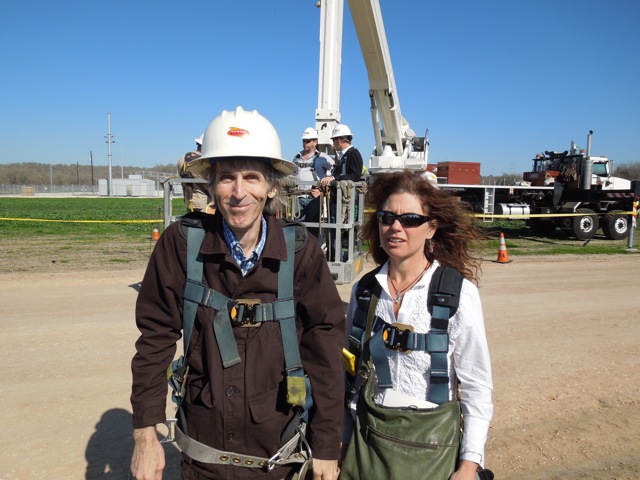
Flipping the switch at solar farm near Austin, Texas. Rag Blog photo.

Let the sunshine in:
On being young and crazy in Austin

They say that victory has 1,000 parents, but defeat is an orphan.

By Paul Robbins | The Rag Blog | January 11, 2012

AUSTIN — On Friday, Jan. 6, Austin officially commissioned its new 30-megawatt solar plant. It is one of the largest solar installations in the U.S. Austin and the environmental community in particular should be proud of this accomplishment.

Located near the small town of Webberville at the eastern edge of Travis County, the “solar farm” consists of 127,780 photovoltaic panels mounted on tracking axes covering a site of 380 acres. It will provide electricity equal to that used in 5,500 average Austin homes. Ironically the site, owned by Austin Energy, the City’s municipal public utility, was originally purchased in 1984 for a coal plant that was never built.

They say that victory has 1,000 parents, but defeat is an orphan. Many people will claim credit for this achievement. Many of them deserve it. However, the people left out of the celebration were the ones who had the original idea: the anti-nuclear activists of the 1970s.

Solar array at massive new solar farm in Webberville, Texas. Rag Blog photo.

We were mostly 20- and 30-somethings with the sun in our eyes, activists who wanted an alternative to a future of dangerous nuclear and coal plants. To the power structure of that generation, we were “crazy.” We were sometimes ignored, other times ridiculed, occasionally even blacklisted or persecuted.

Our attempts to keep Austin out of the South Texas Nuclear Project — ultimately unsuccessful when the City power structure stabbed student voters in the back — were both epic struggles and advanced courses in political organizing.

And last Friday we won. Of about 200 people there, including all manner of press, I was the only member of the “original cast.” It was a sunny winter day and people seemed festive. There were various props, including a yellow ribbon to cut and an official “light switch” to turn on, powering a (compact fluorescent) bulb.

The utility even had a special ride for attendees, who could don hardhats and safety harnesses to get an aerial view of the field from the bucket of a “cherry picker” electric line maintenance truck. We had to sign a release form.

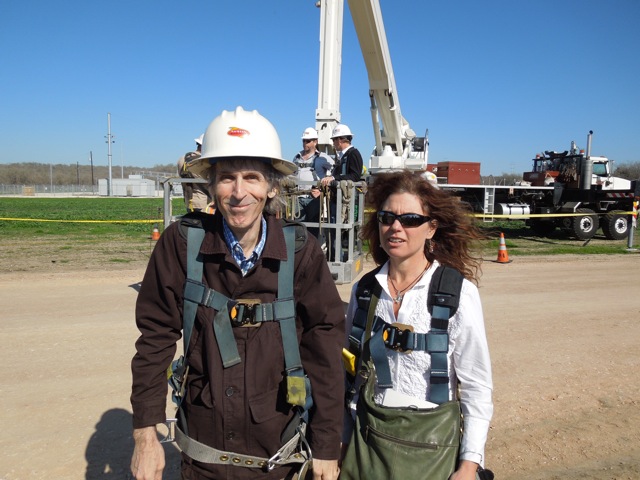
Austin environmentalist and Rag Blog contributor Paul Robbins, shown with Shannon Halley, aide to Austin City Councilmember Kathy Tovo. Rag Blog photo.

I am including a few photos, like the one [above] of me in a hardhat next to Council aide Shannon Halley, who accompanied me in the bucket.

On the bus ride back, I thought about all the people I worked with in that era, the people who had the original vision, the people who went unrecognized. This was their victory too.

[Paul Robbins is an environmental activist and consumer advocate based in Austin, Texas. Read more articles by Paul Robbins on The Rag Blog.]

Links to news stories, with video:

http://www.kxan.com/dpp/news/local/austin/380-acre-solar-farm-goes-online
http://www.kvue.com/news/local/Officials-flip-switch-at-Webberville-Solar-Project-136845053.html
http://austin.ynn.com/content/top_stories/282332/new-massive-solar-farm-to-feed-power-to-austin-homes

The Rag Blog

Posted in Rag Bloggers | Tagged , , , , | 3 Comments

Richard D. Jehn : Moving Through the End of Growth

Transformation time. Image from Fluxed Up World.

Moving through the end of growth
and the collapse of the U.S. as we know it

Welcome to the New World.

By Richard D. Jehn | The Rag Blog | January 10, 2012

Although my headline implies catastrophe, and I firmly believe that there are now factors beyond our control that strongly suggest we are in for an unprecedented hard time, this article is actually one of hope and a call to action for those who are inclined.

First I will discuss briefly those things I think are conspiring to bring on the collapse of U.S. society. I will conclude the article with things that I believe every one of us should become involved in to make the end of growth easier and the transition to a steady-state economy less painful.

It is now five years since Richard Heinberg published The Party’s Over (2nd edition), a chronicle of peak oil and why there are few strategies that will help us come up with the shortage in energy as oil production truly begins to fall. He just published a more encompassing undertaking titled The End of Growth that provides some concrete evidence for things I have begun saying in the past two years.

I believe there are four prime factors which may bring us to economic and social collapse: (1) peak oil (which has just begun to have its effects; gasoline prices will never fall again); (2) climate change (which I now suspect cannot be reversed even if every nation world-wide adopted the equivalent of the Kyoto Protocol to the United Nations Framework Convention on Climate Change tomorrow); (3) the financial crisis (which is far from over; signs are that the U.S. is even closer to bankruptcy than previously believed); and (4) the crisis of industrial agriculture (which is slowly killing us off, despite its best intentions).

There are related factors which are of equal importance that I won’t discuss, such as “peak water” and “peak food” (see The End of Growth).

I am not an expert on petroleum extraction or any of its related activities. Nonetheless, it is apparent from even casual reading that we have passed the point known as peak oil (where world oil production begins to decline), probably about five years ago. Alternative meaningful sources of energy have not seen the level of development that will be necessary to make a smooth transition from oil to something else (although China is pouring significant resources into the development of renewable energy).

No matter what we do in the next 20 years, peak oil will have a profound impact on everything about our present-day lives. Remember that a typical grocery store will empty within three days with no truck deliveries, 80% of our electricity is supplied by generation plants that use some form of hydrocarbons, the source of all plastic goods is oil, and a myriad of other things too numerous to list.

Global warming is now a fait accompli in the eyes of most climate scientists world-wide. The polar ice caps are melting, California, Texas, Arizona, and New Mexico are burning, storms are becoming more intense with each passing season, and we have really just begun to see the first impacts of this new climate regime.

I believe that each passing season we will witness more intense storms and greater climate chaos across the globe. I also believe that there is exactly one solution available to us: adaptation. We are no longer capable of reversing the effects of what has begun in earnest, and the impact, particularly on agriculture, will be devastating.

The financial crisis of 2008 was precipitated by a corrupt capitalist system in the U.S. driven by greed, but it was dramatically accelerated by a largely unsupervised financial sector’s activities that emulated gambling. The Financial Crisis Inquiry Commission report provides a large number of reasons for what happened, but what they fail to do adequately is summarize the structural issues that remain and will likely lead to the financial collapse that I believe is imminent.

There are now numerous publications (see Reinventing Collapse, The Myth of Endless Growth: Exposing Capitalism’s Insustainability, Collapse: How Societies Choose to Fail or Succeed) suggesting that capitalism is really at fault.

Do you remember the advertising from the 1950s where some fellow with a deep, resonant voice reminds us that we will achieve “Better Living Through Chemistry”? Industrial agriculture is one of the results of that perspective, as are our toxic bodies and surroundings, numerous poisons used in war, and an endless reliance on unhealthy, unnatural solutions to our problems.

Industrial agriculture is frequently touted as the solution to the imminent food shortages world-wide, but in Diet for a Hot Planet, Anna Lappé argues that industrial agriculture may not be necessary to feed a hungry world. Regardless, the use of poisonous substances on our food supply to control pests, weeds, and diseases is counterintuitive at best, sheer stupidity at worst.

In more recent years, growth hormones and antibiotics used in raising our meat have yielded horrible results — antibiotic-resistant bacteria, MRSA in hospitals, and the proliferation of truly dangerous diseases that require ever-stronger drugs to combat.

All these negatives do not have to give us a catastrophic outcome; however, we really cannot waste time and we must personally start with concrete positive actions. What I believe has happened is that we have completely disconnected from a large number of the things that actually matter, such as ensuring we have a healthy food supply, expressing compassion for each other, cooperating to achieve common goals.

The first obvious step we all should be taking is to grow our own gardens including preserving the food produced to last the winter. We should all make every effort to reject industrial agriculture completely, refusing to purchase processed foods, rejecting fruits and vegetables that are treated with chemical herbicides and pesticides (that are mostly based on chemicals left over from previous military research efforts into nasty things like nerve gas) and fertilizers that are based on petroleum products, and also rejecting meats that contain antibiotics and other drug or chemical treatments.

Failing to do so could have quite negative impacts personally — cancer or other diseases such as asthma related to poisons in our immediate environment, or less obvious illnesses such as chronic allergies.

The second clear step is to reduce energy usage to the greatest extent possible. This is really not a trivial proposition, since it entails eliminating car travel from your life if you mean it. There is no realistic way that North America is going to keep up its oil/car habit at present levels for very long.

The likelihood is that pricing will drive some to stop driving, but for others, it will take more to change their priorities. If you want to be realistic about what is coming, the time to do it is now — get cars out of your life to the extent possible.

Other energy conservation steps would be to install solar panels, or a wind or water power generator for your home, eliminating the purchase of plastics, and taking daily concrete steps to eliminate your reliance on hydrocarbons.

Another necessary step is to recycle everything. In today’s world, there is not much excuse for failing to recycle as much as humanly possible, and laziness does not qualify as a good reason. Especially non-renewable natural resources such as mined metals and minerals, and hydrocarbons should be maximally recycled.

Finally, get involved in the Transition movement. Taken from the Transition Whatcom website, “The goal of […] all Transition Initiatives is to create a long term Energy Descent Action Pathway, a blueprint — by the community, for the community — of how to significantly reduce energy use and yet provide for our basic needs in times of energy scarcity.”

There are other similar organizations that are moving toward a different world, for example Business Alliance for Local Living Economies and all its myriad local organization members such as Bellingham, Washington’s Sustainable Connections. Get involved as it is very likely that you have a local organization that is doing remarkably good works to turn this planet around.

There are myriad examples of remarkable things happening around the country and around the world. For example, a New England town recently enacted “food sovereignty” legislation that rejects federal and state overview of the production and distribution of local food. In Diet for a Hot Planet, Anna Lappé relates cases of replacing industrial agriculture with sustainable organic farming with comparable yields and much higher quality produce.

We must reject the status quo capitalist approach and build a new society. Welcome to the New World.

[Richard Jehn, who lives in Bellingham, Washington, was the founder and first editor of The Rag Blog in May 2006. His work and education have been in horticulture, linguistics, and computer technologies.]

References:

Diamond, Jared. 2005, 2011. Collapse: How Societies Choose to Fail or Succeed. Penguin.
Flannery, Tim. 2010.
Here on Earth: A Natural History of the Planet. Atlantic Monthly Press.
Heinberg, Richard. 2005.
The Party’s Over: Oil, War and the Fate of Industrial Societies, 2nd edition. New Society Publishers.
Heinberg, Richard. 2011.
The End of Growth: Adapting to Our New Economic Reality. New Society Publishers.
Lappé, Anna. 2010.
Diet for a Hot Planet: The climate crisis at the end of your fork and what you can do about it. Bloomsbury.
Orlov, Dmitry. 2008.
Reinventing Collapse: The Soviet Example and American Prospects. New Society Publishers.
Strauss, William. 2010. The Myth of Endless Growth: Exposing Capitalism’s Insustainability. Lulu Press.

The Rag Blog

Posted in Rag Bloggers | Tagged , , , , , , , , , | 2 Comments

Welcome to Climate Change Texas: Part Three
Bruce Melton PE
[Caption: What a mess. Even without the fires, our natural environment has been devastated by these droughts. This scene was taken in late August just around the corner from my house in southwest Austin. Fortunately I have only lost a handful of immature trees and a few 12 foot shrubs.]

Austin — The Texas Forest Service tells us that a half a billion trees are dead across Texas. The drought and heat that killed them was similar to the heat wave in Moscow (central western Russia) in 2010 that killed 56,000 and created $15 billion (US$) in damages. Academic evaluation of the (Russian) event shows it was 80 percent caused by climate change.
Damage to agriculture and from the drought tops $10 billion here in Texas with another billion and a half in fire damages. Thankfully, the deaths were not near as high here because of the predominance of air conditioning in the drought area in Texas and the Southwest.
As I have been saying in the first two installments of this series, climate change is already much more extreme than most scientists have been predicting. This is mainly because the majority of predictions are based on the “most likely” emissions scenario and because we have not reduced our emissions like climate scientists told us to do we are now on the worst-case emissions scenario path. The bad comes with good though. The solutions to climate change are going to be much less difficult and costly than have been popularized. I will get to the cost and difficulty aspect in a minute but first; one of the biggest reasons that climate change is much more extreme than we thought would be that almost all of the predictions have been based on the “most likely scenario. This “most likely scenario” is just one of about 28 computer scenarios that climate scientists use in dozens of different climate models to look into the future.
The “most likely scenario” sometimes known as the “middle of the road scenario” is roughly based on Kyoto. In other words, if we would have started reducing our greenhouse gas emissions when the consensus of scientific knowledge said we should, these droughts and heat waves would not have happened. Climate scientists began warning us about dangerous climate changes if we control our emissions levels in the mid 1970s. By the time the Rio Earth Summit happened, the modelers knew that the safe zone was likely one with a carbon dioxide concentration similar to that of the 1980s at the most.
Instead of listening and acting though, our emissions have grown fifty percent greater than 1990 levels. And unexpectedly in 2011 (climate scientist warn us that these unexpected things will happen more frequently) annual global emissions rose to six percent–a level not seen since 1970. This is why we are on the worst-case scenario path. Along this path we should expect weather to be much more extreme. We are nearing the point where our already changed climate could be considered dangerous, maybe we have passed it.
The links to climate change are being made in the scholarly findings at an increasing rate. A summary of such works prepared by Kevin Trenberth and a roster of distinguished colleagues summarizes 61 scholarly findings since the turn of the 21st century. The conclusion of the paper reads:
Human-induced climate change has contributed to changing patterns of extreme weather across the globe, from longer and hotter heat waves to heavier rains. From a broad perspective, all weather events are now connected to climate change. While natural variability continues to play a key role in extreme weather, climate change has shifted the odds and changed the natural limits, making certain types of extreme weather more frequent and more intense.

It is no longer valid to say that we cannot blame any one individual weather event on climate change. From statistical evaluation of historic weather events to the results projected from computer climate models our scientists can now say that climate change is to blame for the ultra-extreme weather we have been having. The models show that without our climate having changed already, the costly snowtastrophes in the Northeast and northern Europe would not have happened; billions of trees would not have died in the Rockies because of a native beetle infestation gone berserk; billions of trees would not have died in the Alaskan boreal forest because of extreme fires caused by warming; and billions of trees would not have died in the Amazon because of drought—the results being annual greenhouse gas emissions from the Amazon alone equal to three-quarters of annual U.S. emissions.
Part of the reason that climate scientists can say this with certainty is that their computer models include these unprecedented events, whereas when they run the models without the extra greenhouse gases emitted by our civilization, these unprecedented events do not appear.
How do the scientists know their models are accurate when weather forecasting models so often fail after only four or five days? Climate models show us that they are much more accurate than weather models because climate scientists can start them up in the ancient past and recreate climate faithfully according to evidence from ocean and lake sediments, ice cores, stalagmites, tree rings, pollen records, fossil shells, soil carbon.
But climate models and weather models are basically the same aren’t they? Yes they are, but climate modelers run dozens of models for hundreds or thousands of years with varying input criteria and average the results all together to get climate. (These are called ensembles.) The key here is that climate modelers average their results of many different model runs together. Weather forecasting models used by meteorologists in what is in reality a very different field of science than climate, only run one or a few models and then hope that by the fifth day the chaos has not left their seven day forecast in shambles. The two modeling techniques could hardly be more different. For climate, the averaging of so many different model runs together makes the chaos (or inaccuracy) of weather models moot.
Our climate scientists have known since the beginning that climate change could certainly be as bad as it is now, this was evident by the results of their worst-case scenario model runs as well as the vast amount of evidence of radically abrupt climate changes in ancient history. To prevent these worst-case impacts from happening though, climate scientists expected us to take their sage advice and do something.
Instead we have done almost nothing. But in this realization we must understand that our innocence in this affair is real. The counterituitiveness of climate change alone is enough to create a great debate, never mind the doubt spread by vested interest in the form of negative false propaganda about climate science, and even personal attacks against individual scientists. These tactics are virtually identical to past deceitful propaganda campaigns concerning acid rain, ozone depleting chemicals, pesticide reform and smoking. In many cases these campaigns were perpetrated by the same institutions and individuals who are attacking climate science today.
So our climate scientists said that if we did nothing, things would be much worse, that our bread basket regions would change to deserts, that wildland fires would increase dramatically, deaths from heat skyrocket, insect infestations would cripple ecosystems, feedback mechanisms would kick in and there would be war over resources. They told us these things would happen much sooner if we did nothing whereas if we reduced our emissions we could likely forego these things altogether.
Surprise! All of this has now happened or is in progress. We did nothing and our emissions path is along the worst-case scenario. Civil war in Somalia has been the latest to be added to the lists of things that have been caused by climate change, so said the head of the African Development Bank last August.
Climate scientists have been telling us for a long time and they continue to warn today, that it will get worse faster. They are now telling us that the threshold to dangerous climate change is no longer 2 degrees C of warming, but one degree C. Two degrees should now be considered the threshold to extremely dangerous climate change. The 2001 IPCC repot told us that 550 ppm CO2 was the safe limit in our atmosphere to hold our temperature down to 2 degrees C of warming. The 2007 IPCC report pushed that down to 450 ppm. Since the 2007 IPCC report, some of the most distinguished scientists in the world have been telling us that 350 ppm CO2 is the safe limit and now, the latest papers from the scholarly journals tell us that 300 ppm may be the safe limit. (We are current at about 392 ppm and in preindustrial times it was about 280 ppm.)
Why? Because we didn’t do what the climate scientists told us we should do. We are on the wrong path.
What we are seeing across the globe today with these unprecedented and extreme weather events is the beginning of dangerous climate change. It is now indisputable and if we do not act fast, impacts will be unimaginable. Which leads me to my second message from the world of academia:

Fixing our climate will be no more difficult than installing toilets across the world like we have done over about the last 100 years. It will cost no more, and in what is becoming an indisputable truth, it will be vastly profitable for our society.
Why is this message so different than the one we have all heard? The answer rolls back to those moneyed interests and their propaganda. A few simple statements explain this conundrum clearly: The same voices that simultaneously bring us the radically different and designed to be confusing talking points that: climate change is not real, it is all just a natural cycle, it is a scientific conspiracy and that it will be good for us are the same voices that tell us that the solutions to climate change will ruin our economies.
It is very simple. Not only are these voices telling us all of these vastly conflicting things at the same time, but they were wrong about the causes and effects of climate change. So given the conflict, and the accuracy of these voices and their “beliefs” about the sciences of climate, why would their “beliefs” about the solutions to the climate crisis be any less wrong?
Climate scientists are saying nothing about the solutions ruining our economies. The academic evaluations of the economics of the solutions to climate change do not tell us anything like what is so prevalent in the public’s understanding. All of this darned propaganda and counterintuitivity is blotting out the truth. The climate scientists do not have the resources to mount an outreach campaign anywhere close to the size and extent needed to counter the efforts by the “voices.”
The most current assessments of the cost and scope of fixing our out of control climate tell us that it will take about one percent of global Gross Domestic Product (GDP) per year for a hundred years to create the infrastructure needed to clean up our greenhouse gas pollution. This is a very similar to the installed costs of toilets and wastewater collection and treatment systems around the world today. Now listen up, it took me weeks for the reality of this statement to set in; Climate scientists are telling us that the solutions to the climate crisis are not really so different from the solutions to the toilet crisis.
Another excellent example of the scope of the challenge ahead is the Great Wall of China. Our civilization has built many things of the scope of what needs to be built to remove our greenhouse gas pollutants from our atmosphere. If it is hard to visualize all of the toilets, pipes and treatment plants, it is not too hard to visualize the Great Wall of China.

[Willie Nelson’s Biodiesel Plant at Kline’s Corners, 80 miles south of Dallas. Biodiesel will play a roll, just as solar concentrators, algae, tidewater generators, wind, hot/dry geothermal, wave power, photovoltaic, fuel cells and goodness knows what else.]
A few simple chemical processes, based on those that are widespread in industry today and simpler than that used to create biodiesel would be all that are needed. The technology is officially called air capture and mineral sequestration and it is really nothing more than mining carbon from the sky.
Think of thousands and thousands of railroad boxcars lined up end to end, something the size of the Great Wall of China (which was built by hand, over several different periods totaling much less than a hundred years). Each one of these boxcar sized processes would capture CO2 directly from the atmosphere. A couple of scientists from Columbia University, and Gary Comer’s foundation (Gary Comer was the founder of Land’s End), have developed and scale tested a process to do just this. Another outfit called Carbon Engineering has done the same thing. Another called Global Thermostat has done the same. What’s more, these technologies can very easily be retrofitted onto existing coal fired power plants or industrial processes creating a sequestration solution much less expensive than what ongoing developments in the energy industry suggest.
All of these individual boxcar sized processes, in another example, are probably no larger than the size of all of the chemical plant installations at the Ship Channel complex in Houston. These facilities could remove half of the total carbon dioxide emissions created by all of us earthlings every year. (Why half? Efficiency gains and carbon source capture at power plants can be done, but point source capture from all transportation sources, or energy lost due to inefficient buildings cannot yet be done on this planet. We must use air capture if we are to get our CO2 emissions down anywhere below about 50 percent of what we emit. This is a very simple piece of the puzzle that is not taken into consideration almost exclusively by the politics of climate science.)
The final costs would be far, far less than the cost of building all of the coal fired power plants on Earth alone, much less the vast network of hundreds of thousands of miles of power lines used to distribute the energy that we needed to achieve the greatness of our civilization. Another comparison would be that the total disposal costs of all of this CO2 pollution would be far, far less than what were required to build all of our roads and gas stations.
But, what about that two-year study by the American Physical Society (APS) last summer? The press release, not typical of the Massachusetts Institute of Technology, called our air capture scientists “snake-oil salesman.” The APS’s widely publicized findings appear to show that air capture is actually 20 times more expensive than the air capture “snake-oil salesman” would have us believe (the press release actually said that.) So the public now understands that air capture snake-oil salesman now have no more credibility than some product on the shopping network that promises to be both a floor polish and desert topping. At least, this is the reporting we get from the conservatively controlled megamedia conglomerates and from the “voices” that would have us believe that climate change is simultaneously “not real”, a “conspiracy” and “good for the planet.”
What “the voices” and the media do not tell us however is the APS study simply did not look at any processes other than traditional ones—and the authors of the study tell us so. The study also falsely leads us to believe that there are no current pilot processes in existence, an observation easily argued with a quick Googling of the subject. What the study should possibly have said is that there are no pilot study processes in existence that use the traditional costly process that they evaluated. The traditional processes use giant fans to move air, highly caustic lye or expensive synthetic chemicals to capture CO2 and 350 to 800 degrees of heat to regenerate the capture chemicals. The alternatives used in the actual pilot processes already constructed and proven in the field often use the wind for moving air, require chemicals that are much less caustic and use room temperature reactions, or temperatures less than the boiling point of water to regenerate the absorbing materials. The Lackner model, being developed by Kilimanjaro Energy, uses a simple everyday plastic material to absorb carbon dioxide and water to release the carbon dioxide from the plastic. These are all very simple ideas and they have been proven with scale tests to be affordable. The Lackner model for example costs about $30 to remove a ton of CO2 and this cost will likely fall drastically with massive industrialization.
So just to be clear, why does this big two-year study tell us that the costs are $600 a ton? It is because the new air capture technologies have not been published in the peer review literature. The developers of these technologies are concerned that this would compromise their secret processes. The APS study simply looked at using the old highly caustic lye process, using big fans and 800 degree regeneration temperatures. But did the media tell us this? No. Did the “voices” tell us this? Certainly not!
There will be billions of dollars to be made from these processes in the very near future. Statoil in the North Sea has spent $80 million to build a plant to capture and inject supercooled quasi-liquid CO2 deep beneath the sediments of the North Sea to avoid a $50 a ton carbon tax in Norway. The CO2 is coming from natural gas Statoil is producing. The process sequesters a million tons of CO2 per year and its development and installation cost was paid back in less than two years. Another very important thing to remember is that Statoil uses the traditional expensive air capture process and 800 degree regeneration temperatures.
Once the CO2 is captured from the air it must be disposed of. How does one dispose of 10 gigatons of carbon every year? One of the best ways takes the solid carbonates collected with the new air capture techniques and piles them up in mountains at the collection site. This is an immense job, but one that is done every year at a coal mine near you.
In a little more detail, 10 gigatons of carbon turns into 30 gigatons of calcium carbonate or limestone. Changing carbon dioxide into limestone is also a much more permanent way to solve the problem than disposing of (or storing) the gas underground. We mine 7 gigatons of coal to feed our power plants every year. Much of this mining is from pits or mountaintops. The amount of rock and soil that must be removed to get to the coal is usually much more than the amount of coal mined itself, so the total amount of material moved is far larger than the 7 gigatons that we mine. We would be coal unmining on a scale that at the most, is as large as the coal mining industry today.
A big job this certainly is, but comparing it to something known really gives us a sense that somewhere, somebody has been getting their facts confused. Another comparison is even simpler: Why don’t we visualize all of the CO2 pollution emitted by humans every year and compare it to all of the human waste pollution created every year? I am talking about those wastes from human bodily functions that go into our sinks and toilets and then miraculously and thankfully vanish from our lives.
The amount of carbon dioxide, converted to liquid that we emit globally every year would cover the island of Manhattan to the 85th floor of the Empire State Building. If we collected all of the toilet and other wastes that flow into our wastewater collection systems every year, just in the United States, the amount would be far above the top of the antenna on the Empire State building (eeeewe.)
Real costs are hard to say, sort-of like predicting the cost of wastewater treatment today as we sat in our outhouses a hundred years ago (eeeewe.) The best knowledge we have though tells us that $0.25 to $0.50 per gallon of gas would do the trick. This would be $20 to $30 per ton of carbon. In the North Sea, Statoil has proven the feasibility and profitability of disposing of a million tons of CO2 a year to avoid Norway’s $50 a ton carbon tax which is equal to about $0.50 per gallon of gasoline.
Yet another example comes from one of the most important climate scientists of our times: Wallace Broecker at Columbia University. Broecker has been instrumental in explaining ocean current processes and their relationships to past abrupt climate changes. Broecker is a great proponent of this process of mountaintop reinstallation called atmospheric capture and mineral sequestration. He says that if we used wind energy to substitute for coal, it would take an area of wind the size of a barn to provide enough electricity for the average family for a year. Compare this to the cost of burning coal and then removing the carbon dioxide from the atmosphere. The amount of energy needed could be thought of as being the same as the wind can generate through a barn window! The cost is something near 170 times less!
My story has strayed a bit from the current climate change impacts in Texas, but the solutions to the climate change challenge are just as important as understanding that climate change is real, it is happening now and it happening along the lines of the worst-case scenario. The reason the solutions are so important is the broad understanding that the solutions will ruin our economies. To understand why the propaganda has been able to so heavily influence society is a topic that I have barely skimmed, but is well documented in many books (see references) and articles (my own and many, many others) citing public tax records from the Internal Revenue Service showing who donated how much to what institutes supporting beliefs contrary to the consensus of climate scientists. And once again, understand that the vast majority of folks supporting the non-climate change position base their beliefs on the positions of their authority figures. These good folks, including most of their authority figures, are innocent.
Our great innocence in this matter does not change reality though. We are polluting, but we are not paying. One percent of global GDP per year is what the scientists and economists are focusing on as the cost of fixing climate pollution. Professor Richard Alley of Penn State and one of the coolest ice science geeks on the planet tells us there are about 100 economic assessments of the solutions now. One percent of GDP is about $600 billion a year, or about as much as the annual U.S. military budget—without wars. We simply need to help our leaders understand that the risks from climate change are at least as high as the risks from war. Having the courage to spend the money is easy once the real risks are known.
So make those calls and write those letters and talk with your friends and neighbors and get downtown and stand with the Occupy Movement. The only way to beat the propaganda, the counterintuitiveness and the pure innocence of ignorance is through a groundswell of activism and a transfer of knowledge. This is real, we are responsible, we must provide the solutions, the solutions are already devised and waiting for industrialization and the costs and difficulty will be no greater than many other things our civilization has accomplished.
And always remember that these “easy” solutions to the climate change challenge do not give us the right to emit more pollution, any more than toilets and wastewater treatment systems give us the right to make more of that kind of pollution. One more thing: greenhouse gas pollution is very much like that “other” type of pollution. It is an intimate part of our lives and it will not go away by itself.

Bruce Melton is a professional engineer, environmental researcher, filmmaker, writer and front man for the band Climate Change. You can see his latest climate change outreach, films, writing and music at www.meltonengineering.com Bruce’s new book, Climate Discovery Chronicles, detailing 41 recent discoveries in climate science with 100 color photos, was published in November and is available from Amazon or Barnes and Noble’s website. It can also be ordered from any bookstore through Ingram Publishing. For more information go to: http://www.meltonengineering.com/Climate%20Discovery%20Chronicles%20Book%20Series.html

References

Moscow and European Heat Wave:
Rhamstorf and Coumou, Increase of extreme events in a warming world, PNAS, October 24, 2011.
http://www.pik-potsdam.de/~stefan/Publications/Nature/rahmstorf_coumou_2011.pdf
Worst-case scenario:
Synthesis Report, Climate Change, Global Risks, Challenges and Decisions, Climate Change Congress, International Alliance of Research Universities, University of Copenhagen, March 2009. http://climatecongress.ku.dk/pdf/synthesisreport
Raupach, et. al., Global and regional drivers of accelrating CO2 emissions, PNAS, April 2007.
http://www.pnas.org/content/104/24/10288.full.pdf+html
IPCC Special Report on Emissions Scenarios, http://www.ipcc.ch/ipccreports/sres/emission/index.htm
Six percent CO2 growth in 2010…
Carbon Dioxide Analysis Center. http://cdiac.ornl.gov/ftp/ndp030/global.1751_2008.ems
Sixty-one examples of climate changes already happening…
Trenberth et al., Current Extreme Weather and Climate Change, Climate Communication.org, Science and Outreach, September 2011. http://climatecommunication.org/new/articles/extreme-weather/overview/
Deceitful propaganda campaigns similar to acid rain, smoking, pesticides and ozone depleting chemicals…
Oreskes and Conway, Merchants of Doubt, Bloomsbury 2010.
Billion dollar U.S. weather disasters 2011, National Climatic Data Center:
http://www.ncdc.noaa.gov/oa/reports/billionz.html
The cost of burning coal and removing the CO2 is 170 times less than wind energy…
Broecker and Wang, Fixing Climate: What Past Climate Changes Reveal About the Current Threat–and How to Counter It Hill and Wang, 2009.
Snowtastrophes, beetle infestations, Alaskan fires, The Amazon:
References are too numerous to mention here but can be seen in individual discussions of these topics at my Climate Discoveries Chronicles webpage on www.meltonengineering.com
Vested interest propaganda:
Powell, The Inquisition of Climate Science, Columbia University Press, 2011.
Oreskes, Merchants of Doubt, Blomsbury, 2010.
Washington and Cook, Climate Change Denial, Rutledge, 2011.
Bradley, Global Warming and Political Intimidation: How Politicians Cracked Down on Scientists As the Earth Heated Up, University of Massachusetts Press, 2011.
Hoggan and Littlemore, Climate Cover-Up: The Crusade to Deny Global Warming, Greystone, 2009.
CO2 emissions are worse than the worst-case scenario developed by the IPCC:
Synthesis Report, Climate Change, Global Risks, Challenges and Decisions, Climate Change Congress, International Alliance of Research Universities, University of Copenhagen, March 2009. http://climatecongress.ku.dk/pdf/synthesisreport
Raupach, et. al., Global and regional drivers of accelrating CO2 emissions, PNAS, April 2007.
http://www.pnas.org/content/104/24/10288.full.pdf+html
IPCC Special Report on Emissions Scenarios
http://www.ipcc.ch/ipccreports/sres/emission/index.htm
Regions would change to deserts, wildland fires would increase dramatically, deaths from heat skyrocket, insect infestations would cripple ecosystems, feedback mechanisms would kick in and there would be war over resources: References are too numerous to mention here but can be seen in individual discussions of these topics at my Climate Discoveries Chronicles webpage on www.meltonengineering.com
2 Degrees C, 550, 450, 350 and 300 ppm CO2, Extremely dangerous climate change:
IPCC 2007, Contribution of Working Group III to the Fourth Assessment Report of the Intergovernmental Panel on Climate Change,, B. Metz, O.R. Davidson, P.R. Bosch, R. Dave, L.A. Meyer (eds), Cambridge University Press, Cambridge, United Kingdom and New York, NY, USA, Chapter 13, Policies, Instruments and Co-operative Arrangements.
Morrigan, Target Atmospheric GHG Concentrations Why Humanity Should Aim for 350 ppm CO2e, University of California Santa Barbara, 2010. http://www.global.ucsb.edu/climateproject/papers/
IPCC 2001, Intergovernmental Panel on Climate Change, Third Assessment Report, Climate Change 2001: The Scientific Basis, Technical Summary. http://www.grida.no/publications/other/ipcc_tar/
Ramanthan, On avoiding dangerous anthropogenic interference with the climate system: Formidable challenges ahead, Proceedings of the National Academy of Science of the Untied States of America, 2008. http://www.pnas.org/content/105/38/14245.full.pdf+html
Hansen et al., Target Atmospheric CO2 Where Should Humanity Aim, Open Atmospheric Science Journal, NASA, November 2008. http://pubs.giss.nasa.gov/abstracts/2008/Hansen_etal.html
The Toilet Crisis:
Alley, Earth: The Operators Manual, WW Norton, 2011.
Broecker and Wang, Fixing Climate: What Past Climate Changes Reveal About the Current Threat–and How to Counter It Hill and Wang, 2009.
The costs of solutions to the climate crisis:
ibid.
American Physical Society Study:
Direct Air Capture of CO2 with Chemicals, The American Physical Society, June 2011.
http://www.aps.org/policy/reports/assessments/upload/dac2011.pdf
Evaluation of APS study by Nature:
http://blogs.nature.com/news/2011/05/sucking_carbon_dioxide_from_ai.html
Disposal of 10 gigatons of carbon:
Broecker and Wang, Fixing Climate: What Past Climate Changes Reveal About the Current Threat–and How to Counter It Hill and Wang, 2009.
Atmospheric capture, mineral sequestration and the barn:
ibid.
Additional research and development costs:
ibid.
About 100 economic assessments of the solutions to climate change:
Alley, Earth: The Operators Manual, WW Norton, 2011.


Type rest of the post here

Source /

The Rag Blog

Posted in RagBlog | Leave a comment


Let the sunshine in
On being young and crazy

By Paul Robbins / The Rag Blog / January 9,2012

AUSTIN — On Friday, January 6, Austin officially commissioned its new 30 Megawatt Solar plant. It is one of the largest solar installations in the U.S. Austin and the environmental community in particular should be proud of this accomplishment.

Located near the small town of Webberville at the eastern edge of Travis County, the “solar farm” consists of 127,780 photovoltaic panels mounted on tracking axes covering a site of 380 acres. It will provide electricity equal to that used in 5500 average Austin homes. Ironically the site, owned by Austin Energy, the City’s municipal public utility, was originally purchased in 1984 for a coal plant that was never built.

They say that victory has 1,000 parents, but defeat is an orphan. Many people will claim credit for this achievement. Many of them deserve it. However, the people left out of the celebration were the ones who had the original idea: the anti-nuclear activists of the 1970s.

We were mostly 20- and 30-somethings with the sun in our eyes, activists who wanted an alternative to a future of dangerous nuclear and coal plants. To the power structure of that generation, we were “crazy.” We were sometimes ignored, other times ridiculed, occasionally even blacklisted or persecuted.

Our attempts to keep Austin out of the South Texas Nuclear Project — ultimately unsuccessful when the City power structure stabbed student voters in the back — were both epic struggles and advanced courses in political organizing.

And last Friday we won. Of about 200 people there, including all manner of press, I was the only member of the “original cast.” It was a sunny winter day and people seemed festive. There were various props, including a yellow ribbon to cut and an official “light switch” to turn on, powering a (compact fluorescent) bulb.

The utility even had a special ride for attendees, who could don hardhats and safety harnesses to get an aerial view of the field from the bucket of a “cherry picker” electric line maintenance truck. We had to sign a release form.

I am attaching a few photos, including one of me in a hardhat next to Council aide Shannon Halley, who accompanied me in the bucket.

The sun in my eyes on this occasion felt very good indeed!

[Paul Robbins is an environmental activist and consumer advocate based in Austin.]

http://www.kxan.com/dpp/news/local/austin/380-acre-solar-farm-goes-online

http://www.kvue.com/news/local/Officials-flip-switch-at-Webberville-Solar-Project-136845053.html

http://austin.ynn.com/content/top_stories/282332/new-massive-solar-farm-to-feed-power-to-austin-homes


Type rest of the post here

Source /

The Rag Blog

Posted in RagBlog | Leave a comment


On Being Young and Crazy

By Paul Robbins / The Rag Blog / January 9,2012

AUSTIN — On Friday, Jan. 6, Austin officially commissioned its new 30 Megawatt Solar plant. It is one of the largest solar installations in the U.S. Austin and the environmental community in particular should be proud of this accomplishment.

Located near the small town of Webberville at the eastern edge of Travis County, the “solar farm” consists of 127,780 photovoltaic panels mounted on tracking axes covering a site of 380 acres. It will provide electricity equal to that used in 5500 average Austin homes. Ironically the site, owned by Austin Energy, the City’s municipal public utility, was originally purchased in 1984 for a coal plant that was never built.

They say that victory has 1,000 parents, but defeat is an orphan. Many people will claim credit for this achievement. Many of them deserve it. However, the people left out of the celebration were the ones who had the original idea: the anti-nuclear activists of the 1970s.

We were mostly 20- and 30-somethings with the sun in our eyes, activists who wanted an alternative to a future of dangerous nuclear and coal plants. To the power structure of that generation, we were “crazy.” We were sometimes ignored, other times ridiculed, occasionally even blacklisted or persecuted.

Our attempts to keep Austin out of the South Texas Nuclear Project — ultimately unsuccessful when the City power structure stabbed student voters in the back — were both epic struggles and advanced courses in political organizing.

And last Friday we won. Of about 200 people there, including all manner of press, I was the only member of the “original cast.” It was a sunny winter day and people seemed festive. There were various props, including a yellow ribbon to cut and an official “light switch” to turn on, powering a (compact fluorescent) bulb.

The utility even had a special ride for attendees, who could don hardhats and safety harnesses to get an aerial view of the field from the bucket of a “cherry picker” electric line maintenance truck. We had to sign a release form.

I am attaching a few photos, including one of me in a hardhat next to Council aide Shannon Halley, who accompanied me in the bucket.

The sun in my eyes on this occasion felt very good indeed!

[Paul Robbins is an environmental activist and consumer advocate based in Austin.]

http://www.kxan.com/dpp/news/local/austin/380-acre-solar-farm-goes-online

http://www.kvue.com/news/local/Officials-flip-switch-at-Webberville-Solar-Project-136845053.html

http://austin.ynn.com/content/top_stories/282332/new-massive-solar-farm-to-feed-power-to-austin-homes


Type rest of the post here

Source /

The Rag Blog

Posted in RagBlog | Leave a comment

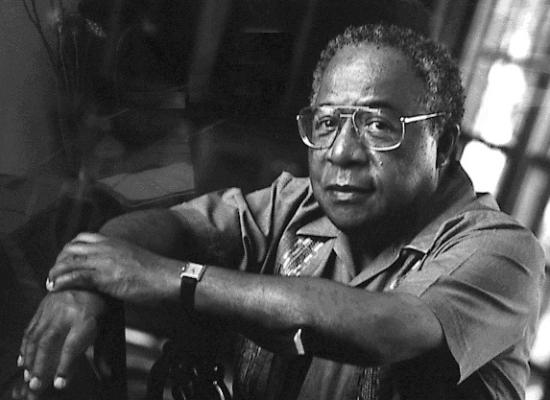
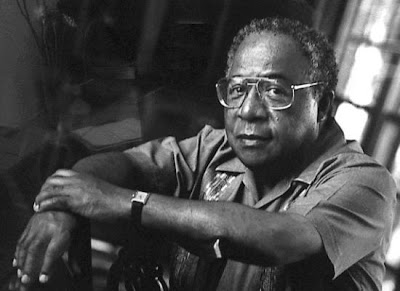
Alex Haley. Image from Gather.

A Better Day:
Remembering Alex Haley and Mario Savio

By Tony Platt | The Rag Blog | January 10, 2012

Let me drink from the waters where the mountain streams flood
Let the smell of wildflowers flow free through my blood
Let me sleep in your meadows with the green grassy leaves
Let me walk down the highway with my brother in peace
Let me die in my footsteps

Before I go down under the ground”

— Bob Dylan, “Let Me Die in My Footsteps,” 1963

In 1963 I moved from England to California, in part to get as far away as possible from my father’s overbearing influence. The political divide between us had deepened as I embraced Marxism and the New Left, while he shunned anything smacking of isms, except capitalism.

As he soured on politics, I was ready to be inspired by Mario Savio standing on a police car in Berkeley’s Sproul Plaza, urging us to put our bodies on the gears and wheels of the machine in order to make it stop; and by Malcolm X, as channeled by Alex Haley, saying it was possible for black and white to unite and fight. “In our mutual sincerity we might be able to show a road to the salvation of America’s very soul.”

My father and I, as it turns out, shared a very similar political trajectory: unrealistic optimism followed by pessimistic realism. For Monty, the 30s promised global socialism. For me, the 60s was a vibrant and hopeful era, with socialism spreading throughout the world, social democracy coming to the West, and colonialism on the run in the Third World.

The collapse of utopian dreams is always rupturing, and always unexpected. The rise and fall of Alex Haley, and the spirit and untimely death of Mario Savio epitomize for me the hope and demise of the New Left.

Alex Haley was an unlikely hero. Without any formal training in history, not even a college degree, he wrote two bestsellers that more than any other books written about the United States in the twentieth century changed the public conversation about race.

In The Autobiography of Malcolm X (1965), he made a black revolutionary into a popular, cultural icon and a model of redemption. And his book Roots: The Saga of an American Family (1976) – and, more important, the television mini-series on which it was based — are credited with generating an unprecedented black-white dialogue, as well as a compelling origins story.

Six million copies of Malcolm X were sold by 1977 and 130 million viewers watched Roots.

Haley wasn’t a particularly good historian. He lifted whole sections from another author’s book for Roots; his ties to his supposed African ancestor, Kunta Kinte, are likely fictional; and recent research on Malcolm X has blown huge holes in Haley’s hagiography. But he was a hell of a good storyteller and the stories he told resonated with millions of people.

I got a sense of his rock-star popularity in 1989 when he visited Sacramento State University, where I was teaching at the time. Nobody seemed to care about his oddly Republican politics, or the plagiarism charges, or sloppy scholarship. “You are the answer to the prayer of our ancestors who hoped during uncertain, terrible times that there would be a better day,” was his upbeat message spoken to a large, mostly youthful crowd on a crisp, fall day.

He seemed to look each of us directly in the eye, urging us to find common ground, telling us what we had come to hear. He was on the road, giving his stump speech, the talk that he had delivered so many times since Roots that the only notes he needed were the ones reminding him where he was and to whom he was speaking.

Some of my friends were disappointed because they expected something new or different. But most people there wanted to hear the familiar speech, delivered in his unpretentious style, a message of reassurance and comfort. He told us the story about how he came to write Roots. Like all good folk tales, we wanted to hear the ending that we already knew.

Although Haley’s speech seemed to ramble from anecdote to anecdote, it was in fact finely honed and crafted, a mosaic of disparate threads. Constructed around a narrative that traced his life from childhood to the present, his story was crammed full of moral lessons, biographies, autobiography, motherwit, and parables.

Haley’s message was relentless: a people whose voice has been long silenced and whose vision has been long hidden from history in fact possess a wondrous past that can’t be denied. The crowd listened closely, imagining the untold stories of our individual pasts and the unexplored potentiality of our collective futures. And in case we missed the point, the motif on his stationary proclaims: “Find The Good – And Praise It.”

Haley’s stories moved easily between experience and imagination, a talent that upset critics who prefer writers to come packaged in appropriate boxes — fictional or non-fictional. By this time, Haley probably wasn’t sure which was which. In Roots, he invented dialogue. Malcolm X wanted Haley to serve as his recorder and clean up his grammar, but Haley engaged his subject in a passionate dialogue that resulted in a memorable book of many voices.

Haley left the Coast Guard in 1959 after a 21-year enlistment. He was 38 years old, searching for a new career. He was an outsider to academia — he had quit college after two unsuccessful years, despite the advice of his professorial father — and regarded as an interloper by the Negro literati who, with one notable exception, had no time for a writer who had learned his craft writing love letters for illiterate sailors and public relations pieces for Uncle Sam.

When C. Eric Lincoln, a fellow writer and authority on black Muslims, proposed Haley’s membership in an African American academic group in the early 1960s, years before he became a celebrity, he was voted down because he lacked proper credentials. In response to his inquiry to leading black writers, asking for their advice about how to make it as a freelance journalist, James Baldwin, fresh from his success with Go Tell It On The Mountain and Notes of a Native Son, was the only who took time to see Haley and give him tips about how to survive in New York’s cutthroat literary circles.

Years later, the tables were turned: Haley’s books were selling in the millions and Baldwin was struggling to survive, economically and physically. When Baldwin called, asking for advice and a “loan,” Haley quickly wrote him the first of many checks, “never more than just a few thousand.” Haley told me that he would never forget the “thin-as-a-willow-reed” writer whose generosity defied the snobbish intellectuals who had turned their backs on a struggling writer without status. Later, when Roots made Haley a rich man, he turned over the royalties of The Autobiography to Malcolm X’s widow, Betty Shabazz.

Though he got paid well to visit Sacramento State for half a day, there was no show-biz glamour or phalanx of security guards. He walked slowly through the campus, portly and easy-going, stopping to greet the constant stream of admirers who let out squeals usually reserved for movie stars. They came up asking for autographs or to shake his hand, but quickly found themselves answering his questions about their roots.

Still, he was never really comfortable in the public spotlight or around intellectuals. He preferred writing about legends than being one. And so every year, once in the summer and once in the winter for two months at a time, he would retreat to the “fruitful writing isolation of a cargo ship,” crisscrossing the Atlantic and Pacific just as he had done in the Coast Guard.

“It is my impression,” Haley wrote to me during a slow trip to Australia, “that academia contains some of the more grudging folk in this world. With no respect whatever to the institution of academia, I counted one of my luckier things that I did not become a scholar, as my professor father very strongly intended. In fact, there were three sons of us for whom he had this intention, and we turned out to be writer, lawyer, and architect. Dad, bless his heart, was still nonetheless proud of us.”

When Haley finished his talk in Sacramento and the audience rose to give him a standing ovation, I realized that this was the first time I had ever been part of a truly multicultural audience on campus. For a brief moment, the university actually reflected the diversity of our community.

Hundreds of black high school kids, most of whom will never make it to any university under our current system, had come to witness the rare spectacle of an African American as an American hero. They were loud and boisterous during Haley’s speech and, after it was over, they had a purposeful gleam in their eyes, a renewed determination to envision a better day.
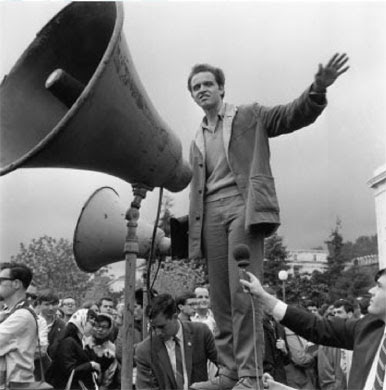
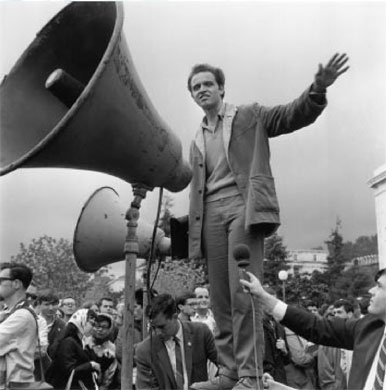
Mario Savio on the steps of Sproul Hall, Berkeley, December 2, 1964. Image from WSU Libraries.

Alex Haley’s ability to reach and move a crowd reminded me of the time that 22-year-old Mario Savio reached and moved me. I was in my second year as a graduate student in Berkeley in 1964 when Savio, in protest of the university’s ban on political speech, told a campus crowd on December 2nd that “there’s a time when the operation of the machine becomes so odious — makes you so sick at heart — that you can’t take part.” Drawing upon imagery from Thoreau, he called upon to us practice civil disobedience and to jam the gears of the machine.

That day, Savio and 800 others were arrested in Sproul Plaza. I supported the Free Speech Movement, but avoided arrest then since I was nervous about my immigration status. (About a decade later, I’d make amends by getting arrested twice during People’s Park protests at the same site.)

The FSM was a defining moment for activism in the 1960s and for my own political development. Poised between the civil rights struggles of the previous decade and the promise of the antiwar and feminist movements ahead, it offered our generation of students the opportunity to participate in history, to be activists in our own right rather than vicarious participants in other people’s struggles.

It was a joy to feel that we might be part of an emergent majority, with the moral authority of justice on our side for once. Savio was not the only leader of the student movement, but his example of self-sacrifice moved many people like myself to deeply consider our political commitments and to put our beliefs into practice. Also, it helped that we were on the winning side: the university revoked its ban on political speech.

Thirty years later, in 1994, I was back in Sproul Plaza for the Free Speech Movement’s reunion. In the intervening years, my political activism cost me my job at Berkeley, but I was lucky to get a tenure-track job at Sacramento State. Mario had not been as lucky. It took him until 1984 to get a science degree and until 1989 to get his master’s degree.

He was nearly 50 years old when he started teaching math and philosophy as a lecturer at Sonoma State University. By then the boom years in academia were over and part-time jobs were the norm.

There was a large crowd on hand at the reunion, including a new generation of activists who were eager to witness a slice of history and hear old-timers justify our pasts. Mario Savio — now graying, balding, and pony-tailed, like many of us in the crowd — spoke with vigor and eloquence about our legacy, likening us in the words of T.S. Eliot to “the hidden laughter of children in the foliage.” There we had been, in the margins and shadows of political power, but still alive and kicking, “sudden in a shaft of sunlight even while the dust moves.”

Mario was not there that December day in 1994 to sentimentalize or bury our movement. If it had been hard on him to live with fame and notoriety in the aftermath of the 1960s, it was even harder to be treated in the 1990s as an icon of a long-gone past. He insistently spoke to the present, of the growing boldness of an increasingly reactionary political system, attacks on immigrant and women’s rights, and the rollback of civil rights gains. Be vigilant, don’t mourn, and get organized, he told us.

A few months later, Mario and I worked together in the Campus Coalitions for Human Rights and Social Justice, a loose-knit organization of campus activists in northern California. Our challenge, no less, was to go against the tide of immigrant bashing, prison building, and welfare cutting. In particular, we focused our efforts on opposing the so-called California Civil Rights Initiative, which as Proposition 209 on the 1996 ballot asked voters to go beyond even the most conservative Supreme Court decisions to end all forms of state-supported affirmative action.

It was an uphill battle. Mario had been more hopeful than most of us that the attack on affirmative action would generate a political revival by combining youthful idealism with wise experience, creating the basis for a new, vibrant, cross-generational movement. Pity he didn’t live to see the rise of the Occupy movement; he would have been out there on the front lines.

It was difficult for him to accept the degree to which universities had by the 1990s become sites of demobilization and cynicism. When his health, already a problem for many years, got worse, his friends urged him to slow down and take it easy, which, for a short while, he did. “Obviously I needed to pull back,” he wrote me in May of 1996. “In the past I have not had the good sense to read my own signals right. Guess I’m growing up — at last, and just in time!”

But, quickly, he was back in the fray, compelled by the news that the anti-affirmative action forces were in disarray and that, with enough effort and work, we had a chance to defeat Proposition 209. Mario worked with his son Nadav day and night to produce a pamphlet, “In Defense of Affirmative Action,” which was used widely on campuses in the last few weeks of the campaign. It helped to close the gap in the polls, but with insufficient money, the damning of faint support by the National Democratic Party, and a low voter turnout, our anti-209 campaign failed by eight points.

Mario suffered a heart attack and went into a coma a few days before the elections, and died the day after without regaining consciousness. He left life as he lived it, intensely committed and passionate in his public politics, gracious in private to his friends. I miss his shaft of sunlight.

  • Alex Haley (1921-1992)
  • Mario Savio (1942-1996)

[Tony Platt is the author of 10 books and 150 essays and articles dealing with issues of race, inequality, and social justice in American history. He has written for the Los Angeles Times, San Francisco Chronicle, Truthdig, History News Network, Z Magazine, Monthly Review, and the Guardian. Platt, now an emeritus professor living in Berkeley, California, taught at the University of Chicago, University of California (Berkeley), and California State University (Sacramento). This article was also posted to his blog, GoodToGo. Read more articles by Tony Platt on The Rag Blog.]

The Rag Blog

Posted in RagBlog | Leave a comment

Alex Haley. Image from Gather.

A Better Day:
Remembering Alex Haley and Mario Savio

By Tony Platt | The Rag Blog | January 10, 2012

Let me drink from the waters
where the mountain streams flood
Let the smell of wildflowers
flow free through my blood
Let me sleep in your meadows
with the green grassy leaves
Let me walk down the highway
with my brother in peace
Let me die in my footsteps

Before I go down under the ground

— Bob Dylan, “Let Me Die in My Footsteps,” 1963

In 1963 I moved from England to California, in part to get as far away as possible from my father’s overbearing influence. The political divide between us had deepened as I embraced Marxism and the New Left, while he shunned anything smacking of isms, except capitalism.

As he soured on politics, I was ready to be inspired by Mario Savio standing on a police car in Berkeley’s Sproul Plaza, urging us to put our bodies on the gears and wheels of the machine in order to make it stop; and by Malcolm X, as channeled by Alex Haley, saying it was possible for black and white to unite and fight. “In our mutual sincerity we might be able to show a road to the salvation of America’s very soul.”

My father and I, as it turns out, shared a very similar political trajectory: unrealistic optimism followed by pessimistic realism. For Monty, the 30s promised global socialism. For me, the 60s was a vibrant and hopeful era, with socialism spreading throughout the world, social democracy coming to the West, and colonialism on the run in the Third World.

The collapse of utopian dreams is always rupturing, and always unexpected. The rise and fall of Alex Haley, and the spirit and untimely death of Mario Savio epitomize for me the hope and demise of the New Left.

Alex Haley was an unlikely hero. Without any formal training in history, not even a college degree, he wrote two bestsellers that more than any other books written about the United States in the twentieth century changed the public conversation about race.

In The Autobiography of Malcolm X (1965), he made a black revolutionary into a popular, cultural icon and a model of redemption. And his book Roots: The Saga of an American Family (1976) – and, more important, the television mini-series on which it was based — are credited with generating an unprecedented black-white dialogue, as well as a compelling origins story.

Six million copies of Malcolm X were sold by 1977 and 130 million viewers watched Roots.

Haley wasn’t a particularly good historian. He lifted whole sections from another author’s book for Roots; his ties to his supposed African ancestor, Kunta Kinte, are likely fictional; and recent research on Malcolm X has blown huge holes in Haley’s hagiography. But he was a hell of a good storyteller and the stories he told resonated with millions of people.

I got a sense of his rock-star popularity in 1989 when he visited Sacramento State University, where I was teaching at the time. Nobody seemed to care about his oddly Republican politics, or the plagiarism charges, or sloppy scholarship. “You are the answer to the prayer of our ancestors who hoped during uncertain, terrible times that there would be a better day,” was his upbeat message spoken to a large, mostly youthful crowd on a crisp, fall day.

He seemed to look each of us directly in the eye, urging us to find common ground, telling us what we had come to hear. He was on the road, giving his stump speech, the talk that he had delivered so many times since Roots that the only notes he needed were the ones reminding him where he was and to whom he was speaking.

Some of my friends were disappointed because they expected something new or different. But most people there wanted to hear the familiar speech, delivered in his unpretentious style, a message of reassurance and comfort. He told us the story about how he came to write Roots. Like all good folk tales, we wanted to hear the ending that we already knew.

Although Haley’s speech seemed to ramble from anecdote to anecdote, it was in fact finely honed and crafted, a mosaic of disparate threads. Constructed around a narrative that traced his life from childhood to the present, his story was crammed full of moral lessons, biographies, autobiography, motherwit, and parables.

Haley’s message was relentless: a people whose voice has been long silenced and whose vision has been long hidden from history in fact possess a wondrous past that can’t be denied. The crowd listened closely, imagining the untold stories of our individual pasts and the unexplored potentiality of our collective futures. And in case we missed the point, the motif on his stationary proclaims: “Find The Good – And Praise It.”

Haley’s stories moved easily between experience and imagination, a talent that upset critics who prefer writers to come packaged in appropriate boxes — fictional or non-fictional. By this time, Haley probably wasn’t sure which was which. In Roots, he invented dialogue. Malcolm X wanted Haley to serve as his recorder and clean up his grammar, but Haley engaged his subject in a passionate dialogue that resulted in a memorable book of many voices.

Haley left the Coast Guard in 1959 after a 21-year enlistment. He was 38 years old, searching for a new career. He was an outsider to academia — he had quit college after two unsuccessful years, despite the advice of his professorial father — and regarded as an interloper by the Negro literati who, with one notable exception, had no time for a writer who had learned his craft writing love letters for illiterate sailors and public relations pieces for Uncle Sam.

When C. Eric Lincoln, a fellow writer and authority on black Muslims, proposed Haley’s membership in an African American academic group in the early 1960s, years before he became a celebrity, he was voted down because he lacked proper credentials. In response to his inquiry to leading black writers, asking for their advice about how to make it as a freelance journalist, James Baldwin, fresh from his success with Go Tell It On The Mountain and Notes of a Native Son, was the only who took time to see Haley and give him tips about how to survive in New York’s cutthroat literary circles.

Years later, the tables were turned: Haley’s books were selling in the millions and Baldwin was struggling to survive, economically and physically. When Baldwin called, asking for advice and a “loan,” Haley quickly wrote him the first of many checks, “never more than just a few thousand.” Haley told me that he would never forget the “thin-as-a-willow-reed” writer whose generosity defied the snobbish intellectuals who had turned their backs on a struggling writer without status. Later, when Roots made Haley a rich man, he turned over the royalties of The Autobiography to Malcolm X’s widow, Betty Shabazz.

Though he got paid well to visit Sacramento State for half a day, there was no show-biz glamour or phalanx of security guards. He walked slowly through the campus, portly and easy-going, stopping to greet the constant stream of admirers who let out squeals usually reserved for movie stars. They came up asking for autographs or to shake his hand, but quickly found themselves answering his questions about their roots.

Still, he was never really comfortable in the public spotlight or around intellectuals. He preferred writing about legends than being one. And so every year, once in the summer and once in the winter for two months at a time, he would retreat to the “fruitful writing isolation of a cargo ship,” crisscrossing the Atlantic and Pacific just as he had done in the Coast Guard.

“It is my impression,” Haley wrote to me during a slow trip to Australia, “that academia contains some of the more grudging folk in this world. With no respect whatever to the institution of academia, I counted one of my luckier things that I did not become a scholar, as my professor father very strongly intended. In fact, there were three sons of us for whom he had this intention, and we turned out to be writer, lawyer, and architect. Dad, bless his heart, was still nonetheless proud of us.”

When Haley finished his talk in Sacramento and the audience rose to give him a standing ovation, I realized that this was the first time I had ever been part of a truly multicultural audience on campus. For a brief moment, the university actually reflected the diversity of our community.

Hundreds of black high school kids, most of whom will never make it to any university under our current system, had come to witness the rare spectacle of an African American as an American hero. They were loud and boisterous during Haley’s speech and, after it was over, they had a purposeful gleam in their eyes, a renewed determination to envision a better day.

Mario Savio on the steps of Sproul Hall, Berkeley, December 2, 1964. Image from WSU Libraries.

Alex Haley’s ability to reach and move a crowd reminded me of the time that 22-year-old Mario Savio reached and moved me. I was in my second year as a graduate student in Berkeley in 1964 when Savio, in protest of the university’s ban on political speech, told a campus crowd on December 2nd that “there’s a time when the operation of the machine becomes so odious — makes you so sick at heart — that you can’t take part.” Drawing upon imagery from Thoreau, he called upon to us practice civil disobedience and to jam the gears of the machine.

That day, Savio and 800 others were arrested in Sproul Plaza. I supported the Free Speech Movement, but avoided arrest then since I was nervous about my immigration status. (About a decade later, I’d make amends by getting arrested twice during People’s Park protests at the same site.)

The FSM was a defining moment for activism in the 1960s and for my own political development. Poised between the civil rights struggles of the previous decade and the promise of the antiwar and feminist movements ahead, it offered our generation of students the opportunity to participate in history, to be activists in our own right rather than vicarious participants in other people’s struggles.

It was a joy to feel that we might be part of an emergent majority, with the moral authority of justice on our side for once. Savio was not the only leader of the student movement, but his example of self-sacrifice moved many people like myself to deeply consider our political commitments and to put our beliefs into practice. Also, it helped that we were on the winning side: the university revoked its ban on political speech.

Thirty years later, in 1994, I was back in Sproul Plaza for the Free Speech Movement’s reunion. In the intervening years, my political activism cost me my job at Berkeley, but I was lucky to get a tenure-track job at Sacramento State. Mario had not been as lucky. It took him until 1984 to get a science degree and until 1989 to get his master’s degree.

He was nearly 50 years old when he started teaching math and philosophy as a lecturer at Sonoma State University. By then the boom years in academia were over and part-time jobs were the norm.

There was a large crowd on hand at the reunion, including a new generation of activists who were eager to witness a slice of history and hear old-timers justify our pasts. Mario Savio — now graying, balding, and pony-tailed, like many of us in the crowd — spoke with vigor and eloquence about our legacy, likening us in the words of T.S. Eliot to “the hidden laughter of children in the foliage.” There we had been, in the margins and shadows of political power, but still alive and kicking, “sudden in a shaft of sunlight even while the dust moves.”

Mario was not there that December day in 1994 to sentimentalize or bury our movement. If it had been hard on him to live with fame and notoriety in the aftermath of the 1960s, it was even harder to be treated in the 1990s as an icon of a long-gone past. He insistently spoke to the present, of the growing boldness of an increasingly reactionary political system, attacks on immigrant and women’s rights, and the rollback of civil rights gains. Be vigilant, don’t mourn, and get organized, he told us.

A few months later, Mario and I worked together in the Campus Coalitions for Human Rights and Social Justice, a loose-knit organization of campus activists in northern California. Our challenge, no less, was to go against the tide of immigrant bashing, prison building, and welfare cutting. In particular, we focused our efforts on opposing the so-called California Civil Rights Initiative, which as Proposition 209 on the 1996 ballot asked voters to go beyond even the most conservative Supreme Court decisions to end all forms of state-supported affirmative action.

It was an uphill battle. Mario had been more hopeful than most of us that the attack on affirmative action would generate a political revival by combining youthful idealism with wise experience, creating the basis for a new, vibrant, cross-generational movement. Pity he didn’t live to see the rise of the Occupy movement; he would have been out there on the front lines.

It was difficult for him to accept the degree to which universities had by the 1990s become sites of demobilization and cynicism. When his health, already a problem for many years, got worse, his friends urged him to slow down and take it easy, which, for a short while, he did. “Obviously I needed to pull back,” he wrote me in May of 1996. “In the past I have not had the good sense to read my own signals right. Guess I’m growing up — at last, and just in time!”

But, quickly, he was back in the fray, compelled by the news that the anti-affirmative action forces were in disarray and that, with enough effort and work, we had a chance to defeat Proposition 209. Mario worked with his son Nadav day and night to produce a pamphlet, “In Defense of Affirmative Action,” which was used widely on campuses in the last few weeks of the campaign. It helped to close the gap in the polls, but with insufficient money, the damning of faint support by the National Democratic Party, and a low voter turnout, our anti-209 campaign failed by eight points.

Mario suffered a heart attack and went into a coma a few days before the elections, and died the day after without regaining consciousness. He left life as he lived it, intensely committed and passionate in his public politics, gracious in private to his friends. I miss his shaft of sunlight.

  • Alex Haley (1921-1992)
  • Mario Savio (1942-1996)

[Tony Platt is the author of 10 books and 150 essays and articles dealing with issues of race, inequality, and social justice in American history. He has written for the Los Angeles Times, San Francisco Chronicle, Truthdig, History News Network, Z Magazine, Monthly Review, and the Guardian. Platt, now an emeritus professor living in Berkeley, California, taught at the University of Chicago, University of California (Berkeley), and California State University (Sacramento). This article was also posted to his blog, GoodToGo. Read more articles by Tony Platt on The Rag Blog.]

The Rag Blog

Posted in RagBlog | Leave a comment

Carl Gibson : Grow Up, Ron Paul

Running away from home. Image from goodbuddies inc.

Grow up, Ron Paul

Ron Paul’s right-libertarian ideology does espouse a new kind of freedom, just as rebellious children who fantasize about running away from home dream of a new kind of freedom.

By Carl Gibson / Reader Supported News / January 9, 2012

Like most other little kids, all I wanted to do was eat junk food, play video games, and goof around with my friends. I didn’t like being made to go to school, going to bed at 9 p.m., eating vegetables, doing homework after school, or taking out the garbage. And like most other little kids who don’t like abiding by the rules of their parents, I sometimes fantasized about what it would be like to run away from home.

But when I packed my backpack full of clothes and individually-wrapped packs of peanut butter crackers from the pantry, I could never go through with my plan. I knew if I ran away I’d be hungry, cold, lost, and eventually found by the police and returned home.

Libertarian views of government regulation are very similar to how six-year-olds view the authority exerted by their parents. Ron Paul’s every-individual-for-themselves rhetoric appeals to young, radical libertarians with simplistic views of authority and an ignorance about why government exists in the first place.

In Ron Paul’s ideal America, safety regulations imposed on employers by the Occupational Safety and Health Administration would be a thing of the past. Clean air and water regulations imposed by the Environmental Protection Agency would be no more.

Taxpayers would save money, since Ron Paul would abolish the Department of Education and cut the Food and Drug Administration’s budget by 40%. Employers would save money by paying workers as little as they wish, since Ron Paul would abolish the Davis-Bacon Act.

Corporate giants would be free to monopolize markets, since Ron Paul opposes federal anti-trust legislation. And employees would no longer be required to pay into Social Security.

So what would this libertarian utopia look like, if Ron Paul were elected and followed through on his campaign promises?

  • Families grieving for loved ones lost due to Massey Energy’s negligence in the Upper Big Branch coal mine explosion would have to accept that their relatives were casualties of the invisible hand of the unfettered free market. And Massey would get off scot-free for polluting Martin County, Kentucky’s drinking water supply with 300 million gallons of coal slurry.
  • Millions of college students dependent on Pell grants would be forced to move back home and work minimum-wage jobs, no longer financially able to further their education. Oh wait — what minimum wage?
  • Food recalls would be a regular occurrence when tainted meat and vegetables hit supermarket shelves, causing record outbreaks of e-coli. And risky new drugs would avoid FDA tests and hit the express lane to the pharmacy, endangering the health of millions.
  • Too-big-to-fail banks like Wells Fargo, Citi, Chas, and Bank of America would be allowed to merge and/or buy out their competitors, as would oil giants like ExxonMobil and Chevron, and cellphone service-providers like AT&T and Verizon.
  • The Social Security trust fund would become insolvent, making retirement that much harder for those who paid into it all their lives.

Ron Paul’s right-libertarian ideology does espouse a new kind of freedom, just as rebellious children who fantasize about running away from home dream of a new kind of freedom. But, as much as we may have rebelled against our parents as little kids, we eventually matured and realized that the rules and regulations our parents imposed on us were meant so we’d grow up to be responsible, functioning adults in society.

An unregulated little kid free to eat junk food and play video games all day won’t ever learn the responsibilities of adulthood. And an unregulated society where all individuals are out for themselves will quickly collapse.

[Carl Gibson, 24, of Lexington, Kentucky, is a spokesman and organizer for US Uncut, a nonviolent, creative direct-action movement to stop budget cuts by getting corporations to pay their fair share of taxes. Since its founding in February 2011, over 20,000 US Uncut activists have carried out more than 300 actions in over 100 cities nationwide. You may contact Carl at carl@rsnorg.org . This article was published at and distributed by Reader Supported News.]

The Rag Blog

Posted in RagBlog | Tagged , , , | 3 Comments

Ted McLaughlin : Are We Marching to War With Iran?

Dogs of war. Graphic from Press TV.

Dogs are barking:
Are we marching to war with Iran?

By Ted McLaughlin / The Rag Blog / January 9, 2012

The animosity between the United States and Iran has a longer history than most Americans realize. Before 1950, most of the oil assets of that country were owned by Western powers (mainly the United Kingdom and the United States).

The countries paid the Shah (King) of Iran for the right to take Iran’s oil, but most of those funds went into the Shah’s many bank accounts and very little was ever actually used for the benefit of the people of Iran. That changed for a short while in 1951.

It was in that year that the Iranian Majlis (parliament) put a socialist prime minister in power, Mohammad Mossadegh. Mossadegh nationalized the country’s oil and proposed using oil revenues to help the people of Iran. This created a power struggle between the Shah and Mossadegh, and the Shah fled the country. This angered the United States (and United Kingdom). How dare these people try to own and control their own resources, and interfere with the profits of Western oil companies!

In 1953, the American CIA overthrew Prime Minister Mossadegh, and reinstalled the Shah as the absolute ruler of Iran. The Shah (Mohammed Reza Pahlavi) then ruled as an even more brutal dictator, using his SAVAK (secret police) to take care of any political opponents. He was able to retain his power for over 20 years, but was hated by the people and viewed as a puppet of the United States.

In the late seventies, the people rose up against the Shah. They were led by Muslim clerics, especially Ayatollah Ruhollah Khomeini, and in early 1979 they seized power and the Shah fled the country. An elected government was set up, but most real power lay with the religious leaders (and still does).

This new government was understandably anti-American, since it was the United States that had overthrown their elected government and put the Shah back on the throne (and then supported him until his overthrow).

This anger at America resulted in the destruction of the American embassy and the taking of embassy employees as hostages. This was a ridiculous and unnecessary action, and is still used by the U.S. to convince others the government in Iran cannot be trusted. The employees were eventually released in January of 1981, but the stage had been set for the current bad relations between the two countries.

And since 1981 the tension between Iran and the United States has only grown worse — and neither seems ready to institute talks to restore diplomatic relations and lessen that tension. The latest charge from the United States is that Iran is building a nuclear weapon. There is no evidence of this, but it has not stopped politicians from making the accusations and the American media from reporting the same.

While it is true that Iran is developing nuclear power plants to supply energy to its people, and is purifying its own uranium (since sanctions have cut off their ability to buy it from other countries), there is no evidence at all that they have started to develop a military application for this nuclear power or have attempted to build a bomb.

Even the International Atomic Energy Agency admits this is true. All they have said is that the Iranians might soon have the capability to do that — not that they are doing it or will do it in the future. The idea that Iran is building a nuclear weapon resides only in the fevered imaginations of fear-mongering politicians.

But the United States and other countries have used this fear to attack Iran with sanctions, the most recent of which were just imposed. The latest sanctions say any country or company that does business with Iran cannot have access to the financial services of the United States.

The Iranians see this as an attempt to choke off the sale of their oil, upon which they depend. And they are right — that is exactly what the U.S. is trying to do. They want to force regime change in Iran by bankrupting the country.

And the Iranians have overreacted to this move. They have now threatened to block the Strait of Hormuz, through which about 16% of the world’s oil supply flows. And they recently held naval maneuvers in that area to emphasize that point.

These actions have brought both countries to the brink of war — and neither seems willing to back down, or even discuss reducing tensions. It seems like the leaders of both countries want war, because both are escalating the rhetoric and trying to justify their own positions.

The crazy thing about this is that neither country can afford a war. It would take the United States only a couple of weeks to use their air power to destroy Iran’s infrastructure. But although the U.S. could seriously damage Iran, it could not win by air attacks alone. And the U.S. simply doesn’t have the ground strength for another prolonged ground war (and a ground war in Iran would be even worse than what we experienced in Iraq, and are still experiencing in Afghanistan).

There are some who believe the war with Iran has already started, and there is some evidence for that view. The Iranians recently shot down a U.S. drone that had invaded Iranian airspace, and several U.S. rockets have landed in an Iranian border area, killing several people.

The United States says the rocket attacks were accidental, but how are we to know? Have the first shots in the coming war with Iran already been fired?

There is still time to back away from the brink, but it would take the people of both countries demanding a stop to the hostilities and warlike rhetoric. And so far, that is not happening. The people of Iran are convinced the U.S. wants to destroy them, and the people of the U.S. are convinced Iran is building a bomb to attack them. Truth has become a victim of fear in both countries.

I wish it wasn’t true, but I think there will be a war with Iran. And we may already be a lot closer to that war than anyone realizes.

[Ted McLaughlin also posts at jobsanger. Read more articles by Ted McLaughlin on The Rag Blog.]

The Rag Blog
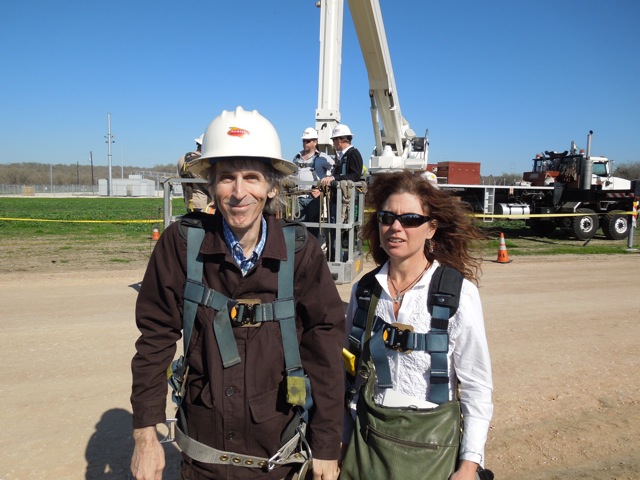
Posted in Rag Bloggers | Tagged , , , , | 3 Comments

Harry Targ : Brute Facts and Political Choices, 2012

Protesters at the State Capitol building in Madison, WI., demonstrating against Gov. Scott Walker’s anti-union legislation. Photo by Mark Hirsch / Getty Images.

Brute facts and political choices:
Thinking about 2012

By Harry Targ / The Rag Blog / January 9, 2012

The year 2011 was truly an exciting year for progressives. Arab spring sent shock waves across the Middle East, launching a campaign for democratization that will ultimately impact every regime in the region. Also Arab spring confirmed to the rest of the world, including the United States, and particularly those engaged in Occupy movements, that mass mobilization, challenging economic control and military might with people power, can affect history.

The spirit of grassroots anger, activism, a growing sense of solidarity across races, gender, class, and national boundaries, planted the seeds for the rise of a new age out of the old. As the young people in Tahrir Square knew from the beginning of their protest, the struggle will be long, sometimes bloody, but the 99 per cent, in the end, will win.

But 2011 also showed the world that politics can be ruthless. Masses of people died in Egypt, Yemen, Libya, Afghanistan, and in various locations in Africa, Europe, and North America. The United States shifted priorities from sending the military everywhere to supporting private armies and high tech drone warfare. Secret intelligence agencies now define the threats to the United States who are targeted for assassination.

Meanwhile the mass media has celebrated executions abroad and at home and the deaths of ostracized leaders. In many ways 21st century global culture has become a “death culture,” in its entertainment as well as its politics. Killing has become fun.

Within the United States, political forces have been unleashed that are trying to return politics to the Dark Ages:

  • escalating the shift in wealth and power from the many to the few
  • destroying the historic right of workers to organize to better articulate their interests
  • privatizing education, health care, and basic concern for the environment
  • transferring control of women’s bodies from themselves to various churches and private interest groups
  • increasing the power of police to control people’s lives, using pepper spray, SWAT teams, covert operations, and spying to serve the status quo
  • eliminating longstanding legal procedures that have given some protection to people, particularly minorities, who have been accused of crimes
  • using, abusing, and disposing of immigrant workers.

Protests against the regime of Muammar Gaddafi in Libya, February 2011. Image from News4Europe.

So at the dawn of the 2012 the world continues its contradictory path. And as the forces of light and darkness contend, progressives once again are confronted with political choices. As the debates escalate, particularly in the electoral arena, some of the summary data I accumulated just after the 2010 election remains relevant:

From data reported in the media between November 3rd and 10th, 2010 the new United States Senate will be comprised of 51 Democratic Senators and two Independents and 47 Republicans. The Republicans experienced their biggest gains in the House of Representatives winning 239 seats to 189 for the Democrats… The 2011 distribution of the governorships will include at least 29 Republicans and 18 Democrats. In sum, the elections brought Republican control to the House of Representatives and significant shifts in gubernatorial contests which will impact on the redistricting of House of Representative districts for the next decade.

At the state level, Republican candidates won 650 seats in legislative assemblies, taking control of 19 legislative bodies from Democrats. For example, Republicans gained both state houses in Alabama, Maine, Minnesota, New Hampshire, North Carolina, and Wisconsin. They won an additional house to take control of both houses in Colorado, Indiana, Iowa, Michigan, Montana, Ohio, and Pennsylvania.

Through gubernatorial and legislative victories at the state level Republicans will control the designation of 170 congressional districts while Democrats will control 70. The rest, about 200, will be determined by bipartisan bodies.

Republicans won three state legislatures in the Northeast, eight in the South, nine in the Midwest, and five in the West. Looking at a USA map of red and blue states, 27 states will be red in the next period.

As I write, Indiana workers are marching inside and outside the state capital protesting the backroom passage of a new right-to-work law. Indiana has not been a right-to-work state since the 1960s. In 2008, the Indiana House of Representatives consisted of 52 Democrats and 47 Republicans. Today the House has 60 Republicans and 40 Democrats.

And as a result of the 2010 election, not only is it likely that right-to-work legislation will become a reality in Indiana but education and resources for women’s reproductive health will be even more vulnerable.

There are similar stories to be told in each and every state, as well as in the national political arena. And, at the same time, there are differences in politics and history in each state and locale. And make note: none of this has much to do with the selection of nominees for president of the United States. That story is the circus, the Super Bowl — Romney or Santorum, the “moderate” Republican or the “social conservative.”

So progressives have a lot to think about in 2012: how to protect the people, the 99 percent, from all the hurt that they increasingly will experience in the short run while at the same time moving “inch by inch, row by row” to the vision that animated Arab Spring, Ohio, and Madison, Wisconsin.

[Harry Targ is a professor of political science at Purdue University who lives in West Lafayette, Indiana. He blogs at Diary of a Heartland Radical — and that’s also the name of his new book which can be found at Lulu.com. Read more of Harry Targ’s articles on The Rag Blog.]

The Rag Blog

Posted in Rag Bloggers | Tagged , , , , | Leave a comment

Chellis Glendinning : In Bolivia, ‘The Repression Strengthened Us!’

Native demonstrators march on La Paz to protest highway construction. Photo from AFP.

Letter from Bolivia:
‘The repression strengthened us!’

The ragtag band walked day and night in flip-flops, and the hearts of Bolivians went out to them…

By Chellis Glendinning | The Rag Blog | January 5, 2012

LA PAZ, Bolivia — One wrong move, forgetting to take your hat off, the interruption of a phone ringing notwithstanding, after a spell a trip to the bank to pay the light bill — alongside men carrying machine guns — does get to feel normal.

Such a transit of mind is a testimony to the human ability to adapt, yes? — and I am reminded of a tale that dear friend anthropologist Francis Huxley tells.

It was the 1950s, and he was called to transport a Native of the Brazilian Xingu tribe to Sao Paulo for emergency medical treatment. After success with that, they strolled through the streets of the city — for the Native man, the first time ever in such a scene. Upon passing a bank heavily guarded by men in military uniform, bearing epaulets, badges, and heavy black boots and carting machine guns — the man turned and asked what this strange display was all about.

Grappling for words, Francis reported that this was where the jefe kept his riches. The Native man immediately quipped, “Well! He must not be a very good jefe!”

And so it is here, just over the border from Brazil and 60 years later.

Jefe Evo Morales has — to quote one of Nicole Hollander’s “Sylvia” cartoons — “made (him)self unpopular.” To tell the truth, he already had accomplished that feat, but the Moxeño-Chimare-Yurakerés march to the capital hammered the final nail in.

On 15 August, some 700 indígenas set out to protest a Brazil-funded intra-continental superhighway the Bolivian state was erecting through their constitutionally-protected, sovereign eco-reserve, the Territorio Indígena and Parque Nacional Isibro Sécure (TIPNIS) — where the last of the planet’s gatherer-hunter cultures thrive, while flora and fauna in danger of extinction make their fragile way. The purpose of the highway: to carry petroleum from Brazil across Bolivia to Chile’s ports to be shipped to your cars in the U.S.

The ragtag band walked day and night in flip-flops, and the hearts of Bolivians went out to them in the form of a nationwide drive to send shoes, clothes, food, and medicines.

First the government blocked the road from passage, including the arrival of food and water. Then, on Sunday 25 September, the police attacked the encampment! Bursting in with tear gas, they chased down fleeing indígenas, sometimes five officers in full riot gear against a single boy in cotton shorts; with their night sticks they beat them on their backs and chests and heads; they bound their arms, legs, and mouths with silver duct tape making it almost impossible to breathe; they dragged some 300 dirigente-leaders, women, children, and ancianos to waiting trucks and hauled them away to unknown locations. It was claimed that one child died in the violence.

Riot police in La Paz. Photo from The Guardian (U.K).

By Monday morning a pall of shock had settled over Bolivia; everyone was glued to a television somewhere — and then the popular response burst forth. All over, including at the Bolivian embassy in New York where Morales was presenting at the United Nations, people took to the streets. And the venting allowed for long pent-up emotions to flow into the public vocabulary.

Ya no tiene máscara indígena”/”Morales can no longer wear his mask of so-called indigenous support,” proclaimed Native social analyst Fernando Untoja. Long-time activist Rafael Quispe trotted out the as-yet unspoken words: “dictadura”/”dictatorship.” And ex-government official Alex Contreras termed the actions “métodos del fascismo”/”methods of fascism.”

Astoundingly, one marcher was quoted in a 20 October newspaper report, “La represión nos fortaleció”/”The repression strengthened us.”

On 19 October what had started, two months before, as a march of 700 had now swelled to 3,000. After two months of treking/camping, treking/camping; after the sweltering heat of the tropics and the driving sleet of the mountains; after bearing inadequate shoes, too thin jackets, foot sores, injuries, dehydration, diarrhea, and exhaustion; after enduring disregard, insults, and arguments for disqualification spouting from the mouths of government officials: after the official withholding of water and food; and then having endured violent repression — the TIPNIS marchers rounded the last crag before the descent into the capital city.

What lay below, they say, was unexpected.

The streets of La Paz were teeming with supporters from every hamlet and municipality in Bolivia and beyond! Red flags were blowing in the wind. Green flags. Yellow flags. Wiphala flags. Workers. Taxi drivers. Housekeepers. University students. Mothers with babies. Union leaders. Theater groups. Supporting indigenous groups boasting traditional dress, flutes, and drums Former government officials who had left the MAS party. The press. International support teams.

Trumpets blared. Flutes sang. Mariachi bands blasted accordion music. Placards proclaimed: “TIPNIS=VIDA, EVO=MUERTE,” “EL TIPNIS: NO SE TOCA, CARAJO!” and “¡TIPNIS SOMOS TODOS!” People rushed to meet the marchers, hugged them, kissed them on the lips. Men and women were sobbing in the streets! Whole schools had been liberated to play a role in history, and uniformed children were waving flags, holding up their drawings of tropical flowers, and cheering.

Along the boulevards the welcomers flanked the marchers like a thick envelope of protection from potential police action; in some parts the shield extended five times thicker than the march itself.

It was the largest gathering of humanity in the history of Bolivia.

After all his grandstanding about how the state would never, ever, give in — not! the president ventured into the plaza with his phony smile — this after months of badmouthing the marchers as dupes of the imperialist state to the north, denying them a meeting, sending para-protestors out to harm them, cutting off food and water, and finally unleashing the military.

Against the very real possibility of his government going under, he gave in. No highway through TIPNIS. As we say in baseball, though, “It’s not over ‘till it’s over.” Now the government is finding ways to backpedal. But this was a major triumphant event that went unreported in the EE.UU — and I wanted you, for this moment, to bask in the heroism that our human spirit is capable of mustering.

[Chellis Glendinning is the author of five books, including When Technology Wounds, Off the Map: An Expedition Deep into Empire and the Global Economy and Chiva: A Village Takes on the Global Heroin Trade. She lives in Bolivia and may be contacted via www.chellisglendinning.org. A version of this article was published at CounterPunch. Read more of Chellis Glendinning’s writing on The Rag Blog.]

The Rag Blog

Posted in Rag Bloggers | Tagged , , , , | 1 Comment

THEATER / Jonah Raskin : Zayd Dohrn’s ‘Outside People’

Cast of Outside People at the Vineyard theater in New York. Inset photo: playwright Zayd Dohrn.

We’re all outsiders now:
Zayd Dohrn’s new play, Outside People

The play — which is part situation comedy, part soap opera, and part prophecy — plays with and deconstructs stereotypes of Americans and Chinese.

By Jonah Raskin | The Rag Blog | January 5, 2012

Zayd Dohrn’s new 90-minute drama, Outside People, doesn’t advertise any of its influences — and that’s not a criticism. Authors aren’t obligated to make disclosures to audiences about the individuals, the creative works, and the sources that impact their imaginations.

An earlier play, Reborning, that was reviewed in The Rag Blog in 2011, seemed to bear the imprint of his parents, Bernardine Dohrn and William Ayers. His newest work might have been shaped in part by the experience of his wife, Rachel Dewoskin, who lived and worked in China and appeared in a popular Chinese soap opera entitled “Foreign Babes in Beijing.”

Outside People reminded me when I saw it recently at the Vineyard theater in New York — where it’s currently on stage — of two books from the 1950s — Colin Wilson’s The Outsider and Eugene Burdick’s and William Lederer’s The Ugly American.

Dohrn’s 21st-century version of the outsider and the ugly American is named Malcolm and for most of the time that he’s on stage he’s holed up in a hotel room in Beijing, China, all dressed up in jeans and a T-shirt and with nowhere to go but back home, after he’s caused a little mayhem among the locals.

Unlike the American characters in The Ugly American, he isn’t loud and ostentatious and unlike the hero of the novel he doesn’t come to understand and appreciate the needs of the Asians he meets. Dohrn’s Malcolm is shy, quiet, neurotic, and needy in an obnoxious sort of way. He doesn’t look and see or hear and understand.

A twenty-something-year-old kid from New Jersey, he has a diploma from Stanford and a passport from the U.S. State Department that gives him political clout and makes him sexier than he’s ever believed possible. His college buddy, Da Wei, an Americanized Chinese entrepreneur, has brought him to Beijing to repay a social debt incurred while the two young men were undergraduates. It seems that once upon a time Malcolm was outgoing and hospitable.

Two women — the babes of the play — round out the compact cast. Xiao Mei is a Chinese woman from the countryside who has come to Beijing to work and hopefully escape her lot in life as the daughter of peasants. Samanya is the privileged daughter of an African diplomat from the Cameroon who speaks Chinese and feels Chinese, though she doesn’t look Chinese.

They’re all outside people in their own individual ways. Malcolm is way outside his own stomping grounds and his comfort zone. Da Wei, or David as he’s called, is an outsider in his own country after life at Stanford. Indeed, with his foul mouth and his sexual vocabulary — he tells David to stop using “pussy repellant” — he seems more American than Malcolm.

Da Wei is the connector in the group. Samanya is the spark plug who supplies much of the electrical current that keeps the drama on edge. Xiao Mei provides the sex and the sincerity, too. Malcolm offers the key line in the drama when he asks in a state of bemused innocence, “Are we all using one another?” The word “we” is crucial here. Malcolm is all about Malcolm; he’s all about me; “Do it for me,” he tells Xiao Mei when he invites her to go back to America with him.

As the play unfolds, and his layers are peeled away, it’s apparent that he’s really incapable of taking responsibility for his own actions and unable to make “I” statements all, of which makes him not only ugly but dangerous when it comes to personal relationships.

Ambiguity infuses many of Dohrn’s plays and it infuses Outside People. Xiao Mei seems innocent enough; she cries real tears and her heart seems to be broken at the end of the play, but she also appears to be using Malcolm as a stepping stone out of China and into her own version of the American Dream — whether she knows it or not.

Da Wei claims to be Malcolm’s friend, but he also tries to seduce Xiao Mei behind Malcolm’s back, and while he brings the two lovers together he also pushes them apart. If he’s meant to be emblematic of the new Chinese economy, than we’d all better watch our own backs or we’ll lose the shirts that are on them and everything else we own.

The play — which is part situation comedy, part soap opera, and part prophecy — plays with and deconstructs stereotypes of Americans and Chinese. It moves along very quickly with punchy one-liners and real sizzle. The actors — Matt Dellapina as Malcolm, Nelson Lee as Da Wei, Li Jun Li as Xiao Mei, and Sonequa Martin-Green as Samanya — are all good for 90 minutes in a play that has no intermissions.

Portions of the dialogue are in Chinese and with no translation into English. One scene between Da Wei and Xiao Mei even takes place only in Chinese. The audience becomes the outsider here and has to become the insider by listening to the tone of voice and by watching the body language and the facial expressions of the actors.

We’re all outsiders now, Dohrn seems to be saying; we’re all pushed and pulled here and there with little if any psychological or existential advantages attached to the status of the outsider. Once upon a time — back in the 1950s when Colin Wilson wrote the classic The Outsider — it was supposedly cool and hip to be an outsider.

But not now, or so Dohrn’s “Outside People” seems to suggest. Better hold on to your American passport if you don’t want to be on the outs permanently. Moreover, if you want a kind of insurance policy it might be a good idea to learn to speak Chinese and to try to feel at home in Beijing, even if you’re a long way from home.

[Jonah Raskin is the author of For The Hell of It: The Life and Times of Abbie Hoffman, and The Radical Jack London. A professor at Sonoma State University, Jonah is a regular contributor to The Rag Blog. Read more articles by Jonah Raskin on The Rag Blog.]

The Rag Blog

Posted in Rag Bloggers | Tagged , , , | Leave a comment