

CLICK ON IMAGE TO ENLARGE

The budget/deficit negotiations in Washington have recently provoked a flurry of petition initiatives from the progressive side of the debate, urging the Obama administration to “take off the table” any changes to Social Security, Medicaid, or Medicare. This, in turn, provoked a behind-the-scenes, coast-to-coast discussion among some of the regular (and irregular) contributors to The Rag Blog — by way of our email discussion group — about what’s really at stake here, and what it all means.
Thoughtful, wide-ranging, respectful, and touching on everything from how we feel in the presence of newborn babies to what makes us afraid of death — the kind of discussion that usually can’t be heard above the roar of mainstream media talking heads. We enjoyed it so much, we wanted to share some of it with you.
Thanks to The Rag Blog‘s Sarito Carol Neiman for putting it all together.
Jane: In case y’all haven’t already received this (see below) here’s something — especially for those of us who worked to get Obama elected — to do, to hopefully end his continual compromising sell-out to the opposition. Though myself not much of a FaceBooker, this is what I posted on my page: “I have never been more serious. Cutting Social Security/Medicare/Medicaid is contrary to the Democratic Platform, not to mention contrary to common sense… why should the innocent suffer at the expense of scoundrels?”
Early on in his own presidential campaign, Howard Dean first spoke of “taking our country back.” Now, Democrats are also going to have to take our party back.
Bold Progressives Petition
URGENT: The New York Times reports that President Obama is offering Republicans “substantial spending cuts, including in such social programs as Medicare and Medicaid and Social Security — programs that had been off the table.”
Will you join 100,000 others who have signed this urgent pledge, which we’ll deliver to the Obama campaign?
“President Obama: If you cut Social Security, Medicare, or Medicaid benefits for me, my family, or families like mine, don’t ask for a penny of my money or an hour of my time in 2012. I’m going to focus on electing bold progressive candidates who will fight to protect our Democratic legacy.” Click to add your name.
Jay: This is among several petitions on the proposed Social Security and Medicare cuts I’ve seen. Though we might discuss “what (else) is to be done?” for starters I’d say: ”sign two, three, many petitions!” The web addresses for what seem to be the most proactive groups working on these issues:
Janet: And why is it more important to provide health care than it is to stop causing disease?
Changing the food in the schools will do far more for the health of our people than trying to fix them once they are sick. It is proven science that environmental toxins and nutrient-free food cause almost all modern disease.
Why worry about “curing disease” (really just covering up the symptoms) and not worry about what is causing it, where Obama is leading the way?
In the sixties I supported single-payer that is not just an arm of the pharmaceutical industry. People today take medicine their whole lives and are never cured.
Val: I think we can do both. Congratulate the Obama administration for the good it does on the disease prevention level and oppose cuts to social services. The statement (accompanying the Bold Progressives petition) that cutting Social Security, Medicare, and Medicaid was something even a Republican president and congress couldn’t do is the kicker for me.
How do folks think of strategy — do we give support where it’s due, as well as opposition? If not, we have to accept lots of bad with the good — not only of Obama but of most of the Dems.
Terry: Perhaps we should quit worrying about health care and focus on death and dying:
Cost of Care at the End of Life
- Patients with chronic illness in their last two years of life account for about 32% of total Medicare spending.
Source: Dartmouth Atlas of Health Care (2005)- Medicare pays for one-third of the cost of treating cancer in the final year, and 78% of that spending occurs in the last month.
Source: HemOnc Today (2008)- One large-scale study of cancer patients found that costs were about a third less for patients who had end-of-life discussions than for those who didn’t.
Source: Archives of Internal Medicine (2009).Read more here.
Sarito: Amen, Terry! [Your post] appeared while I was still busy writing mine.
Janet’s point is a very good one — and the tip of an iceberg that only very few people have been willing or able to address. And as far as social security goes… if rich people (or even foolish ones) want to opt out of the system and turn their future retirement income over to Wall Street, I’d say let them go for it! Just don’t impose that recklessness on the entire country, don’t advertise it as the best and most intelligent thing to do, and for sure don’t let employers impose it on their employees.
And… I personally have no objection to “means testing” when it comes to Social Security, as long as the benchmarks for cutting payments are sufficiently high. I mean, if we can’t get millionaires and billionaires to pay more into the public coffers while they’re still working, then at least we can prevent them from taking money out of those coffers if they truly don’t need it when they retire.
I suspect when we adamantly insist that Medicaid and Medicare be “off the table,” we are avoiding coming to terms with the fact that what passes for our healthcare safety net is deeply, deeply flawed. The entire fee-for-services, disease-oriented, pill-happy, for-profit healthcare system in this country will continue to gobble up increasing amounts of public funds, if we “don’t touch it” — especially as the Baby Boom generation ages and makes its demands on
the system.
There are many worthy experiments happening around the country that suggest alternative approaches to delivering healthcare, and they are more cost-effective, offer better quality of care, and make both patients and doctors happier than anything an insurance company or HMO could possibly devise. These need to be highlighted and brought into the public discussion much more than the current occasional articles in the New Yorker or other serious “liberal media elite” publications.
And, as the system is set up now, for example — along with the entire culture of healthcare, in fact — if we “don’t touch it,” an overwhelming amount of Medicare money will increasingly go toward extending the lives of very ill, very old people, at huge expense in the last months of their lives especially, and in most cases with that so-called “life” confined to a hospital bed. Despite the fact that almost everybody who is asked how they would like to spend their last days would not like to spend them in a hospital hooked up to machines.
But there is a whole “long, drawn-out death industry” adamantly opposed to hospice and palliative care, so you get the “pull the plug on grandma”/“death panels” demagoguery whenever a proposal arises to make those end-of-life care options clear and available to people. Furthermore… have you noticed lately how many general practitioners (who are an essential part of any healthcare system focused on keeping people generally healthy rather than only on treating their specialized diseases) are immigrants from abroad?
That’s because other countries don’t burden their medical students with such a mountain of debt that they either have to take up an exotic specialty or sell their souls to an HMO if they are to have any hope of digging themselves out of that debt. We should give scholarships to every medical student who wants one, in exchange for a commitment to spend 4-5 years (earning a decent salary, mind you) at a community clinic or hospital.
And yes, we need to look at the whole malpractice insurance/litigious aspect of the system as well, I’d guess at least half of which is fueled not by victims of human error or tragic mistake who want to extract a pound of flesh in revenge (rather than just a simple explanation of what happened and a heartfelt apology), but by lawyers who want their hefty share of the proceeds.
It’s both complicated and really simple, it seems to me. But not in the ways we knee-jerk tend to think it is complicated or simple. Because we are still letting the insurance companies, HMOs, big pharma, and their lobbyists define the terms of the debate. So far, I haven’t seen a petition I could sign that begins to address the real issues at stake here.
Roger: Corporatized health care makes a killing through hugely inflated costs during the last few years of a person’s life, which is probably why they oppose single payer so strongly. I saw that during the last few years and months of my mother’s life and death from Alzheimer’s. Even with a “living will,” our family was stuck with high hospital bills and they would not release her until my mother was deemed by the tests to be restored enough to go home and predictably die a few weeks later.
Assisted living is a corporate racket, and the hospitals don’t know the meaning of cost-effective health care. The corporate health care system tried to prevent me from using the best Philippina care giver I can imagine my mother having, because Faye wasn’t part of the corporate system that assisted living tried to impose. They wouldn’t even allow Faye to give my mother her medicine. Compassion and kindness are not part of the care giver resume, when health care is provided through the system, but lawsuit avoidance is a top priority.
I think many people would be happier and get better treatment the last few years of their life living in some third world country, or a country with single payer system.
Janet: The truth is, Roger, that cost-effective health care is illegal. Many long-tried and well proven remedies exist, but FDA will not look at anything but pharmaceuticals or radiation or surgery.
But they go after anyone who is providing these alternative or traditional healing practices, saying they are not approved by the FDA. Of course, they can’t approve them since they won’t consider them.
Jay: We need to take stock of where we are, and where we are is in a position of weakness. The right is defining the terms of the health care debate. Their compelling interest is in “privatization” whereby both Social Security and Medicare are turned, carte blanche, over to the completely for-profit market system. If we don’t defend the advances made by FDR and LBJ, then we stand to lose the whole game. Medicaid may not exist at all.
That’s why it is so important, at this moment, to “save” Social Security and Medicare, pretty much as they are. If impending disaster can be staved off, then maybe we’ll control the terms of the debate, or at least be in a better position to advocate reforms of a progressive nature.
But first things first.
Dick: I thought the suggestion that we have to start encouraging old people to die was meant as a joke! It is not old people who should have to learn to greet death with resignation. It’s the bastards who got us into this mess!
Janet: The “death industry” is one reason Medicare needs some serious reform. I am glad they are talking about it, and hopeful that reason will enter. We got some pretty good stuff for health care in the stimulus package, notably comparative research funding, to see which treatments work best as opposed to just being better than a sugar pill, as well as putting more patient information online so that all your doctors have access to your lab reports, etc. The issues are not just right/left, but more complex.
78% of cancer money spent the last month? Surely many of those patients would be much better off if they were allowed to go home, be with their families, not be tortured by doomed “treatments.”
Terry: Dick, actually, my statement about focusing on death and dying was a double entendre. One meaning was a sort of joke against focusing on single-minded solutions like health care, organic food, exercise, or other single-issue solutions. In reality it will take all of those things and much more to reduce the cost of health care and improve health. The other meaning was more in line with Kübler-Ross’s book, On Death and Dying.
Far from “encouraging old people to die,” the reality is that we will all die, no encouragement needed. However, for some reason our “Christian” society has terrified folks of this inevitability. The fact is, on average Americans spend about 1/3 of their total life’s health care costs in the last year of life, trying to stay alive, and 75% of that in the last month, which is oxymoronic.
We do need good, clean, wholesome food, exercise, clean air, and water, as well as TLC among our families, friends, and society. But many focus on only one of the issues, and I am glad someone does focus, but to deride others’ attempts to find solutions is counterproductive. We are all in this boat together, and no one is getting out alive. The best we can hope for is to leave less of a mess than we inherited.
This goes into huge issues that books are written about. Like the anti-abortion folks that encourage women to carry serious birth-defects like cardiac malformations. The heart defects can cost upwards of $500,000 just to get the child out of the hospital alive. Then as they age, if they live to maturity, they will have the innate desire to procreate, and those defective genes then enter the human gene pool; leading to even more problems down the line.
Modern society has built a pest house of cards that cannot continue forever. I worry about my grandchildren.
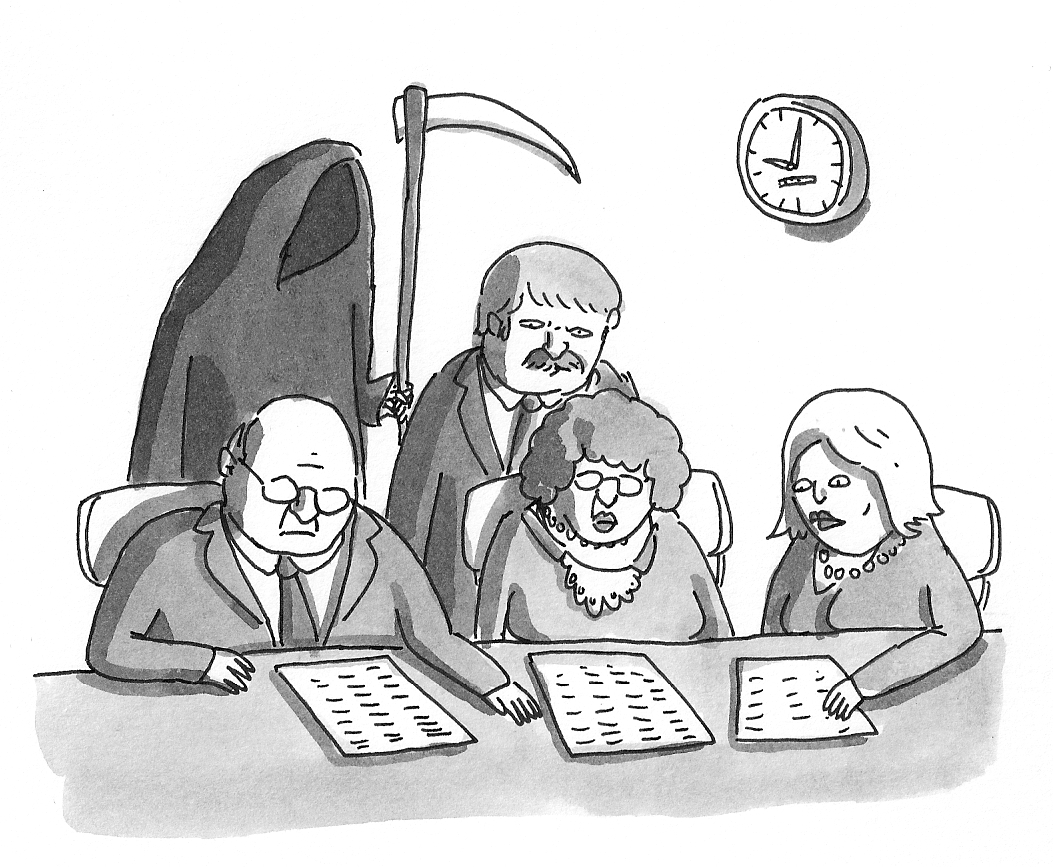
As to the destiny for our progeny, the soul of Kahlil Gibran will benevolently overlook my inability to provide the exact quotation right here, in reassurance that I embraced and will never forget the gist of his pondering why we rejoice rather than weep at the birth of a child, when its very first breath eventually leads to its last: from the moment we’re born, we’re on our way to dying.
I think we laugh and giggle over a newborn out of nervous helplessness, in awe and amazement that such a cute little creature has come into being, then will be in our care until the babe grows to adulthood, ably functioning on its own. What mortal wouldn’t feel helplessly inept in the face such a charge, even while being utterly delighted at the prospect of creating a world this precious responsibility deserves.
Nowadays, the closest I come to faking anything, is upon learning of a pregnancy. “How wonderful!” I exclaim, even though I’m secretly weeping inside, thinking, what a terrible time and place to bring forth another innocent.
Incidentally, though the discussion is very interesting, please don’t lose sight of my purpose in originally posting: My thinking is, signing the petition is a formal way of informing Obama that if he agrees to/cooperates with Social Security/Medicare/Medicaid cuts, we don’t give him our money/time/(implicitly our energy/talents). Whether he/his advisers will heed our fair warning is unknown, of course. But there were lots of us — and for sure more than just Democrats, who sweated and bled to get Obama elected… all the expensive ads in the world don’t/won’t offset that valuable effort.
My further thinking is, signing the petition does not mean we are satisfied with Social Security/Medicare/ Medicaid as it is implemented today. Certainly we want loopholes closed and waste to be identified/ceased, so funds are truly utilized to expand the good. If we had a genuine social democracy in place, we could probably handle both taking care of children knowingly brought severely disabled into the world, if that as a parental option, while also spending boucoups on the jillions of severely dying (meaning prognosis of death is more imminent), with plenty of money left over to take care of all other health needs.
Only those directly involved would have to decide how next to proceed, and the rest of us would respect and abide by their personal choices, comfortable in knowing we have the same latitudes for ourselves.
Oh, I know I have a bad case of everlasting idealism but to me it’s sooo preferable to being greedy and grabby, squealing for room at the trough, I wouldn’t dream of exchanging maladies.
Jay: There’s an intriguing, if not troubling point raised here. It may well be the case that the lion’s share of health care cost is devoted to those in their last year of life. It looks like the argument here is “these people are terrified of death” and they shouldn’t be. It’s also true, as Terry wrote, that Christianity has let a lot of folks down. But if that’s a testament to anything, isn’t it a testament to the fear death holds over many, no matter how devout they may be?
It’s one thing if big corporate health care holds fear of death over people for the sake of profits, little different than how corporate America in general wields fear as one of its major advertising weapons. That should be fought for the abomination that it is.
Many people, who actually may be on death’s doorstep, may not know they’re about to die, or cannot come to terms with that. Maybe fear of dying is irrational, but to delegitimize it is inhumane. There are also many cases where someone in their 80s has a serious, life-threatening illness, maybe even have been read the last rites, but then responds to treatment, or otherwise recovers, and lives another good five, 10, or more years.
Who are we to deny such people hope?
If we want to put health care spending on the chopping block, I’d say let it be bloated overhead and executive salaries, and the whole “for profit” health care system itself! After that, I’d speculate there’d be enough revenue to allow people to make their own decisions about treatment, care, and the end of life, in consultation with family, close friends, and medical professionals who truly have the best interest of their patients at heart. If the end of elderly people’s lives costs some money, I’d much rather pay for that than for Predator drones that end people’s lives early.
Give people honest assessments of their condition and realistic scenarios. Then, “let the people decide.” This applies to the elderly — and the dying — as much as anybody else.
Sarito: Jay, I’d not like to be misunderstood as advocating pulling the plug on grandma, or instituting death panels because of some notion that people shouldn’t be afraid of death. There is nothing “illegitimate” about the fear of death, it’s a species-survival instinct we all carry with us. But it is sad, and I would argue “inhumane” to exploit that fear — whether for profit, as in the medical system and in the advertising by corporate America in general, or for the sake of keeping the Christian faithful devout and coming into the churches.
Fear of hell and greed for heaven is what the Christian church is all about. (Not talking about poor Jesus here, I have the sense he got sold out very early on by his so-called disciples, and not just Judas.)
Yes, there’s a larger community question about how much money we are collectively willing to spend on aggressive medical interventions at the end of life. I suspect, however, that if people are given truly dignified, pain-free, and compassionate alternatives to aggressive medical treatment that (as best as they and their doctors determine) has very little chance of succeeding, they will choose that. For those that still want to fight… they certainly deserve our compassion, and as much help and support as we can give them.
A rather wise person I know has said that the opposite of love is not hate, it’s fear. I think that’s true… and that is the larger, underlying human/spiritual dilemma to be faced in dealing with the fear of death. That is way above the pay grade of any political system or “set of rules” to solve.
But ideally, yes… I would hope we find a way that every single human being can live as long as he or she needs to, to accomplish all they want to accomplish, make peace with everybody they need to make peace with, see their favorite granddaughter get married, whatever it is that they still want to do before they die. A much more worthy use of our common resources than Predator drones indeed.
Terry: I agree with most of what has been said here; however, the real problem with the USA health care system is the “for profit” corporate medicine. It basically changes the Hippocratic Oath of “First, do no harm” to “Your money or your life.” If we had a universal care or universal Medicare system, the overhead and executive salaries would pretty much be brought into line. People would also be able to deal with their physician on a one-to-one basis.
It is the corporate interjection into the system that is getting between the physician and patient. Not only do the corporate preferred provider systems (PPS) tell the patient which physicians in the PPS they can see, it also tells the physicians which diagnostic and therapeutic procedures they may use (or suffer loss of income).
I worked for 20 years with several very competent and compassionate physicians who started to retire in the late 80s and 90s because they got tired of constantly negotiating PPS contracts. I remember one particularly good physician who said, “I didn’t go into medicine to deal with lawyers all the time, and I don’t have to.” He retired before the next annual negotiation cycle, which started as soon as the last contract was signed.
As to “death and dying,” I think this will be much more difficult to change. It is a societal attitude problem. Almost no one wants to die, but we all will. The dilemma is the very last few months before death when the medical professions feel the obligation to pull out all the stops to prevent death, even though it is an impossibility. As one who went into health care 40 years ago in an attempt to recoup my karma after volunteering for Vietnam, I have observed and thought a lot about this.
Jay, you say,
Maybe fear of dying is irrational, but to delegitimize it is inhumane. There are also many cases where someone in their 80s has a serious, life-threatening illness, maybe even have been read the last rites, but then responds to treatment, or otherwise recovers, and lives another good five, 10, or more years. Who are we to deny such people hope?
This is exactly why I say the attitude toward death will be the most difficult to change. I have seen way too many people who were comatose or not competent kept alive for even a few days at great expense, and very few of the “miracle” recoveries from such illnesses at 80 years old. It is at once societal and individual.
As for me, I hope I have a Dr. Jacob “Jack” Kevorkian available when I become so infirmed I can’t wipe my own butt, or am in irreversible pain. I do not want to squander my daughter’s and granddaughters’ inheritance trying to add one month of agony to what has been an otherwise very fortunate and comfortable life.
But, then, that is me, and death is a very personal thing; others may have “hope” eternal.
Jay: Since I live in Florida, trust me, I have not forgotten the infamous Terri Schiavo case, wherein then-Gov. Jeb Bush and a howling right wing mob fought to keep the unfortunate Ms. Schiavo alive, even though she had been comatose for over 10 years and contrary to her husband’s wishes.
We are not talking about those sorts of cases here. What we are discussing is people who are still at least mildly cognizant, and can make something approaching a lucid choice about their terminal care and/or end of life decisions. Situations like that of Ms. Schiavo are a tremendously good reason why everyone should have a “living will” and why that is the basic answer to this question.
Charlie: Fear of dying. Dying is something that humans seem to fear. I am not sure that animals do. They get scared and feel pain but I don’t know enough about animals to know. I do know that from a young child I was taught that I would go to Heaven if I was good and to Hell if I was bad, all of which over the many years of going to various churches and studying various religions turns out to be a lot of hooey.
When my father died he went off to some medical school to be carved up. When my father-in-law died we had a huge battle over what kind of box he needed. I doubt that he cared. Then I cremated my mother and got this box that I have been carrying around for 20 years and don’t know exactly what to do with? I have even lost it a couple of times in the garage. My stepmother shot herself and the church people freaked out and refused to deal with it. She had sinned. She didn’t sin, she just had terminal cancer and shot herself. Again there was a huge flap among the sisters and brothers; eventually she was cremated and that urn was sent to Amarillo.
I think it is the pain of death that we fear most. If we just fell over dead we wouldn’t care much one way or the other. Didn’t the Sioux and other tribes let their old and feeble go off into the woods to expire. Maybe they gave them lots of peyote to make it a fun trip. Christians have some sort of irrational thing about getting to be dead.
Thorne: Though pain is certainly a factor, I think we primarily fear the loss of ego — loss of “self” or consciousness of self. We invest a lot in this life and the idea that it can (will) be ripped out from under us is a rather chilling concept.
Some disciplines, of course, help us to deal with the question of ego, perhaps to tame it a bit if not to totally banish it. And many belief systems tell us that life continues in some form or another. But these are things we cannot — at least intellectually — know to be true.
Bottom line, I think the fear of death derives from the (presumable) fact that life as we know it will be snuffed like a candle.
Terry: Thorne, I agree, it is mainly fear of death that society does not teach us to deal with logically. Of course, fear is the one thing that the R’s are selling right now.
By David McReynolds / The Rag Blog / July 13, 2011
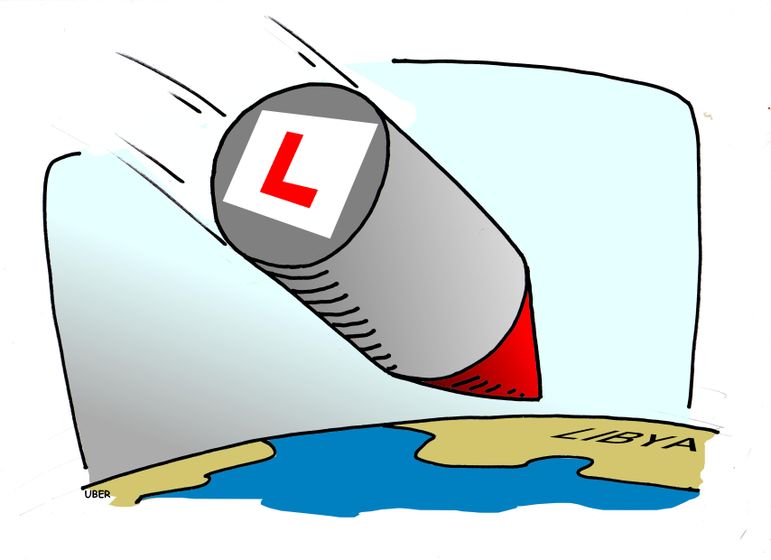
The original UN resolution, pressed for by France, Great Britain, and the U.S. (all three led by men who have never been in armed combat) was to use such force as was needed to protect the civilian population of Libya. It was explicit that the NATO operation was not designed to force a regime change — though Obama has since made it clear that in his view Gaddafi must leave.
The events in Libya are tragic because they are a civil war, not part of the North African Spring. Far more violence has been used in Syria, with no word of NATO intervention. At last report Saudi Arabia had over a thousand troops “loaned” to Bahrain, with no hint of NATO intervention. What makes Libya different? It has oil.
I’m not writing a brief for or against Gaddafi. I am saying that NATO has violated the UN Resolution, that it should cease combat, and accept any of several offers put forward by other countries for an immediate cease fire. In particular the use of air attacks in a transparent effort to murder Gadaffi are completely indefensible.
But it is NATO which I want to look at first, and this carries us back to the early days of the Cold War. There have been books written on the origins of the Cold War but we have time only for a sketch. When WW II ended in 1945, it was won, in Europe, by the extraordinary losses of life by the Soviet Union. From the Western side there was a fear of the masses of Soviet troops and tanks and the reality of the mass Communist Parties in France and Italy.
The Soviet theory, at that time, not to be revised until Khruschev became the Soviet leader, was that conflict (and by this one assumed war) between capitalism and communism was inevitable. The one ace in the hole of the West was the nuclear bomb, and the speed with which the U.S. surrounded the Soviet Union with air bases which would make possible nuclear strikes deep in Soviet territory.
From the Soviet side, their massed troops were exhausted, the lines of communication made any serious attack on the West impossible. What the Soviets did want — what would have been true of any government in Moscow, regardless of its politics — was a buffer zone between Russia and Western Europe.
Russia has no natural defenses, no oceans, no rivers, no mountains. It had suffered from the Napoleonic invasion in the 19th century and from two German invasions in the 20th century. The Soviets sought at first to gain security through getting a U.S. and British agreement to a neutral Germany, along the lines that had been worked out with Austria and Finland. But in the climate of 1948 when nerves were raw on both sides and at a time when, possibly, wiser heads on either side might have changed the course of events, the Soviets moved to take control of Czechoslovakia, bringing it into the East European Bloc.
(There was an unintended tragedy here — in the last free elections in Czechoslovakia, the Communist Party had a strong share of the vote — the Soviet moves to bring it into the Soviet Bloc was a death blow to the Communist Party of Czechoslovakia).
The same year saw the raw testing of nerves when the Soviet Union cut off the land route from West Germany into Berlin, and the West responded with the Berlin Airlift.
 Western Europe, essentially under the control of the U.S. (though a much gentler control than Eastern Europe faced from Moscow) responded to events in Czechoslovakia and the Berlin crisis by establishing the North Atlantic Treaty Organization (NATO) — a military defensive shield. That was in 1949.
The Soviets established the Warsaw Pact in 1955, several years after the founding of NATO. The Soviets had waited, still hoping for some kind of demilitarization of Germany, but this hope was ended when West German military forces were admitted to NATO in 1954.
In theory (and in the eyes of almost everyone in Europe), the two military pacts were “mutually defensive pacts.” But it was Professor Johan Galtung, a Norwegian academic (and pacifist — who served time in prison rather than doing military service) who advanced a theory I think proved more accurate.
Galtung felt that the NATO and WARSAW pacts were never intended to protect from outside forces (ie., the West realized Moscow was in no position to send forces into Western Europe, while the NATO forces knew that massive public opposition would make it untenable to invade the Warsaw Bloc). Rather, Prof. Galtung suggested, the two pacts were designed for “vertical control.”
If one goes back to that period there is a great deal of evidence of plans by the U.S., and by the military and police forces in France and Italy, to prevent even a free election of the Communist Parties in those countries, and to use NATO forces to achieve this — ie., a “vertical control”
Looking to the East the examples abound. On June 17, 1953, there was a major workers’ uprising in East Germany, put down with Soviet military forces, with at least 125 killed. In Poznan, Poland, in 1956 there were substantial working class riots, put down with Soviet forces, with something close to 200 people killed. Finally, and most dramatically, in Hungary, in October of 1956, there was a revolution which overthrew the government.
The Soviets at first agreed to withdraw and permit the formation of a new government, but then sent in troops. It is estimated that at least 700 Soviet troops and 2500 Hungarian were killed. (Matters were not helped by the fact that in October, 1956, when the world should have been focused on Hungary, Britian, France, and Israel invaded Egypt to seize control of the Suez Canal — a lesson reminding us that workers should never look to imperial powers for help at a time of need!).
It was at this moment when, if more rational minds were in control in the West, the leaders of NATO would have put through a call to Moscow saying “Look, it is obvious that the Warsaw Pact cannot possibly attack us — you can’t even control the countries in your own bloc. So we are now, unilaterally, dissolving NATO and we urge you to join us, and together see if we can work out some plans for genuine demilitarization of Europe.”
But rational minds were not in control. Even when the Soviet Union itself collapsed in a remarkable series on nonviolent revolutions, the West did not say, “Hey, we don’t need NATO anymore — the Warsaw Pact has dissolved, and our only excuse for existing dissolved with it.”
No, the “realistic” political minds in Washington, Paris, London, and Bonn began to talk of ways of finding new functions for NATO, admitting the nations that had been under Soviet control, and pushing the Western military machine closer to Russia’s borders. Part of this is the fulfillment of the sociological law that no organization goes quietly into the night.
When the March of Dimes realized it had won the fight against polio, it didn’t dissolve — why dissolve when so many people had jobs? They just found a new disease. NATO provides all kind of jobs for Generals and for ordinary bureaucrats in Brussels. To dissolve NATO might threaten the survival of Brussels itself.
And so NATO found new purposes. It deployed military forces to Afghanistan! A most remarkable deployment, since not one of the countries in NATO (with the exception of the earlier ill-fated British Mission) had ever even been to Afghanistan. A new war! A new purpose! No need for generals to find honest work! The bureaucrats at Brussels were safe!
So in this sense it is not surprising that NATO, finding itself firmly locked out of events in North Africa, not invited to play a key role in Tunisia or Egypt or Bahrain, decided it could play a role in Libya, and at least Libya had oil!
My first point has been that NATO — an organization which probably should never have been formed, and which in any case was formed entirely in relation to tensions in the middle of the 20th century — should be dissolved now. It should have been dissolved long ago. “Out of NATO” should be the slogan of every socialist and peace group in the NATO bloc.
The second point is international law, which has surfaced since the European courts issued a writ for the arrest of Gadaffi. I do not know if Gaddafi qualifies for the writ — there is much that I don’t know. But I do know that former British Prime Minister Tony Blair qualifies for such a writ, as does the former President of the United States, George Bush. I write this not because I have a special dislike for Blair or Bush, but because the force of law must carry with it some element of logic.
I am very glad that some of the surviving leaders of the Khmer Rouge are being brought to trial. But even in that case I am worried over the process by which the international courts selected who should be prosecuted. All scholars who have followed the deep tragedy of Cambodia know that both China and the United States maintained support for the Khmer Rouge long after the Vietnamese Army had driven it from the cities. Scholars of events in Indochina know that it was the CIA action in installing Lon Nol in Cambodia, which in the process, drove the King from his throne, and opened the door to the Khmer Rouge. Again, scholars know the the heavy air attacks on Cambodia, ordered by Kissinger and Nixon, gave the Khmer Rouge a legitimacy. Nixon, of course, is gone, But Henry Kissinger still makes guest appearances on TV shows. He is still a paid consultant for at least one network.
In no way am I trying to excuse the former leaders of the Khmer Rouge from their day in court — Cambodia deserves no less. I have been to Cambodia. I have seen the death pits, the skulls with the bullet holes. I want justice.
But the “trick” of international law is that if it is too obviously selective — in the case of Cambodia we have only four Cambodians on trial — we are surely mocking the dead, and in the process, using that trial to mock the law itself.
And if — with the memory of Iraq on our minds, and knowing all that we know about it, knowing all the civilians in Iraq who were killed, all our own men and women who were killed, or who bear injuries that will twist their minds to the final days — if, given those realties, we bring in a writ only against Gadaffi, does this not turn international law on its head?
Turning to Libya. To admit I do not know enough about Libya, is not to say I know nothing about it. Sheila Cooper, a friend of mine and a woman who liked secretarial work, had been secretary to Peggy Duff, also a good friend, and a leader in the British (and international) peace movement. Of Peggy, Noam Chomsky said she was “one of those heroes who is completely unknown, because she did too much… she should have won the Nobel Peace Prize about 20 times.”
When Peggy died in 1981, Sheila took a secretarial job in Libya. The pay was good and she hoped to make enough to retire. I was in touch with Sheila about Libya, she never conveyed a sense of living in a dictatorship, she chatted about the differences among the Libyans depending on what part of Libya they were from. Sheila, sadly, died of cancer before her retirement, but on the one occasion when I visited her in London, while she was on leave, she did not express any sense of horror or dismay about Libya.
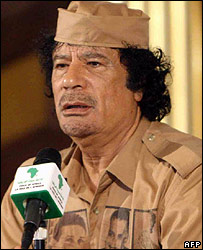 Most of us who are old enough to remember World War II know of Libya from the surge of Allied or Nazi tank battles across the desert, or from an old Humphrey Bogart film set in Libya. What we don’t know is that the Nazis, Italians, British, and American armies left vast numbers of land mines behind, but never gave the Libyans the maps which could make possible finding the mines. As a result, even when I visited Libya in 1989 there were still farmers being blown up somewhere in Libya almost every week.
Nor do most of us have any idea of the patriotic struggle of the Libyans against Italy. We may be aware that the name of Libya’s leader, Gaddafi, is spelled several different ways. The Libya we know today came into being in 1969, when Muammar Gaddafi took power in a coup, overthrowing the monarchy. But already oil had been discovered and Libya, which had not held much interest to other countries (the exception would be the U.S., which had a major air force base at Wheelus, Libya), was suddenly very much “on the map of world politics.”
(This was not the first contact the U.S. had with Libya — in fact, the first U.S. foreign military action was in 1805 in Tripoli against the “Barbary Pirates.”)
One of the first things Gaddafi did was to expel the U.S. from Wheelus — something for which I don’t think the U.S. has ever forgiven him. Libya, under Gaddafi, entered world politics in ways that are confusing. I have a good friend who thinks he is insane. Certainly, with his strange ways of dressing, it is obvious he is not your ordinary political leader. He holds no title, and while he is considered a dictator by his opponents, I think our problem is trying to find some way to think about Libya and Gaddafi — and it is hard.
Shortly after taking power he changed the name of Libya to “Jamahiriya,” an Arabic term generally translated as “state of the masses.” Gaddafi did not line up, politically, with either the Soviet Union or the Peoples Republic of China. Instead, he wrote the Green Book, of which I had a copy at one time but found close to incomprehensible and have (I think) lost it.
Remember, he was only 26 when he took power, he found himself in charge of a country which had, almost overnight, moved from being one of the poorest to being one of the most wealthy. He used that wealth to build universities, housing, medical centers. The form of government was — in theory — to be based on “direct democracy” without any political parties, governed through local popular councils named “Basic People’s Congresses.”
Clearly he had to have had considerable charisma to hold things together, and he seems to have hoped that his views, as set forth in his Green Book, would be a guide for the Third World. The best we can do in trying to translate “Jamahiriya” into English is to say it can be rendered as “Great Socialist People’s Libyan Arab Jamahirya.” And that really leaves us more confused than before!
Gaddafi’s foreign policy has been, at best, erratic. He has extended financial aid to a wide range of groups, acted as a friend to people such as Idi Amin, given aid to the Irish Republican Army, supported armed Islamic rebels in the Philippines, etc.
At some point in the early 1980’s (I don’t have exact notes) I got an invitation to a conference on Peace and Liberation to be held at Malta. I checked with my friend Sheila Cooper, and she said the Libyans had asked her for any names that she could think of — and she had sort of turned over her address book. In addition to me and Daniel Ellsberg, there was an old friend from the independent left movement in Japan, a woman from Yugoslavia, two people from the Fellowship of Reconciliation in the U.S. — perhaps two dozen in all.
My guess that Libyan money was behind it was true enough — we had to raise the air fare to get to Rome, but from there we had tickets to Malta, and our costs in Malta were covered. The one real give-away was the huge table with Gaddafi’s Green Book.
There were only about four Libyans present for the conference, they did not “guide us” to any conclusions. I was interested that there were no representatives from the World Peace Council — the Soviet Union’s front group. It was clear that this was an experiment in trying to reach out beyond the usual group. My own feeling was that the money spent on us was at least not spent on Irish terrorists.
In 1989 the Fellowship of Reconciliation sent a team, including myself, Virginia Baron, an academic — Dirk Vandewalle — and a half dozen others for a week to take a look at Libya. Having Prof. Vandewalle with us was very helpful, as he could give us what clearly Obama needs and doesn’t have — a short course in the history of Libya.
We did not meet Gaddafi, but we met with pretty much all the key people in government. But even to say that is tricky. I realize much has changed since 1989, but there were no civil associations as we would know them, no trade unions, no lawyers associations, no political parties. The question of “how” decisions were made was not clear.
None of us found the political climate oppressive. Our hosts were frank and easy in their talks with us, we visited Tripoli without any “minders,” and had a chance to see some of the real wonders of the ancient history of Tripoli. And of course we saw the home of Gaddafi, which was hit, on orders from Reagan, in revenge for Libya’s alleged involvement in a bombing in Berlin.

The only contact I had had since was indirect. Someone I’ve been in email contact with, an American, had gone to Libya recently for a job, and then when the “troubles” began early this year, she had to leave, but in her notes to me after she left she expressed no sense of horror at Gaddafi — nor any great love for the man. She said that he probably had a fair amount of popular support, wryly noting that even Nixon won two free elections.
The most painful link to Libya was the Lockerbie bombing, since two good friends of mine lost their daughter — their only child — who was on the plane when it was destroyed. There are arguments about whether the Lockerbie bombing was actually the responsibility of Libya but the fact is that Libya had been the source of funds for terrorism (or, if you look at it from the Libyan standpoint, the source of funds for various struggles for national liberation). There is also no question that Libya had, on at least one occasion, sent out hit squads to silence Libyans who had left Libya but remained openly critical of Gaddafi
One does need to remember that the late Soviet Union did the same thing, Israel has done this, and I’m afraid the U.S. has also had a hand in this miserable game.
What is interesting is that in recent years Libya seemed to have made a major change in policy, settling British claims over the Lockerebie bombing, agreeing to end any further research into nuclear or other weapons of mass destruction. It is this most recent period that I know so little about — but how strange that Gaddafi and Libya would now have moved to the top of a hit list.
Two things are clear. This is not a revolution but a Civil War. I don’t know what forces are involved among the “rebels” but how little real support they have is provided by the fact that months after the French, British, and Americans have destroyed any Libyan air force, and after the murder of one of Gaddafi sons, and repeated attacks on his various compounds, Gaddafi is still there, he has been seen in public, he has received foreign guests, and Tripoli remains in his hands.
It is not surprising that various officials have “defected” since I think any of us might consider defecting as we realized guided missiles are being sent to track down key officials. This is less an appeal to a moral reason to leave the government, than an urgent sense of survival.
The other thing which is clear is that the rebels have also killed people. In one case (documented from press reports) the rebels admitted to having killed a number of prisoners of war they had captured “because they were black and we assumed they were hired killers.”
Civil wars are very nasty things. We lost more men in our Civil War than were killed in almost all our wars combined — WW I, WW II, and the Korean War — until late in the Vietnam War the total military dead was greater. We lost those men from a much smaller population. Civil wars are not civil. This one is tragic and we should be urging the European forces to rush to the negotiating table.
Certainly the Libyan adventure is one very good reason not to leave NATO in existence — it is a weapon that has already killed many in Afghanistan and may yet kill many more in Libya.
[David McReynolds is a former chair of War Resisters International, and was the Socialist Party candidate for President in 1980 and 2000. He was recently the subject, along with Barbara Deming, of a dual biography by Martin Duberman titled A Saving Remnant. He is retired and lives with two cats on the Lower East Side of Manhattan. He posts at Edge Left and can be reached at dmcreynolds@nyc.rr.com. Read more articles by David McReynolds on The Rag Blog.]
EdgeLeft: Libya, NATO, and International Law.
By David McReynolds / The Rag Blog / July 13, 2011
The original UN resolution, pressed for by France, Great Britain, and the U.S. (all three led by men who have never been in armed combat) was to use such force as was needed to protect the civilian population of Libya. It was explicit that the NATO operation was not designed to force a regime change — though Obama has since made it clear that in his view Gaddafi must leave.
The events in Libya are tragic because they are a civil war, not part of the North African Spring. Far more violence has been used in Syria, with no word of NATO intervention. At last report Saudi Arabia had over a thousand troops “loaned” to Bahrain, with no hint of NATO intervention. What makes Libya different? It has oil.
I’m not writing a brief for or against Gaddafi. I am saying that NATO has violated the UN Resolution, that it should cease combat, and accept any of several offers put forward by other countries for an immediate cease fire. In particular the use of air attacks in a transparent effort to murder Gadaffi are completely indefensible.
But it is NATO which I want to look at first, and this carries us back to the early days of the Cold War. There have been books written on the origins of the Cold War but we have time only for a sketch. When WW II ended in 1945, it was won, in Europe, by the extraordinary losses of life by the Soviet Union. From the Western side there was a fear of the masses of Soviet troops and tanks and the reality of the mass Communist Parties in France and Italy.
The Soviet theory, at that time, not to be revised until Khruschev became the Soviet leader, was that conflict (and by this one assumed war) between capitalism and communism was inevitable. The one ace in the hole of the West was the nuclear bomb, and the speed with which the U.S. surrounded the Soviet Union with air bases which would make possible nuclear strikes deep in Soviet territory.
From the Soviet side, their massed troops were exhausted, the lines of communication made any serious attack on the West impossible. What the Soviets did want — what would have been true of any government in Moscow, regardless of its politics — was a buffer zone between Russia and Western Europe.
Russia has no natural defenses, no oceans, no rivers, no mountains. It had suffered from the Napoleonic invasion in the 19th century and from two German invasions in the 20th century. The Soviets sought at first to gain security through getting a U.S. and British agreement to a neutral Germany, along the lines that had been worked out with Austria and Finland. But in the climate of 1948 when nerves were raw on both sides and at a time when, possibly, wiser heads on either side might have changed the course of events, the Soviets moved to take control of Czechoslovakia, bringing it into the East European Bloc.
(There was an unintended tragedy here — in the last free elections in Czechoslovakia, the Communist Party had a strong share of the vote — the Soviet moves to bring it into the Soviet Bloc was a death blow to the Communist Party of Czechoslovakia).
The same year saw the raw testing of nerves when the Soviet Union cut off the land route from West Germany into Berlin, and the West responded with the Berlin Airlift.
Western Europe, essentially under the control of the U.S. (though a much gentler control than Eastern Europe faced from Moscow) responded to events in Czechoslovakia and the Berlin crisis by establishing the North Atlantic Treaty Organization (NATO) — a military defensive shield. That was in 1949.
The Soviets established the Warsaw Pact in 1955, several years after the founding of NATO. The Soviets had waited, still hoping for some kind of demilitarization of Germany, but this hope was ended when West German military forces were admitted to NATO in 1954.
In theory (and in the eyes of almost everyone in Europe), the two military pacts were “mutually defensive pacts.” But it was Professor Johan Galtung, a Norwegian academic (and pacifist — who served time in prison rather than doing military service) who advanced a theory I think proved more accurate.
Galtung felt that the NATO and WARSAW Pacts were never intended to protect from outside forces (ie., the West realized Moscow was in no position to send forces into Western Europe, while the NATO forces knew that massive public opposition would make it untenable to invade the Warsaw Bloc). Rather, Prof. Galtung suggested, the two pacts were designed for “vertical control.”
If one goes back to that period there is a great deal of evidence of plans by the U.S., and by the military and police forces in France and Italy, to prevent even a free election of the Communist Parties in those countries, and to use NATO forces to achieve this — ie., a “vertical control”
Looking to the East the examples abound. On June 17, 1953, there was a major workers’ uprising in East Germany, put down with Soviet military forces, with at least 125 killed. In Poznan, Poland, in 1956 there were substantial working class riots, put down with Soviet forces, with something close to 200 people killed. Finally, and most dramatically, in Hungary, in October of 1956, there was a revolution which overthrew the government.
The Soviets at first agreed to withdraw and permit the formation of a new government, but then sent in troops. It is estimated that at least 700 Soviet troops and 2500 Hungarian were killed. (Matters were not helped by the fact that in October, 1956, when the world should have been focused on Hungary, Britian, France, and Israel invaded Egypt to seize control of the Suez Canal — a lesson reminding us that workers should never look to imperial powers for help at a time of need!).
It was at this moment when, if more rational minds were in control in the West, the leaders of NATO would have put through a call to Moscow saying “Look, it is obvious that the Warsaw Pact cannot possibly attack us — you can’t even control the countries in your own bloc. So we are now, unilaterally, dissolving NATO and we urge you to join us, and together see if we can work out some plans for genuine demilitarization of Europe.”
But rational minds were not in control. Even when the Soviet Union itself collapsed in a remarkable series on nonviolent revolutions, the West did not say, “Hey, we don’t need NATO anymore — the Warsaw Pact has dissolved, and our only excuse for existing dissolved with it.”
No, the “realistic” political minds in Washington, Paris, London, and Bonn began to talk of ways of finding new functions for NATO, admitting the nations that had been under Soviet control, and pushing the Western military machine closer to Russia’s borders. Part of this is the fulfillment of the sociological law that no organization goes quietly into the night.
When the March of Dimes realized it had won the fight against polio, it didn’t dissolve — why dissolve when so many people had jobs? They just found a new disease. NATO provides all kind of jobs for Generals and for ordinary bureaucrats in Brussels. To dissolve NATO might threaten the survival of Brussels itself.
And so NATO found new purposes. It deployed military forces to Afghanistan! A most remarkable deployment, since not one of the countries in NATO (with the exception of the earlier ill-fated British Mission) had ever even been to Afghanistan. A new war! A new purpose! No need for generals to find honest work! The bureaucrats at Brussels were safe!
So in this sense it is not surprising that NATO, finding itself firmly locked out of events in North Africa, not invited to play a key role in Tunisia or Egypt or Bahrain, decided it could play a role in Libya, and at least Libya had oil!
My first point has been that NATO — an organization which probably should never have been formed, and which in any case was formed entirely in relation to tensions in the middle of the 20th century — should be dissolved now. It should have been dissolved long ago. “Out of NATO” should be the slogan of every socialist and peace group in the NATO bloc.
The second point is international law, which has surfaced since the European courts issued a writ for the arrest of Gadaffi. I do not know if Gaddafi qualifies for the writ — there is much that I don’t know. But I do know that former British Prime Minister Tony Blair qualifies for such a writ, as does the former President of the United States, George Bush. I write this not because I have a special dislike for Blair or Bush, but because the force of law must carry with it some element of logic.
I am very glad that some of the surviving leaders of the Khmer Rouge are being brought to trial. But even in that case I am worried over the process by which the international courts selected who should be prosecuted. All scholars who have followed the deep tragedy of Cambodia know that both China and the United States maintained support for the Khmer Rouge long after the Vietnamese Army had driven it from the cities. Scholars of events in Indochina know that it was the CIA action in installing Lon Nol in Cambodia, which in the process, drove the King from his throne, and opened the door to the Khmer Rouge. Again, scholars know the the heavy air attacks on Cambodia, ordered by Kissinger and Nixon, gave the Khmer Rouge a legitimacy. Nixon, of course, is gone, But Henry Kissinger still makes guest appearances on TV shows. He is still a paid consultant for at least one network.
In no way am I trying to excuse the former leaders of the Khmer Rouge from their day in court — Cambodia deserves no less. I have been to Cambodia. I have seen the death pits, the skulls with the bullet holes. I want justice.
But the “trick” of international law is that if it is too obviously selective — in the case of Cambodia we have only four Cambodians on trial — we are surely mocking the dead, and in the process, using that trial to mock the law itself.
And if — with the memory of Iraq on our minds, and knowing all that we know about it, knowing all the civilians in Iraq who were killed, all our own men and women who were killed, or who bear injuries that will twist their minds to the final days — if, given those realties, we bring in a writ only against Gadaffi, does this not turn international law on its head?
Turning to Libya. To admit I do not know enough about Libya, is not to say I know nothing about it. Sheila Cooper, a friend of mine and a woman who liked secretarial work, had been secretary to Peggy Duff, also a good friend, and a leader in the British (and international) peace movement. Of Peggy, Noam Chomsky said she was “one of those heroes who is completely unknown, because she did too much… she should have won the Nobel Peace Prize about 20 times.”
When Peggy died in 1981, Sheila took a secretarial job in Libya. The pay was good and she hoped to make enough to retire. I was in touch with Sheila about Libya, she never conveyed a sense of living in a dictatorship, she chatted about the differences among the Libyans depending on what part of Libya they were from. Sheila, sadly, died of cancer before her retirement, but on the one occasion when I visited her in London, while she was on leave, she did not express any sense of horror or dismay about Libya.
Most of us who are old enough to remember World War II know of Libya from the surge of Allied or Nazi tank battles across the desert, or from an old Humphrey Bogart film set in Libya. What we don’t know is that the Nazis, Italians, British, and American armies left vast numbers of land mines behind, but never gave the Libyans the maps which could make possible finding the mines. As a result, even when I visited Libya in 1989 there were still farmers being blown up somewhere in Libya almost every week.
Nor do most of us have any idea of the patriotic struggle of the Libyans against Italy. We may be aware that the name of Libya’s leader, Gaddafi, is spelled several different ways. The Libya we know today came into being in 1969, when Muammar Gaddafi took power in a coup, overthrowing the monarchy. But already oil had been discovered and Libya, which had not held much interest to other countries (the exception would be the U.S., which had a major air force base at Wheelus, Libya), was suddenly very much “on the map of world politics.”
(This was not the first contact the U.S. had with Libya — in fact, the first U.S. foreign military action was in 1805 in Tripoli against the “Barbary Pirates.”)
One of the first things Gaddafi did was to expel the U.S. from Wheelus — something for which I don’t think the U.S. has ever forgiven him. Libya, under Gaddafi, entered world politics in ways that are confusing. I have a good friend who thinks he is insane. Certainly, with his strange ways of dressing, it is obvious he is not your ordinary political leader. He holds no title, and while he is considered a dictator by his opponents, I think our problem is trying to find some way to think about Libya and Gaddafi — and it is hard.
Shortly after taking power he changed the name of Libya to “Jamahiriya,” an Arabic term generally translated as “state of the masses.” Gaddafi did not line up, politically, with either the Soviet Union or the Peoples Republic of China. Instead, he wrote the Green Book, of which I had a copy at one time but found close to incomprehensible and have (I think) lost it.
Remember, he was only 26 when he took power, he found himself in charge of a country which had, almost overnight, moved from being one of the poorest to being one of the most wealthy. He used that wealth of build universities, housing, medical centers. The form of government was — in theory — to be based on “direct democracy” without any political parties, governed through local popular councils named “Basic People’s Congresses.”
Clearly he had to have had considerable charisma to hold things together, and he seems to have hoped that his views, as set forth in his Green Book, would be a guide for the Third World. The best we can do in trying to translate “Jamahiriya” into English is to say it can be rendered as “Great Socialist People’s Libyan Arab Jamahirya.” And that really leaves us more confused than before!
Gaddafi’s foreign policy has been, at best, erratic. He has extended financial aid to a wide range of groups, acted as a friend to people such as Idi Amin, given aid to the Irish Republican Army, supported armed Islamic rebels in the Philippines, etc.
At some point in the early 1980’s (I don’t have exact notes) I got an invitation to a conference on Peace and Liberation to be held at Malta. I checked with my friend Sheila Cooper, and she said the Libyans had asked her for any names that she could think of — and she had sort of turned over her address book. In addition to me and Daniel Ellsberg, there was an old friend from the independent left movement in Japan, a woman from Yugoslavia, two people from the Fellowship of Reconciliation in the U.S. — perhaps two dozen in all.
My guess that Libyan money was behind it was true enough — we had to raise the air fare to get to Rome, but from there we had tickets to Malta, and our costs in Malta were covered. The one real give-away was the huge table with Gaddafi’s Green Book.
There were only about four Libyans present for the conference, they did not “guide us” to any conclusions. I was interested that there were no representatives from the World Peace Council — the Soviet Union’s front group. It was clear that this was an experiment in trying to reach out beyond the usual group. My own feeling was that the money spent on us was at least not spent on Irish terrorists.
In 1989 the Fellowship of Reconciliation sent a team, including myself, Virginia Baron, an academic — Dirk Vandewalle — and a half dozen others for a week to take a look at Libya. Having Prof. Vandewalle with us was very helpful, as he could give us what clearly Obama needs and doesn’t have — a short course in the history of Libya.
We did not meet Gaddafi, but we met with pretty much all the key people in government. But even to say that is tricky. I realize much has changed since 1989, but there were no civil associations as we would know them, no trade unions, no lawyers associations, no political parties. The question of “how” decisions were made was not clear.
None of us found the political climate oppressive. Our hosts were frank and easy in their talks with us, we visited Tripoli without any “minders,” and had a chance to see some of the real wonders of the ancient history of Tripoli. And of course we saw the home of Gaddafi, which was hit, on orders from Reagan, in revenge for Libya’s alleged involvement in a bombing in Berlin.
(Proof of that involvement is sketchy — but the impact of the U.S. bombing was very clear. Not only had one of his daughters been killed, but we saw a part of the French Embassy which had been hit, and an apartment building in a clearly residential neighborhood which had been totally destroyed, along with everyone in it.)
The only contact I had had since was indirect. Someone I’ve been in email contact with, an American, had gone to Libya recently for a job, and then when the “troubles” began early this year, she had to leave, but in her notes to me after she left she expressed no sense of horror at Gaddafi — nor any great love for the man. She said that he probably had a fair amount of popular support, wryly noting that even Nixon won two free elections.
The most painful link to Libya was the Lockerbie bombing, since two good friends of mine lost their daughter — their only child — who was on the plane when it was destroyed. There are arguments about whether the Lockerbie bombing was actually the responsibility of Libya but the fact is that Libya had been the source of funds for terrorism (or, if you look at it from the Libyan standpoint, the source of funds for various struggles for national liberation). There is also no question that Libya had, on at least one occasion, sent out hit squads to silence Libyans who had left Libya but remained openly critical of Gaddafi
One does need to remember that the late Soviet Union did the same thing, Israel has done this, and I’m afraid the U.S. has also had a hand in this miserable game.
What is interesting is that in recent years Libya seemed to have made a major change in policy, settling British claims over the Lockerebie bombing, agreeing to end any further research into nuclear or other weapons of mass destruction. It is this most recent period that I know so little about — but how strange that Gaddafi and Libya would now have moved to the top of a hit list.
Two things are clear. This is not a revolution but a Civil War. I don’t know what forces are involved among the “rebels” but how little real support they have is provided by the fact that months after the French, British, and Americans have destroyed any Libyan air force, and after the murder of one of Gaddafi sons, and repeated attacks on his various compounds, Gaddafi is still there, he has been seen in public, he has received foreign guests, and Tripoli remains in his hands.
It is not surprising that various officials have “defected” since I think any of us might consider defecting as we realized guided missiles are being sent to track down key officials. This is less an appeal to a moral reason to leave the government, than an urgent sense of survival.
The other thing which is clear is that the rebels have also killed people. In one case (documented from press reports) the rebels admitted to having killed a number of prisoners of war they had captured “because they were black and we assumed they were hired killers.”
Civil wars are very nasty things. We lost more men in our Civil War than were killed in almost all our wars combined — WW I, WW II, and the Korean War — until late in the Vietnam War the total military dead was greater. We lost those men from a much smaller population. Civil wars are not civil. This one is tragic and we should be urging the European forces to rush to the negotiating table.
Certainly the Libyan adventure is one very good reason not to leave NATO in existence — it is a weapon that has already killed many in Afghanistan and may yet kill many more in Libya.
[David McReynolds is a former chair of War Resisters International, and was the Socialist Party candidate for President in 1980 and 2000. He was recently the subject, along with Barbara Deming, of a dual biography by Martin Duberman titled A Saving Remnant. He is retired and lives with two cats on the Lower East Side of Manhattan. He posts at Edge Left and can be reached at dmcreynolds@nyc.rr.com. Read more articles by David McReynolds on The Rag Blog.]
The power — and limits — of social movements
Dissidents not only have to be willing to tell the truth about the delusions of the dominant culture, but make sure we don’t fall into delusions of our own.
By Robert Jensen / The Rag Blog / July 14, 2011
[A version of this essay was presented in a talk to the Houston Peace and Justice Center conference on July 9, 2011.]
In mainstream politics in the United States, everyone agrees on one thing: We’re number one. We’re special. We’re America. We’re on top, where we deserve to be.
In dissident politics in the United States, we have long argued that this quest for economic and military dominance can’t be squared with basic moral and political principles. We’re on top, but it’s unjust and unsustainable.
Whether or not the United States has ever had a legitimate claim to that top spot — or whether there should be spots on top for any nation(s) — the days of uncontested dominance are over: Our economy is in permanent decline and our military power continues to fade. We are still the wealthiest society in history, but we are no longer the dynamic heart of the global economy. Our military is still able to destroy at will, but the wars of the past decade have demonstrated the limits of that barbarism.
How should the U.S. public react to this shift? One approach would be to acknowledge that predatory corporate capitalism based on greed and First World imperialism based on violence have produced obscene levels of inequality, both within societies and between societies, that are inconsistent with those basic moral and political principles. Our task is to reshape systems and institutions before it’s too late.
That kind of critical self-reflection also leads to the conclusion that our society not only fails on the criterion of social justice but also is ecologically unsustainable. We are a profligate, consumption-mad society, in a world in which unsustainable living arrangements are the norm in the developed world and spreading quickly in the developing world.
We can’t predict the time frame for collapse if we continue on this trajectory, but we can be reasonably certain that without major changes in our relationship to the larger living world the ecosphere will at some point (likely within decades) be unable to support large-scale human life as we know it.
These crises, if honestly acknowledged and squarely faced, would test our capacity to analyze and adapt — there’s no guarantee that enough time remains to prevent catastrophe. Without such honesty, there is no hope of a decent future.
So, the bad news is that we’re in trouble.
The worse news is that the mainstream political culture cannot face this reality.
Dissident political organizing must take into account the fact that contemporary America is deeply delusional. Our collective life is shaped by a propaganda-driven political system that ignores and evades. Political leaders — from the reactionary right of the Republican Party to the liberal left of the Democratic Party — are not interested in creating new systems to face these challenges but instead are mired in trivial debates about how to duct-tape together the existing social, economic, and political systems to allow us to live in our delusions a bit longer.
In addition to critiquing the delusions of the dominant culture, we dissidents have to make sure we don’t absorb those same delusions. We have to be honest not only about the promise of social movements but their limits.
My fear is that many — maybe even most — people who identify with progressive/left/radical politics are in denial about the depth of the crises and, therefore, prone to misjudge the potential of traditional social movements. Those of us who define ourselves by our commitment to social justice and ecological sustainability — those who want to make the world a better place — have to be careful to avoid delusions of our own. Here’s how this often plays out:
A dissident speaker offers a critique of some aspect of the dominant culture’s political, economic, or social systems. The task of taking on those systems seems overwhelming, and someone in the audience asks, “Is there any hope that we can change things?” The speaker acknowledges the difficulty of the task, but points out that social movements in the past have faced great challenges, lost many battles along the way, and persevered to make the world a better place.
In the United States, the speaker often cites the civil rights movement as an example: Courageous people organizing over centuries to challenge the deeply entrenched white supremacy that defined the country, ending first slavery and then formal American apartheid. The speaker reminds the audience that the work of popular movements remains incomplete and that we owe it to generations past and future — and to ourselves — to press on.
I’m familiar with that exchange because I’ve both been in those audiences and also been the speaker offering that analysis. It’s an honest response — historically accurate and morally defensible — but these days I’m less comfortable with that stock answer. Yes, we must remember the promise of social movements, inspired by past successes. But we also need to be clear about their limits in the present and future.
Let’s push the example of the civil rights movement a bit:
When Martin Luther King, Jr. stood on the steps of the Lincoln Memorial in the 1963 March on Washington, he spoke of “a dream deeply rooted in the American dream.” He argued that “the architects of our republic” had signed “a promissory note to which every American was to fall heir,” which guaranteed “the unalienable rights of life, liberty, and the pursuit of happiness.”
For black Americans, that note “has come back marked insufficient funds,” King said. “We refuse to believe that there are insufficient funds in the great vaults of opportunity of this nation. So we have come to cash this check — a check that will give us upon demand the riches of freedom and the security of justice.”
In 1963, King was speaking in a world that promised endless bounty, and his claim was that black people had a right to their fair share of that bounty; the metaphor of checks and banks was not only metaphorical. He spoke of political liberty, but the assumption was that with the “riches of freedom” would come, if not actual riches, certainly a more equitable share of the country’s wealth.
White America didn’t particularly like letting black — or indigenous, Latino, Asian — people into the winner’s circle, but once it became impossible to maintain apartheid-by-law, white folks gave a bit of ground. White society grudgingly gave that ground in the middle of a post-World War II boom that promised endless expansion. The fight for racial justice took place on a relatively stable platform of U.S. global political power and economic growth.
The same context applies to other social movements of that period fighting for workers’ rights, women’s rights, lesbian/gay rights, ecological awareness. Moving into the 1990s, it also applies to the global justice movement that focused on the economic imperialism of the First World, and even to the anti-war movement of the early 2000s.
There were, of course, ups and downs in these decades. The U.S. debacle in Southeast Asia led to doubts about U.S. power and methods, but those were washed away by the demise of the Soviet Union and the American “victory” in the Cold War at the end of the 1980s.
There were economic recessions, but they didn’t disturb a widely shared belief that the economy, over the long haul, would grow indefinitely. There was a brief period of concern in the 1970s about environmental limits, but when predictions of short-term disaster proved imprecise, most people quit worrying.
Most of the dissident political analysis and organizing of the past half century also has gone forward with an assumption of economic growth and ecological stability. The goal of much of this organizing was to make that stable, growing world a fairer place with a more just distribution of power and resources. I believe that even many of those fighting against U.S. domination of the world expected — and wanted — to live in a world in which the United States remained if not central and obscenely wealthy, at least important and comfortable.
To borrow a phrase from songwriter John Gorka, that is the old future, and the old future’s gone — dead and gone, never to return. While the dominant culture may indulge its delusions of endless bounty, that’s not how the cards are falling. What does that mean for political dissidents? With so many variables and contingencies, any attempt at specific prediction can’t be taken seriously. But we have to do our best to anticipate what is coming so that we can organize as effectively as possible.
The key shift: We will be organizing in a period of contraction, not expansion. There will be less of a lot of things we have come to take for granted (energy and natural resources) and more of other things we’ve been hiding under the rug for a long time (toxic residue and environmental disruption).
That less/more reality in the physical world will no doubt have an effect on our political/economic/social worlds. It may well be that the liberal tolerance that has been hard-won by subordinated groups will evaporate rather quickly with intensified competition to acquire energy resources and avoid toxic disruptions. A willingness to share power and wealth during times of abundance doesn’t automatically endure in times of scarcity. Scapegoating, a time-honored tactic, is especially useful during hard times.
My concerns about this are exacerbated by two trends in contemporary society: a diminished capacity for empathy and a dwindling connection to the natural world.
On empathy: Capitalism defines human beings as primarily greedy, self-interested animals designed to maximize their own position, especially in the acquisition of material goods and status. That instinct obviously is part of our nature, but — just as obviously — that is not all there is to human nature; given the long evolutionary history of humans in band-level societies defined by solidarity and cooperation, we should assume the greedy instincts probably are not primary.
Yet in capitalism that sociopathic instinct is rewarded and reinforced. With each generation that lives in such a system, our capacity for empathy is undermined. This is not an argument against individuality or for complete subordination to the collective, but merely recognition of one of the ugliest aspects of capitalism — the belief that we can ignore the fate of others and still make a decent world.
On nature: In a high-energy/high-technology society that is increasingly mass-mediated, with each generation we grow more alienated from the larger living world. Just as capitalism undermines our connections to each other, industrial society undermines our connections to other species and the ecosystems on which we depend. The industrial world is a dead world, and our immersion in that world makes it harder for us to see what is dying.
This is not an argument against all technology or human’s use of our creative capacity to change our environment, but merely recognition of one of the scariest aspects of modernity — the belief that we can ignore the living world and still live in the world.
There is nothing terribly new in these warnings. Let’s go back to the civil rights movement and another of King’s memorable speeches,”Beyond Vietnam: A Time to Break Silence,” delivered on April 4, 1967, at Riverside Church in New York City. In his critique of the U.S. attack on Vietnam and the larger forces behind that attack, King said:
I am convinced that if we are to get on the right side of the world revolution, we as a nation must undergo a radical revolution of values. We must rapidly begin the shift from a thing-oriented society to a person-oriented society. When machines and computers, profit motives and property rights, are considered more important than people, the giant triplets of racism, extreme materialism, and militarism are incapable of being conquered.
Ask yourself, where do we stand on the struggle to move from a thing-oriented society to a person-oriented society? What about our obsession with machines and computers? The culture’s worship of profit motives and property rights? How much progress have the past four decades of progress brought?
None of this is a call to abandon organizing or sink into the paralysis of despair. It’s simply a suggestion that we deal with reality. Is the sky falling? Of course not, because the sky doesn’t fall — that’s the wrong metaphor. Better to ask, is the sky darkening?
What is my program for organizing in a world beneath a darkened sky? I have no program, only some observations and tentative conclusions, maybe nothing more than gut instincts.
First, we should focus on creating more actual physical spaces and real human networks based on progressive/left/radical values, putting as much energy as needed to anchor and solidify them, even if it takes time away from issue-oriented campaigns. As we work on specific policy issues, let’s organize with an eye toward building not coalitions but communities. In hard times, coalitions evaporate, but communities have a shot at surviving.
Second, whatever projects we pursue, there should be a component that connects people to the non-human world and includes physical work in that world. We need not disconnect completely from our abstract analytical work and computers, but every project should give us a chance to do physical work with others, outdoors as much as possible.
Those first two instincts have led me to redirect a considerable amount of my time, energy, and money to a progressive community center we are building in Austin, Texas, called 5604 Manor. There is important and exciting organizing and advocacy work going on there, but just as important is the community-building activity as we renovate the building, clean up the back yard, plant gardens, and get to know each other across lines of age, race, and language.
These instincts are captured in the first stanza of William Stafford’s poem, “A Ritual to Read to Each Other”:
If you don’t know the kind of person I am
and I don’t know the kind of person you are
a pattern that others made may prevail in the world
and following the wrong god home we may miss our star.
My third instinct may seem obvious: We need to tell all the truths that we know and feel. My sense is that this is our most difficult task, to speak honestly of the darkening sky. In the dominant culture, such talk is most often ignored — people either refuse to listen, laugh it off, or deride it as defeatist. Even in dissident circles, attempts to discuss these subjects bluntly often lead people to disengage or demand that I only speak in a positive manner.
But every day there are more people — though still a small minority — who want to face what is coming, even though such a reckoning deepens our grief. Our task is to speak aloud what others may feel but may be afraid to voice. Perhaps the most radical act today is to speak the truth about a darkening sky and remain committed to organizing, knowing there is no guarantee we can endure, let alone prevail.
This spirit is captured in the last stanza of Stafford’s poem:
For it is important that awake people be awake,
or a breaking line may discourage them back to sleep;
the signals we give — yes, no, or maybe —
should be clear: the darkness around us is deep.
The potential power of social movements at this moment in history flows from this commitment to speaking the truth — not truth to power, which is too invested in its delusions to listen — but truth to each other.
Source /

By Jordan Flaherty / The Rag Blog / July 13, 2011
NEW ORLEANS — In New Orleans’ federal courthouse, five police officers are currently facing charges of killing unarmed Black civilians and conspiring for more than four years to cover-up their crime. The trial, brought by the U.S. Department of Justice, has gripped the city, and daily coverage in local media has focused attention on a deeply troubled department that still has a long way to go before it can regain the trust of residents.
The charges stem from an incident on New Orleans’ Danziger Bridge on September 4, 2005, just days after Hurricane Katrina. Police officers, who apparently had misheard a distress call on their radios, piled into a Budget rental truck and sped to the scene. When they arrived, they came out shooting.
James Brisette, a 17-year-old described by friends as nerdy and studious, and Ronald Madison, a 40-year-old man with the mental capacity of an 8-year-old, were killed. Four others were seriously wounded, including Susan Bartholomew, 38, who had her arm shot off of her body, and Jose Holmes, 19, who was shot point blank in his stomach. Susan’s son, Leonard Bartholomew, 14, was shot at by officers, badly beaten, and arrested. Ronald Madison’s brother, Lance, was arrested by officers under false charges that were later dropped.
Witnesses for the government include survivors of the harrowing ordeal on the bridge, as well as several officers who have plead guilty to lesser offenses in exchange for their testimony. They have described shocking scenes of violence — one officer is accused of kicking and stomping Madison to death after he had already been shot seven times — and a wide ranging cover-up. “When the shooting stopped, these men realized they had a problem,” said federal prosecutor Bobbi Bernstein during opening arguments. “They lied because they knew they had committed a crime.”
The New Orleans police department has developed a reputation as one of the most violent and corrupt in the nation, and the revelations in this case have stoked anger and outrage, especially in New Orleans’ African-American community.
“This case shows the total dysfunction of the New Orleans Police Department,” says Malcolm Suber, a longtime activist against police brutality and project director with the New Orleans chapter of the American Friends Service Committee. “It shows they were just going wild after the storm.”
Suber and other activists have called for the DOJ to launch a wide-ranging investigation into a pattern of abuse they say goes back decades. “What Danziger represents is for the first time there’s been acknowledgment that this police department is rotten to the core,” says Suber.
Like most southern police departments, NOPD was explicitly segregationist for much of the 20th century. The first Black New Orleans police officer was not hired until 1950 and it was several more years before Black officers were allowed to carry a gun or arrest whites.
In 1980, the city was rocked by protests when Sherry Singleton, a 26-year old African-American mother, was shot by police while she was naked in a bathtub, in front of her four year old child. Police said she was armed, but a neighbor testified that she heard her pleading, “please don’t shoot, please don’t shoot.”
The issue of police violence continued to dominate in the 1990s. Revelations of corruption in the force inspired both mass protest and Department of Justice investigations. Federal involvement combined with aggressive actions on the part of a new mayor and police chief led to 200 officers fired and criminal charges brought against more than 60 cops.
Two NOPD officers received the death penalty for killing civilians. One of those officers, Len Davis, was caught on a federal wiretap ordering the assassination of a woman who had complained about police brutality. As officers were being fired and disciplined, the city’s murder and violent crime rates dropped dramatically, and the prosecution of corrupt officers was widely seen as making the city safer.
Advocates say that the changes begun in the 90s were cut short when Mayor C. Ray Nagin became mayor, at around the same time that the Clinton presidency ended and the Bush administration began. Both Bush and Nagin seemed uninterested in continuing to prosecute police, and New Orleans slipped back into being the nation’s murder capital, as well as the capital of police violence.
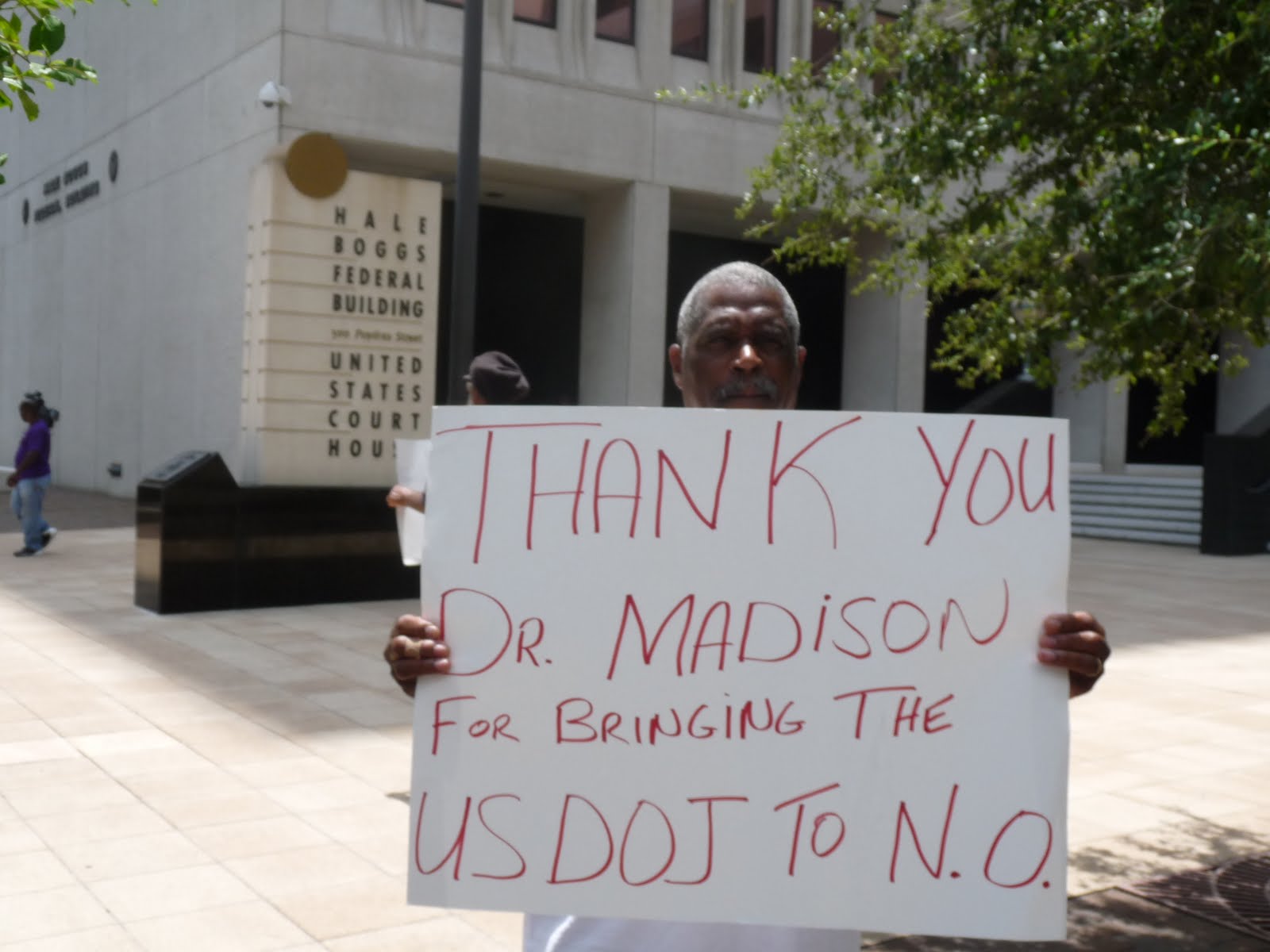
The revelations of post-Katrina police violence have brought in a new era of outrage. Political and civic leaders, across boundaries of color and class, have called for systemic change in the NOPD. “The public has a right to know what really happened,” says Anthony Radosti, vice president of the Metropolitan Crime Commission, which plays the role of an unofficial watchdog over the NOPD. “The police department failed in their mission,” adds Radosti, a 23-year veteran of the NOPD.
Ronal Serpas, who was hired by Mayor Landrieu to run the department in 2010, admits that the department has a long way to go. “Chief Serpas has always acknowledged that he inherited a fundamentally flawed department,” explains NOPD spokesperson Remi Braden. “He has done a lot, but there is much more to be done.”
Federal agents are looking into at least nine cases of police killings from the past several years, but that is just one aspect of their involvement. In March, the DOJ released a 58-page report that describes a department facing problems that “are serious, systemic, wide-ranging, and deeply rooted.” The report highlighted a range of areas in which it found “patterns or practices of unconstitutional conduct and/or violations of federal law.”
The bad news keeps coming out of the NOPD. In just the past two weeks, since the Danziger trial began, scandal has reached the very top of the department. The NOPD’s second in charge, Marlon Defillo, was found in an investigation overseen by the state police to have neglected his duty to investigate police violence, in effect helping to hinder official investigations.
Three police commanders — the position under Defillo, and third in the overall NOPD hierarchy — have also been the subject of internal investigation. One commander was accused of directing officers to specifically target young Black men for questioning during the city’s Essence Festival, one of the nation’s largest Black tourism events.
Criminal justice activists have demanded more federal investigations and a wider scope. “This represents a real opportunity for New Orleans to raise some fundamental questions about the nature of police and what they do,” says organizer Malcolm Suber. “But unless we talk about the entire system, this will repeat again.”
[Jordan Flaherty is a journalist and staffer with the Louisiana Justice Institute. His award-winning reporting from the Gulf Coast has been featured in a range of outlets including The New York Times, Al Jazeera, and Argentina’s Clarin newspaper. His new book is FLOODLINES: Community and Resistance from Katrina to the Jena Six. He can be reached at neworleans@leftturn.org, and more information about Floodlines can be found at floodlines.org. This is an expanded version of an article originally published by theLoop21.com. Find more articles by Jordan Flaherty on The Rag Blog, including previous reporting on the Danziger Bridge incident and post-Katrina police violence.]

By Ed Kilgore / The New Republic / July 12, 2011
According to received wisdom, the Christian Right is engaged in a tactical alliance with more secular-minded conservatives in the Republican Party.
The pairing was established as far back as 1980, when Ronald Reagan made unambiguous support for social-conservative priorities (especially the abolition of abortion rights) GOP orthodoxy and earned the support of conservative evangelicals who had been politically mobilized and then bitterly disappointed by Jimmy Carter.
The relationship has sometimes been compared to a “marriage of convenience,” and indeed, Christian Right leaders have never been reluctant to complain that they are being taken for granted and underserved by their political partners.
Given this background, one might assume that Christian Right leaders would be exceptionally nervous about the ascendancy of the Tea Party Movement, with its libertarian streak and its fixation on fiscal issues. But as it turns out, Christian Right elites, for their own peculiar reasons, have become enthusiastic participants in the drive to combat Big Government and its enablers in both parties.
It’s no accident that one red-hot candidate for president, Michele Bachmann, and a much-discussed likely candidate, Rick Perry, each have one foot planted in the Christian Right and another in the Tea Party Movement.
To a remarkable extent, today’s theocrats have stopped thinking of “social issues” like abortion or gay marriage as isolated from or in competition with fiscal or economic issues, and started thinking of them as part and parcel of a broader challenge that requires the radical transformation of government itself.
On an institutional level, the merger of Christian Right and Tea Party interests is remarkably advanced. The alliance has served as the very foundation stone of the Faith and Freedom Coalition, the latest venture of that intrepid politico-religious entrepreneur, Ralph Reed, which has sprouted chapters in many states, most prominently Iowa, where it sponsored the first candidate forum of the 2012 cycle.
There is even a term to describe this new strain of conservatism: the “Teavangelicals,” a subject of a recent broadcast by Christian Right journalist David Brody, which, among other things, examined the conservative evangelical roots of major Tea Party leaders. Most recently, a host of organizations closely connected with the Christian Right and “social issues” causes have signed onto the “Cut, Cap and Balance Pledge,” the Tea Party-inspired oath that demands a position on the debt limit vote that is incompatible with any bipartisan negotiations.
But this convergence between the two groups goes well beyond coalition politics and reflects a radicalization of conservative evangelical elites that is just as striking as the rise of the Tea Party itself. Indeed, the worldview of many Christian Right leaders has evolved into an understanding of government (at least under secularist management) as a satanic presence that seeks to displace God and the churches through social programs, to practice infanticide and euthanasia, to destroy parental control of children, to reward vice and punish virtue, and to thwart America’s divinely appointed destiny as a redeemer nation fighting for Christ against the world’s many infidels.
There are moral absolutes. No person’s failure reduces or redefines the standards carved in stone by the finger of God and revealed in His Word. We must find a way to stop judges and courts from misinterpreting the Constitution and writing their own laws.
“Activist judges” who have developed and applied protections for abortion rights, non-discrimination, and church-state separation have long been a bugaboo for the Christian Right. But Robison appears to be extending this traditional list of evangelical grievances, adding his blessing to the Tea Party’s objection to the string of Supreme Court decisions that enabled the federal government to enact New Deal programs like Social Security that protect people afflicted by personal “failure” from the consequences of their actions. He continues:
Success and prosperity may be mishandled by some, but the potential for success that produces opportunity for all and prosperity at different levels is not the problem. Those we elect must keep the free market free, healthy and under the influence of people who understand the importance of personal responsibility.
Here Robison lends his religious faith to an endorsement of the moral superiority of capitalism, while brushing aside concerns about inequality. His free-market fervor is grounded in a conception of government as a blasphemous substitute for God when it comes to “picking winners and losers.” He comes out and says the same thing more directly in the following:
Depending on the federal government as our source is idolatry. We must control it, or it will control us. Stop the madness! Hitler believed that Germany needed a government over the people, not of the people. God deliver us from this kind of insanity.
Identification of liberals with the Nazis is an old Christian Right habit, usually focused on the “holocaust” of legalized abortion. Here, though, Robison seems to be extending the analogy to all forms of dependence on the federal government for social benefits. Finally, on spending:
Out-of-control spending, mismanagement of the people’s money and excessive, intrusive regulation is as wrong and immoral as stealing. Spending must be brought under control now, at whatever sacrifice. This does not include foolishly giving the government more of the people’s money to waste or mismanage.
In other words, to Christian Right leaders like Robison, it appears that both Keynsian economics and tax increases have become “as wrong and immoral as stealing.” As with his attacks on judges that let bureaucrats help people who have failed to live up to God’s eternal standards, he sounds like an incongruous Christian Ayn Rand.
Robison’s agenda, as long-time observer of the Christian Right, Sarah Posner, explains at Religion Dispatches, “reads like a theo-economic merger of a religious right and Tea Party wishlist.” And he’s hardly alone in his views, notes Posner:
The players in Robison’s meetings reflect this agenda. They include Jim Garlow, the California pastor instrumental in the California Proposition 8 fight who now runs Newt Gingrich’s Renewing American Leadership, and Harry Jackson [a close advisor of Herman Cain], who relentlessly opposed D.C.’s gay marriage law; religious right historian David Barton; Richard Land of the Southern Baptist Convention and Tony Perkins of the Family Research Council; [and] Rod Parsley , who, like John Hagee, is apparently making a comeback after being rejected by McCain in 2008…
After examining the beliefs of the contemporary Christian Right, candidates like Bachmann and Perry seem less like pols cleverly straddling factions and more like leaders of a single constituency. In particular, the fiery “constitutional conservatism” espoused by many of them reflects a belief in a God-given Founders’ design that equally demands limited government, absolute property rights, a ban on abortion (including some forms of contraception) and same-sex relationships, the right to a Christian education, a stern attitude towards economic “losers,” and hostility to foreign countries other than Israel.
When the Christian Right leaders convened by James Robison come together in Houston on August 6 at Rick Perry’s invitation to hold a “national call to prayer for a nation in crisis,” it may or may not be connected to a presidential run by its host. But it will illustrate that the Christian Right is hardly dead or asleep, and is no longer by any means at odds with the fiscal and economic radicalism gripping the rest of the conservative movement.
[Ed Kilgore is a special correspondent for The New Republic. This article was first published at The New Republic and was distributed by Progressive America Rising.]

The obscene excesses of executive pay practices are not aberrations, but the inevitable products of a complex system.
By Arlene Goldbard / The Rag Blog / July 12, 2011
Recently I read a piece on executive pay in the business section of The New York Times. Ever since, I have been wondering how to write about it.
Here are some of the images I did not want to include: bad apples spoiling a whole barrel; pirates (and other types of marauding bandits); weeds spoiling the garden. Why not? Because the obscene excesses of executive pay practices are not aberrations, but the inevitable products of a complex system.
To redeploy a phrase beloved of judges on TV crime shows (where it refers to something quite different, evidence obtained illegally), they are “the fruit of the poisonous tree.”
Most of the images still circling my mind are from the Ancient History 101 version of the fall of Rome: Rome fell, the history teacher told us, because those in power pursued personal wealth and privilege at the expense of collective well-being. Such explanations were illustrated with lurid depictions of toga-clad degenerates cramming whole roast birds and huge bunches of grapes into their gaping mouths.
Nowadays they are garbed in gray flannel and power ties, but the facts are equally shocking.
While ordinary working people (and the unemployed) were being exhorted to “share the pain” by accepting pay cuts, job losses, and limits on unemployment benefits, executives’ slice of the roast goose got bigger:
Let’s begin with the view from 30,000 feet. Total executive pay increased by 13.9 percent in 2010 among the 483 companies where data was available for the analysis. The total pay for those companies’ 2,591 named executives, before taxes, was $14.3 billion.
That’s some pile of pay, right? But Mr. Ciesielski of the Times puts it into perspective by noting that the total is almost equal to the gross domestic product of Tajikistan, which has a population of more than 7 million.
It’s not even the sheer dollars so much as the fact that the standard rationales for such expenditures no longer provide even as much cover as the flimsiest toga for the self-regarding indifference that drives so much of the corporate sector.
The executive pay study shows clearly that top-level salaries and bonuses swelled even at the expense of shareholders, of research and development, and of market capitalization. Consider a few facts:
The report calculated that at 179 companies in the study, the average value of stockholders’ stakes fell between 2008 and 2010 while the top executives at those companies received raises.
Moving on to R.& D. costs, the report examined the 62 technology companies in its sampling that reported such an expense, excluding certain costs associated with acquisitions.
Mr. Ciesielski found that the median level of executive pay was equal to 5.3 percent of these companies’ R.& D. expenditures.
Eleven companies analyzed in the report gave top executives a combined pay package amounting to 1 percent or more of the companies’ average market value over the course of the year. The Janus Capital Group, the mutual fund concern, topped the list, with pay totaling almost $41 million for five executives. This accounted for 1.95 percent of the company’s average market value over 2010.
“To earn their keep,” the report said, “managers would have to create stock market value in the full amount of their pay.” The executives at Janus failed to increase value in 2010, when the stock closed out the year roughly where it had begun it. This year, the company’s shares are down almost 30 percent.
It’s hard to skip over the fat-cat bad-apple imagery and give such information its full import, because — in a culture that generally ignores class while focusing on individuals — we tend to think in terms of specific cases rather than a whole system.
But it’s really a mistake to allow the facts of executive pay to pull us toward a personalized moral critique of the executives who stockpile wealth at the expense of shareholders, or R&D, or general economic well-being. Focusing on this as individual aberrations misses the most important questions:
The facts of executive pay put the lie to loudly persistent protestations by corporate spokespersons that they’re only following capitalism’s prime directive, to maximize shareholder profit. They are prioritizing the accumulation of personal wealth over shareholder income, which hurts business, shareholders, and the economy in general. Why is everyone else allowing this?
Despite corporate profits being at an all-time high, few corporations are rehiring or replacing laid-off workers, preferring to export jobs to less expensive markets overseas, or simply to work with fewer employees to keep the profit figures high. How many workers could have been paid a living wage for, say, half of the $14.3 billion that was paid to a mere 2,591 executives?
The people who work, share, care, without exploiting others outnumber the fat cats by a magnitude. It’s not Corporation Nation yet; we still have a constitution, and the right to regulate commerce, even if we’ve put Emperor Nero’s crew in charge of our collective commonwealth. Why aren’t we taking the facts seriously and demanding accountability from the piratical system that allows and encourages this?
To find out more about people who are spreading information and taking action, here are a few links:
The antidote to our trance of indifference is a passion for truth.
In ancient Rome, Cicero popularized a question he attributed to Lucius Cassius, whom he said the Roman people used to regard as a very honest and wise judge: “…He was in the habit of asking, time and again, ‘cui bono?’ — ‘To whose benefit?'” A simple question we mostly seem to have forgotten: if we can’t move ourselves to ask it now, when?
I really wanted to link to a video of Tommy’s Castro’s “No One Left to Lie to But Myself,” but I couldn’t find one, so here’s a bit of the lyrics:
The truth hurts but I know I can’t deny it
Can’t sell nothin’ when there’s no one left to buy it
I made this bed and I guess I got to lie in it tonight
But deep down inside I know it’s just as well
Cause now there’s no one left to lie to even if it tried to
Got no one left to lie to but myself
No there’s one left to lie to but myself
On the off chance the universe is pushing me toward an optimistic ending, I’ll go instead with his version — click to it here — of “My Time After Awhile”: “It’s your time now, baby/But it’s gonna be my time after awhile.” May it be so.
When the Empire falls, who benefits?
[Arlene Goldbard, a writer, speaker, social activist, and advocate on behalf of community-rooted art, is chair of the board of The Shalom Center. Her website is ArleneGoldbarb.com.]

By Arlene Goldbard / The Rag Blog / July 12, 2011
Recently I read a piece on executive pay in the business section of The New York Times. Ever since, I have been wondering how to write about it.
Here are some of the images I did not want to include: bad apples spoiling a whole barrel; pirates (and other types of marauding bandits); weeds spoiling the garden. Why not? Because the obscene excesses of executive pay practices are not aberrations, but the inevitable products of a complex system.
To redeploy a phrase beloved of judges on TV crime shows (where it refers to something quite different, evidence obtained illegally), they are “the fruit of the poisonous tree.”
Most of the images still circling my mind are from the Ancient History 101 version of the fall of Rome: Rome fell, the history teacher told us, because those in power pursued personal wealth and privilege at the expense of collective well-being. Such explanations were illustrated with lurid depictions of toga-clad degenerates cramming whole roast birds and huge bunches of grapes into their gaping mouths.
Nowadays they are garbed in gray flannel and power ties, but the facts are equally shocking.
While ordinary working people (and the unemployed) were being exhorted to “share the pain” by accepting pay cuts, job losses, and limits on unemployment benefits, executives’ slice of the roast goose got bigger:
Let’s begin with the view from 30,000 feet. Total executive pay increased by 13.9 percent in 2010 among the 483 companies where data was available for the analysis. The total pay for those companies’ 2,591 named executives, before taxes, was $14.3 billion.
That’s some pile of pay, right? But Mr. Ciesielski of the Times puts it into perspective by noting that the total is almost equal to the gross domestic product of Tajikistan, which has a population of more than 7 million.
It’s not even the sheer dollars so much as the fact that the standard rationales for such expenditures no longer provide even as much cover as the flimsiest toga for the self-regarding indifference that drives so much of the corporate sector.
The executive pay study shows clearly that top-level salaries and bonuses swelled even at the expense of shareholders, of research and development, and of market capitalization. Consider a few facts:
The report calculated that at 179 companies in the study, the average value of stockholders’ stakes fell between 2008 and 2010 while the top executives at those companies received raises.
Moving on to R.& D. costs, the report examined the 62 technology companies in its sampling that reported such an expense, excluding certain costs associated with acquisitions.
Mr. Ciesielski found that the median level of executive pay was equal to 5.3 percent of these companies’ R.& D. expenditures.
Eleven companies analyzed in the report gave top executives a combined pay package amounting to 1 percent or more of the companies’ average market value over the course of the year. The Janus Capital Group, the mutual fund concern, topped the list, with pay totaling almost $41 million for five executives. This accounted for 1.95 percent of the company’s average market value over 2010.
“To earn their keep,” the report said, “managers would have to create stock market value in the full amount of their pay.” The executives at Janus failed to increase value in 2010, when the stock closed out the year roughly where it had begun it. This year, the company’s shares are down almost 30 percent.
It’s hard to skip over the fat-cat bad-apple imagery and give such information its full import, because — in a culture that generally ignores class while focusing on individuals — we tend to think in terms of specific cases rather than a whole system.
But it’s really a mistake to allow the facts of executive pay to pull us toward a personalized moral critique of the executives who stockpile wealth at the expense of shareholders, or R&D, or general economic well-being. Focusing on this as individual aberrations misses the most important questions:
The facts of executive pay put the lie to loudly persistent protestations by corporate spokespersons that they’re only following capitalism’s prime directive, to maximize shareholder profit. They are prioritizing the accumulation of personal wealth over shareholder income, which hurts business, shareholders, and the economy in general. Why is everyone else allowing this?
Despite corporate profits being at an all-time high, few corporations are rehiring or replacing laid-off workers, preferring to export jobs to less expensive markets overseas, or simply to work with fewer employees to keep the profit figures high. How many workers could have been paid a living wage for, say, half of the $14.3 billion that was paid to a mere 2,591 executives?
The people who work, share, care, without exploiting others outnumber the fat cats by a magnitude. It’s not Corporation Nation yet; we still have a constitution, and the right to regulate commerce, even if we’ve put Emperor Nero’s crew in charge of our collective commonwealth. Why aren’t we taking the facts seriously and demanding accountability from the piratical system that allows and encourages this?
To find out more about people who are spreading information and taking action, here are a few links:
The antidote to our trance of indifference is a passion for truth.
In ancient Rome, Cicero popularized a question he attributed to Lucius Cassius, whom he said the Roman people used to regard as a very honest and wise judge: “…He was in the habit of asking, time and again, ‘cui bono?’ — ‘To whose benefit?'” A simple question we mostly seem to have forgotten: if we can’t move ourselves to ask it now, when?
I really wanted to link to a video of Tommy’s Castro’s “No One Left to Lie to But Myself,” but I couldn’t find one, so here’s a bit of the lyrics:
The truth hurts but I know I can’t deny it
Can’t sell nothin’ when there’s no one left to buy it
I made this bed and I guess I got to lie in it tonight
But deep down inside I know it’s just as well
Cause now there’s no one left to lie to even if it tried to
Got no one left to lie to but myself
No there’s one left to lie to but myself
On the off chance the universe is pushing me toward an optimistic ending, I’ll go instead with his version — click to it here — of “My Time After Awhile”: “It’s your time now, baby/But it’s gonna be my time after awhile.” May it be so.
When the Empire falls, who benefits?
[Arlene Goldbard, a writer, speaker, social activist, and advocate on behalf of community-rooted art, is chair of the board of The Shalom Center. Her website is ArleneGoldbarb.com.]
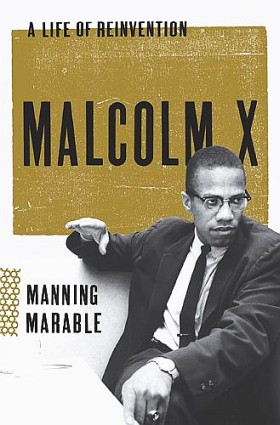
Manning Marable’s
Malcolm X: A Life of Reinvention
The Malcolm he depicts is unquestionably, accurately, and thoroughly the Malcolm I knew.
By Tony Bouza / The Rag Blog / July 11, 2011
[Malcolm X: A Life of Reinvention by Manning Marable (Viking, 2011). Hardcover, 608 pp., $30.]
Any reviewer owes the reader an accounting of possible biases, personal knowledge or connection, or any information helpful in assessing the worth of the analysis.
I was a detective in BOSSI (Bureau of Special Services and Investigations—NYPD) from July 1957 to December 1965 with one brief interruption in 1958. I rose to sergeant and lieutenant there and wound up writing a master’s thesis that became a book, Police Intelligence (an oxymoron?). It should never have been published because it wasn’t a book but a dessicated account of the unit’s operations. It contained a section on The Nation of Islam (NOI) and Malcolm X. The book’s turgid, soporific prose proved an unexpected boon to insomniacs.
I knew Malcolm X through my dealings with him over demonstrations, and I attended many, many street meetings at which he spoke — on Saturday afternoons at 125th Street and 7th Avenue. The heart of Harlem.
There was another level of operation at BOSSI — undercover infiltrations (American Nazi Party; Nation of Islam; many other groups) — in which I was only tangentially and periodically involved. I attributed this to an unspoken suspicion of my politics, but it was never expressed and never led to my deliberate exclusion. There was, of course, the additional factor that in a world of daily communicants who routinely referred to the cardinal’s residence as “One Powerhouse,” I was neither Catholic nor Irish enough. So I was episodically involved but never a central figure in the operations.
When I learned of Marable’s book my interest was piqued. I’ve always felt Malcolm X was a little understood — or even knowledgeably discussed — figure, although Spike Lee’s film was a real attempt at grappling with the central question of who murdered him and why. So I was a bit of a fly on the wall, but deeply interested and as involved as those who were controlling events allowed.
The book’s title is a good one because I’ve come to think of Malcolm as having lived three lives — a street thug, a NOI minister, and an integrationist, for wont of a more satisfying word.
Malcolm X must be understood within the context of the two major strains flowing through the black experience — integrationist and separatist. Thus, you have Booker T. Washington versus W. E. B. DuBois; A. Philip Randolph and Marcus Garvey; Frederick Douglass and Nat Turner; Elijah Muhammad and Martin Luther King, Jr.; Jesse Jackson and Louis Farrakhan. Malcolm X straddled both camps as a separatist (NOI, which demanded five states for its own nation, and the inclusive Organization of Afro-American Unity).
My final personal revelation is that I performed what I considered the very unprofessional act of attending Malcolm X’s funeral and passed by his open casket.
The book
Marable is appropriately dismissive of what is actually Alex Haley’s “Autobiography” of Malcolm X. No one I know seriously considered it the putative author’s true views and feelings. It was mostly seen as a very creative and skillful example of Haley’s take.
Marable’s clear desire is to demonize the police. He cites the FBI, but they were peripheral. The real monitor of Malcolm X’s behavior was BOSSI. His analysis is naïve, superficial, reflexive, and predictable. The reality may prove more nuanced and, perhaps, even more reprehensible, but history is a demanding taskmaster.
The author’s descriptions of Malcolm’s early life reflect careful research, objectivity, and a historian’s effort to avoid hagiography. The descriptions of Malcolm’s likely involvement in some homosexual adventurism can only be described as intrepid and commendable.
Marable’s description of Malcolm’s conversion to NOI is a triumph of research and smooth writing. Its objectivity is clear in the fair treatment accorded Elijah Muhammad’s early involvement in the NOI, especially given his later treatment of the hero.
The author’s willingness to describe Malcolm’s early forays into anti-semitism — a virulent stream in the black community sometimes surfacing as in Jesse Jackson’s reference to NYC as “Hymie-town” — is another reflection of his devotion to authenticity. I personally heard, in the Sixties, Malcolm refer to “Goldberg” in his withering tirades on Harlem’s corners.
Given the involvement of Jews in every facet of the civil rights struggle, this prejudice seems both unwise and perverse. It was, for example, two Jews (Goodman and Schwerner) who were killed with Cheney.
The author holds that the police (BOSSI/FBI, etc.) misjudged the threat posed by the NOI, describing it as “conservative, capitalistic and not really dangerous.” This ignores the profoundly subversive nature of a sect that professed and practiced separatism and hatred of whites, and also demanded its own nation. The NOI was and — though diminished — remains alienated and hostile. Louis Farrakhan, in 2011, praised Libya’s Muamar Qadaffi, who’d made a large contribution to the NOI.
In September 1960 Fidel Castro visited the United Nations and stayed at the Shelburne Hotel in midtown. Miffed at being denied an exclusive interview, New York Daily News reporter William Federici published a sensational account of “chicken pluckings” in the room by the Cuban entourage. This dramatic depiction served the cartoonish interests of an increasingly hostile readership and received international circulation. The Cubans did cook in the rooms but did no chicken plucking.
Incensed, the entire delegation moved to the Hotel Theresa in central Harlem, where Fidel was visited by the USSR’s Nikita Krushchev. Castro added to his move’s appeal to Harlemites by flying in his black army commander, Huber Matos, for very quick public appearances. Author Marable makes no reference to this source of Castro’s pique — a significant error. I was a part of the security detail there and had even engaged Fidel in vigorous conversations since his father and I had been born a few miles apart in Northern Spain.
Castro was irresistibly charismatic and winning.
Much is made of BOSSI’s intense focus on the NOI, but the author apparently didn’t know that equal attention was being paid to its counterpart — the racist, separatist American Nazi party. In a fatally ironic denouement, the men figuratively standing next to both Malcolm X and George Lincoln Rockwell (the Nazi leader) when they were murdered were both BOSSI operatives.
Would Marable’s ultra bleak view have been tempered knowing that BOSSI was an equal opportunity infiltrator? Perhaps not.
The author repeatedly reveals what I believe to be an over-reliance on NOI documents and, particularly, the probably unprecedented access granted by Louis Farrakhan, too central a figure in this controversy to be relied upon.
In An American Dilemma, Gunnar Myrdal, a Swedish sociologist, described our nation’s number one issue as the “Negro Problem.” In reality, over 70 years later, it still is, only now embodying issues of class as well as race. Despite undeniable and admirable progress since the watershed Civil Rights Act of 1965, black Americans continue to constitute the bulk of the underclass. After two and a half centuries of slavery and 100 years of Jim Crow we now address the problem with prisons.
Blacks naturally, resented and resisted this subjugation and expressed their anguish in crime, protests, separatist movements, and demands to be fully integrated. Marable echoes Myrdal’s views perfectly as he speeds to the crisis of Malcolm’s life and its end on Feb. 21, 1965.
But a clear understanding of that still mysterious assassination is absolutely central to any evaluation of this seminal work.
In the early ’60s Malcolm X’s position, nationally, was awkward. Whites largely saw him as representing the extremes of black disaffection, which helped them understand the more nuanced views of integrationist blacks.
His effectiveness as a speaker was remarkable. He related to, communicated with and responded to his audiences in what could be likened to a masterful composer’s interaction with a talented orchestra. I’d seen him sway, move, guide and undulate with street groups in a spirit of perfect symbiosis. He was indisputably Harlem’s greatest street orator, in an area and an era where I’d heard some memorable dithyrambs.
Malcolm’s break with the NOI is central to any understanding of its aftermath. To his last day in the NOI he was slavishly devoted to Elijah Muhammad and consistently extolled his master. Not one deviant or disloyal act could be cited. The author documents this persuasively.
Malcolm had been uttering incendiary indictments of White America in all its iterations, without inhibitions. His casual reference to Kennedy’s assassination on Dec. 1, 1963, only a few days after the event, was seen as being of a piece with every other of his utterances and unremarkable. The “chickens coming home to roost” was a pretty tame commentary by his standards.
Malcolm’s prominence, growth, and frequent referrals as “number two” had created inevitable rivals among a numerous Chicago coeterie anxious to succeed the prophet. Malcolm was suspended for 90 days. He accepted his punishment without question or criticism.
Those of us in the police world, watching NOI grow into a menacing separatist and, yes, subversive organization, were delighted by the split.
Pure serendipity that the NOI would throw away its greatest asset in a tawdry battle of succession among the Chicago clique that would, in a supremely ironic twist, be won by an outsider — Louis Farrakhan. He inherited and presided over — for decades — a diminished empire.
Malcolm accepted his fate with a clear hope of restoration. The hope soon faded. Clearly there was more to his suspension than a fairly tepid quip. What seems clear — from this book and our own assessments at the time — was that Malcolm was expelled to remove an obvious rival to power by those around Elijah Muhammad.
Marable makes clear that in early 1964 Malcolm and the NOI had stumbled and staggered to a separation inevitably turning permanent. This led Malcolm into a desparate search for a role in a play in which he was a star without a script, a national figure without platform or income.
The author states that despite threats, a history of some violence and actual references to a plot, the police did not believe he was in imminent danger. I can verify this since we were watching developments carefully and assessing the risks. We had agents in NOI and with Malcolm.
Malcolm’s life of a predictable slide into crime and drugs — made inevitable by a racist society in which the overclass denied its involvement in his fate — was, to coin a phrase, arrested by his NOI epiphany. This armed him with the intellectual and oratorical weapons that would launch him into national leadership.
His 1964 hajj to Mecca served, albeit however briefly, to greatly broaden his understanding, message, and influence. The NOI was an indefensible intellectual cul de sac from which he had to emerge to gain the relevance necessary to catapult him beyond the pigeon hole of racist freak.
Breaking with the NOI was one thing, denouncing Elijah Muhammad’s serial siring of children by NOI secretaries was another. This struck at the very core of NOI’s integrity and legitimacy. It could not and would not be brooked. The leader’s virtues could not be assailed. The Rubicon had been crossed.
Knowing this, we in BOSSI were perplexed. Assigning platoons of cops to cover Malcolm’s events was easy enough and routine but spasmodic and ineffective.
Assigning detective body guards 24/7 would be prohibitively expensive. I thought Malcolm would scorn a police offer of security but suggested we do so. Besides, we had an undercover agent — Gene Roberts — with Malcolm and this should help with Malcolm’s safety. Coverage was offered and promptly rejected by Malcolm. There is, in all likelihood, a record of this in BOSSI files.
The NYPD would never purposely endanger one of its agents, but the risk of Robert’s safety was weighed and accepted. It was an enormous piece of luck that he escaped injury on Feb. 21, 1965, at the Audubon Ballroom.
But now, with Muhammad’s denouncement as a matter of record, we all, Malcolm included, knew he was in mortal danger. Marable writes that Louis X (Farrakhan) wrote on Dec. 4, 1964, in Muhammad Speaks, “Such a man as Malcolm is worthy of death.”
Yet Marable, obviously grateful at being flattered by Farrakhan’s help and attention when it came to this book, and 45 or so years later, quotes Farrakhan’s “love for Malcolm,” describing him as “my brother.” Crocodiles are described as shedding tears as they consume their prey.
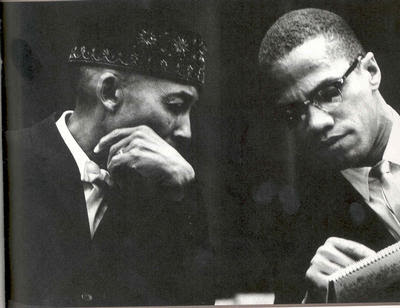
Elijah Muhammad and Malcolm X. Photo by Eve Arnold / Magnum Photos.
The NOI, with its discipline, its cadre of men accustomed to the uses of violence, and its own internal culture of brutal methods of correcting the behaviors of its targets, was a perfectly natural weapon to employ in carrying out organizational objectives. The period of late 1964 to early ’65 saw repeated incidents of bloodshed and even deaths surrounding the clashes inspired by Malcolm’s break/expulsion from the NOI.
The loss of Malcolm was a huge organizational disaster for the NOI, but the hubris at the top blinded them to its consequences. Marable describes the issues cogently.
He makes a really serious mistake when he cites BOSSI Detective Gerry Fulcher as saying the police brass “had the mentality of wanting an assassination.” This is an outrageous falsehood and undermines an otherwise impressive effort. I knew Fulcher and considered him a flake. My recollection, though dim, was that he was an ex-seminarian and so unreliable that we transferred him out. The notion of his serving as any kind of source is laughable.
We certainly viewed Muhammad and the NOI as the enemy but not Malcolm. We were delighted by his separation from NOI and certainly didn’t welcome the prospect — regarded as very real by us after he denounced Muhammad’s promiscuities — of his murder. And his move to a more conciliatory and cooperative posture certainly heartened those of us observing him closely.
Malcolm’s charisma, intelligence, courage and effectiveness were qualities we all could admire. My attending his funeral was really a mark of the genuine regard I had for him and my views were shared by my colleagues.
Malcolm’s assassination on Feb. 21, 1965, in a packed ballroom of the Audubon Auditorium, resulted in a thoroughly confused police investigation that netted three killers from the scene and little else. The truly guilty — not the shooters but those who sent them — escaped all accountability.
The investigation was botched.
With the benefit of hindsight and acknowledging the reality that there’s never been a police mistake I haven’t or couldn’t have made, what would a real inquiry look like?
A task force of about 10 investigators should have been created, composed of BOSSI detectives, homicide sleuths (traditionally the best), and fire marshals. The focus would be on the firebombing of Malcolm’s house days before his murder and the murder itself.
The firebombing may well have rendered clues like fingerprints on the molotov cocktails and such. Then the murder itself and trying to leverage the possibility of long sentences into cooperation from the shooters. There needed to be a more thorough search for the actual perps and then an inquiry into their backgrounds.
The central aim of it all would be to really establish the roles of Captain Joseph X Gravitt, Minister Louis X Farrakhan, and the prophet himself, Elijah Muhammad.
The utter failure of the NYPD created a dismal history and the principal losers have been the black community itself. A parallel tragedy lies in the NYPD’s obvious stonewalling of any release of records likely to help our understanding. I need to add that I cooperated with the press, always, in its attempts to inform the people.
The chaotic scene and the determined silence of those accused didn’t help.
The historical and traditional view of the causes of black martyrdom center on the metaphor of a lynching — whites killing blacks. Malcolm’s murder was different and created a dilemma not confronted by his community even almost half a century after his death. He was killed by blacks.
Marable cites Farrakhan as the principal beneficiary and as Betty Shabazz’s prime suspect, even years later. But the principal focus must center on Elijah Muhammad, and the motive — we all thought then and I do now — was Malcolm’s references to Muhammad’s having fathered six or seven children by his secretaries.
The author’s masterful, scholarly, writerly book is unnecessarily weakened by reliance on a source like Fulcher — and the absence of more authoritative possible sources within BOSSI such as its commander or Detective Roberts or his handlers. The lack of really valuable sources forces the author into the arms of unreliable or mendacious alternates.
It is, withal, a must read.
The Malcolm he depicts is unquestionably, accurately, and thoroughly the Malcolm I knew. It is a wonderfully useful evocation of the man and a sure and certain guide to understanding the icon that was Malcolm X.
But it ain’t the final word.
[Anthony V. (Tony) Bouza was born on April 10, 1928 in El Ferrol, Spain. A 40-year veteran of municipal police including an extended stint as a New York detective, Bouza served as Minneapolis police chief from 1980 to 1989. He is the author of six books. This article was originally published at Southside Pride, a South Minneapolis monthly. Southside Pride editor Ed Felien is a regular contributor to The Rag Blog.]

Bud Selig’s tributes to baseball’s civil rights tradition now look as hollow as Sammy Sosa’s old bat.
By Dave Zirin / The Rag Blog / July 11, 2011
Over the last year, civil rights organizations, politicians, sportswriters, and baseball players have asked Major League Baseball Commissioner Bud Selig to move Tuesday’s 2011 All-Star Game out of Arizona. He chose not to listen and now I choose not to watch. If I lived within a day’s travel of Arizona, I’d be choosing to protest at the stadium gates.
Ever since Arizona passed its darkly punitive racial profiling law SB 1070, thousands of people have pleaded with Selig to do the right thing and move the game. Baseball is 27.7% Latino. It’s a sport dependent on Latin American talent from the baseball academies of the Dominican Republic to today’s biggest stars, Albert Pujols and Adrian Gonzalez. Even more, Major League Baseball has prided itself — and marketed itself — on historically being more than just a game.
Bud Selig, in particular, is a man, who publicly venerates the game’s civil rights tradition. Jackie Robinson’s number is retired and visible in every park and the great Roberto Clemente in death has become a true baseball saint. But Selig’s inaction makes his tributes to the past look as hollow as Sammy Sosa’s old bat.
Selig clearly loves the symbolism of civil rights more than the sacrifice. The presence of the game will mean a financial windfall for the state as well as for Arizona Diamondback owner Ken Kendrick. Kendrick is a first-tier right wing money bundler who has let the state politicians behind SB 1070 use his owner’s box for fundraisers.
The game will also mean a national spotlight for the vile Sheriff Joe Arpaio of Arizona’s Maricopa County, our 21st century Bull Conner. Arpaio has been threatening to bring down his pink-clad chain gang to clean up outside the stadium.
Selig is not the only one backing down from the moment. The Major League Players Association issued a very strong statement last year against SB 1070 and hinted that a boycott might be in the cards, saying they would “consider additional measures to protect the interests of our members.” Earlier this week, after months of silence, Executive Director Michael Weiner said, “SB 1070 is not in effect and key portions of the law have been judged unlawful by the federal courts. Under all the circumstances, we have not asked players to refrain from participating in any All-Star activities.”
To say SB 1070 “is not in effect” is sophistry. Only a section of SB 1070 has been judged unlawful: the extension of police powers to demand papers without cause. Other aspects are now on the books, including stiffer penalties for “illegals” and giving citizens the right to sue any city that sets up safe havens for immigrants. In addition, State Governor Jan Brewer is currently appealing the pruning of SB 1070 directly to the U.S. Supreme Court. Also, the law has spawned copycat legislation is states around the country.
My own discussions with Arizona activists tell me that racial profiling has been rampant since the law passed, with Latinos, legal and illegal, in fear to call the police or the fire department, or even attend church. Even if you agree with Michael Weiner, as he writes that immigration matters “will not be resolved at Chase Field, nor on any baseball diamond,” the MLBPA is being remarkably cavalier about its responsibility to “protect its members.”
As for the players, a massive number are bowing out of this year’s game. Is this because of SB 1070? We don’t know, but either way a weakened product will be on display Tuesday night.
If the spotlight shifts to anyone on the field, it will be centered on Boston’s All-Star first baseman Adrian Gonzalez who changed his position a year ago that he wouldn’t play if the game were in Arizona. There is a movement to have players like Gonzalez, sympathetic to the cause, to wear a ribbon or make some kind of statement. We will see if Adrian Gonzalez takes advantage of the spotlight.
But in the end, responsibility for this debacle rests with Selig. NFL owners, whom no one would confuse with the NAACP, threatened to pull the 1993 Super Bowl out of Arizona if the state continued to refuse to recognize Martin Luther King’s birthday as a national holiday. Now, 20 years later, baseball’s commissioner does nothing.
Yes, Bud Selig would undoubtedly have received an avalanche of criticism if he had moved the game. That’s what it means to actually sacrifice something for the sake of the civil rights he claims to hold so dear. Instead, his legacy will bear another blot, joining the steroid boom, the cancellation of the 1994 World Series, and the gouging of state economies with tax-payer funded stadiums.
Now Bud Selig can always be remembered as the Seinfeld of sports commissioners: the man who did nothing; the man who, with the game on the line, kept his bat on his shoulder and took a called third strike.
[Dave Zirin is the author of Bad Sports: How Owners are Ruining the Games we Love (Scribner) and just made the new documentary Not Just a Game. Receive his column every week by emailing dave@edgeofsports.com. Contact him at edgeofsports@gmail.com. This article was also posted at The Nation blogs. Read more articles by Dave Zirin on The Rag Blog.]
Thorne Webb Dreyer, Editor





