Larry Ray : Politicians Packing Heat? That’s the Ticket…

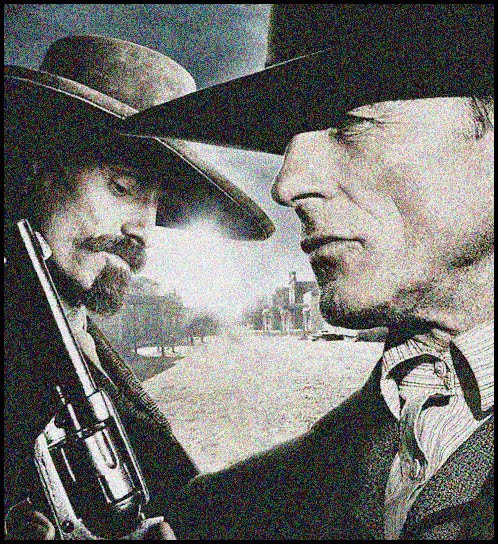
Our OK Corral: Shootin’ irons for all?

OK Corral in California?
Politicians packing heat, oh my…

By Larry Ray / The Rag Blog / March 16, 2011

Got an email this evening from a old friend who keeps a pretty good daily watch on the news, especially the really bizarre and extreme news stories about America in 2011. The article he forwarded had this headline:

California politicians demand right to carry arms

Sacramento state assembly members have introduced a bill that would entitle them to carry concealed weapons

The whole idea of elected representatives and lawmakers who want to make a law to let them pack a gun because they felt threatened by negative e-mail and mean phone calls triggered a top of the head response to my friend, Harry, who sent me the news article.

Here’s my reaction to these Left Coast pol’s whose proposed legislation would help fulfill the NRA’s desire to have everybody packing heat.

Harry, old friend, it occurs that by arming every person capable of loading a gun and letting them carry it in their belts, holsters, or wherever, we actually would create a non-nuclear version of MAD, Mutually Assured Destruction… sort of. It would be more mutual for some folks than others.

Problem is, that a couple of hours on a shooting range and a pat on the back is not going to really make a scared politician packing heat any safer from an enraged, focused person intent upon blowing him away.

Harper’s Magazine had a cover article last year on how this all really shakes out when someone decides to have a gun on him, or her, at all times. One’s thinking changes completely and the really remote chance that someone is going to do you harm becomes an obsession.

So, a simple advance, for a completely innocent reason, by someone into this legally ready-to-shoot-gun-toting person’s “territorial imperative” space around him could result in murderous gunfire.

Like the guy wearing a hood, or the turban-wearing tourist, or whoever you do not recognize and feel threatened by. Some poor soul fumbling for a paper with address on it in his pocket who was just trying to ask you where the city museum is located.

The whole mindset that life is like a cowboy movie reduces humanity and common sense to a perceived primal battle where everyone goes around with a semi-automatic bludgeon at the ready. Kill or be killed.

Had the federal judge in Arizona, Congresswoman Giffords, and her aides all been armed, what would have been the purpose of having a sincere meeting with constituents in a supermarket parking lot?

The nutcase young shooter would have still had the drop on all of them because he did not come there to talk about good government with Ms. Giffords. He came there to shoot her in the head, and all the folks around her for good measure.

Maybe someone in the crowd armed with their concealed weapon would have shot back at him, and maybe that scared shitless shooter blasting away wildly at the nutcase shooter would have killed lots of other folks as well.

What the hell happened to the American dream, Harry, and folks getting together to take part in it? Do we all want to be potential killers if we think someone is lurking out there with a shootin’ iron to kill us? Are we all walking out of that 1950’s Saturday double feature Western where the white hats always shoot and kill the black hats… has that become a movie in an endless loop in our scared collective psyche?

Ain’t like the craziness of the early 60’s at UT in Austin is it, Harry? What is really scary is that voters actually elected these whacko folks to represent them… and this is out in California, not Texas where the Governor packs a gun and shoots coyotes that get too close!

Peace and love, etc.

Larry

[Retired journalist Larry Ray is a Texas native and former Austin television news anchor who now lives in Gulfport, Mississippi. He also posts at The iHandbill.]

The Rag Blog

Posted in Rag Bloggers | Tagged , , | 1 Comment

Tooch Colombo:
The Last Great California Hunter

By Jonah Raskin / The Rag Blog / March 16, 2010

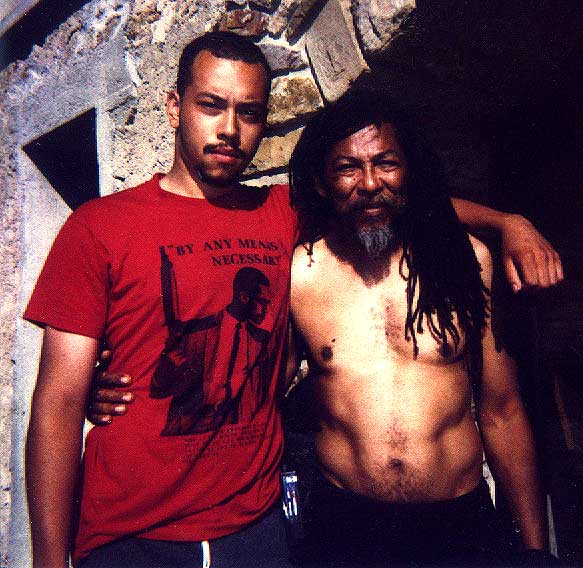
Tooch Colombo isn’t like you, me, most of our friends and family members. When he wants to eat meat he doesn’t go to Central Market, Whole Foods, or Safeway. He goes for his guns and heads for the wilds of California where his ancestors hunted for thousands of years.

He’s been hunting his whole life — including a stint as a professional hunter — and when he stops hunting, a way of life will die with him. He’s the last of the great hunters in California; most of the men with whom he hunted are dead, and the plentiful game they once hunted has long since been annihilated.

Colombo is one of a kind, a survivor of a way of life that as recently as the 1970s in California was also a way of making a decent living. Hunting in the wilds just doesn’t pay anymore, though Colombo still thrills to the excitement of the hunt.

Most men half his age have given up hunting, though they still remember week-long jaunts in the mountains where they shot deer, pigs, antelope, and bear, slept under the stars, told stories, and cooked and ate over an open fire what they had killed.

Colombo is unusual in more than just one way. He does almost everything himself, or nearly so. He’s not only a hunter, he’s also a butcher, a cook, and, of course, an eater with a ravenous appetite. “I eat everything that I kill,” he told me when I first met him at the offices of the Federated Indians of Graton Rancheria, a tribe in which he’s a leading member. He adds, “I’m the complete cycle.”

Colombo’s hair is white and his face is ruddy. He wears battered cowboy boots and well-worn jeans. He is intense and funny and very serious about hunting for wild game and about the centuries-long hunting of Indians by white men that nearly exterminated all of the Indians.

Before he goes hunting, Colombo says a prayer to the “Grandfather in the Sky,” as he calls the Great Spirit. “Let me find game,” he says. “Let me be merciful and let the animal die with one shot.” After he kills a deer or a pig he gives thanks and he means it, too.

Tooch Colombo’s ancestors lived on the coast of California for thousands of years, though he didn’t know anything about them until he was an adult. No one, not even his mother who was born a Miwok, told him that he was an Indian when he was a boy growing up not far from the Pacific Ocean, where his forefathers also fished.

“In those days it was a disgrace to be a Indian,” he told me. “You didn’t advertise the fact.”

On his father’s side, his ancestors were Italians, as the family name Colombo attests. The mixture of Indian and Italian has made for a lifetime of exciting cooking and eating and for an appreciation of the sacredness of food and of life itself.

For Colombo, the authentic life starts with hunting in the rugged terrain of California, where he’s roamed ever since the 1940s. When he was a younger man he worked 9-to-5 as a butcher for Safeway, Lucky, and other supermarkets, but he always took a month off for hunting, which meant that he always had to find another job at the end of hunting season. No one was willing to rehire a butcher who took off for a whole month to stalk, track, and hunt.

At the age of 75, he still goes out for deer in August and for pig all year long, as hunting rules allow. He loves racing up and down steep inclines, his heart pumping. He’s no lonely hunter, either. He goes into the wilds with his buddy, Euell Baker, who is 78, and with three or four dogs that are indispensable for the hunt.

“The dogs are able to track and then to stop a pig long enough for me to get close and to shoot it behind the ears,” he tells me on an afternoon when he remembers a lifetime of hunting stories that would make Ernest Hemingway or William Faulkner proud.

In the field, he skins and guts the animal he kills, and at home he cuts it up into chops and roasts. Sometimes he ages the meat; since he can’t cook and eat everything he kills all at once he freezes a lot of it and thaws it out when he needs it.

If he has both venison and pork on hand in his kitchen he mixes the two together and makes his own version of Italian sausage. He won’t tell me the whole recipe, and he insists that, “Italians will go to their grave rather than give away the secret ingredients,” but he does say that he uses “lots of wine and lots of garlic.” After all, he’s half Italian and he lives up to his roots on both sides of his family.

Occasionally, he also forages for plants that Indians, including his mother, used for cooking and for medicinal purposes.

Colombo has always been a meat eater and he always will be. Years ago, he turned his wife, who was a vegetarian, into a meat eater, too. He started with abalone that she loved and then he made a dish he calls “Pork a la Toochi” that persuaded her to eat the wild pig he hunted and killed.

Still, he doesn’t insist that meat is for everyone. “If you want to eat snow peas for the rest of your life go ahead,” he says. He’s well aware of the impact of hunting on the environment and on wild animals, and he tells me, “there are too many people looking for too few resources.”

There will always be wild pig in the West, he believes, but he has noticed that deer are becoming scarcer, even in rural areas. “My Indian grandmother remembered elk and grisly bears,” he explains. “She also said that the grass was so high after the rains that a man on horse could hardly see over it.”

For a time, he served as the chairman of the California Fish and Wild Life Advisory Board, and tried to implement rules about the protection of fish and game. “I was a voice crying in the wilderness,” he says. “I was hunting in the hills and I could see that the limits had been reached, but I couldn’t persuade others to see them, too.”

Hunting is in Colombo’s blood, and he’s as proud of his skills as a hunter as he is about his identity as an Indian. He’s also not the same hunter at 75 that he was at 13 when he killed his first deer with a rifle his father bought for him.

“Hunting has been a way of life for me,” he says. “It has put food on the table, and it still keeps me in shape. These days, I don’t kill as much as I used to. I’ve learned how precious life is, and how much we need to protect it.”

[Jonah Raskin is the author of Field Days: A Year of Farming, Eating and Drinking Wine in California.]

The Rag Blog

Posted in RagBlog | Leave a comment

The Mondragon Cooperatives and 21st Century Socialism:

A Review of Five Books with Radical Critiques and New Ideas

From Mondragon to America:

Experiments in Community Economic Development

By Greg MacLeod

UCCB Press, 1997

The Myth of Mondragon:

Cooperatives, Politics and Working-Class Life in a Basque Town

By Sharryn Kasmir

State University of New York Press, 1996

Values at Work:

Employee Participation Meets Market Pressure at Mondragon

By George Cheney

Cornell University Press, 1999

Cooperation Works!

How People Are Using Cooperative Action

to Rebuild Communities and Revitalize the Economy

By E.G. Nadeau & David J. Thompson

Lone Oak Press, 1996

After Capitalism

By David Schweickart

By Carl Davidson

Something important for both socialist theory and working-class alternatives has been steadily growing in Spain’s Basque country over the past 50 years, and is now spreading slowly across Spain, Europe, and the rest of the globe.

It’s an experiment, at once radical and practical, in how members of the working-class can become the masters of their workplaces and surrounding communities, growing steadily and successfully competing with the capitalism of the old order and laying the foundations of something new — it’s known as the Mondragon Cooperative Corporation (MCC).

Just what that “something new” adds up to is often contested. Some see the experiment as a major new advance in a centuries-old cooperative tradition, while a few go further and see it as a contribution to a new socialism for our time. A few others see it both as clever refinement of capitalism and as a reformist diversion likely to fail. Still others see it as a ‘third way’ full of utopian promise simply to be replicated anywhere in whatever way makes sense to those concerned.

The reality of an experiment on the scale on Mondragon, involving more than 100,000 workers in 120 core industrial, service and educational coops, is necessarily complex. It can contain all these features contending within itself at once.

That’s what makes MCC a fascinating story where the final chapters are still being written. But one thing is clear: it continues to grow and provide a quality of life for a participant that is unique in its moral benefits and above average in its material standards. Hardly any concerned would give up their position in the project today for the options of the society around them, even if they are skeptical or dubious about various aspects of MCC’s current practices or future prospects.

One MCC worker, for example recently expressed some cynicism about the coops. “People once took them seriously, but not anymore,” she remarked. “You mean it doesn’t matter to you whether you work here or at a private company?” she was asked. “Of course it matters,” she replied. “Here I have job security, and here I can vote.”

If I had to single out one of the five books listed above to tell MCC’s story, it would be the first one, From Mondragon to America by Greg MacLeod, even if its title is a little misleading and its facts 15 years out of date. The reason? It goes deeply into the structures and values at the core of MCC, as well as discussing the philosophical thinking of its founder, Father Jose Maria Arizmendiarrieta, or known more simply as Father Arizmendi.

A Priest with a Philosophy

The story of Mondragon begins with Father Arizmendi’s arrival in the Basque country of Spain in 1941 following the defeat of the Republicans in the Spanish Civil War. The Basques has been a center of resistance to Franco and the area was devastated by the conflict. Most widely known was the bombing of the Basque city of Guernica, immortalized in the mural masterpiece painted by Pablo Picasso. Father Arizmendi himself had fought with the Republicans, was imprisoned and barely escaped execution.

As a young priest, he was assigned to the Arrasate-Mondragon region, which was suffering from high unemployment and other destruction in the war’s aftermath. Arrasate is the Basque name for the area, while Mondragon is the Spanish name—in any case, the industrial mountain valley received little or no help from the Franco regime and was the target of ongoing repression against the Basques, with the fascists trying to stamp out their language and culture as well as their political organizations.

In reorganizing his new parish, Arizmendi thus had to find a way for the Basques to help themselves. He started by forming a small technical school, and helped finance his efforts by convincing the local Basques with meager funds to form a small credit union. He also formed sports and other family-related organizations that could still allow people to gather under the legal restrictions of the fascists. In addition to being an organizer, Arizmendi was also a deep-thinking intellectual—all the while he was doing a thorough study of Catholic social theory, Marx’s political economy and the cooperatives theories of Robert Owen, the British utopian socialist.

Armed with these ideas, in a few years he selected five graduating students from his technical school and with donations and borrowed funds from the credit union, his team of young workers formed a small cooperative workshop, ULGOR, named from one initial of each of the five students’ names. It brought in about 20 more workers and started to produce a small but very practical kerosene stove for cooking and heating. The single-burner stove was much in demand and the coop thus thrived and grew. Today it’s called FAGOR, and its 8000 current employee-owners in several divisions produce a wide range of high-quality household appliances sold across the world.

But this small startup in 1956 contained the first secret of MCC’s success—the three-in-one combination of school, credit union and factory, all owned and controlled by the workers and the community. Starting a coop factory or workshop alone wouldn’t work; a startup also required a reliable source of credit and a source of skills and innovation.

Typically, an MCC coop is entirely owned by its workers—one worker, one share, one vote. Worker-owners get a salary that is a draw against their share of the firm’s annual profit, and is adjusted upward or downward at the end of the year. By Spanish cooperative law, a portion of the profits has to be turned over to the local community for schools, parks and other common projects, The remainder is set aside for the repair and depreciation of plant and equipment, health care and pensions, and emergency reserves, as well as the workers’ salaries.

Technically, MCC worker-owners are thus not wage labor, but associated producers. There is an income spread, according to skill and seniority, but this is set and modified by the workers themselves meeting in an annual assembly. The assembly also elects a governing council, which in turn hires a CEO and management team. Managers can be removed from their posts but worker-owners cannot be fired. New hires however, can be fired or laid off during their trial period—about six months. But when their trial period ends, they can buy into the coop. If they don’t have the funds for the value of their share—today about 3000 Euros—it’s lent to them by the coop bank, and they repay in small amounts over a few years. MCC coops typically have relatively flat hierarchies, and a much smaller number of supervisors compared to similar non-coop firms.

The Ten Principles

Father Arizmendi’s most important intellectual contribution to MCC, however, was the wider formulation of this structure into ten governing principles, which are firmly held and practiced throughout MCC. There is some flexibility around the edges, but not much. Here’s a brief description:

* Open Admission: This means non-discrimination, that all are invited to join the coops—men or women, Basque or non-Basque, religious or non-religious, or from any political party or nonpartisan.

* Democratic Organization. The principle of ‘one worker, one vote’ is the core here, but it also entails a wider participatory democracy in the workplace and engagement with the management team.

* Sovereignty of Labor. This is the underlying core belief describing the overall relation between capital and labor, primarily that labor is the dominant power over capital, at least within the coops, if not fully in the wider local community.

* Capital as Instrument. This is a corollary of the point above. It defines capital as an instrument or tool to be used, deployed and governed by labor, rather than the other way around.

* Self-Management. This stresses the importance of training worker-owners not only to better manage their work on the assembly line, but also to train those elected to the governing councils or selected for management teams to have the wider educational background to steer the cooperatives strategically in the wider society and its markets.

* Pay Solidarity. Here is where the worker-owners themselves determine the spread between the lowest-paid new hires and the top managers, with various skill and seniority levels in between. Originally it was set at 3 to 1, but that was adjusted because it was too difficult to retain good managers. Today the average is 4.5 to one, compared to 350 to one as the average for U.S. firms. The highest single coop’s range is 9 to one, and only exists at Caja Laboral, MCC’s worker-owned bank.

* Inter-Cooperation. This encourages the various coops to cooperate with each other, forming common sectoral strategies, or for transferring members among coops when some firms’ orders are temporarily too low to provide enough work.

* Social Transformation. The coops are not to look inward and operate in isolation from the community around them. They are to make use of cooperative values to help transform the wider society. In the Basque Country, for many this means seeing MCC’s growth as developing a progressive economy for Basque national autonomy and independence.

* Universal Solidarity. The coops are not only to practice solidarity within themselves, but also with the entire labor movement—and not only in Spain, but across the globe as well. MCC has several projects abroad providing assistance in remote areas of third world nations.

* Education. Just as the first coop was preceded by starting with a school and forming a cadre with a cooperative consciousness, MCC continues to hold education as its core value, seeing knowledge as power—and the socialization of knowledge as the key to the democratization of power in both the economy and the society.

In shaping these principles, Father Arizmendi also discovered what he believed was a fatal flaw in the cooperative theory of Robert Owen, which was the ability of an Owenite worker-owner to sell his or her share to anyone. This permitted external financiers to buy up the shares of the better firms while starving others. Thus in MCC, this is forbidden; a retiring worker may ‘cash out’ on leaving the coop, but he or she is not allowed to sell the share to anyone but a new incoming worker, or to the coop itself to hold until it does. This kept MCC’s capital subordinate to its workers, and is a second secret to its success.

Most of all, these principles have meant that the MCC workers retained control over their own surplus value, using it to provide themselves a modest but above-average standard of living while using their resources for measured and planned growth.

Mondragon has come a long way from ULGOR, the small workshop making the little single-burner kerosene stove. Today MCC unites 122 industrial companies, 6 financial organizations, 14 retailers (including the Eroski chain with over 200 hypermarkets, supermarkets and convenience stores), plus seven research centers, one university and 14 insurance companies and international trade services. Its total sales in 2009 were 13.9 billion Euros and a workforce of nearly 100,000 people.

Less than six of the 120 coops have failed over 50 years. In the most recent economic crisis, MCC weathered the storm fairly well. No coop failed, salary reductions were modest and the only workers laid of were the trial-period new hires. Now things are picking up again. MCC remains a dominant force in the Basque economy, the leading force in Spain overall and is now making waves in high-tech manufacturing worldwide.

Cooperativism and Trade Unionism

What about Mondragon’s wider connections with the Basque and Spanish trade union movement outside the coops? Where do the various parties of the Spanish and Basque left come in?

For some answers to those questions, at least as things were in the mid-1990s, the best treatment is in Sharryn Kasmir’s The Myth of Mondragon. As a sociologist who spent some time in the Basque country, she took great pains to try to discern how workers themselves, inside and outside the coops, viewed MCC. At bottom, she would agree that the MCC workers, whatever criticisms they may have, would not readily trade places with their counterparts outside. She would also agree that the coops have become a powerful and progressive economic force in the Basque country. But in the end, these ‘pragmatic’ concerns are not hers; she wants to view MCC through the more traditional ‘ideological’ lens of the left.

Kasmir place high priority, for example, on trade union militancy and solidarity and examines and celebrates its history in the area in some detail. The Basque are best known for their high-mountain shepherds but they have a long industrial tradition in the valleys and coastal towns, especially in iron and metalworking. The workers in these areas like the Arrasate-Mondragon valley formed trade unions early on and have a tradition of solidarity across industries and trades, often shaped in a lively night life in bars involving entire families.

Kasmir does an excellent job digging out this history and showing how it continues. She also reveals, however, that some of the level of its traditional expression has dropped off in the areas where the Mondragon Coops are prevalent. The MCC worker-owners, she notes, are viewed by other workers as ‘working too hard’ and spending less time in the bars in political discussion. Moreover, when strikes are called and other workers are asked to strike in solidarity, the MCC workers only offer a token presence, or don’t show up at all.

“Ekintza, the Basque concept of ‘taking action,’ is a core cultural value,” Kasmir argues. “Basque towns are centers of political activity. In Mondragon, political discussion takes place in bars, demonstrations are frequent, and town walls are covered with posters, murals and graffiti, making them dynamic arenas for political debate. Far from generating ekintza among workers, however, cooperativism appears to engender apathy.” (p. 195)

Finally, Kasmir gives an example of a small group of young Maoist workers in the ULGOR plant that tried to strike the coop in the 1970s, but failed to win much support. They were expelled from the coop by the other worker-owners, although, after a few years, a good number were brought back in. It was the only strike in all of MCC’s 50 year history although there have been other conflicts over regionalism and inter-cooperation where a few coops split off.

Kasmir seems to hold to a traditional left view that the task of the left is to organize increasing on-the-job militancy while building one’s strength in the political area with socialist political parties, and to work both the arenas of elections and other mass action campaigns. And as she correctly observes, MCC doesn’t fit this mold.

Class: Looking Forward, Looking Back

What Kasmir glosses over or misunderstands, however, is that there is indeed a critical difference between the workers in MCC coops and workers in other firms. The most important, already mentioned, is that MCC worker-owners are not wage-labor, but associated small producers. Most MCC firms are under 500 workers and many quite smaller. Second, the MCC firms are not owned by an external force alien to their production process. The managerial strata and the workers representatives in the governing councils have the same single ownership share and vote as everyone else.

In other words, when workers in a regular firm go on a sympathy strike, they hurt or pressure the interest of external bosses; but when MCC workers go out, they only subtract from their own material interest. They may do so anyway as a matter of solidarity, much as a small store owner may close for the day of a political strike, but the structure of interest is clearly different than the wage-laborer. Likewise when MCC worker-owners spend more time at work, or attending school or training sessions after work, subtracting from time spent in the bars—they are contributing directly to their coop’s growth and their own benefit as well, where on the other hand, forced overtime in a regular firm primarily benefits an external owner.

So the interesting question Kasmir leaves unanswered is whether the class position of the MCC worker-owner is a step backward to a petit-bourgeois past or a step forward to a worker-controlled mode of production of a socialist future. Given the overall picture of MCC’s successful growth since the time of her writing, the latter seems the better answer.

Democracy: Representative and Participatory

But do the MCC firms’ internal practices still stand as well-functioning examples of direct and participatory democracy in the workplace? Kasmir suggests they are not; that they are simply run by the managers and the rest is pro forma. But her ideological presumptions miss a great deal here that is much better treated in George Cheney’s book, Values at Work: Employee Participation Meets Market Pressure at Mondragon.

Cheney is both more in solidarity with the Mondragon project and in some ways, more critical of it at the same time. His criticisms, however, come largely from within. He holds up MCC’s own values as a mirror to its practice, and then examines the realities.

During a recent study tour of MCC, for example, my group had a session with Fred Freundlich, an American who hade been living in the Basque Country for more than a decade and teaching economic theory at MCC’s Mondragon University. We asked for his opinion on how involved the younger MCC workers were with their own governance in the coops.

“Frankly, Basque youth aren’t all that active inside the coops. They’re into third world global justice issues, environmentalism in general and Basque nationalism. About the coop managers, I’d say a strong minority, maybe 30 percent, have solid cooperative values at heart, another small minority pays lip service to them, and the rest are somewhere in between. We clearly need a new surge of activism to spread cooperativism beyond the factories.”

The highest governing body of each coop, and MCC overall, is its General Assembly or Congress. The average participation is around 70 percent, and attendance is required. (One absence results in a warning; a second results in a fine to be paid.) Issues decided are important, such as overall salary spreads, strategic direction of products and the election of leadership.

“The General Assembly of worker-members is the highest authority in each company,” explains Freundlich in his 1998 paper, MCC: An Introduction. “It must meet at least once a year to address company-wide concerns (though it often meets twice). The General Assembly also elects the company’s Board of Directors and a President of the Board for four-year terms, based on the principle of one-member one-vote. The Board appoints the chief executive and must approve his or her choices for division directors.

“A Social Council,” Freundlich continues, “is elected by departments to represent front line workers’ interests and to help promote two-way communication between management and workers. Pay solidarity and the distribution of profits to all worker-members, as described previously, are other important cooperative policies.

“While the MCC has its share of workforce controversy and apathy,” he concludes, “and perhaps more today than 30 years ago-these structures and policies have contributed to fairly high levels of commitment to the business and to the cooperative idea, which in turn, many believe, have provided Mondragon firms with a difficult to measure, but nonetheless real, competitive advantage over its conventional competitors.”

Other studies of various MCC components, such as Eroski, have placed the average quantifiable advantage self-management has given MCC coops over non-MCC firms in the marketplace at 15%.

“If one enters a Mondragon factory,” writes George Benello in the magazine Reinventing Anarchy Again, “one of the more obvious features is a European-style coffee bar, occupied by members taking a break. It is emblematic of the work style, which is serious but relaxed. Mondragon productivity is very high—higher than in its capitalist counterparts. Efficiency, measured as the ratio of utilized resources (capital and labor) to output, is far higher than in comparable capitalist factories.”

Changes, Large and Small

As for shifting attitudes, Basque society itself has seen major changes over the past 30 years. “Such changes are revealed, for example,” says Cheney, “in the dramatic drop in attendance at Mass in the Basque country, from about 75 percent in 1975 to less than 25 percent today.” (p. 56). What this shows is the Basques were not immune to a weakening of traditional ties and the growing secularism and consumerism prevalent in Europe.

Even so, there is still a considerable degree of participation and debate at the base of the MCC coops, even if it doesn’t take the forms or rise to the level those on the governing councils or management teams would like to see. One ongoing debate is over the salary spread between managers and production workers. According to Wikipedia:

“At Mondragon, there are agreed-upon wage ratios between the worker-owners who do executive work and those who work in the field or factory and earn a minimum wage. These ratios range from 3:1 to 9:1 in different cooperatives and average 5:1. That is, the general manager of an average Mondragon cooperative earns 5 times as much as the theoretical minimum wage paid in his/her cooperative. This ratio is in reality smaller because there are few Mondragon worker-owners that earn minimum wages, their jobs being somewhat specialized and classified at higher wage levels.[10]

“Although the ratio for each cooperative varies, it is worker-owners within that cooperative who decide through a democratic vote what these ratios should be. Thus, if a general manager of a cooperative has a ratio of 9:1, it is because its worker-owners decided it was a fair ratio to maintain.[10]

“In general, wages at Mondragon, as compared to similar jobs in local industries, are 30% or less at the management levels and equivalent at the middle management, technical and professional levels. As a result, Mondragon worker-owners at the lower wage levels earn an average of 13% higher wages than workers in similar businesses. In addition, the ratios are further diminished because Spain uses a progressive tax rate, so those with higher wages pay higher taxes.”[10]

Another key tension and debate arose in the 1990s, when Mondragon transformed itself from a federation of coops loosely connected through their ‘second degree’ coops—the bank, the social insurance agencies, the university and research institutes—into MCC with its ‘sectoral’ structures—industrial, financial, retail distribution and knowledge. The more centralized and unified structure enabled Mondragon’s management teams to develop and pursue common strategies to better compete collectively with their rivals in the marketplace.

While this relatively greater degree of centralization proved very successful, it also increased market pressures on the individual coops in the form of intensity of work and speed of innovation. ‘Finding the balance’, explains Cheney, is the key term used to resolve differences.

Prospects for Coops in the U.S.

Can an experiment like Mondragon find fertile ground in the U.S.? This is a topic addressed in Cooperation Works! How People Are Using Cooperatives to Rebuild Communities and Revitalize the Economy by E.G. Nadeau and David J. Thompson. This work offers a survey of some 50 cooperative ventures in twelve different areas of the U.S. society, both historical and current—including agriculture, housing, business purchasing coops, credit unions, social services and power utilities—as well as worker-owned industrial coops.

The authors reveal two key points. The first is that cooperatives have a long, rich and varied history across the U.S, ranging from wheat farmers banding together to manufacture and market their own pasta products, to home health care providers building their own company to provide decent wages and benefits in an occupation that often suffers from poor conditions. The second is that none of these 50 case studies, successful or unsuccessful, has followed the Mondragon model of a three-in-one combination of school, credit union and factory—even though in a number of areas these three components exist nearby each other. (The book’s appendix lists the top 100 coops in the U.S. which is quite useful.)

That doesn’t mean some of these coop ventures aren’t doing well or breaking new ground. The Cooperative Home Care Associates, based in the Bronx, NY, has grown to include more than 1600 worker-owners, and vastly improved the lives of the mainly Black and Latino women workers involved.

“By transforming part-time home care jobs into full-time positions,” states board member Kim Alleyne, “CHCA differentiates itself from other firms in New York City’s home care industry. Specifically, we invest significant capacity in scheduling our home care workers for at least 30 hours each week …. We also allocate 80 percent of our total revenue to the wage and fringe benefits costs of our home care workers – including a comprehensive health and dental insurance benefit that does not require a financial contribution from employees.

“We also offer our home care continuing education with many opportunities to accumulate assets, including worker-ownership, through which employees can accumulate a $1,000 equity stake in CHCA and receive dividends based on our annual profits, an employer-contribution to their 401(k) account in profitable years; and as an alternative to predatory payday loans, CHCA offers no-interest loans that average $250. We also encourage workers to create savings and checking accounts, instead of relying on expensive check cashing services.”

For another interesting example, one can look to California’s Bay Area. Here Cheeseboard Pizza and five other bakeries have formed a networked cooperative of Arizmendi Bakeries. With some 200 worker-owners, they produce baked goods combined with retail eateries that keep winning prizes for the best foods and best places to eat in the area. Even though the scale is small compared to MCC in Spain, they also include in their network one ‘second degree’ coop that helps them all with financial services.

In North Carolina, however, a project called the Center for Community Self-Help, started by Martin Eakes and Bonnie Wright, highlighted a core problem. They retrained workers displaced by plant shutdowns, and hoped to help them form coops. Cooperation Works!… explains:

“Eakes and Wright discovered that the engine that gave Mondragon its power was missing in North Carolina and was stalling the development of worker coops. That element was access to capital. For the Mondragon Cooperatives, the Caja Laboral (or ‘Workers Bank’) furnished the necessary capital to launch successful ventures. Thus Eakes and Wright concluded their next step was to create a Caja for North Carolina.”

So that’s exactly what the couple did. Starting with a bake sale, within three years they formed the Self-Help Credit Union with several million dollars in deposits from area churches and government grants. In another seven years, this had launched new businesses with some 4000 jobs and 2000 child care spaces.

Cleveland, Ohio has a similar story. The Cleveland Foundation and other nonprofits for years had been repeatedly funding job training programs for the long-term unemployed in low-income neighborhoods, only to find that their newly certified workers still couldn’t find employment. Finally, a core group of funders and allies made the trek to Mondragon, and was inspired on their return to form the Evergreen Cooperatives, with local colleges serving as schools and the foundations serving as sources of startup capital.

Three businesses are now underway: Evergreen Cooperative Laundry, an industrial-scale operation doing laundry for major medical centers nearby; Ohio Cooperative Solar, which leases urban business rooftops and installs solar arrays, providing electric power to the region’s grid; and Green City Growers, and industrial-scale urban agriculture venture producing fresh produce for local markets and restaurants. A dozen more coop businesses are on the drawing boards.

Another project, in Chicago decided to follow Father Arizmendi’s model closely, and started with the design and organization of a new public school in a low-income neighborhood, Austin Polytechnical Academy. With ideas of worker participation and worker ownership built into the school’s mission and curriculum, it will graduate its first class of students with high-tech manufacturing skills in 2011. The school was developed with partners from area trade unions and some 20 high-tech manufacturing firms. A number of the students have gone to Mondragon on study tours.

Agreement with the Steelworkers

What gave a national focus to all these efforts was a recent decision by the United Steel Workers, one of the largest industrial unions in the U.S, to declare a formal partnership with MCC to try to establish worker-owned enterprises in depressed Rust Belt regions. This was soon followed by a similar partnership declaration between MCC and the City of Richmond in the Bay Area to launch a similar effort.

The U.S., of course, continues to face dire economic conditions. Bank credit is difficult to obtain and unemployment is near 10 percent. Government at every level, blocked by a neoliberal budget-cutting resurgence, is slashing funds for community and small business development in favor of tax breaks for the superrich.

This manufactured austerity is a two-edged sword as far as coops are concerned. One edge is that there is little help coming from government which makes new ventures very tough. The other edge is that the solidarity economy, of which MCC is a mother lode of ideas and experience, emerges precisely when government fails and people have only each other to turn to for mutual aid. The harsh conditions become a spur to radical experiments and strategies for structural change.

This is where the last of these five books takes center stage, David Schweickart’s After Capitalism. In this short but lucid book, Schweickart draws on his earlier studies of workers control in Yugoslavia and his own experiences in Mondragon and elsewhere, and raises all of these to a wider working hypothesis for a new socialism for the 21st century. He calls his effort ‘successor-system theory’ and names its project ‘Economic Democracy.’ The core idea is that the workers themselves democratically elect the managers of their firms, which are either leased from the government collectively or owned cooperatively outright. They also share the wealth they create by sharing the profits among themselves. They make their money the old-fashioned way: by finding consumer needs, meeting those needs with decent products, and selling them to satisfied customers at reasonable prices.

We can see the Mondragon model here, but painted on a much wider canvas of an entire nation’s economy. Schweickart’s theory is one of the main variants of what is called ‘worker controlled market socialism,’ and his task in this work is not so much to tell us how to get there, but how it can work once we do get there.

The heart of his argument rests on dividing markets into three—capital markets, labor markets, and markets in goods and services. Capital markets he would abolish or at least severely restrict by government buyouts or takeovers of major banks and corporations in a time of crisis and turning them into public asset funds. Labor markets he would drastically change or restrict by vastly reducing wage labor, turning most workers into owners or leaseholders of their factories. Workers each have one equal vote, and elect their managers. Markets in goods and services, however, would remain, although regulated for ecological sustainability and other matters related to the common good.

Mondragon as a Bridge to Socialism

Even if the Mondragon cooperators themselves don’t speak directly of wider socialist theory, Schweickart does it for them in this work. “The Mondragon complex did not develop as a purely pragmatic response to local conditions,” he explains. “Arizmendiarrieta was deeply concerned about social justice and explicitly critical of capitalism, basing his critique on progressive Catholic social doctrine, the socialist tradition, and the philosophy of ‘personalism’ developed by Monier, Maritain, and other French Catholic philosophers. He was critical of Soviet state socialism and certain elements of the cooperative movement itself. He was particularly sensitive to the danger of a cooperative becoming simply a ‘collective egoist,’ concerned only with the well-being of its membership.”

Schweickart goes on to note the problems of conflict, tension and abstention from participation within the MCC coops mentioned by both Kasmir and Cheney. But he draws this conclusion:

“The presence of worker alienation and of certain practices that cut against the grain of Arizmendiarrieta’s vision should not blind us to two striking lessons that can be drawn from the economic success of Mondragon. First, enterprises, even when highly sophisticated, can be structured democratically without any loss of efficiency. Even a large enterprise, comparable in size to a multinational corporation, can be given a democratic structure.

“Second, an efficient and economically dynamic sector can flourish without capitalists. Capitalists do not manage the Mondragon cooperatives. Capitalists do not provide entrepreneurial talent. Capitalists do not supply the capital for the development of new enterprises or the expansion of existing ones. But these three functions—managing enterprises, engaging in entrepreneurial activities, and supplying capital—are the only functions the capitalist class has ever performed. The Mondragon record strongly suggests that we don’t need capitalists anymore—which, of course, is the central thesis of this book.”

What Schweickart is doing, of course, is dispensing with all the usual arguments capitalist apologists circulate among average workers as to why socialism can’t work. In addition to the intellectual arguments, he simply points to Mondragon, which continues to move forward as the living example of another path. In this sense, what the MCC worker-owners have established is a bridge to a small fortress that serves as a foothold in the future, a powerful example of one not-so-small victory in a Gramscian ‘war of position.’

To a certain extent, many of the MCC workers and managers would agree. MCC itself is officially ‘nonpartisan,’ meaning that it’s not tied to any particular Basque or Spanish political party.

But this does not mean ‘anti-partisan.’ MCC works with a number of socialist and Basque nationalist parties and officials to build up the economy and educational planning infrastructure of Euskadi, the Basque name of their ‘Basque Country,’ for which they are working for a high degree of regional autonomy, if not national independence. In the MCC coops, the workers belong to a range of socialist, communist and Basque nationalist groups ranging from left to center. There have been sharp differences between socialists and some of the more militant nationalist groups in the recent past, but today, the trend is for a wider popular unity and a cessation of any violence.

Not all cooperatives are on the left, of course, and not only in Spain, but elsewhere, including in the U.S. Nor are those that do have progressive politics at their core the only examples of strongholds that can be won in the ‘war of position.’ There are many other ‘strong points’ in need of multiplying and growing—progressive trade unions and labor councils, community-driven schools and civic organizations and coalitions, and, naturally, progressive political organizations and parties rooted in working-class communities. These are all organizational instruments for a range of tactics that will be required in different phases and a variety of fronts in class struggle and popular democratic campaigns. What Mondragon has done for us, however, is to make a major breakthrough in both theory and practice and bring it to scale as a powerful example of what can begin to happen when ‘labor is sovereign’ in a new socialism for a new century.

[Carl Davidson is a national co-chair of the Committees of Correspondence for Democracy and Socialism, a national board member of the Solidarity Economy Network, and a member of Steelworker Associates. He is also the co-author, with Jerry Harris, of CyberRadicalism: A New Left for a Global Age, at http://stores.lulu.com/changemaker. His email is carld717@gmail, and he is available to speak on Mondragon.]

Type rest of the post here

Source /

The Rag Blog

Posted in RagBlog | Leave a comment

Joe Nick Patoski : Austin’s Historic SoCo Is Just Plain Different

The historically ‘untramodern’ Austin Motel on South Congress. Image from Hoketronics.

‘It’s Just Different Here’:
The bustling life of Austin’s SoCo

By Joe Nick Patoski / The Rag Blog / March 16, 2011

Noted Texas journalist, author, and rock historian Joe Nick Patoski will be Thorne Dreyer’s guest on Rag Radio, Friday, March 18, 2011, 2-3 p.m. (CST), on KOOP 91.7-FM in Austin. To stream Rag Radio live on the internet, go here. To listen to this interview after it is broadcast — and to other shows on the Rag Radio archives — go here.

AUSTIN — To experience Austin, Texas, you could take a walk up Congress Avenue, starting at the Ann W. Richards Bridge that spans Lady Bird Lake, the dammed-up part of the Colorado River that runs through the heart of this city.

Heading north, you’d pass the city’s leading banks, tallest condos, finest law firms, and most influential lobbying firms, as well as an art museum, a jazz club, and fine-dining restaurants. In about 15 minutes, you’d reach the Renaissance Revival Texas State Capitol, the best-known landmark in the Lone Star State, with a dome that stands 15 feet higher than the one in Washington, D.C.

But to immerse yourself in this city’s quirky personality, turn around and go the other way. Head south from the bridge, past the bat statue, and up the hill along South Congress Avenue to the intersection with Academy Drive.

The landmark to look for is the Austin Motel, a spiffed-up classic of the American West. A message at the bottom of the red neon sign out front reads, “So close yet so far out,” and the other side says, “No additives, no preservatives, corporate free since 1938.”

That pretty much sums up the funk and cool that is South Congress and announces that you’re not in normal Austin anymore: This is the Other Austin, the Austin whose peculiarities separate it from everywhere else in Texas.

Creative enterprises here have attracted the kind of bustling street life that makes urban planners drool. Only no one planned, envisioned, or designed this. A series of serendipitous accidents involving some uniquely Austin characters is responsible. In other words, no planning has been the most effective planning of all.

Locals refer to the idiosyncratic retail and entertainment district either as South Congress or SoCo. (Abe Zimmerman dubbed a cluster of restored shops here the SoCo Center in 1999, trying to make use of an old sign that was missing a few letters.) But no matter what it’s called or how you pronounce it, you’ve got to admit South Congress is a testament to the power of creative restoration and reinvention.

Take the Hotel San José, one block up from the Austin Motel. A lavishly tiled “ultramodern motor court” when it opened in 1936, the Spanish Colonial Revival structure gradually fell into disrepair, functioning as a brothel for legislators for a period, then a Bible school, then a flophouse.

In 1995, Liz Lambert, an attorney with West Texas roots who’d worked for the New York district attorney before she became homesick, bought the hotel for $500,000. She thought she would redo the 24 rooms one by one — until Lake/Flato Architects convinced her otherwise. The motor court was instead reimagined as an understated, almost minimalist space — ultramodern once again — with a zen-like courtyard, a pool area, and the inviting open-air Jo’s Hot Coffee café across the parking lot.

The hotel and coffee shop were immediate hits and have become the major alt community gathering spot on the avenue, so compelling that singer Raul Malo wrote and recorded an ode to the hotel.

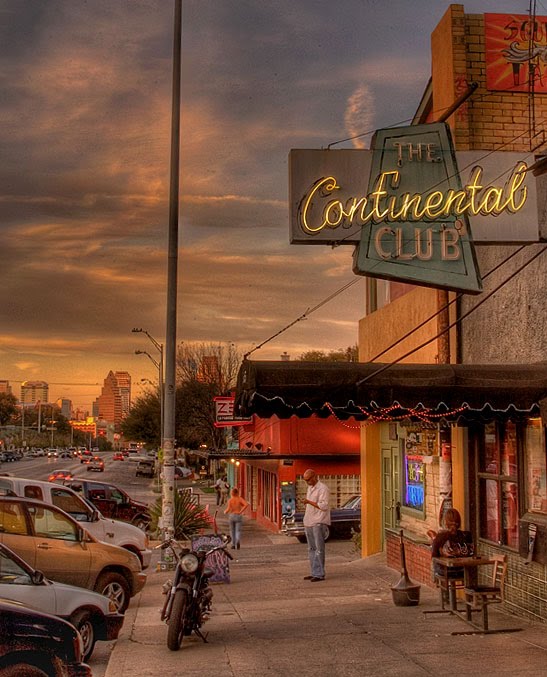
The Continental Club, a legendary blues venue on South Congress. Image from bologna+squash.

The Continental Club, across the street from the San José, is one of the longest-thriving and most popular music clubs in an admittedly music-obsessed town.

The modernist Continental opened as a private cocktail lounge in 1957 and later featured touring burlesque dancers Candy Barr and Bubbles Cash. In the 1970s, it was revived as a rock and blues club. Then Steve Wertheimer quit his job as a comptroller for a real estate firm to restore the club’s Eisenhower-era splendor, and he reopened the venue as a roots rock and alt country showcase.

“I’m a preservationist by nature,” Wertheimer says, about his restoration efforts. “I’m stuck in that period of the ’50s, from the clothing and the music to the cars and the architecture. Those glass blocks at the entrance had been covered up. They needed to be brought back.”

One block south and across the avenue from the Continental, in a century-old building that formerly housed Central Feed and Seed, is Güero’s Taco Bar, which owners Rob and Cathy Lippincott opened in 1995 after moving their restaurant from its original location a couple of miles away. Six months after opening, President Bill Clinton stopped in for dinner (“He cleaned his plate”), business shot up 40 percent, and it’s been busy ever since.

South Congress is just as distinctive for what isn’t there: national clone restaurants, large chain retailers, and retail clusters amid a sea of asphalt. No master plan was sketched out to make it happen. No tax breaks were requested for improvements (in marked contrast to The Domain, a planned mall and residential development on Austin’s northwestern fringe that is the beneficiary of tens of millions of dollars in tax abatements from the city). South Congress merchants just want to be left alone.

Austin was always different from the rest of Texas. It was established in 1839, not because of the area’s strategic location but rather for its aesthetic beauty. The second president of the Republic of Texas, Mirabeau Lamar, killed a buffalo near the present capitol building and noted that the area’s hills, waterways, and pleasing surroundings would make a fine place to locate Texas’ government.

South Congress Avenue was South Austin’s main street from the very beginning and, with the advent of the automobile, the main highway south to San Antonio. Increased traffic inspired the construction of one- and two-story storefronts in the 1920s and 1930s, followed by motels and cafés. But after the Interregional Highway, now Interstate 35, opened in the early 1960s, the road-oriented businesses declined and much of South Congress emptied out.

That was the state of the avenue in 1988, when Kent Cole and Diana Prechter fixed a beat-up wood-frame building that had operated as Flossie’s bar and the Austex Lounge, and reopened it as Magnolia Cafe South, a second location for their homegrown eatery famous for gingerbread pancakes and comfort food.

Why South Congress? Mainly because the rent was cheap, they say. “The only pedestrians on the sidewalks were hookers and drug dealers,” Cole remembers. “Normal people did not walk South Congress.”

It was so dicey the first year and a half that Prechter kept her day job while Cole started looking for other employment. A last-ditch decision to expand operations to 24 hours changed everything. The café tapped into the city’s sizable late-night crowd, and the staff stepped up their game so that Cole and Prechter could make enough money to begin buying nearby properties, some of them historic.

“In Austin, parking is everything,” he says — a constant danger to the historic fabric of older neighborhoods. “So we would buy adjacent businesses and rent them to tenants who were sympathetic with Magnolia Cafe South, allowing our customers to use the spaces in front of their storefronts.”

Memories of drug dealers and prostitutes began to fade in the 1990s. Austin, a relatively small city for most of its history, suddenly enjoyed a tremendous economic boom that attracted new residents and drove an increased demand for older housing stock in the Travis Heights and Bouldin Creek neighborhoods. That in turn spurred massive renovation along South Congress and throughout old South Austin.

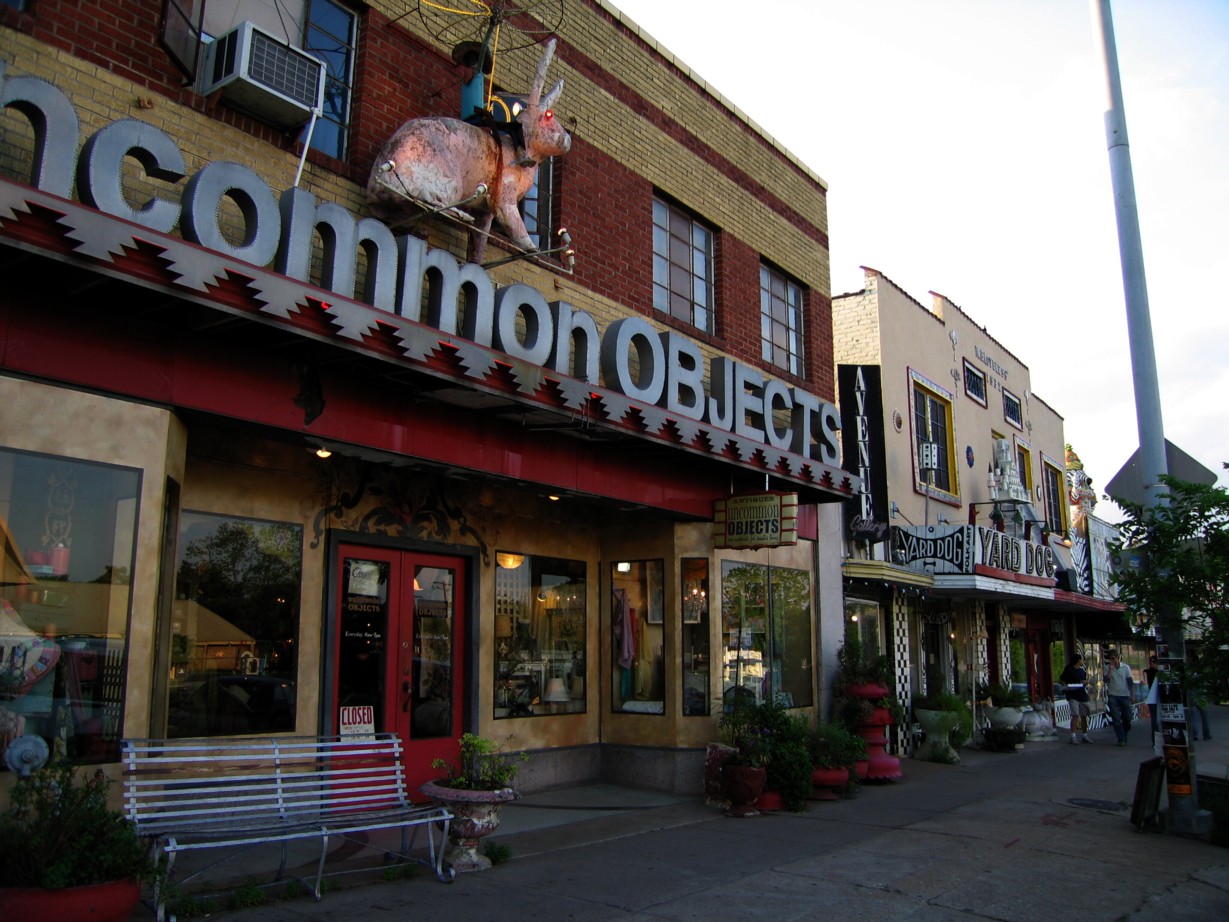
SoCo street scene. Image from The Texas Twang.

A $4 million bond issue passed by the city council in 1998 for sidewalk, bicycle, and pedestrian enhancements improved the avenue’s curb appeal. But when city planners followed with a long-term plan for South Congress that included light rail on the avenue, the merchants allied with the neighborhoods to stop the project.

Six months to a year of construction would be fatal to the many small businesses whose profits were marginal, merchants argued. “That’s an awful long time to take a high-traffic street and close it,” says Gail ­Armstrong, owner of Off the Wall antiques. “No one here could survive that. And if we did survive, most of us couldn’t afford the spike in real estate prices that comes with rail.”

“It’s a complicated area,” admits George Adams, assistant director in the planning and development review department for the City of Austin.

Its development has been more organic, or market-driven, which complicates any attempt to do things. You start out with certain attitudes:”What’s wrong with these people? Don’t they know we’re trying to help them?” Over time, we’ve come to understand the benefit of doing things incrementally, how to make changes and accommodate the needs of the small businesses and of the residents. South Congress has taught us a lot.

Preservationists agree. Dealey Herndon, who is overseeing restoration of the Governor’s Mansion, sees the avenue as part of Austin’s historic fabric:

The vibrant evolution of South Congress is a great example of bringing older neighborhood business areas to life by celebrating the eclectic character of the architecture, the simpler life of a city in an earlier era, and the creativity of new one-of-a-kind businesses. Every business is unique, every building has a personality, and all of this comes together to create a part of Austin that is universally appealing.

Today the avenue remains extraordinarily popular and largely “corporate free.” When a Starbucks opened on South Congress as part of a new apartment complex built closer to downtown, merchants held their collective breath. Two years ago they exhaled when the franchise shut down.

Zoning restrictions that limit commercial businesses to no more than a half-block off South Congress, the small footprints of existing buildings, the high bar the city sets for teardowns, and the lack of parking are some of the reasons why the chains and big-box stores haven’t gained much of a foothold. A bigger factor is the transition of pioneers like the Lippincotts, Cole and Prechter, and Wertheimer from renters to owner-operators and landlords.

Wertheimer misses the days when his hot-rod buddies had the avenue all to themselves, when there was a liquor store on his block, and Just Guns occupied the space where American Apparel, one of very few national chain stores on the avenue, stands now. “We don’t own it like we used to,” he laments.

But as an investor in the San José, Perla’s Seafood and Oyster Bar, and Home Slice Pizza, and as a property owner who has increased his holdings over the years, he realizes he can influence future growth in his own small way, as he did three years ago when he bought and restored the Avenue Barber Shop, one of the oldest businesses on South Congress. “It’s one of those things I didn’t want to go away,” he says. “That’s where I get my hair cut. It still smells like it’s 1933 in there.”

Whatever happens, Wertheimer and his neighbors hope some degree of funk and cool continues oozing through. If places like the barber shop and people like Wertheimer go away, it won’t be South Congress anymore. And without South Congress, Austin wouldn’t be quite as different from everywhere else.

[Joe Nick Patoski has been writing about Texas and Texans for 35 years. He is the author of three biographies of Texas musicians (Willie Nelson, Selena, and Stevie Ray Vaughan) and books about the state’s mountains, coast, and Big Bend National Park. This article first appeared in the July/August 2010 issue of Preservation: The Magazine of the National Trust for Preservation.]

The Rag Blog

Posted in Rag Bloggers | Tagged , , , , | 2 Comments

Mr. Fish : Barack Obama Digs a Foxhole

Political cartoon by Mr. Fish / Clowncrack.com

CLICK ON IMAGE TO ENLARGE.

Thanks to Harry Edwards / The Rag Blog

Posted in RagBlog | Tagged , , | 1 Comment

James Retherford : Austin Street Band Festival: Marching for the Cause

The Honk!TX parade heads east down 2nd Street. Photo by James Retherford / The Rag Blog.

Marching for the cause:
Austin’s first community street band festival

By James Retherford / The Rag Blog / March 16, 2011

The streets belong to the people.
— Diggers, San Francisco, 1967

See more photos, Below.

AUSTIN — The first annual Honk!TX Fest, billed a “festival of community street hands,” marched on Austin Friday through Sunday, March 11-13.

Continuing a Honk! tradition started in 2006 in Somerville, Massachusetts — while also KEEPING AUSTIN WEIRD — some two dozen U.S. and Canadian street bands in gala attire created mobile “liberated zones” in East Austin and the North Campus area with color, costume, cacophony, and collective spirit, carrying “messages of hope, unity, and social change.” The weekend culminated on Sunday with a march from City Hall to East Austin’s Pan American Park, followed by an all-day jam.

(Though not formally associated with Austin’s massive South by Southwest [SXSW] festival, this event is part of hundreds of related music activities happening over the next week here in the “live music capital of the world.”)

The festival was organized by Austin’s Minor Mishap Marching Band, a 30-plus-member “renegade brass band” that describes itself as “Bourbon Street meets Budapest.” MMMP is a truly absurdist spectacle featuring a washboard-playing Roller Derby queen, an (almost) seven-foot-tall Elvis impersonator playing bass drum, a klezmer-shredding clarinet player, dancing tubas, and assorted other freaks of musical nature. Founded two years ago by multi-instrumentalist Datri Bean, this band really kicks it!

The Minor Mishap Marching Band hosted the weekend festival and set a high bar for musicality and theatre. Photo by James Retherford / The Rag Blog.

Also representing Austin (by way of Brazil, sorta) was the samba-sashaying Acadêmicos da Ópera, a huge contingent of drummers and dancers bringing the sensuous rhythms of the Carnaval parade.

The out-of-town guests brought their own hit-and-run street parties also. The red-and-white-themed Extraordinary Rendition Band from Providence, Rhode Island, the green-clad March Madness Marching Band (with hula-hoop twirlers) from Lexington, Kentucky, the Hubbub Club from Graton, California, Environmental Encroachment from Chicago, and Atlanta’s Seed & Feed Marching Abominable (founded in 1974) combined slapstick guerrilla street theatrics with high-energy funk, heavy metal, Eastern European, and Dixieland marching tunes.

Of special note: Seattle’s ultra-tight Titanium Sporkestra, named after the ubiquitous mutant fast food eating utensil. Their logo features a red spork and sickle.

The medium was unhinged fun, but the message from all of those hard-working, fun-loving musical groups was freedom and justice, starting from each public space liberated through the act of playing and then spiraling outward, with insistent drum beat, to the rest of the world. Ya gotta love it.

Minor Mishap Marching Band will open for White Ghost Shivers at Threadgill’s World Headquarters in Austin on March 26.

[Austin activist-journalist James Retherford was a founder and editor of The Spectator in Bloomington, Indiana, in 1966. A graphic designer, writer, and editor, Retherford is a director of the New Journalism Project, the nonprofit organization that publishes The Rag Blog.]

Atlanta’s Seed & Feed Marching Abominable’s “drum majorette” (left) leads the ensemble through some intricate dance steps. Right, The Titanium Sporkestra’s horn section feels the funk.

Austin’s Acadêmicos da Ópera sets a Carnaval mood with a spirited street samba.

The March Madness Marching Band from basketball-crazy Lexington, KY, is all about hoops.

Providence’s activist Extraordinary Rendition Band marches to the beat of a different drummer.

Big Elvis and Lil Miss Hap bring it to the street with that weird Austin beat. Photos by James Retherford / The Rag Blog.

The Rag Blog

Posted in Rag Bloggers | Tagged , , , | Leave a comment

Jonah Raskin : Don Cox, the ‘Wistful’ Panther

Former Black Panther Field Marshal Don Cox — shown with his son in exile in Algiers — died last month. Image from Black Bird Press.

Donald Cox, 1936-2011:
The beauty of the moon
and the passion of the Black Panthers

By Jonah Raskin / The Rag Blog / March 15, 2011

It was sad news that former Black Panther, Don Cox, died in France, February 19, 2011, at the age of 74, but I had to laugh at The New York Times obituary by Bruce Weber that described the Panthers as “the socialist movement founded by Huey P. Newton and Bobby Seale in Oakland, Calif., in 1966.” True, the Panthers were founded by Newton and Seale in 1966 in Oakland, but they were not a socialist movement, not by any stretch of the imagination.

They did for a time provide breakfast for children and they did want community control of institutions, such as police departments and schools, in black neighborhoods, but they did not advocate socialism.

They were part of the Black Nationalist movement that made allies with young, radical whites, and they also shared optimism and the political tactics of the anti-colonial upsurges that spread across the Third World in the 1960s.

I met Donald Cox — “DC” as we called him — and got to know him, briefly, in Algiers in 1970. I had gone to Algiers with a group of Yippies to meet Eldridge Cleaver and Timothy Leary, both of whom were wanted by U.S. authorities and were living in exile.

DC was the mellowest. DC was the coolest, and much less of a megalomaniac or egomaniac than Cleaver or Leary. In fact, he wasn’t a megalomaniac or an egomaniac at all. He didn’t want to change the world with guns or LSD and he didn’t want to run it either. Like Cleaver and Leary, he was also wanted by the FBI and considered “dangerous,” but he seemed wistful to me.

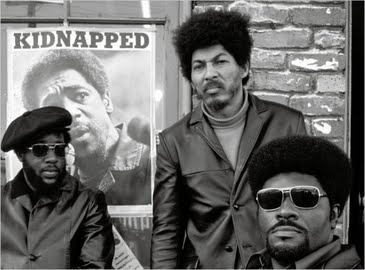
From left, Black Panthers Big Man, Don Cox, and June Hilliard at Panther national headquarters, Oakland, California, 1970. Image from gothamist.

In Algiers, he was concerned about the security of the Panthers and their Embassy because CIA agents monitored their activities. He was also a gracious host who took us — Stew Albert, Anita Hoffman, Brian Flanagan, Jennifer Dohrn, Marty Kenner and me — on a tour of the city, pointing out historical landmarks. He brought us one afternoon to the Place du Martyrs and explained that the French had executed suspected Algerian guerrillas here and then dumped their bodies into the harbor.

He turned to Jennifer Dohrn and asked her, “What color is that water?” She looked down. I looked down. We all did. “It’s reddish-blue,” Jennifer said. And indeed it was. It looked like the sea was awash in blood. “The Algerians say that it’s their blood that gives it that color,” DC explained. “The red blood of the guerrillas changed the color of the Mediterranean.”

At a feast at a seafood restaurant, DC was our official host and sat at the opposite head of the table from Cleaver. He ordered food for everyone — shrimp and fish and white wine. DC was also made uneasy by two African Americans at the bar who said they were from San Francisco, and whom he suspected worked for the CIA. Sekou, one of the Panthers, spoke softly.

“I got us all covered,” he said. And indeed he did. I looked under the table and saw that he had a gun in his hand. I was confident he’d use it if need be. He had hijacked an airplane at gunpoint to get to Algiers.

DC didn’t have a gun in Algiers. I never saw him with one, either under a table or on his own person, though I did see Cleaver with an AK-47 in his lap. In 1970, DC expressed concern about living in exile. He hoped that he would not have to remain for the rest of his life outside his own native country. He missed San Francisco.

He did live in exile for the next 40 years of his life; his widow noted that before his death, exile had begun to wear on him. I’m sure it did and yet what strikes me most about DC now is his longevity. He lived longer than many of the Black Panthers, such as Huey Newton, and Eldridge Cleaver, who became a born-again Christian, a Republican, and a crack-head in the 1990s in Oakland.

DC never turned his back on his ideals, his passion for justice or his appreciation of beauty.

One night, we all looked up at the moon and admired its beauty.

“In Babylon, you can’t appreciate the moon’s beauty,” DC told us. “But here you have the time and space to dig on it.” That’s the way I’d like to remember DC, the Black Panther Field Marshal, who lived more than half his life in exile, and who learned in exile to appreciate the beauty of the moon.

[Jonah Raskin teaches at Sonoma State University and is the author of For the Hell of It: The Life and Times of Abbie Hoffman.]

The Rag Blog

Posted in Rag Bloggers | Tagged , , , , , , , | 4 Comments

VERSE / Verandah Porche : REVOLUTION

Graphic from Rafftrax.

REVOLUTION

Lo, no virtue?

Root, unveil our novel It

O, live no rut. Rev unto oil.

Our violent into velour,

Rune to viol, ruin to love.

Verandah Porche / The Rag Blog

March 14, 2011

[Verandah Porche is a poet and writing partner in Guilford, Vermont. Read more of her work at verandahporche.com.]

The Rag Blog

Posted in Rag Bloggers | Tagged , , | Leave a comment

Kate Braun : Vernal Equinox, a Time for Balancing

Image from imtalkinghere.

Balancing of Planet Earth:
Vernal Equinox: March 20, 2011

By Kate Braun / The Rag Blog / March 14, 2011

Jewel of warmth, Jewel of the Sun/
And the blossoming of Spring has begun.

Sunday, March 20, 2011 is the Vernal (or Spring) Equinox, also named Ostara and Lady Day. The full moon of 3/19/11 will still be exerting her influence but Sunday is the Sun’s day and his growing strength is likely to overpower Lady Moon’s lingering energies.

Use any pastel shades of color in your decorations, but emphasize pink, yellow, and green hues. Also use eggs, crosses with equal arms (solar and Celtic designs), wildflowers, living plants, and rabbit-images. Rabbits were sacred to Diana, one of the goddesses honored on this day; eggs have an association with Eoster, a goddess of Springtime, whose name comes from the same Indo-European root (“Au) as Eos and Aurora (the Greek and Roman dawn goddesses).

Eoster, like Diana, is a maiden aspect of goddessness, signifying youth, new growth, beginnings, and spring. Eoster was fond of sweet things, so incorporating honey and chocolate into your menu will please her as well as your guests.

Eggs are the most important part of this celebration and should be used in the foods eaten, the activities pursued, the decorations for the celebration. One activity that encompasses all these areas is he use of hard-boiled and decorated eggs as place cards/party favors for your guests.

When all are seated, all should crack their eggs (symbolizing the cracking of winter’s ice), peel away the white (symbolizing the melting of winter’s snow), and expose the hard-cooked yolk (symbolizing Lord Sun in all his golden glory). Then all guests should share pieces of their egg with all other guests (symbolizing a sharing of Lord Sun’s glory).

While this is being done, it would be good for you as leader to remind your guests that the eggshell represents Earth, the egg’s membrane represents Air, its yolk represents Fire, its white represents Water; Earth, Air, Fire, and Water are the four elements that are required to create all things so an egg may be considered the symbol of all and everything.

Solstices and Equinoxes are times when we become more aware of the continual balancing and rebalancing of Planet Earth and of ourselves and our souls. Let the concept of balance in all things form the center of your plans, activities, and celebrations.

[Kate Braun’s website is www.tarotbykatebraun.com. She can be reached at kate_braun2000@yahoo.com.]

The Rag Blog

Posted in Rag Bloggers | Tagged , , , , , | 1 Comment

Paul Beckett : A Perfect Day in Madison

A few of the 100,000 that hit the streets of Madison, Wisc., Saturday, March 12, 2011. Photo by Paul Beckett / The Rag Blog.

Just ask 100,000 people!
A Perfect Day in Madison, Wisconsin

By Paul Beckett / The Rag Blog / March 13, 2011

[This is the third of Paul Beckett’s reports from Madison for The Rag Blog.]

MADISON, Wisconsin — Saturday, March 12, 2011. The wind off the frozen lakes was often 20 miles an hour (or more) and from the north. Windchills were in the 20s. It was mainly cloudy. Here and there, old snow and ice remained, and where there was no ice, the Wisconsin Capitol grounds had been trampled into a slippery, muddy morass. And it was beautiful!

Absolutely unprecedented crowds gathered for a whole day of protest events. Police estimates were 100,000 (but exact estimates are impossible). The crowd filled the Capitol square streets, sidewalks and what once were lawns, and then flowed down State Street and Wisconsin Avenue.

This time, a powerful sound system was in place and you could hear the speeches from far out in the crowd. In fact, you could hear them twice as the sound reflected off the taller buildings.

The breadth of social groups protesting Governor Scott Walker’s “union-busting” and public service-cutting Budget Repair Bill was truly awesome. The private sector unions were there (often with major leadership figures). The public service unions (AFSCME and the teachers unions) were there. The firemen, policemen and prison staff were there. Teachers and workers had come from Michigan, where things are also bad.

Farmers staged a tractor parade during the massive Madison protest. Photo by Paul Beckett / The Rag Blog.

Farmers came in, protesting the planned cutbacks in the Medicaid-based programs on which so many of them depend. Late in the morning a tractor parade pushed through the already-dense crowds, festooned with anti-Walker signs (many of them referring to the animal waste that is so familiar to farmers).

But the dominant impression one got was just of PEOPLE: all kinds of people, from all over Wisconsin, unaffiliated, unorganized. Just people. A feeling of complete like-mindedness and shared values and interests linked 100,000 people together.

Thank you, Scott Walker.

By 3 p.m., when the main program began, no one could move. The 14 Democratic senators who had decamped to Illinois to thwart passage of Walker’s bill were welcomed back. Each gave a speech to tumultuous applause and chants of “Thank you! Thank you!” They had not, in fact, stopped the bill. But they had provided almost three weeks for understanding — and protest — to develop

Photo by Paul Beckett / The Rag Blog.

Also, the holdout of the “Fab 14” ultimately forced the Walker camp to “pass” their bill in an abrupt night-time procedure that was full of parliamentary improprieties, and perhaps downright illegal.

The speakers (besides the 14, they included Jesse Jackson, Tony Shalhoub, and Susan Sarandon) noted that now the battle continues, but the battlefield changes.

Suits are already being brought to challenge the legality of the law in the courts.

More important in the longer run are the recall campaigns . While “Recall Walker” was a constant theme in signs and chants, under Wisconsin law that effort can not begin until next year. But petitions against eight Republican Senators have been filed, with May 2 deadlines for completion. There was an enormous sense of energy for these yesterday.

Meanwhile, a Utah-based anti-immigration group has already invaded Wisconsin (it is perfectly legal, it seems) to organize recalls against members of the Democratic “Fab 14” who got so much thanks and appreciation yesterday.

Control of the Wisconsin Senate will be determined during the coming summer by the outcome of these efforts.

Those who participated Saturday went home elated and politically energized in a way that few of us have been for some time. But all understood, as well, that Saturday did not mark the end of a battle, but its beginning. It will be a long battle for the future of Wisconsin, and no one can be sure of the outcome. And Wisconsin, in turn, clearly is just one battleground in the broader struggle for the country’s future.

[Dr. Paul Beckett lives in Madison, Wisconsin. He can be reached at beckettpa@gmail.com.]

The Rag Blog

Posted in Rag Bloggers | Tagged , , , , , , , , | Leave a comment

Ted McLaughlin : The Japan Quake and Nuclear Power

Explosion at Japan’s Fukushima Daiichi No 1 plant following Japan’s earthquake and tsunami. Image from Reuters.

After the Japan quake:
We must rethink nuclear power

By Ted McLaughlin / The Rag Blog / March 13, 2011

By now everyone knows about the disastrous earthquake that has hit Japan. At a magnitude of 8.9 it is one of the largest earthquakes to hit any country, and it has been a catastrophe to the heavily populated nation.

As I write this the official death toll is around 700 people, but many thousands are still missing and there’s little doubt that the death toll will climb much higher. My thoughts and best wishes go out to the people of Japan in their time of need, and I hope this country will offer Japan all the aid it is possible to give.

But in this post I want to concentrate on one aspect of the disaster — nuclear power. Japan has invested heavily in nuclear power and currently receives a large portion of its electrical power from this source. But they may now be paying the price for that. At least two nuclear power plants at Fukushima have been heavily damaged and are currently in danger of a “meltdown,” which could cause a large explosion that would release heavy doses of very radioactive material into their environment.

They are trying to cool the nuclear cores down by flooding them with seawater and boron, but that is a desperate measure that will take days and no one knows if the cores can be cooled in time to prevent a meltdown. The authorities have said that little radioactivity has been released so far, but they are evacuating people from within a 12-mile radius of both plants and are issuing iodine tablets to the population living in those areas (iodine is supposed to inhibit the body’s intake of radioactivity).

And that is just what is happening at those two plants. Other plants were also damaged and are currently being evaluated. More may be heading for the same kind of trouble. The earthquake and resulting tsunami were bad enough for the Japanese people — the damaged nuclear plants are just adding to their difficulties.

Here in the United States we are currently having a debate over energy. Currently the country relies heavily on fossil fuels (oil, gas, coal) but those fuels are causing problems. Much of the oil we use comes from foreign countries — countries where the supply is always in danger (as we can see from the current problems in the Middle East).

Many on the right seem to think that this problem can be solved by just drilling more and more. But the fact is that there just aren’t enough American reserves of oil (even if we tap into our protected wilderness areas) to satisfy the addiction this country has to oil. And many experts (including our own military) believe the world is reaching (or has already reached) the point of “peak oil” — the point at which production begins to fall no matter how much drilling is done.

Coal is not a much better alternative. Although it is plentiful right now and could last for many years, it is also one of the dirtiest of the energy-producing fuels. Even with the new technologies (which industry is fighting tooth-and-nail) it continues to destroy our environment.

Using more coal will simply speed up global climate change (which is a looming environmental and economic disaster regardless of what the right-wing climate-deniers claim). Some are talking about the development of a “clean coal” technology, but this is just a myth being advanced by the coal industry. There is no such thing as clean coal, and I doubt that there ever will be.

But even if the fossil fuels weren’t damaging our environment, they will run out in the future. Coal and natural gas may be more plentiful than oil, but there is not an endless supply of any fossil-based fuel. And someday they will all disappear.

The fact is that new sources of energy must be found or developed. The ideal thing is to find renewable and clean sources of energy (like wind, solar, wave, or geothermal). So far, these sources have not been developed to the point where they could completely replace fossil fuels. That is why many in America (and elsewhere) are advocating a return to nuclear power.

After the disasters at Three Mile Island and Chernobyl, nuclear energy was put on the back burner in this country. But now the idea of nuclear power is making a comeback. Many believe it could fill the gap left by renewable sources and help to wean the country off fossil fuels. And they are quick to tell us that the technology has advanced to the point where accidents like Three Mile Island and Chernobyl couldn’t happen again.

I don’t doubt that the technology has advanced. I’m sure it has. I’m also sure that the Japanese were using the best technology available (since they are one of the most technologically-advanced countries in the world). But that 8.9 magnitude earthquake didn’t care about the technology, and the best technology in the world couldn’t have prevented the damage to the Japanese nuclear plants.

This should give Americans pause. Should we go back to building nuclear power plants — knowing the dangers they could pose? And lest we forget, we still haven’t come up with a solution for disposal of nuclear waste from these plants (which is highly radioactive and will remain so for a very long time).

I have to say that I really don’t know what to do about nuclear energy. I like the idea that it doesn’t pollute the environment while producing energy, but I have to wonder if it’s only delaying that pollution since we haven’t solved the disposal problem. I would feel a lot better if we could figure out how to safely dispose of the nuclear waste (for many centuries). And the Japanese experience is showing us, at the very least, that great care must be taken about where any new nuclear power plants are located.

It is time to rethink the usefulness of nuclear power. Maybe it is a viable alternative, but we should carefully consider all the dangers before proceeding with building any new plants.

[Rag Blog contributor Ted McLaughlin also posts at jobsanger.]

The Rag Blog

Posted in Rag Bloggers | Tagged , , , , , , | 3 Comments

Harry Targ : Thousands Brave Cold Rain to Support Indiana Workers

On a cold, rainy day thousands rallied against anti-worker legislation March 10 in front of the Indiana Statehouse. Image from Fox59.

In bitter cold rain:
Thousands rally at Indianapolis State House

By Harry Targ / The Rag Blog / March 12, 2011

INDIANAPOLIS –On Thursday morning, March 10, three buses left the parking lot of a large supermarket in Lafayette, Indiana bound for the huge workers rights rally at the Indianapolis State House.

The buses were sponsored by the United Steelworkers Local 115A and the NAACP. About 100 workers, teachers, and peace and justice activists were on the buses. About two miles away another three buses left for Indianapolis with 100 activists from the Building Trades Council of Tippecanoe County and the Northwest Central Labor Council (AFL-CIO).

The buses were warm, cozy, and the spirit of solidarity pervaded the atmosphere. Travelers were determined to demonstrate their outrage at the rightwing onslaught on workers and education being planned by Indiana Republicans. Arriving about one hour later, riders disembarked from the warm and fuzzy atmosphere of the trip to a bitterly cold, cloudy, and windy rally in downtown Indianapolis.

The rally consisted of speeches, chants, prayers, and exhortations. Thousands of Hoosier workers withstood the cold to express their anger and their clear realization that the quality of their lives was in jeopardy.

Local 115A passed out some literature to articulate the reasons for enduring the cold and shouting for economic justice. They said that:

  1. The struggle in Indiana was inspired by the events in Wisconsin.
  2. The rally was about worker rights, including so-called Right-to-Work legislation and proposals to eliminate the right of teachers to organize.
  3. The right-to-work bill that was not dead as some media had reported would negatively impact workers in both the private and public sectors.
  4. Public sector rights, which need to be defended, had already been weakened by Indiana’s governor, Mitch Daniels.
  5. The struggle in Indiana was not a publicity stunt, copying the movement in Wisconsin. Democratic House members walked out of the legislature and traveled to Illinois to forestall the Indiana body from passing the draconian legislation.
  6. Taxpayers of the state were not funding the walkout by State House Democrats.
  7. The so-called Right-to-Work bill was not the only threat posed to workers in Indiana. One bill would eliminate the secret ballot in union certification elections. Another would remove the right to collective bargaining from public employees at the local level. Another bill would prohibit local communities from establishing living wage laws in excess of the state determined minimum wage.
  8. The struggle in Indiana is about protecting public education. Bills would authorize private firms to be hired to evaluate teacher performance, without any teacher input. School funding could be used to provide vouchers for use in private schools. Schools that did not meet certain performance standards would be transferred to private for-profit corporations.
  9. The campaign to protect public education also required resisting the cutting of funds for colleges and universities.
  10. The struggle for workers rights was relevant to the economy of the entire state of Indiana, not just the 300,000 unionized workers.

Another USW Local 115 document made the motivation for action crystal clear:

We stand at the statehouse as one people, one labor movement, one united group of citizens. We are proud to be union members and union supporters because together we have built Indiana! Whether we are construction workers, teachers or students –whether we clean buildings, deliver health care or manufacture useful products — we stand together!

There were different assessments of the State House rally in Indianapolis. The conservative Indianapolis Star, on the one hand estimated that only 8,000 workers rallied in Indianapolis, but on the other hand pointed out how cold, windy, and rainy the weather was, suggesting that attendees were truly committed.

One trade unionist, recalling the rally of 20,000 Building Trades workers in 1995 indicated that he could not tell if this rally was bigger or smaller than that one. Another worker said that we needed at least 100,000 at the rally to make a difference.

Several speakers expressed their appreciation for those that attended the rally. AFL-CIO leaders from Kentucky and Wisconsin pointed out that the Indiana struggle was part of a larger movement involving workers from Wisconsin, Ohio, Illinois, New Jersey, and everywhere that the basic standard of living of workers was being challenged.

Perhaps the most poignant statement came from an Iraq war vet who reminded the crowd that $3 trillion had been spent on two costly, foolish wars in the 21st century that helped create today’s economic crisis.

The outcome of the ferment, anger, and rebelliousness all around the world remains unclear. But one fine folk singer, after leading the crowd in a rendition of “This Land is Your Land,” wished the movement well. He recalled Woody Guthrie’s injunction: “Take it easy, but take it.” Perhaps that is where we are at today.

[Harry Targ is a professor of political science at Purdue University who lives in West Lafayette, Indiana. He blogs at Diary of a Heartland Radical.]

The Rag Blog

Posted in Rag Bloggers | Tagged , , , , , , | 1 Comment